V THE PRISON-CAMP AT COURTRAI
Reading edition
From the Intelligence Department I was conveyed to the officers' prison-camp at Courtrai in an automobile. It was about an hour's ride. My escort was one of the most famous flyers in the world, barring none. He was later killed in action, but I was told by an English airman who witnessed his last combat that he fought a game battle and died a hero's death.
The prison, which had evidently been a civil prison of some kind before the war, was located right in the heart of Courtrai. The first building we approached was large, and in front of the archway, which formed the main entrance, was a sentry box. Here we were challenged by the sentry, who knocked on the door; the guard turned the key in the lock and I was admitted. We passed through the archway and directly into a courtyard, on which faced all of the prison buildings, the windows, of course, being heavily barred.
After I had given my pedigree—my name, age, address, etc.—I was shown to a cell with bars on the windows overlooking this courtyard. I was promptly told that at night we were to occupy these rooms, but I had already surveyed the surroundings, taken account of the number of guards and the locked door outside, and concluded that my chances of getting away from some other place could be no worse than in that particular cell.
As I had no hat, my helmet being the only thing I wore over the lines, I was compelled either to go bareheaded or wear the red cap of the Bavarian whom I had shot down on that memorable day. It can be imagined how I looked attired in a British uniform and a bright red cap. Wherever I was taken, my outfit aroused considerable curiosity among the Belgians and German soldiers.
When I arrived at prison that day I still wore this cap, and as I was taken into the courtyard, my overcoat covering my uniform, all that the British officers who happened to be sunning themselves in the courtyard could see was the red cap. They afterward told me they wondered who the "big Hun" was with the bandage on his mouth. This cap I managed to keep with me, but was never allowed to wear it on the walks we took. I either went bareheaded or borrowed a cap from some other prisoner.
At certain hours each day the prisoners were allowed to mingle in the courtyard, and on the first occasion of this kind I found that there were eleven officers imprisoned there besides myself.
They had here interpreters who could speak all languages. One of them was a mere boy who had been born in Jersey City, New Jersey, and had spent all his life in America until the beginning of 1914. Then he moved with his folks to Germany, and when he became of military age the Huns forced him into the army. I think if the truth were known he would much rather have been fighting for America than against her.
I found that most of the prisoners remained at Courtrai only two or three days. From there they were invariably taken to prisons in the interior of Germany.
Whether it was because I was an American or because I was a flier, I don't know, but this rule was not followed in my case. I remained there two weeks.
During that period, Courtrai was constantly bombed by our airmen. Not a single day or night passed without one or more air raids. In the two weeks I was there I counted twenty-one of them. The town suffered a great deal of damage. Evidently our people were aware that the Germans had a lot of troops concentrated in this town, and, besides, the headquarters staff was stationed there. The Kaiser himself visited Courtrai while I was in the prison, I was told by one of the interpreters, but he didn't call on me and, for obvious reasons, I couldn't call on him.
The courtyard was not a very popular place during air raids. Several times when our airmen raided that section in the daytime I went out and watched the machines and the shrapnel bursting all around; but the Germans did not crowd out there, for their own anti-aircraft guns were hammering away to keep our planes as high in the sky as possible, and shells were likely to fall in the prison yard any moment. Of course, I watched these battles at my own risk.
Many nights from my prison window I watched with peculiar interest the air raids carried on, and it was a wonderful sight with the German searchlights playing on the sky, the "flaming onions" fired high and the burst of the anti-aircraft guns, but rather an uncomfortable sensation when I realized that perhaps the very next minute a bomb might be dropped on the building in which I was a prisoner. But perhaps all of this was better than no excitement at all, for prison life soon became very monotonous.
One of the hardest things I had to endure throughout the two weeks I spent there was the sight of the Hun machines flying over Courtrai, knowing that perhaps I never would have another chance to fly, and I used to sit by the hour watching the German machines maneuvering over the prison, as they had an aerodrome not far away, and every afternoon the students—I took them for students because their flying was very poor—appeared over the town.
One certain Hun seemed to find particular satisfaction in flying right down over the prison nightly, for my special discomfort and benefit it seemed, as if he knew an airman imprisoned there was vainly longing to try his wings again over their lines. But I used to console myself by saying, "Never mind, old boy; there was never a bird whose wings could not be clipped if they got him just right, and your turn will come some day."
One night there was an exceptionally heavy air raid going on. A number of German officers came into my room, and they all seemed very much frightened. I jokingly remarked that it would be fine if our airmen hit the old prison—the percentage would be very satisfactory—one English officer and about ten German ones. They didn't seem to appreciate the joke, however, and, indeed, they were apparently too much alarmed at what was going on overhead to laugh even at their own jokes. Although these night raids seemed to take all the starch out of the Germans while they were going on, the officers were usually as brave as lions the next day and spoke contemptuously of the raid of the night before.
I saw thousands of soldiers in Courtrai, and although they did not impress me as having very good or abundant food, they were fairly well clothed. I do not mean to imply that conditions pointed to an early end of the war. On the contrary, from what I was able to observe on that point, unless the Huns have an absolute crop failure, they can, in my opinion, go on for years! The idea of our being able to win the war by starving them out strikes me as ridiculous. This is a war that must be won by fighting, and the sooner we realize that fact the sooner it will be over.
Rising-hour in the prison was seven o'clock. Breakfast came at eight. This consisted of a cup of coffee and nothing else. If the prisoner had the foresight to save some bread from the previous day, he had bread for breakfast also, but that never happened in my case. Sometimes we had two cups of coffee—that is, near-coffee. It was really chicory or some cereal preparation. We had no milk or sugar.
For lunch they gave us boiled sugar-beets or some other vegetable, and once in a while some kind of pickled meat, but that happened very seldom. We also received a third of a loaf of bread—war-bread. This war-bread was as heavy as a brick, black, and sour. It was supposed to last us from noon one day to noon the next. Except for some soup, this was the whole lunch menu.
Dinner came at 5.30 p.m., when we sometimes had a little jam made out of sugar-beets, and a preparation called tea which you had to shake vigorously or it settled in the bottom of the cup and then about all you had was hot water. This "tea" was a sad blow to the Englishmen. If it hadn't been called tea, they wouldn't have felt so badly about it, perhaps, but it was adding insult to injury to call that stuff "tea" which, with them, is almost a national institution.
Sometimes with this meal they gave us butter instead of jam, and once in a while we had some kind of canned meat.
This comprised the usual run of eatables for the day—I can eat more than that for breakfast! In the days that were to come, however, I was to fare considerably worse.
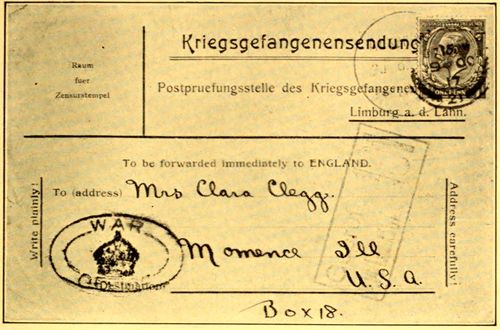
MAILING-CARD SENT BY GERMAN GOVERNMENT TO PAT O'BRIEN'S SISTER, MRS. CLARA CLEGG OF MOMENCE, ILLINOIS
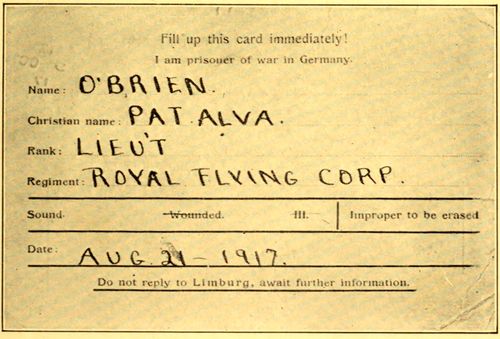
OBVERSE SIDE OF CARD SHOWN ABOVE
We were allowed to send out and buy a few things, but as most of the prisoners were without funds, this was but an empty privilege. Once I took advantage of the privilege to send my shoes to a Belgian shoemaker to be half-soled. They charged me twenty marks—five dollars!
Once in a while a Belgian Ladies' Relief Society visited the prison and brought us handkerchiefs, American soap—which sells at about one dollar and fifty cents a bar in Belgium—tooth-brushes, and other little articles, all of which were American-made, but whether they were supplied by the American Relief Committee or not I don't know. At any rate, these gifts were mighty useful and were very much appreciated.
One day I offered a button off my uniform to one of these Belgian ladies as a souvenir, but a German guard saw me and I was never allowed to go near the visitors afterward.
The sanitary conditions in this prison-camp were excellent as a general proposition. One night, however, I discovered that I had been captured by "cooties."
This was a novel experience to me and one that I would have been very willing to have missed, because in the Flying Corps our aerodromes are a number of miles back of the lines and we have good billets, and our acquaintance with such things as "cooties" and other unwelcome visitors is very limited.
When I discovered my condition I made a holler and roused the guard, and right then I got another example of German efficiency.
This guard seemed to be even more perturbed about my complaint than I was myself, evidently fearing that he would be blamed for my condition.
The commandant was summoned, and I could see that he was very angry. Some one undoubtedly got a severe reprimand for it.
I was taken out of my cell by a guard with a rifle and conducted about a quarter of a mile from the prison to an old factory building which had been converted into an elaborate fumigating plant. There I was given a pickle bath in some kind of solution, and while I was absorbing it my clothes, bedclothes, and whatever else had been in my cell were being put through another fumigating process.
While I was waiting for my things to dry—it took, perhaps, half an hour—I had a chance to observe about one hundred other victims of "cooties"—German soldiers who had become infested in the trenches. We were all nude, of course, but apparently it was not difficult for them to recognize me as a foreigner even without my uniform on, for none of them made any attempt to talk to me, although they all were very busy talking about me. I could not understand what they were saying, but I know I was the butt of most of their jokes, and they made no effort to conceal the fact that I was the subject of their conversation.
When I got back to my cell I found that it had been thoroughly fumigated, and from that time on I had no further trouble with "cooties" or other visitors of the same kind.
As we were not allowed to write anything but prison cards, writing was out of the question; and as we had no reading-matter to speak of, reading was nil. We had nothing to do to pass away the time, so consequently cards became our only diversion, for we did, fortunately, have some of those.
There wasn't very much money, as a rule, in circulation, and I think for once in my life I held most of that, not due to any particular ability on my part in the game, but I happened to have several hundred francs in my pockets when shot down. But we held a lottery there once a day, and I don't believe there was ever another lottery held that was watched with quite such intense interest as that. The drawing was always held the day before the prize was to be awarded, so we always knew the day before who was the lucky man. There was as much speculation as to who would win the prize as if it had been the finest treasure in the world. The great prize was one-third of a loaf of bread.
Through some arrangement which I never quite figured out, it happened that among the eight or ten officers who were there with me there was always one-third of a loaf of bread over. There was just one way of getting that bread, and that was to draw lots. Consequently that was what started the lottery. I believe if a man had ever been inclined to cheat he would have been sorely tempted in this instance, but the game was played absolutely square, and if a man had been caught cheating, the chances are that he would have been shunned by the rest of the officers as long as he was in prison. I was fortunate enough to win the prize twice.
One man—I think he was the smallest eater in the camp—won it on three successive days, but it was well for him that his luck deserted him on the fourth day, for he probably would have been handled rather roughly by the rest of the crowd, who were growing suspicious. But we handled the drawing ourselves and knew there was nothing crooked about it, so he was spared.
We were allowed to buy pears, and, being small and very hard, they were used as the stakes in many a game. But the interest in these little games was as keen as if the stakes had been piles of money instead of two or three half-starved pears. No man was ever so reckless, however, in all the betting, as to wager his own rations.
By the most scheming and sacrificing I ever did in my life I managed to hoard two pieces of bread (grudgingly spared at the time from my daily rations), but I was preparing for the day when I should escape—if I ever should. It was not a sacrifice easily made, either, but instead of eating bread I ate pears until I finally got one piece of bread ahead; and when I could force myself to stick to the pear diet again I saved the other piece from that day's allowance, and in days to come I had cause to credit myself fully for the foresight.
Whenever a new prisoner came in and his German hosts had satisfied themselves as to his life history and taken down all the details—that is, all he would give them—he was immediately surrounded by his fellow-prisoners, who were eager for any bit of news or information he could possibly give them, and as a rule he was glad to tell us because, if he had been in the hands of the Huns for any length of time, he had seen very few English officers.
The conditions of this prison were bad enough when a man was in normally good health, but it was barbarous to subject a wounded soldier to the hardships and discomforts of the place. However, this was the fate of a poor private we discovered there one day in terrific pain, suffering from shrapnel in his stomach and back. All of us officers asked to have him sent to a hospital, but the doctors curtly refused, saying it was against orders. So the poor creature went on suffering from day to day and was still there when I left, another victim of German cruelty.
At one time in this prison-camp there were a French marine, a French flying officer, and two Belgian soldiers, and of the United Kingdom one from Canada, two from England, three from Ireland, a couple from Scotland, one from Wales, a man from South Africa, one from Algeria, and a New-Zealander, the last being from my own squadron, a man whom I thought had been killed, and he was equally surprised, when brought into the prison, to find me there. In addition there were a Chinaman and myself from the U. S. A.
It was quite a cosmopolitan group, and as one typical Irishman said, "Sure, and we have every nation that's worth mentioning, including the darn Germans, with us whites." Of course, this was not translated to the Germans, nor was it even spoken in their hearing, or we probably would not have had quite so cosmopolitan a bunch. Each man in the prison was ready to uphold his native country in any argument that could possibly be started, and it goes without saying that I never took a back seat in any of them with my praise for America, with the Canadian and Chinaman chiming in on my side. But they were friendly arguments; we were all in the same boat and that was no place for quarreling.
Every other morning, the weather allowing, we were taken to a large swimming-pool and were allowed to have a bath. There were two pools, one for the German officers and one for the men. Although we were officers, we had to use the pool occupied by the men. While we were in swimming a German guard with a rifle across his knees sat at each comer of the pool and watched us closely as we dressed and undressed. English interpreters accompanied us on all of these trips, so at no time could we talk without their knowing what was going on.
Whenever we were taken out of the prison for any purpose they always paraded us through the most crowded streets—evidently to give the populace an idea that they were getting lots of prisoners. The German soldiers we passed on these occasions made no effort to hide their smiles and sneers.
The Belgian people were apparently very curious to see us, and they used to turn out in large numbers whenever the word was passed that we were out. At times the German guards would strike the women and children who crowded too close to us. One day I smiled and spoke to a pretty Belgian girl, and when she replied a German made a run for her. Luckily she stepped into the house before he reached her or I am afraid my salutation would have resulted seriously for her and I would have been powerless to have assisted her.
Whenever we passed a Belgian home or other building which had been wrecked by bombs dropped by our airmen our guards made us stop a moment or two while they passed sneering remarks among themselves.
One of the most interesting souvenirs I have of my imprisonment at Courtrai is a photograph of a group of us taken in the prison courtyard. The picture was made by one of the guards, who sold copies of it to those of us who were able to pay his price—one mark apiece.
As we faced the camera, I suppose we all tried to look our happiest, but the majority of us, I am afraid, were too sick at heart to raise a smile even for this occasion. One of our Hun guards is shown in the picture seated at the table. I am standing directly behind him, attired in my flying tunic, which they allowed me to wear all the time I was in prison, as is the usual custom with prisoners of war. Three of the British officers shown in the picture, in the foreground, are clad in "shorts."
Through all my subsequent adventures I was able to retain a print of this interesting picture, and although when I gaze at it now it only serves to increase my gratification at my ultimate escape, it fills me with regret to think that my fellow-prisoners were not so fortunate. All of them, by this time, are undoubtedly eating their hearts up in the prison-camps of interior Germany. Poor fellows!
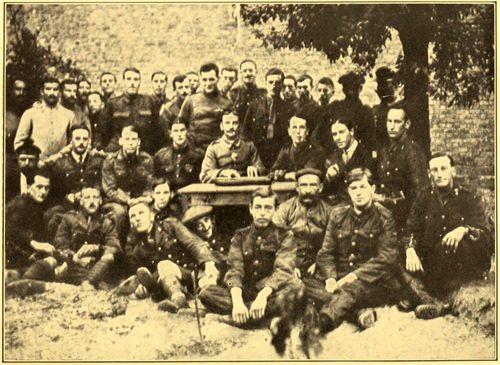
A GROUP OF PRISONERS OF WAR IN THE PRISON-CAMP AT COURTRAI, BELGIUM
(Lieutenant O'Brien, in his R. F. C. flying-tunic, is standing in the center behind the German guard seated at the table. This picture was taken by one of the German guards and sold to Lieutenant O'Brien for one mark.)
Despite the scanty fare and the restrictions we were under in this prison, we did manage on one occasion to arrange a regular banquet. The planning which was necessary helped to pass the time.
At this time there were eight of us. We decided that the principal thing we needed to make the affair a success was potatoes, and I conceived a plan to get them. Every other afternoon they took us for a walk in the country, and it occurred to me that it would be a comparatively simple matter for us to pretend to be tired and sit down when we came to the first potato-patch.
It worked out nicely. When we came to the first potato-patch that afternoon we told our guards that we wanted to rest a bit and we were allowed to sit down. In the course of the next five minutes each of us managed to get a potato or two. Being Irish, I got six.
When we got back to the prison I managed to steal a handkerchief full of sugar which, with some apples that we were allowed to purchase, we easily converted into a sort of jam.
We now had potatoes and jam, but no bread. It happened that the Hun who had charge of the potatoes was a great musician. It was not very difficult to prevail upon him to play us some music, and while he went out to get his zither I went into the bread pantry and stole a loaf of bread.
Most of us had saved some butter from the day before and we used it to fry our potatoes. By bribing one of the guards he bought some eggs for us. They cost twenty-five cents apiece, but we were determined to make this banquet a success, no matter what it cost.
The cooking was done by the prison cook, whom, of course, we had to bribe.
When the meal was ready to serve it consisted of scrambled eggs, fried potatoes, bread and jam, and a pitcher of beer which we were allowed to buy.
That was the 29th of August. Had I known that it was to be the last real meal that I was to eat for many weeks I might have enjoyed it even more than I did, but it was certainly very good.
We had cooked enough for eight, but while we were still eating another joined us. He was an English officer who had just been brought in on a stretcher. For seven days, he told us, he had lain in a shell-hole, wounded, and he was almost famished, and we were mighty glad to share our banquet with him.
We called on each man for a speech, and one might have thought that we were at a first-class club meeting. A few days after that our party was broken up and some of the men I suppose I shall never see again.
One of the souvenirs of my adventure is a check given me during this "banquet" by Lieut. James Henry Dickson, of the Tenth Royal Irish Fusileers, a fellow-prisoner. It was for twenty francs and was made payable to the order of "Mr. Pat O'Brien, 2nd Lieut." Poor Jim forgot to scratch out the "London" and substitute "Courtrai" on the date line, but its value as a souvenir is just as great. When he gave it to me he had no idea that I would have an opportunity so soon afterward to cash it in person, although I am quite sure that whatever financial reverses I may be destined to meet my want will never be great enough to induce me to realize on that check.
There was one subject that was talked about in this prison whenever conversation lagged, and I suppose it is the same in the other prisons, too. What were the chances of escape?
Every man seemed to have a different idea and one way I suppose was about as impracticable as another. None of us ever expected to get a chance to put our ideas into execution, but it was interesting speculation, and, anyway, one could never tell what opportunities might present themselves.
One suggestion was that we disguise ourselves as women. "O'Brien would stand a better chance disguised as a horse!" declared another, referring to the fact that my height (I am six feet two inches) would make me more conspicuous as a woman than as a man.
Another suggested that we steal a German Gotha—a type of aeroplane used for long-distance bombing. It is these machines which are used for bombing London. They are manned by three men, one sitting in front with a machine-gun, the pilot sitting behind him, and an observer sitting in the rear with another machine-gun. We figured that at a pinch perhaps seven or eight of us could make our escape in a single machine. They have two motors of very high horse-power, fly very high and make wonderful speed. But we had no chance to put this idea to the test.
I worked out another plan by which I thought I might have a chance if I could ever get into one of the German aerodromes. I would conceal myself in one of the hangars, wait until one of the German machines started out, and as he taxied along the ground I would rush out, shout at the top of my voice, and point excitedly at his wheels. This, I figured, would cause the pilot to stop and get out to see what was wrong. By that time I would be up to him and as he stooped over to inspect the machine I could knock him senseless, jump into the machine, and be over the lines before the Huns could make up their minds just what had happened.
It was a fine dream, but my chance was not to come that way.
There were dozens of other ways which we considered. One man would be for endeavoring to make his way right through the lines. Another thought the safest plan would be to swim some river that crossed the lines.
The idea of making one's way to Holland, a neutral country, occurred to every one, but the one great obstacle in that direction, we all realized, was the great barrier of barbed and electrically charged wire which guards every foot of the frontier between Belgium and Holland and which is closely watched by the German sentries.
This barrier was a threefold affair. It consisted first of a barbed-wire wall six feet high. Six feet beyond that was a nine-foot wall of wire powerfully charged with electricity. To touch it meant electrocution. Beyond that, at a distance of six feet was another wall of barbed wire six feet high.
Beyond the barrier lay Holland and liberty, but how to get there was a problem which none of us could solve and few of us ever expected to have a chance to try.
Mine came sooner than I expected.