Chapter IX · WONDERFUL SEAL ISLANDS.
Reading edition
The Fur-seal Millions of the Pribylov Islands.—Marvellous Exhibition of Massed Animal-life in a State of Nature.—Story of the Discovery of these Remarkable Rookeries, July, 1786.—Previous Knowledge of them Unknown to Man.—Sketch of the Pribylov Islands.—Their Character, Climate, and Human Inhabitants.—A Realm of Summer-fog.—The Seal-life here Overshadows Everything, though the Bird Rookeries of Saint George are Wonderful.—No Harbors.—The Roadsteads.—The Attractive Flora.—Only Islands in Alaska where the Curse of Mosquitoes is Removed.—Natives Gathering Eggs on Walrus Islet.—A Scene of Confusion and Uproar.—Contrast very Great between Saint Paul and Saint George.—Good Reason of the Seals in Resorting to these Islands to the Exclusion of all other Land in Alaska.—Old-time Manners and Methods of the Russians Contrasted with Our Present Control.—Vast Gain and Improvement for Seals and Natives.—The Character of the Present Residents.—Their Attachment to the Islands.—The History of the Alaska Commercial Company.—The Wise Action of Congress.—The Perfect Supervision of the Agents of the Government.—Seals are more Numerous now than at First.—The Methods of the Company, the Government, and the Natives in Taking the Seals.
When they the approaching time perceive, They flee the deep, and watery pastures leave; On the dry ground, far from the swelling tide, Bring forth their young, and on the shores abide Till twice six times they see the eastern gleams Brighten the hills and tremble on the streams. The thirteenth morn, soon as the early dawn Hangs out its crimson folds or spreads its lawn, No more the fields and lofty coverts please, Each hugs her own and hastes to rolling seas. —Ovid.
The story of the gloomy grandeur of Alaskan scenery and the wild existence of its inhabitants is not half told until that picture of what we observe on the Pribylov Islands of Bering Sea is graphically drawn. Here is annually presented one of the most marvellous exhibitions of massed animal-life that is known to man, civilized or savage; here is exhibited the perfect working of an anomalous industry, conducted without a parallel in the history of human enterprise, and of immense pecuniary and biological value.
In treating this subject the writer has trusted to nothing save what he himself has seen, for, until these life-studies were made by him, no succinct and consecutive history of the lives and movements of these animals had been published by any man. Fanciful yarns, woven by the ingenuity of whaling captains, in which the truth was easily blended with that which was not true, and short paragraphs penned hastily by naturalists of more or less repute, formed the knowledge that we had. Best of all was the old diary of Steller, who, while suffering bodily tortures, the legacy of gangrene and scurvy, when wrecked with Bering on the Commander Islands, showed the nerve, the interest, and the energy of a true naturalist. He daily crept, with aching bones and watery eyes, over the boulders and mossy flats of Bering Island to catch glimpses of those strange animals which abode there then as they abide to-day. Considering the physical difficulties that environed Steller, the notes made by him on the sea-bears of the North Pacific are remarkably good; but, as I have said, they fall so far from giving a fair and adequate idea of what these immense herds are and do as to be absolutely valueless for the present hour. Shortly after Steller’s time great activity sprang up in the South Atlantic and Pacific over the capture and sale of fur-seal skins taken in those localities It is extraordinary that, though whole fleets of American, English, French, Dutch, and Portuguese vessels engaged during a period of protracted enterprise of over eighty years in length in the business of repairing to the numerous rookeries of the Antarctic, returning annually laden with enormous cargoes of fur-seal skins, yet, as above mentioned, hardly a definite line of record has been made in regard to the whole transaction, involving, as it did, so much labor and so much capital.
The fact is, that the acquisition of these pelagic peltries had engaged thousands of men, and that millions of dollars had been employed in capturing, dressing, and selling fur-seal skins during the hundred years just passed by; nevertheless, from the time of Steller, away back as far as 1751, up to the beginning of the last decade, the scientific world actually knew nothing definite in regard to the life history of this valuable animal. The truth connected with the life of the fur-seal, as it herds in countless myriads on the Pribylov Islands of Alaska, is far stranger than fiction. Perhaps the existing ignorance has been caused by confounding the hair-seal, Phoca vitulina, and its kind, with the creature now under discussion. Two animals, more dissimilar in their individuality and method of living, can, however, hardly be imagined, although they belong to the same group, and live apparently upon the same food.
The following notes, surveys, and hypotheses herewith presented are founded upon the writer’s personal observations in the seal-rookeries of St. Paul and St. George, during the seasons of 1872 to 1874 inclusive, supplemented by his confirmatory inspection made in 1876. They were obtained during long days and nights of consecutive observation, from the beginning to the close of each seal-season, and cover, by actual surveys, the entire ground occupied by these animals.
During the progress of heated controversies that took place pending the negotiation which ended in the acquisition of Alaska by our Government, frequent references were made to the fur-seal. Strange to say, this animal was so vaguely known at that time, even to scientific men, that it was almost without representation in any of the best zoölogical collections of the world; even the Smithsonian Institution did not possess a perfect skin and skeleton. The writer, then as now, an associate and collaborator of that establishment, had his curiosity very much excited by these stories; and in March, 1872, he was, by the joint action of Professor Baird and the Secretary of the Treasury, enabled to visit the Pribylov Islands for the purpose of studying the life and habits of these animals.[85]
All writers on the subject of Alaskan exploration and enterprise agree as to the cause of the discovery of the Pribylov Islands in the last century. It was due to the feverish anxiety of a handful of Russian fur-gatherers, who desired to find new fields of gain when they had exhausted those last uncovered. Altasov and his band of Russians, Tartars, and Cossacks arrived at Kamtchatka toward the end of the seventeenth century, and they were the first discoverers of the beautiful, costly fur of the sea-otter. The animal bearing this pelage abounded then on that coast, but by the middle of the eighteenth century they and those who came after them had entirely extirpated it from that country. Then the survivors of Bering’s second voyage of observation, in 1741-42, and Tschericov brought back an enormous number of skins from Bering Island; then Michael Novodiskov discovered Attoo and the contiguous islands in 1745; Paicov came after him, and opened out the Fox Islands, in the same chain, during 1759; then succeeded Stepan Glottov, of infamous memory, who determined Kadiak in 1763; the peninsula of Alaska was discovered by Krenitzin in 1768. During these long years, from the discovery of Attoo until the last date mentioned above, a great many Russian companies fitted out at the mouth of the Amoor River and in the Okotsk Sea; they prospected therefrom this whole Aleutian archipelago in search of the sea-otter. There were, perhaps, twenty-five or thirty different companies, with quite a fleet of small vessels; and so energetic and thorough were they in their search and capture of the sea-otter that as early as 1772 and 1774 the catch in that group had dwindled from thousands and tens of thousands at first to hundreds and tens of hundreds at last. As all men do when they find that that which they are engaged in is failing them, a change of search and inquiry was in order; and, then the fur-seal, which had been noted, but not valued much, every year as it went north in the spring through the passes and channels of the Aleutian chain, then going back south again in the fall, became the source of much speculation as to where it spent its time on land and how it bred. No one had ever known of its stopping one solitary hour on a single rock or beach throughout all Alaska or the northwest coast. The natives, when questioned, expressed themselves as entirely ignorant, though they believed, as they believe in many things of which they have no knowledge, that these seals repaired to some unknown land in the north every summer and left it every winter. They also reasoned then, that when they left the unknown land to the north in the fall, and went south into the North Pacific, they travelled to some other strange island or continent there, upon which in turn to spend the winter. Naturally the Russians preferred to look for the supposed winter resting-places of the fur-seal, and forthwith a hundred schooners and shallops sailed into storm and fog, to the northward occasionally, and always to the southward, in search of this rumored breeding-ground. Indeed, if the record can be credited, the whole bent of this Russian attention and search for the fur-seal islands was devoted to that region south of the Aleutian Islands, between Japan and Oregon.
Hence it was not until 1786, after more than eighteen years of unremitting search by hardy navigators, that the Pribylov Islands were discovered. It seems that a rugged Muscovitic “stoorman,” or ship’s “mate,” Gerassim Pribylov by name, serving under the direction and in the pay of one of the many companies engaged in the fur-business at that time, was much moved and exercised in his mind by the revelations of an old Aleutian shaman at Oonalashka, who pretended to recite a legend of the natives, wherein he declared that certain islands in Bering Sea had long been known to the Aleutes.
Pribylov[86] commanded a small sloop, the St. George, which he employed for three successive years in constant, though fruitless, explorations to the northward of Oonalashka and Oonimak, ranging over the whole of Bering Sea from the straits above. His ill-success does not now seem strange as we understand the currents, the winds, and fogs of those waters. Why, only recently the writer himself has been on one of the best-manned vessels that ever sailed from any port, provided with good charts and equipped with all the marine machinery known to navigation, and that vessel has hovered for nine successive days off the north point and around St. Paul Island, sometimes almost on the reef, and never more than ten miles away, without actually knowing where the island was! So Pribylov did well, considering, when at the beginning of the third summer’s tedious search, in July, 1786, his old sloop ran up against the walls of Tolstoi Mees, at St. George, and, though the fog was so thick that he could see scarce the length of his vessel, his ears were regaled by the sweet music of seal-rookeries wafted out to him on the heavy air. He knew then that he had found the object of his search, and he at once took possession of the island in the Russian name and that of his craft.
His secret could not long be kept. He had left some of his men behind him to hold the island, and when he returned to Oonalashka they were gone; and ere the next season fairly opened, a dozen vessels were watching him and trimming in his wake. Of course, they all found the island, and in that year, July, 1787, the sailors of Pribylov, on St. George, while climbing the bluffs and straining their eyes for a relief-ship, descried the low coast and scattered cones of St. Paul, thirty-six miles to the northwest of them. When they landed at St. George, not a sign or a vestige of human habitation was found thereon; but during the succeeding year, when they crossed over to St. Paul and took possession of it, in turn, they were surprised at finding on the south coast of that island, at a point now known as English Bay, the remains of a recent fire. There were charred embers of drift-wood and places where grass had been scorched; there was a pipe and a brass knife-handle, which, I regret to say, have long passed beyond the cognizance of any ethnologist. This much appears in the Russian records.
But, if we can believe the Aleutes in what they relate, the islands were known to them long before they were visited by the Russians. They knew and called them “Ateek,” after having heard about them. The legend of these people was as follows:
Eegad-dah-geek, a son of an Oonimak chief of the name of Ah-kak-nee-kak, was taken out to sea in a bidarka by a storm, the wind blowing strong from the south. He could not get back to the beach, nor could he make any other landing, and was obliged to run before the wind three or four days, when he brought up on St. Paul Island, north from the land which he had been compelled to leave. Here he remained until autumn, and became acquainted with the hunting of different animals. Elegant weather one day setting in, he saw the peaks of Oonimak. He then resolved to put to sea, and return to receive the thanks of his people there, and after three or four days of travelling he arrived at Oonimak with “many otter tails and snouts.”[87]
The Pribylov Islands lie in the heart of Bering Sea, and are among the most insignificant landmarks known to that ocean. They are situated one hundred and ninety-two miles north of Oonalashka, two hundred miles south of St. Matthews, and about the same distance westward of Cape Newenham on the mainland.
The islands of St. George and St. Paul are from twenty-seven to thirty miles apart, St. George lying southeastward of St. Paul. They are far enough south to be beyond the reach of permanent ice-floes, upon which polar bears would have made their way to the islands, though a few of these animals were doubtless always present. They were also distant enough from the inhabited Aleutian districts and the coast of the mainland to have remained unknown to savage men. Hence they afforded the fur-seal the happiest shelter and isolation, for their position seems to be such as to surround and envelop them with fog-banks that fairly shut out the sun nine days in every ten during the summer and breeding-season.
In this location ocean-currents from the great Pacific, warmer than the normal temperature of this latitude, trending up from southward, ebb and flow around the islands as they pass, giving rise during the summer and early autumn to constant, dense, humid fog and drizzling mists, which hang in heavy banks over the ground and the sea-line, seldom dissolving away to indicate a pleasant day. By the middle or end of October strong, cold winds, refrigerated on the Siberian steppes, sweep down over the islands, carrying off the moisture and clearing up the air. By the end of January, or early in February, they usually bring, by their steady pressure, from the north and northwest, great fields of broken ice, sludgy floes, with nothing in them approximating or approaching glacial ice. They are not very heavy or thick, but as the wind blows they compactly cover the whole surface of the sea, completely shutting in the land, and for months at a time hush the wonted roar of the surf. In the exceptionally cold seasons that succeed each other up there every four or five years, for periods of three and even four months—from December to May, and sometimes into June—the islands will be completely environed and ice-bound. On the other hand, in about the same rotation, occur exceptionally mild winters. Not even the sight of an ice-blink is recorded then during the whole winter, and there is very little skating on the shallow lakes and lagoons peculiar to St. Paul and St. George. This, however, is not often the case.
The breaking up of winter-weather and the precipitation of summer (for there is no real spring or autumn in these latitudes), usually commences about the first week in April. The ice begins to leave or dissolve at that time, or a little later, so that by the 1st or 5th of May, the beaches and rocky sea-margin beneath the mural precipices are generally clear and free from ice and snow, although the latter occasionally lies, until the end of July or the middle of August, in gullies and on leeward hill-slopes, where it has drifted during the winter. Fog, thick and heavy, rolls up from the sea, and closes over the land about the end of May. This, the habitual sign of summer, holds on steadily to the middle or end of October again.
The periods of change in climate are exceedingly irregular during the autumn and spring, so-called, but in summer a cool, moist, shady gray fog is constantly present. To this certainty of favored climate, coupled with the perfect isolation and an exceeding fitness of the ground, is due, without doubt, that preference manifested by the warm-blooded animals which come here every year, in thousands and hundreds of thousands to breed, to the practical exclusion of all other ground.[88]
I simply remark here, that the winter which I passed upon St. Paul Island (1872-73) was one of great severity, and, according to the natives, such as is very seldom experienced. Cold as it was, however, the lowest marking of the thermometer was only 12° Fahr. below zero, and that lasted but a few hours during a single day in February, while the mean of that month was 18° above. I found that March was the coldest month. Then the mean was 12° above, and I have since learned that March continues to be the meanest month of the year. The lowest average of a usual winter ranges from 22° to 26° above zero; but these quiet figures are simply inadequate to impress the reader with this exceeding discomfort of a winter in that locality. It is the wind that tortures and cripples out-door exercise there, as it does on all the sea-coasts and islands of Alaska. It is blowing, blowing, from every point of the compass at all times; it is an everlasting succession of furious gales, laden with snow and sleety spiculæ, whirling in great drifts to-day, while to-morrow the wind will blow from a quarter directly opposite, and reverse its drift-building action of the day preceding.
Without being cold enough to suffer, one is literally confined and chained to his room from December until April by this Æolian tension. I remember very well that, during the winter of 1872-73, I was watching, with all the impatience which a man in full health and tired of confinement can possess, every opportunity to seize upon quiet intervals between the storms, in which I could make short trips along those tracks over which I was habituated to walk during the summer; but in all that hyemal season I got out but three times, and then only by the exertion of great physical energy. On a day in March, for example, the velocity of the wind at St. Paul, recorded by one of the signal-service anemometers, was at the rate of eighty-eight miles per hour, with as low a temperature as -4°! This particular wind-storm, with snow, blew at such a velocity for six days without an hour’s cessation, while the natives passed from house to house crawling on all fours. No man could stand up against it, and no man wanted to. At a much higher temperature—say at 15° or 16° above zero—with the wind blowing only twenty or twenty-five miles an hour, it is necessary, when journeying, to be most thoroughly wrapped up so as to guard against freezing.
As I have said, there are here virtually but two seasons—winter and summer. To the former belongs November and the following months up to the end of April, with a mean temperature of 20° to 28°; while the transition of summer is but a very slight elevation of that temperature, not more than 15° or 20°. Of the summer months, July, perhaps, is the warmest, with an average temperature between 46° and 50° in ordinary seasons. When the sun breaks out through the fog, and bathes the dripping, water-soaked hills and flats of the island in its hot flood of light, I have known the thermometer to rise to 60° and 64° in the shade, while the natives crawled out of that fervent and unwonted heat, anathematizing its brilliancy and potency. Sunshine does them no good; for, like the seals, they seem under its influence to swell up at the neck. A little of it suffices handsomely for both Aleutes and pinnipedia, to whom the ordinary atmosphere is much more agreeable.
It is astonishing how rapidly snow melts here. This is due, probably, to the saline character of the air, for when the temperature is only a single degree above freezing, and after several successive days in April or May, at 34° and 36°, grass begins to grow, even if it be under melting drifts, and the frost has penetrated the ground many feet below. I have said that this humidity and fog, so strongly and peculiarly characteristic of the Pribylov group, was due to the warmer ocean-currents setting up from the coast of Japan, trending to the Arctic through Bering’s Straits, and deflected to the southward into the North Pacific, laving, as it flows, the numerous passes and channels of the great Aleutian chain; but I do not think, nor do I wish to be understood as saying, that my observation in this respect warrants any conclusion as to so large a Gulf Stream flowing to the north, such as mariners and hydrographers recognize upon the Atlantic coast. I do not believe that there is anything of the kind equal to it in Bering Sea. I believe, however, that there is a steady set up to the northward from southward around the Seal Islands, which is continued through Bering’s Straits, and drifts steadily off up to the northeast, until it is lost beyond Point Barrow. That this pelagic circulation exists, is clearly proven by the logs of the whalers, who, from 1845 to 1856, literally filled the air over those waters with the smoke of their “try-fires,” and ploughed every square rod of that superficial marine area with their adventurous keels. While no two, perhaps, of those old whaling captains living to-day will agree as to the exact course of tides,[89] for Alaskan tides do not seem to obey any law, they all affirm the existence of a steady current, passing up from the south to the northeast, through Bering’s Straits. The flow is not rapid, and is doubtless checked at times, for short intervals, by other causes, which need not be discussed here. It is certain, however, that there is warm water enough, abnormal to the latitude, for the evolution of those characteristic fog-banks, which almost discomfited Pribylov, at the time of his discovery of the islands, nearly one hundred years ago, and which have remained ever since.
Without this fog the fur-seal would never have rested there as he has done; but when he came on his voyage of discovery, ages ago, up from the rocky coasts of Patagonia mayhap, had he not found this cool, moist temperature of St. Paul and St. George, he would have kept on, completed the circuit, and returned to those congenial antipodes of his birth.
Speaking of the stormy weather brings to my mind the beautiful, varied, and impressive nephelogical display in the heavens overhead here during October and November. I may say, without exaggeration, that the cloud-effects which I have witnessed from the bluffs of this little island, at this season of the year, surpass anything that I had ever seen before. Perhaps the mighty masses of cumuli, deriving their origin from warm exhalations out of the sea, and swelled and whirled with such rapidity, in spite of their appearance of solidity, across the horizon, owe their striking brilliancy of color and prismatic tones to that low declination of the sun due to the latitude. Whatever the cause may be, and this is not the place to discuss it, certainly no other spot on earth can boast of a more striking and brilliant cloud-display. In the season of 1865-66, when I was encamped on this same parallel of latitude in the mountains eastward of Sitka and the interior, I was particularly attracted by an exceeding brilliancy, persistency, and activity of the aurora; but here on St. Paul, though I eagerly looked for its dancing light, it seldom appeared; and when it did it was a sad disappointment, the exhibition always being insignificant as compared in my mind with its flashing of my previous experience. A quaint old writer, a hundred years ago, was describing Norway and its people: he advanced what he considered a very plausible theory for the cause of the aurora; he cited an ancient sage, who believed that the change of winds threw the saline particles of the sea high into the air, and then by aërial friction, “fermentation” took place, and the light was evolved! I am sure that the saline particles of Bering Sea were whirled into the air during the whole of that winter of my residence there, but no “fermentation” occurred, evidently, since rarely indeed did the aurora greet my eyes. In the summer season there is considerable lightning; you will see it streak its zigzag path mornings, evenings, and even noondays, but from the dark clouds and their swelling masses upon which it is portrayed no sound returns—a fulmen brutum, in fact. I remember hearing but one clap of thunder while in that country. If I recollect aright, and my Russian served me well, one of the old natives told me that it was no mystery, this light of the aurora, for, said he, “we all believe that there are fire-mountains away up toward the north, and what we see comes from their burning throats, mirrored back on the heavens.”
The formation of these islands, St. Paul and St. George, was recent, geologically speaking, and directly due to volcanic agency, which lifted them abruptly, though gradually, from the sea-bed. Little spouting craters then actively poured out cinders and other volcanic breccia upon the table-bed of basalt, depositing below as well as above the water’s level as they rose; and subsequently finishing their work of construction through the agency of these spout-holes or craters, from which water-puddled ashes and tufa were thrown. Soon after the elevation and deposit of the igneous matter, all active volcanic action must have ceased, though a few half-smothered outbursts seem to have occurred very recently indeed, for on Bobrovia or Otter Island, six miles southward of St. Paul, is the fresh, clearly blown-out throat, with the fire-scorched and smoked, smooth, sharp-cut, funnel-like walls of a crater. This is the only place on the Seal Islands where there are any evidences of recent discharges from the crater of a volcano.
Since the period of the upheaval of the group under discussion, the sea has done much to modify and even enlarge the most important one, St. Paul, while the others, St. George and Otter, being lifted abruptly above the power of water and ice to carry and deposit sand, soil, and boulders, are but little changed from the condition of their first appearance.
The Russians tell a somewhat strange story in connection with Pribylov’s landing. They say that both the islands were at first without vegetation, save St. Paul, where there was a small “talneek,” or willow, creeping along on the ground; and that on St. George nothing grew, not even grass, except on the place where the carcasses of dead animals rotted. Then, in the course of time, both islands became covered with grass, a great part of it being of the sedge kind, Elymus. This record of Veniaminov, however, is scarcely credible; there are few, surely, who will not question the opinion that the seals antedated the vegetation, for, according to his own statements, these creatures were there then in the same immense numbers that we find them to-day. The vegetation on these islands, such as it is, is fresh and luxuriant during the growing season of June and July and early August, but the beauty and economic value of trees and shrubbery, of cereals and vegetables, are denied to them by climatic conditions. Still I am strongly inclined to believe that, should some of those hardy shrubs and spruce trees indigenous at Sitka or Kadiak, be transplanted properly to any of the southern hill-slopes of St. Paul most favored by soil, drainage, and bluffs, for shelter from saline gales, they might grow, though I know that, owing to the lack of sunlight, they would never mature their seed. There is, however, during the summer, a beautiful spread of grasses, of flowering annuals, biennials, and perennials, of gayly-colored lichens and crinkled mosses,[90] which have always afforded me great delight whenever I have pressed my way over the moors and up the hillsides of the rookeries.
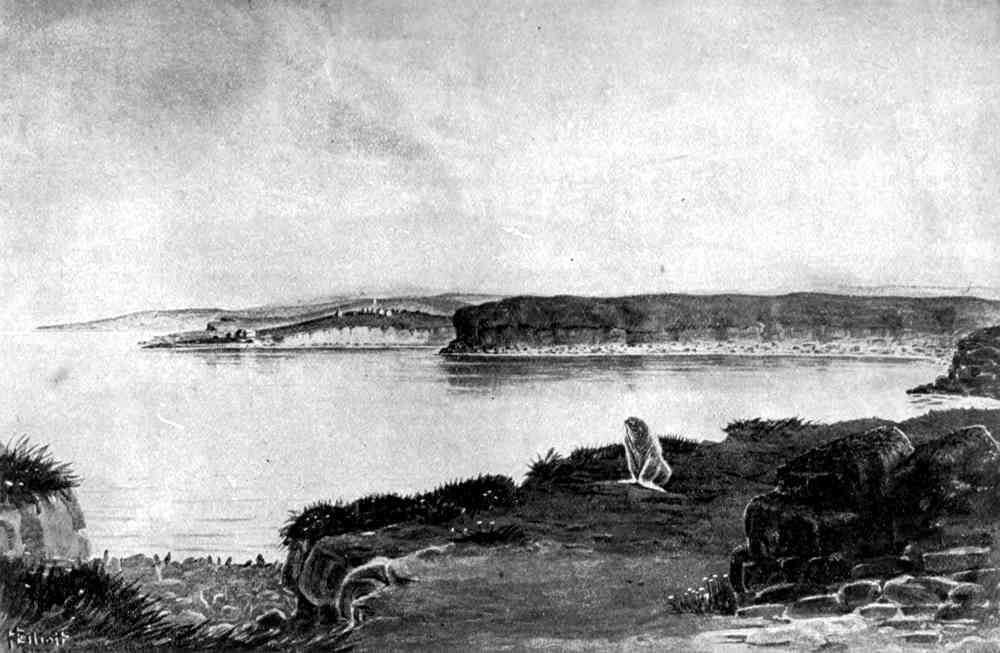
THE NORTH SHORE OF SAINT GEORGE
View of the Coast looking East from the North Rookery over to the Village and the Landing
There are ten or twelve species of grasses of every variety, from close, curly, compact mats to tall stalks—tussocks of the wild wheat, Elymus arenaria, standing in favorable seasons waist high—the “wheat of the north”—together with over one hundred varieties of annuals, perennials, sphagnum, cryptogamic plants, etc., all flourishing in their respective positions, and covering nearly every point of rock, tufa, cement, and sand that a plant can grow upon, with a living coat of the greenest of all greens—for there is not sunlight enough there to ripen any perceptible tinge of ochre-yellow into it—so green that it gives a deep blue tint to gray noonday shadows, contrasting pleasantly with the varying russets, reds, lemon-yellows, and grays of the lichen-covered rocks, and the brownish-purple of the wild wheat on the sand-dune tracts in autumn, together, also, with innumerable blue, yellow, pink, and white phænogamous blossoms, everywhere interspersed over the grassy uplands and sandy flats. Occasionally, on looking into the thickest masses of verdure, our common wild violet will be found, while the phloxes are especially bright and brilliant here. The flowers of one species of gentian, Gentiana verna are very marked in their beauty; also those of a nasturtium, and a creeping pea-vine on the sand-dunes. The blossom of a species of the pulse family is the only one here that emits a positive, rich perfume; the others are more suggestive of that quality than expressive. The most striking plant in all of a long list is the Archangelica officinalis, with its tall seed-stalks and broad leaves, which grows first in spring and keeps green latest in the fall. The luxuriant rhubarb-like stems of this umbellifer, after they have made their rapid growth in June, are eagerly sought for by the natives, who pull them and crunch them between their teeth with all the relish that we experience in eating celery. The exhibition of ferns at Kamminista, St. Paul, during the summer of 1872, surpassed anything that I ever saw: I recall with vivid detail the exceedingly fine display made by these luxuriant and waving fronds, as they reared themselves above the rough interstices of that rocky ridge. From the fern roots, and those of the gentian, the natives here draw their entire stock of vegetable medicines. This floral display on St. Paul is very much more extensive and conspicuous than that on St. George, owing to the absence of any noteworthy extent of warm sand-dune country on the latter island.
When an unusually warm summer passes over the Pribylov group, followed by an open fall and a mild winter, the elymus ripens its seed, and stands like fields of uncut grain in many places along the north shore of St. Paul and around the village, the snow not falling enough to entirely obliterate it; but it is seldom allowed to flourish to that extent. By the end of August and the first week of September of normal seasons, the small edible berries of Empetrum nigrum and Rubus chamæmorus are ripe. They are found in considerable quantities, especially at “Zapadnie,” on both islands, and, as everywhere else throughout circumpolar latitudes, the former is small, watery, and dark, about the size of an English or black currant; the other resembles an unripe and partially decayed raspberry. They are, however, keenly relished by the natives, and even by American residents, being the only fruit growing upon the islands. Perhaps no one plant that flowers on the Seal Islands is more conspicuous and abundant than is the Saxifraga oppositofolia; it grows over all localities, rank and tall in rich locations, to stems scarcely one inch high on the thin, poor soil of hill summits and sides, densely cespitose, with leaves all imbricated in four rows; and flowers almost sessile. I think that at least ten well-defined species of the order Saxifragaceæ exist on the Pribylov group. The Ranunculaceæ are not so numerous; but, still, a buttercup growing in every low slope where you may chance to wander is always a pleasant reminder of pastures at home; and, also, a suggestion of the farm is constantly made by the luxuriant inflorescence of the wild mustard (Cruciferæ). The chickweeds (Caryophyllaceæ) are well represented, and also the familiar yellow dandelion, Taraxacum palustre. Many lichens (Lichenes) and soft mosses (Musci) are in their greatest exuberance, variety, and beauty here; and myriads of golden poppies (Papaveraceæ) are nodding their graceful heads in the sweeping of the winds—the first flowers to bloom, and the last to fade.
The chief economic value rendered by the botany of the Pribylov Islands to the natives is an abundance of the basket-making rushes (Juncaceæ), which the old “barbies” gather in the margins of many of the lakes and pools.
The only suggestion of a tree[91] found growing on the Pribylov group is the hardy “talneek” or creeping willow; there are three species of the genus Salix found here, viz., reticulata, polaris, and arctica; the first named is the most common and of largest growth; it progresses exactly as a cucumber-vine does in our gardens; as soon as it has made from the seed a growth of six inches or a foot upright from the soil, then it droops over and crawls along prostrate upon the earth, rocks, and sphagnum; some of the largest talneek trunks will measure eight or ten feet in decumbent length along the ground, and are as large around the stump as an average wrist of man. The usual size, however, is very, very much less; while the stems of polaris and arctica scarcely ever reach the diameter of a pencil case, or the procumbent length of two feet.
Although Rubus chamæmorus is a tree-shrub, and is found here very commonly distributed, yet it grows such a slender diminutive bush, that it gives no thought whatever of its being anything of the sort. Herbs, grasses, and ferns tower above it on all sides.
The fungoid growths on the Pribylov Islands are abundant and varied, especially in and around the vicinity of the rookeries and the killing-grounds. On the west slope of the Black bluffs at St. Paul the mushroom, Agaricus campestris, was gathered in the season of 1872 by the natives, and eaten by one or two families in the village, who had learned to cook them nicely from the Russians. These Seal Island mushrooms have deeper tones of pink and purple-red in their gills than do those of my gathering in the States. I kicked over many large spherical “puff-balls” (Lycoperdæ) in my tundra walks; myriads of smaller ones (Lycoperdon cinereum?) cover patches near the spots where carcasses have long since rotted, together with a pale gray fungus (Agaricus fimiputris), exceedingly delicate and frosted exquisitely. Some ligneous fungi (Clavaria), will be found attached to the decaying stems of Salix reticulata (creeping willows). The irregularity of the annual growing of the agarics, and their rapid growth when they do appear, makes their determination excessively difficult; they are as unstable in their visits as are several of the Lepidoptera. The cool humidity of climate during the summer season on the Pribylov Islands is especially adapted to that mysterious, but beautiful growth of these plants—the apotheosis of decay. The coloring of several varieties is very bright and attractive, shading from a purplish-scarlet to a pallid white.
A great many attempts have been made, both here and at St. George, to raise a few of the hardy vegetables. With the exception of growing lettuce, turnips, and radishes on the Island of St. Paul, nothing has been or can be done. On the south shore of St. George, and at the foot of a mural bluff, is a little patch of ground less in area than one-sixteenth of an acre, which appears to be so drained and so warmed by the rarely-reflected sunlight from this cliff, every ray of which seems to be gathered and radiated from the rocks, as to allow the production of fair turnips; and at one season there were actually raised potatoes as large as walnuts. Gardening, however, on either island involves so much labor and so much care, with so poor a return, that it has been discontinued. It is a great deal better, and a great deal easier, to have the “truck” come up once a year from San Francisco on the steamer.
There is one comfort which nature has vouchsafed to civilized man on these islands. There are very few indigenous insects. A large flesh-fly, Bombylius major, appears during the summer and settles in a striking manner on the backs of quiet, loafing natives, or strings itself in rows of millions upon the long grass-blades which flourish about the killing-grounds, especially on the leaf-stalks of an elymus, causing this vegetation, over the whole slaughtering-field and vicinity, to fairly droop to earth as if beaten down by a tornado of wind and rain. It makes the landscape look as though it had moulded over night, and the fungoid spores were blue and gray. Our common house-fly is not present; I never saw one while I was up there. The flesh-flies which I have just mentioned never came into the dwellings unless by accident: the natives say they do not annoy them, and I did not notice any disturbance among the few animals which the resident company had imported for beef and for service.
Then, again, this is perhaps the only place in all Alaska where man, primitive and civilized, is not cursed by mosquitoes. There are none here. A gnat, that is disagreeably suggestive of the real enemy just referred to, flits about in large swarms, but it is inoffensive, and seeks shelter in the grass. Several species of beetles are also numerous here. One of them, the famous green and gold “carabus,” is exceedingly common, crawling everywhere, and is just as bright in the rich bronzing of its wing-shields as are its famous prototypes of Brazil. One or two species of Itemosa, a Cymindis, several representatives of the Aphidiphaga, one or two of Dytiscidæ, three or four Cicindelidæ—these are nearly all that I found. A single dragon-fly, Perla bicaudata, flitted over the lakes and ponds of St Paul. The familiar form to our eyes, of the bumble-bee, Bombus borealis, passing from flower to flower, was rarely seen; but a few are here resident. The Hydrocorisæ occur in great abundance, skipping over the water in the lakes and pools everywhere, and a very few species of butterflies, principally the yellow Nymphalidæ, are represented by numerous individuals.
Aside from the seal-life on the Pribylov Islands, there is no indigenous mammalian creature, with the exception of the blue and white foxes, Vulpes lagopus,[92] and a lemming, Myodes obensis. The latter is restricted, for some reason or other, to the Island of St. George, where it is, or at least was, in 1874, very abundant. Its burrows and paths, under and among the grassy hummocks and mossy flats, checkered every square rod of land there covered with this vegetation. Although the Island of St. Paul is but twenty-nine or thirty miles to the northwest, not a single one of these active, curious little animals is found there, nor could I learn from the natives that it had ever been seen there. The foxes are also restricted to these islands; that is, their kind, which are not found elsewhere, except the stray examples on St. Matthew seen by myself, and those which are carefully domesticated and preserved at Attoo, the extreme westernmost land of the Aleutian chain. These animals find comfortable holes for their accommodation and retreat on the Seal Islands, among the countless chinks and crevices of the basaltic formation. They feed and grow fat upon sick and weakly seals, also devouring many of the pups, and they vary this diet by water-fowl and eggs[93] during the summer, returning for their subsistence during the long winter to the bodies of seals upon the breeding-grounds and the skinned carcasses left upon the killing-fields. Were they not regularly hunted from December until April, when their fur is in its prime beauty and condition, they would swarm like the lemming on St. George, and perhaps would soon be obliged to eat one another. The natives, however, thin them out by incessant trapping and shooting during the period when the seals are away from the islands.
The Pribylov group is as yet free from rats; at least none have got off from the ships. There is no harbor on either of these islands, and vessels lie out in the roadstead, so far from land that those pests do not venture to swim to the shore. Mice were long ago brought to shore in ships’ cargoes, and they are a great nuisance to the white people as well as the natives throughout the islands. Hence cats also are abundant. Nowhere, perhaps, in the wide world are such cats to be seen as these. The tabby of our acquaintance, when she goes up there and lives upon the seal-meat spread everywhere under her nose, is metamorphosed, by time of the second generation, into a stubby feline ball. In other words, she becomes thickened, short, and loses part of the normal length of her tail; also her voice is prolonged and resonant far beyond the misery which she inflicts upon our ears here. These cats actually swarm about the natives’ houses, never in them much, for only a tithe of their whole number can be made pets of; but they do make night hideous beyond all description. They repair for shelter often to the chinks of precipices and bluffs; but although not exactly wild, yet they cannot be approached or cajoled. The natives, when their sluggish wits are periodically aroused and thoroughly disturbed by the volume of cat-calls in their village, sally out and by a vigorous effort abate the nuisance for the time being. Only the most fiendish caterwauling will or can arouse this Aleutian ire.
On account of the severe climatic conditions it is, of course, impracticable to keep stock here with any profit or pleasure. The experiment has been tried faithfully. It is found best to bring beef-cattle up in the spring on the steamer, turn them out to pasture until the close of the season in October and November, and then, if the snow comes, to kill them and keep the carcasses refrigerated until consumed. Stock cannot be profitably raised here; the proportion of severe weather annually is too great. From three to perhaps six months of every year they require feeding and watering, with good shelter. To furnish an animal with hay and grain up there is a costly matter, and the dampness of the growing summer season on both islands renders hay-making impracticable. Perhaps a few head of hardy Siberian cattle might pick up a living on the north shore of St Paul, among the grasses and sand-dunes there, with nothing more than shelter and water given them; but they would need both of these attentions. Then the care of them would hardly return expenses, as the entire grazing-ground could not support any number of animals. It is less than two square miles in extent, and half of this area is unproductive. Then, too, a struggle for existence would reduce the flesh and vitality of these cattle to so low an ebb that it is doubtful whether they could be put through another winter alive, especially if severe. I was then and am now strongly inclined to think that if a few of those Siberian reindeer could be brought over to St. Paul and to St. George they would make a very successful struggle for existence, and be a source of a good supply, summer and winter, of fresh meat for the agents of the Government and the company who may be living upon the islands. I do not think that they would be inclined to molest or visit the seal-grounds; at least, I noticed that the cattle and mules of the company running loose on St. Paul were careful never to poke around on the outskirts of a rookery, and deer would be more timid and less obtrusive than our domesticated animals. But I did notice on St. George that a little squad of sheep, brought up and turned out there for a summer’s feeding, seemed to be so attracted by the quiet calls of the pups on the rookeries that they were drawn to and remained by the seals without disturbing them at all, to their own physical detriment, for they lost better pasturage by so doing. The natives of St. Paul have a strange passion for seal-fed pork, and there are quite a large number of pigs on the Island of St. Paul and a few on St. George. Such hogs soon become entirely carnivorous, living, to the practical exclusion of all other diet, on the carcasses of seals.
Chickens are kept with great difficulty. In fact, it is only possible to save their lives when the natives take them into their own rooms or keep them over their heads, in their dwellings, during winter.
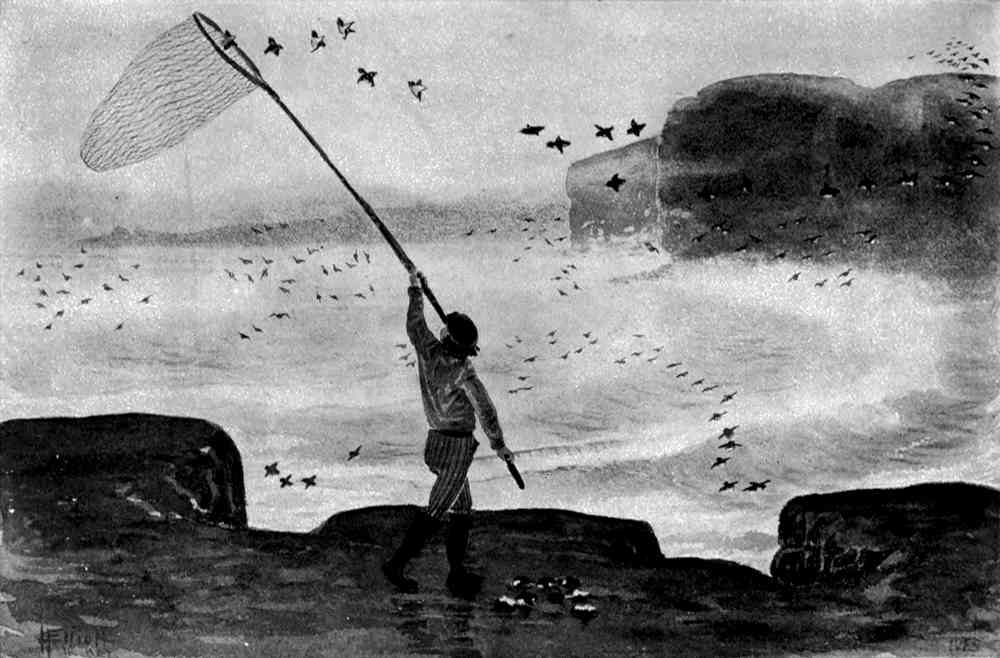
NETTING CHOOCHKIES
A Native catching little Auks (Simorhyncus Pusillus), St. Paul’s Island
While the great exhibition of pinnipedia preponderates over every other feature of animal life at the Seal Islands, still there is a wonderful aggregate of ornithological representation thereon. The spectacle of birds nesting and breeding, as they do on St. George Island, to the number of millions, flecking those high basaltic bluffs of its shore-line, twenty-nine miles in length, with color-patches of black, brown, and white, as they perch or cling to the mural cliffs in the labor of incubation, is a sight of exceeding attraction and constant novelty. It affords a naturalist an opportunity of a lifetime for minute investigation into all the details of the reproduction of these vast flocks of circumboreal water-fowl. The Island of St. Paul, owing to the low character of its shore-line, a large proportion of which is but slightly elevated above the sea and is sandy, is not visited and cannot be visited by such myriads of birds as are seen at St. George; but the small rocky Walrus Islet is fairly covered with sea-fowls, and the Otter Island bluffs are crowded by them to their utmost capacity of reception. The birds string themselves anew around the bluffs with every succeeding season, like endless ribbons stretched across their rugged faces, while their numbers are simply countless. The variety is not great, however, in these millions of breeding-birds. It consists of only ten or twelve names, and the whole list of birds belonging to the Pribylov Islands, stragglers and migratory, contains but forty species. Conspicuous among the last-named class is the robin, a straggler which was brought from the mainland, evidently against its own effort, by a storm or a gale of wind, which also brings against their will the solitary hawks, owls, and waders occasionally noticed here.
After the dead silence of a long ice-bound winter, the arrival of large flocks of those sparrows of the north, the “choochkies,” Phaleris microceros, is most cheerful and interesting. These plump little auks are bright, fearless, vivacious birds, with bodies round and fat. They come usually in chattering flocks on or immediately after May 1st, and are caught by the people with hand-scoops or dip-nets to any number that may be required for the day’s consumption, their tiny, rotund forms making pies of rare savory virtue, and being also baked and roasted and stewed in every conceivable shape by skilful cooks. Indeed, they are equal to the reed-birds of the South. These welcome visitors are succeeded along about July 20th by large flocks of fat, red-legged turn-stones, Strepsilas interpres, which come in suddenly from the west or north, where they have been breeding, and stop on the islands for a month or six weeks, as the case may be, to feed luxuriantly upon the flesh-flies, which we have just noticed, and their eggs. These handsome birds go in among the seals, familiarly chasing the flies, gnats, etc. They are followed as they leave in September by several species of jack-snipe and a plover, Tringa and Charadrius. These, however, soon depart, as early as the end of October and the beginning of November, and then winter fairly closes in upon the islands. The loud, roaring, incessant seal-din, together with the screams and darkening flight of innumerable water-fowl, are replaced in turn again by absolute silence, marking out, as it were, in lines of sharp and vivid contrast, summer’s life and winter’s death.
The author of that quaint old saying, “Birds of a feather flock together,” might well have gained his inspiration had he stood under the high bluffs of St. George at any season, prehistoric or present, during the breeding of the water-birds there, where myriads of croaking murres and flocks of screaming gulls darken the light of day with their fluttering forms, and deafen the ear with their shrill, harsh cries as they do now, for music is denied to all those birds of the sea. Still, in spite of the apparent confusion, he would have taken cognizance of the fact that each species had its particular location and kept to its own boundary, according to the precision of natural law. The dreary expanse and lonely solitudes of the North owe their chief enlivenment, and their principal attractiveness for man, to the presence of those vast flocks of circumboreal water-fowl, which repair thither annually.
Over fifteen miles of the bold, basaltic, bluff line of St. George Island is fairly covered with nesting gulls (Rissa) and “arries” (Uria), while down in the countless chinks and holes over the entire surface of the north side of this island millions of “choochkies” (Simorhyncus microceros) breed, filling the air and darkening the light of day with their cries and fluttering forms. On Walrus Islet the nests of the great white gull of the north (Larus glaucus) can be visited and inspected, as well as those of the sea-parrot or puffin (Fratercula), shags or cormorants (Graculus), and the red-legged kittiwake (Larus brevirostris). These birds are accessible on every side, can be reached, and afford the observer an unequalled opportunity of taking due notice of them through the breeding-season of their own, as it begins in May and continues until the end of September.
Not one of the water-birds found on and around the islands is exempted from a place in the native’s larder; even the delectable “oreelie” are unhesitatingly eaten by the people, and indeed these birds furnish, during the winter season in especial, an almost certain source of supply for fresh meat. But the heart of the Aleut swells to its greatest gastronomic happiness when he can repair, in the months of June and July, to the basaltic cliffs of St. George, or the lava table-bed of Walrus Islet, and lay his grimy hands on the gayly-colored eggs of the “arrie” (Lomvia arra); and if he were not the most improvident of men, instead of taking only enough for the day, he would lay up a great store for the morrow, but he never does. On the occasion of one visit, and my first one there, July 5, 1872, six men loaded a bidarrah at Walrus Islet, capable of carrying four tons, exclusive of our crew, down to the water’s edge with eggs, in less than three working hours.[94]
During winter months these birds are almost wholly absent, especially so if ice-floes shall have closed in around the islands; then there is nothing of the feathered kind save a stupid shag (P. bicristatus) as it clings to the leeward cliffs, or the great burgomaster gull, which sweeps in circling flight high overhead; but, early in May they begin to make their first appearance, and they come up from the sea overnight, as it were, their chattering and their harsh carolling waking the natives from slothful sleeping, which, however, they gladly break, to seize their nets and live life anew, as far as eating is concerned. The stress of severe weather in the winter months, the driving of the snow “boorgas,” and the floating ice-fields closing in to shut out the open water, are cause enough for a disappearance of all water-fowl, pro tem.
Again, the timid traveller here is delighted; he has been relieved of the great Alaskan curse of mosquitoes: he also walks the moors and hillsides secure in never finding a reptile of any sort whatever—no snakes, no lizards, no toads or frogs—nothing of the sort to be found on the Seal Islands.
Fish are scarce in the vicinity of these islands. Only a few representatives of those families which can secrete themselves with rare cunning are safe in visiting the Pribylovs in summer. Naturally enough, the finny tribes avoid the seal-churned waters for at least one hundred miles around. Among a few specimens, however, which I collected, three or four species new to natural science were found, and have since been named by experts in the Smithsonian Institution.
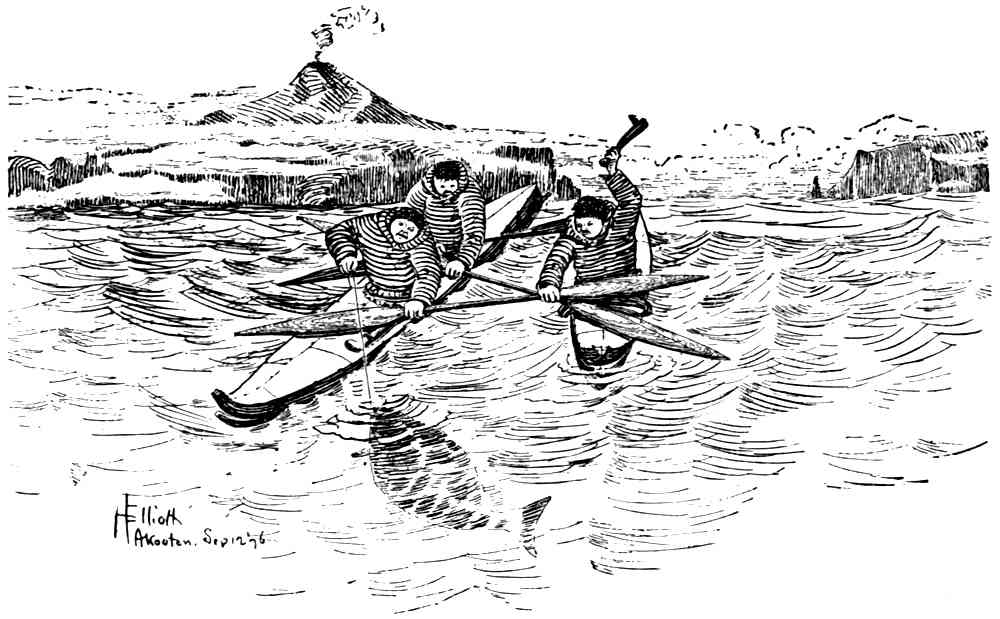
Aleutes catching Halibut, Akootan Pass, Bering Sea.
The presence of such great numbers of amphibian mammalia about the waters during five or six months of every year renders all fishing abortive, and unless expeditions are made seven or eight miles at least from the land, unless you desire to catch large halibut, it is a waste of time to cast your line over the gunwale of the boat. The natives capture “poltoos” or halibut, Hippoglossus vulgaris, within two or three miles of the reef-point on St. Paul and the south shore during July and August. After this season the weather is usually so stormy and cold that fishermen venture no more until the ensuing summer.[95]
With regard to the Mollusca of the Pribylov waters, the characteristic forms of Toxoglossata and Rhachiglossata peculiar to this north latitude are most abundant; of the Cephalopoda I have seen only a species of squid, sepia, or loligo. The clustering whelks (Buccinum) literally conceal large areas of the boulders on the beaches here and there. They are in immense numbers, and are crushed under your foot at almost every step when you pass over long reaches of rocky shingle at low tide. A few of the Neptunea are found, and the live and dead shells of Limacina are in great abundance wherever the floating kelp-beds afford them shelter.
On land a very large number of shells of the genera Succinea and Pupa abound all over the islands. On the bluffs of St. George, just over Garden Cove, I gathered a beautiful Helix.
The little fresh-water lakes and ponds contain a great quantity of representatives of the characteristic genera Planorbis, Melania, Limnea, and that pretty little bivalve, the Cyclas.
Of the Crustacea, the Annelidæ, and Echinodermata, there is abundant representation here. The sea-urchins, “repkie” of the natives, are eagerly sought for at low tide and eaten raw by them. The arctic sea-clam, Mya truncata, is once in a long time found here (it is the chief food of the walrus of Alaska), and the species of Mytilus, the mussels, so abundant in the Aleutian archipelago, are almost absent here at St. Paul and only sparingly found at St. George. Frequently the natives have brought a dish of sea-urchins’ viscera for our table, offering it as a great delicacy. I do not think any of us did more than to taste it. The native women are the chief hunters for echinoidæ, and during the whole spring and summer seasons they will be seen at both islands, wading in the pools at low water, with their scanty skirts high up, eagerly laying possessive hands upon every “bristling egg” that shows itself. They vary this search by poking, with a short-handled hook, into holes and rocky crevices for a small cottoid fish, which is also found here at low water in this manner. Specimens of this cottoid which I brought down declared themselves as representatives of a new departure from all other recognized forms in which the sculpin is known to sport; hence the name, generic and specific. The “sandcake,” echinarachinus, is also very common here.
By May 28th to the middle of June a fine table-crab, large, fat, and sweet, with a light, brittle shell, is taken while it is skurrying in and out of the lagoon as the tide ebbs and flows. It is the best-flavored crustacean known to Alaskan waters. They are taken nowhere else at St. Paul, and when on St. George I failed to see one. I am not certain as to the accuracy of the season of running, viz.: May 28th to June 15th, inasmuch as one of my little note-books on which this date is recorded turns out to be missing at the present writing, and I am obliged to give it from memory. The only economic shell-fish which the islands afford is embodied in this Chionoecetes opilio (?). The natives affirm an existence of mussels here in abundance when the Pribylov group was first discovered; but now only a small supply of inferior size and quality is to be found.
With reference to the jelly-fishes, Medusæ, which are so abundant in the waters around these islands, their exceeding number and variety and beauty startled and enchanted me. An enormous aggregate of these creatures, some of them exquisitely delicate and translucent, ride in and out of the lagoon at St. Paul when the spring-tides flow and ebb. Myriads of them are annually stranded, to decay on the sandy flats of this estuary.
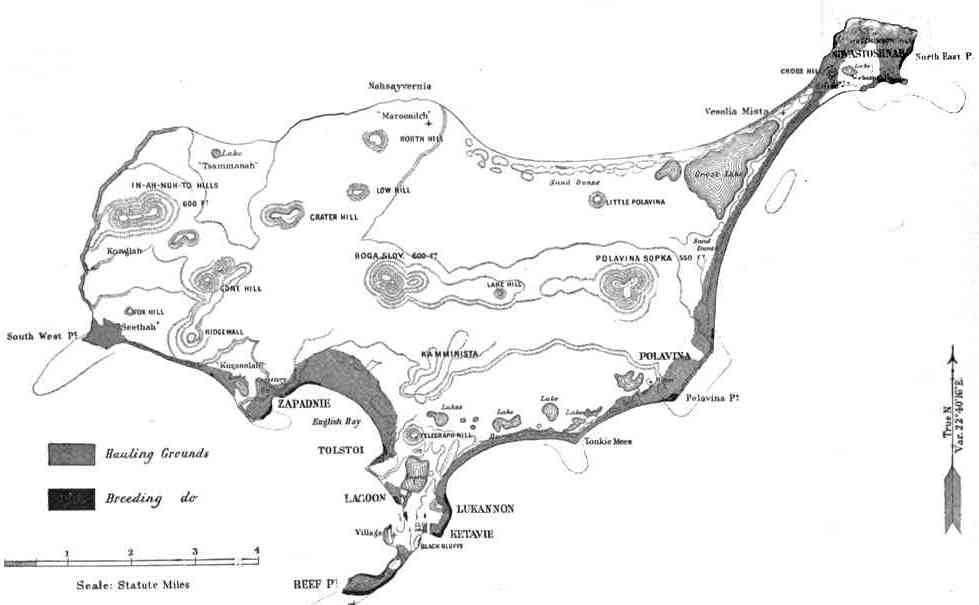
MAP OF ST. PAUL ISLAND—PRIBYLOV GROUP.
Showing the Area and Position of the Fur Seal Rookeries and Hauling Grounds. Surveyed and drawn (1873-74) by Henry W. Elliott.
As to sea-weeds, or mosses,—the extent, luxuriance, variety, and beauty of the algæ forests of those waters of Bering Sea which lave the coasts of the Pribylov Islands, call for more detail of description than space in this volume will allow, since anything like a fair presentation of the subject would require the reproduction of my water-colored drawings. After all heavier gales, especially the southeasters in October, if a naturalist will take the trouble to walk the sand-beach between Lukannon and northeast point of St. Paul Island, he will be rewarded by the memorable sight. He will find thrown up by the surf a vast windrow of kelp along the whole eight or ten miles of this walk—heaped, at some spots, nearly as high as his head; the large trunks of Melanospermæ, the small, but brilliant red and crimson fronds of Rhodospermæ interwoven with the emerald-green leaves of the Chlorospermæ. The first-named group is by far the most abundant, and upon its decaying, fermenting brown and ochre heaps, he will see countless numbers of a buccinoid whelk, and a limnaca, feeding as they bore or suck out myriads of tiny holes in the leaf-fronds of the strong growing species. Actinia or sea-anemones, together with asteroids or starfishes, Discophoræ or jelly-fishes, are also interwoven and heaped up with the “kapoosta” or sea-cabbages just referred to; also, many rosy “sea-squirts,” yellow “cucumbers,” and other forms of Holothuridæ.
On the old killing-fields, on those spots where the sloughing carcasses of repeated seasons have so enriched the soil as to render it like fire to most vegetation, a silken green Confervæ grows luxuriantly. This terrestrial algoid covering appears here and there, on these grounds, like so many door-mats of pea-green wool. That confervoid flourishes only on those spots where nothing but pure decaying animal matter is found. An admixture of sand or earth will always supplant it by raising up instead those strong growing grasses which I have alluded to elsewhere, and which constitute the chief botanical life of the killing-grounds.
In order that the reader can follow easily the narrative of that remarkable life-system which is conducted by the fur-seal as it annually rests and breeds upon the Pribylov group, I present a careful chart of each island and the contiguous islets, which are the only surveys ever made upon the ground. The reader will observe, as he turns to these maps, the striking dissimilarity which exists between them, not only in contour but in physical structure, the Island of St. Paul being the largest in superficial area, and receiving a vast majority of the Pinnipedia that belong to both. As it lies in Bering Sea to-day, this island is, in its greatest length, between northeast and southwest points, thirteen miles, air-line; and a little less than six at points of greatest width. It has a superficial area of about thirty-three square miles, or twenty-one thousand one hundred and twenty acres, of diversified, rough and rocky uplands, rugged hills, and smooth, volcanic cones, which either set down boldly to the sea or fade out into extensive wet and mossy flats, passing at the sea-margins into dry, drifting, sand-dune tracts. It has forty-two miles of shore-line, and of this coast sixteen and a half miles are hauled over by fur-seals en masse. At the time of its first upheaval above the sea, it doubtless presented the appearance of ten or twelve small rocky, bluffy islets and points, upon some of which were craters that vomited breccia and cinders, with little or no lava overflowing. Active plutonic agency must have soon ceased after this elevation, and then the sea round about commenced a work which it is now engaged in—of building on to the skeleton thus created; and it has progressed to-day so thoroughly and successfully in its labor of sand-shifting, together with the aid of ice-floes, in their action of grinding, lifting, and shoving, that nearly all of these scattered islets within the present area of the island, and marked by its bluffs and higher uplands, are completely bound together by ropes of sand, changed into enduring bars and ridges of water-worn boulders. These are raised above the highest tides by winds that whirl the sand up, over and on them, as it dries out from the wash of the surf and from the interstices of rocks, which are lifted up and pushed by ice-fields.
The sand that plays so important a part in the formation of the Island of St. Paul, and which is almost entirely wanting in and around the others of this Pribylov group, is principally composed of Foraminifera, together with Diatomacea, mixed in with a volcanic base of fine comminuted black and reddish lavas and old friable gray slates. It constitutes the chief beauty of the sea-shore here, for it changes color like a chameleon, as it passes from wet to dry, being a rich steely-black at the surf-margin and then drying out to a soft purplish-brown and gray, succeeding to tints most delicate of reddish and pale neutral, when warmed by the sun and drifting up on to the higher ground with the wind. The sand-dune tracts on this island are really attractive in the summer, especially so during those rare days when the sun comes out, and the unwonted light shimmers over them and the most luxuriant grass and variety of beautiful flowers which exist in profusion thereon. In past time, as these sand and boulder bars were forming on St. Paul Island, they, in making across from islet to islet, enclosed small bodies of sea-water. These have, by evaporation and time, by the flooding of rains and annual melting of snow, become, nearly every one of them, fresh; they are all, great and small, well shown on my map, which locates quite a large area of pure water. In them, as I have hinted, are no reptiles; but an exquisite species of a tiny fish[96] exists in the lagoon-estuary near the village, and the small pure-water lakes of the natives just under the flanks of Telegraph Hill. The Aleutes assured me that they had caught fish in the big lake toward Northeast Point, when they lived in their old village out there; but, I never succeeded in getting a single specimen. The waters of these pools and ponds are fairly alive with vast numbers of minute Rotifera, which sport about in all of them wherever they are examined. Many species of water-plants, pond-lilies, algæ, etc., are found in those inland waters, especially in that large lake “Mee-sulk-mah-nee,” which is very shallow.
The backbone of St. Paul, running directly east and west, from shore to shore, between Polavina Point and Einahnuhto Hills, constitutes the high land of that island: Polavina Sopka, an old extinct cinder-crater, five hundred and fifty feet; Bogaslov, an upheaved mass of splinted lava, six hundred feet; and the hills frowning over the bluffs there, on the west shore, are also six hundred feet in elevation above the sea. But the average height of the upland between is not much over one hundred to one hundred and fifty feet above water-level, rising here and there into little hills and broad, rocky ridges, which are minutely sketched upon the map. From the northern base of Polavina Sopka a long stretch of low sand-flats extends, enclosing the great lake, and ending in a narrow neck where it unites with Novastoshnah, or Northeast Point. Here that volcanic nodule known as Hutchinson’s Hill, with its low, gradual slopes, trending to the east and southward, makes a rocky foundation secure and broad, upon which the great single rookery of the island, the greatest in the world, undoubtedly, is located. The natives say that when they first came to these islands Novastoshna was an island by itself, to which they went in boats from Vesolia Mista; and the lagoon now so tightly enclosed was then an open harbor in which the ships of the old Russian Company rode safely at anchor. To-day, no vessel drawing ten feet of water can safely get nearer than half a mile of the village, or a mile from this lagoon at low tide.
The total absence of a harbor at the Pribylov Islands is much to be regretted. The village of St. Paul, as will be seen by reference to the map, is so located as to command the best landings for vessels that can be made during the prevalence of any and all winds, except those from the south. From these there is no shelter for ships, unless they run around to the north side, where they are unable to hold practicable communication with the people or to discharge. At St. George matters are still worse, for the prevailing northerly, westerly, and easterly winds drive the boats away from the village roadstead, and weeks often pass at either island, but more frequently at the latter, ere a cargo is landed at its destination. Under the very best circumstances, it is both hazardous and trying to unload a ship at any of these places. The approach to St. Paul by water during thick weather is doubtful and dangerous, for the land is mostly low at the coast, and the fogs hang so dense and heavy over and around the hills as to completely obliterate their presence from vision. The captain fairly feels his way in by throwing his lead-line and straining his ear to catch the muffled roar of the seal-rookeries, which are easily detected when once understood, high above the booming of the surf. At St. George, however, the bold, abrupt, bluffy coast everywhere all around, with its circling girdle of flying water-birds far out to sea, looms up quite prominently, even in the fog; or, in other words, the navigator can notice it before he is hard aground or struggling to haul to windward from the breakers under his lee. There are no reefs making out from St. George worthy of notice, but there are several very dangerous and extended ones peculiar to St. Paul, which Captain John G. Baker, in command of the vessel[97] under my direction, carefully sounded out, and which I have placed upon my chart for the guidance of those who may sail in my wake hereafter.
When the wind blows from the north, northwest, and west to southwest, the company’s steamer drops her anchor in eight fathoms of water abreast of the black bluffs opposite the village, from which anchorage her stores are lightered ashore; but in the northeasterly, easterly, and southeasterly winds, she hauls around to the lagoon bay west of the village, and there, little less than half a mile from the landing, she drops her anchor in nine fathoms of water, and makes considerable headway at discharging her cargo. Sailing-craft come to both anchorages, but, however, keep still farther out, though they choose relatively the same positions, yet seek deeper water to swing to their cables in: the holding-ground is excellent. At St. George the steamer comes, wind permitting, directly to the village on the north shore, close up, and finds her anchorage in ten fathoms of water, over poor holding-ground; still it is only when three or four days have passed, free from northerly, westerly, or easterly winds that she can make the first attempt to safely unload. The landing here is a very bad one, surf breaking most violently upon the rocks from one end of the year to the other.
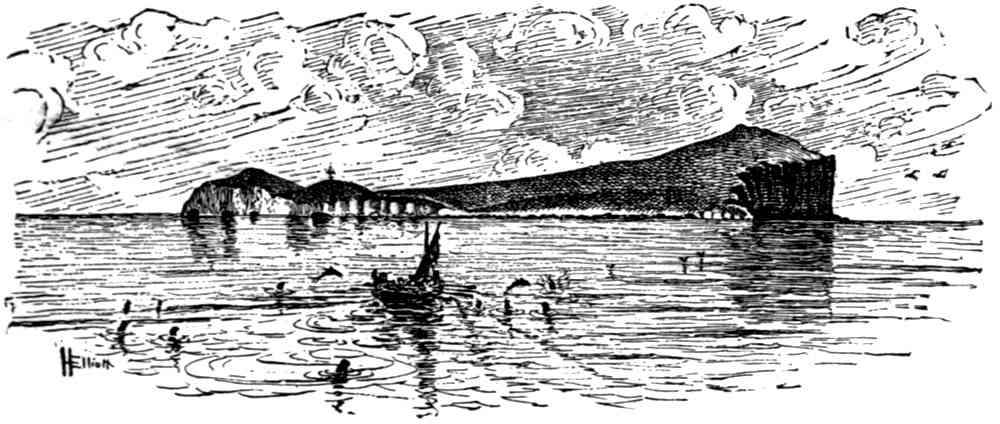
“Bobrovia,” or Otter Island six miles south of St. Paul Island.
[The North Store and landing, viewed from St. Paul.]
The observer will notice that six miles southward and westward of the reef of St. Paul Island is a bluffy islet, called by the Russians Bobrovia, because in olden time the promishlyniks are said to have captured many thousands of sea-otters on its rocky coast. It rises from the ocean, sheer and bold, an unbroken mural precipice extending nearly all around, of sea-front, but dropping on its northern margin, at the water, low, and slightly elevated above the surf-wash, with a broken, rocky beach and no sand. The height of the bluffs at their greatest elevation over the west end is three hundred feet, while the eastern extremity is quite low, and terminated by a queer, funnel-shaped crater-hill, which is as distinctly defined, and as plainly scorched and devoid of the slightest sign of vegetation within as though it had burned up and out yesterday. That crater-point on Otter Island is the only unique feature of the place, for with the exception of this low north shore, before mentioned, where a few thousand of “bachelor seals” haul out during the season every year, there is nothing else worthy of notice concerning it. A bad reef makes out to the westward, which I have indicated from my observation of the rocks awash, looking down upon them from the bluffs. Great numbers of water-fowl roost upon the cliffs, and there are here about as many blue foxes to the acre as the law of life allows. A small, shallow pool of impure water lies close down to the north shore, right under a low hill upon which the Russians in olden times posted a huge Greek cross, that is still standing; indeed it was the habit of those early days of occupation in Alaska to erect such monuments everywhere on conspicuous elevations adjacent to the posts or settlements. One of these is still standing at Northeast Point, on the large sand-dune there which overlooks the killing-grounds, and another sound stalwart cross yet faces the gales and driving “boorgas” on the summit of Bogaslov Mountain, as it has withstood them during the last sixty years.
To the eastward, six miles from Northeast Point, will be noticed a small rock named Walrus Island. It is a mere ledge of lava, flat-capped, lifted just above the wash of angry waves; indeed, in storms of great power, the observer, standing on either Cross or Hutchinson’s Hills, with a field-glass, can see the water breaking clear over it: these storms, however, occur late in the season, usually in October or November. This island has little or no commercial importance, being scarcely more than a quarter of a mile in length and one hundred yards in point of greatest width, with bold water all around, entirely free from reefs or sunken rocks. As might be expected, there is no fresh water on it. In a fog it makes an ugly neighbor for the sea-captains when they are searching for St. Paul; they all know it, and they all dread it. It is not resorted to by the fur-seals or by sea-lions in particular; but, singularly enough, it is frequented by several hundred male walrus, to the exclusion of females, every summer. A few sea-lions, but only a very few, however, breed here. On account of the rough weather, fogs, etc., this little islet is seldom visited by the natives of St. Paul, and then only in the egging season of late June and early July when that surf-beaten breakwater literally swarms with breeding sea-fowl.
This low, tiny, island is, perhaps, the most interesting single spot now known to the naturalist who may land in northern seas, to study the habits of bird-life; for here, without exertion or risk, he can observe and walk among tens upon tens of thousands of screaming water-fowl; and, as he sits down upon the polished lava rock, he becomes literally ignored and environed by these feathered friends, as they reassume their varied positions of incubation, from which he disturbs them by his arrival. Generation after generation of their kind have resorted to this rock unmolested, and to-day, when you get among them, all doubt and distrust seem to have been eliminated from their natures. The island itself is rather unusual in those formations which we find peculiar to Alaskan waters. It is almost flat, with slight, irregular undulations on top, spreading over an area of five acres perhaps. It rises abruptly, though low, from the sea, and it has no safe beach upon which a person can land from a boat; not a stick of timber or twig of shrubbery ever grew upon it, though the scant presence of low, crawling grasses in the central portions prevents the statement that all vegetation is absent. Were it not for the frequent rains and dissolving fog characteristic of summer weather here, the accumulation of guano would be something wonderful to contemplate—Peru would have a rival. As it is, however, the birds, when they return, year after year, find their nesting-floor swept as clean as though they had never sojourned there before. The scene of confusion and uproar that presented itself to my astonished senses when I approached this place in search of eggs, one threatening, foggy July morning, may be better imagined than described, for, as the clumsy bidarrah came under the lee of the low cliffs, swarm upon swarm of thousands of murres or “arries” dropped in fright from their nesting-shelves, and, before they had control of their flight, they struck to the right and left of me, like so many cannon-balls. I was forced, in self-protection, to instantly crouch for a few moments under the gunwale of the boat until the struggling, startled flock passed, like an irresistible, surging wave, over my head. Words cannot depict the amazement and curiosity with which I gazed around after climbing up to the rocky plateau, and stood among myriads of breeding-birds; they fairly covered the entire surface of the island with their shrinking forms, while others whirled in rapid flight over my head, as wheels within wheels, so thickly inter-running that the blue and gray of the sky was hidden from my view. Add to this impression the stunning whir of hundreds of thousands of strong, beating wings, the shrill screams of the gulls, and a muffled croaking of the “arries,” coupled with an indescribable, disagreeable smell which arose from broken eggs and other decaying substances—then a faint idea may be evoked of the strange reality spread before me. Were it not for this island and the ease with which the natives can gather, in a few hours, tons upon tons of sea-fowl eggs, the people of St. Paul would be obliged to go the westward, and suspend themselves from the lofty cliffs of Einahnuhto, dangling over the sea by ropes, as their less favored neighbors are only too glad and willing to do at St. George.
I am much divided in my admiration of the two great bird-rookeries of this Pribylov group, the one on the face of the high bluffs at St. George, and the other on the table-top of Walrus Islet; but perhaps the latter place gives, within the smallest area, the greatest variety of nesting and breeding birds, for here the “arrie” and many gulls, cormorants, sea-parrots, and auks come to lay their eggs in countless numbers. The face and brow of the low, cliff-like sea-front to this island are occupied almost exclusively by the “arries,” Lomvia arra, which lay a single egg each on the surface of the bare rock, and stand, just like so many champagne bottles, straddling over them while hatching, only leaving at irregular intervals to feed, and then not until their mates relieve them. Hundreds of thousands of these birds alone are thus engaged about the 29th of every June on this little rocky island, roosting stacked up together as tight as so many sardines in a box, as compactly as they can be stowed, each and all of them uttering an incessant, muffled, hoarse, grunting noise. How fiercely they quarrel among themselves—everlastingly! and in this way thousands of eggs are rolled off into the sea, or into crevices, or into fissures, where they are lost and broken.
The “arrie” lays but one egg. If it is removed or broken, she will soon lay another; but if undisturbed after depositing the first, she undertakes its hatching at once. The size, shape, and coloration of this egg, among the thousands which came under my observation, are exceedingly variable. A large proportion of the eggs become so dirty by rolling here and there in the guano while the birds tread and fight over them as to be almost unrecognizable. I was struck by a happy adaptation of nature to their rough nesting. It is found in the toughness of this shell of the egg, so tough that the natives, when gathering them, throw them as farmers do apples into their tubs, baskets, etc., on the cliff, and then carry them down to a general heap of collection near the boats’ landing, where they are poured out upon the rocks with a single flip of the hand, just as a sack of potatoes would be emptied; and then again, after this, they are quite as carelessly handled when loaded into the “bidarrah,” sustaining through it all a very trifling loss from crushed or broken specimens.[98]
These “arries” seem to occupy a ribbon strip in width: it is drawn around the outward edges of the flat table-top to Walrus Island as a regular belt, reserved all to themselves: while the small grassy interior from which they are thus self-excluded is the only place, I believe, in Bering Sea where the big white gull, Larus glaucus, breeds. Here I found among grassy tussocks the white burgomaster building a nest of dry grass, sea-ferns, Sertularidæ, etc., very nicely laid up and rounded, and in which it laid usually three eggs, sometimes only a couple; occasionally I would look into a nest with four. These heavy gulls could not breed on either of the other islands in this manner, for the glaucous gull is too large to settle on the narrow shelf-ledges of the cliffs, as the smaller gulls do, and lesser water-fowls, and those places which could receive it would also be a happy hunting-ground and footing to the foxes.
The red-legged kittiwake, Rissa brevirostris, and its cousin, Rissa tridactyla, build in the most amicable manner together on the faces of those cliffs, for they are little gulls, and they associate with cormorants, sea-parrots, and tiny auks, all together, and, with the exception of the last, their nests are very easy of access. All birds, especially the “arries,” have an exceedingly happy time of it on this Walrus Islet—nothing to disturb them, in my opinion, free from the ravenous maw of blue foxes over on St. Paul, and from the piratical and death-dealing sweep of owls and hawks, which infest the Aleutian chain and the mainland.
The position of the islands is such as to be somewhat outside of that migratory path pursued by the birds on the mainland, and owing to this reason they are only visited by a few stragglers from that quarter, a few from the Asiatic side, and by the millions of their own home-bred and indigenous stock. One of these migratory species, a turnstone, however, comes here every summer, for three or four weeks’ stay, in great numbers, and actually gets so fat in feeding upon the larvæ which abound in the decaying carcasses over the killing-grounds that it usually bursts open when it falls, shot on the wing. A heavy easterly gale once brought a strange bird to the islands from the mainland—a grebe, P. griseigena. It was stranded on St. George in 1873, whereupon the natives declared the like of which they had never seen before; again, I found a robin one cool morning in October, the 15th: the natives told me that it was an accident—brought over by some storm or gale of wind that took it up and off from its path across the tundra of Bristol Bay. The next fair wind sweeping from the north or the west could be so improved by this robin, M. migratoria, that it would spread its wings and as abruptly return. Thus hawks, owls, and a number of strange water-fowls visit the islands, but never remain there long.
The Russians tried the experiment of bringing up from Sitka and Oonalashka a flock of ravens, as scavengers, a number of years ago, and when they were very uncleanly in the village, in contrast with the practice of the present hour. They reasoned that they would—these ill-omened birds—be invaluable as health officers; but the Corvidæ invariably, sooner or later, and within a very short time, took the first wind-train or lightning-express back to the mainland or the Aleutian islands. Yet the natives say that if the birds had been young ones instead of old fellows they would have remained. I saw a great many, however, at St. Matthew Island in August, 1874.
A glance at the map of St. Paul shows that nearly half of its superficial area is low and quite flat, not much elevated above the sea. Wherever the sand-dune tracts are located, and that is right along the coast, will be found an irregular succession of hummocks and hillocks, drifted by the wind, which are very characteristic. On the summits of these hillocks an Elymus has taken root in times past, and, as the sand drifts up, it keeps growing on and up too, so that a quaint spectacle is presented of large stretches to the view wherein sand-dunes, entirely bare of all vegetation at their base and on their sides, are crowned with a living cap of the brightest green—a tuft of long, waving grass blades which will not down. None of this peculiar landscaping, however, is seen on St. George, not even in the faintest degree. Travel about St. Paul, with the exception of that trail to Northeast Point, where the natives take advantage of low water to run on the hard, wet sand, is exceedingly difficult, and there are examples of only a few white men who have ever taken the trouble and expended the physical energy necessary to accomplish a comparatively short walk from the village to Nahsayvernia, or the north shore. Walking upon the moss-hidden and slippery rocks, or tumbling over slightly uncertain tussocks, is a task and not a pleasure. On St. George, with the exception of a half-mile path to the village cemetery and back, nobody pretends to walk, except the natives who go to and from the rookeries in their regular seal-drives. Indeed, I am told that I am the only white man who has ever traversed the entire coast-line of both islands.[99]
Turning to St. George and its profile, presented by the accompanying map, the observer will be struck at once by the solidity of that little island and its great boldness, rising, as it does, sheer and precipitous from the sea all around, except at the three short reaches of the coast indicated on my chart, and where the only chance to come ashore exists.
The seals naturally have no such opportunity to gain a footing here as they have on St. Paul, hence their comparative insignificance as to number. The island itself is a trifle over ten miles in extreme length, east and west, and about four and a quarter miles in greatest width, north and south. It looks, when plotted, somewhat like an old stone axe; and, indeed, when I had finished my initial contours from my field-notes, the ancient stone-axe outline so disturbed me that I felt obliged to resurvey the southern shore, in order that I might satisfy my own mind as to the accuracy of my first work. It consists of two great plateaus, with a high upland valley between, the western table-land dropping abruptly to the sea at Dalnoi Mees, while the eastern falls as precipitately at Waterfall Head and Tolstoi Mees. There are several little reservoirs of fresh water—I can scarcely call them lakes—on this island; pools, rather, that the wet sphagnum seems to always keep full, and from which drinking-water in abundance is everywhere found. At Garden Cove is a small, living stream: it is the only one on the Pribylov group.
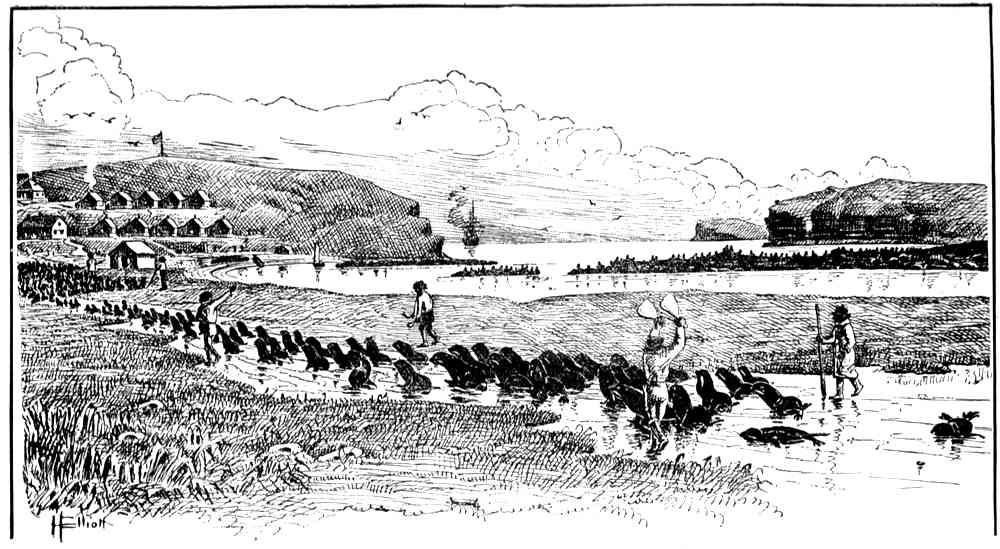
NATIVES DRIVING "HOLLUSCHICKIE" The Drove passing over the Lagoon Flats to the Killing Grounds under the Village of St. Paul. Looking S. W. over the Village Cove and the Lagoon Rookery
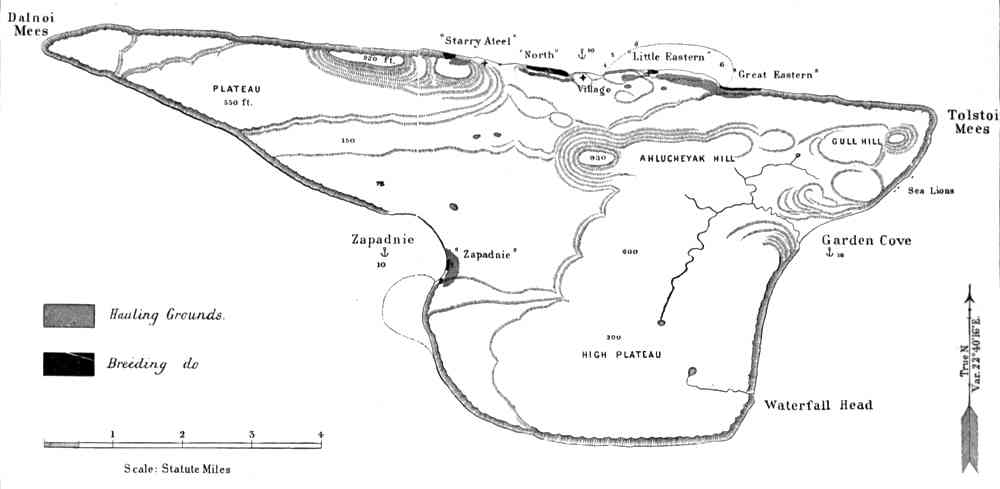
MAP OF ST. GEORGE ISLAND—PRIBYLOV GROUP.
Showing the Area and Position of the Fur Seal Rookeries and Hauling Grounds. Surveyed and drawn (1873-74) by Henry W. Elliott.
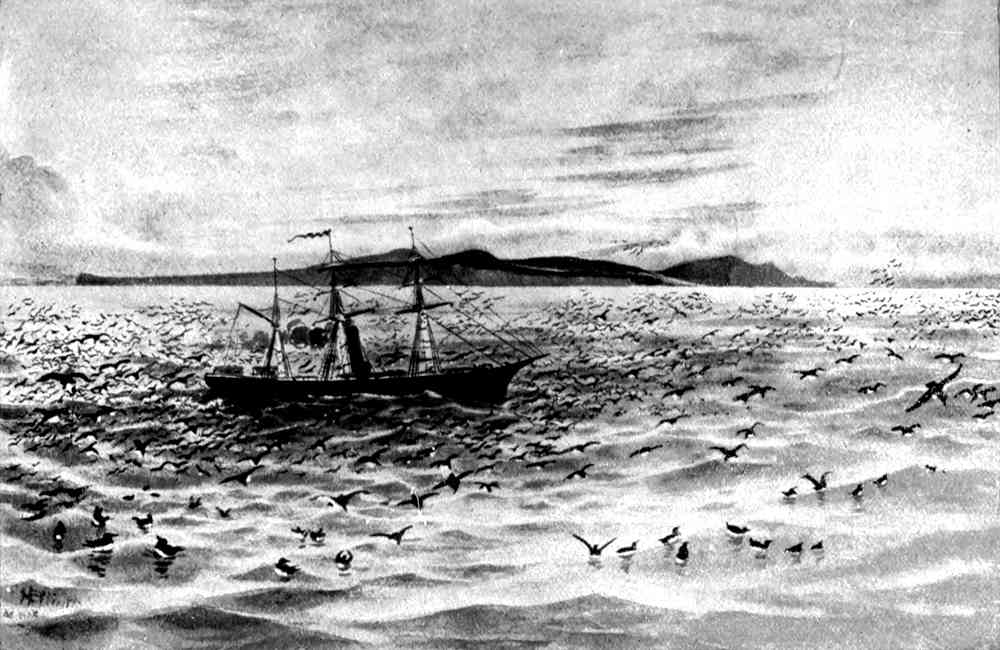
ST. GEORGE’S ISLAND, PRIBYLOV GROUP
Viewed from a point at sea about 7 miles E. N. E., off Tolstoi Mees: these characteristic swarms of water-fowl, arries and choochkies, stirred up by an approach of the steamer, encircle the whole island in this manner, and give notice to a mariner, in thick weather, of the proximity of that island long before it can be seen
St. George has an area of about twenty-seven square miles; it has twenty-nine miles of coast-line, of which only two and a quarter are visited by the fur-seals, and which is in fact all the eligible landing-ground afforded them by the structure of the island. Nearly half of the shore of St. Paul is a sandy beach, while on St. George there is less than a mile of it all put together, namely: a few hundred yards in front of the village, the same extent on the Garden Cove beach, southeast side, and less than half a mile at Zapadnie on the south side.
Just above the Garden Cove, under the overhanging bluffs, several thousand sea-lions hold exclusive, though shy, possession. Here there is a half-mile of good landing. On the north shore of the island, three miles west from the village, a grand bluff wall of basalt and tufa intercalated rises abruptly from the sea to a sheer height of nine hundred and twenty feet at its reach of greatest elevation: thence, dropping a little, runs clear around the island to Zapadnie, a distance of nearly ten miles, without affording a single passage-way up or down to the sea that thunders at its base. Upon its innumerable narrow shelf-margins, and in its countless chinks and crannies, and back therefrom over an extended area of lava-shingled inland ridges and terraces, millions upon millions of water-fowl breed during the summer months.
The general altitude of St. George, though in itself not great, has, however, an average three times higher than that of St. Paul, the elevation of which is quite low, and slopes gently down to the sea east and north; St. George rises abruptly, with exceptional spots for landing. The loftiest summit on St. George, the top of the hill right back to the southward of the village, is nine hundred and thirty feet, and is called by the natives Ahluckeyak. That on St. Paul, as I have before said, is Bogaslov Hill, six hundred feet. All elevations on either island, fifteen or twenty feet above sea-level, are rough and hummocky, with the exception of those sand-dune tracts at St. Paul and the summits of the cinder hills, on both islands. Weathered out, or washed from the basalt and pockets of olivine on either island, are aggregates of augite, seen most abundant on the summit slopes of Ahluckeyak Hill, St. George. Specimens from stratified bands of old, friable, gray lavas, so conspicuous on the shore of this latter island, show an existence of hornblende and vitreous felspar in considerable quantity, while on the south shore, near Garden Cove, is a large dike of a bluish and greenish gray phonolite, in which numerous small crystals of spinel are found. A dike, with well-defined walls, of old close-grained, clay-colored lava, is near the village of St. George, about a quarter of a mile east from the landing, in the face of those reddish breccia bluffs that rise from the sea. It is the only example of the kind on the islands. The bases or foundations of the Pribylov Islands are, all of them, basaltic; some are compact and grayish-white, but most of them exceedingly porous and ferruginous.[100] Upon this solid floor are many hills of brown and red tufa, cinder-heaps, etc. Polavina Sopka, the second point in elevation on St. Paul Island, is almost entirely built up of red scoria and breccia; so is Ahluckeyak Hill, on St. George, and the cap to the high bluffs opposite. The village hill at St. Paul, Cone hill, the Einahnuhto peaks, Crater Hill, North Hill, and Little Polavina are all ash-heaps of this character. The bluffs at the shore of Polavina Point, St. Paul, show in a striking manner a section of the geological structure of the island. The tufas on both islands, at the surface, decompose and weather into the base of good soil, which the severe climate, however, renders useless to good husbandmen. There is not a trace of granitic or of gneissoid rocks found in situ. Metamorphic boulders have been collected along the beaches and pushed up by heavy ice-floes which have brought them down from Siberian coasts far away to the northwest. The dark-brown tufa bluffs and the breccia walls at the east landing of St. Paul Island, known as “Black Bluffs,” rise suddenly from the sea sixty to eighty feet, with stratified horizontal lines of light-gray calcareous conglomerate, or cement, in which are embedded sundry fossils characteristic of and belonging to the Tertiary Age, such as Cardium grœnlandicum, C. decoratum, and Astarte pectunculata, etc. This is the only locality within the purview of the Pribylov Islands where any palæontological evidence of their age can be found. These specimens, as indicated, are exceedingly abundant; I brought down a whole series, gathered there at the east landing or “Navastock,” in a short half-hour’s search and labor.
Although small quantities of drift-wood lodge at all points of the coast, yet the greatest amount is found on the south shore, and thence around to Garden Cove; this drift-timber is usually wholly stripped of its bark, principally pine and fir sticks, some of them quite large, eighteen inches or two feet in diameter. Several years occur when a large driftage will be thrown or stranded here; then long intervals of many seasons will elapse with scarcely a log or stick coming ashore. I found at Garden Cove, in June, 1873, the well-preserved husk of a cocoanut, cast up by the surf on the beach: did I not know that it was most undoubtedly thrown over by some whaler in these waters, not many hundred miles away at the farthest, I should have indulged in a pretty reverie as to its path in drifting from the South Seas to this lonely islet. I presume, however, that the timber which the sea brings for the Pribylov Islands is that borne down upon the annual floods of the Kuskokvim and Nooshagak Rivers on the mainland, and to the east-northeastward, a trifle more than two hundred and twenty-five miles; it comes, however, in very scant supply. I saw very little drift-wood on St. Matthew Island; but on the eastern shore of St. Lawrence there was an immense aggregate, which unquestionably came from the Yukon mouth.
The fact that fur-seals frequent these islands and those of Bering and Copper, on the Russian side, to the exclusion of other land, seems at first odd or singular, to say the least; but when we come to examine the subject we find that those animals, when they repair hither to rest for two or three months on the land, as they must do by their habit during the breeding-season, require a cool, moist atmosphere, imperatively coupled with firm, well-drained land, or dry broken rocks or shingle, rather, upon which to take their positions and remain undisturbed by the weather and the sea for a lengthy period of reproduction. If the rookery-ground is hard and flat, with an admixture of loam or soil, puddles are speedily formed in this climate, where it rains almost every day, and when not raining, rain-fogs take rapid succession and continue the saturation, making thus a muddy slime, which very quickly takes the hair off the animals whenever it plasters or wherever it fastens on them; hence they carefully avoid any such landing. If they occupy a sandy shore the rain beats that material into their large, sensitive eyes, and into their fur, so they are obliged, from simple irritation, to leave and return to the sea for relief.
This inspection of some natural characteristics of the Pribylov group renders it quite plain that the Seal Islands, now under discussion, offer to the Pinnipedia very remarkable advantages for landing, especially so at St. Paul, where the ground of basaltic rock and of volcanic tufa or cement slopes up from many points gradually above the sea, making thereby a perfectly adapted resting-place for any number, from a thousand to millions, of those intelligent animals, which can lie out here from May until October every year in perfect physical peace and security. There is not a rod of ground of this character offered to these animals elsewhere in all Alaska, not on the Aleutian chain, not on the mainland, not on St. Matthew or St. Lawrence. Both of the latter islands were surveyed by myself, with special reference to this query, in 1874; every foot of St. Matthew shore-line was examined, and I know that the fur-seal could not rest on the low clayey flats there in contentment a single day; hence he never has rested there, nor will he in the future. As to St. Lawrence, it is so ice-bound and snow-covered in spring and early summer, to say nothing of numerous other physical disadvantages, that it never becomes of the slightest interest to fur-seals.