Chapter X · AMPHIBIAN MILLIONS.
Reading edition
Difference between a Hair-seal and a Fur-seal.—The Fur-seal the most Intelligent of all Amphibians.—Its singularly Free Progression on Land.—Its Power in the Water.—The Old Males the First Arrivals in the Spring.—Their Desperate Battles one with Another for Position on the Breeding Grounds.—Subsequent Arrival of the Females.—Followed by the “Bachelors.”—Wonderful Strength and Desperate Courage of the Old Males.—Indifference of the Females.—Noise of the Rookeries Sounds like the Roar of Niagara.—Old Males fast from May to August, inclusive; neither Eat nor Drink, nor Leave their Stations in all that Time.—Graceful Females.—Frolicsome “Pups.”—They have to Learn to Swim!—How they Learn.—Astonishing Vitality of the Fur-seal.—“Podding” of the Pups.—Beautiful Eyes of the Fur-seal.—How the “Holluschickie,” or Bachelor Seals, Pass the Time.—They are the only ones Killed for Fur.—They Herd alone by Themselves in spite of their Inclination; Obliged to. —They are the Champion Swimmers of the Sea.—A Review of the Vast Breeding Rookeries.—Natives Gathering a Drove.—Driving the Seals to the Slaughtering Fields.—No Chasing—no Hunting of Seals.—The Killing Gang at Work: Skinning, Salting, and Shipping the Pelts.—All Sent Direct to London.—Reasons Why.—How the Skins are Prepared for Sacks, Muffs, etc.
“The web-footed seals forsake the stormy swell, And, sleeping in herds, exhale nauseous smell.”—Homer.
A vivid realism of the fact that often truth is far stranger than fiction is strikingly illustrated in the life-history of the fur-seal: as it is the one overshadowing and superlatively interesting subject of this discussion, I shall present all its multitudinous details, even at the risk of being thought tedious. That aggregate of animal life shadowed every summer out upon the breeding grounds of the Seal Islands is so vast, so anomalous, so interesting, and so valuable, that it deserves the fullest mention; and even when I shall have done, it will be but feebly expressed.
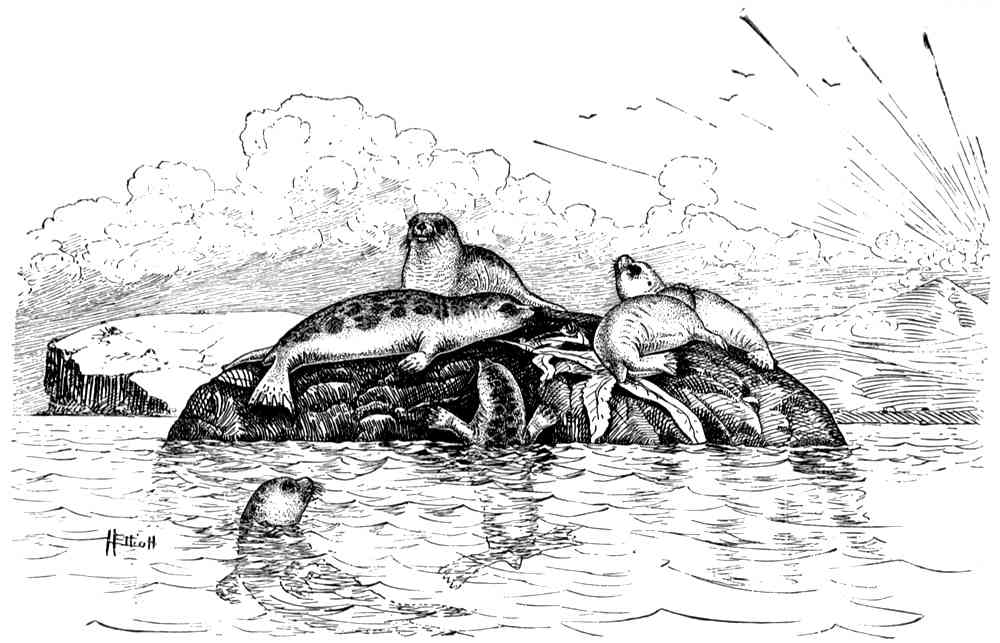
THE HARBOR SEAL
Adult Male and Female Young, 2 months
[Phoca vitulina: a Life Study made at Zapadnie, St. Paul’s Island. July 10, 1872]
Great as it is, yet a short schedule[107] embraces the titles of all the pinnipeds found in, on, and around the island-group. Of this list the hair-seal[108] is the animal which has done so much to found that erroneous popular and scientific opinion as to what a fur-seal appears like. Phoca vitulina has, in this manner, given to the people of the world a false idea of its relatives. It is so commonly distributed all over the littoral salt waters of the earth, seen in the harbors of nearly every marine port, or basking along the loneliest and least inhabited of desolate coasts far to the north, that everybody has noticed it, if not in life, then in its stuffed skins at the museums, sometimes very grotesquely mounted. This copy, set everywhere before the eye of the naturalist, has rendered it so difficult for him to correctly discriminate between the Phocidæ and the Otariidæ, that the synonymy of the Pinnipedia has been expanded until it is replete with meaningless description and surmise.
Although the hair-seal belongs to the great group of pinnipeds, yet it does not have even a generic affinity with those seals with which it has been so persistently grouped, namely, the fur-seal and the sea-lion. It no more resembles them, than does the raccoon a black or grizzly bear.
I shall not enter into a detailed description of this seal; it is wholly superfluous, for excellent, and, I believe, trustworthy accounts have been repeatedly published by writers who have treated of the subject as it was spread before their eyes on the coasts of Labrador, Newfoundland, and Greenland; to say nothing of the researches and notes made by European scientists. It differs completely in shape and habit from its congeners on these islands. Here, where I have studied its biology, it seldom comes up from the water more than a few rods at the farthest; generally hauling and resting at the margin of the surf-wash. It takes up no position on land to hold and protect a family or harem, preferring the detached water-worn rocks, especially those on the lonely north shore of St. Paul, although I have seen it resting at “Gorbatch,” near the sea-margin of the great seal-rookery of that name, on the Reef Point of St. Paul; its cylindrical, supine, gray and white body marked in strong contrast with the erect, black, and ochre-colored forms of the Callorhinus, which swarmed round about it. On such small spots of rock, wet and isolated from the mainland, and in secluded places of the north shore, the “nearhpah” brings forth its young, a single pup, perfectly white, covered with long woolly hair, and weighing from three to seven pounds. This pup grows rapidly, and after the lapse of four or five months it tips the scales at fifty pounds; by that time it has shed its infant coat and donned the adult soft steel-gray hair over the head, limbs, and abdomen, with its back most richly mottled and barred lengthwise, by dark brown and brown-black streaks and blotches, suffused at their edges into the light steel-gray ground of the body. When they appear in the spring following, this bright gray tone to their color has ripened into a dingy ochre, and the mottling spread well over the head and down on the upper side or back of the flippers, but fades out as it progresses. It has no appreciable fur or under-wool. There is no noteworthy difference as to color or size between the sexes. So far as I have observed, they are not polygamous. They are exceedingly timid and wary at all times, and in this manner and method they are diametrically opposed, not by shape alone, but by habit and disposition, to the fashion of the fur-seal in especial, and the sea-lion. Their skin is of little value, comparatively, but their chief merit, according to the natives, is the relative greater juiciness and sweetness of their flesh, over even the best steaks of sea-lion or fur-seal pup meat.
One common point of agreement among all authors was, by my observations of fact, so strikingly refuted, that I will here correct a prevalent error made by naturalists who, comparing the hair-seal with the fur-seal, state that in consequence of the peculiar structure of their limbs, their progression on land is “mainly accomplished by a wriggling, serpentine motion of the body, slightly assisted by the extremities.” This is not so in any respect; for, whenever I have purposely surprised these animals, a few rods from the beach-margin, they would awake and excitedly scramble, or rather spasmodically exert themselves, to reach the water instantly, by striking out quickly with both fore-feet simultaneously, lifting in this way alone, and dragging the whole body forward, without any “wriggling motion” whatever to their back or posterior parts, moving from six inches to a foot in advance every time their fore-feet were projected forward, and the body drawn along according to the violence of the effort and the character of the ground; the body of the seal then falls flat upon its stomach, and the fore-feet or flippers are free again for another similar motion. This action of Phoca is effected so continuously and so rapidly, that in attempting to head off a young “nearhpah” from the water, at English Bay, I was obliged to leave a brisk walk and take to a dog trot to do it. The hind-feet are not used when exerted in this rapid movement at all; they are dragged along in the wake of the body, perfectly limp and motionless. But they do use those posterior parts, however, when leisurely climbing up and over rocks undisturbed, or playing one with another; still it is always a weak, trembling terrestrial effort, and particularly impotent and clumsy. In their swift swimming the hind-feet of Phocidæ evidently do all the work; the reverse is a remarkable characteristic of the Otariidæ.
These remarks of mine, it should be borne in mind, apply directly to the Phoca vitulina, and I presume indirectly with equal force to all the rest of its more important generic kindred, be they as large as the big maklok, Erignathus barbata, or less.
This hair-seal is found around these islands at all seasons of the year, but in very small numbers. I have never seen more than twenty-five or thirty at any one time, and I am told that its occidental distribution, although everywhere found, above and below, from the arctic to the tropics, and especially general over the North Pacific coast, nowhere exhibits any great number at any one place; but we know that it and its immediate kindred form a vast majority of the multitudinous seal-life peculiar to our North Atlantic shores, ice-floes, and contiguous waters. The scarcity of this species, and of all its generic allies, in the waters of the Pacific, is notable as compared with those of the circumpolar Atlantic, where these hair-seals are the seals of commerce: they are found in such immense numbers between Greenland and Labrador, and thence to the eastward at certain seasons of every year, that employment is given to a fleet of about sixty sailing and steam vessels, which annually goes forth from St. John, Newfoundland, and elsewhere, fitted for seal-fishing: taking in all this cruising over three hundred thousand of these animals each season. The principal object of value, however, is the oil rendered from them: the skins have a very small commercial importance.
The fur-seal, Callorhinus ursinus, which repairs to these islands to breed and to shed its hair and fur, in numbers that seem almost fabulous, is the highest organized of all the Pinnipedia, and, indeed, for that matter, when land and water are weighed in the account together, there is no other animal known to man which may be truly classed as its superior, from a purely physical point of view. Certainly there are few, if any, creatures in the animal kingdom that can be said to exhibit a higher order of instinct, approaching even our intelligence.
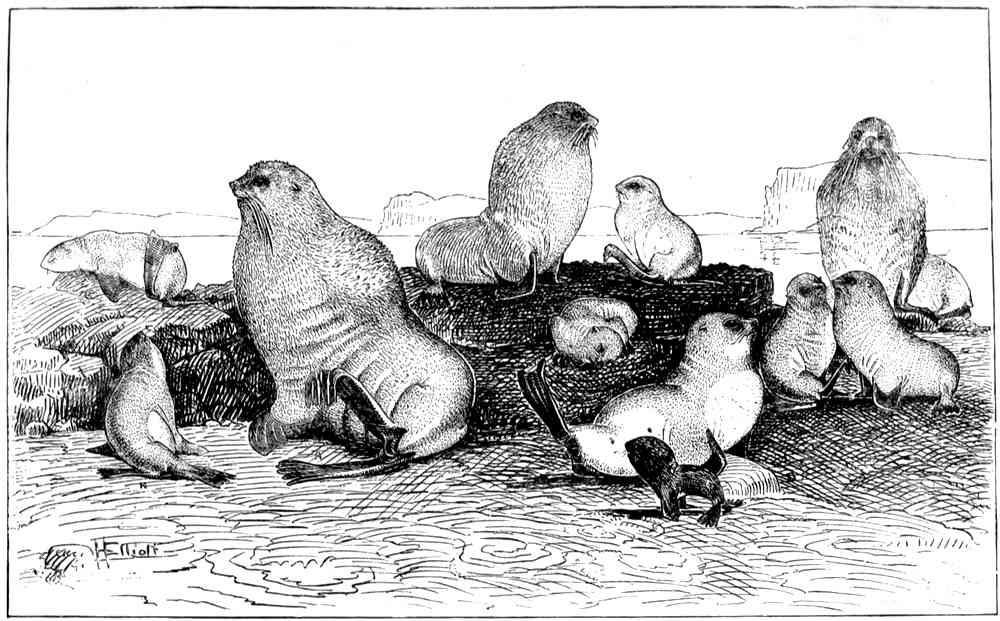
GROUP OF FUR SEALS
Young Females Old Male Young Male Mother Seal Old Male “Roaring”
2 years 18 years 6 years and Pup nursing Young Males
2 years
I wish to draw attention to a specimen of the finest of this race—a male in the flush and prime of his first maturity, six or seven years old, and full grown. When it comes up from the sea early in the spring, out to its station for the breeding season, we have an animal before us that will measure six and a half to seven and a quarter feet in length from tip of nose to the end of its abbreviated abortive tail. It will weigh at least four hundred pounds, and I have seen older specimens much more corpulent, which, in my best judgment, could not be less than six hundred pounds in weight.[109] The head of this animal now before us appears to be disproportionately small in comparison with an immensely thick neck and shoulders; but, as we come to examine it, we will find it is mostly all occupied by the brain. The light frame-work of its skull supports an expressive pair of large bluish-hazel eyes, alternately burning with revengeful, passionate light, then suddenly changing to the tones of tenderness and good-nature. It has a muzzle and jaws of about the same size and form observed in any full-blooded Newfoundland dog, with this difference, that the lips are not flabby and overhanging; they are as firmly lined and pressed against one another as our own. The upper lips support a yellowish-white and gray mustache, composed of long, stiff bristles, which, when not torn out and broken off in combat, sweeps down and over the shoulders as a luxuriant plume. Look at it as it comes leisurely swimming on toward the land; see how high above the water it carries its head, and how deliberately it surveys the beach, after having stepped upon it (for it may be truly said to step with its fore-flippers, as they regularly alternate when it moves up), carrying the head well above them, erect and graceful, at least three feet from the ground. The fore-feet, or flippers, are a pair of dark bluish-black hands, about eight or ten inches broad at their junction with the body, and the metacarpal joint, running out to an ovate point at their extremity, some fifteen to eighteen inches from this union—all the rest of the forearm, the ulna, radius, and humerus being concealed under the skin and thick blubber-folds of the main body and neck, hidden entirely at this season, when it is so fat. But six weeks to three months after this time of landing, when that superfluous fat and flesh is consumed by self-absorption, then those bones will show plainly under its shrunken skin. On the upper side of these flippers the hair of the body straggles down finer and fainter as it comes below to a point close by, and slightly beyond that spot of junction where the phalanges and the metacarpal bones unite, similar to that point on our own hand where our knuckles are placed; and here the hair ends, leaving the rest of the skin to the end of the flipper bare and wrinkled in places at the margin of the inner side; showing, also, five small pits, containing abortive nails, which are situated immediately over the union of the phalanges with their cartilaginous continuations to the end of the flipper.
On the under side of the flipper the skin is entirely bare from its outer extremity up to the body-connection. It is sensibly tougher and thicker than elsewhere on the body; it is deeply and regularly wrinkled with seams and furrows, which cross one another so as to leave a kind of sharp diamond-cut pattern. When they are placed by the animal upon the smoothest rocks, shining and slippery from algoid growths and the sea-polish of restless waters, they seldom fail to adhere.
When we observe this seal moving out on the land, we notice that, though it handles its fore-feet in a most creditable manner, it brings up its rear in quite a different style: for, after every second step ahead with the anterior limbs it will arch its spine, and in arching, it drags and lifts up, and together forward, the hind-feet, to a fit position under its body, giving it in this manner fresh leverage for another movement forward by the fore-feet, in which the spine is again straightened out, and then a fresh hitch is taken up on the posteriors once more, and so on as the seal progresses. This is the leisurely and natural movement on land, when not disturbed, the body all the time being carried clear of and never touching the ground; but if the creature is frightened, this method of progression is radically changed. It launches into a lope and actually gallops so fast that the best powers of a man in running are taxed to head it off. Still, it must be remembered that it cannot run far before it sinks, trembling, gasping, breathless, to the earth. Thirty or forty yards of such speed marks the utmost limit of its endurance.
The radical difference in the form and action of the hind-feet cannot fail to strike the eye at once. They are one-seventh longer than the fore-hands and very much lighter and more slender; they resemble, in broad terms, a pair of black-kid gloves, flattened out and shrivelled, as they lie in their box.
There is no suggestion of fingers on the fore-hands; but the hind-feet seem to be toes run into ribbons, for they literally flap about involuntarily from that point where the cartilaginous processes unite with the phalangeal bones. The hind-feet are also merged in the body at their junction with it, like those anterior. Nothing can be seen of the leg above the tarsal joint.
The shape of the hind flipper is strikingly like that of a human foot, provided the latter were drawn out to a length of twenty or twenty-two inches, the instep flattened down and the toes run out into thin, membranous, oval-tipped points, only skin-thick, leaving three strong cylindrical, grayish, horn-colored nails, half an inch long each, back six inches from these skinny toe-ends, without any sign of nails to mention on the outer big and little toes.
On the upper side of this hind-foot the body-hair comes down to that point where the metatarsus and phalangeal bones join and fade out. From that junction the phalanges, about six inches down to the nails above mentioned, are entirely bare and stand ribbed up in bold relief on the membrane which unites them, as the web to a duck’s foot. The nails just referred to mark the ends of the phalangeal bones and their union in turn with the cartilaginous processes, which run rapidly tapering and flattening out to the ends of the thin toe-points. Now, as we are looking at this fur-seal’s motion and progression, that which seems most odd is the gingerly manner (if I may be allowed to use the expression) in which it carries these hind flippers. They are held out at right angles from the body directly opposite the pelvis, the toe-ends or flaps slightly waving, curled, and drooping over, supported daintily, as it were, above the earth, the animal only suffering its weight behind to fall upon its heels, which are themselves opposed to each other, scarcely five inches apart.
We shall, as we see this seal again later in the season, have to notice a different mode of progression and bearing, both when it is lording over its harem or when it grows shy and restless at the end of the breeding season, then faint, emaciated, and dejected. But we will now proceed to observe him in the order of his arrival and that of his family. His behavior during the long period of fasting and unceasing activity and vigilance, and other cares which devolve upon him as the most eminent of all polygamists in the brute world, I shall carefully relate, and to fully comprehend the method of this exceedingly interesting animal it will be frequently necessary for the reader to refer to my sketch-maps of its breeding grounds or rookeries, and the islands.
The adult males are the first examples of the Callorhinus to arrive in the spring on the seal-ground, which has been deserted by all of them since the close of the preceding year.[110]
Between May 1st and 5th, usually, a few males will be found scattered over the rookeries pretty close to the water. They are at this time quite shy and sensitive, seeming not yet satisfied with the land, and a great many spend day after day idly swimming out among the breakers a little distance from the shore before they come to it, perhaps somewhat reluctant at first to enter upon the assiduous duties and the grave responsibilities before them of fighting for and maintaining their positions in the rookeries.
The first arrivals are not always the oldest bulls, but may be said to be the finest and most ambitious of their class. They are full grown and able to hold their places on the rookeries or the breeding flats, which they immediately take up after coming ashore. Their method of landing is to come collectively to those breeding grounds where they passed the prior season; but I am not able to say authoritatively, nor do I believe it, strongly as it has been urged by many careful men who were with me on the islands, that these animals come back to and take up the same position on their breeding grounds that they individually occupied when there last year. From my knowledge of their action and habit, and from what I have learned of the natives, I should say that very few, if any, of them make such a selection and keep these places year after year. Even did the seal itself intend to come directly from the sea to that spot on the rookery which it left last summer, what could it do if it came to that rookery margin a little later and found that another “see-catch” had occupied its ground? The bull could do nothing. It would either have to die in its tracks, if it persisted in attaining this supposed objective point, or do what undoubtedly it does do—seek the next best locality which it can secure adjacent.
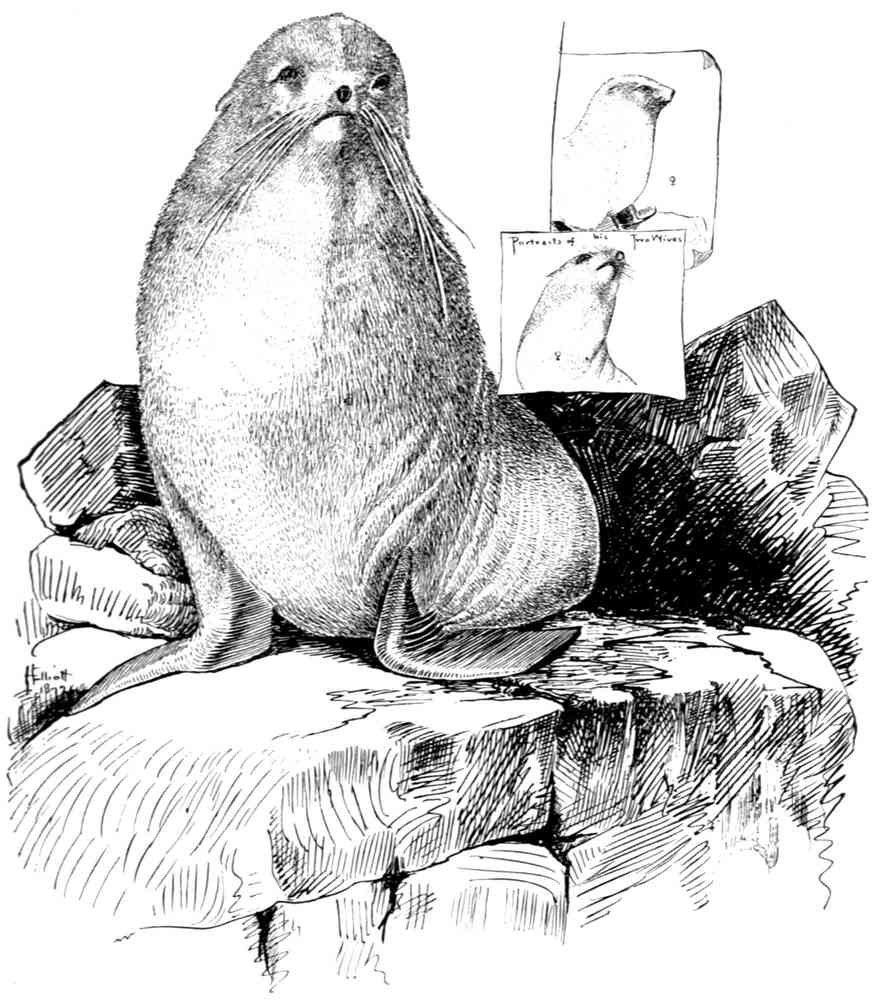
“OLD JOHN”
A Life Study of an aged Fur Seal-Bull or “See-catch.”—Gorbatch Rookery, July 2, 1872
One aged “see-catch” was pointed out to me at the “Gorbatch” section of the Reef rookery, as an animal that was long known to the natives as a regular visitor, close by or on the same rock, every season during the past three years. They called him “Old John,” and they said they knew him because he had one of his posterior digits missing, bitten off, perhaps, in a combat. I saw him in 1872, and made careful drawings of him in order that I might recognize his individuality, should he appear again in the following year, and when that time rolled by, I found him not; he failed to reappear, and the natives acquiesced in his absence. Of course it was impossible to say that he was dead when there were ten thousand rousing, fighting bulls to the right, left, and below us, under our eyes, for we could not approach for inspection. Still, if these animals came each to a certain place in any general fashion, or as a rule, I think there would be no difficulty in recognizing the fact; the natives certainly would do so; as it is, they do not I think it very likely, however, that the older bulls come back to the same common rookery ground where they spent the previous season; but they are obliged to take up their position on it just as the circumstances attending their arrival will permit, such as finding other seals which have arrived before them, or of being whipped out by stronger rivals from their old stands.
It is entertaining to note, in this connection, that the Russians themselves, with the object of testing that mooted query, during the later years of their possession of the islands, drove up a number of young males from Lukannon, cut off their ears, and turned them out to sea again. The following season, when the droves came in from the “hauling-grounds” to the slaughtering-fields, quite a number of those cropped seals were in the drives, but instead of being found all at one place—the place from whence they were driven the year before—they were scattered examples of croppies from every point on the island. The same experiment was again made by our people in 1870 (the natives having told them of such prior undertaking), and they went also to Lukannon, drove up one hundred young males, cut off their left ears, and set them free in turn. Of this number, during the summer of 1872, when I was there, the natives found in their driving of seventy-five thousand seals from the different hauling-grounds of St. Paul up to the village killing-grounds, two on Novastoshnah rookery, ten miles north of Lukannon, and two or three from English Bay and Tolstoi rookeries, six miles west by water; one or two were taken on St. George Island, thirty-six miles to the southeast, and not one from Lukannon was found among those that were driven from there; probably, had all the young males on the two islands this season been examined, the rest of the croppies that had returned from the perils of the deep, whence they sojourned during the winter, would have been distributed quite equally about the Pribylov hauling-grounds. Although the natives say that they think the cutting off of the animal’s ear gives the water such access to its head as to cause its death, yet I noticed that those examples which we had recognized by this auricular mutilation, were normally fat and well developed. Their theory does not appeal to my belief, and it certainly requires confirmation.
These experiments would tend to prove very cogently and conclusively that when the seals approach the islands in the spring they have nothing in their minds but a general instinctive appreciation of the fitness of the land as a whole, and no special fondness or determination to select any one particular spot, not even the place of their birth. A study of my map of the distribution of the seal-life on St. Paul, clearly indicates that the landing of the seals on the respective rookeries is influenced greatly by the direction of the wind at the time of their approach to the islands in the spring and early summer. The prevailing airs, blowing, as they do at that season, from the north and northwest, carry far out to sea the odor of the old rookery flats, together with a fresh scent of the pioneer bulls which have located themselves on these breeding grounds three or four weeks in advance of their kind. The seals come up from the great North Pacific, and hence it will be seen that the rookeries of the south and southeastern shores of St. Paul Island receive nearly all the seal-life, although there are miles of perfectly eligible ground at Nahsayvernia or north shore. To settle this matter beyond all argument, however, I know is an exceedingly difficult task, since the identification of individuals, from one season to another, among the hundreds of thousands, and even millions, that come under your eye on one of these great rookeries, is well-nigh impossible. From the time of the first arrival in May up to the beginning of June, or as late as the middle of that month, if the weather be clear, is an interval in which everything seems quiet. Very few seals are added to the pioneers that have landed, as we have described. About June 1st, however, sometimes a little before, and never much later, the seal-weather—the foggy, humid, oozy damp of summer—sets in; and with it, as the gray banks roll up and shroud the islands, old bull-seals swarm from the depths by hundreds and thousands, and locate themselves in advantageous positions for the reception of the females, which are generally three weeks or a month later than this date in arrival.
It appears from my surrey of these breeding grounds that a well-understood principle exists among the able-bodied males, to-wit: that each one shall remain undisturbed on his own ground, which is usually about six to eight feet square: provided, that at the start, and from that time until the arrival of the females, he is strong enough to hold this ground against all comers; inasmuch as the crowding in of fresh arrivals often causes a removal of those which, though equally able-bodied at first, have exhausted themselves by fighting earlier and constantly, they are finally driven by these fresher animals back farther and higher up on the rookery, and sometimes off altogether.
The labor of locating and maintaining a position on the rookery is real, terrible and serious business for these bulls which come in last, and it is so all the time to those males that occupy the water-line of the breeding grounds. A constantly sustained fight between the new-comers and the occupants goes on morning, noon, and night, without cessation, frequently resulting in death to one, or even both, of the combatants. The “seecatchie” under six years of age, although hovering about the sea-margins of the breeding grounds, do not engage in much fighting there; it is the six and seven year old males, ambitious and flushed with a full sense of their reproductive ability, that swarm out and do battle with the older males of these places. A young male of this latter class is, however, no match for any fifteen or twenty year old bull, provided that an old “seecatchie” retains his teeth; for, with these weapons, his relatively harder thews and sinews give him the advantage in almost every instance among the hundreds of combats that I have witnessed. These trials of strength between the old and the young are incessant until the rookeries are mapped out; since, by common consent, the males of all classes recognize the coming of the females. After their arrival and settlement over the whole extent of the breeding grounds, about July 15th at the latest, very little fighting takes place.
Many of those bulls exhibit wonderful strength and desperate courage. I marked one veteran at Gorbatch, who was the first to take up his position early in May, and that position, as usual, directly on the water-line. This male seal had fought at least forty or fifty desperate battles, and beaten off his assailants every time—perhaps nearly as many different seals each of which had coveted his position—when the fighting season was over (after the cows are mostly all hauled up), I saw him still there, covered with scars and frightfully gashed—raw, festering, and bloody, one eye gouged out—but lording it bravely over his harem of fifteen or twenty females, which were all huddled together around him on the same spot of his first location.
This fighting between the old and adult males (for none others fight) is mostly, or rather entirely, done with the mouth. The opponents seize one another with their teeth, and thus clinching their jaws, nothing but the sheer strength of the one and the other tugging to escape can shake them loose; then, that effort invariably leaves an ugly wound, for the sharp canines tear out deep gutters in the skin and furrows in the blubber, or shred the flippers into ribbon-strips.
They usually approach each other with comically averted heads, just as though they were ashamed of the rumpus which they are determined to precipitate. When they get near enough to reach one another, they enter upon the repetition of many feints or passes before either one or the other takes the initiative by gripping. The heads are darted out and back as quick as a flash; their hoarse roaring and shrill, piping whistle never ceases, while their fat bodies writhe and swell with exertion and rage; furious lights gleam in their eyes, their hair flies in the air, and their blood streams down,—all combined makes a picture so fierce and so strange that, from its unexpected position and its novelty, it is perhaps one of the most extraordinary brutal contests which a man can witness.
In these battles of the seals the parties are always distinct; the one is offensive, the other, defensive. If the latter proves the weaker, he withdraws from the position occupied, and is never followed by his conqueror, who complacently throws up one of his hind flippers, fans himself, as it were, to cool his fevered wrath and blood from the heat of the conflict, sinks into comparative quiet, only uttering a peculiar chuckle of satisfaction or contempt, with a sharp eye open for another covetous bull or “see-catch.”[111]
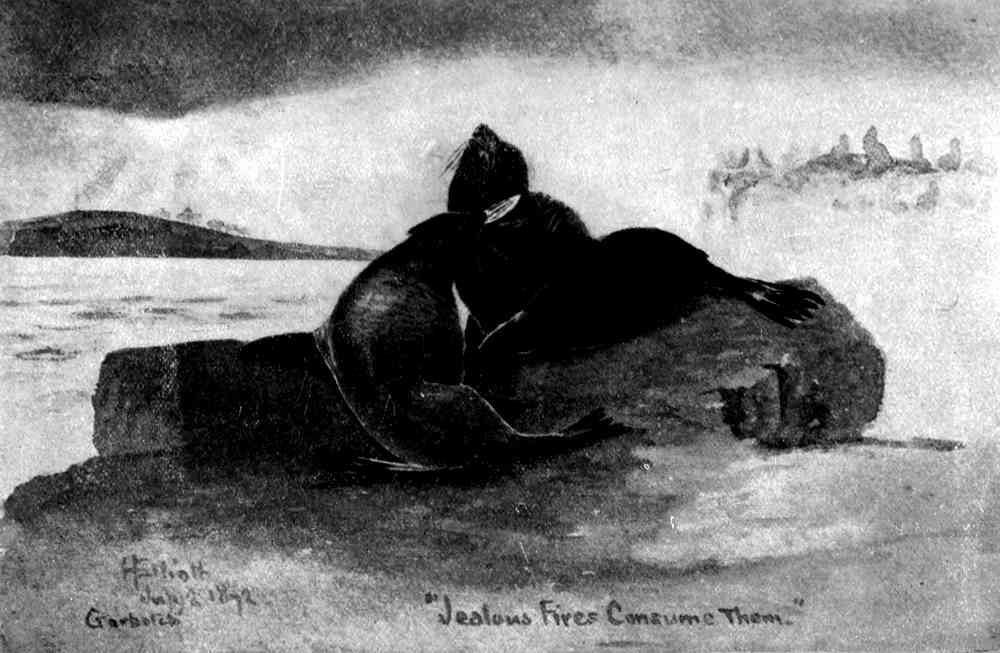
OLD BULLS FIGHTING
Fur Seals in Deadly Combat: a Thousand such Conflicts are in simultaneous Action during every Minute of the Breeding Season on the Pribylov Islands
That period occupied by the males in taking and holding their positions on a rookery offers a very favorable opportunity to study them in the thousand and one different attitudes and postures assumed between the two extremes of desperate conflict and deep sleep—sleep so profound that one can, if he keeps to the leeward, approach close enough, stepping softly, to pull the whiskers of any old male taking a nap on a clear place. But after the first touch to these mustaches the trifler must jump back with electrical celerity, if he has any regard for the sharp teeth and tremendous shaking which will surely overtake him if he does not. The younger seals sleep far more soundly than the old ones, and it is a favorite pastime for the natives to surprise them in this manner—favorite, because it is attended with no personal risk. The little beasts, those amphibious sleepers, rise suddenly, and fairly shrink to the earth, spitting and coughing out in their terror and confusion.
The neck, chest, and shoulders of a fur-seal bull comprise more than two-thirds of his whole weight; and in this long, thick neck and the powerful muscles of the fore-limbs and shoulders is embodied the larger portion of his strength. When on land, with the fore-hands he does all climbing over rocks and grassy hummocks back of the rookery, or shuffles his halting way over smooth parades—the hind-feet are gathered up as useless trappings after every second step forward, which we have described at the outset of this chapter. These anterior flippers are also the propelling power when in water, and exclusive machinery with which they drive their rapid passage—the hinder ones float behind like the steering sweep to a whale-boat, and are used evidently as rudders, or as the tail of a bird is, while its wings sustain and force its rapid flight.
The covering to its body is composed of two coats, one being a short, crisp, glistening over-hair, and the other a close, soft, elastic pelage or fur, which gives a distinctive value to the pelt. I can call it readily to the mind of my readers when I say to them that the down and feathers on the breast of a duck lie relatively as the fur and hair do upon the skin of the seal.
At this season of first “hauling up”[112] in the spring the prevailing color of the bulls, after they dry off and have been exposed to the weather, is a dark, dull brown, with a sprinkling in it of lighter brown-black, and a number of hoary or grizzled gray coats peculiar to the very old males. On the shoulders of all of them—that is, the adults—the over-hair is either a gray or rufous-ochre or a very emphatic “pepper and salt.” This is called the “wig.” The body-colors[113] are most intense and pronounced upon the back of the head, neck, and spine, fading down on the flanks lighter, to much lighter ground on the abdomen; still never white or even a clean gray, so beautiful and peculiar to them when young, and to the females. The skin of the muzzle and flippers is a dark bluish-black, fading in the older examples to a reddish and purplish tint. The color of the ears and tail is similar to that of the body, perhaps a trifle lighter. The ears on a bull fur-seal are from one inch to an inch and a half in length. The pavilions or auricles are tightly rolled up on themselves, so that they are similar in shape to and exactly the size of the little finger on the human hand, cut off at the second phalangeal joint—a trifle more cone-shaped, however—as they are greater at the base than they are at the tip. They are haired and furred as the body is.
I think it probable that this animal is able to and does exert the power of compressing or dilating this scroll-like pavilion to its ear, just according as it dives deeper or rises in the water, and also I am quite sure that the hair-seal has this control over its meatus externus, from what I have seen of it. I have not been able to verify it in either case by actual observation; yet such opportunity as I have had gives me undoubted proof of the fact that the hearing of a fur-seal is wonderfully keen and surpassingly acute. If you make any noise, no matter how slight, an alarm will be given instantly by these insignificant-looking auditors, and the animal, awaking from profound sleep, assumes, with a single motion, an erect posture, gives a stare of stupid astonishment, at the same time breaking out into incessant, surly roaring, growling, and “spitting,” if it be an old male.
This spitting, as I call it, is by no means a fair or full expression of a most characteristic sound or action, so far as I have observed, peculiar to fur-seals alone, the bulls in particular. It is the usual prelude to all their combats, and it is their signal of astonishment. It follows somewhat in this way: when the two disputants are nearly within reaching or striking distance, they make a number of feints or false passes, as fencing-masters do, at one another, with the mouth wide open, lifting the lips or snarling so as to exhibit their glistening teeth; with each pass of the head and neck they expel the air so violently through the larynx as to cause a rapid choo-choo-choo sound, like steam-puffs as they escape from the smoke-stack of a locomotive when it starts a heavy train, especially while the driving-wheels slip on the rail.
All of the bulls have the power and frequent inclination to utter four distinct calls or notes. This is not the case with the sea-lion, whose voice is confined to a single bass roar, or that of the walrus, which is limited to a dull grunt, or that of the hair-seal, which is almost inaudible. This volubility of the adult male is decidedly characteristic and prominent. He utters a hoarse, resonant roar, loud and long; he gives vent to a low, entirely different gurgling growl; he emits a chuckling, sibilant, piping whistle, of which it is impossible to convey an adequate idea, for it must be heard to be understood, and this spitting or choo sound just mentioned. The cow[114] has but one note—a hollow, prolonged, bla-a-ting call, addressed only to her pup: on all other occasions she is usually silent; it is something strangely like the cry of a calf or an old sheep. She also makes a spitting sound or snort when suddenly disturbed—a kind of cough, as it were. The pups “blaat” also, with little or no variation, their sound being somewhat weaker and hoarser after birth than their mother’s. They, too, comically spit or cough when aroused suddenly from a nap or driven into a corner, opening their little mouths (like young birds in a nest) when at bay, backed up in some crevice or against grassy tussocks.
Indeed, so similar is that call of the female to the bleating of sheep that a number of the latter, which the Alaska Commercial Company had brought up from San Francisco to St. George Island during the summer of 1873, were constantly attracted to the rookeries, and were running in among the “holluschickie” so much that they neglected better pasturage on the uplands beyond, and a small boy had to be regularly employed to herd them where they would feed to advantage. These transported Ovidæ, though they could not possibly find anything in their eyes suggestive of companionship among the seals, had their ears so charmed by those sheep-like accents of the female pinnipeds as to persuade them in spite of their senses of vision and smell.
The sound which arises from these great breeding grounds of the fur-seal, where thousands upon tens of thousands of angry, vigilant bulls are roaring, chuckling, and piping, and multitudes of seal-mothers are calling in hollow, bleating tones to their young, that in turn respond incessantly, is simple defiance to verbal description. It is, at a slight distance, softened into a deep booming, as of a cataract; and I have heard it, with a light, fair wind to the leeward, as far as six miles out from land on the sea; even in the thunder of the surf and the roar of heavy gales, it will rise up and over to your ear for quite a considerable distance away. It is a monitor which the sea-captains anxiously strain their ears for, when they run their dead reckoning up, and are lying to for the fog to rise, in order that they may get their bearings of the land. Once heard, they hold on to the sound, and feel their way in to anchor. The seal-roar at “Novastoshnah” during the summer of 1872 saved the life of a surgeon,[115] and six natives belonging to the village, who had pushed out on an egging trip from Northeast Point to Walrus Island. I have sometimes thought, as I have listened all night long to this volume of extraordinary sound, which never ceases with the rising or the setting of the sun throughout the entire period of breeding, that it was fully equal to the churning boom of the waves of Niagara. Night and day, belonging to that season, vibrates with this steady and constant din upon the rookeries.
Fur-seals Scratching Themselves.
[Off the Black Bluffs, St. Paul’s Island.]
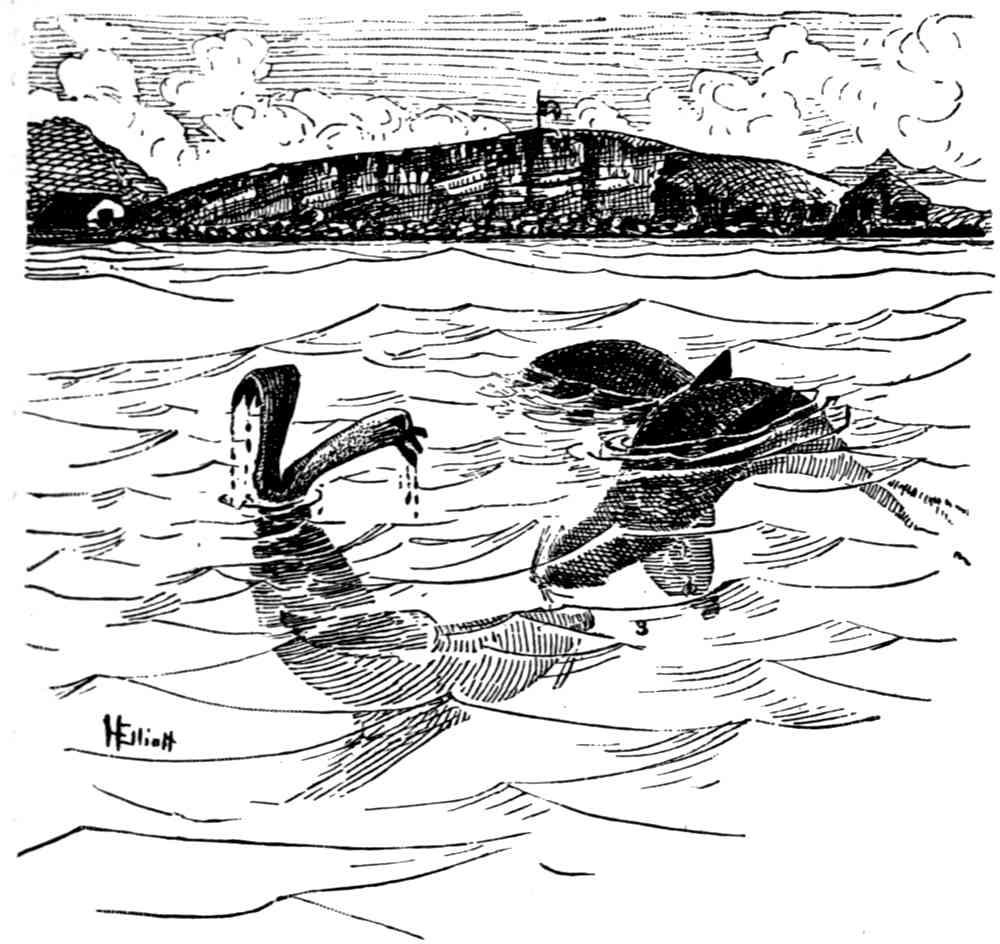
The most casual observer will notice that these seals seem to suffer great inconvenience and positive misery from a comparatively low degree of heat I have often been surprised to observe that, when the temperature was 46° and 48° Fahr. on land during the summer, they would show everywhere signs of distress, whenever they made any exertion in moving or fighting, evidenced by panting and the elevation of their hind flippers, which they used incessantly as so many fans. With the thermometer again higher, as it is at rare intervals, standing at 55° and 60°, they are then oppressed even when at rest; and at such times the eye is struck by the kaleidoscopic appearance of a rookery—in any of these rookeries where the seals are spread out in every imaginable position their lithesome bodies can assume, all industriously fan themselves: they use sometimes the fore flippers as ventilators, as it were, by holding them aloft motionless, at the same time fanning briskly with the hinder ones, according as they sit or lie. This wavy motion of fanning or flapping gives a hazy indistinctness to the whole scene, which is difficult to express in language; but one of the most prominent characteristics of the fur-seal, and perhaps the most unique feature, is this very fanning manner in which they use their flippers, when seen on the breeding grounds at this season. They also, when idle, as it were, off-shore at sea, lie on their sides in the water with only a partial exposure of the body, the head submerged, and then hoist up a fore or hind flipper clear out of the water, at the same time scratching themselves or enjoying a momentary nap; but in this position there is no fanning. I say “scratching,” because the seal, in common with all animals, is preyed upon by vermin, and it has a peculiar species of louse, or parasitic tick, which annoys it.
Speaking of seals as they rest in the water leads me to remark that they seem to sleep as sound and as comfortably, bedded on the waves or rolled by the swell, as they do on the land. They lie on their backs, fold the fore flippers down across the chest, and turn the hind ones up and over, so that the tips rest on their necks and chins, thus exposing simply the nose and the heels of the hind flippers above water, nothing else being seen. In this position, unless it is very rough, the seal sleeps as serenely as did the prototype of that memorable song, who was “rocked in the cradle of the deep.”
All the bulls, from the very first, that have been able to hold their positions, have not left them from the moment of their landing for a single instant, night or day; nor will they do so until the end of the rutting season, which subsides entirely between August 1st and 10th—it begins shortly after the coming of the cows in June. Of necessity, therefore, this causes them to fast, to abstain entirely from food of any kind, or water, for three months at least; and a few of them actually stay out four months, in total abstinence, before going back into the ocean for the first time after “hauling up” in May. They then return as so many bony shadows of what they were only a few months previously; covered with wounds, abject and spiritless, they laboriously crawl back to the sea to renew a fresh lease of life.
Such physical endurance is remarkable enough alone; but it is simply wonderful when we come to associate this fasting with the unceasing activity, restlessness, and duty devolved upon the bulls as the heads of large families. They do not stagnate like hibernating bears in caves; there is not one torpid breath drawn by them in the whole period of their fast. It is evidently sustained and accomplished by the self-absorption of their own fat, with which they are so liberally supplied when they first come out from the sea and take up their positions on the breeding grounds, and which gradually disappears, until nothing but the staring hide, protruding tendons and bones mark the limit of their abstinence. There must be some remarkable provision made by nature for the entire torpidity of the seals’ stomachs and bowels, in consequence of their being empty and unsupplied during this long period, coupled with the intense activity and physical energy of the animals throughout that time, which, however, in spite of the violation of a supposed physiological law, does not seem to affect them, for they come back just as sleek, fat, and ambitious as ever, in the following season. That the seals drink or need fresh water, I doubt; but they cool their mouths incessantly by swimming with them wide open through the waves, laving as it were their hot throats and lips in the flood.[116]
Between June 12th and 14th, the first of the cow-seals, as a rule, come up from the sea; then that long agony of the waiting bulls is over, and they signalize it by a period of universal, spasmodic, desperate fighting among themselves. Though they have quarrelled all the time from the moment they first landed, and continue to do so until the end of the season, in August, yet that fighting which takes place at this date is the bloodiest and most vindictive known to the seal. I presume that the heaviest percentage of mutilation and death among the old males from these brawls, occur in this week of the earliest appearance of the females.
A strong contrast now between the males and females looms up, both in size and shape, which is heightened by an air of exceeding peace and dove-like amiability which the latter class exhibit, in contradistinction to the ferocity and saturnine behavior of the former.[117] The cows are from four to four and a half feet in length from head to tail, and much more shapely in their proportions than the bulls; there is no wrapping around their necks and shoulders of unsightly masses of blubber; their lithe, elastic forms, from the first to the last of the season, are never altered; they are, however, enabled to keep such shape, because, in the provision of seal economy, they sustain no protracted fasting period; for, soon after the birth of their young they leave it on the ground and go to the sea for food, returning perhaps to-morrow, may be later, or even not for several days in fact, to again suckle and nourish it; having in the meantime sped far off to distant fishing banks, and satiated a hunger which so active and highly organized an animal must experience, when deprived of sustenance for any length of time.
As the females come up wet and dripping from the water, they are at first a dull, dirty-gray color, dark on the back and upper parts, but in a few hours the transformation in their appearance made by drying is wonderful. You would hardly believe that they could be the same animals, for they now fairly glisten with a rich steel and maltese gray lustre on the back of the head, the neck, and along down the spine, which blends into an almost snow-white over the chest and on the abdomen. But, this beautiful coloring in turn is again altered by exposure to the same weather; for, after a few days it will gradually change, so that by the lapse of two or three weeks it is a dull, rufous-ochre below, and a cinereous brown and gray mixed above. This color they retain throughout the breeding season, up to the time of shedding their coats in August.
The head and eye of the female are exceedingly beautiful; the expression is really attractive, gentle, and intelligent; the large, lustrous, blue-black eyes are humid and soft with the tenderest expression, while the small, well-formed head is poised as gracefully on her neck as can be well imagined; she is the very picture of benignity and satisfaction, when she is perched up on some convenient rock, and has an opportunity to quietly fan herself, the eyes half-closed and the head thrown back on her gently-swelling shoulders.
The females land on these islands, not from the slightest desire to see their uncouth lords and masters, but from an accurate and instinctive appreciation of the time in which their period of gestation ends. They are in fact driven up to the rookeries by this cause alone; the young cannot be brought forth in the water, and, in all cases marked by myself, the pups were born soon after landing, some in a few hours, but, most usually, a day or so elapses before delivery. They are noticed and received by the males at the water-line stations with attention; they are alternately coaxed and urged up on to the rocks, as far as these beach-masters can do so, by chuckling, whistling, and roaring, and then they are immediately under the most jealous supervision; but, owing to the covetous and ambitious nature of those bulls which occupy these stations to the rear of the water-line and away back, the little cows have a rough-and-tumble time of it, when they begin to arrive in small numbers at first; for no sooner is the pretty animal fairly established on the station of male number one, who has welcomed her there, than he, perhaps, sees another one of her style in the water from whence she has come, and, in obedience to his polygamous feeling, devotes himself anew to coaxing the later arrival, by that same winning manner so successful in the first case; then when bull number two, just back, observes bull number one off guard, he reaches out with his long strong neck and picks up the unhappy but passive cow by the scruff of hers, just as a cat does a kitten, and deposits her upon his seraglio ground; then bulls number three and four, and so on, in the vicinity, seeing this high-handed operation, all assail one another, especially number two, and for a moment have a tremendous fight, perhaps lasting half a minute or so, and during this commotion the little cow is generally moved, or moves, farther back from the water, two or three stations more, where, when all gets quiet again, she usually remains in peace. Her last lord and master, not having that exposure to such diverting temptation as her first, gives her such care that she not only is unable to leave, did she wish, but no other bull can seize upon her: this is only a faint and (I fully appreciate it) wholly inadequate description of the hurly-burly and that method by which the rookeries are filled up, from first to last, when the females arrive—it is only one instance of the many trials and tribulations which both parties on the rookery subject themselves to, before the harems are filled.[118]
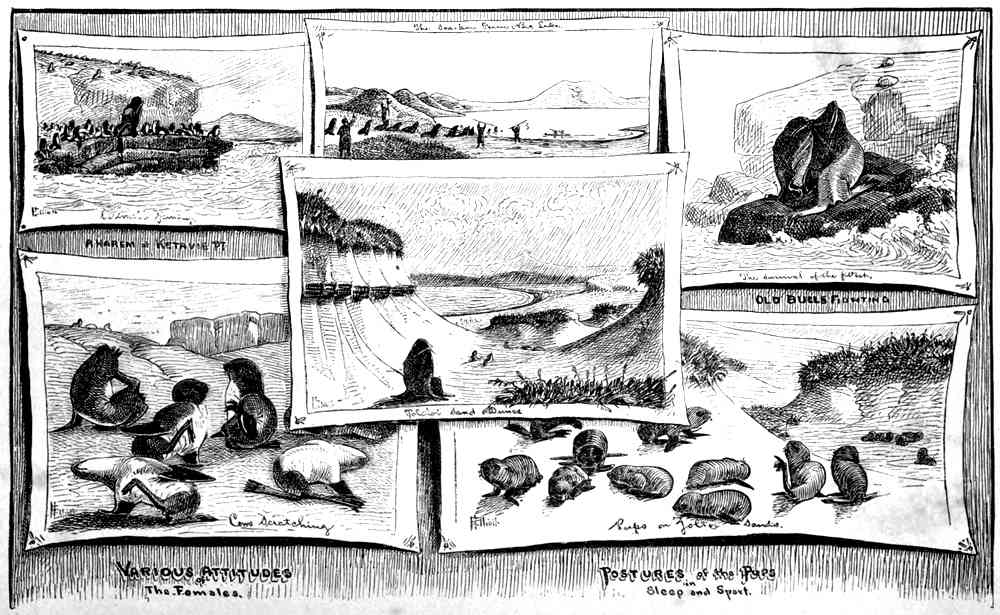
SUNDRY SEAL SKETCHES FROM THE AUTHOR’S PORTFOLIO
On St. Paul’s Island, 1872-’76
Far back, fifteen or twenty “see-catchie” stations deep from the water-line, and sometimes more, but generally not over an average of ten or fifteen, the cows crowd in at the close of the season for arriving, which is by July 10th or 14th; then they are able to go about very much as they please, for the bulls have become so greatly enfeebled by this constant fasting, fighting, and excitement during the past two months, that they are quite content now with only one or two partners, even if they should have no more.
The cows seem to haul up in compact bodies from the water, covering in the whole ground to the rear of the rookeries, never scattering about over the surface of this area; they have mapped out, from the first, their chosen resting-places, and they will not lie quietly in any position outside of the great mass of their kind. This is due to their intensely gregarious nature, and is especially adapted for their protection. And here I should call attention to the fact that they select this rookery ground with all the skill of civil engineers. It is preferred with special reference to drainage, for it must slope so that the produce of constantly dissolving fogs and rain-clouds shall not lie upon it, since they have a great aversion to, and a firm determination not to rest on water-puddled ground. This is admirably exhibited, and will be understood by a study of my sketch-maps which follow, illustrative of these rookeries and the area and position of the seals upon them. Every one of those breeding grounds rises up gently from the sea, and on no one of them is there anything like a muddy flat.
I found it an exceedingly difficult matter to satisfy myself as to a fair general average number of cows to each bull on the rookery, but, after protracted study, I think it will be nearly correct when I assign to each male a specific ratio of from fifteen to twenty females at the stations nearest the water, and for those back, in order, from that line to the rear, from five to twelve; but there are many exceptional cases, and many instances where forty-five and fifty females are all under the charge of one male: and then, again, where there are only two or three females: hence this question was and is not entirely satisfactory in its settlement to my mind.
Near Ketavie Point, and just above it to the north, is an odd wash-out of basalt by the surf, which has chiselled, as it were, from the foundation of the island, a lava table, with a single roadway or land passage to it. Upon the summit of this footstool I counted forty-five cows, all under the charge of one old veteran. He had them penned on this table-rock by taking his stand at the gate, as it were, through which they passed up and passed down—a Turkish brute typified.
At the rear of all these rookeries there is invariably a large number of able-bodied males which have come late, and wait patiently, yet in vain, for families; most of them having had to fight as desperately for the privilege of being there as any of their more fortunately located neighbors, who are nearer the water, and in succession from there to where they are themselves; but the cows do not like to be in any outside position. They cannot be coaxed out where they are not in close company with their female mates and masses. They lie most quietly and contentedly in the largest harems, and cover the surface of the ground so thickly that there is hardly moving or turning room when they cease to come from the sea. The inaction on the part of those males in the rear during the breeding season only serves to well qualify them for moving into the places which are necessarily vacated by disabled males that are, in the meantime, obliged to leave from virile exhaustion, or incipient wounds. All the surplus able-bodied bulls, which have not been successful in effecting a landing on the rookeries cannot be seen at any one time, however, in the season, on this rear line. Only a portion of their number are in sight; the others are either loafing at sea, adjacent, or are hauled out in morose squads between the rookeries on the beaches. The cows, during the whole season, do great credit to their amiable expression by their manner and behavior on the rookery. They never fight or quarrel one with another, and never or seldom utter a cry of pain or rage when they are roughly handled by the bulls, which frequently get a cow between them and actually tear the skin from her back with their teeth, cutting deep gashes in it as they snatch her from mouth to mouth. If sand does not get into these wounds it is surprising how rapidly they heal; and, from the fact that I never could see scars on them anywhere except the fresh ones of this year, they must heal effectually and exhibit no trace the next season.
The cows, like the bulls, vary much in weight, but the extraordinary disparity in the adult size of the sexes is exceedingly striking. Two females taken from the rookery nearest to St. Paul village, right under the bluffs (and almost beneath the eaves of the natives’ houses) called “Nah Speel,” after they had brought forth their young, were weighed by myself, and their respective returns on the scales were fifty-six and one hundred pounds each; the former being about three or four years old, and the latter over six—perhaps ten. Both were fat, or rather, in good condition—as good as they ever are. Thus the female is just about one-sixth the size of the male. Among the sea-lions the proportion is just one-half the bulk of the male, while the hair-seals, as I have before stated, are not distinguishable in this respect, as far as I could observe, but my notice was limited to a few specimens only.
The courage with which the fur-seal holds his position as the head and guardian of a family is of the highest order. I have repeatedly tried to drive them from their harem-posts, when they were fairly established on their stations, and have, with very few exceptions, failed. I might use every stone at my command, making all the noise I could. Finally, to put this courage to its fullest test, I have walked up to within twenty feet of an old veteran, toward the extreme end of Tolstoi, who had only four cows in charge, and commenced with my double-barrelled fowling-piece to pepper him all over with fine mustard-seed shot, being kind enough, in spite of my zeal, not to put out his eyes. His bearing, in spite of the noise, smell of powder, and painful irritation which the fine shot must have produced, did not change in the least from the usual attitude of determined, plucky defence (which nearly all of the bulls assume) when he was attacked with showers of stones and noise. He would dart out right and left with his long neck and catch the timid cows that furtively attempted to run after each report of my gun, fling and drag them back to their places under his head; and then, stretching up to his full height, look me directly and defiantly in the face, roaring and chuckling most vehemently. The cows, however, soon got away from him: they could not endure my racket, in spite of their dread of him. But he still stood his ground, making little charges on me of ten or fifteen feet in a succession of gallops or lunges, spitting furiously, and then comically retreating, with an indescribable leer and swagger, to the old position, back of which he would not go, fully resolved to hold his own or die in the attempt.
This courage is all the more noteworthy from the fact that, in regard to man, it is invariably of a defensive character. The seal is always on the defensive; he never retreats, and he will not assail. If he makes you return when you attack him he never follows you much farther than the boundary of his station, and then no aggravation will compel him to take the offensive, so far as I have been able to observe. I was very much impressed by this trait.
It is quite beyond my power—indeed, entirely out of the question—to give a fair idea of the thousand and one positions in which seals compose themselves and rest when on land. They may be said to assume every possible attitude which a flexible body can be put into, no matter how characteristic or seemingly forced or constrained. Their joints seem to be double-hinged—in fact, fitted with ball and socket union of the bones. One favorite position, especially with the females, is to perch upon a point or edge-top of some rock, and throw their heads back upon their shoulders, with the nose held directly up and aloft; and then, closing their eyes, take short naps without changing their attitude, now and then softly lifting one or the other of their long, slender hind flippers, which they slowly wave with that peculiar fanning motion to which I have alluded heretofore. Another attitude, and one of the most common, is to curl themselves up just as a dog does on a hearth-rug, bringing the tail and nose close together. They also stretch out, laying the head close to the body, and sleep an hour or two without rising, holding one of the hind flippers up all the time, now and then gently moving it, the eyes being tightly closed.
I ought, perhaps, to define the anomalous tail of the fur-seal here. It is just about as important as the caudal appendage to a bear; even less significant. It is the very emphasis of abbreviation. In the old males it is positively only four or five inches in length, while among the females only two and a half to three inches, wholly inconspicuous, and not even recognized by the casual observer: they never wag or move it at all.
I come now to speak of another feature which interested me nearly, if not quite, as much as any other characteristic of this creature, and that is their fashion of slumber. The sleep of the fur-seal, seen on land, from the old male down to the youngest, is always accompanied by an involuntary, nervous, muscular twitching and slight shifting of the flippers, together with ever and anon quivering and uneasy rollings of the body, accompanied by a quick folding anew of the fore flippers; all of which may be signs, as it were, in fact, of their simply having nightmares, or of sporting, in a visionary way, far off in some dreamland sea. But, it may be that as an old nurse said in reference to the smiles on a sleeping child’s face, they are disturbed by their intestinal parasites. I have studied hundreds of such somnolent examples. Stealing softly up so closely that I could lay my hand upon them from the point where I was sitting, did I wish to, and watching the sleeping seals, I have always found their sleep to be of this nervous description. The respiration is short and rapid, but with no breathing (unless the ear is brought very close). The quivering, heaving of the flanks only indicates the action of the lungs. I have frequently thought that I had succeeded in finding a snoring seal, especially among the pups; but a close examination always gave some abnormal reason for it—generally a slight distemper; never anything more severe, however, than some trifle by which the nostrils were stopped to a greater or less degree.
The cows on the rookeries sleep a great deal, but the bulls have the veriest cat-naps that can be imagined. I never could time the slumber of any old male on the breeding grounds which lasted, without interruption, longer than five minutes, day or night. While away from these places, however, I have known them to lie sleeping in the manner I have described, broken by such fitful, nervous, dreamy starts, yet without opening the eyes, for an hour or so at a time.
With an exception of the pups, the fur-seal seems to have very little rest, awake or sleeping. Perpetual motion is well-nigh incarnate with its being. I naturally enough, when beginning my investigation of these seal-rookeries, expected to find the animals subdued at night, or early morning, on those breeding grounds; but a few consecutive nocturnal watches satisfied me that the family organization and noise was as active at one time as at another, throughout the whole twenty-four hours. If, however, the day preceding had chanced to be abnormally warm, I never failed then to find the rookeries much more noisy and active during the night than they were by daylight. The seals, as a rule, come and go to and from the sea, fight, roar, and vocalize as much during midnight moments as they do at noonday times. An aged native endeavored to satisfy me that the “seecatchie” could see much better by twilight and night than by daylight. I am not prepared to prove to the contrary, but I think that the fact of his not being able to see so well himself at that hour of darkness was a true cause of most of his belief in the improved nocturnal vision of the seals.[119]
As I have said before, the females, soon after landing, are delivered of their young. Immediately after the birth of the pup (twins are rare, if ever) the little creature finds its voice—a weak, husky blaat—and begins to paddle about with its eyes wide open from the start, in a confused sort of way for a few minutes, until the mother turns round to notice her offspring and give it attention, and still later, to suckle it; and for this purpose she is supplied with four small, brown nipples, almost wholly concealed in the fur, and which are placed about eight inches apart, lengthwise with the body, on the abdomen, between the fore and hind flippers, with about four inches of space between them transversely. These nipples are seldom visible, and then faintly seen through the hair and fur. The milk is abundant, rich, and creamy. The pups nurse very heartily, almost gorging themselves; so much so, that they often have to yield up the excess of what they have taken down, mewling and puking in a most orthodox manner.
The pup at birth, and for the next three months, is of a jet-black color, hair and flippers, save a tiny white patch just back of each forearm. It weighs from three to four pounds, and is twelve to fourteen inches long. It does not seem to nurse more than once every two or three days; but in this I am very likely mistaken, for it may have received attention from its mother in the night, or other times in the day when I was unable to keep up my watch over the individual which I had marked for this supervision.
The apathy with which the young are treated by the old on the breeding grounds, especially by the mothers, was very strange to me, and I was considerably surprised at it. I have never seen a seal-mother caress or fondle her offspring; and should it stray to a short distance from the harem, I could step to and pick it up, and even kill it before the mother’s eye, without causing her the slightest concern, as far as all outward signs and manifestations should indicate. The same indifference is also exhibited by the male to all that may take place of this character outside of the boundary of his seraglio; but the moment the pups are inside the limits of his harem-ground he is a jealous and a fearless protector, vigilant and determined. But if the little animals are careless enough to pass beyond this boundary, then I can go up to them and carry them off before the eye of the old Turk without receiving from him the slightest attention in their behalf—a curious guardian, forsooth!
It is surprising to me how few of these young pups get crushed to death while the ponderous bulls are floundering over them, engaged in fighting and quarrelling among themselves. I have seen two bulls dash at each other with all the energy of furious rage, meeting right in the midst of a small “pod” of forty or fifty pups, tramp over them with all their crushing weight, and bowling them out right and left in every direction by the impetus of their movements, without injuring a single one, as far as I could see. Still, when we come to consider the fact that, despite the great weight of the old males, their broad, flat flippers and yielding bodies may press down heavily on these little fellows without actually breaking bones or mashing them out of shape, it does seem questionable whether more than one per cent. of all the pups born each season on these great rookeries of the Pribylov Islands are destroyed in this manner on the breeding grounds.[120]
The vitality of a fur-seal is simply astonishing. Its physical organization passes beyond the fabled nine lives of the cat. As a slight illustration of its tenure of life, I will mention the fact that one morning Philip came to me with a pup in his arms, which had just been born and was still womb-moist, saying that the mother had been killed at Tolstoi by accident, and he supposed that I would like to have a “choochil.” I took it up into my laboratory, and, finding that it could walk about and make a great noise, I attempted to feed it, with the idea of having a comfortable subject to my pencil for life-study of the young in varied attitudes of sleep and motion. It refused everything that I could summon to its attention as food, and, alternately sleeping and walking in its clumsy fashion about the floor; it actually lived nine days, spending the half of every one in floundering over the floor, accompanying all movements with a persistent, hoarse, blasting cry, and I do not believe it ever had a single drop of its mother’s milk.
In a pup the head is the only disproportionate feature at birth when it is compared with an adult form, the neck being also relatively shorter and thicker. The eye is large, round, and full; but, almost a “navy blue” at times, it soon changes into the blue-black of adolescence.
The females appear to go to and come from the water feeding and bathing quite frequently after bearing their young and an immediate subsequent coitus with the male: they usually return to the spot or its immediate neighborhood, where they leave their pups, crying out for them and recognizing the individual replies; though ten thousand around, all together, should blaat at once, they quickly single out their own and nurse them. It would certainly be a very unfortunate matter if the mothers could not identify their young by sound, since these pups get together like a great swarm of bees, and spread out upon the ground in what the sealers call “pods,” or clustered groups, while they are young and not very large; thus, from the middle or end of September until they leave the islands for the dangers of the great Pacific in the winter, along by the first of November, they gather in this manner, sleeping and frolicking by tens of thousands, bunched together at various places all over the islands contiguous to the breeding grounds, and right on them. A mother comes up from the sea, whither she has been to wash, and perhaps to feed, for the last day or two, feeling her way along to about where she thinks her pup should be—at least, where she left it last; but perhaps she misses it, and finds instead a swarm of pups in which it has been incorporated, owing to its great fondness for society. The mother, without first entering into a crowd of thousands, calls just as a sheep does for a lamb, and out of all the din she—if not at first, at the end of a few trials—recognizes the voice of her offspring, and then advances, striking out right and left toward the position from which it replies; but if the pup happens at this time to be asleep, it gives, of course, no response, even though it were close by. In the event of such silence the cow, after calling for a time without being answered, curls herself up and takes a nap or lazily basks, to be usually more successful, or wholly so, when she calls again.
The pups themselves do not know their own mothers, a fact which I ascertained by careful observation; but they are so constituted that they incessantly cry out at short intervals during the whole time they are awake, and in this way the mother can pick out from the monotonous blaating of thousands of pups her own, and she will not permit any other one to suckle her. But the “kotickie” themselves attempt to nose around every seal-mother that comes in contact with them. I have repeatedly watched young pups as they made advances to nurse from another pup’s mother, the result invariably being that, while the “matkah” would permit her own offspring to suckle freely, yet when these little strangers touched her nipples she would either move abruptly away or else turn quickly down upon her stomach, so that the maternal fountains were inaccessible to alien and hungry “kotickie.” I have witnessed so many examples of the females turning pups away to suckle only some particular other one, that I feel sure I am entirely right in saying that the seal-mothers know their own young, and that they will not permit any others except them to nurse. I believe that this maternal recognition is due chiefly to the mother’s scent and hearing.
Between the end of July and August 5th or 8th of every year the rookeries are completely changed in appearance. The systematic and regular disposition of the families or harems over the whole extent of breeding-ground has disappeared. All that clock-work order which has heretofore existed seems to be broken up. The breeding season closed, those bulls which have held their positions since May 1st leave, most of them thin in flesh and weak, and of their number a very large proportion do not come out again on land during the season; but such as are seen at the end of October and November are in good shape. They have a new coat of rich, dark, gray-brown hair and fur, with gray or grayish-ochre “wigs” of longer hair over the shoulders, forming a fresh, strong contrast to the dull, rusty, brown and umber dress in which they appeared to us during the summer, and which they had begun to shed about August 1st, in common with the females and the “holluschickie.” After these males leave at the end of their season’s work, and of the rutting for the year, those of them that happen to return to land in any event do not come back until the end of September and do not haul up on the rookery grounds again. As a rule, they prefer to herd altogether, like younger males, upon the sand-beaches and rocky points close to the water.
The cows and pups, together with those bulls which we have noticed in waiting at the rear of the rookeries, and which have been in retirement throughout the whole of the breeding season, now take possession, in a very disorderly manner, of these rookeries; also, a large number of young, three, four, and five year old males come, which have been prevented by the menacing threats of stronger bulls from an earlier landing among the females during the breeding season.
Before the middle of August three-fourths, at least, of the cows at this date are off in the water, only coming ashore at irregular intervals to nurse and look after their pups a short time. They presented to my eye, from the summits of the bluffs round about, a picture more suggestive of entire comfort and enjoyment than anything I have ever seen presented by animal life. Here, just out and beyond the breaking of the rollers, they idly lie on the rocks or sand-beaches, ever and anon turning over and over, scratching their backs and sides with their fore and hind flippers. The seals on the breeding ground appear to get very lousy.[121]
Frequent winds and showers will drive and spatter sand into their fur and eyes, often making the latter quite sore. This occurs when they are obliged to leave the rocky rookeries and follow their pups out over the sand-ridges and flats, to which they always have a natural aversion. On the hauling-grounds they pack the soil under their feet so hard and tightly in many places that it holds water in shallow surface-depressions, just like so many rock-basins. Out of and into these puddles the pups and the females flounder and patter incessantly, until evaporation slowly abates the nuisance for a time only, inasmuch as the next day, perhaps, brings more rain and the dirty pools are replenished.
The pups sometimes get so thoroughly plastered in these muddy, slimy puddles, that the hair falls off in patches, giving them, at first sight, the appearance of being troubled with scrofula or some other plague: from my investigations directed to this point, I became satisfied that they were not permanently injured, though evidently very much annoyed. With reference to this suggestion as to sickness or distemper among these seals, I gave the subject direct and continued attention, and in no one of the rookeries could I discover a single seal, no matter how old or young, which appeared to be suffering in the least from any physical disorder other than that which they themselves had inflicted, one upon the other, by fighting. The third season, passing directly under my observation, failed to reward my search with any manifestation of disease among the seals which congregate in such mighty numbers on those rookeries of St. Paul and St. George. That remarkable freedom from all such complaints enjoyed by these animals is noteworthy, and a most trenchant and penetrating cross-questioning of the natives also failed to give me any history or evidence of an epidemic in the past.
The observer will, however, notice every summer, gathered in melancholy squads of a dozen to one hundred or so (scattered along the coast where the healthy seals never go), those sick and disabled bulls which have, in the earlier part of the season, been either internally injured or dreadfully scarred by the teeth of their opponents in fighting. Sand is blown by strong wind into their fresh wounds, causing inflammation and sloughing which very often finishes the life of a victim. The sailors term these invalid gatherings “hospitals,” a phrase which, like the most of their homely expressions, is quite appropriate.
Early in August, usually by the 8th or 10th, I noticed one of the remarkable movements of the season. I refer to the pup’s first essay in swimming. Is it not odd—paradoxical—that the young seal, from the moment of his birth until he is a month or six weeks old, is utterly unable to swim? If he is seized by the nape of the neck and pitched out a rod into the water from shore, his bullet-like head will drop instantly below the surface, and his attenuated posterior extremities flap impotently on it. Suffocation is the question of only a few minutes, the stupid little creature not knowing how to raise his immersed head and gain the air again. After they have attained the age indicated above, their instinct drives them down to the margin of the surf, where an alternate ebbing and flowing of its wash, covers and uncovers the rocky or sandy beaches. They first smell and then touch the moist pools, and flounder in the upper wash of the surf, which leaves them as suddenly high and dry as it immersed them at first. After this beginning they make slow and clumsy progress in learning the knack of swimming. For a week or two, when overhead in depth, they continue to flounder about in the most awkward manner, thrashing the water as little dogs do with their fore feet, making no attempt whatever to use the hinder ones. Look at that pup now, launched out for the first time beyond his depth; see how he struggles—his mouth wide open, and his eyes fairly popping. He turns instantly to the beach, ere he has fairly struck out from the point whence he launched in, and, as the receding swell which at first carried him off his feet and out, now returning, leaves him high and dry, for a few minutes he seems so weary that he weakly crawls up, out beyond its swift returning wash, and coils himself immediately to take a recuperative nap. He sleeps a few minutes, perhaps half an hour, then awakes as bright as a dollar, apparently rested, and at his swimming lesson he goes again. By repeated and persistent attempts, this young seal gradually becomes familiar with the water and acquainted with his own power over that element, which is to be his real home and his whole support. Once boldly swimming, the pup fairly revels in a new happiness. He and his brethren have now begun to haul and swarm along the entire length of St. Paul coast, from Northeast Point down and around to Zapadnie, lining the alternating sand-beaches and rocky shingle with their chunky, black forms. How they do delight in it! They play with a zest, and chatter like our own children in the kindergartens—swimming in endless evolutions, twisting, turning, or diving—and when exhausted, drawing their plump, round bodies up again on the beach. Shaking themselves dry as young dogs would do, they now either go to sleep on the spot or have a lazy terrestrial frolic among themselves.
Why an erroneous impression ever got into the mind of any man as to this matter of a pup’s learning to swim, I confess that I am wholly unable to imagine. I have not seen any “driving” of the young pups into the water by the old ones, in order to teach them this process, as certain authors have positively affirmed. There is not the slightest supervision by the mother or father of the pup, from the first moment of his birth, in this respect, until he leaves for the North Pacific, full-fledged with amphibious power. At the close of the breeding season, every year, the pups are restlessly and constantly shifting back and forth over the rookery ground of their birth, in large squads, sometimes numbering thousands upon thousands. In the course of this change of position they all sooner or later come in contact with the sea; they then blunder into the water for the first time, in a most awkward, ungainly manner, and get out as quick as they can; but so far from showing any fear or dislike of this, their most natural element, as soon as they rest from their exertion they are immediately ready for a new trial, and keep at it, provided the sea is not too stormy or rough. During all this period of self-tuition they seem thoroughly to enjoy the exercise, in spite of their repeated and inevitable discomfitures at the beginning.
That “podding” of these young pups in the rear of the great rookeries of St. Paul, is one of the most striking and interesting phases of this remarkable exhibition of highly-organized life. When they first bunch together they are all black, for they have not begun to shed the natal coat; they shine with an unctuous, greasy reflection, and grouped in small armies or great regiments on the sand-dune tracts at Northeast Point, they present a most extraordinary and fascinating sight. Although the appearance of the “holluschickie” at English Bay fairly overwhelms the observer with an impression of its countless multitudes, yet I am free to declare that at no one point in this evolution of the seal-life, during its reproductive season, have I been so deeply impressed by a sense of overwhelming enumeration, as I have when, standing on the summit of Cross Hill, I looked down to the southward and westward over a reach of six miles of alternate grass and sand-dune stretches, mirrored upon which were hundreds of thousands of these little black pups, spread in sleep and sport within this restricted field of vision. They appeared as countless as the grains of that sand upon which they rested!
By September 15th, all the pups born during the year have become familiar with the water; they have all learned to swim, and are now nearly all down by the water’s edge, skirting in large masses the rocks and beaches hitherto unoccupied by seals of any class this year. Now they are about five or six times their original weight, or, in other words, they are thirty to forty pounds avoirdupois, as plump and fat as butter-balls, and they begin to take on their second coat, shedding their black pup-hair completely. This second coat does not vary in color, at this age, between the sexes. They effect such transformation in dress very slowly, and cannot, as a rule, be said to have ceased their moulting until the middle or 20th of October.
That second coat, or sea-going jacket, of the pup, is a uniform, dense, light gray over-hair, with an under-fur which is slightly grayish in some, but is, in most cases, of a soft light brown hue. The over-hair is fine, close and elastic, from two-thirds of an inch to an inch in length, while the fur is not quite half an inch long. Thus the coarser hair shingles over and conceals the soft under-wool completely, giving the color by which, after the second year, the sex of the animal is recognized. A pronounced difference between the sexes is not effected, however, by color alone until the third year of the animal’s life. This over-hair of the pup’s new jacket on its back, neck, and head, is a dark chinchilla-gray, blending into stone-white, just tinged with a grayish tint on the abdomen and chest. The upper lip, upon which the whiskers or mustaches take root, is covered with hair of a lighter gray than that of the body. This mustache consists of fifteen or twenty longer or shorter bristles, from half an inch to three inches in length, some brownish, horn-colored, and others whitish-gray and translucent, on each side and back and below the nostrils, leaving the muzzle quite prominent and hairless. The nasal openings and their surroundings are, as I have before said when speaking of this feature, hairless and similar to those of a dog.[122]
The most attractive feature about the fur-seal pup, and that which holds this place as it grows on and older, is the eye. That organ is exceedingly clear, dark, and liquid, with which, for beauty and amiability, together with real intelligence of expression, those of no other animal that I have ever seen, or have ever read of, can be compared; indeed, there are few eyes in the orbits of men and women which suggest more pleasantly the ancient thought of their being “windows to the soul.” The lids to that eye are fringed with long, perfect lashes, and the slightest irritation in the way of dust or sand, or other foreign substances, seems to cause them exquisite annoyance, accompanied by immoderate weeping. This involuntary tearfulness so moved Steller that he ascribed it to the processes of a mind, and declared that seal-mothers actually “shed tears”!
I do not think a seal’s range of vision on land, or out of the water, is very great. I have frequently experimented with adult fur-seals, by allowing them to catch sight of my person, so as to distinguish it as of foreign character, three and four hundred paces off, taking the precaution of standing quietly to the leeward when the wind was blowing strong, and then walking unconcernedly up to them. I have invariably noticed that they would allow me to approach quite close before recognizing my strangeness; then, as it occurred to them, they at once made a lively noise, a medley of coughing, spitting, snorting, and blaating, and plunged in spasmodic lopes and shambled to get away from my immediate neighborhood. As to the pups, they all stupidly stare at the form of a human being until it is fairly on them, when they also repeat in miniature these vocal gymnastics and physical efforts of the older ones, to retreat or withdraw a few rods, sometimes only a few feet, from the spot upon which you have cornered them, after which they instantly resume their previous occupation of either sleeping or playing, as though nothing had happened. Perhaps it is safe to say that the greatest activity displayed by any one of the five senses of the seal is evidenced in its power of scent. This faculty is all that can be desired in the line of alertness. I never failed to awaken an adult seal from the soundest sleep, when from a half to a quarter of a mile distant, no matter how softly I proceeded, if I got to the windward, though they sometimes took alarm when I was a mile off.
They leave evidences of their being on these great reproductive fields, chiefly at the rookeries, in the hundreds of dead carcasses which mark the last of those animals that had been rendered infirm, sick, and killed by fighting among themselves in the early part of the season, or of those which have crawled far away from the scene of battle to die from death-wounds received in bitter struggles for a harem. On the rookeries, wherever these lifeless bodies rest, the living, old and young, clamber and patter backward and forward over and on the putrid remains: thus such constant stirring up of decayed matter, gives rise to an exceedingly disagreeable and far-reaching “funk.” This has been, by all writers who have dwelt on the subject, referred to as the smell which those animals emit for another reason—erroneously called the “rutting odor.” If these creatures have any odor peculiar to them when in this condition, I will frankly confess that I am unable to distinguish it from the fumes which are constantly being stirred up and arising out of those putrescent carcasses so disturbed, as well as from the bodies of the few pups which have been killed accidentally by heavy bulls fighting over them, charging back and forth against one another, so much of the time.
They have, however, a very characteristic and peculiar smell when they are driven and get heated; their breath-exhalations possess a disagreeable, faint, sickly odor, and when I have walked within its influence at the rear of a seal-drive, I could almost fancy, as it entered my nostrils, that I stood beneath an ailantus-tree in full bloom; but this odor can by no means be confounded with what is universally ascribed to another cause. It is also noteworthy that if your finger is touched ever so lightly to a little fur-seal blubber, it will smell very much like that which I have appreciated and described as peculiar to their breath, which arises from them when they are driven, only it is a little stronger. Both the young and old fur-seals have this same breath-taint at all seasons of the year.
With the precision of clock-work and the regularity of the precession of the seasons, fur-seals have adopted and enforced the following method of life on these islands of Pribylov. In this system millions of those highly organized animals sustain themselves.
First.—The earliest bulls land in a negligent, indolent way, at the opening of the season, soon after the rocks at the water’s edge are free from ice, frozen snow, etc. This is, as a rule, about the 1st to the 5th of every May. They land from the beginning to the end of the season in perfect confidence and without fear; they are very fat, and will weigh on an average five hundred pounds each; some stay at the water’s edge, some go to the tier back of them again, and so forth, until the whole rookery is mapped out by them, weeks in advance of the arrival of the first female.
Second.—That by the 10th or 12th of June, all the male stations on the rookeries have been mapped out and fought for, and held in waiting by the “see-catchie.” These males are, as a rule, bulls rarely ever under six years of age; most of them are over that age, being sometimes three, and occasionally doubtless four or five times as old.
Third.—That the cows make their first appearance, as a class, on or after the 12th or 15th of June, in very small numbers, but rapidly after the 23d and 25th of this month, every year, they begin to flock up in such numbers as to fill the harems very perceptibly, and by the 8th or 10th of July they have all come, as a rule—a few stragglers excepted. The average weight of the females now will not be much more than eighty to ninety pounds each.
Fourth.—That the breeding season is at its height from the 10th to the 15th of July every year, and that it subsides entirely at the end of this month and early in August; also, that its method and system are confined entirely to the land, never effected in the sea.
Fifth.—That the females bear their first young when they are three years old, and that the period of gestation is nearly twelve months, lacking a few days only of that lapse of time.
Sixth.—That the females bear a single pup each, and that this is born soon after landing. No exception to this rule as ever been witnessed or recorded.
Seventh.—That the “see-catchie” which have held the harems from the beginning to the end of the season, leave for the water in a desultory and straggling manner at its close, greatly emaciated, and do not return, if they do at all, until six or seven weeks have elapsed, when the regular systematic distribution of the families over the rookeries is at an end for this season. A general medley of young males now are free: they come out of the water, and wander over all these rookeries, together with many old males, which have not been on seraglio duty, and great numbers of the females. An immense majority over all others present are pups, since only about twenty-five per cent. of the mother-seals are out of the water now at any one time.
Eighth.—That the rookeries lose their compactness and definite boundaries of true breeding limit and expansion by the 25th to the 28th of July every year; then, after this date, the pups begin to haul back, and to the right and left, in small squads at first, but as the season goes on, by the 18th of August, they depart without reference to their mothers; and when thus scattered, the males, females and young swarm over more than three and four times the area occupied by them when breeding and born on the rookeries. The system of family arrangement and uniform compactness of the breeding classes breaks up at this date.
Ninth.—That by the 8th or 10th of August the pups born nearest the water first begin to learn to swim; and that by the 15th or 20th of September they are all familiar, more or less, with the exercise.