Chapter XI · THE ALASKAN SEA-LION.
Reading edition
A Pelagic Monarch.—Marked Difference between the Sea-lion and the Fur-seal.—The Imposing Presence and Sonorous Voice of the “Sea-king.”—Terrible Combats between old Sea-lion Bulls.—Cowardly in the Presence of Man, however.—Sea-lions Sporting in the Fury of Ocean Surf.—It has no Fur on its Huge Hide.—Valuable only to the Natives, who Cover their “Bidarrah” with its Skin.—Its Sweet Flesh and Inodorous Fat.—Not such Extensive Travellers as the Fur-seals.—The Difficulty of Capturing Sea-lions.—How the Natives Corral them.—The Sea-lion “Pen” at Northeast Point.—The Drive of Sea-lions.—Curious Behavior of the Animals.—Arrival of the Drove at the Village.—A Thirteen-mile Jaunt with the Clumsy Drove.—Shooting the old Males.—The Bloody “Death-whirl.”—The Extensive Economic Use made of the Carcass by the Natives.—Chinese Opium Pipes Picked with Sea-lion Mustache bristles.
The sea-lion is also a characteristic pinniped of the Pribylov Islands, but ranks much below the fur-seal in perfected physical organization and intelligence. It can, as well as its more sagacious and valuable relative, the Callorhinus, be seen, perhaps, to better advantage on these islands than elsewhere in the whole world that I know of. The marked difference between a sea-lion and the fur-seal up here is striking, the former being twice the size of its cousin.
The size and strength of a northern sea-lion, Eumetopias stelleri, its perfect adaptation to its physical surroundings, unite with a singular climatic elasticity of organization. It seems to be equally well satisfied with the ice-floes of the Kamchatka Sea to the northward, or with the polished boulders and the hot sands of the coast of California. It is an animal as it appears upon its accustomed breeding grounds at Northeast Point, where I first saw it, that commanded my involuntary admiration by its imposing presence and sonorous voice, as it reared itself before me, with head, neck, and chest upon its powerful forearms, over six feet in height, while its heavy bass voice drowned the booming of the surf that thundered on the rocks beneath its flanks.
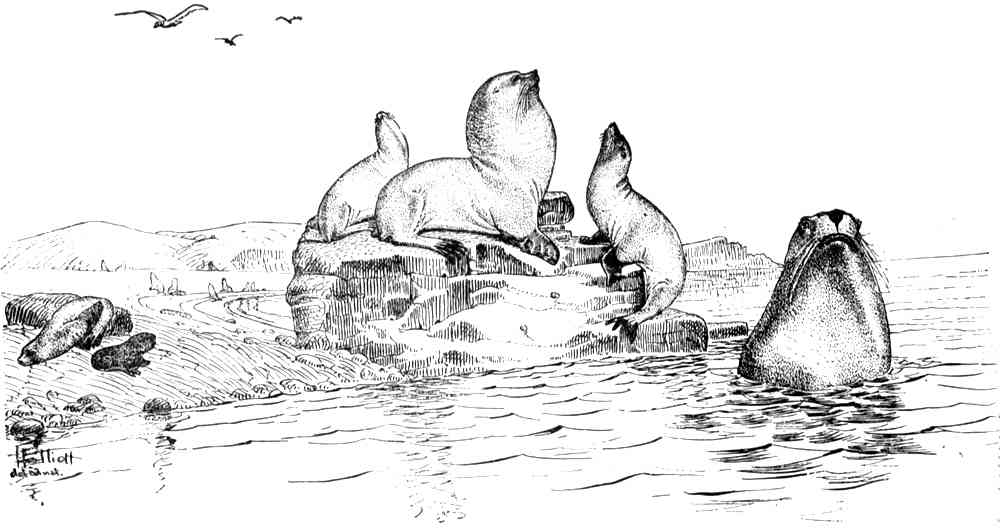
A GROUP OF SEA-LIONS
Young Adult Male and Female Old Bull Roaring
[Eumetopias stelleri: a Life Study made at St. Paul’s Island. July 16, 1872]
The bulk and power of the adult sea-lion male will be better appreciated when I say that it has an average length of ten and eleven feet osteologically, with an enormous girth of eight to nine feet around the chest and shoulders; but while the anterior parts of its frame are as perfect and powerful on land as in sea, those posterior are ridiculously impotent when the huge beast leaves its favorite element. Still, when hauled up beyond the reach of the brawling surf, as it rears itself, shaking the spray from its tawny chest and short grizzly mane, it has a leonine appearance and bearing, greatly enhanced as the season advances by a rich golden-rufous color of its coat; the savage gleam of its expression is due probably, to the sinister muzzle, and cast of its eye. This optical organ is not round and full, soft and limpid, like the fur-seal’s, but it is an eye like that of a bull-dog: it is small and clearly shows under its heavy lids the white or sclerotic coat, with a light-brown iris. Its teeth gleam and glisten in pearly whiteness against a dark tongue and the shadowy recesses of its wide, deep mouth. The long, sharp, broad-based canines, when bared by the wrathful snarling of its gristled lips, glittered more wickedly, to my eye, than the keenest sword ever did in the hand of man.
With these teeth alone, backed by the enormous muscular power of a mighty neck and broad shoulders, the sea-lion confines its battles to its kind, spurred by terrible energy and heedless and persistent brute courage. No animals that I have ever seen in combat presented a more savage or more cruelly fascinating sight than did a brace of old sea-lion bulls which met under my eyes near the Garden Cove at St. George.
Here was a sea-lion rookery the outskirts of which I had trodden upon for the first time. Two aged males, surrounded by their meek, polygamous families, were impelled towards each other by those latent fires of hate and jealousy which seemed to burst forth and fairly consume the angry rivals. Opening with a long, round, vocal prelude, they gradually came together, as the fur-seal bulls do, with averted heads, as though the sight of each other was sickening—but fight they must. One would play against the other for an unguarded moment in which to assume the initiative, until it had struck its fangs into the thick skin of its opponent’s jowl; then, clinching its jaws, was not shaken off until the struggles of its tortured victim literally tore them out, leaving an ugly, gaping wound—for the sharp eye-teeth cut a deeper gutter in the skin and flesh than would have held my hand; fired into almost supernatural rage, the injured lion retaliated, quick as a flash, in kind; the hair flew from both of them into the air, the blood streamed down in frothy torrents, while high above the boom of the breaking waves, and shrill deafening screams of water-fowl over head, rose the ferocious, hoarse, and desperate roar of these combatants.
Though provided with flippers, to all external view, as the fur-seal is, the sea-lion cannot, however, make use of them at all in the same free manner. The fur-seal may be driven five or six miles in twenty-four hours under the most favorable conditions of cool, moist weather; the “seevitchie,” however, can only go two miles, the weather and roadway being the same. When driven, a sea-lion balances and swings its long and heavy neck, as a lever, to and fro, with every hitching up behind of its posterior limbs, which it seldom raises from the ground, drawing them up after the fore-feet with a sliding drag over the grass or sand and rocks, as the case may be, ever and anon pausing to take a sullen and savage survey of the field and the natives who are urging it.
The sea-lion is polygamous, but it does not maintain any regular system and method in preparing for and attending to its harem, like that so finely illustrated on the breeding-grounds of the fur-seal; and it is not so numerous, comparatively speaking. There are not, according to my best judgment, over ten or twelve thousand of these animals altogether on the breeding-grounds of the Pribylov Islands. It does not haul more than a few rods anywhere or under any circumstances back from the sea. It cannot be visited and inspected by men as the fur-seals are, for it is so shy and suspicious that on the slightest warning of such an approach, a stampede into the water is sure to result.
That noteworthy, intelligent courage of a fur-seal, though it does not possess half the size nor one-quarter of the muscular strength of a sea-lion, is entirely wanting in the huge bulk and brain of the Eumetopias. A boy with a rattle or a pop-gun could stampede ten thousand sea-lion bulls in the height of a breeding-season to the water, and keep them there for the rest of the time.[137]
Old males come out and locate themselves over the narrow belts of rookery-grounds (sometimes, as at St. Paul, on the immediate sea-margin of fur-seal breeding-places), two or three weeks in advance of the females, which arrive later, i.e., between the 1st to the 6th of June; and these females are never subjected to that intense, jealous supervision so characteristic of the fur-seal harem. Big sea-lion bulls, however, fight savagely[138] among themselves, and turn off from the breeding-ground all younger and weaker males.
A cow sea-lion is not quite half the size of an adult male; she will measure from eight to nine feet in length osteologically, with a weight of four or five hundred pounds; she has the same general cast of countenance and build of the bull; but, as she does not sustain any fasting period of over a week or ten days consecutively, she never comes out so grossly fat as he does. With reference to the weight of the latter, I was particularly unfortunate in not being able to get one of those big bulls on the scales before it had been bled, and in bleeding I know that a flood of blood poured out which should have been recorded in the weight. Therefore I can only estimate this aggregate avoirdupois of one of the finest-conditioned adult male sea-lions at fourteen to fifteen hundred pounds; an average weight, however, might safely be recorded as touching twelve hundred pounds.[139]
You will notice that if you disturb and drive off any portion of the rookery, by walking up in plain sight, those nearest to you will take to the water instantly, swim out to a distance of fifty yards or so, leaving their pups behind, helplessly sprawled around and about the rocks at your feet. Huddled up all together in the surf in two or three packs or squads, the startled parents hold their heads and necks high out of the sea, and peer keenly at you: then, all roaring in an incessant concert, they make an orchestra to which those deep sonorous tones of the organ in that great Mormon tabernacle, at Salt Lake City, constitute the fittest and most adequate resemblance.
You will witness an endless tide of these animals travelling to the water, and a steady stream of their kind coming out, if you but keep in retirement and do not disturb them. When they first issue from the surf they are a dark chocolate brown-and-black, and glisten; but, as their coats dry off, the color becomes an iron-gray, passing into a bright golden rufous, which covers the entire body alike—shades of darker brown on the pectoral patches and sterno-pectoral region. After getting entirely dry, they seem to grow exceedingly uneasy, and act as though oppressed by heat, until they plunge back into the sea, never staying out, as the fur-seal does, day after day, and week after week. The females and the young males frolic in and out of the water, over rocks awash, incessantly, one with another, just as puppies play upon a green sward; and, when weary, stretch themselves out in any attitude that will fit the character of that rock, or the lava-shingle upon which they may happen to be resting. The movements of their supple spines, and ball-and-socket joint attachments, permit of the most extraordinary contortions of a trunk and limbs, all of which, no matter how distressing to your eyes, they seem actually to relish. But the old battle-scarred bulls of the harem stand or lie at their positions day and night without leaving them, except to take a short bath when the coast is clear, until the end of the season.
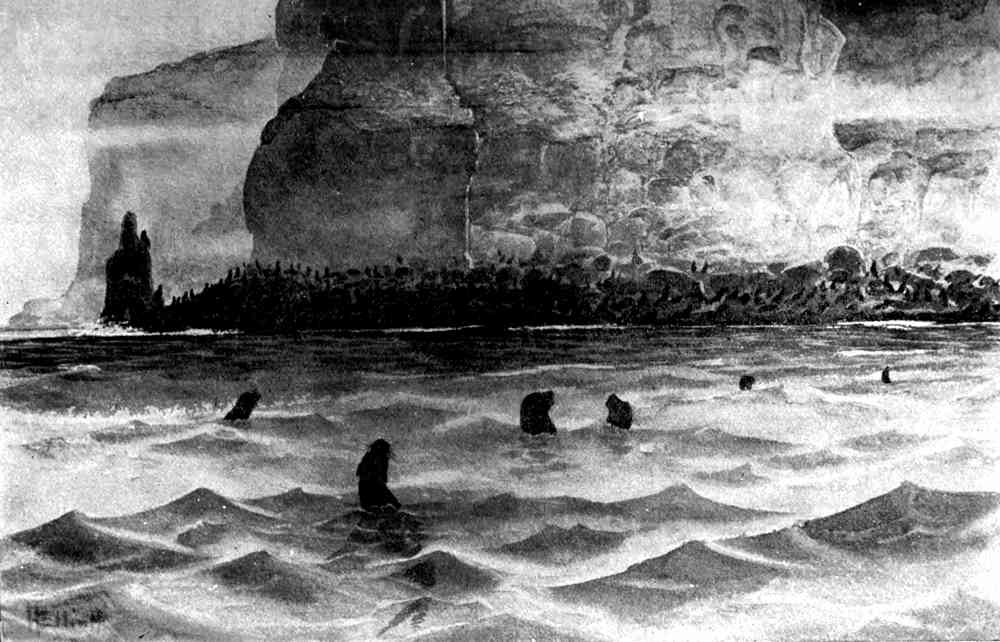
SEA-LION ROOKERY, AT TOLSTOI
A view of the great Sea-lion breeding ground under the high bluffs of St. George’s Island, between Garden Cove and Tolstoi Mees. June, 1873
When swimming, the sea-lion lifts its head only above the surface long enough to take a deep breath, then drops down a few feet below, and propels itself, for about ten or fifteen minutes, like a cigar-steamer, at the rate of six or seven knots, if undisturbed; but, if chased or alarmed, it seems fairly to fly under water, and can easily maintain for a long time a speed of fourteen or fifteen miles per hour. Like the fur-seal, its propulsion through water is the work entirely of its powerful fore-flippers, which are simultaneously struck out, both together, and back against the water, feathering forward again to repeat, while the hind flippers are simply used as a rudder oar in deflecting an ever-varying swift and abrupt course of the animal. On land its hind flippers are employed just as a dog uses its feet in scratching fleas—the long peculiar toe-nails thereof seeming to reach and comb those spots affected by vermin, which annoys it, as the fur-seal is, to a great extent, and causes them both to enjoy a protracted scratching.
Again, both genera, Callorhinus and Eumetopias, are happiest when the surf is strongest and wildest. Just in proportion to the fury of a gale, so much the greater joy and animation of these animals. They delight in riding on the crests of each dissolving breaker up to a moment when it fairly foams over iron-bound rocks. At that instant they disappear like phantoms beneath the creamy surge, to reappear on the crown of the next mighty billow.
When landing, they always ride on the surf, so to speak, to an objective point: and, it is marvellous to see with what remarkable agility they will worm themselves up steep, rocky landings, having an inclination greater than forty-five degrees, to flat bluff-tops above, which have an almost perpendicular drop to water.
As the sea-lion is without fur, its skin has little or no commercial value.[140] The hair is short, an inch to an inch and a half in length, being longest over the nape of the neck; straight, and somewhat coarse, varying in color as the season comes and goes. For instance, when the Eumetopias makes its first appearance in the spring and dries out after landing, it has then a light-brownish rufous tint, with darker shades back and under the fore flippers and on the abdomen. By the expiration of a month or six weeks, about June 15th, generally, this coat will then be weathered into a glossy rufous, or ochre yellow; this tinting remains until shed along by the middle of August, or a little earlier. After a new coat has fairly grown, and just before an animal leaves the island rookery in November, it is a light sepia or Vandyke brown, with deeper shades, almost black, upon its abdomen. The cows after shedding never color up so darkly as the bulls; but when they come back to the land next year they return identically the same in tinting; so that the eye, in glancing over a sea-lion rookery during June and July, cannot discern any dissimilarity in color, at all noteworthy, existing between the coats of the bulls and the cows; also, the young males and yearlings appear in that same golden-brown and ochre, with here and there an animal which is noted as being spotted somewhat like a leopard—a yellow rufous ground predominating, with patches of dark-brown, blotched and mottled, irregularly interspersed over the anterior regions down to those posterior. I have never seen any of the old bulls or cows thus mottled, and this is likely due to some irregularity of shedding in the younger animals; for I have not noticed it early in the season, and it seems to fairly fade away so as not to be discerned on the same animal at the close of its summer solstice. Many of the old bulls have a grizzled or “salt and pepper” look during the shedding period, which is from August 10th up to November 10th or 20th. The pups, when born, are a rich dark-chestnut brown. This coat they shed in October, and take one much lighter in its stead, still darker, however, than their parents.
The time of arrival at, stay on, and departure from the islands, is about the same as that which I have recorded as characteristic of the fur-seal; but, if a winter is an open, mild one, some of the sea-lions will frequently be seen about the shores during the whole year; and then the natives occasionally shoot them, long after the fur-seals have entirely disappeared. Again, it does not confine its landing to the Pribylov Islands alone, as the fur-seal unquestionably does, with reference to such terrestrial location in our own country. On the contrary, it is a frequent visitor to almost all of the Aleutian Islands: it ranges, as I have said before, over the mainland coast of Alaska, south of Bristol Bay, and about the Siberian shores to the westward, throughout the Kuriles and the Japanese northern waters.[141]
When I first returned, in 1873, from the Seal Islands, those authors, whose conclusions were accepted prior to my studies there, had agreed in declaring that the sea-lion, so common off the port of San Francisco, was the same animal also common in Alaska, and the Pribylov Islands in especial; but my drawings from life, and studies, quickly pointed out the error, for it was seen that the creature most familiar to the Californians was an entirely different animal from my subject of study on the Seal Islands. In other words, while scattered examples of the Eumetopias were, and are, unquestionably about and off the harbor of San Francisco, yet nine tenths of the sea-lions there observed were a different animal—they were the Zalophus californianus. This Zalophus is not much more than half the size of Eumetopias, relatively; it has the large, round, soft eye of the fur-seal, and the more attenuated Newfoundland-dog-like muzzle; and it never roars, but breaks out incessantly with a honk, honk, honking bark, or howl.
No example of Zalophus has ever been observed in the waters of Bering Sea, nor do I believe that it goes northward of Cape Flattery, or really much above Mendocino, Cal.
According to the natives of St. George, some sixty or seventy years ago the Eumetopias held almost exclusive possession of that island being there in great numbers, some two or three hundred thousand strong; and they aver, also, that the fur-seals then were barely permitted to land by these animals, and in no great number; therefore, they assert they were directed by the Russians (i.e., their own ancestry) to hunt and worry the sea-lions off from the island: the result was that, as the sea-lions left, the fur-seals came, so to-day Callorhinus occupies nearly the same ground which Eumetopias alone covered sixty years ago. I call attention to this statement of the people because it is, or seems to be, corroborated in the notes of a French naturalist and traveller, who, in his description of the Island of St. George, which he visited sixty years ago, makes substantially the same representation.[142]
That great intrinsic value to the domestic service of the Aleutes rendered by the flesh, fat, and sinews of this animal, together with its skin, arouses the natives of St. Paul and St. George, who annually make drives of “seevitchie,” by which they capture two or three hundred, as the case may be. On St. George driving is positively difficult, owing to the character of the land itself: hence, a few only are secured there; but at St Paul unexceptional advantages are found on Northeast Point for the capture of these shy and timid brutes. The natives of St. Paul, therefore, are depended upon to secure the necessary number of skins required by both islands for their boats and other purposes. This capture of the sea-lion is the only serious business which the people have on St. Paul. It is a labor of great care, industry, and some physical risk for the Aleutian hunters.[143]
By reference to my sketch-map of Northeast Point rookery the reader will notice a peculiar neck or boot-shaped point, which I have designated as Sea-lion Neck. That area is a spot upon which a large number of sea-lions are always to be found during the season. As they are so shy and sure to take to water upon the appearance or presence of man near by, the natives adopt this plan: Along by the middle or end of September, as late sometimes as November, and after the fur-seal rookeries have broken up for the year, fifteen or twenty of the very best men in the village are selected by one of their chiefs for a sea-lion rendezvous at Northeast Point. They go up there with their provisions, tea, and sugar, and blankets, and make themselves at home in the barrabora and house which I have located on the sketch-map of Novastoshnah, prepared to stay, if necessary, a month, or until they shall get the whole drove together of two or three hundred sea-lions.
The “seevitchie,” as the natives call those animals, cannot be approached successfully by daylight, so these hunters lie by in this house of Webster’s until a favorable night comes along, one in which the moon is partially obscured by drifting clouds and the wind blows over them from the rookery where the sea-lions lie. Such an opportunity being afforded, they step down to the beach at low water and proceed to creep on all fours across surf-beaten sand and boulders up between the dozing herd, and the high-water mark where it rests. In this way a small body of natives, crawling along in Indian file, may pass unnoticed by sea-lion sentries, which doubtless in that uncertain light see, but confound the forms of their human enemies with those of seals. When the creeping Aleutes have all reached the strip of beach that is left bare by ebb-tide, and is between the surf and those unsuspecting animals, at a given signal from their crawling leader they at once leap to their feet, shout, yell, brandishing their arms and firing off pistols, while the astonished and terrified lions roar, and flounder in every direction.
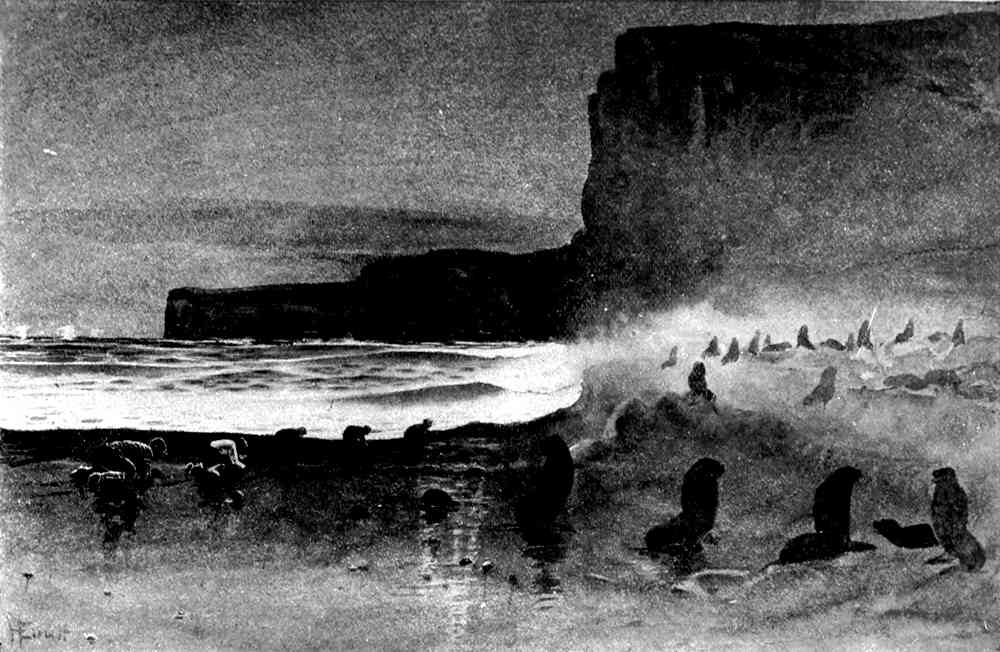
ALEUTES CAPTURING SEA-LIONS
Natives creeping up between a herd of dozing Sea-lions and the water, at low tide during a moonlight night, at Garden Cove, St. George’s Island; getting into position for “springing the alarm”
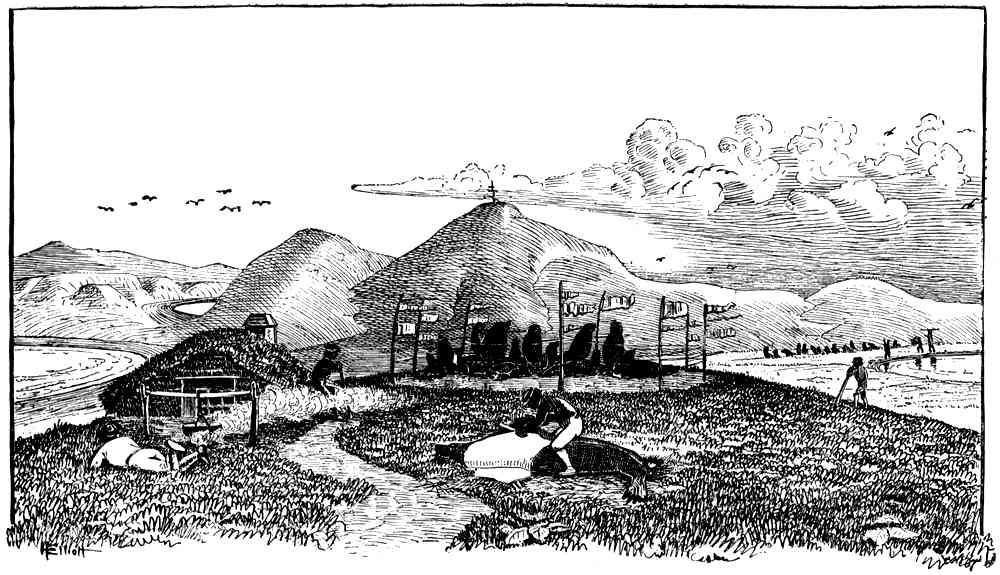
THE SEA-LION PEN
Method of corralling Sea-lions at Novastoshnah, St. Paul’s Island, while the Natives are getting a Drove together for driving to the Village
If at the moment of surprise seevitchie are sleeping with their heads pointed toward the water, as they rise up in fright they charge straight on in that direction, right over the men themselves; but those which have been resting at this instant, when startled, pointed landward, up they rise and follow that course just as desperately, and nothing will turn them either one way or the other. These sea-lions which charged for the water are lost, of course;[144] but the natives promptly follow up the land-turned animal with a rare combination of horrible noises and demoniacal gesticulations until the first frenzied spurt and exertions of the terrified creatures so completely exhaust them that they fall panting, gasping, prone upon the earth, extended in spite of their bulk and powerful muscles, helpless, and at the mercy of their cunning captors, who, however, instead of slaying them as they lie, rudely rouse them up again and urge the herd along to the house in which they have been keeping watch during the several days past.
Here at this point is a curious stage in such proceeding. The natives drive up to that “Webster’s” house those twenty-five or thirty or forty sea-lions, as the case may be, which they have just captured—they seldom get more at any one time—and keep them in a corral or pen close by the barrabora, on the flattened surface of a sand-ridge, in the following comical manner: When they have huddled up the “pod,” they thrust stakes down around it at intervals of ten to twenty feet, to which strips of cotton cloth are fluttering as flags, and a line or two of sinew-rope or thong of hide is strung from pole to pole around the group, making a circular cage, as it were. Within this flimsy circuit the stupid sea-lions are securely imprisoned, and, though they are incessantly watched by two or three men, the whole period of caging and penning which I observed, extending over nine or ten days and nights, passed without a single effort being made by the “seevitchie” to break out of their flimsy bonds, and it was passed by these animals, not in stupid quiescence, but in alert watchfulness, roaring, writhing, twisting, turning one upon and over the other.
By this method of procedure, after the lapse usually of two or three weeks, a succession of favorable nights will have occurred: then the natives secure their full quota, which, as I have said before, is expressed by a herd of two or three hundred of these animals.
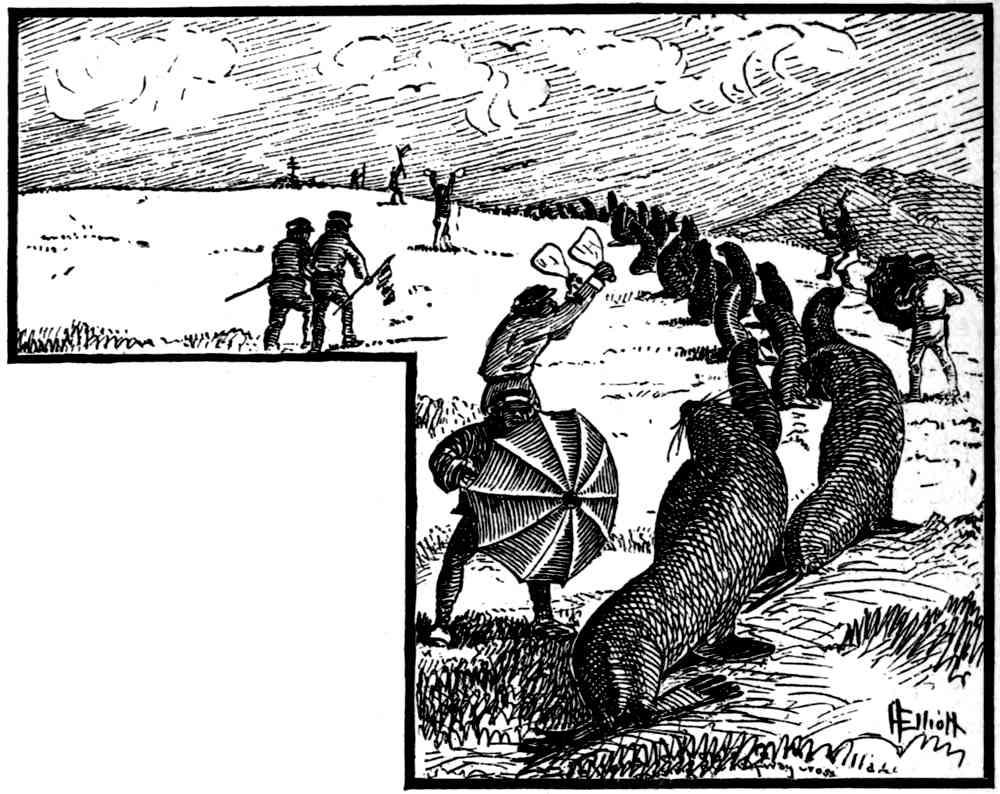
The Sea-lion Caravan.
[Natives driving a drove over the plain of Polavina, en route from Northeast Point to St. Paul.]
When that complement is filled, the natives prepare to drive their herd back to the village over the grassy and mossy uplands and intervening stretches of sand-dune tracts, fully eleven miles: preferring thus to take the trouble of prodding such clumsy brutes, wayward and obstinate as they are, rather than to pack their heavy hides in and out of boats, making in this way each sea-lion carry its own skin and blubber down to the doors of their houses in the village. If the weather is normally wet and cold, this drive or caravan of sea-lions can be driven to its point of destination in five or six days; but should it be dry and warmer than usual, three weeks, and even longer, will elapse before the circuit is traversed.
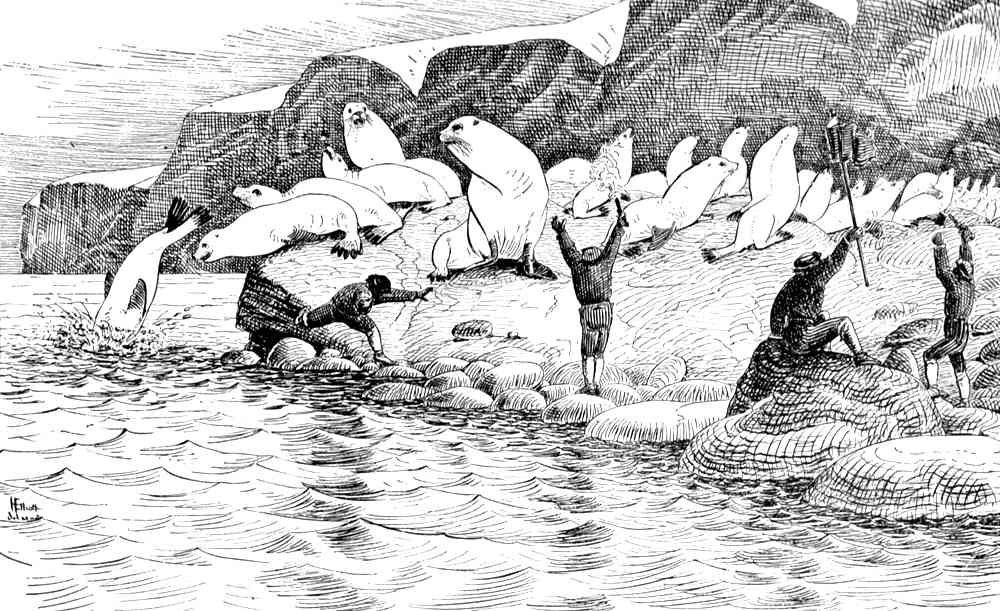
SPRINGING THE ALARM
Natives surprising a Herd of Sea-lions at Tolstoi, St. George’s Island. August 3, 1673
When the drive is started, the natives gather around the herd on all sides, save an opening which they leave pointing to that direction they desire the animals to travel; in this manner they escort and urge the “seevitchie” along to their final resting and slaughter near the village. The young lions and the females, being much lighter than old males, less laden with fat or blubber, take the lead, for they travel twice and thrice as easy and as fast as the latter; these, by reason of their immense avoirdupois, are incapable of moving ahead more than a few rods at a time, then they are completely checked by sheer loss of breath, though the vanguard of the females allures them on; but when an old sea-lion feels his wind coming short, he is sure to stop, sullenly and surlily turning upon the drivers, not to move again until his lungs are clear.
In this method and manner of direction the natives stretch a herd out in extended file, or as a caravan, over the line of march, and as the old bulls pause to savagely survey the field and catch their breath, showing their wicked teeth, the drivers have to exercise every art and all their ingenuity in arousing them to fresh efforts. This they do by clapping boards and bones together, firing fusees, and waving flags; and of late, and best of all, the blue gingham umbrella repeatedly opened and closed in the face of an old bull has been a more effective starter than all the other known artifices or savage expedients of the natives.[145]
The procession of sea-lions, managed in this strange manner day and night—for the natives never let up—is finally brought to rest within a stone’s throw of the village, which has pleasurably anticipated for days and for weeks its arrival, and rejoices in its appearance. The men get out their old rifles and large sea-lion lances, and sharpen their knives, while the women look well to their oil-pouches, and repair to the field of slaughter with meat-baskets on their heads.
No attempt is made, even by the boldest Aleut, to destroy an adult bull sea-lion by spearing the enraged, powerful beast, which, now familiar with man and conscious, as it were, of his puny strength, would seize the lance between its jaws and shake it from the hands of the stoutest one in a moment. Recourse is had to a rifle. The herd is started up those sloping flanks of the Black Bluff hillside; the females speedily take the front, while the old males hang behind. Then the marksmen, walking up to within a few paces of each animal, deliberately draw gun-sight upon their heads and shoot them just between the eye and the ear. The old males thus destroyed, the cows and females are in turn surrounded by the natives, who, dropping their rifles, thrust big heavy iron lances into their trembling bodies at a point behind the fore flippers, touching the heart with a single lunge. It is an unparalleled spectacle, dreadfully cruel and bloody.[146]
This surrounding of the cows is, perhaps, the strangest procedure on the islands. To fully appreciate this subject the reader must first call to his mind’s eye the fact that these female sea-lions, though small beside the males, are yet large animals; seven and eight feet long and weighing each as much as any four or five average men. But, in spite of their strength and agility, fifteen or twenty Aleutes, with rough, iron-tipped lances in their hands, will surround a drove of fifty or one hundred and fifty of them by forming a noisy, gesticulating circle, gradually closing up, man to man, until the sea-lions are literally piled in a writhing, squirming, struggling mass, one above the other, three or four deep, heads, flippers, bellies, backs, all so woven and interwoven in this panic-stricken heap of terrified creatures that it defies adequate description. The natives spear those cows on top, which, as they sink in death, are mounted in turn by the live animals underneath; these meet the deadly lance, in order, and so on until the whole herd is quiet and stilled in the fatal ebbing of their hearts’ blood.
Although the sea-lion has little or no commercial value for us, yet to the service of the natives themselves, who live all along the Bering Sea coast of Alaska, Kamchatka, and the Kuriles, it is invaluable; they set great store by it. It supplies them with its hide, mustaches, flesh, fat, sinews, and intestines, which they make up into as many necessary garments, food-dishes, etc. They have abundant reason to treasure its skin highly, since it is the covering to their neat bidarkas and bidarrahs, the former being the small kayak of Bering Sea, while the latter is a boat of all work, exploration and transportation. These skins are unhaired by sweating in a pile, then they are deftly sewed and carefully stretched over a light keel and frame of wood, making a perfectly water-tight boat that will stand, uninjured, the softening influence of water for a day or two at a time, if properly air-dried and oiled. After being used during the day these skin boats are always drawn out on the beach, turned bottom-side up and air-dried during the night—in this way made ready for employment again on the morrow.
A peculiar value is attached to the intestines of the sea-lion, which, after skinning, are distended with air and allowed to dry in that shape; then they are cut into ribbons and sewed strongly together into that most characteristic rain-proof garment of the world, known as the “kamlayka,” which, while being fully as water-repellant as india-rubber, has far greater strength, and is never affected by grease and oil. It is also transparent in its fitting over dark clothes. The sea-lions’ throats are treated in a similar manner, and when cured, are made into boot tops, which are in turn soled by very tough skin that composes the palms of this animal’s fore flippers.
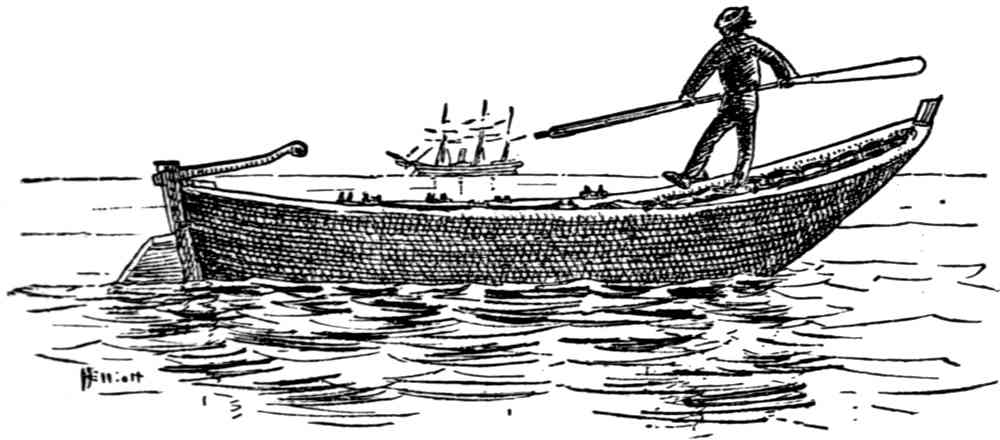
The “Bidarrah.”
[Characteristic Alaskan boat, made by fitting sea-lion skins over a wooden frame and keel.]
The Aleutian name for this garment is unpronounceable in our language, and equally so in the more flexible Russian; hence the Alaskan “kamlayka,” derived from the Siberian “kamläia.” That is made of tanned reindeer skin, unhaired, and smoked by larch bark until it is colored a saffron yellow; and is worn over a reindeer-skin undershirt, which has the hair next to its owner’s skin, and the obverse side stained red by a decoction of alder-bark. The kamläia is closed behind and before, and a hood, fastened to the back of the neck, is drawn over the head, when leaving shelter; so is the Aleutian kamlayka; only the one of Kolyma is used to keep out piercing dry cold, while the garment of the Bering Sea is a perfect water-tight affair.
Around the natives’ houses, on St. Paul and St. George, constantly appear curious objects which, to an unaccustomed eye, resemble overgrown gourds or enormous calabashes with attenuated necks; examination proves them to be the dried, distended stomach-walls of a sea-lion, filled with its oil—which (unlike the offensive blubber of the fur-seal) boils out clear and inodorous from its fat. The flesh of an old sea-lion, while not very palatable, is tasteless and dry; but the meat of a yearling is very much like veal, and when properly cooked I think it is just as good; but the superiority of sea-lion meat over that of the fur-seal is decidedly marked. It requires some skill in the cuisine ere sausage and steaks of the Callorhinus are accepted on the table; while it does not, however, require much art, experience, or patience for good cooks to serve up the juicy ribs of a young sea-lion so that the most fastidious palate will not fail to relish it.
The carcass of a sea-lion, after it is stripped of its hide, and disembowelled, is hung up in cool weather by its hind flippers, over a rude wooden frame or “laabaas,” as the natives call such a structure, where, together with many more bodies of fur-seals treated in the same manner, it serves from November until the following season of May, as the meat-house for an Aleut on St. Paul and St. George. Exposed in this manner to open weather, the natives keep their seal-meat almost any length of time, in winter, for use; and, like our old duck and bird-hunters, they say they prefer to have this flesh tainted rather than fresh, declaring that it is most tender and toothsome when decidedly “loud.”
The tough, elastic mustache-bristles of a sea-lion are objects of great commercial activity by the Chinese, who prize them highly as pickers for their opium pipes, and several ceremonies peculiar to their joss-houses. Such lip-bristles of the fur-seal are usually too small and too elastic for this service. The natives, however, always carefully pluck them out of the Eumetopias, and get their full value in exchange.
The sea-lion also, as in the case of the fur-seal, is a fish-eater, pure and simple, though he, like the latter, occasionally varies his diet by consuming a limited amount of juicy sea-weed fronds, and tender marine crustaceans; but he hunts no animal whatever for food, nor does he ever molest, up here, the sea-fowl that incessantly hover over his head, or sit in flocks without any fear on the surface of the waters around him. He, like Callorhinus, is, without question, a mighty fisherman, familiar with every submarine haunt of his piscatorial prey; and, like his cousin, rejects the heads of all those fish which have hard horny mouths or are filled with teeth or bony plates.
Many authorities who are quoted in regard to the habits of hair-seals and southern sea-lions speak with much fine detail of having witnessed the capture of water-birds by Phocidæ and Otariidæ. To this point of inquiry on the Pribylov Islands I gave continued close attention; because, off and around all of the rookeries, large flocks of auks, arries, gulls, shags, and choochkies were swimming upon the water, and shifting thereupon incessantly, day and night, throughout the late spring, summer, and early fall. During the four seasons of my observation I never saw the slightest motion made by a fur-seal or sea-lion, a hair-seal or a walrus, toward intentionally disturbing a single bird, much less of capturing and eating it. Had these seals any appetite for sea-fowl, this craving could have been abundantly satisfied at the expense of absolutely no effort on their part. That none of these animals have any taste for water-birds I am thoroughly assured.
In concluding this recitation of that wonderful seal life belonging to those islets of Pribylov, it is well to emphasize the fact that, with an exception of the Russian and American seal islands of Bering Sea, there are none elsewhere in the world of the slightest importance to-day; the vast breeding-grounds of fur-seals bordering on the Antarctic have been, by the united efforts of all nationalities—misguided, short-sighted, and greedy of gain—entirely depopulated; only a few thousand unhappy stragglers are now to be seen throughout all that southern area, where millions once were found, and a small rookery, protected and fostered by the government of a South American State, north and south of the mouth of the Rio de la Plata. When, therefore, we note the eagerness with which our civilization calls for seal-skin fur, the fact that in spite of fashion and its caprices this fur is and always will be an article of intrinsic value and in demand, the thought at once occurs that the Government is exceedingly fortunate in having this great amphibious stock-yard, far up and away in the quiet seclusion of Bering Sea, from which it shall draw an everlasting revenue, and on which its wise regulation and its firm hand can continue the seals forever.