How Once Upon A Time The Row-Galleys Fought The Roebuck.
Reading edition
THE little town of Lewes is on Delaware Bay, with rolling dunes of sand between it and the ocean. The winds that blow over it have the smell and taste of salt in them, and in the sky overhead, the grey seagulls soar and hover.
There was a time, long ago, when pirates sailed the Delaware waters. Sometimes they landed there, and drank and plundered and put the people in fear of their lives. There is a story that Captain Kidd buried much treasure somewhere among these dunes.
But that was long before the American colonies went to war with England, and in Revolutionary times it was not pirates that Lewes was afraid of, but English warships.
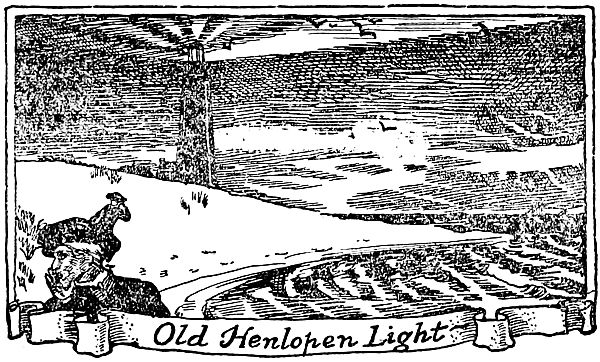
From Delaware Bay the Delaware River lies, wide and open, all the way to Philadelphia. An enemy’s ship that entered the bay could easily sail on up the bay and river, past New Castle, Wilmington and Chester,—and might bombard Philadelphia from the water-front. This was what the Committee of Safety feared the British would do when the Revolutionary War began, so a guard was set at Henlopen light house.
It was in the last week of March of the year 1776, that the first British war vessel entered Delaware Bay. This vessel was a frigate called “Roebuck.” She came sailing slowly in, the black mouths of her guns threatening the town, and anchored in the bay. Her tender followed her, and she too was armed with guns.
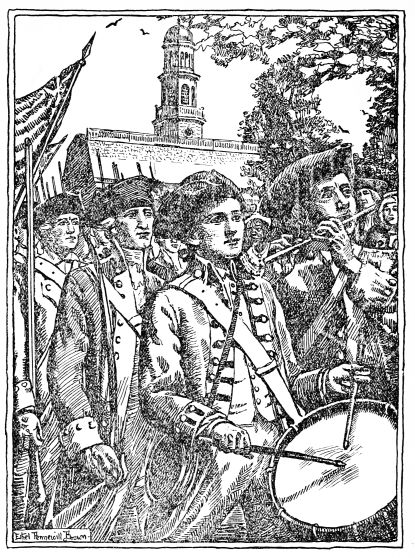
Then all Lewes was in a stir. Messengers were sent riding in hot haste to Philadelphia, and all along the way they spread the news that the British ships had arrived. Colonel John Haslet came marching down to Lewes at the head of the Delaware militia, so as to be ready to protect the town against the English, in case they tried to land.
This, however, the British did not try to do. They cruised up and down in the “Roebuck,” or lay at anchor in the bay.
They managed to capture a pilot boat named the “Alarm,” near Lewes, and they fitted her out as a second tender. A little later they made a prize of an American sloop called the “Plymouth.” All the men from the tender were put on board this new prize except a lieutenant and three soldiers who were still left on the “Alarm,” to take care of her. But that night the helmsman on the “Alarm” fell asleep; the boat drifted on shore, and the lieutenant and his men were taken prisoner by the Americans.
There had as yet been no shots exchanged between the Americans and the English. But one bright, clear Sunday morning in April, word was brought to Colonel Haslet that an American schooner had anchored just off the shore below Cape Henlopen. The captain wished him to send men to help unload her. She carried supplies for the Americans.
Unluckily, news of the schooner reached the British, too, and at the same time that Haslet’s men started by land to help the captain unload, the British tender started by sea.
The Americans made all the haste they could, but they were obliged to cross a creek before they could reach the place where the schooner lay. The country people brought boats and ferried them over, but the soldiers soon saw that the tender was out-racing them.
The captain of the schooner saw this, too, and rather than have his cargo fall into the hands of the British, he set his sails, and ran ashore.
As soon as the American soldiers arrived they began to fire at the tender, but she kept too far away for their bullets to reach her. Seeing this, they laid aside their muskets and set to work to help the sailors unload the schooner.
The tender kept firing at them all the while they were unloading, but her shots fell harmlessly in the sand. Several of the soldiers picked up the balls as they fell, and carried them home to show to their families.
The tender now sent a barge back to summon the “Roebuck,” and presently, the frigate came sailing around the Cape at full speed to help the tender. She swept down toward the schooner like a great bird, but presently she found she was running into shoal water. She was obliged to come to anchor just off the Hen-and-Chicken shoals, but from there she began to fire at the soldiers and the schooner.
The Americans now turned the schooner’s guns on the frigate and tender. They saw a gunner on the frigate throw up his arms and fall. A number of the English were wounded, but not a single American was hurt. Presently, the frigate, finding it a losing game, sailed back around the Cape and out of reach.
No more shots were exchanged between the English and American vessels until May. Early in that month the “Roebuck” was joined by the sloop “Liverpool,” and the two with their tenders sailed straight up the bay and river toward Wilmington. Then they moved to and fro, between Chester and New Castle.
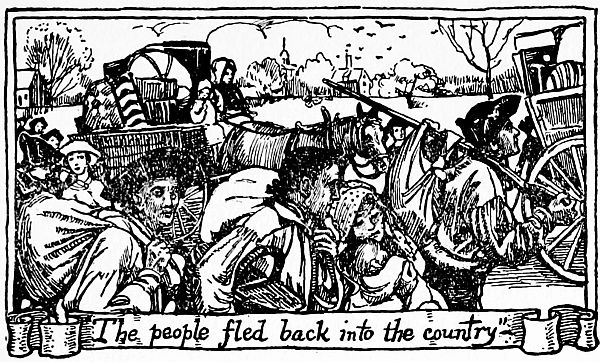
News of their coming went before them. At New Castle, houses were closed, and the people loaded their goods in wagons and carriages and fled back into the country.
At Wilmington, a number of row-galleys (some thirteen in number) were gathered and furnished with guns and ammunition, and were made ready in every way to give battle to the enemy. The galleys were under the command of Captain Houston, of Philadelphia.
It was on the morning of the eighth of May, that the British sails were seen coming up the river. Great crowds of people had gathered on the banks to watch the battle.
It was not until the British vessels were almost opposite Christiana creek that the firing began. The dull boom of the guns echoed and re-echoed from the wooded hills of the Brandywine. Great puffs of grey smoke drifted across the water. Sometimes the vessels were almost hidden.
In the midst of the battle, four Wilmington boys started out from the shore, armed with some old muskets that they had somehow got hold of. They boldly rowed out through the smoke until they were directly under the stern of the “Liverpool,” and then they began to fire at her. Presently, an officer on the sloop saw them.
“Captain,” he called to his commanding officer, “do you see those young rebels? Shall I fire on them?”
The brave old Captain Bellew shook his head. “No, no,” he cried; “don’t hurt the boys. Let them break the cabin windows if they want to.”
That indeed, was about all the damage the young patriots were able to do. When they had used up their ammunition, they rowed back to the shore again unhurt.
While the firing was still at the hottest, a major of artillery came riding at full speed. He threw himself from his horse, and begged a couple of boatmen who were standing with the crowd, to row him out to the galleys; he wished to have a chance to fire a shot at the enemy.
The boatmen refused. They were afraid they might get shot, but when the major promised them a handful of money they changed their minds and agreed to row to the nearest galley.
As soon as the major was on board the boat, he stationed himself at a gun and began to fire it off, and as he proved to be a very good shot he was allowed to stay there. After a while he called for more ammunition, but was told that it had all been used. The gallant officer pulled off his boots, filled them with powder, rammed them into the gun and fired it for the last time. In after life his boast was that he had not only been in the first naval battle of the war, but that he had fired his boots at the enemy.
On all the galleys the officers showed the greatest bravery. The British had at first looked with contempt at the open boats that had come to fight them. It did not take many shots, however, to teach them that these American galleys were not to be despised.
A part of the “Roebuck’s” rigging was shot away and her sides were badly damaged by the balls. Finally, in trying to get nearer to the galleys she ran aground, near the mouth of the Christiana creek. She now keeled over in such a way that she could no longer use her guns. Night came and she still lay there, unable to get off into deep water, or to right herself. The great fear of her men was that the galleys might come to attack her while she lay there helpless, so they sent out three small boats and kept them circling around her all night to watch out for an attack. If the Americans had come, it was the plan of the English to fill the small boats with as many of the “Roebuck’s” men as they could, and send them over to the “Liverpool.” The “Liverpool” was then to retreat down the river. However, the night passed quietly, and at four o’clock in the morning the water had risen so that they were able to get the “Roebuck” off.
In the morning, the row-galleys returned to the attack, though they had been very much damaged the day before. But their men were as determined as ever, and they had a fresh supply of ammunition. One of their shots went clear through the bows of the “Roebuck,” and a number of her men were wounded. One of the officers was killed.
The British now decided to retreat. Very slowly they drew off and drifted down the river. On their way they tried to destroy the little town of Port Penn, but they could not get near enough to the shore; the water was too shallow.
When they reached Lewes they lay there for some time, while the ship’s carpenters mended the holes made by the American shots. They took on fresh water and provisions, and then sailed out from the Delaware waters.
So ended the first naval battle of the Revolution; a battle fought in Delaware waters. One other sea fight was fought there, and it was the last one of the war. It was between the American sloop of war “Hyder Alley,” and the British sloop “General Monk,” and in this, too, the British were defeated. It was not an important battle, but it seemed a curious chance that the first and the last sea-fights of the Revolution should both have been in Delaware waters.