How Once Upon A Time The Blue Hen’s Chickens Went To War.
Reading edition

WAR had begun,—war between the United Colonies of America, with their small, poorly armed forces, and England, the richest and most powerful country in the world.
From all the thirteen colonies of America, regiments marched away to join General Washington and the little army he had already gathered together.
Delaware sent her regiment with the rest. It was under the command of Colonel John Haslet.[1] Men had come from all over the state to enlist in it. They carried whatever weapons they could get,—rifles, carbines, muskets or fowling pieces. A few of them had uniforms, but some of them had not even coats, and so came in their shirt sleeves.
The regiment set out from Dover to the sound of fife and drum. Their flag waved gaily over them and the people crowded the streets, and waved and cheered to see them go.
It was a long, hot march from Dover up to New York, where General Washington was encamped. The soldiers soon grew footsore and weary, marching, as they did, from early dawn till night. Sometimes when they passed a stream they broke ranks to kneel on its bank and drink the cool, running water. Sometimes the farmers came out and handed them summer fruits and vegetables as they passed, and as they went through the towns the people cheered and waved their handkerchiefs to them.
At last they reached New York, but they had no sooner arrived than the whole regiment was ordered to cross the river and join General Stirling’s brigade in Brooklyn. Stirling was expecting an attack from the British at any time, and he needed all the troops he could get.
Before the regiment had left Delaware, Colonel Haslet had begun to drill them, and as soon as they were settled in Brooklyn the drill began again. The men were kept at it until their bones ached and they were ready to drop with weariness, but it was this constant drilling that brought the Delaware regiment into shape, and afterward won for it the name of “the picked regiment of the Colonial Army.”
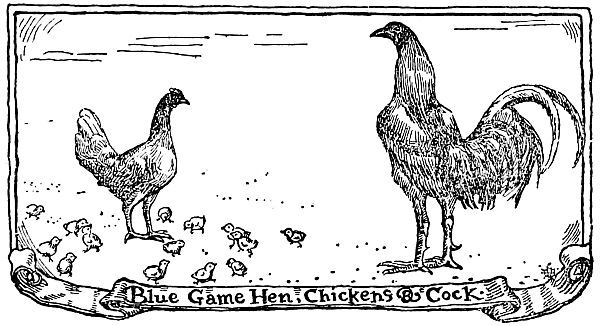
One evening when the men were resting around the fires, one of their comrades came out from a tent carrying two game-cocks by the legs. Somehow he had managed to bring them up from Delaware with him. They were of a bluish grey color, and were of a breed well known in Kent County, and called “Blue Game Chickens.”
When the soldiers saw the two cocks they shouted for joy. “A chicken-fight! A chicken-fight!” they cried. “We’ll have a chicken-fight. Where did you get them Bill?”
Bill threw the cocks into the middle of the ring. For a moment they stood looking about with their bright eyes. Then they lowered their heads and ruffled their feathers. The next moment they flew at each other and fought furiously but before they could injure each other they were separated and shut up in boxes.
“That’s the way we’ve got to fight,” cried Bill. “We’re sons of the old Blue Hen, and we’re game to the end.”
“That’s what we are,” shouted the others. “We’re the Blue Hen’s Chickens, the fighting breed.” And from that night that was the name by which the plucky Delaware regiment went—The Blue Hen’s Chickens.
The Delaware regiment[2] was soon to prove its courage. It was August twenty-seventh, about five days after they had arrived in Brooklyn, that they first went under fire.
On the twenty-sixth, General Stirling had received news that the next morning the British meant to attack his forces. They would begin the attack very early.
It was not yet light when the Delaware regiment, shivering with excitement, was marched out, and stationed near an orchard. In this orchard the Maryland regiment was placed but just where the British troops were they did not know.
It was too dark to see anything at first, but there were sounds that made them know that somewhere there in the darkness, the enemy was moving and marching. Presently, a faint light began to show in the sky. There were shots in the distance. Then they saw through the growing light a great dark moving mass opposite to them. Nearer and nearer it came, and now they could see long lines of the Hessians; the light glittered on the brass fronts of their immense caps.
They were coming!
The Maryland and Delaware regiments opened fire, and here and there they saw a Hessian throw up his arms and fall, but immediately the ranks filled up, and on they came at a steady, quick step. The Delaware regiment had found some shelter behind an old fence.
“Fix bayonets!” There was a rattle and clash as the bayonets of the Delawares slipped into place. “Forward, charge!” Out from their shelter sprang the Delaware soldiers. They charged upon the Hessians, but they were met by such a steady front that for a moment they wavered. Then (we are told) a captain of Smallwood’s company sprang forward and caught the Delaware flag from the flag bearer; he flung it over into the midst of the Hessian regiment.
A long roar followed as the Delaware men flung themselves forward, mad to recover their flag. Before that fierce rush, the Hessians wavered and broke; they tried to recover and then turned and fled, and again the flag of Delaware waved over the heads of the Blue Hen’s Chickens.
The Maryland regiment had also charged, and now they and the Delaware soldiers stood drawn up on a hill. The guns of the enemy were turned upon them, but their colors were flying. Other regiments of the American army had been forced to retreat, but these gallant little bands did not think of quitting their place. At last an express order came from the General commanding them to retreat. Then, and not till then, they fell back. Their flags were almost cut to pieces with shot, but the Delaware regiment retreated in such good order that they lost but few men.[3] The Marylanders were not so lucky, as many of them were taken prisoners or killed.
This victory seemed to satisfy the British for the time. They took up their quarters in Trenton and then they led a merry life, feasting and drinking. They stole as they liked from all the country round, and the poor country people were helpless. If they resisted they were shot down like dogs.
So the autumn and the first part of December passed. Upon the other side of the river from Trenton, the American forces were encamped. December was bitterly cold. Many of our men had no shoes. Food and blankets were scarce. The men kept the fires going day and night.
The day before Christmas, word was passed through the American encampment that on Christmas morning they would cross the river and attack the English. The men cheered when they heard that news.
Christmas day dawned cold and dark and snowy. In the chill morning the men were marched, company after company, down to the flat boats that lay on the river, and were rowed over to the other side. Men and horses huddled together, trying to get some warmth from each other. The bitter wind whistled past their ears, and the sleet cut their faces.
On the Trenton side the troops were landed, and then began a seven miles tramp through the snow. The men struggled through the drifts, blinded by the sleet. Their hands were almost frozen to their muskets.
As they drew near the British encampment they were halted for a rest. They stood there in the snow, panting and leaning on their muskets. They could hear, through the snowy air, the ringing of the bells, and the shouts of the British soldiers. A gun was fired. They almost thought they heard a roar of laughter. The British were making merry at Christmas with no thought that their enemies were so near.
“Silence, and forward!”—the muffled order passed along the line.
The soldiers again shouldered their muskets and marched on. The deep drifts muffled their footsteps and the falling snow hid them like a curtain. Two hundred yards from the British encampment they were formed in line and the order rang out, “Forward, charge!”
Down upon the encampment they swept, running, leaping, stumbling through the drifts.
There was a wild alarm in the British camp, and a scramble for muskets, but the surprise was too sudden for them. They could not escape, and within half an hour the Americans had made one thousand of them prisoners; they had also captured one thousand muskets, and sixteen hundred blankets. Many a poor lad, for the first time in weeks, slept warm that Christmas night in British blankets.
When the cities heard of the great victory their army had won at Trenton, bells were rung and bonfires were lighted; they went mad with joy.
The battle of Princeton, which followed soon after, was an even greater victory for the Americans. But Delaware could not share in the rejoicings that followed, for her brave regiment was almost cut to pieces in that battle. Of the eight hundred men who fought that day barely one hundred were left, and Colonel Haslet was killed by a shot through the head.
Washington now called for more troops, and again Delaware gathered together a regiment and sent it north to join him.
The men under Hall were with Washington in the battle of Brandywine, when his forces were terribly defeated, and also in the battle at Germantown; and they went with him into winter quarters at Valley Forge.
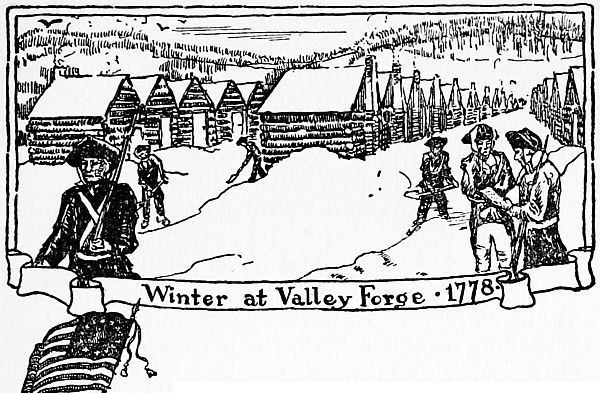
Though the troops had suffered at Trenton the winter before, it was nothing to their sufferings at Valley Forge. They built themselves rough log huts, which gave them some shelter, and they had plenty of wood to burn, but food was scarce. The death of a horse was hailed with joy, for then they could have meat. Their clothing fell into rags, and they had nothing to sleep on but the bare earthen floors of their huts. Washington sent out orders to all the farmers round to thresh out their grain, and let the soldiers have the straw to sleep on.[4]
Almost every day the General went from hut to hut, cheering and encouraging his soldiers as best he could.
One day he saw a soldier tramping barefoot through the snow. His foot prints were marked with blood. Washington unfastened his cloak and held it out to the man, “Here my poor fellow,” he said, “tear this into strips and bind it around your feet.”
The soldier refused the cloak with a laugh. “That’s all right, General,” he said. “I don’t need it. As long as my feet are bleeding I know they’re not frozen.”
Not all of the men could bear the suffering and hunger however. Many died, and still more deserted. In February there were in camp only about five thousand men able to work and carry arms. The regiment of Delaware was among the faithful ones who staid through it all.
It was with joy that the American soldiers saw the coming of spring. On clear days they stretched themselves out in the sun and felt fresh life warming their bodies. Thin, sickly and ragged, they still found strength to joke and laugh.
The British troops, who had spent the winter in Philadelphia, were in fine condition. They had been well fed and housed, and had spent their time in merry making and balls, while our poor men were starving in their huts.
In April 1780,[5] our army was again on the move. The Delaware and Maryland regiments were ordered south under Baron DeKalb, to join General Greene’s army, which was fighting there. It was in this Southern campaign that the Delaware regiment won its greatest glory. The Blue Hen’s Chickens were in many battles and skirmishes, and in all they bore themselves with the greatest bravery.
Then, in August, came the battle of Camden, South Carolina. It was the battle in which the Delaware regiment proved themselves bravest, and the last in which they were to fight as a separate regiment.
Cornwallis had determined to attack our forces early in the morning of the fifteenth.
All that night the two armies lay opposite to each other, waiting for the daylight. The American forces had more men than the British, but many of them were raw recruits, and many were deserters. Cornwallis’s men were in good condition, and were almost all veteran fighters.
Before dawn the British began to take their positions and prepare for an attack, and the Americans made ready to meet them.
In the early dawning the first charge was made. The Americans saw the forces charging down upon them. The Virginia militia were seized with a panic. The order came to fire. Hardly knowing what they did, they fired one shot and then threw down their arms and ran. The North Carolina regiment saw them running, and without even one shot, they, too, threw away their muskets and ran. Only the Delaware men, the Marylanders and one North Carolina regiment were left to bear the brunt of the attack.
DeKalb now gave the order to his men to charge with bayonets. Fiercely the Delaware and Maryland regiments charged upon the enemy,—so fiercely that they broke the British line. But the British guns poured on them volleys of grape and canister. It was more than our men could bear. They were obliged to retreat. Again came the order to charge, and again they threw themselves against those solid ranks of the British, and were driven back. Three times they charged, and then, almost cut to pieces, they were obliged to retreat. Of the brave regiment of Delaware, a mere handful of men was left. Baron DeKalb himself had fallen, with eleven wounds.
So ended the terrible battle of Camden. After it was over, many of the Americans hid themselves in the swamps and woods for a time. The few Delaware soldiers who were left joined the Virginia regiment. They fought with them through the rest of the war, and when peace was declared Virginia offered to each of them one hundred acres of ground if they would settle there. However, they preferred to return to their own state and people.
The prisoners who were taken were sent to Charleston. Among them was Major Patten, a gallant officer. He had taken with him into the war his own body servant, a negro, and had entrusted to him all his clothes. When the battle was over the negro had disappeared and Major Patten never saw him again. He entered Charleston a prisoner, and in rags. There were many loyal ladies there however, and they made him a set of shirts and did for him what they could. He was very handsome and gay, and as he was allowed a great deal of liberty, he became a great favorite. After the war was ended, he returned to his home near Dover and showed with pride some of these shirts which had been made for him by the Charleston ladies.
He was more fortunate than many of the other soldiers. Some of them returned in rags, to find their farms and homesteads fallen almost into ruin. Some had lost their health or were suffering from wounds. But one thing our Delaware men had won,—the glory of having made part of that regiment fittingly called the “picked regiment of the Continental Army.”[6]
NOTES