How Once Upon A Time Delaware Welcomed Lafayette.
Reading edition
WHEN Lafayette was in America, helping us fight for liberty, he made many friends among the Delaware people. Caesar Rodney was then President of Delaware, and Lafayette was often entertained at his house. It was there that he met the beautiful Miss Vining. He and she became great friends, and for a great many years they used to write to each other.
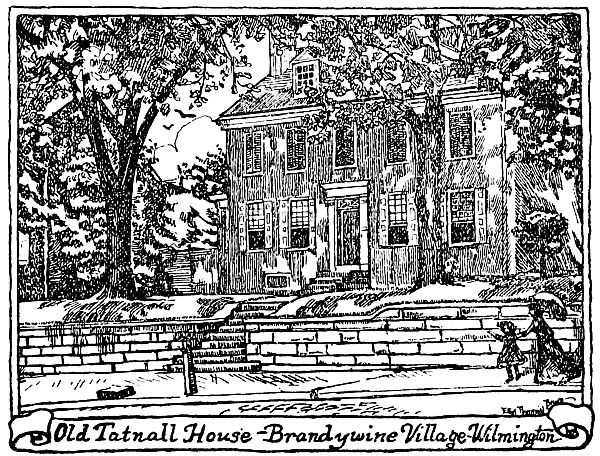
When Washington had his headquarters in Wilmington, Lafayette came with him. He staid at the house of a Quaker, Mr. Joseph Tatnall, in Brandywine Village, just across the stream from Wilmington. General Wayne and other of Washington’s officers, were stationed at Mr. Tatnall’s house, too.
Brandywine Village was then a separate place, and not a part of Wilmington as it is now. There was no bridge across the Brandywine, and people who wished to go from one place to the other, were ferried across the stream.[1] Lafayette often crossed the Brandywine in this way. He would ride his horse on to the great clumsy boat and sit quietly while it was ferried over; then he would ride clattering off on the Wilmington side, and up the hilly streets to join Washington at his headquarters.
Often General Washington himself would cross in the ferry to Brandywine Village, and come to the Tatnall house to discuss plans of battle with Lafayette, and the other officers. These meetings were held in the back parlor; there was a large round table in the middle of the room, and on this they spread out their maps and plans. Washington kept other important papers at the Tatnall house, too. It was a safer place than his headquarters in Wilmington.
Lafayette was at this time a very gay and dashing young officer, and the Tatnall children, who were shy little Quakers, were rather afraid of him. After he had been out riding he used to come marching into the house, snapping his riding whip, and glancing about him with keen, bright eyes; his spurs jingled as he walked. The children generally ran and hid when they heard him coming,—that is all but the youngest, a pretty little girl of two or three. She never felt the least fear of the Frenchman. She would run to meet him, holding up her little bare dimpled arms for him to take her. Then Lafayette would swing her up on his shoulder, and march with her through the house. He called her “his little sweetheart.”
But one morning Lafayette and the other officers said good-bye, and went down to the ferry for the last time. His “little sweetheart” never saw him again. He had gone with Washington and his army to meet the British further north, and to fight in the battle of Brandywine.
After the Revolution was over, and the colonies were free, Lafayette went back to France, and it was almost forty years before he visited America again. In that time, there were many changes. Washington died and was buried at his beloved home, Mount Vernon. Lafayette himself had changed from a gay, dashing officer to a stately, grey-haired man of sixty-seven.
He landed at New York on August, sixteenth, 1824, and was welcomed with great honor as “the nation’s guest.” Flowers were strewn before him. In many places the horses were taken from his carriage, and it was drawn through the streets by the people themselves.
There were at that time, twenty-four states in the Union, and Lafayette wished to visit each one of them. He planned to come to Wilmington on October, sixth, so as to attend the wedding of Mr. Charles I. du Pont and Miss VanDyke, the daughter of U. S. Senator, Nicholas VanDyke, at New Castle in the evening of that day. Lafayette had known Mr. du Pont’s father in France, for they were of a French family.
Great preparations were made by all the people of Wilmington and its vicinity, (indeed from all parts of the State) to welcome Lafayette.
The day of his arrival dawned clear and bright. As early as seven o’clock in the morning all the town was astir. Fifes were sounded, drums were beaten. The Wilmington City Troop was to march up the Philadelphia pike and meet the General at the state line, between Pennsylvania and Delaware. This City Troop had been named the “Lafayette Guard,” in honor of their visitor. With the troop were to ride about two hundred of the young men of Wilmington. These young men were all dressed alike, in white trousers, blue or black coats, and high black stocks. They all wore Revolutionary cockades, and Lafayette badges. A number of the older men of Wilmington rode out with them, too, in carriages.
At the boundary line in Brandywine Hundred, near the Practical Farmer, a magnificent floral arch had been erected with the American eagle suspended in the centre, a United States flag, with a portrait of Washington underneath of it and the words:—
“DELAWARE WELCOMES LAFAYETTE.”
Advancing into the city of Wilmington, his reception was overwhelming. Flowers were strewn in his pathway; arches of evergreens, decorated with flags, had been built across Market Street at different points. From one of the arches hung a model of the ship “Brandywine,” and above it were the words, “In honor of Lafayette, the friend of Civil Liberty.”
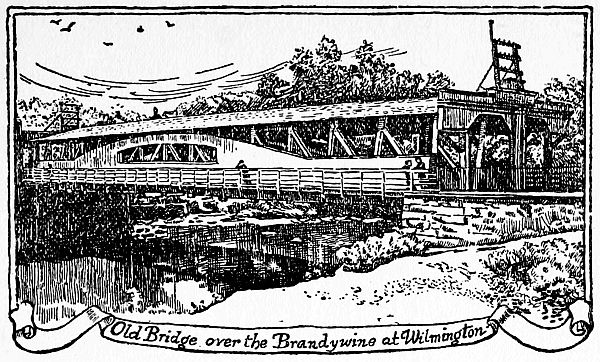
The ladies of the town had decorated Brandywine bridge so that it was almost hidden by wreaths and flowers. It was over this bridge that Lafayette would enter the town.
It was eight o’clock when the procession set out from Wilmington and marched up the Philadelphia pike to meet the distinguished guest.
At about ten o’clock word was brought that General Lafayette was then in sight. The procession drew up in order, and as soon as Lafayette appeared the men burst into a loud shout of “Long live Lafayette!”
Lafayette rose and bowed in answer. He was riding in a barouche, and with him was his son, George Washington Lafayette. He was escorted by the First City Troop of Philadelphia, and a number of well known men.
As soon as Lafayette reached the State line where the Wilmington procession was waiting, he stepped from the barouche down into the road.
The Honorable Louis McLane came forward to meet him, and made a speech of welcome. Lafayette answered him, and in his answer he spoke of the war for liberty, in which he had fought, and of the great bravery of the Delaware regiment in that war.
Mr. McLane then asked to introduce to the General, three men who had fought in the Delaware regiment,—three of the Blue Hen’s Chickens. They were, Major Peter Jaquet, Captain Caleb P. Bennett and Colonel Allen McLane. Colonel McLane, an old man of eighty-three years, was dressed in the Colonial uniform he had worn in the war.
Other prominent citizens of Delaware were introduced, and then Lafayette stepped into the carriage that had been brought for him, and to the music of the band, the procession moved on toward Wilmington.
As they reached the top of Shellpot hill, just outside of the city, the dull boom of a cannon sounded across the sunny fields. Again it boomed, and still again, till thirteen shots had been fired, one shot for each of the thirteen original colonies. It was a salute to Lafayette.
The General was very anxious to stop in Brandywine Village, at the Tatnall house. His old friend, Joseph Tatnall, had died many years before, but his son was still living in a stone house close by.
He was standing in the doorway when Lafayette’s carriage stopped before the house. He hurried down to the street to welcome the General. He had his little son in his arms, and at a whispered word from his father, the little fellow held out a beautiful basket of Washington pears.
Lafayette took it with a smile, and thanked the child. “You were not so many years older than this little fellow, when I was here before,” said the General to the father.
“And my little sweetheart?” added the General. “What has become of her? Shall I see her?”
But the little sweetheart was dead. Years before, she had grown up and married, and then had died, leaving a daughter. Lafayette wished to see this daughter, but she was away at boarding school. Mr. Tatnall had asked the mistress of the school to allow his niece to come to him for that day, but the mistress had refused; she was so strict that she would not allow the young girl to be absent for a day, even to meet General Lafayette.
Just beyond the bridge, a great crowd of people had gathered. They cheered wildly as Lafayette’s carriage rolled across the bridge. At the same time, all the bells in the city began to ring, and so with shouts and music, and the pealing of bells, General Lafayette was welcomed back to Delaware.
The procession paraded through the streets and under the arches, and at last drew up before the City Hall, where a great feast had been made ready. About two hundred people were at the banquet.
Just as the feast was ended, an old woman pushed her way into the hall, and came to where Mr. McLane was standing. Mr. McLane knew who she was very well. Her name was Belle McClosky, and she earned her living by selling cakes and pies about the town. Wherever she went, she always carried an old musket ball in her pocket. Often she took out this ball and showed it to her customers, and boasted that she had taken it out of General Lafayette’s wound with a pair of scissors when he was wounded at the Battle of Brandywine.
Now, as soon as she reached Mr. McLane’s side, she said, “Mr. McLane, I want you to introduce me to General Lafayette.”
Mr. McLane hesitated a moment; then he said “Very well, Belle, I will do it. I know you are a true patriot, and I believe you saved many a poor soldier’s life at the time of the war.”
He then led Belle over to General Lafayette. The General spoke to her pleasantly, but he had not the least idea who she was.
“General,” said Belle, “do you remember being wounded at the Battle of Brandywine, and the young woman who took out the ball with a pair of scissors?”
“I remember very well,” answered Lafayette. “She saved me several hours of suffering. I would like to see her again, that I might thank her.”
Belle took the ball from her pocket, and held it out to him in her hand. “This is the ball,” said she, “and I am the woman who took it out, though I am so old now it is no wonder that you do not know me.”
Lafayette was amazed. He thanked her warmly, and then took the ball and looked at it. “So you have kept it all these years,” he said. “That is very curious.”
Then he gave the ball back to her, and Belle went out from the hall that day a very proud and happy woman.
Lafayette paid only one visit in Wilmington, and that was to Mrs. Connel. She was the wife of Mr. John Connel who had been very kind to some French soldiers at the time of the war between France and Russia.[2]
Later in the afternoon, the General set out for New Castle, to attend the wedding there.
New Castle had prepared to welcome him with a military salute. There were two six pound cannons in the old arsenal at New Castle, that were named the “Wasp” and the “Hornet.”
They had been moved to the northeast end of the town, near the site of old Fort Casimir, ready for use. As the procession passed Rogers’ Woods, and came in sight of New Castle, the gunners began. The cannons boomed and boomed incessantly until Lafayette had entered the house of George Read, 2nd, on Water St., where he was received, and where guards were placed at the front door to keep back the crowd.
In the evening Lafayette attended the wedding. At this wedding, he was, of course, the guest of honor. The chair where he was to sit was raised so as to be higher than any others in the room, and was wreathed about with flowers.
A great crowd gathered before the house to see General Lafayette.
Senator VanDyke, the father of the bride, gave orders that the door and windows should be left open, so that the people outside could see the General and also the wedding party.
Afterward, he went to take supper and spend the night, with George Read, 2nd, the son of the signer of the Declaration of Independence. The next morning, he was driven over to Frenchtown, Maryland, on the Elk river, where he was met and welcomed by the Marylanders.
So Lafayette passed through Delaware, on his tour through the States, and so the Delaware people welcomed him. It was a beautiful greeting, and Delaware may well be proud of the day when Lafayette was here.
NOTES