How Once Upon A Time MacDonough Sailed The Sea.
Reading edition

COMMODORE THOMAS MACDONOUGH was sometimes called “the Boy Commodore,” for he was the youngest Commodore in the American navy.
He was born December, thirty-first, 1783, on a farm in New Castle county where his father and grandfather had lived before him.
When he was seventeen he joined the navy as a Midshipman, and made his first cruise on the ship “Ganges.”
He was a tall, thin, shy youth. He was never strong, but he was so brave that he was ready for any dangers or hardships. Cooper called him “the modest but lion-hearted MacDonough.”
At the time MacDonough joined the navy, the United States was at war with France, and his first cruise was against the French in the West Indies. The “Ganges” captured three of the enemy’s vessels, and sent them home as prizes. Then the yellow fever broke out on board the “Ganges.” MacDonough was one of the men who had it. He and the other sick men were carried on shore to a miserable dirty Spanish hospital at Havana. Here, for many weeks, he lay ill.
When he was able to get up and go about again he found that the “Ganges” had sailed away, and that he was left, poor, alone, and almost without clothing, in a strange land. All the Americans who had been brought to the hospital had died except himself and two others. These two were in as much distress as himself. The American agent at Havana gave them some shirts and other pieces of clothing, and they got back to the United States on a sailing vessel.
MacDonough landed at Norfolk, Virginia, and worked his way back to Delaware. He had been away from home a year, and his family had never expected to see him again; they had been told he had the yellow fever at Havana, and was either dying or already dead. They could hardly believe it was he when he walked in among them, thin, pale and weak-looking, but still alive. The whole house was filled with rejoicings. He was still dressed as he had been when he left Havana, in worn out clothes, a straw hat and canvas shoes.
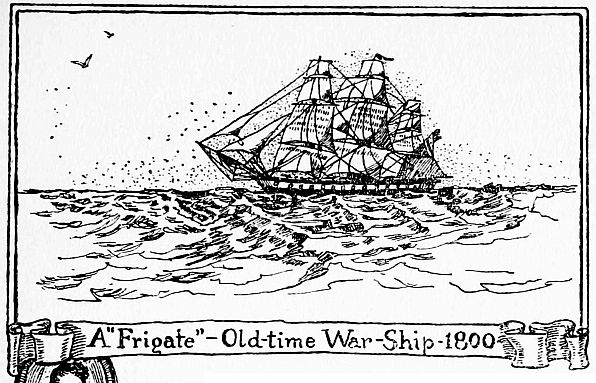
As soon as he was able, he went back to the “Ganges,” and was with her until he was ordered to the Mediterranean on the frigate “Philadelphia.”
We were then at war with Tripoli. Soon after the “Philadelphia” reached the Mediterranean, they captured a Moorish vessel, and MacDonough was sent on board of her to take her to Gibraltar.
It was a very lucky thing for MacDonough that he was ordered on to this other vessel, for very soon after he left the “Philadelphia” she ran aground, and was captured by the enemy. All the men and officers on board of her were taken prisoner.
After the “Philadelphia” was taken by the enemy, the Americans were very anxious to destroy it, for now the enemy had the ship and might use it as a war vessel. But it seemed as though it would be almost impossible to destroy the “Philadelphia.” It lay in the harbor of Tripoli, close under the fortress, and above it were the black mouths of the cannon. If the Tripoli gunners had seen any American ship come into the harbor, they would have blown it to pieces rather than let it come near their prize.
The only way to get to the vessel would be by using some trick.
Stephen Decatur, then a young commander, was very anxious to try it. It would mean the risk of his life, and of the lives of all who went with him; but every sailor on his vessel was as eager to try as he himself. From among them all he chose sixty-two to go with him, and MacDonough was one of those chosen.
They set sail for the bay of Tripoli, in a ketch, (a sort of small merchant vessel) which they named “Intrepid.” Almost all the Americans hid down in the lower part of the ketch. Only a few stayed on deck. Those on deck darkened their faces, and dressed themselves as Maltese sailors, with red fezzes and round jackets. The inside of the ketch was filled with powder and everything else necessary for blowing up the “Philadelphia,” if they could only get to her.
Boldly the little ketch with these brave men on board sailed into the enemy’s harbor.
The Tripolitans, looking from their forts, saw nothing but what seemed to be a Maltese merchant ship, sailing into the harbor to shelter there for the night,—for the daylight was already fading from the sky and the moon was rising.
The “Intrepid” sailed slowly across the harbor to where the “Philadelphia” lay under the fortress. Aboard of her were the Tripoli officers on the watch.
When the ketch was near enough to the “Philadelphia,” an American officer hailed her, speaking in the Maltese language. He said they had lost their anchors at sea, and asked whether they might fasten their boat to the “Philadelphia” for the night.
The Tripoli officer hesitated a moment. “That is a very unusual thing to ask,” he said. However, he agreed that they might, and a hawser rope was flung over to the ketch for them to fasten by.
Just then the “Intrepid” swung out from under the shadow of the “Philadelphia,” and the moon shone down on her deck. There on her deck, in the full light, lay the anchors that the officer said had been lost at sea.
Immediately the Tripoli men knew that a trick had been played upon them. “Americanos! Americanos!” they shouted. But they had found it out too late. The ketch was already fastened to the side of the larger vessel. The Americans swarmed over the sides of the “Philadelphia,” and the Tripolitans found themselves fighting for their lives. MacDonough was the third man to spring aboard of the ship. In a short time all the Tripolitans were killed or driven overboard, the powder was hastily carried from the ketch to the “Philadelphia,” and she was set on fire. Then the Americans returned to their own boat. They cut loose and rowed at full speed away from the “Philadelphia” and across the harbor.
The men in the fortress near by, had seen that strange things were happening on board the “Philadelphia,” but in the uncertain moonlight they could not tell just what the matter was. It was not until they saw the ketch well across the harbor, and flames and smoke pouring from the “Philadelphia” that they realized what had happened. Then their cannon roared, but the balls fell short. The men on the “Intrepid” rose to their feet, waved their caps, and in the red light of the burning ship, gave three rousing American cheers. Then they again fell to their oars, and rowed out of the harbor to where the “Siren,” an American war vessel, was waiting for them outside.
This burning of the “Philadelphia” was said by Admiral Nelson, to be “the most bold and daring act of the age.”
MacDonough had shown such bravery in this action that he was made a lieutenant.
It was while MacDonough was still on this Mediterranean cruise that he had an adventure with three cut-throats.
The commander had given him leave to go on shore one day, and toward evening, as he was coming back to his boat, three cut-throats set upon him in a lonely place. Instead of trying to escape, MacDonough turned upon them and fought so fiercely that he soon wounded two of them, and the third took to his heels and ran. MacDonough ran after him. He chased the man for some distance, and then they came to a low building; into this building the man dashed, and up the stairs, with MacDonough still after him. When he reached the roof he looked behind him. There still was the terrible Americano. Then the man ran to the edge of the roof and jumped off, for he felt he would rather run the risk of breaking his neck than fight with MacDonough.
When MacDonough came down stairs again, he looked all around for the man, but he could not see him, so he quietly returned to his boat and rowed back to the ship.
In 1806, MacDonough was first lieutenant on the “Siren,” with Captain Smith in command.
They were lying just off Gibraltar at one time, and at some distance from them were anchored two other vessels. One was an American merchant ship, and the other a British frigate.
One day Captain Smith had gone on shore and MacDonough was in charge of the “Siren.” In the afternoon he saw a boat put off from the frigate and row over to the merchant ship. It lay there for a while, and then when it started to return to the frigate he saw that there was one more man in her than there had been before.
MacDonough knew that the captains of English warships sometimes kidnapped American sailors, and made them serve on board the British vessels, and he suspected that this extra man was an American who was being stolen from the crew of the merchant ship.
He immediately sent over to the ship to ask whether this were so.
The captain told him “Yes;”—that the British had come on board, and taken one of his sailors. The captain had been afraid to resist them, for the frigate had guns and he had none.
As soon as MacDonough heard this, he had a cutter lowered, and set out in chase of the British boat. The Englishmen were rowing in a very leisurely manner, for they never dreamed that any one would dare to interfere with their prize.
MacDonough caught up to them just as they reached the frigate. The prisoner was sitting in the stem of the boat. MacDonough’s men drove the cutter so close that the two boats grated together. One of the Englishmen shouted to them to keep off, but instead MacDonough reached over, and catching hold of the prisoner dragged him, bodily, into his own boat. Then his rowers gave way, and before the Englishmen could recover from their surprise, he was on his way back to the “Siren,” the rescued man with him.
The British captain had seen the whole affair from the deck of the frigate, and he was in a fury. He got into a boat and had himself rowed over to the “Siren.” When he came on board, he saw MacDonough walking quietly up and down the deck, with his hands clasped behind him.
The captain marched up to him insolently. “Where is that man you took? I must have him back,” he cried.
“I will not give him up,” answered MacDonough quietly.
“You dare to tell me that? Why you are not even the captain of this vessel, and you dare to say you will not let me have the man?”
“I will answer to it to my captain,” said MacDonough, “and I will not give him up.”
The captain raged and threatened to turn the frigate’s guns against the “Siren” and blow it out of the water.
“You can do it, no doubt, if you choose,” answered MacDonough, “but as long as this boat is afloat I will never give that man up.”
The captain finding he could gain nothing, got into his boat again and had himself rowed over toward the merchant vessel.
MacDonough feared he might try to kidnap another man, so he entered the cutter and followed close after the British boat. The Englishmen rowed about for some time and then finding they could not shake him off they returned to the frigate. Then, and not till then, MacDonough went back to the “Siren.”
The English officers one and all admired MacDonough’s conduct in this affair, and always afterward spoke of him with great admiration.
But it was in the battle of Lake Champlain that MacDonough won his greatest fame.
Our troubles with England had finally ended in a war with her. MacDonough was put in command of the naval forces on Lake Champlain. He was then a little over thirty years old.
The battle was fought on a clear, bright September morning, in 1814.
Before the battle began the Commodore (as MacDonough was then called) knelt on the deck of the “Saratoga,” and with his officers and crew about him, he prayed for success in the conflict.
When a little later they were clearing the decks of the “Saratoga” for action, they let out some chickens that were in coops, and threw the coops overboard. One of the cocks flew up on the rigging and flapped his wings and crowed loud and long. It was as if he recognized in the Commodore one of the “Blue Hen’s Chickens,” and was greeting him.
The sailors took his crowing as a sign of victory, and cheered in answer to him.
The American ships were scarcely set in battle order, before the British squadron came sailing proudly around a wooded point of land. The red flags at their mast-heads fluttered gaily in the sunlight.
MacDonough himself fired the first shot from the “Saratoga.” The gun was aimed at the British flagship “Confidence,” and the shot killed and wounded several of her men, and carried away her wheel. Again and again, through the battle, MacDonough, with his own hands, helped to work the guns. Three times he was struck by splinters and thrown across the decks. Once a heavy spar fell over him and knocked him senseless. Once a shot blew off the head of a gunner, and threw it against him with such force that he was again knocked across the deck and into the scuppers. But he was not seriously hurt, though every other officer on the “Saratoga” was either killed or wounded.
By mid-day the battle was over and the Americans had won. So fierce had been the broadsides that not a single mast was left standing on the vessel of either of the opposing squadrons.
After the battle was ended the American officers all gathered on the deck of the “Saratoga” and the British officers came to give up their swords to MacDonough.
Instead of taking them, however, MacDonough said, “Gentlemen, your gallant conduct makes you the more worthy to wear your swords;” and he bade them put them back in their scabbards and keep them.
Every care was now given to the wounded on both sides, and MacDonough himself visited every ship in his squadron, and thanked the officers and men for their bravery.
News of the American victory was received with joy all over the country. Congress offered a vote of thanks to MacDonough, and many states and towns gave him presents. But through it all he was still the modest MacDonough. Often tears came into his eyes when he was speaking of all the country had done for him.
This was almost his last battle. Soon after it, peace was declared, and he left Lake Champlain and went back to the ocean.
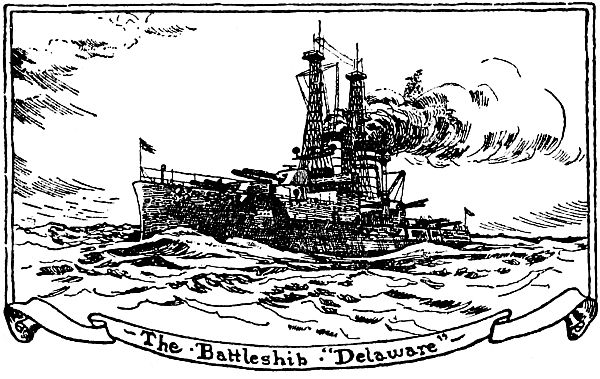
In 1825 he was Commander of the “Constitution,” in the Mediterranean. But his health failed and he determined to go home. He never reached his country, however. On November tenth, he died, leaving behind him an undying name—a brave officer, a great seaman, and a Christian gentleman. In memory of MacDonough, the place near which he was born has been named after him, and in the great warship “Delaware,” the largest in the present American navy, his portrait (presented by the Colonial Dames of the State) is hung with those of Admiral Jones and Admiral du Pont, to commemorate the naval heroes of Delaware.