"Notable Voyagers" (continued 9)
Reading edition
The Manilla galleon, not having sailed from Acapulco, in consequence of his appearance off that place, calculating that there would be two vessels this year instead of one, he determined to cruise off the island of Samal in the hopes of intercepting them. He at first kept this plan to himself, but as soon as the ship was at sea he summoned the crew on deck and informed them of his intentions. The place he intended to cruise off was Cape Espirito Santo. It was sighted on the 20th of May. As the commodore knew that sentinels were placed on that cape to give notice of the Manilla ship as soon as she made the land, he immediately tacked and took in top-gallant sails to avoid being discovered.
The crew were now kept constantly practising at their guns, an exercise which had been pursued for some time previously. By this means they were rendered extremely skilful. Every preparation was also made for battle. The commodore’s journal shows how anxiously he and all on board were looking out for their expected prize. At last, just a month after the arrival of the Centurion at her station, a sail was discovered at sunrise in the south-east quarter, by a midshipman, Mr Charles Proby. The commodore had taken every means in his power to secure the victory. He had placed about thirty of his choicest marksmen in the tops, and as he had not hands enough remaining to quarter a sufficient number to each great gun in the usual manner, he placed on his lower tier only two men to each gun, who were to be employed solely in loading it, while the rest of the people were divided into different gangs of ten men each to run out and fire such guns as were loaded. By this arrangement he was able to make use of all his guns, and instead of firing broadsides at intervals, to keep up a constant fire without intermission. He knew that it was the custom of the Spaniards to fall down on deck when they saw a broadside preparing, and to continue in that posture until it had been given, after which they rose, and presuming the danger to be over for some time, worked their guns and fired with great briskness, until they supposed that another broadside was ready to be fired, when they acted as before. The plan adopted by the commodore, however, rendered this practice of theirs impossible.
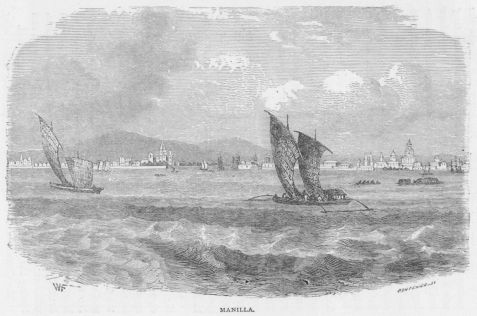
At the news of a sail being in sight, the ship’s company had no doubt that this was one of the galleons, and they expected soon to see the other. The Centurion stood on until about half-past seven, when the stranger could be seen from her deck, and no doubt remained that she was one of the long-sought-for ships. The hopes of the Centurion’s crew rose high, and all hands with alacrity hastened to their stations. At length the galleon fired a gun and took in her topgallant sails, which was supposed to be a signal for her consort to hasten up. The Centurion, therefore, fired a gun to leeward in order to amuse her.
The commodore was surprised all this time to find that the galleon did not alter her course, but continued to bear down upon her, for he hardly believed—what afterwards appeared to be the case—that her captain knew his ship to be the Centurion, and had resolved to fight her. About noon the Centurion was a little more than a league from the galleon, and could fetch her wake, so that she could not now escape. No second ship appearing, it was concluded that she had been separated from her consort. Soon after the galleon hauled up her foresail, and brought to under her topsails, with her head to the northward, hoisting Spanish colours, and having the standard of Spain on the topgallant masthead.
The Centurion now rapidly neared the galleon. A little after noon there were several squalls of wind and rain, which often obscured the latter from sight; but whenever it cleared up, she was observed resolutely lying to. Towards one o’clock, the Centurion hoisted her broad pennant and colours, she being then within gunshot of the enemy. The Spaniards, the commodore observed, had neglected to clear their ship, they being engaged in throwing overboard cattle and lumber. He gave orders to fire upon them with the chase-guns, to prevent them from completing their work.
The galleon returned the fire with two of her stern-chasers. Soon after the Centurion came abreast of her, within pistol-shot, keeping to leeward for the purpose of preventing her from putting before the wind and getting away.
Now the engagement commenced in earnest. For the first half-hour the Centurion overreached the galleon, and lay on her bow. By the greater wideness of the ports of the former, she could traverse almost all her guns, while the galleon could only bring a part of hers to bear. Scarcely had the action begun, when the mats with which the galleon had stuffed her netting took fire and burned violently, blazing up half as high as the mizen-top. This accident threw the enemy into great confusion, and the commodore feared lest the galleon should be burned, and his ship suffer by driving on board her. The Spaniards at last, however, freed themselves from the fire by cutting away the netting and tumbling the whole mass into the sea.
Still the Centurion kept her advantageous position, firing her guns with great regularity; whilst, at the same time, the topmen, who having at their first volley driven the Spaniards from their tops, made great havoc with their small arms, killing or wounding every officer but one that appeared on the quarter-deck, and wounding in particular the general of the galleon himself. After the engagement had lasted half an hour, the Centurion fell alongside the galleon, the decks of which her grape-shot swept so effectually,—killing and wounding a great number,—that the Spaniards were thrown into the greatest disorder, as could be seen from on board the Centurion. The Spanish officers were observed running about to prevent desertion by the men from their quarters; but all their endeavours were in vain; and at last, having fired five or six guns, the galleon’s colours being already burnt, the standard at her main-top-gallant-masthead was struck. The seaman who did this would have run great risk of being shot down, had not the commodore given orders to the men not to molest him. The action lasted altogether about an hour and a half, during which the Spaniards lost sixty-seven killed and eighty-four wounded.
The prize was called Nuestra Señora de Cabadonga, and was commanded by Don Jeronimo de Montero, a Portuguese by birth, and a skilful and brave officer. The galleon was much larger than the Centurion, had a crew of five hundred and fifty men, and thirty-six guns, besides twenty-eight pidreroes or petards, each of which carried a four-pound ball. She was besides well furnished with small arms, and was provided with boarding nettings.
The treasure she contained amounted to nearly a million and a half of dollars. Scarcely, however, had the galleon struck, and the long-expected wealth she contained become the prize of the English, than a terrible announcement was made to the commodore by one of the lieutenants, who whispered to him that the Centurion was on fire near the powder-room. He received the intelligence with his usual calmness, and, taking care not to alarm the crew, he gave the necessary orders for extinguishing it. Some cartridges had been blown up between deck, in consequence of which a quantity of oakum, near the after-hatchway, close to the powder-room, was on fire. The volumes of smoke which issued from this caused the apprehension that a dangerous fire had broken out.
The crew, led by their officers, set to work to extinguish it. While they were thus engaged, the galleon fell on board the Centurion on the starboard quarter, but she was cleared without doing or receiving any considerable damage. By the exertions of the men, the fire was in a short time got under. The commodore now made the first lieutenant, Mr Saumarez, captain of the prize, appointing her a post ship in his Majesty’s navy.
Most of the prisoners were at once removed on board the Centurion, and judicious arrangements were made for keeping them from rising, which, as they far outnumbered the crew of the Centurion, they might easily have done; indeed, when they saw the men by whom they had been captured, they expressed themselves with great indignation, to be thus beaten by a handful of boys.
All the seamen, with the exception of the wounded, were placed in the hold, and that they might have air, the two hatchways were left open, these hatchways being fitted with a square partition of thick planks, made in the shape of a funnel, which enclosed each hatchway on the lower deck, and reached to that directly over it on the upper deck, rising seven or eight feet above it. It would thus have been extremely difficult for the Spaniards to clamber up. To increase that difficulty four swivels were planted at the mouth of each funnel, and a sentry with a lighted match stood ready to fire into the hold, should they attempt to escape. The officers, amounting to seventeen or eighteen, were lodged in the first lieutenant’s cabin, under a guard of six men, while their general, who was wounded, lay in the commodore’s cabin, with a sentinel placed over him.
As there was a scarcity of water, only a pint a day could be supplied to each prisoner. Of this they could not complain, as the ship’s company had but a pint and a half. Still, they suffered greatly.
All arrangements being made, the Centurion and her prize sailed for Canton. Captain Anson now heard that the Manilla ship, for which he had watched at Acapulco the preceding year, had set sail sooner than the others, and had probably got into the port of Manilla before the Centurion arrived off Cape Espirito Santo. He had thus to regret his long delay at Macao. On her arrival in the river of Canton, a boat, with a mandarin, immediately came off to the Centurion from the forts of Boca Tigris, to inquire what she was and where she came from.
Captain Anson, in reply, gave him an exact account of the ship. The officer, on hearing of the number of guns and the amount of ammunition she had on board, declared that he could not venture to make such a statement to his superiors, who would instantly become alarmed.
Captain Anson’s object was to remain here during the monsoon, and to obtain a supply of provisions for his voyage home. During his stay in the river he had to submit to various annoyances. The Chinese authorities treated him in a way for which they were then and have ever since been notorious. The provisions they promised were not forthcoming, and the traders endeavoured to cheat the strangers in all sorts of ways. The fowls which had been brought on board quickly died, and the crew thought that they had been poisoned. On examining them it was found that they had been crammed with stones and gravel, to increase their weight. The hogs also which had been purchased ready killed had had water injected into them, and even the live ones had had salt given them to increase their thirst, so that they had drunk vast quantities of water, and were inflated. Even at the last, hearing that the barbarians, as they called the English, never ate anything which died of itself, the Chinese managed to drug the animals so that they died before the ship was out of harbour, numbers of boats following to pick up the carcases. Anson’s greatest difficulty was to obtain food, and Anson had himself to go up to Canton, the contractors not having prepared the bread they had promised, nor any other articles of food. At last the authorities had the impudence to demand port dues for the ship. This Captain Anson, answering that she was a man-of-war, and that he had not come to trade, refused to pay. He at last dispatched a letter to the Viceroy, insisting that his various demands should at once be complied with.
He, with some of his officers and a boat’s crew, had gone up to Canton, when a fire broke out in the town, which threatened to burn down the whole place. Chiefly by his and his men’s exertions the fire was got under, although not until a large amount of damage had been done. It consumed a hundred shops and eleven streets full of warehouses. When the fire was subdued, many Chinese merchants came to Captain Anson and requested him that he would allow each of them one of his “soldiers,” as they called his boat’s crew, to guard their warehouses and dwelling-houses, which they feared might be pillaged, should any tumult arise. He granted their request, and had the satisfaction of finding that his men had behaved themselves with great diligence and fidelity.
Next morning many of the inhabitants waited on the commodore to thank him for his assistance, frankly owning that they could never of themselves have extinguished the fire. Captain Anson’s conduct on this occasion greatly assisted him in his subsequent proceedings with the timid and treacherous Chinese.
His great object was now to sail for England before the enemy should gain intelligence of the wealth carried in the Centurion. Having disposed of the galleon for six thousand dollars, much below her real value, Captain Anson set sail from Macao on the 15th of December, 1743. Having touched at Prince’s Island in the Straits of Sunda, he anchored in Table Bay, at the Cape of Good Hope, where he remained until the 3rd of April, 1744, when he sailed for England.
Speaking a ship on the way, he learned that war had broken out between the English and French.
A careful look-out was kept to avoid the enemy, and on the 15th of June, to the infinite joy of all on board, the ship came safely to an anchor at Spithead. Captain Anson there learned that a French fleet was cruising in the chops of the Channel, and, from the account of their position, he found that the Centurion had run right through it, but had, during the time, been concealed by a thick fog.
The return of the expedition, although with sadly-diminished numbers, caused general joy throughout the country. The treasure taken from the galleon was carried through the streets to the Tower in thirty-two waggons, attended by a large procession. The voyage thus happily ended had occupied three years and nine months. Had the ships been properly fitted out, and supplied with efficient crews, most of the disasters which had attended the expedition would have been avoided. At the same time the intrepidity and prudence of the commodore, and the unflinching perseverance and courage displayed by the seamen, are worthy of all admiration, and make the expedition of the Centurion one of the most notable of voyages.
Chapter Twenty Five.
Voyages of Captain Cook—A.D. 1768.
Birth and education—Enters the Royal Navy—Employed to take soundings in the Saint Lawrence—Diligence in study—Marriage—Expedition to observe the transit of Venus—Cook appointed to the command—Equipment of the Endeavour—Scientific men sail with him—Leave Plymouth—The nuns of Santa Clara—Jealousy of the Governor of Rio de Janeiro—Natives come on board—Their behaviour—Landing and exploring the country—Overtaken by a snow-storm—Sufferings from cold—Return to the ship—Voyage continued—Round Cape Horn—Run 700 leagues—Coral reefs—Naming islands—Anchor in Matavia Bay—Conduct of the natives—Captain Cook lands—Aspect of the country—Reception by the chiefs—Pocket-picking by the inhabitants—A thief shot—Annoyance of Captain Cook—Excursions up the country—Erect a fort—Punishment of one of the ship’s company—The pity of the natives excited—Theft—Recovery of the property—The transit of Venus—The Queen Oberea—A native priest wishes to accompany the English—Dress, habits, and manufactures of the natives—The expedition sails—Islands visited—A famous warrior—Dancers—The Society Islands—Off Oheteroa—Opposition of the people—Anniversary of sailing—A comet—Discovery of New Zealand—Disturbance with the natives—Prisoners taken—Attempt to carry off a boy—Mercury Bay—Furious Gale—Survey of New Zealand completed—Australia sighted—Anchor, and go on shore—Conduct of the people—Botany Bay—Strikes a reef—Repairing the vessel—Australia—Sail for England—Sickness at Batavia—Arrival.
Captain James Cook, who deservedly takes rank as the greatest of English explorers and navigators, was the son of a farm labourer, and born at Marton, near Stockton-upon-Tees, on the 27th of October, 1728. Shortly afterwards his father, an intelligent and industrious man, obtained a situation as farm bailiff to Mr Thomas Skottowe, of Airy-holme, near Ayton, in Yorkshire, by whom young James, when old enough, was sent to a commercial school, where he learned writing and the rules of arithmetic. At the age of thirteen he was apprenticed to Mr William Sanderson, a grocer and haberdasher, at the fishing town of Straiths, near Whitby. He remained with his master until he was about eighteen years of age, when, having a strong desire to go to sea, he obtained a release from his engagement, and having apprenticed himself to Messrs Walker and Company, shipowners, of Whitby, he embarked on board one of their vessels—the Truelove, collier—trading between Newcastle and London. After having made several voyages, from his thorough knowledge of seamanship, he was raised to the rank of mate on board the Friendship.
In her he remained until the breaking out of war between England and France in 1756, when, considering the risk he ran of being pressed, he volunteered as an able seaman on board the Eagle, of sixty guns, commanded by Captain Harmer, who was succeeded by Captain Palliser, afterwards Sir Hugh Palliser, Cook’s warm and constant patron. He had by this time many friends on shore, and his captain, who having remarked his intelligence and assiduity, had already made him a quartermaster, received a letter recommending him to his notice, and in a short time obtained for him a warrant as master. In 1759 Cook was accordingly made master of the Grampus, but the former master returning, he was appointed to the same rank on board the Garland. He was again doomed to disappointment, as she had sailed, but quickly received an order appointing him to the Mercury, which immediately sailed for North America, to join the fleet under Sir Charles Saunders, which, in conjunction with General Wolfe’s force, was engaged in the siege of Quebec. He was here employed, by the recommendation of Captain Palliser, who now commanded the Shrewsbury, in taking soundings in the Saint Lawrence opposite Quebec. While thus occupied he had a narrow escape of being captured by the French. After this he had many opportunities of displaying his talents, while he applied himself diligently to the study of astronomy and other branches of nautical science. While serving on board the Northumberland, he was engaged in the capture of Newfoundland, and was afterwards employed, at different periods, in surveying its coast. At the end of 1762, returning to England, he married Miss Elizabeth Batts, a young lady of respectable family. By her he had six children, three of whom died in their infancy. His last visit to Newfoundland was as marine surveyor, in 1767. After the establishment of peace between England and France, two expeditions had been fitted out to circumnavigate the globe, one under Lord Byron, and the other under Captains Carteret and Wallis. Before the return of the latter commanders, a new expedition was designed for the purpose of observing the transit of Venus, which had been calculated by astronomers would occur in 1760. Various parts of the Pacific were talked of as most suitable; but before the expedition was ready, Captain Wallis returned and recommended King George’s Island or Otaheite as the most eligible situation for observing the approaching transit.
After various persons had been proposed to command the expedition, the Secretary of the Admiralty named Cook; and Sir Hugh Palliser, who was applied to, strongly recommending him, he was at once appointed.
Instead of selecting a frigate or larger ship, Sir Hugh Palliser chose the Endeavour, a bark of three hundred and seventy tons, built for a collier, as more suitable for the purpose, as she could, from her build, carry ample provisions and stores, could run into shallow water, and might be laid on shore to be repaired without risk.
She was at once carried into a basin in Deptford yard, and Lieutenant Cook received his commission as commander. She was fitted with ten carriage and ten swivel guns, and those appointed to sail on board her numbered, in addition to the commander, his officers, and scientific men, forty-one able seamen, twelve marines, and nine servants, making altogether eighty-five persons. She was victualled for eighteen months. One of the chief promoters of the expedition was Mr Banks, afterwards Sir Joseph Banks, President of the Royal Society, who obtained permission to join the expedition. He took with him Dr Solander, a Swedish naturalist, a secretary, two draughtsmen, and four servants. The Admiralty also appointed Mr Green, an astronomer, to assist Lieutenant Cook in his observations. A large supply of such articles as were likely to be useful were taken on board by Mr Banks.
The Endeavour having gone round to Plymouth, set sail from thence on the 26th of August, 1768, and steered a course for Madeira. Here the simple nuns of the convent of Santa Clara, hearing that the strangers were great philosophers, begged to be informed when it would thunder, and whether a spring of fresh water was to be found anywhere within the walls of the cloisters.
The Endeavour, sighting Teneriffe, reached Rio de Janeiro on the 13th of November. Here the ignorant Portuguese Governor, jealous of the expedition, and unable to comprehend its objects, treated the voyagers with scant courtesy. His only idea was that they were going out to witness the passing of the north star through the south pole.
On the 11th of January, 1769, Cook came in sight of Tierra del Fuego, and three days afterwards entered the straits of Le Maire. The Endeavour anchored in the bay of Good Success, where they met with a number of the inhabitants, three of whom were induced to come on board, but showed a remarkable want of interest in all they witnessed. Being treated, however, in a kind way, they became very friendly, and showed no fear of their visitors. They were not so low in the scale of humanity as many voyagers have described them, and probably not less capable of receiving instruction than other savages. The weather being fair and mild, on the 16th of January Mr Banks, Dr Solander, Mr Green, Mr Monkhouse, the surgeon, and Mr Buchan, a landscape painter, landed to explore the country. After crossing a morass, commencing the ascent of a mountain, and passing a wooded tract, it being nearly eight o’clock in the evening, the party were greatly fatigued, while they were chilled with the intense cold. Though Dr Solander had kept saying, “Whoever sits down will sleep, and whoever sleeps will wake no more,” he himself was the first to insist on resting, and it was with the greatest difficulty his companions could get him on. He and a black man were at length allowed to recline against some bushes for about five minutes, but even during that short period his limbs became so numbed that he could hardly move. The rest of the party had gone on, and had succeeded in lighting a fire, towards which the Doctor was dragged, but it was found impossible to rouse the black, who was left in charge of another black and one of the seamen named Richmond. The snow came on and fell incessantly for two hours.
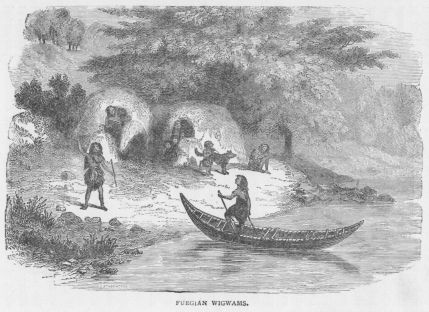
Mr Banks dispatched some persons to look for Richmond and the blacks, but they were unable to find them. About midnight a cry was heard, and the seaman was discovered standing, but unable to move, while one of the blacks lay insensible on the ground. So exhausted were the party that their united efforts failed to bring in the unfortunate negroes, who quickly expired, and were left where they fell, covered up with boughs. The night was passed in the greatest possible misery. In the morning, so fierce were the snow-blasts that it was found impossible to proceed, while they dared not venture to quit the fire. At length, having shot a vulture, the only food they obtained, at ten o’clock they set out, and after walking three hours found themselves on the beach, in sight of the vessel. On the 22nd the Endeavour proceeded on her voyage, and the fourth day afterwards rounded Cape Horn. She then ran for seven hundred leagues without land being in sight. Several coral islands were passed, the first of which was inhabited, and, after the dreary mountains of Tierra del Fuego, appeared a terrestrial Paradise. It was an almost circular band of land, with here and there cocoa-nut trees rising out of it, and enclosing a large lagoon. The natives appeared to be tall, of a copper colour, with long black hair, and they held in their hands poles of considerable length. This was called Lagoon Island, others, from their shape, obtained the names of Bow Island, Chain Island, and and Bird Island.
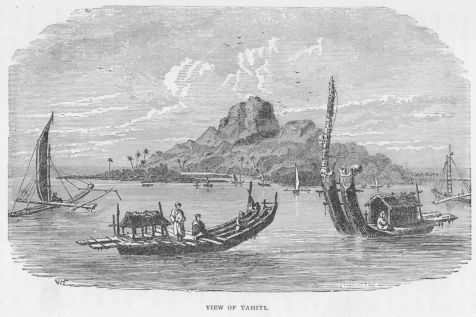
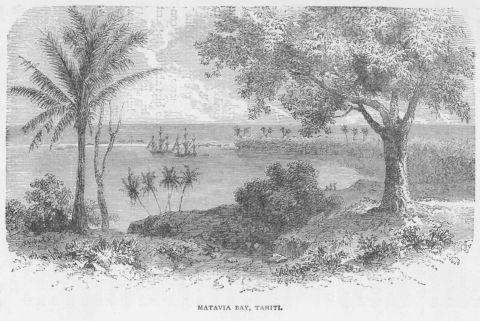
About noon on the 9th of April the high mountains of Otaheite were faintly discerned, but owing to calms the ship did not come to an anchor in Matavia Bay until the morning of the 13th. She was immediately surrounded by canoes, their crews bringing off fruits and fish, and waving green branches as a sign of friendship.
These were taken by the seamen and placed in different parts of the ship, to show the natives that their visitors also wished for peace. Strict rules were now laid down by the commander for the government of his people while on shore. He then landed with Mr Banks and Dr Solander, and a party of men under arms.
The natives received them in the most humble manner, the first who approached creeping up on his hands and knees to present a green branch as an emblem of peace.
After examining a place to ascertain if it was suitable for watering purposes, the party marched three or four miles into the interior through groves of trees loaded with cocoa-nuts and bread-fruit, affording the most grateful shade. Numerous huts were seen under these trees, which in the daytime had the appearance of roofs without walls. At night mats were let down, to afford such privacy as the habits of the people in that genial climate required.
All this time none of the principal persons of the island had made their appearance. After the ship had been there a couple of days, two chiefs, Matahah and Tootahah, came off, the first fixing on Mr Banks as his friend, and the latter on Captain Cook. The ceremony of making friends was gone through. It consisted in the natives taking off the greater part of their clothing and putting on that of their visitors. Their dress was formed of the bark made from the paper mulberry-tree. Captain Cook, Mr Banks, and others went on shore with their new friends, where they met another chief named Tabourai-Tamaide, and formed a treaty of friendship with him.
During a feast with which he entertained his visitors, Dr Solander and Mr Monkhouse found that their pockets had been picked, the one of an opera-glass, the other of his snuffbox. The chief showed his concern, and offered several pieces of native cloth as a compensation. This, however, was refused. The chief going out, by the aid of a sage woman, recovered the articles, and restored them to their owners.
One of the first objects to be attained was the erection of a fort, to protect the astronomical instruments. The spot was soon fixed upon, away from the habitations of the natives, and a party of men sent on shore to commence operations. While the principal officers were away, a number of people gathered round to watch what was going on, and one of them, rushing forward, seized a sentry’s musket, and made off with it. Without consideration, a midshipman ordered the marines to fire, which they did, but did not hit the thief. He, however, being pursued, was at length shot dead.
Notwithstanding this, the chiefs behaved with great moderation, and seemed satisfied that the act was not in consequence of any hostile feeling, though death was far too severe a punishment for the crime the man had committed.
Cook was greatly annoyed at this incident. He considered it prudent, however, to warp the ship closer in, to protect his people while engaged on shore, as he feared, in consequence of no natives coming near the ship, that they might be attacked. Before long, however, the natives got over their alarm, and brought propitiatory gifts of the usual green boughs. So confident was Cook of their good feeling that he allowed his officers to make excursions into the country.
Crossing a belt of fertile land on the side of the harbour, they reached a range of barren hills. Beyond them again they descended into a wide plain, watered by a river nearly a hundred yards wide. The plain was studded over with houses, the inhabitants of which appeared to live on the ample productions of their country. Happy as the people appeared to be, it was evident that they were mere children of impulse, scarcely knowing right from wrong. The greater number were pertinacious thieves, and addicted besides to many vices. Though not apparently bloodthirsty, they were accustomed to offer up human sacrifices. But little insight at that time was gained into their religious practices.
While the fort was in course of erection, the natives watched the proceedings closely. It was finished by the 26th of April, and six swivel guns were mounted on it. This seemed to alarm the people, who moved to a distance; but the chiefs came in with their wives, and exhibited no signs of fear. While they were there the butcher took a fancy to a stone hatchet in the hands of one of the women, and because she refused to give it, he threatened to kill her. The captain hearing of this, ordered him to receive a couple of dozen in the presence of the natives.
When they saw the first strokes given their kind feelings being aroused, they entreated that the rest of the man’s punishment might be remitted, and when their petition was refused they burst into tears. A day or two after this great alarm was caused in the fort by the disappearance of a large instrument in a case, without which the intended observation could not be taken. The friendly chiefs were applied to, and by their means the thief was traced, and though the parts of the instrument had been divided among various persons, the whole were collected uninjured, and it was finally set up in its place.
To have a better chance of obtaining a clear sky, the astronomers were divided into three parties. One with Mr Banks proceeded to the island of Eimeo, twelve miles west of Otaheite; Mr Hicks went to a spot eastward of Matavia Bay; while Captain Cook and Dr Solander remained at the fort. The eventful morning of the 3rd of June arrived. The sky was perfectly clear, and the passage of the planet Venus over the sun’s disc was observed to great advantage.
Captain Wallis had discovered a female whom he supposed to be the Queen of the isles. She was recognised by Mr Molineux, the master of the Endeavour, who had accompanied Captain Wallis on his late voyage. Her name was Oberea. She was therefore treated with much attention, and many presents were made to her. Among them she seemed to value most a child’s doll, possibly supposing it to be one of the gods of the white man. She had apparently been deposed, and Tootahah had become the principal chief, but, jealous of the favours shown to Oberea, was not content until a doll had been presented to him also, and at first he seemed to value it more than a hatchet. Among the attendants of Oberea was Tupia, who had become a priest, and had evidently considerable influence among his countrymen. He had from the first attached himself to the English, and now expressed a strong desire to accompany them when they should quit the country. As his services were likely to prove of the greatest value, Captain Cook gladly agreed to his proposal, and he was appointed interpreter on board the Endeavour.
The inhabitants of Otaheite were far superior to those of most of the other islands. They were all more or less clothed in well-made cloth manufactured from the paper mulberry-tree, and ingeniously painted. In wet weather they wore instead garments made of matting, some of a very fine and beautiful description. They produced a great variety of basket-work, and made string and rope of various thicknesses. Their houses were neat, and they were remarkably clean in their habits, many of them washing twice or oftener in a day. The last event of importance which occurred was the desertion of two marines, who stole from the fort, intending to remain in the country.
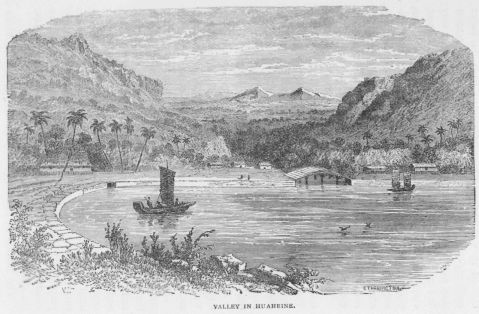
As Captain Cook could not allow so bad an example to be set, he was compelled, in order to recover them, to detain Tootahah and several other chiefs until the fugitives should be restored. The natives retaliated by capturing two petty officers, and the arms of two others, and matters began to look serious, until, by the intervention of Tootahah, the deserters were restored and received due punishment.
After a stay of three months the voyagers, having bade farewell to their friends on shore, prepared for sailing, when Tupia, accompanied by a boy as his servant, came on board, and expressed his readiness to accompany them.
About noon on the 12th of April the anchor was weighed, and the vessel getting under sail, the Indians on board took their leave of their visitors and Tupia, weeping with a deep and silent sorrow, in which there was something very striking and tender. Tupia evinced great firmness, struggling to conceal his tears, and, climbing to the masthead, made signals until he was carried out of sight of the friends he was destined never again to see. As they sailed along he frequently prayed to his god Tane for a favourable breeze, but it was observed that he never commenced his orisons until he saw the signs of the coming gale.
The islands of Eimeo, Huaheine, Ulietea, and Bolabola were visited in succession. The ship anchoring near Ulietea, Captain Cook took the opportunity to stop a leak, and take in ballast; he went also to visit Opoony, the warlike sovereign of Bolabola, who had conquered this and many of the neighbouring islands. Instead of seeing a fine-looking warrior, as he expected, he found a withered, half-blind, decrepit old man, who was, notwithstanding, the terror of the surrounding islands. The people on shore welcomed their visitors with all possible courtesy. On their way they met a company of dancers, men and women, who were said by Tupia to be among the principal people. The women wore graceful head-dresses of long braids of hair and flowers, with pearls in their ears. The upper parts of their bodies were unclothed, but they were amply covered from the breast downwards in native cloth stained black. Regular dramas were represented before the strangers, and the style of dancing was objectionable in the extreme. An ample supply of hogs, poultry, and provisions having been obtained at Ulietea, the Endeavour again sailed. When off Bolabola, at which the landing was found to be extremely difficult, to gratify Tupia Captain Cook fired one of his guns, though the ship was several leagues off. Tupia’s object was to exhibit his hatred of the King of that island, as well as the power of his new allies. To the group of islands which had been seen or visited, Captain Cook gave the name of the Society’s Islands, but Otaheite was not included among them, and continued to be known as King George’s Island.
On the 13th of August the Endeavour came off Oheteroa, considerably to the south of the others. Here the natives, dressed in coloured cloths and feathers, stood ready to oppose a landing; and after several fruitless attempts to conciliate them, Captain Cook continued his course to the southward. On the 25th of August, the anniversary of their departure from England, the day was celebrated by taking a Cheshire cheese from a locker where it had been preserved for the purpose, and tapping a cask of porter, which proved to be in excellent order. On the morning of the 30th a comet was seen in the east, a little above the horizon. After this, a heavy sea and strong gales were met with from the westward, and the ship being wore round, stood to the northward. On the weather moderating, the cruise was continued westward during the whole month of September, and on the 6th of October land was seen from the masthead bearing West-by-North.
On the evening of the next day the voyagers got near enough to observe that the country was of great extent, with several ranges of hills rising one above the other, and beyond them a lofty chain of mountains. The general notion was that they had found the Terra Australis Incognita. Night coming on, they were compelled to stand off, but the following day again sailed for the shore.
They saw some neat small houses, and a large number of people seated on the beach. Farther on was discovered a high regular paling, enclosing the whole top of a hill. In the afternoon the ship came to an anchor off the mouth of a river in a bay, the sides of which were composed of white cliffs of great height.
Such was the first view the English obtained of New Zealand, which has since become the home of many thousands of our countrymen. Captain Cook, Mr Banks, Dr Solander, and a party of men having landed, tried to open a communication with the natives across a river. While they were on the bank, a party of savages with long lances rushed out of a wood, and were on the point of spearing the men left in charge of the boat, when the coxswain fired and shot one of them dead. The natives then ran away. On examining the dress of the dead man, it was found to answer the description given in an account of Tasman’s voyage, which convinced the explorers that that navigator had previously visited the country. On the following day the natives again appeared on the opposite side of the river, inviting the strangers to cross; but Tupia warned them to be careful, and prepared for hostilities. Ultimately the savages swam across, almost all armed. At first they appeared inclined to trade, but in a short time made an attempt to seize the weapons of the English, and one of them carried off the cutlass of a seaman, which he flourished about his head as he made his escape. Others in considerable numbers came down to his assistance. At first Mr Banks fired, and merely wounded the man, who was still retreating, when Mr Monkhouse took a more fatal aim, and he dropped, and another piece being fired, the savages at length fell back. Shortly afterwards Captain Cook, who was anxious to make some prisoners, and by treating them well to inspire a general confidence, sent the boats to capture some canoes which were seen coming in from the sea. The natives, however, assailed their pursuers so vigorously with stones and other missiles, that the English were compelled to fire, and four men were killed. Three boys were captured. Cook deeply lamented this proceeding, though it appeared to be almost unavoidable. The boys on being taken on board became reconciled, and at first seemed very unwilling to be sent on shore, but were ultimately seen to join their companions.
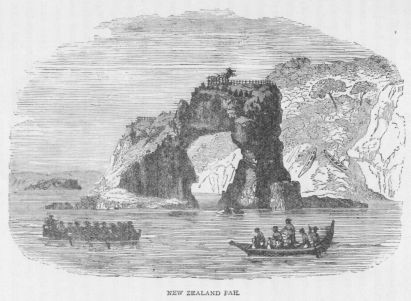
Such was the unhappy commencement of our acquaintance with the natives of New Zealand. As nothing could be obtained at the place where Cook first anchored, it was called “Poverty Bay.” Leaving on the 11th, he proceeded along the coast for six days, until the bluff headland was reached, to which he gave the name of “Cape Turnagain,” as the ship was there put about to return along the coast. She continued her course until she had sailed completely round the island. Names were given to the bays and headlands, which they retain to the present day. The intercourse with the natives was mostly of the same lamentable character as that at the commencement, though they in some instances brought off fish and willingly traded with the voyagers. The savages, however, stole whatever they could lay hands on, though appearing to be amicably disposed. One suddenly seized Tayeto, Tupia’s boy, and, dragging him into his canoe, made off. The marines fired at the canoe farthest from the boy, when one of the natives fell, on which the other let go his hold of Tayeto, who leaped overboard and swam to the ship.
At Mercury Bay—so-called in consequence of an observation of the planet Mercury having been made in the harbour—the natives behaved in a more peaceable manner, though many of them there tried to cheat their visitors. To this conduct there were some exceptions. One chief, named Toiava, behaved with great propriety, and expressed his hope that his countrymen would properly conduct themselves in future. Some of the canoes which approached the ship were of great size, one of them having sixteen paddles on each side and containing sixty men. She was making directly for the ship, when a gun loaded with grape-shot was fired in front of her, and, on a second shot being discharged over the heads of the crew, they seized their paddles and made for the shore.
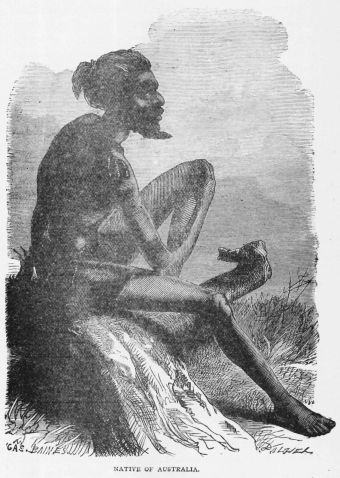
A headland, near which this occurrence took place, was consequently called “Cape Runaway.” Captain Cook having landed near the spot called by Tasman: “Murderer’s Bay,” on ascending one of the neighbouring hills, discovered that the country, which he at first supposed to consist of one large island, was divided by a strait into two islands. This strait has since been called Cook’s Strait. Leaving the inlet, on which he bestowed the name of Queen Charlotte’s Sound, the ship was borne rapidly through the straits. Having been exposed, when off the coast, to a furious gale, which, though it was the height of summer, lasted for five weeks, he continued his survey of New Zealand, and having run down the coast of Middle Island, and discovered Banks’s Island, he returned to Cook’s Straits. The Endeavour took her departure from Cape Farewell, the last land seen of New Zealand, on the 31st of March; and sailing westward, on he 19th of April land was descried, which proved to be part of New Holland. For several days the Endeavour coasted along the shore to the northward, until at last a bay was discovered, into which she ran and came to an anchor. Several black natives were seen on shore flourishing their spears. Abreast of the Endeavour was a village of about eight huts, and not far off four small canoes, with a man fishing in each. Presently an old woman with three children came out of the forest, laden with fire-wood. She threw down her burden, and kindled a fire, when the men, landing, began to dress the fish, apparently taking no notice of the ship.
Captain Cook, with several companions, went on shore, when most of the people ran away; but two, armed with lances, came down on the rocks to dispute the landing of the strangers, regardless of the presents which Captain Cook held out to them, flourishing their lances and shouting in discordant tones. Even when a shot was fired, though at first they retreated, one of them returned and threw a stone at the invaders. At last, another musket, loaded with small shot was fired at their legs, when, one of them throwing a spear, they both took to flight. The explorers, now landing, found some little children hidden in a hut; they were not disturbed, but some presents of beads, ribbons, and pieces of cloth were left in exchange, for a bundle of spears which was appropriated. It was at first supposed that these were poisoned, as a green substance was observed on their tips; but, on examining them, it was found to be seaweed, and that they must have been used for spearing fish. The next day, when Mr Banks, Dr Solander, and the others, landed, they found that their presents had not been removed. While the English were filling casks at a spring, and drawing the seine, when large numbers of fish were taken, the natives watched what was going forward without attempting to molest them.
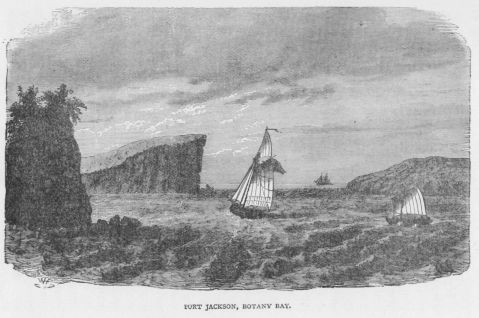
Several excursions were made by the naturalists on shore, when they also kept at a distance. A few animals and numerous gaily coloured birds were seen, and vast quantities of plants collected, from which circumstance Captain Cook gave the place the name of Botany Bay, which for half a century it retained. On the 6th of May the Endeavour left Botany Bay, and steered northward. Shortly afterwards, as she was passing along the coast, a seaman named Jackson observed what he took to be the entrance to a harbour, which in consequence was called Port Jackson; but Cook did not attempt to enter, being doubtful at the time whether it would prove to be a harbour. The object was now to lay the ship ashore, to clean and repair her. As he sailed along he anxiously looked out for a suitable spot, landing occasionally to explore the country. He had got as far north as 16 degrees 4 minutes, when, one fine night, as the ship was rapidly running on, a grating sound was heard. She had struck upon a reef. The officers and crew hurried on deck. The well was sounded: she was making a great deal of water. The boats were hoisted out, and attempts made to heave her off, but she beat so violently on the rocks that the crew could scarcely keep their feet, and she could not be moved. Her sheathing-boards and false keel also floated up. As she had struck at high water, though she might not sink, there appeared every probability of her becoming a wreck. Cook did not despair. At once the guns, ballast, and other heavy articles were thrown overboard, and preparations made for heaving her off when the tide again rose. Happily a dead calm came on, and at daybreak land was seen about eight leagues off. All day long the crew laboured without moving her. The night tide was likely to be the highest. At length she was hove off into deep water. Now the difficulty was to keep her afloat, for the crew were wellnigh exhausted by their exertions. At length Mr Monkhouse suggested that he had seen a vessel saved by fothering a sail—that is, covering it thickly with oakum, and then dragging it under the ship’s bottom to the place where the leak existed, when the oakum, drawn in by the force of the water, would fill up the openings.
This was done, and succeeded so well that two pumps kept her afloat until the 17th, when a safe harbour was found, and she was at once hauled ashore. It was then discovered that a fragment of the rock had gone through her bottom, and remained sticking there. Had this fallen out, she must have foundered. Tents and a forge were at once set up on the shore, and the carpenter, blacksmith, and others to assist, were speedily busy repairing the damage the ship had received. The sick were also landed. Of these there were many, for notwithstanding all their care, that scourge of seamen, scurvy, had already made much progress.
Mr Banks and other scientific gentlemen made excursions into the country. They saw several animals, but the strangest of all was of about the size of a greyhound, mouse coloured, and very swift. It had a long tail, and leapt like a hare, while the print of its feet resembled those of a goat. It was some time before another of the same species was seen and shot, when it was discovered to be what has since become a well-known animal, called after the native name, a kangaroo. Some days elapsed before any natives were seen. At last a gang approached, when Captain Cook ordered his people to take no notice of them. This had the desired effect of allaying their fears, and though shy, they became tolerably friendly.
A few days afterwards a party ventured on board, and took a great fancy to some turtles which had been caught, though they seemed to regard nothing else with interest. They first took hold of one, and then attempted to carry it off; but, on being prevented, jumped into their canoes, and paddled away in a rage. On landing, they seized a brand from under the pitch-kettle, and with it set fire to the long grass. It blazed up so furiously that it was with the greatest difficulty that the tent in which Tupia was lying sick could be preserved, while the woodwork of the smith’s forge was destroyed; it also caught a sow and young pigs, one of which was scorched to death. On a subsequent occasion the natives played a similar trick. Providentially, the stores and powder had been taken on board, or the consequences would have been serious.
Thanks to the knowledge of the naturalist, many vegetables were found on shore which contributed greatly to restore the health of the scurvy-stricken patients. Although in many respects the ship could not have remained at a more satisfactory place, a view to the eastward, obtained from some high ground, caused serious apprehensions. As far as the eye could reach were rocks and shoals without number, while it was evident that there would be great danger in navigating among the winding channels between them. The master, who had been engaged in surveying the mouth of the harbour, brought an equally unsatisfactory report, and it seemed surprising that the ship on entering the bay could have escaped the numerous dangers in her way. As provisions were running short, it was necessary to put to sea as soon as possible; but heavy gales kept the ship in harbour until the 4th of August, when at length she made her way out of Endeavour Harbour. For many hours, with the most vigilant care, she was steered among the reefs, until night approaching, and it coming on to blow, it was necessary to bring up. The gale increased, and she began to drive. By striking her yards, and then her topmasts, she at length rode securely. Here she remained for four days, until Captain Cook resolved to try and find a passage inside the reefs, close to the shore. At last, by the long rolling swell which set in from the eastward, he was convinced that he was free of the reefs; but the movement caused the ship to leak, and serious apprehensions were entertained that she would be unable to accomplish the voyage. His object was to ascertain whether the coast of New Holland, along which he was sailing, was or was not united to that of New Guinea. By standing on he was afraid that, should a passage exist, he might overshoot it. The ship was therefore hove to. The next morning a reef was seen, over which the surf was breaking with terrific violence. The current rapidly carried the ship towards it, the wind fell to a dead calm, and it was impossible to anchor on account of the depth of the sea. The only two boats fit for the service were sent ahead to tow, and the sweeps were got out; but all their efforts seemed to be unavailing, and her destruction seemed inevitable, when a light air sprang up, and she was able to get to some distance. Twice the breeze dropping, she was carried back towards the roaring breakers, until an opening was seen in the reef, through which she safely passed.
Day after day, keeping the land close aboard, Captain Cook sailed northward, until his perseverance was rewarded by the discovery of Cape York, the northern extremity of Australia, and the southern side of Torres Straits, through which he passed.
Having landed, and taken possession of the whole eastern coast in the right of his Majesty King George the Third, he called it New South Wales. Having found his way through the intricate navigation of the straits, Cook sailed northward along the coast of New Guinea, and at last came to an anchor in three fathoms of water, though still three or four miles from the shore. He then, with Mr Banks, Dr Solander, and others, landed, well armed. They made their way round a wood, until they reached a group of cocoa-nut trees, at about a quarter of a mile from the beach, when suddenly three blacks rushed out of the wood, the foremost of whom threw something from his hand which burnt like gunpowder, while the others darted their lances.
Though some small shots were discharged at the savages, they still came on, throwing their darts; but some bullets fired put them to flight, and it was hoped none were injured. On looking round, they saw the men in charge of the boat making signs that more natives were approaching, and presently a hundred appeared, shouting, throwing their darts, and sending out clouds of smoke from long tubes. As they were watched from the ship, it appeared that they were using firearms, though the sound was wanting. Some muskets being discharged over their heads, the savages retreated leisurely.
Besides other discoveries, Captain Cook on this voyage ascertained the size of New Zealand, also that the coast of New Holland was fit to become the habitation of civilised man, and that that vast territory was separated from New Guinea. The condition of the Endeavour made it now necessary to carry her to some harbour where she might undergo a complete refit. The nearest place was Batavia, belonging to the Dutch. He was aware of its unhealthiness, but he had no choice, and hoped that his crew would escape. Passing Timor, he came off the island of Savu, not at that time marked in the charts, but which had lately been taken possession of by the Dutch, though its native Rajah still remained its nominal ruler.
From this fertile spot abundance of provisions were obtained at fair prices. Java Head was reached on the ist of October. Poor Tupia was very ill, and Mr Banks at once sent on shore to procure fresh provisions for him. The ship proceeded on to Batavia. Here Cook was received with all courtesy and kindness by the Dutch Governor, and every assistance afforded him to repair the Endeavour. She was in a worse state than had been supposed. Her frame was much shattered, her pumps were rotten, and the planking in some places was not half an inch thick.
Tupia at first seemed to revive as he witnessed the wonders of a civilised community, but he soon experienced a reaction. Young Tayeto was also seized with an inflammation of the lungs, and Mr Banks, Dr Solander, Mr Monkhouse, and others were taken seriously ill. Tents were set up on shore for the invalids, but before long the surgeon succumbed. A few days afterwards young Tayeto died, and Tupia, who loved him as a son, was so much affected that he quickly followed him to the grave.
Mr Banks and Dr Solander rapidly recovered on being removed to a more healthy spot, but seven persons were buried at Batavia, and others imbibed the seeds of disease, which in the end proved fatal. When the Endeavour sailed from Batavia on the 26th of December, 1770, she had forty sick on board, and many others in feeble condition; and before she reached the Cape of Good Hope three-and-twenty persons died, in addition to those who were buried at Batavia.
On anchoring in Table Bay the sick were sent on shore, where most of them recovered. At that time Cape Town consisted of about a thousand brick houses with thatched roofs, and the inhabitants described the country as sterile, so as not to tempt the English to take possession of it.
Shortly after leaving the Cape, the master and first lieutenant, Mr Hicks, died. The latter was succeeded by Mr Charles Clerke, who accompanied Captain Cook in all his subsequent voyages.
Calling off Saint Helena, Captain Cook found there the Portland man-of-war, commanded by Captain Elliot, with whom he deposited his logs and other valuable papers, for fear that the Endeavour should not reach home.
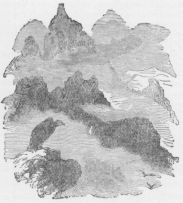
The Portland and her convoy of twelve Indiamen were soon out of sight. Though the sails and rigging of the Endeavour were rotten, and she leaked considerably, she ultimately reached the Downs on the 12th of June.
Chapter Twenty Six.
Captain Cook’s Second Voyage—A.D. 1772.
Supposed great southern land—Exploring expedition formed—Captain Cook appointed commander—Equipment of the Resolution and Adventure—Sail from Plymouth—Reported discovery by the French—Steer south—Land-like appearance of the ice—Intense cold—Separation of the ships—Icebergs—Sail from the Antarctic regions for New Zealand—Reach Dusky Bay—Health of the crew—Intercourse with the natives—Visit the ship—Garden planted—Live stock left—Sail for Queen Charlotte’s Sound—Fall in with the Adventure—Traffic with the natives—Voyage continued—Scurvy on board Captain Furneaux’s ship—Sail for Otaheite—Nearly on a reef—Natives visit the ship—Propensity to steal—Treatment—Interview with the King—Sail for Matavia Bay—Sail for Huaheine—Behaviour of the chief—A native is taken on board—Leave the Society Islands—Steer for Middleburg and Amsterdam—Reception—Description of the country—Object of the voyage continued—Quantities of ice—Illness of the commander—Easter Island—Ancient monuments—Sail for the Marquesas—Anchor at Nombre de Dios—The Indians come on board—A savage killed—Return to Otaheite—Native expedition against Eimeo—Voyage continued—Savage Island—The Tonga group—At Erromongo—Quarrel with the natives—Tamia—Native cultivation—A new island discovered—Reception by the natives—New Caledonia—Norfolk Island—News of the Adventure—Reach Christmas Sound—The natives—Sandwich Land—Vain search for Cape Circumcision—Steer for the Cape of Good Hope—News of an accident which befell the Adventure—Sail for England—Results of the voyage.
Before the return of Captain Cook to England it was supposed that New Guinea, New Holland, and New Zealand formed one great southern land, denominated Terra Australis Incognita. Though he had proved that these were islands, it was still supposed that there existed a great southern land, which had been seen by a French officer, Captain Bouvet, in 1739.
To determine whether such a land did exist, it was resolved to send out another expedition, the command of which was offered to Captain Cook. He gladly accepted it, and chose two vessels—the Resolution, of four hundred and sixty-two tons, on board of which he sailed, and the Adventure, of three hundred and thirty-six tons, of which Captain Tobias Furneaux was made commander. Two astronomers, Messrs Wales and Bayley; three naturalists, Mr Foster and his son, a Swede—Dr Sparrmann; and a landscape painter, accompanied the expedition.
An abundant supply of provisions of an anti-scorbutic nature was placed on board. Each ship also carried a vessel in frame of twenty tons, to serve as tenders. The Resolution had a complement of one hundred and twelve officers and men, and the Adventure of eighty-one. Fishing-nets, hooks, and articles of all sorts to barter with the savages were put on board; indeed, no exploring expedition had ever left England so well equipped.
After frequent delays the two ships left Plymouth on the 13th of July, 1772, and shaped a course for Madeira. Merely touching at Funchal, they took in a supply of water at the Cape de Verdes. The two ships then sailed for the Cape of Good Hope.
Here the Governor informed Captain Cook that a French ship had discovered land in the meridian of the Mauritius, in latitude 48 degrees south, and that a French expedition, under Captain Marion, was now exploring the South Pacific. On the 22nd of November Captain Cook left the Cape of Good Hope, and steered a course towards Cape Circumcision, the name given to the point of land which Captain Bouvet supposed to be a part of the southern continent.
As the ships got farther south, the weather became so cold that much of their live stock died. On the 10th of December an island of ice was seen, after which thick hazy weather came on. While the Resolution was leading, an iceberg was discerned from her deck. It was about fifty feet high, with perpendicular sides, against which the sea broke furiously. Captain Furneaux, mistaking it for land, hauled his wind. Other navigators probably have been deceived as he was. Day after day the ship sailed on among icebergs, exposed to storms of rain and sleet and constant storms, although it was the middle of summer.
Captain Cook now steered to the west, hoping to get round the ice and reach the highest position of Cape Circumcision; but he finally came to the conclusion that Captain Bouvet had mistaken some lofty icebergs surrounded by field ice for land.
The ships were thus engaged until the 8th of February, when, during thick weather, the Adventure was separated from the Resolution. For three days Captain Cook cruised in search of her, and was at last compelled to proceed. Here numerous whales were seen, and flocks of antarctic petrels. While two of the boats were engaged in collecting loose ice off an iceberg, to melt for water, it was seen to lean over until it completely turned bottom up, though it thus lost neither in height nor size. The boats providentially escaped. By the middle of March, the antarctic summer being over, Captain Cook shaped a course for New Zealand, where he intended to recruit his crew and refit the ship. On the 26th he entered Dusky Bay in the middle island, having sailed over nearly ten thousand miles without having once sighted land. His crew had been kept in excellent health by the anti-scorbutic provisions on which they were fed, and by the frequent airing of the ship by fires. A snug harbour having been found, the ship was warped into it, and places forthwith cleared in which the observatories, forge, and the tents were set up. By the suggestion of Captain Cook, wholesome beer was brewed from the leaves of a tree resembling the American black spruce; indeed, he at all times attended to the most minute points calculated to maintain the health of his people.
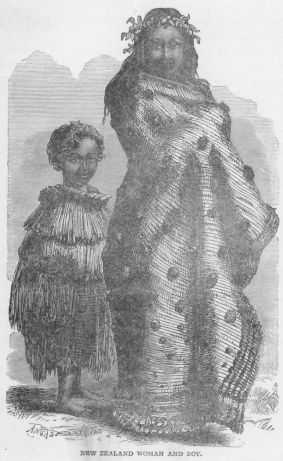
A few families of natives only were met with. One of these having taken up their quarters near the watering-place, soon became intimate. They looked with perfect indifference on the trinkets offered them, but evidently set a high value on hatchets and spike nails.
The head of the family and his daughter paid a visit to the ship. Before stepping on board, however, he presented a couple of talc hatchets to the captain and Mr Foster, and the girl gave one to Mr Hodges. He also waved a green branch, with which he struck the ship, and made a speech before coming on board.
On a shooting expedition another party of natives was met with, the chief of whom approached with a plant in his hand, one end of which he presented to the captain, while he himself held the other. After making a speech, he took off his cloak, which he placed on Cook’s shoulders. After this he and his companions attended the English to the boat, and assisted in launching her, and seemed much inclined to carry off anything they could lay hands on.
Captain Cook, according to his universal plan, here left five geese in a retired cove, hoping that by multiplying they might benefit the natives. He also had a garden dug, and sown with seeds of various sorts.
Leaving this harbour, the Resolution sailed for Queen Charlotte’s Sound, encountering on the way no less than six waterspouts of unusual size. A gun was got ready to fire, but they all passed by without touching her. On reaching their destination, the Adventure, to the satisfaction of all, was found to have arrived there first. At Queen Charlotte’s Sound a garden was also planted, and Captain Cook gave the natives some potatoes, explaining their use, and the mode of cultivating them. A boar and two sows, and a pair of goats, were likewise landed. The natives appeared to be friendly, and some came on board with their children, for whom they hoped to obtain presents, though at first it was supposed with the intention of selling them. To one of the boys, about ten years old, a white shirt had been given, and he went about showing it until he encountered an old goat, who knocked him over into some dirt. The boy was inconsolable until his shirt had been washed and dried. While a party of the natives were on board, a large canoe was seen coming into the harbour. Some of the natives hurried on shore to look after the women and children, but two who remained begged the captain to fight for them, and fire at the strangers.
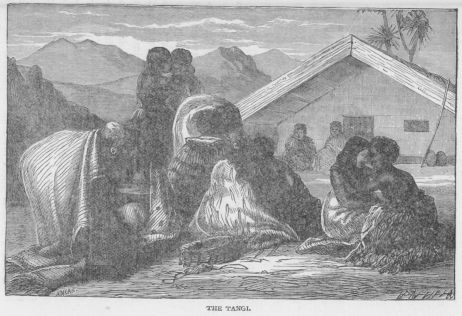
The latter, however, came alongside without fear. Their first question was for Tupia. On hearing that he was dead, some of them expressed their sorrow. Among those he saw, Captain Cook did not recognise a single person he knew when there in 1770, and he concluded, therefore, that the entire population had changed since then.
The Resolution and Adventure once more proceeded on their voyage, on the 7th of June, 1773, it being Captain Cook’s intention to explore the unknown part of the Southern Ocean between New Zealand and Cape Horn. After they had been the greater part of the month at sea, Captain Furneaux sent word that the scurvy had broken out on board his ship, that the cook had died, and that twenty men were ill. It appeared that her people had neglected to eat vegetables while at Queen Charlotte’s Sound, and since they had been at sea, Captain Cook had from the first insisted on having wild celery, scurvy-grass, and other herbs boiled with the peas and wheat, both for officers and men. He consequently had only three men ill, and one alone of scurvy. Instead, therefore, of continuing the cruise to the southward, he determined to put into Otaheite. Several low islands, on which cocoa-nut trees grew, were seen on the way. Having reached the south-east end of Otaheite, the two ships being together, at daybreak they found themselves not half a league from a reef, towards which the send of the sea, the wind having fallen, was drifting them rapidly. To anchor was impossible. A passage was discovered through the reef, but a boat being sent ahead to sound, it was found there was not sufficient water for the ships to pass on. The horrors of shipwreck threatened the explorers. Closer and closer they drove to the reef. At last the anchors were let go. The Resolution was brought up in less than three fathoms, striking at every fall of the sea. The Adventure, however, remained afloat. Kedge anchors and hawsers were immediately carried out, which would have availed but little had not the tide turned, and a light breeze coming off shore, both vessels making sail, got safely to sea.
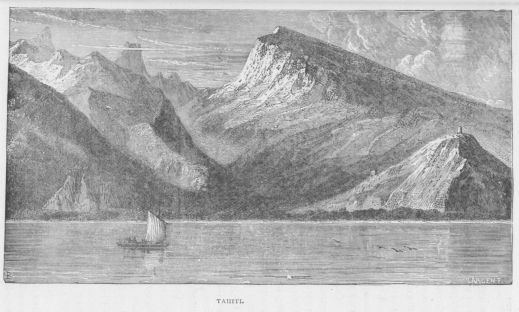
On anchoring close in shore in the Bay of Oaiti-piha, numbers of natives came off, bringing numerous fruits and vegetables, which they exchanged for nails and beads; but the petty chiefs were greatly addicted to pilfering and cheating in every possible way, and on one occasion the whole party being found stealing, they were turned out of the ship and two muskets fired over their heads to frighten them. They took to flight, leaving a little boy, who was at first greatly alarmed, but having been kindly treated and some beads given him, he was sent safely on shore. This at once restored the confidence of the natives.
On another occasion a native seized a musket from one of the sentinels and made off with it. He was seen, however, by one of the chiefs, and his prize restored. On the following day the chief brought a quantity of cocoa-nuts tied up in bundles, but on opening them it was found that they were empty. The chief did not seem disconcerted, but acknowledged, after opening two or three himself, that the inside had been extracted. He afterwards, to make amends, sent off a quantity of plantains and bananas.
After an interview with the King Waheatoua, whom Cook had formerly known under the name of Tearee, the ships sailed for Matavia Bay. Before they anchored, a large number of natives came off. Among them was the King Otoo. Next day Captain Cook and some of his officers set off to visit him. He was found seated on the ground under the shade of a tree, with a large crowd round him, all standing with bare heads and shoulders in mark of respect. Captain Cook having given the presents he had brought, King Otoo inquired for Tupia and for several officers who had been on board the Endeavour. Afterwards coming on board, when, entering the cabin, several of the chiefs who had been there before, uncovered their shoulders, although they showed no other mark of respect. He took an especial fancy to the bagpipes. In return for the civilities he had received, he entertained the voyagers with a dramatic performance, in which his sister, elegantly dressed in a robe of feathers, took part.
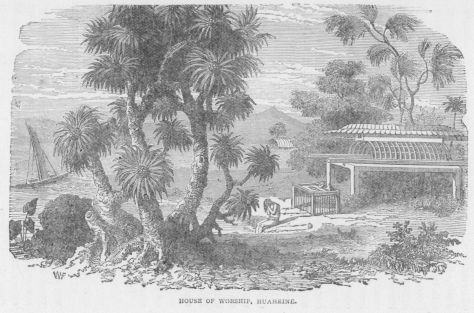
Leaving this place, the ships anchored in the harbour of Owharre, in the island of Huaheine. Abundance of provisions were exchanged, and the chief Oree, who had on Cook’s former voyage exchanged names with him, was still living, and now seemed greatly rejoiced to see him again. Friendly intercourse was maintained with the people. Notwithstanding this, Mr Sparrmann, one day while wandering in the woods, was robbed of his clothes and hanger. Oree, on hearing of it, shed tears, and by his personal exertions recovered most of the articles.
From this island Captain Furneaux received on board his ship a young man named Omai, who was anxious to accompany him; but he was not a chief, and was inferior in figure, complexion, and manners to most of them.
Ulietea was also visited. Here also a friendly intercourse was kept up with the natives. Captain Cook, who had before praised the inhabitants of these islands greatly, now discovered many of their horrible habits and customs; among others he found that human sacrifices were offered up at their Morais, the victims frequently being persons to whom the priests had taken a dislike, and who, unsuspicious of their intended fate, were knocked on the head.
After leaving the Society Islands, Cook steered west for Middleburg and Amsterdam, discovered by Tasman. At the first island the explorers met with an enthusiastic reception. The chief conducted the officers to his dwelling, which was built near the shore at the head of a fine lawn, under the shade of some shaddock-trees, in a most delightful situation. Here they were entertained and invited to join in a kava feast. Cook was the only person who ventured to taste the beverage.
Leaving this island, they steered for Amsterdam or Tonga Taboo. The natives welcomed them with white flags. When Cook landed, their chief Attago conducted him over part of the country; and so fair was its aspect, that he could fancy himself transported into the most fertile plains of Europe; not a spot of waste ground was to be seen. Fences were often formed of useful plants, and the road occupied as little space as possible. In other places the inhabitants resembled those of the Society Islands.
As it was now time to prosecute his researches in high southern latitudes, he sailed on the 7th of October, and having sighted Pilstart, he on the 21st descried the land of New Zealand, though, owing to contrary winds, he did not reach Queen Charlotte’s Sound until the 3rd of November, having in the meantime lost sight of the Adventure. He here remained three or four weeks, waiting for her appearance, and then sailed in the hopes of completing the circle round the pole in a high latitude.
This was a most dreary part of his voyage. Immense masses of ice were seen, and occasionally the antarctic petrels, grey albatrosses, and some other birds; but there were few other objects of interest to amuse the minds of the crew. Often the ship was in great peril from icebergs. At one time no less than ninety-seven were seen within a field of ice, besides a number outside, many of them very large, and looking like a range of mountains rising one above another until they were lost sight of in the clouds. The outer or northern edge of this field was composed of loose or broken ice, so closely packed together that it was impossible for the ship to enter it. Since therefore he could not proceed farther to the south, he determined to stand back in search of a more genial clime. Many of his crew were suffering, and he himself was seized with so dangerous an illness that his life was despaired of. Unable to leave his cabin, Mr Cooper, his first officer, took charge of the ship. When he began to recover, a favourite dog, belonging to Mr Forster, was killed to supply him with fresh meat and broth.
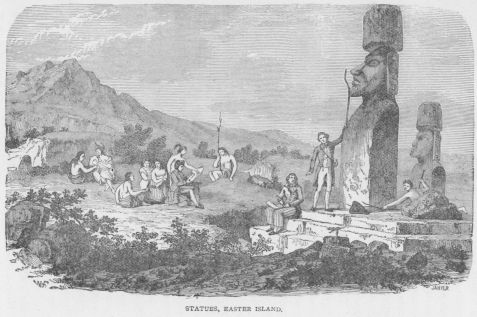
The first land made was Easter Island, which had been in vain looked for by Byron, Cartaret, and Bougainville. There was no anchoring-ground, and but a very small supply of fresh provisions or water. The inhabitants, numbering between six and seven hundred, had made less progress in the arts than any other tribes of Polynesia. The objects of chief interest in the island were gigantic statues, some from fifteen to twenty-seven feet in height; on the head of each was a cylindrical block of red-coloured stone, wrought perfectly round. The carving on the upper portion resembling a human head and breast—was rude, though the nose and chin were fairly delineated, while the ears were of a length out of all proportion. The natives paid the statues no respect, and it appeared unlikely that they could have been carved by the ancestors of the present inhabitants.
From Easter Island Cook steered northward, until he came in sight of the Marquesas, discovered by Mendana. Passing between Dominica and Santa Christina, he came to an anchor in the port called Nombre de Dios by the Spaniards. A number of canoes immediately came off, their occupants richly tattooed, bringing bread—fruit and fish, which they willingly exchanged for nails. In each canoe was a heap of stones, and every man had a sling tied round his hand. Next morning many more came off and began to barter, and the deck was soon crowded. One of the savages stole an iron stanchion, when, as a warning, Cook gave an order to the marines to fire over the canoe in which the plunderer was making off. Unfortunately a marine aiming at him, shot him dead.
They, however, returned after some time, and again began bartering; but some of the gentlemen incautiously introduced new articles of trade, which were eagerly sought for, especially red feathers. When these were not to be obtained, the savages refused to bring off more provisions. Cook had to sail away without them.
He now steered nearly south-west, until the most easterly of King George’s Islands was reached. Hence he returned to Otaheite, where he was warmly welcomed by the natives. Here provisions had become very plentiful. Numerous new habitations had been erected, and an immense number of canoes, destined for an expedition against Eimeo, were drawn up along the beach.
Some of the war canoes were from fifty to ninety feet long. In all there were three hundred and thirty vessels, carrying nine thousand seven hundred and sixty warriors and rowers, dressed in breast-plates and turbans or helmets, while other warriors were armed with clubs, spears, and stones. Having refitted the ship, Cook sailed for Huaheine, where he found his old friend Oree as kind as ever. They were received in the most affectionate manner by him and his family. The old chief wept when he heard that Captain Cook was not likely again to return, and inquired where he would be buried. When Cook replied “At Stepney,” a hundred voices instantly echoed “Stepney mariai no Toote!” Toote being the name by which the natives called Cook.
Here Oedidee, who had been so long on board, was landed, greatly to the grief of the young islander, who, as he looked up at the ship, burst into tears, and then sank down into the canoe which was conveying him ashore.
After leaving Olietea, the Resolution proceeded westward, sighting Howe Island, seen by Captain Wallis, and afterwards an island before unknown, to which the name of Palmerston was given. On the 20th of June she came in sight of an island eleven leagues in circuit. Keeping the ship well out to sea, Captain Cook in vain attempted to open a communication with the natives, who, regardless of the muskets pointed at them, rushed forward, shaking their spears. One man darted his weapon at Captain Cook, who, to defend himself, pulled his trigger, but his musket missed fire. Unwilling to shed blood, he and his companions retired to their boat. In consequence of the fierce behaviour of the natives, he named this Savage Island.
After leaving this place, the Resolution steered westward, or west-south-west, until a string of islands was seen ahead, which proved to be those of the Tonga group. A canoe came off. At first the inhabitants appeared to be friendly, but various thefts were committed. Mr Clark’s gun was snatched out of his hand, and another savage seized a fowling-piece belonging to the surgeon, who was out shooting. The marines were therefore landed, and took possession of two large double sailing canoes; but the chiefs restored the articles, and brought on board a man who had been slightly wounded by small shot, stretched on a board as if dead. They seemed to think the captain wanted him. On examination, he proved to be very slightly hurt, and his wounds were dressed.
After leaving the Friendly Islands, the Australis del Esperito Santo of Quiros was reached. Sailing round it, Cook proved it to be an island. Passing another, which the natives called Ambrym, he anchored the next day off another island, of which he discovered the name to be Mallicolo. The natives were hideous in appearance and very dark, while their language differed entirely from that of the other South Sea Islands. Having passed several more islands, he again anchored, on the 3rd of August, on the south-east side of Erromango. Here a large number of people assembled as the boat pulled for the shore. Cook landed with only a green branch in his hand, and offered a number of presents to the chief, which were accepted. Still the natives were armed with clubs, spears, bows and arrows, and kept advancing in a suspicious manner. On this the captain stepped back into the boat, when the islanders, rushing forward, attempted to drag her up the beach. Others snatched at the oars. In this predicament he was compelled to raise his gun, but the piece only flashed in the pan. The savages now began throwing stones, darts, and shooting their arrows, one of the crew being wounded in the chin. Captain Cook now ordered his men to fire. The first discharge threw the savages into confusion, but a second was hardly sufficient to drive them from the beach. They then retired behind the trees, from which they continued to shoot their arrows. The boat succeeded in getting off, and returning to the ship. Cook now ordered a gun to be fired, and a shot was pitched among the crowd. Happily no one was killed, but it prevented all further communication with the savages, who too probably did not forget the way they had been treated.
After leaving Erromango, Cook steered for another island, which was called Tanna, and on which a volcano was seen in full activity. The natives, coming off, proved to be daring thieves, some attempting to steal even the rings from the rudder. An effort was made to carry off the buoys, but a musket or two, fired over their heads, had the effect of driving them off. One old man, who said his name was Paowang, continued to bring off provisions, and barter with the English. After some time Cook, with a well-armed party, landed, but the natives, instead of being frightened, began to use such threatening gestures that it was necessary to fire upon them. At the same time the guns opened from the ship. At first the savages dispersed, but soon came back in a humble manner, and there appeared every probability that they would prove submissive.
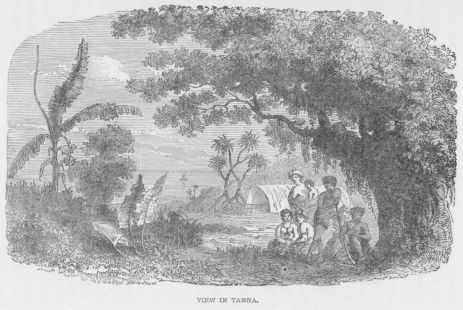
After this the English were able to make excursions in various parts of the island, while old Paowang enabled them to obtain as much wood as was required, as also bread-fruit, plantains, and cocoa-nuts.
Black and savage as were the inhabitants, every hill was covered with plantations. The vegetation was luxuriant, and the valleys watered by sparkling streams. Having surveyed the whole of the group, Captain Cook left Tanna on the 20th of August, and stood for New Zealand. On her course to the north-west a fourth island was discovered, and, passing through a reef, the ship came to an anchor. The natives, in numerous canoes, came alongside, and were invited on board. Although naked, with the exception of the usual wrapper, they were intelligent, and examined with much interest the goats, hogs, ducks, dogs, and cats. Some were invited into the cabin, but would touch none of the provisions except some yams.
Afterwards Captain Cook landed, and all the chiefs made speeches. One of them, Teabooma, especially, showing a friendly disposition, was of great use in obtaining water, fuel, and provisions. Though hundreds of natives came on board, not a theft was committed. In some respects the country resembled New Holland, but the sides of the mountains and other places had an especially dreary aspect. The natives had made some advances out of a purely savage state. They lived in well-thatched circular huts, some of which had two fireplaces, and some even two stories, while their canoes were of large size.
Such was the first knowledge obtained of New Caledonia, and it was considered, with the exception of New Zealand, the largest island in the Pacific. To the south of it a small island was seen, to which the name of the Isle of Pines was given, on account of the number of tall trees growing on it.
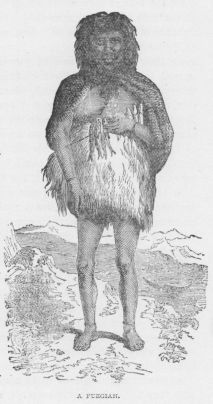
Some of these were cut down for spars, and the Resolution then bore away for New Zealand.
On the 10th of October a small island was discovered, rising to a great height out of the ocean, and bearing numbers of spruce pine and cabbage-palms. It was uninhabited, and possibly no human being had ever before landed there. The name of Norfolk Island was given to it, and it was afterwards used by the British as a station for twice-convicted prisoners.
On the 18th of October the Resolution anchored in Ship Cove, near Mount Egmont, in New Zealand. The conduct of the natives was suspicious. They found that the Adventure had been there, and feared from what was said that some accident had happened to her; what it was could not be made out.
On the 10th of November Captain Cook again sailed, and on the 20th of December reached a harbour at the western entrance of the Straits of Magellan, to which the name of “Christmas Sound” was given. Here a number of natives made their appearance in nine canoes: a little, ugly, half-starved, beardless race. Their clothing consisted of two or three seal-skins, forming a cloak. Some had only one sealskin, and the women wore a sort of apron. On the 28th the Resolution again sailed, and rounded Cape Horn the next morning. She afterwards put into Success Bay, in the Straits of Le Maire, where a notice was left for Captain Furneaux, should he call there. Vast numbers of sea-lions, bears, geese, and ducks were obtained, the former for the sake of their blubber, from which oil was made. On the 3rd of January, 1775, the Resolution was again at sea. Ten days afterwards two islands were discovered—one being named “Willis’s Island,” from the man who first saw it, and the other “Bird Island,”—while beyond, land was seen extending for a considerable distance.
On approaching, they landed at three different places,—the British flag was displayed, and possession of the country taken in his Majesty’s name. It was a dreary region, bordered by perpendicular cliffs of considerable height, from which pieces were continually breaking off. Beyond, the country was equally savage and horrible, not even a shrub being seen large enough to make a toothpick.
At first it was supposed to be a continent, but proved, after they had sailed partly round it, to be an island, about seventy leagues in circuit. After passing other islets and rocks, land of considerable extent was discovered, to which the name of “Sandwich Land” or “Southern Thule” was given. It rose to a great height, covered everywhere with snow. While the Resolution was close in with the coast, a great westerly swell sent her nearer and nearer to it. No bottom was found, and a thick haze obscured the land. It appeared too probable that the ship would be dashed to pieces on one of the most horrible coasts in the world. When the fog cleared away, a point appeared, beyond which no land was visible.
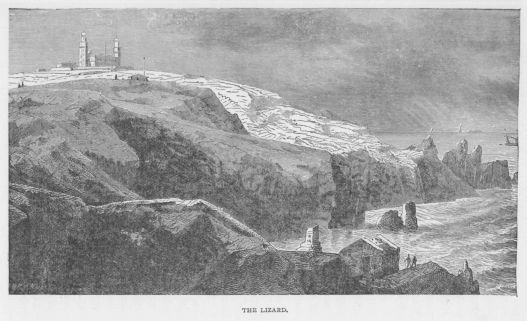
After escaping this danger, Captain Cook looked in vain for the long-sought Cape Circumcision. Convinced, at last, that it did not exist, to the delight of all he steered for the Cape of Good Hope. On arriving there he found a letter from Captain Furneaux, giving an account of the massacre of a midshipman and a boat’s crew by the natives, who had rushed down on them while at dinner, and clubbed them all.
After being treated with great courtesy by the Dutch, Captain Cook sailed for England on the 27th of April, in company with the Dutton East Indiaman, and on the 30th of July, 1775, he anchored at Spithead, having been absent from home three years and eighteen days.
Besides the numerous important discoveries made by Cook on this voyage, he had shown that, by due attention, the health of a ship’s company can be preserved in all climates, and while undergoing extreme toil. His system was to make the crew keep their persons, hammocks, bedding, and clothes clean and dry; to air the ship once or twice every week with fires, or to smoke her with gunpowder mixed with vinegar and water. A fire in an iron pot was frequently lowered to the bottom of the well. The ship’s coppers were kept constantly cleaned. Fresh water was taken on board whenever practicable, and vegetables, including scurvy-grass, and greens of all descriptions, were, when possible, obtained. As a remedy against scurvy, sweet wort was found most valuable, two or three pints a day being given to a man on the slightest appearance of the disease. Preparations of potatoes, lemons, and oranges were served out, and a pound of sour-krout was supplied to each man twice a week, while sugar and wheaten flour were found useful, but oatmeal and fish oil were considered to promote scurvy.
The voyage, now completed, was justly considered without a parallel in the history of maritime enterprise. Never, indeed, had any expedition been conducted with greater skill and perseverance. Cook received the honours which were his due. He was raised to the rank of Post-Captain, and named a Captain in Greenwich Hospital, and in February of the following year he was unanimously elected a Fellow of the Royal Society.
Chapter Twenty Seven.
Captain Cook’s third voyage—A.D. 1776.
A third voyage planned—The Resolution and Discovery commissioned—Expedition sails—Omai taken on board—Touch at the Cape of Good Hope—Van Diemen’s Land—New Zealand—The Friendly or Tonga Islands reached—Acquaintance formed with Feenon—His treacherous designs—Cook’s determined conduct checks the natives—Visits Otaheite—Omai shows his true character—Astonishment of natives on seeing horses ridden—Omai landed at Huaheine with his property—His bad conduct and wretched fate—Desertions at Ulietea—Live stock landed—Bolabola and other islands visited—Unknown islands sighted—Cook lands—Natives receive him with deep respect—Assist the watering party—Name of Sandwich Islands given to the group—Ships proceed to coast of America—Natives come off at Nootka Sound—Anchor in Prince William’s Sound—The ships enter Behring’s Straits—Turned back by the ice—Anchor off Oonalaska—Kind behaviour of the Russian authorities—The expedition returns to the Sandwich Islands—Sail round them, and come to an anchor in Karakavoa Bay—Vast numbers of natives come off—Cook supposed to be their god Rono—Honours paid to him—Ceremonies at a temple—Ships put to sea—Compelled to return—Temper of the natives changed—Attempts to coerce them—Death of Captain Cook and several men—His character—Captain Clerke succeeds, and makes peace with the natives—Ships sail in search of a passage round America—Touch at Saint Peter and Saint Paul—Courtesy of the Russians—Ships again compelled to return by the ice—Death of Captain Clerke—Captain Gore takes command—Sails for Macaohigh price obtained for seal-skins—Commanders of French ships ordered to treat the Adventure and Resolution as neutrals—Touch at the Cape of Good Hope—Steer round Scotland, and reach the Nore 4th of October, 1780—Remarks on Captain Cook’s discoveries—Notice of his family.
It had long been the desire of scientific men to discover a passage round the north coast of America between the Atlantic and Pacific. In 1773, Captain Phipps, afterwards Lord Mulgrave, went to Baffin’s Bay, but had returned without making any important discovery. At a dinner at the house of Lord Sandwich, to which Sir Hugh Palliser, Mr Stevens, Secretary to the Admiralty, and Captain Cook had been invited, the importance of the design was under discussion, when Cook, although he might justly have enjoyed quiet and repose, volunteered to command any expedition which might be undertaken. His offer was accepted. He was at once appointed to the command of the Resolution, and Captain Clerke, who had been with him on each of his previous voyages, received orders to commission the Discovery, a vessel of three hundred tons, fitted out as the Adventure had been. The ships were ready early in July, 1776. Everything that could tend to preserve the health of the crews was put on board,—warm clothing, as well as numerous animals, garden seeds of all sorts, and iron tools to traffic with the natives, while many things, purely for the benefit of the people, were to be supplied. The chief object of the voyage was to find a passage from the Pacific into the Atlantic; but the Society Islands and other spots were to be visited on the way. The young savage Omai, who had been petted and made a lion of in London, but whose advancement in civilisation was entirely superficial, and who had imbibed no religious principles, was to be restored to his country, under the foolish notion that he would convey to the islanders of the Pacific an exalted idea of the “greatness and majesty of the British nation,” as a writer of the day expresses it.
A very brief sketch of this voyage can alone be given. The two ships sailed from Plymouth on the 12th of July, 1776, and reached the Cape of Good Hope on the 10th of November. Again sailing on the 3rd of December, they sighted Marion and the Crozet Islands, and coasted along Kerguelen’s Land, which was found to be an island, desolate and sterile in the extreme. On the 24th of January they anchored in Adventure Bay, on the coast of Van Diemen’s Land. A few natives appeared, whose only weapons were pointed sticks, and who were black and perfectly naked. Sailing on the 30th of January, the ships reached Queen Charlotte’s Sound in New Zealand on the 12th of the next month. The natives were somewhat shy, fearing that Cook had come to punish them for the murder of the boat’s crew belonging to the Adventure. Some of those who had not taken part in it urged him to do so; but, as he remarks, “the natives of one part were constantly requesting him to destroy their neighbours—indeed, the tribes were living in a state of warfare among each other.”
Leaving Queen Charlotte’s Sound, Mangeea was reached, a pleasing fertile island, and beyond it another called Wateea, a spot of great beauty, diversified by hills and plains. The inhabitants were in general remarkably handsome, and were of the same race as those of the Society Islands. Thence a course was steered for Hervey Island, seen on the previous voyage. Though then supposed not to be inhabited, several canoes came off, carrying men of a somewhat darker hue and a more fierce and warlike aspect than the natives of Mangeea, though probably of the same race.
On the passage to the Friendly Islands, the ships called off Palmerston Island, where scurvy-grass, palm-cabbages, and fodder for the animals and birds, and cocoa-nuts for the crew, were obtained.
Passing Savage Island on the 1st of May, they dropped anchor at Annamooka. Here Cook made the acquaintance of Feenon, who, though then only a tributary, afterwards became lord of the whole group. By his means an abundant supply of provisions of all sorts was obtained. Feenon and another chief, Omai, accompanied him to Hapai, belonging to the same archipelago. Here Cook accompanied them on shore, and a large concourse of people, numbering three thousand, assembled, whom the chief addressed, urging them to bring such provisions as were required.
They were entertained with various games, such as wrestling and pugilistic matches. Some warriors engaged in a succession of single combats, in which they fought with clubs. Cook, on landing, suspected from the behaviour of the chiefs that something more than ordinary was in agitation. In fact, friendly as they appeared, they had formed a plot, instigated by Feenon, to massacre their visitors and take possession of their ships, as they did some years afterwards of the vessel in which Mr Mariner sailed. Fortunately, disputes arose amongst the conspirators, and they either abandoned or put off their design. Feenon, notwithstanding his intended treachery, accompanied their other visitors on board ship, and dined with the captain. Afterwards he sent a present of two large hogs, some yams, and a considerable quantity of cloth. Notwithstanding this apparently friendly intercourse, the natives, who came on board in considerable numbers, stole whenever they had an opportunity. At length, to put a stop to this, Cook seized three canoes which were alongside, and then going ashore with a strong guard, and having found the King, his brother Feenon, and some other chiefs in a house, immediately placed a guard over them, and made them understand that until the things were returned they must remain under restraint. This had the desired effect, and most of the articles were brought back. Cook then invited the King and other chiefs to accompany him on board to dinner. The King set the example, although the others at first objected, and in a short time the remainder of the things were brought back.