"Notable Voyagers" (continued 11)
Reading edition
At Beachey Island the vessels remained after their exploration of nearly three hundred miles of new ground. Plans, no doubt, were made for the following year, while the cold death-like hand of winter came and grasped everything in its iron grip. The sun, of course, left the ships, and after climbing the hills to see the last of him, the crews went back in darkness to the vessels. How the crews amused themselves during the winter we can imagine, and we find plenty of testimony to the games, the acting, the reading, and study, in which time was passed. The great thing to be aimed at was occupation—action. Stagnation meant death.
Three men died during the winter, and when the sun reappeared, when the creeks in the ice warned the crews that the time of release was at hand, a good and anxious look-out was kept. At length the ice-floes moved away, and after a while the channel was cut out for the release of the Erebus and Terror. The open water was at length gained, the instructions were to go south-west from Cape Walker, and that was now the point aimed at. When the Cape had been gained, and quitted for Cape Herschel, the ships fell into the Melville Island ice-stream, and they struggled on till King William’s Land was sighted. But unfortunately by that time another winter had began to reform the ice. So there was nothing to do but find winter quarters, which were finally established northward of Cape Felix, in anything but a happy place, for the ice there is described as of a most fearful nature, and of terrible pressure.
Here there was a fearful prospect—nothing but ice in mountains, and in masses which tossed the ships—slowly indeed—and threatened to “nip” them in halves. But notwithstanding all the hardships, the men bore up, and prepared for the overland journey to Cape Herschel—a hundred miles only!—as soon as the spring should open. As soon as possible, a pioneer party, under Lieutenant Gore and Mr Des Voeux, of the Erebus, started off to see the channel or path by which they might reach America. When they rapidly returned to tell their comrades the good news they had gathered, they found Sir John Franklin dead!
Shortly afterwards, in a deep crevasse in the ice, the body was laid while the burial service was read over it by Captain Fitzjames. Franklin, “like another Moses, fell when his work was accomplished—with the long object of his life in view.”
The movement of such ice as was still around the vessels would not take place till very late. The ice will move, but winter may again shut the ships in before they have traversed one half of the ninety miles still remaining. Captains Fitzjames and Crozier consult accordingly.
The floe moves, and the imbedded ships go south with it, but there is no water. No sailing is possible. Drifting helpless with the ice, the Erebus and Terror are carried along, but unless open water be found, they will drift back again in the autumn, or at any rate remain imprisoned in it.
Autumn has arrived—the new ice is forming, the floe no longer moves at all. Thirty miles have been passed over by the floe; the explorers are so much nearer, but then the drift ceases. Sixty miles or less of ice intervene, and then the open sea will be reached. But the doom has gone forth. Winter closes again on the brave, the sick, and the suffering; cold, disease, and privation are fast decimating the available hands. The snow-cloud settles down upon the vessels, darkness shrouds them; and when the curtain again rises, and the sun shines out, we find twenty-one officers and men had been laid to their long, last rest in the Arctic solitudes. One hundred and four men still remain—hungry, frozen, patient, brave. Alas that all the bravery was no avail!
It is pitiful to dwell upon the remainder of the sad story of the expedition. We can picture the band now reduced to such extremity that they must all remain to die, or struggle on across the ice and snow to Cape Herschel. They must go. They pack the boats, and put them upon sleighs, and then wait for spring to set about their weary work.
April comes, and has nearly gone, when the command is given. The men look their last upon the Erebus and Terror, give them three cheers, and go away into the desolate waste—to die! Point Victory their object. They gained it, and then their helplessness came and stared them in the face. In a cairn on the point Fitzjames placed a brief record, and that is all. They have only food for a month more, and day by day the strong are growing weak and the weak are dying.
The increase in the number of the latter necessitated a division. The sick must remain till help comes, or go back to the ships. We can picture the fearful alternative. Many remained, and of that number two skeletons were afterwards found, and on board one of the ships the “bones of a large man with long teeth!” That is all!
The remainder pushed on to Cape Herschel, and left a record in a cairn. They were desperate and dying men, yet they endeavoured to reach the Great Fish River, but alas! alas! the skeleton found lying face downwards, left unburied as he fell, tells us as much of the fate of the whole party as if the record had been kept.
“The Polar clouds uplift One moment, and no more.”
For a long time no one knew the fate of the Erebus and Terror, until Lady Franklin sent out McClintock in the Fox to lift the veil which hung over the last voyage of the intrepid John Franklin. But before giving the account of McClintock’s successful search we will enumerate the various attempts made by Government to ascertain the fate of Franklin. Our summary must be a very brief one.
Three years after Franklin had set out considerable uneasiness was felt in Great Britain concerning him. In 1848 two ships, the Herald and the Plover, were sent out by the Admiralty to afford assistance, but Sir John Richardson and Doctor Rae had anticipated the Government vessels, and gone via New York to the Mackenzie, which he had already twice visited with Franklin. Captain Sir James Ross also was searching by the Lancaster Sound, and he experienced many hardships; but in 1850 his vessels (the Enterprise and Investigator, under Collinson and McClure) were sent, and later on an international squadron was dispatched to Lancaster Sound under Captains Austin and Penny, Sir John Ross in the Felix, and Mr Grinnell’s two American ships under Lieutenant De Haven, as well as the Albert, sent out by Lady Franklin at her own cost, commanded by Commander Forsyth.
This mixture of royal and mercantile naval commands gave rise to some unfriendly feelings, but Captain Penny succeeded in finding many traces of Franklin’s crews, and the tombs of those who had died in 1846. Many most useful surveys and some geographical discoveries were made, but beyond the traces found by Ommaney and Penny nothing of the fate of the Franklin expedition was discovered.
In 1852 Sir E. Belcher sailed on the same errand. Lady Franklin also dispatched the Isabel. Doctor Rae in 1854, however, discovered, through the information afforded by the Esquimaux, that some white men had been seen in King William’s Land a few years previously, “dragging boats across the ice,” and “looking thin.” The Hudson’s Bay Company then sent Mr Anderson, in accordance with a request of the English Government, to explore the district; and on Montreal Island he found the remains of a boat, and obtained from the Esquimaux many relics of Franklin’s expedition, with articles which had belonged to the crews. This intelligence decided Lady Franklin to make another attempt to learn the actual fate of her brave husband.
Before Doctor Rae had returned with the intelligence he had gained concerning the Franklin Expedition, a very important Arctic Expedition had been undertaken by Doctor Elisha Kane. To this we must turn our attention in a new chapter, as he went out to the limits of the Arctic Zone in search of Sir J. Franklin, and accomplished a most adventurous journey.
Chapter Thirty.
Dr Kane’s voyage to the Polar Regions.
American exploration—The “open Polar Sea”—Dr Kane’s voyage in the Advance—Sledge-work—The Advance in winter quarters—Incidents of the winter—Abandonment of the ship—Terrible suffering—Drifting—Rescued.
The Americans had already sent out an expedition to search for Franklin, which was commanded by Lieutenant De Haven. These vessels were the Advance and Rescue, and the expedition, which we have referred to as the “Grinnell Expedition,” was accompanied by Doctor E.K. Kane as “surgeon, naturalist, and historian.” In the spring of 1853, when more search expeditions were being sent out, Mr Grinnell, Mr Peabody, and other gentlemen, dispatched Doctor Kane as leader of this important undertaking.
Doctor Kane had minutely studied the Arctic problem, and he entertained the idea that around the Pole is open water—a theory afterwards acted on by Doctor Hayes, and set forth in a pamphlet by Captain Bent, called “Gateways to the Pole,” which sustains the belief that the Gulf Stream, by its warm water, keeps the northern channel free from ice, and by following the Gulf Stream the Pole may be reached.
But this is a digression. Doctor Kane had accepted the conduct of the expedition, and at once embarked upon it. He went upon the supposition of the “open Polar Sea,” and sailed in the Advance from New York, on the 30th of May, 1853. He had determined to penetrate as far up “Smith’s Strait” as possible, and by it enter the Polar Sea. His party consisted of eighteen officers and men, including Doctor Hayes.
At Saint John’s, Newfoundland, they paused to embark some dogs for sleigh-hauling, and steered thence for Baffin’s Bay. Early in July the ship entered Frikernaes, in Greenland, where the people received the crew gladly. On the 16th the promontory of Swartchuk was passed; and, later, icebergs were met with in considerable numbers, under one of which they were nearly swamped, the warning fragments only giving the ship time to cast off her icy moorings. Melville Bay was however navigated, and by the 3rd of August the North Water, through which Kane wished to reach Smith’s Strait (or Sound), was opening to their view.
The “Red Snow,” or Crimson Cliffs mentioned by Sir John Ross, were safely passed, and then doubling Alexander Cape, Smith’s Sound was fairly entered. When Littlebow Island was at length reached, Doctor Kane determined to form a store depot there, and leave a boat, in view of future contingencies. Stones, and sand, and water were placed and poured upon the covered stores, blankets, etcetera. This cache was soon frozen solid, and thus preserved from the weather and the Polar bears. The boat was left near what proved to be an old Esquimaux camp.
When these far-seeing preparations had been made, Doctor Kane endeavoured to press on, but all attempts were defeated by the ice which pressed upon the vessel; so an advance along the coast was tried. A storm arose, and the bergs came dashing along before the wind. The brave Kane determined to utilise his threatening foes, and, making fast to one fine iceberg, the Advance was towed along, while the storm lasted, through the ice which the drifting berg cleared away merrily. Thus, after considerable peril from storm and ice, the vessel lay at rest in temporary shelter under another iceberg, which, fortunately, protected them from the hurricane.
They had come fully ten miles in the track of the convenient iceberg; and, when the storm abated—which it did on the 22nd—the crew took the Advance in tow, but made little progress along the ice-belt. Doctor Kane was too impatient to stay with the vessel, so, with a few followers, he hurried on in front to survey the coast in a boat, somewhat unpleasantly named the Forlorn Hope, which, however, they soon abandoned for a sleigh.
The journey in this conveyance was neither so easy nor so rapid as perhaps may be expected, but some progress was made, though eight miles a day does not come up to our European notions of sledge-travelling. Finding the ice more and more difficult the sleigh was in its turn quitted, and the party advanced on foot. In this manner, in not very cold weather, they proceeded rapidly. They passed Cape Thackeray, which they named, and reached Cape George Russell; whence they viewed the great Humboldt Glacier, Cape Jackson, and Cape Barrow, all illustrious titles in the archives of the world.
When Doctor Kane had made a search for a harbour, and found none so convenient as the place he had left the Advance, he made his way back again, satisfied that he had as good winter quarters as he could reasonably expect to find. But he, perhaps, overlooked the fact that had he discovered a convenient inlet in the ice fifty miles from the ship, how was the Advance to be brought into it over an ice-pack, where a boat or a sleigh could not travel? So, perhaps, all things considered, it was fortunate that he did not find a better shelter.
Doctor Kane and his men returned to the Advance, and had her warped in between two islands for the winter, which was then rapidly approaching. Soundings were taken in seven fathoms, and when all had been made snug, the vessel was secured, laid-up in harbour—a shelter which she was destined never to quit—at any rate, not as a “commissioned” ship.
Preparations were made for sleigh journeys. The dogs were trained, sleighs were constructed, while an observatory was also erected. Some of the party made excursions during the winter, and found their course barred by an immense glacier four hundred feet high. Varied means were resorted to to kill the usual monotony of the Arctic winter. A newspaper was started, “hare and hounds” was practised, and perhaps amateur plays were acted, beside the “Frozen Deep.” They did get up a fancy ball, and enjoyed it very much.
A fire on board ship varied these more interesting proceedings. It occurred while an experiment was being made to kill rats with carbonic acid gas. The chief immediate effects were to nearly suffocate Doctor Kane and three others, a considerable fire, and some discomfort. Then some dogs went mad in consequence of the depression induced by darkness and the intense cold. The explorers encountered many dangers in their excursions, also in falling into crevasses, etcetera. Some dogs died owing to want of sunlight.
Never had any explorers wintered in such high latitudes before, excepting perhaps in Spitzbergen. We cannot picture to ourselves the intense Egyptian darkness which prevails in such places as Kane and his companions wintered. The thermometer was more than 100 degrees below freezing point. This was in February, 1854, and the “madness” of the dogs, though not harmful to their masters, was evidently attributable to the terrible cold, which affected the air passages, and to the continued absence of light.
At length Doctor Kane went with a selected party to meet the sun. He set off to find the light for which all were perishing. The sun was sighted, and the news was quickly followed by the orb, which revived the half-frozen crew and the remaining dogs, of which only six were alive, the rest had died mad—“mentally” afflicted—not with “hydrophobia,” but with “brain” disease. As for the effect on the men, we may quote Doctor Kane, who says, “An Arctic night and an Arctic day age a man more harshly than a year anywhere else in all this weary world.”
Doctor Kane had made preparations for his sledge expedition to the north, and a small party was sent ahead on the 19th of March to establish a depot of stores. But by the 31st of the month three men returned, swollen, haggard, and scarcely able to articulate. Four men had been left frozen in the ice in a tent, perfectly disabled. Even the direction in which they lay was uncertain, but Kane and nine men started to the rescue. They nearly relinquished the search in sheer despair until some footprints were discovered which gave them the clue. They reached the tent after a continued search of twenty-one hours.
After a brief rest—some sleeping in the small tent by turns, while the rest walked about outside to keep themselves from freezing—they set out on their homeward journey, but quickly became aware of their rapidly failing energies. They were still nine miles from home, and some men wanted to lie down and sleep, another was frozen stiff, and another lay down in the snow. A halt was necessary.
The tent was pitched: no fire could be lighted, as no one could hold the materials for striking the flame. The worst patients were put inside the tent, and then Kane and Godfrey pushed on to the camp for food. They could only keep themselves awake by incessant talking all the way, and Doctor Kane states they were neither of them entirely in their right senses during this trying walk. They remember a bear which tore a “jumper” that one of the men had thrown off on the previous day; however, the animal did not mind the explorers at all. But Bruin had upset the tent, and it was with much difficulty Kane and his companion raised it. They then went to sleep, and Kane’s beard was frozen to the buffalo skin, so he had to be “cut out.” By the time they had made preparations, the remainder of the party arrived, and they all made for the brig.
The remainder of the journey was scarcely accomplished with life. Many ate snow, and their mouths swelled fearfully. Nearly all were exhausted. At length they became delirious, and only reached the Advance by instinct, for they were all staggering along blindly when Peterson and Whipple met them with some restoratives. This expedition cost two men amputation, and two others died.
During the short summer some expeditions were organised, as the Advance remained immovable. Some discoveries were made, but the expeditions ended in disaster. The Humboldt Glacier and Tennyson Monument—the latter a column of ice, like an obelisk four hundred and eighty feet high, on a pedestal—were visited. But nothing resulted from the excursions but blindness, privation, and suffering. An attempt was made to communicate with Sir E. Belcher on Beachey Island, but it failed, and another winter in the ice had to be faced. Some men preferred to leave the ship, but they returned after a while.
The winter passed drearily, amid privations which brought the men almost down to the lowest pitch of despair but employment fortunately kept them from the last depth, and preparations for a spring excursion cheered them up. The Esquimaux were friendly, and a treaty was entered into with them, which proved useful.
At last summer appeared. The 17th of May was fixed for the start; the Advance was to be abandoned. The day was Sunday. Prayers were read, and then Doctor Kane addressed his men, hopefully pointing out their duty, and encouraging them to proceed, unselfishly helping the sick and behaving like men. The flags were then hoisted and struck; then the Advance was abandoned, and the retreat commenced to Littleton Island first, and thence to Danish Settlements.
It was Tuesday, the 19th of June, when the party took a last leave of the Esquimaux and put to sea; that first night a boat was swamped. The Eric went down in the ice; the Faith and Hope remained. On the 22nd, Northumberland Island was reached in a blinding snowstorm; but fresh provisions were fortunately procured.
They then succeeded, by dragging the boats over the ice, with occasional rowing, in crossing the Murchison Channel, and encamped for the night on the land ice-floe. Thus they proceeded, amid tremendous difficulties, on scanty food—bread-dust and a lump of tallow about the size of a walnut—and tea when they could procure water. At length they found the loads heavier, and came to the sad conclusion that their energies were giving way. Nothing in view, “we were sorely disheartened,” says Doctor Kane.
No wonder! Utterly at the mercy of the ice, which at times broke up, and fell down, threatening to carry them to destruction with it, or bury them amid the hummocks. Hemmed in, and in imminent danger of death, they nevertheless clung to the ice until the rising tide should float them up and enable them to scale the icy cliffs into comparative shelter—“Weary Man’s Rest.”
There they remained till the snow had abated, and then they struggled on amid ice and “sludge” until checked by a glacier. They had doubled Cape Dudley Digges, and after a survey, decided to wait in the ice at “Providence Halt.” After a week’s rest they again continued their way, past the “Crimson Cliffs,” and into more cheerful regions. They were, however, nearly starving, but managed to secure a seal, which saved them for the time; their feet were badly swollen, and they had no desire to sleep. They were now drifting in the open bay (in the Atlantic “ice-drift”) in leaky boats, a position sufficiently perilous, even without the accompaniments of hunger and sleeplessness.
On the 1st of August, however, they had reached familiar waters. Two days later a cry was heard, ending in a “hullo.” Men were coming, in a small boat. “It is the Upernavik oil-boat,” said Petersen. He was right. From the men they learned the news of the Crimean War, and the discovery of the remains of Franklin’s party a thousand miles south of the places they had explored.
Next day they gained Upernavik in safety, after eighty-four days’ travelling; in the open air all the time. In Upernavik they remained until the 6th of September, and then embarked for the Shetland Isles. On the way they fell in with some American vessels which had been dispatched to search for them, and they were soon welcomed in New York.
From a scientific point of view Doctor Kane’s expedition had most important results in the discovery of a large channel to the north-west, and in many other discoveries and surveys of the American and Greenland coasts.
Chapter Thirty One.
The “Fox” Expedition.
Expeditions in search of Franklin—The Fox commissioned by Sir L. McClintock—The search by Hobson—Relics found—The fate of Sir John Franklin’s expedition—The North-West Passage discovered.
While Doctor Kane was away in 1853 the North-West Passage had been demonstrated by Captains McClure and Collinson, who it may be remembered went on in 1850 in the Investigator and Resolute to carry out the “Behring Strait Expedition.” In 1853 Lady Franklin sent out the Rattlesnake and Isabel to find McClure. Captain Inglefield also went out, as already stated, to aid Sir E. Belcher in Barrow Strait. It was on this voyage that Lieutenant Bellot was lost (August, 1853). Belcher found no traces of Franklin, but they found McClure and his ships’ company, who had been in the ice for three years. They had gone in by Behring’s Strait and returned by Baffin’s Bay, which established the fact of the so long doubted passage parallel with the American coast between these pieces of water. In 1854 the ships Assistance, Resolute, Pioneer, Intrepid, and the Investigator were all abandoned. The crews were taken on board the Talbot, Phoenix, and North Star, and reached England in 1854 without having found any true trace of Franklin, though it had been ascertained that he wintered upon Beachey Island in 1845-6.
The crews of the Erebus and Terror were given up. War was threatening in Europe, and the relics of Franklin were obscured in the smoke of the Crimean battles. Nevertheless, the idea that Sir John Franklin and his devoted followers were in the Arctic regions, and still alive, was entertained by a good many people. The Admiralty declined to inquire farther, but Lady Franklin again found means to equip and dispatch a fourth expedition. In 1857 the preparations were made. Captain McClintock, who had commanded former expeditions, undertook the post of leader. The Fox was purchased, and on the 1st of July, 1857, the search again was entered upon.
After an interesting voyage, the Fox arrived off Upernavik, and procured some dogs for the sleighs. On the 6th of August letters were sent home, and the yacht bore away for Baffin’s Bay. Ice in quantities was encountered; and the ship was then steered along the “pack,” till on the 12th of August the Fox was moored to an iceberg. On the 16th, the floes began to move off; but the vessel was soon beset by the floes again after a short progress; and on the 7th of September the Fox was quite hemmed in, and had to remain where she then was until the 17th of April, 1858. Then ensued the terrible silence and darkness of the winter, and the monotonous, weary cycle of the days, while drifting helplessly in the ice.
On the 26th of February daylight superseded the candles, and in March the ice showed symptoms of breaking up. The disruption at length came. The Fox was in imminent danger from the closing up of the ice, and the force with which the floes come together cannot be estimated by any who have not witnessed the scene. The dogs were alarmed, and many were lost. The Fox drifted and sailed on, was again beset, and in danger. At length the ice broke up, the vessel was put under steam, and before the wind; she pushed her way out, and on the 28th of April the Fox dropped anchor in Holsteinberg harbour, in Greenland, where the crews met with a warm and cheerful reception.
After many struggles and escapes Cape York was reached on the 26th of June, and then many places were visited, but no traces nor information concerning the lost expedition could be obtained. So, in August, the Fox sought Beachey Island, and erected a tombstone over the remains of those who lay there, close to Bellot’s monument. Many days were occupied in endeavouring to pass Bellot’s Strait, but again and again were carried back by tides and ice-drift. Some land expeditions were made and surveys taken, but at the end of September the strait was quitted, and a refuge sought within Kennedy Harbour.
Hobson, who had been exploring, had a very narrow escape of being carried away on the floating ice; but he got back safely to the ship. After this the ship’s company sat down in winter quarters until the 10th of February. Captain McClintock and Lieutenant Young then left the Fox on searching expeditions. McClintock came back on the 14th with intelligence concerning some white men who had been seen off the north-west coast of King William’s Land. Young returned early in March, and was off again on the 18th to Fury Beach. Afterwards three search parties were formed. Lieutenants Hobson and Young and Captain McClintock all started. The last resigned to the first-named the most likely field of discovery in King William’s Land. McClintock went towards the Fish River, and subsequently found the dead man we have already mentioned, lying face downwards in the snow, near Cape Herschel. He then came across a boat which Hobson had already found, and left in it a memorandum to the effect that he had discovered the records of the Erebus and Terror, and had returned to the Fox. Along the shore by Cape Victoria Hobson had searched and found the memorandum left in the cairn which told of the death of Franklin on the 11th of June, 1847, and that, after quitting the ships, the one hundred and six survivors, under Captain Crozier, would start for the Great Fish River. Many relics were found by Hobson, and near Cape Crozier he discovered a boat with two skeletons, with matches, spoons, and money, prayer-books, etcetera.
Further investigation proved that all had perished in the attempt to make the North-West Passage, an attempt which may be said to have succeeded, though the poor men themselves never lived to tell of their success. They came down Franklin Straits, and had found the Passage they sought. The searchers were satisfied, and the Fox returned home.
Captain McClintock had well accomplished his mission. He found that the lamented Franklin had reached within ninety miles of success, for just that distance intervened between him and the place reached by Messrs Simpson and Deane in 1838-9. Franklin’s men died “in accomplishing their last great earthly task, and but for the energy and devotion of the wife of their great leader, it would in all probability never have been known that they were indeed the first Discoverers of the North-West Passage.”
Chapter Thirty Two.
The German and Austrian Expeditions to the Arctic Regions.
The Germania and Hansa—They part company—The fate of the Hansa and her crew—The Germania expedition and its return—Voyage of Payer and Weyprecht in 1871—Austro-Hungary expedition—The Tegethoff—Discovery of Franz-Joseph Land—Sledge work—Incidents—The return—The Tegethoff abandoned—Home again.
The Germania and Hansa constituted the second German expedition to Arctic regions. The first had been undertaken in 1868 under Koldeway and Petermann, but when the Germania returned another expedition on a larger scale—the Hansa under Koldeway, and the sister vessel under Hegemann—proceeded with all the necessary equipment from Bremen on the 15th of June, 1869, and on the 5th of July crossed the Arctic circle, where similar ceremonies to those practised when the “line” is crossed, were performed. Jan Meyer’s Land was passed, and on the 10th of July the Hansa and Germania parted company in the fog, and met again no more. An error in signalling occasioned the separation.
The Hansa continued along shore and got in amid the ice. The winter set in, and the crew managed to exist as men usually do under such circumstances. They built a hut and killed bears, living with no very great discomfort till the middle of October, when the ice pressed on the ship and stove it in. The water gained when the ice retreated; the Hansa was doomed to destruction, and she sank, on the 21st, in latitude 70 degrees 52 minutes North 21 degrees West near the Liverpool coast amid the floating ice.
The crew escaped to the ice. They had already, Crusoe fashion, saved all they could from the ship. The field of ice in which they had encamped drifted away to the south. The floe was examined. It was about seven miles in circumference, about two miles in diameter, and about forty-five feet thick, five feet being above water. Christmas came, still they drifted. By the new year the ice gave symptoms of breaking up, the wind blew, and the danger was imminent. Though the floe had been considerable no mishap occurred to them. The boats were fortunately in good condition, but day after day the ice kept threatening, until at last the floe became so small that living on it any longer was out of the question. February, March, and April had passed thus, and on the 6th of May the latitude of Bergen had been reached. The ice raft was soon abandoned, the boats launched, but the ice again stopped them. On the 6th of June, after various adventures, the voyage was resumed, and the boats’ heads put for Freiderichsthal on the south-west coast of Greenland, near Cape Farewell, which was gained in June, 1870. Schleswig was reached in safety in September via Copenhagen, where they were landed by the Constance.
The Germania meantime had continued her voyage, and endeavoured, though without success, to reach the east coast of Greenland. She wintered in Sabine Bay. The ordinary incidents of the winter occurred, and we need not mention the health-drinking and Christmas festivities in the Arctic Regions. The explorers quite disagreed with Kane’s “open sea” theory after making some sledge expeditions to verify the suggestion. Ice was everywhere, as far as the eyes could see. Many surveys were undertaken, and much useful scientific information was obtained, but no new discoveries of any importance were made by either the Hansa or the more fortunate Germania.
The homeward voyage passed without incidents, and the surviving ship returned to Bremen on the 11th of September, when the stupendous results of their countrymen’s arms in France were revealed to them in all their meaning.
Several expeditions other than the above were dispatched in 1869, but they did little. In 1870 there was no great voyage accomplished, but in 1871 the Arctic Regions were again looked at as the Ultima Thule of voyagers, and in June of that year Lieutenants Payer and Weyprecht sailed away to Novaya Zemlya, where they found an open sea with little ice. In October they returned to Tromsoe, after sighting the island they sought.
The North-East passage now became the idea. That it could be accomplished via Siberia, Lieutenant Payer believed, and the Austro-Hungarian Arctic expedition was soon an accomplished fact. Doctor Petermann said the work accomplished by the little expedition were very valuable, and it was decided to supplement it. The steamship Tegethoff was fitted out: the equipment was most complete, many well-known Arctic voyagers lending their assistance. Captain Carlsen was pilot, Captain Weyprecht commanded, and Lieutenant Payer was the land explorer.
The Tegethoff left Bremen on the 13th of June, 1872, and came in sight of Novaya Zemlya on the 29th of July. In August the Jabjörn yacht joined company; but little in the way of exploration was undertaken until August, when the yacht, with Count Wilczek, left the Tegethoff to her own devices. The gallant vessel pushed on, and was beset by the ice very soon on the north coast of Novaya Zemlya, where in many and great dangers the winter passed. On the 29th of October the sun disappeared for 109 days! The winter over, the months of May, June, and July were spent in trying to saw the Tegethoff out of the ice; but all the efforts made were futile. The north wind in July sent the ice southward, but in a month the return drift set in with southerly winds, and no hope of the breaking up of the ice was entertained. In August, 1873, the crew sighted land; it was approached, and named after Count Wilczek, the originator of the expedition.
The gloom of Arctic night prevented any more exploration. The vessel continued to drift northward, and at length the floe was driven on an island, where it remained with the vessel, three miles from the shore. The second winter now began. In January the cold was very severe: the oil froze, the lamps went out, and the brandy even was congealed into a solid mass. Bears paid the voyagers frequent visits, and many were shot; but all males, no female bears appeared.
In March, Lieutenant Payer and his party went on a sledge-journey in a north-west direction to Hall Island. The whole region seemed “devoid of life”—ice and great glaciers everywhere. The cold was intense. This party returned, and another journey was undertaken to the north with the sleighs, equipped as directed by Sir L. McClintock. This expedition resulted in the discovery of Franz-Joseph Land, as it was named after the Emperor. It is like Eastern Greenland—a “land of desolation,” with high mountains and vast glaciers, of a greenish-blue colour. The vegetation is extremely poor, and the country is uninhabited.
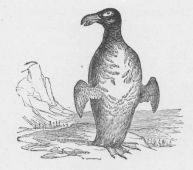
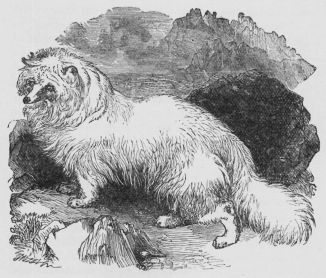
Further on they reached another territory, which they named Crown Prince Rudolf Land, the habitation of millions of sea-birds, and thousands of bears, seals, and foxes. A great glacier was crossed, but as it was quitted an immense fissure engulfed the sleigh with the stores, while the others only narrowly escaped by cutting the traces. Lieutenant Payer hurried back for assistance, and at length dogs, men, and sleigh were pulled up, safe and nearly sound. Rounding Auk Cape, the explorers reached open water by the shore.
Pressing on to latitude 81 degrees 57 minutes north, the party reached their farthest point. From an elevated position the explorer made his observations, which led him to the conclusion that there is no open polar sea, yet that the ocean is not always covered with ice. There is a medium which a favourable year would improve, and render navigation, near the shore, possible. Having deposited a record of the visit, the party returned over the hundred and sixty miles they had come.
One more little journey was made, and then the thoughts of the officers and men turned to home. On the 20th of May the ship’s colours were nailed to the mast, and the retreat was commenced. Provisions were packed in boats, the boats placed on sleighs, but little progress was made at first as all hands were required for each sleigh in turn. Two months were occupied in making a distance of eight miles—and a third winter in the ice seemed probable.
At last, in July, they made a mile a day. In August they reached the edge of the pack, when the sleighs were abandoned, and the dogs killed, as no room could be spared. The boats then crossed open water to Novaya Zemlya, and at the end of three months from leaving the ship sighted a Russian vessel. The Nickolai brought them to Vardoe in Norway, where the voyagers landed in September, 1874.
The success of the expedition was unquestionable, for land was discovered two hundred miles north of Nova Zemlya. The success of the sleighing is due to Sir L. McClintock’s advice.
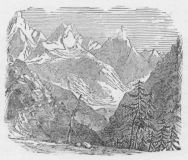
(The Tegethoff we see drifted north—other vessels we have read of drifted south. Does not that indicate a simultaneous movement of ice around the Pole on both sides? The American side going south as the ice-floe on the Asiatic side ascends—as glaciers in Switzerland which are connected, advance and recede in turn. This idea would go to prove that no open sea exists there; the ice covers the whole of the Polar Ocean, and moves north and south correspondingly. This is, however, only speculation, but as the Tegethoff is said to have been drifted by the wind, which must have been southerly, and therefore northerly on the other side, the fact will not militate against the idea above suggested.)
The Austro-Hungarian Expedition did not succeed in discovering the North-East Passage. We will now turn to the great Nordenskïold, who did succeed.
Chapter Thirty Three.
The voyages of Erik Nordenskïold—1870-1878.
Expeditions to the North—To Spitzbergen and the Yenissei—The Discovery of the North-East Passage.
Nils Adolf Erik Nordenskïold was born at Helsingfors, Finland, in November, 1832. His father was a distinguished naturalist; Erik often accompanied him in his expeditions, and thus early acquired a taste for natural history and research. He entered the University at Helsingfors in 1849. The stern rule of Russia subsequently compelled young Nordenskïold to go to Sweden. The governor of Finland, fancying he detected treason in some after-supper speech, Nordenskïold was obliged to depart; but this was the turning point in his career.
The illustrious Mosander received the student cordially. Nordensk’iold studied hard, and in 1858 made his first acquaintance with Arctic seas in Torrell’s Spitzbergen expedition. In 1861 he again accompanied Torrell to Spitzbergen. In July, 1863, he married. In 1864 he commanded an expedition fitted out by the Academy of Stockholm, and in 1868, aided by Government and Mr Oscar Dickson, he reached the highest latitude ever attained in the eastern hemisphere. From this expedition he brought home a rich collection of curiosities. Again, in 1870, Mr Dickson paid the expenses of a voyage to Greenland.
In 1872, Nordenskïold (whose name, we may mention, is pronounced Nordensholt) undertook another Polar expedition with two vessels, the Polhern and the Gladen. A quantity of reindeer-moss was provided and stowed in a third ship, the Onkel Adam. Nordenskïold was accompanied by Lieutenant L. Palander, with Doctor Envall, E. Parent, an Italian officer, and Messrs Wijkander and Kjellman as scientists. On the 4th of July the Polhern and Gladen sailed; from Gothenburg, and when the former reached Tromsoe, the Austrian Polar vessel Amiral Tegethoff was about to sail.
On the 25th of July, South Cape, the southern extremity of Spitzbergen, was sighted, and the vessels proceeded along the coast northward between Prince Charles Foreland and the mainland till Fair Haven was reached. Here they were obliged to remain because of the ice, and in August the Onkel Adam arrived with the reindeer and other necessary assistance, and with stores. The attempt to reach the Seven Islands north of Spitzbergen was now abandoned for that season, but some progress to the north was effected, and Mussel Bay, to the north-north-east of Spitzbergen, was selected as winter quarters.
Scarcely had the necessary preparations been made when a sudden and extremely violent storm arose; by this the unexpected advent of the ice was announced. The cold hand was quickly laid upon the waters, and the winter campaign had to be faced. But we may imagine the surprise of the explorers when, as they were settling down in winter quarters, six strangers approached, who informed Nordenskïold that their six ships had been unexpectedly frozen in, and there were fifty-eight men in danger of ultimate starvation!
This was most unpleasant news, for the expedition had only sufficient for its own requirements, and such an addition to the party was a very serious drawback. Still help was absolutely necessary, and a note was sent to the captains of the imprisoned ships, that the explorers would do all in their power.
But a sad blow awaited them. In another severe storm all the reindeer got away; and, of course, a valuable supply of fresh meat, besides transport, was cut off at one fell stroke. Only one of the reins was recaptured, and he was wounded. Fortunately some large wild reindeer were shot, and they made a welcome addition to the larder. At the end of October winter began to set in severely, and the reindeer-moss was utilised by the imprisoned people as food. The winter-time was passed as well as possible, and interesting observations were taken. Scurvy and pleurisy, however, attacked the men; and though Christmas and New Year were celebrated, and 1873 was saluted by a display of fireworks, the precarious condition of the crews was by no means ameliorated.
However, lamp-light was dispensed with on the 6th of February, and on the 13th of March the sun was seen again. In January the cold had been “inconsiderable,” and the bay had been cleared of ice, but on the 20th of February the cold was very great. April was occupied in preparations for Nordenski’old’s expedition across North-East Land, and on the 24th of April he and Palander started with three sleighs. After some delay, in consequence of accident, Palander returned, and Nordenskïold proceeded to Shoal Point, the north-west extremity of North-East Land, where Palander again joined him on the 5th of May (1873).
The sledge party started on the 6th. It consisted of Nordenskïold, Palander, and nine men, who intended to proceed to the Seven Islands which will be found on the map north of Spitzbergen. Each man in turn was cook for the party; he had to rise early and get breakfast ready. The march was then proceeded with, resting occasionally at certain intervals during the ten hours allotted to the daily journey. Sailing over the ice and snow on the sledges, good progress was made, and on the 12th Costien’s Island was reached.
Early on the 16th, Parry Island was gained, and a small depot was made there. Some of the men then were sent back. The leaders of the party here made a survey from an elevated standpoint, and this view showed them that there was no possibility of going north of the Seven Islands, as the ice was in such an uneven condition. The journey in the anticipated direction was therefore abandoned as hopeless.
But Nordenskïold would not return by the same way he had come. He determined to go back by way of North-East Land, a course which occupied the party forty days, but they gained considerable information, and the scientific results, as well as the difficulties, were greater than had been expected. The expedition returned safely to Mussel Bay on the 29th of June. The members who had been left behind had passed a most uncomfortable time. The cold was great, provisions scarce. Scurvy set in, which, added to home-sickness and anxiety on account of the absent ones, made matters worse. Food became scarcer, but providentially Mr Leigh Smith, in the Diana, arrived, and he satisfied the immediate requirements of the unfortunate Swedes. The historian of the expedition warmly acknowledges the assistance so opportunely rendered.
Spring was at hand. Palander came in, and then Nordenskïold. All anxiety was then over. The same day, the 29th of June, the vessels passed through the channel which had been cut in the ice, and then they anchored in open water. No time was lost. The Onkel Adam sailed homeward almost immediately: the Gladen followed. The Polhern, however, remained in the icy latitudes for some time longer dredging. On the 6th of August, after with difficulty escaping the ice, Nordenskïold arrived at Tromsoe, and on the 29th at Gothenberg, where the expedition dispersed.
In 1875 and 1876 the professor made two voyages to the Yenissei River and up it. By this course he opened up Siberia to trade, and received the thanks of the Russian Government for inaugurating a sea route to Siberia. But these voyages, in a sense tentative, were completely eclipsed by the expedition undertaken in the Vega, in which Nordenskïold accomplished the long-desired North-East Passage from the North Atlantic to the North Pacific Ocean eastwards. The ease with which he had accomplished the two voyages already mentioned (to the Yenissei River) urged him to proceed with the expedition which he had been studying for years, the discovery of the North-East Passage.
Sebastian Cabot was the first adventurer in the work destined to be accomplished by the Swedish explorer. More than three hundred years ago Cabot equipped three ships for the “Merchant Adventurers,” and put them under the command of Sir H. Willoughby and Chancelor in 1553. This ended in disaster. In 1580 the “Muscovy Company,” as the “Adventurers” called themselves, sent out Arthur Pitt, who could not open the “pack” ice. Barentz, who tried three times, in 1593, 1595, and 1596, was closed up in the ice of Novaya Zemlya, and perished. Henry Hudson tried in 1607-8. The Danes made the attempt in 1653. Captain J. Wood also sailed to the unhospitable shores of Novaya Zemlya, and so terrified people by his descriptions that they gave up the attempt in despair.
Thus the North-East Passage became a dreaded and a sealed course to the mariners of all nations. It was deemed impossible to break through the icy barrier; and the Russians made the attempt only to prove the assertion by failure. But when Nordensk’iold had reached the Kara Sea, and the Yenissei River, he began to think he could also solve the long-tried problem of the North-East Passage eastwards to the Pacific.
Assisted by his liberal friend, Mr Oscar Dickson, and supported by King Oscar the Second of Sweden, and M. Sibiriakoff, a Siberian landholder, Nordenskïold purchased the steam-whaler Vega—a name now celebrated throughout the civilised world. She was equipped and manned under Government auspices, and provisioned for two years. She sailed from Gothenburg on the 21st of July, accompanied by the steamer Lena, commanded by Johannesen from Tromsoe. There were also supply vessels in company, but our narrative (which is compiled from “Nordenskïold’s Voyages,” and other sources) will deal with the Vega, and incidentally with the Lena, till she parted company at the mouth of the river whose name she bears. In the expedition were included many scientific gentlemen, and the crews were composed of picked men.
The vessels rounded the North Cape, and on the 29th of July sighted Novaya Zemlya. Then they passed the Yergar Strait and entered the Kara Sea, the immense gulf lying between Novaya Zemlya and the north point of the Asiatic continent, Cape Chalyaskin. On the 31st of July the little fleet was united at Chabarook (Charbarova). The vessels which had accompanied the Lena and Vega went up the Yenissei River with cargoes, and returned safely to Norway. The Vega and Lena proceeded, and after some delays the North-East Cape (Cape Chalyaskin) was reached for the first time. Flags were hoisted and salutes fired to emphasise the fact, and they were acknowledged by an immense bear that came out upon the ice to welcome the ships. Hence fogs and occasional ice-floes hindered the navigation. Many very interesting scientific searches were made, and after the 23rd of August the sea was smooth and free from ice up to the delta of the Lena River. Here the vessels parted company on the 27th-28th of August, the Lena to go up the river, while the Vega proceeded alone to the Siberian Islands.
Many interesting remains of the mammoth animals were discovered in these islands, and the supply of ivory must be very valuable to the seekers. The ice was too rotten to permit of landing, and the boats could not pass in, so Nordenskïold reluctantly relinquished his intention to explore those almost unknown islands, and the animal remains which abound there.
The Vega continued her uninterrupted course eastward till the ist of September. Then snow fell, and the Bear Islands were covered with the white garment. The navigation became difficult; the coast was cautiously skirted till, as September wore on, the nights became too dark for sailing, and the Vega was obliged to come to an anchor every evening.
On these occasions the natives came and made friends with the voyagers, and subsequently these Tchuktches welcomed the foreigners. The description given of the natives and their dwellings is curious. They live in large tents, which enclose sleeping-places or a kind of inner chambers, heated and lighted by an oil lamp. In these inner rooms the native women sit, with very little clothing on. In summer a fire is kept burning in the centre of the hut, and the smoke goes up through a hole in the roof. In winter there is no fire, and presumably the hut is closed against the outer air. The Greenlanders and Tchuktches use similar household articles: they trade for needles, knives and tools, linen shirts, etcetera, and especially brandy. Everyone smokes tobacco when he or she can obtain it. When it cannot be had, some herbs are chewed and smoked, after being dried behind the ears. Men and women seldom wear head coverings; they have tunics and trousers of reindeer skin, mocassins or shoes of bear-skin or walrus hide; the women plait their hair, and wear it long. The men cut theirs except the outer margin, which is combed down in a “fringe.” The faces are painted or “tattooed” by both sexes.
The Vega continued her eastward course, meeting with little incident, but continually adding to the information already acquired. So on till the 27th of September, when, in the strait that separates Asia from America—near the entrance of Behring’s Strait, the vessel got imprisoned in the early forming ice. The rising north wind rapidly piled up the hummocks, and in a short time all hope of quitting the place until the summer had to be abandoned, but very reluctantly, by Nordenskïold. “One single hour’s steaming would have probably been sufficient to traverse the distance” between their position and the open strait, and one day earlier no difficulty would have presented itself!
This was extremely disappointing, and Nordenskïold writes pathetically about been frozen in so near the goal he had been so long aiming at. It was “the one mishap” which had attended his Arctic exploration. In this condition the vessel remained for two hundred and sixty-four days, the time passed nearly in darkness, but not unpleasantly, for the scientist has resources which set time at defiance. Good health and spirits were present, and the natives were friendly. At length deliverance came. On the 18th of July the Vega was released, and on the 20th she passed Behring’s Straits. The North-East Passage was an accomplished fact! After a stormy cruise, in the course of which the ship was struck by lightning, and a voyage of marine discovery welcome to the civilised world accomplished, the Vega reached Yokohama, whence the electric current carried the news of Nordenskïold’s success from sea to sea. The homeward journey was made by the Suez Canal to Europe, where the welcome accorded to the brave explorer was a veritable triumph. Nor must those who assisted him be forgotten. To Mr Oscar Dickson the honour belongs of holding out the full hand to Nordenskïold, without which his first voyages would never have been accomplished, and the North-East Passage might be still a mystery.
Chapter Thirty Four.
Captain Hall’s Voyages.
Doctor Hayes’ voyages—Captain Hall’s experiences—The Polaris expedition—High latitudes—Illness and death of Captain Hall—The catastrophe on the ice—Skating on the floe—A perilous journey—Saved—Fate of the Polaris.
We must pass rapidly by Doctor Hayes’ voyages undertaken to survey Greenland. He fully believed in the theory of the “open Polar Sea,” and he had been a member of Kane’s party. He left Boston in 1860, and entered Baffin Bay in August of that year. After much delay from ice, he started with sleighs across Smith’s Sound to Grinnel Land. He encountered tremendous difficulties—most of his party turned back, but Hayes, with three men, persevered, and succeeded in reaching Grinnel Land. He still pushed on, then with only one companion, and reached the most northerly point attained, whence he could see water covered with soft ice. This he states is the open Polar Sea in the summer. He saw a headland farther north—“the most northerly land known.” But having no boat he was obliged to return to his companions, and they reached Boston in 1861. The American Civil War prevented him from trying again for some years, but he subsequently explored Greenland, more for pleasure than in the interests of science, in 1869.
We now come to the voyages of Captain Charles F. Hall, which culminated in the Polaris expedition. In 1860, however, Captain Hall had made an attempt to find some traces of the Franklin expedition; but meeting with an accident, he returned. In 1864 he sailed again, and reached Hecla Strait. He carried home many Franklin relics, and ascertained that Sir John had actually discovered the North-West Passage, and established the melancholy truth that most of Franklin’s men died of starvation in King William’s Land, where their bones lay bleaching in the snowy waste. After five years’ residence amongst the Esquimaux he ascertained that Captain Crozier, of the Terror (and he believed a companion), were living amongst the Esquimaux in 1864.
In September, 1869, Captain Hall returned to America, having discovered the site of Frobisher’s settlement three hundred years before; but it was not until 1872 that he was enabled to start in the Polaris to find the North Pole. On the 29th of June he sailed from New York. Doctor Bessel accompanied the ship as naturalist, and at least one member of Kane’s expedition also went. Captain Tyson, who figures in the narrative, joined the Polaris at Godhaven, and Hans, the hunter, at Upernavik.
On the 21st of August the Polaris continued her voyage, and followed Kane’s route. Captain Hall reached the spot where the Advance had been quitted, and pushing on steadily, reached the channel which had been thought was the “open Polar Sea.” He proceeded up to latitude 82 degrees 16 minutes North; but here the Polaris was beset in the ice at last; hitherto all had been plain sailing. They reached winter quarters in September, and named the place “Thank God” Bay, latitude 81 degrees 38 minutes North, longitude 61 degrees 44 minutes West.
The winter was fatal to Captain Hall. After his return from a few days’ sledging journey, he was suddenly taken ill. In this exploration, which he undertook with the Esquimaux and his first mate (Mr Chester), he reached a place he named Newman’s Bay, in latitude 82 degrees North. When the illness first attacked him it was not deemed serious; but he became partially paralysed, and on the 8th of November he expired, leaving Captain Buddington in command. Captain Hall was buried on the morning of the 11th of November, the darkness of the Polar night being faintly illuminated by ship’s lanthorns and the weird boreal gleam of the stars in the atmosphere.
During the remainder of the winter, surveys were made; but Buddington did not continue the discipline of Hall. In May, Tyson, Meyers, and the two Esquimaux started on a sledging expedition, and got some musk oxen. Through these boat-expeditions, during the summer, discipline was greatly relaxed, and consequently the original plan of the voyage could not be carried out. The Polaris on the ice drifted, as other vessels have drifted, and came down Smith’s Sound to Kane’s former winter quarters.
A panic occurred in October, which nearly proved fatal to some of the members of the expedition. The ice “nipped” the Polaris, and it appears, from all accounts, that the ice-master who commanded (Buddington) completely lost his presence of mind, and commanded a general heaving overboard of stores and everything on deck. The order was obeyed, with results as might have been anticipated. The ice was broken up by the lifting and settling of the ship. The stores were scattered broadcast on the floe, and Captain Tyson, with a few of the most sensible men, left the vessel to arrange the stores, with the Esquimaux and their wives and children as assistants in the work.
They were all very busy sorting the supplies when a terrible rending and cracking was heard. Explosion succeeded explosion—the ice opened in many places—the Polaris was freed; and in a few moments, before the people on the ice could return, or indeed realise the situation, she had plunged into the darkness and disappeared!
This was a terrible catastrophe. There were nineteen men, women, and children actually adrift upon a mass of ice, with a very limited supply of provisions; and the only means of gaining terra firma two small boats. These were got ready, but the loose ice rendered their use impossible. The Polaris came in sight, but paid no attention to signals. So the voyagers remained drifting on the ice-floe, about four miles in circumference, but by no means assured from disruption, which might occur at any moment.
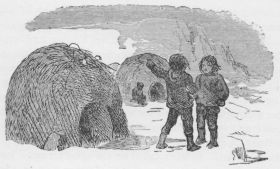
The ice continued to drift, and now and then pieces broke off. On the 16th the dreaded event occurred—the floe parted—the castaway party on one side, and the house, etcetera, on the other. But by means of the boats the stores were recovered, and then a fresh floe was occupied, whereon snow-huts were erected, Esquimaux fashion.
Time passed. October went and November came; food was scarce, and the exploring party were “allowanced.” But two seals, less cautious than their companions, were at length captured—nearly all the dogs had already been eaten, and fresh food was absolutely necessary. The seals caught were scientifically killed, the blood was drunk, and “the eyes,” says Captain Tyson, “given to the youngest child.” (The animal, being cut up, is divided into portions which are distributed by lot to the various candidates for the delicate morsels, of which the brain is considered the daintiest.)
We need scarcely detail the daily round and common tasks of the drifting party on the ice. In January Davis Strait was reached, and a ray of sunlight cheered them on the 19th, so the progress southward had been considerable. The German seamen did not behave well and caused considerable anxiety, but there was no long disturbance.
At the beginning of the month of March the ice reached Cumberland Gulf, and on the 11th of that month it broke up with direful noises, leaving the whole party on a small piece, which being fortunately very thick continued its journey southward very gently. Seals were now captured in abundance. One of the Esquimaux also shot a bear. Then the floe was quitted, and the pack ice reached. After that things became worse. A gale arose and blew away their tent and bedding, and unless they had all clung to the boat it would have been lost also. They saved it, but remained without shelter, half-frozen and in danger of starvation. At the end of April three steamers successively appeared, but although the castaways did all they could to attract attention they were not perceived until on the 30th another “steam sealer,” the Tigress, of Newfoundland, appeared and rescued them from their perilous position. They were all landed at Saint John’s on the 12th of May.
Meanwhile, as the Polaris had not appeared, the Tigress was commissioned by Captain Green, U.S.N., to seek her. She steamed up to Littleton Island, where an encampment of Esquimaux was discovered. The men were wearing clothing obtained from the Polaris, but after search and inquiry no after trace of the crew could be obtained, so Captain Green returned to Saint John’s. They reached New York afterwards, and heard that Buddington and his crew had been picked up by a whaler some months before.
The ill-fated Polaris had been abandoned in latitude 78 degrees 23 minutes North, and 73 degrees 21 minutes West. She had been rendered almost useless by the ice, and the Esquimaux were presented with the hull; but she foundered. The crew encamped during the winter, and in the summer they sailed down to Cape York, where they met the ice. But in Melville Bay a steamer was seen embedded in the ice. This vessel was the Ravenscraig, of Dundee, whose Captain, Allen, received them very kindly. He subsequently put some of them on a vessel bound for Dundee, whither they then proceeded, and came home from Liverpool to New York; the others came back a few weeks later. Thus ended the unfortunate Polaris expedition, which, but for the untimely death of Captain F. Hall, might have accomplished its object—the discovery of the North Pole.
Chapter Thirty Five.
Captain Sir George S. Nares’ voyage with the “Alert” and “Discovery”—1875-6.
The Alert and Discovery—Heavy weather—Arrival in Greenland—Winter on the ice—Amusements and employments—Sledging work—The return home—Reception—Conclusion.
In 1875 the British Government commissioned the Alert and the Discovery, under the command respectively of Captains Nares and Stephenson, to explore the Arctic regions of the Pole. This expedition was fitted out in the most complete manner, and had the advantage of the advice and assistance of the most experienced Arctic travellers. Commander Markham, who was attached to the Alert, had crossed the Arctic circle before, as had Captain Nares, and all that could be done was done to make the voyage a success.
Sir George Nares had already seen considerable Arctic and sea service. His scientific voyage in the Challenger, too, had given him an unlimited fund of experience, in addition to his previous geographical attainments. Captain H. Stephenson also had proved his mettle in many parts of the world, and under these commanders were many trustworthy and experienced officers. The expedition quitted Portsmouth amid enthusiastic cheers on the 29th of May, 1875, and made their way across the Atlantic. Here they met with most violent storms, which tried both ships and ships’ companies, as well as the Valorous store ship, which parted company in the ocean. The first ice was seen on the 27th of June, and the Valorous was picked up again all well.
Skirting the Greenland coast amid the ice, the vessels encountered heavy weather, and at length anchored in Godhaven Harbour, in the Isle of Disco. Here supplies and sledge dogs were embarked, and on the 15th of July the Alert towed the Discovery out of harbour, and proceeded northwards. They reached Upernavik and left it. Soon afterwards the Alert grounded, but cleared at high water. Cape York was gained in seventy hours, an extremely rapid passage. The Alert passed on by the Crimson Cliffs and Cape Digges, which have been so often mentioned, and reached the Cary Islands on the 27th of July. Depots were formed here and records placed with letters, as also on Sutherland and Littleton Islands. The advance into Smith’s Sound was by no means easy, and several times the ships had to return to the latitude of Kane’s winter quarters.
About this time the Alert was nearly crushed by an iceberg, but got clear, and the crew made the mountain tow the vessel by grappling it. By very slow degrees, pushing and driving through the “pack,” the vessels at last reached Cape Constitution, to which Doctor Kane had penetrated, but which he did not pass. Going still northwards the ships cleared Kennedy Channel and reached Hall’s Basin, in the north-east side of which were the winter quarters of the unfortunate Polaris. Robeson Channel had now to be cleared.
All this time the officers and men who could be spared from duty were not idle. Parties went hunting and sketching. Many scientific observations were made by dredging. Photographs were taken also. The Musk ox gave the hunters some sport, and Doctor Moss records that all the animals met with, though presumably they had never seen man before, were afraid of the party, thus contradicting the popular notion that animals which have never seen man are not afraid of him.
At this stage of the journey excellent winter quarters were found for the Discovery. The retreat of the ships had been secured. Orders were for the Discovery to remain in or about the eighty-second parallel. Such a situation was now found. The Discovery therefore remained just north of Lady Franklin Strait, on the opposite side of Hall’s Basin, to that on which the Polaris wintered.
On the 26th of August the Alert proceeded alone into Robeson Channel, but got into difficulties with the ice, which bore down on the ship in tremendous masses. But fortunately she found shelter, and escaped destruction. Any further progress appeared impossible, so preparations were made for forming the winter quarters near at hand. As September had come the sledges were got ready, and Commander Markham set out with stores to establish a depot for the spring exploring parties farther north. The party returned in three weeks frost-bitten and exhausted, but they had accomplished their mission. Lieutenant Aldrich had also come back, but reported nothing but ice.
Attempts were made to communicate with the Discovery, but the state of the ice and snow prevented any such adventure, though Captain Stephenson was only sixty miles distant. Winter now set in, and the Alert was banked in snow. Candles and stoves and snow kept the inhabitants warm, and snow-houses were erected for scientific and storage purposes. The prospect afforded a view of limitless snow, and then darkness set in and limited the view to a few yards, except when the oft-recurring moon gave her welcome light. Doctor Moss, in his journal, gives a spirited description of the daily routine, which we condense. The cold was intense—the greatest ever experienced (73 degrees).
The toilet is rapidly performed, a tub is a weekly luxury. The men have breakfasted, and the rattling of cups and saucers warns the officers curried-sardine day has come round again! Cocoa is ready and hot rolls. Then the men have lime-juice and hot water for health’s sake. Afterwards all hands parade on deck for inspection and prayers. Then work begins. Water is procured from ice, tools mended, etcetera. The crew dine at one o’clock, the officers at 2:30. The latter go for a walk or rehearse theatricals. Going out, the air smells like green walnuts, says Doctor Moss. The walk, unless there is a moon, is taken up and down a beaten track, in the dark, half a mile long. The dinner gong sounds, all come in (brushing off the snow first). Then dinner, and when the cloth is off the white cat seats herself on the table. After dinner reading or writing, then school for the men; and music, chess or whist concluding the evening.
The Alert had no sun for a hundred and forty-two days, and the darkness was nearly as deep at noonday as an ordinary moonless night in England. On the 2nd of March the sun shone brightly, and the sledging was arranged for. The theatrical season had ended on the 24th of February. Many favourite farces were played, and the burlesque written by the chaplain met with great success.
A sledge party left to find the Discovery, but returned exhausted, and Petersen was nearly lost. He afterwards died, poor fellow, and was buried by his comrades on Cairn Hill, on the 14th of May. We have not space to follow all the sledging expeditions. We must condense the information and the interest. For two months and a half this, the most monotonous of all travelling, was continued. The labour was most severe and incessant, the distance made only a mile or two a day. Scurvy began its ravages, and the northern expedition had been nearly overcome, when Lieutenant Parr returned to the ship for assistance. Summer had arrived by this time. Immediate help was dispatched, but it was no easy task to find the men. Four of the party were alive, one had died. The sick man had been dragged on the sledge thirty-nine days, and they had buried him after all in a solitary spot in the far north—“a paddle and a batten” made a rude cross, and the sketch shows it most effectively in Doctor Moss’s book. Five only of the seventeen of the party came back in working condition, and they were nearly exhausted.
The question now arose whether the Alert should remain, advance, or retreat. It was impossible to advance more than a few miles—the crew was suffering—and retirement was the most sensible act. So the vessel rejoined the Discovery, some of whose men had not returned, and great anxiety was manifested concerning them. At length the party appeared, after an absence of one hundred and thirty days.
From Discovery Bay they struggled south in company, racing against winter. On the 9th of September Cape Isabella (Smith’s Sound) came in sight. Here letters were found which had been left by the Pandora. These were a cause of great joy, and when Disco was reached, and some coal procured, the explorers felt almost at home. On the 2nd of October the ships sailed for England. The Alert anchored at Valentia on the 27th of October, and the Discovery in Bantry Bay on the 29th.
A great deal had been accomplished by this expedition. The Alert had explored the west coast for two hundred and twenty miles, the Discovery had surveyed the Greenland coast, and Captain Stephenson placed a tablet over the grave of the brave Captain Hall of the Polaris, with a suitable inscription. The Alert men had attained the highest latitude ever reached, viz, 82 degrees 27 minutes North. The idea of the open Polar Sea then received its “quietus,” for nothing but ice is there.
The Queen commanded the Admiralty to thank Captain Nares and the officers and men under his command, and Captain Nares was knighted. Some little dissatisfaction was expressed, but the effects of the work so ably done quickly extinguished any hostile feeling.
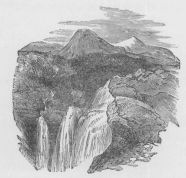
In concluding these Notable (Polar) Voyages we regret we cannot find space to relate the adventures of the plucky Pandora (afterwards the Jeannette), the Eira expedition, and others of less importance which have been undertaken since 1875. The Alert has lately been presented to the United States Government for their Arctic expedition, of which we shall soon hear something.
There are many chapters yet to be written concerning maritime discovery, but those we have selected appear to us to embody the greatest interest for our readers, for public curiosity and assistance has been lately so often directed to the Arctic which are slowly yielding their secrets to the enterprise of modern scientific and naval explorers.
| Chapter 1 | | Chapter 2 | | Chapter 3 | | Chapter 4 | | Chapter 5 | | Chapter 6 | | Chapter 7 | | Chapter 8 | | Chapter 9 | | Chapter 10 | | Chapter 11 | | Chapter 12 | | Chapter 13 | | Chapter 14 | | Chapter 15 | | Chapter 16 | | Chapter 17 | | Chapter 18 | | Chapter 19 | | Chapter 20 | | Chapter 21 | | Chapter 22 | | Chapter 23 | | Chapter 24 | | Chapter 25 | | Chapter 26 | | Chapter 27 | | Chapter 28 | | Chapter 29 | | Chapter 30 | | Chapter 31 | | Chapter 32 | | Chapter 33 | | Chapter 34 | | Chapter 35 |