"Notable Voyagers" (continued 10)
Reading edition
Cook remained at the Tonga Islands for nearly three months. Having left with them several useful animals and various seeds, he sailed on the 17th of July for Otaheite. Here Omai found several relatives, who showed him little affection until he presented them with some coloured plumes and other treasures he had brought. Cook here induced his crew to take cocoa-nut liquor in exchange for part of their allowance of spirits, with beneficial results. Omai showed his true character by associating with the lower orders of the people; and had not Cook interfered, he would have given everything he possessed away to his worthless companions. Some horses had been brought out, on two of which the captains rode daily over the plains of Matavai, to the great astonishment of the natives, who on all occasions assembled to witness this, to them, extraordinary feat.
Leaving Otaheite, Cook the next day landed at Eimeo, where one of the goats he carried to stock their islands was stolen. It was not until several war canoes and six or eight huts had been burnt that the natives restored the missing animal.
On the 12th of October, he anchored at Huaheine, where it was arranged that Omai was to be left, though he himself wished to settle at Ulietea, where his father had possessed some land, which he hoped to be able to recover through the means of the English. He was very indignant on finding that the captain would not consent to do this, but was at last reconciled to the plan proposed for him. The grant of a piece of land being obtained from the chief, a house was built, a garden stocked, and the young savage was sent on shore with various firearms, toys, a portable organ, an electrical machine, fireworks, with other things, as well as a horse and a mare, a boar and sow, and a male and female kid. Being thus established, it was hoped that with these advantages he would be able to maintain himself, and instruct the islanders in some of the arts of civilisation. He exhibited the deepest grief when he was at length landed, and would gladly have remained with his friends.
How different was the conduct of Omai to that which was expected! Abandoning his European dress, he quickly sank into idleness, barbarously employing his firearms either to assist the chief in his wars or to shoot those of his countrymen who had offended him. In three years he died, despised even by the savages it was supposed that he would have improved.
At Otaheite, where Cook afterwards touched, three or four of his people having deserted, several members of the chief’s family were seized and kept as hostages until they should be delivered up. Oreo, the chief, fearing that the runaways might not be discovered, formed a plot to seize the captain and some of his principal officers; but, as they wisely took care not to put themselves in his power, this was prevented, and fortunately the deserters were discovered and brought on board.
Bolabola was the next island visited, for the purpose of recovering an anchor which had been lost by Bougainville at Otaheite, and brought here as a tribute to its warlike inhabitants; Cook’s object being to manufacture it into iron tools to trade with. It was easily obtained from the chief Opoony for some axes and other articles.
Cook here landed, as at other places, goats and hogs, in hopes that the archipelago would in a few years be stocked with all the valuable domestic animals of Europe. Sailing from Bolabola on the 8th of December, he steered northward, and on the 24th saw a low island, of barren appearance, to which the name of “Christmas Island” was given. It was uninhabited, though nearly twenty leagues in circumference. No fresh water could be found here, but three hundred green turtles were taken.
On the 18th of January, 1778, an island appeared north-east by east, and soon after another was seen bearing north, and the next day a third, in a west-north-west direction. From the second some men came off to the ships in a canoe. They were of a brown colour, but the features of many differed little from those of Europeans. As the vessels steered along the coast, several villages were seen, and the inhabitants brought off pigs and fine potatoes. From the looks of amazement with which they regarded the ships and everything on board, it was evident that they were unused to European visitors; at the same they exhibited remarkable intelligence. On rowing ashore with three armed boats and a party of marines, the instant Cook landed, the natives fell flat on their faces, until by expressive signs he prevailed upon them to rise. They had brought a number of small pigs, which they presented on plantain-leaves, one of the party making a long speech. The people willingly assisted the sailors in rolling the casks to and from the watering-place, and made no attempt to cheat or steal.
To this group, now first visited by civilised man, the name of the “Sandwich Islands” was given, in compliment to the First Lord of the Admiralty. On leaving these islands,—destined to be so fatal to the discoverer,—the ships steered for New Albion, which had been visited by Drake. After tacking on and off the shore for several days, they put into a harbour, which received the title of “Hope Bay.” The morning afterwards three canoes, shaped like Norway yawls, came off from a village, and a man, dressed in the skin of an animal, with a rattle in each hand, make a long speech. Others followed, and one of the party sang a pleasant air in a soft tone. When the voyagers moved to a safer anchorage, a large number of inhabitants made their appearance. They willingly supplied the ships with such provisions as they possessed, but would receive nothing but brass in return, and all brass articles to be found on board were bartered away. Nearly a month was passed in uninterrupted friendship among these savages. The inlet was called “Nootka Sound,” from the native name.
Again putting to sea on the 4th of May, Mount Saint Elias was seen. Nine days afterwards the ships came to an anchor in a bay, on which was bestowed the name of “Prince William’s Sound.” The most remarkable feature of some of the inhabitants on its shores was a slit through the lower lip, parallel with the mouth, through which were worn pieces of carved bone. Sometimes the natives would remove this bone, and thrust out their tongues from the opening, which had a most hideous effect.
After examining an inlet, which it was hoped would lead round the north coast of America, the vessels sailed south-west round the promontory of Alaska. At length the discoverers reached the entrance to Behring’s Straits, although not aware at the time of the fact. About the 9th, the most westerly point of America was reached, to which the name of Cape Prince of Wales was given. On the same evening the coast of Asia came in view, and on the following morning the ships anchored in a harbour of the Tschutski territories. Here the natives, though alarmed, made their visitors profound bows. A few days after this the ships encountered a dense field of ice, extending across their course as far as the eye could reach. To proceed farther was impossible, and the ships’ heads were therefore turned to the southward. Coasting the shores of Asia, Cook anchored off Oonalaska. Here the natives were most inoffensive. Their stature was low, their necks short, their faces swarthy and chubby; whilst they had black eyes and small beards. Their houses were large oblong pits, covered with a roof thatched with grass and earth.
A few days after the arrival of the ships, the Captains were surprised by a present of a salmon pie, baked in flour, and a note in Russian, which was delivered to them by two natives. John Ledyard, a corporal of marines, afterwards known as a traveller, volunteered to proceed with the messengers and discover who had sent the gift. In two days he returned with three Russian traders, and shortly afterwards Mr Ismyloff, the principal person in the island, arrived. Through him Cook transmitted to the Admiralty a letter enclosing a chart of his discoveries. Intending to make another attempt to find the long-sought-for passage, Cook returned to the Sandwich Islands. On the 26th of November he discovered Mowee, lying farther west than the islands before visited, and on the evening of the 30th a much larger island to windward, called Owhyhee or Hawaii. Several weeks were passed in sailing round this island in search of a harbour. At length the ships came to an anchor, on the morning of January 17th, 1779, in Karakavoa. Here a vast number of people were assembled to witness, to them, the so novel spectacle. Multitudes came off in canoes, crowding into the ships, many hundreds swimming round like shoals of fish, and the shores were thronged with eager spectators, who expressed their pleasure in shouts, songs, and various extravagant motions. It was supposed they fancied Captain Cook to be their god Rono, who after a long absence had returned to their island. At the time this he of course did not know, or he would not have received the worship paid to him. No sooner was the Resolution moored, than two chiefs came, accompanied by a priest named Koah, who approached the captain with much veneration, and threw over his shoulders a piece of red cloth, and then made an offering to him of a small pig, and landing, they conducted him to a Morai or temple, where he was presented in due form to their idols, arranged on a platform within it.
After various other ceremonies, the priest presented him with a large live pig and a piece of red cloth, and the men who brought it prostrated themselves before him. He now descended from the platform, and led the captain before a number of other images, each of which he addressed in a sneering tone, snapping his fingers at it until he came to the centre, when he threw himself before it and kissed it, requesting the captain to do the same, who throughout had suffered himself to be directed by the priest Koah. After this, a feast having been prepared, the two captains were fed by the priests.
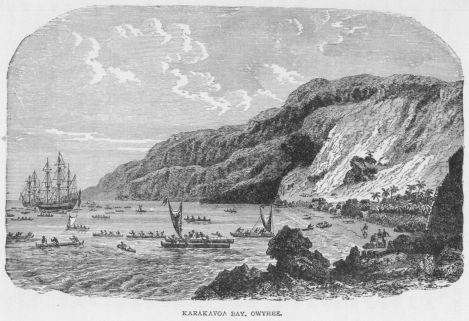
After distributing some presents, the captains returned, being conducted to the boats by men bearing wands, the people falling down before them as they walked along the beach. It is sad to reflect that a man of judgment and intelligence should have submitted to this idolatrous worship. Captain Cook probably expected that by yielding to the natives, he should obtain greater facilities for trading and keeping up amicable relations with them. After this the King Terreeoboo, with his wife and child, came on board. He had previously paid the Resolution a visit, when the ships were off Mowee. The following day he came in state, he and his chiefs dressed in rich feathered cloaks, and armed with long spears and helmets. In the second canoe sat the chief priests, with idols of wicker-work of gigantic size, covered with feathers of different colours and pieces of red cloth. Their eyes were large pearl-oysters, and their mouths were marked with double rows of dogs’ fangs, giving them a hideous appearance.
When Cook returned the visit the King threw a superb cloak over his shoulders, and placed a crown of feathers on his head, spreading six other cloaks at his feet, of great beauty, while his attendants brought four hogs, sugar-canes, and cocoa-nuts. After this the ships sailed, but, meeting with very bad weather, were compelled to put back into Karakavoa. On their return it was observed by some of those on board that a change had taken place in the minds of some of the natives. Instead, however, of trying to win back the people by gentle means, force was resorted to directly any offence was committed. Some of the people having stolen several articles from the Discovery, were trying to escape, when she opened fire upon them. The articles were returned, but an officer on shore not knowing this, seized a canoe belonging to one of the chiefs, who, in a squabble, was afterwards knocked down. Captain Cook, also ignorant of what had taken place, followed the supposed thieves into the interior, although he returned unmolested. The next day the Discovery’s cutter was carried off, and Captain Cook, in order to recover it, resolved to seize the King. With this object he landed, carrying with him his double-barrelled gun, accompanied by Mr Phillips and nine marines. Mr King ordered the marines to keep their pieces loaded, and to be on their guard. He then, going to the huts of the priests, endeavoured to quiet their alarm. Captain Cook in the meantime reached the old King’s house, and persuaded him to come on board; but as they were embarking one of his wives came down and induced him to give up his intention. A vast number of armed men now began to collect, and Captain Cook, seeing that matters were growing serious, considered how he might best prevent bloodshed, and endeavoured to draw off his party.
Meantime the boats stationed in the bay had fired at some canoes, and a chief of high rank had been killed. The hostile natives soon heard of this. Mr Phillips, on seeing the state of affairs, had withdrawn his men to some rocks close to the water. The anger of the natives being excited, they now began to throw stones, and one of them threatened Captain Cook with his dagger. In defence he fired one of his barrels, loaded with small shot. He then discharged the other, and a man was killed. The marines had now begun to fire, and Captain Cook had turned round either to order them to cease or to summon the boat, when a savage struck him on the back with a large club, and he fell forward on his hands and knees, letting his fowling-piece drop. A chief next plunged his dagger into his back, and he fell into the water, the natives who crowded round preventing him from rising.
From that moment nothing more was seen of him. The natives rushing on, four of the marines were killed before they could reach the boats; another was saved by the gallantry of Lieutenant Phillips, who, though wounded himself, leapt overboard, and dragged the man who was struggling in the water into the pinnace.
Lieutenant King had remained near the observatory with a party of his men. Though the natives attacked him, he drove them off, and they at last willingly agreed to a truce. He afterwards tried to obtain the body of his captain, and in a few days some human flesh was brought off by a man, who said that this was all that remained, the head, bones, and hands being in possession of the King. With the exception of the head the greater portion of the remainder was subsequently brought on board, and they being placed in a coffin, were committed to the deep with the usual naval honours.
So angered were the crews of the two ships at the loss of the captain, that it was with the greatest difficulty the officers could restrain them from hurrying on shore and wreaking their vengeance on the heads of the natives.
Thus died Captain Cook in the fifty-first year of his age, surpassed by none as a seaman, and was probably equalled by few as a marine surveyor and draughtsman; while, if he was at times hasty, he was kind-hearted and humane, and possessed the important power of attaching both officers and men to his person. Captain Clerke, who succeeded to the command, made peace with the chiefs, many of whom came on board expressing their sorrow at what had happened, while the natives brought off provisions as usual. Indeed, as the ships sailed away they expressed every mark of affection and good-will.
Two other islands of the group, Woakoo and Atooi, were visited, when the natives behaved in the same friendly way as elsewhere. After this, on the 12th of March, the ships sailed for Behring’s Straits, in search of a passage into the Atlantic.
Captain Clerke, who had been suffering for some time from consumption, was evidently fast sinking, but he still persevered in his undertaking. On the 28th of April the harbour of Saint Peter and Saint Paul was reached. The Russian inhabitants, on finding that the explorers were English, treated them with the greatest possible kindness, and through Major Behin, the Governor of Bolcheretsk, Captain Clerke sent home an account of the proceedings of the expedition, with that of the death of Captain Cook. Both ships, after passing through Behring’s Straits, encountered an icy barrier, against which the Discovery was nearly lost.
Every effort having been made in vain, Captain Clerke resolved to return. Before the ships again anchored in the harbour of Saint Peter and Saint Paul he had breathed his last. He was there buried on some ground on which it was intended to raise a church. The command of the expedition now devolved on Captain Gore, who went on board the Resolution, while Lieutenant King took charge of the Discovery. That ship, on being examined, was found to have suffered seriously from the ice. It seemed surprising, indeed, from the injuries she had received, that she had kept afloat.
She was repaired as far as possible, some time being spent in these necessary operations, as also in exchanging civilities between the officers of the Russian garrison and the English.
The ships sailed on the 9th of October, and steered a course for Macao. While in Behring’s Straits sea-otter and other skins had been obtained; these realised altogether upwards of two thousand pounds. The report of the high prices obtained on the return home of the expedition, probably set on foot the fur trade with the west coast of North America, which afterwards became of such considerable importance. Here Captain Gore heard that war had broken out between England and France; but soon afterwards, being informed that the commanders of the French ships had been directed to treat the expedition under Captain Cook as belonging to a neutral power, he put to sea, resolved to preserve the strictest neutrality during the remainder of the voyage.
Touching at several places in the Indian seas, the ships at length reached Cape Town, where they were treated with the same kindness as on former visits. Sailing thence on the 9th of May, they made the coast of Ireland on the 12th of August. Strong southerly winds compelling them to run to the northward, they rounded Scotland, and at length, on the 4th of October, arrived at the Nore, after an absence of four years, two months, and twenty-two days.
It is remarkable that during this time the two ships only twice, for a short time, lost sight of each other.
Owing to the admirable arrangements for preserving health, during the whole time the Resolution had lost only five men by sickness, three of whom were ill when she left England, while the Discovery had not lost a man.
Although one of the objects of the expedition had failed, that of finding a way through Behring’s Straits round the north coast of America, during this and his previous voyages Cook had made far more discoveries than any previous navigator. He had surveyed the whole eastern coast of New Holland, and proved it to be an island, as also that of New Zealand. He had discovered New Caledonia, and surveyed the islands of the New Hebrides, and other islands in the Austral Ocean. He had made known the Marquesas and Tonga group, and completed the survey of the Society Islands. He had succeeded in finding Easter Island, had visited the groups of the low archipelago, and had discovered numerous separate islands,—Norfolk, Botany, Palmerston, Hervey, Savage, Mangaia, Wateeoo, Allakootaia, Turtle, Toobania, and Christmas, as also the magnificent group known as the Sandwich Islands. He had ascertained the strait between America and Asia to be eighteen leagues in width.
It was not until many years after that any navigator penetrated as far north as he had done. In the Antarctic Ocean he had brought to light Sandwich Land, settled the position of Kerguelen’s Land, as also of Isla Grande, on which he justly prided himself; and his survey of the southern shore of Tierra del Fuego was long unsurpassed, while he rendered the greatest service to the cause of humanity by the way he maintained the health of his crews. During all previous expeditions numbers of the men had perished. During his long and protracted voyage he lost none by scurvy, and very few from any other disease.
The nation, grateful to him, bestowed a pension of two hundred pounds a year on his wife, and each of his children had twenty-five pounds a year settled on them, though the latter did not live long to enjoy it. Three died in infancy. Another, a midshipman, was lost on board the Thunderer. The second, intended for the ministry, died at Oxford, in the seventeenth year of his age; and the eldest, who became a commander, was drowned while attempting to get on board his ship off Poole during a gale of wind. His widow survived until the year 1835, when, she died at the age of ninety-three.
Chapter Twenty Eight.
Parry’s three voyages in search of a North-West Passage—A.D. 1819.
Ancient voyagers in arctic seas—Parry’s voyage in command of the Alexander—Under Captain John Ross—Parry’s first expedition with the Hecla and Griper—The ice reached—Danger among icebergs—The vessels freed—Steer westward—A way cut through the ice—Enter Lancaster Sound—Sail up it till stopped by the ice—Reach longitude 110 degrees west—A passage cut through the ice into a harbour in Melville Island—Preparations for passing the winter—A paper established—Plays acted—An observatory and house built on shore—The former catches fire—Many of the men frost-bitten while extinguishing the flames—All animals quit the country—Scurvy appears—Mustard and cress grown—Employments of officers and men—Excursions on shore—Ice begins to break up—Get out of harbour—Attempt to sail westward defeated—Return—Parry’s second expedition with Fury and Hecla in 1821 to Hudson’s Bay—Dangers among icebergs and floes—Visited by Esquimaux—Fox’s Channel and Repulse Bay reached—Further explorations made—No opening found—More natives appear—Ships frozen in near Lyon Inlet—Plays acted—A school established—Natives come on board—Native village—Honesty and intelligence of natives—A clever woman—Iliglink and her son—The Esquimaux leave them—Ships again put to sea—In fearful danger—Fury and Hecla Strait reached—Attempt to pass through it—Go into winter quarters—Natives appear—Winter less pleasantly spent than the former—Great difficulty in escaping—Parry’s wish to remain overruled—Ships swept along by the current—Sail homewards—Reception at Lerwick—Parry’s third voyage in the Hecla and Fury, 1824—Accompanied by the William Harris transport—Call off Lievely—Reach Lancaster Sound—Are frozen up in Port Eowen—Masquerades—Good conduct of the men—Progress in the school—Expedition on shore—Ships get out of harbour—In fearful danger—The Fury wrecked and abandoned—The Hecla refitted, sails homeward, and safely reaches England—Remarks on Admiral Sir Edward Parry.
From the days of Edward the Sixth, and even before that period, attempts have been made to discover a passage eastward along the northern shores of Europe and Asia to India from the westward, and from the Atlantic into the Pacific, as well as to reach the north pole.
Among the gallant men who commanded these expeditions the names of Sir Hugh Willoughby, Richard Chancellor, Sir Martin Frobisher, Barentz, Henry Hudson, and Baffin stand out pre-eminently. Captain Cook, as we have seen, made attempts to penetrate from the Pacific into the Atlantic, and at the same time Captain Phipps, afterwards Lord Mulgrave, accompanied by Nelson, then a midshipman, was engaged in an attempt to reach the north pole along the coast of Spitzbergen. For some time after this the interest in arctic discovery died away, but was at length revived in the year 1818 by the reports of the state of the ice, which was said to have broken away from the coast of Greenland in places where it had been attached to the shore for centuries. In that year four ships were fitted out—two, the Isabella, commanded by Captain John Ross, and the Alexander by Lieutenant Parry, to explore the north-west passage, and the Dorothea, commanded by Captain Buchan, and the Trent, by Lieutenant John Franklin,—for the purpose of attempting to reach the north pole. Many of the officers who subsequently became well known as arctic explorers were employed in these expeditions; among others were Mr Beechy and Mr Hoppner, both sons of eminent artists, and themselves excellent draughtsmen.
Neither of the expeditions was successful. Captain Ross sailed up Davis’s Straits into Baffin’s Bay, passing the entrances to Smith’s and Lancaster Sounds, across both of which he was persuaded that a lofty range of mountains extended. These he called Crocker Mountains. The openings, he was convinced, were merely the mouths of deep inlets. Lieutenant Parry differed entirely from his commanding officer, and deep regret was expressed by many on board that an opening, by examining which important discoveries might have resulted, should have been abruptly quitted.
The reports brought home satisfied most scientific men that an opening existed through Lancaster Sound. On the following year, therefore, the Admiralty fitted out an expedition, which was placed under the command of Lieutenant Parry, who had Mr Beechy as his lieutenant.
As Parry takes the highest rank amongst arctic explorers, it is proposed to give a sketch of his three voyages to the polar regions in search of a north-west passage.
The expedition being determined on, two vessels, the Hecla, of three hundred and seventy-five tons, carrying fifty-eight men, and the Griper, a gun brig of one hundred and eighty tons, with thirty-six persons on board, were forthwith got ready for sea. Both vessels were strengthened as much as possible, and stored with provisions for two years, including an ample supply of anti-scorbutics, and everything which could be thought of to enable the crews to endure the extreme rigours of a polar winter. Captain Sabine accompanied Lieutenant Parry as astronomer, and Mr Beechy as lieutenant. Among the midshipmen were Joseph Nias and James Clark Ross, who became eminent arctic explorers. The Griper was commanded by Lieutenant Siddon, and his first lieutenant was Mr Hoppner.
The two vessels sailed from the Nore on the 11th of May, 1819, and having rounded the Orkneys, stood across the Atlantic. Having contrary winds, they made but slow progress. On the 18th of June they first fell in with icebergs, flying amid which were numberless petrels, kittiwakes, tarns, and other winged inhabitants of the northern regions. Some of these bergs, of which fifty were seen at a time, were of great size. The heavy southern swell dashed the loose ice with tremendous force against them, sometimes raising a cloud of white spray, which broke over their tops to the height of more than a hundred feet, accompanied by a loud noise, resembling distant thunder. As the Hecla was drifting on with a southerly current, she was nearly nipped by a detached floe, which drove her against a berg aground, one hundred and forty feet high, where the depth of water was one hundred and twenty fathoms, so that its whole height must have exceeded eight hundred feet.
Parry at first attempted to force his way north and west, amid the masses of ice, in the direction of Lancaster Sound; but as the vessels were sailing on, the floes suddenly closed round them, and on the 25th both were so completely beset that it was impossible to turn their heads in any direction. Here they were fixed, though in no danger, until the morning of the second day, when the violence of the sea loosening the ice, it was driven against the ships’ sides with such force that, had they not been strongly built, they would probably have been destroyed. At this time, from the crow’s nest, upwards of eighty-eight enormous icebergs were seen, besides many smaller ones. The vessels being at length freed, Lieutenant Parry came to the resolution of abandoning the attempt to reach Lancaster Sound by a direct course, and instead steered northward along the border of the great ice-field, in the hopes of finding open water farther to the north. He steered on that course until he reached latitude 73 degrees, when he resolved upon making a determined push to the westward.
A favourable breeze springing up, the ships stood on among the detached floes, through which they were warped by securing ice-anchors with hawsers to the more solid pieces ahead. Before they had made much progress, a thick fog came on, which prevented the open lanes ahead being seen. Still they continued to make way, sometimes dangerously beset by masses of ice; yet by persevering efforts, they first got into one lane, then into another, till, the fog clearing, they saw only one long floe separating them from the open sea. The ice-saws were therefore set to work, and with great labour cutting through the floe, they had the satisfaction of seeing the shore clear of ice extending out before them. They now steered for Lancaster Sound, and on the 30th of July they gained its entrance. As they sailed on, under a press of canvas, westward, the mast-heads were crowded by officers and men, eagerly looking out to ascertain if the supposed mountain barrier lay across their course.
The sound continued open, and it was calculated that the two shores were still thirteen leagues apart, without the slightest appearance of land to the westward.
Again and again a report was received from aloft that all was clear ahead, and the explorers began to flatter themselves that they had fairly entered the polar sea. Several headlands were passed, and wide openings to the north and south. With a strong breeze from the eastward, running on until midnight, they found themselves in latitude 83 degrees 12 minutes, nearly one hundred and fifty miles from the entrance of the sound, which was fully fifty miles in breadth. The Griper, which had fallen astern, joining the Hecla, they together reached latitude 86 degrees 30 minutes, when two other inlets were discovered, and named Burnet and Stratton; and then a bold headland, to which the name of Fellfoot was given. A lengthened swell rolling in from the north and west, gave them hopes that they had now really reached the wide expanse of the polar basin, and that nothing would stop their progress to Icy Cape, the western boundary of America.
While their hopes were at the highest land ahead was seen, but it proved only to be a small island. Very soon afterwards more land was seen, with a broad inlet, named Maxwell Bay. Still the sea stretched out uninterruptedly before them, but their hopes fell when, in a short time, they saw to the south a line of continuous ice.
Shortly afterwards an open passage appeared, through which it was hoped the ships would make their way westward. On proceeding on, however, the explorers discovered, to their sorrow, that this ice was joined to a compact and impenetrable body of floes, completely crossing the channel. They had therefore to haul their wind and stand away from it, for fear of being caught in the ice, along the edges of which a violent surf was beating.
As soon as the weather, which had been thick, became clear, an open sea, with a dark water sky, was seen to the south. In the hopes that this might lead to a passage, unencumbered with ice, the commander steered for it, and shortly reached the mouth of a large inlet, ten leagues broad, with no visible termination. The names of Clarence and Seppings were given to the two capes at its entrance.
Avoiding the ice on one side, the ships entered a broad open channel. The coast was dreary in the extreme, while the irregularity of the compass showed that they were approaching the magnetic pole, and increased the difficulties of navigation. They had run one hundred and twenty miles up this inlet, to which the name of Prince Regent was given, when the ice was found extending across it. Standing out of it, Parry steered across the channel, until he came off another broad inlet, leading north, which was called Wellington Inlet.
The great channel through which they were passing was called Barrow Straits, in compliment to the promoter of the expedition. The wind again becoming favourable, the ship sailed triumphantly along; three islands they successively passed being named Cornwallis, Bathurst, Byam Martin. The compass had now become perfectly useless, and they judged that they had passed the magnetic meridian at about 100 degrees west latitude, where it would have pointed due south instead of north. The cold also greatly increased, and thick fogs enveloped them. They had also to saw a passage through a thick floe.
Still forcing their way on, they discovered a large island, to which the name of Melville was given. Though the wind failed, by towing and warping, on the 4th of September they reached the meridian of 110 degrees west from Greenwich, in latitude 74 degrees 44 minutes 20 seconds, and became entitled to a reward of five thousand pounds, voted by Parliament to the first British ship’s company who should obtain that meridian. To the bluff headland where the observation was made the appropriate name of Bounty Cape was given.
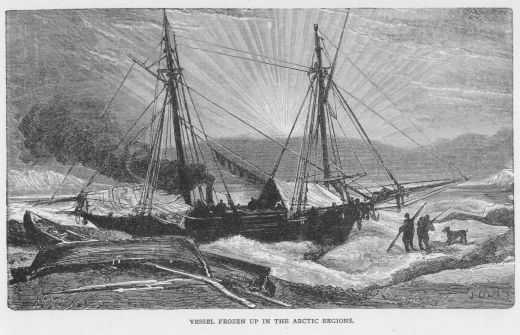
Encouraged by their success, they continued their course, until it was crossed by an impenetrable barrier of ice. In vain for a fortnight they attempted to pierce it, until about the 20th the young ice began to form rapidly on the surface, and Parry was convinced that a single hour’s calm would be sufficient to freeze up the ships in the midst of the sea. Reluctantly, therefore, he was compelled to return, not without encountering great danger and difficulty. On the 24th he got off a harbour on the western side of Melville Island. A large floe, two miles wide, guarded its entrance. To get through this floe, it was necessary to form a channel with the ice-saws. To do this two parallel lines were first marked with boarding-pikes on the ice, at a distance from each other of somewhat more than the breadth of the Hecla. Having cut along these lines, large pieces were detached by cross-saws, and then again cut diagonally, in order to be floated out. Sometimes the boat’s masts and sails were placed on them to hasten their movements. In two days the channel was cut, and the ships carried in and anchored in five fathoms of water, about a cable’s length from the beach. At first the ice round them was every morning cleared away, but it was soon found that the task was useless, and the two ships became frozen up for the winter. They were immediately unrigged and housed over, snow walls built round them, and other plans adopted for keeping out the cold.
As they had ample provisions, preserved meat and concentrated soup were substituted for salt beef, and beer and wine were served out instead of spirits. They also had sour-krout, pickles, and vinegar. Every day the seamen were mustered and compelled to swallow a certain quantity of lime-juice in the presence of their officers, while their gums and shins were examined to detect the first appearance of scurvy. The stove for baking was placed in a central position, and by other arrangements a comfortable temperature was maintained in the cabin. At a distance from it, however, and in the bed-places, steam and even the breath soon turned into ice, which had to be carefully scraped away. To amuse the people, a newspaper was started, under the editorship of Captain Sabine, and a school was established, at which many of the men, who had never before handled a pen, learned to write well. Plays were acted, a fresh one being performed every fortnight, sometimes by the officers, and sometimes by the men. The theatre was on the quarter-deck, where, however, the cold was often as low as freezing-point, except close to the stove,—a position eagerly sought for.
Lieutenant Beechy became stage manager. The theatre received the name of the North Georgian, and was opened on the 5th of November, with “Miss in her Teens.” The ships’ companies were highly delighted, and Lieutenant Parry took a part himself, considering that an example of cheerfulness, by giving a direct countenance to everything that could contribute to it, was not the less essential part of his duty, under the peculiar circumstances in which they were placed.
It was by this means that Parry established a character for ready and happy expedients, accompanied by a sound judgment, which kept alive the active powers of the mind, and prevented it from falling into the worst of all conditions,—a state of morbid torpor. His plan was completely successful, and the crew, as well as the officers, were as happy as, under the circumstances, could possibly be expected.
One of the first works carried out, after the ships had been made snug for the winter, was the erection of an observatory, at a spot convenient for communication with the ships; and a house was also built on the beach, for the reception of the clock and other instruments. The walls of this were of double plank, with moss between, so that a high temperature could be kept up in it, without difficulty, by a single stove. To induce the men to take exercise, the band played, and they tramped round the deck to the music. While thus engaged, one day, what was their dismay to see the house containing the valuable instruments on fire! The crew, without stopping to put on their extra warm clothing, hurried to the shore, pulled off the roof with ropes, knocked down a part of the sides, and, by being thus able to throw in large quantities of snow, succeeded in extinguishing the flames. So bitter was the cold that, though thus actively employed, the noses and cheeks of all the men were white by frostbites. The medical officers were compelled to run from one to the other and rub them with snow, in order to restore animation; even thus it was found necessary to cut off several fingers of one poor fellow, and sixteen others were added to the sick list. Hunting excursions were organised, and reindeer, musk oxen, partridges, and ptarmigan were met with. Some of the former were killed. No bears had been seen, until one day Captain Sabine’s servant being at a distance from the ship, a huge white monster started up and pursued him. The man ran as fast as his legs could carry him, until he got on board, when the bear, coming close to the ship, was shot at and wounded, but notwithstanding made its escape. It was the only one seen during the long stay of the ships on that desolate shore. The animal tribes disappeared early in the winter. On the 15th of September a herd of deer was seen lying down, except a large stag. This, after the rest had risen, guarded the herd in their flight, frequently going round them, sometimes striking them with his horns to make them move faster.
On the same day the last covey of ptarmigan was met with. What no one would have expected to see in that frozen region—three specimens of a caterpillar were obtained one of which, as an arctic curiosity, was brought to England.
For some months the crew retained excellent health, but early in January the gunner showed symptoms which indicated scurvy. The immediate cause appeared to be a collection of damp which had formed round his bed-place. At once all the anti-scorbutics were put into requisition, such as lime-juice, pickles, spruce beer; a quantity of mustard and cress had also been raised from mould placed over the stove-pipe, which rapidly grew. So successful were these remedies that, in nine days, the patient could walk about. The only animals remaining were a pack of wolves, which nightly surrounded the ships, although they cleverly avoided being captured. A beautiful white fox, however, was caught and made a pet of, and became very much attached to the commander, in whose cabin it took up its quarters. Every day, indeed every hour, had its allotted duties. On Sundays divine service was invariably performed, and a sermon read on board both ships, the men attending with evident satisfaction. The officers, unless when there was wind, took walks on shore, but were not permitted to go beyond two miles from the ship. After the ordinary duties of examining the berths and bed-places, the crews had their suppers, and the officers went to their tea, and after this the men were allowed to amuse themselves with games of various kinds, as well as dancing and singing, until nine o’clock, when they had to turn in, and all lights were extinguished. The officers employed their evenings in reading and writing, with an occasional game of chess, or a tune on the flute or violin, until half-past ten.
For forty-eight days they were entirely deprived of a sight of the sun, the long-continued night being lighted up only partially by the moon and occasionally by the aurora borealis. Thus the months went by until the middle of May arrived, and the ptarmigan began to appear. A considerable number were shot, their flesh having a beneficial effect on the crew. Under the snow was found an abundance of sorrel, a most potent antidote against scurvy. Footsteps of deer were seen, the animals evidently moving northwards. As soon as the cold decreased, the commander made an excursion across Melville Island, on which the vegetable productions were dwarf willow, sorrel, moss, grass, and saxifrage.
Captain Sabine fell in with a ranunculus in full flower on the western side of the island, evidently the most genial. The crew had in the meantime been employed in cutting away the ice from round the ships.
Soon after the commander’s return, on the 15th of June, from his excursion, the ice in the offing began to move with a loud grinding noise, and by the middle of July the thermometer rose to 60 degrees, the highest point it reached in Melville Island. By the 24th everything was ready for sea, but still it seemed very probable that the two ships would be much longer detained, while it was known that in eight or nine weeks from that period the navigable season must come to a conclusion. Before the expiration of July the thermometer again fell, and the pools of water froze over in the night, but there were channels through which the boats could pass. On the ist of August, however, the outer mass of ice suddenly broke up and floated out. With eager haste the anchors were weighed, the sails spread, and the two ships, after being shut up for ten whole months and a part of September, sailed out of Winter Harbour, and stood round the shore of Melville Sound. They were still not free from danger, as the masses of ice were whirling about in all directions. To avoid them the ships stood close into the shore, but at length, off a point of land surrounded by hummocks of ice, some vast masses were seen driving down upon the Hecla. The Griper was in the same dangerous predicament, and there appeared every probability that she would be nipped and destroyed. Escaping these dangers, they pushed their way westward until they arrived at very nearly the most western point of the island, when all further progress was barred by the density of the ice.
The commander having consulted the officers of both ships, it was agreed that any further attempt to proceed in that direction would be useless. It was also arranged that they should run back along the edge of the ice, to look out for any opening which might lead them to the American continent. None, however, was found, and on the 31st of August they repassed Lancaster Sound.
They now, not without some risk of being frozen up after all, made their way to the southward, and on the 28th of October came in sight of Fair Island and the Orkneys.
The commander reached London on the 3rd of November, 1820, after an absence of eighteen months. Out of both ships’ companies only one man, who had left home in ill health, died; the rest returned in excellent health and strength.
Scarcely had Captain Parry returned than it was resolved to fit out another expedition without delay. For this purpose the Hecla was again commissioned, and as it was considered that vessels of the same size were best calculated for the work, the Fury, of three hundred and seventy-seven tons, was appointed to accompany her instead of the old Griper.
Several of the officers who had served in the former voyage were again employed, and Commander Lyon was appointed to the command of the Hecla, while Commander Parry took charge of the Fiery. Among the midshipmen were F.R.M. Crozier and James Clarke Ross, both of whom were arctic explorers of note, the former ultimately destined to perish in the realms of ice.
The two ships were accompanied by the Nautilus transport, filled with stores and provisions, to be transhipped on arriving at the ice.
Parry was directed to proceed towards or into Hudson’s Straits. He was then to penetrate to the westward until he should reach Repulse Bay, or some other part of the shores of Hudson’s Bay to the north of Wager River, or some portion of the coast which he should feel convinced to be a part of America. Failing this, he was to keep along the line of this coast to the northward, examining every bend or inlet which should appear likely to afford a practicable passage to the westward.
The three ships sailed from the Nore on the 8th of May, 1821, but it was not until the 14th of June that they came in sight of the first iceberg, or until the 2nd of July that they reached Resolution Island, the valleys of which were filled with snow, while a dense fog hung over the land, rendering the scene before them indescribably dreary and desolate. In a short time the ships were surrounded by no less than six hundred and fifty-four icebergs, one of which rose to two hundred and fifty-eight feet above the sea. Among them were large floes, which were turned round and round by the strong tides and currents rushing in from the ocean. At the same time, fearful as they are in appearance, they are less dangerous to approach than those aground, against which a ship is liable to be carried with the whole force of the tide.
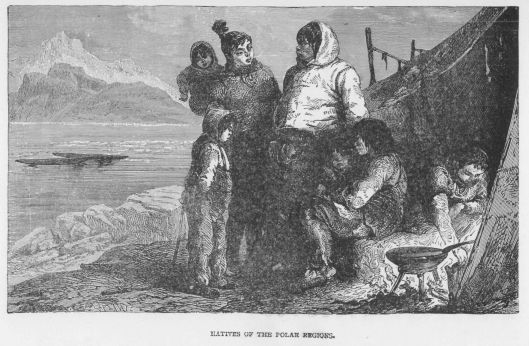
Captain Lyon, on one occasion, having fixed an anchor to a mass of ice with two strong hawsers, both were carried away, and the anchor broken off as if it had been made of crockeryware. The ships were here separated to the distance of eleven or twelve miles, and became closely beset by the ice, where they remained for eight or nine days. During nineteen days only seventy miles were made. At length they reached, on the 21st, the Savage Islands. Next afternoon a loud shouting was heard, and shortly afterwards a large number of natives were seen paddling their canoes through the lanes of open water, or occasionally drawing them over the ice. These were chiefly kayaks, rowed by a single man. There were also five oomiaks or women’s boats, of considerable size, formed of a framework of wood and whalebone, covered with deer-skins, and having flat sides and bottom. One of these contained no less than twenty-one women, boys, and young children. They were of a wild tribe, and evidently more debased than those of the Greenland shore. They laughed, and shouted, and skipped, and then commenced traffic with the greatest eagerness, some of them stripping off the skins which formed their only covering, until they were almost in a state of nudity; the women, however, always retaining their breeches. They drove, as they fancied, a hard bargain; yet, being ignorant of the value of the skins, they raised shouts of triumph when they exchanged them for a nail, saw, or razor. Hideous as were the old women, some of the children looked almost pretty, although, being thrown carelessly into the bottom of the boat, they more resembled young wild animals than human beings. The men were especially addicted to practical jokes. One of them, getting behind a sailor, shouted lustily in his ear, then gave him a hearty box on the other. Captain Parry formed a very unfavourable opinion of the moral character of these natives, who seemed to have acquired, by an annual intercourse with our ships for nearly a hundred years, many of the vices of civilisation, without having imbibed any of the virtues or refinements which adorn it. Notwithstanding all obstructions, the expedition, early in August, came in view of Southampton Island, at the entrance of Fox’s Channel, and from thence forced its way to Repulse Bay, through which it was supposed that a passage westward existed; but, after it had been thoroughly explored, Captain Parry proved that the land round it was continuous. The appearance of the land was not altogether uninviting. It rose to seven or eight hundred feet, and there was the usual vegetation found in the arctic regions. Reindeer and hares were plentiful, as were ducks and other birds. In one spot were the remains of no less than sixty Esquimaux habitations, consisting of stones laid one over the other, in regular circles, eight or nine feet in diameter. There were besides about a hundred structures,—fireplaces, store-houses, and other rough enclosures, four or five feet high,—used to keep their skin canoes from being gnawed by the dogs.
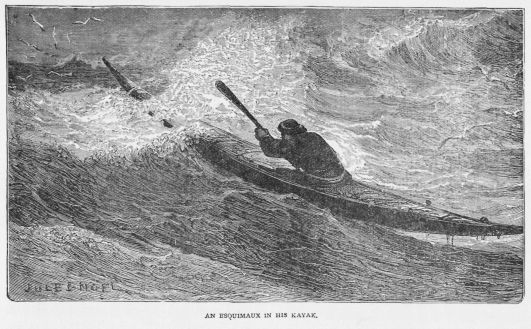
Getting out of Repulse Bay, Captain Parry commenced a career of discovery along an unknown coast. An inlet was discovered, on which the name of Gore was bestowed. At the mouth of the opening the valleys were richly clad with grass and mosses. The birds were singing, the butterflies and other insects displaying the most gaudy tints; so that the seamen might have fancied themselves in some happier clime, had not the mighty piles of ice in the frozen strait told a different tale.
While the ships were at anchor, hunting parties were sent out, and the game laws of the preceding year were strictly enforced, by which every beast and bird was to be given up for the general good, the capturer only retaining the head and legs. The head, however, was sometimes greatly extended, so as to include several joints of the back-bone. At length the explorers found themselves among a complete labyrinth of islands, amidst which strong currents set in various directions, while fogs and drift ice made navigation perilous in the extreme. Successive masses assailed the Fury. At one time her anchor was dragged along with a grinding noise, two flukes being broken off. She was afterwards carried forward by a violent stream amid thick mist, while it was found impossible to steer her in any direction.
At length the ships emerged into the open sea, but a strong northerly gale compelled them to run before it, when, on the 6th of August, they found themselves close to the spot where they had been on the 3rd of September. Still Captain Parry persevered, examining every opening, in the hopes that each might prove a passage into the polar ocean.
Lyon and Hoppner Inlets were surveyed. When near the shore, a number of Esquimaux came off to obtain some iron tools. The behaviour of one of the fair sex created considerable surprise. She had sold one boot, but obstinately retained the other. At length the suspicions of the seamen being aroused, she was seized and the buskin pulled off, when it proved to be a receptacle of stolen treasure. Besides other articles, it contained a pewter plate and a couple of spoons.
The end of September was now approaching. The summer was far from genial, and now, at any moment, the icy hand of winter might grasp the ships. Pancake ice began to form on the surface of the ocean. As the ships rolled from side to side, the ice clung to them in vast masses, and the various pieces which were tossing in the sea around became cemented into one great field, which threatened every moment to bear down upon them and dash them to pieces.
As it was important, without delay, to secure the ships for the winter, a small island lying off the northern point of the entrance into Lyon Inlet was fixed on. The distance was about half a mile, but the soft state of the pancake ice rendered the task not a very laborious one, though often dangerous, as it bent like leather beneath the feet of the seamen as they were working. At length it was accomplished, and the two ships were frozen in for another winter.
As there was no time to be lost, arrangements were at once made for passing it comfortably. Both ships were more thoroughly heated than had been the case on the previous voyage. They were both more amply provisioned, and anti-scorbutics against scurvy had been more bountifully supplied.
To amuse them, the theatre was opened on the 9th of November. The play of “The Rivals” being chosen, the two captains appeared as Sir Anthony and Captain Absolute.
A school was also established, and it was interesting to observe the zeal with which the hardy tars applied themselves to their books.
Sixteen of the men who had before been unable to form a letter could by Christinas write very well. That day was passed with the usual festivities, the seamen being amply regaled with fresh beef, cranberry pies, and grog, when they drank, with three hearty cheers, the health of each officer in succession. The shortest day was scarcely observed; indeed, the sun did not entirely leave them.
A few hares were caught, with a purely white covering, which resembled swans’-down rather than hair, and about a hundred white foxes were snared in the nets. At first they were perfectly ungovernable, but in a short time the young ones threw off their timidity, and became tame.
The sky was frequently brilliantly lighted by the aurora borealis. The light had a tendency to form an irregular arch, which in calm weather was very distinct. When the air became agitated, showers of rays spread in every direction with the rapidity of lightning. Sometimes long streams of light were spread out with inconceivable swiftness. No rule could be traced in the movement of the light parcels which are called the “merry dancers.” The sun and moon were often surrounded with haloes and concentric circles of vapour, tinted with the brightest hues of the rainbow. Parhelia, or mock suns, frequently shone in different quarters of the firmament. Still the life the explorers were compelled to lead was becoming very monotonous, when, on the morning of the ist of February, a number of figures were seen in the distance, moving over the ice. The spy-glasses were turned towards them, and they were pronounced to be Esquimaux.
As it was important to establish friendly relations with these people, the two commanders, attended by a few men, proceeded towards them, walking in file behind each other, that they might cause no alarm. As the natives approached, they formed themselves into a line of twenty-one; then they advanced slowly, until, making a full stop, they saluted the English by the usual movement of beating their breasts. They were well clothed in rich deer-skins. On coming to the ships they immediately began to strip; and the females, finding that they could obtain knives, nails, and needles for their dresses, pulled them off, when it was discovered that they had others of a similar character beneath the outer ones.
A visit to their village, at their invitation, was paid; but at first no one could discover their habitations. They, however, led the way to a hill in the snow, through which they crept, on hands and knees, along a winding passage of considerable length, until they reached a little hall with a dome-shaped roof, the doors of which opened into three apartments, each occupied by a separate family. This curious structure was tenanted by sixty-four men, women, and children. It was formed entirely of slabs of snow, about two feet long and half a foot thick. On the outside a series of cupolas rose about seven feet above the ground, and were sixteen feet in diameter. A plate of ice in the roof served as a window.
When first seen the village appeared like a cluster of hillocks among the snow; but successive falls filled up the intervening spaces, and converted it into one smooth surface, so that the boys and dogs were seen sporting over the roof. In each room, suspended from the roof, a lamp was burning, with a long wick formed from a species of moss, the oil being the produce of the seal or walrus. This lamp served at once for light, heat, and cooking.
A few hours had been sufficient to put up the village. The natives were as desirous of pleasing as they were ready to be pleased, and a favourable impression was thus made at the first interview, which was not diminished during a constant intercourse of between three and four months. They were strictly honest, and frequently returned articles which had been dropped by accident.
During a visit to the Hecla, the fiddler having struck up a tune, these merry people danced with the seamen for an hour, and then returned in high glee to their huts. They were highly delighted with the tones of the organ, as with the songs of the seamen and music of every description. They were very ingenious in employing such materials as they had at their disposal. A sledge being required to carry a lad to some distance, one of them set to work, and in a short time cut out of ice a serviceable little sledge, hollowed like a bowl, and smoothly rounded at the bottom. The thong to which the dogs were secured was fixed to a groove cut round its upper edge. Among the women was one named Iliglink, the mother of a lad called Toolooak, who had frequently come on board. She was a superior person, of great natural talent. Her voice was soft; she had an excellent ear for music, and a great fondness for singing. It was somewhat difficult, indeed, when she once began, to stop her. She made beautiful models of canoes, sledges, and other articles; but she showed her superior intelligence by the readiness with which she communicated her knowledge of the geographical outline of the sea-coast of the country and of the islands. Several sheets of paper were placed before her, and she drew roughly, on a large scale, an outline of the land about Repulse Bay and Lyon Inlet, continuing it northerly to the present winter station of the ships. Sheet after sheet was tacked on until she had completely lost sight of Winter Island, at the other end of the table. She afterwards drew, on a smaller scale, with wonderful accuracy, a chart embracing a much wider extent of coast. With intense interest it was found that she drew the extreme northern boundary of America, or rather its north-east extremity, round which Captain Parry had received instructions to proceed, if possible.
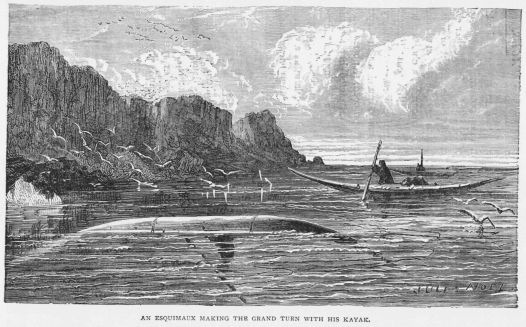
The armourer’s forge especially attracted her attention, and she expressed great astonishment at seeing two pieces of iron welded together. She was rather spoiled, however, by the attention paid her, and seemed to claim as a right her privilege of coming on board whenever she pleased.
Early in April some of the tribe deserted their habitations, proceeding to the westward in search of food, and at the end of May the whole party announced that they were about to migrate to the northward. On receiving what they considered the most valuable presents from the commander, the women broke into such immoderate fits of laughter as to be almost hysterical, finishing by bursting into tears.
The men were thankful, but less noisy in expressing their satisfaction. As these good-humoured and very cheerful people took their departure, they greeted the voyagers with three cheers, in true English style.
While preparations were being made for sailing three deaths occurred, two on board the Fury, and one seaman of the Hecla.
On the 2nd of July the ships moved out of their winter quarters, but they did not put to sea until the 8th. They were almost immediately exposed to most terrific danger, being driven along the ice at a furious rate, frequently almost nipped by it. At one time the Hecla’s stern was lifted more than five feet out of the water, and her rudder unslung by a violent jerk. Had another floe backed the one which lifted her, the ship must inevitably have turned over or parted amidships. Providentially she righted, and drove several miles to the southward before her rudder could be again slung. The Fury was exposed to almost equal peril of destruction. By long and unremitting perseverance, and by taking advantage of every opening and breeze of wind, the ships moved to the northward as far as latitude 67 degrees 18 minutes, to the mouth of a fresh water river. The boats were lowered, and parties landed and proceeded up the banks of the river, where, at about two and a quarter miles from the entrance, they found a fine waterfall, the scenery being romantic and beautiful in the extreme. It was named Barrow, after the Secretary of the Admiralty. Its beauties were enhanced by the vegetation on its banks, the enlivening brilliancy of a cloudless sky, and the animation given to the scene by several reindeer, which were grazing beside the stream.
On the 14th of July the ships reached the island of Amitiske, which by Iliglink’s chart appeared near the strait which they had reason to believe would conduct them to the polar sea. Here they saw an enormous herd of walruses, lying piled up over each other on the loose drift ice. A boat’s crew from each ship was sent to attack them, but the animals—some with their cubs on their backs,—making a most determined resistance, kept their assailants at bay. One of them, rushing forward, tore the planks of a boat in several places, and very nearly sank her. Three only were killed.
Sailing on, a strait was seen stretching westward in long perspective; but the hopes of the explorers were soon disappointed, when the ice was discovered extending in one unbroken line across it, from shore to shore.
This passage was named Fury and Hecla Strait. Hoping ultimately, however, to force the ships through, Parry made an expedition along the surface of the strait, and from an elevation saw a wide passage opening out to the west, inducing him to believe that he saw before him the polar sea. Scarcely, however, had he returned when the ice began to break in rents and fissures, and, soon entirely disappearing, the vessels floated in open water. With a brisk breeze he stood on, but at the end of five days it was announced from the crow’s nest that ice in a continuous field occupied the whole breadth of the channel. On examining it, however, it was found to be rotten, and the captain, therefore, determined to try and force the ships through it. With all canvas set, they had proceeded three or four hundred yards, when they stuck, and, in spite of all their efforts, were unable to make the slightest advance during the remainder of the season. With the greatest difficulty they were at length extricated, and proceeded to the neighbouring harbour of Igloolik, into which, by the usual operation of sawing, they made their way. Here they prepared to spend another winter. The two ships were at some distance from each other, though not sufficiently so to prevent constant intercourse. They were prevented, however, from continuing their theatrical entertainments, but schools were carried on as industriously as before. A wall of snow, twelve feet high, was built round the Fury, at a distance of twenty yards from her, forming a large square, like that of a farmyard, by which not only was the snow-drift kept out, but a good walk, sheltered from every wind, was afforded. Before long the Esquimaux appeared, among whom were several of their old friends; but Iliglink did not arrive, nor was any reason given for her not coming. The winter was less pleasantly spent than the former, while some slight cases of scurvy appeared, arising from the want of fresh anti-scorbutic plants. At length, when the month of August arrived, the ships were as securely confined in the ice as in the middle of winter, except that a pool of water, about twice their own length and diameter, had opened round them. There was a distance of four or five miles between the ships and the sea, yet notwithstanding, Captain Parry determined to commence the laborious task of sawing his way through it.
By the 6th of August, about four hundred yards of ice were sawn through, leaving a broad canal, eleven hundred yards in length. By this and the disruption of the floe on the 8th of August, the Fury floated once more in open water, and was followed on the 12th by the Hecla.
Captain Parry had come to the resolution of sending the Hecla home, and by taking such stores and provisions as could be spared from her on board the Fury, with her alone to brave a third winter in the polar regions; but on desiring the medical officers to furnish him with their opinions as to the probable effect that a third winter passed in these regions would produce on the health of the ship’s company, they expressed it very strongly to the effect that it would be dangerous in the extreme. Captain Lyon fully agreed with this, and the ships, therefore, stood out eastward. The current rapidly hurried them along to the southward, their drift being twenty-one miles in twenty-four hours, though closely beset, without a single pool of water in sight the whole time. As they approached a headland, they were whirled round it at the rate of two or three knots an hour, and on passing Barrow River were drifted nine or ten miles off land by the current setting out of it.
On the 17th of September, a strong westerly breeze clearing them from the ice, enabled them to shape their course for Trinity Islands in a perfectly open sea, from whence they ran down Hudson’s Straits, without meeting with any obstruction. The favourable wind still continued, and on the 10th of October they anchored in Brassa Sound, off Lerwick, where they enjoyed their first sight of civilised man, after an absence of seven and twenty months.
They were received by the people of Lerwick in the warmest manner. The bells were set ringing, the town was illuminated, and people flocked in from all parts of the country, to express their joy at their unexpected return.
On the 18th Captain Parry arrived at the Admiralty, and the ships were paid off on the 16th of November.
The idea being entertained that the passage westward into the Pacific might be made through Prince Regent’s Inlet, Captain Parry was appointed to the command of another expedition for the purpose of ascertaining if this could be done. The Hecla was re-commissioned, he taking command of her, while Commander Hoppner was appointed to the Fury, with Horatio Thomas Austin and James Clark Ross as his lieutenants. The Hecla carried sixty-two and the Fury sixty persons.
The ships sailed from the Nore on the 19th of May, 1824, accompanied by the William Harris transport. Captain Parry received his instructions to make the best of his way to Davis Straits, to cross over to Lancaster Sound, and, proceeding through Barrow Straits, endeavour to make through Prince Regent’s Inlet a passage into the sea which bounds the American continent on its northern coast, and thence westward to the Pacific. At the Danish settlement of Lievely the ships received their stores from the William Harris, which returned home. On leaving the harbour, the Hecla struck on a sunken rock, but without receiving much damage. On the 17th of July the ice began to close round the ships, and from that time forward the crews were constantly employed in warping or sawing through the frozen mass. On several occasions the Hecla received awkward nips, and it was not until the 9th of September that they got into open water. On the 10th of September they entered Lancaster Sound, and found it free from ice; but on the 13th they had the mortification of perceiving the sea ahead covered with young ice, through which they made their way until they came to the entrance of Port Bowen, into which the ships were warped by the ist of October, and here took up their winter station. The usual preparations for passing that dreary season were made. Numerous whales were seen off the coast, which would have afforded a rich harvest to a whaler.
Parry’s first care was to find occupation and diversion for the seamen. As many of their former amusements were worn threadbare, he proposed a masquerade, in which officers and men alike took part. Admirably dressed characters of various descriptions made their appearance, and were supported with a degree of spirit and humour which would not have discredited a more refined assembly. It does especial credit to the disposition and good sense of the men that, although the officers entered fully into the spirit of these amusements, which took place once a month alternately on board each ship, no instance occurred of anything that could interfere with the regular discipline, or at all weaken the respect of the men towards their officers. Mr Hooper, purser of the Hecla, superintended the school, aided by other officers. The progress of the men was surprisingly great. He also attended to the cultivation of that religious feeling which so essentially improves the character of seamen, by furnishing the highest motives for increased attention to their other duties. The officers also found full employment in the various observations to which their attention was directed. An expedition was also made to the eastward, under Commander Hoppner. On his return, two other parties, under the respective commands of Lieutenants Sherer and Ross, travelled, the former to the southward, and the latter to the northward, along the coast of Prince Regent’s Inlet, for the purpose of surveying it accurately. The travelling along the shore was so good that they were enabled to extend their journeys far beyond the points intended. On returning, Lieutenant Ross brought the welcome intelligence that the sea was perfectly open at a distance of twenty-two miles northward of Port Bowen. On the 12th of July the ice began to break up, and by the 20th, owing to the sudden separation of the floe, the ships got free. They first crossed over to the western shore of Prince Regent’s Inlet, then proceeded southward, close in with the land, having alternately open water and floating ice, to which they had occasionally to make fast. Before long, however, the ice was observed to be in rapid motion towards the shore. The Hecla was immediately beset, in spite of every exertion, and, after breaking two of the largest ice-anchors, in endeavouring to heave in to the shore, she was compelled to drift with the ice. Both ships were in extreme danger. The cliffs next the sea, four or five hundred feet in perpendicular height, were constantly breaking down, and the ships lay so close in shore as to be almost within range of some of these falling masses. The following day the Hecla managed to get to a greater distance; but the Fury remained where she was, and on the 31st a hard gale brought the ice closer and closer, until it pressed with very considerable violence on both ships, though mostly on the Fury, which lay in a very exposed position. Shortly afterwards the Fury was forced on the ground, where she lay, but was got off again at high water. A broad channel appearing and a fresh breeze springing up, an attempt was made to reach the water; but the ice came bodily in upon the ships, which were instantly beset in such a manner as to be literally helpless and unmanageable.
Thus they were carried southward, when the Hecla, driving close in shore, struck the ground several times, and remained immovable. The Fury was seen driving past, narrowly escaping being forced on board her. She was driven about three hundred yards, powerfully pressed by the ice, until she became so severely nipped and strained as to leak a good deal, when she was again forced ashore. Both ships, however, got off at high water, but on the 2nd of August the Fury was again driven on the beach, and the Hecla narrowly escaped. Captain Parry went on board the former vessel, and found four pumps going, and Commander Hoppner and his men almost exhausted with the incessant labours of the last eight and forty hours. They were now looking out for a spot where the Fury might be hove down, when again the ice drove down upon them. Once more freed, however, the ships proceeded to a place where there were three bergs, at which it was determined to heave down the Fury. The formation of a basin was at once commenced, and completed by the 16th of August, and on the 18th all the Fury’s stores, provisions, and other articles, were landed, and she was hove down. Scarcely, however, had this been done when a gale of wind came on, which destroyed the bergs, and made it necessary to tow both the ships away from the land. The Fury was again reloaded, but on the 21st was once more driven on shore. It was now seen that any attempt to carry her to a place of safety, even should she be got off, would be hopeless and productive of extreme risk to the remaining ship, and that an absolute necessity existed for abandoning her. Her crew, with such stores as were required, were transferred to the Hecla, and every effort was made to carry the surviving ship into clear water.
Five and twenty days of the time when navigation was practicable had been lost. As soon, therefore, as the boats had been hoisted up and stowed, they sailed away to the north-eastward, with a light air off the land, in order to gain an offing before the ice should again set in shore. The Hecla was at length worked out of Prince Regent’s Inlet, and arrived safely at Melville Harbour, where the necessary repairs were effected for enabling her to cross the Atlantic.
Weighing anchor on the 1st of September, the Hecla entered Barrow Strait, where the sea was found perfectly open, and she was thus enabled to bear away to the eastward. In crossing Lancaster Sound more than the usual quantity of icebergs were seen. For ten miles she had only to make one tack, when she reached the margin of the ice, and got on its eastern side into the open sea. On the 10th of October the Orkney Islands were sighted, and on the 12th Captain Parry landed at Peterhead.
This last voyage to discover the north-west passage, though less successful than the former ones, equally exhibited the courage, perseverance, and hardihood which had before distinguished the officers and crews employed; while we cannot help contrasting the admirable discipline maintained with the sad want of it displayed in so many of the voyages described in the preceding pages.
In 1827 Captain Parry commanded an expedition, which was fitted out in the hopes of reaching the north pole by way of Spitzbergen, when, accompanied by Captain Ross, he performed a long and hazardous journey over the ice; but, after travelling six hundred miles, it was found that they had only made good, owing to the drift of the ice, one hundred and seventy miles.
As a reward for his laborious services, he received the honour of knighthood, and Admiral Sir Edward Parry will ever be remembered as one of the bravest, most sagacious, and enterprising officers who have done honour to the British Navy.
The voyages of Sir John Franklin will now occupy us in succession to the heroic Parry.
Chapter Twenty Nine.
Sir John Franklin’s expeditions.
Birth and youthful career of Franklin—His service at sea—Appointed to survey the Coppermine River—His expedition—His second expedition to the Arctic regions—Made Governor of Tasmania—His return—The last Franklin expedition.
Sir John Franklin, whose Arctic expeditions and their consequences will form the subject of this chapter, was born at Spilsby, in Lincolnshire, on the 16th of April, 1786. He was the youngest son of most respectable parents and intended for the Church, but as he preferred the sea service, his father yielded, and got him appointed a middy at fourteen years of age. Young Franklin soon saw some service. He was present at Copenhagen in 1801, and was appointed to the Investigator, which, under his cousin Captain Flinders, explored the Australian coast. The Investigator went to grief, and when the crew were transferred to the Porpoise she was wrecked, the ship’s company and officers living on a sandbank for fifty days. After being taken off, Franklin was carried to Canton, and when he eventually reached England he was appointed to the Bellerophon, and was present at the battle of Trafalgar, where he was signal midshipman, and behaved splendidly.
For several years he served in the Bedford, and was engaged and wounded at New Orleans. In 1818 he was put in command of the Trent to find an Arctic passage to India, and in this Captain Buchan, in the Dorothea, took command. But the latter vessel being damaged, the expedition returned to England, though Franklin wished to proceed alone.
After this, his reputation having been well established, not only as a thorough seaman but as a man of science, he was appointed to the expedition to cross the continent from Hudson’s Bay to the Coppermine, and explore the coast eastward.
We will now, as briefly as possible, give the interesting narrative of Franklin’s Arctic expeditions.
While Sir Edward Parry, whose expedition we have already detailed, was endeavouring to cross the Polar Sea westwards, Lieutenant John Franklin was commissioned by the Admiralty to ascertain the sources of the Coppermine River. At the same time Doctor Richardson and Messrs Hood and Back were also nominated, with two English sailors, to accompany him. This small party embarked on board the Hudson Bay Company’s vessel Prince of Wales on the 23rd of May, 1819, and after some perils they arrived off York Factory, on the Hudson Bay shore, in August of the same year.
On the 9th of September the party commenced their exploration, and reached Cumberland House on the 22nd of October. Franklin, notwithstanding the advanced period of the year, determined to push on, and after a delay he set out, accompanied only by Lieutenant Back, on the 18th of January, 1820. Doctor (afterwards Sir John) Richardson and Mr Hood were to bring up the baggage and more stores in the early spring. The enterprising pair then journeyed more than eight hundred miles in the terrible Arctic winter, and reached Fort Chepeywan on the 26th of March following.
Meanwhile Doctor Richardson and Mr Hood remained at Cumberland House engaged in congenial pursuits and studying the Cree Indians, with other natural history subjects. The notes they give concerning the manners and customs of the Indians are extremely interesting, but are by this time pretty well known. Their dexterity in hunting and hawking are particularly commended, and much useful information concerning the fauna of the district was collected by Doctor Richardson and his companion.
When spring began to appear Doctor Richardson and his friend, with the Indian hunters, set out to join Franklin, and the “misery”—there is no other name for it—which the party endured, not from cold but from the mosquitoes, must be read about in detail to be even partially appreciated. This is a fearful plague of the northern regions just as Nature is beginning to clothe herself anew in green, and the white mantle of winter has disappeared in those places where snow is not perpetual.
On the 18th of July, 1820, the whole party was assembled at Fort Chepeywan, and they set out together, so as to reach the mouth of the Coppermine in time to establish winter quarters for the next cold season. But tremendous difficulties beset them—lakes and rivers had to be crossed, portages had to be made, as rapids had to be avoided, and shallows had to be circumvented. Thus it was the middle of August again ere they reached a place whence further progress was impossible that season. The signs of approaching winter could not be disregarded: a house was constructed as a winter residence, and called “Fort Enterprise.”
Their objective point was still many, many miles away, and those miles they could not traverse with their boats and stores. So, after a hurried peep at the head of the river, they made ready to winter, and with that view laid in a stock of provisions. This consisted chiefly of pemmican, which is frozen or dried reindeer-flesh kneaded with the fat into a kind of paste. Fish was added to this, but as people came along—natives and their families, who “made for” shelter as quickly as possible—the stock was not enough. Ammunition gave out, many necessary stores had not come up, and at length Mr—afterwards Admiral Sir George—Back determined to return, and bring up the required stores.
After a lapse of five months this intrepid young officer returned to Franklin. In the meantime he had travelled one thousand miles in snow-shoes, had no covering at night except a blanket and a deer-skin, the thermometer at 40 degrees to 50 degrees below zero, and on occasions he was for two or three days without food! This was indeed intrepidity, but he knew his friends were waiting for him, and that without some such self-sacrifice they could not have remained in their winter quarters, where, during Mr Back’s absence, they suffered greatly from the climate.
The young voyager brought back with him two interpreters, whose names in English were “Stomach” and “Ear,” but who were called Augustus and Junius, in preference to the British equivalents of their baptismal names. During the winter all played games and wrote out their journals—a favourite occupation with all travellers in their forced idleness. They subsisted on reindeer meat without vegetables, and drank tea or chocolate. The Indians were very kind and friendly all the time. Many instances are related of their good-nature and simplicity.
The 14th of June had come before the travellers considered the icy river navigable. Some difficulties occurred with the hunters as to the procuring of provisions by the way, but when all had been arranged comfortably, a start was made, and the rocky river attempted.
The party arrived at the Copper hills, where the ore was searched for, and then the expedition continued its course, though the Indians would not go on after a while for fear of meeting the Esquimaux; and even the Canadian hunters wanted to go back. The sea was reached on the 18th of July, and the party paddled their own canoes towards the east. For more than five hundred miles they coasted, until, instead of finding themselves in the Arctic Ocean, they were only in an immense bay. So they turned back and went up Hood’s River, with the intention to go as far as possible by water, and then strike overland to Fort Enterprise again.
This was a hazardous attempt, but it was their only chance. They were soon stopped by a waterfall, and then the pilgrimage began. The large canoes were made into two smaller ones, for the crossing of rivers and lakes, and, with only provisions for two days, they started overland.
In three days they encountered quite a wintry climate, and from the 5th to 26th of September they had to march through snow and live on mosses, without any guide, or observation, to show the way, and many days they had no food at all. Frozen, and eventually almost in despair, the Canadians grew impatient. One canoe was disabled, the other lost, and, at length, when they all reached the Coppermine River, they had no means of crossing it.
In this emergency, Doctor Richardson volunteered to swim the hundred and thirty yards of icy water (38 degrees), and carry a line over. He made the attempt, and had almost succeeded when the cold overcame him, and he was dragged back nearly drowned. He was with much difficulty restored to animation. A kind of basket was then rigged up, and in it Saint Germain, an interpreter, paddled over, carrying the line. He managed to reach the opposite bank, and with no more than a wetting the rest all crossed in safety after him.
This was in the beginning of October, and winter was upon them. So Franklin sent on some of the men with Mr Back to find the Indians near Fort Enterprise, and the rest followed. But the lichens disagreed with two men, and though Doctor Richardson went back and endeavoured to cure them and bring them along, he was obliged to abandon them to die in their tracks. Things looked so serious that Richardson and Hood pluckily proposed to remain at the first convenient halting-place with the weaker brethren, and let Franklin push on to the fort, and send back help and food. This was agreed to. Franklin went on, but Hepburn, the English sailor, volunteered to remain with Richardson. This parting took place on the 7th of October, twenty-four miles from the fort. Of the eight men who left with Franklin, four were taken ill and returned to Doctor Richardson, but only one man, the Iroquois Michel, reached the tent in rear.
On the 11th Franklin, with four men, reached the fort, and found it completely empty and deserted—no food, no friends, nothing! After a while a note was found from Mr Back saying he had gone after the Indians, but he was unsuccessful in finding them. Others were sent afterwards, and so for eighteen days Franklin lived miserably on the skins, bones, and remains of the reindeer which had been eaten the previous winter!
On the 29th of October Richardson and Hepburn came in—walking skeletons. Where was poor Hood? Where were the others? A tragic tale had to be told by Doctor Richardson. Here is the account of what happened.
For two days the party left by Franklin had no food. Michel then brought a little game. Then another day and no food, and Mr Hood was very ill. Next day the Iroquois carried home some “wolf-meat,” but Richardson believes it was a part of the body of one of the wanderers who had been killed by the Iroquois. This man now became very ill-natured and got worse and worse in his conduct, refusing to supply his companions with food or to share what he had procured. One day after being remonstrated with while Doctor Richardson and Hepburn were absent from the tent, this wretch shot Hood in the back, and Michel was so evidently the murderer that afterwards, in self-defence, Richardson shot him unexpectedly as he was coming to the fort. Hepburn had noticed certain acts which left no doubt of Michel’s intention to murder his companions, and Richardson anticipated the murderer’s aim.
After this Richardson, emaciated and half dead, with Hepburn a perfect skeleton, found Franklin as bad as themselves. Utterly unable to find any food they gnawed skins and bones. They were on the point of death when on the 7th of November assistance came. Three Indians sent by Back appeared with food. They afforded material assistance, and finally conducted the remainder of the party to the next fort. The survivors reached York Factory in July, 1822, having been absent from it just three years.
Many Arctic expeditions were sent out after this for the north-west exploration. Commander Lyon, in the Hecla, has been already mentioned. We shall hear of the Blossom in connection with Sir John Franklin. The Victory, under Captain John Ross and Lieutenant Ross, Captain Back in the Terror and in boats, the Hudson Bay Company’s employés in 1836-39, and Doctor John Rae, 1846-47, all added their “notable voyages” to the record of Arctic expeditions, and were we to detail them there would be a sameness in the narratives, though the adventurous spirit breathed through them all. But later on we will mention Doctor Kane’s expedition.
We will at present confine ourselves to Sir John Franklin’s expeditions undertaken in 1825-27 and 1845-50, with the search made for him by various vessels.
Not contented with what had been done, and was being done, by Parry and others in the North, Franklin undertook to conduct a second expedition, which Captain Beachey was appointed to meet by going round Cape Horn, and through Behring’s Strait to the eastward, so as to unite with Franklin, who hoped to come overland. Four expeditions, including these, were fitted out; but we have already seen what Parry did. Captain Lyon’s attempt to survey the coast failed; so we will follow Franklin in his second venture.
The explorer was again accompanied by Doctor Richardson and Lieutenant Back; Mr Kendall and Mr Drummond also went as members of the “staff.” Their object was to descend the Mackenzie River to the sea. There it was determined the party should divide, one portion going eastward, the other westward to Behring’s Strait.
The whole expedition reached Fort Chepeywan once again in July, 1825, and pressed onto the Great Bear Lake; then, following the river which runs out of it to the Mackenzie River, they took up winter quarters; but, as there was still time to explore a little, Franklin descended the Mackenzie to the sea, and returned to the Fort (Franklin) before the severity of winter had overtaken him.
Winter passed over in the usual manner, and in June, 1826, it was judged that an advance might safely be made. On the 15th June all were ready. Two parties were formed. Franklin and Lieutenant Back, with fourteen men, were to go westward in the Reliance and Lion (boats); Doctor Richardson and Mr Kendall, with the Dolphin and Unicorn, were to proceed eastward. They all descended the Mackenzie together, and when they reached the mouth they separated as agreed on. Franklin’s party proceeded westward, and met with some opposition from the Esquimaux, who tried to steal the stores and other things.
Eventually the explorers got free, and sailed on in continually thick, foggy weather. It was the middle of August before the boats reached the half-way point between the Mackenzie and the Cape. After a careful consideration of the circumstances, and being ignorant of the vicinity—comparatively speaking—of Captain Beachey in the Blossom, which had been directed to unite with him, Franklin made up his mind to return, as the winter was already beginning to manifest its approach.
Beachey was at that time actually expecting Captain Franklin. Only one hundred and forty-six miles intervened between them, and the brave explorer afterwards declared that had he known of the Blossom being so near he would have risked the meeting. But he had no reason to think that Beachey had got nearer than Kotzebue Sound, whereas a party from the Blossom had even ventured round Icy Cape in the search for Franklin.
The result was that Franklin returned, encountering severe weather, and on the 21st of September again gained the shelter of Fort Franklin. Beachey, meanwhile, waited in Kotzebue Sound as long as he dared, and then retreated to Petropavlovok. The extent of Franklin’s survey had extended over three hundred and seventy-four miles of dreary coast without discovering a single harbour for vessels. He penetrated as far as latitude 70 degrees 24 minutes, and longitude 149 degrees 37 minutes West.
Doctor Richardson’s party made some very valuable observations in his survey of five hundred miles—a much more pleasant journey than Franklin’s. In the account of the expedition are many interesting details of Esquimaux life. Doctor Richardson and his companions reached winter quarters in safety on the Great Bear Lake. In 1827 Captain Beachey again made his way up to Kotzebue Sound, in the expectation of encountering Franklin, but, of course, did not meet him. These three parties traced the coast down to Return Reef westward, from the Mackenzie eastward to Cape Kensurstern, and circumnavigated the Great Bear Lake, this, “if continued eastward, would have solved the North-West Passage.”
Before considering the several Arctic expeditions which made attempts to discover the desired North-West Passage, we will speak of Sir John Franklin’s third and last expedition to the Icy Regions. In the year 1829, Captain Franklin had been created a Knight, and received the degree of D.C.L. at Oxford. In 1830 he commanded the Rainbow in the Mediterranean, which ship was known as “Franklin’s Paradise,” so well did he treat his crew. In the year 1836, he was appointed Governor of Van Dieman’s Land (Tasmania), and in that colony he remained until 1843, where he was, and is still, gratefully remembered. He returned to England in consequence, it is said, of some misunderstanding with the Colonial Office, and in 1845 he claimed the command of the new expedition.
The Last Voyage of Franklin.
In 1844 public attention was again directed to the discovery of the North-West Passage. The expedition under Sir James Ross, in the Erebus and Terror, to the South Polar regions had reopened the Arctic question. The vessels had been proved sound; they were available for a new advance. Sir John Franklin had returned from Tasmania, and when the Admiralty had decided to send out an expedition, he laid claim to the post of commander of it.
It was not until May, 1845, that the Erebus and Terror, fitted with auxiliary screws, were ready to go. A store-vessel accompanied them as far as Disco, on the Greenland coast, and there the two ships entered Baffin’s Bay. Along the coast and into the ice they go, meeting it as it is making its slow way to the south. At length the ships are completely surrounded, and anchored to the snowy floes which extend in all directions.
By the end of July they have managed to press on out of the track of all the whaling vessels, and make for Lancaster Sound, westward. The desolate coast of North Devon is skirted, and subsequently Beachey Island is reached. From hence they move northward again, and to Wellington Channel, only to be turned back again by the ice.
But the signs of coming winter made it absolutely necessary that some sheltered place should be found in which the long dreary months might be passed. Day after day the Erebus and Terror sought such a resting-place, and found none. Any advance was now out of the question; the “massing” ice prevented that, and threatened them daily. At length it was decided to run for shelter to Beachey Island, and in Erebus and Terror Bay the expedition was made as snug as possible for the winter. The daily record of the passed months tells us of a continual struggle with ice and snow; checks and renewed efforts; storm-tossed seas, and icebergs innumerable.