"Notable Voyagers" (continued 5)
Reading edition
Touching at the island of Mindanao, they met with a friendly reception from the Rajah. It was found to abound in rice, sugar, ginger, hogs, hens, and other animals. They next touched at Cagayan Sooloo, where from some of the natives they heard of the large island of Borneo existing to the west. The inhabitants appeared to possess much gold, and they used poisoned arrows, which they darted by the force of their breath through hollow reeds. At their sides they wore daggers ornamented with precious stones. Magnificent trees were seen on shore, but no provisions, so greatly required, could be obtained. In consequence of this, they were so nearly starved that many of the men proposed landing on one of the islands and establishing themselves there for life.
On reaching Puluan, however, and finding provisions abundant, they resolved to continue their voyage. Besides the articles they found at Mindanao, it produced large figs, sweet potatoes, cocoa-nuts, and sugar-canes.
The Rajah, as a token of peace, drew some blood out of his left arm, and marked his body, face, and the top of his tongue with it. The Spaniards, to win his regard, imitated his example. The people went perfectly naked, and occupied themselves chiefly in cock-fighting.
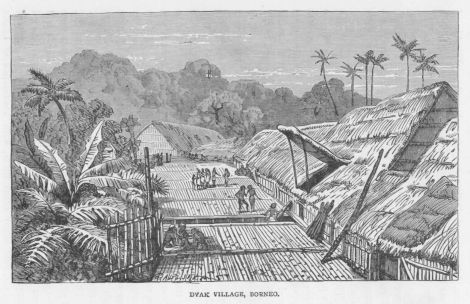
The voyagers here first met with arrak, which the natives distil from rice. Having obtained a pilot, the Spaniards crossed over to the large island of Borneo, and on the 8th of July they came to an anchor off a city which was said to contain twenty-five thousand houses. They were built within high water mark, and raised on posts. When the tide was full, the people communicated by boats going about from house to house.
Soon after they dropped anchor, the Rajah, who was a Moor, of considerable power, sent handsome presents on board, and invited the Captains to visit him.
On landing, the Spaniards found two elephants, covered with silk trappings, ready to conduct them to his palace. In front of it a feast had been prepared, consisting of meat, fowl, and fish, placed on the floor, round which they sat on mats. The natives, after each mouthful, sipped arrak from porcelain cups, and used golden spoons to eat their rice. The feast being over, it was announced to the Captains that the Rajah was ready for them. On their way they passed through a large saloon, in which were a number of courtiers, and from thence into an anteroom, where three hundred guards, armed with poniards, were drawn up. At the farther end of the apartment was a curtain of brocaded silk, and on this being pulled aside, the Rajah, a stout man of about forty, was seen seated at a table, with a little child by his side, and chewing betel, while behind him stood his female attendants, who were supposed to be the daughters of the chief men and to govern his household.
As the courtiers—who were naked, with the exception of a piece of ornamented cloth round their waists—approached, they raised their hands, clasped, three times over their heads; then, lifting up their feet one after the other, they kissed their hands before speaking. They wore numerous rings on their fingers, and daggers with gold hilts set with gems. The Rajah, as the gifts of the Spaniards were presented to him, bowed slightly, and returned others of brocade and cloth of gold and silver. While in his presence the explorers observed the way in which suitors made their petitions, none being allowed to address him personally.
The suitor, having arrived at an outer chamber, presented his petition to a courtier, who repeated it to one of higher rank, and he again passed it on to a person of still greater importance, who then whispered it through a hollow cane fixed in the wall, reaching the inner chamber, into the ear of the chief officer of state, by whom it was conveyed to the Rajah himself.
The Captain heard that the Rajah possessed two pearls the size of hens’ eggs, and that when placed on a polished table they kept continually moving.
The ceremony of introduction being over, and permission to trade being granted, the curtain was again drawn aside to allow of their exit, and the Captains retired. So great was the confidence established that they remained in the palace during the night. Their sleeping-apartment was lighted by two wax candles in silver candlesticks, and two large lamps, with four lights to each, were kept burning all night, being attended by two men to trim them.
The people were skilful in the manufacture of porcelain, of which they exported large quantities. Their vessels were also ingeniously formed; those belonging to the Rajah had their prows carved and richly gilt. The country produced camphor, cinnamon, sugar-cane, ginger, oranges, lemons, melons, and many other fruits, with abundance of beasts and birds.
Having regained their ships, notwithstanding the polite treatment they had received, under the pretence that they were about to be attacked by some junks, the Spaniards seized several in the harbour, which they knew were richly-laden, and kidnapped a number of wealthy persons on board them.
Leaving Borneo, the two ships proceeded to the island of Cimbuhon. On their way the crews insisted on deposing the pilot, Cavalho, who had never been liked, and in his stead they chose Espinosa as Captain-General, with Sebastian del Cano under him.
Finding a commodious port, with abundance of fresh water and fuel, they hove down their ships and caulked them. This occupied them forty days. To obtain suitable wood for repairs, they had to search for it in the forests, and drag it with infinite labour from among the prickly bushes, their feet suffering greatly, as their shoes had worn out.
It was here that the priest Pigafelta found what he fancied was an animated leaf. He was watching a tree resembling that of a mulberry, when several leaves fell off. The moment they were touched they sprang away. He kept, he says, one of these animated leaves in a dish for eight days. They were, in reality, not leaves, but insects, which, from their resembling leaves, are enabled to escape the attacks of other creatures; indeed, they were the well-known leaf-insect of the mantis species.
The island abounded with cassowaries, the East Indian ostrich, and wild hogs. They also captured a fish with a head resembling that of a hog, having two horns and something like a saddle on its back. After leaving this place, they encountered a tremendous storm, when, in their alarm, they vowed to set free a slave, in honour of their three saints, Saint Elmo, Saint Nicolas, and Saint Clare.
Anxiously they looked for the sign of the assistance they sought, when at length, to their joy, they observed the desired lights flickering at their mast-heads, which continued shining for two hours, when the storm abated. They were thus convinced that Saint Elmo, the friend to mariners, had come to their assistance, accompanied by the other two saints.
At the next island, Sarraugan, where they touched, they seized two natives, whom they compelled to go as their pilots to the long-sought-for Moluccas. The Portuguese had reported that the sea was too shallow to be navigated, but on sounding they found it upwards of fifty fathoms. They well knew, indeed, that their rivals had an object in describing it as dangerous.
At length, on the 8th of November, at sunrise, they entered the harbour of Tidore, one of the Moluccas. The Mohammedan ruler of the island, Almanzor, at once came on board to welcome them, assuring them of his affection for his brother the King of Spain, and inviting them to establish a factory on shore.
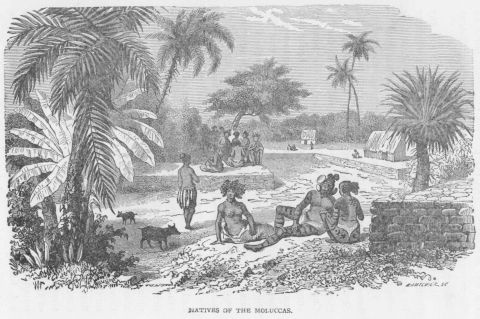
Here the spices they sought for were given in exchange for red cloth, drinking-glasses, knives, and axes. The houses, like those of Borneo, were built on piles, and fenced round with cane hedges. Provisions of all sorts were brought off to the ships, and water, which, though it rushed out of the mountains very hot, became perfectly cool when exposed to the air.
The Rajah of the neighbouring island of Bachian sent a present to the King of Spain,—a couple of birds about the size of turtle-doves, with small heads, long bills, and two long feathers at their sides, their bodies being of a tawny colour. The Moors told them that the birds never fly, but are blown by the wind from heaven. They were, indeed, the first specimens they had seen of the now well-known birds of Paradise, of which there are numerous species. The population generally were heathens, the Moors having gained an ascendancy in the islands only forty years before.
When about to sail, the Trinidad was found so leaky that she was left behind, and the Vittoria proceeded alone on her voyage, with a crew of forty-seven Europeans, thirteen Indians, and some pilots from the Moluccas.
In her progress her captain did not scruple to rob any Portuguese or native traders he met with, taking whatever he wanted. They touched at various islands, where they obtained sandal-wood, ginger, and different sorts of fruit.
Passing to the north of Java, they ran through the channel between that island and Sumatra, taking care to avoid the Straits of Malacca, on the north shore of which the Portuguese had a settlement. They now steered directly for the Cape of Good Hope. As they approached Madagascar, in consequence of the want of provisions, a mutiny broke out, some of the men wishing to put into Mozambique to repair the ship and obtain food; but as it was known that the Portuguese were there also, who would perhaps make them prisoners and take possession of their ship, the captain, supported by most of the officers, refused to listen to their complaints, and steered a course so as to round the Cape. By this time twenty-one men of those who had left Tidore had died. They passed the Cape of Good Hope on the 6th of May, 1522. They were now suffering greatly both from sickness and starvation, and, after two months, at length sighting the Cape de Verde Islands, when nature being unable longer to hold out, rather than risk death from famine, they put into the harbour of Santiago, and threw themselves on the mercy of their rivals. To their surprise, they found that although, according to their reckoning, it was Wednesday, the 9th of July, it was in reality Thursday, the 10th, showing that they had lost a day. This was in consequence of their having sailed west with the sun. Had they gone round in the opposite direction, they would, in the same way, have gained a day. The Spaniards had no difficulty in obtaining provisions, and a supply of food was got on board.
The men had been strictly enjoined not to say where they came from, but one of them, who with twelve more had gone ashore, offered some spices in exchange for food and drink, when it was suspected that they had visited the Moluccas. On this the Portuguese immediately seized them; but, by some means, Sebastian del Cano, who was now captain, observing the preparations for attacking his vessel, ordered the cable to be cut, and, all sail being made, he carried the Vittoria out of the harbour in safety.
He now, with his diminished crew, continued his progress to the northward. After a farther voyage of nearly two months, the successful commander, who was to reap the chief benefits of the voyage, brought the Vittoria safe into the harbour of Saint Lucar on the 6th of September, 1522; the whole circumnavigation having occupied nearly three years, during which fourteen thousand six hundred leagues of sea had been traversed. On the 8th he took the vessel up the river to Seville. The eighteen survivors of the crew of sixty who sailed from the Moluccas, landing, walked barefooted in their shirts, carrying tapers in their hands, to offer thanks for their safe return.
Sebastian del Cano, escaping the fate which befell so many Spanish navigators, was handsomely received and rewarded, letters patent of nobility being bestowed upon him, with a globe for a crest, having the motto, “Primus me circum dedisti”—“You first encompassed me.”
The vessel herself, after becoming the theme of poets and historians, who declared that she deserved a shrine of gold, was ignominiously lost on her passage from Saint Domingo.
Putting aside the conduct on many occasions of the explorers, we must give due praise to the leader of the expedition who conducted it so nearly to a successful termination. By it was demonstrated without doubt the spherical form of the earth. The passage from the Atlantic to the Pacific was discovered, with numerous hitherto unknown islands, and the way thus opened to the several voyagers who subsequently sailed forth to explore the wide expanse of the Pacific Ocean.
Chapter Fifteen.
Voyage of Sir Francis Drake round the world—A.D. 1577.
Drake introduced to Queen Elizabeth—Describes his birth, education, early voyages, adventures with Hawkins, capture of treasure, and first sight of the South Sea—Exploit and death of Oxenham—Drake’s liberality—His plan unfolded—The Queen’s sanction—A squadron of five vessels equipped—Sails on 15th of November, 1577—Puts into Mogador—visited by Moorish chiefs—A seaman carried off by the Moors—Small prizes taken—Drake’s generosity—Touches at the Cape de Verdes—The inhabitants fly—Expedition on shore—No provisions to be obtained—A Portugal ship taken, and the pilot, Nuno da Silva, detained—The Portugals liberated, and a pinnace given them—Captain Doughty’s misconduct—The coast of Brazil sighted—Native alarm fires seen—A tempest—The Christopher separates—Squadron enters Rio de la Plata—The Christopher returns—Sails along the coast—Another storm—Caunter lost sight of—Approach of winter—The Admiral in danger—Rescued by Captain Thomas of the Marigold—Lands—Natives fly—Their huts visited—Mode of catching ostriches—The squadron collected—The Elizabeth broken up—Natives appear—Friendly intercourse—The Christopher run on shore—The Mary recovered—Squadron anchors in Port Saint Julien.
One morning, in the early part of the year 1577, Queen Elizabeth was seated in the private audience-chamber of her palace, attended by her ladies in waiting and two or three courtiers, who stood round in graceful attitudes, eager to catch her words, and equally ready to make suitable replies to the remarks of her Majesty, when a page entered and announced her Vice-Chamberlain, Sir Christopher Hatton, attended by a sea captain—Master Francis Drake—whom he craved permission to introduce.
“Admit them,” said the Queen. “I have long desired to hear from Captain Drake’s own lips an account of his adventures.”
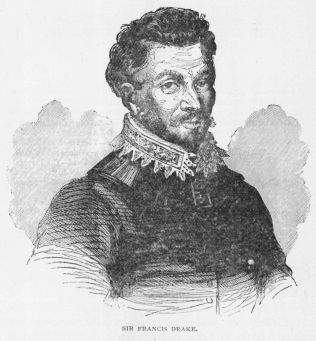
In a brief space of time the Vice-Chamberlain entered, followed by a person who in appearance differed much from the gaily habited courtiers in attendance on her Majesty. He was a man apparently between thirty and forty years of age, with the air and carriage of a seaman. His figure, somewhat below the middle height, was exquisitely proportioned; his chest broad, and his head round and well formed. Though sunburnt, his complexion was naturally fair and sanguine, his countenance open and cheerful, his hair of a brown colour, and his beard full and carefully trimmed. His large and lively eyes beamed with intelligence, and his mouth was firm set, while his whole countenance showed a quick and resolute character.
Bowing low as he entered, he was introduced in due form. He replied in a free and unembarrassed manner to the questions the Queen put to him.
“I have been well informed, Captain Drake, of the good service you have rendered to the Earl of Essex with your three frigates in subduing the rebellion in Ireland; but I desire to know more of your earlier exploits in the West Indies, and I shall be pleased to be informed of your birth and parentage.”
Exhibiting due modesty in all he said, Captain Drake replied that he had been at sea from his boyhood. He was the eldest among twelve sons of Master Edward Drake, Vicar of Upnor, and was born in the year 1544 in a cottage near Tavistock, on the banks of the Tavey. From his earliest days, having constantly seen the royal ships anchored in the Medway, his desire had been to follow the sea; and to gratify his wishes, when he was of an age to leave home his father placed him with the master of a bark, in which he used to trade along the shore, and sometimes to carry merchandise into Zealand and France. His master dying, left him his bark as a mark of his good-will, and when but eighteen he became purser of a vessel frequenting the ports of Biscay. He shortly afterwards entered a ship commanded by Master John Hawkins, engaged in the slave trade. Having obtained a cargo partly by the sword and partly by other means at Sierra Leone, they were conveyed across the Atlantic to the island of Hispaniola.
Having made a voyage or two with Master Hawkins, he obtained the command of the Judith, a bark of fifty tons, one of a squadron under the same Admiral.
The ships having taken in their cargoes of slaves as usual, Master Hawkins sailed for the Canaries and the Spanish Main, that he might exchange his freight for silver, sugar, and other commodities most valued at home. On passing the town of Rio de la Hacha, Master Hawkins stormed it, because the Governor refused to trade with him.
“Such an act was not in accordance with our will,” observed the Queen. “But go on, Master Drake.”
“Reaching the Gulf of Mexico, the squadron was compelled to seek shelter in the port of San Juan del Ulloa. At first the Spaniards believed that we were part of a fleet they were expecting, and were in great consternation when, coming on board, they discovered their mistake. Our commander assured them that our sole desire was to seek shelter from stress of weather, and procure provisions and merchandise, for which he would pay, but he deemed it prudent to detain two persons of consequence as hostages. His proposals were accepted. Near us lay twelve merchant ships, laden with two hundred thousand pounds’ worth of goods; but, though we might easily have mastered them, the Admiral, knowing that it would displease your Majesty, refrained from doing so.
“While waiting for the answer from the Viceroy of Mexico, the expected Spanish fleet arrived with a cargo valued at one million eight hundred thousand pounds. We were sorely tempted, it must be confessed, to go out and attack them, and we knew that if they were admitted our safety would be jeopardised, as the haven is confined and the town populous.
“At length the Viceroy agreed to the terms proposed by Master Hawkins, and we in a friendly way exchanged visits with the officers of the newly arrived fleet. Thus lulled into security, we did not dream of the vile treachery the Spaniards were preparing, until we observed an unusual bustle on board their vessels, and soldiers in great numbers gathering on shore. Master Hawkins was at dinner in his cabin on board the Minion, when a Spaniard, Villa Nueva by name,—but an old villain he was by nature, your Majesty will allow,—attempted to plunge a dagger, which he had concealed in his sleeve, into the Admiral’s breast. But Master Hawkins was too quick for him, and, having him bound, sprang on deck, where he saw the Spaniards from their admiral’s ship, which lay close to the Minion, about to board her.
“On this, shouting ‘God and Saint George! Upon those traitorous villains, and rescue the Minion!’ he and his men drove back the Spaniards and set their ship on fire.
“He then made sail and stood for the mouth of the harbour, though surrounded by foes. I, on board my little bark, the Judith, followed his example, firing at the treacherous Spaniards, who in their ships and boats endeavoured to overwhelm us. They succeeded too well with the rest of the squadron, all of which were captured and their crews butchered. This foul deed was done, although we had in no way offended the Spaniards. Your Majesty will doubtless see that we have just cause to retaliate on those wretches for their unexampled treacherous cruelties towards your Majesty’s faithful subjects.
“On my arrival in England, feeling sure that I was acting justly, I fitted out two ships, the Dragon and Swan, with which I sailed to the Spanish Main; and in the following year I again went out in the Swan, more to obtain information of those seas than to make reprisals, although I captured not a few goodly barks laden with merchandise.
“In 1572 I again sailed in command of the Pacha, of seventy tons, and the Swan, of twenty-five tons, of which my brother John, who had taken to the sea, was captain. Reaching the coast of America, we were joined by another bark, belonging to the Isle of Wight; and now, having obtained the friendship of a tribe of natives, the Cimarrones, we considered ourselves sufficiently strong to attack the town of Nombre de Dios, where we expected to obtain a rich booty; but, disappointed in this, led by one of our dark-skinned allies, we resolved to intercept the mules bringing treasure from Panama to the aforesaid place. We therefore left our squadron in the Sound of Darien, and marched overland. Though again at first disappointed, we at length fell in with a train of fifty mules laden with gold and silver, of which we took possession. It was on this journey that the chief of the Cimarrones, taking me by the hand, led me to the top of a high tree in which steps had been cut, and where twelve men might sit with ease. Thence I could see, at the same time, the Atlantic, from whence we came, and that Southern Ocean so greatly desired, on the other hand; for on both sides, the trees having been cut down, nothing impeded our view. On this, calling up my men, and among them my trusty follower John Oxenham, I prayed Almighty God of His goodness to give me life and leave to sail once in an English ship on that sea. On this, John Oxenham swore that, unless I should beat him from my company, he would, by God’s grace, follow me. As I was narrating to your Majesty, we secured the gold and part of the silver; but, as we could not carry the remainder across the mountains, it was concealed until an opportunity might occur for our removing it. By a sad mishap, one of our seamen fell into the hands of the Spaniards, and when I sent a party to recover the treasure, it had been carried off; the poor fellow, as we found, having been put to the torture to reveal its hiding-place. On our march back we surprised and burnt Venta Cruz, and obtained more booty, returning to our ships just in time to escape a large body of Spaniards, who had been assembled to attack us.
“We safely reached Plymouth on Sunday the 9th of August, 1573, when the people in the church, hearing of our arrival, rushed out to welcome us, leaving few to hear the preacher finish his discourse.
“Though not relating to myself, I must tell your Majesty how my faithful friend John Oxenham sailed away forthwith, accompanied by carpenters and other artificers, determined to do that which never man had before enterprised. Crossing the Isthmus of Darien, he built a pinnace, in which he embarked on the South Sea. Having taken two prizes, he was returning with his booty across the isthmus to his ship, when he was assailed by overwhelming numbers of the Spaniards and made prisoner. Of his sad fate I have gained tidings. He was carried to Lima, and there, according to the vile custom of those foes of the human race, cruelly tortured and put to death. It makes the heart of a man burn within him to avenge such treatment of your Majesty’s subjects.”
The Queen did not reply, but she had no desire to check the ardour of the brave captain.
“Master Drake has not mentioned to your Majesty a circumstance of which I have been told,” observed Sir Christopher Hatton. “Before coming away, he presented his cutlass to the chief of the Cimarrones, who had shown a great longing for it; and when in exchange the cacique gave him four large wedges of gold, Master Drake, declining to appropriate them, threw them into the common stock, observing he thought it just that such as bore the charge of so uncertain a voyage on his credit, should share the utmost advantage that the voyage produced; and good fortune deservedly attended him to the end of his enterprise.”
“On what matter have you desired this interview, Captain Drake?” asked the Queen.
“It is one which, for obvious reasons, Master Drake desires should not be made public,” observed Sir Christopher Hatton.
On this her Majesty signed to her courtiers to retire out of earshot, and then ordered Drake to speak. He accordingly, craving her Majesty’s sanction, and pointing out its importance, and the gold and advantage which her kingdom might derive from its prosperous issue, unfolded his design. His ambition was, he said, to conduct a fleet of stout ships, well armed, through the straits which the Portuguese Magalhaens had discovered more than half a century before, into that Pacific Ocean which he had navigated from east to west, and on which John Oxenham’s bark had floated, and he himself had besought Almighty God that he too might sail in an English ship. He spoke not at the time of attacking the Spaniards wherever he should meet them, and depriving them of the wealth they had procured by the death of the thousands of helpless Indians they had enslaved, knowing that her Majesty, since she was at peace with Spain, could not openly approve of such a proceeding.
What more was said need not be repeated; but as he took his parting farewell of the Queen, her Majesty presented him with a sword, saying, “We do account that he which striketh at thee, Drake, striketh at us.”
With this verbal warrant, the brave Captain lost no time in making energetic preparations for his projected voyage. He found no lack of followers eager to share his fortunes; but, according to the best of his judgment, he chose men of experience and tried bravery, on whom he could depend. He gave out that the squadron was intended for a trading voyage to Alexandria, though neither his officers nor the ever-watchful Spaniards were deceived by those pretexts.
Five ships were procured, and, being rapidly fitted out, were supplied with all necessary stores and munitions. Drake himself superintended everything, down to the minutest point, so that nothing required might be wanting. It was to this, as well as to the interest he took in his men, and to his superior seamanship and enterprise, that much of his success was owing.
His squadron consisted of five vessels,—the Pelican, of a hundred tons burden, in which he himself sailed; the second being the Elizabeth, vice-admiral, burden eighty tons, Captain John Winter; the third the Marigold, a bark of thirty tons, Captain John Thomas; the fourth the Swan, a fly-boat of fifty tons, Captain John Chester; the fifth the Christopher, a pinnace of fifteen tons, Captain Thomas Moon. These ships were manned with a hundred and sixty-four able seamen, officers, and others, and among other things carried were several pinnaces, ready framed in pieces, to be set up in smooth water as might be required. He had a band of musicians, his cabins were richly furnished, and the services for the table, and many utensils even belonging to the cook room, were of silver. All things being ready, the Admiral and his officers went on board, and set sail from Plymouth Sound at five o’clock in the afternoon of the 15th of November, 1577.
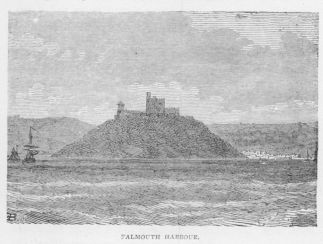
When off the Lizard, meeting with a heavy south-westerly gale, they were driven back, the Pelican and Marigold having to cut away their mainmasts, to Falmouth, where they remained until the 13th of the next month, when, all their damages being repaired, they once more put to sea.
All on board were eager to know their destination. When out of sight of land, the Admiral, should the ships be separated, appointed Mogador as a rendezvous, and it was thus guessed that they were not bound up the Straits of Gibraltar.
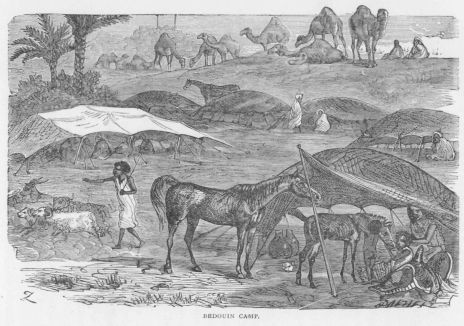
Sighting the Barbary coast on the 25th of December, the squadron entered the harbour of Mogador, in the dominions of the King of Fez, on the 27th. While some of the people were employed in setting up a pinnace, several natives appeared, among whom were two Moorish chiefs, requesting to be taken on board to the Admiral. A boat was accordingly dispatched, and the two Moors were brought off, an Englishman being left as a hostage. The Moors were courteously entertained. When wine was presented to them, they declined drinking it in public, but had no objection to swallow a good quantity when they could do so unobserved.
On their return the hostage was restored. The next day some men and camels came down to the beach, apparently wishing to trade, as they exhibited various commodities. On this a boat from one of the ships, unknown to the Admiral, was sent to meet them, when one of the men in her, John Fry by name, wishing to become a hostage, that he might hear them speak and observe their manners, leapt hurriedly on shore, and ran on some way from the boat. Before he was aware of his danger, he was seized by the Moors, who, lifting him up on one of the camels, set off with him at a rapid rate. As the rest of the crew were about to land, a large number of the natives sprang out from behind the rocks, and compelled the English seamen to retreat. It was afterwards found that the man had been carried off by the orders of the King of Fez, who wished to gain information regarding an expected invasion of his territory by the Portuguese.
Drake, on hearing what had occurred, landed a party of men and marched some distance into the interior, but the Moors kept out of his way, so that he was compelled to return without gaining information; and, supposing that Fry was lost, he ordered the squadron to put to sea. Fry meanwhile was kindly treated by the King of Fez, who, finding that no information could be got from him, sent him back to the coast, where, to his grief, he found that the fleet had sailed. He, however, before long got home in an English merchant vessel.
Running down the African coast, they took three Spanish fishing-boats called caunters, and shortly afterwards two caravels, when at length they caught sight of the Southern Cross. Passing Cape Barbas, they sighted a Spanish ship at anchor. She was captured with only two people on board, the rest having fled on shore. In a harbour, three leagues within the cape, the ships brought up, and there remained several days, obtaining fresh water and provisions, as well as all sorts of fish in abundance.
The people here appeared to be suffering from famine, and a wretched woman, with a babe in her arms, was brought down to the beach to be sold as a slave; but Drake indignantly refused to purchase her, saying that he did not trade in human beings. Other people brought leather bags to buy water. Drake gave them water, but declined receiving payment in return. Having refitted the ships and discharged all the Spanish prizes, except one caunter, in exchange for which the Christopher was given to the owner, and one caravel, the squadron proceeded to the Cape de Verde Islands, and put into the harbour of Saint Mary’s. Here, when the inhabitants, who were subjects of the King of Portugal, saw them coming on shore, they fled to the mountains, and no provisions or fresh water could be purchased.
A party, under Captain Winter and Mr Thomas Doughty, was sent on shore to try and obtain what was required. They saw large herds of goats; wild hens, and salt which had been gathered in great quantities from the rocks. The country was fertile, covered with trees and vines, bearing delicious grapes, with which the seamen refreshed themselves. There were many other fruit-trees, some bearing plantains, a pleasant and wholesome fruit, others figs, with ripe fruit on them. Sailing from Saint Mary’s on the 30th of January, they the next day passed the island of Saint Jago, beyond which lies the burning island called by the Portuguese Fogo. To the south-west of this island they took a Portugal ship laden with wine, linen and woollen cloths, and other necessaries, bound for the Brazils, and having many gentlemen and merchants on board her. The command of this prize was given to Thomas Doughty, who was an old friend of Drake’s, and much trusted by him.
The ships passed by several towns, the people in which fired off their great guns to signify that they were prepared for an assault. The pilot of the Portuguese ship, Nuna da Silva, being found to be an expert mariner, well acquainted with the coast of Brazil, was taken on board the admiral.
Passing Fogo, the squadron brought to off the fertile island of Brava. Here the only inhabitant to be found was a monk, who had built himself a rude dwelling; but on seeing the English landing, he fled, leaving behind him the relics of his false worship—a cross with a crucifix, an altar with its superior altar, and idols of wood of rude workmanship.
Here the Portugals taken near Saint Jago were dismissed; the Christopher, pinnace, being given them in exchange for their own ship, and wine, bread, and fish for their provision, excepting Nuna da Silva, who, when he heard that the fleet was bound for the South Sea, willingly remained with Drake.
Only a small supply of water being taken on board, the fleet sailed from Brava on the 2nd of February, steering a course for the Straits of Magellan. Passing the equator on the 17th, they sailed for sixty-three days out of sight of land.
Drake was not without his troubles: it having been found that Captain Doughty had appropriated to his own use certain presents made by the prisoners, he was superseded by Thomas Drake, the Admiral’s brother. This disgrace appears to have rankled in Mr Doughty’s heart, and caused him to feel a bitter animosity against his former friend and commander. During this long passage the squadron sometimes met with adverse winds and violent storms, when lightnings flashed and terrific claps of thunder rattled above their heads; at others they were long becalmed, suffering from the effects of the sweltering heat of the torrid zone. They were depressed, and would have suffered greatly from the want of water, had they not been able to supply themselves, both before and after crossing the Line, by means of the heavy showers which every day fell, the water being collected in sails and sheets.
When in the tropics they saw, for the first time, shoals of flying-fish of the size of pilchards, chased by bonitos and dolphins, or “dorados,” as the Spaniards called them. Also, as they watched the flying-fish trying to escape from their foes in the water, they observed huge birds pounce down and seize the helpless fugitives. Cuttle-fish likewise—strange, black creatures—leapt on board the ships in considerable numbers. These and other novel sights did not fail to interest them. On the 5th of April they sighted the coast of Brazil, where the land was low, and, sounding, they found only twelve fathoms three leagues off the shore. Huge fires were observed, kindled by the inhabitants. The Portuguese had before this landed on the coast, and reduced the natives to a miserable stage of bondage, compelling them by their cruelty to fly from the fertile parts of the country into the more unfruitful districts.
Drake wished to go on shore, but, finding no harbour, the squadron coasted along until the 7th of April, when a terrible storm of wind from the southward rose, during which the Christopher was separated from the rest of the fleet. She was the caunter taken at Blanco, on which the name of Christopher was bestowed when the vessel originally so-called was given to the prisoners. After the squall, which lasted only three hours, the squadron continued beating to the southward, until they got off the Rio de la Plata, up which they ran until they came to an anchor under Cape Joy. Drake so-called it from the satisfaction he felt at seeing the Christopher come in two days after they had anchored, he having thoughtfully appointed it as a rendezvous, should any of the vessels be separated.
Among the principal of his subordinate objects was to keep the fleet together, to obtain good drinking-water and fresh provisions as often as possible. They found the climate delicious, and saw a number of large deer. Considerably higher up the river they anchored near some rocks, where they killed a large number of seals, or sea-wolves, as the Spaniards called them. They found their flesh wholesome and pleasant, and salted a number for their further use.
Having spent a fortnight in the River Plate, they again put to sea, when shortly afterwards the fly-boat Swan was lost sight of. In order to save the inconvenience of so many vessels to look after, Drake determined to lessen their number, that the crews of those remaining might be strengthened and have less duty to perform. Winter was coming on, and, in order to prepare for it, a convenient harbour was searched for. While examining the coast, on May 8th, during another storm, the caunter was again separated from the fleet. The ships being much tossed about, they stood in with the intention of coming to an anchor near a headland, off which many rocks were observed. Drake, who never trusted to other men when he could perform the work himself, despising danger and toil, had a boat lowered, and rowed in himself to examine the bay.
Approaching the shore, a native was seen singing and dancing, and shaking a rattle, expecting him to land. Suddenly the wind still further increased, while a thick fog coming on, the Admiral lost sight of his ships. He immediately pulled off to try and regain them, but would very probably have been lost in the heavy sea running, had not Captain Thomas of the Marigold, at great risk, stood in, and having taken him on board, bravely rode out the gale.
Next morning the weather cleared, but the rest of the ships were nowhere visible; the Admiral, therefore, landing, lighted up large signal-fires in the hopes of their being seen by the ships. The natives had fled up the country for fear of the strangers. The seamen found, however, in their huts near the shore the flesh of upwards of fifty ostriches cured, as well of that of other birds, the size of the former being equal to legs of mutton. They discovered also the device by which the ostriches were captured. This consisted of the head, neck, and plumage of the bird fixed to the end of a pole, with large feathers sticking out behind sufficient to conceal a man’s body. With these the ostriches were stalked and driven either into some neck of land, or against large and strong nets, with the assistance of dogs.
The dispersed ships, seeing the fires, shortly came to an anchor, excepting the Swan and the Mary, the Portugal prize, which had parted company. This not being a convenient place, the squadron sailed on the 15th of May, and on the 17th anchored in a sheltered bay, where they remained fifteen days. Having made various necessary arrangements, the Admiral sailed northwards to look out for the Swan, and dispatched Captain Winter in the Elizabeth for the same object. She was fortunately soon discovered, and being brought back, was unladen and run on shore, when she was broken up, her ironwork and planking being distributed among the ships, the latter to be used as fuel and other purposes.
While the crews were thus employed, the natives made their appearance on the top of a hill, leaping, dancing, and holding up their hands, and crying out in a curious fashion. With the exception of a skin of fur cast about their shoulders, they were naked. Their bodies were painted, and the chiefs wore feathers in their hair, which looked at a distance like horns.
The Admiral on this sent a boat on shore with knives, bells, beads, and other things, which he thought would please them. Seeing the strangers, two of the natives came rushing down at a great rate, but stopped short when still at some distance. On the English retiring, they, however, advanced and took the articles which had been placed on sticks so that they could be seen, leaving instead plumes of feathers, and bones shaped like large toothpicks.
Their confidence was soon gained, and numbers coming down, mixed freely among their visitors. They appeared to be a mild, well-disposed people, and learned to place implicit confidence in the Admiral, who won the affection of the chief by bestowing upon him the cap he usually wore. The savage, as a curious mark of his affection, wounded himself with an arrow in the leg, letting the blood stream on the ground.
These natives were well-made, good-looking, and remarkably active and swift of foot. They obtained from the birds and seals frequenting the shore an abundance of food, which, it appeared, they ate raw. They were all armed with short bows, and arrows of reed headed with flints. The English here killed large numbers of birds, which were so tame that they perched on the men’s heads and shoulders, and in a bay near at hand they took upwards of two hundred seals in the space of an hour.
Having repaired and provisioned the ships, on the 3rd of June they set sail, steering southward, but anchored again in two days in a bay, where the caunter Christopher was run on shore and her cargo removed.
Again they proceeded, after anchoring a short time, until they brought up once more in another bay in 15 degrees 20 minutes, short only one degree off the mouth of the straits.
Here the Admiral, anxious to find the long-missing Mary, which had on board their chief store of wine, determined to sail back again until they reached the latitude where she had been lost. A bright look-out was kept for her, and happily, on the evening of the 19th of June, when the squadron was within a few leagues of Port Saint Julien, the missing ship was sighted. They were greatly rejoiced at this; but she was found to be so much out of order, and her crew had suffered so many privations, that the Admiral thought it well to put into that harbour, which was to prove a place fatal to several of their number.
Chapter Sixteen.
Voyage of Sir Francis Drake, continued—A.D. 1578.
Squadron at Port Saint Julien—Attacked by the natives—Captain Winter, and Oliver the gunner, killed—Doughty’s conspiracy—Trial—Execution—Squadron sails—Enters the Straits of Magellan—Name of the Dolphin changed to the Golden Hind—Passage through the Straits—Elizabeth Island—Meets natives—Enters the Southern Ocean—Ships driven before a northerly gale—The Marigold lost sight of—After a month’s buffeting, the two ships gain a harbour—The Hind again driven to sea—The Elizabeth deserts her—A pinnace lately set up remains, but is finally lost—The Hind alone regains a harbour—Sails north—Calls off Mucho Island—Boat treacherously attacked by natives—Drake wounded—Refuses to retaliate—Reaches the mainland—Search for provisions—Meets an Indian—Treats him kindly—His friends bring off provisions—He pilots the Hind to Valparaiso—Capture of a richly-laden vessel, and sack of the town—Sail northward—Put into a bay—Boat’s crew attacked by Spaniards—Minjoy killed—The pinnace set up—Drake sails in her—Driven back by foul winds—Booty obtained from an Indian asleep and from a train of llamas—Indians come off on balsas—Two Spaniards, through fear, bring off provisions—Llamas described—Vessels at Arica and Arequipa plundered—A vessel laden with linen captured—Callao reached—Drake hears of the Cacafuego—Plunders several vessels—Sails in pursuit of the Cacafuego—Pursued.
The squadron came to an anchor in Port Saint Julien on the 20th of June, and, having arranged various matters, the next day but one the Admiral, accompanied by his brother, John Thomas, Robert Winter, Oliver the master gunner, John Brewer, and Thomas Hood, rowed up along the shore in search of a good place for watering.
Not far off on the shore was seen the remains of a gibbet, supposed to be that set up by Magalhaens for the execution of one of his rebellious captains. On landing, two huge natives, called by that navigator Patagons, came down and appeared to be friendly, being ready to receive whatever was offered to them. They took especial pleasure at seeing Mr Oliver, the master gunner, shoot with his bow, till they were joined by an ill-tempered-looking savage, who tried to draw them away. At this juncture a number more of big fellows, armed with bows, who had hitherto been concealed, crept up towards the English. While Mr Winter was also shooting with his bow, thinking to amuse them as Mr Oliver had done, the string broke. Not liking their gestures, the Admiral ordered his party to retreat, covering themselves with their targets, and remembering, probably, how Magalhaens had been slain, ordering them to break all the arrows aimed at them.
While Mr Winter was trying to repair his string, an arrow shot by one of the savages pierced his lungs, but he did not fall. On this the master gunner levelled his caliver—a sort of blunderbuss—but it missed fire, and before he could shoot it off two savages, taking sure aim at him, killed him on the spot.
Many other natives had by this time made their appearance, and were coming on with threatening gestures, when the Admiral, taking the gunner’s piece, fired it at the native who had killed him, and as it had been loaded with bullets and small shot, it tore open his belly. The tremendous roars he uttered, equalling that of ten bulls together, so appalled his companions that they took to flight.
Drake, unwilling further to injure them, allowed them to escape, and had Captain Winter, to whom he was greatly attached, conveyed down to the boat, leaving the body of the gunner behind. Mr Winter, however, was too severely injured to recover, and died the following day on board his ship. That night a boat was again sent on shore with a number of men well armed. Here they discovered the body of the gunner lying where he had fallen, with his coat wrapped up to form a pillow, and an English arrow stuck in his right eye, showing, as it was conjectured, that the natives had no wish to be on hostile terms with their visitors. He and Mr Winter were buried together, close to the spot where the Spanish captain was supposed to have died.
Drake was greatly grieved at the loss of his friend Winter and his gunner, but he had a still greater anxiety on his mind from the reports he received of the conduct of one whom he had considered his friend, Mr Thomas Doughty. His conduct in appropriating the gifts made to him by the Portuguese prisoners was reprehensible, but it was now found that he was plotting a mutiny to kill the Admiral or to supersede him in the command, intending to carry off some of the squadron, and to sail on a different venture.
So strong was the evidence brought of the nefarious designs of Doughty, that the Admiral was compelled to summon together forty of the principal officers. By these, he sitting as president, Doughty was found guilty, and was condemned either to suffer death, to be left on shore among the savages, or to be sent home as a prisoner in one of the vessels, with a full statement of his trial, to be dealt with as her Majesty the Queen might think proper: the choice of which punishment he would suffer was offered him.
Rather than undergo the shame of being sent home, or to endure the wretched fate which would have been his lot among the savages—some days being allowed him to decide—he resolved, after fully acknowledging his guilt, notwithstanding the persuasions of his friends to the contrary, to select the first alternative offered, desiring only that he might take the communion with the Admiral, as a token that he died at peace with him and all men.
Strange as it may seem, the sacred ordinance having been celebrated by Mr Francis Fletcher, the preacher and pastor of the fleet, he dined at the same table as the Admiral, both appearing cheerful and drinking to each other as if only some journey had been in contemplation.
After dinner he was led forth, and entreating those around to pray for him, he kneeled down and bade the executioner perform his office.
The stern justice meted out on a gentlemen and an officer who had hitherto been highly esteemed, had no doubt a great effect in deterring others who might have contemplated any mutinous proceedings. He was taken on shore and buried where Don Luis de Mendoza was supposed to lie—in a grave close to those of Mr Winter and the gunner.
This painful duty performed, and other matters arranged, the Mary, the Portuguese prize, being in a leaky state, she was run on shore near the island on which, for the two months of their stay, their tents had been pitched.
Here her planks were stripped off, and divided amongst the other three ships, which now constituted the whole squadron, besides the pinnaces which were still on board.
Having wooded, watered, and thoroughly repaired their vessels, the explorers sailed from this “Port Accursed,” as some of the seamen called it, on the 17th of August, and again steered southward.
On the 20th they came off the Cabo de las Virgines, as the Spaniards called the entrance to the Magellan Straits. About four leagues off it had the appearance of black rocks full of grey stars, against which the sea beat like the spouting of whales. At this cape the Admiral ordered the ships to lower their topsails on the bunt, in homage to the Queen’s Majesty; and he here changed the name of his ship, the Pelican, to that of the Golden Hind, in compliment to his patron Sir Christopher Hatton, whose coat of arms bore a golden hind. A sermon being preached by the chaplain, Master Fletcher, and prayer being offered up, the squadron entered the straits, passing along which, with land in sight on both sides, they in a short time made their way through a narrow channel, with a strong wind blowing astern. They then passed through a broad expanse. The following night they saw a lofty island to the southward, which appeared to burn like that of the island of Fogo. The tides as they passed on rose and fell regularly, the difference between high and low water being upwards of five fathoms.
On the 24th of August they came off a large and fruitful island, on which, the weather being fine, the Admiral and some of his officers landed, taking possession of it in the name of her Majesty, and calling it Elizabeth Island. Some other islands close to it abounded with strange—looking birds, somewhat in size less than a goose, and although they could not fly, ran at a great rate. They were in reality penguins, which abounded in those regions. In one day they killed no less than three thousand. On another island they found the body of a man who had been long dead. From these islands onwards the passage was so crooked and narrow that they very frequently had to come to an anchor. They found numerous harbours and abundance of fresh water. The mountains here rose to a great height, their tops apparently lost in the sky, and covered with ice and snow. On the low grounds many fine trees were seen, with green grass and herbs, the temperature being very similar to that of England.
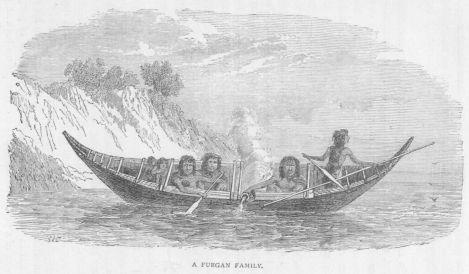
The inhabitants made fires as they passed along, but did not come off to them. As they drew near the western entrance of the straits, the passage appeared so narrow, with so many broad channels opening to the southward, that the Admiral doubted which to select. He, therefore, ordering the squadron to anchor, put off himself in a boat, and rowed forwards to survey the passage. Having found one of sufficient width, he turned back to rejoin the fleet. On his way he fell in with a canoe made of bark, and full of people. It was of a peculiarly elegant form, turning up both at the stem and stern in a semicircle, the workmanship being also excellent in the extreme. The people in it were of low stature, but of compact form, and had their faces painted. They were on their way to the island off which the ships lay at anchor. A visit was afterwards paid to them on shore. Their dwellings were of framework, covered with the skins of beasts. Their food appeared to be mussels and other shell-fish. All their houses were of bark neatly sewn together. Their knives were formed of mussel-shells of great size, and were so sharp that they could cut the hardest wood with them, as well as bone, out of which they made the fizgigs they used for killing fish.
On the 6th of September, to the joy of all on board, the three ships sailed proudly into the South Sea, having accomplished the whole passage in about a fortnight, which had occupied their predecessors—Magalhaens, Loyasa, and Juan de Ladrilleros, who had come from the Pacific side—several months.
The land to the south had been found to consist, not of a mainland, or even of one large island, but of numerous islands, with broad passages between them. In consequence of the cold weather which now came on, the Admiral intended to sail northward, to get as soon as possible into a warmer latitude; but, a furious north wind arising, the ships could in no way make head against it, and were driven farther and farther south and east.
Instead of finding it the Pacific Ocean, they, from their experience, considered that it should be called the Stormy Sea. Day after day the tempest blew with extraordinary violence. During that period, on the 15th of September, an eclipse of the moon occurred, which lasted for a considerable time, adding to the horrors of the storm. For many days they ran on under bare poles, being unable to face it. On the 30th of the same month, the Marigold, commanded by Captain John Thomas, who had rendered such service to the Admiral, and having many other of his friends on board, was separated from her consorts. It was hoped, however, that she might be able to rejoin them at their place of rendezvous, about the thirtieth degree of south latitude, on the coast of Peru.
For a whole month the two remaining ships, sorely battered by the tempest, were out of sight of land, which at length regaining, on the night of the 7th of October, they ran into a harbour to the southward. They had not, however, long dropped their anchors before both ships were again driven out to sea, and that of the Admiral left an anchor behind her, but a sloop which had been put up at the entrance of the straits soon regained the harbour. The Elizabeth was lost sight of, while the Golden Hind was driven far away to the southward, where she lay helplessly tossed about by the fury of the waves. Again, the storm abating, she made sail, and sighted the utmost cape or headland of those islands, about the fifty-sixth degree of south latitude, and since known as Cape Horn.
On the 28th of October the Golden Hind anchored within a creek of the same island. Though people were seen on shore, no communication was held with them. On the 30th of October, with a fair wind, Drake steered to the north-west, and then north, in order not to lose sight of the continent. The following day the explorers came off an island covered so thickly with birds that they were able to obtain a plentiful supply; indeed, the whole fleet might have been equally well furnished.
Coasting along in sight of land, they observed a lofty range of mountains, but the country appeared barren, without water or wood, except here and there, where Spanish settlements had been formed. There being no possibility of obtaining information of the missing ships, they again ran off towards an island called Mucho, on account of its large size. Here they came to an anchor on the 25th, and found it a fertile place, with an abundance of sheep, cattle, Indian corn, and potatoes. The inhabitants were Indians, who had been driven off by the cruelty of the Spaniards, and had here fortified themselves. On ascertaining that the visitors were English, they came with great courtesy, bringing with them various fruits and two fat sheep, which they presented to the Admiral. He, in return, gave them a variety of useful articles, at which they seemed greatly pleased, and signified that they would return with further provisions.
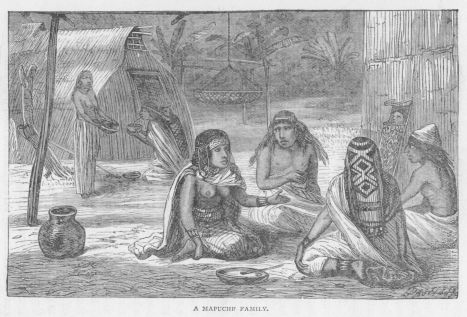
Next day, therefore, at an early hour, the Admiral, with a number of men, repaired to the beach, carrying articles for barter. He first put two men ashore, with casks to obtain water at a place which had been pointed out, but scarcely had they landed when they were treacherously set upon and killed. Shortly afterwards, five hundred savages, armed with bows and darts, springing up from behind the rocks where they had been concealed, let fly a shower of arrows. The boat being driven in by the force of the sea towards the beach, the crew had great difficulty in pulling off. The Admiral received two wounds, one under his right eye, and one on his head, nearly penetrating to the bone; the rest of the party being also severely injured in different parts of their bodies. Had they not succeeded in getting the boat off, the whole might have been massacred. The arrows were long reeds, with heads of stone, and their darts were of great length, with iron or bone tips.
Serious as were the wounds, none proved mortal, and although the chief surgeon was dead, and the other had gone off in the Elizabeth, so that they had only a lad, whose anxiety to do right was far greater than his skill, they all in a short time recovered. Drake, though he might have revenged himself on the ignorant savages for their unwarrantable attack, convinced that they were influenced from their hatred of the Spaniards, who had so cruelly ill-treated them, refrained from retaliating.
In the afternoon the Golden Hind again set sail, Drake being anxious to fall in with the missing ships as soon as possible, and to find some convenient harbour where fresh provisions and needed repose for the wounded men could be obtained.
On the 30th of November the Admiral put into a bay at about the thirty-second degree of south latitude, and forthwith sent a boat to discover what likelihood there was that the place would afford the things they stood in need of. After a long search, neither fresh provisions nor water could be found; but they saw on shore huge herds of buffalo, though no signs of inhabitants. On their return they fell in with an Indian canoe, which, with the person in it, they brought alongside. He was a fine-looking man, dressed in a white shirt reaching to his knees. His hair was long, but he had no beard; he appeared to be of a mild and amiable disposition, and very grateful for the things the Admiral gave him. He was a fair specimen of the gentle and harmless people whom the Spaniards were treating so barbarously.
The native’s confidence having been thoroughly won, he was sent away in the Hind’s boat, accompanied by his own canoe, that he might be landed wherever he chose. Being put on shore, he met several of his friends, to whom he described the kind treatment he had received, and they, accompanied by their chief or head man, in a short time came off to the ship, bringing hens, eggs, a fat hog, and other provisions. The Indian gave them to understand that they could not obtain a sufficient supply of necessaries at that place, but offered to pilot them to a harbour a short way to the southward, where they might procure all they required.
Instead, therefore, of landing and going in chase of the buffaloes, as they had proposed doing, they set sail under their new pilot, and in a short time came to an anchor in the harbour of Valparaiso, not far from the town of Santiago.
None of the missing ships were here to be seen, nor could tidings be obtained of them. They found, however, a large ship, which, as they sailed in, welcomed them by beat of drum, supposing that they were Spaniards. At once, therefore, pulling on board, they rudely undeceived the crew by clapping them all down below, with the exception of one man. He, managing to jump overboard, swam to shore and alarmed the inhabitants, who speedily took refuge inland, carrying all they had time to snatch up.
On examining their prize, the Grand Captain, they found that she was laden with eighteen hundred jars of wine, upwards of twenty five thousand pesos of gold, and a crucifix of gold set with emeralds. Going on shore, they found a further quantity of wine, and supplied themselves with bread and all other necessaries in great abundance of which they stood in need. They also plundered a church of its ornaments and relics, among which were two cruets, a silver chalice, and an altar-cloth. All these, according to the curious notions which governed the rovers, were bestowed, as his share of the booty, on Master Fletcher the chaplain, who did not consider that he was in any way bound to decline them.
Having carried off the pilot of the Grand Captain, who, being a Greek, was called Juan Greigo, as well as the ship herself, they set sail, and, piloted by the friendly native, steered northward, until they reached the place where they had taken him on board. He was here, being loaded with presents, set on shore, seeming very grateful for the way he had been treated.
As the Golden Hind sailed towards the Line, a sharp look-out was kept for the missing vessels, while at the same time a search was made for a convenient harbour into which they could run and refit the ship, as likewise set up one of the pinnaces. The Admiral was anxious to do this, as the boat was too small to carry sufficient men should they encounter any Spaniards, and the ship was too large to put into small harbours.
As soon as the pinnace was completed, he intended to sail to the southward and examine every creek and small bay on the way, so that should either of the missing vessels have run in for shelter, she might be discovered.
With this object, on the 19th of December the Golden Hind entered a bay not far from the southward of Coquimbo, then called Cyppo, and inhabited by Spaniards. Fourteen of the seamen having landed, they were observed by the people of the town, who speedily, to the number of three hundred—of whom a hundred were mounted Spaniards, the others naked Indians, running like dogs at their heels, showing the miserable condition to which they were reduced—came out to attack them.
They were descried in time by the English seamen, who, scrambling round the rocks, gained their boats. One man, however, Richard Minjoy, vowing that he would not be put to flight by a hundred despicable Spaniards, remained on the rocks, daring them to come on; but he had not long thus stood when an arrow pierced him, and the Indians being sent to drag him up to the beach, he was there cruelly beheaded by the Spaniards, who cut off his right hand and plucked out his heart, then setting up the body, made the Indians shoot at it. All this was done in the sight of the crew.
After this exhibition of their cruel vengeance the Spaniards retired, leaving the body to be devoured by the beasts of the field and fowls of the air; but the seamen, in spite of the risk they ran, went on shore and buried it.
This not being the sort of place the English were in search of, nor the treatment they desired, they speedily got under weigh, and came on the following day to a convenient harbour some distance to the northward of Cyppo. Here some time was spent in refitting the ship, and bringing her into better sailing trim, as also in building the pinnace.
As soon as the latter was finished, the Admiral, with a party of picked men, set sail to proceed to the southward; but a contrary wind springing up, he was compelled to return. In this bay vast quantities of fish resembling the gurnard were found, so that in two or three hours, with only four or five hooks and lines, sometimes four hundred were taken.
Sailing on the 19th, two days afterwards they reached an island off a high cape, where they found four Indians fishing from their canoes. These men undertook to pilot them to a place where fresh water was to be found.
The natives fulfilled their promise, but the amount of water was very insufficient for the requirements of the ship. While constantly looking out for fresh water, they discovered a Spaniard lying asleep, probably drunk, with a bag containing four thousand Spanish ducats. Without disturbing the poor man’s slumbers, they relieved him of his charge, which they carried off.
Again landing, they met another Spaniard with an Indian boy, driving eight llamas, each laden with two leathern bags, and in each bag was found fifty pounds weight of refined silver. Unable to endure the thoughts of a Spanish gentleman turning carrier, they relieved him of his charge, themselves becoming drivers, but directing the animals towards their boats. The entire weight of the booty thus acquired was eight hundred pounds.
Proceeding northwards, they saw several Indian towns, the people from which came off in a curious kind of boat, bringing various sorts of fish, wishing to exchange them for knives, beads, and looking-glasses. Even the old men were as willing to accept such trifles as the young. They, like the rest of their countrymen, appeared to be of a mild and agreeable disposition.
The boats, if they could be so-called, were perfect novelties to the voyagers. They consisted of two large inflated skins fixed side by side, with a board on the top of them, on which the paddler sat, carrying his merchandise. They are known as balsas.
The Hind next came off the town of Normarena, governed by two Spaniards. Drake, wishing to obtain further refreshments, sent on shore to invite them to traffic. Rather from fear than love they consented, and among other things sent off several llamas, which were in height and length about the size of a small cow; but they must have been of great strength, for three full-grown men and a boy were seen seated on the back of one of them, their feet not reaching the ground. The sheep, as they were called, had necks like camels, but their heads much resembled those of ordinary sheep. Their wool was exceedingly fine. The Spaniards employed them to carry loads of silver from the mines. The voyagers heard that, throughout the province of Cuzco, so rich was the soil that every hundred pounds of earth yielded twenty-five pounds of pure silver. This, of course, was an absurdity; but so inflamed were their minds with ideas respecting the wealth of the country, that they were ready to believe anything told them.
From this place no harbour in which the missing vessels could have taken refuge was found, until the Golden Hind arrived off the town of Arica, on the 7th of February. The country around it appeared rich and fertile; the port was frequented by vessels from Lima and other parts of Peru, and was inhabited by Spaniards.
Here two vessels were found at anchor, the crews of which were on shore, and the voyagers visiting them discovered upwards of forty bars of silver, each weighing about twenty pounds. These they carried off, and, without communicating with the people on shore, proceeded on to Ylo. From thence, on their way to Lima, they met another bark at Arequipa, which had begun to load with gold and silver; but, hearing of their proceedings, the crew had re-landed her cargo.
Shortly afterwards they met another vessel laden with linen, and, thinking that it might be useful, they took her with them. As the Admiral was now preparing for more active proceedings, collecting the prizes, he hoisted their canvas, lashed their helms, and, the wind being off shore, sent them sailing away across the Pacific. Great must have been the astonishment of the natives of some distant islands, when these tenantless barks arrived off their shores. So rapid had been the progress of the Golden Hind, that on the 15th of February she entered Callao, the port of Lima, before news of her being on the coast had reached those who resided there.
They here found a fleet of thirty ships, among which the Golden Hind brought up, no one suspecting her character. Had they not been anxious about their missing vessels, they would have been tempted to take possession of the unarmed merchantmen.
Before their character was discovered, they visited several of the vessels in search of information, but they could hear nothing of their friends. They were told, however, that on the 3rd of February a large ship, called the Cacafuego, laden with a rich cargo of gold and silver, had sailed for Panama, from which point all goods were carried across the isthmus to the Atlantic shore, to be transmitted to Spain.
Having obtained all the information he required, Drake pulled round in a boat to the different ships, on board one of which, belonging to a certain Michael Angelo, one thousand five hundred bars of plate, besides a chest of silver royals, and silk, linen, and other things, were found. Of these the owners were quickly relieved. Several other ships were visited, and whatever articles of value were found on hoard them taken, though the whole did not amount to much. The crews being mostly on shore, no resistance was offered.
While thus employed they saw a stranger entering the port, but she got timely notice of how the English were engaged, and, nutting about, made her escape to sea. Not knowing, however, the direction they intended to sail, she stood northward, and only deferred for a time falling into the hands of her enemies, for she was soon afterwards captured.
The two largest ships were carried out of the harbour, where their mainmasts were cut away, while the cables of the smaller vessels were chopped through, so that they might drift wherever the tide might carry them.
These precautions were not unnecessary. Drake at once made chase after the rich prize he had heard of, but there was still the risk of his being overtaken. While yet in sight of the port, the Golden Hind lay becalmed, and from her deck two large vessels were seen standing off the land to attack her. The boats were lowered, and the crews pulled with might and main to keep ahead.
Nearer and nearer their enemies approached. The odds were fearfully against them. The English well knew that the Spanish ships would be crowded with men, who would, in overwhelming numbers, should they get alongside, endeavour to crush them. But their hearts did not fail. Cheering each other they rowed on, resolved if overtaken to fight to the last. Drake, however, had no idea of risking an action, for even though he might gain the victory, his ship and many of his people would be injured, and he would probably be compelled to abandon his undertaking.
As the voyagers watched the approaching foe, to their great joy they saw cats’-paws playing over the ocean; then their sails were filled by a breeze, which increased to a fresh gale, and away they flew on their desired course.
Still the Spanish ships followed, and the next morning appeared to be gaining on the Golden Hind. By noon, however, they were seen to haul their wind and turn back, the reason being that the Spaniards, in their hurry to get on board, had forgotten to bring with them any provisions, and, like other men, had no desire to fight on empty stomachs.
Chapter Seventeen.
Voyage of Sir Francis Drake, continued—A.D. 1579.
The Golden Hind chases the Cacafuego—Pursued by the Spaniards—Captures several vessels—The Line crossed—When off Cape Francisco a sail seen ahead—The Cacafuego heaves to—Is captured and plundered—Dismissed with a letter from Drake—The Hind puts into Cano—Other prizes taken—Sails for Guatuico—A council interrupted, and judge and prisoners carried off—Booty obtained—The pilot Da Silva and all prisoners set at liberty—The Hind sails northward—Bitter cold—Driven to the southward—Puts into the bay of San Francisco—A fort built—Natives appear—Friendly behaviour—Strange ceremonies—Visit from the King, who makes his country over to her Majesty—Drake horrified at the attempt of the natives to worship him—They at length take their departure—Drake’s excursion into the country—Sees deer—Coneys—Native huts—Preparations for departure—Grief of the natives—The Golden Hind sails away—The country named Albion.
Onward pressed the Golden Hind, her crew eager to overtake the richly-laden Cacafuego, or the Spitfire, as we will translate her name. Drake considered that she was likely to touch at other ports to take in more cargo, and, trusting to that circumstance and to her being occasionally becalmed, he confidently hoped to overtake her before she could reach Panama and land her cargo.
The sharpest of look-outs was kept ahead, and the seamen were constantly in the fore-top straining their eyes in expectation of catching sight of her white canvas. Every port was narrowly scanned on the chance of her having put in there. When the wind fell, the crew eagerly leapt into the boats to pull ahead. When there was a breeze every inch of canvas the ship could carry was spread to urge her along. The chase would prove a rich prize, for her cargo was worth many times more than that of all the vessels they had hitherto captured.
Drake was not aware all this time that he had enemies following astern, resolved to sink the Golden Hind, and hang the bold rover captain and every one of his pirate crew, for such they considered them, or, should they escape, purposing to lie in wait for them as they should attempt to pass again to the eastward through the Straits of Magellan.
A favouring breeze filling her sails, the Golden Hind pressed on. The ports of Paita, Saint Helena, and Guayaquil were successively passed; but, on the principle that a bird in the hand is worth two in the bush, they hove to some time after leaving Callao to capture a ship they sighted on their way, the one which had before escaped.
Another they took in the port of Paita, partly laden with wine, and a third, laden with ships’ stores, besides eighty pounds weight in gold. They made quick work of it, however, for they had just heard that a vastly superior force was on the look-out for them.
When near the Line they captured another vessel, belonging to Gabriel Alvarez. From him, as well as from the prisoners taken in the other ships, the information they had before received was confirmed, that the Cacafuego was but a short distance ahead of them. Their hopes, therefore, rose higher than ever. Drake, who was not less eager than his men to capture the rich argosy, to sharpen their eyesight promised to the first that should discover her the gold chain he wore round his neck.
It was the ist of March. The Line was passed. Far off, on the starboard bow, the lofty headland of Cape Francisco was seen, though dim and indistinct. All day long the seamen, with eager eyes, had been looking out ahead and on either side, hoping to espy the tiny speck of white just above the horizon. The day was clear, the sun shone brightly down from an unclouded sky, and the Golden Hind in hot haste sped on, her canvas spread wide on either side to catch the breeze. Midday was passed. In spite of the heat every one was on deck, the eyes of most of the ship’s company, whether there or aloft, looking in the direction they were going.
Presently a shout rose from the summit of the highest mast, to which John Drake, a seaman, had climbed—
“A sail, a sail! right ahead!”
“Should the stranger prove to be the Cacafuego, the chain of gold shall be yours, John,” replied the Admiral.
If human muscles could have urged on the Golden Hind at a greater speed than she was going, the men would have exerted their strength until they had dropped. They could do nothing, however, but stand on deck or cling to the masts and shrouds, looking at the distant sail with still more eagerness than before.
Gradually the topsails of the stranger rose above the horizon, then her courses or lower sails, then the hull itself came into view. As they examined her from the trucks to the water’s edge, they were more and more convinced that she was the argosy of which they had been so long in chase. What was their astonishment, at length, to see her clew up her sails and heave to!
“Is she so strongly armed that she can venture to stop and fight us?” was the question.
No one had anticipated that she earned guns. Such had not been the practice of the Spaniards in those seas, for they had been fully convinced that no enemies could venture through the straits to wrest their ill-gotten treasures from their hands. Hitherto they had enjoyed the monopoly of tyrannising over the Indians, and of all the profitable commerce carried on along the coast. Drake had aroused them from their sleep of security.
The Golden Hind got nearer and nearer to the stranger. John Drake felt convinced that he had won the Admiral’s chain. Presently the ship ahead was seen to put her helm up and make all sail, endeavouring to escape; but it was too late,—already she was within range of the guns of the Golden Hind, which forthwith began pouring forth their shot, aimed not at her hull—that was too precious to be injured—but at her masts and spars. The English were rejoiced to see the efforts made by the Spanish captain to escape, for this convinced them that his cargo was a valuable one, or he would not have run the risk of losing his life or the lives of his men from the iron shot which came rattling on board. Another shout, triumphant and jubilant, rose from the deck of the Golden Hind. The mast of the chase was shot away, and the adventurers, soon getting up to her, made fast alongside.
She was indeed the Cacafuego. The captors eagerly pressed on board, the Spanish captain and his crew having no heart to oppose them. He confessed that, when he hove to, he had taken the Golden Hind for a Spanish ship, sent by the Viceroy with some special message for him to convey to Panama, and great had been his astonishment when he discovered her real character. The Admiral, setting all sail, carried his prize away from the land, out of the track of passing vessels or of the Spanish squadron sent in chase of him, that he might at his leisure transfer her cargo to the hold of the Golden Hind.
Unbounded was the delight of the seamen when they found that the riches she contained were fully equal to the amount they had been led to expect. At first, to be sure, they found chiefly fruit, conserves, meal, and sugar; but before long they ferreted out cases of jewels and precious stones, thirteen chests of silver royals, eighty pounds weight of gold twenty-six tons of uncoined silver, not to speak of two very beautiful silver-gilt drinking-bowls and like trifles; the whole valued at 360,000 pesos, or somewhere like 75,000 pounds,—in these days equal to a million of money, not taking into account the precious stones and other booty. The bowls, with which Drake was mightily pleased, belonged to the pilot, and when the Admiral told him he must have one of them for a punch-bowl, to show his contempt and hatred of the English, he presented the other to the Admiral’s steward. Nearly six days were spent in unloading the ship of her precious cargo, when she was allowed to proceed on her way to Panama; Drake having presented to the captain, Juan de Anton, some linen and other articles, and a letter addressed to Captain Winter and other officers of the squadron, requesting them, should they fall in with him, to give him double the value of anything they might receive, and treat him well.
The Golden Hind then stood off the coast, to avoid any Spanish vessels that might be on the look-out for her. Though still searching for the missing ships, the explorers had now very little hope of finding them.
Both officers and crew, indeed, began to pine for home, with a great desire also to carry the enormous wealth they had obtained with them. Drake’s great object was now—having repaired and stored the ship—to go in search of a passage round the northern end of America into the Atlantic Ocean. That one existed he had ever believed, though he little thought of the icy barrier which blocked it up. His hope was that he should find it, and that then he and his companions should speedily with joy return to their longed-for homes.
He now shaped a course for the island of Cano, off the coast of Nicaragua. On his way he fell in with one more Spanish ship, laden with linens, silk, and china dishes, and a falcon of finely-wrought gold, on the breast of which was set a large emerald. Having taken only the more valuable portions of the cargo, the vessel was dismissed, an Indian and a pilot only being detained.
On the 16th of March they reached Cano, when they entered a fresh water river suitable for their object. While the Hind and the pinnace lay at anchor, about a mile from the shore, suddenly they found the vessels quiver and shake as if they had struck a rock. A terrible earthquake was taking place, the effects of which were felt even at that distance from the land.
They here obtained fresh water, wood, and an abundance of fish, besides monkeys and several animals killed on shore. While the ship was here, the pinnace, being dispatched on active duty, brought in a prize, laden with honey, butter, and other commodities, besides which were letters from the King of Spain to the Governor of the Philippines, and charts, or sea cards, as they were called. The latter afterwards proved of considerable value to the voyagers.
The Admiral, considering it prudent, with a long voyage in prospect, to thoroughly provision the ship, determined to put into some place where he might, either by fair means or by force, obtain a sufficient quantity of the articles he considered necessary. He therefore compelled the pilot who had last been taken to steer the ship to Guatulco. He reached that place in safety. As soon as they had dropped anchor, the boats were lowered and a well-armed party hastened on shore.
Marching up to the largest building, they found a council of the principal inhabitants, who altogether consisted only of seventeen Europeans, trying a number of Indians accused of forming a plot to burn the place. To the astonishment of the Spaniards, and to the no small joy probably of the accused Indians, all were hurried on board, when the judge was compelled, upon the threat of being carried off, to write to his fellow-townsmen, advising them to offer no resistance.
While he was thus kept as a hostage, the place was ransacked; but the only valuable booty collected was a bushel of silver reals. One of the party, however, Thomas Moon, observing a Spanish gentleman running off in great fright, pursued and took from him a chain of gold and some jewels.
The rovers obtained also numerous articles of provision, clothing, stores, and suchlike, which they much needed. They here landed the Portuguese pilot Nuna da Silva, whom they had brought from the Cape de Verdes, and likewise set at liberty all the other prisoners they had taken.
Having thus arranged their business on shore, on the 16th of April they set sail, standing out into the ocean. Obtaining a fair wind, they steered northward for one thousand four hundred leagues, until they reached the forty-second degree of north latitude. Here they found the cold so intense, that many of the crew suffered greatly. The air was biting in the extreme, and even the ropes of the ship on which the rain fell became covered with ice. This occurred not only at night, but during the day, when the sun was shining.
As they sailed two degrees farther north, the seamen could scarcely keep themselves warm with the thickest clothing they could put on. They found it difficult also, even with double the number of men, to work the ropes and trim the sails. The crew, not without reason, began to murmur, and declared that they should never be able to endure the cold. The Admiral, however, urged them to persevere. They were standing on when they found themselves close to a shore trending to the westward, and, compelled by a contrary wind, they put into a bay, where they brought up; but the anchorage appearing very insecure, they sailed out again. The Admiral would have continued on his course again in search of a passage, but a northerly wind springing up, drove the Golden Hind once more to the southward.
Though it was in the height of summer, the cold continued so bitter, that many would have taken to their beds had they not been compelled to attend to the working of the ship. During this time also the sky became so overcast with clouds and thick mists, that it was impossible to take an observation. At length they came to the conclusion that there was no passage at all along the north shore of America, or that it was so blocked up with ice as to be impassable. They ran in and dropped anchor in a roadstead, since called the Bay of San Francisco.
The following day the natives came down to the beach, and sent off a man in a canoe, who, as he approached, stood up and made a long speech, using a variety of gesticulations, moving his hands and turning his head about in all directions. His address concluded, he turned back and made for the shore. In a short time he came again, and behaved exactly in the same manner; a third time he appeared, bringing with him as a present a bunch of feathers, much like those of a black crow, all neatly and cleverly put together, forming a sort of crown, such as was also worn by the principal persons in attendance on the chief. He also produced a small basket made of rushes, filled with a herb, which the natives called tabak, from which the French take the word tabac, and the English tobacco. Having tied this to a pole, he placed it in the boat alongside.
Drake would at once have recompensed him with several articles, but the only thing he would receive was a hat, which was floated off to him.
As the ship had sprung a leak and required to be put on shore, she was carried nearer, in order that her cargo might be landed, and that she might be repaired.
In order to guard against any attack from the natives, the Admiral decided on throwing up a fort, in which, for security, their valuable cargo and stores might be placed, and which would serve as a protection to themselves.
While the English were thus employed, the natives were seen coming over the brow of a hill, at the foot of which, close to the beach, the fort was being built. At first only a few warriors appeared, armed with bows and arrows, then more and more came. The seamen sprang to their arms; Drake ordered them not to fire or to show any sign of alarm.
The savages, it appeared, however, had no hostile intentions, for they approached in a humble fashion, as if they were inclined rather to reverence the white strangers than to attack them. Their numbers still further increased.
It being intimated to them by signs that they must lay aside their bows and arrows, they willingly did as they were directed. The example of the first parties was followed by the rest. Drake, anxious to secure their good-will by every possible means, distributed among them various articles of clothing, of which they stood greatly in need. As the natives by their reverential gestures appeared to look upon their visitors as beings of a superior order, Drake, shocked at the thoughts of allowing himself or his men for a moment to be so worshipped, tried to make them understand that he and his companions required clothing as much as they did, as also food and water, for which purpose he and his companions ate and drank in their presence. Notwithstanding this, nothing apparently could remove the idea entertained by the Indians that the white men were divinities.
In return for the shirts, linen, cloths, and other articles they had received, they offered feather ornaments, net-work bags, quivers made of deer-skin, and various skins.
The costume of these people was not very elaborate. The women wore on their shoulders the skins of deer, with the hair upon them, in addition to which they had petticoats formed of rushes combed out, hanging down from their waists to their knees. They appeared to be very obedient to their lords and masters, and did not even venture to move without asking permission. The men wore scarcely any clothing whatever.
Having satisfied their curiosity, or whatever brought them to visit the strangers, they retired towards some woods seen in the distance, where their dwellings were supposed to be.
Scarcely had they reached the woods, when they began weeping and crying out, the women especially shrieking in shrill tones, the sounds, although they were three-quarters of a mile off, reaching to the fort.
Drake wisely considered, in consequence of the experience he had had with other savages, notwithstanding the humble way in which they had behaved, that it would be dangerous to trust them too much, well aware, also, that any trifling event might cause a breach of the peace.
For two days none of the savages came near the voyagers, who were thus able to finish the fort without interruption. It was constructed of rough stones and stakes, so that with their guns and crossbows it might easily be defended against any number of assailants.
At the end of two days a still larger number of people than before appeared in the distance, men, women, and children, who brought with them, as they had before, feathers and bags of tabak, as propitiatory offerings. On reaching the top of a hill they stopped, when one of their number, who appeared to be their chief, commenced an oration in a loud voice, which could be clearly heard, though he was at some distance; while he used at the same time the strangest and most violent gestures, exerting himself until he was breathless.
When he had concluded, the rest bowed their bodies, crying “Oh!” as if to give their consent to the truth of all he had spoken. This done, the men, leaving their bows and arrows on the top of the hill with their women and children, approached the fort with their presents. As they did so, the women began shrieking in the most piteous tones, tearing their flesh with their nails, and dashing themselves against hard stones and stumps of trees and prickly bushes until blood streamed from their cheeks and all parts of their bodies. Supposing that they were performing some rite in honour of the diabolical beings they worshipped, Drake, to avert the evil which might ensue should he calmly sanction such a proceeding, ordered his men to fall on their knees, he himself setting the example. There they offered up prayers to God, that He would in His own good pleasure open the eyes of the savages, that they might in due time be called to a knowledge of Himself and Jesus Christ, whom He hath sent to be the salvation of the Gentiles.
While the chaplain was reading certain portions in the Bible, and the seamen were joining in the prayers and singing psalms, the savages watched them attentively, at every pause uttering “Oh!” as if highly pleased.
The service over, the savages approached, and their first request was that the English would again sing them some psalms.
On further presents being offered them, they left them behind, wishing to show that they had not come to receive such things. Towards the end of another three days a still larger number of people appeared: so great, indeed, was the concourse, that it seemed as if the whole population of the country for a considerable distance must have been assembled.
From the midst of the crowd two persons were seen approaching, who from their gestures were supposed to be heralds. As far as could be understood, their Hioh or King was at hand, and desired to pay the strangers a visit.
One of the heralds spoke in a low soft voice, as if to prompt his companion; the other repeated word by word what was said in a loud and sonorous tone. The speech lasted half an hour. At the end of it they requested that something might be sent to their Hioh, as a token that he would be received as a friend.
With this request Drake willingly complied, and a suitable present was placed in the hands of the heralds, who took their departure.
In a short time a handsome man of great stature was seen approaching, who from his plumed head-dress and a coat of rich skins which he wore, reaching to his waist, was shown to be their King. In front marched a fine-looking man of large size, carrying a heavy black club, to which was suspended two feather crowns and three chains of great length, made of bone highly polished, and a bag containing tabak.