Part Two In the Apennines
Reading edition
The Mountains.
Where the winding chain of the Apennines stretches upward from the sea, crossing and recrossing the land with so many and such strange devices that from off the height of one of the mountains themselves there seems scarce room for a space of level plain, wedged in between ridges or sunk in clefts of hills, are the fair valleys of North Italy. Away from the blue sea and its blinding beauty, and from the leaden heat of the shores, they hold a fresh and free life of their own. Heavy night dews there feed the wild flowers that sicken in the nerveless pallor of the summer sea-air, and fresh water runs swiftly from mountain springs. Sometimes they are narrow and hidden valleys, in whose depth even villages could scarce find a home, did they not climb the hill-sides on either hand, and camp out, as it were, upon the meadows or among the vineyards. Or, again, they are wider, so that little towns have been built within them—quaint towns with tall houses and taller campanile, at whose side there flows, perhaps, a shallow river, brown upon its shingly bed.
Where, north of Genoa and the sea some twenty miles, the low back of the Giove mountain lies across the country, there is one of these more open valleys that creeps upward toward the higher peak of Antola, and along its way many a picturesque little village has grown for years, wearing out the thatched roofs of its chimneyless houses beneath hot suns and sharp mountain winds, cheerily holding its own against storms and inundations from the river hard by, that is so cruel a foe when the great rains have been at work. Little hamlets cling to the mountain sides, with scarce a common thoroughfare beside them; while other hamlets that stand upon the roadside can often boast a finer house in their midst, for the forestieri come in summer, and people whose houses lie conveniently can let rooms. By these villages a stone bridge is even built over the stream, so that the torrent may be safely crossed when it is swollen by the rains.
It was early on a summer evening that I first saw this broader and loveliest of North Apennine valleys which is between Giove’s mountain and the more cloven peaks of Antola hills. In the towns it had been so hot of late that not all the delights of sea-bathing in soft, Mediterranean waters, from the marble steps of olive-planted gardens, nor even the seductiveness of the dolce far niente beside spouting fountains, beneath colonnades and on balconies, could banish the longing for the freedom of a fresher air, could atone for the remorseless Scirocco, for the sapping heat of those white August days and terrible nights. I sought release from them all and from the mosquitoes, where green trees might perchance fan a breeze towards me, where turf would at least be cool to lie on, and I sought it in the valleys—so little known even by those who live within their reach—of the Piedmontese Apennines.
I had seen a little station, just at the mouth of the Giove tunnel on the way to Alessandria, around which the country seemed to me crisply and luxuriantly beautiful. It was called Busalla. No one knew of it as a recommendable villeggiatura; Pontedecimo, Serravalle, Voltaggio were suggested to me instead, but I preferred my own choice. The little town is dirty, noisy, dusty as little Italian towns mostly are; but in the country round about I was not disappointed. Dense, bountiful chestnut woods, whose tender-coloured, fan-like leaves sway soothingly in the whispering breeze, would alone have been enough to freshen me, wearied by grand buildings and splendid colonnades. And besides the desired trees there was the gurgling of water all about—sometimes I could scarcely find from whence. I would glance around to see the stream that was babbling so audibly, and lay my head down again on the turf, fancying I was mistaken, only to hear the mocking laughter of the water again when I had ceased to look for it.
When I arrived at Busalla, I was rather at a loss at first about a shelter for the night. The cleanest even of the two inns looked scarcely such as I cared to enter. I questioned a comely female in the piazza, who had figs and peaches in a basket on her head, and who was freely gesticulating and shouting at a handsome negoziante from Genoa. Having secured her attention by means of a larger remuneration than the nominal price she asked for the fruit, I learnt that there was a magnifico stabilimento at Savignone, a village some three miles off: I could have a conveyance, or she herself would show me the way, as she was going to the village. I accepted her offer—the vettura I had seen standing out, and I should have feared for my safety at its mercy.
We came first through the little town, with its butcher, fruiterer, and inevitable barber, past the old whitewashed campanile with the sun-dial on its façade, and struck out upon a roughish way to the left. There was a torrent to cross on stepping-stones. I recollect that my guide laughed loudly at my care to keep on the stones. She trudged through the water on her bare feet. For a good half-hour the road runs alongside of just such a drowsy river as I have remembered before, creeping away furtively in the midst of an arid bed, too weary in the drought even to lift its voice; yet this river can swell beneath the sharp lash of an angry thunderstorm, to roll onward in muddy, turbulent volumes, regardless of walls, bridges, or any other obstacle. Now to the left is a weir: the road mounts some hundred feet above the level of the water, and is none of the safest to drive over, being narrow, ill-made, and unparapetted. I was glad I had not chosen the vettura.
Glad too, because a more lovely walk could scarcely be conceived. The valley lay before me in all its sweet, mellow beauty: fresh, crisp, luxuriant, and yet burnished all over and saturated with the dim, gently sorrowful shadow of coming autumn. The vintage was near, and the terraced hill-sides were hung with the rich festoons of unpruned vines, that seemed fondly to try and cover the bare ground whence the golden wheat had been shorn. Waving, sweeping chestnut woods drape those hills around, leaving bare only the summits, whose frail outlines lie clear against the pale sky. Unlike bolder types of mountains, these Apennines are fretted all over with a delicate tracery of faint furrows that wander waywardly, and of watercourses that rise slenderly above to grow into large ravines and gashes below. Nature is warm and gracious here, but not wanton with luxuriance, as in the more tropical beauty which I had just left; the country is not a wild country because the hand of man has rested on it all to put cultivation within its valleys, and even upon its hill-sides; but cultivation has not wiped away the mark of nature’s own wayward grace, that is fit to that other grace, free, winning, and wayward, too, even to quaintness, which belongs to its people.
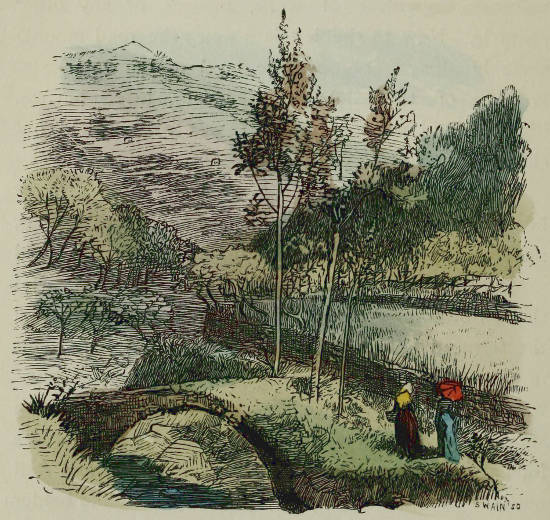
IN THE FIELDS AT SAVIGNONE.
We crossed the bridge—the only stone bridge on the river, that gives its name to a village hard by—and followed the way that steeply climbs the hill for a while until another Campanile is in sight. Ten minutes more of climbing brought us out on to the piazza of Savignone.
I dismissed my friendly peasant guide, who promised me her warmest prayers in exchange for my silver coin, and watching her as she reaped neighbourly greetings from knots of country folk gathered on the piazza for their evening relaxation, I looked around upon the village that was, for a while, to be my home. I stood in a large open square paved with round pebbles; a church was on my right—on either side of which, and forming a quadrangle round about, lay a long, low building, yellow-painted and large-windowed, formerly a hospital, but now the magnifico stabilimento of which I had been told. Here were evidently the remains of an old feudal borough, belonging probably in long-lost times to one of those lords of the marshes so famous in the days of the terrible condottieri. Even through the embellishments of modern stucco one could trace the skeleton of a palace which had seen better usage, in the days when architecture was something more than a name; and besides the palace, hospital, or stabilimento, there were ruins of a castle on a little hill close above, a hill that in the twilight seemed to dwell beneath the shadow of another and rockier mountain.
All around me rose graceful and methodless mountains, with forms that were broken into a wealth of harmonies, and sky-line lying clear-cut and undulating upon the darkening blue. A soft dew fell from out the hot day upon all drooping things, and, as I rested, the sound of rippling water smote on my hearing—of water that, said I, would ripple and murmur just the same to-morrow, when the sun should be burning overhead. ‘Ah, yes, we have many streams here; that is why the doctors have built a Stabilimento Idroterapico,’ was the old contadino’s explanation, to whom I turned now for advice. ‘Your honour will be well there in the Stabilimento; there is true luxury! We have a fair spot at Savignone for anyone to pass the time in, and one does not feel the heat too much—no! And over the gorge of the river is la Valle Calda.’ So I stayed at Savignone; and when the sun’s power had flagged the next day, and dews crept down once more, I went back upon my steps of the first evening—back almost as far as Busalla, that I might learn to know that other gorge, which the old peasant had called la Valle Calda.
Leaving the town of Busalla, my road struck off from the main highway across the Giove, from that highway which was in olden times the traveller’s only route from Turin to Genoa. It is still studded along with many a little wayside inn, now forlorn and impoverished, where carriage-loads of foreigners used to stop in days gone by, while their horses were baiting. These little inns have sunk nowadays to the lower rank of ‘bettole’ or taverns; since the making of the railway they lack the custom which raised them into ‘alberghi,’ and no longer profess to find beds, but only to supply the wayfarer or the waggoner with food and drink. Nevertheless the ‘bettole’ are still distinctive features, and picturesque with a purely Italian picturesqueness.
The branch road up the valley of the Scrivia is not at first sight inviting. Poor and dirty buildings of the town’s outskirts flank its ill-paven and narrow streets, but squalid houses are soon left behind, and the country opens out before and around you. As I have said before, it is a free landscape, even though the hills stand about on every side closing in the valley, and though, looking up toward the farther end of it, you can see that the land grows more mountainous, and that the cones and shoulders of hills seem to lie up more cumbrously against the horizon. But they are not mountains whose peaks tower into the sky, neither are their sides made up of cliffs and dark ravines. They are scarcely perhaps high enough and important enough even to deserve the name of mountains—these slimly moulded and graceful hills, daintily muffled in luxuriant vegetation—excepting that they are so amply cultivated where the chestnut woods are not, that something of their height is lost, perhaps, because their nature is so like the nature of the plains; the plains, that are no more than narrow little strips of level land from which cultivation creeps up the steep slopes; for patches of corn-field, of maize and potato crops, intersected with vineyards and trellises, find room on many a tiny ledge or terrace of earth till the whole land wears a look of careful plenty.
Even the timber vegetation of the country has a sort of prodigality in its beauty, which seems to tell how the broad-leaved chestnut trees are not only fair to behold but also bountiful in service. They wear a promise of warmer tones now over their brilliant summer colouring, for the autumn has just begun to shed a new influence abroad, and faintly golden tints speak of the fruit-time of the year, after the sunnier time of flowers and scents is over. The whole land has a flush of this new promise. Harvest is over, and the corn-fields are laid bare, yet there is a golden burnished hue upon the ground where the yellow stubble is left upon the yellow clay soil. The vintage is not yet gathered in, so that the vines have lost none of their beauty, but that rather the cool purple-red of their luscious fruit-clusters, near to that other warmer red which is faint as yet upon the gracefully-turning tendrils and broad leaves of their foliage, serves to help the warm painting of the whole. As far as the eye can see, gold and green mingle in subtle harmony. A faintest fancy of coming gold in the chestnut woods, the steadier gold and yet pale of the cropped fields, the gold that almost deepens into brown where patches of ploughed land lie here and there upon the hillsides and in the valley, and through the whole the golden-winding thread of the river.
This is the valley of the Scrivia, from whose main course that side gorge creeps up, among the mountains, to the village of Savignone and the feudal castle. At its foot a mountain stands sentinel to all the little quiet and cosy villages within the precinct below—a tall mountain, uprising many hundreds of feet in one solid mass, but indented with many clefts and water-courses, and cut at its summit into many sharp peaks, each different in shape and in size, and all lying clear and fine against the sky. Here the river winds in closer coils, and its rough bed spreads across the valley; for soon the water gathers itself together, since it is somewhere in the fissures of Monte Baneo or her range that the Scrivia has its birth. At the foot of the sentinel mountain you may see a little white town lodged—and this is the town, more properly called the village, of Casella.
All this you will have seen on before you and beside you as you walked up along the stony road from Busalla. The stream has been flowing at your left, and on your right were chestnut woods growing up into the hills, and turf and moss that spread beneath them, and little hamlets dotting the wayside, and blackberry hedges by the road. Many little torrents bubble across the footpath—streams that must be crossed on the roughest of stepping-stones, for only the village called ‘Ponte di Savignone’ boasts a stone bridge across the river for those who are bound for the Baths, and here are houses gathered on either side of the bridge, finer looking than the smoke-coloured and thatched cottages. From this point the main road of the Scrivia valley runs on the farther side of the water.
But I, in my evening ramble, was not bound for the high road nor for the town of Casella, that lies at the valley’s foot. The old contadino had spoken of the mountain’s eastern side, when he had pointed across the gorge to the slopes lying opposite, and he had spoken of it as la Valle Calda. I did not therefore cross the stone bridge again, but holding to the right, went in search of this new valley. No carriage—not even the brave one offered to my notice the evening before at Busalla—could have held its way upon this road, for the stones lay looser and larger than ever upon it, and, as it went farther into the hills, it narrowed, and grew more and more uneven. Monte Baneo still stood up before me with the valley and the river at its feet, and to westward the slopes of Antola. Little cottages began to appear in clusters upon meadows and peeping from among woods; blue smoke curled into the air from dells and copses, showing where other human habitations lay hid; then the Campanile came to sight. It stood close against the hill, and as I came nearer the bells began gently to chime with gladsome rhythm for the morrow’s feast of Saint or Virgin.
This was La Valle Calda; and as I stood gazing on the soft and quiet scene there came an old woman along the road who went across the mountains weekly with new-laid eggs to sell, and she, greeting me friendly, as all these peasants do, told me many things of the country and of the neighbours, and commending me heartily for my genuine admiration of this valley of her home, she bade me turn my walk once more to the right till I should reach a village called, she said, La Madonna della Vittoria, for there should I behold a view worth the seeing indeed!
So towards the east I turned again, and climbed my way into the chestnut woods. I left the river behind that had been flowing on my left through green meadows as I walked from Ponte towards the chief village of La Valle Calda. I left even this semblance of a high road, running parallel with the real high road on the stream’s opposite shore which had seemed so close in the summer air that I had heard the laughter of the vetturino as he drove his infirm vehicle, and chattered with his passengers, or urged his horse by loud vociferations.
My new way was nothing but a mountain path, and a steep one—for La Madonna della Vittoria stands on a hill. The foot-track winds up between chestnut groves, rising higher and higher above the banks of a mountain torrent that in autumn and winter time is turbulent in its downward rush to the river. Now and again little hamlets appear, whose houses are ranged and huddled on both sides of the path; the road grows steeper, and the sides of the ravine, in whose deep the torrent gurgles, are rough and jagged as you look down upon them. In this side valley the country is wilder and more bleak, for there is less room for cultivation. The path creeps round an angle of the hill, and the long ridge is in sight, where La Madonna della Vittoria stands between two heads of the mountain. The place takes its name from a little oratory, sacred to the Virgin of that title. People come hither in pilgrimage from the parish church; and in times of blight or of pestilence, of rains or of long drought, processions are frequent. The chapel is beyond the village, a little farther up on the hill. If you mount the street and the flight of stone steps that is at the end of the village, you will come upon the little mound on which stands the oratory. The piazza is a paved enclosure with a low stone wall and a stone bench that runs round hemming it in. There are acacia trees and cypresses against the church, and upon its front a worn and faded image of the Madonna, with sceptre and crown and glory, stands where it has stood for many a year within shallow niche to receive the winds and the rain and the people’s obeisance.
A sharp air blows of an evening around this little piazza upon the hill, a breeze that is keen to refresh and yet soft enough to soothe. Sitting upon the little low wall, it blows around, while your looks stray over the goodly country spread out beneath and about you. Ranges upon ranges of hills set a girdle on every side. But they are not hills that tell of a mountainous land far ahead, as do the hills of Savignone. There is a vague sense of space and freedom here, for we have turned our faces back again towards the sea. The distance that your eye can scan seems measureless: hills as far as you can see—tier rising behind tier, the higher peaks standing forward and the lower ones peering forth, as it were, from betwixt their shoulders; hills on every side, but hills whose outlines sink and grow dim in the filmier light as they near the sea far away. At first the mountains seem so thickly wedged upon the soil that no room can remain for places of human habitation; but as you gaze, you see how the rivers flow down from them, growing wider in their course, and with space for towns upon the banks. Far out ahead, where the blue air grows paler, the dim sky sinks down into a silvery line, that is the Mediterranean. And, perhaps, if the sunset has been clear, and if the vapours have not arisen to muffle it, you may see in the vague distance other things that are dim, yet more solid in their dimness, and these are the islands of the sea; and further up, beyond the sky-line, forms of dazzling whiteness, and these are peaks of the Maritime Alps; while below, in the nearest valley, the town of Ponte Decimo gleams out in the last of the sunlight, and La Madonna della Vittoria looks down upon it all.
The old pedona had been right when she told me it was worth while to climb the hill for the sake of the view at its top. I sat a while on the wall of the little piazza watching the evening vapours creep down from the mountains, and feeling their breath on my cheek. Women with children clinging to their skirts, and small, swaddled babies in their arms, came to make their evening prayer in the sanctuary—to have their evening gossip in its porch. They greeted me with courteous grace, and one of them talked long with me, telling me of the neighbourhood and of its people—rambling on with stories of her own and of many other villages. They have the true grace of perfect unconsciousness, the dwellers in these little Apennine homes, and have no conventionalities, since each acts upon the moment’s impulse that he may enjoy life to the full. I call them all to mind, those simple friends of a time long past, and, as I think of them, I think of summer days when breezes moved silently amid leaves, and the air was white with heat as it lay clear above the tender green of chestnut trees.
I think of little rough and quaint villages that are the homes of these my friends, and, best of all, I remember one village that stands beneath the crest of a hill, with shady woods and orchards to girdle it about. Another hill lies over against it, whose graceful form I seem to see as I write—soft shapes, yet varied that rest upon the sky, subtle waves and indentations of earth, with which play the lights and shades of the daylight. It is that village of La Valle Calda, towards which I turned my steps again after I had looked on the fair scene from La Vittoria’s hill. A church stands for centre to the parish—that church with tall campanile and blue-painted belfry—and, beside the church, an oratory, where the memory of some special saint is sacred; but the parish itself is scattered far and wide through copse and over meadow, in hamlets that stand beside streams or on hill-tops.
The steeple is nevertheless, here as elsewhere, the beacon that can gather all neighbours together, and beneath it is a piazza with stone benches around, where at Ave Maria my memory confidently returns to recall each one of those faces seen long ago. I know I shall find them there, for I know they must have a goodly portion of gossip and loitering, and am fain indeed to confess that if foreign sayings about Italian impetuosity, and easily moved Italian feelings, have been often exaggerated, these Apennine country people are, on the other hand, no taciturn race. They are cunning to mould to their use the lithe tongue of their land, to adorn it with expletives, and to point it with gesticulation; and it is even this habit of noisy vociferation which has perhaps won them abroad the character—so little deserved—for curbless passions and vindictively cruel propensities. For they are a kindly people in their mutual relations, and formed by their very nature for warm, social life, since they need a free neighbourly intercourse, such as quiet and colder temperaments can scarcely understand.
Hence it is that the life of an Italian community, unlike the comparatively secretive life of northern lands, is to be learned in its open thoroughfares rather than its individual homes, and that we must seek on cottage door-steps, in market-places and piazzas, where men and women mix freely together, the true colour of the Italian people.
At the Chestnut Harvest.
As October days draw nigh to their end there is festival in the cottages of North Italy. Walking at evening among her mountains and passing through her homely villages, a red light of wood fire comes streaming upon you from open cabin doors and from between the chinks of clumsy window-shutters, and noisy sounds of revelry fall around. For this is the season when the chestnuts are ripe, and the peasants are making merry by dark, for the work they have had during the hours of day, and they are glad for that harvest which is to them the most bounteous of the year.
In autumn, thunder-storms lower in the Apennine valleys. Torrents grow turbulent, hurling themselves in foam from the hills around, and rivers that, in the long drought, have grown meagre, swell rapidly to great size, fed by rains amid the mountains and by the hundred little streamlets and torrents that cast themselves noisily down ravines. The river-beds are wide—so wide that in summer their barren expanse of shingle looks ill amid the green land—yet now there is often no room within them for the mass of moving water. It overflows the banks and swamps the near-lying cultivation, till the maize plantations lie dashed and the meadows are soft, like bogs. It carries away the little temporary bridges which, spring after spring, are newly set across the streams; scarcely can it flow, sometimes, beneath the arches of more stable bridges that, here and there, are built for greater security; it damages the weirs, and brooks no obstacle in its way, flowing swiftly—a great muddy, turbid stream, that bears upon its breast the trunks or the branches of trees and many other spoils from off the banks. And year after year the people know that this may all happen, yet year after year they take no precautions to shield themselves from evil; they build up no embankments, turn aside the course of no injurious waters, only, laughing they say, or sighing, ‘It is time that the great waters descend.’
And during the present month they are almost sure to descend, once, at least, with all their power of devastation, for the best of the sunshine has taken its leave of the land by the end of October. Down in the more level parts of the valleys, where the meadows lie, little cottages look out ruefully from amid the dripping walnuts, their thatched roofs damp and glistening in the wet; and higher up, among the chestnut woods, sad leaves lie damp upon the ground, where the mossy turf is so moist, that mushrooms are spoiled ere they be grown. The country looks tenderly forlorn, that was so gay with its vintage in September. Trees shed their foliage early in chestnut-wooded districts, and already tints have little left that is freshly green, but leaves are yellow upon boughs, and scattered day by day more thickly to earth. There is no hot sunshine, no blue light that is misty with heat; yet the valleys can still smile in their soberer mood when chance and glorious sunbeams strike across the land, or when the rain ceases and bright days come back, here and there, with warmer breezes. Swollen rivers abate if the deluge cease only for a day, and as you walk upon their banks the waters are limpid again, yet green from their depth with an intenser colour.
And wandering beneath the chestnuts, no sense of damp or dreariness oppresses now that sunshine is abroad once more, for yellow-tinted leaves wave brightly overhead, and yellower leaves, that are scattered, rustle pleasantly beneath your feet, while now and again a quick sound breaks the stillness, and that is the fall of the fruit. Since the middle of October you might have heard it when you were in the woods, for the chestnuts began to ripen at that time and the brown-burnished fruit to peep from out its prickly shell. But scarcely before the end of the month does the chestnut harvest begin in earnest in the Apennines. There are divers kinds of chestnuts, and the gathering of each dates properly from a different day: the so-called ‘timely chestnuts,’ that ripen before the commoner sorts—but this variety is rarer and the fruit finer than that of others—the late chestnuts, such as, of their own accord, do not fall sometimes till November—though these trees are often thrashed during the general harvest for the greater convenience of the gatherers.
Companies of women and girls greet you now upon your walks. They have little bags of sackcloth slung around their waists, and rough wooden tweezers in their hands, with which they open the spiked husks, where the fruit lies yet in its green case. They are merry; they laugh and talk, their shrill Italian voices sounding shriller to English ears in the harsh Genoese dialect. It is a season of festivity. The festa of the ‘Santi’ has but lately passed, and there is much interchange of colloquial news and much surmising on parish matters, with a little gossip and neighbourly scandal mixed therewith.
The ‘Santi’ is the last great feast of the year until Christmas be come, and it is treated with much solemnity throughout the whole of Italy. The ‘Giorno dei Morti’ is likewise a great day among the people, but then the pageant is one of mourning and of woe. Black garments are donned by those who have lost friends during the year, and little charms and candles are sold throughout the streets of the towns, with black and yellow garlands of everlastings, with which people are wont to adorn the graves. Yet there always seems to be as much excitement around this day as any other. Southern feelings love so dearly to be moved, that apparently it matters little whether it be to joy or to grief.
However, this great homage to the day of the dead seems to be confined more to the cities, and beneath the chestnuts, where our people are gathering up the harvest, there is little talk of sadness. Here a man has come to the aid of the girls, and has climbed to the top of a huge tree, that he may the better thrash down the fruit. It falls in prickly showers upon the crackling dead leaves below, but the women seem little to fear any hurt from thorns, for they tread boldly amid the heap, often with bare feet, and take the harsh shells within their hands to open them. All day the people are at work. They are almost all women at this task, for the men are labouring in the fields. Some few of them return home at midday to cook and to carry the dinner for brothers and husbands without, but most of them remain in the woods till dusk, and eat their cold ‘polenta’ at midday, resting upon the banks. Towards dark the great baskets are piled up that have been filled all day from each woman’s sack, and then the girls lift them upon their heads or their shoulders, and pick their way deftly along the stony paths with the burthens. Sometimes the loads are too heavy and must be left for the men, but this does not often happen, for these peasant women are strong, with a beautiful ease of strength, and proud of their power.
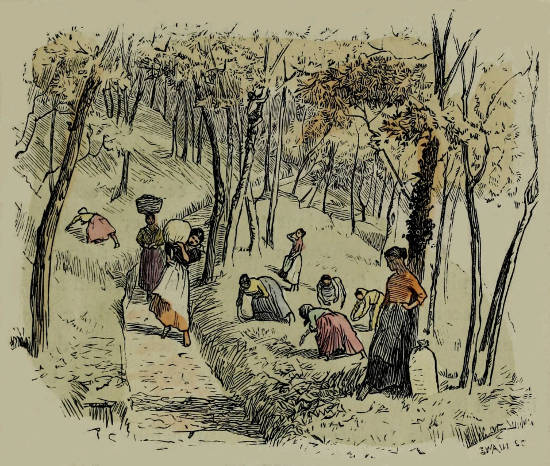
GATHERING THE CHESTNUTS.
So, whether the day has been dark and cheerless, or whether the kind autumn sunshine has been there to brighten up all anew into a beauty more beautiful than summer-time, the women have been at work in the woods, and now the recreation hour has come. Within cottages great fires are lit upon hearths that are in the chamber’s midst, and the pot is put on to boil; rough wooden benches are drawn around, and men and women meet after their labour to commemorate, with fun and jollity, the first of the chestnuts. Upon each successive evening they meet in different cottages according to the help they have lent to one another during the day; land is not rented in the Apennines, neither do the people labour for pay, but each has his small homestead according to his wealth, and cultivates the ground himself, men and women helping their neighbours during every pressing season, as they themselves expect to be helped in turn.
When the ‘minestra’ has been eaten, or the ‘polenta’ then the pot is taken off, with the great chain from whence it hung, and the ‘padella’ is brought forth, upon which chestnuts are to be roasted. The red wood fire flares and flickers upon the hearth amid its heap of embers, throwing fitful dashes of light upon faces around—copper vessels and platters make sudden gleam upon dingy walls. Again the bold flames die away, and there is only a lurid mass of cinders, and then the women toss chestnuts in the pan and the men slit the brown hide of other chestnuts that are yet unroasted, and they all chatter and gesticulate the while in a fashion so quick and eager and with voices so high and thrilling, that foreign ears, to whom the shrill dialect is unknown, might fairly hear therein the words of an angry quarrel.
And sometimes there are quarrels even at these scenes of merriment. Italian natures are hot, and Italian women are jealous, besides being coquettes too, in their way, with often prudent or mercenary considerations, so that wrangles come and altercations; but they make it up again most times, and do not seem to break their hearts.
The women are not, as a rule, beautiful hereabouts. They are superbly built and powerful, with graceful movements, but their faces belong to a heavy-featured type that lacks much in delicacy of form, even though the ruddy pallor of colouring might atone for many deficiencies. The splendour of dark eyes can sometimes scarcely kindle them into real brilliancy, nevertheless these women have their lives to live and their wars to wage, and they bear the tokens, in themselves beautiful, of toil and the labour of living.
The chestnut harvest lasts some three weeks or more, and, when the fruit is all gathered in, it is spread above the open rafters that form the roof of every kitchen in these Italian cottages—there to be dried during winter by the fire’s heat from below. And when the chestnuts are dried, and the outer skin has been cracked off by the heat, then they are ground in a mill, so that the flour goes to make bread and cakes and porridge during the barren season, when there is little fresh food to be got by the poor. The dried chestnuts are boiled whole likewise, and in one form or another the common production of the woods provides nourishment, during this time, for all the peasants throughout the land.
Under the Cherry Trees. The Bridal.
Summer sunshine lies gladly upon the green hill-sides of la Valle Calda. It moves in broken light over the warm green of broad-leaved chestnut trees that daintily sweep the turf with their branches, it quivers across the stream’s passing wave, or rests in a sheet of silver upon the still pools of the slowly flowing river. Flowers bloom gayer and breathe forth a stronger scent for its goodly radiance, summer fruits ripen the sooner. For these are June days, that I call to mind, as I think of la Valle Calda, that fairest of North Apennine valleys, and the wild cherries are ripe upon the land, the lads and the maidens are merry, for to-morrow is the Feast of St. John and the bridal day of Caterina Ponte.
In the hamlets around, excitement has waxed high these many days past. St. John is the patron saint of this little church that stands so simply beside the green background of the richly-wooded mountain, with belfry tower whose top seems almost to lie against the far horizon clouds. St. John is the saint to whom most honour is due from the dwellers in this particular parish. There will be a procession to-morrow, and that would be grave enough matter, even without the wedding of the prettiest girl in our village.
Down by the river’s brink, where the tall cherry trees grow whose large black fruit will not be ripe yet awhile, the morrow’s bride has had her home these twenty years long. Her cottage roof is thatched and moss-grown, as the roofs of all the other cottages that are here gathered together into a hamlet—one of the many hamlets that go to make up the parish.
The father’s homestead, where Caterina has lived away her life till to-day, is nothing but a low, one-storeyed house, that has no chimney to its roof and no glass to its windows, blackened around where the smoke has made its way; there are rough wooden shutters to keep out the night air and the coldest of winter blasts, but, in these happy dog-days, is no need to fear the fresh breath of the outside breezes, and, upon the sills, carnations bloom in pots, with marjoram and rosemary for the soup-flavouring, and marsh-mallow for the healing of hurts. The stone steps are uneven that lead to the threshold; the kitchen is dark, above the loose rafters of which chestnuts lie all winter time to dry with the heat of the fire below; a great black pot is hanging now over the red embers on the square centre-hearth, and Caterina knows every dint in those bright copper vessels that gladden the gloomy walls—every sunken brick in the floor. No wonder she sorrows a little to leave the hard bench where she has sat so often to fan the flame or—one among many—to roast chestnuts of an autumn evening; no wonder she drops a passing regret to the broken stone balcony without the door, where ofttimes she has stood gossiping with neighbours beneath the trellised vine or has listened to the ready vows of village swains! Though she be going to a better cottage, where there are windows and even a chimney, Caterina can still be sorry to leave the yellow gourd flowers that trail across the ground in the garden of her girlhood, will still perchance miss awhile the Michaelmas daisies, the sunflowers, the tomatoes, and even her own pet fruit-orchard stretching across green grass towards the river. But though she sigh a furtive sigh for all this, the vows of the one particular swain have been heard and registered now, so there must be a good-bye for ever to anything the others might have had to say, and this must be the last day even for the gossip of a maiden.
Where the land leaves the river-side and swells up into hills, wild cherries grow better than in low-lying orchards, and it is the wild cherries that are ripe for the feast of St. John; so that now, while it is yet daytime, girls of the village are still plucking the fruit, up among those further plantations, nor will be down till dark for the last chat beneath the vine of Caterina’s maiden home.
The trees are small and slender trees whereon grow the amarene, bitter wild cherries of our country, and it needs but the deftness of a light-footed mountain girl quickly to climb them, while the strength of some other tall Apennine maiden can boldly reach down branches with long arm and lithe figure, cruelly to strip them of the glistening, ruddy fruit.
Margaret and Virginia, Paula and Bianca are there at work, and they are favourite friends of the bride, and will hold a good place in the morrow’s ceremonies. ‘Yes, yes, he is rich, I tell you; she will be married in no dress of homespun! The stuff is to be of real wool! You will see!’ says one. ‘What luck, and she the poorest of us all,’ sighs another damsel for reply, and breaks the full-laden bough of a low little tree as she speaks. ‘But I grudge her no good fortune. Our turn will come, girls, and meanwhile who can put the garlic so justly into the pot, who can knead the maize so smoothly or the dough for household bread, who can mend a man’s suit or iron his shirt better than Caterina of the Walnut Cottage?’ The bride’s old home is thus named in the parish because of the fine nut trees that grow beside and around it. ‘See the fine cherry bough,’ pursues this last speaker; ‘she shall have it for gift in sign of prosperity.’ The luscious, bright fruit hangs in richest clusters from this slender stem; such tender stalks seem scarce able to uphold the heavy knots. Beside the crimson berries grow tufts of pale leaves, the same leaves that a moment before have had the soft blue sky behind their young green for background and the summer sunlight shining through them. ‘Truly it is pretty!’ say the girls in chorus, and then they all agree that Caterina has deserved so fortunate a fate as that which will be hers to-morrow ere noon, and they slake their thirst with the tart cherry-juice, the while they pile baskets with the spoil, and weary their lungs with talk and laughter, if not their limbs with toil.
So do evening shadows begin to creep over the soft slopes of those tender-carven hills, begin to lie darkly in their ravines; and when the ebbing sunlight is near to leaving the frail outlines alone upon the sky, then the bells of St. John’s strike their gladsome chime, for to-morrow is the day of the patron saint. It is the girls’ token that the day is done, and each lifts a basket to the head of a comrade ere, with firm step—the step that comes easy to women of such strong and graceful figure—they descend the mountain path towards home and a gossip with the bride. And all the while the bells are ringing so noisily, so wildly hurrying in merriest triplets, so loudly pealing with deep bass voice now and then, that even Virginia’s clear tones, and the chatter of other three good lungs besides, can scarce make themselves heard above the din.
If yesterday was a happy day when things were bright and hearts were glad, to-day is better a thousand times, with sun that is hotter and land that lies fairer before the eyes: so thinks the bride, and so think those four girls who are the bride’s friends. Many a little half-hour went by last night while these five told old tales and fancied new wonders, as they sat on the old wall beneath the vine, in the growing summer darkness. The wedding gown was handled and criticised, so were the wedding garments and the bride’s little dowry of household linen, that she and her mother and her mother’s sister had been spinning and weaving on the rough handloom these many months past. So was that fine young man criticised—the betrothed—who had been able to furnish his house so suitably, and had given the bridal gold of such massive weight and fine workmanship!
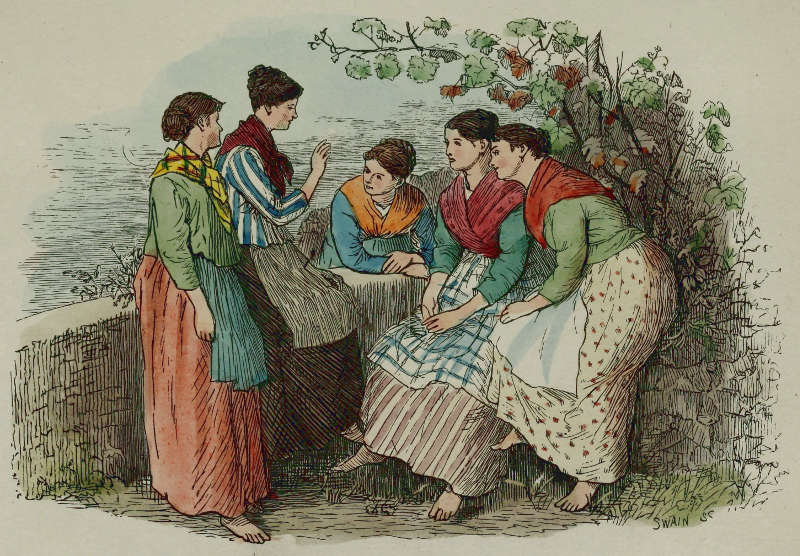
Gossip.
These five told old tales and fancied new wonders, as they sat on the old wall beneath the vine, in the growing summer darkness.
But past discussions, past surmises are all over now: the wedding morning is here. Upon the hedgerows that hem the path all the way from this river-side hamlet to the church, there has glossy homespun linen been hung in long lengths for adornment, with red and yellow church properties between, that have belonged to the vestry for processions these twenty years. This is all for St. John’s Day, and so are the flower-heads of gorse and poppy that strew the ground, the fresh-plucked posies in the little shrine on the bridge. But Caterina gets the benefit of it all notwithstanding.
The marriage is to be at eleven. It will not be in the church, but when the ring has wedded bride and bridegroom, and the sacred words that bind them have been spoken by the priest in the priest’s own house, then Caterina and her husband will come before the great altar for benediction, and that is the only part of a wedding which the congregation may see in Italy. The villagers are nevertheless assembled on the piazza just in front of the church, that they may see the bridal pass, because the priest’s house is just behind the church, and even Caterina, in all her glory, must pass under the arch of the belfry, and up between the two trimmed box-hedges to-day, just as she has passed up many a time before with the tithes in kind or the priest’s best linen from the wash.
All the village children cry aloud, for the bride is in sight. ‘See! the dress is really of woollen stuff,’ whisper the women, and the men make comment on her comely person, for truly Caterina is a pretty girl. Her white stockings and clean bright shoes are neat (small are the dainty feet they clothe, say the village swains); her dress is costly for a peasant bride, the gold about her neck—gold that is no vanity here, because it is the bride’s invariable marriage portion—the gold in her ears and hair is of good quality, the muslin veil is fresh and fine, that drapes head and figure, after her country’s costume; but best of all is Caterina’s proud and merry face, best are her deep, brown eyes, her strong, lithe frame, and the healthy blood that flows beneath her olive skin. Caterina is a handsome girl, but, more precious in the sight of her bridegroom, she is a sound woman, fit to be a peasant’s wife.
Laughing—half with shyness, half with pleasure—the bride and the bride’s mother pass first through the little archway: the wedding party follows after. In the kitchen of the priest’s house—which is the entrance to his oratory and to all the rest of his abode—more admiration, more talk and wonderment from the old housekeeper, delay the couple awhile on their road. Caterina must be examined from top to toe while the men stand impatient at such female frivolity, and the guests are gathered, waiting, beneath the wide-spreading vine-trellis of the priest’s garden, or beside the trickling fountain in its midst. Everybody is glad when the ring has been put on—(Caterina has already twenty-three gold rings on different fingers, all part of her only dowry)—everybody sighs a little sigh of relief when the last Latin words have been spoken, of that ceremony which is about the same in all lands and in all religions. Nothing of importance occurs—only once a candle on the altar goes out unaccountably, and Caterina is frightened at the evil omen—a woman and an Italian peasant, she must needs be superstitious! But all the same, it serves for conversation at the wedding feast. The priest has had his comfit-box with the gold coins hidden within it; the old housekeeper has not been forgotten, since this bridegroom is not of the poorest; the wedding party descend into the church.
And, when the exhortations are said and the benediction has been given, Caterina is quite a married woman. The neighbours may have their fill of comment and admiration now, and the children their portion of comfits which Caterina scatters among them. Good words and bad words—ejaculations and laughter—fly to and fro, and resound under the trees of the cherry orchard, where they eat the marriage feast. Everybody is contented. Even the girls who have no husbands, and the fathers who have more mouths to feed than money withal to feed them, are glad to-day; for the sun shines and the harvests are all yet to come, and the winter is a long way off, and the bells ring merrily, for it is the Feast of St. John. And when they have done ringing for morning ceremonies and the marriage, they begin again for afternoon ceremonies and the procession. There, Caterina walks with her husband, and sees Bianca in her own old place, carrying the great cross in front. The pop-guns are fired, the procession has been round the meadows by the well, and is near home again. And the bells’ ringing dies away slowly, as banners and crosses are lowered beneath the porch. The lads and lasses have their simple dance on the green by the river, and the day of St. John sinks away into night.
Cherry trees still bloom and bear fruit in that North Apennine valley. Walking in and out amid the little frail trees, brushing the quaker’s grass and ragged robin, and treading down the buttercups and daisies, you might look up to see the ripe and ruddy fruit overhead, and listening, hear just such joyous voices as I have written of—voices of laughing maidens stripping the orchards’ cherry-trees. But Caterina would not be there, nor Virginia nor Bianca, nor any of the girls that I know, even though upon the stillness of the waning day there might come to you a sound of bells—joyful pealing bells—such as those that ring in the Feast of St. John.
The Parish Priest.
It is the day of the Corpus Domini. As though to herald in the sun, bells began to ring this morning from every church throughout the valley. For this is a great feast. It does not belong more to San Matteo than to San Luca, nor can even la Madonna claim it for a special honour: it is the property of every village, of every saint, and of every parish. That little church niched in among the chestnuts has, therefore, just as good a right to sound her peal in the grey hours of the morning as has any other campanile throughout this valley of the Northern Apennines. We are among the mountains of the Polcevera—in one of the numerous indentures of the land, scarcely large enough to deserve a more important name, which serve to vary and make more beautiful this already richly gifted portion of the country.
Twenty miles away from us is the Mediterranean, and on the other side of us lie the plains of Lombardy, white with the sun’s heat as it rests on the rice plantations. But here there is not even a remembrance either of plains or of sea. We are in the depth of the country, where the view has no monotony as of the flat, or even as of the sea, when it is unruffled by wind, and dazzling beneath the sun’s power of this summer time. The horizon’s margin is broken by the outline—now gently undulating, now jagged—of hills against a limpid sky; the foreground is varied—hill and dale, rugged wildness and careful cultivation, subtly balancing each other as separate effects in the landscape’s picture.
The scenery is characteristic of the Northern Apennines: a river gently flowing, and many a little quiet spring, thickly-growing chestnut woods—where the trees are not always tall and spreading, but somehow always shady—mossy banks that are green for Italy, and the land divided into plots and terraces, where each man grows his own corn and beans and potato-crops, gathers his own maize, and trains his own vines. The strawberries are nearly over—little rough, red fruit, that grows wild and luscious among the grass and the turf in the spring-time: but the glory of the fruit season is all to come. Large yellow plums and little blue plums, peaches and apricots, medlars, figs, grapes, melons, blackberries that are as large as mulberries, all these will follow one another in time, and great handsome golden gourds, with every kind of vegetable: now it is the season of the cherries. There are tall trees whereon the fruit grows small and jet black, and others whose berries are large, and sweet according to the usual shape and savour of their kind; but the type of the Apennines at this season is the amarena. The little trees are small and graceful, growing over the hill-side, often so low that the fruit can be plucked by the mere outstretching of a strong arm from the strong and graceful figure of an Apennine damsel. The amarene are ripe for the Corpus Domini, and the bright red fruit, with the merriment of its ingathering, makes the brightest of all the bright colours in memory’s picture of these festivals of summer’s prime.
The long grass is not all yet mown, and among it the ragged robin, the buttercup, scabius, and ox-eyed daisy have woven a medley of merry colour; while, upon the river’s banks, meadow-sweet blooms, and higher up among the budding heather a golden field of yellow gorse. This forms the floral feature of the festivities. Yesternight, in the long June evening, after work was done, girls and boys wandered up the hill-sides, and, in their aprons, the maidens stored the golden bloomlike chaff. Then, when the bells awoke this morning at daybreak, the women rose to spread, along the highway before their dwellings, yards and yards of newly-bleached linen, spun with their own hands, and woven on the homely looms—a snow-white carpet on which to strew the gay blossoms. Upon the hedges, and hanging from the windows of the little cottages, bright crimson draperies and curious heirlooms are not wanting to honour the way where the sacred procession is to pass. Merrily the bells jangle—trills and triplets up and down—with the deep-toned first bell tumbling in now and then as bass, to add the necessary touch of solemnity. The ringers have been at work for hours. The first mass has been sung, and the second will soon be coming on, but the procession will not be till after vespers. The parroco (or parish priest) stands on the piazza in black gown and biretta. He has said his say in church, and has no further work till afternoon: he is a peasant again, among his peasant flock, as he is on week-days, with only the faint halo of skirts and head-gear to keep him from his pipe and the broadest of his jests.
‘His reverence will walk himself in procession this afternoon?’ asks a lean peasant.
‘Surely, yes,’ replies the priest. ‘I would not if I could help myself, but the parish is not content unless I go through the farce myself for them. The Virgin grant a breeze, or we shall die of heat under the panoply, with the chin buried in devotion!’
‘Truly!’ laughs another peasant, a pipe in his mouth. ‘It’s poor work being a priest. And a fine sermon it was you preached, though! I wasn’t in church myself, not longer than for my duty at the right minute, but my wife told me! A woman’s not to steal excepting her husband’s drunk, and then it’s her duty to take the gains from his pocket for the household’s benefit. Sound religion! But the women aren’t always to be trusted!’
‘No, no; we preach these things, but you do as best you can. There’s no telling how things’ll turn out. Now, there’s myself even. Preach toleration in church, but, Corpo di Bacco, wouldn’t I have boxed Luigina’s ears, as soon as I was out, if she’d have let me!’ Luigina is the priest’s cousin—a lady of portly frame and of years that waver ’twixt forty-five and fifty. She lives in two brick-floored rooms on the top storey of the parsonage, lives and dresses like a peasant woman, and would fain have more to do with the priest’s household than his old servant permits.
‘Signora Luigina’s no fool,’ laughs the first man; ‘and she’s been a companion to you, your reverence.’
‘Yes—by the Virgin—thirteen years, more is the pity! I’d bury her for nothing, poor soul, and shed a good tear afterwards; but she spoilt those mushrooms all the same, that she cooked me to-day as a favour! Let the oil get outside them, would you believe!’
‘San Pietro—that was enough to drive a saint to swear, much sooner a priest; and they say she leads you a life as bad as Caterina does. But what can a man expect when he keeps women in his house that are not tied by the hand of the law?’
‘What can I do?’ objects the priest, laughing, and nothing depressed! ‘One had to choose a profession. Caterina’s a good servant, and Luigina is as good as most women when she doesn’t force me to a clean shirt. There she is. You there! Have you picked me out those two clean girls to scatter the flowers before the priest’s face in the procession?’
‘I know none so good as myself in the village,’ answers the woman, laughing. ‘Though it’s odd I should scatter flowers before your face—only you’re not the same man, and that’s of course, when once you’re under the banner of the Lord!’
‘What, and do you think He’d put up with an ugly old scarecrow like you! Go to. I’ll find out the girls for myself.’
‘Santa Madonna! And you’re right,’ says the woman, looking round and laughing. ‘So much the better for me! I must see to my own minestra. I’m not going to eat beans half-cooked, that Nicoletta has put to boil in cold water, so that the Lord’s own mercy wouldn’t soften them—nor cabbage either, that’s not had a scrap of the vice cut out of it! Andiamo, let me be quiet! Vossignoria might be ashamed to be so light-minded at his age!’ A laugh greets the two from around, for the Vicar, forgetful of dignity, has thought fit to inflict summary punishment on the portly shoulders of Luigina, to whom the diminutive scarcely applies! But the joke is hurriedly thrust aside as the little bell sounds from within the church, which quickly brings the people, priest and peasants alike, to their knees.
The act of devotion is no long penance—it is over almost as soon as begun, and, from the building, the congregation now pours out upon the piazza, mixing with the set of earlier worshippers, and entering busily with them into the pleasures of the present, and the business of before and after as well.
The Corpus Domini is over. The Virgin’s statue has been carried in state—hideously painted effigy with her gorgeous and silver trappings—the priest has muttered his say beneath the panoply, walking in the slow pace of the procession, and swearing fitly afterwards at the cruel infliction; the girls and the young men have vied with one another for who should carry crosses, and banners, and candles; the children have shouted, the bells have jangled, and the pop-guns been fired. Now the gorse blossoms are trampled and withered, and the linen has been gathered up. Girls are weaving new linen at the loom, and women bleaching it on the river’s shingle. The Signor Prevosto is himself again and has ceased to lament the fearful consumption of beans and pumpkins—no lavish hospitality will be dealt out from the parsonage yet awhile!
Good-bye vain and yet so dearly-prized rejoicings! Good-bye, till next week! The priest works in his garden. His spare form needs no longer be hampered with black gown; his movements have their freedom in the most threadbare of frock-coats, and his eyes may be comfortably shaded by the useful brim of an old straw hat. And the priest’s housekeeper shreds peas on the porch step, and scolds neighbours who are remiss in the payment of tithes in kind, or who would presume too far on the generosity of the Parroco’s garden. He is happy tilling his ground, watering the choicer of his vegetables, pruning his fruit trees, training his vines, and blowing upon them through bellows the sulphur which is to save them from the fell disease.
Now a girl comes to ask his advice on the acceptance of a suitor.
‘Marry him, and he has been fitly presented to you by a third party, my child. A damsel must let no man seek her himself,’ says the old man, as he hammers at the rotten wood of his pergola, or digs trenches about his maize.
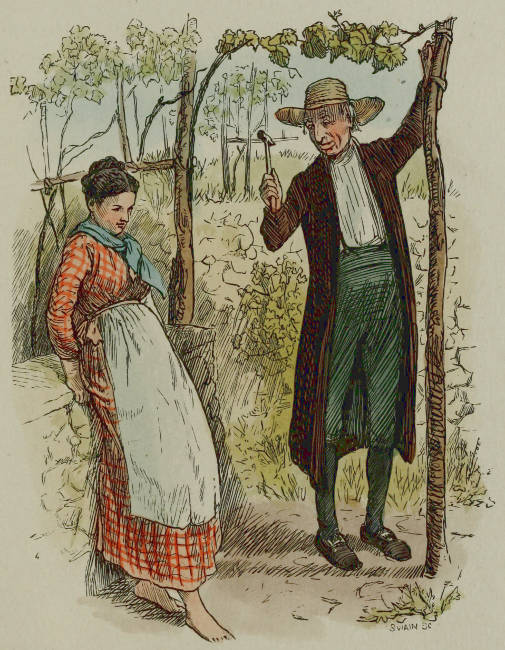
The Parish Priest.
“A damsel must let no man seek her himself,” says the old man, as he hammers at the rotten wood of his pergola.
A neighbouring contadino turns up next, to bargain for the sale of a calf. Here the Prevosto is all alert. His thoughts would be distracted by gardening. The affair must be concluded over a bottle of sour Monferrato.
‘Two marenghi—why, you take me for a fool! I will give you one, and pay you for ten francs with a portion of the hay from the field of the marshes!’
‘Per Bacco! But I also am no sucking child! The hay is all rotten. No—a marengo and fifteen francs on this table, as the Madonna hears me swear it.’
The bargain is made, the old Parroco has none the worst of it, and the maid, or rather the mistress, Caterina, announces, ‘Here is the wife of squinting Giacomo, who bids you quickly to the cottage of Maddalena of the cherry orchard!’
‘I come—I come quickly; but why the woman should have owed me such a grudge as to die when the polenta is cooked and I faint from hunger! These peasants are uneducated!’ And he hurries to shrive the departing soul—none the less tender-hearted, none the less moved for his rough words of five minutes before; none the less ready, either, to advise the girl whom he meets on his downward path as to the superior usefulness of wool over cotton for a dress, be it for wedding or prima communione.
The men chatter to him of crops, the women of sick children, of inconsiderate husbands, of the expense of linen fabric, of the scarcity in eggs, and all the while he rapidly recites to himself the obligatory office, answering merrily to questions at every breathing space.
Then home to boiled beans and oil, to the perusing of a newspaper, or perhaps, even of a book and certainly to a sharp word-tussle with Luigina, his cousin of upstairs, or with Caterina, the rough and faithful companion of his long years of contented loneliness and poverty. Such is the parish priest.
The Priest’s Serving Maid.
The little footpath that, amid pear and cherry trees, and vine-trelissed ‘pergola,’ runs up alongside of the church, leads to the threshold of the prevosto’s house. The establishment does not boast many rooms, and these are rough and poorly built, with great bare rafters, whitewashed walls and deep embrasured windows. The walls are ill-plastered, so that, when the weather has been hot and the rains heavy, spiders and scorpions can creep from out the cracks; the doors are cumbrous and unsightly, with great chinks at the hinges, but the rooms are large and lofty as far as may be, and in summer the curato is cosy enough.
It is the kitchen that you must enter first, and through it alone can you pass into the rest of the house. Caterina, the maid-of-all-work, stands before the dresser, rolling out the paste for minestra. Beans and potatoes, sliced gourd and mushrooms, tomatoes, sweet herbs, and the unfailing garlic are already cooking, so that the kitchen is filled with a fragrant odour. Caterina rolls out the paste, throwing it gracefully over the rolling-pin, wielding and handling it artfully. She is a gaunt, threadbare-looking woman, of some five-and-thirty years—but the prevosto is gaunt too, and sallow; the two match well together.
‘The neighbour, Maddalena, has come to eat two lasagne with us,’ says the priest, now entering timidly—for Caterina is a bit of a tyrant. She does not answer now, and he makes a sign to the woman to seat herself upon the stone step at the threshold. There are platters and dishes ranged upon the shelf, and the peasant woman eyes them with interest. There is bread baking, too, in the oven, and Maddalena fancies perhaps that the poor little place wears even an air of opulence.
She sits on the doorstep chattering away fluently in a shrill soprano, that her voice may be heard above the noise of rushing water from without—for there is a fountain beneath the vine pergola in the courtyard—a rough little fountain, into which water pours incessantly from a spring above, and from which troughs are laid sometimes to water the flowers and vegetables in the prevosto’s little garden. This fountain is well known to the people of the village; there is a back-way to it which does not pass before the priest’s door, and many a time have I seen the villagers, when other springs have run low, filling their pitchers at this spout.
The peasant woman holds the talk herself, for Caterina makes no answer. She is in a bad humour. Both the women are plain and ill-favoured specimens of their class, only that Caterina is a little less unkempt and disorderly than her neighbour. Her hair is smooth though scant, and her faded print dress is neat; but Maddalena has many different patterns and patches upon her skirt—the bright yellow kerchief around her shoulders is soiled, and the fine and cunning plaits of her grey hair are not as well ordered as the women’s are wont to be on mass days.
Presently Caterina bustles into the darkened parlour, where, sits the prevosto lazily smoking his pipe and reading the country newspaper. He has put aside even the least of his clerical garments now, and lounges at ease in an old coat and slippers, his tonsured head covered by a battered straw hat.
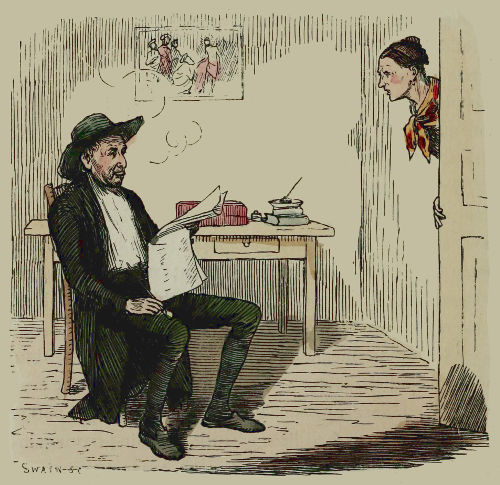
THE PRIEST’S SERVANT ADMINISTERING A REPROOF.
‘Listen to me, Prevosto,’ breaks forth the faithful woman, and she is not careful to modulate her voice even to a semblance of secrecy; ‘you don’t bring another mouth for me to feed here when it is baking-day again! Per Bacco! no, indeed! The mean, grasping creature! She has as much food in her own house as we have in ours any day, and she must come here, forsooth, to delay me in my work, and to pry into my affairs, that she may report them in the village! It’s all her laziness. Who’s to get the merenda for her husband and her children, I wonder, if she’s to find her’s ready for her here, whenever she chooses to ask for it! I’m sick of her slanderous tongue. But it shan’t happen again, do you hear? And I have the holy wafers to bake to-day, besides. For shame of you! Come now to your dinner in the kitchen. I’m not going to bring it in here. You’d best look sharp, for I know there’s that dying woman up at San Fedele, you ought to go after. I don’t know what you took off your canonicals for!’ And Caterina, the better for this free expression, hastens to dish up the minestra.
‘Poor old priest! What a shrew has he got in his house!’ says some pitying reader. Yet he would not part with her for worlds! She is his solace and his right hand, and loves him, besides, none the less because of her sharp and uncurbed speech.
Words in Caterina’s mouth are only the natural vent of her quick and eager nature, when the words are spoken to the old priest. For the most part, they are forgotten as soon as uttered, both by master and servant. The lonely man cannot afford to quarrel with mere froth of words in the woman who devotes her life to his comfort. Who would care for him as cares this poor hard-working servant? Who else would lay aside her ease, and forget her people, that she might carry his interests the steadier at heart, the better fight his battles and guard his homestead, and order his goods to advantage?
Yet Caterina is no miracle of a servant. In many a lone and cheerless home of Italian priest can I call to mind such a woman as this—such a fond and faithful drudge, with harsh ways and soft heart! And where the priest is old, having plodded out his life in some little secluded parish, amid a people more uneducated than himself—there the servant is old also, and the one has almost drifted into a shape and mould of the other’s nature and mind. For, as far as home-companionship goes, are these not all-in-all to each other? There is no wife for a comrade, there are no children to keep the old life burning to the end, in these homes of the Roman priesthood. And yet, who shall pretend that they are always sad? If you have been to see them now with me, surely, for all their quarrels, for all her loud voice and his cunningly judged and well-feigned meekness, you will scarcely say this is an unhappy house!
So the lasagne are cooked and eaten with a good relish, and Maddalena has her portion upon the door-step, spite of Caterina’s vehement remonstrances beforehand. Neither is a little plateful denied to the pretty contadinella who comes presently to the door with a summons for the prevosto. ‘Did I not tell you that you had best hasten up the hill without further delay?’ says Caterina, sending forth her parting shaft. And the priest sallies out on his mission while the girl gets detained awhile for a gossip. For this one is a favourite; she is young and merry, and comes not too often nor a begging. Caterina loves her well enough.
Il Signor Cappellano.
The Signor Prevosto is parish priest, and yet he is little more than a peasant. The Signor Cappellano is under-priest, and he is just nothing more than a peasant. ‘Abbiate pazienza,’ his own parishioners would say if they were excusing his deficiencies to you! What would you have? San Matteo is not a large parish; though its hamlets lie far from one another, and it takes a long while on a weary way to bear the Sacrament to the sick, or even to offer homely advice to marriageable girl or ill-used wife, still the parish does not require three priests. And since they are kept merely to say a mass each on Sundays and holy days, why, they must manage with what pay they can get, for the best of the tithes must go to the rectory.
So the Cappellano has little to do and little to earn for doing it. The Church gives him a cottage and a slip of barren land that lies mostly alongside of the stream’s bed; the cottage is weathertight and sufficient for himself and his old servant, and, with the aid of heaven’s mighty sun and man’s patient care, the land brings forth produce enough to keep two souls and two bodies—what more could an under-priest expect? Michaelmas daisies stand with goodly sunflowers in a row before his porch, brilliant pomi d’oro ripen their fruit against the southern wall, while the gourds trail large leaves and golden flowers along the ground, among wheat and beans and potatoes. Neither he nor old Ninetta taste meat more than once a week, but what of that? The minestra is as wholesome without, and of polenta one never wearies, only the Signor Cappellano himself must till the ground and sow and reap and manure again, or even the pumpkins would not grow large nor the maize fill its cones, so how can you expect him to be other than a peasant? ‘Abbiate pazienza di lui!’
‘Frà Giuseppe’ has the care of the parish school. Perhaps he gets paid a trifle more for it—a trifle that goes towards the meat on festa days; be that as it may, if you come down the hill from the ‘Square Village’ towards the church, early upon any morning but a Sunday or a Thursday, you may hear certain monotonous sounds that leave no doubt as to the employment pursued beneath the thatched roof of the Cappellano’s outhouse. The sound is the sound of lessons repeated, of moral tales read aloud, often of the switching of boys’ calves, oftener of the poor pedagogue’s swearing. He knows little enough himself, but the boys know less, and will never know more, because both teacher and pupil are sure that knowledge is quite useless, having got along, and seen others get along, very well without it thus far.
The school hours last till ten o’clock only—if he does not receive much, at least Frà Giuseppe gives but little—the best of the day is all in front, and the Cappellano makes good use of it. Besides digging trenches amidst maize and rice, training the vine, pruning the fig and the cherry tree, besides kicking the shins of refractory urchins, and having altogether a good deal to do with the boys, he has something to do with the girls too—he is the writer of village love-letters. The post is one of some importance: Frà Giuseppe turns another honest penny by it.
But this is scarcely a matter we speak of. The love-letters—and even other letters, would-be business letters, which Frà Giuseppe writes for the parish—cannot always be free from little white lies and intrigues of an innocent nature if they are to satisfy their purchasers, and in this, as in other trades, one must go heart and soul into one’s affair, and always work for the most lucrative market. So it is not as Cappellano that Frà Giuseppe writes his customers’ letters, but only as village Scrivano, and that is quite a different thing, and not a thing to be mentioned in the same breath with his priestly title. One is not forced to be consistent, and though, for the half-hour when he is in canonicals, the under-priest thinks fit—as under-priests do everywhere—to differ from his superior in matters of religious theory, though as in this case, he belongs to the Ultramontane party when he wears robe and biretta, and would fain make a stir in the parish about the Prevosto’s laxity and so forth—in fact, though the Signor Cappellano be a bit of a bigot in intention, both time and policy forbid him any indulgence of his opinion in practice.
‘Life is short and argument is long,’ says he. Were he possessed of ever so much more influence than he has in the parish he would still be a poor man, whose gourds and vines must always be a great deal more important to him than the souls of human creatures.
So, in other things beside the writing of letters, does the Cappellano wear two faces, and having salved conscience by the preaching of fiery doctrines within the church’s walls of a Sunday and feast-day at Second Mass—he has the worldly wisdom to be nothing more outside the pulpit than that which he really is: a peasant amongst peasant neighbours. Who can afford to be a priest all day long for so poor a salary? One must needs have a little fun to one’s victuals when poverty forbids better sauce, or even a priest’s digestion would suffer, and the Signor Cappellano knows well enough fun is not to be got by a strict face outside the church doors.
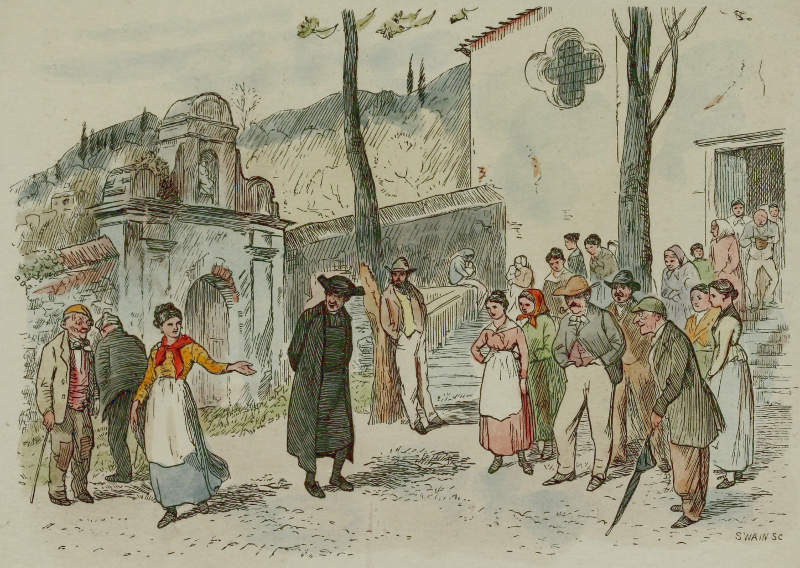
Il Signor Cappellano.
A plump, hardy-looking girl of some twenty-five years accosts him with rough raillery.
It is Sunday morning, and Frà Giuseppe has just sung mass and delivered a scathing discourse in broad Genoese dialect to the somewhat empty benches of a nine o’clock congregation. He comes out of the sacristy now, having doffed his soutane, to keep only the knee-breeches and stockings with steel-buckled shoes for a finish, the long black coat and three-cornered hat of etiquette. He crosses the piazza, which is crowded with peasants, male and female, not all of whom have been in church, except for a moment at the Elevation. A group of lads and maidens turn towards him; none of them are very respectful in manner, but Frà Giuseppe takes no offence. Though his person were held in ever such veneration—even as the Prevosto’s own—though his voice be listened to with some amount of awe, as it is at the confessional, though, on holy ground, his counsels and upbraidings be sometimes regarded, none knows better than the Cappellano himself what a mere name is any priest’s power outside of his office.
A plump, hardy-looking girl of some twenty-five years accosts him now with rough raillery. She has made a bet with some of the village swains on a matter regarding the under-priest, and at his answer the group around burst into loudest laughter. But even this is not enough to discomfit Frà Giuseppe; he has seen the joke and retaliates smartly, neither fear nor prudery hindering.
Another damsel appeals to him for succour against the too forward advances of a stalwart old farmer, and something of a romp ensues. Broad jests and plain words are spoken, but though a spade be called a spade with little ado, Frà Giuseppe offers no reproof. His own education has not aimed at making him peculiarly sensitive to outward grossness of speech, and that is generally the worst feature about this frank and merry people. Who that is Italian, by birth and by nature, could have grown to be thus susceptible? A country priest, at all events, is not, and, as a rule, he gets on best by descending—if such a word be the fit one—to the work and the interests of the peasants about him, happy enough in his own way, and careless of any great show of respect.
Now he joins another party, and this time the group is one of old and seasoned men, whose interests are wrapped up in the crops and the coming fair. Hear him, as with avidity he discusses the country’s prospects, or reconnoitres cautiously, that he may know the better how to buy and to sell with advantage on Monday next!
Here is no moonstruck priest, but a man of the world—poor, parsimonious, and prudent. Poor, but not always stingy, not always grasping, because he, too—though pinched and careworn far more than the greater number of his people, who have their own lands and crops—he too has the proverbial buon cuore of the Italians.
‘Eh, Teresa,’ he calls now to an old woman whom, as he turns his steps back to the little cottage, he meets coming down the path, a basket of eggs and vegetables on her head. ‘Hast brought my portion at last? And thou hast made me wait for it!’ ‘It is too true, Signor Cappellano,’ replies the poor soul. ‘Your excellence must excuse. It has been a bad time, and I have not had the things to bring, though, the Virgin knows, the will to bring them!’ ‘Well, well, it signifies not. Come now to the kitchen, and you shall eat a good mouthful of minestra with Ninetta and myself.’
The little footpath leads down the meadow to the house with the thatched roof, where Michaelmas daisies grow to the front. There are no glass windows, there is only one chimney, the hearth is in the middle of the floor: it is just like a peasant’s hut. Ninetta has the minestra ready; its savoury perfume pervades the kitchen, and she stands with the great pot tipped up to pour it out, blowing away the steam from her face meanwhile. She is a merry-eyed, wrinkled old lady of considerable years, and she is not conspicuous for a superabundance of mother-wit; in this she differs from Caterina, who is the Prevosto’s housekeeper. The poor peasant wife eats the good soup silently, while Ninetta chatters and the Cappellano scolds.
‘Well, well, I shall get a better mess than this to-morrow, Ninetta mia,’ says he; ‘truly no man could keep his heart alive many days on nonsense of this sort. But with the morning’s sun I go to the threshing at neighbour Pasquale’s, and thank Heaven there will be a minestra there that is fit to be called one, when it will be his daughter Marrina who has made it!’
‘Oh, yes, you—you are always for praising what the pretty girls can do! An old woman like me can never please you. I’m ashamed of you, priest as you are!’
Frà Giuseppe laughs contentedly. Such talk is his pleasure, spite of Ultramontane convictions. So is it also his pleasure to go to the common threshing-floor next day, where he handles his flail with the best of them, and bandies compliments with the pretty hostess as well, to quarrel afterwards—a pipe in his mouth—over bowls and moro with village swains.
But none the less tenderly does he doctor the hurts of the very men with whom he has quarrelled—for the Signor Cappellano is village physician too—none the less patiently would he sit beside a sick bed that night, for the sun goes down on nobody’s wrath—the sun that sinks behind the stately cone of Monte Baneo’s hill, to leave the rich little valley lying quiet beneath a clear summer night. And walnut trees stand still upon the darkened sky, to shadow the cottage over, where Frà Giuseppe sleeps the placid sleep of the field-labourer.
Sweeping the Church.
Bells ring in the great Festa of San Giovanni Battista, and chosen girls of the village are busy with their preparations within the church, preparations both for the funzione and for the procession. San Giovanni Battista is the patron saint, and hence it is that his day is held in higher honour here than even in the other villages around.
It is evening, and the vigil of the feast. All the afternoon, wearisome chimes have been sounding overhead, rippling along in a joyous, careless fashion, with here and there a great echoing stroke to give them emphasis. Upon the church piazza, or even within the building itself, the noise is almost maddening, but from woods and valleys around, or, better still, from the far side of the torrent, the bell’s voices have a sweet and plaintive ring that might almost lull to rest in these summer days.
Within the church four or five girls are at work. Some sweep the tesselated, marble floor of the nave, some dust the queer gaudy figures of saints and Virgins or the vessels of the sanctuary. Others, again, are busy hanging heavy crimson damask from windows and cornice, and in this work a man must needs be found to help with ha’mmer and steps. Two—and these are the greater and more privileged spirits—stand upon the daïs of the high altar to adorn it with flaring artificial flowers; fresh blossoms are rarely seen in a Romish church. The maidens ply their tasks merrily, not overanxious that the work be quickly ended, for it is pleasanter than toil in the fields or at home in cottages, and they chatter noisily the while. There is none of the reverential awe in their behaviour for which Roman Catholics are usually credited.
Presently the Signor Cappellano comes in. He is supposed to be superintending the business, but there is field labour to attend to, the potato harvest is at hand, which the Cappellano can ill afford to leave in other care than his own.
‘Orsù,’ begins the little man sharply. ‘Haste with your business, girls, for I have much to do and little time to waste.’
‘And it is perhaps necessary that your honour remain here to spy upon us,’ retorts the foremost of the maidens, pertly? ‘We are fairly capable of setting in order the church, and you may return to the fields.’
The little priest laughs. He knows that he is not much beloved among the neighbours, but the speaker is a pretty girl among her set, and the Cappellano would fain be a favourite. He walks around, making a few haphazard remarks, that are received with about as much scorn as the feeble suggestions of an English curate who comes in among the squire’s daughters in the midst of decorations. He is soon out again in the hot daylight.
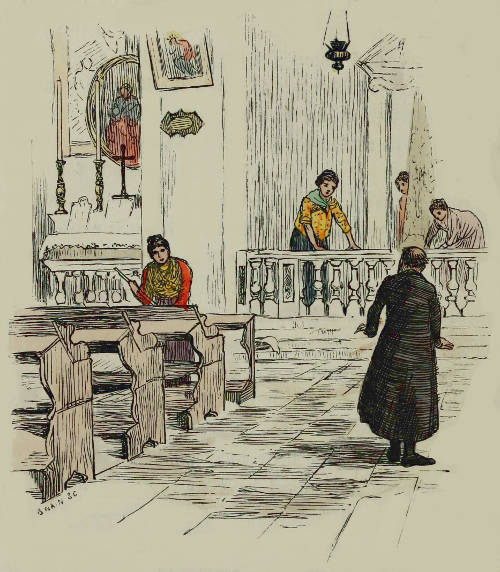
BIANCA DECORATES THE ALTAR AND SNUBS THE UNDER-PRIEST.
‘The good-for-nothing meddler!’ ejaculates she fervently who has spoken before. ‘It seems impossible he should not have understood by this time that I will have none of his impertinence!’ and she laughs a loud laugh, in which the others join also, furtively glancing at one another and then giggling afresh.
‘Say on, Bianca, and tell us a little news,’ they plead. And the request is readily complied with, for Bianca is the bold and adventurous spirit of the village, and has always some tale on hand which she loves to pass on amongst the quieter of her companions. The damsel is a proud and powerful woman; she has taken her stand long since in their midst, and, before her face at all events, the rest of the flock is tacitly content to submit to her sway.
She stands now upon the altar steps as she begins her story—a fine and goodly figure. Through the soft texture of her blue homespun, likely enough her only garment, one can clearly see the curves of her large and shapely form. Her bare feet rest freely upon the cool marble; one of her bare arms, from whence sleeves are tucked away, is stretched on high to fix a garland around the reredos, the other—curved and rounded beautifully—selects flowers from the basket at her side. Firm and graceful are the poses into which her figure is thrown as she moves and stands and stoops in the various requirements of her task. Bianca is no wondrous beauty; she has the heavy features and the sallow complexion of her race—she is but a fair sample of our Apennine contadina, only a woman with dark and fervid eyes, with masses of coarse and glossy hair; yet she has a fairness of form and a perfection of graceful strength, that we may not look to find elsewhere, as we find it at every turn amongst the North Italian peasants.
‘Well, girls,’ says she, and her voice sounds clear above the noise of the bells, ‘you must know that I’ve had an adventure—a fine and a merry one, too, and, what’s more, it’s the son of the sindaco that I have to thank for it.’
‘Oh!’ comes an ejaculation in many tones from all the maidens.
‘It was down at the fair of Presoli. I went to sell and to buy for the mother, and as I was bargaining over a handkerchief—and I must have been red with excitement, too—he comes up behind me, and I hear him laughing with right good-will at my tussle with the old pedona. “Ha, ha! my pretty girl,” says he, “and I will give you the handkerchief.” “A thousand thanks, Signor Beppo,” I answer, and then we discourse a little, and when I have sold the little white heifer and bought the sieves and the rolling-pin for the mother, “It is nearly evening,” says he, “and at dusk the dance is to begin. Thou wilt surely come and step one measure with me.” I stay for the dance, I give no thought to the scolding which the mother will, perhaps, give me—for she expected me home for the supper, you must know—but I just enjoy myself to the full. Then the Signor Beppo gives me to eat and to drink, good wine of Monferrato, and he conducts me home in the later evening—it must have been upon ten o’clock.’
‘Oh, what fun!’ exclaim all the girls. ‘But didst thou not fear the mother?’
‘Che!’ the girl ejaculates, shrugging her shoulders. ‘I invented a little white lie for her. I told her there had come a rich signore, and wanted to buy the heifer for a good price, but then, that he went away, having said he would come back for her; that I waited, though tired and weary I was, until dusk of evening, and when he never came, that I sold to another man. Oh, the mother praised me for a thrifty girl! You think I am so stupid that I can’t even find a lie when I want it!’
The girls laugh. ‘Oh, no,’ says one, ‘and the white lies which one needs not to tell in confession are so fair and convenient.’
‘But say on, Bianca,’ calls out another. ‘The handkerchief that he gave thee—thou hast it?’
‘Surely. It is a ravishing handkerchief. He would have given me a brooch of gold, but that I would not.’
‘Oh, pity!’ says a sympathetic maid.
‘Pity!’ retorts Bianca. ‘Thou little fool! And what excuse should I have given for the trinket? The kerchief the mother knew well I meant to buy for myself, but gold gives no man to a girl but he who will marry her, and where was then my suitor to show? No, Bianca has got no gourd’s head on her shoulders! She knows her business! Also did he get his box on the ear before I had done with him, the fine young man,’ laughs she!
‘How was that? tell us,’ come the voices in chorus. But Bianca has said as much as she means to say, and no entreaties can extract more news from her.
‘I’ve told you the story for fun,’ says she, ‘and as to how I played my cards and why I spoke my mind as I did, that’s no concern of yours. And what’s more, girls, when your day comes, I don’t doubt you’ll know how to manage your game just as well as I did without any advice of mine,’ puts in this wary daughter of Eve. ‘All I say is, have your fun, and mind you don’t pay the bill.’
And Bianca is right, for again she is but a fair specimen of her class. The girls of North Italy are by no means so weak and impressionable as their free and fiery natures have led it to be surmised. Fun and frolic they love well enough, it is true; neither do they fear to run a risk of misunderstanding, sometimes, for the sake of a little glory and a brave adventure. But the girl who has not been dexterous with her weapons and bold in her dignity is for ever scorned amongst her neighbours and her comrades.
Therefore it is that our girls can freely go their way.
The Village Sempstress.
When the road leaves the church to steer for the valley’s narrower end and to follow the river’s course, it leads, before half a mile is gone, into the midst of a little hamlet that is one of San Matteo’s prettiest parasites. And there stands a cottage that has always been a marked feature in the neighbourhood. It is the house of Marrina, the village sempstress.
When the day’s heat has abated, and the shadows begin to deepen, and the breezes to blow more freshly, let us, with the villagers, gather round one of the village’s greatest characters.
She is an old maid. An old maid with plenty of ditties, like most of her kind, ditties about the youthful days when Paolo proposed, and nothing but prudence induced her to send poor Giovanni about his business—he who was such a handsome young fellow, too, and had such a flourishing pasta business! But in spite of them all, Marrina is still single, though she is past fifty, and is of so portly a figure as to excuse any man for thinking twice about the necessary allowance of polenta and beans. If you ask her, she will praise the Virgin to your face, who has kept her a virgin in peace and contentment until this age, and will assure you that, though Giovanni and Paolo were dying of love, nothing should persuade her to change her determination. Has she not nephews and nieces of all sizes, sexes, natures, and ages to cheer her loneliness? Does she not nourish towards all the men whose coats she fashions, and whose breeches she mends, a love far greater and more philanthropic than any she could have borne to one poor single husband?
It must surely be under no protest that Marrina is happy. Watch her broad, beaming face as she turns it round on the bystanders; listen to her good-humoured jests! She is no soured woman, though she has been lame from childhood, and has probably never been wooed as she pretends. She is proud of her position—the position which gowns and petticoats, corduroys and jackets, have won for her. With heavy figure, scantily clad in red and purple bordato—the homespun linen of the district—a bright yellow kerchief folded across her ample bosom, and her few grey locks neatly braided and packed into a lump behind her head, she sits on the stone bench beneath her cottage porch, two stockingless feet propped on an opposite stool, while she clips rashly with great scissors, sewing, settling, and jabbering jocosely the while.
A knot of peasants has gathered round; Marrina’s porch is almost as common a meeting-ground as the church piazza on festas or the well at sunset. If there is any news rife anywhere, it is to be heard from the sempstress sooner than from anyone else; if there is any advice wanted, she is the one whose advice is asked at least, if rarely taken. A more sympathetic person could not be with whom to gossip over all matters of personal interest, with whom to weigh the pros and cons in all affairs of female indecision, and perhaps the taking of advice rarely includes much that is more definite. Besides the family circle—that children of brothers and of sisters, boys and girls of all ages, have swelled to goodly proportions around her—many inhabitants, not only of this hamlet, but of others in the parish, have met together to-night. Some have brought their own supper from home to eat, standing or lounging on steps and wall, others content themselves only with taking their evening rest. Amongst the men, many do not even talk; Marrina and her crew do it for them.
‘I never knew a man like you, Gian-Battista, for wearing out the knees of your breeches! I’ve patched this pair for you three or four times!’ (And this may clearly be discerned, for stuffs of more than one colour and texture have been used to help out the poor brown fustian.) ‘If you had a wife, and were not a blessed unencumbered mortal as I am, she would have told you long ago it wasn’t worth paying two soldi every fortnight to get these things seen to! But I must earn my money, though I shan’t have the face to ask you for the coppers this time! Look there, here’s Bianca! She’s been to Ponte Decimo and some new stuff she’ll have brought to show me! I’m sick of these girls’ vanity! When I was a girl we took what our aunts and mothers gave us, without being so bold as to choose for ourselves. Eh, well, come on, child! What if I do talk? We’ve all been young once. Hand over the things.’