Part One On the Riviera (continued 2)
Reading edition
Even la pettinatrice’s goodly strength is well-nigh spent and her fingers greased to the bone, before the last head is finished off, for, in spite of her only having taken half-an-hour’s rest to see the Princess drive round the gardens, it is midnight long past when the final touch is put to the final Marchesa. The day’s work is over, but Marrina does not go home to the tall house on the dusty road beyond Porta Pila. She too must have her night’s recreation. Who would expect the love of folly to be spent in a woman of that figure and those eyes, even though her calendar count thirty birth-days? But after the gas-lit night, the summer sunshine still comes back, bright and pure, and fresh apple-blossoms blow beside la pettinatrice’s home.
Fisher-Folk.
When the high road of the eastern Riviera has left the town behind a space, and has even travelled clear of the last palaces without the walls of the city of marbles—when it has crossed that tongue of Albaro’s Hill that divides the waves, and, having left sea behind in Genoa’s Bay, comes back to more sea that laps freely upon a free and rocky coast—when it has coiled closely round corners and skirted precipices for many a mile—it comes, on its way, across a little town where the hills rise abruptly behind, and the orange groves are thick around, and the villas of nobles lie sumptuously upon the shore.
There have been many little towns, scarcely larger than villages, all along the road from Porta Pila, and many a lovely palace standing in its garden and fruit-groves along the coast—so many, indeed, that even a quarter of a mile has not been left untenanted by man-kind; but Nervi is a prettier place than any of the other places since Albaro’s villas were left behind. The hills that stand for background to it are straight hills and fairly wooded, yet they are not the best features in its beauty, for, excepting from the sea, no one has seen their shapes impressively, so close do they rise, looking down upon the village. Nervi’s loveliness is in her gardens, with the palms and pines that grow there, and the stately palaces whose time-tinted marble walls stand in the midst; it is in her lemon orchards and orange groves, where the breeze blows laden with scent in the flowering time, and the pale or golden fruit hangs heavily-gorgeous through the early spring days; it is in her rocky beach, where the changing sea laps for ever and is never the same, where fishers spread their nets, and children wade and play, and the wonderful water-line is broken and perilous because of the cloven rocks that lie guarding it.
The little straight street is not beautiful, though its barber and dressmaker and its Fabbrica di paste be indispensable to the dwellers round about, and though dirty shops and tall houses, because strange, have often been called picturesque; the Mediterranean lies hid from Nervi’s street, and, when one is on the Riviera the Mediterranean is the thing most powerful to charm. But, on the sea-shore, street and barber and shops are forgotten. The sun gleams on white wave-crests that temper the sea’s blue on some breezy spring day; the sun lies scorching the weed-grown jagged rocks, the sloping slate rocks that slide far down beneath water that grows green near shore; the sun sweetens the oranges, and makes the flowers more luscious of scent, and the fishermen lay their nets. Though Nervi is a village where rich folk have their dwellings and marble steps lead down to the water for bathing, there are hamlets near around, of poorly squalid mien and strangest name, where fisher-folk live and fisher-children hunt crabs and shell-fish in the bays.
Walking along the winding way that creeps round the lip of little gulfs, and dives into dark crevices of crags—or along the way that, being poised midway aloft upon the cliff some hundred feet above the water, leads from Nervi to the fishing village of Bogliasco—you might see Maso, perhaps, out at sea in his broad and tanned old boat, spreading nets for the night’s fishery, or, further on, from off the smoother shingle, Paolo pushing out upon the coming wave, with the children standing by to help with shout and laughter, and the women with parting joke or reproof.
May is near to her end now, and the long evenings make summer again. The water is warm, because the sun has lain upon it all day, and blue with a memory of the clouds overhead, that are paling now in the waning lights. A golden glamour comes down upon the waves; the sun is near to setting. Paolo stands in the sea, making ready to push off; his brown, broad feet upon the yellow shingle are broader, but not browner, beneath the green water that reaches to his knee where the striped hose rolls up; the golden light strikes across his face on its way to the bright group upon shore and to the bright spring green over the hill beyond. He is a tall man and strongly built, but his face is battered and seamed; they call him in the fishery ‘the furrowed one,’ but he is liked well enough notwithstanding, and, truly, that careworn face has a kindling eye and an honest smile. Paolo is a married man. That mischievous urchin is his own first-born, who leans against the boat with his calves in deep water—as the calves of the rising generation are apt to be; his hard young hands are eager to help, his keen black eyes look for the signal. And that is Paolo’s wife—that broad-hipped woman with the full, free figure, who waits upon the beach with the swaddled infant in one arm and the year-old boy clinging to her skirt; all the other children play around, they are waiting to see father away.
Now his ropes are coiled, his nets are in order; Gian-Battista has arrived leisurely—Paolo’s lazy nephew, who helps in the fishery. When his lighter skiff has also been made ready, two strong pairs of hands—that nine-year-old boy helping lustily—start both old crafts out to sea. Paolo leaps in swiftly, the oars are dipped, and the golden sun sinks a little lower upon the horizon. ‘Andiamo bambini!’ calls Maddalena shrilly, only she calls it in strangest dialect, to the loitering children. And by the time she has dragged the younger and driven the elder up the short, steep slope of beach on to the jagged rocks beyond, that lie beneath the village, the boats have pulled a mile out to sea, and Paolo has sunk his nets for the tunny fishery.
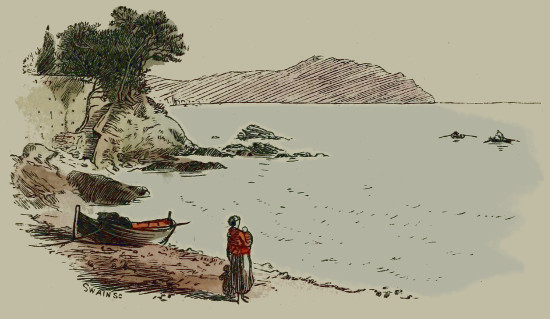
PAOLO AT SEA.
Some two hundred yards and more each of them spreads around; you may see the little brown bobbins, that mark the circumference, float and jerk up and down on the water as Gian-Battista spreads his end of net, rowing across the marked space meanwhile; then the two boats lie sentinels at either end, to guard their sacred surface from other craft, and to watch for the haul. So when the time has come, and the watching has been long enough, calling to one another across the space with deep, loud voices that are tempered to softness as they travel over the water, Paolo and Battista begin slowly to row towards the net’s centre with the net’s ends fastened to their separate boats, and, when they meet in the middle, the net’s mouth will have closed upon the captured fish.
There are not many this time. When Battista has got into his uncle’s boat, and when together, with cheery cry and many a passing ejaculation, they have hauled in the great net, it is but a cattiva pesca that is the result of their evening’s labour. And the sun has gone down now behind the purple clouds and beneath the waves; the sea’s blue is dark, almost to blackness, as the night breeze creeps up; Sestri’s coast can no longer be seen—scarce even the great promontory that hides La Spezia from sight in the daytime. Yet further out to sea they lay down the net again, and little lanterns have had to be lighted in either boat, other lights and lanterns have been long put out that glimmered faintly from the village ashore, before Paolo and Battista row back again towards the rock-bound bay beneath the cliff. But a dying memory of sunset from the west can still light the boats homewards though the summer night be far advanced, and, against the background of this dim and distant brightness, Paolo’s tall figure stands taller than before as he waits, with forward foot and well-poised body, upon the boat’s prow, till the shingle shall grind beneath her keel, and it be time to leap out into shallow water and pull her high upon the yellow beach. Maddalena’s shrill voice is hushed, the children are all a-bed and the hearth swept up; but, if the fire be spent, the fisher’s meal has not been forgotten by the fisher’s wife; cold polenta, brown bread and chestnuts stand ready by the settle, though the portly fishwife lies asleep whose work it will be to bear the haul of tunny-fish to early market.
The morning dawns, pure and bright. Beneath the pergolas of Bogliasco cottages the sun is warm already, though night-dews lie wet still on flowers and herbage. The blue water below laps but gently against the gnarled rocks where it can dash at will so wildly, for the sea is calm to-day under a tender sky. ‘It will be hot,’ fisher-wives say, ‘but what will you have when June days are so near?’ Scarce a ripple stirs the water surface, whose blue is as only the Mediterranean’s blue can be when the sky is full of colour as now, and the sun is strong to perfect and enhance. Paolo has been abroad betimes, and Maddalena is already on her way to the fish-market with last evening’s produce; but we, who have not cared to rise so early, will follow Maso this time, who, having neither wife nor children, begins only to fish when the sun is aloft.
Maso has not so handsome a fame as he who stood last night against the sunset. In fact, he is an ugly man, for, besides a face that is brown and weather-beaten, and pitted with the small-pox (as his nickname in the village dialect would tell you), he has a short, wiry figure, that for all its ease of movement cannot compare with the tall, spare grace of his neighbour. Maso had wonderful luck with the bianchette, that are a kind of whitebait, through the past month of April, and he had a good net of anchovies some three days ago; but anchovies are not the surest sport, and this morning he will lay for the sardines, as Paolo has done. Maso has a little brother—a brisk, lithe little ragamuffin of ten years, one of those who rarely have time for aught but mischief, as his keen eyes would tell you; him he sends up on the hill for watch. And while the two men—for the fishing is all done in couples, and Maso has a comrade like the rest—while the men spread their nets just beyond the rocks in the creek’s clear water below, Giannino’s bare feet have climbed the hill where the stones were sharpest for his long toes to cling to, and is squatting on the hot earth amid the thyme and the flowers and beneath the grey-toned olives, between the frail network of whose boughs those blue waves shine with fairest glory.
But Giannino notes none of the things of Nature; he is watching the sardine shoals come on. Maso and the other have parted company in their separate boats now; each is posted at an opposite side, with a net’s end fastened to his skiff. And presently Giannino, from behind the olive trees, sees a goodly company of little slim and silvery fish making towards that very pool of clearest blue-green water, where the cruel snare lies spread in the rock’s great shade. A silent signal is enough to the fishers, who are watching for it, and the boats row slowly centre-wards, till the net’s mouth has closed upon the dainty prisoners. Silver and gold gleam in the sun’s own silver light, for the little fish struggle pitifully amid those horrible meshes. It has been a buona pesca this time, and the brown and dingy coils are soon in the boat, the spoil secured safely within the well. It is Nicoletta who goes to market with the sardines; but not into town, only to Bogliasco, where men and women buy the fish from the fishers, to take into Genoa. Nicoletta is a spare and tanned little maiden, with brown feet and ankles that have never known shoes or stockings; she is sister to Maso and Giannino, but it is the latter she resembles in her wild, wiry strength, for she, too, is something of a pickle!
The sun climbs the sky till its rays are so hot that even Riviera men and women are fain to fly from it for an hour or so, while they eat the merenda, and sleep their own calm sleep beneath the shadows of rock or fig-tree. The olives shine silver-white in the fair beams that ripen their fruit; aloes and palms flourish, broad pines are darkly green and perfumed; in bays and upon burning rocks the colour-laden water ebbs quietly. But at last the sun sets again, and in the evening’s cool, fishers sink the lobster baskets in rock-bound pools of the coast, where the water is nigh to blackness in its depth beside the cliffs. Night is near, and the sea’s colour fades awhile with the last of the sunlight.
Santa Margherita.
Santa Margherita is one of the many little towns which have gradually grown up along the eastern Riviera, gathering themselves together around the country palace of some signore, which, first, had been built alone upon the shore, or springing up where, for convenience sake, a little fishing hamlet had been set in creek or bay, until now the whole of the coast line from Genoa to La Spezia is studded thickly with the white walls and glistening roofs of human habitations. The little place has had a station since the railroad has come this way—a station of its own, and not one shared with another village, as some of its neighbours, and one, too, at which all the trains must stop which run during the day to Sestri. There was a great palace built up here many years ago. I forget to what family it belongs, but it is a stately pile, whose marble steps creep down to the water’s edge, and on whose battered face the dim colours of ancient frescoes still show quaintly through the dirt which has encrusted them. The signori used to come here for the sea-bathing, and perhaps it was in this wise that the town of Santa Margherita came to be built. Nevertheless it is in a fair position upon the coast, and it was probably a prosperous little fishing village long before it could boast its stone pavements and its piazza of now-a-days. The coast swerves in gently so as to form a smooth and ample bay just where the town stands, and jutting out on either side into the blue waves stand two promontories guarding the gulf. To the right is Porto Fino, and, within the bay round the point, a little village bears the name. It is so called from the many dolphins which, near to that shore, sport in bevies beneath the clear water quickly to disperse at the approach of a boat. ‘Fino,’ for shortness and convenience sake, apparently can mean delfino.
Hills, graceful and undulating, clothed with many trees and watered by many a cool stream, are set against the sky for background, and Santa Margherita lies within their lap, sending the gayest houses to adorn her front upon the coast. Buildings of any note belonging to the place are but few—only the Campanile, which stands up tall against the hill, and has some pretty colouring in the mosaic of its belfry, and one or two decrepit old mansions belonging to the gentry of the neighbourhood. The great palace of which we have already spoken stands upon a low hill without the town; orange groves gather round and about it, and woods where dark and spreading pines are set against the tenderer foliage of chestnuts and arbutus: its white loggias and colonnades face the sea, hung richly with creepers and vines. In the town there are many poorer houses—most of them modern—tall and thinly built, with ill-designed proportions, and gaudily coloured paintings nowise resembling the frescoes of olden times. Along the façade of the town houses stand closely wedged together whose windows are thickly studded up and down, and hung with the white linen from which meaner habitations in Italy are rarely unadorned. This is the most populous part of Santa Margherita, and between these houses and the waters of the bay there is only the paved street from whence steps lead to the higher part of the town, the railway station and the fair country beyond. Here roads branch out on all sides; one leads from behind the town, over the hill to more towns and villages inland, another is hemmed by tall rows of ilexes, and others again, less important, creep up the clefts of the valley until they are lost in the woods, and only peep out again on the barren crests of mountains, where pine trees alone stand as fringes against the sky.
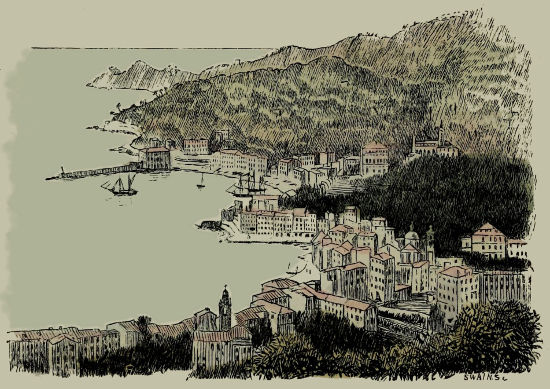
VIEW OF SANTA MARGHERITA.
Santa Margherita is but one of a hundred nooks along the Cornice from Nice to La Spezia; the villages all breathe the same balmy sea air and bask in the same sunshine, and wear the same garb of luxuriant vegetation, of quaint picturesqueness, side by side with gaudy vulgarity; and yet each has its own life, each is home, as no other place can be to its citizens. Santa Margherita, like the rest, has its full sum of incongruity. Squalid habitations that yet have something of the grace of Italy, with their green shutters, large windows, and marble mosaic floors, stand, in dirt and poverty, side by side with stately palaces of olden time or with the pretentious structures of modern architecture. And in the inhabitants is the same apparent discord. Men and women who for years have been used to exact the homage of their inferiors, live side by side with the lowest and the poorest of the people, and, even more, with a perfect grace and courtesy; ladies to whom fashion is a necessity, and excitement has become a second nature, take a naïve pleasure in the pursuits and interests of poor fisherwives, of contadine cooking the porridge, or lace-weavers at their pillow.
And nature is there to keep all this strange medley in countenance. Down upon the beach, where the fishers stow their craft when the day’s work is over at sea, and where the little dark-eyed children, ragged and dirty, play in and out the nets upon the shingle, the wind blows hot from off the great moving plain of the Mediterranean and the sun shines heavily for many an hour upon the houses and groves and gardens that are on the water’s level. Leave the town a space, and take one of those roads which lead upward among the mountain valleys, and in a little half-hour the face of nature seems subtly to have changed, and her voice tells a different tale, while yet murmuring of the sea which is near. The summer breeze is scarcely cooler or the sun’s rays less powerful where they break between the large-leaved foliage of the chestnuts, yet a sense of freshness creeps silently around, vigour is in the flowers that grow, in the trees, in the water that flows and ripples. Ferns are tall and waving upon the banks of little rills and beside cascades, or frail and feathery growing between the crevices of loose stone walls. Maiden-hair is there in profusion, and hart’s-tongue and holly fern, besides many others. The ways are rough and stony, sometimes losing themselves in what seems to be but a mere water-course, sometimes steeply climbing the hills in tortuous coils; but even these rough footpaths look upon fair valleys, and the pale sky is spread out above them, till they reach the mountain’s summit and wind round again upon its crown back towards the whispering sea. And now you will enter upon the region of stone pines, and this is the promontory of Porto Fino. The goodly trees rise up from out soft earth, and their straight stems, with the curiously carved bark, stand tall and erect, many feet on high, ere the branches begin gracefully to strike out on the several sides. Then the boughs grow more forked and multiply again, and still there are no leaves yet to be seen, only when you look up from below you see that there is a great shade spread above you, and that all those thickly matted branches are clothed and adorned with the dark and sweet-scented foliage. Then you sit down, perhaps, in the dreamy cool and the twilight of this forest—where the trees do not need to be thickly set that they may throw their shadows densely—and you breathe the heavy-perfumed air from the pines, while you hear from afar the murmur of the sea. These pine trees can grow on the narrowest ledges of soil that have found a place up the face of the cliffs, and can yet stretch their branches far out over the waves, so that the most barren edge of land by them is made beautiful and softened. And all the time, perhaps, that you have been walking you have scarce caught more than a far-off vision of the magic water. As you made a turn in the road or climbed some little knoll on your way there came a sudden picture before you of a brilliant colour, neither blue nor green nor purple, such as you ever saw it before, framed in the stately branches of the dark pines. And the sky is pale, and yet the sky, too, seems pregnant with colour, and fathomless, and so the sea and the sky meet in one. Then you dive down into a little dale again and into a lonely glen, and the sea is away and the memory of it, only still mysteriously its influence seems to be around. The village of Porto Fino lies to your left, but far below upon the sea-shore. You must descend. The pines still fringe the ridge of land, where it overhangs the water, but now the vegetation will change. Little tufts and sprigs of divers shrubs cling to the rock—myrtle—and gracefully twining sarsaparilla; but green things are not abundant here, where strange boulders of rock strike down into the sea, or lift up their great forms from its depths a little way from the shore; and when the cape is rounded, and the woods begin again, they are no longer pine plantations but sweeping chestnut groves that drape the hill-side. There is a little shrine that has been built upon the farthest point of the Porto Fino promontory. On windy days the ‘Madonetta’ has bidden fair to be cast from her home and hurled into the treacherous Mediterranean, for the gales rise up suddenly on this coast, and I have seen the smiling waters wax dark and livid in one short hour, dashing their waves in mighty billows upon the rocks, and tossing their white foam far aloft. Then the dolphins gather themselves in companies below the surface, and the ships are fain to take refuge in one of the bays which nature has provided along the coast. Of these Porto Fino is by far the best and largest for many miles ahead. The harbour can hold even large ships, and is a constant halting-place for the smaller craft which ply their trade along the coast. Then the little fishing-smacks are forced to be moored upon the beach, for the swell of the sea is heavy even in this sheltered bay.
So the footpath will have brought you down, curling round the cliff’s front till you come where the chestnut woods are growing luxuriantly above the shores of the little harbour. Porto Fino’s church is to the right of the village, and above it. It is on the neck of the peninsula, just where the land is narrowest, so that standing beside it some windy day you can feel, on the one hand, from the turbid billows beneath, the foam that dashes up against the rocks, and on the other you can see the gentle heaving of the calmer waters in the little bay at your left. You must needs pass the church as you make your way down to the village. The way is steep, but it is paved, though the round stones are somewhat hard and slippery. Porto Fino is a small place. There is a piazza upon the shore whence the little pier juts out into the water, and around which the houses are built in a square. They are poor dwellings most of them, though one or two pink and yellow houses, with balconies, suppose themselves to be charming summer residences for strangers. The village is a fishing village, and therefore is pretty well huddled together upon the shore; but there are a few cosier looking cottages in the woods behind, where the lace-makers live; and the odds and ends of the place have crept up into the valley or upon the slopes. There are pleasure boats at Porto Fino, besides the fishing-smacks: though when I say pleasure boats I have not in mind those dainty little craft which are wont so to be called in fashionable watering-places, for these are rough and dingy, and built, I doubt not, against all rules of modern invention. Nevertheless, they are safe and comfortable, and swift enough when pulled by two stalwart fishers. They will beset you as you come out upon the piazza, these swarthy boatmen, and clamour loudly for your favour. Then the boat will row you over the dark green waters of the little bay out into the wide sea without, where the water is bluer and less transparent; and when you have rounded the promontory and skirted other little bays you will be back at Santa Margherita.
The Lace Weaver.
On the hill with crest that is fringed with stone pines, above Santa Margherita’s town and harbour, Lucrezia’s grey cottage stands, with thatched roof, among the trees. Olives are around her dwelling, for it stands on the nether slopes, where the fir’s fragrance from above scarce reaches; their fine branches and crooked stems rest traced upon the sky, and into their grey tones fig-trees bring brighter green for contrast, though brightest of all are the vines that twine beneath. The blue-grey smoke curls above the green-grey trees, to show where the lace-weaver lives; a rough spring flows freshly out of the earth beside her cottage, with wooden trough to guide its stream into the brick basin, and thence into the beans and potatoes of her garden; a rude balcony flanks the house, a walnut tree shadows it over, a pergola dims the light at the kitchen window; and the gourd-plants trail beneath it on the ground, with ample golden flowers; carnations, side by side with kitchen herbs, grow in a box upon the window-sill.
Lucrezia sits outside on the little terrace; the pear tree is white with blossom, just opposite, and at the foot of many a sloping, stone-hemmed garden, where green wheat waves and gladioli bloom between, the sunny sea spreads far away and breaks white upon the rocks; but her face is not raised to look, for before her is the lace-pillow, and, while her fingers ply busily, her head is bowed, and she softly rocks a cradle with her foot. Lucrezia is a young mother. Last year, when the fruit was at the best and the fishing had been good, she was married to Pietro of Santa Margherita, and the little swaddled infant that sleeps at her feet is the first-born, who came with the summer’s return this May-time. He has no features to boast of yet, and his legs and arms are tightly bound with swathing bands, but Lucrezia thinks him truly fair nevertheless, nor minds the piteous wail with which he will shortly break in upon her deftest bit of labour. She is a comely woman, but beautiful rather with the recollection of other beauty—the beauty of past generations—than perfect in her own person. She is dark and tall and straight, with square, broad shoulders and ample bosom; her hair is almost black, her eyes are grey, her skin is bronzed and slightly freckled, her mouth is wide, and the teeth within it white and even; the hands that weave and twist amid a labyrinth of threads are coarse and large, though seemly shaped; the foot upon the cradle’s edge is no dainty foot, for it has grown hard upon the hard stones, and tanned with the sun, and soiled with the world’s work of every day. Neither contadine nor fisherwives waste their scant pence on shoes and stockings.
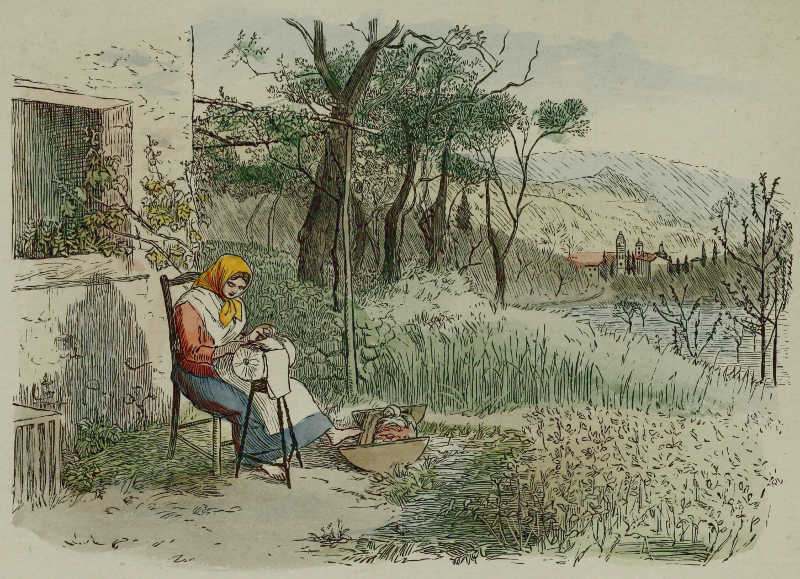
The Lace Weaver.
While her fingers ply busily, her head is bowed, and she softly rocks a cradle with her foot.
Lucrezia plaits her white threads swiftly—so swiftly that you might almost see the pattern growing beneath her fingers, though it is no simple design that she weaves thus from memory, but an elaborate arrangement of groundwork and spray and border, that go to make the width most used for flounces. The wooden bobbins clap together merrily when Lucrezia thus nimbly twists and crosses threads over the pink pillow’s surface. She is crooning a lullaby to the bandaged bamboccio the while, and nearly mars the use of it by the loud peals of laughter that Maria’s conversation provokes, who sits idling on the cottage door-step.
‘Marry? I wouldn’t marry for worlds, and have to work as you’re working now,’ declares decisively that one who is yet a spinster. ‘What man is worth it? For me, I like to amuse myself—in the way one should, of course! Santa Vergine! you’re always at it! If you’re not at the lace-pillow, you’re with the fish to market or down in the villa round the tomate and the herbage! And then that marmot of yours! It’s one thing to dandle him a bit for you when you’re up to Santa Margherita on an errand, but to have a thing like that of one’s own——! Not for me!’ ‘Go to!’ laughs Lucrezia. ‘And that young man of Camogli that I know of?’ ‘And that young man—and that young man! What young man, and what’s he to do with me?’ simpers the maid. ‘All very fine,’ replies the married woman, with a giggle so loud that Ernesto gives an ominous whine, and would probably move his limbs were they not so well secured, ‘that will he know better than I for a surety!’ And she rocks the cradle faster, and begins to croon afresh, till the pins on the pillow want shifting forwards, and Maria so far recovers her gravity as to continue, ‘You are always up to your jokes, you! But tell me a little—wilt teach me the lace-making if I have the patience to learn? It’s the only way for us poor girls to earn a pair of ear-rings, I suppose.’ ‘Dear heart, you would never have patience,’ says Lucrezia. ‘A fisher-girl like you! Why, your hands are rough from the oar, and you’d never sit still a little half-hour. It’s bad enough for me, who have been used to it since I was twelve years old!’
A portion of the pattern gets finished off at this point, and Lucrezia casts a handful of threads aside—the threads that have twined one kind of weft for sprays—and takes up a new set to fill in the ground with. She has had a good day’s work, has been at the pillow at least five or six hours, and has completed nearly mezzo palmo of flounce, which is about five inches. If she were not the nimblest worker in all Santa Margherita’s vicinity, she could never make as much lace as this in the whole twelve hours, and yet the Genoa shops will scarcely pay her more than a franc for the piece she has done, weaving since daybreak, till now that it is time to cook the cena. Indeed, if hers were not the best and smoothest made lace to be had along that shore, Lucrezia would not even earn as much. It is not without some reason that to Maria’s remark about its being the best means of gain for a woman, she answers, but curtly, ‘You believe it? Listen to me rather; that you, who have hard hands and slow wits, and the patience only of a spirit in purgatory, you would not make half a franc with your day at the pillow! Even the glove-sewing would suit you better, though ’tis but a poor trade! Take to yourself that young man of Camogli, and go in peace! He has a house above his head, and you are fit for nothing so well as to sell his fish for him at Santa Margherita, and harvest his wheat and his olives.’
Lucrezia rises to stretch her arms, for the shadows are creeping longer and a filmier light dims the sun’s dazzle on the bay. It will be time to pare the potatoes and wash the rice for minestra, though, on second thoughts, she has a mind to cook some polenta—that is quicker done, and just as acceptable for a second meal. Maria’s gossip must end for this time. She, too, has a cena to make ready at home for the men, and Lucrezia has enough to do now, for, just when the pot wants putting on—that bundle in the cradle begins to wail, of course! ‘It’s always so,’ laments she plaintively, but the mother’s heart cannot find it within to be cross, though she must rake the fire with one hand while holding the infant to her breast with the other.
The first-born’s woes are stilled, supper simmers over the burning logs, in the light of whose flames Lucrezia’s copper vessels shine brightly on the smoke-tarnished walls; without, the sunlight has faded, and grey clouds cross the west. ‘We shall have a storm to-night,’ muses she on the terrace, looking seawards with her back to the road, and to the chestnut-woods behind her olive trees. Truly, the blue waves are sadder-coloured than before and begin to wear white feathers on their bosoms. A wind moves in the grey branches overhead, and rustles more noisily amid the broader-leaved chestnuts behind; on the hill’s crest it is sighing beneath the stone pines. ‘Pietro will surely not go to the fishing this night,’ says she, half aloud; and she turns to fetch the copper cauldron to fill at the spring.
Some one is coming through the chestnut wood that lies away from the sea—a lady. Is it one of the ladies from the palazzo on Santa Margherita’s beach? Yes—good Virgin—it is indeed, and the same one who bought lace of her last week! What a good fortune, for a private customer buys at double the price offered at Genoa shops. ‘Your servant,’ says she modestly, but without a curtsey—that is not the way with our contadine; yet her manner is none the less respectful. ‘A fair evening to you, my good girl,’ replies the town dame in the high singsong that is special to Genoese dialect, and different from the Venetian twitter or the deep Milanese chest notes. She is not alone—a tall man attends her, dressed after a supposed English mode, as for the country; he is chestnut-haired, and would call himself biondo, or fair, spite of his skin’s colour; that is why he affects the English style, and he too says a gracious ‘Felice sera’ to our Lucrezia, because she is a comely woman. She meanwhile, standing beside the fountain with her hand resting on the copper bowl to steady it, gazes with appreciating eyes on the lady’s elegant attire, who says presently to the swain beside her, ‘It will rain, I think—it behoves to go quickly home;’ then to the contadina whose vessel has filled the while at the trickling spring, ‘Have you any more lace of that sort that I bought last time?’ ‘Come up the steps beneath the pergola, dear lady, and I will show you what I have,’ replies Lucrezia, frankly, but with no curtness as the words might imply. And she heaves the water-vessel to her head, which must first be replaced in the kitchen, whence she then brings two nicely dusted rush chairs for the signori. La marchesa sits down, asks a question about the prospects of grape and olive harvest, speaks a word to the now wakeful bambino, and handles black and white lace while the fair-haired gallant leans against the stone parapet and smokes and gives valuable opinions on stitch and pattern and quality.
Lucrezia has a handsome store of completed lace—of course, some of it is promised to the shop, but what matter? No one can quicker invent a suitable lie for the shopwoman, should the marchesa take a fancy to any special piece. There are lengths of all widths, in flounce, and edge, and insertion-lace; there are scarves and shawls, and parasol covers, and every kind of female adornment that is in fashion, whether suited to this special kind of guipure trimming or no. Lucrezia’s lace is the finest made in the neighbourhood, but even hers is no fine and precious kind. True, in olden times the Riviera girls used to make a straight-edged and thin-threaded lace that was worthier the name, but, for this long time past, florid designs and Maltese stitches have come into vogue, and now we have nothing but guipure made along the shores. La marchesa buys her five metres of heavy-weighted black silk flouncing, in which kind the loose-woven patterns show to best advantage, and when she has bargained a while over it, and laughed and talked friendly with Lucrezia, it is discovered suddenly by all three that the rising blast has lashed our blue sea’s waters into swelling and breaking billows, and that the storm is overhead. Dark clouds hasten across the sunset, and the rain begins to drop. ‘Misericordia!’ says the lady. For the square pink palace looks a long way off. She is fain to take the shelter of the lace-weaver’s shady kitchen, that is now gracefully offered, and to blacken her dainty slippers on the square brick hearth and listen to the first-born’s wail till the rain have ceased to water the garden, and the wind to turn up the olive leaves’ white linings, till the worst of the storm be over, in fact, though waves still dash white spray on black and cloven rocks in the bay, and the sunlight be blotted out for good this day. But Pietro has good news on his return to the cottage; the fishing has been good this broken weather, and Lucrezia has good news, too—she has sold five metri at an honest price to the marchesa of the great palace.
Il Manente. The Husbandman.
At Camogli, where the stone-pines adorn the cliff’s edge, and burthen even the fresh sea-breeze with their strange and heavy sweetness—at Camogli, that is built beside the waves, and that has the quaint harbour where fishers dwell, there are many new houses for gentlefolk to live in, and one or two old ones for old families to whom they belong; and these well-worn palaces stand on their own lands, beside their own fig-trees, and beneath pines of their own planting. Such things are at Camogli, and even at Recco, though Recco is a little town with church and streets, not so picturesque by half as the thriving fishing village—such city memories are at both these places because they lie beside the sea, and because from homes and lodgings in their midst people can easily spend the half of their summer days in the water.
But at Ruta there are not many fine houses for city folk, and not even many old palaces, for Ruta is up on the hill with the land-breezes behind it, that come through clefts and valleys, and the sea-scent in front of it that must travel across vineyards and up corn-covered terraces to get there. Yet there is a broad, smooth, carriage-road from Recco to the village on the hill—that same old road along which many a traveller of many a nation has come in the days when the railroad was yet unmade, of which many another has heard tell because of its beauty; for Ruta stands on the way that used to be the highway from Genoa to La Spezia. And besides this wide and dusty one, there is another path by which you may reach the village that I mean—a path that strikes off from Camogli’s gayest front, to wind steeply up the hill when once it has left Camogli’s church behind; a rough foot-path, whose sides are hemmed with low stone walls, and upon which other loose stones roll perilously. It is the way that the manenti take when they come in the sunrise hours to Camogli with their market goods, and carry fish up again that has been bought on the shore with their morning’s earnings, for Ruta lies crowning the valley that is called in Genoa and on the Riviera the valley of fruit; and, though nobles of old did not build their palaces so far from the sea, any more than town-folk of to-day, all of them are glad enough of the fruit that grows better where the shade is, and where dry sea-breezes are not so prone to wither.
Giovanni’s villa lies on the western side of the hill, and looks to the sunrise. He is an old man, his hair is whitening fast and his hands are wrinkled and horny, his face is seamed; though so tall and strong a frame scarce will have need to stoop yet a while. But for all he has been on the ground, pruning the vines and the fruit-trees, and tilling the soil these many years, Giovanni has rarely yet had occasion to grumble much at his land’s produce, though neighbours do tell him oftentimes the place lies with an unprofitable aspect. The terraced fields and little plantations where he grows the maize and peas and fine asparagus in season, lie one above another in patches, on the steep, with the rising ground behind to shield them from untoward winds, and the sun full to their front; and beyond, where the hill curves round to westward, his cherry trees and pear and plum trees grow, with peach and almond trees between for a good sprinkling, and aloes faintly grey and stiff on the rocky wall above; silver-lined olive-leaves wave from knotted boughs where wheat grows, with gladiolas blooming in its midst; fig trees spread widely, and vines twine around wildly wherever there is room amongst all the cultivation: truly, Giovanni has no need to complain.
The old manente lives lonely; he has few friends so close as the crops and the fruit-gathering that he labours so fondly for. The tender-leaved lettuce and early asparagus are more to him than neighbours, and the ripening of the red tomatoes is of keener interest than anything that happens in the village, for the weather-worn man has none at home to care for him: his wife is dead, and, of his children, the sons are about the world, fishing at sea, and selling pasta in Genoa; the daughters are well married in distant towns and villages. It is better so; and to heave the pickaxe in the upturned field, to train the vines while thinking on Marrina’s last-born babe or on Pietro’s success a-board the merchant vessel, is dearer to the husbandman’s heart than the sound even of loved voices around his hearth.
The day is a July day; the wheat is waving yellow and near to the harvesting; the melons have ripened well, and it is a good year for all the fruit; the peaches have even been so many that manenti have given them away in baskets-full. Fine and tender spring crops have had their day, and it is over. This is the full time when nature is the most lavish—not a time of sharpest interest, perhaps, but the husbandman joys in his reward. It will be a good vintage, and the green autumn figs crowd thick on their trees’ branches; they are swelling fast, and will streak their soft green skins ere long with pink, as they come to full maturity. People say there will be a falling-off in the chestnut-harvest on the other hand, but that matters less to this manente of whom I write, because his riches are greater in olive-woods.
Giovanni has been to Camogli this early morning already, and he is an old man, but he means to go to Rappallo in the forenoon yet. ‘Fair Madonna, and it is the old ones must work whether they will or no,’ says he to neighbours who greet him on the steep and stony way, with some comment on his toil; ‘the young have all gone to the devil, and to the city trades; what would the soil do if it weren’t for us, whose bones are oiled to the labour?’ But though he fret and fume a bit now and then, if truth were told, Giovanni would ill brook even a day’s idleness! What if the path be bad, and the burthen on an old man’s shoulder makes the sweat to steal down his brow? Do not the fig-leaves cast broad shadows where one sits awhile on the flints by the roadside to rest, and is it not consolation enough to note how the fruit waxes full, and how the olives are rich in berries? Besides even at three hours after dawn, when Giovanni was climbing the hill again from market, dews were still moist and breezes fresh off the sea from behind; it is of a hot sultry night, or with a fierce midday sun overhead, that one fears the mount a bit, and wearies of the secret stillness amid trees, or of the silver dazzle on that blue sheet, of Mediterranean that one leaves behind and below. No one can say that in Ruta there is a hardier labourer than the manente who rents the larger portion of his villa from those silk-mercers of Genoa—owners of the white house on the ridge. It is sale-time and profit-time now; and though Giovanni may silently love the season best that is for tilling and sowing and reaping, it is not he who will shrink from any day’s work. Just an hour to eat the breakfast that a little neighbour’s wench will have prepared him, who comes in from hard-by to do such jobs at a modest price, just another little half-hour to go the dearly-loved round of his property and pluck more fruit and herbs for the new market, just a grim jest or two with the children of the signori from the house, who frolic around and get many a handful of garden spoil—then Giovanni is away again, for Rappallo is a bit of way off, and one must be there not too late at the stabilimento, or others will have gotten the custom.
The sun glitters on the pale sea that is down and away a mile or more, beyond the sloping fields and gardens, and the dipping valley. Giovanni’s villa is above that part of Ruta’s village lying along the roadside, above the church too, and close upon the bend of a path that turns away from the sea into turf and chestnut woods; nevertheless, he keeps a hold on the great white water still, and can look over the valley that is rich of careful cultivation, can see churches standing cypress-guarded, and palaces where the land drops shore-ward—can see as much, and even more, of the sea-view than they can from the top windows of the old tavern in the village, where carriage-folk used to stop when carriages were many along the highway, and Ruta was a place for the horses to bait at and vetturini to feed at, while their signori got dinner on the terrace beneath the vines. For all he never remembers thinking of it, Giovanni would not like to have his back to the sea, not though it dazzle old eyes, even from far, as it dazzles them to-day, for no clouds have come up to make walking lighter beneath a burthen by the time Giovanni shoulders his fruit-baskets anew and comes down the steps upon the high road. The church bells ring a chime as he passes, and Maria, the pedona who sells eggs, comes down the paved way behind to go to Rappallo as well. She is a woman of years, and fit to join company with Giovanni, to whom her tongue can wag none the less fast for his economy of response. The old manente is a heavy-jawed and tough-hided specimen of contadino; one can see at a glance his words will be few, but Maria’s chatter flows not the less merrily because his deep-set eyes show no sign, and the wrinkles that strew his ancient face do not let themselves be displaced into smiles. Maria is an old woman in whose yellow cheeks the lines seem to have no rhythm, so purposeless is she; but every seam on the old husbandman’s countenance is as though set there by careful length of living. Striking into the tunnel that, just outside of Ruta’s village, covers the roadway, Maria turns to hurl a neighbourly jest after the girl whom they have met driving a donkey from some distant market. A sapphire-coloured morsel of sea lies behind a frail-foliaged aspen tree—lies framed in the green of shrubs that grow around the grotto’s mouth; a long, broken water-line hems the land that fondly goes out in crags and points to meet it, and puts forward her fairest vegetation to fringe the border; in the farthest distance the sea seems to creep into wider bays, and the cliffs to grow less, and the water margin straighter, till a mist gathers into shape, and holds dim white roofs and tall spires and domes within its folds where Genoa lies away to westward. Giovanni, standing with head bent beneath a burthen, Maria, with shrunken face and forehead bound about with crimson kerchief, have this and more before them as they linger a space out of the sunlight, but neither notes skies and seas so familiar, for Rappallo is yet a long way off. ‘The parroco of San Martino has got to manage now without that serving-woman of his that he thought so much of,’ says Maria, as they step out into the cooler shadow on the grotto’s other side. ‘Did you know it? The foolish thing is going to marry! No husband will be what that old master was to her. Yes—yes, poor holy man!—the feasts coming on, too, and he who scarcely knows where to lay hand on his own canonicals unless she’s by. And as for the sacred wafers, who, indeed, will see to them?’ Giovanni’s comment is but a suppressed murmur as he turns to look towards the priest of San Martino’s Church, whose spire lies up against a chestnut-mantled hill to left. The green is the brighter green of inland foliage here, for even olives are scarcer to mingle their silver-grey tones; hills lie behind and beside one another, and turf is fresh beneath these shadier woods, rills trickle and flowers grow; the Mediterranean’s memory is forgotten for a while, and the hot, grey aloe plants and Indian figs give place to gorse bushes and mountain ash. Giovanni tramps forward steadily, and both man and woman have soon left the few tall houses of negozianti behind, that have been built on this side the archway by those who prefer land to sea breezes for change from town. And Maria beguiles the way with many a tale about these same negozianti, till, rounding a point in the smooth high road, Giovanni pauses to rest his burthen upon the wall just where the way turns to right again and, with mountains and chestnut-clad hills behind it still, looks forward once more upon the blue, sunny sheet of the sea. Figs, and aloes, and olives grow again by the roadside with vines between, and here the chestnut-woods flourish beside them as well, and dark cypress trees crown the long crests of hills to the front. So now, as the old people walk, the sea draws ever nearer again if a bend in the road hide it sometimes from view; but the mountains are not left behind all the same, nor the chestnuts shorn for other culture, and, when they reach Rappallo, a river winds about it, and mountains guard it, in whose cleft the town lies; greenest woods girdle it round, though its front be spread beside the waves, and the stabilimento be aptly enough placed for the bathing. Maria sells her new-laid eggs for the summer visitors, Giovanni has disposed of green herbs and melons enough; but the one lingers to return with the sunset cool, and the other hastens back betimes to the village that is his home, and to the villa that reaps all his labours and his fondest affections.
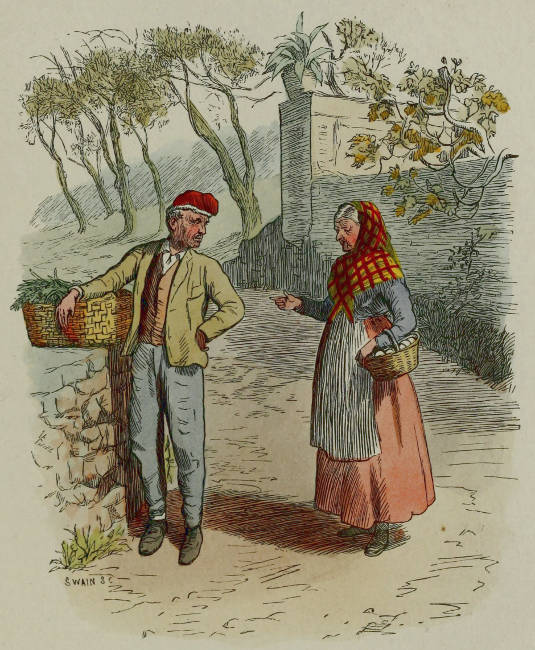
The Husbandman.
And Maria beguiles the way with many a tale, till, rounding a point in the smooth high road, Giovanni pauses to rest his burden upon a wall.
La Donna di Casa. The Country Housekeeper.
Portofino’s bay lies calmly blue beneath a morning sky: the sun shines, and its glamour is set upon dainty ripples of restless sea, where the Mediterranean sways and washes without a quiet harbour. The Villa C—— stands to westward, with face set seaward toward Sestri’s opposite shore, and terrace built inward over the bay. It was a fortified castle once upon a time, long ago, when battles were fought along the coast, and Genoa was a great maritime power; the castle’s battlements are there still, built down into the rock that lies sunk in the waves; around their base aloes and sweet thyme cling to barren soil, and upon their crown a modern dwelling-house has grown into shape, with windows that see the water a hundred feet below, and a patch of terrace-garden growing upon scant mould, between the old walls of the fortifications. A goodly fig-tree finds room spite of scant space, and spreads wide boughs into the castle’s very windows, with fresh big leaves upon them, and luscious fruit thick between; the gate is to the hinder side, looking inland, and, when you find its mouth in the hill-side among the olives, dank and rugged stone steps will lead you within the house, and through the house out again on to that terrace upon the battlements that is sea-framed.
Here lived Teresa years ago when the Villa C—— belonged to an old Genoese marchese of lone life and bachelor ways, and Teresa is the country housekeeper. Her master is her pride, her pet, and her slave; she scorns the negoziante class who can grow rich in a trice, and buy a title, too, since the year 1848! She would tell lies, white or black, for an old family’s honour; day and night her simple soul schemes to uphold, amid poverty, the traditions of a race for whom she has lived alone these twenty years; the coronet of the house of C—— is the fairest of all in her eyes, and there is no place, though ruined, like Portofino Castle and Portofino Bay.
And here Teresa is right. Leaning upon the fortification’s old wall before the front windows—that wall that holds the terrace I have told of, looking around on this sun-lit summer morning that I call to mind, scarce anyone would grumble at Teresa’s verdict. To westward Genoa is hid from sight because of many rocks and promontories that seek the waves, and are pine-fringed and clad with olives; towards the sun-rising a near point—the other of the harbour’s arms, of which our Castle’s pedestal is one—hides neighbouring clefts of the shore, but further on a space, the bays seem to sweep inland with larger curves, and from the point of Portofino Cape many creeks, big and little, go together at last to make the one great gulf that curves round again to Chiavari and Sestri, lying opposite. The blue waves sway softly to and fro with the sun’s glitter on their bosoms; the sky is pale and calm in the heat; white sails and yellow mark the horizon and link sea and sky in the nearer foreground; round shapes of hills along the coast lie languidly to right and left, for the coming heat has sent a white mist before it. This is all looking seaward; from beneath the fig-tree or from off the hindermost wall of battlement you might see that gentle slopes or steeps are around, to girdle the bay—that vineyards and rich cultivations adorn them, that olive and fruit trees shade their sides, that green turf springs near the water, and aloes and house-leeks upon the rocks. And Portofino’s tiny town lies around the head of Portofino’s harbour; this also you can see from off the battlements of Villa C——, can even hear the sound of children’s voices from off the stone-paved piazza—fisher-children, who play around the beach and the little pier—or the harsher tones of women calling and men in argument. Where the land heaves inward and the slopes climb up into hills, chestnut trees grow in place of olives and aloes, and the turf is more mossy beneath them, for streams flow there, on whose brink ferns and the maiden-hair flourish. Looking across the tranquil blue bay, to the hill and cliff over against us, other villas stand up on the green background—where other old families live or have lived with other country housekeepers. And of these our Teresa is strangest and best of all. Watch her now, with Maso the fisher, as she stands in the shadow of the Castle wall, with face set towards that inland aspect that is green with luxuriant vegetation. No silk gown, white apron and sober cap are here the badges of responsible service. Though Teresa’s power be absolute and her position in the household invulnerable, she has rough work to do and wears no stockings to her feet, while her gown is but of homespun linen, her plaited, grey locks are uncovered, and no collar shields a throat that is open to the sun within an amber kerchief. But it is in her strange, strong face that she wears all the dignity of her office. Seamed though it be with gathering years and the labour of life, individuality is set in its every wrinkle, and power in the massive chin, swelling nostrils and heavy brow, while in the keen, black eyes youth’s fire is not yet quenched. Maso is afraid as he stands, leaning with curly, dark head against a cherry tree, for ‘And you think you can pass off your nasty tunny fish on me,’ screams the tall, old woman! ‘And you would like to get soldi from the marchese for what you can’t sell elsewhere, I don’t doubt! Go to, ill-educated man that you are! Sardines for the master’s dinner I will have, if you fish for them even at this hour!’ And Teresa’s palms are poised defiantly on her broad hips, her tall and powerful frame sways with agitation. Maso laughs, but his laughter is timorous, and quickly he turns to run lightly down the hill with the scorned contents of his basket. ‘Yes, yes; you may well run, for back again you need to be in a quarter of an hour, mind you!’ calls the housekeeper in his wake. ‘It is a little fast day, and the marchese eats magro, and requires the fish! Truly it seems impossible,’ continues she, using this favourite ejaculation as she comes slowly up again, and round the outer battlements to the brick-paved kitchen! Its deep-set windows look down the castle wall, and down the steep rock into the sea; the sunlight streams through them to flicker the rough floor over, and noting this, that tells the time of day, ‘Up, and quick, you lazy wench!’ calls Teresa sharply to the gaunt help-woman who slaves at her orders. ‘The Signor padrone will be home presently, and no breakfast cooked, and that linen yet to wring out! Come, lend me a hand!’ So the shirts of the marquis being hung out to dry on the castle turret, in company with sundry sheets and aprons, the crumpled-featured woman falls to fanning the charcoal fire with a feather screen, whilst Teresa chops fine herbs for the master’s daily omelette. ‘Here he is now,’ mutters she half crossly, as a heavy footfall climbs the stone stair, and, bustling into the forecourt that is open to the terrace by an archway, she begins to set out two-pronged forks and blunt knives on a coarse linen tablecloth for the meal. The marchese always eats in this middle court, whence he can see his pots of carnation and sweet geranium-leaf on the terrace, and get a glimpse of the sea behind the leaves of the fig-tree across the arch; but the housekeeper oftentimes scolds at him for not using the salotto in preference, which is dark and dirtily furnished; here, in the hall, the coarse oaken table and carved oak press stand alone with a few rush-seated chairs on the brick floor, and are nowise adequate, in Teresa’s eyes, to her master’s high lineage. He comes slowly, he is a man of somewhat sad countenance—dark, and pale, and fat. He wears a limp, long frock-coat now, but soon changes it for a many-coloured dressing-gown, while keeping the flower-worked smoking-cap still that Nina, his pretty niece, made for him last New Year. ‘I have fairly hunger,’ says he somewhat glumly to the old woman, glancing at the scarce-spread table. ‘So much the better,’ replies this one; ‘vossignoria will eat with the keener appetite!’ ‘It is near to eleven,’ murmurs he again, but would not venture closer than this towards a reproof to the all-powerful donna di casa. Teresa condescends to no reply; but, when she has placed the white-wine flask beside plate and knife and fork, and has retired into the kitchen to put the omelette on the fire, some sense of justice, perhaps, compels her to deal sharp words again to the drudge, and this is the only effect of the padrone’s mild displeasure! But the omelette is good, and the funghi are better than yesterday’s, so when the marchese has eaten a mouthful he is content to obey Teresa’s summons on the terrace that he may see a white-sailed schooner pass across the offing well in sight. ‘There will be ugly weather to-night,’ remarks the woman. ‘No, I think not,’ replies he, thinking of an unfinished tumbler of Monferrato. ‘Vossignoria is not always right, however! It is not the fishers who will make so sure of fine weather because the sun shines in heaven and the sea is blue! Wait and see if they moor not their boats high on the beach before evening!’ ‘May be,’ says the marchese mildly, and returns to his breakfast, while Teresa, approaching that other turret over the harbour, sends a cry out of good lungs to the fisherman coiling ropes in a boat below. It is Maso, who has not sent the fish. His answer comes travelling up through the olive trees, betwixt and above whose boughs the jewel-blue water lies cool in the heat, and deeper-coloured where a rim of midday shadow is around each brown old boat. ‘We have taken a “sea-serpent!”’ calls Maso again, and Teresa hastens within with this piece of news, for the capture of these dog-fish is an event, even if the sight of a shark or a monster cuttle-fish be a matter of yet more thrilling interest because of rarer occurrence. ‘What will Vossignoria take for dinner?’ asks the housekeeper when the tale has been told. And after a moment’s pause for the reply that well she knows the marchese dares not give, ‘You have a miserable portion of sardines,’ continues the autocrat, having been through this daily mockery of humility, ‘the half of a boiled fowl—which well the priests allow on a half-fast day, having but the health you have—two potatoes, and a filled tomato with a fry to finish.’ ‘Benissimo!’ says the marchese, as he has said every day these twelve years, and then he knows he has ordered his dinner.
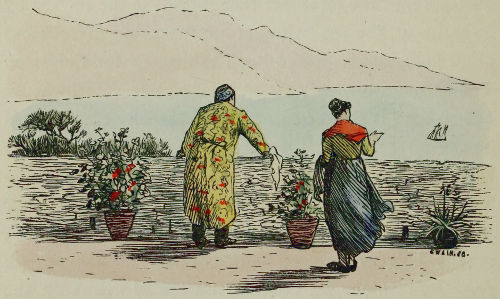
THE MARQUIS AND HIS HOUSEKEEPER.
It is evening and—in the boat that has lain gently swaying in the harbour all day, beneath a pink awning—the marchese takes his nightly row. The dolphins, whence Portofino has its name, sport around the prow, but soon they gather in companies, and sink safely low beneath the sea’s surface, for Teresa was right after all, and there is a storm brewing behind the sunset. The marchese comes within doors with the clothes that hung a-drying, for the rain-drops begin to fall. The boats are moored high, the waves gather white crests over the darkening blue. Even in Portofino’s land-locked harbour that is the safest on all the coast, the waters that were as smooth as glass begin to swell a little with the rush of the sea from without; they are blue still from far, and green from off a boat’s prow, but they are duller beneath the grouping clouds than they were in the searching sunlight. Teresa does not mind, for did she not prophesy that bad weather was blowing up?
Bathing Time.
The blue Mediterranean with warm and buoyant waters laps and breaks around Italy’s peninsula, and Italy’s people are none the less fond of their fair and treacherous sea than we of our greyer and more boisterous Atlantic, even though theirs leaves them no passage northward into other lands, nor binds them about with her waves. Long ago, even so long ago as in the time of the first great Romans of the Republic, Italians loved the shores of their land, and would flock thither from the middle countries to breathe the stronger, if not always fresher, sea-breeze, and to rest and revel in the clear waters of ebbing waves. Many fashions have changed since then, but that one still holds good. From inland towns people fly to the smooth beach, or the rocky, of their sea’s landmark when hot August days are heavy; scarce a family even of the hindermost nobility—and in Italy, as is well known, this nobility is only the country’s gentry—but has some kind of dwelling, good or bad, upon some portion of the shore. Even seaport town people seek the mountains less readily than some village on the coast which they have seen all their lives, for, though briny breezes from off these inland waters can never be invigorating as those that travel across the Atlantic, Italians have none the less fond a belief both in them and in the soft waves wherein they delight to plunge. And of all the sea-loving people of the south the people of Genoa are best at the sport. Crowds seek the Lido at Venice, bathing-houses are built into the waves, music plays and fine water-costumes are there displayed. The rich and pleasure-loving of all nations ply this summer pastime busily at Nice, but none of them know the sea as do they of the quieter Riviera haunts; none of them can leap from sharp rocks to cut the green surface, none can dive and swim, and brave risks of dolphin and cuttle-fish, sometimes even of sharks, as can the dwellers on the rocky coast where no smooth sands help the timid ones.
All along the coast on Genoa’s either side habitations crowd the earth; palaces, time-worn and soiled or new and gaudy, for the rich; tall and thin and straight houses with small rooms and many storeys for the class of the negozianti and artisti; everybody must do the ‘Season of the Baths’ somehow. Quarto, Quinto, Nervi, Bogliasco, not to speak of Albaro nearer town, and then Sori, Recco, and best of all, Camogli, where the stone pines grow in a fringe along the hill’s ridge—everywhere there are houses in flats, with apartments to let; everywhere cottages stand beside palaces or behind stabilimenti, so that all classes should have room equally. The proprietors of villa Franchi, villa Crosa, villa Gropallo, and many more, come in elegant summer attire or in economical costumes, to recruit ‘in villeggiatura’ and to bathe and dive and swim in waters that lap the beach of their own domains. La signora Friuli, who has many children, and whose husband is in the Pasta trade, comes from the fifth storey of a house in the narrow town street to wear out her own old clothes and to send the children shoeless on to the beach of Camogli, whence one and all dip in the mild blue sea. A terraced hill rises behind Camogli’s picturesque harbour, with its fisher-huts; the hill is cultivated with wheat patches and little potato fields, for it belongs to the old palace that stands below, whose walls, once fresco-painted, are now so weather-stained. But the cultivation is of a desultory nature, and the olives are its best harvest, of which the small, sturdy trees stand over the terraces with gnarled trunks and twisted branches. Following the path that leads up to the flat of a ridge, you can reach pine-plantations, where dark and widely-spreading trees stand in the soft earth on the cliffs’ edge and on the side also where inland scenery comes in sight, with church-steeples and houses dotted over a valley’s expanse. The faint, heavy perfume of tropical vegetation hangs around, pine-dust lies thick and slippery on the ground, paths wind about, laurel bushes grow beside them, and, though the western slope look towards mountains, the hill’s crest rests over against the sea again. Waves lap far below, where cloven rocks and smooth rocks and peaked rocks are sunk in the sand for ramparts; waves swell gently for miles in front, more waves of clouds seem to be in the sky, and fishing smacks sway on the sea’s surface; brown sails and white sails lie against the cloud’s background, and the broken coast-line winds back to where Genoa halts, like a fancy city, between mist and sunshine. This is Camogli, where many a man and woman and lad and lass and child has rejoiced in the stagione dei Bagni. And yet Camogli is not the fashionable one among Riviera bathing-places, and we must turn to the sun-setting side of the Riviera capital for a glimpse of the life that is August life indeed to the professional pleasure-hunter.
A railway has been open for some time now along the eastern Riviera: it has marred the perfection of some fair spots, but it has its conveniences, and it cannot spoil far afield. But in the days that I best remember there was no railroad to eastward, and the Ponente shore had thus an advantage over the other in civilization’s eyes. There was a strada ferrata to Nice some time ago, a strada ferrata that some people wondered was ever made: the vetturini, whose trade is marred for instance, and the diligence proprietors, who can no longer count on crowding their vehicles with dust-smothered passengers, or the traveller, who has money to pay for a post-chaise, and can spare time to loiter along the road at his pleasure, enjoying the full fragrance of its loveliness, and providing food for extortion to the innkeepers. The trains never run regularly—some part of the road is always out of repair—you travel in fear of being plunged into the sea, and the carriage route is altogether spoilt. Yet it is a step in civilization. ‘What would you have?’ says the ever obsequious guard to whom one confides one’s wrongs at having been five hours longer on the road than the guide-book stated. ‘Did we go faster, you would be now in the sea: the road is not safe. Patience!’ the invariable ejaculation of an Italian when others but himself are complaining.
To anyone who knows the Cornice from Genoa to Nice the name of Pegli will not be totally strange. It is, or rather used to be, a little fishing village; used to be, for of late years there has been built in the midst of it a grand Stabilimento, whither the town’s inhabitants flock during the months of July and August for the sea-bathing. In summer it is a fashionable place; many of Genoa’s nobles divide their summer between Pegli and some inland foreign baths, whilst the bourgeoise class seek their holiday first in quiet mountainous parts of Italy known best to themselves, but do not fail to return for i Bagni when the rich have left things cheaper. In winter Pegli is utterly desolate, excepting for some few foreigners, mostly English, who try to make themselves comfortable in the huge marble halls of the Stabilimento, built only for coolness, in the delusion that they are safer from bronchitis because they see the sun and know it is Italy, than they would be, snug and warm, in English homes.
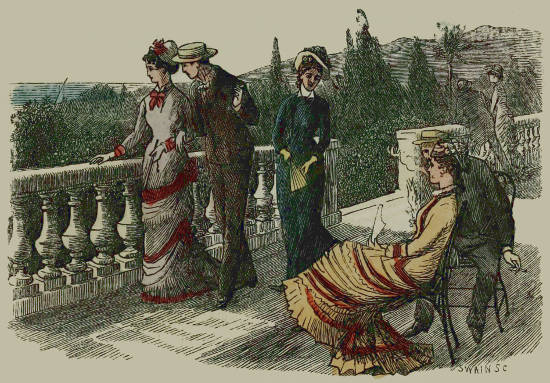
FLIRTATION AT PEGLI.
Pegli stands straggling along the beach of a sunny bay, almost within the Gulf of Genoa. The village itself is not pretty, but around it on the sea shore, with gardens sloping down into the very waves, and stone loggias and terraces whose feet stand in the water, above it on the hill-side, girt about with woods and vineyards, stand many a grand old palace or cool and pleasant villa. True, there are here, as everywhere else, in Northern Italy, queer examples of modern Italian architecture, in thin, tall houses, painted over with every crude tint of scarlet, orange, blue, and violet, bearing staring frescoes of horses and water-nymphs, and balconies out of perspective. But these defective edifices, though many in number, cannot utterly spoil the place. Though dusty the highway and breathless the summer days, the idle, hazy hours are happy that one may spend in the villas or bathing-houses of Pegli. In the Stabilimento for ten francs a day you have (according to the maître d’hôtel) every luxury which human craving may desire. A cool, marble-floored, furnitureless room, with goblin-bedizened ceiling and mosquito-curtained bed, an ample billiard room, an elegant ‘salon,’ a vast dining-room, every convenience for sea or freshwater bathing, even a ball-room, in which to flirt once a week with any one of the pale dark-eyed ladies who invite you to that pastime. Nor is the ball-room the only meet place for this exercise; there is a balcony—two, nay three balconies—and a large marble terrace that you can pace in the cool night air, gently smoking your cigarette in company with an attractive Milanese, Piedmontese, or Tuscan countess. Rising in the morning at five, or even before, you stroll down lightly clad to the shore, where the little waves are washing lazily up and down on the shelving beach, cool and limpid in the dewy dawn; you cross the soft small strip of shingle and parched, wrinkled sand—it is only a strip, for we have no tide—you secure one of those quaint little tents built out into the water and you adorn yourself for the great event of the day. Then issuing forth freely into the soothing water, you meet all the lovely ladies whom you saw last night at table d’hôte, in every variety of fascinating attire. Some are dressed as nymphs, some wear the most elaborately embroidered flannel garments, some have broad-brimmed Leghorn hats, but these are they who fear the spoiling of their complexions, and are few in number. Out of this mass of insinuating loveliness you choose the one to you most sympathetic, you ask her if she swims (but of course she swims, since she is Italian, or at worst Italian by education and customs), you engage her for the morning as you would for a dance, you conduct her out to sea and does she need any assistance you offer it. You talk, you laugh, the hour passes, and you bring her safely to shore. You make your way back to your apartment, return to your couch and smoke. You read the paper, you drink coffee, then you dress, play billiards, and attempt breakfast. You yawn, doze, but not again see the fair water-nymph until dinner at five P.M., when she reappears in other guise, as the perfumed, powdered, languid, and bien coiffée lady of fashion. After dinner everyone saunters forth to the woods and gardens. Those who can, go in pairs, those who cannot in dreary solos or triplets. It is still hot, but not beyond endurance. The Pallavicini Gardens close by are wonderful; waterworks are there, artificial lakes, grottos with stalactites, Chinese pagodas, Swiss châlets, and English farmhouses, besides arbours, into which the confiding stranger strolls innocently, to be drenched unawares from a secret stream, and whence he darts, less confidingly, only to be met by four or five more conflicting streams on some deceptive bridge or turret. There are many more cunning devices besides, and beyond all—or rather not to be marred by them all—is the subtly seductive beauty of Southern nature: the luxuriant vegetation, the waveless dreamy sea, the tender rose-tinted sky, the trickle of many a tiny rivulet, the hot, pale air rich with harmonious scents of orange blossom, rose, and magnolia; and then later on, when the hours have sped into darkness, the whisper of rising night-breezes amid the foliage, the flittering of fire-flies, the shooting of stars, the hush of waves on the shelving shore below, when the water is gently moved by the touch of the wind. Night grows, everyone goes home. The terraces of hotels and palaces are peopled with gracefully-reclining ladies who smoke cigarettes and flirt fans, with obsequious and attentive cavaliers, flattering and self-conscious; with fat dowagers, wearied and sleepy, who yet will not for the life of them retire to leave the field open to younger and fairer rivals. The cool hours wear away—the only hours in which one lives in summer—a short while of sleep, and the early morning is back again with its delicious water duties and the lazy hours that follow on till night.