Part Two In the Apennines (continued 2)
Reading edition
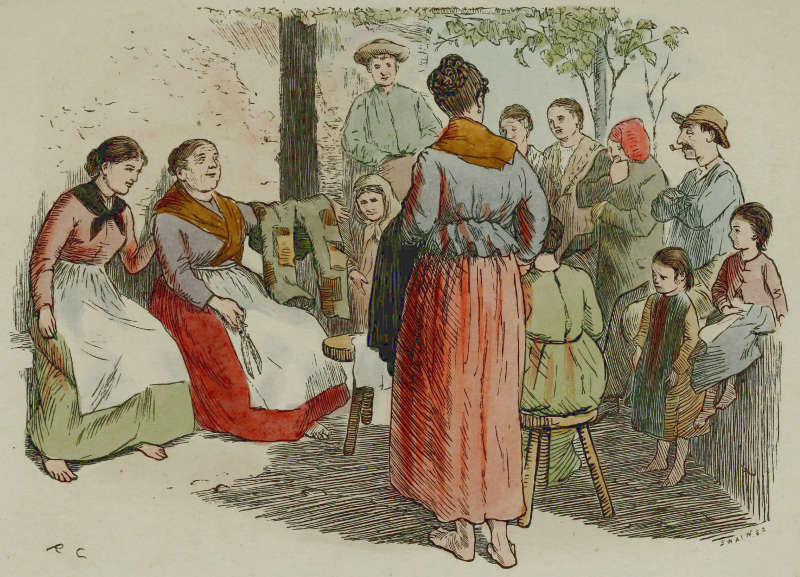
The Village Sempstress.
“I never knew a man like you Gian Battista, for wearing out the knees of your breeches.”
And the old face is as eager as any of the young ones over the merits of pure wool versus cheaper mixed wares. ‘Give over thy silk apron, for the love of the Holy Mother, girl, and just buy a good thing while you’re about it! Who cares whether you’ve a silk apron or a decent stuff one? New-fangled notions from the towns! I’ve no patience with you all! As long as you’ve a good dress, a clean veil, and a little gold on, not the Lord himself but must needs be content with your looks!’
‘Don’t you think it’s too bright?’ objects the anxious and undecided purchaser. ‘They do say that in Genoa one wears nothing but dark colours.’
‘You go away with you!’ retorts the old woman angrily. ‘Why, when you can’t get a colour now if you want it! When I was young that pedlar that you’ve heard me speak of—who used to look two ways out of his eyes, you know—why, I’ve known him bring round stuffs with colours in them that shamed the very Creator of the world! Now, hasn’t the Virgin that they carry round in procession got fine colours on? You don’t suppose the holy Madonna doesn’t know what’s to be worn! Go to!’
And Marrina flings her big shears recklessly into some yards of calico, out of which there issues speedily the roughest pattern of a man’s shirt.
‘You’ve woven good linen this year, mother Teresa. I’ll buy twenty palmi of it to make my Virginia some sheets against her marriage. The girl must have them, and, if her mother won’t give them her, I suppose her aunt must! And you,’ turning to the former girl, ‘not content with a stuff like that for a mere festa dress, when my poor Tonietta has got nothing but a calico frock to have her First Communion! Why, I’d almost believe the wool was English, and they make no bad goods there, for they’re so rich they don’t need to.’
And Marrina takes the coveted stuff in her hands, crushing it to test its genuineness, and regarding it with the eye of a true connoisseur. Then, carefully refolding it, she gives back the packet without another word, and returns to her work.
The sky has become overcast. Banks and boulders of heavy cloud rest on the hills of Savignone down the valley. The mountains have caught the gloom, and look so dark that the ruined castle upon Monte Pilato’s side scarcely shows from off its background. A storm has been prophesied all day, because the air was so sultry; and now the walnuts overhead rustle ominously, and even the chestnuts far away seem to sway as though before a coming strength. Large drops of rain begin to fall.
‘Holy Madonna, and the tempest must come now when we want to keep the wheat upright!’
Marrina takes her huge person hastily away, limping over the stones, and calling with shrill voice to one niece to see to the linen, to the other to drive in the cows.
‘Ah, it’s become a strange parish since the days when I was a girl,’ she mutters. ‘Not a bell ringing yet for the Lord’s mercy against the storm, and it’s upon us, with the corn standing half a yard high, and the maize too!’
Most of the neighbours have disappeared to see after their property, but to the remaining Marrina addresses her complaint.
‘Why, when I was fifteen there wasn’t a stranger in the village—not even other country folk, let alone town folk! And now, because our valleys grow things better than theirs do, they must come and spoil our luck! It’s the strangers do it all. Not but that I admire the fine pink house over the river that Signor Mendicano built, as well as the blue front to the miller’s new cottage, but I say it’s the strangers spoil everything!’
‘You can’t have it both ways, dear heart,’ remarks a young man from beneath.
‘That’s all very well for you, Giannino. The strangers do you a great deal of good, I suppose, when they persuade you to play bowls all day and waste your time! When your land has gone to rack and ruin, and the disease has killed all your vines from want of a little care, they can set it all to-rights, I suppose, by just talking you over to go to America! It’s no fortune you’ll make there, but the fortune of pride and conceit, though you’ll have left your native land for it, and the girl who loves you well! But the young are all alike nowadays—no fear in them, and no fitting shame of things they know nothing about! And, to be sure, it’s not much there is in the girls of to-day that would keep a man to them! Yes, they’ll be all off to get their fortunes too, as if the poverty that did for their parents couldn’t do for them!
‘Ah, the bells have begun to ring at last,’ she puts in as the clashing chime breaks in on her speech.
‘It’s all the foreigners from the towns!’ she goes on again glibly. ‘Now, I remember when I first used to go and mend canonicals in the sacristy for the Prevosto! It was as fearful he was of these Signori as I am. They’ll ruin the village, Marrina, he said. And now doesn’t he go and eat their very minestra—I should even dare to say broth that’s made with meat on a Saturday, if it weren’t I’d be afraid for my soul at saying such a thing of the Lord’s priest! And no more delight does he take in walking under the canopy at procession than—Dio! And there he is with the lady of the Signor Perrino! And a real woollen dress she has on, with this rain down on us! Why it’s a sin!’
Marrina quickly swings herself down the broken steps of her abode, and hastens towards the advancing couple.
‘Fetch a chair for her under the pergola; why it’s no education you young men have nowadays,’ she whispered angrily to Giannino.
The rain has come up the valley in a great mist; it has broken over the fields and the woods in a torrent that quickly saturates the ground; it drops again from the broad-leaved chestnuts. It is scarcely a wholesome rain, though the land was parched, for the hail descends and a violent storm might heavily damage the growing things of the country.
The Prevosto seeks Marrina’s sympathy in this evil chance, but all her complaints have quickly given place to pleasure in the very presence of the townwoman with the real woollen dress on of a working-day. She is only a tradesman’s wife, but she has bits of news from the city and a figured silk jacket to display, and Marrina warms so that she is really mortified at the refusal of beans and polenta, which refreshment was offered at once with the gracious hospitality that comes as naturally to these courteous peasants as the passing benediction or chance greeting by the roadside.
But at last the storm is over, the air is fresh, the soil is fragrant after the rain. The Prevosto goes on his way towards the sick person, whom he has to visit. The tradesman’s wife, after an exciting gossip, returns to the pink house in the meadows. Marrina lays aside her needle, for the night has darkened, and work cannot be done by firelight. ‘She’s a good soul, and it was a beautiful stuff,’ she murmurs sitting by the hearth. ‘But I say let everyone keep to what he’s been brought up in. And as for the strange folk and the going to America, I say, God forbid!’
The Village Damsel.
For a time holidays are over. Until the festival of the Madonna is due, after the dog days, there is no rigorous necessity for laziness. San Giovanni is past, and the most particular feasts of the early summer. Work is again the order of the day, with only the less important interval of Sunday to make a little breathing space—breathing space that will scarcely seem necessary from such pleasurable labour, perhaps, for all the peasants of the Northern Apennines think it indispensable even though they cannot be so fitly accused as the Southern Italians of that love of the dolce far niente which has come to be considered, sometimes most unjustly, such a good description of their existence.
To-day is a giorno feriale, a working-day proper: let us judge for ourselves of the aptness of the proverbial reproof.
Standing on the church steps, as we stood on the day of the Corpus Domini, with the peasants—men and women—gathered in knots on the piazza, and the priest in their midst, you might see straight before you a road running right away amongst the meadows to the river’s bank, while to left of you another way winds itself above the water; and behind, a third, more rugged than ever, climbs the mountain’s side to a hamlet on the mountain’s brow. Take either of those three paths, and you cannot miss coming shortly into the midst of some steady labour.
Down towards the river’s shingle girls are driving cows to their evening drink, women are spreading yellow linen to bleach in the sunshine and moistening it with water that they dash up from the stream with their wooden scoops, or perhaps rolling it into bales before carrying it home. Below them the torrent’s bed widens out in the broader expanse of the valley, with plantations of willow trees guarding its way on the stones, and coronella shrubs bending over from the rocks; above them the water’s line dwindles away to a mere thread as it nears the mountains where it has had its birth. With the heavy homespun in coils on their heads and shoulders, or neatly folded away in baskets which they swing between them, the contadine climb up to the meadow’s level, and so home to thatched cottages where walnuts grow in the fields, to lonelier cottages that stand in strong breezes on the ridge of the hill-side: home to fractious children, famished husbands, sons and brothers—the linen, the dinner, and the supper, have been their day’s work.
And on the broader way that leads to a larger neighbouring village, there have been also wayfarers. The little town that lies some three miles off down the river’s course holds a few things which cannot be procured in the village. It boasts a fair now and then, whence the head of a household brings back a calf or a heifer perhaps, and even on common days the town has a few shops that can produce articles of homely furniture, or even of bright peasant dress.
Nettina has been there this very afternoon. She is coming home as cooler shadows lengthen over the meadows and furrow the hills: she has a new wooden conca on her head—the old timeworn copper one has been soldered so often, and yet always wears through and lets the water leak! In her hand she carries shoes which clash against a red earthen pot that is one of her purchases, and her large, shapely feet rise up and down off the sharp stones as fearlessly as though her way were across the cool turf of the meadow. Nettina is considered a handsome girl. She has keen dark eyes, a well-cut face, a brown skin, and black glossy hair that ripples gladly down beside her face and behind her ears, its plaits fitting round tightly into the head’s hollow above the nape of the neck; her teeth stand in beautifully even rows, large and white, and ready to be shown upon the slightest provocation to a smile. She walks well: though she must have been walking all day, she walks well, and is not tired. Her head is erect—the wooden bowl, poised on the cushion of her own knotted kerchief, only sways with the motion of her own gait. Her square shoulders scarcely give at all to the swing of her quick step, but the limbs move freely, and the body sways easily on the hips, upon one of which she holds a hand, as though to steady her step.
The last corner of the road has been doubled, and the well-known church spire with its blue painted belfry is in sight. Here the path from La Madonna della Vittoria strikes the main road. A man descends it now. He should be a young man from the strength and speed of his step, but his face, and even the top part of his figure, is not visible, while his gait is of necessity stooping, for on his shoulders he bears an enormous load of hay packed into an enormous wicker pannier of coarsest network, through the holes of which long grasses press out to hang in a fringe around him. Nettina, however, seems to know, in spite of travesty, whether he be a young man or not.
‘A happy night to you, Beppino,’ she calls out, but without stopping her way.
‘And is it you, Nettina, of the walnut-grove? What, again to Ponte Novo? How many days in the week do you go to Ponte Novo?’
‘You’re an ill-educated man to speak so! But I pay no heed to you. Why should I wish, suppose you, to go to Ponte Novo? But a woman has duties which you men only remember when she forgets them!’
‘You say well—you say well! All the same the miller’s son who lives at Ponte Novo is better than the poor devils who grow the gran turco up in the valley! Eh, I should like to see what you look like now?’
‘But you can’t! And it’s like your impudence to think I should look anything for you to see! I shall have no shame to tell you, when I go to say the “Yes” in church, that you may count upon! So I will give you the holy night.’
And with this greeting Nettina hurries on. She has the water to fetch, and the supper to see to. She has no time for further parley. Only, as she walks, her white teeth are the better to be seen, as she thinks over the little conversation.
The sun has set. The sky is deeper and further than ever, for it is more transparent now that there is only a remembrance of the rosy glow. The solid hills meet the air that seems almost solid, too, so far away; their outlines lie peacefully upon the sky, soft browns and greens of pastures contrasting with the harsher character of rocks, and again with the softest quality of clouds. Just opposite, Monte Pilato breaks from out the quiet line of the horizon to strike up a great mass into the air, and at the foot of the valley Monte Cranio makes a mitre with its two sharp peaks, in whose clefts one can see the chestnut trees’ outline even from this distance.
The woods cluster so richly over the country that there scarcely seems room for the waving wheat to grow, for the large-leaved maize, nor the tall grass of the meadows. Below the road, some hundred feet, the river is creeping lazily, but now the rush of water over the weir warns Nettina that she is close at home, and must leave the river’s bank and climb a steep bit of path to reach her cottage on the hill’s ridge. Yet her figure scarcely stoops, nor her pace slackens, though the way is hard. To her right a little gorge cleaves the land, in which gurgles a half-parched rill, and Nettina’s lungs have strength, even as she climbs, for a merry shout to the labourer who works on the opposite side.
Now she has gained the more level road above. On her right hand, thick chestnut woods clothe a hill-side that slopes up toward the horizon; but on her left, fields, and vineyards, and meadows lie in fertile terraces one below the other, until they reach the valley’s depth where the stream, shallow sometimes and calm, then tossed and wayward, flows onward to the larger river. Chestnut woods again are upon the further slope. They grow and flourish everywhere—tall and sweeping where the ground is richest, but finding room even upon those narrowest ledges of earth for which the rock makes a little place. The woods are not very dense, nor the trees noble and stately, as in English parks and forests, but the trunks are old, and hollow sometimes, or gnarled again and sinuous and sweetly scented; the branches are curved, and graceful with a strange and pertinacious grace; large and full-veined leaves fan kindly in the breeze. Who would seek fairer and pleasanter woods wherein to pass summer days?
Now thatched and sloping roofs and whitewashed walls of cottages peep out from between the trees, and the damsel knows that she will soon be home. For there is the village which lies opposite to her own across the gorge, and little lights are already beginning to flicker from its open doors and windows. Not lamp-lights, or even rushlights; in the July days, at least, no light is needed after daylight is gone but the light of dying embers or of newly kindled sticks upon the hearth. These that she sees are the flames of the wood fires just lit for supper. And Nettina hastens forward with quicker step. There is a cool wind creeping softly about, and even the noise of the rushing water below seems to freshen the air. She has entered the hamlet. Walking upon the soft dead leaves which have been strewn over the stony way, and running up the few broken steps beneath the little pergola, she turns in at the cottage door.
The mother is on her knees, blowing from her sound lungs upon the struggling fire, whence the white wood smoke ascends freely. The kitchen is an odd and dingy little place, with its solitary window and blackened ceiling, where slender rafters are set widely apart, that the chestnuts, strewn over the floor above, may be dried during winter by the heat from beneath. There is no glass, moreover, to the window, but only heavy little wooden shutters; but these are not often closed, and the free air blows in by night and by day, bearing the sweet scent of carnations, that stand in a broken pot on the sill. There is no door leading into the sleeping-room—only an aperture in the wall. The pot hangs over the fire by means of a heavy chain from the centre beam. For the hearth is in the middle of the room in these Italian cottages, raised a few inches above the rest of the floor.
Rough benches stand around it, and these, with a table and a dresser at the further end, where paste is rolled out for the maccaroni, are all of dark walnut wood. The room is the dwelling-room as well as the kitchen—this do many little signs of rough comfort and homeliness abundantly testify. Red earthenware platters are ranged on a shelf, and several curious water-vessels, of earthenware, or metal, stand about, giving colour and quaintness to the room. On a low wooden stool without the doorstep sits a little maiden of some eight or ten years, dark and richly brown, like the greater part of Italian children; she shells beans into a platter of quaint yellow ware, and beside her, upon the low wall of the little terrace, sits another child—older by a year or two, who carries a tiny, swaddled mummy in her arms. She is no doubt the daughter of some neighbour, and is sitting here with her little charge, that she may, at least, not be scolded by the mother and worried by more babies at home.
‘Hie thee to the well, Nettina,’ says the elder woman, almost without looking up from her task, as she sees her daughter stand within the kitchen. ‘Thou hast been long at the fair. But patience! I will kindle these two sticks while thou art gone, and then we put on the polenta. Haste thee.’
The girl has already twisted her kerchief into a firm little cushion upon which to rest the water-vessel on her head. Then she takes the great copper conca and sallies forth.
The village fountain lies hard by, and at this evening hour it is thronged with women, young and old, in quest of their nightly supply. A great chattering may be heard; the well is a trysting-place for young men and maidens, and a place of gossip for the old women: it is noisy. Nettina has ever been a favourite; proud though she be, she is fond and gentle, so that, peasant girl as she is, she has more tact and courtesy than many a high-bred lady. The girls welcome her loudly, and would fain detain her awhile for the usual exchange of confidences, but she is firm to-night in her resolve not to loiter, and only laughs at the importunate questions of companions, all eager to know if that rumour be true about the new gallant. The conca is filled in a few minutes, and then lifted to its place on her head; lifted, not painfully nor clumsily, but with a movement full of that grace for which these strong and hardy girls are so specially remarkable. Watch her now as she descends the steep and stony path upon the village. Her figure—strong and beautifully measured—sways gently upon its hips, her knees are straightened slightly, and her toes are pointed that she may the better feel her way as she comes down the hill. The way is rough, and the stones roll from under her, neither dare she look to her steps by reason of the burthen on her head; yet her bare feet tread none the less firmly, nor fear to cling to the rocks. The brown column of her throat grows erect to support a shapely head from out curved and goodly shoulders, and, beneath a soft silken kerchief which she wears loosely across the top part of her figure, the breasts swell tenderly. One arm rests curved on her hip, as though to steady her gait; and, even through a sleeve of soft, stout stuff, the firm moulding of the flesh can be distinctly traced. The other arm hangs at her side, and seems to emphasize the graceful motion of her limbs.
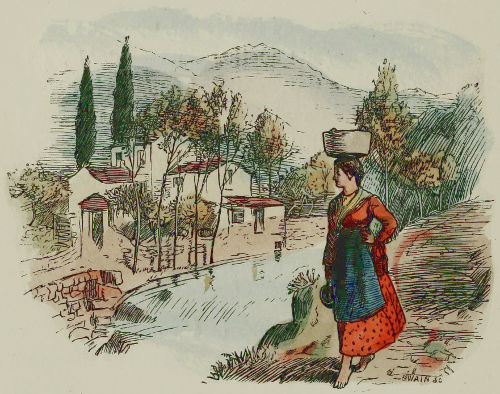
NETTINA RETURNING FROM THE WELL.
The polenta is boiling in the great pot, the beans are shelled, and the neighbour’s baby has been carried away to be unswathed and swathed again, when Tonietta, playing now in the road, shrieks out in her piping treble to say that the signori of the villa are about to come by on their evening walk. Nettina steps out upon the terrace, the wooden staff in her hand with which she has been stirring the pot, and even the mother is no less curious to have a peep at the blue muslin dresses, and starched frills, and elaborate-dressed hair of the gentry. They pick their way over the dirty ground with dainty shoes, no wise fitted for mountain wear. The ladies belong to a fine family of negozianti, who have rented the doctor’s house in the larger village. They are grand now, and glad to be stared at, for it is the eve of a great festa, otherwise might they be seen in the mornings, around their lodging, in attire far more slatternly than Nettina’s at the present moment.
‘Orsù,’ whispers the elder woman loudly to her daughter, ‘haste thee, and dish up the polenta. The signori will eat with us to-night, who knows?’
But ere the meal is served and ready, the fine ladies have gone their way, mobbed and gazed at by many children, commented upon by many voices of the more learned ones.
Further down the village, families are already at supper, eating their minestra from off wooden platters, while they lounge in the cool upon steps and balconies of rough stone.
‘A happy evening, pretty ladies! Come and eat a mouthful with us.’ Such are the courteous invitations poured out from all sides upon the passers-by. Hospitable-natured, for all their rough simplicity and their poverty, these good peasants are gracious and gentle-mannered, with never a thought of false shame. What they offer is of their best, and the gift needs no apology. Frank and primitive people, with winning and cheery ways, are these. Often have I rested with them beneath vine-trellised pergole, eating of their savoury food, or have sat upon a wooden bench, when youths and maidens gathered round the hearth on autumn evenings to toss and roast the chestnuts, and always have I been cared for as an honoured guest, while yet the merriment and the plain-speaking went on alike, nor did irksomeness creep in amongst them because of the presence of one guest who was not of their own caste.
But the twilight is fast deepening into night. The signore have doffed their holiday clothes, doubtless, and are eating their supper by this time. Within the cottage there is scarce time to display the goods bought at the fair, scarce a moment wherein to question and marvel at the centesimi which were deducted from each bargain, before the men are all there, clamouring for the supper that is so late to-night, and laughing at the yellow kerchiefs and tapes and buttons displayed to view on the kitchen dresser. All the purchases are quickly cleared away for very shame! Nettina lifts the flat baskets within doors, in which maize has been drying all day in the sun, and gathers up the golden cones that were hanging on cords along the cottage’s front; that other gold of the gourd-flowers, where they trail on the ground, changed to green an hour ago, when they shut their petals with the sunset.
Men and women close round the hearth, for supper is ready at last. ‘The minestra is good to-night,’ some one remarks; ‘the faggioli are boiled to a savoury pulp, the tagliarini are finely cut.’ Darkness has fallen; nine o’clock strikes. ‘Good-night, neighbours; I am weary,’ says Nettina. ‘Good-night.’
The Village Swain.
Ask Nettina what she thinks of him: pretty, proud Nettina, who can tread so stately a measure at the village fête, and can throw so scornful a glance at the man who has been too frivolous for her well-ordered mind! Well, maybe she is a bad one to choose for a fair opinion, for whether he please her or no she will toss her head, and answer you only with a gruff ‘Cosa me ne fasso?’ which, being interpreted from our dialect, means, What is he to me? So, better than that, ask our village pet, our dear little cosy, most comfortable, and convenient of flirts—Bianca del Prato; she will tell you truth! Yes; though with her lips—curling, smiling, rosy lips—she only simper, ‘he is not amiss,’ yet does not the creeping crimson colour say as clearly as any words, and would not the two brown eyes say so too, if only they were not cast down, ‘The village swain? He is charming; he is beautiful! Life would be nothing without him! And the red kerchief that I wore at the fair is lovely only because he told me my lips could shame the colour even of that.’ And yet he is not Bianca’s betrothed. Prepare to be shocked, oh righteous damsels! He is only one of the village swains—only ‘a young man like every other’—only a youth whose name and whose voice she knows well, the fire of whose banter she has stood bravely, the glance of whose eyes she has blushed beneath, nothing more. But where would be the use of the summer sun, thinks Bianca, if one might only look pretty for one’s own gallante!
There are three village beauties—you have seen them all. There are four village beaux—of the very first water! So much the better for the girls, they think! Pietro Mazzacane shall serve us for a type.
If, from the church, you take the straight road that has led you before to the home of Marrina, the sempstress, and if, instead of following your shadow, you turn to its right, and cross the river upon those odd old stepping-stones, if you do this of an evening after work hours, and climb the opposite hill till you reach the hamlet in front of you, maybe you may find Pietro smoking a clay pipe on the doorstep, whilst he devours a goodly bowl of the home minestra. He is a tall man, not heavily built, not even very broad-shouldered; as he lounges, one leg bent, one arm upraised behind his head, consolation’s emblem in clay between his lips, as he appears now, propping his manly form against the grey stone of the cottage wall, you might scarcely believe him to be strong or even a good labourer. His crisp black hair vies with the tendrils of his own vines in curly, wayward beauty; his dark, deep eyes tell of fire that can swiftly be roused, of love tales that can sweetly be told; his lips are ruddy, his limbs have the subtle shape which should be theirs. All this you will allow: even of his yellow skin you will graciously say ‘it harmonises with the rest.’ But still you doubt that that man can ever labour with the stern strength that labour demands: he does not look like it. And you are right. Put him to till your ground, to dig your trenches, to plant your potatoes, and his long lazy limbs will achieve not a whit more than you gave them credit for, though his clay pipe will work busier than ever, and his siestas be the more frequent as also his merry jokes and his friendly conversations.
But do not judge our Pietro’s powers from your trenches. Get up some day, when the steaming land bids men know how brazen will be the mid-day’s heat—get up when Pietro, when Nettina, and when Bianca get up: at three o’clock in the morning. The sky is grey. Perhaps there is not a cloud, and yet it is grey with a solemn greyness, and one would scarcely dare to hope for the rosy young light that will steal over it before long to flush it slowly into warm and fulsome life.
The mountains seem very near; their peaks and cones look very tall as they stand out of the morning mists that creep around their girth and wind themselves away into the hollows of the hills. Perhaps you find it almost cold. So does not Pietro. Only the sack in which he is to carry down a load from the mountain is wound round his shoulders above his linen shirt, but the keen exercise stands in place of covering, for an hour’s hearty lung-labour has brought him out upon the cone of Monte Marzo, some five hundred feet above the placid valley of his home. Bianca has driven the cows to pasture upon the slopes just below, but the village swain has only time for one shout in far-off greeting now; it is his own business that he is about, and his own corn must not rot, nor his own land lie fallow for want of a good day’s swing of the pickaxe. What say you now? Are not his muscles tough, and is that arm not mighty that hurls the zappa above his head and brings it down again into the stiff clay to dig up his field?
Look around you off this mountain-top. Behind you lies Monte Stella, before you the range of the Polcevera hills, to your right Antola with her great stretching shoulder and heavy-browed summit; below you are valleys, where meadows lie and waters flow and fall and trickle; and everywhere on high hills and descending slopes there is cultivation. It is no lazy race of men that has notched those mountain-sides with terraces the better to train the vines towards the sun, that has planted them with corn and maize, with peas and beans and potatoes, with fruit trees of every kind, that has trained the gourds and the vines, that has utilised every strip and corner of land upon the steeps, that has quarried the stone, and fed and tended the silk-worms. ‘Per Bacco, the Lord Himself could do no more,’ Pietro would tell you as he shoulders his huge pickaxe and, beneath the chestnut wood hard by, gathers and crowds into his sack no mean load of the first fallen leaves to strew beneath the cattle in cattle-sheds. One does not go down the mountain empty-handed, even after a hard day’s work, and no one could say that Pietro does not show to advantage running down the steep with faggots on his shoulders and over his head—running to keep his balance on the rough and rapid incline. Though Bianca would laugh if you found anything to admire in him at such a moment! ‘A young man not amiss, I grant you, but with a load of foglia on his head—Dio, what a taste!’
No, Bianca likes him better on the days when, he being somebody else’s brother working with her own father, she can go with ‘somebody else’ to take the meal to them at midday; better still on the days when he is threshing with all the neighbours on her father’s threshing-floor, and comes to eat a cena of her own preparing in her own home; best of all, when there is a fair at Ponte Novo or Bossola, and she, who is going to buy conche, can walk by his side, who is going to buy cattle.
Yes, those are fine days! One goes to see a friend the evening before, and gets one’s hair plaited in a beautiful resca di pesce for the morrow’s adventure. [It does not get tossed as you might fancy; the sleep of the just is sweet and sound.] Then to rise with the daybreak, to don one’s best bordato dress, to fold one’s yellow kerchief, and tie one’s heavy shoes, that all ‘goes without saying’ for a girl. That would be done for mere pride’s sake, whether one’s gallante lives in Genoa, as Bianca’s does, or no.
And is it not the merest chance that Pietro, sauntering up the hill with two or three other young fellows abreast, all of them with hands in their pockets, and pipes in their mouths, and carnation in their soft felt hats, is it not the funniest thing that Pietro should just meet ‘Bianca bella’ upon the bend of the rising ground, where the town first comes to sight, and just have been making a joke about her to Giovanni, too? Well, well, at all events, Pietro has a very bright red scarf to gird up his loins, and a very specially handsome carnation, and quite a remarkable blue cravat, besides wearing his hat a little more to one side than the rest. He looks quite as well as if he had been dressed in Genoa; one cannot be expected not to see that, though one has a lover in the town! And Pietro knows that Bianca has seen it, and is as pleased as he need be.
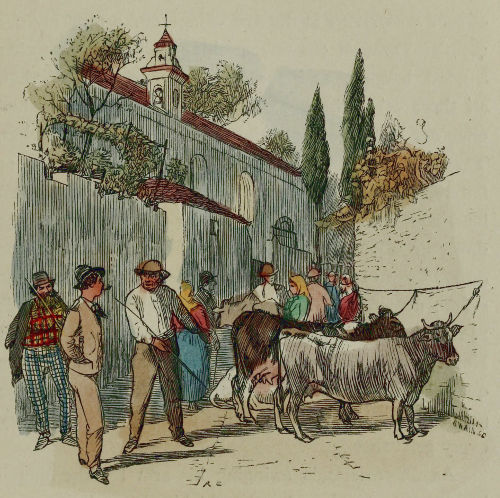
THE VILLAGE SWAIN AT A BARGAIN.
Surely no man ever had his way with the girls better than Pietro! Though Bianca picks up a friend at Cerisola, and there is a great deal of talk about woollen stuffs, our swain still fancies even the female rubbish is trimmed and fitted to his special ear. Oh, blessed and invariable male content! A pretty girl in front who cannot fail to admire the best-looking man about, a glass of sour monferrato at the first village, and a pipe in your mouth—Paradise can offer nothing better! Excepting a good bargain, and for the better chance of that, all those other three good things are abandoned when once our Pietro gets into the thick of the cattle market. That poor pale little brindled heifer means success or failure, perhaps for the whole year, to our modest land and farm-owner. No wonder that knuckles come down bravely on the little three-legged table of the osteria where Pietro sits face to face over wine with the seller; no wonder that oaths are frequent, and words run high! Is it not a question of two whole francs? Nevertheless, they split the difference, and make up the quarrel till it needs must be opened afresh over the game of bowls, whither buyers and sellers soon carry every grievance.
As Pietro stands swinging his arm for the fling—handling the bowl or stooping for his aim, as he saunters about among the company or drinks his glass at the open-air bar—in all or each of these poses he is an object of admiration to many even more than to Bianca del Prato, who has seen him grow tall ever since the day, ten years ago, when he switched the cherry-bough back into her face! An object of admiration, and, though he is a simple-hearted fellow enough, to none more than to himself. Is he not young and healthy—what better can he do? And no doubt he is right! Though Bobbio can perhaps produce better and Cerisola several as good, our Pietro is a good enough example of his kind. He is not very religious; he will laugh at the priests to their face when they pass in procession, and make fun of their Latin, but he will bend his knee and doff his hat and wedge his person just within the church-door at benediction time, or when the bell sounds at the elevation, as a good Catholic should: what man of sense does more? And at a bargain he will hold his own to the last, and come off triumphant if it be only to one centesimo; what better praise can one give to a man’s honesty? Surely, Pietro Mazzacane is as good as you could wish for a village swain!
The Love-letter.
There are three of the village girls who are prettier than its other girls. One of them is red-haired and buxom, with pink cheeks and white arms—she is the most admired by townsfolk: village folk have another taste. Nettina, from the walnut-grove, carries the palm with them—she has a figure that is grand in its every line, and when she dances on the green on a festa night, she does not bound and frolic with uncurbed merriment, but moves stately through the ring, and has no mind for any foolish jest with men that are from the cities. Nettina is a very proud and modest maid—she cares for no new fashions of dress, she is thrifty and patient, and when she walks up the steep from the church to her father’s cottage she can bear the floursacks on her shoulders or the dry leaf on her head without show of weariness or stain. ‘What a fine chip of a woman,’ say the village suitors! But Nettina looks neither to right nor to left till a fitting offer be made and a trusty mediator ready to negotiate—so—to meet coming down the mountain or at the well of an evening or upon the piazza at Ave Maria and at the fair—Bianca even before Nettina is the pet of our village. She is grey-eyed and smooth-tongued, with long hair and lithe figure, not proud nor hasty, but good-tempered and merry, with ready jest, when the evening’s ‘chaff’ has hit the hardest. Moreover, she can deftly spin the distaff and weave linen on the hand-loom: Bianca is San Matteo’s second belle.
The daylight is gone, but the clearness of the summer’s night is as good as the sun. Supper has been cooked and eaten at home; the hearth is swept, and though the Angelus has finished sounding awhile ago, and resting-time is near, our Bianca sallies out into the white evening to do a commission that has been on her mind all day. The Signor Cappellano shall earn four soldi to-night, and who knows if he shall not earn some more on the day of the wedding, for Pietro Gambari is rich, and every priest shall have his due. Already she begins to dream of that pretty day in the mellow autumn, and of the silk dress, which surely such a promising lover will not fail to bestow for the marriage, even besides the gold which it is her right to expect! And so many confetti for the children! Bianca is rash. She is going to negotiate a little for herself, without the help, as yet, of the inevitable mediator. But only a little, to the extent of answering a love-letter! If the suitor be true and worthy, he will find the mediator to send to her father’s house.
There is an early moon. It hangs in the clear sky just above the church spire, and floods the piazzetta with grey light. The leaves of the walnut tree near by shiver gently, and the black cypresses in the burying-ground look very ghostly, but far off the moonlight only makes things lovelier. Everything is a little mystified in its treacherous beams, only the mountain’s outline looks more simply clear than even in daylight, when white vapours are prone to stray upon the border. Monte Bruno’s three cones stand, in even row, against the southern sky, and the moon is so bright that you can see the large chestnut that grows in one of the curves. Mon Pilato rears a tall mass into the nearer distance. The Cappellano’s cottage stands quite in the shadow of the oratory of San Gian-Battista, and there is even no light in the window this evening; but ghosts are few in the pious valleys of the Scrivia—Bianca has no fears.
‘Are you at home, Frà Giuseppe?’ she calls from below.
‘Who is it wants me at this hour of night?’ growls the under priest, as he comes out upon the stone balcony beneath his porch? ‘And is it you, Bianca bella? Come up, come up only!’ Even a priest is appeased by the sight of a pretty girl. ‘Who would have thought of your coming to visit an old man like me?’
The Cappellano knows as well as another what is likely to be the errand of a damsel who seeks him after working hours! But he is not in canonicals, and would not be averse to a little amusement on his own account before the love-letter business begins.
‘Come in, Bianca bella, I have two mushrooms in oil on the hearth, that, if I don’t mistake, you will thank me right prettily for when you have eaten!’
‘O bella!’ cries the girl laughing, ‘Bella come il fondo della padella’ (pretty as the bottom of the frying-pan), ‘as the proverb says. You don’t take me in with that kind of fun. I come on business.’
But even while she speaks Bianca has seated herself on the bench beside the hearth, and is proving the merits of the mushrooms.
‘How goes it, Ninetta?’ says she the while to the old servant. You have a fine time of it with this man, I can take my oath. If I live to be a hundred, I’ll have nothing to do with men.’
Master and maid burst into a loud laugh.
‘I suppose it’s not to see the colour of my ink that you’ve come again to-night, then, you little liar.’
The Cappellano makes as though to pinch her cheek, but thinks better of it, for the girls of this village are very proud.
‘Well, well, I have a new bottle of beautiful red! Oh, what funghi, eh? Come into my study. I never do business in the kitchen. Ninetta has the long tongue; and a love-letter, why, it’s as delicate a matter as the confessional!’
‘Vossignoria can easily jest, because you are but a priest, who knows nothing of these things’—Bianca blushes and is pleased as she says this—‘but indeed it is of no love that I speak to-night, and that you might have known me better than to suppose!’
More laughing; nobody believes a word that anybody else says! More chattering, and a little good, sound gossip; then the Cappellano leads the way to his study. It is not very different from the kitchen. Instead of a hearth in the middle of the floor, there is an old, rough-hewn table; instead of bright copper and earthenware vessels upon the walls, there are strangely-coloured maps of the two hemispheres. Two or three books bound in white calf—breviaries perhaps—lean to one or other side of the bookcase shelves; in the table’s midst is an ink-stand with a sponge soaked into it, a sand-pot, and a steel pen. The Cappellano sits before these implements, takes a sheet of pink paper from a drawer, dips the pen in the ink, shakes it, writes the date, and awaits further orders of Bianca, who stands smiling to herself in a corner.
She has a blooming, winsome face, grey eyes that are soft and shady, and crisply waving hair; she has full lips, too, and lovely rows of white gleaming teeth, and she laughs as she pulls a letter from her pocket.
‘This is the one which he wrote to me,’ she continues. ‘Perhaps you may like to see it, that you may know the style that will fit him best.’
‘No, no! my daughter; I have written many a love-letter, and can trust to my own sense,’ grumbles the scrivano, as he sets pens and paper in order, for he has his own well-worn phrases ready flowing to hand, and would be greatly discomfited at having to invent any new ones. He puts on his spectacles, smoothes the fair sheet of paper, and, dipping his pen in the ink, again glances up at the girl for instructions. She meanwhile stands awkwardly before him, smiling to herself, and ejaculating beneath her breath, as she twirls her apron mechanically round finger and thumb.
‘But I never said it was a love-letter,’ she says at last, laughing again.
‘Eh, well, well, my daughter. A letter to a gallant, then? What matter? it’s all the same thing. Tell me his name, and whether you mean to have him or no, and then leave the rest to me.’
‘But no, Signor Cappellano,’ remonstrates the damsel eagerly; ‘it is not just so. You must understand the affair.’ And she comes closer to the table, for Bianca wants to have a finger in the matter herself.
‘You see,’ she says, ‘the young man is rich and fine, they tell me, and a good match for me, a poor contadina: I don’t want to send him quite away. But then, I don’t just know either if he will suit me or no! Now you, who know the Latin, and are fine and wise, you can put it grandly, what I mean.’
‘Yes, yes, my daughter, surely; so tell me what to write first.’
‘Well, first you shall put,’ and Bianca plays again with her apron, ‘You shall put—that I have received his letter,’ she blurts forth, as though struck with a good and sudden thought.
The fine steel pen proceeds to work, and makes a few flourishes on the pink paper, while the girl looks on, eager and intent.
‘That have I written,’ says the scrivano at last. ‘What next?’
‘And next, next! You shall put that he does too much honour to a poor peasant girl such as I.’ Again the pen moves warily over the paper, and this sentence takes long to indite, for it can be inflated with many a fine word and sentiment; but in time the scrivano looks up for fresh matter. The girl is sorely perplexed, indeed.
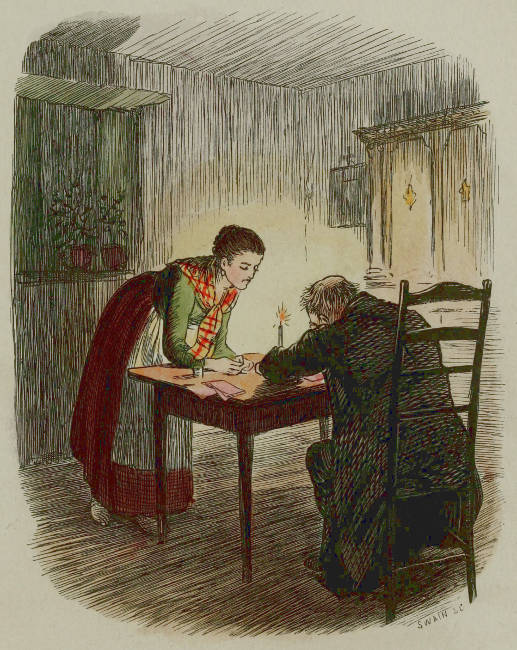
The Love Letter.
The fine steel pen proceeds to work, and makes a few flourishes on the pink paper, while the girl looks on, eager and intent.
‘But, vossignoria, who knows Latin,’ says she again, ‘can you not put together a fine letter?’
‘That can I do, my daughter; but do you wish me to say he shall come and see you or no?’
‘Well, you will understand, vossignoria, this is about how it is. Pietro Gambari is a rich young man, and I am only a contadina. For me, I should not mind being a miller’s wife, but it is not enough that the man tells me I am graziosa, and would give me earrings.’
‘The Virgin forbid!’ ejaculates Frà Giuseppe.
‘Well, that’s what I say, and so I spoke up to him, “Signor Pietro, if you wish to know of me,” said I “you can ask Pasquale, the baker, at Ponte, and for me I will inform myself of you.” And that I have done surely, but Pasquale has heard no word of this fine youth, so when he lets it be written to me whether I go to the fair at Damigiano or no, I wish to say, “Signor Pietro, it may happen I go and it may happen I stay at home,” and who knows but that may bring him to his senses! Oh, but you who know the Latin will understand better than a poor girl like me!’
‘Surely, surely, figlia mia,’ replies the Cappellano, returning to his flourishes on the paper, ‘we will say all that and more.’ Yet, in truth, he is somewhat puzzled at the prospect of something outside of the elegant ready-made phrases that have served the parish for sentiment during the last twelve years. Bianca begins to grow suspicious after a few dozen lines.
‘You understand,’ she says, ‘he must come, and he must not think I want him to come. So I shall go on the arm of Pasquale, and if he comes I shall leave those two to arrange the business as well as they can. Not another smile from me till I see the gold of his gifts to me and know his position! I am an honest girl, and no fool! And who knows but it might please your honour to tell him,’ adds she, as though struck by an after-thought, ‘that Paolo of our village is speaking to the manente about me! It would be but a white lie, for it was true a while ago, and I could tell it quickly in confession!’
‘Oh, for that, no matter; but it is whether he would believe it, my daughter!’ replied Frà Giuseppe. Nevertheless, something he writes down. Poor credulous Bianca!
‘I want naught else,’ says she now, thinking of her pence.
But the priest means to earn something more yet out of this weary letter.
‘You have said nothing, hitherto,’ he complains! ‘Poor young man! He won’t know if you mean to have him or no! One must give him at least to understand if you mean to look favourably on his suit.’
‘But if I don’t know myself?’
‘Eh, eh, per Bacco; what is to be done then?’
There is a long pause. The scrivano’s pen glides cunningly over the sheet: it forms capital letters, and small letters, and flourishes; it reaches the bottom of the page, and then he takes the sand-box to sprinkle it over. Bianca has looked on gloomily. She has been watching her little earnings ebb sadly away in all those lines, and strokes, and dots, and yet it seems as though she were to get no good out of this epistle. She is very sore and angry.
‘Is there anything more?’ says the little man, at last, in a provokingly mild tone.
‘No, per Bacco, there is no more! Is not that enough?’ she mutters crossly.
‘But I have said no word as to whether you will have him or no!’
‘Eh, Holy Virgin! Say what you will! I care not! For the rest, so long as you make it fine, he will not understand much of what you mean, unless he is more of an ass than I take him for. Give here,’ she concludes, petulantly, ‘till I put my cross.’
And the letter is sanded once more, as Bianca pulls out her silken netted purse.
‘How much?’ demands she; ‘and are you sure the affair will lead to a good end?’
‘The Virgin will see to your right, child, but twenty soldi are not too much for this. I say it with a clean conscience!’
‘Dio! what a bold heart you have to rob a poor girl so! And if Signor Pietro does not come after all, and if I am forced to content myself with a peasant?’
‘Eh, anima mia, that will not be my fault!’
‘But it will be the fault of your letter! Oh, these men, when I could have written it so well myself! But I can tell you, you may keep your fine scrawl many a day before I give you a franc for it. Ten soldi, come!’
‘My child, you dream! Ten soldi! I might have made two Spiriti Santi in the time. Impossible! Eighteen.’
‘Nevermore,’ declares Bianca, staunchly. ‘Before I pay you eighteen soldi I take the letter to some one who knows how to read, and I make myself be told if you have said what I required.’
The poor scrivano begins to get frightened. What would this bode? He might never write a letter again. ‘Make it fifteen soldi,’ he pleads.
And long and hotly they wrangle ere the price can be fixed between them, but at length a compromise is effected. Frà Giuseppe is to put up with twelve soldi now, and to have a hand in the marriage ceremony, if the letter fulfil its purpose. What more could justice demand? The document is folded and sealed. Bianca exchanges it for the dirty coppers, and with a hasty leave-taking makes her way across the stream and up the rugged path to the thatched house, under the chestnuts. Neither Pietro Gambari, nor soldi, nor Cappellano, trouble her slumbers much in spite of all apparent excitement. Even a white lie rests lightly on a conscience of eighteen years old, that gets up at four in the morning.
La Cresima. The Confirmation Day.
The cherries are over; neither large, black nor small bright ones are on the trees now, and the wood-strawberries were forgotten long ago. The grapes begin to flush purple-red over their pale green skins: soon they will be ready for the vintage. But the grapes are not havoc for the village children, and if it were not for many another kind of fruit that grows on trees, and can, happily, not be made into wine, it would be a weary time till the walnut harvest came round! Heaven be praised, there are large purple plums and larger yellow plums and little blue plums that may all be climbed for, letting alone the peaches, and apricots, and figs, and the large pears, that are ripe enough now for the taste of any simple-minded village child!
And summer is play-time. Nobody thinks of the girls till winter is well in, and then it is only one or two out of the whole village gang whose mothers will spare them to learn reading of the Signor Prevosto of an evening, or knitting and darning of Ninetta del Cappellano in the forenoon.
But whatever is done in the bleak months, we have not long passed the dog days now, and no mother gives a thought to any child but the swaddled puppet who hangs at her breast, or the tall damsel who can weave at the handloom and fetch back purchases from town or fair. So Virginia had naught else to do all the days of the summer but be up and down, with the rest of the village children, amid the hamlets and through the woods, across meadows and streams. Her mother is Maddalena, the wife of Pietro the pedone, but she has six children, and four of them are girls, who are of an age to help in the house and the fields. Virginia thanks the Virgin that she has been of more use out of the way than anywhere else!
Till last week nobody thought of her; she was one of the village torments, neither more nor less: one of the children who shout at festivals, and stare and wonder at mass when a newcomer enters the church; one of those village inflictions who are always up other people’s fruit trees, yet never get properly punished; one of that dark-eyed, walnut-hued gang, whose feet are always shoeless, whose hair is always rough, whose garments are always in rags; one of the rest, in fact, to share and share alike, excepting that when ‘the rest’ happen to be all boys it isn’t much Virginia gets but a cuff here and there, and not much that she gives, for the matter of that, but a good blow back again! That was how Beppo came by his black eye yesterday, perhaps, and Virginia by that ugly rent in her apron!
Well, till last week, nobody thought of Virginia; but last Monday, when the pedone went to Ponte Novo with the letters, he was accompanied by the pretty Nettina, who is Virginia’s eldest sister, and in Ponte Novo Nettina bought a piece of stuff, for which she bargained many a long hour, on and off, and which was just enough of a remnant to make the child a new frock. And it was no flinsy print material either, but a bit of woollen fabric, for is not Virginia’s father the postman, and must not his child look more fitly dressed than a mere poorest contadina when she goes to take la Cresima from the Archbishop?
Yes, truly this is the great event to which we look forward, and we have been thinking of it ever since the San Giovanni, when it was given out in church. No wonder that the mother has been saving her soldi very zealously, for after the Cresima Virginia must make her prima communione, and Pietro’s wife would suffer a good deal of privation rather than not make a fitting show with each of her girls on such an event. Even the child herself grumbles at no loss of bird-nesting or fruit-stealing when it comes to such a grave matter as making a better figure than anyone else! She is only nine years old, and knows no more of the mighty problems that she will have to believe ere the week is out, than does any other little girl of the same age who has run wild all her life among the brambles. But the Archbishop does not come round very often, and many of the children must needs be confirmed as young.
So Marrina, the sempstress, sets to work upon the little lithe figure, and, though she has plenty to do with all the other confirmation children, she will make a grown-up little gown, that shall fit to the childish form as the mother’s fits to full and ripe proportions—a little gown that will set in at the waist and fall down to the ankles, with beautiful trimming on the sleeves, and buttons up the front: henceforth Virginia will be a woman. Then to vie with the new frock Virginia has a pair of new shoes, a little black apron, and a transparent veil arranged over the tightly-plaited hair and falling over the proud little childish face. What finer costume could any town-child boast?
The great day is here. It is August—an August so hot and so dry that even the sturdy contadini have been murmuring at such heat for harvesting. The wheat has been gathered in, and the vines upon their trellises stand out brighter than ever against the shorn hillsides. Those damsels who have care of the church were at work all yesterday; they swept, and washed, and garnished, and then they adorned the sanctuary with those choicest of adornments that only come out on the best of all the feste. Above the great picture of Rachel at the Well there are draperies of amber damask, and the high altar is profusely laden with every description of artificial flower, with tinsel stars and hearts and gaudy streamers. ‘Truly it will look well when the wax candles are alight,’ says Nettina, whose work are the paper flowers! Upon the side altars hang gorgeous embroideries, and around the pictures and the organ-loft more of the orthodox crimson damask.
It is evening: six o’clock. He will soon be here. For he is to arrive to-night, and to address the flock briefly from the church steps, before he retires to rest his portly form under the Parroco’s humble roof. The Cresima will be given to-morrow morning at seven.
Caterina, the Parroco’s servant, is in a fever of flurry and nervousness, for he is the Archbishop, and he brings two Cappellani with him! Besides which there will be all the neighbouring clergy to dinner to-morrow, at mid-day! Bontà di Dio! The bells are at work merrily—so merrily that no one can hear the first of the popguns that shall announce the approach of his Holiness. Six of the handsomest village swains have gone up the mountain to meet him. Swains of the village whence he comes, will bear him in sedan chair to the confines of the parish, but on San Matteo’s frontier it will be San Matteo’s duty to provide for the progress of the guest. So six of our best grown lads have gone up the road as far as the turn where, if you went up with them, you would have a view of valleys and mountains that stretch as far away as to the sea. The Signor Prevosto is nervous. He stands upon the church porch in canonicals and snaps at Frà Giuseppe, who, also in canonicals, offers curious suggestions as to means and manners.
‘Here are baskets and enough of plucked flowers,’ says he, ‘but no one is ready to shower them before his Holiness! Pick me out two clean girls from among you to do this work!’
There are many ‘clean’—even pretty—girls among the village damsels, much prettier girls than those daughters of townfolk in villeggiatura, but the contadine are all too bashful, even whilst longing for so prominent a post, and it is only just as the pop-guns go off again, and the bells cease jangling because the great man is close by, that two maidens are found, who, being children of Maso, the baker, feel themselves worthy of so mighty an office. ‘Eccolo, eccolo!’ The piazza is full of people, and with one voice they raise the shout. His shoes with the bright steel buckles rest against the foot-board of a lowly sedan chair! His purple stockings have not been too grand to be donned for ‘us lowly peasants!’ His broad, red face beams on the company, and his sacerdotal hat crowns all, as the baker’s girls strew their gorse and daisies! Truly, the village swains have been honoured in bearing so goodly a burden! They rest, and mop their hot brows as l’Arcivescovo descends to greet the people, and, ascending the church steps, prepares to give them his friendly address.
Dio! how short it is! One has barely time to note the folds of his garments, the shape of his cuffs, or the turn of his hat! But he is tired and hungry, povero sant’ uomo! And does not the whole village know that Caterina has a supper prepared that would tempt the Lord himself to forget his duty? All the priests, big and little, file off through the piazza and through the gateway; they go past the oratory and under the campanile, and up into the Prevosto’s garden. The Archbishop is very fat; he has to be helped up the broken stone steps that lead to the piazzetta, where vines hang and climb on the pergola, where gourds ripen in the sun, and the fountain trickles and the cherries lie drying in flat baskets. The Prevosto makes many excuses for his lowly fare and lowlier habitation; but is it not the will of the Holy Church that he should have no better? The great man and his chaplains eat their supper bravely, nevertheless, whilst the villagers gather in knots to talk them over; then they all go to bed until the daybreak of the morrow.
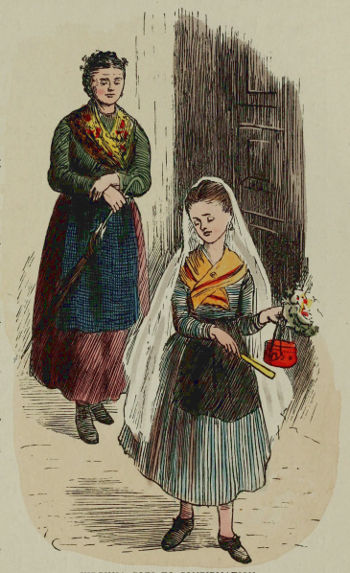
VIRGINIA GOES TO CONFIRMATION.
Virginia wakes with the greyest of the dawn. It is a fine day for her—one that will never come again till the day she is married and then—are there not graver responsibilities therewith? The ‘remnant’ has been enough to make a gown as quaint as any little maiden could desire, but this little maiden has a fear lest it should be too quaint, lest the girls of the walnut-grove should eclipse her! New shoes, a new kerchief, and the lace veil go far, however, to restore her complacency.
The family get under way, and set off towards the church, Virginia walking two paces in front of the rest, as befits so great a personage. Upon the piazza she must fall into the ranks of children of her own parish, for many other parishes have sent candidates to this Cresima. So they enter. The organ-loft is thronged with parents and relations, and other spectators have climbed to the gallery which encircles the roof; the nave is exclusively reserved for the priests and their prey. Behind and around a barricade covered with crimson damask, the candidates are ranged in methodically-moving ranks, while the bishop and his priests stand in the midst, ready to perform upon each advancing boy or girl. The organ sounds, it plays merry waltzes and pathetic love-songs, with now and then a warlike march. ‘Il nostro Arcivescovo’ stands and mutters low, whilst he dabs each newly-presented cheek with oil from his sacred phial, and anoints each separate ear. Then the chaplain wipes the oil off again, and for each the deed has been done. ‘What a mercy it didn’t drop upon my dress,’ thinks Virginia, and fans herself with her first fan, and feels her new earrings. How nice it is to be a figlia di prima communione, but alas, how many more there are still to have the oil, and how long it will be before we can eat plums again and climb for apricots!
At last the great day is drawing to its close. Everybody has amused themselves well. There was so much fine music, you might almost fancy you were at the opera—from what we’ve heard tell of it! And so much beautiful damask and false flowers and incense! Paradise could not much excel such a place, especially as everyone had their best things on!
‘Did you see Marrina? Not pure wool, that! And Tomasina—well, hers was a real silk stripe in the material. But Tomasina is proud! I wouldn’t be proud like that—I’d as soon have a bordato gown!’ says one. ‘And the holy man’s sermon! That did make one laugh! He doesn’t know much about us, that’s evident! Would have made the prevosto out to be a saint!’ continues another.
‘The Prevosto knows better than to come over us with such nonsense! As if he were the Madonna’s own friend! Patience, they’ve got to be so in church! And of course it’s only right a priest should talk fine when he gets into the pulpit or the confessional! Where would our poor souls be otherwise?’ objects a third.
Everybody has had their dinner. The Archbishop and the priests ate Catterina’s mushrooms and risotto and polpette, while Virginia had real holiday ravioli, with plenty of honour and glory for condiment. To-morrow mother Maddalena will have enough to do thinking of her family as a whole, but to-day Virginia is the child par excellence.
After dinner there is more congregating, more admiring of garments; then more church, when the great man sings vespers in a splendid cope, and Virginia still keeps on her frock, if not her veil, and rests content that she looks as well as little Bianca of the village on the hill. But now it is all over. The fine trappings are put away—the church’s damasks stored in the press of the Sacristy, and Virginia’s frock in an old oaken chest at home. The Arcivescovo is gone, and the walnuts will soon be ripe, with the chestnut harvest coming quickly on. Virginia has her rags on again and is up the trees, but she has not forgotten her vestito di lana, nor how la Cresima has made a woman of her.
In Villeggiatura. Town Folk in the Country.
La Signora Pareto lives in town—Via degl’Uffiziali, No. 4. She lives at the top of 149 steps, on the sixth floor of a very new and very pink house in the most recent suburbs of the city. It takes such a long time and, when one has only one maid-servant, and is blessed with six children, time is a precious thing—it takes such a long time and, for a lady of la Signora Pareto’s goodly proportions, it takes so many more long breaths than she can, in wisdom, spare to get up those said hundred and forty-nine steps, that, it may safely be stated, neither mamma nor children go out for a walk more than once a month. What would you have? Children would wear their very souls to rags if the good Lord weren’t wiser than to leave souls in people’s own keeping, and you couldn’t let folk see them in plain things any more than you can let them wear out their best ones: that is only natural!
So it comes to be just about once in a month that la Signora Pareto thinks it is time to have the children’s faces washed and their short hair, that was shaved last summer, brushed up in a ridge on their crowns, and their hats with the bright flowers and feathers put on, while she herself dons silken and trailing garments for a walk in the lime-scented Acquasola. Who would believe this to be the same Signora Pareto who, with heel-trodden slippers and loosened gown, stirs the polenta, and fans the fire, and shrilly scolds the children on the top floor of No. 4 Via degl’Uffiziali? And who would recognise in the primly-walking and stiffly-dressed boys and girls of the public gardens those scantily-attired mortals who hunt the house-top above the sixth floor, and peril their necks on dangerous parapets, and furtively feel for small spoil in the kitchen, and get whipped for venial sins in theft and fibbing?
The lady mother walks with portly, swaying frame and upright head, that black tresses profusely adorn; behind her trail yards of green silk in the gravel’s dust, and on her broad bosom, mock gold and stones glitter, for alas, she is not of the peasant women, who fear aught but the true metal! And the children plod primly two-and-two, with all that tells of childhood carefully hidden from the much-revered gaze of the world, and too proud of furbelowed frocks to think of any other enjoyment, to borrow any youthful glee from the sweet-scented acacias or the flowering laburnum and purple Judas-blossoms.
No wonder that not much of country pink flushes the cheeks of the poor town-bred babies who get so little fresh, free air; no wonder that from time to time the town-bred mother, who thinks more of outward show than of any other human advantage, begins to note the pallid hue on her offsprings’ faces, begins to long for a bit of rough life, where they can rejoice in heaven’s pure air without new frocks, and where her own battered slippers and torn skirts will be good enough to breathe a mouthful of honest wind in, when the wind blows around homely meadows and cottages, where the great world’s criticism does not, happily, penetrate.
La Signora Pareto has a brother-in-law who is a great negoziante; he is rich, richer far than herself—which is a trial when one is in town, for appearances must be kept up and the brother-in-law’s wife has to be vied with! But when the time comes for going in villeggiatura then those riches in the family are an advantage, because there is a little house up in the Apennines, some mile or two from Busalla, that belongs to the brother-in-law, and which one may have for very little money, if a little squabbling and haggling be added thereto.
So one day at the end of July the family from the sixth floor in Via degl’Uffiziali makes a move. The maid-of-all-work is sent home—in the country one does not only half, but all, the cooking oneself, and has a village girl in to help! The good papa takes charge of numbers four, five, and six, because his arms are the strongest; the shrill-voiced mamma attempts to keep three elder boys in order, whose spirits are quite too much for them at the prospect, first of a journey, and then of green trees, and fruit to plunder! One kisses the neighbours all the way down the staircase—inmates of pianos five, four, &c.—one reaches the station, one takes many a second-class ticket, half and whole. After an hour’s slow progress, sitting in a railway carriage, with the din of children in the ears, and, in the nostrils, the smell of truffles and fish and such things as cannot be procured in the country, one descends at last on the platform of a little station, and lifts out the joyful half-dozen of one’s progeny!
How green the trees are, how fresh the breeze, even along the dusty highway, that would lead across the mountains of the Giove, were one not minded to turn aside and follow the torrent’s course to left! Paolo and Checchino, and even the little Emilia, feel it blow pleasantly, indeed, upon their almost bare heads that were short-shaven again yesterday for the season of recess! They caper gladly along the road, while father and mother exchange greetings and compliments with fruit-sellers and barbers in the town’s little street, with peasant men and women as they strike out into the free country beyond.
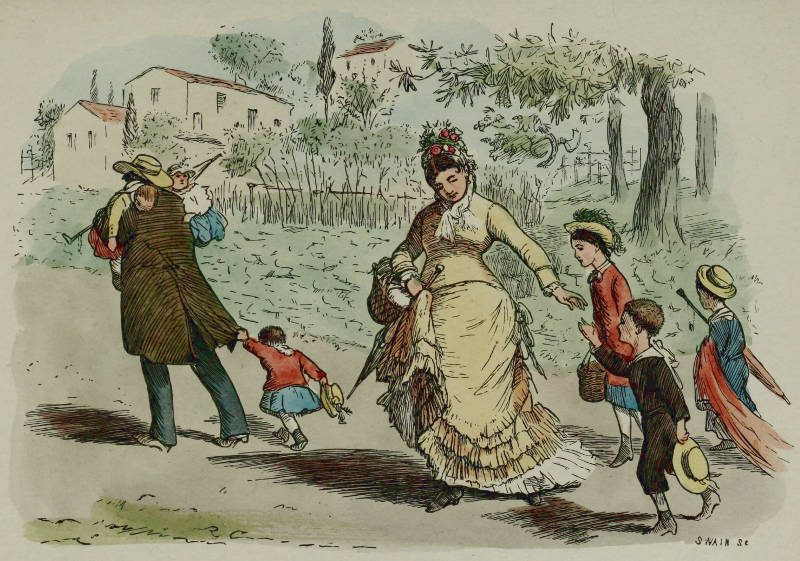
In Villeggiatura.
“Madonna, what a heat!” complains the town lady, while the papa trudges on wearily in front with babies two and three.
The chestnut leaves are broad and full on the boughs of trees to the road’s right hand, the river runs idly to left, and beyond the river more turf springs and more chestnuts grow upon it. Woods flourish, with meadows, and fields, and vineyards. After the village of Ponte is past—with the bridge over the stream whence the carriage-road begins to run to left of it—when the last of the houses, that have been built for summer visitors, is behind, papa and mamma Pareto have a rougher and stonier way along which to drive their little flock—for the brother-in-law’s cottage lies up the side valley of la Valle Calda. ‘Madonna, what a heat!’ complains the town lady, loosening the scarf around her throat! And even the children’s strength begins to ebb into fretfulness, while the papa trudges along wearily in front with babies two and three. It is three miles from Busalla to the parish church of the village, and town heat has not been apt to fit anyone for work. ‘Andiamo, Nina, thou art truly the laziest of all, because thou art tall! Fie and for shame!’ scolds the mother to her eldest-born girl.
But the tall campanile is in sight at last, and everybody plucks up courage to take and give friendly greetings courteously. The Prevosto comes out on the piazza with his serving-maid behind; the Cappellano descends the rugged steps of his dwelling to give a welcome. Neither priest is in canonicals—the one has been tilling the soil, and the other pruning the vines—but the family of Pareto are no sticklers for etiquette when once out of town. Compliments and greetings flow graciously, words and jokes fly swiftly; the children are admired, the village news is told. Then the party moves onward towards its destination, but escorted now and strengthened by gathering friends.
The sun is setting above the tree-tops of the little deep, dark dell beneath the church: it is night before parents and children are well installed in the black and white cottage that stands in the midst of open meadows, having maize fields around it, and a fence about its modest garden. The family has come by an afternoon train for the cool’s sake, and it is time to go to bed before the well has even been visited hard by, or any of the familiar nooks; indeed, the children are asleep almost before the fire has been lit for them to have their supper, and the sharp words of the mother, who is ever threatening punishments that have no room in her heart, fall but lightly on their ears.
The morning sun creeps softly down the side of tall Monte Mazzo opposite. When the Pareto family gets up next morning, the cottage lies yet in shade, as do the meadows also and our own chestnut woods above the well, and even the campanile, with everything that is on this side the torrent. ‘One must rise early to enjoy the Creator,’ says the mother, and the children are not prone to quarrel with her advice in these country days! With garments that already are faded and soon will be torn as well, with white-toed shoes and heads bare to the sun and the breezes, they scour the country betimes to visit their favourite haunts, to spoil the fruit trees that are in season, and to coax scrap and bit from neighbourly cauldrons and granaries. Nobody gives much thought to them all day. They are safe, for everybody knows them, and will take a turn at looking after them, safe as the peasant children themselves, of whom they are part and parcel now that town pride and strivings are left behind.
La Signora Pareto has gossip enough to do herself this first day. There is no need to hire any girl for a help this week, for there are neighbours and to spare who will gladly give a hand for the sake of a bit of city news! They must see once again the fine dress which the lady wore yesternight when she arrived! ‘Oh, but that is nothing! On the day of the Assumption, at mass and procession, you shall see what you shall see,’ boasts the town bird, and yet at the present moment her dress is more slatternly by far than that of the peasant women who throng her kitchen. They wear skirts of dark homespun linen, bright cotton kerchiefs, and aprons, but her garments are of threadbare woollen stuff and soiled, while a loose black bodice hangs carelessly upon her shoulders in place of the folded square, and her hair is still in the fashionable coils of last night, but rough now and disordered.
Caterina, the parsonage housekeeper, calls in now with a supply of eggs and vegetables to help out the first day’s dinner. She thinks but slightly of la Signora Pareto’s grandeur as she looks on the stained and trailing skirts that are deemed good enough for the country—for Caterina is a strict and thrifty woman. But when the day of the Assumption comes, and the lady of the cottage comes to mass, then even the priest’s servant is forced to admit that her costume is one ‘truly of luxury!’ For the silk dress with the train that Marrina, the village sempstress, declared would have reached right over to America, where the emigrants go—the violet silk and the gold ornaments, and the French cashmere shawl, have all been thought worthy of so grand an occasion! Nina, the firstborn, has her hat and feathers on, and her white frilled petticoat, whilst even the boys have been promoted to cleanliness.
The day is bright even amid this dazzling summer brightness. Spite of the heat, meadows are fresh and the wooded turf, because of many rills that water the valley. Orchis and yellow lady’s-slipper and broom have come in place of the ragged robins and the buttercups, and upon the open land over the hills the little pink heather blossom will soon be abloom. The river winds slowly, the mountains make a dark, dented line upon the calm sky, all around, the chestnut woods stir in the breeze, and droop their boughs upon the green grass.
The stars on the Virgin’s blue robe glitter in the sunlight as the procession winds up across the fields, by the well, and by the cottage of the town family, to come back again along the river path into the church. And la Signora Pareto is proud to walk behind the Holy Madonna, for she is well-dressed, and people stare even more at her garments than at the Virgin’s own, which they have seen many times. ‘It is even more worth while to don one’s finery here than in town,’ thinks the lady, for in town there is always a fear it may pass unnoticed in the crowd! But all the same one must do one’s economy in the country. For what else does one come but to economise, and to rejoice in the Creator, as la Signora Pareto says? So to-morrow the soiled grey skirts will be on again, the children will be shoeless and ragged, and we shall eat minestra of beans in place of ravioli for dinner.
But the cool air fans freshly all the same upon the children’s cheeks, meadows are soft and fragrant that lie around the black-and-white house—the garden grows peas and beans and gourds and lettuce beneath the fruit trees, and this is matter of interest to everybody. The vines trail wildly across the kitchen window, and boys and girls think it fine fun to blow the sulphur upon them that keeps off the fell disease. Who cares whether children’s clothes are rent and threadbare, since roses are coming to their cheeks in the wild, free life and the good air of this Apennine villeggiatura?