Part One On the Riviera
Reading edition
Genoa.
Spring returns. In northern lands, where much work is done and living is hard, our skies are yet grey and the winds blow keen while the earth is hard with the late frosts. Yet almond blossoms bloom sweetly in scant little gardens or beside the bleak walls of town houses, and spring begins to bud even in the lands where spring’s struggle is the longest, and as I watch her oncoming and rejoice in her tender-toned early flowers, I must needs remember the home where her life is the fairest and merriest, and her sunlight the stronger to play and be played with. It is the Mediterranean that I call to mind, her winds and waves and sails and rocks, her shores, towers, villages, groves—the light and colour on her kindly people’s life. And most of all, as the sunshine grows and the air gets whiter, memory paints again for me that whitest, but not newest of towns, where winds and waves and groves and all are fair, the city of marble—la Superba—Genoa, the Queen of the Riviera. Genoa, no longer the great republic, no longer the city of much merchandise and wealth, but Genoa, the city of palaces still.
Who is there that has seen her from off the waves of her own Mediterranean, and looked upon her as she climbs the slopes on every side, gorgeous in her towers, her domes and cupolas, her terraces and gardens, quietly lying within the great amphitheatre of her hills—who could fail to acknowledge that she is the city of palaces still? Above and around her stand her fortifications, gaunt and grey upon the soft sky, like sentinels upon the tops of the green and barren mountains, while half way down, the hills begin to be dotted with villas and terraces, and, as they creep towards the sea, grow white with palaces and campanili, that multiply upon their sides until they become the great town itself, where whiteness is all around in stone and marble. In the streets there is marble, for it is fashioned into churches and colonnades; and upon the water’s brink there is marble still that has taken the shape of terraces and loggias. There is no end to the whiteness, for the air is white too on these early spring days, yet there is no lack of colour as well; it lurks in the sunshine, it lives on the earth and the sky, is dashed along the public ways in dresses of the people, and over the harbour in curious hues of sails and flags, red and green and yellow, that the weather has mellowed into harmony. The sky is heavy with colour, in the March air that is keen and sun-steeped. Genoa, with her crooked and narrow streets and her curious nooks, with her picturesque piazzas and her sumptuous churches, of her would I write as I dream of flowers and Eastertide.
The light is everywhere, and everywhere there is something to remember. In crooked, winding ways that climb hills and go down again in steps, and thread dark passages and cross bright piazzas, in ways where winds can be icy cold and suns scarce reach, there are still things whereon memory rests fondly, amongst quaint shops and stalls of fruit-sellers, and fish and flower and green-markets, in hurrying or loitering people, beneath dingy doorways, up dusty stairs, on solemn or gaudy house-fronts. Down upon the wharfs and along the moles where the green waters of the port are not always fragrant as they lap on to time-worn marble steps, there are more things fair to think of in crowding boats and quaint, noisy boatmen, in flapping amber sails of strange fishing smacks, in fine-framed men and women whose shrill voices quarrel and joke, and whose faces and figures bring more colour to the sketch—even something perchance of gala days when stately vessels sailed into the harbour, vessels that were thickly manned and royally freighted, so that flags must needs wave from ships and skiffs and steamers on the water, and, on land, from turret and terrace, while bouquets were flung and floated, and royal salutes were fired. And from the broader of old streets, where palaces flank the way and are sumptuous with façade and arch and stair, from straight and new streets down which the Tramontana can blow grimly enough if the sun can shine also, from loggias on hills that look towards the sunrise, from the walls of tall ramparts that hang over the waves and see the best glory of the sunsets, from every open place, from every nook and corner, more recollections crowd around the first picture of the city’s whole. The steep salite that are paved with red bricks up the middle, the dark cypress standing against churches, the scent of limes and acacias, the growth of arbutus and horse-chestnut, all come telling some little story of the past. Yet, perhaps, most of all, Genoa’s gardens recall the best of Genoa’s life, because they are the most bound up with her holiday life—with her Saints and fasts and feast days—for the Ligurians make merry on most of these occasions, and the Acquasola is the way to and from many a sanctuary. And Genoa is full of gardens. Private gardens upon the hill-sides or upon terraces that appear suddenly in the streets, where flowers grow in boxes, and orange and oleander trees bloom in pots as in the free earth—gardens that are open to the public but are none the less rich in all that nature can lavish, gardens that spring at unexpected turns in the town’s heart to break the monotony of the palaces. Some of them have restaurants in their midst, and there, among Japanese medlar-trees with great fibrous leaves, beneath acanthus and willow and magnolia trees, people dine or sip coffee and ices in the company of marble nymphs and heroes, of shivering cupids who toss the water from stone fountains. But the public promenade is the garden that tells most about the town people’s public life, for to the Acquasola people are wont to go to walk and drive, and meet their acquaintance, and show off new dresses and new equipages. It is the place in which to spend a holiday afternoon. The broad walks are crowded with people, who wander beneath acacia and arbutus trees; fine ladies with attendant cavaliers, mothers of the middle class chaperoning their marriageable daughters, fathers carrying their children that the women may have leisure to enjoy the festa dress and the festa scene; along the drive and the sycamore and horse-chestnut avenues carriages roll smoothly with gay people. Flower-vendors are there, and men and women with Madonnette to sell, or filbert-strings or iced-drinks and wafers. Sometimes a group saunters away to the higher gardens, where the paths wind upward, till they reach a terrace with flowers and palms and trees from foreign lands. The whole town lies spread beneath; towers and palaces and domes seem to grow softer of outline as evening lights creep around. In the far foreground lies the great valley of the Bisagno, where troops have camped—Zouaves and Africans in gorgeous dress. It is a long stretch of dusty road and arid river-bed, but from the Acquasola none of this is to be seen, and there is only an impression of green country far away, with palaces lying on the slopes of Albaro’s hill, and a knowledge of sea beyond. Behind the rising ground runs the town’s great aqueduct, that is built through glens and copses when once it has left the city’s first outskirts. And to your right is the harbour again, with ships and flags and masts, and beyond the harbour a waste of Mediterranean neither blue nor grey nor white, that, in the doubtful light, will seem neither land nor water, lying out towards the sunset, where dim clouds hold Riviera mountains in their midst.
Martedì Grasso. Shrove Tuesday.
Of all the festas we used to have—glorious days when the sun might shine as fiercely as it liked and we were only the better pleased, since it was a sin to work outright, but only a venial fault to keep one’s shops open a little, and to forget about going to mass—of all those most comfortable saints and Virgins, how few, alas! have they left us now! One can count the strict day off one’s fingers. ‘Per Bacco, ’tis a disgrace truly,’ mutter the old men and women who have been wont to consider a week where there were not three holidays at least, one really God-forsaken and cursed by the Evil Eye of luck! But, ‘well, well, days are changed, and Providence can’t expect us to give all that time to religion when it’s all we can do to make way against the bad times, and keep a roof over our heads,’ say the young men who have wives and growing children, and the women whose piety would not be at all equal to the giving up two francs for a day’s ironing, merely because the Virgin chose to institute a rite, or some strange saint had seen fit to die! ’Tis an ill wind that blows nobody any good! Perhaps the greater half of the population are better pleased than not. The days of the dolce far niente are pretty well over, in the north of Italy, at all events, and every man must keep pace with his neighbours. So we let the old people grumble, the half of whose portion it is the duty of sons and daughters to provide, and the rising generation are content. Only when somebody wants to tell a story about Italian festas, he finds that the throng which used to be so goodly has grown small indeed, and that, if he must needs be faithful to the present, his choice is very limited, and the colours on his palate must also be only by half so brilliant as they used to be in the old days. For where are the gorgeous trappings, the stately pageants with which Mother Church was wont to send out her saints and her relics? Alas, for the wild days of mirth and folly, for the glittering sights, for the colours of street-pictures, we have grown too cynical and too worldly-wise for such nonsense now! So, we who regret them a little—old people or travellers that come only to marvel, modern Italy says—we are fain to go back a step or two into the days when the sun’s glamour off the Mediterranean could still bring colours into boldest relief against dark backgrounds, could search out gloomy corners, and deck streets and people in holiday garb, making mad with its glitter and its warmth the reckless brains of an untutored Southern nation.
Time ago there was Carnival really as it should be, along the highways and byways, and in the public halls and the private homes of Genoa—not a Carnival so rich and so splendid as the Carnival of Rome, for Genoa merchants have always been close-handed, and even her populace has had a name long past in other Italian districts for shrewd economy; not a Carnival so studied and so lengthened as the Carnival of Milan, for Milan is a city privileged of Mother Church, and can keep up her frolic when other towns have been three days shrouded in ashes and penitence; still a Carnival no way to be despised as a means of enjoyment, even of unmeasured madness and merriment for those to whom such things come easily. And such things used to come very easily to many people in the days that we, mourners of better Carnivals, can call to mind.
Holy Week, called la settimana grassa, is past. Lent moves forward apace with gloomy garments, with sack-cloth and ashes, and calls to prayer and penitence! Come, let us make good use of this last day of reprieve! For it is Martedì Grasso, and with to-morrow’s sun dawns Ash-Wednesday!
The picture is in shade as the morning breaks, for there are faint clouds overhead—after all, it is only February—and the sun has only half its strength, and only a grey colour for silver glory to shed over the Mediterranean, and off the Mediterranean, up on to the green hills and marble terraces of the town. The sea is not blue but white, beneath these pearl-grey clouds, that let the sun through as through a veil, but it is calm, the limpid waves of it lapping gently on to the knotted and slimy rocks of the coast. There is but little to complain of in the weather, and before the midday meal has been eaten, before even the most impatient of spectators or the maddest of masqueraders have begun to line the sides of the streets where the Corso will pass—our sun has made his way as usual through all obstacles, and makes the sky and the sea blue, the streets and the people bright with his gladdening warmth. The highways begin to swarm with people that press and pour in from the hundred little yards and colonnades and alleys of which the old city has so many; they are men and women of the peasantry from without the walls, of the smaller tradesmen, from within—the people who, in all nations, would rather stand breathless for hours in a throng than miss the exultation of giving the first shout for the first rumour of a pageant’s approach. The women of this crowd are mostly conspicuous for dark red and blue gowns of stout homespun linen, called in the neighbourhood bordato, or for gowns of brilliant coloured calicoes gaily-flowered in pattern, for kerchiefs of still gaudier hue, orange and crimson, for massive and curiously wrought gold ornaments—they are the contadine, and as yet the tradesmen’s wives are but a handful. You will know these, as they push their way into the medley, by their cunningly built hair that is smoothed into a perfect mirror of glossiness, and coiled and twisted and piled into a marvel of structure; mark them by their worsted dress also, and by the silken jacket after a Paris mode of some years back, or the cashmere shawl in place of the gaudy kerchief about their shoulders.
The Piazza San Lorenzo or of the Cathedral, the Piazza before the Ducal Palace and Sant’Ambrogio, have both seen something of the crowd as the people pressed up from the heart of the city to reach the more open thoroughfares; the Piazza San Domenico where the Opera House stands, and where of early mornings these same men and women are wont to come buying and selling at market, has also been a gangway for the mob, but none of these places see the best of the Carnival, for the cream of the Corso is down the Vie Nuove and Nuovissime. So the people fight their way from Piazza S. Domenico, down the Via Carlo Felice, to the Piazza delle Fontane Amorose, for here the Carnival will soon begin in good earnest. The balconies of the Spinola Palace, of the Pallavicini, Brignole, Serra, Durazzo, and of all the palaces down these chiefest, beautiful streets, have been decked with crimson hangings and cushions, with gold and green and amber trappings, curious heir-looms that for centuries perhaps have been kept for such occasions. Baskets of flowers, stocks, violets, heartsease, camellias red and white, and everything that commonly blooms here in the winter time, are placed ready for gallants and ladies soon to shower on the masqueraders beneath. The air is a little cold, but the sun shines, the sky is blue, faces and colours wake to merriest life.
The first of the merry-makers has appeared. He is a buffoon, with tawdry costume and hideous mask, he is of the people and comes along on foot, hurling jests and poisonous comfits around him, but all the more the people are amused; they hoot and cheer, and so he passes down the ranks. He is quickly followed by another mask, also of the people, but this one drives a donkey in a small cart; he is ill-dressed with a purpose, he screams, he gesticulates, he is evidently the caricature of some pet grievance, for the mob cry aloud for joy. But this is not the Corso; this would not content even the populace—great things are coming. Ladies of the nobility—beautiful, with hair dressed after the French fashion, and silken garments and graciously-smiling faces—begin to fill the balconies. They nod and laugh and pose gracefully to their attendant gallants, then they rise in their seats to pose and laugh again for other gallants who are in the masquerading throng beneath, and upon whom they will shower comfits and flowers and smiles alike, to get comfits and flowers in return. For the Corso is all alive now. It is four o’clock, and past. On the lower ranges of balconies, windows of offices and less important houses, the ladies of the merchant class are airing themselves likewise in scarce less costly array, to get what attention they may from masqueraders in their own set; while servant wenches and shop-girls, who aspire to no post at a window and are proud in the possession of a black silk apron, a pezzotto veil, and a little gold for ornament, parade the street happily on the arm or in search of a lover. The air is laden with colour, and every turn of the beautiful winding street flashes out some new bit of it, in waving banner, fluttering drapery, or passing throng.
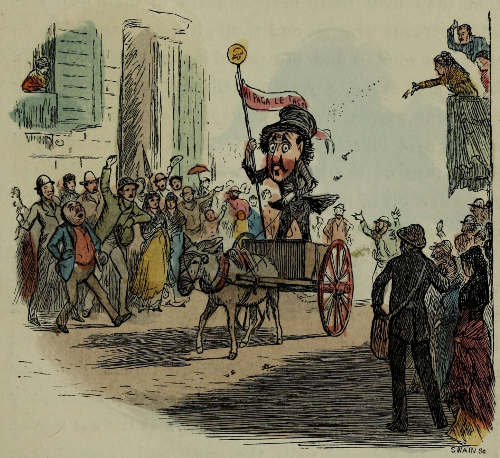
THE CARNIVAL.
The great car of the afternoon is coming. Most of the cars have been out before at the Sunday Corso, but this one has reserved itself for the last of the Carnival—it is the feature of this Martedì Grasso. People shout along the street, and heads are all turned one way from out the windows. It is in sight—a ship amid wavy billows of blue silk for sea; it sways as the car moves. ‘’Tis truly natural,’ yells the mob, and cheers. The ship’s bulwarks are of silver, its sails of rosy silk and golden tinsel; its masts are manned with sailors in handsome garb, whose masks counterfeit handsome faces. It is pronounced a wonderful success. From the balconies flowery missiles fly swiftly, to light daintily where they will—most often where the fair marks-women themselves will not! And the handsome sailors pelt back again, pelt on all sides, pelt the ladies with flowers, the children with comfits, the mob with coriandoli, that, being made only of flour, burst as they fall, to sprinkle their prey with a white storm of dust. It is a scene of the maddest, merriest confusion. But the sailors have been recognised by balcony ladies, pelted by mob admirers, appreciated by all: the ship moves on to give place to some other part of the pageant. Carriages follow closely on one another between the lines of the crowd; they are all filled with masqueraders—boys in clown dress, in Masaniello dress, as harlequins, as marquises; little girls as shepherdesses, as vivandières, powdered countesses; fathers and mothers in dominoes for escort. Out of every carriage somebody pelts and cheers to be cheered again, and now and then comes a more elaborate car, on which the mob are scarce restrained from falling for very excitement. Afternoon wears away into evening; bouquets, that have loaded the air with colour and perfume, are trampled now under foot; the coriandoli bags are empty in the maskers’ cars; their supply of comfits is exhausted—not so the spirits of men and women, whether of nobles and gentle-folk at the windows, or of shop-girls and contadini below. If it is too dark to see the maskers, and to pelt in the streets—since Government no longer allows the mocoletti lights, which it used to be our fun to put out for one another as darkness deepened—are there not still the Veglioni to come, and shall we not dance if we may not pelt? Surely: for is not to-day the last of the Carnival? So, as the night hours lengthen, and just before they begin to grow short again, the streets, that were quieter for an hour, begin to live again with bustle. In carriage or on foot, all classes of people are going to the masked balls of the theatre. Marchese, in the boxes which are their family’s heritage at the opera, to look down on the gay scene of masked dancers in the amphitheatre beneath, and to receive the visits of dominoed gallants with whom their jests are both broad and lively; men and women of the lower orders to entertainments in their own set, or even to the amphitheatre of the Opera House itself, where the highest nobility has been known not too proud, in dominoes, gallantly to address many a prettily masked servant wench: for of the nobles only the men may fitly descend into the masked ball-room, just as the Marchese are free to receive who they will into their boxes, and to thrust and parry with the masked intruder as best they may. ‘Ah, in truth it is delightful to be noble and to possess a box at the Opera,’ sighs many a merchant’s lady, because for love or money you cannot otherwise procure one for the night of the great Veglione. And so, dancing and flirting and jesting, the hours grow old again into day, the gas-lights burn yellow in the grey light of morning, the paint and the powder have lost their excellence, the dresses are marred and tarnished. But are spirits grown weary, is merriment spent, though the Last of the Carnival is dead, and the sun has risen on Ash-Wednesday? ‘Ah—everything is changed,’ moans out some old lady of the old school; ‘so used the Martedì Grasso to be in my young days, or even a few years ago, but now—non c’è Carnevale!’
La Fioraja. The Flower Girl.
Sunshine is full on this picture even as it first climbs the horizon of our memory: full on the shifting Mediterranean, that is bluer for its presence, full on the white walls of new houses, on the yellow shutters of old palaces inland, strong amid fleeting clouds that are the whiter for its power, fitful on these girl-faces, that shine the merrier for its sake. Because the wind has blown cold from the mountains these three days past—the sharp Tramontana that sweeps down the northward valleys to blight the budding trees, to whirl the dust in clouds, to lash the sea’s water into bristling crests—and if the cheering sun shine not, we, who must ofttimes meet the wind’s greeting at street corners, and shiver out the daylight hours beneath palace porticoes, shall have but a sorry time of it indeed! For even the flowers that make our livelihood have a hard fight and a poor success of it in this weather. ‘One must have patience!’ Only ’tis pity the enemy could not just have waited till a little further into Lent, when good Catholics having had their fill of amusement, see fit to waken conscience to a little necessary obedience and expiation: when camellias could therefore no longer fetch so good a price! For so early in the Church’s penance season as this, society makes Carnival still in her private homes; we are grown lax about fasts nowadays, as we have grown wisely cynical over feasts and processions, and who would drown merriment to wear sackcloth forty days long, unless it were with a much surer hope of reward than modern Romanists think prudent to believe? No, no; the last Lenten week, when there is plenty of excitement in mission preaching, sepolcri and masses—when Easter’s sun, moreover, begins already to lighten the horizon before us, the six days of Holy Week make up the sum of all the fasts we do in our enlightened generation! Let the camellias bloom fair yet awhile, and we will pray the Madonna to keep the Tramontana back for another month, say the flower-girls!
Rosina is the favourite of all the fioraje of the Carlo Felice, and that is the favourite flower street of Genoa. When the sun shines as bright as it does to-day, out of a sky that is as blue in the cold, and when it lies with a great sheet of light on the square flag-stones of the Piazza S. Domenico, Rosina’s face is as the sunlight itself that can be friendly even in an air so hard as this is with Tramontana. And it is merriment that pays, that wins the loved jest from lowly swains, the soft compliment from gracious signori, that sells the camellias, and adds many a mite on to a bargain! Who cares for a pathetic face and a wistful gaze? Such cunning arts are only for ‘marchesine’ and ladies who can afford powder; we of the people had best trust to a healthy frame and a kindling eye, and to the jests and smiles of a light heart, for our conquests! Truly, it is in this wise that Rosina has come to be ‘la bella dei Portici,’ and it is by simple and lighthearted devices that have made many a gallant think of her as the reflection of this cold, bright sunshine itself, that our flower-girl can keep so many and such fragrant bouquets on her stall in the gateway and such a goodly hoard of soiled old soldi in her pocket. To-day, heedless of the cruel Tramontana, she has been up with the kindly sun’s return, and in her garden among the camellias. All the buds that bore any promise for immediate use were nipped off at the very flower and thrown into the common basket, and when the round of the camellia grove had been made Rosina went on her knees to pluck the purple heartsease, to strip the beds where bloom the pale Neapolitan violets, and then on her tip-toes, with upstretched, graceful arm, to tear down the ‘fiorellin d’oro’ from the wall, to break the blossom of the Judas tree. All the time the wind was sharp, the sky darkly blue; and the sun had no warmth till Rosina had been awhile in the stock garden and had spoiled the straight stalks of their gaudy flowers, mixing into this basket a handful of striving carnations and a share of sweetly-scented myrtle twigs, besides large-veined and dark-hued medlar leaves, wherewith to build the outer frame of her stiff bouquets. Poor flower season! It is past, and is not come again, but we have our glory still at Genoa, in the camellias, as people have in no other town—thank the Virgin!
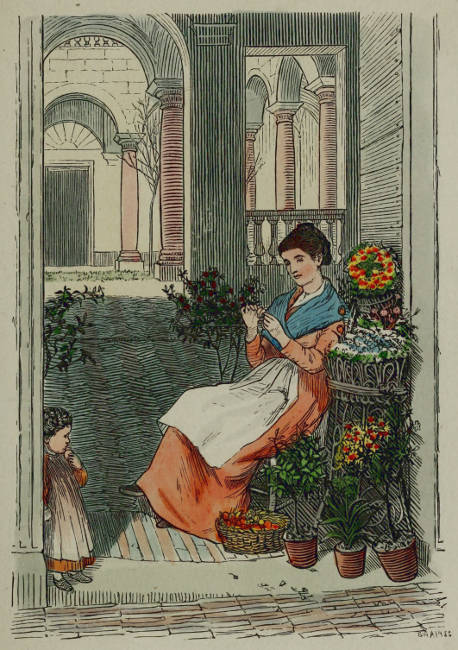
The Flower Girl.
So she sits, with flowers close around her—red and yellow tulips, festive-looking camellias—to set off the strongly-coloured portrait of herself; and as she sits she picks the heads of blossoms from baskets at her feet.
So the early morning is gone, and Rosina is at her post beneath the Carlo Felice door-way. The sun has outstripped the east wind in power by this time, and for those who walk within its hearty radiance, and avoid the northward corners of streets—for those who, like our Rosina, sit within reach of its rays in some sheltered corner, the Tramontana matters but little. Indeed, Rosina forgot long ago how she had grumbled at the cold in those early hours after dawn in her Villa delle Peschiere, forgot it as she came down the narrow way of the Salita Sta. Trinità, when you might have seen her tall and buxom figure swaying gently on its firm, broad hips, erect as a reed, and as a reed pliant to circumstance, while on her head and in one downward-pointed hand she carried baskets of flower-material, and on her curved left arm bore the child of some busy mother. Truly, she is a girl of much presence, as indeed all the lads of the town do allow! For all the youth of the town knows Rosina who sits all day in the portico of the Palazzo Spinola, via Carlo Felice! It is not for nothing that she has that tall and massive figure, those heavy coils of bright, black hair with the broad waves, that smooth skin with the faint fresh colour, those even rows of white teeth that appear so often when the merry smile parts her rosy lips! She knows how to use all the fair gifts of nature, and best of all how to make use of two saucy black eyes in the trade which she plies daily so well—for who sells so many flowers as Rosina? Watch her now at work. Her striking person sits framed in an old gateway, round whose margin a graceful design of fruits and flowers in low relief—sad, neglected memory of days long fled—lies yellow upon yellow marble. Above her head, over the palace portal, another bas-relief, black with age, serves her for canopy; but this one is of fighting men and horses, and passionate of expression. Beneath her feet, a black and white pavement stretches back into the gloom of the court, that finishes in a scantly grass-grown yard whose almond trees will not be rosy with blossom till the last of Lent. And the background is varied by the flowering plants and shrubs of Rosina’s stock in pots, while away in the dimness, the soiled staircase—of marble, like everything else architectural—winds up to the first, and then higher and higher to the fifth floor of Palazzo Spinola. So she sits—with flowers close around her, red and yellow tulips, festive-looking camellias, to set off the strongly-coloured portrait of herself, and as she sits she picks the heads of blossoms from baskets at her feet, to open and bend the poor petals of them at her will, and to wire them for her bouquets. See one with pink carnations in a cross on a field of white! It is as large as a small-sized table and quite even in its flatness—it is for the Church of San Luca. And here another, smaller and choicer of flowers, but scarce less stiff in appearance; it is white with violets around, and has been ordered by the Marchesa Pallavicini. Rosina is weaving more posies as she converses in loud tones with the old woman behind and glances up now and then to the street’s opposite side where wayfarers grow hourly thicker on the pavement and where, in another portico, old but not as beautiful as her own, an aged man has already begun to roast chestnuts. There is a fiorista, maker of false flowers, on the first-floor of the opposite house—she has nothing picturesque to show as our fioraja has; but, alas, modern Italy thinks far more of la Signora Raffo’s trade than it does of our Rosina’s! She herself is of the same opinion for the matter of that, and no one can praise a perfect flower of hers so much to her mind as by saying it is like a false one.
‘To-night is the ball of la Marchesa Del Mele. I sell all that I have in flowers before twelve o’clock, you will see,’ calls Rosina in her loud brave voice to the porter’s wife who sweeps the staircase behind; ‘gracious! your honour did make me jump,’ adds she quickly to the polished and perfumed signore who now darkens the sunlight in the portico. ‘Indeed!’ laughs the young man. ‘No, no, you don’t make me believe I catch you unawares, bella—you, who have eyes at the back of your head as sharp as those two bright ones in front! Well, well,’ as Rosina laughs to show her pearly teeth, ‘we all know you! But now give me a flower—one for myself—a knot of violets, emblems of thine own fair modesty;’ il Marchese del D—— (for it is he) laughs as he says this, looking at Rosina. ‘Shame!’ remonstrates the damsel, bending over her flowers to choose out the mazzetto di viole, but the blush does not rise to her smooth cheek, and she only says, presenting the flowers, ‘Il signor marchese will buy something for his lady of to-night?’ ‘Surely, make me a thing of taste, all white with violets, and we will agree to-morrow for the price. With pretty girls one makes no bargain!’ And the marchese goes, only to leave the field for other gallant butterflies and purchasers who all agree that ‘with pretty girls one makes no bargain.’ Truly, Rosina’s free, fair face is worth many soldi to her purse! The day grows—it is time to eat maccaroni in the porter’s lodge, while little Tonietta keeps watch beside the flower-stall. And when the sun is near to setting in the early afternoon and the Tramontana blows chiller than ever, a man passes down the staircase, out of the many that have passed up and down this day, who calls the blush for the first time to the cheek of our fioraja. He also is a perfumed youth, but he is no marchese—only the son of Ricardi who keeps the manufactory for pianos upstairs. He stands a long time beside Rosina’s chair while her swift fingers twine bouquets for the ball of to-night; fast they talk, and merrily laugh and broadly jest, till Rosina’s saucy glances are well-nigh quelled, and she is forced to blush a bit and remonstrate—till the gas-lights are burning in the streets, moreover, and it is time for the flowers to go home to their purchasers. Then la fioraja sweeps up the faded blossoms and the broken stalks on her square of marble pavement, and with them she sweeps away all the dead jests and forgotten words of to-day, all the love-making and the banter. Gathering together her baskets she climbs the Salita S. Trinità once more, to remember little else at the top but the sum of those gains that she counts over so proudly.
La Festa delle Palme.
There are no consistencies to uphold in Italy, no conventionalities to overcome, and festa-making revels in true glory among the pleasure-loving natures, that are soft and fiery, mad and merry, all at one time. No fickle chances disturb the course of fasts and feasts; the Roman Church holds her sway above all else, self-sufficient and serene; and the people have learnt to love the old days and seasons by this time, and are nothing loth to lend their aid to the pageant. Yet even were her children deaf to the call, the Church would still put up her pictures, nor alter one jot of her proceedings because of their indifference. Amid all that is false and hollow the system has its good side, as most systems have; the Roman Church binds the people together with her festivals, even if they scoff at them now and then, and to her we owe the beauty of the broad lights and shades that are thus cast over the nation as a whole. Seasons change and come again (now days of joy, now days of woe) bringing each some brightly-painted symbol of ancient tradition, some well-worn mystery that has had its hold for ages on the imaginative mind of the people; symbols and mysteries work their way as of old, the days that are gone are linked to the days that are, so that, in their festas, the people of Italy are one nation from end to end of the land. They may not believe very clearly—many do not pretend to believe at all—but they find a zest none the less eager for that, in each of the seasons as it comes, with its mysteries to be marvelled at, and its duties to be done. It is festa, and festa garb must be donned, festa bells must sound. The people put on their bright colours, and are merry with a matter-of-course and yet a true merriment, as though they caught the light-heartedness reflected from their blues and reds and yellows. And when gala days are over, and Lent is to be met, they put aside their carnival and eat ‘magro’ almost as contentedly!
Carnival over, the pranks of the masqueraders are followed closely by Lent’s fastings, and these would perhaps scarcely be borne so patiently, were it not for the solace that can be seen throughout the forty days in the distance. That solace is the Feast of the Palms, with the strange week of mixed penance and excitement, of gay sights interwoven with sorry dirges, that ushers in the Eastertide.
In days when people all go abroad, and can criticise and scan for themselves, talk about these things would seem almost superfluous were it not for those spots that lie beyond the range of the stream of travellers rushing on year after year towards the great capital, and that can yet show, within their capacity, as fair and joyous a festival as any that reigns supreme at St. Peter’s, or flaunts its gaudy pageant along the streets of Rome. Little roadside nooks there are upon the shores of the Mediterranean, or among the clefts of the Apennines—places still unspoiled and unmolested by the foreigners, with their levelling influence—where perhaps the festival will be even quainter than in any of the towns. Here and there, on the lip of little dainty bays that secretly lie along the coast, palm-trees flourish in the fertile soil, with the soft and sultry breath of African deserts blowing gently upon them from across the Mediterranean. Sometimes they stand alone in their grace, growing up erect and sudden from out the moist hot earth, with arched and slender branches that are set around their heads and that droop gently with the weight of tapering leaves. Sometimes they grow in knots along the shore, or in little plantations that stretch upward towards the hills. The pale-blue sky is spread above the pale-blue sea, and above the deeper-coloured earth, and the palm-trees stand up quietly against it, with frail outlines clearly traced in the keen air.
All along the Riviera, whether in towns or villages, there is festa for Passion-week and Easter. In rain as in sunshine, processions march forth beneath weather-worn banners to worship familiar relics, and bells chime gaily, and fresh veils and kerchiefs are pulled out to deck pious or laughing faces, while the palms are blessed and the Holy Sepulchre is built up around the altar.
And yet it is not the Cornice villages, nor the sunny groves where the palms have their birth, that I remember at this season most willingly. Again, the crooked ways of Genoa, her gorgeous churches and ample piazzas, are the things that rise before me as the Easter time comes back once more.
The Festival of Palms seems always to have been one of the dearest of gala-days to the hearts of the Genoese people. Spring is then at hand, that will bring flowers and fruits and warm days. Passion-week is close on the festival’s joy, and there is woe to be met ere the Easter sun can dawn, so the people make merry for Palm Sunday and for many days before. Upon the first days of the preceding week those branches are gathered from the sunny plantations of Bordighera, that are to be plaited and adorned and consecrated in the churches, that they may wither out a whole year above the bed of some peasant woman or child. Not such a fair life, perhaps, as the life of those sister branches that flourish and wave and grow green again in the pale sunshine and the cool night-breezes of the shores; but the same blue sky of Italy is overhead, and beneath it even the yellow boughs on a whitewashed wall have their fitting grace.
On Monday the market of San Domenico begins to be filled with peasants who bring palms from the Riviera, and by Wednesday the long leaves are ready bleached to be fashioned into the wonted curious shapes; for they may not remain green as nature bade them. By some process handed down from past generations they are dyed of a faintly yellow colour, that they may the better last unshrivelled from Eastertide to Eastertide again for sacred guards and memories. The market-place, always a wondrous scene of confusion and vociferation, is now more perturbed than ever. The palms are set up in queer water-tubs, whence they are taken one by one to be rapidly transformed into fantastic shapes beneath the swift hands of girls who have grown deft in the art of flower-weaving for which Genoa is specially famous. The women split the slender fibres asunder, and then braid them together again and build them up in a strange medley of loops and bows, from whose midst one spray of the natural leaves is allowed to wave; at last they fasten little patches of gold-leaf upon the plaits, and stick a bit of olive-branch coquettishly on one side. The making of the palme is a true example of Italian taste, that loves nothing so well in its natural as in its artificial state. Flowers grow with little tending and have beauty enough; magnolias and pomegranates, camellia and oleander trees, bloom each in turn throughout the land, and never fail in their perfection, and still the people have no higher praise for the fairest blossoms of their glens and their gardens than the words, ‘They are as good as false ones!’
As the days wear on—Thursday, Friday, Saturday—customers grow frequent on the market-places, and inevitable vociferations wax more eager as the sale progresses:
‘That palm there, with the golden leaf—how much, good woman?’
‘Forty-three soldi.’
‘Holy Virgin, you would rob the Lord Almighty himself! I will give you thirty-five!’
‘Not for the world. I would sooner present it myself to San Lorenzo.’
And so the bargaining goes on for, perhaps, half-an-hour, until the prize is carried off for some two or three centimes more than the first sum offered by the purchaser. No Genoese marketer would dream of buying at the price demanded, nor a seller of asking at first the price he means to take at last.
In the Via dé Orefici, or the Goldsmiths’ Street, there are also booths set up, and the palm-plaiting is going on vigorously. This street is narrow, too narrow to be one of the main thoroughfares; but it is also one of the most picturesque of the town. Most of the jewellers’ shops have no plate-glass windows, they stand out into the street, as it were, because the frames in which the gold-work is set are fixed to the outer walls; and the shops themselves are freely open to the passers, their glittering display of gold and silver filigree making the way brightly gorgeous with a character that is quite peculiar. There is no room for booths in the Via dé Orefici, but in a little piazza close by, called the Piazza di Campetto, the buying and selling of the palms go on busily. Throngs of people stream out thence into the narrow streets around, where palaces stand up stately on either side and, through a strip of blue sky above, the sun looks down furtively upon dark and winding ways that are bright now with colour and alive with hurrying folk. They are alive and strong and busy, yet even in their bustle and merriment they seem like some picture of the old life in those by-gone days when the lordly palaces and winding streets first grew into being.
As the night draws on, the workers kindle rough pine torches, whose fierce uneven light flares and flickers across the piazza and upon the faces of near bystanders; the sky looks black then overhead, and there are black shadows side by side with the red glare. The sale of palms must cease early on the Sunday morning, so that by Saturday night the holders of booths are well pleased to have their stock nearly disposed of. At all events the palms must be ready plaited to be set in the large market before sunrise to-morrow, because by eight o’clock the Piazza S. Domenico must be clear, even of marketers who have left their purchase to the last minute before church time.
Masses are being sung betimes, and the churches will be crowded long before the great service of the day at eleven o’clock. The streets are full to overflowing. Through the great Piazza delle Fontane Amorose the people flock in a strange medley, each class in special attire. There are women of the merchant class, complacent in new spring dresses, who wear their fresh muslin pezzotti after the new mode, the better to display their cunningly-plaited hair and ornaments of finely-wrought gold. There are servant-girls who have not much gold to show, but whose tresses are even more prettily arranged: and these smooth their black-silk aprons with an air of superiority as they note the factory girls, who have theirs only of woollen stuff. There are people of the gentry, who wear silk dresses and bonnets of Paris fashion, as they think, but these do not appear to much advantage on a day like this. Then there are peasant women, whose gorgeous red and orange-coloured kerchiefs serve better than all the rest to paint the streets over with brilliant tone; their ornaments are of massive gold moulded into ancient forms, the scarves that drape their heads and shoulders of many colours grotesquely designed, and of thicker material than the town-women’s muslin pezzotti; they call the thick scarf mezzaro.
The crowds wend their way through the town to the different churches, and now before the ducal palace they begin to grow denser than ever, for this is the way to the cathedral, where the Archbishop of Genoa is to bless the palms himself, at high mass. The great steps of the Duomo are covered with the multitude; the people press up them between the carven lions, through the beautiful gateways, and stand thickly packed beneath the central arch, where St. Laurence lies stretched on the torturing irons, and still other people are fighting their way through the piazza, and keep pouring in from the back streets. Boys and girls, men and women, mothers with swaddled infants, children that can barely walk alone and that have to be perched on the great lions which flank the steps of the Duomo, that they may have a chance of a sight of the procession; old women with ugly faces, who seem to be the more devout for their ugliness; men, of whom many make but a poor show even of outward respect;—all are jostled together upon the steps and in the entrances; and within the church’s aisles more people again are moving.
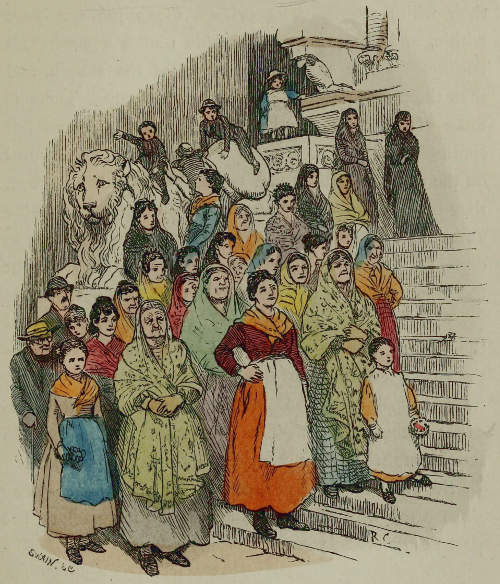
ON-LOOKERS AT THE PROCESSION OF PALMS.
The chanting and preaching begin within, varied now and then by the rise and fall of barely suppressed voices throughout the nave. Then the procession comes forth—banners and images, and crowds of children bearing their white palms. The priest’s monotone continues within, and the procession outside makes answer. Its flag-bearers knock upon the gates of the church, and then the palms and the banners enter again. There is more of the ceremony, but even the people attend but sparingly to it. The crowd lingers awhile; some kneel on the steps to pray, some enter the cathedral as best they can for benediction; many more wait about outside and talk and laugh and gesticulate, but when mass is done, mothers and fathers claim their children from out the procession, and the multitudes disperse quietly.
The day’s afternoon is spent in the public ways and the public gardens. Perfect enjoyment for an Italian is the enjoyment of idleness, and he wears it with a graceful sort of sincerity. Day sinks into darkness, but the caffès are still open. The fire must not die out too soon, since with the morrow fasting must begin again.
So, amid laughter and jollity, La festa delle Palme sinks away with everything else that is gone into the past things of the year.
Holy Week and Easter Feasts. I Sepolcri.
The Palms are blessed and done with, fasting has begun, for even the first week-days of the Settimana Santa are ‘giorni magri,’ though few folks pretend to practise any self-denial until the last three days of the week. Monday, Tuesday, and Wednesday pass without much ado. The preacher-monks harangue congregations in churches, upon highways and market-places, pouring forth strange prognostications and fiery words, often of the most grotesque. But the Frati predicatori are as nothing in the eyes of the populace compared with the sights and wonders that begin to multiply on Maundy Thursday. It is the day of the Santo Sepolcro.
People throng the churches; a pilgrimage to one or more of them is considered a sacred and a necessary duty. The Duomo is crowded. Worshippers tread the aisles of Sant’Ambrogio, that church which is famous to travellers for its Rubens, but to the inartistic natives for its ashes of St. John, and at this season for its magnificence of camellias: they kneel at its confessionals and bow before its altars and pray before its Christs and Virgins.
The scene is strange. The priests have spread Il Santo Sepolcro around the chief altar. It is arranged in every church more or less fitly, but in every church the details are different, if the main effect must needs be the same. Miniature gardens, meadows, and cornfields, fashioned out of bleached and yellow grasses, with flowers in their midst, cover the marble pavement within the altar rails; and amid the gardens and the flowers little figures of men and women are set talking and labouring in the fields. This is the foreground, and in the near distance perhaps rises a tiny hill, with three nude crosses upon it, while farther back, where the altar is wont to be, rests—among a wealth of flowers and many gaudy trappings—the body of the Christ in its rocky sepulchre. Hundreds of wax candles are alight upon the reredos, and there is a soft yellow radiance in the nave. Sant’Ambrogio is famed for its flowers. To-day pillars of red and white camellias stand high above people’s heads on either side the chancel’s entrance, and down upon its pavement there are spring roses and heartsease, daffodils and bright ranunculus growing among moss and bleached grasses, or shining from out quaintly stiff posies.
People pass in and out of the churches all day. They say their prayers to the Christ in Sant’Ambrogio, and then they go on to La Maddalena or to San Luca, and say more prayers and gaze on new wonders. This is penance and prayer-time, and people must think a little about the next world, however much they love this one, says the good Catholic! And these Lenten duties are not much harder than festival ones after all, enshrined as they are in sights and sounds and beloved mysteries. La Madonna della Nunziata is another church, holding a place of honour on this day, not so much by reason of her flowers as because of her riches and the great number of her masses. La Madonna della Nunziata is that church of most gorgeous interior, where massive columns of rare marbles bear up a frescoed and heavily-gilded roof. It is rich in costly decoration, in gems and bright colours. The citizens hold it of great account and crowd thither to-day to worship at the Santo Sepolcro, though they have flocked from church to church already, and told their beads, and whispered their criticisms and little bits of gossip, saying to themselves the while that the more churches they visit the more ease it will be to their souls. The devout make a long stride towards heaven on Maundy Thursday, but they have a hard day’s work of it all the same, for when they are not on their feet they are on their knees. It is sure to rain the whole time, if not in hearty showers, then with a desponding fine rain out of scirocco clouds; as indeed it ought in answer to the prayers that have bade Heaven send moisture for all the good things of the land which are growing. The devout do not complain. Heaven is forced to weep on this day of woe, and all the green things of nature will spring the better meanwhile, so they trudge contentedly, with veils that are soiled and damp (for the devout are almost always women), and red and green umbrellas, to make some gay-coloured things in the sad streets. They are not even too much fatigued to go to the night ceremony at the Duomo, when the archbishop washes the feet of the pilgrims; and even by that time the excitement has scarcely been enough for them, but they must needs eagerly question one another about the way in which the Signore is laid out in Santa Catarina or in the Cappucini. And the prayers must all be prayed before the Sepulchre, its wonders seen and conned over ere the dawn of Good Friday, for then the spectacle must be cleared away to make room for still graver duties. It is no doubt for the greater convenience of Easter preparations that the Roman Church has decreed the Burial should be solemnized before the Crucifixion—but the devout do not seem to have a scruple as to the fitness of this arrangement, and are just as ready for funeral ceremonies as though they had not celebrated the interment beforehand. There are no flowers in the sanctuaries on Good Friday—all day long there is only black drapery and sad music, and bells that must not sound; for the Church would fain tune all to her solemn silence until the mid-day of Saturday, when all the chimes from all the steeples and domes break out together, and the great deep-toned bell of the cathedral peals out afterwards alone. Easter is rung in with the spring.
All over the country, and wherever there is a spare nook in this town of palaces and marble, the peach and almond trees, the Judas and apricot blossoms spread a dainty cloth of colour, while against the rose-tinted flower of fruit-trees, lilacs and banksia roses begin to bloom in contrast. Before the month is out laburnum and acacia will be striving for mastery with the orange-blossoms.
A fresh wind blows over the town upon the morning of Easter-day. Ere the sun has been up an hour house-wives are bargaining on the Piazza S. Domenico for the peas and greens and gaudy tulips. Easter eggs are set out for sale in confectioners’ windows, along the high streets, upon booths in the public ways or smaller shops in the dark alleys. Every child, rich or poor, must have an egg for his Easter morning gift. People go to mass again, but not as they went during Holy Week, for this day is a day of holiday-making proper.
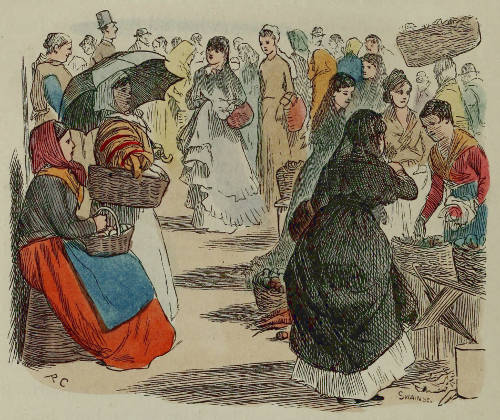
MARKETING.
Scarce can a busy marketer spare time from her early purchasing to spend ten minutes before the altar of some church on her way, that she may just save her soul from the neglect of a binding duty, but no one thinks very much of mass and vesper to-day, when the ravioli have to be made before twelve o’clock, and the fish-stalls have yet to be sought far down the town, after the green-market has duly been searched and spoiled. ‘The priests will pray for us to-day,’ say the devout, as they dip their fingers in holy water coming out from Benediction. They loiter awhile before the church door to buy some image, or coin, or rosary as they talk—or some Easter egg of crimson dye; but they are soon home again with the peas and the marjoram and bay for the day’s great dish, with the fresh fish and the lump of lean, solid beef, and the brains and the sweetbread. The dinner must be cooked, or at least superintended, the dinner must be eaten before idleness can begin. But, when the hours have crept well into afternoon, holiday dresses begin to flit gaily through the spring green of trees on the public gardens, holiday voices and holiday jests ring along the broad avenues and under the boughs of budding chestnuts. The sunshine is broad and pleasant, there is no heat to annoy and no curt breeze to ruffle tempers; it is really warm weather. No one wittingly gives a thought to the blushing orchard-bloom or the blue April sky—no one speaks of the fair tulips, the white narcissus, the lilacs and roses that are a-flower, but the light-hearted laugh the lighter all the same for knowledge that the spring-time is back again.
La Fantesca. The Servant Wench.
The sky is dull and sad to-day, and so the Mediterranean is grey. Even where the low-lying horizon clouds have parted a little to let through a far-away memory of sunlight, it is only a whiter grey light that outlines the margin of water and sky, and where the sea’s surface is broken into ripples by the softest of stirring breezes, the harmonies of shadows and relief are still in faint and faded colour-scales. It is a scirocco. Dull and sleepy vapours rest on the mountains around and creep down towards the town and the bay.
This picture of the Mediterranean is in shade, and the Mediterranean city lies clouded where Maddalena dwells, so that she is not glad, for her mistress is to give her holiday to-day because Tomasina, the sister’s eldest, is to make first communion, and, please the Virgin, there will be fine doings. The sister is no poor woman; she married the pizzicagnolo, or sausage merchant, in Via Luccoli, and can afford to spend a few francs. ’Tis a sad shame indeed that the day be so gloomy, for sunshine lights many a face into smiles that else would be shy and sallow, and sunshine accords well with holiday doings; but as la donna grossa, who comes in to help scrub and chatter of a morning, assured our Maddalena, so soon even as six o’clock this day, scirocco does not mean rain and, when the clouds lie so languid on the hills, one may safely don the dress of woollen stuff, for the weather is too heavy even to let the water come down from its skies.
Maddalena’s lady, la padrona, lives in a strange place near San Matteo. And San Matteo is considered so strange a quarter for the home of a widow who retains presence enough to have gallants still if she would, that fond relations and neighbours have actually been heard to say la signora Marini must be out of her mind. And yet the quartiere S. Matteo, if not fashionable, has beauties of its own. The little church is of old and beautiful design that stands with black and white marble façade on the piazza, and the gateway of the palace opposite is rich without in graceful and elaborate carving, sumptuous within by reason of a staircase weighty with ancient glory. But the widow does not live over the piazza nor in the grimy old palace. Behind S. Matteo’s sanctuary is its cloister, no longer set aside for religious uses, no longer peopled by cowled monks or demure and whitehooded nuns, but the same for shy and tender beauty as in the old days before Italy became a kingdom, and the Church’s institutions had come to be held in ridicule. A carpenter’s shop has grown into shape in the recesses of those sacred colonnades, and a carpenter’s apprentice planes his lathes and sprinkles his shavings beneath the graceful arches, while around and looking down into the little grassgrown courtyard, tall houses stand in a quadrangle, and white linen hangs to dry against the time-tinted marble: but slender columns with twisted stem and fair carven capital still spring frankly from out a daintily moulden base around the green enclosure, and stand in their simple beauty through shade and sunshine of Italy.
And this is where the padrona lives. Our Maddalena has been with her for sole servant wench these seven years past. One day la signora Marini came to the town Orphan Asylum, or Albergo dei Poveri, as we call it, and there sought a child whom she might educate to domestic service. Maddalena knew nothing at first; she was but thirteen years old and had had little teaching; but, thanks to the thrifty housewife’s pains and wholesome influence, assisted, as it surely was, by many a sharp word and friendly cuff, thanks also to her own bright wits, the little orphan grew rapidly into a servant of the quickest and deftest—into a maiden of the strongest and comeliest. Not that Maddalena was ever tall. Though, from their first frail babyhood, the poor little foundlings have the best care that such an institution as the Albergo dei Poveri can afford; though they be plentifully nourished by sturdy peasant nurses, according to the country’s custom; yet a mother’s care has never been theirs, nor have fresh field breezes ever fanned their cheeks, and strengthened their growing forms, such as may, perhaps, have greeted the first days of their lives. And so, though the little damsel be a pretty girl in her own style and fit for all life’s work, she wears a sometimes wistful look behind her simple face, and will always be of small and dainty type, though of firm-knit frame and wholesome strength enough. She has a warmly tinted skin with rosy flush, and two round brown eyes wherein the sunlight could dance as it can dance on Mediterranean waves; but to-day—since the beams are hidden that can so brightly catch those blue sea-ripples when they like—curling black lashes veil the bright brown eyes, and they soften their glance and darken their sunlight into wistfulness.
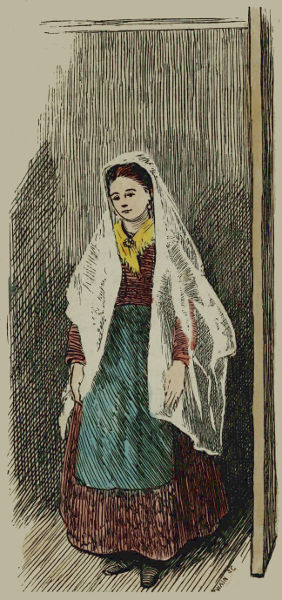
THE SERVANT WENCH.
It is three o’clock. The Mistress’s soup has been cooked and eaten, the piece of dry boiled beef is removed at last from table, the dishes are washed up, the last reproof has been administered. Maddalena stands before her lady in all the glory of a new-patterned dress, with silk apron, silken-fringed kerchief, brightly glowing gold brooch and ear-drops, fresh pezzotto, whose white muslin folds drape her neck and shoulders—she is ready to go. All blunders and scoldings of five minutes ago are forgotten: the mistress is only a woman, and as a woman she sympathises. Has she not herself smoothed those black braids whose plaits lie round so wondrously? Has she not placed the gold pins to secure the veil, and fastened the kerchief behind? ‘Thou hast a good appearance, in truth,’ she remarks, complacently gazing on her work—for Maddalena is her work, has been her work these years past—and the girl’s blood kindles with pleasure at the praise: la signora Marini knows what’s what, and would not, on this occasion, take the trouble to say what she did not mean!
The sky has not lightened with the growing day nor have the clouds taken their load off the mountains, the scirocco is still in the air, so that marble is less white and colour less brilliant along the streets, but the shadow is a tender shadow, and we do not mourn the searching sunlight. To-day is a great day at the Church of San Siro; the first communion has been given there this morning to hundreds of children, who now parade the streets in gala dress before going home to join in festivities of quite a secular nature. The girls have white dresses—satin, silk, or muslin, according to their degree, with bridal-seeming veils and flowers—the boys wear, probably, their first cloth suits and carry bouquets of flowers, of which they are half ashamed. Maddalena hurries on, smiling complacently. In every little white-robed girl she sees her own little niece, Tomasina, who has also been this morning at San Siro, and in every escorting damsel behind she sees herself walking beside the mamma, for is not she the aunt of a first communion girl? It is not far from San Matteo to Via Luccoli, and soon the little servant has climbed a dark winding stair, has pulled a feeble bell-rope on the 5to piano, has been admitted and warmly embraced by many female relations, in the midst of an admiring throng that is gathered round the little furbelowed and perfumed doll, who stands beside her mamma. ‘What luxury!’ says everybody, and congratulations pour from all sides upon the firstborn and the firstborn’s parents, who have thus safely borne her to years of discretion and the Church’s bosom. But she, poor infant, meanwhile, being but nine years old, listens wondering, and sure only of her new frock and her own importance, and of the comfits which are soon to be hers.
Voices rise shrill, and jokes fly merrily. Maddalena is not of the maddest among the guests. She stands now apart, softly conversing with a young man from Rivarolo, who keeps a baker’s shop, and is in no way to be despised. The shadow of the scirocco has not passed from her eyes, and the heavy lids lie but half folded away, with long lashes sweeping downwards; but the young man from Rivarolo does not seem to mind that sleepy gaze, and has just made up his mind that last Sunday shall not be the only time he follows a little maiden into the church of Saint Ambrogio, when she goes to early mass! Now the board is spread in this large, scantily furnished hall, where the floor is of red brick and the walls of yellow cement, and the curtains of soft and faded calicoes; sixteen people sit down to eat ravioli and stewed beef and truffles, to drink sour Monferrato wine, and to break their teeth over hard sugar-plums. They are all very free and friendly, and talk loudly, all but Maddalena, who prefers to speak in whispers, but then she is sitting beside the baker. When the evening is over it is this same baker who walks with her slowly, in the darkness of eight o’clock, up the steep of Via Luccoli, and along the broad way of the Carlo Felice, till they reach the point where a narrow, brick-paved and rapid descent runs down into San Matteo. ‘Brava! thou com’st home to time,’ says the mistress, when she opens the door to the servant-wench. And then they discuss the party and the presents, the viands, the dresses, the conversation, and all the scandal that can possibly be gathered from so humble an affair. ‘Well, thou hast amused thyself; to-morrow there will be plenty to do, my child,’ says the padrona, as maid and mistress retire to sleep.
And there is plenty to do indeed! La signora Marini has an entertainment in honour of her name-day, and la signora Marini likes to make a show, while being at the same time economical. Mistress and maid climb the steep hill betimes in the morning to have the pick of the market produce in the Piazza San Domenico, and both are a good hand at a bargain and a better hand still at a little friendly wrangling to small purpose. Maddalena is all day long plucking fowls, shredding beans, sorting rice, washing lettuce, rolling paste, stirring minestra—graver kitchen duties the housewife attends to herself—and when the dinner is under way the hall must be swept, and the girl has her mistress’s hair yet to do, and her own little slip-shod person to make neat! ‘Dio, how the ribs ache!’ says Maddalena, and while she says it the feeble door-bell tinkles—the guests are there!
Every man and woman, however, has a word and a jest for the serving-maid, which words and jests re-assure her a good deal, so that by the time the padrona is ready seated, among the company, at the long board with the coarse tablecloth, she is herself again, and, handing the viands, confidentially informs each guest of its chief ingredients, recommending her own favourites to favoured ones in the party. Only, when all are served and comfortably eating, Maddalena does not blush to sit down on the soiled old chintz settee with the vegetable dish in her lap. She can keep just as sharp a look-out over the wants of the table, and feels no way guilty of neglecting any duty—in fact, if reproved would have known quite well how to answer that she had been on her feet all day and was tired. But no one makes any complaint. People, on the contrary, are not afraid to exchange a friendly word now and then with the winsome waitress; and even when the guests are gone and the mistress goes into the kitchen to discuss the party’s success, Maddalena gets no scolding, either for her freedom of manner in the dining-hall, nor because ‘that young man of Rivarolo’ is there, having been brought by a third party in the shape of the charwoman. Indeed the lady gives countenance to this affair by her presence, and when the house is locked up, and both are alone again for the night, the talk between them is just as much of ‘him’ and his prospects as of the boiled beef and roasted capons, and of the success of the tagliarini as second course.
It is not a one-sided interest either. Maddalena has all her mistress’s concerns just as much at heart, and the concerns of her mistress’s aunts and uncles, and nieces and cousins as well. If the tagliarini had not been a success, or the lady had failed to get her due of compliment, the girl would have cried as copiously as when her own new dress was spoilt, the first time of wearing, by the water-squirts in the Pallavicini Garden at her sister’s wedding! And when la signora Marini had on that violet silk just new for the Corpus Domini procession, Maddalena could not refrain from a friendly ejaculation when she opened the street door to her—even though two strange gentlemen had accompanied her back from church! It is she who greases and plaits her lady’s hair on occasions less grand than those for which la pettinatrice—or female hair-dresser—is summoned. Maddalena can do a little of everything, and everything quite passably well, from the mending of a bell-rope with a hairpin to the crimping and ironing of fine muslins, the coiling of plaits, the stewing of fowls, the rolling of paste, the sweeping of rooms, and last, but certainly not least, the nursing of sick folk. When la padrona’s aunt had the typhus, who so deft, so patient, and so tender as the little servant wench? And when the child of the first-floor lodger had to have leeches put on for inflammation, did not the doctor say that he couldn’t have done it better himself than did Maddalena? To which she had answered, ‘No—nor half so well, being but a miserable man.’ Of course she must needs have her cryings, and scoldings, and ill-humours, and many is the time she has vowed to run away from the home she loves so well; but when all’s said and done there is surely no happier place than the 4to piano of that house in S. Matteo where mistress and maid live, and laugh and cry and squabble so thoroughly.
Il Negoziante. The Shopman.
Carnival has been and gone, Lent is over and Easter festivals, with sunny smile, have opened the gate to Spring. Upon the country that spreads around our goodly Riviera city, the flush of almond blossoms still lies rosily, to fade soon into the paler tones of pear and apple and cherry bloom. The trees are budding, to help with their faint green for contrast, but the green that is fullest at this time lies over the fresh, brown earth, where spring crops have come to life and are growing fast in the keen, sunlit air. Nursery gardens spread fair and far about the town, with little white and trellis-covered cottages in their midst for the husbandmen—gardens that have neat furrows intersecting them for water-supply, and that make a rich show in market produce. This is towards Albaro, on Genoa’s eastern side, and the low front of Albaro’s hill is adorned with many a white old palace and the slender columns of marble loggias that are fresco-painted within. From the town’s ramparts these many marble buildings have a great effect, that stand amidst green gardens, with roofs lying upon a bright sky, and—walking along the straight and dusty road that makes, towards the sunrise, for the sea-shore, and is flanked on both sides with arbutus trees—the white colonnades of the Paradiso palace are before you all the time to make you remember for ever after the look of marble arches on a green hillside and a strong blue sky.
Among the streets the spring cannot make itself quite so well remembered, nor can the sun have such an effect, but here, as elsewhere, April, May, and even March have quite another beauty from January. The sunlight is dashed even across the dark narrowness of Via San-Luca, and streams across the Piazza Soziglia to light upon the very counter of Signor Giordano’s shop. Surely bargains must be the less sharply driven, and the smiles of fair purchasers the more persuasive! But then Tuesday is the night of la marchesa Bice’s ball, and one must make one’s profit when one can, for in a small town, where the people are proverbially stingy, ’tis not every day that business is to be done!
Il Signor Giordano is a great man in Genoa. He has the largest shop for the novelties of fashion, and is moreover almost the only one of the first negozianti who go to London as well as to Paris for spring and autumn modes. On the other hand, he is not too expensive! He has his own interest at heart, of course, but he thinks to further it better by a judicious lowness of price than by an assumption of foreign exorbitance, as some others do. Then he is not impervious to female flattery, and something can be done with him in this wise! The windows of Signor Giordano’s shop are of plate-glass. Years ago there were no shops in Genoa that had plate-glass for windows, that had any windows at all in fact, just as there were no cittadine, or cabs, in the streets, and private carriages were so few that one could tell them all apart by their liveries: just as there were no gas lanterns but only oil lamps in the public thoroughfares. Even now the shops that have real plate-glass windows are few enough, and those that have them so broad and so fine as Signor Giordano are fewer still. His premises are large, large for a provincial town of Italy—and his young shopmen are civil, his goods deftly displayed in the window; all these advantages go to make the store in Via Soziglia one of the town’s favourites. So to-day it is well beset with female customers—prudent and economical mammas, eager daughters, placidly lavish young matrons, who are the most acceptable of all to Signor Giordano—everybody wants some adornment, great or small, for the coming festivity. A neat brougham stops at the door, whence there steps a slim-figured and pale-faced little dame, tastefully dressed in the latest of Paris fashions. ‘It is the Contessa Capramonte, per Bacco,’ says the foreman in the front shop to the great Signor Giordano, who is reading his Corriere behind. [The Corriere is the great mercantile paper.] ‘Excellent! Show her those new gauzes that we had last night;’ then advancing to meet this most graceful of customers, ‘Your servant, madam,’ bows the vender of fashions to their wearer; ‘what might be your ladyship’s pleasure this afternoon?’
And soon the hopeful comer is on the usual high wooden stool before the counter, all the new Paris gauzes displayed for her choice, with a dark and tall and perfumed young man to show them off, and the proprietor himself close at hand to take advice of, to jest and chat with besides, as these Italian ladies are never afraid to jest with their social inferiors. ‘Pretty,’ ejaculates she, admiringly, as the tall young man crushes and drapes a citron-coloured gauze the better for the sunlight to catch and beautify it! ‘But with that stuff I shall need a silk dress of the colour besides; it will cost me too much!’ ‘Truly your ladyship has the love of fun,’ laughs fat Signor Giordano at her elbow; ‘we know pretty well what the Contessa Capramonte has for money!’ ‘Truly,’ pouts the pretty lady; ‘you are a good husband one can see. Do you not reflect on the face which that sour-visaged Count will make when I bring him the bill, and have no more money, of the poor pittance he gives me, to pay it with? Oh, but I must reflect upon it, however!’ ‘The bill will not arrive yet awhile, and then, when the Signor Conte sees your ladyship in that dress, whose colour fits so perfectly to the complexion, which is the talk of our town——!’ ‘Come, have a care,’ laughs the lady back again, but with no foolish blush. Then considering, while the fatal look of indecision comes slowly to her pretty face, ‘for the rest you are right, Signor Giordano; no colour suits me so well, and with an assortment of tea-roses——’ ‘And the diamonds of the Capramonte family,’ puts in the great man, dexterously. ‘Yes, with the diamonds, perhaps,’ ruminates she. ‘Holy Madonna! it will be a sight for men to come from far and wide to see,’ murmurs the gauze vendor, fervently, and the dark youth ejaculates, ‘I believe it!’ as he is paid to do.
‘Well, I suppose I must,’ sighs the customer, and then there comes a question of quantity, and the Signor Giordano’s advice is again required about the number of metres for skirt, tunic, scarf and bodice, the which great matter cannot be decided until the manner of making have also been chosen, for la Contessa says that for economy she is going to have this dress made at home by her maid! It is pretty well certain the matter will be settled and unsettled over again at least twenty times by maid and mistress when the latter gets home, but meanwhile it pleases her to discuss it with the shopman, so forty metres are at last pronounced to be the necessary amount, and the lady can always have more afterwards, remarks the perfumed shop-youth with appropriate judgment.
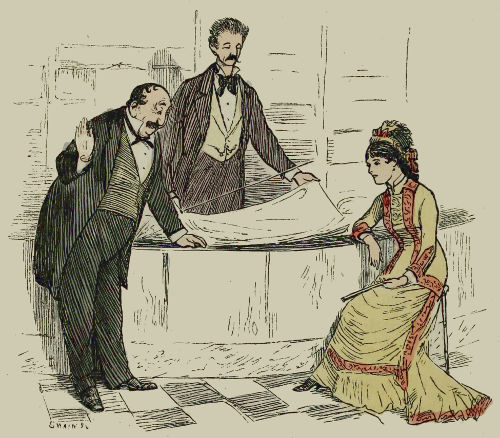
SHOPMAN AND PURCHASER.
‘Two francs a metre, you said, did you not?’ asks the Countess, innocently, watching the soft silk stuff being measured out. ‘Dear madam, no; three francs,’ corrects Signor Giordano with all suavity, and still the pale-coloured folds pass quickly through the hands of the tall young man. His thumb is on the great scissors, he has counted the forty metres, but ‘Stop, stop!’ cries the lady’s eager voice; ‘I must do without the dress, then—for certainly all that money, 120 francs, Dio, never shall I obtain it from my husband! Pity,’ adds she, rising gracefully, and replacing the high stool in its place, ‘for the colour suits me to perfection, and the stuff pleases me; this satin stripe is new, and looks well—but 120 francs—heaven forbid!’ ‘Eh, well,’ concedes the shopman, glancing at his humble satellite over the counter, ‘what do you think? For such a customer it would be worth while to make a reduction, is it not true? She would make such a figure, per Bacco! Let us make it two francs and eighty centimes. For you I will make a sacrifice,’ adds il Signor Giordano, with an admiring bow, ‘only’—and this in a lower tone—‘her ladyship will not mention the price.’ The concession is indifferently well received. Scoffs the customer, with a pretty toss of her small head, ‘I do not jest! Two francs a metre, or else I buy my dress elsewhere; and if I cannot find another to my taste, I stay at home to-morrow night.’ This is said poutingly, and master and man utter at once a deprecating ejaculation. ‘Two francs!’ pleads the former; ‘sweet lady, I couldn’t do it! If heaven had but been more generous to me, how proudly would I have made a gift of the thing which has been fortunate enough to please you, but——’ ‘Preposterous!’ laughs the beauty,’what a good thing that I know you! Well—make it two francs and thirty centesimi! You will not? Oh, well, I find my dress easily elsewhere. And there are to be many ladies of great beauty at la marchesa’s on Tuesday night. I should have required silk for the skirt too!’ These parting shafts are sent home as the lady retreats gracefully to the door. ‘Addio,’ nods she, and the plate-glass swings to behind her, the citron-coloured gauze is folded away off the counter. Yet both vendor and purchaser know well enough it will be out again in a trice, and addressed, moreover, to the Palazzo Capramonte.
So sure, in fact, is the shopman of this that when, five minutes later, another and less constant customer sees, admires, and would purchase that frail fabric, he is not afraid positively to state that forty metri of it are sold to the Contessa Capramonte; he is not ashamed either, when asked the price by this next customer, to give it only as two francs and fifty centesimi, but then this second lady is a foreigner, and will not bargain, and the Signor Giordano knows exactly how much to put on, because he knows how much a Genoese lady will have off before she buys. Is it waste of time? Not at all, the shopman will tell you—only part of the day’s work.
The Contessa walks leisurely from Soziglia down the Via de’ Orefici, and goes into a jeweller’s shop in this jewellers’ street, where, over lumps of pale pink coral and finely-wrought trinkets of silver and gilt-silver filigree, she plays her play over again, to come out triumphant with a necklace, whose dainty lumps and loops and wires are cunningly fashioned into leaves and roses. The necklace is not for herself, for a Genoese lady despises the produce of that darkly, strangely winding street, where the booths stand out freely to view, and glitter with the light silver wares, or are rich with the red heavy coral; but bargaining comes to her as second nature, so she has fought none the less bravely over the trinket because the commission is for a foreign friend. Thoughts of that dress have not strayed from her mind all the same, and before the Contessa drives out of Soziglia the citron gauze has been purchased for two francs and fifty centesimi the metro, which was the exact sum on which Signor Giordano meant they should meet from the beginning; and silk to match, and flowers, and ribbons have been added to the bill, all for something more than the one, for something less than the other said at first. So la Contessa goes home to her palace at Carignano, where banksia roses are blooming against the wall, and pink and white fruit-blossoms in the villa, while a purple Judas-tree is a-flower before the house. And the Signor Giordano goes home to the flat in Castelletto, where, though it is five storeys high, flowers still bloom upon the terrace and over the pergola, for winter is past, and we are in spring-time.
La Pettinatrice. The Hairdresser.
Marrina has her hands full to-day; for though it is quite too hot for early May—so hot that the first whiteness and crispness of a pezzotto is gone before the week is out—there is to be a ball to-night, and a ball in the sad old halls of the deserted Royal Palace; the king is coming to Genoa—the king and the people’s favourite, our much-loved Princess Margherita. Even the sparing Genoese do not grudge a little money to be brightest and happiest on such an occasion. The people and the shops are gay—the very streets, and walls, and houses seem to shine with joy of the prospect; illuminations are preparing in the public ways, the stalls of the fioraje are well stocked, and on the Acquasola the trees are a-flower, bright with green and wide spreading, the air is sweet with acacia-scent and laburnum. Marrina lives without the city’s gates, on the side towards the great cemetery. Why she lives there, who knows, as she often says? For, although the way into town is not further than even a buxom woman, like herself, can comfortably do in half-an-hour, it is more trouble than it is worth, this being obliged to pick up one’s petticoats, and turn out along the dusty highway every blessed morning of one’s life—whether the sun be hot or the Tramontana bleak—just to coil, and plaster, and construct aloft those heavy black masses of the Signora De Maroni’s hair! But, then, if one always had a reason for everything one did, Madonna, life would be a purgatory indeed! This is Marrina’s philosophy, and, indeed, the rents are not so high without the walls, and one has a breath for one’s money in summer time, if a colder blast in winter.
This morning there is little room for complaint of any sort. The weary-white valley of the Bisagno opens out to the sea, and is, perhaps, not beautiful in itself, because the shingle of its river’s bed lies around so wide with so small a thread of water in its midst; but, on either side of it, and beyond the dusty roads which hem its margin, green slopes rise gently with palaces on their sides where they are nearest the town, and with fruit trees in blossom and chestnut trees in leaf, on the opposite slopes of Albaro, which the market gardens of manenti make green the sooner. Pinkest peach bloom is over, but the cherry and the pear, and the tender-toned apple-blossom have not cast all their flowers yet, while the may and the blackthorn spread white and pink patches on hedge-rows inland, and, on the mossy turf of the Quesia Valley some two miles ahead, violets bloom beneath bright chestnut trees, and primroses on banks and boulders, faint narcissus breathes a scent where the air plays freely, and cowslips hang their heads in the sunshine. La Pettinatrice does not often see these things, it is true, for her own house stands nearer town upon the high road, where the Bisagno is thick with the soap-suds of many washerwomen who flog clothes upon hard flint, as they stand in its stream. But she has an aunt who lives up there where the water flows clean, and glides off mill-wheels into deep, green pools, and she has plucked the faintly streaked tulips from out the new spring wheat, and she knows the bloom of the fruit trees, though she is a town woman born and bred.
The dust lies thick on the road; although the summer has scarce begun, the sun shines hotly down, and Marrina is minded to spend two soldi that she may escape both dust and heat in a very insecure and closely-packed conveyance that runs to the Virgin’s gate of Porta Pila. Yet the sun is on Marrina’s broad back worse than ever, the dust whirls in her face from the open door and the flies are numerous, but a little altercation with the omnibus inmates makes up for all this and more. There is a man who carries the most fragrant of truffles with stale fish in a basket, and another who has just eaten freely of garlic and onions, but both of them discourse well with the comely pettinatrice, and she finds no fault in them. Marrina is a well-preserved woman of some thirty years. She is, perhaps, a little more showy-looking than some, even of the town-women of her age—that comes from her life amongst many classes, and a little also because Marrina has no husband, no home of her own, and no children. She has a shapely figure, that is a little too short for its size, a full round throat which the sun has burnt brown, a face that is one shade whiter than the throat, and a fine head of black crimped hair, whereon her own craft is amply displayed; her mouth is large, with full red lips and white teeth, her cheeks are rosy, her eyes twinkle proudly, and she wears white thread stockings and black shoes; her petticoats set out richly from her broad hips, her dress is gaily patterned, her kerchief falls aside a little at the neck, her hands are plump and smooth.
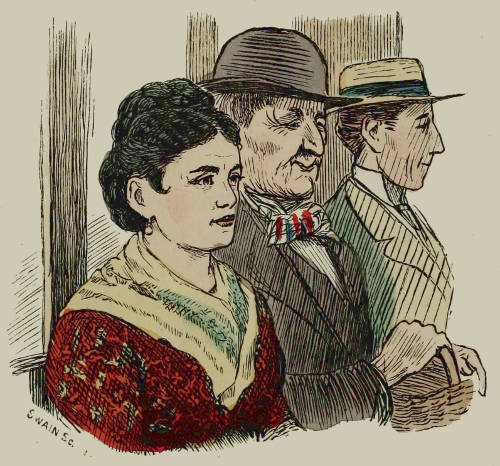
LA PETTINATRICE IN AN OMNIBUS.
The gate-keeper at Porta Pila, the host of the Osteria degli Amici, at the corner, the woman who sells fried fish two steps further on, all greet la pettinatrice as she comes across the drawbridge, with swinging gait, to turn up the first road on the right. La Signora De Maroni is the first to have her hair dressed, for she is a constant customer; but other thoughts and wider plans are rife in Marrina’s brain to-day, and she bestows but scant attention on this lady’s well-greased plaits. The morning’s unfailing gossip loses none of its excellence, however, for the grist is more rather than less plentiful to the mill. ‘Does vossignoria call to mind the linendraper’s wife who used to rent the little house with the pergola here above the convent?’ ‘That little red-haired one? Well, what of her?’ demands the lady sharply. She is a fine woman for her years, and has a handsome pile of hair, but hers is black, which is common-place, and besides the linendraper’s wife is ten years younger! Marrina knows all this. ‘Giusto,’ she answers glibly, ‘what a wit your worship has, to be sure! Red it is—red enough to scare the devil! Well, they’ve made a failure, they don’t live up here; they’ve only got a bit of a place now—you should see what a misery—down in Via Giulia!’ ‘Truly,’ murmurs La Signora De Maroni, well pleased. ‘I should think she wouldn’t be on the Acquasola to see the Princess, then?’ ‘I believe you, she won’t,’ laughs Marrina, crimping a poor handful of front hair as she speaks! Then, taking a hairpin from between her teeth, where it has been held for convenience, and placing it firmly through the towering structure of her victim’s head, ‘She’s too vain to show herself without a new silk dress! It’s quite ridiculous at her age! If it were yourself now, one would understand!’ ‘Go away with you,’ laughs the flattered dame, now holding the hot irons ready, to have the little flat curls of long usage made and plastered upon her forehead! ‘Yes, yes, it is true,’ continues Marrina, ‘and yet what is youth good for, I say? Only to play the fool. See there that new bride of Signor Parini, the goldsmith! People made such a noise of her youth and her beauty—only fourteen years old, and a wife! Well, how does she use it? Not been a mother three months, and a mere chit of sixteen as she is, before they do say’—and la pettinatrice’s voice sinks to an impressive whisper which la Signora De Maroni alone is able to hear.
But the daily erection is done, and Marrina has no time for gossip this morning. ‘Does vossignoria go to the opera to-night to see the Princess?’ she asks, rolling down her sleeves again. ‘Eh, povera me! No, indeed I do not,’ answers the lady! ‘Not even for a joke could I persuade that wretch of a De Maroni to hire me a box! And he that everyone tells me is so rich. Shame on him!’ Marrina laughs loudly. ‘They are all so, those husbands,’ she says. ‘The Virgin defend me from one!’ And with a ‘dunque domani,’ she is gone. La Signora De Maroni has neither so interesting a head nor so interesting a conversation as many whose hair she will do this day, for Marrina has twisted and combed and greased those black locks every morning for the last five years; so, swiftly running down the ninety-four dark and dirty steps, perhaps not with the lightest of footfalls, she is glad to greet the cobbler again, who stitches in the portico, and to be out in the spring air. There are two more subscribing clients to be finished off, and after that who knows how many chance heads of ladies who are going to the Princess’s ball?
The next customer lives up one of the fine new streets. She is not so rich as the De Maroni, but she is noble, and has better hair—hair that it’s a pleasure to stick the pins into, as la pettinatrice has been heard to say. Lilacs are blooming, with snowy guelder roses behind the tall railings of private gardens in Via Serra, and the banksia buds have grown so wildly that their long and flowering sprays fall back over the wall into the street. Marrina plucks a blossom with which to greet her customer. It is not hers to pluck, but why should that signify, any more than it can signify she should make fun of the bourgeoise De Maroni with this younger and prettier rival of the aristocracy, telling of the grey hairs that lie underneath, if only you lift the well-greased black ones, and of how that old husband of hers refused to spend his money to take her to the opera. ‘And with reason,’ says Marrina for comment; ‘if the poor devil must needs spend money, ’tis natural he should prefer to spend it for a pretty face.’ Then the lady laughs, and quite agrees, and they fall to the discussion of this one and that one—for this customer is young, and has her many gallants, and Marrina is always very useful for gossip and scandal. La signora is going to the opera, and then to the ball—not with her husband, of course—and must needs consult Marrina about her toilet, for a pettinatrice sees the costume of many a fine lady, and can advise so as to make or to mar many an evening’s happiness.
On this occasion the pretty countess gets many a hint, and knows what most of the marchese will wear to-night, so that she is able still to devise—with la pettinatrice’s help—some extravagance that shall outvie them all. Fortunately for her, she is a favourite with Marrina, and may trust just a little more to the discretion of Marrina’s tongue than all the poor ladies who confided the secret of their toilets to her yesterday—because, though her hands will work amongst hair till far into the coming night, Marrina dressed many a head yester eve, whose owner sat upright in a chair till this morning—nor thought anything of it—for appearance sake! ‘Amuse yourself, Signora Contessa, and have a care for that poor little marquis of last week, now that you have a new gallant,’ says Marrina, deftly placing the last pile. ‘Dio, what time I waste with you,’ adds she, as the church clock strikes! And she is down the stair, down the street almost with the thought, and out into the flower-strewn Acquasola, where the air is flushed with summer sunshine, and waxen blossoms stand stiffly amid the broad leaves of horse-chestnuts in the sloping avenue. La Marchesa Tagliafico lives on the Salita dei Cappucini, where she can see the flowering creepers against the tall old wall of the Villetta de’ Negri opposite, that is now the new Acquasola, where she can hear the rush of the cascade, and scent the limes and acacias off the public-gardens, and watch the nobility driving round of a warm Sunday evening; where she is close to the ancient Church of the Cappucini, besides, and can stand beneath its cypresses two minutes after leaving home, to visit its Presepio at Epiphany or its Santo Sepolcro in Holy Week, to hear its Frati Predicatori, to attend mass and buy waxen images on all or any of the festas. La Marchesa is one of the devout; nevertheless she is to be at the ball to-night, and Marrina is to do her hair.