Front matter (continued 5)
Reading edition
He counted on his fingers. He'd been kidnaped, and he'd spent a year on Ertene. That was one. There was a year or so developing the barrier-screen—that made two. There were five years of advancing from senior executive to marshal's rank, and that made seven. It was a year since his being discharged from the Terran Space Patrol, and that made eight years.
Eight long years since he hadn't had a care on his mind. And in spite of his successes, there was that constant gnawing knowledge that he was not true to himself or his fellows. Yet, his conscience was clear. The knowledge had not been bad for his morale; it was merely disconcerting to know that the things they gave him credit for were not his own.
Maynard did not consider for one moment that Ertene hadn't given him everything. It took inventive genius to fit the barrier to spacecraft, and the other developments were all Maynard's own. But he scorned them all and debased himself.
It was eight long, lonely years ago—
He mentally kicked himself. He wondered whether Joan Forbes would have made a difference in his life. She might have been the outlet to pent-up feelings that he needed so badly. Joan would have given him rest without asking suspicious questions. It might have been better—
But Joan was dead, and though Thomakein claimed that she would have been there anyway, it did little to cheer him up. Thomakein's reasoning did not include the possibility that Joan might have been making a home for him, or that even the tiniest mite of family would have immobilized her against following a planet invasion.
Joan Forbes, thought Maynard, might have been the answer—but at the present time she was another blind alley of thought. Might have been is the cry of the second-guesser; the Monday Morning Quarterback.
The sense of thermal balance that was high in Maynard warned him first. Then that sense that tells of another sentient being close by, its warning, and Guy turned to see a small figure beside him on the bridge.
"Elanane," she said.
"Don't say it," he warned softly. "I can watch the stars, too."
"They're so silent and quiet and big."
"And peaceful," agreed Guy.
"I've been lonesome," said Leilanane plaintively. It was with effort that Maynard resisted the impulse to put his hand on her shoulder.
"Are you now?" he asked softly.
She shook her head. "Elanane, I want to talk."
"Go right ahead," smiled Guy. "I like to hear you."
"No—this is important, and it is hard for me to begin."
"Serious?"
She nodded. "No ... Elanane, please don't take my shoulders like that ... it makes it more difficult."
Guy turned her around, pointed her head at the sky. "Up there, somewhere," he said quietly, "is the answer to everything. We'll find it some day. Now, Leilanane, tell me what you are worrying about."
"Thomakein asked me to marry him."
Guy's reason beat his reflex to the muscles in his forearms and prevented him from closing his hands tight on Leilanane's shoulders. Thomakein perceived the emotional tangle that was becoming more and more imminent, and by marrying Leilanane he would eliminate it. Guy knew that Thomakein thought everything of Leilanane—possibly loved the girl in a passive manner. Guy smiled briefly, obviously Thomakein could have had little opportunity to make real love to her, but a man of Thomakein's personality could carry off such a proposal by his own sheer persuasiveness. Also, Thomakein wanted power himself. Marrying the lanee's sister would put him in the eyes of the public, and doing it with the approval of the lanee himself would give him the official recognition that he needed to become lanee after Elanane. Well, Guy would resign as soon as Thomakein wanted him to, that was reasonable and desirable. It also solved the problem that bothered both Guy and Leilanane.
"Why not?" he asked softly.
"I don't know. Something—keeps me from it."
"Me?" asked Guy in a voice that was almost a whisper.
Leilanane turned and buried her face in Guy's shoulder. "Am I bad?" she cried. "Is it so terrible to love my brother?"
"It is unfortunate, Leil," said Guy softly. "It cannot be. I, too, am torn. We must face this thing as it is. Brothers and sisters normally do not care for one another. Perhaps our being apart so much has removed the usual reason. Yes, Leil, I love you too. Do you love Thomakein at all?"
"Thomakein attracts me," admitted Leilanane. "There is something dynamic in him; dynamic and powerful and all-sweeping. I could learn to love him truly."
"Then do so. Leil, no matter what we do, you and I, if we permit this outlandish thing to go on, it will mean unhappiness for both of us."
"No. Couldn't we go ... to Sol ... and live there?"
Guy shook his head. "You'd learn to hate me, Leil. In our hearts we'd always know that what we were doing was dead wrong."
Leilanane nodded pitifully. "There are times, though," she said earnestly, "when you do not seem like my brother."
"Forget it," said Guy. "There is nothing more certain in the world." Guy's sense of humor told him that he was right, all things considered.
"I suppose I will forget it soon enough. What will you do?"
"What I should have done years ago—go out and find me a mate."
"I'll hate her."
Guy laughed, and if it sounded forced, Leilanane did not notice. He turned her around to face him and shook her gently. "You're a silly little lovely," he told her. "Nothing is less like the intelligent girl I know you are. It's been my fault all along. Now you'll marry Thomakein and you'll love it."
"Think so?"
"Do you think of him at all?"
Leilanane thought for a moment. "I think so," she said slowly. "Perhaps I might learn to love him—I've never had much chance."
"Again my fault. Come on, I think he's up. We'll settle this right now."
They found Thomakein reading. Guy opened abruptly with: "Thomakein, Leil says you have been talking deep."
Thomakein smiled solemnly. "I have—and what's your answer?"
"There can be one answer. When?"
"As soon as possible."
Guy searched the other man's mind for any ulterior motive and found none. He feared to increase the sensitivity of his instrument because of the necessity of fiddling with the tuning and gain controls before their eyes. He nodded, smiled and gave Leilanane a little hug. "You're it," he said. "Now go away."
Leilanane left, and Guy sat quiet for a moment, thinking. Thomakein had solved his problem again. No matter how he felt, Guy knew that what had been growing was not to be. He asked: "Are you on the level?"
"I am. I've loved her a long time."
"Good. I think rather well of my sister."
"I know."
"Look, Tom, you're not doing this just to break this up?"
"Not entirely. Forgive me if I ramble a moment, but I want you to understand. You are never out of danger, Guy. You never will be as long as you are lanee. Once you retire, you can accept the alternative of utter retirement, or you may be more inclined to a less public life. People will revere you always, but your importance will wane, and your words will be less quoted and less watched until you are safe from chance slips of the tongue.
"Now I want to be lanee—permit me that. As I have said, I've been too far from Ertene too long. People know me, but not well enough. You sponsor this marriage, and it will be practically an endorsement from you. Then in a kiloday you may announce your retirement and I'll announce my candidacy. The family tie-up will run me in on a wave of popularity. As for Leilanane, I'll be as good and as loving a husband as I can. I know that she'll be a good wife."
"I haven't heard the word 'love' used yet."
Thomakein smiled wryly. "Honest, Guy, it always struck me slightly silly to hear two grown, mature, intelligent, strong, capable men discussing love. Forgive me. I feel that some things should be kept between the man and the woman alone. I do love Leilanane, that I promise."
"O.K.," laughed Guy. "Go ahead and commit matrimony. But look, Tom, once you get settled and running, see if you can find a friend for me."
Forty days later, Guy led Leilanane down the long aisle with a golden cord. The choral voice of the great organ rolled sonorously, exultantly, and then faded to a musical whisper as the couple reached the altar bar. The ceremony started, and its origin was lost in antiquity but returned in symbol. Guy removed the golden halo from Leilanane's head, and burned it on the flame-blackened pedestal. Thomakein accepted the protection of the woman as Guy's protection was removed and destroyed by the all-consuming fire.
Guy returned up the long aisle alone where he stood to watch the final phases of the ceremony.
The bridal couple clasped hands, and then as the music rolled out again, they left the altar bar hand in hand. They stopped before Guy, who smiled and said: "Life, love, and happiness."
Then he shook his head. The official ceremony was over, and Guy grinned hugely. He pried them apart and took an arm of each, leaving the chapel with them. He handed them into their flier, and motioned them away with a jerking movement of his thumb. "Beat it," he said, "and don't return until you're better acquainted."
Guy returned to his offices and called for Charalas.
XIX.
The period that follows defies description. It is simple to take a protracted length of time and describe the events that transpire, but when little or nothing of interest takes place, there is nothing to record. It is similar to the engineering report of negative answer; it is inconclusive and unsatisfying.
This is an historical record of the events that took place during a certain period, and during that period there are times such as this in which nothing happened.
Literally nothing.
It is this lack of action that made the outcome. Guy Maynard was a Terran. Terrans have been accustomed for centuries to action. From the time of the caveman to the present, Terrans have lived in a cultural system that was ever accelerating. They progressed from the animal-powered vehicle to the machine-powered vehicle in a matter of years, and they went from land-travel to air-travel in the scant matter of years. Life on Terra has been a constantly-increasing tempo to the present, when Terrans traverse space in velocities measured in thousands of miles per second.
It is improbable that Terrans will slow down. Like the Ertinians, once a race is geared to high-velocity, slowing down is impossible.
The Ertinians, geared to a nomad life, could not conceive of a stable system and like the proverbial tramp, continued to think in terms of travel.
The Terran—Guy Maynard—found the peaceful life on Ertene suitable for a long time. He expected that action would take place once Thomakein and Leilanane were mated, but things fell into their grooves again, and time went on interminably.
Guy tried to push the physicists that were working on his pet projects and found a placitude that maddened him. The necessities of sudden and decisive action were not there. Ertinians didn't think as Terrans do. Eons had passed since anything of real velocity was needed, and their thinking habits had been trained along these lines.
The idea of accepting an idea and developing it immediately into a practical thing was unheard of. There had been no need. Certainly there must be no need now.
Guy was a dynamo of action in a world geared to ten miles per hour.
He found that their scientific developments were slow and cumbersome. Their science was not their own, but that of the worlds of their passage, and with years between such contacts, scientific ambition was low, indeed. With no competitive force driving them forward, Ertene had assumed the role of a lazy man, content to live in indolence.
Had any danger come to Terra, it would have been answered immediately and more than likely Terra would have gone out to meet the threat on the threat's home ground. But after the first flurry of worry over the disclosure of Ertene to Terra by the man Gomanar, Ertene's concern subsided. Half-heartedly Ertene put up vortex projectors about their cities, and then returned to their homes.
At first, Guy worried about these weapons. It was not fair to his peace of mind to see on every hand the evidence of Ertene's dislike of Terra. His own feelings were mixed; Terra hadn't played fair with him, true, but the idea of ruling a planet that would kill thousand upon thousand of his people stuck in Guy's throat. He worried about this, and because he could tell no one about it—not even Thomakein for fear that his motives be mis-read—he worried alone.
His worry gave him something to do, at least.
But then as the days added into kilodays, and Ertene continued on and on and on in its course through the heavens, and no Terran forces came to contest or to seek, Guy became used to the idea that Ertene's barrier was far more obscure than the proverbial needle in the haystack. A magnet, well plied, will show the fallacy of that platitude, but trying to see nothing against a field of black—impossible.
Guy knew that his no-radiation detectors were being used. He suspected deeper developments, and fumed and fretted because he could not know what they were. His imagination cooked up many ideas, possible and impossible, for the finding of such a minute bubble in space. And it all reduced to one thing.
Mephisto had been unfound for hundreds of years of space travel and exploration. Men suspected the possibility of inner- and outer-planets and went on the search for them. They failed until the Ertinian science provided Guy with an instrument to locate such bodies.
Ertene's chances were excellent.
And the mathematicians of Ertene spent kilodays in deep theory and high abstractions and decided that the law of probabilities prohibited the finding of Ertene.
And instead of feeling concern at the idea of fighting his own people, Guy looked upon the vortex projectors in the same light as a fire department in a city of pure metal.
Guy's life changed as a result of this. Like the man on vacation, he began to seek something to do. The job of lanee was unexciting and drab after the life of activity he knew on Terra.
On every hand he saw things that would be hailed as miraculous on Terra. Medical science was far ahead of Terra's in spite of the drive of necessity; Ertene's science had gone forward passively and the diseases were gone completely from the planet. Their accident-surgery could stand a bit of Terran influence just as the Terrans could stand some of Ertinian vaccine and antibody discoveries.
He scorned the speed of the workmen that erected the home for Thomakein and Leilanane—now named Leilakein, of course—because it took them almost a thousand days. The same home, he knew, could have been erected upon the planets Venus, with material shipped cold from Terra, and the couple would have been living in it within sixty days.
But Terran workmen used tiny MacMillans to drill holes instead of the brace and bit of the ancients. Spikes and nails were unused on Terra, instantaneous welding was done on metal, and molecular-bonding, and forming. Wood was worked with portable power-tools, and fastened together with huge wire staples formed as used from spools of wire, and driven with the machine on the premises.
In the sky, traffic moved ponderously and sedately. Even in rush periods Ertinian traffic did not approach the mad scramble that took place on Terra.
Guy drove his flier through the skies with them and came to the conclusion that the hurrying scramble of traffic and its frequent accidents was productive of a bunch of better drivers. The percentages of dented wings to fliers in the sky was higher on Ertene.
He read an editorial in a paper objecting to the lanee's hairbreadth sky-tactics and Guy scorned the words because he hadn't been in the slightest danger. After all, Guy had learned to run a flier over Sahara Base, where a flier sometimes cut between building tops in a vertical bank to keep from hitting wingtips, and where one of the more scatter-brained stunts consisted of racing another driver to the last landing space.
"Sure, they lost fliers that way," grinned Guy aloud. But it made for the quick or the dead and it kept people on their toes.
He accepted Charalas' theories about survival, and admitted that if Terra were rotten and avaricious, so was he. He knew that if it came to a choice, he'd prefer that they experiment on a Titanian than upon him.
His only sore spot was the fact that Terra denied him his right to his secret—and his life. They had been more than unreasonable in that, expecting him to break his oath to them.
And that brought back the old argument. Who was right? Should he have agreed to Ertene's oath and then sold them out?
He shook his head. Had he been that kind, Ertene would not have permitted him to leave.
Guy had spent his life under the idea that when things went too quietly too long grief was brewing. He had theorized upon it, and had formulated the relation that the amount of grief was proportional to the length of quiet time.
His accounting was piling up to a terrible, staggering total. He knew it wouldn't last, couldn't last. He hoped that Thomakein would move, giving him a chance to lose himself. But Thomakein went about his business quietly, testing the vortex projectors and handling the details of defense.
What form the end would take, Guy didn't know.
He'd have welcomed it save for the one fact that if and when it came, Guy would then be out of a place to live. Terra had made it impossible to remain there, to have Ertene denied him would make him a man without a planet.
And so he fought the idea of alliance with Terra because such an alliance would place him right in the hands of the Terrans themselves. There would be no forgiving if they came, and once they came and disclosed Guy's real identity, Guy would have no Ertinian shelter. Ertene would throw him out for violating his promise never to return.
Guy snorted at himself. His was a life of broken promises and cross-purpose oaths.
But there was one oath he intended to keep. He would do all he could to keep Ertene free—his life depended upon it! It occurred to Guy that the way to keep things that way was to remove the source of irritation, and so he began to investigate and to reason.
How lucky it was that Elanane had passed on as he did. How lucky that Guy resembled him. Guy had accepted these coincidences glibly, without question, until it came to him that Thomakein could have done otherwise if he had found it necessary. Charalas had been lanee once, and the neuro-surgeon would have followed Thomakein's urgings, especially after Thomakein's stories of Terran intrigue.
It was too trite.
Would a popular ruler, professing isolation, refuse to arm his planet against invasion? Perhaps. There are men who think that if they mind their business, others will mind theirs. But not Terra. Not when known otherwise, would such a policy work. The idea of passive resistance went out when the airplane came in.
The real Elanane was quite a man. He was loved, admired, and eulogized. He was intelligent, well-balanced mentally, morally, and physically. Elanane was neither crank nor crackpot, and Guy knew that his theories of government were stable and sensible.
Therefore Guy reasoned that Elanane would be certain to take any measures to insure the safety of Ertene.
That would mean absolute co-operation with Thomakein. Elanane had appointed Thomakein to study Terra and to report. A spy, if the word must be used. Elanane would accept the word of his friend and do as that friend suggested.
But Elanane might go so far and no more. There is a vast difference between preparing to stand off a possible invasion and preparing to fight an offensive war. Elanane might believe that the best defense is a quick offense.
Would Thomakein do away with a friend for that?
Hardly. It must be deeper.
Coincidence was too thick. That alcohol and irritation business did not make sense. Ertinian anti-lamine drugs were similar to Terra's, and furthermore Ertinians used alcohol which would mean that the Ertinian drug must have been tested under these conditions. That brought up another thought.
If Thomakein had slipped a neutralizer into Guy's drinks, he could almost be certain that exposure would follow.
Would Thomakein gain by such a deal?
Well, would he?
Guy's hand found the sensitivity control and stepped the power high. His sensitive fingertips tuned for maximum contact with Thomakein.
The answer he sought exploded in his mind with clearness and conciseness. Its sheer audacity staggered Guy. The very gall of the man was appalling, and yet the utter forcefulness of Thomakein might push it through. The plan itself was so daring that Thomakein would stun those who were against him. Not permanently, but they would be amazed long enough for the Ertinian to take his toll.
Once Thomakein unwound his plot, it would defy catching.
Guy headed for Thomakein's office on the run, and caught him present.
"I've just figured it," snapped Guy.
"So? Figured what?"
"That little plot you've been cooking!"
"Plot? You mean my plan for—"
"It's a stinking plot and nothing more."
"You're a little upset, Elanane. Remember that you live only at my bidding."
"What did you do to Elanane?"
"It was unfortunate—"
"The men who permitted his death were dealt with," admitted Guy harshly.
"So?"
"But removing Elanane permanently didn't bother you at all."
"No, not too much. But remember that Elanane was my friend."
"I hope that I never have such a friend."
"You have," smiled Thomakein in a superior manner.
"You? God forbid!"
"Look, hothead, cool down. If you get tossed off of Ertene, then what?"
"I made an oath to protect Ertene."
"You made an oath never to return."
"I also made an oath never to tell. Also one previous to tell Terra of anything I discover."
"Do you suppose that Ertene will believe anything you tell them once the truth of your broken oaths are known?"
"They needn't know. I—am Elanane."
"We can put a stop to that," snapped Thomakein.
"I think that I can stop you first."
"No doubt," said Thomakein easily. "The Terran methods of hand-to-hand fighting are devastating. But you'll never conceal your victory."
"You stinker," snarled Guy. "How about Leil?"
Thomakein's face fell. "I will be blamed for Elanane's death," he said solemnly. "I am more than sorry about that."
"Being sorry is not enough."
"What do you intend to do about it?"
"Thomakein"—Guy opened the phonoscope key, dialed government headquarters, and continued—"I arrest you, Thomakein, for treason against the integrity of Ertene!"
The faces on the plate registered horror, and then action. The plate continued to register as headquarters kept the circuit open. Guy dropped his hold on the audio key to cut the sounds of men in full cry.
"Now we'll see."
"You idiot," laughed Thomakein. "You'll see how Ertinians stick together!"
"We'll see."
"You might have come in," said Thomakein. "Together we could have ruled the entire System."
"You planned to rule it alone," sneered Guy.
"I shall—now."
"You're the kind of man to share such power with me."
"Certainly."
"Rot."
"Have it your way."
"I'll have it my way," said Guy. "It's not your way."
"Nor yours. I don't particularly care," said Thomakein easily. "My plans are about set anyway. A day or so means little."
"Days—even hours can ruin anything."
"Not when the plan includes the possibility of something slipping."
"Nice trick you played on me."
"Thank you, Guy. That's just an idea. If I can play puppets with a ruler of Ertene, an ambitious young man from Terra, and the fate of worlds and make everything come out even—I can run the show."
"You controlled the election of Elanane because he resembled me."
"Naturally. That was part of it."
"Why?"
"Because I knew that no Ertinian would permit me to arm Ertene for power and invasion. It took an energetic man, with will, force, and fear of discovery to push it through. Guy, you'd have been safe if I'd been permitted to run this freely. Terra couldn't touch you. But you choose to pit your futile will against mine. Mine—and Ertene's!"
"I am going to keep Ertene free!" shouted Guy, hammering on the desk with his fist.
"You mean, 'Gomanar is going to save his skin!' don't you?" sneered Thomakein.
"I'll shoot the works, Thomakein, if it's necessary."
"Poor lad. You had promise."
The door flung open, and police entered. They begged Thomakein's forgiveness, and then marched him from the office to the great hall wherein the Council met.
The great Hall of History brought back the memory of his first visit, and Guy smiled. Then as the Council entered and seated itself, Guy faced them. In the balcony above, faces peered over at the governmental representatives. The wall below the balcony's edge came alive with the hundred and eighty phonoscopes that would take this proceeding to all Ertene.
"A grave charge has been made," said the leader of the group. "Who brings this charge."
"I, Lanee Elanane, charge that this man, Thomakein, has plotted against the Will of Ertene."
"The charge is treason, then?"
"Yes."
"Explain the reason for these charges. Remember, Lanee Elanane, this is no trial, but a pretrial to arrive at the decision as to the graveness of the crime. Evidence for such a crime must be collected, and if the charge is allowed, you will be permitted to gather such evidence during a period of time decided by this Council."
"I have reason to believe that Thomakein is plotting to take Ertene into the Solar System," said Guy.
The Council exploded. The austere meeting broke into a riot of talk until Guy shouted: "Quiet!"
"Proceed, Elanane."
"In addition, Thomakein has ambition to become the supreme ruler over the allied Solar System and Ertene."
Harabond, the head of the Council, arose. "Assuming that Thomakein were successful in his mechanical intrigue—he might be elected to rule. The accomplishment of such a feat would prove his ability."
"Ertene can be swung, can't it?" asked Guy.
"Yes—but only if it is universally agreed on Ertene."
Guy leaned forward and his voice was dry and hard. "Harabond, on Terra it is reported that many times a brilliant but dishonest leader of minorities has succeeded in making a shambles of the world before he was subdued. It is fear of this that has made Terrans distrustful of everyone who is not openly for them. And do you think that a man capable of running this intrigue to its present state of completion would stop at elections? He'll grab!"
"Thomakein, will you offer defense?"
Thomakein stood forward with a cryptic smile upon his lips. "Harabond, how long have you been Leader of the Council?"
"Proceed, Thomakein. Leave the personalities out of this."
"You do not know the man before you," said Thomakein. "Those of you who were here when we first met a denizen of Sol—do you remember Gomanar? This is he!"
"Impossible."
"Not at all. I remembered how he resembled the lanee-assistant. Elanane became lanee later, remember. This man before you, Members of the Council, is the man who promised never to tell of Ertene. He was willing to violate his initial oath to Terra and keep us from exposure. This is the man who spoke openly on Terra, violating his oath to us. This is the man who is now violating his oath to us by being here—he promised never to return."
"Get Charalas," said Harabond. A courier left silently, scowling that his absence would deprive him of some interesting scenes.
"Now," said Harabond, "if this is whom you say, prove it here and now!"
"Have I no time to gather evidence?" asked Thomakein cynically.
"His charge against you was first. This matter of counter-charges complexes the proceedings. Must we hold our lanee in trial to prove his right to charge another with treason?"
"I need no time," said Thomakein. "I can prove that he is not Elanane."
"Perhaps I can disprove you," smiled Guy.
"He thinks to baffle us all," laughed Thomakein. "Harabond, so great is his deceit that he thinks to fool us all."
"You may answer his charge," said Harabond to Guy.
"Harabond, do you recall thrashing me for swimming in your abandoned quarry as a youngster? I was four kilodays old, then. At four point three kilodays, Neilamon, your son and I—we were of an age—skipped school and ran away to become vagrants. They found us and we were again thrashed. It is laughable, gentlemen, but I find that I cannot recall any incidents of good, bright, intelligent youth. Apparently I was a healthy, normal youth that got into trouble as any healthy schoolboy will. And there is Tocamay. He knocked out one of my baby teeth for pulling the hair of the girl that sat in front of me in school. Afterwards, we split an apple stolen from Harabond's orchard, and swore never to trust a woman again—she walked home with the school sissy whom we both hated. The sissy, remember him, Tocamay? He sits beside you, now one of the better philosophers of Ertene and destined to go down in history. Did you marry her, Diamony?"
"No," grinned the philosopher.
"Shall we take a vote?" asked Harabond.
"No impostor can be that well read," said Tocamay.
"To become educated in the present society might be accomplished, but never to recall childhood things from learning. Impossible."
"Then you admit that Elanane is Elanane?"
"We do."
"I wish to add something," smiled Guy. "If I am this Gomanar, I want to know what Thomakein did with Elanane?"
"You answer me that," smiled Thomakein. Guy started. The Ertinian looked as though he were enjoying himself immensely. It worried Guy, and he knew that Thomakein must have a pair of aces up his sleeve.
"Then we proclaim that this man is Elanane," said Harabond, "and Lanee Elanane may proceed with the charges against Thomakein." He thought for a moment. "No, we must—by law—listen to any evidence offered by Thomakein that this man is not Elanane."
"I'll take the chance," said Thomakein brightly. Harabond looked at Thomakein in amazement.
"Yes," nodded Thomakein. "I'll take the initiative now. Members of the Council, a mind-reader could baffle us all. He could recall things of our childhood at will, by reading our minds. This impostor—Gomanar by Ertinian pronunciation—Guy Maynard by his mother on Terra—Elanane by his own selection, has a mental amplifier, which enables him to read thought!"
"Incredible!"
"Impossible!"
"Not at all," said Thomakein. "It is fact. This instrument is not perfect. It reads surface thoughts only—unless the subject is thinking at you. Then the deeper thoughts are clear."
"But if this is true, and he is not Elanane, how can he read deep thoughts directed at Elanane?"
"Misdirection," said Thomakein. "You and I and Ertene thought he was Elanane. We thought at him as Elanane. He used these thoughts for his own purpose."
"Can you prove this?"
"Am I talking for fun?" sneered Thomakein. He stepped to the phonoscope, snapped the key, and said: "Bring it in, Lentanar."
The door opened and the man brought in the huge thought-beam instrument that Guy built in Elanane's workshop. "This is it," said Thomakein.
"What have you to say?" asked Harabond.
"May I show you how it works?" asked Guy. He stepped forward, turned it on, tuned it to Thomakein and himself, and broadcast their thoughts.
"Now," he said, "read and think!"
XX.
An hour passed in silence. Then Harabond held up a hand and Guy turned the instrument off. "So," he said to the Council, "you see that my interest is for Ertene!"
"A man who is capable of developing an instrument such as this," said Harabond, "is more than capable of distorting its output to his own purpose!"
"But thought—" said Guy.
Harabond shook his head. "To think that Thomakein would plot this way against Ertene is unbelievable. Were this charge brought by an Ertinian, we might consider it valid. There is too much at stake to believe a Terran, whose word has proven to be none too good."
"Use this thing for yourself," Guy directed. "Put technicians on it, build several and prove that you cannot distort its output. Then believe me."
"An instrument such as this would deprive all of us of our sacred privacy. I direct that it be destroyed and that no research be permitted along these lines," said Harabond. "As for the incredible story I see—or was directed to witness—at the operation of this machine, I can only shake my head. I reiterate, any man possessing genius enough to build an instrument like this is more than capable of making it perform to his will. Therefore its evidence will not be allowed. And, furthermore, the Terran, Guy Maynard, will be charged with the murder of Elanane!"
"But—!"
"Take him away!"
Guy was marched from the room before the same policemen that he had summoned to bring Thomakein. As they passed the portal, Charalas entered, shook his head in puzzlement and asked Thomakein what was this all about?
"An incredible impersonation," said Thomakein, "plus the loss of a loved leader," Guy heard him explaining as the door closed behind them.
Halfway across the rotunda between the buildings, the whine of sirens climbed up the scale and shook the very ground with their power. It was a frightening sound, and the men clinging to Guy's arms let go to look around in wonder.
Guy might have run, but he was too stunned and bitter to react properly. The very gall of Thomakein! The utter blindness of the Council!
Guy envisioned the end of Guy Maynard's unhappy life at the end of a rope—or according to the Ertinian plan of painless removal. He went limp and beaten. He was licked. He was a poor pawn, and all that he could do to sway the lives of worlds was to push in futility and fall below them when they refused to move. It would have been better—
"Terrans!"
"The Space Patrol!"
"You summoned them!" snarled one captor.
"No—"
"Liar!"
"I swear not."
"We believe not!"
Down out of the clear sky came the Terran Patrol in battle formation. With the precision that spoke volumes, the space pattern flowed from the closed cylinder to a lenticular disk and the massed ships of the task force sped across the city at fifty thousand feet.
"They've come for you!"
"No," swore Guy.
"They'll not get you!"
"We'd best give him," argued the other. "They'll fire!"
"They're firing."
"No, they're not," said Guy. "That's signaling."
"Either signaling or poor marksmanship," said the captor. "Nothing's hit."
"Terra doesn't miss," said Guy.
From the ringed emplacements, the vortex projectors vomited their toroids. Upward went the pattern of vortexes, and the Patrol broke formation in an effort to elude the whirling toroids.
"Did you?" asked Charalas, coming up behind.
"Send for them? No."
"Your story is true?"
"I swear it!"
"Then what of them?"
The pattern of toroidal vortices went up and up, and caught Terran ships, passed on, and left the Terran ships to fall inert. Pressor beams cradled the falling ships and lowered them to ground. The rest of the Terran Patrol drove inward on a slant, with the turreted AutoMacs blazing purple at the snouts and the invisible beams cutting flaring furrows across the city.
Another toroid went up before them, and pilots fought their controls to divert the ships. The slow-moving vortex hovered, and the high-velocity ships arrowed through the vortex in spite of the pilots. More pressor beams caught the inert ships.
Torpedoes started to burst in the city, and with each explosion a building leaped skyward in a mass of flame and dropped in ruin. The sky crisscrossed with flaring beams, and the vortex projectors spewed forth again and again, filling the air with death.
The Patrol drove high, hovered. They fenced with MacMillans on automatic, and then fled precipitately as a super-sized toroid formed and raced upwards.
"Beat 'em off."
Guy nodded.
Then he turned and slugged his nearest captor. He took the man's MacMillan and faced the rest. "I'm leaving," he snarled.
He backed carefully away, keeping his back against the building. A movement caught his eye, and Guy's quick hand dropped an Ertinian from a high window. With the diversion, the other policeman reached for his MacMillan, and Guy blasted the hand as it grabbed, and then drilled the man behind him for trying to reach forward for it.
"I'm not fooling," snarled Guy. "And I'll take hostage. Charalas, come along!"
"Me?" asked the aged man, stalling for time.
"You—and jump!" yelled Guy, sniping a swift shot at his feet. Guy reached the parked police flier, pushed Charalas in, and then took off on a screaming zoom upwards.
A MacMillan flared and missed, a vortex rolled upwards too slow by half, another MacMillan missed, and then Guy was off and far away and free once more. He grinned. They'd left him his personal thought-beam instrument. They'd find it hard to run him down when he could read their minds. He turned the gain a little lower so that they couldn't read his, and he wondered whether the more powerful instrument would really be destroyed now.
An hour later, along near the ocean's edge, Guy dropped the flier. "Charalas," he said, offering a hand, "I'm sorry."
"You're in a real mess," said the neuro-surgeon.
"I know—but what's Ertene going to do now?"
He snapped on the flier-radio and caught Thomakein in the act of speaking: "—obviously came at the call of the impostor. He was a high official in the Patrol, and was working undercover here. People of Ertene, we must reply! We may not hold up our heads until this insult has been repaid. We now have a fine space fleet, thanks to the vortex and the pressors, and the Terrans. Never could we have built such a fleet here on Ertene; but it is now ours."
Guy growled and snapped Thomakein off.
"What are your plans?" asked Charalas.
"I'm going to drop you off here. Then I'm going somewhere."
"Where?"
"That's it. I don't know where. I'm barred from everything but Mars—I might try there."
"You loved Ertene, didn't you?" asked Charalas.
Guy nodded. "Until I found out how blind they are. A fine thing! They give credence to a plotter because his accuser is not of Ertene. And this last—I hate them and him!"
"This last?"
"Thomakein dropped the barrier so that the Terrans would come to investigate. He planned it all—and got his fleet ready-made."
"They came to fight—"
"They wouldn't have come if Thomakein hadn't started it all. Blame whom you will, but Thomakein saw his plan start when he found me alive in the Mardinex. My life has been just a pusharound for Thomakein for nine years."
"You think Ertene will win?"
"Thomakein may be highly successful for a long time—but Terra will win," said Guy. "Remember, Charalas, when you strike a rat, the rat bites back. That slaughter of Terrans back there is just nasty enough to make Terra completely mad. It happened before, on Mephisto III, and when we cooled down to the mere screaming point, there wasn't a living thing on Mephisto proper. Berserk, is the word for angry Terrans, Charalas. And I say Beware."
"And you?"
"Me, I'd like to push something around. I'm getting sick of being a pawn. I've reached the last straw, Charalas, and something's going to be crowned. That utter murder of Terrans just about broke me, and if I break completely, I'll take after Ertene single-handed."
"Slaughter?" asked Charalas.
"It was downright murder. If I only had an army."
"That's not murder. Ertene seldom kills."
"Look, Charalas, I'm in no mood for foolishness. I saw those ships come down after the vortex hit them. Terrans do not scare stiff, Charalas, they fight to the last."
"I know, but the vortex does not kill."
"The ... vortex ... does ... not ... kill?" repeated Maynard dully.
"No."
"It doesn't kill?" came the dazed repeat again.
"No. The vortex slows the life processes to almost zero, but not quite. Several, repeated exposures will kill, of course, but two or three aren't too dangerous to healthy people."
"What do they do to recover them?"
"Heat lamps, massage, and a shot of cuperenalin."
"I've got my army then," said Guy quietly. "I've got my army!" His voice repeated the phrase, and his tone crescendoed from stunned quietness to an exultant roar. "I've got my men!"
"I don't understand," said Charalas.
"I don't expect you to," smiled Guy. "Below here, in the ocean, is my spacecraft. I'm leaving Ertene—but I'll be back. Oh, will I be back! Terra needs some Ertinian love of leisure, and Ertene needs some of Terra's ambition. As a team, they should get on fine!"
"What are you going to do?" asked Charalas in alarm.
"Terra pushed me around for trying to protect Ertene. Ertene shoved me out for being Terran. They're both blindly unreasonable. I'm going to play Kilkenny cats, Charalas."
"Play what?"
"The Kilkenny cats were tied by the tails and hung over a line. They clawed each other to death. I'm going to break up this balance of power in Sol, with Mars and Terra always running the main show, by hanging Ertene in an orbit. Then there'll be three to treat with, plus the minority on Venus, and they'll all be standing around with their hands in one another's pockets. Mars will have to come off of her high horse or lose her shirt when Terra and Ertene get together, and Terra will have to listen to Mars if and when Ertene takes a notion to let Mars into confidence. Ertene will have to play baseball with both Terra and Mars or the Solarians will gang up in spite of themselves. And eventually there'll be less isolationism around Sol, and we'll all be better off. I'm going out to get me enough people to do the job—and now I know where to get 'em!"
Guy grinned at Charalas, stepped to the high bluff over the ocean, and dived.
The Loki emerged from the ocean an hour later. It went high and arrowed into the sky, and it was out of sight in seconds. Charalas wondered if followers would come, certainly the detectors would be running full power and would catch this ship and register it as nonconforming to the licensed ships of Ertene.
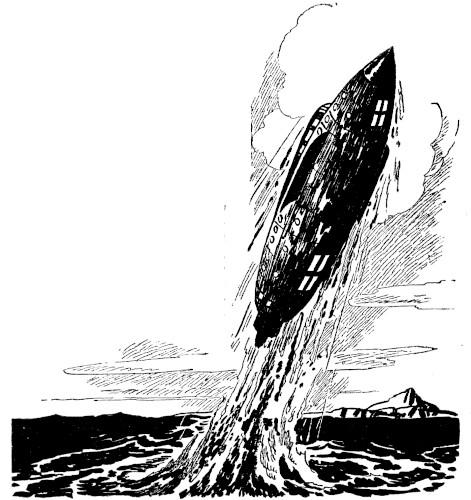
But the followers did not come, and Charalas realized that Guy Maynard was once a high officer in the Terran Patrol, and that he was more than familiar with the technical details of such a small craft. Charalas grinned, and wondered which one of Ertene's destroyed ships was now being detected in action again, and not being recorded because of matrices that eliminated unwanted alarms.
But Charalas wondered most about Guy's future plans. How and what was he going to do—and alone, too!
"Also unarmed," added Guy to himself. "Nice to know you, Charalas. And if you'll wonder about me for a week, I'll appreciate it. Bet the Ertinian land forces are on the prod right now—and you'll be found directly. No matter, I can take care of Guy Maynard from here."
Guy nosed the Loki cautiously toward the moon of Ertene. Their synthetic sun, dimming a bit now that the unbounded energy-intake was cut, shone full and bright upon one side, and Guy wasted precious minutes circling to the dark side.
It was mostly wasteland, yet Guy went die-straight to the half-concealed emplacement.
With callousness born of necessity, Guy rammed the dome and the Loki was flung away in the out-rush of air. Guy set his grapples, and literally tore the building apart, brick by brick, and then hooked onto the great vortex projector and lifted it high into the sky. He returned for the power equipment and took that also. He thanked his lucky star that the Loki was a Terran ship and not one of the less agile Ertinian jobs. The fact that it was fitted with everything but a set of turret-mounted MacMillans made Guy jump up and down in glee. He recalled the game of hide-and-seek of a couple of years ago, and knew that the Loki could take it.
He set the Loki down on a barren plain on the side away from Ertene, and donned space garb. Welding the vortex projector on the top of the Loki made a strange-looking spacecraft, but streamlining was unimportant in space anyway. He hooked girder after girder on the huge parabolic reflector, welding them securely to his hull. He fitted the supply cables with air-tight bushings through the walls, and then spent several hours fitting up a series of relays to a thumb-button on the pilot's levers.
His detector rang as he was finishing, and Guy poked the drive control without waiting to see the nature of the approaching ship.
He grinned as he arrowed away from Ertene, because he knew that no matter whose ship it was, it was against him. They'd given him the time he needed, and if he managed to get through the next phase, they would never be able to stop him again. No one would ever collect the price that was upon his head—a double price, one in Solar coin, one in Ertinian.
His detector rang again, and Guy saw a small Terran ship approaching. Its turrets jerked forward, and Guy's thumb hit the button. The Loki bucked to avoid the discharge of the AutoMacs, but the velocity of the Terran was too high to swerve. It ran into the floating vortex and went dead, at full velocity, on and on into the nothing of the sky. It was picked up later by Ertinians, who added it to their captured fleet.
And Guy, knowing that his life might control the future of billions of lives, hardened. Friend or foe, all must fall before him until he had reached the end of this phase of his life. If he fell, the Solar System itself might never recover from the outcome of his failure.
For Maynard, knowing his Terrans, his Martians, and also his Ertinians, could have pointed out the moves of the next five years on the fingers of his hand—and no one alive could have denied him.
From ten thousand miles above, Guy looked at Mephisto III. "Two or three aren't dangerous," muttered Guy, repeating Charalas' statement. "Please God it be three with no danger, for they will have had two!"
His thumb pressed the button, and the vortex formed, whirled, and then went racing forward in a boiling toroid of energy. It spread as it went, widening swiftly and encompassing the entire moon before it wrapped itself about the ground, closing like a monstrous blanket on the far side in curlers of lightnings and fire. The vortex died, and Mephisto III was again lifeless. Guy dropped quickly, and landed the Loki on the same spaceport that he had created from the hard ground years ago. He looked about him at the supplies and the ships lying mute, and shuddered at the bodies that lie a-sprawl. Then he smiled wryly and apologized mentally. There were but few of the big guns of the Terran Patrol present—but they would be a good nucleus.
For now, though, Guy had work to do.
XXI.
Maynard looked at the ground, and wondered. It was cold—deathly cold—in spite of the years of the barrier-input. Cold enough to give him hope.
Guy set his crowbar into the grave and pried. The dirt came out in lumps—the same lumps blasted long ago to create the shallow trench. The white wrappings were not soiled; the ground was frozen hard enough to prevent bits of grime from working their way into the soft cloth. The body was stiff and utterly cold beneath the wrappings, and it was more like carrying a log than a human being. But Guy took the exhumed one to the Loki, removed the white wrappings, and snapped on the battery of heat lamps.
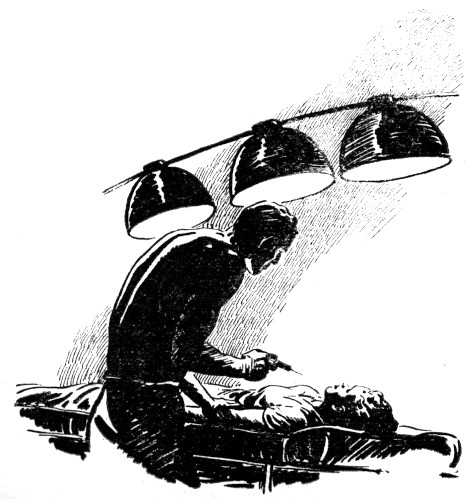
Losses made the air grow unbearably hot in the little cabin, but Guy worked woodenly and did not notice. He forced himself to this. The handling of a corpse—for until it showed the sign of life it was a corpse—made Guy's stomach crawl and made his hands feel as though they never would be clean again. Time and again he looked away to keep from screaming aloud.
And when it came time to insert the needle containing superenalin into the body, Guy's fingers went cold and insensitive. The needle did not slide in the way it should, it entered with that dead feeling similar to cutting dead flesh with a dull knife. It sickened him, and after emergence, when the tiny droplet of blood did not come, it brought on that nausea again.
Massage! It was a gruesome thing, this fondling and stroking of cold, stiff limbs. The heat seemed to be doing no good, for Guy could discern no softening of the joints. They creaked and cracked as he moved the arms and legs, and it worried him because he knew the brittleness of frozen flesh. Was he breaking bone and flesh deep within this body?
More—was it worth it?
Guy's mind recoiled and rejected the horror that he felt. This body was no stranger to him. Alive, physical contact would not have been distasteful. Now that it was dead, why did he feel horror?
Alive, it might have fought him because of the liberties he was taking; with no objections to his ministrations possible, why did he feel horror and fear?
It struck Guy as insanely funny and he laughed uproariously. The cabin rocked to the sound of his laughter, and as he stopped, the echo reminded him of the cackle of an idiot. He stopped with indrawn breath, shook his head, and returned to his task.
The body moved perceptibly, and Guy recoiled from the table with the same feeling of horror and fear. This was too much like awakening the dead.
A gasp of indrawn breath came, and the body choked on the volume of air that entered the lungs. Color returned to the cheeks, and the eyes opened, fluttered, and then looked at Guy full and open.
The lips parted.
"Guy!"
"Joan! You're all right?"
"Of course—shouldn't I be?"
"But—"
"That toroid in the sky—what was it?"
"It came from Mephisto."
"Then it is not dangerous?"
"Not when you understand it."
Joan snorted. "If that's the best they can do—we'll lick them easy."
Guy nodded foolishly. How was he going to tell Joan the whole story in short of a lifetime?
She looked around. "This isn't the Orionad. Why did you bring me here?"
"I ... we—"
"Guy!" she came from the table, put her hands on his shoulders, and looked up into his face. "It's been long, hasn't it?"
He nodded.
She searched his face understandingly, comprehended the suffering and worry there, and said: "Tell me."
It came then, all in a burst of words. The entire tale from start to finish with nothing withheld. It took an hour solid, and when Guy finished, Joan looked up and asked:
"You're still going on?"
He nodded, but asked: "Should I?"
"You must. First off, Guy, you are a man alone. That might be fine for you, but life demands that you do your utmost to progress. You know what will happen."
"Ertene and Terra will fight. Ertene will fight to join the System as ruling planet, and Terra will fight to haul Ertene in by brute force. Eventually, Terra will win, partly, and subdue Ertene. Ertene will reply by swerving outward again, and try to continue on the roaming, nomad life. As a last measure, Ertene will hit Sol with a vortex. That will set things off—how, I do not know. Nova, perhaps. Instability, definitely. Or Ertene will hit Terra with a vortex. At any rate, super-vortexes will be hurled back and forth, and Ertene—if she isn't a black ruin—will go on through space with no man alive. Sol will continue to run as a dead, sterile system.
"So long as they are permitted to fight, complete ruin will be the outcome. I must ... I MUST prevent that."
"You must," agreed Joan. "You must be ruthless and calloused. You mustn't hesitate to kill and maim—though it sounds against all nature. Ertene must be chastened—and Ertene must be brought into the System! To let Ertene go will constitute a constant threat to Sol—no constant, but lasting for a hundred years. So long as Ertene can hurl a vortex at Sol, we are endangered. Ertene must be immobilized, and placed under the same necessities—those of keeping Sol alive and stable. Terra must be taught to accept Ertene as an equal.
"And since a three-world system must become interwoven to remain, Terra, Ertene, and Mars will lose their isolationism. But it's your job, Guy. You're the only man who understands. You are the only man who can bring a balance of power to bear. Take it and knit a new system!"
"You'll help?"
Joan smiled. "Naturally." She lifted herself on tiptoe and held him close. "I've always wanted to help, Guy. Anything you say—name it!"
Guy choked.
"You've"—and Guy recalled years ago when Joan said the same words to him—"been lonely, Guy."
Years of loneliness and yearning and heartbreak expended themselves in a matter of minutes, and the long, bitter years dropped away, bringing them right up to the present moment. Then the future promised briefly before they broke apart. They regretted the break, though something unspoken made them stop; they could not seek the future with so much to be done in the present: They must cross this bridge first.
Gradually, the scene took on a busy appearance. Men in suits bustled around the ships, and they rang with the sound of repair and servicing. And across the plain there came a steady stream of men carrying white-swathed bodies, and when six came in, twelve left to continue the work. With progressingly larger numbers at work, the stream of men entering the huge, squat building became a double line, a triple line, and then a sixfold line. Other buildings opened, and the stream continued to expand.
Projectors and turret-mounted MacMillans roved the sky and the detectors went out to their extreme limit.
Technicians worked over Guy's thought-beam, and produced a large one for each ship in the small group. Maynard's fleet would be knit with thought-communications, and no interference would cause them to lose control. Other technicians toyed with the vortex projectors, and though Guy saw no more success here than on Ertene, the amount of activity was higher by far, and in a few weeks the Terrans had passed the most advanced researches of the Ertinians.
A convoy of Terran ships approached, and Guy merely smiled.
"I've been expecting them. Go get 'em, Harrison!"
"Right. They're replacements for this gang?"
"Were."
"Why don't we wake up the gang that was here when you came?"
"You know that. I can't trust 'em. I brought you fellows back—at least you owe me your lives."
"I'll argue that point when I get back. Ships, supplies, and men! We need 'em!"
The little fleet sped out to contact the larger convoy. Unlike the usual Terran procedure, Maynard's fleet spread wide apart, and waited in the dark of space, behind barriers.
It would have been slaughter again. This convoy expected to find its own men awaiting supply and materials. Instead, the vortex projectors spewed.
Out they rolled, and the barriers went down as they passed. Turreted MacMillans whirled, and the invisible energies laced the sky. Torpedoes winked in gouts of flame and the interferers chopped the communications band into uselessness. Maynard's ships fired a second series before the first reached the Terrans, and the Terrans, fighting their own velocity, rolled into the whirling toroids firing their AutoMacs to the last.
Ships rained out of the sky in flaming ruin, cut bright arcs in the sky, and died.
And then it was all over. Massacre it would have been if the vortex projectors had been deadly. The Terran convoy was not prepared to meet a powerful fleet, and it succumbed in a matter of seconds.
Cradling pressors lowered the Terran ships to ground, and Maynard's men took possession.
"Well?" asked Harrison. "Have we got what it takes?"
"Not enough," said Guy glumly. "There was one constellation craft in that bunch—the Leoniad. It's a creaky old crate that uses co-ordinator fire in the turrets instead of autosyncs. Her torpedo tubes are rusty, her generator room reeks, and her drive is one of those constantly variable affairs that never settles down to a smooth run. The Leoniad is a derelict, as far as I'm concerned. The smaller stuff is fine business, though I doubt that they could stand up to a half dozen constellations. We'll fit the old tub up, though, and use her. She's all we have in that class."
"Any chance of getting more?"
"Might raid Ertene. I think it might be easy—Ertene is none too sharp invasionwise. They're armed to the teeth with vortex jobs, though."
"Vortexes aren't deadly."
"A local anaesthetic would be a killer-weapon if you could numb up a man's trigger finger only," grinned Guy. "Might as well be dead as sleeping it off on Ertene."
"I get you. How about raiding Sahara Base?"
"We might duck their mounted stuff. I wish I knew what they are doing with the vortex projectors."
"Let's wake up the commanding officer of the convoy and ask. He'd know."
"Good idea," said Maynard, and gave the order over the phone.
Eventually, the man was brought in. He was indignant, defeated, angry, and anxious about his future in turns, and his emotions changed from one to the other swiftly. He was Sector Commander Neville.
"What is the meaning of this outrage?" he asked. "I know you. You're the renegade, Maynard."
"Stop it!" exploded Harrison. "He is Guy Maynard, and a better man than you and I, Neville."
"You, too, must have turned pirate, commander."
"I'm no pirate. What I'm doing is by sheer choice. Wait until you hear his story, and you may wish to join us."
"Never."
"Never say 'never'," grinned Harrison. "It shows how much you don't know about everything—especially human nature."
"Look, Neville, I want to know what Terra is doing with the vortex gun."
"I'll never tell you."
"I'll tell you, then," smiled Maynard. "Emplacements augmenting the planet-mounted MacMillans are being set up around Sahara Base. Luna is being set up with them, too, since the moon is a natural invasion-springboard. The main cities are being protected, too, and some long-range stuff is being put in the remote spots to stave off any attempt at entry. The triple-mounts in the midships turret of all constellation craft are being changed from MacMillan to vortex, and the fore turret on all cruisers. Destroyers will carry a smaller edition in a semi-mobile mount in the nose, and the fighter craft of the heavier classes are to have vortex projectors in fixed position. The three MacMillans will drop to two, the center being replaced in the lighter ships.
"Oh, and yes, Neville, I mustn't forget the super-sized job that is being erected on Luna for cross-space work. That's a nice, brutal, long-futured thought, Neville, and it can do nothing but bring reprisals."
"That one will not be used except in self-defense—"
"Sky-juice! I only hope that it can be destroyed before it is used. The fools! Can't you realize that Mars is erecting one on Phobos, too?"
Neville blanched. "Hadn't considered it."
"Why not? Why shouldn't they? They're no less intelligent than we are ... don't jump up and down, Neville, they are and you know it ... and they react in about the same fashion. The only thing that has enabled us to stay ahead of Mars is the fact that we can take three times the acceleration standing up. Another item of general interest. Ertene—you've heard of that one—is erecting a projector of super-size, too. Guess where it will be used."
Neville thought, and then asked: "How do you know these things?"
Guy tapped the thought-beam on his belt. "Thought-reading gadget," he said quietly, and then proceeded to read Neville's thoughts to him, saying them word for word as Neville expressed them in his mind.
"Now," said Guy, "Sol is in for trouble. That is, unless we get Ertene in here too. That'll mean invasion. But, Neville, I don't want Ertene overrun like we did on Mephisto. Ertene is like Terra, but its culture is just enough different and its physiology different enough to make a separate entity in the System. They think somewhat differently, too, as you'll see later. But, Neville, getting Ertene here as a prime power will entail much work."
"Why must she be a power?"
"Because this projector is a final weapon. With it, I alone in a tiny fighter, can lay every living thing down on Terra, and then proceed onward to Mars, Ertene, the inhabited planetoids, moons, asteroids, meteors, spacecraft, and anything else I've forgotten to mention. The planets of Sol must be stripped of their militant attitude. Otherwise any progress we might make is stopped. With Mars and Ertene, Sol may have the combination to the long-sought space drive. Centauri lies beyond the horizon, Neville, and we may reach it if we forget our petty quarrels."
"Why couldn't Terra get that herself?"
"Because Ertene and Mars hold certain keys. Neither will work for Terra, either freely or under duress. If this war is fought to the finish, there'll be no great minds left to carry on the research. Remember that."
"What do you intend to do?"
"I intend to conquer them all!"
"You deluded idiot—"
"Look, Neville, I've got this," and Guy slapped the mind instrument. "I've got this," and Guy waved a hand at the field, teeming with its workmen, awakened from the vortex-induced sleep. "And, I've got this!" and Guy pointed outside to the great vortex projector that stood on the ordnance field. "Do you think I can be beaten?"
"Eventually, you will. No dictator ever held out against the entire System."
"I don't intend to hold out. All I want to do," said Guy pointedly, "is to set up this mind-reading, thought-beam instrument on every planet, in every congress, in every voting booth, and in every home! Then we'll see what happens to warmongers, hate-raisers, and petty politicians! The will of the people is to work in peace, and peace they will get when each knows the will of the other, alien races. Fear drives men to fight, Neville, and if any group decides to get up and run things, the vast majority will know it first."
"It'll destroy our privacy," whispered Neville.
"With everyone wearing one, the effects cancel pretty well," said Guy. "Except when the wearer intends to have his thoughts read. And the larger models, set in voting places and congressional groups, will be used to broadcast on frequencies open to anyone who cares to listen. I don't intend that this thing will be used to deprive people of their right to think as they please, but it can be used wisely and well to prevent criminal cliques, ill-advised minorities, and individual criminals."
"It won't work."
"That I want to see for myself. At any rate, either we put a stop to this warfare that will leave Sol lifeless or we will never be able to look up into the sky ourselves."
"Far too much time and wealth is spent," said Neville slowly, "in fighting or preparing for war. The research—could use some of that money. No one has even got the first inkling of a defense against the vortex—you're right, if all have it, it will wind up in death to all. I'll help Maynard."
"Because you think that Terra is unable to accomplish her purpose alone?"
"No," answered Neville. "It's because you are sincere. You let me read your mind—and I know."
"If used for nothing else," grinned Guy, "we can assume right now that any candidate for high office must use this machine. Any who do not will find their qualifications and intentions up for argument. The graft it will kill will be wonderful."
XXII.
Maynard's force swept out from Mephisto, drove in toward Sol, and slipped between Terra and Venus. They passed Sol just outside of the orbit of Mercury and headed outward again.
Just beyond the orbit of Terra, the souped-up detectors flared briefly and then burst into full indication. Maynard smiled wryly and said: "How can any military strategy work when both sides have mental telepathy, even though it is mechanical?"
The Martian task force was plunging into space almost on an opposite course, coming forward under battle acceleration. "We're not having any," snapped Guy.
"They must have heard of the trouble Terra had with us," observed Turretman Holmes. "Maybe they'd like Mephisto?"
"They aren't heading for Terra," said Guy. "Well, we're being attacked, technically. Let's have at them."
The indication in the detector opened, and the pattern of the Martian fleet became clear. Guy shook his head at the perfection of the space lattice. Against the vortex, a perfect space lattice meant ruin.
Into the Martian fleet went Maynard's group. At terrific velocity, the two fleets met, and the vortexes flowed from Guy's ships and ran together in a mad pattern through which there was no place to pass unharmed.
There was a flash of MacMillan fire. Crossed beams radiated, and the space between the ships dotted with blinding flashes of premature torpedoes.
The Martians were more interested in avoiding the toroids, and their fire was desultory. The Terrans were more interested in the Martian ships, and their fire was defensive only.
Then at once, the Martians were through, passed, and inert. They sped on at zero drive, and their courses diverged.
"After 'em!" grunted Maynard. "Get 'em on detectors!"
The Martians went out of sight. The contact-detectors stretched as the two opposing velocities caused the separation to add into the unthinkable miles. Days passed before the velocity of Guy's fleet dropped to turn-back velocity, and more days passed before Guy's ships were within sight of their quarry. By then, no ship was within detector range of its fellow; the sky was clear save for the inert Martian and the pursuing ship.
Slowly, the Leoniad crept up beside the Martian ship. And then as the velocity of Leoniad approached zero relative to the Martian, there was motion in the sky, the detectors flared bright, and the alarm bells rang with ear-splitting loudness. The detector showed a Martian sub-ship at pointer range.
Its barrier had been blasted open by the huge vortex that crept and rolled towards the Leoniad.
"Pilot! Vortex at fourteen—seven ten!"
Leoniad creaked. Ponderously, it swapped ends. A seam split, and the intercom became hoarse with the shrill of escaping air and the cries of the repair crew. An alarm rang loud, which stopped when the split seam was plastered. Acceleration took hold, and the men were nailed to their places. The generator alarm pealed, indicating dangerous overload. More plates creaked as the drivers took the power and strained against the mass and inertia of the Leoniad.
"Not enough!"
The turrets of the Leoniad whipped around and the sub-ship was blasted in a vast, expanding flare.
But its work was done. Though the drivers, straining their best, were fighting the Leoniad into velocity, there was too little time. The vortex caught up with the Leoniad, passed upward from base to top, and went on to die in the remoteness of space.
The breakers blew, the fuses sputtered, and Leoniad went inert.
She coasted away from the Martian at much less than one mile per second.
Maynard bumped gently into the wall of his scanning room and the pain wakened him. Dazedly, he passed a hand over his face, and the movement turned him over in midair. He clutched foolishly at the wall, and then waited until he found a handhold. He handed himself to the floor of the room, and sought the desk.
Forcing himself into the seat, Guy snapped the safety belt and then reached for the communicator.
"Pilot! Technician! Navigator! Isn't there anybody alive on this crate!"
He sat and thought. Something had happened that was not in the books. He'd hit a vortex and had awakened without help. The others—what had happened to them?
The communicator spoke tinnily: "Is there anybody else on this space can?"
"Maynard—who's speaking?"
"You and I are all?" came the return. "This is Hume, the assistant calculator."
"Might as well get together," said Maynard. "Come on in."
"This is Evans, of the Technician's crew. Can I come in, too?"
"Wait a minute, both of you," said Guy. "Go take a look around. Someone else may be alive, too."
"How many?" asked another voice. "In case anyone's interested, this is Ted Jones, of the power gang."
"Pete Rivers and I ... I'm Jim Phelps ... are both O.K."
"Wait a minute," said Guy. "Someone run into the turretman's office, and the other go into the navigator's office. If either of them come out of it, let me know immediately."
"Pilot Tinsley, sir. Just came out of it."
"Were you on duty?"
"No, sir. Assistant Pilot Adcock was on the board."
"Oh," answered Guy. "He's still in the greenhouse, then."
"Did you expect him?"
"Dunno," said Guy slowly. "The passage of the vortex effect is leaving this office spherically. Or roughly so. Spread out—"
"Turretman Greene just came to, sir."
"You beat me by ten seconds. Navigator Sampson just took up his interest in life."
"See?" continued Guy. "As I was saying; spread out and cover the ship. Record each awakening time precisely. Later we'll get the dimensions of this can to the fractional millimeter, and we can chart what happened."
As time went on, the communicator took up the clamor, swelling from individual calls to the full cry of the personnel in a regular increase.
The calculator and Guy sat before the plans of the Leoniad and drew lines, scribed curves, and calculated in simple trigonometry. It did not take long. Guy put a pinprick in the plan and said:
"It's right here!"
"You suspected that," answered the other.
"I know—but what's in here that would nullify that effect? It takes heat, work, and superenalin."
"Haven't you anything odd?"
"Nothing that the other ships haven't got ... no, wait ... no, can't be."
"What?"
"Can't possibly be."
"Name it, Maynard. No matter how silly it may seem, that's it!"
"This thought-beam gadget—the heavy-duty one."
"That's it."
"But Mephisto went down under the vortex projector. To the last man. They had these things."
"You fired and fired and fired, though. Hundreds and hundreds of vortexes. The effect is cumulative, I've heard. But for a single shot, Guy, we've got a remedy."
The ship took control as the instrument gang replaced the fuses, threw in the breakers, and reset the balancing controls. The Leoniad swapped ends, raced for the quarry that was invisible in the distance, and took over the Martian.
It was days before the combined fleets were collected again. They converged upon a million cubic miles of space, and mulled around in a mad pattern before they turned and headed for Mephisto.
The commander of the Martians came before Guy.
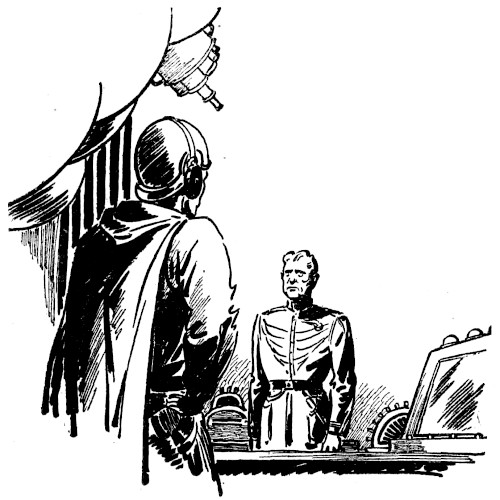
"I am defeated," said the Martian stiffly. "I would have preferred it at the hands of—"
"One who is not a traitor?" asked Guy. "Marshal Monogon, why am I a traitor?"
"You betrayed your oath."
"My oath," said Guy, "was intended to set up a condition in which a man will do the best thing for his homeland. That I am doing."
"You think so."
"They'll all think so."
"I am defeated," repeated Monogon. "I hope to see the day when you are caught."
"You may, at that."
"But to what end are you working? You fought Terrans. You fight us. Why?"
"Monogon, you have a super vortex machine set up on Phobos. Terra has one on Luna. You now know that the vortex will not kill on a single try. But how much less dead will the entire System be if either of us fires?"
"I ... yes, the speed will permit you to fire once we have fired. You would be able to detect the operation of the projector hours before the toroid envelops Terra."
"And with no one alive to awaken any of us—those who are not on Terra will fight one another to the death—vortexes will be coming from every solid body in the Solar System within a week. Do you think I want that?"
"You hope to accomplish something?" asked Monogon. "What—and how and why?"
"I hope to unify. I cannot appeal directly because of my ... my traitorous past. But Monogon, I can and will fight to the last breath to try my plan. Never forget Ertene, Monogon. They'll be here next, looking for me—or something. They've got to have their trouble, and they well know that a good offense is the best defense. They've got vortexes too, you know. As a last resort, they'll fire on us both. What I've got to do is to hold off both Mars and Terra—and then go out and take Ertene!"
"Madness."
"Necessary. Ertene must be brought in, so that she will depend on Sol and the rest of us."
"You're mad, Guy Maynard. Stark mad. But I agree with you. The vortex is deadly, and with things at the breaking-point as they are now, oblivion is but a step. Can you believe me?"
"Yes," smiled Guy. He tapped the thought-instrument and explained.
"Then you can also believe me when I offer you my aid?"
"Yes."
"I'll make no move against Mars, understand."
"I'll not ask you to. You'll go to—"
The radiation alarm broke.
"What's up?" asked Maynard.
"Nothing dangerous. We just uncovered a Terran crate trying to run through us under a barrier."
Maynard looked at Monogon. "We'd better hurry," he told the Martian. "They'll be tearing up the Solar System before we can stop them."
The combined fleet increased its acceleration towards Mephisto.
The spaceport on Mephisto became a mad place. Terran ships stood plate to plate against Martian ships, and the sky above the port was interlaced with the invisible communication beams that connected incoming and outgoing ships. At no time was the sky ever completely clear of spacecraft.
They came in sight out of the clear black sky of the moonlet, and hovered until the ship before them had landed. Then they dropped slowly into the landing place assigned to them, coming to a full landing just in time to see the next ship begin to drop. Another ship would come from outer space at this time, and assume the hovering area, awaiting its turn.
Ships took off at the same rate. But unlike the cumbersome landing feat, they leaped upward into the sky, running a direction-beam before them, and disappeared in seconds.
The nerve center of this activity was a squat building on the edge of the port. In it worked Maynard's spies—his agents provocateur. A black chamber of intense men, all working their shifts over huge mental projectors.
Solarian shipping was being completely disrupted.
No ship took off from any of the spaceports without Guy's knowledge. And no cargo worth having ever reached its destination. Mephisto was becoming the most valuable planet-system in the Solar sphere, for the cargoes that were pirated and brought to Mephisto were those items that Terra and Mars could not find in plenty at home.
The capture of single ships had gone on unchecked for a long time. Then protection began to go with the shipping, and finally the spacelines were running in full convoys that sported constellation craft for protection. But Guy's fleet collected the constellation craft as easily as they caught tramp spacers. When a spaceship is going a thousand miles per second, a barrier-sown toroid could burst from space before the huge ship. It was a matter of dropping the toroid so close to the nose of the ship that the turreted AutoMacs had no time to answer the impulses that came from the detector-couplers. The huge ship plunged through the toroid, and left the rest of the unprotected convoy for Maynard's choice.
And when they sent decoys, Maynard's men ignored them. Only when the carriers held valuable material did they suffer.
The ships of Ertene came in for their share. Guy worried about the thought-beam instrument that he had left there; he knew that no sensible world would adhere to a program of destroying such a device. One of the main thought-beam jobs was continually directed at Ertene and the thought-beam instrument that Guy had left. So far, they had done nothing but use the thing locally. It would not reach Mephisto by a billion miles, and so Guy knew his secret was safe.
At least for the time being.
But molesting Ertene on Ertene's own ground was not possible; once they came within range of Ertene's thought-beam, the secret of avoiding the vortex would be out. Only those ships of Ertene that came outside of range were taken—and they were all too few.
But there are ways of starting trouble—
The intercom pealed in Maynard's office. "Andrew has escaped," came the message.
Maynard smiled. "Good. As we planned?"
"According to clockwork," came the amused answer. "He bopped Timmy over the head with that hunk of plastic, used the same plastic rod to pry his way out of the house, and then he took off like a demon in the Ursiad's lifeship."
"I wonder what he thought we had it out for," laughed Guy. "Also I wonder what he thought we were using to keep him in?"
"He's not too well informed. He knows, for instance, that we can avoid the vortex—and that some sort of mind-reading gadget is available. Furthermore, he knows that there is one on Ertene. Nothing about the stuff, understand, but just that such a thing exists."
"That's the ticket," smiled Guy. "Now we'll get action!"
Detector operation of the following events were impossible. In their place, the men in Maynard's black chamber controlled a model of the System, synchronized with others throughout the Mephistan system of planet and moons.
And for the first time in history, Mars and Terra took off in battle array and headed together in the same direction. And Mephisto followed them, watching all the way.
At nightside, the combined fleets dropped onto Ertene, showered the area with toroids, and landed. They forced the heavy doors open and emerged again with the machine.
Up they drove, into the Ertinian sky, and away. Ertene came to life then, and vortex projectors hurled their toroids into the sky after the fleeting ships of Sol.
Sol's ships scattered and avoided the toroids, and then answered by dropping their own onto a greater area than before. They silenced those that might give danger, and then sped away in a die-true line for Sol. From Ertene there arose the Ertinian fleet to give chase.
Normally, Terra could have out-distanced them, for they had the head start in an accelerative race. But Mars could not keep that killing pace, and Terra was forced to hang back; they hoped to best Ertene in full battle, if escape were impossible.
Conquest would give them Ertene, and that would have been desirable, too. But conquest of Ertene was planned for the future, and well-planned.
So Ertene caught up with the slower fleet of Sol, and the two intermingled.
Space filled with the myriad winking spots of prematured torpedoes. Gouts of released energy burst in empty space as crossed MacMillans backfired. Energy bombs were strewn as a matter of course to prevent the operation of sub-ships, and the milling mass circled in a battle plan that no space marshal had ever planned.
The ship that had Ertene's thought-beam was known. Battle centered about it, and it became evident that neither side cared to direct its fire in that direction. The whirling melee spread out into a vast sphere of fighting ships, with the thief in the middle. Wide spread the battle; the thickness of the fighting globe dropping as the sphere increased.
Maynard smiled. "Now!" he said.
And from the Leoniad there dropped a torpedo in a barrier. Invisibly and indetectably it sped, led by the radiation from the thief. Through the fighting globe it went safely, and inside, where no bit of stray energy filled space. Not even detector beams entered this space, and the men in the thief looked out on all sides at the mighty globular battle with wonder. They realized that this fight was over them, and that because of their loot—the thought-beam instrument—neither side would strike at them.
But the barrier-covered torpedo found them. The barrier hid the torpedo from them, but the barrier permitted the detecting radiation to enter and energize the director.
The thief exploded in one coruscating flash. The white-hot gases expanded rapidly, wildly, cooling as they spread.
Action stopped.
Had this been a fight on land between men, they would have turned as one and looked at the ruin. They would have stood elbow to elbow with their enemies, and wondered. Both sides knew the value of what they were fighting for, and they knew the other side knew its value, too. Loss of the thief stunned them beyond belief—
And stunned them beyond the desire to fight one another.
The flashing lights of prematured torpedoes died as the mechanical finders still worked on the already-launched missiles. No more came from the tubes, and gradually the flaring died, leaving the ether clear of crackling radiation.
Far-flung detectors flared, and the cardex machines in hundreds of ships purred, and came up with a single answer. It was called aloud, and on the throats of a million men, Terrans, Ertinians, and Martians, there came the single word:
"Leoniad!"
With no order from High Command, every ship turned and headed for the Leoniad.
The Leoniad lazed along, waiting. Just ahead of MacMillan range, the Leoniad ran before the combined fleets. From all sides there came the rest of Maynard's fleet, making a space pattern about the Leoniad.
Within the Solarian fleet, quick orders and consultations passed. The fleet took battle shape, spread out, and gave chase according to plan. Their space pattern became that which was developed by the Terran command to avoid sown toroids, and in comparative safety, they settled down to the long, stern chase.
Before them, Maynard's fleet ran easily. Forward-flying toroids died abruptly, killed by the anti-radiations of Guy's high-powered projectors; torpedoes were sought and prematured in space; and MacMillan fire was not answered save to cross the oncoming beam with a backward-flung beam. The initial flurry of fire stopped, then, and the chase became a matter of hare and hounds.
The Solarian fleets were forcing the flight. Mephisto's fleet was obviously running to their base. That meant, to the Solarians, that at midway, there must be a turnover maneuver so that Mephisto's fleet could decelerate for their landing. Then they would catch up, for the velocity attained by Maynard's outfit must be forced down. The Solarians were not trying to effect a Mephistan landing, but were after the other fleet. They would not turnover at mid-point, and then they could catch that fleet of pirates that stayed just out of range.
XXIII.
Turnover came, inevitably. Maynard's fleet flashed up to the "fix" in space and began the end-swapping job. Solarians watched, gloating. Maynard was going to turnover! The gap closed. Terra and Ertene alerted for action, and the entire personnel of the combined fleets went on double-watch. No one knew how much stuff Maynard's men had developed.
Vortex projectors sowed toroids that floated with Guy's ships. In and about the pirate fleet, the huge vortexes of energy roamed, covering the fleet by sheer number.
Torpedoes directed against the toroids prematured. MacMillan fire entered them, and added to their total energy. Other toroids flung into them merely added to their number.
And the very number of them made operations in the combined fleets difficult. The space pattern was never intended to fight into a massed effect. Ertene and Terra spread slightly, opening up a hole. Through this hole flowed the toroid-covered Mephistan fleet, and Maynard's men were behind. Turnover was completed, and with the indifference to the Solarian fleet that was maddening, Maynard gave the order to decelerate for landing on Mephisto.
Solarians fell behind—below, now, for they were dropping onto Mephisto, the deceleration creating a false gravity.
They crammed on the deceleration too; not to do so would have put them far beyond Mephisto. They crammed on all they had, and it was just enough to stay below Maynard's fleet—
Just outside of range.
The men in the combined fleets of Ertene and Terra writhed in hatred. Mars, unable to keep up with the man-killing gravities, laughed nastily—she thought that the fun would have been over before her slower ships could join.
But though amused, Mars was none the less angry. Her men in her ships were killing themselves to keep from arriving too late. They knew now that the big fight would be around Mephisto.
It takes but a minute to tell, but it was days and days in the action. Men slept and changed watches and went through the tiresome routines of space travel across the System. And ever before them was the specter of Maynard's fleet, just out of range. It maddened them, and it made them sacrifice a few fighter ships that tried to run ahead, into the other fleet. They were lost, every time, without doing any damage.
And the temper of the men increased by the minute—and days and days with hours full of minutes went by with not one bit of action to salve their hatred.
Mephisto loomed in the sky below, eventually, and the fleets swept down to Mephisto, and the Solarian fleet spread wide and passed the planet. They did not like the idea of being between a fighting fleet and its home base. Maynard landed easily, and was able to consolidate his force on the ground before the combined Ertinian and Terran fleets circled and returned.
"Just hold 'em off," said Guy.
And again there passed the maddening job of not being able to do anything to the enemy. They patrolled the planet, but it was unsatisfactory patrol. Any ship that came too low was fired upon and collected by Guy's planet-mounted projectors. Solarians thought that they knew how to arm a planet, but Mephisto was well-nigh impregnable. Toroids stopped, torpedoes prematured, and MacMillans flashed in the sky, dissipating the energy with no harm save the blown fuses in the ships.
"How long?" asked Neville.
"Wait for Mars," smiled Monogon. "I insist that Mars be not left out. What's good enough for them is good enough for my world, too."
"He's right," said Guy. "We'll wait."
And finally Mars arrived on the scene, and the fleets went high to discuss the problem of extinguishing this menace. Guy followed their conference—and they suspected that he did. Their plan was bold. A power play, and it came in a down-thrust of the ships of three worlds. They drove toroids before them, filled the air with torpedoes, and interlaced the sky with MacMillans.
"Now?" asked Neville.
"Now," smiled Guy. His smile was bitter and hard. He stepped to the vast instrument and put the helmet over his head. His left hand turned the switch and the right hand adjusted the intensity. "Cease fire!"
The fighting stopped.
"Land!"
The inrushing of fighting ships continued, and they landed quietly, one after the other. Immediately, doors opened in three of them and three men emerged. Stiffly they walked to Maynard's headquarters where they were greeted and taken to Guy's room.
"You can not touch me," said Guy in a hard, cool voice. "I am impregnable. You will never be able to touch me!"
"You stinker," snarled Space Marshal Mantley.
Guy faced Thomakein next. "Have you anything to say?" he snapped.
"We are defeated," said Thomakein. "What would you have me say?"
Guy turned to the Martian. "Marshal Ilinoran, any comment?"
"We are defeated—but we need take no insult! What have you in mind?"
"At the present time, the carriers of your fleets are being packed with your men. Some of them will remain, of course. But I like the size of your fleet, gentlemen. I'm keeping most of it for my own. I have prepared a little proclamation which you may take back to your respective governments. I, gentlemen, proclaim myself the Emperor of Sol!"
"Megalomaniac!"
"As Emperor of Sol, I will tell you," continued Guy, indifferent to the snarl, "how and when to collect the yearly tribute from each and every Terran, Martian, and Ertinian. You may suit yourselves to any other arrangements. Mephisto is mine, and will stay mine. But I shall require money, merchandise, and supplies to stock the planet.
"And if you think differently, you may try to defeat me! And I hope you try!"
"We'll pay nothing—"
"I hope you try that, too," snapped Maynard. "You have no idea of how tough a real tyrant can get! A single lesson might convince you. A super-toroid hurled into the Manhattan area—?"
"You're a fiend!"
Guy nodded. "Never make me prove it," he said quietly. "Now, gentlemen, you will receive your instructions as you leave, if you prefer to leave. I offer you the chance to join me—but remember that I can read your mind and find out how true you intend to be. I intend to be very harsh with spies."
"I'm leaving—but I'll be back!" promised Mantley. He tried to sound ominous, but his position was not firm to carry it away. He knew that he sounded flat and it enraged him.
"We'll both be back, together!" snapped Ilinoran.
"Ertene will be back, too!" added Thomakein. "You wouldn't permit us to leave, and I know it!"
Guy nodded. "I'll be waiting. But don't forget that I am still master of you all. And I'm going to stay master. I've spent ten years being pushed around, and now I'm going to do some pushing myself! I have very little affection for any of you; Terra disowned me, Ertene did not want my offer of fidelity; Mars wanted to torture me and did, partly. Had any one of you taken me for what I had to offer, this would never have happened."
Mantley and Ilinoran left. But Thomakein came forward and put out a hand.
Guy looked at the hand and then at Thomakein. "Why?" he said sharply.
"You did it!"
"I did it, all right. But look at me. And what have you to offer?"
"You still do not know. Guy, forgive me. I tried, myself, and failed. Your plan is superior to mine—yours works."
"Plan? Know?"
"I forced you into this."
"Yes, but you had no plan except a sort of self-aggrandizement."
Thomakein shook his head. "You didn't read my mind deep enough, Guy. The instrument you carried was never perfect and deep-seated concepts are often hidden because of the more powerful surface thoughts. I thought of conquest—and realized that sleepy, lazy Ertene couldn't conquer the Solar System and keep it conquered. What Sol needed was a man with drive and ability. No one wanted you, Guy, because you were continually torn between your own promises. I was responsible for that, I fear. I took you because of your latent ability, those long years ago, and planned well."
"And so you forced me into this place?"
"Yes," smiled Thomakein. "But the only way that you'll hold this sun full of cross-purposes together is to provide a common menace. Terra hates you more than she hates Mars, and Mars will co-operate with Ertene to get you. Ertene, burning mad because her desire to wander is curtailed by you, will throw in with both of them. Perhaps they will get used to co-operation after a bit, but never forget that competition will make advances far quicker than complete co-operation.
"Yes," said Thomakein, "I tried. I plotted and tried, and then knew that Ertene did not have the drive, the ambition. You, Guy, had the ambition, and all you needed was to get the killer-instinct, so to speak. You had to be driven to it. You did it. Can you hold it once someone finds the key to the mental-gadget?"
Guy grinned. "They never will. Mephisto is the only world with normal temperatures low enough to make key more than a feeble-order effect. Upon Mephisto, it becomes evident in the third decimal place; on any other world it is several decimal places beyond the experimental error. Besides," Guy said with a hardening of the jaw muscles, "I've got the whole System under coverage. I'll permit no experiments along those lines!"
"I see what you mean. Well, Guy, you're the Emperor. For the love of God, stay that way! The first time you abdicate, hell will break loose all over the System. You are the common menace that will hold us together."
Guy smiled wryly. "So you drove me to it. It was necessary. I know. But it was a dirty trick to play on any man. It goes deeper than that. Joan and I can't see raising a kid in this mess."
"Your children must be raised absolutely incognito. I owe you more than life, Guy. May I help, please?"
Maynard took Thomakein's outstretched hand.
"Finished," said Thomakein, shaking the hand hard.
"Not finished—nor will it be. I have a lifetime job of making myself more hated than any traditional enemy."
Thomakein nodded. He stepped back and saluted.
"Farewell, Guy Maynard—Ruler of The Solar Worlds!"
THE END.