Front matter (continued 3)
Reading edition
Maynard laughed cheerfully. "As long as you get my thought, I don't care how you say it. The barrier-screen absorbs all radiation. Therefore any position holding a sub-ship would produce zero radiation. It would then show on the negative sphere. Right?"
"I think that's about it," said Carrington.
"Good. We agree on that. Want to work on it?"
"Absolutely."
"It's yours, then. Go ahead and make it tick."
"That I'll do, sir. We'll have it by the time we hit Pluto."
"One more thing, Carrington. Keep it under your hat. It's a military secret, you know."
"I'll say nothing."
"Check. I'll be down and see you later."
Carrington left, and as he went back to his quarters, he told several of his contemporaries that the new commander was everything that they had ever heard of him.
Finding Pluto was a good job of work for the combined efforts of the astrogator and the chief pilot. Pluto was completely hidden just as Ertene was, and Maynard knew the completeness of that shield. It was done gropingly, by sheer hit and miss effort, but finally a black circle in the starry sky established above them. And as the pilot announced his success, it began to spread from a minute spot to mightiness. Then they passed through the barrier, and Pluto was a warm, greenish planet above them, much the same as Terra as seen from Luna.
The Orionad dropped onto the Spaceport; the entire trip without incident.
Maynard signed his command into the base marshal's office and ordered his chief executive officer to grant planet liberty as he saw fit. Space Marshal Lincoln smiled at the younger man and told him: "I think you'll be interested in the experiments going on in the radiation laboratory."
"Yes?"
"They're having a bit of trouble on one of your gadgets."
"Which one?"
"The stellar light-filter. Somehow, it doesn't work as you predicted."
"Why didn't they ask for me sooner?" wondered Maynard. "It's been six years since I thought that one up—they've had plenty of time."
"It's possible," admitted Lincoln. "But you forget that it was extremely complex and highly theoretical. Also, no good use has ever been found for it. Unlike your other inventions, this seems to be an experiment in pure research. So we didn't start on it until last, and it's been three years in the building."
"So long?"
"Oh yes. Some of the parts were entirely unheard of before, and many of the major components had to be built of parts that were designed for the job. When you design the minor components to assemble the major components—which also require design—you pyramid the time and difficulty."
"I hadn't thought of it that well."
"I wish you'd go over and tell them what's wrong. Kane, the publisher came in for the unveiling of the thing, and we'd hate to present him with a complete failure, in spite of its uselessness."
"Kane's here? Good, I'll go right over."
Maynard was youthful enough to be amazed that the weight of his rank opened a path through the grouped technicians to the complex instrument that lined the entire wall of the huge laboratory. Kane was near the center, and the only one in the group that knew Guy Maynard well enough to call him by his first name: therefore he was the first to speak.
"You invented this thing, Guy. Can you make it work?"
Guy blushed. "I didn't invent it—" he started and then saw Kane's puzzled look, which caused him to pause; then he nodded and finished: "—I merely worked on it theoretically. I did not have enough equipment in the lifeship to build any more than a few of the more complex circuits."
"Good enough," laughed Kane. "Well you may know more than we do at that. After all," he said in defense of his statement, "these men have been working on it for a couple of years."
A man with the rayed stars of a senior executive offered: "That's not strictly true, Mr. Kane. We started to work on it about three days ago—if you consider the instrument as a whole. There have been many groups working on the components separately, building them up. We assembled the whole last week."
"Take a swing at it, Guy."
"It's a maze to me," admitted Guy. "Let me see the circuits."
It took Maynard some time to figure them out. He was working from memory now, and it was none too good, plus the fact that he had memorized the complex circuit in Ertinian symbols and in Ertinian constants, and they all required conversion to Terran terms. He called for the group leaders of the various components, and asked them to report on the functions of their parts.
Together, they pinned the error down, and corrected it. Then Maynard turned the thing on himself.
The broad plate took on a gray-green background, mottled with huge circular blotches of white. He turned the focusing knob, and the mottling contracted into individual circles of intense, flaming white. He reduced the intensity control, and the eye-searing brightness dimmed to a more comfortable level. More fiddling with the focus, with alternate adjustment of the intensity, for they were inter-reacting, and the plate took on the appearance of the sky.
"So far so good. Now for the shaping control," said Maynard. He drove the left hand end swirling upward on the plate with one knob, stretched the stars across the top of the plate, and compressed them along the right side. He caused them to whirl circularly, and gradually the distortion dropped until the constellations appeared.
"There you are," he told the chief technician.
"Fine. Now what can we do?"
"Well, there aren't too many planets," said Maynard. "We can decrease the response of celestial bodies that shine by reflected light. That one," he said needlessly, since they all knew it well, "is Jupiter. Watch him fade!" and Maynard turned the knob. After the demonstration, he returned it to its original position again.
"On the other hand, we have a lot of stars," he said, turning the other knob. The starry heavens faded, leaving a widely scattered group of pinpricks grouped about a deeper black disk. He pointed to the disk and said: "Since it is the brightest, we may expect it to be the darkest too. Can't beat Sol from here. At any rate, this knob causes the fading of all bodies that shine by intrinsic light. The reflected-light bodies remain, so."
"Marshal, sir, there are nine of them," said the technician.
"Well," interrupted Kane, "there are nine planets, aren't there?"
"Not from one of them," answered the technician. "Or," he asked Maynard, "would we appear along with the rest?"
"No," said Maynard slowly. "You're right. There are nine planets, which counting the one we're on makes a total of ten."
"You realize what you're saying?" stammered Kane. "That means you've discovered a new planet with this gadget."
Maynard shook his head in dazed unbelief. "Another planet?" Then he shook off the amazement and said: "It may be so. But before we shout too loud, we must investigate and be certain."
"Of course."
Maynard turned the stellar intensity knob up slightly, bringing the stellar background into faint light. "Get the constants of that planet, and we'll check. Kane, you'll come along as a representative of the Terran Press?"
"I wouldn't miss it for the world itself," said Kane. "Any chance of missing it?"
"If we get the linear constant of that planet from Pluto, here, we'll line-drive out there. Once within a few million miles, passing by if need be, we'll know it."
"Couldn't we pack this thing aboard the Orionad?"
"Not unless we tear the side out of the ship," grinned Maynard. "We'll fly this blind, and that won't be too hard."
"And then we may find that planet is but a flyspeck," said Kane.
"It could be," agreed Maynard. But he knew better. He was thinking of a huge panel; a brilliant painting in a vast hall lined with paintings. The one he faced showed Sol—and ten planets.
And Maynard had patiently waited for all these years for the stellar light-filter to be built. He knew that the unknown planet was so far from Sol and at such an angle that it would remain unseen until they made the filter work. After all, it had been unseen for hundreds of years during the advent of space travel, and for hundreds of years of pure stellar research from Terra before space travel gave the astronomers a chance to prove their planetary theories. He had not been worried that his find would be found too soon, but he would have broken all rules to get to Pluto at the time he did. Luckily, there was no reason to break rules.
Now he could go anywhere and do anything except the short periods when he was under explicit orders.
He wondered whether his action had been too abrupt, and then remembered that his position permitted a large amount of snap-decision and some eccentricity. The quickness of his action would add to the legends of one Guy Maynard, and would cover up the fact that he had been planning this particular party for years.
At the end of the usual landing duration, Guy gave orders for the Orionad to go out to the new planet.
X.
Die-straight, the Orionad flew. On a course tangent to the orbit of Pluto, on and on and on beyond the limits of the Solar System, out to a position almost twice the distance from Pluto to Sol; a distance of 7,180,000,000 miles. And there Maynard looked down upon the globe of another world.
"There it is," he said to Kane in what he hoped to sound like awe.
"I'd never have believed it," breathed Kane.
"The funny part," said Maynard in a surprised tone, "is that this planet is about the correct distance for agreement with Bode's Law for Pluto, which is not met. Wonder why it never occurred to the brass hats to look in the 'Bode Position' all the way around."
"Neptune sort of screwed Bode's Law up," smiled Kane. "It is the fly in the ointment. If you set up Bode's Law and check for Neptune, you find that Pluto occupies that position, while Neptune is in a supposedly unoccupied position. Neptune is an interloper."
"Wonder why he came," mused Maynard.
"Probably got here and couldn't leave," said Kane. "Well, Guy, if nothing else, you've re-established the value of Bode's Law. Proper continuity on either side of a discontinuous section—Neptune—indicates to me that the Law is correct. It is the presence of an alien planet that is the troublemaker."
"Is there anything on that planet?"
"I wouldn't know. Has three moons, though. Guy, how could anything live on this planet ... you're entitled to name it, you know, since you discovered it."
"I discovered it?"
"You'll get the credit, and not without reason, Guy."
Guy shrugged. "We'll call him Mephisto. I'm going to run in close, Kane. I'd like some initial information on this planet before we return." He called into the communicator: "Marshal to Executive: Until further notice, we shall call this planet 'Mephisto.' Therefore, circle Mephisto at one thousand miles. Have the technician's crew take all data possible. Have the astrogator check his constants, and if possible, get an initial estimate of Mephisto's velocity, orbit, and ecliptic angle."
"Executive to Marshal: Check."
The answer to Kane's idle question as to the possibility of Mephisto being inhabited came with a distinctness that left no doubt. Not only was Mephisto inhabited, but Mephisto harbored intelligent life. And the intelligent life either resented the arrival of the Orionad, or thought that the Orionad was the vanguard of a special invasion.
At any rate, both were correct. And no matter what the inhabitants of Mephisto thought, they acted.
The detectors rang in alarm, and automatic circuits closed. The big turrets of the Orionad whipped around with speed enough to warm their almost frictionless bearings in the brief arc. They threw their surge on the ordnance-supply lines, and the meters jumped high. The big AutoMacMillans emitted their energy silently and invisibly, and seven great gouts of flame bloomed in the space between Mephisto and Orionad.
They swiveled slightly and fired a second time, and four more blossoms of flame spread, this time closer to the Orionad. Upon the third attack, the flashes were very close to the super ship.
"Ships—or torpedoes?" asked Kane.
"Torpedoes," said Maynard definitely.
"How can you tell?" asked Kane.
"Ships would have flared less brilliantly and more slowly. It takes a well-loaded warhead to blast that way. The fierceness and the velocity of the blast give the answer to that one. Also, those things were coming up at better than a thousand G, all the way. That's guessing that they all started at once or nearly so. In order to separate that much in the distance they covered, and to cover so much distance between the first, second, and third contacts the acceleration must be about that high." He snapped the communicator and asked: "Marshal to Executive: What was the acceleration of the exploded bodies?"
The answer came immediately. "Approximately, 941-G, according to the recorders on the detector circuits."
"Good-bye, Guy."
"Lots of practice," said Maynard. "Well, we're heading back. I'm not going to risk the Orionad in a single-handed battle against a whole planet. Even if I won, they'd bust me flat. We'll head for Terra and set us up a real punitive expedition. Then we'll return and take Mephisto for Terra!"
The Orionad based at Sahara Base and Maynard went into the Bureau of Exploration building. His entry into Malcolm Greggor's office was easy, and he told the space marshal about his discovery. Greggor's reaction was first doubt, but Maynard called Kane and his executive officer, and when Greggor was convinced, his excitement knew no bounds.
He called an immediate conference with the head of several bureaus, and told Maynard he was to remain, and then added Kane to the list. Once assembled, Maynard explained the details, complete, and Malcolm Greggor opened the discussion by stating: "This will be difficult. They resent us. If we go in at all, we must go in armed to the teeth, and expect trouble all the way."
Mantley, of the Bureau of Ordnance, said: "You expect anything unique in ordnance, Maynard?"
"I hardly think so. On the other hand, they have space travel, as witness those torpedoes. They must have a definite isolation policy, otherwise they would have contacted us long ago."
"Not necessarily," objected the head of the Bureau of Exploration. "They may be alien—they must be utterly alien to inhabit a planet that far from Sol. What form they take, or what their chemistry might be, I have no idea. Furthermore, I don't care, and if I ask about it, it'll be academically only. They exist, they have science. They do not like us. Perhaps they know of us, and realize that any traffic with us of the inner worlds is impossible."
"Their attitude in firing upon the Orionad gives us no alternative," said Mantley. He turned to Garlinger, and asked: "We haven't heard from the Bureau of Maneuvers, yet. Have any ideas?"
"It'll be out and out war," said Garlinger. "I'm certain that we made no warlike move in merely visiting them. They've been in preferred isolation, and now that we've discovered them, they fire on us, without provocation. My guess is that we'd not only be better off going in armed, but we'd best prepare for countermeasures, counterattack, and all the trimmings. Now that they've been smoked out, I'll bet they won't sit there on their icy planet and wait for us to come a-blasting."
"How and why have they developed space travel," asked Greggor, "if they care nothing for interplanetary commerce?"
"Their moons," suggested Kane. "There were signs of inhabitation on all three of them."
"This is going to be more difficult than I thought. The problem of breaching a planet alone is one that has seldom been tried. But if Mephisto has three armed moons, that's another item to consider. Well, fellows, it has never been Terra's way to go in with less than all we have. If we have ten million men that never see Mephisto from anything but the viewports of the transports, we'll be better off than if we were blasted to every last man for not having enough of them. It'll be a full-scale attack, gentlemen."
"More than that, Garlinger, we'll get lots of practise."
"Meaning?"
"Some day we're going to be forced into fighting Mars on an all-out basis. This will be excellent experience. I believe that Mars will be the harder to fight, gentlemen. After all, knowing your enemy makes the battle easier—and they know us very well. So if we correct our mistakes on Mephisto, and take the resulting plan to Mars, we may break this deadlock between Mars and Terra forever."
"No one here doubts that it will be an all-out attack," said Mantley. "We'll have to mobilize—and that's your job, Donigan."
"Yup," drawled Donigan. "After you boys get all done making your plans, you hand it to me. Uh-huh—and after I get 'em, it's war with a capital W. Gentlemen, is it your wish that the Bureau of Warfare take over from here on in?"
"It is."
"My aides will present to you the requirements of the Bureau of Warfare as soon as they can be pulled from the files. You will break the news," he said to Kane, "immediately, and in headline form only. Mere mention, in this case, of the new planet, and Guy Maynard, the discoverer. Meanwhile I'll have the Bureau of Propaganda prepare a news-campaign for you, which you will follow within reason."
"With nothing to print but the mere discovery of Mephisto," smiled Kane, "I'll be forced to play up Patrol Marshal Maynard. That all right?"
"Oh certainly. After all, he's fairly well-known and it will seem only right that a well-known figure gets the limelight. I see your problem; you can't break a lonely headline."
"I must at least fill up one column, and even with eighteen point type it takes words. We'll prepare the way, though."
"I want Maynard," said Donigan suddenly.
"The Bureau of Warfare runs this show," nodded Mantley. "May I ask what for?"
"He'll command one phase of the attack. And it will look well that the discoverer leads the battle. It implies that we have implicit confidence in him, in spite of his youth."
"Will he require an increase in rank?"
"Not at the present time. That will come as necessary. But let's close this. Time is important; Mephisto will be mobilizing even as we are."
"May I use the official wire?" asked Kane. "And one more item. What about secrecy?"
"A thing this big can not be kept a secret," answered Donigan. "We haven't enough men and materiel to successfully attack a militant planet. Therefore we must recruit men, and get the manufacturers to produce supplies. Mars—I believe—will sit tight and wait until we take the initiative. A move on their part will hinge upon our success or failure on Mephisto. Break it wide and big, Kane. And send it out on the interplanetary service. Mars may as well have something to think of. We know she will never attack Terra as long as the Terran Space Patrol maintains a fleet. Mars is too small and, therefore, too easy to cover compared to Terra. Go ahead and break your story, Kane."
Kane was as good as his word. It hit the newsstands that evening, in three-inch headlines. They said nothing more than the hourly news-broadcasts for news, but Kane's writers had done an excellent job in building Maynard up as the man of the hour.
And then the report of the attack followed. Guy Maynard, commanding the Orionad, had been fired upon without provocation as he attempted to run in close to the new planet for photographic records. The bursting of the torpedoes was pictured in the newscasts in all their blasting flame, and the pictures suffered nothing from the film record.
Guy Maynard was then called upon to face the iconoscopes. He looked into the faces of three hundred billion Terrans and told them simply and forcefully that Mephisto's military action prevented any peaceful negotiations, and that it was certain that they were even now preparing to maintain their isolation.
"And," he finished, "we know that isolation can not be defended. To preserve isolation, the enemy must be destroyed on his home base. We can expect attack from Mephisto unless we tackle them first. And to take the battle from Terra to them, we need men, material, and all the myriad of things that follow."
The recruiting posters hit the public next, and all of the machinery of war was started. And though it rolled in the super-slow gear at first, it would pick up momentum as time went on. All that the Patrol needed was a backlog to replace losses, and with that assured within the next few months, the mighty fleet of the Terran Space Patrol assembled at Sahara Base, formed a complex space lattice, and drove outward towards Mephisto.
Inexorably, the Terran battle fleet drove onward. Massively ponderous; immobile in its chosen course, the massed fleet flashed up through the velocity range to mid-course, made their complex turnover, and started to decelerate. Hours passed, grew into days, and the days added one to the other, and the lattice was maintained with precision and perfection. Hardly a centimeter of vacillation was observed from ship to ship, and from the Orionad in the center of the space lattice, it seemed as though the monstrous, assembled fleet were truly set in a huge glasslike jelly, immobilized.
But it was a wary personnel that manned the huge Terran Space Patrol task force. They expected something. And the fact that so many hours and days had gone without interruption did not make them less restive. Each moment that went without trouble brought more certain the chance of excitement in the next. It was a beautiful war of nerves, with the Terrans getting more and more certain of attack as the hours sped on and the fleet's velocity dropped to far below the lightning-speed of the maximum at turnover.
The watch was not stirring, save that the crews were on the constant alert for the clangor of the alarms; and the detectors were operating at overload range which gave them plenty of time to get into action—barring something superior in the way of weapons. Far better than human senses were the detectors, and they could be relied upon.
Surprise was impossible because attack was inevitable. And since the human element of watching was eliminated by the ever-alert detectors and the element of counterattack was automatic with the turret-coupled AutoMacs, it was only a matter of time. As one, the fleet moved through the vastness of space between the orbit of Pluto and their goal.
Guy Maynard prowled his scanning room impatiently. In the easy-chair beside the broad desk, Ben Williamson lazed without apparent excitement. Upon the twentieth cigarette, Ben said softly: "You should take it easy, Guy."
"Like you?" asked Maynard. "You look calm—but!"
"I know all about it. But remember, even though it's action you crave; you're the big boss on this expedition and you'll be able to do nothing but watch."
"Watch—and pray that my plans are effective. Uh-huh. But talking it down won't lessen the tension."
"Wait 'em out, Guy. They'll come soon enough."
Guy snorted, tossed his cigarette into the wastebasket and tried to relax. A matter of time, all right. Well, maybe he could wait in patience. At best he'd have to wait until the Mephistans were ready to attack.
When it came, it was swift to start and equally swift to end. From one side there came a fast-moving jet of tiny spacecraft. At unthinkable velocities, the thin stream poured into the space pattern of the Terrans.
The clangor of the alarm ceased as contacts were opened. The communications band roared with cries and questions.
"Who got it?"
"Scorpiad!"
"Bad?"
"Not yet."
"Get out the fighter-cover!"
"They're coming—give us time!"
"Time, hell! This is a space fight, not a pink tea!"
The turrets of the Scorpiad danced back and forth in a mad pattern. At the end of each lightning move they paused. At each pause they vomited unseen energy that catapulted the temperature of the Mephistan ship into incandescence.
The sky beside the moving fleet was dotted with winks of light as the fencing AutoMacs parried the rapier thrusts of the tiny fighters. More ships poured into the arrowing horde, and the dancing turrets raced madly to keep up their program. They lost space, and the wall of coruscating death moved inward.
From long range the Pleiad opened fire, and the dancing motes of flame moved back as the overloaded detectors found more time to focus upon the incoming horde.
Maynard mopped his forehead, one half at a time to permit at least one eye on the celestial globe during the job. "That was close," he snapped.
"It ain't over yet!" said Williamson shortly.
"No ... here comes another line of those devils ... at Pleiad!"
"They're not afraid to die!"
"They seem to want it!"
The Pleiad stopped the long-range fire and began to take care of the horde that was striking at her direct. Pleiad was capable of handling this new attack easily, but it left the brunt of the heavy attack on the Scorpiad.
Once more the flashing motes moved inward as the detectors found themselves unable to keep up. And still more of the tiny ships poured into the stream, and the borderline of death moved into almost-contact with the constellation ship.
A burst of flame came from the flank of the Scorpiad, and the ports flashed outward, followed by gouts of smoke and incandescence. Four red spots spread outward on the Scorpiad's hull, and the constellation ship lost drive. Unable to keep up the deceleration of the rest of the Terran fleet, Scorpiad fell out of position and dropped below the fleet—farther and farther ahead.
A blinding flash of flame came and died.
"Gone!" moaned Maynard.
"But what a cost!" said Ben.
"No cost is worth it!" said Maynard. Then he calmed and added: "Accursed business. But we may be ahead in the exchange."
"It's brutal," agreed Ben. "Let's keep 'em from getting another."
"Might be robots."
"Nope. If so, the technicians would have scrambled 'em. What's making now?"
"The fighter-cover! It's arrived!"
The incoming jet of Mephistan fighters wavered like a gas flame in a high wind, and scintillations scarred the perfection of the needling ships. The long-range fire of the constellation ships picked off the aimlessly moving ships and as the flaming specks reached an almost-solid appearance, the jet of tiny fighters ceased abruptly.
"Stopped 'em!"
Maynard nodded. "For the time."
The communicator spoke: "Commander to Marshal: Located the mother-fleet."
"Yes?"
"We're hitting them now—as per orders. But this is a warning. If we don't stop 'em first, they'll be there in fifteen minutes. They're on collision course!"
"Expected that," said Guy, worriedly.
"O.K.," said Ben in what he hoped would be an encouragement. "Now we'll see if your battle-plan works."
"I keep worrying that it won't."
"If it didn't have merit," observed Ben dryly, "it wouldn't have been adopted."
"I want to get out there and pitch."
"You gotta stay in here and hope they pitch to your call," said Williamson.
Twelve minutes later, the Mephistan fleet came into long-detector range, and the entire Terran fleet opened fire. The heavies, still circling the fleet, took up the job as soon as they came into range, and the space between became filled with flashes of fire as crossed MacMillan beams neutralized one another and spent their mighty energies in light and heat. The power rooms of the ships became a noisy clatter of automatically opening and closing circuit breakers as the MacMillan overloads worked the safety-circuits. Now and then the ultra-loud clamor of the fuse alarms rang out above the chattering racket, and the power gangs worked furiously to replace master line-fuses while the rest of the ship fumed and fretted without power for offense or defense.
The heavies—the sluggers—got between the constellation ships and the Mephistans, and their super-powered AutoMacs outfought the lighter turret-mounts of the Mephistans.
They took their long-range toll, and then as the Mephistans came into torpedo range, the sluggers fell back through the open-work pattern of the constellation ships. From here on in, the omni-powerful battlecraft would have to face battle with every weapon.
Unleashed energy filled the gap between the fleets, and the sky below the decelerating ships became a blazing graveyard of ruin as the ships lost drive and went free, falling ahead of the main body.
Word flashed through the Terran fleet that the Centuriad II had discovered the interference frequency of the Mephistan torpedoes. Technicians in all Terran ships shifted their transmitters to the called frequency, and the torpedoes lost their aiming perfection.
But they were not safe.
Wandering torpedoes continued to roam in among the Terran fleet and touched off fountains of flame and death.
Then from point-blank range, the sub-ships of Terra flashed in through the Mephistan fleet. In one great swarm they came. From the virtual zero of the detectors—that in-close distance that limited the minimum range—torpedoes dropped into being from nowhere and hit full upon ship after ship.
The Mephistan fleet became a flaring holocaust of coruscating flame.
When the fifteen-minute deadline came, the Terrans fought a remainder of the huge Mephistan horde that had tried to stop them. The dead hulls, still incandescent, were easy to dodge, though most of them had fallen free long enough before to have them cross Terra's course ahead rather than at coincidence.
Combining the big turrets of the sluggers with the primary, secondary, and tertiary batteries of the constellation ships, Terra's forces fairly crushed the fragments of Mephisto's horde that remained.
And then the sky was clear once more. The winking lights of death were silent. The furor and clatter of the instrument rooms ceased more slowly as the alarms continued to pick out detritus and to reject such harmless stuff. The power rooms were quiet, too, and the generator rooms no longer resounded to the scream of overworked generators. A clean-up began, and droplets of metal from blown fuses mingled with blackened bits of contalloy from the circuit breakers. Pyrometers dropped back to the central portion of their scales, and the air, acrid and warm, cooled and became sweet again.
They looked, and saw that the sky was theirs—completely.
Mephisto was a disk in the sky below them.
It beckoned—or did it taunt?
XI.
Terra deployed, encircled, and closed down upon Mephisto III. A flurry of up-shooting energy broke out, catching the planet-slow spacecraft easily. Down-fire crisscrossed the third moon of Mephisto, silencing some batteries.
The sluggers made a compact mass, and dropped swiftly. Their AutoMacs scored and re-scored a ten-mile square until no answering fire returned. They spread, making a vast circle and spreading a curtain of MacMillan fire as they spread. The lighter ships and the fighter carriers circled up, around, and landed in the cleared area. Constellation craft paced above the sluggers, beating off attempts to break the tightly woven circle.
A barrier went up around the area, and the landed ships opened to disgorge spacesuited men. Planet-mount detectors were set upon prefabricated towers, and coupled AutoMacMillans pointed their mute parabolic bowls at the sky, awaiting the impulse from the detectors.
The barrier increased in size as the sweeping ships spread, and as the circle increased, more ships landed and set up more planet-mounts.
With a hundred-mile moonhead established, Terra's forces relaxed to rest, eat, and plan.
It was six solid weeks before Mephisto III belonged to Terra completely. But it was not six solid weeks of constant fighting. Wars are never constant fighting. Terra photographed the moon, and went in picked groups to blast reinforced spots as they were discovered.
At first it was fairly easy to find the embattled spots. Then as the Mephistans were cleaned out of area after area, the lesser spots became harder to find. Time and again a previously-blasted spot would return to life, and it became second nature for the Terrans to be wary of any smaller place that adjoined a dead and blackened place.
The total energy sent against the smaller places rose higher than the power directed at the larger places, since it appeared wise to give the charred spots another blasting for safety.
But Terra widened her circle, covered a hemisphere, and then began to tighten down on the other side.
The peak of effort was past, now, and with ever-lessening area to cover, the job of blasting Mephisto III clean and free of Mephistans dropped in magnitude.
Then like the closing of an iris, the circle of Terra's domain throttled the resistance, and Mephisto III was completely in the hands of the Terran forces.
Maynard called Sahara Base, reported, and called for reinforcements. With orders to sit tight and hold on, Guy returned to the moon to make the best of it. He hoped to have peace and quiet for a time, but peace was not for them.
As Orionad passed inside of the barrier that blocked all radiation from Mephisto III, a horde of Mephistan fighters circled down out of the sky, came through the barrier, and made a suicide attack against the ground forces.
Again they went through that saturation attack, and they silenced battery after battery. The roar of the attack came through the almost-nothing atmosphere, and the blasting of mighty bombs shook the ground and misaligned delicate instruments. The answering fire was terrific, and the fighters rose to fight the Mephistans off with sub-ships and torpedoes.
Then this first raid was over. The Mephistans retreated and were gone in seconds, leaving the massed flight of the Terran Space Patrol with nothing to fight. They landed once again.
It was but a pattern for the days that followed. Regularly every thirty-one hours, twelve minutes, and eight seconds, a horde of Mephistans dropped down upon their third moon with all projectors blazing and then fled before the Terrans could take the initiative against them. It happened seven times this way, and then as the Terrans established the regularity of the attack, the Mephistans shifted the time, leaving the Terrans standing at their positions awaiting the order to go. Ten hours passed with no attack, and then Maynard ordered his men to relax. The wave of destruction came one hour later, and it was the same as before. The next time came within ten hours after the delayed fight, and the one after that waited until the Terrans were almost exploding with anticipation before it came. Three came within one day, and then nothing for a solid week.
Maynard swore and prowled his office in the Orionad. He lost sleep and worried ten pounds away. Then he ordered the Orionad outside of the barrier and contacted Sahara Base in person.
"Donigan?" he stormed. "When are the replacements coming?"
"Soon," said Space Marshal Donigan.
"That isn't good enough!" retorted Maynard. "This is no pink tea, Donigan. This is a matter of life and death. We have the moonlet you wanted for a base—we've had it for three weeks of sheer hell—and you say 'Soon.' With what I've got left I can't even make a stab back. It's no fun fighting a purely defensive fight, Donigan. You never know when the devils will hit, and my men are tired of being surprised in their beds."
"Do they do that all the time?" asked Donigan, thinking to chide Guy for exaggeration.
"About seven times out of ten. We may not know them, Donigan, but somehow they know us—all about us."
"What do you want?"
"Men, ordnance, materiel, hospital units, doctors, nurses, ships, and planet-fighters."
"Guy, you aren't going to blast the planet itself?"
"I sure am. At least I can make the fight come when I want it. This way, they'll blast us off of Three in another two weeks."
"You'll get them. They should be there now."
Maynard returned to the moonlet in hope—and he was watching the sky when the Mephistans hit.
Out of the black sky came a downpour of deadly torpedoes. They burst among the barracks, and though their detonations did no harm in the ultrathin atmosphere of Mephisto III, the fragmentation shot the shelters full of holes and the trapped Terran air escaped. Men died in their sleep, that night, and the Mephistans covered the moonlet in sub-ships of their own devising.
"Sub-ships!" breathed Maynard.
MacMillan beams sought the invisible enemy, and their random hits were all too few. Maynard ordered them silenced, and the Terrans hurled material torpedoes into the sky. Up among the Mephistan sub-ships went the torpedoes, to burst with great, eye-searing gouts of radiant energy.
Thousands of the energy torpedoes went aloft, and they served their purpose. The barriers of the enemy ships collected the energy and heated the sub-ships to utterly unlivable temperatures—for the Mephistans. The ships dropped out of the sky—still enveloped in their barriers—and burst open against the hard surface of Mephisto.
Three days later, the reinforcements arrived. Terrans by the million swarmed the third moonlet of Mephisto, and the hemispherical shelters dotted the surface. Cylindrical runways connected one to the next so that spacesuits were not needed to pass from one to the other. Gigantic, permanent-mount AutoMacMillans were set up in readiness; and they assured protection against practically anything that flew the skies.
With the coming of aid, life took on a less hectic appearance, and smiles appeared once more. The medical corps took over, and the injured men received better care than with the rugged life on the tiny moon. Music filled the hemispheres, and though they could not go outside because of the atmosphere, things smoothed out as time went on. There were the reunions of old friends, and stories of those hectic weeks on Mephisto III were recounted and amplified in the time-honored Terran custom.
Even Guy Maynard.
He looked up from a sheet of figures into a familiar face and came to his feet in a jump. "Joan Forbes! What are you doing here?"
Joan waved the comet-borne caduceus before him and said: "Senior Aide Forbes, if you please. Fully graduated and ready for work."
"But ... when?"
"I've been studying for three years."
"What about the ptomaine-palace?"
"I had to work somewhere to pay my tuition."
"What ambition!"
"Now stop sounding like a grandfather, Guy Maynard."
"But this is no place for a woman," objected Guy.
"Isn't it? Someone has to do the work."
"But this is grim work."
"So is life, Guy. Someone has to care for the injured. We've got to be here, you know. After all, we must be where the injured and dead are. We can only help them when we're on the very spot."
"But I think—"
"It sounds grisly? Maybe it is. Look, Guy, I'm a healthy, normal woman, no different than the average. I'm not much different than the average male when it comes to stamina, fortitude, and will. Look, Guy, it's all right for other women?"
Guy's blank face told Joan that she had scored a hit.
"But you think it not all right for a friend of yours? That's stuffy, ridiculous, and hypocritical. Rot, Guy. After all, what's good for the patrol marshal should be good enough for the girl that pinned on his insignia."
"Hm-m-m, I suppose you're right."
"I am right. After all, in order to do any limb-grafting, the free limb must be fresh. A corpse will not keep too long, Guy. Autointoxication sets in and kills the cells, and then the limb is useless for grafting. The same is true for eyes, ears, and anything that can be grafted. All right," she snapped, "it's ghoulish to take a leg from a corpse and graft it on to a man who is alive but with a shattered thigh. It's inhuman? Not at all. Of what good to the dead is their lifeless body?"
"O.K., Joan, I didn't mean to sound sanctimonious."
"All right. It's pretty ghastly sometimes, but I think it's worth it all the way."
"I'm sorry, Joan."
"Well, consider me good enough to be where the trouble is," she said with a shy smile.
"Look, Senior Aide Forbes, you are as fine an officer and gentleman as I have ever seen, even though it did take an Act of Terran Congress to make a gentleman out of you. You have my undying admiration."
"You sound sincere," she said.
"I am sincere. Some day some bird will come along that's good enough for you."
Joan's peculiar glance was lost on Guy. "When he does," she said in a strained voice, "I'll follow him to the very end of the Solar System!"
She looked at him seriously, and then turned and left. "I'll bet she will at that," he said to himself, and then forgot her in the maze of figures on his broad desk. After all, he had an important decision to make, and a conference to attend within the next hour.
"Gentlemen, we'll by-pass One and Two, and hit Mephisto direct. I think we'll fox 'em that way, they'll be certain that we wouldn't leave a main base behind us, much less two bases. But we will, and by doing that we'll take the system!"
"And when?"
"As soon as we can mobilize. Hamilton, how soon is that?"
"Do you mean that?" asked Hamilton uncertainly. The conference laughed at his deep swallow. "All right. Three hours!"
"It's done, then! Come on, fellows. This is IT!"
The grand assembled fleet lifted from Three and headed for the planet direct. With numbers enough to invade a planet, they swarmed in and were met by planet-mounted beams that took a terrible toll with their extra power. They hit Mephisto in one spot, and literally sterilized the planet for a hundred square miles. The weight of their numbers would have broken into any planet, no matter how armed. Invading was not difficult; keeping the break and spreading it to cover the planet was the difficult job. No defense can be set up against an enemy that is able to choose the time and place for his invasion. Once the invasion is made, concentration of power against the invader is possible, and that is the point in dispute.
So with ease, the Terran Space Patrol wiped out a hundred square miles of Mephisto and landed. Convoys poured in from Three, and the heavy permanent-mounts ranged the ragged square. Overhead, a horde of fighter-cover searched the skies for counterattack.
It was inevitable, and it came from all sides.
Across the plains of Mephisto came the tractor-mounted projectors. Maynard thought of the disperser screen, but behind that they were blind.
"Isn't there something better than this useless barrier?" he asked.
"Not that we know of," answered Williamson.
"Look, Ben, you take a hunk of that crew of yours and go out to the East, to sector G-21, and blast the power-conversion plant. Take the entire city if you have to. But get that plant!"
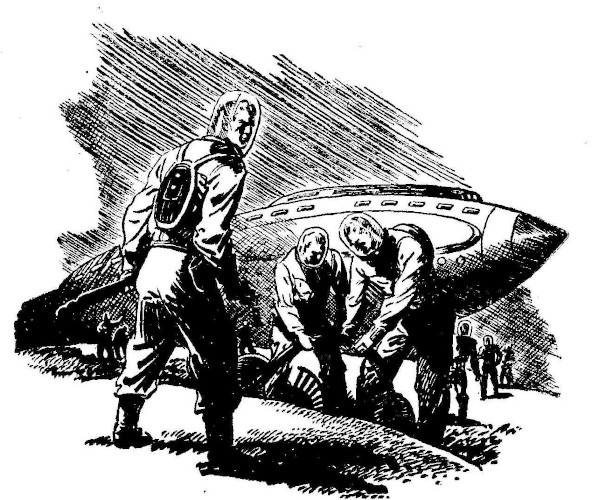
"I'll get it," said Williamson, and left. Maynard turned to Hamilton. "And you, Jack, get some of your heavies into action against sector A-13. You know the target we want destroyed."
"I sure do. And I'll get it!"
He turned to the commanding officer of the forces that arrived with the reinforcements. "Can you hold them to the north, south, and west? If so, can you advance to the east?"
"That's quite a job."
"Can you?" demanded Maynard.
The other man looked at Maynard's nebula and then down at his own rayed star. "I'll try," he said.
"No, Walter, say 'I'll do it!' and then try. We're counting on you."
There was a three-mile border around the hundred square miles of Terran-held Mephisto. It was a terrible border now. It was a solid mass of flame and fragment, and it was creeping inward slowly. Saturation destruction, it was called, and if successful, obliterated not only the enemy, but also his traces.
Above, the circling of tiny fighter ships darkened the sky, and the rain of broken ships became dangerous.
And then a wave of intense hatred filled Maynard. It was so violent that he found himself climbing the roof of his shelter to man one of the AutoMacMillans himself. He got control of himself, and saw that all the Terrans in the field of his sight were positively writhing in hatred. Shaking his head in wonder, Maynard returned to his scanning room and watched the luminous map of operations.
He was amazed to see that the sides of the square held by the Terrans were advancing, closing down that barrier of fire that bordered the square. The east side, which should have advanced slowly, was rocketing forward at a dizzy pace.
The wave of hatred diminished, and so did the swift advance. The battle settled down to a continuous roar.
Hamilton's group returned and as the sector commander landed to report, his command roared through the skies above the embattled defenders of the planet and poured destruction down upon them. Hamilton came in and told Guy: "We did it, but what a cost!"
"Bad?"
"Terrible. They hacked at us all the way there and all the way back—and when we got there, that place was defended like Sahara Base itself."
"But you got the target?"
"We did."
"Good. Can you get the target in sector L-14 now?"
"If my command holds out."
"Go ahead then—and we'll meet you at Area 2. Don't return here at all."
"I get it. You're going to abandon this place?"
"No. I'm going to hit F-67 with three quarters of the main fleet. That'll divide their defenses and we'll end up with two hundred-mile areas."
"You're going to leave enough here to hold this place?"
"Yes. It'll be tough going, but once they're divided, it'll be easier here. With three quarters of our fleet attacking another place, they'll be forced to follow. Look, Hamilton, some of their power is down! Ben must have got that power-conversion plant!"
"When are you leaving?"
"As soon as Ben returns. Hello," he said, turning to see four officers struggling with—a creature.
"We caught this one alive," offered the foremost. "Thought you'd like to see what we've been fighting!"
"Nice to know," said Maynard drily. "What now? Do you expect me to give it tea?"
The laugh was universal. But the creature straightened, and waved the tentacle on top of the shapeless collection of antennæ, tendrillike fronds of hair, and wide, flat appendages that must have passed for the head on Mephisto. It whipped the tentacle to the back of the head and found a curved case that fitted the back of the head. Another tentacle tore from the officer's grasp and found a similar box at the belt.
It turned a knob on top, and Maynard whipped his MacMillan from its holster and blasted the tentacle off at the "shoulder."
And then, in Maynard's mind there came a thought. It staggered the patrol marshal, and he blinked in unbelief. It rang in his mind: "You shouldn't have done that!"
"What?" asked Maynard aloud. "Why—?"
"You shouldn't have done that. I meant no harm with this. Now I may not retune it to your fellows."
"But—?"
"It is a development that will ultimately win for us," came the thought. "A thought-beam transmitter."
Maynard sat down suddenly. "No," he said. "I'm mad! I must be."
Hamilton said: "That I doubt, Guy. What's the matter, though. You look ill, but madness I doubt."
"He says that thing on his head and belt is a thought-beam transmitter."
"What? He says—?"
"That's his thought. But it can not be—"
"Or can it?"
"Your misbelief is amusing in the face of fact," came the amused thought. "Tell me aloud to perform some simple action."
"Can you sit down?" asked Maynard.
To the amazement of everyone, the creature bent in the middle and seated itself on a stool.
Hamilton smiled foolishly. "From here on in, Guy, that's a thought-beam transmitter. Take it from there and go on."
Guy smiled and nodded. "I'll accept it."
"It's the explanation for a lot of things," said Hamilton. "Their concentration of forces against selected targets, for instance. Their use of the barrier."
"Naturally," came the Mephistan's thought.
"I thought you couldn't tune to them," remarked Guy.
"They spoke to you—your mind followed their speech; I followed your mind. I can not talk to them direct."
"I see. It's logical. But why did you permit us to get this far?"
"You are alien; tuning the instrument to your very alien minds was a matter of hundreds of years. We have been trying, and only succeeded after the first horde of you came close—landed upon Ungre—and gave us a large thought-input to work on."
"But why did your kind fight us from the very beginning?"
"Because we know what manner of mind you have. We saw it in action before."
"Surely you knew that we would negotiate with you?"
"To our disadvantage."
"Not necessarily."
"Don't be ridiculous," came the thought. "You and I both know that the Solar System is not large enough for both our kinds."
"We have no desire to own your world."
"No? Then what are you fighting for?"
"For the right to negotiate with you—and to uphold our honor. After all, we were fired upon without provocation."
"You are the commander of the Terran forces here. Suppose a race came to Terra. Suppose this race was one you knew to be absolutely ruthless, grasping, ambitious, and proud. Suppose you knew this hypothetical race to be the one that used a minor race as subjects in vivisection; and because of valuable minerals on another planet, this race oppressed still another race and held them in ignorance so that the true value of the minerals was not known to the ignorant natives."
"You're speaking of the troglodytes of Titan—who haven't the power of reason. Why shouldn't we use their bodies as experimental subjects to aid our researches into the subject of medicine?"
"Because they, themselves, are life!" came the scathing thought. "Given the opportunity, they develop reasoning minds and are quite intelligent. Their environment holds them back. Titan is a poor place, destitute of minerals and unproductive of easy living, such as is necessary for civic advancement."
"That I do not follow."
"In order that a race advance, he must have time to think. That means leisure. His living must come easy enough to give this race time to think, and to dream, and to plan. When scratching a living out of nature becomes a full-time job, little civic advancement can prevail. Also, on Titan, he is already supreme as far as his native enemies go. There is nothing to drive the Titan to his fellows for mutual protection. Each Titan is alone because he has nothing to fear, not even his own kind.
"But," continued the Mephistan, "give him the opportunity, and you will find that the Titan can evolve into intelligent life. Say three generations!"
Guy let this matter drop, and said: "And your other statement pertains to Pluto."
"Certainly. Valuable ores were found on Pluto. Also a race of semi-intelligent natives. They traded worthless bits of glass and glittering, chromium-plated jewelry for gray and shapeless masses of dirt—but the dirt must be excavated from certain locations, and in certain ways. To keep the ores moving, and at this ridiculous rate of exchange, no program of education was installed on your Pluto. Even your Men of God—missionaries—obscured the real value of those ores. What did you give them in exchange?"
"We gave them protection against a common enemy."
"An enemy of yours that would probably have treated them no worse than you did. The protection you prattle of was protection of your own mines against the enemy, not of the natives against this enemy. In either case, the natives would be no better off."
"You paint our race as black-hearted," said Guy.
"And what did you do?" came the cynical thought. "As soon as you discovered this barrier-screen, you raised it over Pluto, and the rise in temperature, good for Terrans, killed the Plutonians to the last one! A benign race? Bah!"
"We—"
"Nothing you say will convince me that your main desire is not for yourselves! And if you think for one moment that we will permit you to throw up a barrier around Mephisto and kill us off, you're mistaken."
"You're all convinced that we mean harm?"
"You do!" The creature tapped the thought-beam instrument.
"I presume that you speak for the entire race?"
"I do. You, with your so-called democratic government; with your populace swayed by orators; with your justice biased with bribery; with your elections purchased by the highest bidder, could not possibly understand how a race could hold an honest government. But we do," said the Mephistan proudly. Again he tapped the thought-beam instrument. "This instrument tells the truth! No silvery-tongued orator can sway the people; no biased judge can color the evidence; no public servant can buy an election, for problems of state are presented via thought-wave, and a liar is detected! When you first advanced into the planets, we saw your progress. And when we found you in our system, we knew your real thoughts at last! We broadcast your hidden purpose and to the last Mephistan, we decided to fight! To the last one of us we will fight, for we know that your purpose is to move in on us and run us to death. We have nothing to lose but our lives, and those we will lose if we permit your invasion."
"You hold us in deep contempt," said Maynard. "Therefore your statements themselves are biased."
"They are not. Perhaps, with this instrument, we know you better than you do yourselves. You are death for us—unless we become death for you!"
"But what can we do when you fire upon us without provocation?"
"Stop prattling about provocation," came the thought. "When a burglar pries his way into your living room, do you wait until he collects your valuables before you fire on him?"
"Now we're burglars?"
"Worse. A burglar knows that he is doing wrong."
Guy shook his head. How could he make this creature see that Terra meant no real harm until the Mephistans made the first aggressive move?
"You made the first aggressive move," said the Mephistan. "You made it when you first landed on Titan. You made the second on Pluto. What is your feeling toward Mars? You plan extermination for them—and they only desire to grow with you."
"They—"
"Only fought back when you fought them. Only this"—tapping the instrument at his belt—"will keep us from falling in death. You, yourself, brought home many new concepts from Ertene which will throw the balance of power for Terra."
Guy started, and then looked wildly around at the other officers in the room.
"I know of Ertene from your own mind," said the creature. "These others can not hear my mind. But I curse Ertene for the things she gave you; they will make our battle difficult."
"It will make your fight impossible," said Maynard, catching the brief flash of a hidden, fearsome thought in the Mephistan's mind. He turned to Hamilton and said: "Set up a barrier about the system, and focus the output of the screen on the center of Mephisto!"
The creature snarled audibly; it was the first sound ever heard that was made by a Mephistan. He drove forward, shaking the officers' grip from him as though the hold was nothing.
A darting tentacle lunged forward like a rapier; and like a rapier it impaled Hamilton through the throat. Withdrawn, it flattened and swung like a scimitar in and among the stunned officers.
They came to life and rushed the Mephistan. Crowding the creature close. The stool upon which he had been sitting was lifted high in another tentacle and it shattered to bits against the skull of the tallest officer in the room. The other three grappled with the Mephistan and bore him backward to the floor which may have seemed desirable to the Terrans. It was also desirable to the Mephistan, too, for it gave him a more solid basis for his slashing attack. He cut through one officer's midsection entirely, crushed the skull of the next against his own by driving that bullet head forward, and then picked the last from the floor in his tentacles and dashed him across the room against the wall. The body crunched, quivered, and fell to the floor.
Maynard lifted the MacMillan and drilled the Mephistan again and again. His eyes blazed with hatred for the alien creature, and his mouth curled in utter distaste. The room filled with the stench of—burning varnish!
"Naturally," came the thought, continuing as though nothing had happened, "I could not come to such a fearsome temperature as you maintain and hope to live. You seem to have destroyed my servant, but we shall destroy you!"
When the aides came to clean up Guy's office, they found him inspecting the little instrument that fitted head and waistline of the alien creature. It was off, now, and partly disassembled upon the patrol marshal's desk.
Williamson came at Maynard's call and raised an eyebrow at Maynard's action.
"I had to do something," said Guy in a flat voice. "I couldn't just sit here and contemplate those bodies."
"I know," said Ben softly. "Anything I can do?"
"Yes. Set up a barrier. Focus the screen's output on the center of Mephisto. And then maintain that barrier for your life—and it will be just that. It will be for your very life, for it will be against the lives of all Mephistans!"
"Good!" glowed Williamson. "That'll do it!"
"It may take months," said Maynard. "But from now on we're fighting a winning battle."
"What is that thing you're tinkering with?"
"A goldberg that was on the creature's body. Interesting thing, too. Look, Ben, this thing may have been a robot, but their psychology is such that they hate us completely. Issue orders that no more prisoners are to be taken. Extermination is the only way; their strength is such that three of them could wipe out a regiment. If we don't exterminate them, they'll exterminate us, and they can do it if we permit them one chance. We'll not give them that chance. Have the technicians figure out the estimated temperature rise of Mephisto with a full screen and full output directed at the center of the planet. I'd like to know when this affair can be considered over."
"Check. I'll do it, Guy. What you need is a rest."
"I know. But there'll be no rest for any of us until this fight is finished. Come on, Ben. Let's get moving. We've got a job to do."
XII.
Guy put the alien instrument in his personal locker and went to see how the battle was coming. Out across the face of Mephisto, he saw the battle machinery locked in mobile death with the huge, alien machines of Mephisto.
The ground was strewn with smoking ruin, and Guy saw with horrified gratification that the ruined machinery was all on the Terran side of the battleground—which meant that his ring of offense was advancing. The energy bombs were bursting above the planethead, and the sky was filled with blinding light. Sub-ships fell as their drive was burned by the entrapped energy within the barriers, and Guy wondered how many men were getting energy burns from the terrific radiation from the energy bombs.
Orionad, standing in the circle of planeted ships, was dealing power blows from the turrets, and beams of energy—just energy—were roving the sky to saturate the barrier-protected sub-ships. Now and then a MacMillan beam would touch one of the sub-ships unawares, and there would be a terrific blast as the entire ship exploded instantly.
Then Guy saw his forces waver slightly, fall back, and then go down in a terrible wave of destruction from massed sub-ships.
Again they retreated, and as the next wave dropped, they expended their energy on nothing but the bald surface of Mephisto. The solid ice of Mephisto boiled into great clouds of vapor and liquid water ran across Mephisto's face for the first time.
The vapor clouded operations—for both.
One sub-ship scraped Mephisto—broke the barrier, and slid through a crashing pile of accumulating rubble to a destructive stop.
And on one upthrust plate, torn and almost obliterated, was the device of the Martian Space Guard!
"Martian!" breathed Guy.
"Right!" agreed Ben.
"Check that wreck!" exploded Guy. "What's running it!"
His order was passed: fifty Terran machines raced forward and encircled the smoking ruin; and seven of the planeted constellation ships blasted a pathway back to safety for the carry-alls.
The ruined Martian ship was dropped in a clear area, opened by brute force, and through the torn plates streamed a group of cautious Terrans. They emerged immediately.
"Martians!"
"The devil! They've made a pact!"
Maynard looked understandingly at the broken ship. "Naturally," he said sourly. "What would you do?"
Williamson looked up and nodded. "Right. Well, does this change anything?"
"No—unless it is to apply what we know about fighting Martians to the present situation. We didn't consider this possibility."
As Maynard turned to re-enter the Orionad, eighteen of Hamilton's raiding horde returned in a screaming landing. Hamilton came out, white-faced, and said, dully: "It was sheer hell—both ways. We got 'em—but they hit us with the book. Sixty percent lost!"
"How do you feel?" asked Maynard.
"I don't know."
"Take your command out again and hit Sector F-67."
Hamilton looked up in surprise, and then anger crossed his face. He saluted and said: "Yes sir!"
As he turned to go, Maynard called softly: "Hamilton! We're fighting Martians now—they've made a pact!"
Hamilton turned, looked at Maynard, and muttered something that Guy could not hear over the roar of battle. Then he returned, and faced Guy.
"The stinking, rotten devils—!" His face cleared, and he left.
Behind the embattled lines of the Mephistans, Martian craft landed. Martian sluggers, Martian power-craft, Martian constellation class super battlecraft. And as they were landing, and getting set for an open battle, the Terran forces lined up behind the thin line that flanked Orionad.
It was a situation that made Maynard start. For years, no real action had ever been fought between the two forces. Sorties, scrapes, incidents; these had been the sum total of the trouble between the denizens of two worlds. Ream upon ream had been written concerning theoretical battle-plans for war against Mars, and in the Martian pictographs, equally large quantities of ink and paper went into the libraries on how to fight Terra.
Guy realized: Here it is!
The power ships of the two forces faced one another across ten miles of plain. Above the heads of each roved the tiny fighters, and above this cover, reaching up far into the realm of space, were rising the battlecraft.
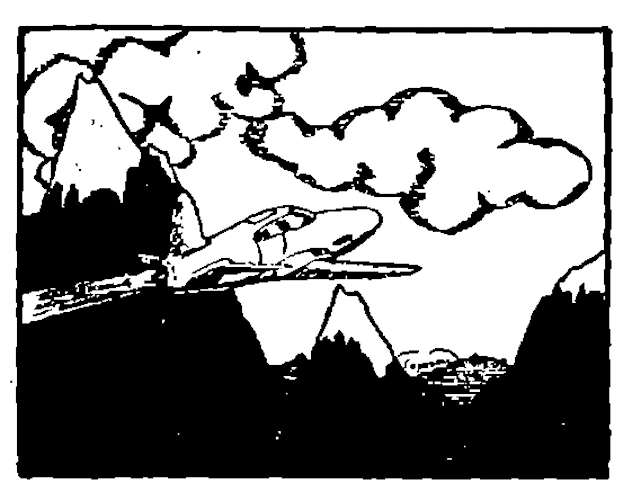
Planet forces began to move against one another, right through the unseen death that roved from the MacMillans on the tractors and the moving pillboxes. Space above the battleground filled with a continuously exploding roar, and sheets of released energy flares at the meeting points of crossed MacMillans.
The constellation ships fenced momentarily, and then roared forward into full battle. The sluggers stood back and threw the might of their energy from long range. Tiny fighters raced forward, depending upon speed, mobility, and minuteness to escape the wary detector-coupled AutoMacs.
Sight became impossible. The flaring of explosive and raw energy seared the eye that dared to look, and when the flaring light stopped by chance, the rising wreaths of smoke, steam, and incandescent vapor obscured the vision. Lightnings flashed in and through this cloud, and the instruments became wabbly.
Fire ceased briefly, and both sides waited for the veil to clear. Technicians put the cancel plugs on ruined targets to clear them from further destruction, and turretmen served the heating projectors.
A wave of sub-ships zoomed in and spread flaming death among the Terran forces, and the energy bombs poured up, and among the barrier-protected ships. A group of Martians holding disperser screens zoomed over, spreading energy in wide-aperture releases from their turrets. Bombs and torpedoes raced in through the disperser screens, and the blind crews died without knowing whether they had hit anything. Terran sub-ships crossed beneath the first wave of Martians, and hit the enemy. A veritable fence of exploding ships barred the view as sub-ships collided. Their indetectability was mutual, too.
Like twin tornadoes, the ships of both worlds spun upwards in a vast, whirling spiral. Bits of dust, smoke, and vapor intermingled with the ships, giving them a definitely tornadolike appearance as they swept the surface of Mephisto towards each other.
The volume between the twin vortices was torn and blasted. Slowly and ponderously they moved together, and as they intermingled in a whirling eddy of battle, the ground of Mephisto was scoured clean of life.
The weight of Terra's forces carried the most momentum, and the spout moved across the territory formerly held by Mars.
Reinforcements swooped in from space, and the whirling mass expanded. And with gathering speed, the vortex moved in an irregular path across Mephisto, sterilizing the planet as it went. Mephistans went before the tornado of huge battlecraft as straws go before a hurricane.
The path of the storm was strewn with smoking, ruined ships. The luckless were forced inside of the whirling cylinder and gunned there. They fell down that chimney of death to the ground that awaited them at the bottom, or crashed against uprising sub-ships that swooped upward through the vortex and fired on all sides, relying on the identifier-couplers that stopped their aim against their fellows.
The vortex broke, and the Terran ships opened from circle to crescent to straight line to closing crescent and strove to encircle the Martians. Outnumbered now, the latter fled slowly and kept up a killing fire of retreat.
Across the face of Mephisto arrowed the embattled fleets. A wall ten miles high and fifty miles long and thirty miles from front to back accelerated and swept everything before it. Between the two walls of fighting ships was a constant flare of death. Cities caught in the conflagration died; their buildings seared, blasted, and broken.
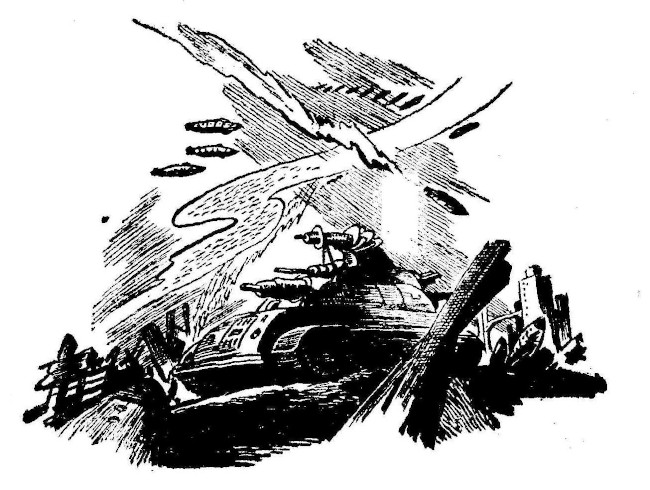
In full rout, the Martian forces raced to converge upon a large city.
In a tight circle, the Martians braced themselves. Power beams came from the city to feed them, and as Terra came before them they lashed out with the power of planet-supported fire. Terra englobed the city, but it was a questionable success.
From horizon to zenith, the Terrans poured their power into the Martian hemisphere. The ground about the city ran hot, and the grounded ring tilted and mired down, but they continued to fire back. Stalemate set in; Terra could not breach that close-knit hemisphere and Mars could not fight off the pressing Terrans. Destroyed torpedoes filled the annular gap with explosions, and crossed MacMillans flared to sear the eye.
Then a mile inside of the Martian ring, the ground heaved upward, and the ugly snouts of underground raiders appeared. Their protected turrets lifted out of the blisters and began to pour energy into the Martians from behind. The Martians swept downward from their hemisphere and fought back against the pincer-movement. The topmost Terrans pressed downward as a second ring of underground raiders appeared to bolster the first wave.
The city erupted in tiny areas as Terran undergrounds broke the surface, blasted the interfering building away with torpedoes, and lifted to add to the ever-increasing energy of the battle.
The Martians hopped backwards over the ring of undergrounds and set up an inner line. At point-blank range, and almost plate to plate, the Terrans massed their energy in a flaming wall of destruction, fighting the Martians back, foot by foot.
The circle tightened upon a tiny, central park. Spacesuited figures worked furiously under a disperser screen; they were putting the last touches upon an alien projector. No light came to them from without, but they could be seen by the light of their own working floods. Outside of the projector and the disperser, a ring of large detector-coupled MacMillans were dancing from point to point and dropping Terran ships with each point.
"Ben!" snapped Maynard. "We'd best get that thing before they finish!"
"Right. We'll hit 'em with AutoMacs and keep 'em under constant fire."
"No good."
"We can't hit 'em through that disperser, but they can't see to hit us."
"I know. But there's one thing they don't need sight to hit."
"Huh?"
"Mephisto III, you idiot. Could you hit Luna from Terra without aim?"
"If I had an ephemeris."
"What do you suppose they call theirs?"
"I—"
"Break out a ground force," ordered Maynard. "We're going to take that projector!"
The Terran fire tripled as the ground force moved ponderously across the intervening yards. A salient point was made, and the sides began to widen. Back and forth the individual sorties went, and as men and machines went up in flaring puffs of fire, the salient moved forward toward the projector.
Inside the disperser, the combined Martians and Mephistans worked furiously, though they seemed oblivious to their danger. No signals would enter this barrier, and no living thing could step outside and hope to re-enter.
They stepped back from the thirty-foot parabola, and one of them thrust down upon a plunger.
Above the parabolic reflector, a thick haze formed. A torpedo succeeded in passing the coupled AutoMacs and raced inside of the disperser and into the haze. It exploded, and its energy added to the forming vortex.
The haze thickened, became toroidal, and spread out. Up from a dun color it went, into cherry-red incandescence. Up through the red past yellow into blue and then into flaming white went the color-temperature. Like a close-knit toroid of flaming, white-hot metal, it poised above the projector, moved slightly, and then raced upwards. It passed the disperser, and the screen went up in a flare of white.
Into the sky above Mephisto went the toroid, and below it, Terrans swarmed over the projector, fought off the remaining enemy, and held the projector as their objective. The last floods of resistance died as the toroid went into the far sky above.
"Orionad!" bellowed Maynard. His ship lifted, swooped over him, and lifted him on a tractor. Upward they raced, catching the slow-moving vortex.
Turret-mounted AutoMacs vomited energy into the vortex—and back-thrusting power burned out the feedlines. Torpedoes entered the flaming mass and just disappeared. Tractor beams slid from the coruscating surface and pressor beams found nothing against which to push. A sub-ship plunged against the vortex. It was stripped of its barrier and it floated down, inert, and started the long fall to the hard ground below.
Fighting against the vortex with weapons that did no good, and cursing the foul thing all the way, Maynard and the Orionad followed its ponderous course out and out and out to Mephisto III.
It spread as it went, and by the time it wrapped its tenuousness about the tiny moon, it was almost gone. But it contained strength enough to blow out the barrier-generator that held Mephisto III invisible from without.
The toroid disappeared, and Guy, with misgivings, made inward to land at the base.
His fears grew as time went on, for he was not challenged. A swift report gave him some hope, but it came from Mephisto itself, telling him that resistance was at an end in the sector he had just left, and that the fleet, victorious and supreme on Mephisto, was returning to the outer moon.
Guy worried. Returning to what?
Inspection showed that nothing was harmed—save life. Dead men sat in their places operating instruments, dead men patrolled unseen areas, dead men manned the landing ports. It was a moon of the dead—with every instrument operable.
Not a machine was damaged—but no living things remained on Mephisto III.
Broken with grief, Guy Maynard looked down on the silent face of Senior Aide Joan Forbes. He felt wooden, and it all seemed dreamlike and unreal, but he knew that this was no dream, but cruel reality. Hat in hand, he stood there as if frozen and searched the girl's face as though expecting the closed lips to part in a smile, and the closed eyelids to open before a pair of twinkling eyes. His men knew of the affection there, and they pitied him silently.
In neat, geometrically precise rows; seven billion, four hundred million miles from home; on a tiny, almost airless moonlet of an alien planet the hundreds upon hundreds of physically perfect bodies were buried. Not a scar or burn marred them, yet—
The chaplain said: "—from the earth thou camest, and to the earth thou hast returned. And though this earth is far removed from the earth which bore thee and thine, it is thy resting place and home, for in the eyes of God Almighty all places and all planets are His Domain. And though ye travel to the farthest star, yet you will find Him there before thee, and this we know and believe for His Only Begotten Son hath said: 'My Father hath other worlds beside thine.'
"And so we consign these erstwhile friends of ours to the depths of the earth, knowing that time and space knows no deterrent to Our Father Almighty; We shall all meet again some day—"
Guy Maynard plodded away from the scene. His eyes were dry, and in his heart was nothing. Shock had taken control of Maynard. Through the rows of mounds he walked, back to the Orionad, and his entry into the super ship failed to give him that lift he always felt.
He sat in his scanning room and stared at the blank wall. Nothing aroused him. Nothing caused him to think; his mind was almost a blank, and it raced with futile rapidity from scene to scene with no plan, no reason.
An hour he sat, and the shock began to wear off. It left him with heartbreaking grief, and Maynard put his hands over his face and wept bitter, honest tears.
A phrase crept into his mind: "—the fortunes of war—!"
Maynard hated it. He hated the unknown who first said it. And then his hatred changed to the creatures that had created this ill fortune. He arose, his eyes blazing; and he thought:
Am I mad?
How could any man with such hatred be anything but mad?
Then I am mad!
He stormed out of the scanning room and went to the upper turret. He strode in, and saw that the super-projector was being installed there. Williamson turned and his face softened.
"Well, Guy?" he asked quietly.
"It's not well!" snapped Guy. Then his voice cleared and he said: "Sorry, Ben. When?" he asked, meaning the vortex projector.
"Now, I think. We lifted it wholesale, generators and all."
"Then blast the accursed planet until it writhes!"
The vortex formed and hurtled down upon Mephisto. Again it formed and went down, following the first. Rings of violent energy, the vortices flew from the snout of the projector one after the other, time and time again until Ben stopped because the power was running low. Lines were thrown in from adjoining ships and the everlasting barrage continued. Hour after hour it went on, and each vortex laid waste to a section of Mephisto.
And long after the last Mephistan was dead, the Terran torpedoes dropped on the planet. His men wondered, but still there came no order to cease fire. Moonlet-mounted AutoMacs crossed the void and scored Mephisto, and when the final blast was fired and the Patrol landed upon Mephisto, no complete article of Mephistan life was anything but a smoking, charred mass.
The taking of Mephisto was finished.
And Guy's hatred had passed through the saturation point, and all that was left to him was a dull ache. Shock had taken him again; it was with a dull, toneless voice that Guy issued orders to return the Orionad to Sahara Base.
XIII.
Guy Maynard inspected his image in the mirror and swore at it. He hated what he saw. His glance went from the mirror to the surroundings, and the face in the mirror, he felt, did not seem in keeping with the ornate suite of rooms at the Officers' Club. The rooms were rich, formal, and sedate. The face that looked back at Guy from the mirror was a composite between care and foolishness.
Lines had come between his eyes, and the frown of worry marked him, too. His face about the eyes and nose seemed old. An honest observer would have said that Guy's face had character there. But the lower piece of face was the idea of frivolity. That mustache! It was the sign of a youth trying to be grown up. It was an admission of immaturity that the face behind it was not enough front in itself; that foliage was needed to conceal the lineless face of youth.
It was there for beauty's sake! Beauty, he repeated in his mind. He snorted aloud. From now on they'd take him as he felt; as he was. In the face of his sorrow and self-hatred, Maynard was eschewing all signs of youth and self-indulgence.
He smiled slowly. They'd accept him, all right. They'd taken him wholeheartedly when he landed at Sahara after the completion of the Mephistan campaign. He'd had a three-day beard then and it hadn't mattered.
He entered the bathroom and when he emerged, his face was clean-shaven for the first time since he was twenty.
The bell rang, and from somewhere a junior aide came to open the door. Kane stepped in, and greeted Guy with surprise. "Well, young man, where's that face-fern of yours?"
"Shaved it off," grinned Maynard.
"You look better, I must say."
"I feel as though I've dropped a lot of foolishness since I did it," admitted Maynard.
"Why did you grow it in the first place?"
"Laura Greggor said she liked men with mustaches."
"And now you don't like Laura Greggor?"
"That isn't it. She'll take me for what I'm worth from now on."
"Them's harsh words, podner," drawled Kane. "What is your feeling for Laura?"
"I don't know," said Maynard honestly. "We've both been a little rough on one another, you know. She treated me slightly coldish the last time I saw her—though she was indeed warmer than the incident after the Orionad got painted. Then, too, the last time I saw her was the day before I headed for Pluto with the Orionad. Because she has been so snippy once before, I gave nebulae to Joan Forbes to pin on, remember?"
"That was a cold thing to do," said Kane.
"Laura told me not to annoy her until I could give her the insignia of a patrol marshal—when I became sector marshal. So when I was raised last time, I did as she demanded."
"Sometimes women don't expect to have their snapped words taken to the letter."
"Are you carrying her banner?" asked Guy.
"Not exactly. I'm trying to be honest. And I think that Laura Greggor would make a good wife for you."
"Why?"
"Laura has background, money, friends. She has social standing. Also, I have a feeling that she has been sort of waiting for you. After all, she is a very desirable woman, and I doubt that she has been friendless all these years."
"She's twenty-six," said Guy absently. "Maybe you're right. It'll depend upon how she greets me."
"Any woman in her right mind would greet you affectionately," smiled Kane. "You're the Man of the Hour for fair. The Man Who. You're famous, Guy. Wealth is yours for the taking. Fame is yours already. They're talking about hitting Mars, and they're naming you as supreme commander. How do you like that?"
Guy shook his head. "I've had enough killing for one lifetime."
"You'll change that opinion," said Kane. "What you need is rest and relaxation."
"I'd like to get away from the whole business," said Maynard. "I'm beginning to hate the whole shebang."
"You'll forget that. Did you know that they're going to present you with your starred nebulae tonight?"
"Are they?"
"Yes. Laura Greggor will be there, too. Are you going to offer her the chance?"
"Might as well," said Guy.
Kane looked at the younger man sharply. "You lost more than friendship out there on Mephisto," said Kane. "You lost more than your fellow men."
"You mean Joan Forbes?"
"Yes."
Guy nodded slowly. "I curse myself that I didn't realize her affection sooner. I'd have had her now if I'd not been so accursedly blind."
"No, you're wrong," said Kane. "Forbes would have followed you out there anyway. Nothing would have changed, excepting that Joan could have eased your worry some. Call her Joan Forbes or Mrs. Guy Maynard, and you would have found her out there on Mephisto III."
"I called her Forbes and ignored her affection," said Maynard with a groan.
"It's done now," said Kane. "In all of our lives, there are mistakes which cause us regret for the rest of our lives. Not one of us is immune. But, Guy, the successful ones of us forget our regrets and look forward instead of backward. Living in the past is death in the future."
"It's hard to forget," said Guy.
"And yet," said Kane, "out there you will find an entire planet ready to give you their acclaim. They'll make you forget. Unless, of course, you prefer to remember, in which case you'll retreat within yourself and become an embittered man. But if you'll go out there among the people who want you to be the hero they think you are, you'll find yourself being so busy living up to their belief that there'll be no time for regret.
"But above all, Guy, don't take the other road. You can go anywhere from here, now. If you become embittered because of your regret, you'll end up a wizened old man with nothing but sorrow to recall for all your lifetime. Life is too short and too interesting to spend it in the past. Guy, what would Forbes tell you to do?"
Guy turned. "She'd probably laugh and tell me not to be a fool. She'd probably admit in that laughing way of hers that she was the best—but second best becomes top when the best is gone."
"You're bitter," said Kane. "The remedy is people, noise, music, excitement, and forgetfulness. Come on, Guy, we'll go out now and find it!"
"I don't think I care to."
"Don't be an idiot. Must I tell the world that their hero does not come to his own functions because of grief? And Guy, why do you now fall grief-stricken? I know and you know. But frankly it was because you didn't know until too late. Now, snap out of it and come with me."
Maynard viewed the banquet with distaste. Yet it was exactly like one of those same functions that he would have given his life to attend five years ago. He thought of that and tried to forget. The reception room was filled with glitter, and the sound of talk and light laughter assailed his ears, and in part, Maynard forgot his feelings. He became eager for the laughter. Kane noticed the change, however slight its appearance, and he smiled inwardly.
"Good boy, Guy," he said. He led Guy to the center of the larger group and without a word shouldered into the circle.
It was enough. They knew Kane and accepted him easily. Then they saw Guy, and accepted him immediately; while they did not know him, they recognized him. Guy became the center of a smaller circle and one of the men growled cheerfully in Kane's ear:
"I don't know whether I like you any more or not. That young cub has collected all our women."
Kane laughed. "Call him a young cub to his face, Tony, and he'll collect your scalp."
"I know it. He's quite a fellow, I hear."
"He's the finest. Get Bill over there and we'll find a drink. And don't worry, your women will be here when you find time to take 'em home."
"I know that, too. And for nine weeks afterward they'll be yelling at me to show some get. Darn him, he even looks like a swashbuckler."
"I doubt that any piratical thoughts run through Maynard's mind," said Kane, motioning to the man called Bill. "And as far as women go, he's been a very busy boy for a long time."
"That's the trouble right now. If I'd been isolated as long as he has, I'd be howling at the moon. And look at 'em flock around! A mutual admiration society if I ever saw one."
Bill came up smiling. "It looks as though your protégé is doing well in all fields of endeavor, Kane. Right now he's fighting the battle of Amazonia."
Tony growled again. "Don't you call my wife an Amazon!"
Bill laughed. "I meant mine. Come on, let's haunt the bar where we can excel in our own fields."
The lightness of the talk was doing Maynard a world of good. There was nothing said at all; nothing of the slightest importance. It was all done by inference and by double-talk, and each of the women seemed to be doing her best to entice him. In the back of Maynard's mind something kept telling him that it was all sort of silly; that he had nothing in common with these frivolous women, but the fore portion of his mind enjoyed it.
And the stiffness went out of him, and absently he began to look over their heads for Laura Greggor. When he saw her arrive, he wondered how he should greet her, but she took the problem in her own way and came over to the group.
"Hello, Guy," she said, offering him her hand.
"I'm glad to see you," he told her.
One of the other women smiled wryly. "An eligible, girls. That's about all, now."
"We've experience," returned another. "And what has she got that we haven't?"
"His hand," said the first. "And from here, it looks as though she intends to keep it."
The orchestra broke into dance music, and as though prearranged, Guy led Laura through the crowd to the dance floor.
"How've you been?" he asked quietly.
She looked up at him and smiled. "Fine," she said. "I'm glad you're here."
"So am I—now. An hour ago I didn't think I would."
"So?"
"I was feeling low. Reaction, I guess."
"What you need is relaxation," she told him. "A drink, perhaps?"
"Could be," he agreed.
"If I were you, I'd get good and fried. You must have been through everything."
"It seems like everything," he smiled. "But I can't get stinkeroo. I'm supposed to be the guest of honor."
Laura laughed lightly, and led him to the bar where she prescribed a healthy drink. Guy downed it, gulped, and wiped tears from his eyes. "Whoooooo!" he squealed, hugging his midsection.
"Sissy," giggled Laura.
"Feels like a MacMillian going off down there. Is there a fire extinguisher in the place?"
They both laughed. Then Laura led the way to the opened French doors and out into the fragrant garden. It was warm and pleasant there, and with one thought they went to the far, darker end of the garden and sat down.
"Did you think of me?" asked Laura.
"Always," lied Maynard. Then he said truthfully: "I've been working toward this moment for a long time. You wanted a set of patrol marshal's nebulae. You may have mine, now."
Laura took the box, and looked at the starred nebulae of the sector marshal.
"I shouldn't do this," she teased.
It rubbed Maynard the wrong way, that teasing. He knew it was just coquetry, but still it went against the grain. It was probably because he knew what was in her mind.
"Why not?" he asked. "In some circles it is considered an honor."
"Huh," gibed Laura, "perhaps in some circles. But remember it is no great novelty to the daughter of a space marshal."
"The thrill of giving some bird the royal send-off is gone, hey?" asked Guy, stubbornly. "How many other officers have you done the honor for?"
"Quite a number," she told him. "Quite a few more than any one man can boast of having women do it for him. After all, one man only gets eight new insignia during the course of his life."
"You must have quite a collection," said Guy. "Which collection includes some of mine."
"Some," answered Laura sharply. "Most of my officers are true, though, and do not go off letting other girls pin their insignia on."
Guy shrugged. This was not going according to plan at all. But best have it out. If he could get the upper hand in this argument with Laura, he'd feel better. Always before he had come off second best in disagreements with Laura Greggor. But he felt that he was dead right in this affair, and he was not going to back down now that she had flung his actions into his teeth.
"Well," he said with an expansive wave of the hand, "you told me not to annoy you with petty trifles, and that you'd be glad to accept the patrol marshal's nebulae when I became sector marshal. I merely followed your wishes. To the letter, in fact."
"You didn't have to make a public show of yourself with that little waitress!"
"You mean Senior Aide Forbes?" asked Maynard, feeling the back of his neck bristle. If he'd been possessed of any kind of mane, it would have stood up in anger.
"Senior aide? How did she get that rank?" scorned Laura.
"She worked for it. And hard."
"Slinging hash?"
"No, you little twirp. She went to a school for Patrol Nurse Corps and paid for her tuition by working nights."
"She could have made a better night-living than working in a beanery," snapped Laura.
Slap!
Maynard had been raised as a normal youngster. His mother had done her best to instill the instincts of a gentleman in her son Guy, and at an early age he discovered that little girls are not to be beaten over the skull with a toy truck, and that beebee guns make little round bruises when they hit little girls' legs, and that produced bad evidence. Little girls, he learned, had no such restriction upon their action, but could let him have a few quick blows without suffering the consequences. On the other hand, he soon discovered that at best their blows didn't count for much, and so he learned that hitting women was taking an unfair advantage.
But hitting with the tongue had never been explained to Maynard's satisfaction. Laura Greggor was being just too open with her scorn. And so Maynard, who never had hit a lady before, slapped Laura Greggor across the face.
"You hit me," she said in absolute surprise and equally absolute anger.
"You talk too rotten about someone far above you," snapped Maynard.
"Don't you call me rotten," snarled Laura. "Go on back to that little trollop you prefer."
"Can't," said Guy shortly. "She died up there!"
It made no impression on Laura. "And so now you come running back to me? Sorry, Guy. I don't play second fiddle—even to a corpse!"
"You don't have to," he said evenly. He took the box from her hand. Then as she watched in amazement, Guy removed his own insignia and placed the starred nebulae on his own lapel. With that finished, he arose from the bench; flung the plain nebulae into the little lagoon, and left Laura sitting there.
Guy entered the room through the same door, and went immediately into the bar where he downed four drinks in rapid succession.
He felt as though he needed that alcoholic sterilization of his mouth. Maynard's stomach was unused to liquor in such undilution. It reacted; got rid of the alcohol as soon as it could by filtering it into the blood stream. In other words, Guy became slightly drunk on a total of five drinks. Unevenly, Guy went to the main room, where he was immediately taken in tow by two women.
"Now," said the one on his right, "we have you to ourselves. Tell us about Mephisto."
"How did you find it?"
I found it cold and forbidding.
"To think that it was undiscovered for all of these years!"
Too bad I did find it.
"You found it, and you conquered it. That makes it almost your own planet, Guy."
I'll trade it for a chance to seek it again.
They prattled on, not noticing his silence. They wouldn't have heard him if he had spoken, for they poured the questions at him without waiting for an answer.
"Was it exciting to go all the way out there?"
It was deadly. They hit us with all they had.
"Tell us about the battle. We want to hear the final words on the finish of the fight. Tell us how you captured the weapon that destroyed all Mephisto. Was that thrilling?"
Thrilling? Maynard saw a white face with closed eyes, neatly placed in endless rows of other faces. He heard the voice of the chaplain saying again: "—vast though the universe be, and though you travel it endlessly, there you will find His work—"
How could death be thrilling?
"You make me sick," said Maynard uncertainly.
"He's drunk."
"Yes, I'm drunk," he roared. "And you'd be dead or worse than drunk if you'd seen what I had to live with. What do you know of death and of war? Thrilling? Exciting? Wonderful? Bah. It was rotten, as sordid, and as ungodly as running opium! Sending men to their death. Fighting a war against an enemy that knows it is fighting for its right to live.
"Fighting for what? So that you and your kind can sit here and praise the unlucky man who is destined to return for these medals.
"Fighting to make the Solar System bend to Terra's will, that's what it is. What did we want of Mephisto? Nothing except tribute. I'm sick and tired of people telling me that I did a wonderful job. A brilliant job of butchering, that's what they mean!"
"Guy, take it easy. They mean no harm," interposed Kane.
"If they want to see how thrilling war is," blazed Guy, "let 'em go out and see!"
"Take it easy!"
"Let 'em help cut the leg from a corpse so that it can be grafted onto a lad with his leg shot off!" stormed Guy. "Let 'em watch a ship fall ten thousand miles into a planet, and watch it blaze as it hits the air."
"It's all over," Kane told him. He turned to the rapidly collecting group and said: "Permit me to apologize. Guy has been through hell, and shock still claims him."
"It's over?" asked Guy. "It'll never be over. It'll go on and on and on until the last Terran is dead and forgotten."