Front matter (continued 4)
Reading edition
"Well," said Kane, "you'd better make the best of it, Guy. You're Terran, and there's no place else to go."
"I'd like to find a planet that hasn't seen war for a thousand years," said Guy uncertainly. The alcohol-concentration was reaching new levels in Guy's system, and his brain was feeling more and more the effects.
"We'd all like that," said Kane. "Now break it up, Guy, and simmer down."
The storm passed, then, and Kane walked Guy into the dining room and seated him at the speakers' table.
The room hazed before Guy's eyes as he sat down. The echo of his voice resounded in his brain: "A thousand years—"
What was it that Charalas said? A thousand years—no, it was more than that. Thousands of years since they had war. That was a planet! Ertene. The nomad world that wanted no part of Sol's warfare and strife; killing and death. They knew—they knew from the things he said—that Terra was a planet of self-aggrandizement and that Terrans were proud, haughty, and belligerent.
Maynard laughed wildly.
His hand felt the clean-shaven face.
He'd go there!
"No strife for thousands of years," he said aloud.
Space Marshal Mantley, at his side, turned in puzzlement and asked: "What was that?"
Maynard saw the other as a sheer maze of white; no features were visible to his befuddled mind.
"They haven't had war for thousands of years," he said.
"Who? What kind of dead, sterile place is that?"
"Ertene—and never call Ertene dead!" exploded Guy.
"What's Ertene?"
"Ertene—the nomad planet. The wanderers."
"I do not follow?"
"They came and saw us. They decided not to have any."
Mantley turned to Kane and said: "What is this young man talking about?"
"I should know?" asked Kane with a shrug. "He's drunk—and though it is deplorable that he should pick this time to get that way, I, for one, don't blame him."
"Well, after the circumstances, neither do I," agreed Mantley with a sympathetic smile. "Those female predators would drive any man to murder with their thoughtless questions. But look, Kane, this tale of a nomad planet that preferred peace to association with Terra sounds too complicated to be the figment of a drunken imagination."
"How could it be anything but?"
"Not a drunken figment," blurted Guy. "I was there, I should know."
"It must be a wonderful place," said Mantley soothingly.
"It is a paradise," insisted Guy.
"And you were there?"
"How would I know about it otherwise?"
"All right," laughed Kane. "Prove it!"
"How can I? They destroyed every shred of evidence."
"Who did?"
"You did—you and your kind. Didn't want Mars to know about Mardinex—shot up the lifeship. Made me mem'rise forged log—forged by Ertinians to fool you—and then burned log. Ha!" and Guy went into a paroxysm of laughter. "You forged a log from a forged log."
"When was this visit?"
"When—right after capture by Martians. Came home to Terra."
"Kane," said Mantley, "there may be nothing to this wild yarn. But to stop any wild talk on the part of observers here, I'm going to investigate thoroughly."
"Please do. I'm certain that it will kill any rumors. Guy went through part of the Martian idea of torture, I think, and it may have deranged his mind somewhat."
"I'll look into it," said Mantley.
"We can permit no ugly rumor to mar the record of Guy Maynard," insisted Kane. "He is too high a figure now to permit rumors—and there are those who would spread such rumors."
Mantley nodded. "Some of them are here, and they have heard."
"You don't mind a bit of scorn?"
"Of what kind?"
"My publications will break this, of course. We'll do it in the light of an investigation made over the statements made in jest by Sector Marshal Maynard. You may find yourself an object of some scorn since you are willing to accept the prattlings of a slightly-drunken man, suffering from battle-shock, as basis for a formal investigation."
"If you'll paint me as an unwilling investigator, I'll take it."
"Well," smiled Kane, "you are unwilling, I know. You'll be portrayed as a friend of Maynard's who is forced to investigate and is doing so only because your duty to the Patrol insists that you do. Correct?"
"Yes. But let's get it over with. I wouldn't want this dragged out too far."
XIV.
Guy Maynard faced the President of the Court, who said to him: "Maynard, your story is absurd. That you spent a year on an unknown planet sounds impossible. But—there is one bit of evidence which, if you can explain, will be discarded. Early medical records claim that you have a MacMillan burn beneath your right arm. It is further stated that if this scar is not removed, it will turn into cancer. No record can be found of its removal—yet it is gone. To clear yourself, name the surgeon that removed the dangerous scar."
Maynard blinked. He'd forgotten the scar entirely. It had been a minute speck that had never given him a bit of trouble.
"The record states that you got that scar at age twenty-two. You were a junior aide at the time, and you received the burn in a fight with the Martians during the Martio-Terran Incident."
He'd gotten it before he went to Ertene!
"Can you recall the name of the doctor?"
Guy shook his head.
"I can not believe that you would visit a disreputable doctor for such treatment when the Base doctor is available—and the expense is no answer. Having received the wound in service, its treatment is a responsibility of the government. Yet we have searched the records of all reputable doctors and find no mention."
Guy shook his head again.
"Maynard, I am beginning to assume that there is truth in your drunken story. Your developments—your inventions—were so startling and so brilliant. Memorized details of a civilization's best efforts. The barrier-screen. Used, no doubt, to keep Ertene hidden as it passes from start to finish through the universe. A brilliant bit of adaptation, Maynard."
"That's a little harsh, Mantley," said Kane.
"Are you in this with him?" asked Mantley sharply. "If I were you, Kane, I'd look to my own past and see if there are any loose ends. We may decide that you know about this, too."
"You're being overharsh to a man that should have the entire world at his feet."
"Maynard, will you swear upon your honor that no such planet exists?" demanded Mantley.
Maynard remained silent, convicting himself.
"Ha! Then it was not drunkenness entirely. Look, Maynard. Your high position as sector marshal will not help you in the face of this. The entire situation will be overlooked if you do your duty and lead us to Ertene now."
Maynard made a soundless "No".
"You are a valuable man," insisted Mantley. "Copies though the originals may have been, your work at adaptation is nothing short of genius. To take an alien concept and reduce it to practice is no small feat, Guy. Do not fling your future into the drink. Lead us to Ertene, and we will consider your job well done."
"They saved my life," said Guy. "They gave me knowledge. I strived and worked enthusiastically in an effort to convince Ertene that Terra and Sol would ever be friendly, and offered her a place near Sol. I assured Ertene of our undying alliance and protection. They preferred eternal loneliness to joining a militant system such as ours. Since they felt that entering Sol's system would bring about the death of Ertinian integrity, they offered me life in exchange for silence."
"A fine bargain," sneered Mantley.
"I swore to keep their secret. I shall."
"Your honor is rooted in dishonor—"
"That I deny. I had no other alternative. I could bring their secrets to you only by swearing silence. If I had not sworn silence, I would have been executed. Alive, but silent, I brought to Terra the science by which she will gain mastery over the Solar System. Dead, I would have been able to do nothing, and Terra would not have the benefit of the things I brought. Give me that credit, at least!"
"You should have sworn silence," said Mantley coldly. "And then taken us to them."
"You would prefer an officer whose word means nothing?"
"False oaths. The only oath that is worth the breath of life is your oath to the Patrol."
"I see. Dishonesty extends in only one direction? Be rotten to the core—for the Terran Space Patrol! Even a Martian spy has more honor than that!"
"Enough. We find you guilty of treasonable acts, Maynard. You will be removed from command, relieved of any connection with the Terran Space Patrol, and your citizenship in the Terran and Colonial Alliance destroyed. We'll see how popular you are, Maynard. No matter how big a man may get, he still is less than the world itself. We'll find out whether you can find friends who trust you when you've been dishonorably discharged from the Patrol.
"There is this fact. To remove the Act of Treason from your record, you must remove the charge. By leading us to Ertene you will remove any cause for action, and by doing so you will regain your position. Understand?"
Maynard's lips curled in a sneer. He said nothing because there was nothing to say. The President of the Court approached him and harshly ripped the insignia from his uniform.
"Thus I remove the sacred shields of honor from a man of dishonor. He has defiled them."
The insignia were dropped into a small box, which was then burned so that no trace of the original shapes remained. During the firing of the insignia, Guy stood woodenly. His former friends looked past him, through him, ignoring him. They arose and filed out of the room, leaving Guy standing alone.
Completely alone.
He stood on the edge of the great spaceport and watched the activity. It was hard to realize that he was no longer a part of it; he knew that he could return as soon as he grew tired of going hungry, of finding no work, of being without a single friend. But before he did that—well, he was not reduced to starvation yet. Perhaps something would turn up.
He heard a footstep beside him, and found it was Kane.
"Sorry," he said to the publisher.
"So am I, Guy. But I believe with you. You should have been permitted your little secret. Would they have preferred another Mephisto? A planet such as you describe ruined and sterilized because of pride? No—and believing that I know the mettle of the people on that mysterious planet, I know that they'd die before they'd permit invasion. Right?"
"Absolutely. That's why I did nothing. They were human, Kane, as you and I are human. A dead specimen is no good in a zoo."
"I know. What are you going to do?"
"I don't know."
"Don't take it too hard. I'm still the big publisher. I'll see that your case reaches the public in the proper light. You'll be a victim of Patrol politics, thrown out because of personal pettiness over practical action."
"That may help."
"They'll never stand for it."
"You should know."
"I do. Now look, Guy. Will you take the Loki and head for Pluto? Get lost there on Pluto; hire out as a workman. When the time is ripe, you'll know and can come back. I'm not going to see my friend broken because of their high-handed methods."
"That's offering a lot."
"Not at all. I can pick the Loki up there. Right at the present time you'd get nowhere if you stay on Terra; your face is known to every man, woman, and child on the planet."
"But—"
"Go to Pluto, Guy. Out there they will not demand ten years of references before you apply for a job."
Guy faced Kane once more. "Was I right?" he asked.
"As far as I am concerned, you were. And as far as I have the ability to make people believe—and I've made quite a pile doing just that—they'll believe, too. We'll campaign you right back into the service. But meantime you must play this my way. Disappear, Guy, because when you return, we can claim another M-12 for you, and tell the world that your dismissal was all a part of a grand plot. Understand?"
Guy nodded. Kane's argument was very sound. Remaining in the light would destroy any chances of squashing the charge later.
"I'll do it!"
Kane handed Maynard the key to the Loki's shelter. "Keep an eye on the newsprint," he said. "You'll know when to return!"
High in the Solar System; up near the orbit of Jupiter, Guy became lonely. Killing time, he'd started at a 1-G drive, and in spite of the terrific velocities that can be achieved at a single G, it took a long time to make the run to Pluto at 1-G. He'd watched and listened daily to the Press Broadcasts and gratified to know that Kane's campaign was off to a successful start.
Other headline stories bothered him. The Patrol had started a search for the hidden planet. It worried Guy. Supposing that they did manage to find it? The recurring worry caused cold sweat and shakes, and it was only by main force that Guy willed himself into a semblance of nervous stability.
Again and again he analyzed his actions. He viewed them as Guy Maynard. He tried to see them from the standpoint of the Patrol. He tried to visualize the thoughts of the people, and knew that they were being swayed by both Kane's publicity and the Patrol's adverse reports. Would they ever know the real truth? How could they ever really realize the facts when the facts were cloaked in suave words and shaded tones?
The Mephistan was right. True democracy would occur only when the thought-beam instruments became universal and fancy words no longer prevailed. But all evidence of the mental instruments was destroyed on Mephisto; Guy had seen to that. He'd been afraid that their use would disclose his secret.
It would have uncovered his secret, without a doubt.
And yet he was responsible for destroying an instrument that would have been the salvation of mankind. Wars and strife and graft and lies were the rewards of power; and power went to the man who was wealthy and dishonest enough to buy it. An honest man did not have a real chance to gain power; others bought it easily, and by trying their tactics and buying their power, they themselves became dishonest.
He felt like cursing Ertene, and then remembered that without the nomad world, he would have been dead.
And yet, what had he gained from life?
It was a hard thing to balance and justify. He'd had his day of success and power. Regardless of what they said about him, he had made his good mark on history. He realized the life was a continuous succession of rises and falls, and by all the rules he had been heading for the fall. But to have fallen so far—was that really fair?
How should he have treated Laura Greggor? And what of Joan? Could he have changed that, really?
Mephisto? Well, he'd found the tenth planet for them because he wanted power himself. He'd fought the tenth planet, and had given Terra another planet to colonize, and in carrying on the long incident of the tenth planet, had succeeded in losing something that could not be calculated in the mean terms of money.
He wondered whether he was any better than the rest. Had he been satisfied to remain as he was, Mephisto would have been discovered by someone else, and that would have lessened his chances of getting involved in this present situation. But no. He had to strike high and hard, so that he could fling the insignia of the Patrol Marshal in Laura Greggor's face with an "I told you so!"
Laura Greggor didn't deserve it.
And then what had he done? He'd pinned them on himself.
Guy smiled glumly. "Superstition," he snorted. And yet it had happened. The first time he'd pinned his own lapel ornaments on, trouble had claimed him for its own. "Superstition!" he growled. Perhaps superstition was just the human-equation coming to the fore. Those unexplainable factors of human behavior. In walking under a ladder, one might get hit by falling tools; in breaking a mirror one might cut himself; one was fortunate to find a four-leaved clover because they were rare, one so fortunate might repeat. In having disaster fall upon an officer that had no friend to pin his insignia on—it meant that he had no true friends. At least, no friends among the opposite sex.
And Maynard knew that a man of that character, whose friends did not include one member of the opposite sex, was possessed of a warp in his get-together and quite capable of speeding blindly into some form of disaster. A man should be balanced in all things—even to the sex of his friends.
Guy felt a tiny pang of jealousy. Who, he wondered, had been the lucky man to pin the caduceus on Joan's uniform?
Guy turned to the news-recorder and read the pages with aloof interest. A great verbal fight was beginning between Kane's outfit and another. Guy shook his head. It was all wrong. Kane shouldn't be fighting the Patrol. They'd break him—and then what good could he do. For even a publication company such as Kane's to attempt to sway the people against the wishes of the Patrol was foolish. And Kane's interests covered everything possible in the realm of the Fourth Estate. Books, broadcast, newsprint, commercial advertising, everything.
A trace of humor passed through Guy. It was a trace of that same humor that had been essential in saving every human being since the beginning of time.
Guy listened to the glowing claims of an advertiser on the newscast and laughed to think what the thought-beam would do to his script—"—and these cigarettes, ladies and gentlemen, are made of no worse a grade of floor-sweepings than any other brand!"
He laughed, and it did him good.
But this rise in feeling was short-lived. The next newscast took him right down to the bottom again.
It was a long editorial, written by one of the High Command, denouncing Kane and his publications, and officially suspending all operations of the Kane Publishing Co. for publicly and aggressively resisting the Patrol's attempt to add still an eleventh planet to the Solar System.
It made no matter that Ertene was passing through. They did not know that Ertene was dirigible and could be swung into an orbit. In fact they thought not. But they were determined to visit Ertene. And Guy Maynard knew that their intent was to ravage the nomad of her treasures and every bit of her science.
So Kane was no longer a factor. He had fallen in the battle to save a friend—himself, Guy Maynard.
Guy felt that he was an unfortunate fellow. Everything that he loved and wanted to befriend was going to hell—or had gone there already. Even Ertene—
No! Perhaps he could still do something about that!
Not openly. But he could pass as Ertinian, he knew, provided that he shaved twice daily and managed to hide his razor well.
It would take years of careful planning and working to get himself to a dominant position on Ertene—one that would be without question. He'd done it on Terra—using Ertinian science, and no doubt he could do the same thing on Ertene using Terran science.
He had time. Ertene was still far, far out beyond the orbit of Mephisto and the speed gave him years to prepare, unless an unhappy accident cut his time. He made an oath, then. There were two things to take with him. The vortex projector and the thought-beam. One, Terra had. The other, neither knew existed. A threat on the part of Ertene to blast Sol itself with vortices might hold Terra away, and the thought-beam would solidify Ertene against invaders.
If his action in coming to Ertene to protect them were really known, he didn't think they'd act harshly in his direction. Ertene was one place where the thought-beam would save him at the proper time.
Maynard strode to the tiny pilot's chamber and charted the course of the Loki.
When he established the barrier, he did not know that a hundred beam-detectors throughout the system went wandering foolishly; their center-of-urge gone completely. But he suspected, and he searched the Loki with a sensitive detector rigged out of the communications set parts and located twelve separate spotter-generators.
If he were to land on Ertene safely, he'd want no detectors on him. And if the barrier failed for the barest instant on his course, Terra would be on the trail in minutes.
Once inside the great barrier that covered Ertene, he would be safe—except that he wanted no Ertinian to detect him either.
So he combed the Loki free of all emission and then continued to coast toward Pluto, concealed behind the barrier.
Ertene was on the far side of Sol.
Evasion of the Patrol was going to be a problem. Though he was not undetectable, they knew where he was and how fast he was going and in what direction. Their course-predictors could extrapolate very well indeed, and could predict the position of a barrier-hidden ship since no drive would work behind the barrier. It was a matter of straight-line projection unless the celestial masses caused some deflection, but this could also be calculated.
Since his creation of the barrier would be taken as an admission of flight, he was willing to wager his life that a Terran ship would soon take the pursuit. Armed with the course-prediction, the ship would match the Loki's velocity and position to a precision within a few days.
He could not hope to drive the Loki under the barrier. Yet he was beyond the negative-detector range that he had devised on the Orionad to predict the positions of sub-ships. His problem, then, was to stay outside of that range, and at the same time change his course.
Once the barrier was removed, he would be detected by his drive. He shook his head. Well, there were certain ideas he could give a try. And, luckily, there was no premium put on time.
He would make use of the minor errors in all detectors. He could make use of the "angles of confusion" which give areas instead of pinpricks at great distances for the position of a target. And he could hope to win through.
Kane's little ship was not a Patrol ship, unluckily, though the publisher had installed just about every attachment that he could get his hands on. Guy's assumption that he would find acceleration garb in the locker was correct, and he strapped the binding, holding suit on tightly and waited while the oxygen-content of the Loki increased.
Then Guy cut the barrier and pointed the top of the Loki north; at ninety degrees from his line of flight and drove it for thirty minutes at a bone-tingling 10-Gs. Then he set the barrier again and coasted.
He'd been loafing along the road to Pluto at 1-G. He was about halfway there, and it had taken him slightly less than ten days, twenty-four hours each, to achieve his present initial velocity, Plutowards, of just a trace over five thousand miles per second. His action at driving the ship northward had changed his course only slightly. It had given him one hundred and ten miles per second velocity northward. His course, then, differed from the original course by the angle whose tangent is equal to one hundred ten divided by five thousand, or roughly one over fifty.
In decimals, this becomes point zero two. It is one degree, eight minutes, and forty-four plus seconds.
Not much, but enough to throw Guy quite a bit out of place by the time he continued to coast toward Pluto. Minute angles add up when they are projected for half the distance from Sol to Pluto, a matter of one billion, eight hundred fifty million miles. That plus the fact that he should start decelerating at 1-G to make Pluto and his calculated course constants come out even.
Then there came a long period of nothing to do.
But Guy found things to do. He went to work on the detector. He increased its gain, and in doing so sacrificed much of its selectivity and directivity. Targets at one million miles, formerly at extreme range, would no longer be pinpoints in the celestial sphere, but shapeless masses but one third the distance out from the center of the detector sphere. The angles of confusion would be greater, too, and the noise level went up to almost prohibitive quantities. Flecks of noise-projected light filled the globe with a constantly swirling, continually changing pattern that reminded Guy of the Brownian Movement viewed in three dimensions.
Calibration of the souped-up detector range was based on estimation since no accurate measure of distances was available to him. Guy pessimistically estimated the range at three million miles and hoped it good enough.
At least, no ships were within that range.
And since the barrier, when first established, had broken the far-flung contact maintained by the driver-detectors on Terra, Guy was safe until they could send out ships to intercept him.
He cursed the cardex files in all Patrol ships, and wondered whether he could change the Loki sufficiently to make it appear different to the sorting machines and the characteristic detectors. The detector impulses were based on the size, the characteristic radiation of the drivers, the mass, and the metal of the hull. Those four characteristics were individual and while some duplications occurred, sufficient evidence remained to pin the cardex-information down to a particular ship. Especially when this particular ship was being sought and others of the same characteristic would be catalogued as to course, and position.
He had the barrier, but he could not drive through it. He could hide, but when hiding could not run. He could run, but when running could not hide.
But he was the equal of the Patrol's best watchdogs. A bit of hare and hounds might come out with the hare a winner. At worst, Guy had nothing to lose.
XV.
His only hope of escaping detection was his knowledge that the negative-detector, developed in the Orionad for use against sub-ships was less sensitive as to range than the positive-detector. The establishment of negative evidence is never conclusive. And his souped-up detector would outrange any but another souped-up job.
So Guy coasted for days, which at five thousand miles took him far, far beyond the orbit of Pluto. Then he crammed on the deceleration and came to a stop, with respect to Sol, and then started back along a course several degrees to the south and thirty degrees to the right of Sol. He drove at the same 10-Gs for an hour and then closed the barrier about him once more.
Meanwhile, the mathematicians on Terra had been plying their trade. The Laws of Probability came out of hiding and became their favorite subject. Knowing his course and direction up to the first establishment of the barrier, which surprised them and caused them to dislike Kane that much more for having installed one on the Loki, they tossed their hypothetical coin, drew probability curves, made space-models, and came up with a flared cone, in which volume Guy must appear. And then they buttered their decision by stating that the cone held true only if Guy did not apply power in another direction.
They grinned, when they said it. It was thirty billion to one that Guy would apply power instead of just running off at five thousand miles per second until he hit the next star in line with that course.
So they sent out ships with souped-up detectors to follow the edges of the cone.
And Guy, running back Solward outside of the cone of expectancy with the barrier on, detected them at extreme range and laughed. He left them running in the opposite direction, and when they were far beyond range, Guy dropped his barrier and drove at an angle away from Sol which added to a quartering course from Pluto by the time he had the course corrected. He drove solid for days at 1-G, and then decelerated in an upwards vector which carried him a billion miles to the north of the Celestial Equator and ten billion miles from Sol. He turned again and ran tangent to the circle from his position to Sol, and dropped slightly southward. Again he came to a stop.
Then, with a sad shake of his head, he abandoned the Loki. He dropped from the larger ship in the tiniest of lifeships, and taking the barrier-generator with him, he let the Loki drive across the System towards Mephisto, while he in the lifeship gave a short, ten minute thrust at 10-Gs and set up the barrier again.
If any detectors had been close enough to catch him, they would be souped-up to the limit of gain, for his own super-sensitive detectors caught no pursuit. At that range, both lifeship and Loki would appear as a single drive, and when he disappeared, only Loki at 10-Gs would remain to lead them across the Solar System towards Mephisto.
He laughed. If this chase had been a chase to the death, he'd have been dead by now. But they had preferred to let him think he was being let alone, or that they had lost him. He'd given them the slip, he knew. And if they were still on the lookout, they'd follow Loki right across that vast orbit and beyond Mephisto on the other side. Better than twenty billion miles!
And with Loki running on clockwork for the barrier, and with the autopilot set for a series of gyrations with an apparent ending of the course completely unpredictable and yet obviously better than fifty billion miles beyond Mephisto, in an area that covered as much sky as the orbit of Mars itself—
They'd spend a lot of time thinking of that one.
It was slightly funny, though. The Terran mathematicians did not know that Guy was starting for Pluto in the first place. They believed that the initial start was but a throw-off direction on the secret way to Ertene. They based their probabilities on that one fact, and built their house of mathematical cards on that false premise. They came up with what they thought to be a shrewd guess—and when the Loki was picked up rifling across the Solar System in the direction of Mephisto, they jumped up and down in glee.
The Laws of Probabilities had coincided with the Laws of Absolute Randomness, the basic rule of which argument is that there are no laws that prevail.
And while the Solar System combed the vastness of space beyond Mephisto for the hidden planet, Guy Maynard was coasting out of the Solar System on the opposite side, approaching the hidden planet in truth.
Guy was going slowly as spaceships travel, but he was secure in the belief that he was not followed. He wondered whether his arduous path had been really necessary. He'd given them the shake easily. Right on the first try, and from then on he'd been able to go free as he wanted. The rest of his manipulation had been insurance.
But there had been no pursuit. It was almost impossible to have flown the millions of miles he had covered in free flight along a course beside another freely flying ship without diverging or converging. That would take corrective driving, and the radiation would flare in his detector. He had seen none. He was safe.
He spent his time figuring, and trying to fix the position of Ertene. He corrected his fix time after time, and prayed that he was right.
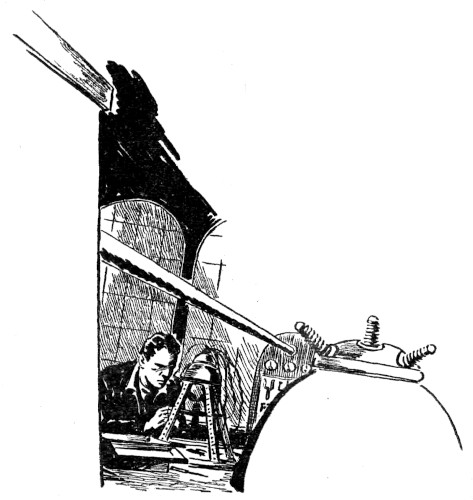
And when he detected the great, nonreflecting sphere in space with his converted detector, he shouted in joy.
He passed Ertene and went beyond detector range by twenty million miles. Then he broke his barrier and directed the lifeship to the center of the big barrier over Ertene. He closed his own barrier again and watched the blackness increase in size as he coasted toward it. He made contact, passed inside, and saw Ertene and the synthetic sun.
He kept his barrier on and approached the planet with the acceleration of falling bodies.
He hit the atmosphere and the falling velocity turned the silence of space-flight into a scream. He watched the pyrometers, and though the hull became hot, it did not become dangerously so. His velocity upon contact had been in thousands of feet per second, not miles, as would have been the case in a meteor.
The velocity dropped slightly; Guy calculated the terminal velocity of the lifeship at three hundred miles per hour, and with that in mind he began to figure furiously.
He had none too much time.
His automatic calculator ground out the answer. The best he could do was sixty seconds at 12-Gs! That would bring him to almost-zero velocity upon contact with Ertene.
He believed that sixty seconds would be short enough to escape detection by any but an observer expecting him. The recorders, showing a streak that ended deep in Ertene's broad ocean would be suspected of recording noise-transients instead of a signal. No ship would land deep in an ocean.
And it must be remembered that Ertinians were quite nonsuspicious, since they'd had no experience with disreputable characters for several thousands of years. They might not even have detection circuits working other than to enumerate the items that came in through the screen above. His barrier would not cause reaction with the big barrier about Ertene; it would have presented another problem of entering if it were so.
Guy sprawled in the flattened pilot's chair, took a deep breath, and then the autopilot threw on 12-Gs of deceleration. Sixty seconds later, the slowed ship splashed wide and beautifully into the ocean, and sank gently to the bottom.
And Guy spent twenty-four solid hours trying to detect the spurious responses that might emanate from a close-at-hand detector circuit.
No one came to investigate.
Running submerged, Guy went slowly across the ocean to the nearest land. He lowered the lifeship to the ocean floor beside a forbidding cliff and emerged, swimming to the beach several miles down the coast, clothed in spacesuit and bulging like a blimp with buoyant air.
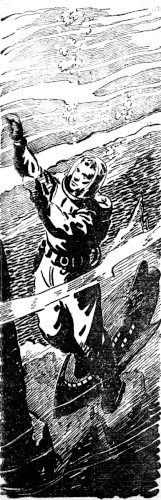
He walked along the coast back to the spot above the ship, and cached his helmet and as much of the heavy equipment of his suit as he could remove. He loafed and rested until night fell, and then made his way toward the blinking lights of the city several miles in the other direction along the coast.
His following actions were not according to the code of ethics.
He completely submerged whatever conscience he had and proceeded along the back-ways of the darkened streets at an hour when most honest Ertinians were fast asleep. Those who were not asleep were preoccupied, as he found when he almost passed within arm's length of a couple that were sitting silent and close together on a street-side bench as far from the dim streetlight as they could get. They did not see him, though he watched them and chuckled quietly.
He located the back entrance of a clothing store and tackled the lock with a bit of steel wire. He worked for an hour, undisturbed, before it clicked open. Then he stood up and went to work on the lock above the door that kept the alarm from ringing when turned by a proper key. Another hour solved that lock, and Guy entered the store stealthily. His action was quite logical. He went to the stock room below and selected one each of his size from the bottom boxes. He rifled the jewelry counter and selected a minor item or two with the Ertinian initial that signified the pseudonym of his choice. He took a few small coins from the register and then left, attired as an Ertinian.
They'd notice the discrepancy in time. But it would occur from time to time, as each rifled box was opened and found to be short. They might even put the shortages to error in packing instead of robbery.
He went directly away from the town, hiking along the road that returned him to his ship. Here Guy buried the last evidence of his Terran origin, and when the first rays of morning shone across the broad ocean, Guy Maynard became Gomanar.
He looked at himself. Gone were the Terran shirt and trousers. Gone were the low, soft shoes. In the warmth of Ertene, Guy was thankful for the abbreviated costume, and equally thankful for the over-all tan that came as a result of spending much time in space.
Blue trunks; loose, flowing shirt; hard-soled, high-laced boots of the softest material known; and a short shawl or cape that hung from the shoulders to mid-thigh in back. Maynard worried about the lack of pockets and found some difficulty in getting used to the cartridge belt effect that passed in place of pockets on Ertene. A small, hard handcase contained his razor and some spare items of clothing.
Maynard left Terra behind him beside the ocean, and strode along the highway. He continued to practice his speech and though he knew he was proficient, he worried about the first time he'd be expected to use it. But he could not remain silent forever, and so he turned into the first farmhouse he came to. Breakfast was his aim, and the sun was getting high.
He knocked on the door. A dog came rushing around the corner of the house, all suspicion, and smelled Guy's feet curiously. Then as Guy spoke to the animal, the dog backed up several feet and lay with chin on forefeet.
"Doda seems to like you," came the rich, pleasant tones of the woman from inside the doorway. "May I ask your business, sir?"
Guy smiled his best smile, usually reserved for special occasions. "I am named Gomanar. I am a migratory worker in search of two items: Breakfast first and work second. Have you either?"
"Of course," smiled the woman. Her smile broke into a full laugh. "You'll not mind if we present them to you in reverse order?"
"You'll get the worst of the agreement that way," smiled Guy, cheerfully. "I'll work less on an empty stomach and then be hungrier."
"You look like the kind of man who can pack it away," she said. "It might be that you would eat so much that you become sluggish?" she finished with another laugh. Her eyes traveled up and down Guy's muscular figure and decided that sluggish was possibly the one way that this startling young man did not get. She turned and called: "Lors! We have a visitor!"
Her husband came to the door and looked questions at Maynard. He repeated his tale.
"Naturally," he boomed. "Naturally."
"Thank you," answered Guy simply.
"What's the disagreement?" he asked his wife.
"A mere argument as to the sequence of events. He wants to eat first."
"A natural desire. That gives him the benefit of deciding the value received. But let's keep no man hungry, Tena. Your name again?"
"Gomanar."
"Lorsana," said the man. "Come in. We'll quibble over value received while eating." He treated the argument as a huge joke though it was serious business to Guy.
Breakfast was large and appetizing, and near the finish, Lorsana said: "You look as though hard work did not bother you too much. You didn't get that figure just roaming back and forth, performing odd jobs."
"I've managed to keep fit," said Guy noncommittally.
"I see that," laughed Lorsana. "But look, Gomanar. I need a helper for a few days. Have you ever logged?"
"No."
"Too bad, but not impossible. I'm clearing a bit of wooded land and need an experienced logger. If you'll help out until it's finished, I'll pay you the regular wage-level. Would you care to help?"
"I may at that. Yes, a bit of logging would round out a wide and varied experience."
"It's done then," laughed the man.
Guy thanked his active life. The job would have killed him if his muscles hadn't been in condition. It was hard, heavy work, and it covered long hours daily. At night, Guy crawled into his bed and slept like an innocent. And though he kept a sharp ear out for any mention of the System that Ertene was approaching, nothing was said in his presence. It worried him. Had positions been reversed, the subject would have been in every Terran radio and in every Terran newspaper, and a common subject for dinner-conversation.
When the work was finished and Lorsana paid him sixty Ertinian ronnads, Guy said good-by to Lorsana and his wife, patted the dog and left. The work had done him good. It had taken the newness out of his clothing and had filled his belt with good, Ertinian money.
But farm work was no place to make a start in life—from Guy's age, at least. So with regret, he left the farmhouse and trudged along the road for several miles until he came to a large city. He sought lodgings, bought dinner at a restaurant, and then on the following morning presented himself to a manufacturer of precision instruments.
His age and bearing seemed to have good effect, and he was given preference over several other applicants, and ushered into the employment manager's office.
"Be seated," directed the manager. He looked at the card in his hand and memorized briefly. "You're Gomanar. Call me Jerimick."
"Thank you."
"You seek technical work, Gomanar. Yet your card indicates that you have no formal education."
"I am well read. And I believe that I can hold my own ground with any college graduate."
"Perhaps. Have you attended any college or university, even for a single term?"
Guy had, but not for Ertinian publication. He shook his head and smiled defiantly.
"You understand that regulated study is far superior to the random investigations made at home?"
"If one marshals his mind to follow a prescribed pattern, the ill effects of random study are not present."
"Quite true. I feel inclined toward you—Gomanar." He thought for a moment. "We have some instruments in here at present which require repair. There is no rush on a couple of them—I'm going to try you out, Gomanar, on these. You'll pardon my taking insurance by giving you those of little urgency first. If you succeed in your repair of these instruments in equal or better than the time normally spent by accredited employees, you'll be hired. Is it a deal?"
"I'm confident enough," laughed Guy. Small tools and instrument-work came as a second nature to the Terran. "Lead me to it!"
"I have but one objection to hiring a man like you," said Jerimick. "You'll prove an excellent worker—and in forty days you'll tire of it and go to wandering again."
"I can't answer that."
"I can. You've never had a woman thrown your way. Some day one will come along and tie you down, and the whole planet will be better off for it. You're the type that we worry about."
"Why?" asked Maynard innocently.
"You—and all your kind—are restless. You are always searching for something you can not find. I don't know what it is, but what you seek does not exist."
"You mean we're looking for something nonexistent?"
"I do."
"That's strange. After all, I've met my kind. They all seem intelligent. No intelligent man would search the world over for something that did not exist. Or is my logic false?"
"Sounds reasonable. Yet you explain it. I know your type. I've dealt with people for ten kilodays. I've consulted the brainiest psychiatrists on Ertene, and they agree with me. Your type," said Jerimick, "is restless. You are quick of mind, and sure of yourselves save for this unrest. You can turn your hands to any trade, and prosper, yet no trade offers you the outlet you seek. I'll wager my income for the next kiloday that you'll repair my instruments in record time—and wager the next kiloday's income that you have never seen their like before. You have an ability to visualize hidden details of operation and apply a sort of rule-thumb logic to them and make them work. And when you've discovered that your logic is good, you seek a more complex problem.
"I'm going to make a serious admission, Gomanar. I believe that your kind of man would be better off if Ertene joined Sol's System."
That stunned Guy. "I'd keep that idea beneath my skull," said Maynard.
"I know. I shall. It was merely hypothetical. I'm certain that it will go no farther. Besides, such a rash move would most certainly be bad for the great majority of us, though your kind might prosper."
"I'd really hate to see such a thing happen," said Guy.
"And that statement, I believe, is the voice of education, of training, of conditioning. I doubt that you really know what is good for you!"
"We'll never know," said Maynard.
"No, please God," said Jerimick, fervently. "But both of us have work to do." He scribbled on a printed form, filling out less than one quarter of the spaces, and handed it to Guy. "Through that door and to your right. The medical examiner will O.K. you first, and then you'll be sent direct to your job. Luck, Gomanar."
"Thank you," replied Guy, worrying slightly about the examiner.
He discovered that the examination was as sketchy as the filled-in hiring-form. Within an hour he was seated at a bench with tools and equipment before him, and was whistling a cheery but tuneless melody as he delved into the insides of a small traffic-control that must be intended for local flier-traffic.
And so Guy Maynard came to Ertene.
XVI.
In the days that passed, Guy noted a tendency to show him deference. He could not understand, though he tried, why they would single him out above the others. When he needed a tool, and his actions showed that he was in search, a mere question brought immediate—not only results—but delivery to his bench.
They stood aside as he approached narrow passageways, and in a tight corridor they would back up all the way without a word. His own offer of retreat went unwanted; the other party retreated and waited with a smile until Guy decided that they had reached an impasse and went himself since the other obviously had no intention of moving.
He found this same condition prevailed throughout the city, too. They spoke to him seldom, yet he found himself with the best meals, the better seats, the quieter rooms, and the clearest path.
It took about twenty days of that to get Guy worried.
And since he became dead certain that they suspected him of being different, Guy left the city at night, and gave only a short note of thanks to Jerimick. He explained that his search required that he seek new fields. His only concession to Terran training was the night he selected. It was the night after payday, and it increased his tiny store of funds to a more reasonable value.
Guy took a night-flier and went halfway across the continent. It still followed him, for the stewardess gave him more than his share of attention.
Guy was not vain. No more, that is, than any other normal man. He knew that his figure was well-proportioned and did not require any apology in the abbreviated Ertinian costume. His features were regular, and though his thirty years was still considered young, the lines on his face gave him character. He'd been shaving within an inch of his life each morning and before dinner each night, and he knew that his beard was light enough to escape detection as long as he maintained that schedule.
This attention he was getting bothered him. He was not ready for attention yet. He'd prefer a couple of years to establish some sort of false foundation by skipping around from place to place, and losing his past in the maze of data.
What was worse, he could pin nothing down definitely. He wondered whether he might be guiltily self-conscious. That might be. But he'd been honestly critical and knew that Ertene was singling him out for something.
It was not the kind of attention that accompanied suspicion or notoriety. It was a universal will to help him, to offer him the best, to accord him some sort of deference.
But why?
His discussions with others were nonproductive. They spoke in vague terms until they heard his viewpoint and then agreed with him, and it was only with difficulty that he learned their true views were calculable only by the magnitude of their agreement.
For lack of anything more desirable, Guy took to walking in the evening. He covered miles in his meanderings through this city in the center of the continent, and in doing so learned very little, but at least it kept him from being everlastingly confronted by that unnamable acclaim.
Worst of all, most of them treated his name—Gomanar—with some amusement. Guy searched his mind, and knew that it had no amusing nuance by any stretch of the imagination. He wondered whether he had assumed the name of some famous man, but a search of the libraries gave him negative evidence—which in this case was fairly conclusive both for fame and for notoriety.
His work was well received. Even when he made errors, it was overlooked, and Guy knew that others were called to task for their errors.
At last he could stand it no longer, and since his position as an instrument worker placed him in contact with numberless small, technical parts, Guy pilfered them shamelessly, and started to make a thought-beam receiver in his rooms.
And that was a project that might take a year in itself.
But it would give him the answer.
Forty days after he arrived in this city, which contained among other things the most prominent university on Ertene, Guy was walking alone in his usual habit. His steps unconsciously turned toward the university campus, and as he neared the broad campus, the pleasant strains of music came to him. It gave him a lift of spirit, and his steps quickened until he was approaching a ten-deep ring of people surrounding the vast campus.
He stood behind them, trying to look between their heads, and his curiosity caused him to press forward. The man ahead of him turned, annoyed, and his annoyance turned to pleasure. He stepped aside and motioned Guy to take his place. Guy blinked, smiled, and moved forward; it had become natural to accept these offers. A whispering arose, faint, unintelligible, insidious. Those in front of him pressed aside, one by one, and opened a lane for Guy until he could see the entire campus from the front line.
He remembered seeing a notice in the evening news; The University of Locana was holding the graduation dance for the upper classmen. It meant absolutely nothing to Guy, but the sight was interesting to see.
The gay colors, the glad music, the circling couples—were all cheerful until the music stopped with a sudden crash, and played a loud, joyous chord.
The orchestra leader pointed his long wand in Guy's direction, and from the maze of dancers there came a youthful figure, running.
"Elanane!" she called. "Oh, Elanane!"
He heard the whisper "—the lanee's sister—" and nothing registered save that this girl must be the sister of the elected governor of Ertene. He didn't know her, which he thought to be a shame since she appealed to his sense of appreciation as few other women ever had. He probably never would know her.
"Elanane!" she called as she approached her brother, who must be near Guy. He looked around to see who he might be—and when he looked back at her to get another "fix" on the line of her sight, to better follow her intended course, he found himself hurled back three steps as the girl ran, without stopping, right into him.
She hurled herself at Guy hungrily, and hugged him until he felt his ribs complaining.
He grunted, and she stepped back to inspect him. "I knew you wouldn't miss it," she said. She was deliriously happy and went right on talking with the appearance of one who has had no one to talk to for several years. "I was worried—you worried me, Elanane. I actually thought you'd miss your sister's graduation, and I'll only graduate once. But you didn't."
Guy took the wise course. He said nothing. A protestation would have caused comment and questioning as to his real identity. An acceptance of the masquerade would set him up even afterwards as a liar and an open fake. He decided to brazen it out and hope for an opening that would permit him to get away without exciting more comment.
He wondered what her name was. A man should know his own sister's name.
"—ill, they told me. Unable to visit me. Elanane, you look the soul of health!"
Guy decided that an answer was necessary and he wondered about the tone of his voice and the characteristics of his speech. They would give him away. But a short, precise answer might not.
"I've had a sore throat," he said. He hoped that would explain the differences in tonal range.
"Pooh! Couldn't have been bad at all."
"They thought so."
"Why, you're not even hoarse!"
Guy decided that she was so elated at her brother's presence that anyone could sell her a bill of goods. "I'm not?"
"Not in the least. I don't think you were ill at all. You've been running all over Ertene again, Elanane, trying to make people think you are a vagrant, and trying to get honest information out of them. You should be ashamed, not trusting us!"
Guy Maynard felt a bit of worry. He began to wonder several things, among which were the answers to the questions of: One, was he completely insane; two: was he Guy Maynard, Elanane, or the reincarnation of Haroun El-Raschid; and three: how was he going to get out of this? He decided then that the first was possible, the last desirable, and the second highly questionable.
A bit of Terra's own private humor reared its horned head in Guy's mind and the forked tail glinted impishly over the ruddy forehead as the devil winked at him. Guy felt a hand-shaking acquaintance with the devil at that moment and decided to have something to remember, at least.
"I'm here," he told her, "to see your graduation. I came because you would be hurt if I remained away, and because I wanted to see you happy. But I'm holding up the proceedings here, and not even a lanee should demand that your ceremonies be interrupted for a whim. I'd stay, but I have work to do—and believe me if it did not concern the integrity of Ertene I'd remain and watch. But you go back to your dance and I'll be with you later!"
"That's a promise, Elanane?"
"A promise. Now give your big brother a kiss and go back to your ceremony."
"A promise," said the girl to seal the agreement. Her kiss was affectionate but sisterly, and Guy wondered afterwards why he expected anything but a sisterly kiss from a sister. Then she turned and went back to her partner. The music began again, and Guy stood there watching. To rush off would excite suspicion, and though the nerves up and down his spine were tingling, Guy stood there brazenly, fighting that rising impulse to turn and bolt.
Then feigning sorrow at having to leave, Guy turned and made his way through the crowd. A man behind him shouted: "All right, folks! It's no secret now! Do you like him?"
The roar of cheers that went up nearly staggered Guy.
Elanane must be one swell person, thought Guy. Well, that was that. Now what? Disguise upon disguise? He was a marked man, just as much marked as if he'd permitted his whiskers to grow.
He cursed Elanane for his looks, and wished that the lanee of Ertene had been possessed of brown eyes, a hook nose, and a cleft chin—or that he did. Well, now what—?
Guy didn't know.
The next move was made for him. A man came up, tapped him on the shoulder and said: "Thomakein will be glad to see you, Elanane."
Guy squirmed inside. He'd never seen Thomakein, but he'd heard plenty about this Ertinian. On the other hand, Thomakein had seen him on his previous visit to Ertene, and Guy knew that Thomakein might have seen him without his mustache at one time, for he vaguely recalled having been shaved clean at one time during his convalescence. He turned and looked behind him.
A second Ertinian smiled widely. "Thomakein said you were playing the vagrant again, Elanane, and that he insisted that you come immediately. Things require your personal attention."
Guy knew that violence would result in only one answer—he'd be taken horizontal instead of vertical, and resistance would show Thomakein that he meant harm. There was still the partly-finished thought-beam receiver in his room—
"Where is he?" asked Guy.
"Come," said the first Ertinian. He led the way for several yards, and then fell back as the other Ertinian came up to walk on the opposite side of Guy. Guy felt like a prisoner making his Last Mile.
"Look, boys, I'm really not Elanane."
"We know you aren't," laughed the first one. "What name are you using this time?"
"Gomanar."
"Not too good," laughed the one on Guy's left. "You did better as Inualdi the last time."
"You'll excuse us," smiled the first, "if we treat this matter lightly. You know us and we know you. Furthermore, we know you know us and you know we know it. We'd like to follow your wishes, Elanane, but we cannot think of you as anything other than Lanee Elanane. May we have your forgiveness?"
Guy smiled, nodded, and gave up. To himself he admitted that he was licked. Whatever his next move was, it was out of the question now. It must be a spur-of-the-moment plan, Guy thought, and he decided to bluff it out as long as he could. He'd try valiantly, for if Ertene failed him, he was a man without a planet.
He reminded himself that he had one ace in the hole. The partly-finished thought-beam instrument. If they questioned his motives, he could ask permission to finish that and let them see for themselves that his interest was only in saving Ertene.
With the eyes of his captors on his back, Guy strode across the cabin of the luxurious flier and without hesitation opened the door, stepping into the inner compartment.
He had little hope that he would be able to fool Thomakein, but he must try.
The door swung shut behind him, and as it slammed, the flier lifted into the sky, effectively cutting Guy's retreat completely.
"Come in—sit down," greeted the Ertinian.
"You seem to have been expecting me?"
"Yes—but we knew you'd show up sooner or later. Had things become acute, I think we might have made an open appeal. But you are in time."
"Anything urgent?"
"The Terran, Guy Maynard, ah—talked open!"
"Uh ... he—What?"
Guy blinked. It was too close to home not to stagger him. This was one place where he'd be forced into carefulness. He'd have to watch his step. Discussing himself as a third party was more than likely to bring out too many things that he, as Elanane, could not possibly know. If he were to fool Thomakein—and it looked all right at this point—he'd have to submerge himself in Elanane's unknown personality, and use Elanane's unknown knowledge. That could be done by permitting Thomakein to do all the talking. Well, he'd permit Thomakein to talk continually.
And then it filtered into Guy's dazed mind that the last words had been spoken in Terran. The term "Talked open" was a Terran idiom—and—
It had been expressed in Terran!
"You seem surprised, Elanane. I'm amused. Really, I'm sorry that the shock should come to you this way, Guy, but you have lost all resemblance to Elanane in the last few minutes. Guy, don't you recognize me?"
Guy stood open-jawed and stared at the Ertinian. Slowly, uncertainly, Guy shook his head in negation.
"I suppose that surroundings and dress do have a lot to do with recognition. That plus the fact that you never expected to see me here on Ertene. I am in strange dress, in an impossible place, and you do not know me. At your expense, Guy, I'm amused." Thomakein went into a deep laugh.
Guy was irritated, but he said nothing. He was still dazed. "Thomakein—Thomas Kane!" he said after a full ten minutes had passed.
"Fine! So you do recognize me? Shake, Guy. If I'd not known your intent, I wouldn't know you either in that Ertinian get-up."
"But ... but—?"
"There's one thing you'll need, Guy. Your face shows the effect of so much daily shaving. We'll have you whisker-free in three days, Guy, using a permanent depilatory often used by some of us who are unlucky enough to retain a few facial hairs. Then you can go on without worrying."
"But—?"
"Forget everything for the moment, Guy. I want the answer to one question. Will you swear that your desire is for the good of Ertene?"
"I swear that—I came to see if I could undo the damage I started."
"I knew we could count on you. We still can—and will. Now listen, and I'll tell you my end of this long and complicated tale. And, Guy, it is complicated beyond imagination. Confound it, remind me to call you Elanane. I might slip and that would be bad. You'll be Elanane for some time, you know, and you must be Elanane to the letter. Sit down and I'll begin to talk."
"I'm dazed."
"You must be thunderstruck. But you won't really feel the shock for a couple of hours. I'm going to do my talking now before shock sets in, and you'll be able to evaluate both sides at once. O.K.?"
"Well, to tell the truth, I feel that an explanation is due."
"It started with a coincidence and swiftly built up into an impossible necessity, Guy. First, an explanation of my actions. Ertene does not kill unless it is necessary, Guy. You won the liking of too many men; to eliminate you would have gone against the grain. You are a likable, innocuous chap, Guy. You are intelligent, quick, ingenious, and ambitious. You have few bad traits and vindictiveness is not one of them.
"However, since you were set free, and a living danger to us in spite of our drugs, plus the desire on the part of Ertene to learn all we could of Terran science—and what makes Terra run—I was appointed to the unenviable position of spy. Fortified with unlimited wealth, I purchased my way into the high spots. I took a sincere liking to you too, Guy, and together we climbed to a place near the top. I reported regularly to Ertene, and we are in possession of Terra's every secret. Believe me, it was necessary."
"I can see that," said Guy. "Ertene has never wanted to join Sol, nor wanted any part of us."
"Correct. You also realize that Terra would try like everything to keep us once you knew where we were—and that we were. You do not begrudge us Terra's secrets, Guy, because you believe in Ertene's ideal.
"Seven decdays ago, Elanane died. Ordinarily we would hold an immediate election to select a new lanee. One thing interfered. There is a faction on Ertene that desires conquest. Why, I do not know. They do—that's all. They are powerful, and the death of Elanane put these people in the limelight—or would have if his death had been disclosed. Therefore, knowing the majority of the people were against union, we kept Elanane's death a secret. We hired an actor for a few days—twenty or thirty. He is one of us, and one of the few who really know."
"How many know?"
"Believe it or not, Guy, less than ten men on all Ertene know that Elanane is dead. Members of the Council, even, are not all in the knowledge. Too many knowers make a bad secret, Guy. Now comes the coincidence."
"Me?" asked Guy in surprise.
"You," said Thomakein, nodding his head in amusement. "Your likeness to the assistant lanee on your initial visit was a factor in your freedom, Guy. Had you resembled one of our hateds you might not have had your chance. But people and human nature are funny. Resemblance to a loved character is a fine way to get yourself liked in an alien land. You resembled the assistant lanee then—and he became lanee not many decdays after your return to Terra. When, after his death, you became involved in the trouble on Terra and headed this way, I came to the conclusion that permitting you to masquerade as Elanane would serve us well."
"It sounds thin to me," objected Guy.
"I'll explain why you are a logical man. I've been the only one with contacts in your system. My stories about Terran prowess in the art of war have not been too well received. Most of Ertene do not understand your ability to take two widely divergent arts—luxuries, even—and combining them into hard-hitting weapons. Ertene would never think of using the barrier for a thing of war—yet you did it in a few weeks. That's one example.
"Now Elanane was openly against any traffic with Terra. You are Elanane. If we elected a new lanee who believed me and armed Ertene, those who desire conquest—and they really mean conquest—would use that as a lever. Their propaganda would direct everyone to the thought that the new lanee believed in conquest. In spite of previous thought, that conquest would be desirable and that he was preparing for eventual war. Follow?"
"I think so. If Elanane ordered that Ertene be prepared, no such propaganda would hold water. With Elanane, it would be strictly defensive armament. Is the fact of our resemblance clear to Ertene?"
"Uh—Oh. You mean the resemblance between the races. No. That would excite Ertene even more. Generally similar, yes. But the identicalness has been withheld."
"Do they know of me?"
"Vaguely. We caught a denizen, baffled him, questioned him completely, and strove to cure him of terrible MacMillan burns but failed."
"Too bad you couldn't use his open talk as a lever to gain your ends."
"No. We can't. But you'll help?"
"I must. It was my foolishness that put Ertene in danger. I'll strive to help Ertene as best I can. How am I to fool my friends?"
"With my help. You are a closer double to Elanane than you think, Guy. Even Leilanane, your sister, is fooled."
"I won't fool her too long," smiled Guy wryly.
"You will. Leilanane has been in school for four kilodays and her contact with her famous brother has been limited to scant visits, letters occasionally, and the visibox broadcasts every decday. People change—so have you changed. Oh, you've been ill and your lapses will be forgiven."
"I hope."
"Why," laughed Thomakein, "your predecessor even had the habit of masquerading so that he could get the un-retouched opinion of the man in the street."
Guy understood the meaning of the deference, the willingness to give him the better portion, the smiles and amusement at the name Gomanar, the willingness to accept his scant record as experience. A lot of things became clear, and he smiled, wiped his face with his open hand and said: "Thomakein, my heart is with Ertene. I feel that I have failed you in one thing. But with my knowledge of Terran strategy plus my high position on Ertene, we'll do everything in our power to keep Ertene free!" Guy's face brightened at the thought of far horizons, "I'll see another system some day. Perhaps ... Thomakein, has Lanee Elanane a wife or do I start from scratch?"
"I'm afraid you'll have to remain single—or give up the idea of children. I doubt very much that any offspring can come of a union between Terra and Ertene. You might marry, but you'll remain childless."
"At least I'd have company," said Guy, "or would I be likely to talk in my sleep?"
"Your trouble was something we of Ertene hadn't anticipated. It was twofold. You imbibed considerable of the higher alcohols, which exert a temporary nullifying effect on our super-drug. It is of the iso-dinilamine family too, you know. Well, that, plus your ingrained desire to tell people off after being goaded to the screaming point did it. You actually willed yourself to speak—and speak you did. Nothing Ertene could have done would have saved you, Guy, and so I am not holding you in blame."
Guy nodded, and then said: "Not to change the subject, Thomakein, but haven't you the ability to become lanee?"
"My liaison work with Sol kept me too much out of the public eye. Also, I am the only one who had contacts there. I'll have to return from time to time, too, which would interfere with being lanee. No, you're the man, Guy. We'll play this our way, you and I, and we'll get our answer that way."
"O.K. I'll play."
"You're tired."
"I am."
"Also slightly whirly, I imagine," grinned Thomakein. "Well, Elanane, you may sleep in the royal apartment tonight. We'll be there shortly. One more thing. You'll see Charalas. He's not aware. But you'll be hidden because of your resemblance to Elanane and the Ertinian dress, and so forth, plus the idea that no one—no, never—would ever impersonate the lanee! The latter is going to get us over a lot of close spots, Guy."
"I won't fear meeting Charalas. As long as you think I'm capable, I must be. You know the answers to this problem, Kane."
"From now on, it's Thomakein," reminded the latter. "And don't forget it for your life. That's one job—remembering one another's names—that we'll both have to work at."
"Right—Thomakein."
"Dead right—Elanane!"
XVII.
In the lanee's apartments, Guy sat down to think. It was morning, breakfast was over, and Guy had enjoyed a full night of deep and honest sleep. He had analyzed things to his satisfaction right up to the next move, and that troubled him.
There was no doubting Thomakein's statements concerning the need for masquerade, though Guy wondered whether it wasn't slightly off color. But Thomakein was of Ertene, and should know the temper of the Ertinians better than any Terran. Certainly there was no doubting Thomakein's ideals. And as for his friendship—that was well established.
But Thomakein was a little glib in expecting a rank outsider to come in and masquerade as a Public figure. It would be hard enough to act as a mere citizen with no popularity, let alone a rising, popular, and well-balanced governor of a planet.
He fingered the book of Elanane's friends and their descriptions and habits, and despaired of ever being able to call them by name, much less knowing them well enough to discuss their favorite subjects with them. It was a heavy volume, and Guy knew that Elanane was very much loved by his people.
Habit set in at this point, and Guy opened his little kit to shave before he recalled the depilatory that Thomakein gave him. Shaving, for Guy Maynard, was over forever since his trial of the rather tingling unguent that morning.
But—beside his razor was the partly-assembled thought-beam instrument. Guy laughed aloud.
This would put him in the possession of anything that was needed. And Guy grinned again. This was his secret. Let Thomakein think that he was really brilliant. He'd use the thought-beam gadget for himself, and use it for the best. Besides, letting knowledge of the thought-beam instrument out would be as dangerous for Guy on Ertene as it would have been on Terra. No one alive, save Guy, knew of the instrument. Its inventors were dead and gone and every instrument of its kind a smoking mass of burned components. For his own protection, he would keep this one secret.
He snorted in derision. Would he never finish having secrets to keep? Was his life to continue with one important phase hidden from the world? Would he never be free?
Or, came the comforting thought, do all men have something hidden from their fellows?
Finishing the instrument was impossible at the present time. That would take some work. But if Guy by-passed some of the finer circuits, he could at least gain a crude idea of a man's surface thoughts, especially if they were directed at him. Guy started to hook the partially-completed instrument together, and considered the effectiveness of the instrument.
It was small, luckily. It fitted one pouch of the pocket-belt to perfection, and Guy closed the flap over the instrument and snapped the little catch with confidence.
Guy nodded. Then he rang for his valet.
"You rang." It was an introductory statement rather than a redundant question, and it held none of the abruptness that a query as to the wants of the lanee might have held.
Guy faced the Ertinian and read in the man's mind that his name was Willadoran. "Willadoran, when is Leilanane expected to arrive?"
In the man's mind Guy could see admiration for his lanee, enhanced since the busy governor had time to think of his younger sister no matter how busy he was.
"Sometime today," answered Willadoran.
"I wonder if I'll have time to see Charalas first."
An annoying thought crossed Willadoran's mind—had Elanane forgotten that Charalas never awakened at this time?
"I mean after Charalas arises," amended Guy.
Elanane must be reading my mind, came the amused thought. "I'll see," came the reply, "that he is informed of your desire as soon as he awakens."
"Good," said Guy. He reminded himself never to take an expressed thought for speech. He smiled inwardly at Willadoran's amusement and wondered what the valet would do if the truth were known. Willadoran was highly amused at the idea that Elanane was a mind-reader, and considered the act utterly impossible.
A deep-seated impulse to shock the valet crossed Guy's mind, and it was only with trouble that he stifled the impulse.
Guy tried to discern Willadoran's thought concerning Charalas again, but it was a blank. Thomakein was blank, as was Leilanane, and Guy decided that his instrument was not sensitive enough to dig these deep-seated thoughts out of the below-threshold level. Only the surface thoughts were available—which, thought Guy, were sufficient.
Guy spent an hour speculating, and roaming the apartment to investigate its mysteries. Then Charalas came.
The neuro-surgeon smiled affably, looked around, and asked: "Well, where is it?"
Guy started, and then smiled. "You're slightly earlier than I expected." He went to the cupboard indicated in Charalas' mind and returned with the toran set. He was about to ask: white or black? when he perceived that Charalas expected the black men since he had been victorious on their last game. Reading the positions from Charalas' mind, Guy set up the various men upon their proper squares, and offered Charalas the first move, which was proper.
Guy's knowledge of chess was fair, and toran was an Ertinian version of the ancient Terran game. He had no idea as to the moves, but—Charalas thought: Elanane always counters my first move by counter-attacking with his vassal.
Guy moved the minor piece up to confront the other.
Charalas covered his pawn with a major piece and Guy countered with exactly the one thought that Charalas hoped against.
Charalas set up a complicated trap, and sat back thinking: Let's see you outguess that one, Elanane.
Guy wondered about the move of the castle piece, and touched it briefly. Four moves in any direction, came Charalas' thought. Guy moved the castle, and Charalas thought: Now why did he do that?
Guy worried. Elanane might not have made that move.
If I move my protector, he should fall into the trap by capturing it. He always does.
Guy decided that this game was no fun at all, and took the piece. Charalas smiled brightly and removed three of Guy's major pieces with a single move, Guy countered by making the one move that Charalas did not want, and the Ertinian lost the piece that he was hoping to save. The rest was quick, Charalas moved and Guy countered, but Charalas triumphed because Guy didn't know enough to set up his own traps. He could avoid Charalas' traps, but in simple exchanges he lost ground, and finally Charalas removed the last white piece from the board.
The neuro-surgeon smiled tolerantly, "You may be lanee, Elanane, but I am still your master at toran."
"I'll learn some day," promised Guy.
"You seemed preoccupied," said Charalas. "You've been worrying."
"That's possible."
"About Sol, I'd guess."
"Right."
"Why worry about them?" asked Charalas.
"They threaten our integrity."
"You mean since Thomakein informed us that the Terran, Gomanar, was forced to violate his oath?"
Guy blinked. To treat this properly, he would have to absolutely divorce himself from his personality and treat the Terran as another entity. "Yes," he said. "The Terrans, according to Thomakein, are more than capable of setting up a detector that will detect the presence of the light-shield."
"We'll cross that bridge when it comes."
"We should look forward to it—and plan."
"Elanane," said Charalas, "my loyalty has never been questioned. For a moment, I'd like to discuss this as an impartial observer."
"Of course."
"Ertene is stale."
"Stale?" asked Guy in astonishment.
"Ertene has lost the pathway that leads to the apex," said Charalas. "We have become soft and stale."
"I don't understand."
"When mankind came to Ertene, he was a soft, inefficient creature. Nature had tried size, force, quantity, physical adaptability, and a score of other concepts before she tried brains. Mankind was nature's experiment with brains as a means of survival. We are a weakling race, Elanane. Unarmed, we are no match for any of the beasts of the jungle. Dropped into the depths of uncivilization—naked and alone—what happens?"
"We die."
"No we do not. Within fifteen minutes we are armed with a stone bound to a treelimb. Then we are the match for anything that lives. Within a day, we are supreme in our jungleland. Our home is in a tree. Snares are set for food animals, death traps are set for carnivores, and the jungle is cleared for our safety. And, Elanane, from that time on the beasts of the jungle avoid us. We, the weakling creature, are to be feared mortally."
"Granted, but what has that to do with the present?"
"Mankind fought the jungle to supremacy. Mankind fought beasts, the cannibals, and nature herself. He pushed himself upward by walking on the heads of those below him. Then he fought with himself, since there was nothing left that was worthy of his mettle. He fought himself because he could gain no more by fighting lesser things."
"What may we gain by fighting among ourselves?" asked Guy.
"The right way to live," said Charalas thoughtfully. "Consider, Elanane, the extremes of government. No matter what you call them, they are absolute anarchy and absolute tyranny, and between these two lie every other form of government. Obviously complete anarchy is impossible at the present level of human nature. Equally obvious is the impossibility of absolute tyranny in a culture based upon ambition and education. But, Elanane, somewhere between these extremes is the best system."
"Can fighting find it?" asked Guy doubtfully.
"It is the only way. Consider an hypothetical planet containing two continents of equal size, on opposite hemispheres. One continent is absolute anarchy, the other complete tyranny." Charalas grinned boyishly for all of his years. "Obviously they have been living in complete ignorance of one another up to now, for otherwise they couldn't have arrived at those extremes.
"Well, it is hypothetical, anyway, and there are your constants. This goes on, and then one day one of two things happen. Either is possible and I am not plumping for either side—but the two possibilities are: One, the tyrant decides to gather the anarchs under his rule, or; two: the anarchs decide to free their fellows from the tyrant rule. This, Elanane, means war, to quote an ancient cry.
"Immediately the tyrant finds that he cannot run the whole show by himself, so he relegates power to able men. The anarchs decide that they are impotent, and elect leaders to run certain phases of the campaign. So we have less of a tyranny on one side and less anarchy on the other. In either case, power relegated is seldom regained, and as the years bear on, war after war is fought and either side approaches a norm."
Guy smiled. "Supposing one side wins."
"That is a sign that the winning side is closer to the best form of social co-operation."
"And when they reach that norm, then what?"
"They never reach," said Charalas. "Their struggles cause each of them to rise above the norm, and then they swing like the pendulum below the norm. It is a long, damped cycle."
"A damped cycle must eventually cease."
"Not when you constantly change the norm," said Charalas. "The norm of prehistoric times is vastly different from the present. Our norm is different than the future norm. Men advance in knowledge and in responsibility, and they resent, bitterly, being judged on laws and rules set up to control their forefathers. City Indilee was the object of ridicule some hundred kilodays ago because some jurist tried to invoke a rule against flying less than five thousand noads above the city."
"I've read about that," smiled Guy, reading it from Charalas' mind. "At the time, we'd been landing on the building stages for thirty kilodays."
"Right. Another thing, Elanane. Some day anarchy will be the government of man. But not until man has learned to control himself as an individual, to respect the rights of others, and to follow the common wish. Until then we will have government."
"Which brings us back to the original question. You said Ertene is stale."
"I mean it. Elanane—are we capable of running ourselves?"
"Obviously."
"Then we shouldn't fear a test of fire."
"Our ability to keep out of the fight should be answer enough."
"Any coward can keep from fighting by hiding. Perhaps these Terrans are right."
"Right? Is it right to destroy the people of Pluto with their way of living in comfort?"
"Yes. We do not mind killing cattle for food, do we?"
"Yes, but—"
"No, Elanane, it is no different."
"Then how about the ones used by the Terrans for medical experiments?"
"Justified. Up to a certain point a race may experiment to good advantage on the lower primates. Eventually, there is little to be known, since the more delicate investigations must be carried out on higher levels of intelligence."
"These denizens of the outer moon of one of their planets were not of high intelligence."
"Wrong," said Charalas. "They are of a high order of intelligence. It is their knowledge that is low. They have the capability. Yet, Elanane, we have the fundamental law of the survival of the fittest. In warring upon Mars, weapons and sciences are unloosed which out-strip the advances made in medicine. Nothing is said against Terra for fighting against Mars. They are traditional enemies.
"To return to the denizens of Titan. These semi-intelligent natives are like swine wearing diamonds. They evolved in a society in which they had no native enemy. They were not forced to become intelligent in order to live—if they had but one single enemy, they would have evolved into first-rate civilization ages ago. There has been no forward step on Titan for ten thousand Terran years. They will never make an advance. Even if offered the sciences of the inner system, they would shrug them off and revert back to their semi-savagery."
"I've been told that three generations of schooling would make them suitable allies for Terra," objected Guy.
Charalas shook his head. "Wrong. Mankind on Terra rose because he was ambitious—he still is. Titan is not ambitious and never will be. They have no reason to work, and will not. Terrans—and early Ertinians—fought their way upward because they had to in order to live. Therefore, Elanane, the Titanians fall under the classification of those whose lives are only to support intelligence."
"Um," said Guy. "Then Terra is not the black race they've been painted?"
"Not by a jugful. Nothing was said of downtrodden races of the past—why balk at downtrodden races of the present?"
"But they should help—"
"Helping anyone is possible only when they want to be helped. The Titanians are not even grateful for the comforts given to them by Terra."
"Comforts?" sneered Guy. "The comfort of being vivisected?"
"Terra is not a vampire race," smiled Charalas. "Terra tried to raise their level and failed because of their lassitude. They didn't give a hoot. Terra tried to conduct their experiments on a gentle basis; small experiments such as testing vaccines and antibodies—all, mind, on Titanians who were ill. They had no chance of danger, and a good chance of living. Titan had nothing to lose; either the vaccines would work and save the victim, or would not work and the victim would receive the best care possible anyway. Terra offered to pay royally. Titan didn't even care for that. They didn't care for payment; didn't care for comfort; didn't care that some of their members died.
"And," added Charalas pointedly, "they do not care now, when Terra uses a few of them for medical purposes."
"How many?"
"There are one hundred million Titanians. Terra takes perhaps one thousand per year. And a goodly portion of these are ill already. Terra developed their limb-grafting method out of them, and that alone is worth their trouble."
"That puts a new face on it," said Guy.
"As for their new find—Mephisto. Mephisto might have received good friendship. The Mephistans were absolutely alien to Terrans. Mephisto has nothing that Terra really needs, that Terra couldn't exchange for. Terra has items that Mephisto could have had, too, thus completing the cycle. Mephisto's atmosphere is unsuited for Terrans and vice versa. Their body chemistry would have been poisonous to each other. Here, then, we have a condition whereby two alien races could have lived in peace together. Yet Mephisto, not knowing the entire story, thought Terra a rapacious, vampire race. They, the utter fools, sought Martian assistance."
"That's what I'd have done."
"Not smart," smiled Charalas. "Never, never get between traditional enemies, Elanane. You become an innocent bystander that goes down before the steam roller of a spite battle. That, plus the traditional system of both planets."
"What's that?"
"Never fight your battles on the home ground—it spoils it badly. Fight your battles all over some poor innocent's land and leave the homeland unscarred. Also dirty, Elanane, but Nature is a dirty fighter."
"So you think Terra is all right fundamentally?"
"Obviously. Nature will not permit any unsuitable system to obtain. Given a few hundred years and Terra will see eye to eye with Mars against some other system."
"Perhaps against Ertene—?"
"I hope not," said Charalas fervently. "Yet they have some attributes we need."
"Have they anything we need?"
"They have the verve, the ambition, and unbeatability of youth. We, Elanane, are stodgy and slow and old."
"That doesn't please me too much."
"That's too bad. It's true. Look, Elanane, how long is our history compared to theirs?"
"Several hundred times as long, I believe."
"Not quite several hundred, Elanane. But long enough—far long enough to prove my statement. How does their scientific culture compare?"
"Somewhat less—"
"Equal! Or better perhaps!"
"Oh no."
"Oh yes. The two are divergent to the nth power, but their development is as high as ours is. Now, Elanane, they've come up alone, driven only by Mars and other exigencies. Mars came with them. We, Elanane, came up by slyly taking bits of culture from this system and that system as we came along.
"Be that as it may," added Charalas. "The question I ponder is this: How do we know we're so right?"
XVIII.
Guy didn't answer. And Charalas smiled. "I've said my piece," he told Maynard. "Take it as from an old, old, bothersome man who may be bitter because of his age."
"Charalas, you are Ertene's foremost neuro-surgeon, and also one of the most popular philosophers. I'll accept your arguments. But I am still convinced that Ertene will suffer if any alliance is formed between Terra and Ertene."
"A little suffering might wake us from our lethargy, but it is also human nature to let the other guy suffer. We'll go on and on until we get caught. Some day," promised Charalas, "Ertene will suffer. It's just a matter of time before we get caught."
"Not if I can help it," said Maynard stoutly.
The door opened to admit Thomakein. He bore a sheaf of papers. He looked surprised at Charalas and then greeted the neuro-surgeon. "Been here long?"
"Couple of hours," answered Charalas. "Elanane and I have been discussing the state of Ertene."
Thomakein's forehead wrinkled, and he cast a worried look at Guy, who smiled cheerfully. "Have you come to a conclusion?" he asked with forced cheer.
"We've decided that Ertene may be in for trouble some day," said Charalas. "And also that we'll forestall it as best we can."
"That's what I came for," said Thomakein. "We're setting up vortex projectors on strategic places. We need your signature, Elanane, on the orders which procure the land."
"Upon what basis?"
"Purchase, of course."
"I'll sign—and pray that they are never used."
"So will we all," smiled Thomakein. "But to need them and not have them would be terrible."
Guy signed the papers, and Thomakein left with Charalas. Maynard smiled inwardly as they left. Thomakein's anxiety was so obvious; he wanted to question Charalas to see what, if anything, was said that might lead to trouble. He shrugged as the phone rang once and a girlish voice told him that she was home and could she come up to see him. The voice clicked a chord in Guy's mind, and he answered: "Come on up, Leilanane."
He wondered whether it was customary for the lanee to kiss his sister on every possible occasion; his thought-beam instrument gave him enough information to make his heart beat faster.
The days passed swiftly for Guy Maynard. Had he been the real Elanane, they would have passed slowly, for nothing of any real interest transpired. It was a humdrum life, he found. The affairs of state were few and far between, and more and more Guy came to believe that Ertene's system was as good or better than the turmoil that prevailed on Terra. The only activity that went on was the construction of the vortex machines, and that was the job of a few, specially-trained technicians. Guy found his time passing swiftly because of the constant necessity of keeping his guard up.
The thought-beam instrument kept him out of trouble, and gradually he completed it, making the special parts in a tiny workshop that the real Elanane had furnished. He thanked the dead lanee for having that kind of a hobby, and used it to the best advantage.
Leilanane helped. The affairs of state were the small part of being lanee, but the social functions were nightly. And since Lanee Elanane had no mate, nor cared to speak with intent, he appeared at the state functions with his sister. He was gently criticized for this; not as lanee, but for the fact that he prevented his sister from the company of young men of her own set. In shorter, blunter words, Guy was "spoiling her chances!"
But Leilanane did not seem to care. She was happy. Guy pondered this, and wondered whether she would have been as happy with her real brother, or whether the facts, though unknown to her mind, were not unknown to the chemistry that attracted men and women mutually.
Wondering, Guy opened the gain of his instrument one evening and looked into her mind. He wanted to know, truly, whether she preferred him, or whether her preference was but a desire to serve him. To Guy's way of thinking, there was a difference in love between love of the man and love of doing things for him.
So Guy looked and retreated blushing. For in Leilanane's mind there was confusion and frustration; she was bitter against the laws that forbade mating between blood relatives. That one experience told Guy how huge a weapon the thought-beam instrument really was, and he swore never to do that again.
It also gave him confusion. He was in no position to ponder the unanswerable question he put to himself. It evolved into a merry-go-round that left him dizzy. In telling Leilanane the truth, he could establish a right to openly court her. But it would at once remove any possibility of remaining close to her. On the other hand not telling her kept them together—with the most formidable barrier between them.
It gave Maynard sleepless nights, and in order to keep from thinking himself into a bottomless pit, Guy started to build a thought-beam instrument of monster proportions. What he hoped to do with the instrument he did not know, but at one time he considered using it to condition Ertene into believing that it would be proper to mate him with his sister. When he analyzed the latter consideration, he scorned himself for thinking of it. He'd be throwing Ertene to the dogs for his own personal desire for a woman. And then he knew that no matter how he felt, he could not use the instrument in that manner.
It was excellent, he found, for gaining information without the giver's knowledge. But trying to coerce the individual in the slightest thing was impossible without letting the one know that mental tricks were being played.
He was forced to do some fast talking on the day he found that out, and only managed to talk himself out of trouble by calling to mind and attention the fact that he had known the man for many kilodays.
If the small one were that ticklish a proposition, the larger one would be more brutal in its operation. Yet he continued to work on the thing as a means of keeping his mind and hands busy. So night after night he worked in the little workshop, and then as he grew drowsy at his bench, Guy would stand under the stars upon the spiderweb of a foot-bridge that connected the governmental offices with the governmental apartments. He would look Solward and wonder how and why such a mess had been made of his life, and whether happiness would always be out of grasp.