Front matter (continued 2)
Reading edition
"Good-bye. And if you ever decide whether your way is at all questionable, have someone look me up. I'll be around Sol."
Terokar laughed. "And if you find that Sol changes her way of living, you may see if you can find us!"
Charalas smiled: "No need. They will not. This is farewell forever, Guy. Good luck."
It was little more than an hour later that Guy Maynard, inoculated with all kinds of shots, was lifted into the sky in a heavy spaceship and on the way for a predetermined section of the Solar sky.
They left him, a couple of weeks later.
And Guy Maynard was headed for Terra in a broken lifeship saved from the derelict of the Mardinex. He thought of Ertene briefly, and then put the thought from him. He would never see Ertene again.
But the things he had in his mind would make Ertene's influence everlasting over an unknown Terra. That alone made the contact worth while.
Guy Maynard stumbled upon another thought. He had accused them of going on forever like an itinerant, taking nothing and giving nothing and living sterile as far as their good toward civilization. He was wrong, and now he knew it. Ertene did not go on her lonely path. She had strewn the fruits of experience in Sol's path as best she could and still maintain safety for herself. It was reasonable to suppose that Ertene had done the same things for those other systems.
Hers was not a useless existence. Ertene was doing as much for civilization as Terra, surely.
And though he would never see Ertene again, his own personal gain from having been to Ertene would cause him to remember the wanderer. And even though Terra would never know of Ertene's existence, she would benefit from their experience.
Ertene—completely altruistic.
Or was she completely selfish?
Terra would never know.
V.
Ben Williamson sat bolt upright in his chair and listened to the faint piping whistle that came through the communicator along with the sounds from the communications office. He snapped the button calling for silence in order to hear better, and then scratched his head in wonder.
"Executive to Communications and Pilot: Tune in that signal better and get a fix on it. Prepare to follow the fix."
"Received," came the laconic reply, and then the less formal: "What's in the sky, Ben?"
"Whether you know it or not, that signal was Guy Maynard's private sign."
"I thought so," said the communications officer. "I wasn't certain."
"We'll not court-martial you for that," laughed Ben. "After all, you didn't know Maynard personally."
"Right. I didn't know him at all. But this fix—I've got it."
"Can you get range and possible track?"
"Fairly well." There was silence for several minutes and then the communications officer announced the figures concerning the distance and probable course constants of the emitting source.
"Executive to Technician: Jimmy, have you got the cards on the Mardinex or did we put them in the morgue after we slipped her the slug?"
"Still got 'em. BuSI thought we should keep 'em a bit just in case. After all, the Mardinex was a secret proposition and to remove her cards from the Terran cardexes would be like the guy in that story."
"Which guy in what story."
"The fellow who suspected his neighbor of stealing his chickens just because he found the neighbor garbaging chicken feathers and chicken carcasses. They've made no announcement of the Mardinex's failure to return. To have Terra toss away the information that we have so painstakingly gathered concerning her most intimate features would be almost an open admission that Terra is not longer concerned about the Mardinex."
"They couldn't prove a thing."
"No, but as the Chinese say: 'A wise man does not stoop to secure his shoes in a melon patch nor adjust his hat under a cherry tree.' They could trump up enough evidence to arouse their people if they could prove our disinterest in some concrete manner. As it is, the whole system knows that Terra still carries the cards of the Mardinex. That's the one thing they've ascertained. We've got 'em all right."
"Good. Then as soon as we get close enough to that source, and the spotters take hold, run the constants through the cardex."
"Good Sol, Ben. What do you expect?"
"Dunno. Couldn't be the Mardinex, of course. That couldn't possibly be here and now. But—that was Maynard's sign and he may have survived in some queer manner. We know that the Mardinex carried lifeships."
Time passed as the destroyer accelerated constantly, reached turnover, and began to decelerate toward the suspected position of the signal-emitting object. Just after turnover the spotters took hold and announced that the object was capable of being scanned and analyzed.
The whirr of the file as the cardex ran through the thousands of minute cards filled the technician's office and came through the open communicator. Then the attention bell tingled once, and the card that matched the constants of the emitting object was slid from the file into a projector. The micro-printing above the cardex pattern was projected on the ground glass above the instrument and the technician read it off in a flat voice.
"Fore lifeship—standard type from Martian space craft of the Mardinex class. One of six similar models placed in the upper quadrant of the ship. These ships are capable of four gravities, Terran, and are capable of making the one hundred million mile trip. No armament as per agreements under the Eros Conference. Will accommodate thirty passengers for a period of ninety days, Terran without discomfort other than atmosphobia and the possibility of avoirduphobia if the distance demands free flight for any period of time. Equipped with spotter equipment and signaling equipment capable of reaching interested searchers but not raising those whose equipment is nondirective or whose directive equipment is pointed away from the emitting source. Also equipped with complete spares for signaling equipment—"
"That's enough," said Ben. "Executive to Turretman: Trim your autoMacs and load the torpedo tubes. This may be a trap."
"Right," said Tim. "And according to Jimmy, they may be trying to see how we react after a sign of the Mardinex's lifeship pattern. They're capable of duplicating that pattern, you know."
"We're going in there to win or lose," said Ben soberly. "No matter how they take it, we're ready. Tim, put a remote arming fuse in one torp and launch it right now. If this is trouble, we'll butter our chances. If this is not trouble, we'll keep the arming signal running and retrieve the torpedo. Right?"
"Received. Want it set to remain inert as long as the arming signal is on?"
"That's the order."
The destroyer bucked slightly and Tim said: "She's off. Any time anybody thinks we should let her roar, poke the arming button on the panels."
Instinctively, Ben Williamson glanced at the minute pilot light that gleamed faintly just above a button on the ordnance panel. It was the left-most button of a row of twenty. By reaching out of his chair with the right hand and leaning back so that his spine was arched deeply, Williamson could touch the arming control. He nodded, and as he watched, the panel below winked on, indicating that the turret was ready for action. Beside it, the winking lights indicated that his orders to load up the torpedo tubes had been conveyed to the tube crew. A string of varicolored lights indicated a series of interferers and space bombs that were being armed in the bomb bay. Williamson smiled. Tim Monahan was an excellent ordnance officer; one who rode the turret himself and directed the fire controls from there.
"Executive to Pilot: What's our position?"
"Twenty minutes from object."
"Ring the Action Alarm. Who knows—we may see action!"
"Turretman to Executive: Object sighted. Definitely a lifeship. Doesn't look dangerous. Shall we take a chance?"
"Executive to Communications: Answer 'em on their band."
"Received. Ben, they went off the air as soon as I opened my transmitter." There was some period of silence. "Communications to Executive: Identifies himself as Guy Maynard. Says alone and safe. Cut emitter to prevent curiosity on the part of Martian observers who may be listening."
"Good fellow. He should be an Intelligence Officer. Tell him to prepare for transshipping."
"He says that after a year in that sardine can, it can't be too quick. Want him to jump?"
"Can he put on any speed?"
"His suit is still in partial operation. He can rev up about a G."
"Tell him to dive. We'll scoop him without trying to match speed."
Guy smiled vaguely. He made one last prayer that he could look as starved for company as a man would after a year in that tiny ship. He didn't stop to wonder why they'd asked him to dive. He merely prayed that his story would be acted as convincingly as his forged diary read. He'd partially committed that to memory; certain lapses would be expected. It was good and it contained several references to ideas for equipment which would help explain his sudden inventive streak. He hugged the volume to him and dived out of the open space lock. Once free of the ship, Guy turned the tiny driving fin on and he stood upright on the soles of the spacesuit shoes.
And minutes later the destroyer arrowed silently past and a silent, invisible tractor reached out and caught him in the focal area. It stretched like a thin elastomer cord, invisible, and it accelerated him gently as the destroyed sped on. He caught up with the destroyer and was taken aboard just as the soundless gout of flame far below marked the end of the lifeship.
"Why?" he asked patiently, shortly and tersely.
"Didn't care to leave any evidence for the Marties."
"Sort of got attached to it," said Guy.
"Could be, but one sight of that anywhere in the Solar System would mean trouble. Evidence from the Mardinex, you know. Forget it, Maynard. You're far more important. What happened, and how, and why?"
Maynard looked pained.
"Forget it, Guy. Obviously you had a tough time. Take your time about telling us. What do you want most?"
Guy smiled shyly. "I thought about that a lot," he said slowly. "I wanted steak and potatoes. I wanted cigarettes. I even thought of Laura Greggor. I wanted.... Ben, I want everything, and in mass-production lots."
"Steak and potatoes we can give you. Cigarettes we have in plenty. A shower and a shave and a soft, well-made man-sized bed. Books and pictures and a dollop of liquor, too. Candy, cigars, chewing gum, et cetera. But the only female we have on board is cooky's pet hen. Like a fresh egg?"
"Anything as long as it is not lonely," said Guy. "My throat is slightly lame."
"I can imagine. Well, it's sick bay for you and we'll wait on you. And—Guy, there'll be plenty of company." Ben snapped the general communicator button and said: "Executive to crew: Junior Executive Guy Maynard is aboard. He is to be shown every consideration, and it is directed that each watch appoint three roving spacemen whose duties will be to replace crew members who will visit Maynard. His stay in sick bay is not quarantine."
"Williamson, I'll take that shower now. And then the steak. Got a cigarette?"
As Maynard ignited the cigarette, he thought: Carefully prepared evidence! How painstaking they were! Even the scratches on the wall made so that the earlier ones would be made first. The millions of fingerprints. And destroyed because it would be bad evidence against us. Ironic. And yet—they might have missed something. And supposing Williamson hadn't armed that torpedo but had taken the crate in to Terra instead? Then Ertene's evidence would have been needed. We couldn't have known—
"Now for that shower," he said to Ben. There was no use in deliberately thinking of Ertene now. Forget it. To Ben he added: "Might run through that log of mine. Gives you the story pretty well, and my voice-box is still unused to talking much. I'm going, but I'll be back."
"Good thing you kept a log," said Ben. "It'll be most valuable evidence for the investigation."
Investigation! Guy hadn't thought of that factor. Naturally he must give his evidence before a court-martial, though he would by no means be on trial. Yet, they were thorough and he prayed that he wouldn't make the most unnoticed slip. They'd ply him with questions and watch his answers. He was glad that he hadn't memorized the log by rote. To repeat word for word certain parts would be expected, and to miss completely other parts would be expected. There would even be parts he had forgotten and parts too doleful for the mind to keep fresh.
Then Guy Maynard put it all aside. He forgot his troubles and his worries, and gave himself up to the luxuries of civilization once more. His act was most convincing. He ate with relish and smoked until his throat was sore. He was reticent at the right time, and he made it appear as though it had become habit with him to remain silent; and also brought out the fact that his larynx was slightly unused to exercise. He was glad to be home, though he deplored the destruction of his lifeship—he spoke of it affectionately sometimes, other times he outwardly hated the thought of it—because there were some experiments uncompleted on it. They could be duplicated from the log, of course, but the originals were priceless in his estimation—
And then the reaction really set in. Guy Maynard was home again. Home, to Guy, was the ever-changing orientation of the starry sky and the never constant gravity. He fingered the ordnance controls on the destroyer with affection and realized that Ertene was long ago and far away, and that his place was here, and that his life was geared to the quick life of a spaceman in the Terran Space Patrol.
Peace was wonderful, of course, and at the time he wanted it desperately. But now he realized that the excitement of living in a system of planets offered more than the placid existence of Ertene with its one moon and the occasional space trip.
In spite of the treaties and acceptance of peaceful measures made on the part of the Martians, there was always the chance that some underhanded move might be made. There was that edge to life; that fine, razor-sharp edge of excitement and danger. Mars might make untoward moves, but it was not all Mars' party. Terra made her own espionage and operations tended to display her might to the Red Planet. Brushes that never reached notice were always going on.
He permitted himself to wax enthusiastic over his being home again. They never knew that it was not merely the release from space loneliness but a return from a too long, too uneventful vacation.
He considered himself objectively one day after he found himself looking forward to the return to Terra. The investigation did not bother him; it was the question of whether his year of absence from the service would cause him a year's loss in advancement. If it caused him no loss, he would become a Senior Executive within a month or so after his return. That would give him the right to captain a destroyer like this one.
His interest and anxiousness to return to Terra had become honest. On Ertene he had argued against it. Now he knew his mind and also knew that Charalas had done the proper thing. He would not have remained on Ertene. Some day the everlasting peace and quiet would get him, and then there would have been trouble.
He owed them his life, and if some of the things in his log worked to his own satisfaction, he owed them more than that. He'd keep their secret; denying Terra the right to exploit Ertene was hard, but better deny them that than to deny them the knowledge he had gained. Terra would hold dominance over the Solar System without Ertene's presence; though it was not without Ertene's help.
Poor Ertene. A sterile, placid life that was beginning to look pale and uninteresting against the rugged, boisterous existence of men who roamed the Solar System.
Let them have their stability. What was their history? A few thousand years since the dawn of their written lore? Far greater than Sol's though he had been loath to tell them that. At that time such an admission was like admitting that one was but an adolescent. But it was true. But in those thousands of years, had their science come a comparable distance with Terra's?
And Guy knew why. With nothing to strive against, progress ceases.
He wondered whether the investigating committee would make an issue of the fact that a junior executive had been so oblivious to his duty as to permit capture by Martians. That was the only fly in his ointment, the only point over which he worried. He felt that his capture could have happened to anyone, and secretly he admired the bold stroke in the light of how daring it had been for Mars to storm the very ramparts of Sahara Base.
But investigating committees are strange things and their decisions are often based on theory instead of action with no regard to circumstances.
That one minor point continued to worry him at times.
And then the destroyer dropped out of the sky onto Sahara Base, and Guy Maynard stooped to pick up a handful of the soil of Terra. He shook it in the sky and rubbed it into his hands. He smelled of it and exhaled deeply. Then, still holding a bit of it, he faced the sector commander who was waiting for him in the command car.
The commander smiled curtly and said: "Junior Executive Maynard, you are to speak to no one. You are technically not under arrest, nor are you to be placed in that light. However a violation of the order to discuss nothing with anyone will lead to arrest."
"How long is this quarantine going to last, sir?"
"Not too long. The Board of Investigation will convene tomorrow. At that time we will decide your future."
Maynard entered the command car and they drove off silently. He was thinking: One more hurdle. If I can make it—
His dreams were troubled that night. There was nothing definite about them; they were kaleidoscopic in nature and Charalas whirled in and out of them along with Greggor of the Bureau of Exploration and Laura Greggor. In these dreams he was the central figure; a pitiful, unarmed being that could not strike back against the pointed questions that they hurled at him. He was mired in a black mess of intrigue that would follow him forever. And only by living in constant guardedness would he be safe.
For once the hurdle of the investigation was passed, there would be no recanting.
God help him if after he perjured himself they found out that his tale had been designed to cover a definite breach of his own oath.
It was the price he would pay for the success that Ertene's science would bring him.
Yet he knew that if he continued as he had started, he would be all right. To be convincing in a lie, he knew that the first problem was to convince himself.
And so Guy Maynard went into the Board of Investigation almost self-convinced that his year of loneliness was a fact.
He didn't dare consider the future if he failed to convince the Board. Not only for himself, but for Ertene and Terra both. They—he dropped the awful possibility there. He stiffened his resolve and thrust the thought from his mind. There must be no slip.
So with a part of his mind fighting to keep from viewing utter chaos, and another part of his mind telling him that he was hiding his head in the sand like an ostrich, Guy Maynard entered the large room with the silent, waiting men.
He swallowed deeply as he noted the weight of the platinum braid and he took his appointed position with a qualm of misgiving.
VI.
Guy Maynard's eyes swept about the room and saw eyes that were quiet, and if they were not openly friendly, at least they were neither hostile nor doubtful. The Board of Investigation was composed of several high officers and a civilian. He glanced at the neat pile of papers that were placed on the table before his appointed position and glanced through the names of those present, wondering about the civilian; most of the officers he knew by sight.
He nodded to himself; the civilian was Thomas Kane, a news publisher, and therefore quite natural a presence in this investigation. The fact that he was the publisher himself, and not one of his hirelings gave the investigation the air of extreme secrecy, and Guy understood that whatever went on in this gathering today would be held in the utmost confidence until the necessities of living made the publicity of the conference desirable—if ever. The public would accept the word of the publisher with more credulity than they would a prepared statement issued for common consumption by a propaganda department.
People had become used to normal propaganda, and were capable of picking it out and disregarding it. A publisher's own statements were considered to be noncontrollable since the only recourse that any Patrol investigation could take was to bar the publisher from their subsequent conferences, and to combat that the publisher could make things literally warm for any body of Patrol officers who tried to muzzle him.
The chairman, Patrol Marshal Alfred Mantley, rapped for order, and started the proceedings by telling Guy: "We have been in order for three hours, during which time we have considered the evidence presented by the log of your ... er ... journey. Also, the log has been read and digested by professional readers and pronounced authentic. The latter is not so much in defense of you, Maynard, as it is to assure us that you have not been or are not now acting under duress. You present us quite a problem, young sir. Quite a problem. Coldly and cruelly, we would find our lives less complicated if you hadn't returned," he said with a laugh. "But you are here and we are glad to have you returned. You have had quite an experience—one that is seldom enjoyed and only recorded a few times in the annals of the Terran Space Patrol. How are you feeling?"
"Quite all right."
"Fine. Now, Guy, tell us in your own words a brief account of your travels."
Guy got as far as the encounter with the Martian when he was interrupted by Patrol Marshal Jones. "How do you account for the fact that a Martian was able to penetrate to the very heart of Sahara Base?"
"I have no idea, sir. I, like the rest of us, have been led to believe that our security in the Base was perfect. Naturally I was not armed."
"No," said the chairman. "And had you been armed, I doubt that the encounter would have been different. Fighting unarmed against a Martian who is holding a MacMillan at the ready is not considered the kind of thing that any intelligent man would attempt. The fault lies with the security office, not with you."
His chief, Greggor of the Bureau of Exploration asked: "Is this an official decision? I want it made clear that my assistant is not responsible for his trouble."
"Maynard is not to be held responsible. When the word came via Senior Executive Williamson, the investigation of the kidnaping act disclosed that the blame—if any—was to lie with Security. Off the record, I can not see how any security bureau could cope with such boldness. It was born of desperation and bred of terror—and it died for lack of sheer weight and velocity."
"Thank you," said Space Marshal Greggor.
Guy went on, telling his partly-memorized tale, until he was again questioned.
"You hadn't felt the brunt of the electrolysis before the Mardinex was attacked?"
"It had just started. The final explosion broke my straps and destroyed the electrolysis equipment."
"And you couldn't make your way to a lifeship at that time?"
"I did as soon as I came to, and realized that I was alone. The least damaged lifeship required repairs that were completed several hours later. By that time we were passing through the midst of Martian territory and I thought it best to lie low."
"You preferred to take the chance of orbiting rather than running the Martian gauntlet?"
"Orbiting was no chance, sir. Running the gauntlet would have been sheer suicide since the Martians were extremely interested in the Mardinex. They had most of their grand fleet out watching. Only my velocity—which prevented any attempt to stop me—and my acceleration—which prevented any attempt to try to match my speed—got me past safely. I am certain that they put a pointer on me as we went past."
"By what reasoning?"
"I would have done it, sir, if the cases had been reversed."
"Naturally," said the chairman. "Proceed, Maynard."
"Knowing that any deviation of the Mardinex or electrical activity aboard would register at the Martian detector stations, at least until we were out of safe range, I proceeded to make the lifeship as spaceworthy and as comfortable as I could. I took plenty of spare equipment—"
"Of what sort?"
"Sheer gadgetry, sir, I've had a few ideas, and this looked as though I'd have plenty of time to try them out. I powered the lifeship far beyond her normal power because I had to get back home from a ship leaving the System at better than ten thousand miles per second."
"In order to bring out the resourcefulness of my assistant," said Greggor, "I want the record to state that he prepared for the boredom he knew would come."
"It is recorded."
"Then, as soon as we were beyond the longest possible range of the most powerful detector-analyzers, even when aimed by a pointer, and taking into consideration that Mars might have had an observer out about even with the orbit of Pluto, I emerged from the derelict and began to decelerate."
"Good."
"Well, that's about all," he said. He felt that this was it. He was worried that the deeper discussion might bring forth errors and contradictions, and he wanted them to lead him into the initial disclosures rather than to have them add to a statement that might be straining at the truth already. "I slept. I worked. I did about everything a man can do when he's sitting in a lifeship for a solid year waiting for his home planet to come close enough to signal to. This is the hard part. Nothing of any importance happened. One hour was like the rest. I slept when I got tired and worked until I tired of it. I ate when hungry. I shaved when my beard got uncomfortable. I probably have attained a number of bad habits during my enforced hermiting, but they will be easily broken."
"Your record is quite clear," said Chairman Mantley. "Is it the agreement of this investigation that Guy Maynard's story be accepted?"
"I see no reason why it should be disputed."
"What purpose would Maynard have in lying?"
"It is truthful enough for me."
"I'm in accord."
"Let's drop this foolishness," said Kane, the publisher. "What is far more important is the public explanation for Maynard's absence."
"Our friend of the Fourth Estate is correct," said Mantley. "The log is accepted, and will be maintained in the archives under secret classification." He smiled at Maynard. "Now, young man, you force us into developing a year-long cock-and-bull story for the public."
"Sir? I don't understand."
"If you breathe a word of that story to anyone else, you'll be the direct reason for an Interplanetary War—with capital letters."
"But—"
"So it's the truth. You'll learn, young man, that there are times when the truth is not always the best. You are all right, alive and well—to say nothing of being equipped with a few brilliant ideas for your trouble. Your captors are dead and gone. Mars doesn't really know what happened to their Mardinex, and Terra doesn't really know anything about the incident. You can't be court-martialed for being Absent Without Leave for we need you and your ideas. You haven't been spacewrecked, for no ship is missing."
"How was my absence explained?" asked Guy.
"You were M-12."
"Oh?" said Guy.
"Then it's easy," said Greggor. "Has his first contact been reported yet?"
"No. I see your point. Certainly. Funny, it never has happened this way before and now that it did, I forgot the reality."
"As an M-12 case, he can make the one-year mention in his own right. It will also tend to authenticate other M-12 cases which must be false. Then after the third year—if he hasn't been returned to full duty already—he can make the third-year mention. But instead of decreasing the mention, Guy will increase it."
"Providing it is necessary. After all, we are not trying to establish a fade-out for a man killed in an incident that might lead to total war. This time the man has returned."
"How can we strengthen this contact?"
Kane spoke up cheerfully. "From the stuff in his log, I'd say that the best way would be to promote him a rank for service above and beyond the requirements of his present rank. It will also permit him to skipper a destroyer or lighter craft which was denied him by the Junior Executive's rank. I'll plant his picture in my news sheet with a vague reference to the fact that Guy Maynard has been engaged in experiments at a secret place and that his initial experiments have been so successful that he is being given the command of a small laboratory ship in order that the experiments may be tested in the prime medium."
"And then?"
"Marshal, there is nothing that sounds like truth than a lie liberally sprinkled with truth. In fact, I'd say the latter sounded even better than truth."
"Truth? Is there any in this story?"
"Maynard," asked Kane, "you said that some of these things were partially assembled and tested in that lifeship?"
"Yes. It is deplorable that they were completely destroyed."
"Not too deplorable," said Marshal Warsaw wryly. "After all, the evidence was pretty bald-faced."
"Well, his story about working in a secret laboratory is not too untrue, is it? What could have been more secret than his position? Gentlemen, no one but he knew where he was! And some of the experiments were eminently successful, were they not?"
"I believe so."
"Then his statements warrant the trust of this assemblage. What do you say, gentlemen?"
"Sounds reasonable," said the chairman. "Any dissent?"
There was none.
"Furthermore," said Kane, "I'd suggest that you have professional writers copy his log and convert it into a day-by-day account of his experiments. Use it as close to the real thing as possible so that he won't have to memorize too much. Then destroy this original."
"Excellent," said Patrol Marshal Mantley. "Maynard, you may think this cold-blooded. No doubt you want revenge. I'd want it, I know. But we're all satisfied, here. You are back, and the Martians lost their battlecraft."
"It does sound brutal," said Maynard. "And very depressing. But I do suppose that one man's loss against the loss of a heavy space craft and a partial crew can not be argued. I'll accept it."
"Then," said Mantley, "this Board of Investigation is closed and the recommendations will be followed. Maynard, your rank will be increased immediately, and until we can commission a small laboratory ship for you, you are released from active duty. You will remain in touch with this office, for you will be needed from time to time to sign papers and to requisition the materials you will require to complete your experiments. As soon as our writers have been able to copy your original log, the Bureau of Science will check it over and decide which of your experiments will be completed."
"Will I be able to work on the rest of them, sir?"
"That depends. You will probably be called upon for consultation since you developed them. But we cannot overlook the urgency of some of these."
Space Marshal Greggor came over to Guy and placed an arm over the young man's shoulders. "That was quite an experience, Guy. Far beyond the experiences of most men. I am sorry for myself, and happy for you. You'll be coming to the house?"
"As soon as I can get settled, sir. Possibly tonight."
"Excellent. I'll prepare Marian and Laura—they think you're a real M-12."
"Will it be a shock?"
"Somewhat. They aren't too certain of the M-12 business; though they do not know the blunt truth, they are aware that few men classified under the M-12 are ever heard of again. That's because they're close to the Service. M-12 is a brilliant method of permitting a man to drop from sight, since it was designed to permit a man to leave his friends gently—the so-called contacts are made by telegram and personal messenger to remove certain portions of the man's effects and to pay his rent and so on. Eventually all of his stuff is gone, his friends wonder where he is and eventually forget him.
"But your return will put faith in M-12 again. They'll both be glad to see you."
"You must do me a favor," asked Guy earnestly. "Please explain to Laura about my leaving without saying good-bye."
"I'll do that. M-12 is the roughest on the ones who are close without being blood-relations. We'll smooth it over. Now take it easy. Hello, Kane," he said looking over Guy's head. "Are you sorry we deprived you of a story?"
"Some day this young man will make me a better one," laughed Kane. "Drop up to the office tomorrow if you can. I'll buy lunch—you deserve some special treatment to pay for your year of—experimenting. He'll be safe," said Kane to Greggor.
"I know it," said the Space Marshal. "You wouldn't be permitted the inside the Council unless you were proven, you know."
"I'll do more," said Kane. "I'll have one of my boys run over the forged log for you. He can make it sound a bit more authentic. I've always thought that your logs and diaries were a little stiffish. A bit of yearning and youthful hope would lend that log a world of reality, it having been written by a lonely young scientist."
"That's a deal. Well, take it easy. And we'll see you later."
Guy Maynard arrived to find his room in order as according to the treatment given M-12 cases. He walked around the room and inspected everything there, finally dropping into the easy-chair to think. It struck him, then. For a moment he was thoughtful, and then the humor of the situation hit him like a blow.
For Ertene had prepared a world of painstaking evidence to support his tale of suffering and trouble. They gave him every bit.
And for their trouble on the lifeship, it had been destroyed without inspection because of Terran fear of discovery. Not that Terra was concerned about reprisals, but just because Terran ideas of exchange dictated that they should let a matter drop after they had received the better of the argument.
And then his story. Had he memorized that log day for day and word for word, it would have been of no use. He was ordered to forget it in every detail save those "ideas" he was supposed to have had.
How neatly had the Terrans destroyed every mite of Ertinian evidence.
All expect the scientific side.
And Ertene would roam on through the Galaxy in utter silence, having scattered the seeds of advancement upon fertile ground.
Ertene's life was not in vain.
Guy Maynard paused a moment before he pressed the doorbell. He'd been missing a long time, and he wondered just how Laura Greggor would greet him. He hoped her eagerness would match his, at least, and with that prayer he rang.
Laura came to the door herself, which lifted Guy's heart. She took him by the hand and drew him in, saying: "Teemens is busy mixing a cocktail. I had to answer myself."
Guy wanted to say "Oh" but didn't. He knew that the tone of his voice would have betrayed his feelings. And then he lifted his feelings again by main force. After all, Laura was no schoolgirl. There was no reason why she should be carried away by any cheap melodrama. She believed him to be an M-12 and as such he was doing a job. He wished he could tell her the truth; perhaps then she would be more emotional in her greeting.
So after a solid year of semi-loneliness, Guy was greeted with a carefree: "You've been gone a long time, Guy. I'm glad to see you."
"I'm more than just glad to see you," said Guy earnestly. He gave her hand an affectionate squeeze and then tried a gentle urge towards him. It was almost unnoticeable, that attempt to draw her to him; and had he not met with instant and opposite reaction—
He sighed, relinquished her hand, and then handed her the small box he held under the other arm.
Laura looked at the corsage and then said: "Wait a moment, Guy. I want to run in and put this in my hair. Make yourself comfortable."
Guy entered the large drawing room and looked around slightly in wonder. It was the same—but he hadn't remembered it as being so large. Everything was as immaculate as ever and Guy felt slightly out of place there. He knew that he was expected to sit down, but that old feeling of wondering which piece to sit upon came back to him.
He found a chair that had a minute scratch on one leg and seated himself. He wanted a cigarette, but there was no ash tray nearby and so he stifled the want. He was seated in the chair stiffly when Laura returned with the gardenia in her hair. She was smoking a cigarette and as she passed through the room she flicked the ash negligently at a large ash tray. Some of the ash missed and landed on the deep carpet. Laura didn't notice.
"My," she said. "You look slightly formal, Guy."
"Relax, Guy," her mother told him as she entered just behind Laura. "Andrew was telling me of a few of your ideas. Too bad you can't tell us more. We're interested."
"I'd like to tell you, Mrs. Greggor," said Guy shyly. "But I'm under strict orders not to disclose—"
"Pooh, orders," said Laura. "Oh well, you can have your silly secrets. I want to know, Guy; did you miss me?"
"Quite a bit," he answered, thinking that this was no time to ask a question like that. Her mother's presence took the fine edge off of his anticipated answer.
"I'd like to go out in a Patrol ship," said Laura. "This normal traveling on the beaten path doesn't seem like much fun to me."
"It's no different," said Guy. "It's the same sky, the same sun, and the same planets. They remain the same no matter what you're doing."
"Yes, but they're in different places—I mean that you aren't always going Venusward or Terraward. You change around."
"It's still similar."
"Don't be superior," Laura said. "You're just saying that because you're used to traveling in a Patrol ship."
"No," said Guy earnestly. "It is still the same sky whether you look at it from a destroyer or a luxury liner."
"Some day I shall see for myself," said Laura definitely.
A faint, male roar called Mrs. Greggor's attention to the fact that her husband had mislaid his shirt studs. "I shall have to leave," she said. "Please pardon me—?"
"Certainly," responded Guy, jumping to his feet.
She smiled at him and left immediately.
"Laura," he said. "I've brought—" and he opened the little flat plastic box and held out his senior executive's insignia.
"I'm glad," she said. "Father told me you were being raised in rank."
"That's why I'm here," he answered, a little let down that all of his surprises were more or less expected. "You'll do me the honor?"
"I'd be angry if I weren't permitted," said Laura casually. "Stand close, Guy. You're quite tall, you know."
His eyes were level with the top of her head as she stood before him, removing the junior executive's insignia from his coat lapels. She worked deftly, her face warmly placid. She placed the old, plain stars on the table beside her and picked up the rayed stars of the senior executive.
Quickly she fixed them in his lapels, and then stood back a step. She gave him a soft salute, which he returned. Then she stepped forward and kissed him chastely.
"Ah, fine!" boomed the voice of Andrew Greggor from the doorway. "The old ritual! That makes you official, Guy. Like the old superstition about a ship that is launched without a proper christening, no officer will succeed whose insignia is not first pinned on by a woman. Congratulations."
"Thank you, sir," said Guy, taking the extended hand.
"Now," said Greggor, "dinner is served. Come along, and we'll toast my loss of a fine secretarial assistant. Your swivel-chair command is over, Guy."
"We're not sorry," said Laura. "After all, what glory is there in doing space hopping in a desk-officer's job?"
"None," agreed her father.
"He'll get some now," Laura assured the men.
"If those experiments turn out correct," said Greggor to Guy Maynard over Laura's head, "you sure will. Funny, though, I still considered you as my assistant until they handed you the senior's rank."
"Still had your brand on him?" laughed Laura.
"Sort of," said Greggor. His real meaning was not lost on Guy, who knew that the girl's father was only establishing the official facts of his adventure.
The dinner was excellent, and the wines tended to loosen Guy's tongue slightly. He forgot his stiffness and began to enjoy himself. He hadn't realized how much he had missed this sort of thing in the year among the Ertinians. They treated him fine, but he missed the opportunity of mingling with people who spoke his language. He looked at the clock. There'd be dancing later—if he could break away, and he hadn't danced in a solid year.
Marian Greggor said: "You've been gone a long time, Guy. Can you tell me the tiniest thing of your adventures?"
"They were not adventures," said Guy.
"Nonsense!" boomed Malcolm Greggor. "Some of them will be out in the open soon. I'll tell you one."
"Why can't he?" asked his wife.
"He's had his fun—I'm going to have mine," said Greggor, winking at Guy. "He's developed a means of making Pluto a livable place."
"No!" breathed Laura.
"Indeed. Our trouble there has always been the utter cold. Pluto is rich in the lighter metals—lithium, beryllium, and the like. It has been a veritable wonderland for the light-metal metallurgist. But it has been one tough job to exploit. But Guy has invented a barrier of energy that prevents any radiation from leaving outward and passes energy inward. That'll heat Pluto excellently—with the unhappy result that Pluto will be hard to find save by sheer navigation."
"Oh, wonderful."
"There's another angle to that," said Guy. "It'll make Pluto harder to find for the Martians, too. Since the radiation passes inward, the incoming ship may signal with a prearranged code, and the shield may be opened long enough for the ship to get a sight on Pluto. The barrier offers no resistance to material bodies."
"Hm-m-m. We'll score another one for Guy," said Malcolm Greggor. "That'll be a nice nail in the ladder of success, young man. There's one more thing—are you thinking what I'm thinking?"
"Perhaps. May I speak?"
"Go ahead. Marian and Laura will not repeat it. Their interests are clear, and their trust has been accepted by the Patrol. All officials' wives are cleared to the Patrol's satisfaction since we know it is impossible to prevent us from mentioning small things from time to time."
"Yes, indeed," said Marian. "Living with a man for years and years as we do, it would be hard to keep from knowing things. We hear a hint today, another next week, and a third a month from now. Adding them to something we heard last month, and we have a good idea of what the man is thinking of."
"That's not all," laughed Greggor. "Wives have some sort of lucky mental control. Mine, confound it, can almost read my mind—and most of them can almost read their husbands' minds. So go ahead and speak."
"I was thinking of a cruiser equipped with the barrier."
"Is the equipment small enough?"
"Certainly. The size of the barrier dictates the size of the equipment—within limits. Anything from a lifeship—say fifty feet long—to a super battlecraft like the Orionad—twelve hundred feet long—can be equipped."
"Fine. And now as to this barring of radiation? How would the drive work?"
"I don't know, not having had the opportunity of trying it out. I doubt that it will work."
"Then the idea is not so good."
"I think it fair enough for a trial."
"But a ship without a drive is useless."
"It has limitations. But it is not useless. Battle conditions may be developed to take the limitations as they may exist. Look. The course of the target is determined—or wait, we must determine the course of the target first. The course of the target is found by lying in wait with detectors. The ship is concealed in the barrier-screen, and the target can not see or detect the sub-cruiser, but the detectors catch the target. The sub-cruiser must remain in the shell, so to speak, until the target is out of detection range. This gives plenty of time to plot the course of the target. Once out of range, the shell is opened and the sub-cruiser takes off on a tangent course at high acceleration. It exceeds the speed of the target, and then turns to intercept the course of the target at some distant spot—calculated on the proposition of the sub-cruiser driving powerless, or coasting. The shell is re-established, and the target and the sub-cruiser converge. At point-blank range, the sub-cruiser lets fly with interferers and torpedoes, and continues on and on until it is out of range once more.
"The target is either demolished; or missed, requiring a second try. At worst, the target knows that from out of the uninhabited sky there has come a horde of interferers and torpedoes, and there is nothing to shoot at. They still do not know which way the blast will come from next. Follow?"
"Sounds cumbersome," said Greggor. "But it may work."
"Is that what you've been working on?" asked Laura.
"Yes," said Guy.
"Sounds as though we have genius in our midst," she answered, flashing Guy a glance that made his heart leap.
"Oh, I—" started Guy, and then remembered the whole tale again. He couldn't really take credit for this. It wasn't truly his idea; that had come from Ertene. The application of the light-shield had been his, but they were giving him credit for the whole thing.
That was not fair—and yet he knew that he must take false credit or betray not only himself but Ertene, too. And now that his die was cast, he must never waver from that plan. To do so would bring the wrath of the Board of Investigation for his not telling all upon his arrival.
So he stopped the deprecatory sentence and merely smiled.
"—don't think it is too wonderful. It is, or was, but a matter of time before someone else struck the same idea."
"But you were first!" said Laura. "And we're going to celebrate. Mind if I run off with him?" she asked her parents.
She drew him from the dining room without waiting for an answer.
VII.
From Sahara Base to New York is a solid, two-hour flight for the hardiest driver. Maynard was no tyro at the wheel of a sky-driver, and he drove like fury and made it in slightly over the two-hour mark. He let the flier down in New Jersey and they took the interurban tube to the heart of Manhattan.
Guy was proud. Very proud and very happy. The rayed stars on his lapels gave him a lift that acted as a firm foundation for the presence of Laura Greggor, whose company always lifted him high.
Her hand was at his elbow in a slightly possessive manner, and he was deliriously happy at the idea of belonging to Laura Greggor. They swept into the Silver Star, and though he was unknown, the rayed stars of the senior executive gained him quite a bit more deference than he had ever known as a junior. He'd been in the Silver Star before; usually it was too rich for his blood, but he had one year's salary in his wallet, and the increase in rank warranted shooting the whole wad.
He palmed a twenty solar note into the head waiter's hand, and the head waiter led them to a ringside table and removed the "Reserved" sign.
As they settled, Guy said: "'Reserved'? For whom?"
"What?" asked Laura.
"Nothing," said Guy cynically. A great truth had dawned upon him. Before, he had been refused the better tables because they were reserved. Now he knew that they were reserved for the ones who could pay for them. "Dance?"
Laura was peering into the haze of cigarette smoke and answered absently: "Not now. I want a cigarette first."
Maynard handed over the little cylinder and snapped his lighter. Laura drew deeply, and then turned to scan the crowd once more. She satisfied herself, and then smoked the cigarette down to the last drag before consenting to dance.
"I'm a little rusty," he apologized. "We don't do much dancing in a destroyer."
"I'm afraid not," answered Laura.
"You are as light as ever," he told her. He didn't like the inference; obviously she had been dancing long and often while he was gone.
"Forget it," said Laura, catching his thought. She put her forehead against his chin and sent his pulse racing.
Too soon the dance was over, and he followed her to their table. Guy offered Laura another cigarette, and as he was lighting it, a young man in evening clothes came over and greeted them with a cheery "Hello!"
Maynard went to his feet, but the stranger draped himself indolently into a chair which he lifted from a vacant table adjoining. Maynard shrugged, and sat down, feeling slightly overlooked.
"Hi, Laura, what brings you here?"
"He does," said Laura, nodding across the table to Guy. "Guy Maynard, this is Martin Ingalls."
Greetings were exchanged, and each man took the other's measure. "Senior executive, hey?" smiled Ingalls. "That's something!"
"Oh," said Maynard cheerfully, "they think I've been useful."
"Keep 'em thinking that," suggested Ingalls, "and you'll get along fine."
"He'll get along fine," offered Laura. "But what are you doing here?"
"Oh, Timmy and Alice hauled me in for dinner. They're over there."
"Well! Let's join them!"
Maynard swallowed imperceptibly. He wanted Laura to himself. And here was a young man faultlessly attired in evening clothing who came to a place like the Silver Star for dinner.
He nodded dully, and followed to another table where a couple sat waiting. The man known as Timmy handed over a twenty solar bill and said, laughingly: "All right, Mart. You win."
"What was the bet?" asked Laura.
"I bet Mart that he couldn't get you over here."
"That was a foolish bet," said Laura. "I'm always happy to be with friends."
"We know," said Alice. "But your friend has a brand new set of rayed stars on, and I told both of these monkeys that it looked like a celebration to me—and lay off."
"Yeah, but if there's any celebrating to be done, we can do it better," laughed Martin Ingalls.
"You aren't here alone?" asked Laura.
"I am a recluse tonight," answered Ingalls. "Nobody loves me."
"Liar!" said Timmy. "He didn't bother to call anyone."
"So he's alone," added Ingalls. "And where do we go from here?"
"Let's go to Havana," suggested Alice. "I've been needing some blood pressure." To Maynard she added: "If you know a better way to get high blood pressure without hatred, let me know. Do you?"
"Better than what?" asked Guy.
"Dice. I crave excitement."
"But we just came," objected Maynard.
"You can leave," said Ingalls. "After all, the Silver Star is nothing to get wrought up over."
"Who's to drive?" asked Alice.
"We'll take Mart's junk," said Timmy. "It'll hold the five of us with ease."
"Mine is in New Jersey—we could follow," said Maynard.
"Now I know we'll take mine," said Martin. "It's on the roof. We'll waste no time dragging all the way to New Jersey."
Maynard settled up with the waiter, and within five minutes found himself seated in the rear seat with Martin Ingalls, and Laura Greggor between them. The run to Havana was made during a running fire of light conversation. And from there on, the night became lost to Guy Maynard.
He followed. He did not lead, not for one minute. They led him from place to place, and he watched them hazard large sums of money on the turn of a pair of dice. He joined them, gingerly, hiding his qualms, and played cautiously. He won, at first, and permitted himself to enjoy the play as long as he was playing with the other party's money. Then he lost, and tried to buck up his loss with shrewdness. But skill and shrewdness never prevail against an honest pair of dice, and these were strictly honest. So Maynard played doggedly, and his financial status remained the same. He was a couple of hundred solars behind the game.
He missed the others, and went to look for them and found them dancing. He stood on the side line for a few minutes, until Laura spied him. She broke from Martin's arms and came to him, leading him on to the floor for the rest of the dancing.
The excitement had done its work on Laura. Her eyes were bright, and her hair was ever-so-slightly mussed, which removed the showcase perfection and made her, to Maynard, a glamorous and wonderful thing. His arm tightened about her waist, and she responded gently.
"Like this?" he asked her quietly.
Her head nodded against his cheek. Maynard took a deep breath. "You're lovely," he said.
Laura caressed his cheek with her forehead. "It's been a wonderful evening," she said. "But I'm getting tired. Let's go home?"
Guy lifted his left hand from hers and stroked her hair. "Anything you want," he promised.
"You're a grand person," she said.
The music stopped, and Maynard felt that the spell of the evening stopped with it. They found Alice, Timmy, and Martin at the bar, and Martin called for drinks for them. "A final nightcap," he said, "to a perfect evening."
They agreed to his toast.
"And now," said Martin practically. "As to getting home."
"Yes, indeed. Who lives where?"
"We are in Florida," said Timmy. "We can catch us a cab."
"The rest of us—at least Guy and I are from Sahara Base," said Laura. "But Guy's flier is in New Jersey."
"Shame to make you travel all that way," said Martin. "Should have thought of that when I demanded that we all take my crate. I'm deucedly sorry, Guy."
"Forget it," said Maynard with a wave of his hand.
"I can do this much for you, though," offered Ingalls. "It's past dawn at Sahara now, and since you folks live by the sun, I can imagine that Laura is about asleep on her feet. Look, Maynard, you're used to a rigorous life; you can take this sort of thing. Laura can't. I live by New York time and am therefore several hours better off than she for sleep. I'll run her across the pond, and you traipse up to New Jersey for that flier of yours. That way Laura will get to bed an hour sooner. What say?"
Maynard groped. How could he tell Ingalls that he wanted to take Laura home without sounding like a jealous adolescent? Perhaps he was, but he didn't want to sound childish in front of these people. Ingalls' suggestion was reasonable, from a practical standpoint, but Maynard did not want to be practical. He thought that Laura should have objected; surely she would prefer that he see her home. She should prefer it, according to etiquette. But she did not protest, and Maynard sacrificed his desire for the benefit of practicality.
They said good-by, and Laura patted his cheek and made him promise to see her soon. Guy promised, and as she turned away to go with Ingalls, he had a fleeting thought that the pat on the cheek was small solace. Maynard wanted a bit of loving.
Instead, he sat on the far side of Alice from Timmy, and watched Alice doze on Timmy's shoulder all the way from Havana to Miami. Their good-by was quick, and though Timmy demanded his right to pay this part of the fare on the basis that Maynard had a long drag ahead and that this portion of the trip would have been his anyway, Guy laughed and waved the other man out of the cab with a cheery: "See you later!"
Dawn was over New York when Maynard's flier started out across the Atlantic toward Sahara Base. Maynard dropped in his landing-space at Sahara nearly two and one half hours later, and wearily made his way toward home.
The smell of good coffee caused him to stop, and he entered the small lunchroom with remembrance. Coffee and breakfast might take the pang out of the night's lack of climax, so Guy seated himself at the long counter and toyed with the menu. The waitress came forward, recognized him, and said: "Guy Maynard! Well! Hello!"
Guy looked up. The open welcome sound in the voice was good to hear. He smiled wearily and answered: "Howdy, Joan. Glad to see me back?"
Joan leaned forward over the counter and put her elbows down, cradling her chin on the interlaced fingers. "You, Guy Maynard, are a sight for sore eyes. Over at Mother Andrew's we thought you were a real M-12."
"I am," he smiled. Joan and the rest of the people might think they knew the real purpose of M-12. Those who lived within the vastness of Sahara Base had good reason to think as they did, but Maynard believed that this was as good a time as any to dispel that belief. "I am a real M-12. I've been off working on some hush-hush. You're still living at Mother Andrew's?"
"You bet. I'm going to stay there, what's more, until my name isn't Forbes any more," and Joan held up the bare left hand. "We missed you every morning at breakfast."
"I saw her last night. She kept my room in fine shape."
"She's wonderful," Joan yawned.
"Tired?"
"Uh-huh. I've been on the dawn patrol. Look, Guy, I'm going off in about an hour. Have yourself a good, hearty breakfast, and you may walk me home. O.K.?"
Guy Maynard looked into Joan's cheerful face and nodded. Joan shook her curls at him, and without asking for his order, she went to the kitchen and was gone for fifteen minutes. When she returned, she was laden with breakfast, complete from grapefruit to toast. She drew his coffee, sugared and creamed it, and then said: "Pitch in, spaceman. Have a good breakfast. I'll bet my hat that you haven't had one like that since you left on that M-12."
Maynard looked the counter-full over and said: "You are right, Joan."
He set to with a will, and when he finished, Joan was ready to leave.
They walked home in almost-silence. Joan knew better than to press him concerning tales of his activities while on the mission, and she was wise enough to know better than to speak of other men and other fun to a man who has been away and at work. Nothing had happened to her worth mentioning, and the rest of her life had been discussed with Guy Maynard long ago.
As for Guy, he felt at ease. He did not know it; he was unaware of the reason for his better-feeling. He did know that the tightness was gone from the muscles across his stomach, and he felt less like running and hiding than he had in hours. He wondered whether the coffee and excellent breakfast had done it, and then forgot about it. He felt too good to wonder why.
They walked in silence and partly in understanding companionship. Maynard knew that he needed no "act" to impress Joan. She would accept him as he was. And when Joan spoke, she directed her thought at him, which made him feel at ease.
Together they entered Mother Andrew's apartments, and as Joan did not dismiss him, he followed up the stairs to the door of her apartment. She fumbled with the key and the door swung open.
"Well," he said, extending a hand, "it's been nice seeing you again."
Joan took the hand and gave it a gentle pressure. She smiled up at him mischievously and said: "Is that the best you can do?" She laughed, but her laugh was gentle.
Instinctively, Guy put his free hand on her shoulder, and her head went back so that she faced him squarely. "You know, I think you've been lonely," she told him. She did not evade him, but went into his arms willingly, almost eagerly.
VIII.
The days that followed were busy, indeed. Maynard found that the increase in rank not only gave him more pay, but more authority too. He was now entitled, by his rank of senior executive, to command one of the speedy, small destroyers, and his command was being prepared for him.
Unlike other, normal commands, the Asterite was being fitted with laboratory equipment, and was to be staffed with technical men. Maynard found himself literally swamped with paper work, and he was expected to supervise the installation of the equipment too. But he found time to dine with Kane twice, and the publisher extracted a promise from Maynard that the young officer should co-operate with him.
When the time for leaving was at hand, Guy made his parting with Laura Greggor at the Greggor home. Laura, realizing that her actions had not been too complimentary to him, was duly affectionate. Guy left there with his heart high and his spirit unbeatable.
He went home and packed, and as he was leaving for the Asterite, he paused and knocked on Joan's door. There was no answer, and so Maynard asked Mother Andrew to tell the girl good-by for him.
The elderly woman smiled cheerfully and said: "She knew she'd miss you, Guy. She left this letter. You're to read it after you get aboard your command."
"After?" asked Maynard. "Nonsense." He ripped the envelope and read:
Dear Guy:
I was right. You were lonely. Space must be lonely; even if for no other reason than its vastness. I've been told before, but I didn't realize. You've been lonely, Guy, and you will be lonely again, once you are back in space. I may not keep you from loneliness there, Guy, but please, never be lonely again when at home.
Joan.
"She's a fine girl," said Guy.
"Joan Forbes is one of the world's finest," said Mother Andrew positively. She was gratified to see him put the letter in an inside pocket as he left. What was in Guy's mind, she could not guess, but she believed that he was slightly muddled, for some reason.
Guy was confused. There was something wrong with the way things went, and he was not brilliant enough to understand the trouble. He gave it up as a major problem after trying several times to unravel the tangle.
Then, too, there was no time to think about it. His problem lost importance when displayed against the program he had set out to cover.
And as the miles and the days sped by, the problem at hand became the important thing, and the other problem died in dimness. The Asterite moved swiftly out into the region beyond the Belt, and into a completely untenanted region that was marked by absolutely nothing. On his astrogator's chart, a dotted line was labeled Neptune, but the planet itself was almost in quadrature with that position. Pluto was on the far side of Sol from him, and Saturn and Uranus were motes of unwinking light in almost-opposition to Neptune.
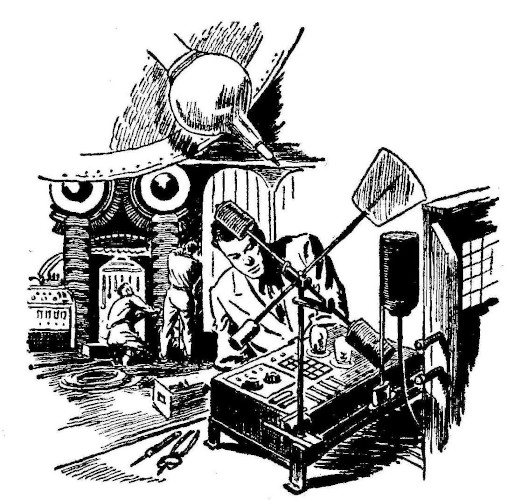
He was alone with his crew. They worked diligently, setting up the barrier-screen generators, and when they had them working to satisfaction, they tried variations.
The pilot worked upon their course day by day until it was corrected and stable; an orbit about a mythical point, the centripetal force of the outward-directed drive being in balance with the centrifugal force of their orbit. It made them a neat 1-G for stability, and did not cause them to cover astral units in seconds, or require continuous turnovers for deceleration and return, which would have been the case had no orbit been established.
Their work progressed. The neat, orderly arrangement of the scanning room became slightly haywire as they ran jury-rigged circuits in from the barrier-generators.
No petty quarreling marred their work. This was partly due to the training of the men at Patrol School, and partly due to Maynard's foresight in picking his crew. He had done a masterful job, for in this kind of job, the tedious nature of flight was amplified, and the lack of any variation in the day's duration, or of one day from the one past or the one coming next, made men rub each other the wrong way.
And part of it was due to the nature of the job, enigmatically. They were working on something entirely new. It was interesting to watch the results pile up, and to add to the diary of the experiment the day's observations and the opinions of the workers.
Then as the end came in sight, the inevitable irritation flared briefly as the technician tossed his chessboard aside with a snort and stamped to his quarters. It might have started a long chain of events if a real diversion had not presented itself, right in the technician's department.
Maynard heard the communicator snap on, and listened.
"Technician to Executive: Spacecraft approaching. Range extreme, about one point seven megs."
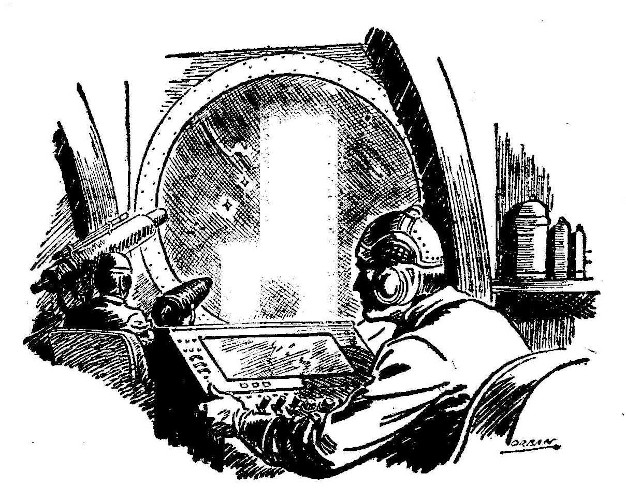
"One million, seven hundred miles," said Maynard aloud. "Technician: can you get a reading?"
"The cardex is chewing on the evidence, sir," came the reply.
"Let me know as soon as you get the answer, Stan."
"O.K. Here it is. It is the Loki, a private craft owned by the publisher, Kane. Want the vital statistics?"
"Forget the color of eyes, weight, and fighting trim," smiled Maynard. "What's his course and velocity?"
"Deceleration at about 4-Gs, course within ten thousand miles of us. Velocity less than a thousand miles per second."
"How soon can we match her speed?"
"Depends upon their willingness. Perhaps ten or twelve hours will do it," answered Stan. "Get your astrogator on it."
"Executive to astrogator: Have you been listening?"
"Astrogator. You bet, and Stan's wild. Make it fourteen hours."
"Executive to pilot: Contact astrogator and follow course. Stan, will you try to contact them? I think it's your job, since they're at extreme range. Communications, you try with the standard sets, but I will not have any tinkering with the set-up in an effort to get another mile of range out of it."
"This is Stan. I have them on a weakling signals, they're asking for you."
"Tell 'em I'm here and we'll see 'em later. Check their course and prepare to match it. Then tell 'em to keep silence. That's an official order. Follow?"
"Check."
Fourteen hours later, Thomas Kane came across the intervening space in a tender and shook Maynard by the hand.
"Kane! How are you?"
"Fine. And you?"
"The same. But how did you find us?"
"Did a little ferreting."
"Did you know this is restricted space?"
"Sure, but forget it. How's the experiment?"
"Excellent."
"Mind telling all?"
"No. We set up a barrier on the Asterite, here, and have been testing and investigating it for months, as you know."
"Have you licked the main bugaboo?"
"We'll never lick that one. The drive, being a type of radiation, will not pass the barrier and so will not drive us. We can not discover a range of radiation that passes outward at all, though there is some minute leakage. The latter is absolutely insufficient to do any good."
"Too bad."
"It is. But the barrier is a good thing."
"Oh, it'll serve in spite of its difficulties."
"We developed the reverse, too. In addition to the barrier, we have what we call a disperser. It is the reverse of the barrier in every way."
"That's interesting. You can drive through that one?"
"Yes, but that's strictly impractical for space maneuvers. You see, both barriers are tenuous with regard to material bodies. A torpedo will pass without knowing that a barrier is there. And no ship can hope to match acceleration with a torpedo, roaring along at a hundred Gs or better. The barrier will keep a ship from detection, but it is sudden death to the ship if its presence is known. AutoMacs will burn the ship to nothing, torpedoes will enter and blast. Even misses with the AutoMacs cause trouble because their energy goes into the barrier-sphere and remains, reflecting off of the insides of the sphere until absorbed by the ship. The trick in use is to speed up and stab with torpedoes, and then continue on your course undetected until a safe distance is covered.
"The disperser screen is opposite. It will protect against AutoMacs or any other energy. It is detectable in itself, since it reflects anything sent against it, and also passes any inside energy right out through the screen. A ship with one of those is bear-meat. The AutoMacs wouldn't be used at all, a torpedo will be shot out to blast it from the universe. No, the disperser is useless."
"Do torpedoes work on the barrier?"
"Not too well," said Maynard. "You see, their aiming and steering circuits are useless until a target is set. Since the sphere is nonradiating, the only way you can fire a torpedo into a sub-ship is to aim it well and drive it into the barrier-screen by sheer aim. Once inside the screen, however, it will track the target. It will bar against drive-interferers, too. But take my word for it, there is nothing good about the disperser."
"How about combining them?"
"We had that idea, too," laughed Maynard. "No dice."
"Why? Seems to me—?"
"When the barrier is equal to the disperser, they cancel, believe it or not. If the barrier is put inside of the disperser, the disperser can not form since the barrier also bars the radiation that sets up the disperser screen. It will also bar the idea of establishing two barriers, too, by the way. On the other hand, if the disperser is put inside of the barrier, they can be held. But—and this is a big but, Kane, energy enters the barrier, and energy emanates from the ship, and there is a stress set up in the volume between the two spheres that sets up a counter force that blows the generators right out of this universe."
"You seem to have seen the whole works," smiled Kane.
"You know, I can't even see the idea of carrying this disperser equipment on a detector to go up in case of attack with AutoMacs, even if it could be made to establish instantly. Just takes up good room—the generators, I mean."
"What's the generating time?"
"Seventy-three milliseconds is the best we've been able to clock. That's a close screen, and it takes considerable stability in the generators to hold it. The best barriers for distance and power establish in point one nine eight seconds. Anything beyond that would require too much holding power, anything closer requires more generator stability."
"How does instability affect the screen?"
"Won't hold up. It collapses, and the build-up begins from zero again. That would be dangerous."
"You've been a busy boy," smiled Kane. "Also a definite credit to us all."
"Thanks."
"And how do you intend to operate this thing in practice?" asked Kane. "Not attack, in defense. I mean?"
"We've got the thing hitched to the finders," Maynard punched a switch. "Now, for instance, if anything that radiates comes within detector range of us, the barrier goes on. You'll see that everything is tacked down. We've been trying it out with the tenders, and the first time we did it, we went free and everything floated around the place in no-gravity. We're now protected, and if your pilot should kick his drive, we'd go free." Maynard adjusted three dials. "Now," he said, "the spotter is set to neglect any radiation from the Loki. We can set up many such channels, compensating for every ship in a flight, and yet have the whole flight protected in case of intrusion by another ship."
"You've got everything all set, haven't you?"
"Just about. If we had torpedoes, we could declare a private war on Mars."
"Then you're about finished?"
"Just about. Want to come in with us, or will you go in the Loki?"
"I'll ride with you, if you do not mind."
"Not at all," smiled Guy. "Executive to Communications: Inform Loki that Kane will return with us, and to make for Terra immediately."
"Check."
"We'll lose him," grinned Guy. "We're all set for 5-G."
"He'll take it easy, at three. I don't mind."
"Executive to Pilot: Take course for Terra at five!"
"Check!"
The Asterite turned and left the Loki far behind, and the velocity began to build up for the return trip. An hour later, with the Asterite bettering a hundred miles per second, the second incident occurred. It came as a complete surprise, since they were running through a restricted space, and Maynard remarked that it looked more like a public thoroughfare.
The finder-alarm clanged stridently, and immediately the ship went free. Men clutched at the hand-rails, and as they settled down, the technician took the communicator and started to speak excitably: "Technician to crew: Hold your hats! We're about to be passed by the Orionad!"
"Orionad? Holy Pete!" exploded Maynard. "See that this confounded screen doesn't fail. If it dies, so do we!"
"Huh?" asked Kane.
"This restricted space was created for the Orionad to return through. The nature of the restriction is such that anyone of official nature will be warned, and no civil traffic will be cleared through here. I am here because I didn't think the Orionad was due to return yet, and you came because you probably left without clearance. Right?"
"Right."
"Well, the Orionad believes that anybody who is in the restricted space is an enemy; spying upon their course. The consequences are clear."
"I hope they hold that screen," said Kane. "But what about Jimmy? My pilot?"
Maynard groaned. "He's several thousand miles behind, and any attempts to save him would fail. The Orionad will recognize no incoming signals. Nothing we can do will save him!" Maynard groaned, and then he brightened briefly. "Stan!" he called. "What's the chances of the Orionad missing the Loki?"
"Not too bad," said the technician. "They'll be running with their finder at cruising range, and they'll just touch us. Loki is sliding sidewise and may be out of range."
"We hope. Well, keep it going, fellows. This may be dangerous."
Time passed slowly and ponderously, and the Orionad caught up and passed the Loki without seeing or detecting the publisher's ship. Of this, Maynard was certain, since the celestial globe would have flared briefly had any action been taken against the Loki.
Then as the Orionad passed the Asterite, Maynard said: "Chalk us up a win, Kane. Your crate is safe."
"You're certain?"
"I am. Loki is now beyond range of our detector, which was souped up and is running at overload range. Orionad's detectors would be running at cruising range, which I happen to know is one quarter meg—two hundred and fifty thousand miles, to you."
"I see. Loki is on the far side of us from the Orionad, and their distance is such that their cruising range on the detector is less than the distance to Loki?"
"Right. And give us another ten minutes, and Orionad will go beyond detection range from us. Cruising range, that is."
"Mark yourself up a credit for this one, too," smiled Kane. "If you were an enemy, you could surely score one on the super ship itself."
"Sure could," agreed Guy enthusiastically.
Stan Norman said: "Technician to Executive: May I enter this encounter in the log?"
"Go ahead," said Guy. "They'll never believe us, though."
"Wouldn't a definite statement of their course and velocity be evidence?"
"Nope. I happen to know it. It was part of the maneuver secret that I was kidnaped for, remember."
"They'd just accuse you of telling tall tales that couldn't be substantiated," agreed Kane. "The crew and myself would be considered biased witnesses. I'd sure like to cinch the argument, though."
"So would I," said Guy thoughtfully.
"Do you trust this dingbat of yours? The barrier, I mean."
"Naturally."
"Then couldn't we really do something about it?"
"I don't know what—unless we splashed them with a bucket of paint. We have a gallon of bright red, wire-impregnating varnish. Executive to Pilot, Astrogator, Technician, and Observer: Get the course of the Orionad to the last millimeter. Both the intrinsic course and the course with respect to the Asterite. Then plot a free flight across their path to intercept within a thousand feet at thirty degrees angle. You know the standard attack problem as we have designed it; this is an applied problem, fellows. We're going to label the Orionad! And when they land, they're going to bear the Asterite's trademark, and they'll not know it until we make Terra. Like?"
"We're on it now," said Stan.
"And working in nine decimals," added Astrogator Cummins.
Technician Norman stretched his back, and started to gather his tools. "So far," he told Maynard, "every instrument we need has been checked and corrected to the last micron. Turretman Hastings and Machinist Trenton have converted one of the mounts to a spring-loaded gadget to propel a gallon-sized cannister of plastic material. Adkins has just cemented such a cylinder together and filled it with the wire gluck. I hope we hit the main personnel lock; it'll stay glucky until they land, and that wire-impregnating googoo ranks high among the things I wouldn't care to bathe in."
"It ranks top with me," said Maynard.
"To me, it is outranked only by chewing gum and rubber cement. But anyway, we're ready, all of us."
"That correct?" asked Maynard of the crew.
A series of "Check" shouts came in ragged confusion.
"O.K. Start going!"
With the instruments under personal supervision, the Asterite accelerated in a wide circle, and then corrected the side-vector component of her course.
Then for an hour solid, the Asterite accelerated on a die-true course. The components of the intersection were complex because the Orionad was in deceleration all the time, while the Asterite was in acceleration, and would be picking up speed until the barrier established; then the little destroyer would coast free, crossing the Orionad's course at the precise instant that the super ship came to the course of the free-flying Asterite.
The last driving moments of the Asterite's maneuver passed. The barrier went on, and the tiny ship went free. Time passed, and eventually the Orionad, long beyond detector range, came into the scope of the Asterite's souped-up finder.
Furious and extensive checking on the part of the crew resulted in the information that everything was going according to plan.
More time passed, and now within sight, the two ships were converging. They became tense, a single moment of failure would be death for all. But the barrier held, as they expected it to, and with lightning velocity, the two ships crossed at thirty degrees angle.
"Fire!" called the technician.
"Stick to your meters," drawled Turretman Hastings. "This is a job for an eyepiece and fingertip man. A man, may I say, with eyes in his fingertips. A man, may I add ... Ughh. There she goes, fellers!... who is capable of doing things based upon the excellency of his coordination."
"What a line of baloney," snorted Norman. "Did he follow through on that malarkey?"
"And, may I add," drawled Hastings, "a man who never claims ability beyond his capability? Who never claims that which he is unable to produce. The Orionad is now bearing a great, ugly, irregular circle of bright red, gooey paint."
"Are they aware?"
"Apparently not," said Technician Norman. "Also, the projectile we tossed at them is nondetectable and nonradiating, and was in the separation-space too briefly for observation. Another thing, we hit 'em in a blind spot."
"Blind spot?" asked Kane. "I didn't know she had any."
"She hasn't. What I meant was that we hit 'em in a bald spot. They'll not see the mess until they land. Pilot, how're we doing?"
"Fine. We're coasting away at a great rate."
"Well, get this barrier down as soon as you get out of range. Wait until you are out of operating range, but don't worry about extreme range unless you think they smell a crate full of mice."
"Right-o."
"You know, Kane, that was fun, sort of. But I hate to think of what they will say back home. I'm liable to get busted right down to a junior aide again."
"They can't break you for that kind of demonstration," said Kane.
"Yes they can. I'm still at the mercy of my superiors."
Kane smiled. "No, you're not. I forgot to tell you—or you didn't let me get to the point of my coming. But, Guy Maynard, since the successful establishment of the Plutonian shield, you are now a sector commander. That gives you—"
"I'm what?" asked Maynard.
"A sector commander. Here, if you don't believe me," and Kane handed Guy a tiny box. Guy opened it, and found lapel-insignia; the circling comet of the sector commander. In Kane's other hand was an envelope stamped "Official" which contained official notice of his advance in rank.
"That puts you in the upper bracket," said Kane. "You are now on your own, Guy. Any demonstrations you may give will be viewed officially, and this is no longer a prank, but a self-assertion; a very definite evidence of your ability to accomplish the difficult."
The barrier dropped, and the celestial globe traced the last indication of the receding Orionad to the surface of the clear, glassite sphere.
Maynard touched his hat in salute to the Orionad's last glimmer and said: "Hi!"
IX.
The Asterite beat the Orionad to Terra by a few hours, and in sufficient time for the report of Maynard's trip to be reviewed by the Bureau of Ordnance. When they came to the incident of the painting, they laughed first, and then called Malcolm Greggor to ascertain the moment of the Orionad's landing. Armed with the information they went to the big landing area at Sahara Base, and waited for the big ship to touch.
Greggor was there; he arrived almost as they did.
"What's the meaning of this?" he stormed.
Patrol Marshal Mantley grinned at the irate man and answered: "Your erstwhile employee has demonstrated his sub-screen to excellent effect, Greggor. He hung a gallon of red paint on the Orionad without their notice."
"This is preposterous!" exploded Greggor.
"Not at all," said Mantley. "Sector Commander Maynard was merely bringing home the effectiveness of his own invention. If he can do that to the Orionad, no Martie can hope to best us. You must admit that he has something good."
"That I admit. But to play such a prank—"
"No prank, Greggor. This was a very convincing demonstration. How can you possibly classify such an epoch-making act as a prank? It is deplorable that your pride and joy should be thus decorated by a mere ... he was but Senior Executive Maynard at the time ... destroyer, a spacecraft one tenth the tonnage of the Orionad. But I insist that it does not detract from the pride of the Orionad to have been bested by such a weapon."
"I feel as though I've been made a fool of."
"Ridiculous! It is not an admission of defeat to acknowledge a minor defeat at the hands of a man who is responsible for making Pluto inhabitable. After all, Greggor, Maynard is one in fifty billion."
Greggor smiled wryly. "When you put it that way, I must admit," he said. "Any man who can bring the means of warming a planet to human climates certainly must be capable of decorating the Orionad. Maybe I should grow angry again; why should such a genius stoop to tamper with my ship?"
"It was available and the best thing we have to boot."
Maynard interrupted. "Surely you would not believe me capable of bringing ridicule upon you, Marshal Greggor. It was but a splendid opportunity to demonstrate what could have been done to an enemy with a torpedo. What if I had been a Martian?"
"I agree," said Greggor. Then he laughed uproariously. "We'll pink Patrol Marshal Inkland with the idea," he said. "Tell him that his ship was destroyed in space by a real destroyer; that he must have been asleep. Roast him good, and see what happens. Here she comes—and Maynard, that splotch of red paint sticks out like a miniature sun. What a mal-beautiful job of decoration."
The Orionad landed, and Inkland came across the sand toward the little group as soon as he saw who it was. He shook hands all around and smiled until Greggor told him of the decoration.
Inkland turned red and blustered. "Nothing was within detector range of me!" he insisted.
"That slab of red paint says you're wrong," said Greggor sternly.
Inkland inspected the red paint from where they stood and was forced to admit that something had been close enough to do it while in space. "Who did that?" he stormed.
Mantley indicated Maynard, and Inkland strode over to Guy with murder in his eye. "You insolent young puppy—I'll see that you lose your rank, senior executive." He whirled to the assembly and said: "No matter what was done, the fact that a mere senior executive did it is good enough to prove that it was a prank—"
"Just a moment," snapped Maynard. "First, I resent being called a puppy. I dislike being called insolent. And third, I defy your intent to deprive me of my rank!"
"Why you—"
"For your troubles, Patrol Marshal Inkland, I shall consider my success complete upon the day that I command the Orionad myself!"
"Ridiculous."
"Inkland," said Mantley softly, "I would speak more even. You are at fault, and the fact that Sector Commander Maynard has decorated your ship in a complex space maneuver of his own device should bring praise from you instead of hatred."
"Sector Commander?" asked Inkland.
"His insignia has not been properly installed," said Space Marshal Greggor with a fatherly smile. "But his rank has. And if young Guy Maynard puts his aim at commanding the Orionad, I'm beginning to believe that I would start looking for another job, if I were you."
Inkland turned upon his heel and left, with no further word.
The group of high-ranking officers followed him at length, leaving Maynard to watch the mighty Orionad being serviced and unloaded. He stood there for some time, relaxing and enjoying the fresh air and watching the operations. He found a comfortable spot, and seated himself lazily.
He did not sleep, though he did drowse a bit, and a sparse circle of cigarette butts began to surround him. He did not care; his last sojourn into space had made him appreciative of the comforts of just being on Earth where he could watch the sky and the ground meeting at the horizon.
He was not molested; though many people came to see the monster Orionad, none bothered him until the day wore into late afternoon. His first visitor was Laura Greggor.
"Guy," she said. Her voice was neither sharp nor inviting, but rather a flat tone of greeting.
Guy leaped to his feet and reached for her hands. "Laura!" he breathed. "It's good to see you!"
"I thank you for that," she said coldly.
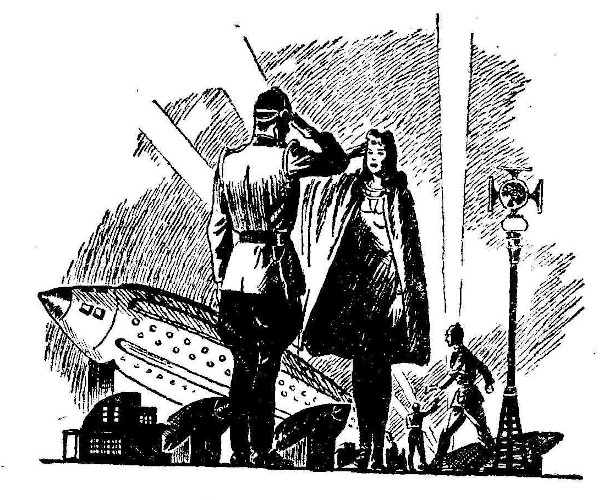
"Why," he asked her, "what's the matter?"
"Guy, before I go any further, I want to know something. Did you, or did you not decorate father's ship?"
"Why," he answered proudly, "I most certainly did."
"I didn't believe it of you," she said sharply.
"There was nothing wrong with it," he said. "It was the best thing that happened to me."
"You believe that?" asked Laura.
"I certainly do. After all, it proved the worth of my invention. And," he added eagerly, "it gave me another set of insignia to have installed."
"If the worth of your invention is more interesting to you than the interest of my father's office," said Laura sharply, "your latest rise in power—made by using father's finest ship as a stepping stone—is of little interest to me."
"But Laura. I'm a sector commander now. And you may have my senior executive's stars."
"I have a fair collection," said Laura coldly. "You may bring me your patrol marshal's nebula when you're raised to sector marshal. Good day!"
She stamped off angrily, and Maynard searched his mind for the answer to the question, and gave it up as one of the unanswerable mysteries of life. If Malcolm Greggor could look upon the incident without rancor, why should she turn upon him? Any reasoning he did made no sense.
And as he stood there, footsteps made him aware of another visitor. He turned to see Joan Forbes.
"Hello," she said brightly. "I was on my way to the lunchroom and passed by to see the Big Fellow." She indicated the Orionad now being illuminated by mighty floodlights in the dusk. "I found you instead."
"Hi," he said to her. "What's new?"
"Nothing in my life," she said with a broad smile. Her eye caught the boxed insignia in Guy's clenched hand. "I see that something is new in yours. May I salute you, Sector Commander?"
Guy looked at her with a half-smile as she stepped back and cast him a womanly salute. "Congratulations," she said, offering her hand.
Guy looked first at her face, and then at her outstretched hand. Instead of taking it in his for a handshake in friendship, which was the manner of its offering, Guy placed the opened box in the outstretched fingers.
Joan blinked, and looked down at the box in surprise for a moment. Then she brightened.
She stepped forward and removed the rayed stars from Guy's lapel and replaced them with the circularly tailed comets. She stepped back, saluted him silently, and then came forward and kissed him on the lips. Her caress was affectionate, but brief.
"You're properly installed, commander," she told him. "But if I don't hurry, I'll be un-installed by my boss. I've got to run along. Keep rising, Guy!"
And with that she was gone.
Guy looked at the empty box, and then at the comets on his lapels.
And from them, across to the Orionad.
And a challenge arose to confront him. He would be sector marshal one day, and whether he took his patrol marshal's insignia to Laura Greggor depended only upon her. And he would also command the Orionad.
He clenched his fist upon the empty box, crushing it. His question was not: Would he command the Orionad? It was: How long would it take?
It took five years. Five long, toilsome years.
But five years of constantly increasing, constantly expanding, constantly improving. He never forgot the day of the Orionad's landing in all that five years, though there was evidence that Laura Greggor had been reprimanded by Malcolm Greggor for her actions. But Maynard remembered, and it was Joan Forbes that pinned the silver nebula on his lapels—in public as befitted a Patrol Marshal—just before he stepped aboard the Orionad to take his first major command.
He hoped that Laura Greggor remembered.
Then the Orionad sped into the sky above Sahara Base on the way to Pluto.
Guy Maynard was on his way to the top. Ertene was a dim remembrance by now, and though he could almost pick out the spot of the nomad planet's present position, it occurred to him only at odd intervals. Ertene was gone. But the strength of Ertene's knowledge was serving both him and Terra, and her brief visit was not wasted.
Maynard lost himself in reverie for a half hour, relaxing in the luxury of the master's office aboard the mighty Orionad. Then Guy's active mind asserted itself, and he called the chief technician for a conference.
Senior Executive Martin Carrington entered the office and stood at attention, and Guy recalled briefly that on his first command, he had been of the same rank as his chief technician now. Then he asked Carrington to be seated.
"Carrington, I've been worrying."
"Worrying, sir?"
"Suppose we are attacked by a sub-ship? How may we detect him?"
"You are supposing that the Martians gain the secret."
"I fear they will, some day. We haven't all the brains, you know."
"But a Martie, sir?"
"They may capture one of ours by a fluke. Then we'd all be bear-meat."
"Hardly possible, sir."
"Then accept it as hypothetical, Carrington. Take off from there and answer my question."
"That I cannot do, sir. Frankly, I do not know."
"Then listen. I have an idea; I want you to pass on its value."
"I shall try, sir."
"Carrington, is it possible to establish a celestial globe that is capable of giving a negative action? No, wait, I'll explain. Our present celestial globe is positive; it operates by three-dimensional fluorescence in the sphere, glowing when a positive radiation comes in from a spaceship. What I want is a negative indication: one that will glow in any location from which there comes absolutely zero radiation. Is that possible?"
"Hm-m-m," mused Carrington. "Our present level of detection is based upon the maximum level of celestial radiation, which is fairly constant in all directions save Solward. Your supposed sphere would operate on the celestial radiation—with the normal globe the entire sphere would glow—and be dark everywhere except in a place where all radiation were absorbed. It would be devilishly ticklish, sir."
"You follow my reasoning?"
"Oh certainly. Your idea is to prepare a sphere that glows with no signal. That can be done with a local signal, which is cut when no-radiation enters. Hard to say in words, isn't it?"