Front matter
Reading edition
Cover
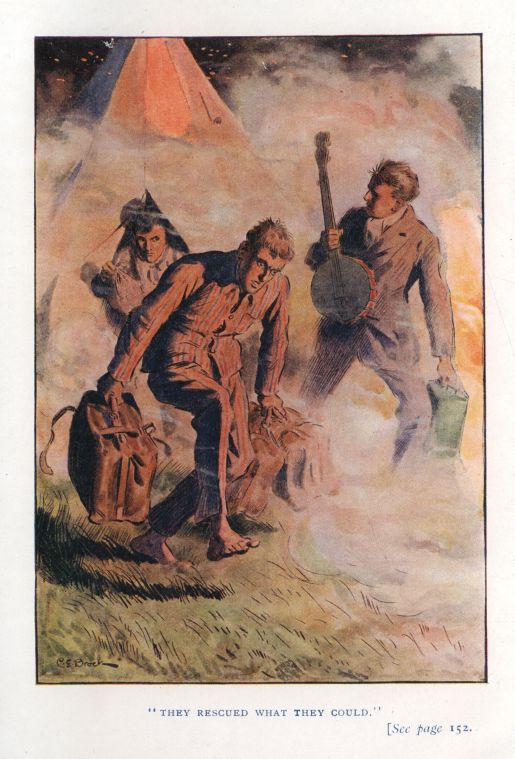
"THEY RESCUED WHAT THEY COULD." See page 152.
NO MAN'S ISLAND
BY
HERBERT STRANG
ILLUSTRATED BY C. E. BROCK
HUMPHREY MILFORD OXFORD UNIVERSITY PRESS LONDON, EDINBURGH, GLASGOW TORONTO, MELBOURNE, CAPE TOWN, BOMBAY 1921
PRINTED 1921 IN GREAT BRITAIN BY R. CLAY AND SONS, LTD., PARIS GARDEN, STAMFORD STREET, S.E.1, AND BUNGAY, SUFFOLK.
HERBERT STRANG
COMPLETE LIST OF STORIES
ADVENTURES OF DICK TREVANION, THE ADVENTURES OF HARRY ROCHESTER, THE A GENTLEMAN AT ARMS A HERO OF LIEGE AIR PATROL, THE AIR SCOUT, THE BARCLAY OF THE GUIDES BLUE RAIDER, THE BOYS OF THE LIGHT BRIGADE BRIGHT IDEAS BROWN OF MOUKDEN BURTON OF THE FLYING CORPS CARRY ON CRUISE OF THE GYRO-CAR, THE FIGHTING WITH FRENCH FLYING BOAT, THE FRANK FORESTER HUMPHREY BOLD JACK HARDY KING OF THE AIR KOBO LONG TRAIL, THE LORD OF THE SEAS MOTOR SCOUT, THE NO MAN'S ISLAND OLD MAN OF THE MOUNTAIN, THE ONE OF CLIVE'S HEROES PALM TREE ISLAND ROB THE RANGER ROUND THE WORLD IN SEVEN DAYS SAMBA SETTLERS AND SCOUTS SULTAN JIM SWIFT AND SURE THROUGH THE ENEMY'S LINES TOM BURNABY TOM WILLOUGHBY'S SCOUTS WITH DRAKE ON THE SPANISH MAIN WITH HAIG ON THE SOMME
CONTENTS
CHAP.
NO MAN'S ISLAND
BELOW THE BELT
PRATTLE
THE FACE IN THE THICKET
THE GAME BEGINS
A SCRAP OF PAPER
TIN-TACKS
PIN-PRICKS
REPRISALS
A SOFT ANSWER
INFORMATION RECEIVED
QUEER FISH
FIRE!
A CIRCULAR TOUR
UNDERGROUND
WATERMARKS
THE TOPMOST ROOM
ZERO
THE PRISONER
THE PACE QUICKENS
TRAPPED
A PARLEY
"VI ET ARMIS"
A LEVY EN MASSE
SQUARING ACCOUNTS
EPILOGUE
LIST OF ILLUSTRATIONS
"THEY RESCUED WHAT THEY COULD" (see p. 152) . . . Frontispiece in Colour
"'CLEAR UP ALL THIS DISGUSTING LITTER'"
"THE FOREIGNER CHARGED UPON HIM LIKE AN INFURIATED BULL"
"THE OTHER WAS DIVING INTO THE STREAM"
"'GOT A PUNCTURE, OLD MAN?'"
"THEY SHINNED UP A SMALL TREE"
"HALF A MINUTE LATER THE CAR RAN PAST"
"PRATT THREW THE INTRUDER HEAVILY TO THE GROUND"
"'ZE TOWER? NO, IT IS RUIN, FALL TO PIECES'"
"THEY LIFTED THE BUNDLES OF GEAR, AND CARRIED THEM INTO THE HUT"
"'THE BOTTOM'S ONLY ABOUT FIVE FEET DEEP'"
"THEY SAW A SHORT, STOUT MAN DRAWING SHEETS OF PAPER FROM THE OPENED PACKAGE"
"BETWEEN THEM THE TWO BOYS ASSISTED THE MOTHER"
"HE STRODE UP AND DOWN, HIS LARGE BONY HANDS CLASPED BEHIND HIM"
"HE REMAINED FOR AN INSTANT IN HIS BENT POSITION, MOTIONLESS"
"RUSH SWIFTLY ROPED HIS ARMS AND LEGS TOGETHER"
"HE STAGGERED BACKWARD, AND THE PISTOL WAS KNOCKED FROM HIS HAND"
"'SQUEEZE INTO THE BOAT'"
"THE FARMER WAS UPPERMOST"
CHAPTER I
NO MAN'S ISLAND
One hot August afternoon, a motor-boat, with a little dinghy in tow, was thrashing its way up a narrow, winding river in Southern Wessex. The stream, swollen by the drainage of overnight rain from the high moors that loomed in the hazy blue distance, was running riotously, casting buffets of spray across the bows of the little craft, and tossing like a cork the dinghy astern. On either side a dense entanglement of shrubs, bushes, and saplings overhung the water's edge, forming a sort of rampart or outwork for the taller trees behind.
The occupants of the boat were three. Amidships, its owner, Phil Warrender, was dividing his attention between the engine and the tiller. Warrender was tall, lithe, swarthy, with crisp black hair which seemed to lift his cap as an irksome incubus. A little abaft of him sat Jack Armstrong, bent forward over an Ordnance map: he had the lean, tight-skinned features, spare frame, and hard muscles of the athlete, and his hay-coloured hair was cropped as close as a prize-fighter's. In the bows, on the scrap of deck, Percy Pratt, facing the others, squatted cross-legged like an Oriental cobbler, and dreamily twanged a banjo. He was shorter and of stouter build than his companions, with a round, chubby face and brown curly hair clustering close to his poll, and caressing the edge of his cap like the tendrils of a creeper. All three boys were in their eighteenth year, and wore the flannels, caps, and blazers of their school Eleven.
"We ought to be nearing this island," remarked Armstrong, looking up from his map. "I say, Pratt, you've been here before: can't you remember something about it?"
Pratt thrummed his strings, smiled sweetly, and sang, in the head notes of a light tenor--
"The roses have made me remember
All that I tried to forget;
The past with its pain comes back again,
Filling my heart with----
Sorry, old man, I've pitched it a bit too high. Lend me your ears while I modulate from G to E flat."
"Keep your Percy's Reliques for serenading the moon. You were here as a kid; aren't we nearly there?"
"'The past with its pain'--fact! It was pain. My old uncle could beat any beak at licking. He made a very pretty criss-cross pattern on me that day--all for pinching a peach! Frightful temper he had. My people said it was due to sunstroke on his travels. Jolly lot of good being a famous traveller, if it makes you a beast. He was more ratty every time he came home. I don't wonder my pater had a royal row with him, and hasn't been near the place since. Rough luck, to have to desert your ancestral dust-heap.
"I try, try to forget you,
But I only love you more."
"Isn't that the island? Away there to starboard?" Warrender interposed. "But I thought you said we might camp there, my Percy?"
"True, sober Philip. We picnicked there in the days of yore."
"Well, we'd have to do a week's clearing before we camped there now. Look at it!"
Pratt swung lazily round on his elbow, and gazed over the starboard quarter towards the left bank. The river was parted by what was evidently an island. The channel between it and the left bank was very narrow, and almost impassable by reason of the low, overhanging branches, which formed a tunnel of foliage. Warrender steered across the broader channel towards the right bank, all three scanning the island intently as they coasted along.
"Shows how old Tempus fugit," said Pratt. "In the dim and distant ages when I was a kid that island was a lawn; now it's a wilderness. Think what your beardless cheeks will be like in ten years' time, Armstrong. See what Nature will do unless you use the razor. The place seems quite changed somehow. But I'd never have believed trees could grow so fast. As we're not dicky birds, we certainly can't pitch our camp there. Drive on, old shover."
The island was, indeed, to all appearances, more densely wooded than the river banks. By the map scale it was about a third of a mile long, and at its widest part fully half as broad. Nowhere along its whole extent did they see a spot suitable for camping.
They ran past the island. The stream narrowed; the wooded character of the mainland banks was unchanged.
"We might as well be on the Congo," growled Armstrong. "Are you sure your uncle didn't bring back a bit of Africa in his carpet bag, Pratt, and plank it down here?"
"Let the great big world keep turning,
Never mind, if I've got you,"
hummed Pratt. "Turn your eyes three points a-starboard, Armstrong, and you'll see, peeping at you through the sylvan groves, the gables of my ancestors' eligible and beautifully situated riverside residence. It's pretty nearly a quarter-mile from the river, but that's a detail."
Warrender slowed down so that they might get a better view of the stately old house of which they caught glimpses through gaps in the woodland.
"You behold that ruined ivy-clad tower about a cable's length away from it," Pratt went on. "Tradition saith that one of my ancestors incarcerated there a foeman unworthy of his steel, and forgot to feed him."
"Well, I want my tea," said Armstrong. "We had next to no lunch, and I can't live on memories."
A sharp crack cut the air.
"Some one's shooting in the woods ahead," said Warrender. "Perhaps we'll catch sight of them, and get a direction."
"Why not make a polite inquiry of that woodland faun or satyr smoking a clay pipe yonder?" suggested Pratt, pointing with his banjo to the left bank.
On a tree-stump near the water's edge sat a thick-set man, square-faced, beetle-browed, blear-eyed, a cloth cap pushed back on his close-cropped bullet head, a red cloth tie knotted about his neck. He wore a rusty, much-rubbed velveteen jacket, corduroy breeches, and a pair of shabby leggings. Warrender slowed down until the boat just held its own against the current, and called--"Hi! can you tell us of a clear space where we can camp?"
The man looked suspiciously from one to another, chewing the stem of his pipe.
"Can't," said he, surlily.
"Surely there's a stretch of turf somewhere?" Warrender persisted.
"Bain't. Not hereabouts. Woods, from here to village up along."
"Nothing back on the island?"
The man half closed his eyes, and again suspicion lurked in the glance he gave the speaker.
"No. No Man's Island be nought but furze and thicket. Nothing hereabouts. Better go on and doss at the Ferry Inn."
Then, however, he leered, barely recovering his pipe as it slipped from between his discoloured teeth. "Ay, I were forgetting," he said with a chuckle. "There be a patch farther up. Ay, that might suit 'ee. A party camped there last week. Ay, try en."
He chuckled again. Warrender opened the throttle, and when the boat had run a few yards up a guffaw, quickly stifled, sounded astern.
"Pleasant fellow," remarked Armstrong.
"When you are near, the dullest day seems bright;
Doubts disappear, my load of care grows light,"
warbled Pratt. "But he didn't say which bank it's on."
"We can't miss it," said Warrender,--"unless he was pulling our leg."
Within three minutes, however, they found that the man had not misled them. There was disclosed, on the right bank, a considerable stretch of smooth green sward, affording ample space for their bell-tent and the simple impedimenta of their camp. Warrender ran the boat in, and hitched it to a sapling; then the three began to transfer their equipment to the shore. Besides their tent, they had a Primus stove, a kettle, a couple of saucepans, pots, cups and plates of enamel, pewter forks and, stainless knives, cases of provisions, three sleeping-bags, three folding stools, and other oddments.
While Warrender and Armstrong were stretching and pegging out the tent, Pratt started the stove, filled the kettle from the river, and assembled such utensils as they needed for their tea. These operations were punctuated by renewed sounds of shooting, which were drawing nearer through the woods that skirted the clearing.
"I say, you chaps," cried Pratt, "I wonder if I talked nicely, if I could coax out of them something gamey for supper to-night?"
"Wouldn't you like to sing for your supper, like little Tommy Tucker?" said Armstrong.
"Excellent idea! As you know, I've got a select and extensive repertoire, and--hallo! Here's my little dog Bingo."
A retriever came trotting out of the wood, stopped in the middle of the clearing, and gazed for a moment inquiringly at the tent, just erected; then turned tail and trotted back.
"A very gentlemanly dog," said Pratt. "No loud discordant bark, no inquisitive snuffling; evidence of good breeding and a kind master."
"Hi, there!" called a loud voice. "What are you doing on my land? Who the deuce gave you permission to camp?"
A stout, florid, white-whiskered gentleman of some sixty years, wearing a loose shooting costume, and carrying a shot-gun under his arm, hurried across the clearing, the retriever at his heels.
"I'm sorry, sir," said Warrender, politely. "We've come up the river, and this is the first suitable place we've found. If we had known----"
"Known!" interrupted the stranger. "You knew it wasn't common land--public property. If you didn't know, any one about here would have told you."
"Just so, sir. But we understood that a party had camped here a short while ago, and----"
"You understood, boy? And where did you get your information?"
"From a gamekeeper sort of man a little below on the other bank. He----"
"That'll do," snapped the sportsman. "Take down that tent. Clear up all this disgusting litter, and be off. The place reeks with paraffin. Look alive, now."
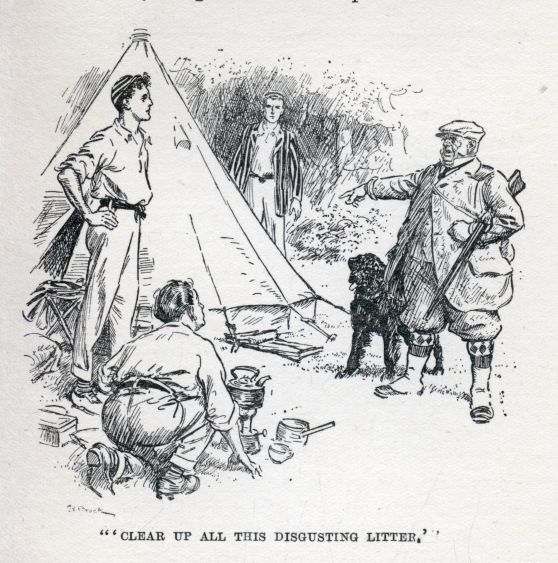
"'CLEAR UP ALL THIS DISGUSTING LITTER.'"
In silence Warrender and Armstrong began to loosen the tent guys, while Pratt put out the stove and started to carry the properties down to the boat. He alone of the three showed no sign of feeling; his friends sometimes said that he was perennially happy because he was fat, not, as he himself explained, because he had music in his soul. Warrender's mouth had hardened, his face grown pale--sure indications of wrath. Armstrong, on the contrary, had flushed over the cheek-bones, and expended his anger in muscular energy, heaving unaided the tent to his back, and carrying it, the pole, guys, and pegs, with the ease of a coal-porter. The landowner stood sternly on guard until the place was cleared.
The boat moved off.
"Dashed old curmudgeon!" growled Armstrong.
"He and my uncle Ambrose would make a pretty pair," remarked Pratt. "I'd give anything to hear a slanging match between 'em. Anything but this," he added, taking up his banjo.
"I had a little dog,
And his name was Bingo.
His master's name ought to be 'Stingo!' Eh, what?"
"It happens to be Crawshay," said Warrender, pointing to a tree. Upon it was nailed a board, facing upstream, and bearing the half-obliterated legend, "Trespassers will be Prosecuted." Below this, however, in fresh paint, were the words, "Camping Prohibited.--D. CRAWSHAY."
"Precisely; D. Crawshay," said Armstrong.
CHAPTER II
BELOW THE BELT
Something less than a mile up the river they came upon an old-fashioned gabled cottage of red brick, standing back a few yards from the left bank. The walls were half-covered with Virginia creeper; a purple clematis climbed over the porch and round a sign-board bearing the words, "Ferry Inn." Beyond it, on rising ground some little distance away, glowed the red-tiled roofs of a straggling village. A ferry boat, or rather punt, lay alongside of a narrow landing-stage.
The lads tied the boat to a post, and stepped on to the planking. At the closed door of the inn, standing with legs wide apart, was a little, round man whose jolly, rubicund, clean-shaven face and twinkling eyes bespoke good humour and a contented soul. He was bare-headed, in shirt-sleeves, and wore an apron. His brown, straight hair was obviously a wig. In front of him stood a group of villagers.
"'Tis past opening time, I tell 'ee," one of them was saying. "I can tell by the feel of my thropple."
"'Twould be always opening time if you trusted to that, Mick," said the landlord, with a laugh. "I go by my watch." He pulled out with some difficulty from the tight band of his apron a large silver timepiece. "There you are; three minutes to the hour."
"Well, I reckon you be three minutes slow, and so you could swear to if so be----"
A slight jerk of the landlord's head caused the rustic to look along the road to the right. Strolling towards the inn was the village policeman.
"He's had me fined once, and I didn't deserve it," the landlord remarked. "And there's another who'd like to catch me tripping."
His eyes travelled beyond the policeman, and rested on a thin, loose-jointed man with a stubbly fair moustache and a close-cut beard, who was hurrying to catch up with the constable.
"Ay, Sammy Blevins do have a nature for such," said another of the rustics. "'Tis my belief he'll be caught tripping himself one o' these days."
"Ay, and Constable Hardstone too," said the first. "Birds of a feather. They be thick as thieves, they two, and no friends o' yours, Joe. Well, I bain't the man to glory in a friend's tribulation, and so you may keep your door shut till three minutes past."
"Say, when is this blamed door opening?"
The loud, hoarse voice caused a general turning of heads. From round the corner of the inn sauntered, somewhat unsteadily, his hands in his pockets, a big burly fellow whose red waistcoat, tight leather breeches, and long gaiters proclaimed some connection with horseflesh. His accent was nasal, but there was an undefinable something in his pronunciation that suggested a European rather than an American origin. A long, fair moustache drooped round the corners of a wide, straight mouth; his clean-shaven cheeks were thin and hard; his pale-blue eyes heavy-lidded and watery. The rustics appeared to fall back a little as he approached. He leant one shoulder against a post of the porch, and scowled at the landlord, attitude and gesture indicating that, so far from needing refreshment, he had anticipated the opening of the door.
"All in good time, Mr. Jensen," said the landlord, placably. "Law's law, you know."
"Law!" scoffed the man. "I'm sober. I want a lemon-squash. See, if you don't open that door---- Ah! I guess you know me."
The landlord, consulting his watch, had turned, and now threw open the door leading into the bar. The foreigner entered behind him, and was followed by the villagers one by one. A pleasant-faced, motherly woman came out into the porch, and looked inquiringly at the three lads. They walked up from the landing-stage, where they had lingered watching the scene.
"Can we have some tea?" asked Warrender.
"Ay sure," replied the woman. "They told me as three young gemmen had come up along in boat, and I says to myself 'tis tea, as like as not. Sit 'ee down at thikky table, and I'll bring it out to 'ee."
"We're pretty hungry," said Armstrong. "What can you give us?"
"Why, there 'tis--I've nothing but eggs and bacon."
"Glorious!" said Pratt. "Two eggs apiece, and bacon to match."
"Ay, I know what young gemmen's appetite be," said Mrs. Rogers, smiling as she bustled away.
They sat down at a table placed outside the window. Within they saw Rogers, the landlord, energetically pulling ale for his customers. He had laid aside his snuff-coloured wig, revealing a scalp perfectly bald.
While they were awaiting their meal, a girl, dressed in white, riding a bicycle, came along the road on the far side of the river, and, dismounting at the landing-stage, rang her bell continuously as a summons to the ferryman. An old weather-beaten man emerged from the back premises of the inn, touched his hat, hobbled down to his boat, and slowly poled it across. The girl wheeled her bicycle on to it, chatted to the old man while he recrossed the river, paid him with a silver coin and smiling thanks, and, having remounted, sped on towards the village.
"Why didn't I bring up my banjo?" said Pratt, dolefully. "Of course, I can sing without accompaniment.
"There's no sunbeam as bright as your smile,
There's no gold like the sheen of your hair----
but you do want the one-two-tum, one-two-tum to get the full effect, don't you, eh?"
"You sentimental owl!" exclaimed Armstrong, laughing. "Here comes our tea."
They had finished their meal, and were leaning back comfortably in their chairs, when the drone of talk within the inn was suddenly broken by voices raised in altercation. The clamour subsided for a moment under the landlord's protest, but burst forth again. There was a noise of scuffling, then two men appeared in the doorway, struggling together in the first aimless clinches of a fight. They stumbled over the step; behind them came the villagers in a group, some of them making half-hearted attempts by word and act to separate the combatants. These, reaching the open, shook off restraint, swung their arms as if to clear a space, and, after a preliminary feint or two, rushed upon each other.
Warrender and his friends got up; were there ever schoolboys, even sixth-formers and prefects, who were not interested in a fight? The antagonists were not unequally matched. Height and weight were on the side of the foreigner, but his opponent, apparently a young farmer, though slighter in build, had clear eyes and a healthy skin, contrasting with the other's well-marked signs of habitual excess.
The rustics formed up on one side, looking on stolidly. The three lads moved round until they faced the inn door. On the step stood the landlord with arms akimbo. His wife came behind him, slapped his wig on to his head, and retreated.
For a minute or two the combatants, displaying more energy than science, employed their arms like erratic piston-rods, hitting the air more often than each other's body. Armstrong's lip curled with amusement as he watched them. Then they appeared to realise that they had started too precipitately, and drew apart to throw off their coats and recover their wind.
"What's the quarrel?" asked Warrender, in the brief interval, of the nearest bystander.
"Furriner chap he said as the Germans be better fighters than us Englishmen, and that riled Henery Drew, he having the military medal and all. You can see the ribbon on his coat."
Stripped to their shirts, the combatants faced each other. They sparred warily for a moment, then the farmer darted forward on his toes, landed a blow on the foreigner's nose, between the eyes, and, springing back out of reach, just escaped his opponent's counter.
"One for his jib!" murmured Armstrong.
The blow, and the subdued applause of the rustic onlookers, enraged the foreigner. Swinging his bulk forward he bore down on the slighter Englishman, appeared to envelop him, and for a few seconds the two men seemed to be a tangle of whirling arms. Suddenly Armstrong sprang towards them, shouting, "Foul blow!" At the same moment the farmer reeled, and the foreigner, following up his advantage, dealt him a furious body-blow that dropped him flat as a turbot. Angry cries broke from the crowd, but, before the slower-witted rustics could act, Armstrong dashed between Jensen and the prostrate man.
"You hound!" he cried. "You'll deal with me now."
One arm was already out of its sleeve, but before he could fling off his blazer the foreigner charged upon him like an infuriated bull. Armstrong sidestepped, threw his blazer on the ground, and stood firmly, ready to meet the next onrush.
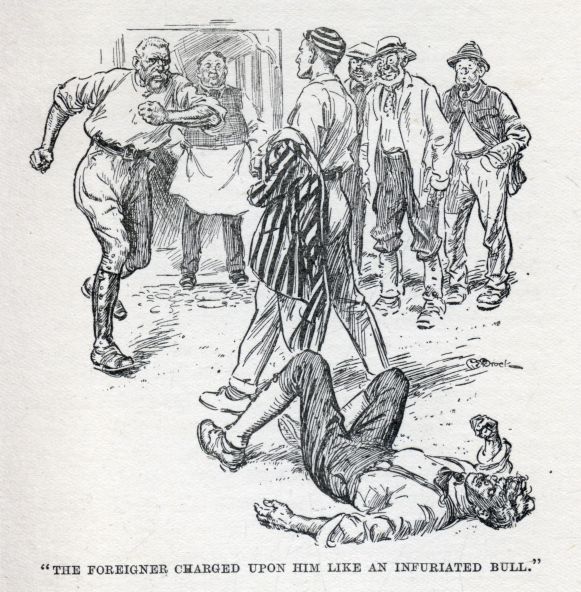
"THE FOREIGNER CHARGED UPON HIM LIKE AN INFURIATED BULL."
The big man topped him by a couple of inches, and bore down as if to smother him by sheer weight. He shot out a long arm; Armstrong ducked, and quick as lightning got in a counter-hit that took the foreigner by surprise and caused him to draw back an inch or two. Armstrong said afterwards that he ought to be shot for mis-timing the blow, which he had expected to crack the man's wind-box. Already breathing fast, the foreigner perceived that his only chance of winning was to strike at once. He lowered his head and swung out his left arm in a lusty drive at Armstrong's ribs. It was an opening not to be missed by a skilled boxer. With left foot well forward and body thrown slightly back, Armstrong dealt him a smashing right upper-cut on the point of the chin. The man collapsed like a nine-pin, and measured his six feet two on the ground.
"Jolly good biff, old man!" cried Pratt. "Won't somebody cheer?"
The rustics were smiling broadly, but their satisfaction at the close of the battle found no more adequate mode of expression than a prolonged sigh and a cry: "Sarve en right!" The farmer, however, a little pale about the gills, had risen to his feet, and, approaching Armstrong, said--
"Thank 'ee, sir. 'Twas a rare good smite as ever I see, and I take it kind as a young gentleman should have----"
"Oh, that's all right," Armstrong interrupted, slipping on his blazer. "He should have fought fair."
"True. A smite in the stummick don't give a man a chance. I feel queerish-like, and I'll get Joe Rogers to give me a thimbleful, and then shail home-along. That's my barton, on the hill yonder, and if so be you're stopping hereabout, I'll be main glad to supply you and your friends with milk and cream."
Assisted by two of his cronies, the farmer walked into the inn, the rest of the crowd hanging about and casting sheepish glances of admiration at Armstrong.
"You'll come in and take a drop of summat, sir?" inquired the landlord.
"No, thanks," replied Armstrong. "You might have a look at that fellow, will you?"
"And can you give us beds to-night?" asked Warrender.
"Ay sure, the missus will see to that."
"Very well; we'll just go on to the village and get a thing or two, and come back before closing time. You'll give an eye to our boat?"
The innkeeper having promised to set the ferryman in charge of the boat, the three struck into the road.
CHAPTER III
PRATTLE
The one street of the village contained only two shops. One of these, the forepart of a simple cottage, was post office and general store, whose window displayed groceries, sweetstuffs, stockings, reels of cotton, and other articles of a miscellaneous stock. A few yards beyond it stood a larger, newer, and uglier building, the lower storey of which was a double-fronted shop, exhibiting on the one side a heterogeneous heap of old iron, on the other a few agricultural implements, a ramshackle bicycle, a mangle, tin tea-pots, a can of petrol, a concertina, and various oddments. Above the door, in crude letters painted yellow, ran the description: "Samuel Blevins, General Dealer."
"We must try the post office," said Warrender. "But I don't expect we'll find anything up to much. Still, there'll be some local views."
They entered the little shop, filling the space in front of the counter, and began to examine picture-postcards. The shopkeeper, a middle-aged woman in a widow's cap, was in the act of handing packets of baking-powder to a customer--a small man who turned quickly about as the boys went in, showing a plump, brown face decorated with a tiny, black moustache and dark, vivacious eyes.
"And how be your missus?" the woman was saying.
"She is ver' vell," said the man, swinging round again. "Zat is, not bad--not bad. She have a cold--yes, shust a leetle cold."
"I be main glad 'tis nothing worse," said the shopkeeper, drily. "Rogers did say only this morning as he hadn't seed or heard anything of her for a week or more--and her his own sister, too, and not that breadth between 'em. She might as well be in foreign parts. 'Twas never thoughted when she married you, Mr. Rod; my meaning is, Rogers believed her'd always be in and out, being so near; whereas the truth is he sees no more of her than if she lived at t'other end of the kingdom."
"And now ze isinglass," said the man, with the obvious intention of turning the conversation. "Vat! No isinglass? Zis is terrible country. Vell, zat is all, madame. You put every'ing in ze book?"
"Trust me for that, Mr. Rod. Remember me to Mary, and I hope she'll soon be rid of her cold."
The man gathered up his purchases, and left the shop, darting a glance at each of the boys as he passed them.
They bought a few postcards and some postage stamps, and issued forth into the street. Blevins, the general dealer, standing at his shop-door with his hands under his coat-tails, gave them a hard look.
"These country folk are as inquisitive as moths," remarked Armstrong.
"Take us for strolling minstrels, I dare say," rejoined Pratt. "Lucky I didn't bring my banjo."
"Our blazers make us a trifle conspicuous," said Warrender. "I say, as we've plenty of time before dark, and I don't want to run into that crowd at the inn again, suppose we stroll on."
They passed the general dealer's, soon left the last of the cottages behind them, and rambled along the grassy bank of the road, which wound across a wide and barren heath land. About half a mile from the village they came to narrower cross-roads, leading apparently to the few scattered farmsteads of the neighbourhood. A few yards beyond this they saw, rounding a bend, a girl on a bicycle coasting down a slight hill towards them.
"The fair maid in white!" said Pratt. "I think my banjo ought to have been a guitar, or a lute, whatever that is."
A loud report startled them all. The bicycle wobbled, stopped, and the girl sprang lightly from her saddle, and bent down to examine the front tyre. She rose just before the boys reached her, gave them a fleeting glance, and started to wheel the machine down the road.
After a brief hesitation Warrender turned towards her, lifting his cap.
"Can I be of any assistance?" he asked.
"Oh, please don't trouble," replied the girl. "It's a frightfully bad puncture, and I haven't very far to go."
"Some distance across the ferry?"
"Well, yes; but this will take a long time, and I really couldn't think of----"
"It's no trouble--if you have an outfit."
"Yes, I have, but----"
"He's a dab at mending tyres, I assure you," Pratt broke in. "Also at all sorts of tinkering old jobs. Our engine broke down the other day--that's our motor-boat, down at the ferry, you know--I dare say you saw it when you passed an hour ago--or was it two? It seems a jolly long time. Do let him try his hand; he'll be heartbroken if you don't. Besides, wheeling a bicycle is no joke; I know from experience; and for a lady--why, there's a smudge on your dress already. Really----"
Like many loquacious persons, Pratt was apt to let his tongue run away with him. The girl had shown more and more amusement with every sentence that bubbled from his glib lips, and here she broke into a frank laugh, and surrendered the bicycle to Warrender, who laid it down on the grass bordering the road, opened the tool pouch and set to work.
"He may be nervous, and fumble a bit, you know," said Pratt, "if we look at him. I used to be like that myself, when I was young. Don't you think we'd better walk on? Perhaps you'd like to be shown over our boat?"
"I think I'd prefer to wait for my bicycle," said the girl, demurely.
"Warrender's quite to be trusted," rejoined Pratt. "He isn't just an ordinary tramp or tinker. We've none of us chosen our professions yet. We have been called 'The Three Musketeers' in some quarters."
"At school, I suppose," the girl put in.
"Because we're always together, you know," Pratt continued. "We came up the river to-day--on a holiday cruise--all the joys of nautical adventure without any of the discomforts. Of course, there are disappointments; bound to be. We thought of camping on the banks--one of the banks, I mean--but, as Armstrong said, it might be the Congo, it's so frightfully overgrown, and as we didn't bring axes or dynamite, or any of the old things that explorers use, we had to reconcile ourselves to the shattering of our dreams.... Whew! That was a near thing!"
At the cross-roads just below, a motor-car, carrying two men, had emerged suddenly from the right, and run into a country cart which had been lumbering along the high road from the direction of the village. The chauffeur had clapped his brakes on in time to avoid a serious collision, but two spokes of the cart's near wheel had been smashed, and the wing of the car crumpled. Springing out of the car, the chauffeur, a dark-skinned little man, rushed up to the carter, who had been trudging on the off-side at the horse's head, and began to berate him excitedly, with much play of hands.
"Vy you not have care?" he shouted, so rapidly that the monosyllables seemed to form one word. "You take up all ze road; you sink all ze road belong to you; you not look round ze corner; no, you blind fool, you crash bang into my car, viss I not know how many pounds of damage."
"Bain't my fault," said the carter, stoutly. "Can you see round the corner? Then why didn't you blow your horn?"
The chauffeur retorted with a torrent of abuse, in which broken English and expletives in some foreign tongue seemed equally mingled, the carter keeping up a monotonous chant of "Bain't my fault, I tell 'ee."
The former appealed to his passenger, a tall man of fair complexion and straw-coloured moustache and beard. A lull in the altercation between the other two enabled him to declare that the carter was in the wrong, and his clear measured words rang with a distinctly foreign intonation in the ears of the four spectators above. The squabble revived, and was ended only when the passenger got out of the car, laid a soothing hand on the chauffeur, and persuaded the carter to give his name, which he wrote down in a pocket-book. A few seconds later the car snorted away into the cross-road on the left-hand side.
Warrender had looked up from his task only for a moment, but the other three had watched the whole scene in silent amusement.
"Can you tell us," said Pratt to the girl, "whether the Tower of Babel is anywhere in this neighbourhood? We've seen four foreigners since we landed at the ferry an hour or two ago, and, if accent is any guide, they all hail from different parts."
"It is funny, isn't it?" said the girl. "And the explanation is funny, too. They are all servants of a strange old gentleman who lives in a big house near the river. Some people say he is mad, but I think he's only very bad-tempered."
"Very likely the old buffer we saw. But go on, please."
"His English servants went to him one day in a body and asked him to raise their wages. It was quite reasonable, don't you think, with all the labourers and people earning twice as much as they did before the war? But they say he stormed at them, using the most dreadful language, dismissed them all, and vowed he would never have an English servant again. Frightfully, silly of him, but my father says that there's no telling what extremes a hot-tempered lunatic like Mr. Pratt will----"
"Who?" ejaculated Pratt.
"That's his name--Mr. Ambrose Pratt. Perhaps you have heard of him? He was a great traveller--quite famous, I believe."
"My aunt! I mean--I'm rather taken by surprise, you know; but--well, the fact is," stammered Pratt, "he's--he's my uncle."
"Mr. Pratt is! Oh, I'm so sorry!"
"So am I!"
"For calling him such names, I mean."
"Nothing to what I've called him, I assure you. He gave me an awful licking once. Not that that matters, of course; we men don't think anything of a licking; no--what I meant was I'm sorry an uncle of mine is bringing the ancient and honourable name of Pratt into disrepute. Why, he must be a regular laughing-stock. Fancy having a menagerie of foreigners!"
"But didn't you know? Aren't you staying with him, then?"
"Rather not. We're not on speaking terms."
"I remember--you said you were thinking of camping out."
"Yes; and our dream was shattered. We've had to take beds at the inn. It's terrible to lose your illusions, isn't it? We all thought nobly of our fellow-men till this afternoon, and now our hearts are seared, and we'll be frightful cynics till the end of the chapter. I don't suppose you know him, but there's a bullet-headed brute of a fellow in a red choker and a velveteen coat who sits on a tree-stump down the river----"
"Oh, yes," said the girl. "That's Rush. Every one knows him. I believe he has been in prison for poaching."
"Well, it seems to be his business in life now to delude unhappy mariners; a regular siren luring them to their doom. We asked him to direct us to a camping-place. At first he protested there was no suitable spot, but his malignant spirit prompted him to tell us of a glade where the sward was like velvet, under a charming canopy of umbrageous foliage. We had just got our tent up, and I was boiling the kettle for tea, when there broke upon our solitude a man and a dog--detestable, unnatural creatures both; the dog hadn't a bark in him--it was all transferred to the man. The old buffer barked and bellowed and bullied and brow-beat and bundled us off."
A ripple of laughter from the girl's lips brought Pratt up short. He looked at her reproachfully.
"Do forgive me," she said, "but do you know, I'm sure that--old buffer--was my father!"
Even the ebullient Pratt was rendered speechless; as Armstrong afterwards put it, in boxing parlance, "he was fairly fibbed in the wind."
"Father is a little hasty, but quite a dear, really," the girl continued. "He has been frightfully annoyed by trespassers--that man Rush, for one, and some of Mr. Pratt's servants. But don't you think perhaps we had better say no more about our relations?"
"Certainly," said Armstrong, with a solemn air of conviction. It was the first word he had spoken, and the girl gave him a quick, amused glance.
"Umpire gives us both out!" remarked Pratt, his equanimity quite restored. "We are now back in the status quo, Miss Crawshay, with this difference: that we know each other's name. The Bard of Avon wouldn't have asked 'What's in a name?' if he had been here five minutes ago. If you had known my name, and I had known that you were the daughter of----"
"That's forbidden ground, Mr. Pratt."
"Well, is there any ground that isn't forbidden?" Pratt rejoined. "For our camp, I mean?"
"Why not try No Man's Island?"
"Siren Rush told us it's a mere wilderness, 'long heath, brown furze,' and so on."
"Oh! That's quite wrong; he must know better than that. There's an excellent camping place on the narrower channel. We often picnicked there before my father quarrelled with Mr. P----"
Smiling, she caught herself up.
"Call 'em X and Y," suggested Pratt. "It is a sort of simultaneous equation, isn't it? But the island can't belong to Y unless Y is generally recognised in the neighbourhood as no man at all."
"Nobody knows whose it is. The owner died years ago; his cottage there is falling to ruin; they say it belongs now to a distant relative in the colonies."
"Then there's no one to chevy us away, as soon as we've got things shipshape?"
"Unless you're afraid of ghosts. There are all sorts of queer tales; the country folk shake their heads when the island is mentioned; not one of them will have the courage to set foot on it."
"A haunted island! How jolly! I've always wanted to meet a spook. That's an additional attraction, I assure you. Perhaps I can soothe the perturbed spirits with my banjo. I admit it has the opposite effect on Armstrong, but----"
The girl turned suddenly away towards Warrender, who had finished his job and was pumping up the tyre.
"You frightful ass!" muttered Armstrong in a savage undertone, heard by Pratt alone. "You've done nothing but drivel for the last half-hour."
"All right, old mule," retorted Pratt, grinning.
"Yes, it will carry you home," Warrender was saying, "but I'm afraid you'll have to get a new tyre."
"Thanks so much. It is really awfully good of you," replied the girl.
"I'm sorry I've been such a time."
"I've been very well entertained. It hasn't seemed long at all. Thank you again. Good-bye."
She mounted the bicycle, beamed an impartial smile upon the three, and sped away down the road.
CHAPTER IV
THE FACE IN THE THICKET
When the three friends arrived at the inn it was full to the door. Rogers, wigless again, caught sight of Warrender over the heads of the crowd, and came from behind the counter, edging his way outwards through the press of villagers.
"Missus have got the rooms shipshape, sir," he said. "She's a rare woman for making a man comfortable."
"I'm sure she is," returned Warrender, "and I'm only sorry we shan't know it by personal experience. The fact is, we're going to camp on No Man's Island; there's plenty of time before sunset to fix ourselves up."
"She'll be main sorry, that she will," said the innkeeper, pocketing the two half-crowns Warrender handed him. "No Man's Island, did 'ee say? Maybe you haven't heard what folk do tell?"
"We have heard something, but I dare say it's just talk, you know. Anyhow, we're going to try it, and we'll let you know in the morning how we get on."
"Now, Rogers--drat the man!" cried his wife's voice from behind. She came out into the porch, flourishing his wig. "How many times have I told 'ee I won't have 'ee showing yourself without your hair? If you do be a great baby, there's no need for 'ee to look like one."
Rogers meekly allowed her to adjust the wig, explaining meanwhile the intention of the expected guests. She received the news with disappointment and concern.
"I hope nothing ill will come o't," she said. "Fists bain't no mortal use against spirits; 'twould be like hitting the wind. Howsomever, the young will always go their own gait. 'Tis the way o' the world." She went back into the inn.
"That furriner chap was hurt more in his temper than his framework," said Rogers. "And knowing what furriners be, I'd keep my weather eye open. There's too many of 'em in these parts."
"I understand they're servants of Mr. Pratt; they should be fairly respectable."
"Ay, that's where 'tis. A gentleman must do as he likes, and we haven't got nothing to say to't. But we think the more. And I own I was fair cut up when my sister Molly married the cook; a little Swiss feller he is."
"We saw him up at the post office a while ago; the shopwoman inquired after your sister, I remember."
"And well she might. I never see the girl nowadays; girl, I say, but she's gone thirty, old enough to know better. By all accounts Rod's uncommon clever at the vittles, and the crew down yonder be living on the fat of the land, while the skipper's a-dandering round in furren parts."
"Mr. Pratt's away from home, then?"
"Ay sure. He haven't been seen a good while, and 'tis just like him to go off sudden-like. You'd expect he'd be tired of it at his time o' life, but 'tis once a wanderer, always a wanderer. Well, the evening's getting on, so I won't keep 'ee. Good luck, sir."
Warrender rejoined his companions, who had taken over the boat from the ferryman, and they were soon floating down on the current. They took the narrow channel on the left of the island which they had avoided on the way up, and found it less difficult to navigate than it had appeared at the other end. The dusk was deepening beneath the trees, but in a few minutes they discovered a wide open space that offered more accommodation than they needed. Running the boat close to the shore, they sprang to land, moored to a tree overhanging the stream, and set to work with a will to make their preparations for the night.
The clearing was carpeted with long grass, damp from yesterday's rain, and encircled by dense undergrowth, thicket, and bramble. They pitched the tent in the centre, beat down a stretch of grass in front of it on which to place the stove and the bulk of their impedimenta, and by the time that darkness enwrapped them had everything in order. The moon, almost at full circle, had risen early, and soon, peering over the tree-tops on the mainland, flung her silver sheen into the enclosure, whitening the tent to a snowy brilliance and throwing into strong relief the massed foliage beyond. A light breeze set the leaves quivering with a murmurous rustle. The hour and the scene made an appeal to Pratt's sentimental soul too strong to be resisted. Opening one of the folding chairs, he lay back in it with crossed legs, gazed up into the serene, star-flecked heavens, and began with gentle touches of his strings to serenade the moon.
Warrender, having slipped on his overalls, kindled a lamp and went down to tinker with his engine. Unmusical Armstrong, always accused by Pratt of being "fit for treasons, stratagems, and spoils," sauntered, hands in pockets, across the clearing. Elbowing his way through the undergrowth he found, after some fifty or sixty yards, that the vegetation thinned. The lesser shrubs gave way to trees, which grew close together, but with a regularity that suggested planting on a definite plan. Pursuing his way, he came by and by to a more spacious clearing than the one he had quitted; and on the left, in the midst of what had evidently been at one time a small garden, he saw the shell of a two-storeyed cottage. The walls were covered with creepers growing in rank disorder; the windows gaped, empty of glass; the doorless entrance shaped a rectangle of blackness; and bare rafters, shaggy with unpruned ivy, drew parallel lines upon the inky gloom of half the upper storey. Ruins, in daylight merely picturesque, take a new beauty in the cold radiance of the moon, but present at the same time an image of all that is desolate and forlorn. Practical, unemotional as Armstrong was, he thrilled to the impression of vacuity and abandonment, and stood for a while at gaze, as though unwilling to disturb the loneliness.
Presently, however, he stepped lightly across the unmown lawn, and the moss-grown path beyond, and, entering the doorway, struck a match and looked around. From the narrow hall--strewn with fragments of brick and mortar, broken tiles, heaps of plaster, and here and there spotted with fungi--sprang the staircase, whole as to the stairs, but showing gaps in the banisters. Curling strips of torn discoloured paper hung from the walls. The match went out; through the open roof the stars glimmered. Deciding to defer exploration till daylight, lest a tile or brick should fall on his head, or the staircase give way under him, Armstrong turned to go out. As he did so he was aware of a low moaning sound, such as a person inside a house may hear when a high wind soughs under the eaves. It rose and fell in cadences eerily mournful, as though the spirit of solitude itself were lonely and in pain. Armstrong shivered and sought the doorway, and as he felt how gentle was the breeze he met, he wondered at its having power enough to produce such sounds. The moaning ceased; he listened for a moment or two; it did not recur, though the zephyr had not sensibly dropped. Puzzled, he started to retrace his way to the camp. At the farther side of the clearing the melancholy sound once more broke upon his car. Almost involuntarily he wheeled round to look back at the cottage; then, impatient with himself, turned again to quit the scene.
His feeling, which was neither awe nor timorousness, but rather a vague discomfort, left him as soon as his active faculties were again in play. Pushing his way through the undergrowth, he was inclined to deride his unwonted susceptibility. All at once, however, without sound or any other physical fact to account for it, he was seized with the fancy that some one was behind him. Does every human being move in the midst of an invisible, intangible aura, that acts as a sixth sense? Whatever the truth may be, certain it is that we have all, at one time or another, been conscious of the proximity of some bodily presence, which neither sight nor sound nor touch has revealed.
Armstrong swung quickly round, and started, for there in the thicket, within a dozen yards of him, a shaft of moonlight struck upon a face, pallid amidst the green. It disappeared in a flash.
"Who's there?" called Armstrong, sharply; then impulsively started forward, parting the foliage.
There was no answer, nobody to be seen. Indeed, within a yard of him the thicket was so dense, so closely overarched by loftier trees, that no ray of moonshine percolated into its pitchy blackness.
Holding the branches apart, peering into the gloom, he listened. Overhead the leaves softly rustled; within the thicket there was not a murmur. He let the branches swing back; stood for a few moments irresolute; then, with an impatient jerk of the shoulders, strode away towards the camp.
Armstrong was not what the pathologist would call a nervous subject. His physical courage had never been questioned; in his healthy life of work and play his moral courage had never been called upon; his lack of imagination had saved him from the tremors and terrors that prey upon the more highly strung.
To find himself mentally disturbed was a novel experience; it filled him with a sense of humiliation and self-contempt; it enraged him. Thoughts of Pratt's mocking glee when the tale should be told made him squirm. "I say, the old bean's seen a spook"--he could hear the light, ringing tones of Pratt's voice, see the bubbling merriment in his large, round eyes. "I swear it was a face!" he angrily told himself. "Dashed if I don't come in daylight and hunt for the fellow--some tramp, I expect, who finds a lodging gratis in the ruins."
By the time he reached the camp he had made up his mind to say nothing about the incident. Emerging into the silent clearing, he saw Pratt and Warrender side by side on their chairs, fast asleep, the latter with folded arms and head on breast, the former holding his banjo across his knees, his face, the image of placid happiness, upturned to the sky. Apparently the swish of Armstrong's boots through the long grass penetrated to the slumbering consciousness of the sleepers. Warrender lifted his head, unclosed his eyes for a moment, muttered "Hallo!" and slept again. Pratt, without moving, looked lazily through half-shut eyelids.
"'O moon of my delight, who know'st no wane!'" he murmured. "Well, old bean, seen the spook?"
"Rot!" growled Armstrong.
"I believe you have!" cried Pratt, starting up, his face kindling. "What's she like?"
"Ass!"
"Well, what did you see? You don't, as a rule, snap for nothing. I'll say that for you. Only cats will scratch you for love. What's upset the apple-cart?"
"I saw the ruined cottage, if you want to know--a ghastly rotten hole. I'm dead tired--I'm going to turn in."
"All right, old chap; you shall have a lullaby." He struck an arpeggio.
"Sing me to sleep, the shadows fall;
Let me forget the world and all;
Lone is my heart, the day is long;
Would it were come to evensong!
Sing me to sleep, your hand in mine----"
Armstrong had fled into the tent.
"I say, Warrender," murmured Pratt, nudging the somnolent form at his side, "something's put the old sport in a regular bait."
"Eh?" returned Warrender, drowsily.
"Armstrong's got the pip. Never knew him like this. Something's curdled the milk."
"Well, it's time to turn in," said Warrender, rising and stretching himself. "He'll be all right in the morning. Good-night."
"Same to you. I suppose I must follow you, but it's so jolly under this heavenly moon."
And Warrender, undressing within the tent, smiled as he heard the lingerer's pleasant voice.
"Dark is life's shore, love, life is so deep:
Leave me no more, but sing me to sleep."
CHAPTER V
THE GAME BEGINS
For all his loquacity, his gamesomeness of temper, Pratt was not without a modicum of discretion. Next morning, when they had taken their swim and were preparing breakfast, he did not revive the subject of spooks, or make any allusion to Armstrong's ill-humour. Armstrong, for his part, always at his best in the freshness of the early hours, had thrown off the oppression of the night, and appeared his cheerful, vigorous, rather silent self.
"You fellows," said Warrender, as they devoured cold sausages and a stale loaf, "after I've overhauled the engine, I think of pulling up stream in the dinghy and getting some new bread at the village----"
"Rolls, if you can," Pratt interpolated.
"And some butter and cheese, etcetera. Now we're on this island, we may as well explore it. You can do that while I'm away."
"And hand you a neatly written report of our discoveries. All right, Mr. President."
"I shan't be gone more than about a couple of hours."
"Unless you get another tinkering job. By the way, why not call at old Crawshay's, and ask if she got home safe? I think that would be a very proper thing to do, and the old buffer would appreciate it. Good for evil, you know; coals of fire; turning the other cheek, and all that."
"You can turn your own cheek, Percy. You've got enough of it."
"Do you allude to my facial rotundity, which is Nature's gift, or to my urbanity of manner, my----"
"Dry up, man. It's too early in the morning for fireworks. So long."
Pratt gave a further proof of his tact when he started with Armstrong on their tour of exploration. Instead of striking southward, in the direction of the ruins, he set off to the north-west. "The island's so small," he reflected, "that we are bound to work round to that cottage, and then----"
Daylight showed the undergrowth dense indeed, but not so impenetrable as it had seemed overnight. At the cost of a few scratches from bramble bushes laden with ripening blackberries, they pushed their way through to the western shore, overlooking the broader channel and the right bank of the river; then they turned south, zigzagging to find the easiest route.
Hitherto, except for the whirr of a bird, or the scurry of some small animal, they had neither seen nor heard anything betokening that the island had any other visitors than themselves. But not long after their change of course they came to a spot where the grass had recently been trampled.
"Oh, poor Robinson Crusoe!" hummed Pratt.
"Here's a wire snare," exclaimed Armstrong. "Some one's rabbiting."
"Very likely Siren Rush," Pratt returned. "It wasn't original malice that prompted him to warn us against the island, but a sophisticated fear of competition. I dare say he made tons of money out of rabbits in the lean time during the war; skinned them and the shop people too!"
Armstrong let this pass; the face he had seen for a brief moment overnight had not recalled the leering countenance of the poacher.
They went on, skirted the southern shore, and turned northward. Presently Pratt caught a glimpse through the trees of the roof of the ruined cottage. He did not mention it, but struck to the right towards the narrow channel, and led the way as close as possible to its brink. A minute or two later, in a shallow indentation of the shore, they discovered the remains of a small pier or landing-stage. The planks had rotted or broken away; only a few moss-covered piles and cross-stretchers were left, still, after what must have been many years, defying the destructive energy of the stream that swirled around them. Through the channel, at this spot contracted to half its average width, the swollen river poured with the force of a millrace.
"The old chap kept a boat, evidently," said Pratt. "There ought to be a path from here to the house, but there's no sign of one. Let's strike inland, and see if we can trace it somewhere."
They pushed through the thicket, here as closely tangled as anywhere else, and emerging suddenly into the wilderness garden, in which perennial plants were stifling one another, they saw the ruined cottage before them.
"Jolly picturesque," said Pratt, halting. "I dare say distance lends enchantment to the view; no doubt it's a pretty dismal place inside; but the sunlight makes a gorgeous effect with those old walls. The creepers running over warm red bricks--it's a harmony of colour, old man. I'd like to make a sketch of it."
"Houses were built to be lived in," grunted Armstrong.
Pratt made no reply at once. For the moment the schoolboy was sunk in the artist. He let his eyes linger on the spectacle--the broken roof; the one gable that here survived; the creepers straggling round it and over the glassless window of the room beneath; the heap of shattered brick-work at the base, half-clothed with greenery and gay with flowers.
"Of course, it looked very different by moonlight," he said at last. "You'd lose all the colour. Still----"
"I saw it from the other side," said Armstrong. "That won't please you so much--it's not so much ruined."
"Well, let's go and see."
He was leading through the riot of untended flowers, Armstrong close behind him, when he stopped suddenly, and in a tone of voice involuntarily subdued, asked--
"Did you see that?"
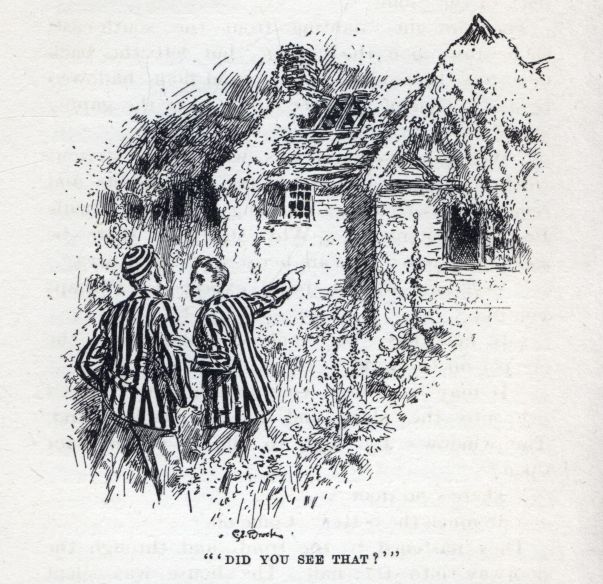
"'DID YOU SEE THAT?'"
"What?" said Armstrong, starting in spite of himself.
"A figure--something--I don't know; at the back of the room."
The sunlight, slanting from the south-east, shone full upon the cottage, but left the back of one of the rooms on the ground floor shadowed by the screen of creepers falling over the gaping window.
"Well, suppose there was, why the mysterious whisper?" said Armstrong, his own doubts and remembered tremors disposing him to ridicule Pratt's excitement. "Why shouldn't there be some one there? We are here--why not others?"
"Yes, but--well, I didn't expect it. Perhaps you did."
"It may have been only the shadow of the creeper on the wall."
"It may have been your grandmother! Let's get into the place and have a look round. The window's too high to climb; is the door open?"
"There's no door."
"So much the better. Come on."
They hastened to the front, and through the doorway into the hall. The house was silent as a tomb. On either side opened a doorless room. They entered the one on the right--that in which Pratt had believed he saw a moving figure. It was pervaded by a subdued greenish sunlight, becoming misty by reason of the dust their footsteps had stirred up. It held neither person nor thing. They crossed to the opposite room, which, being out of the sunshine, was in deep gloom. This, too, was empty. Passing the staircase they arrived at the back premises, a stone-flagged kitchen and scullery. Both were bare; even the grate had been removed.
"Now for upstairs," said Pratt. "They've made a clean sweep down here."
They mounted the staircase, at first treading carefully, then with confident steps as they found that the creaking stairs were sound. There were four rooms on the upper storey, two of them exposed to the sky. Of these the floors were thick with blown leaves, twigs, birds' feathers, fragments of tiles and bricks, broken rafters, and the debris of the ceiling. The other two, roofed and whole, were as bare as the rooms below. Through the empty casement of one they caught sight of the tower in the grounds of Mr. Ambrose Pratt's house, and the upper windows and roof of the house itself. Pratt's appreciative eye was instantly seized by the prospect--the foreground of low thicket; the glistening stream; the noble trees beyond, springing out of a waving sea of sun-dappled bracken; the gentle slope on whose summit stood the buildings, and in the far background the rolling expanse of purple moorland. For the moment he forgot the shadowy figure he had seen, and lingered as if unwilling to miss one detail of the enchanting landscape.
"There's no one here," said Armstrong, matter-of-fact as ever.
"I dare say it was an illusion. Look how the sunlight catches the ripples, Jack. And did you see that kingfisher flash between the banks?"
"I'll go and have another look downstairs," Armstrong responded. "I'll give you a call if I find anything."
He felt, as he went down, that perhaps he would have done better to be candid with Pratt. Why make any bones about an incident capable, no doubt, of a simple explanation? The tramp, if tramp he was, had, of course, the objection of his kind to being found on enclosed premises, even though they were a ruin. Yet it was strange that he had left no tracks--had he not? Armstrong was suddenly aware of something that had hitherto escaped him. There was no dust, no litter on the stairs. Singular phenomenon in a long-deserted house! And surely the floor of the room in which Pratt now stood, unlike the other floors, was clear. It, and the staircase, must have been swept. Why? Not for tidiness--no tramp would bother about that. For what, then? Secrecy? Dusty floors would leave tell-tale marks--and with the thought Armstrong hurried down to the room in which the figure had been seen, and examined the floor. Yes! besides the footprints of himself and Pratt between door and window, there were others along the wall at the back of the room. The fellow must have slipped out with the speed of a hare. Armstrong perceived at once the clumsiness of the attempt at secrecy, for the very fact that some of the floors were swept gave the game away. At the same time, he was puzzled to account for the man's motive. The island was deserted; it was no longer the scene of picnics; the villagers avoided it; why then should a casual visitor--for there was no evidence of continuous occupation--be at the pains even to try to cover up his movements? The strange oppression of the previous night returned upon Armstrong's mind, and he roamed about the lower floor in a mood of curious expectancy.
He came once more to the kitchen, and noticed that between it and the scullery was a closed door--the only door that remained in the house. Instinctively bracing himself, he turned the handle; the door opened, disclosing a dark hole and a downward flight of stone steps. He went down into the darkness, at the foot of the steps struck a match, and found himself in a low, spacious cellar, empty except for a strewing of coal dust. As the match flickered out he caught sight of something white in a corner. Striking another, he crossed the floor and picked up a jagged scrap of paper, slightly brown along one edge. At the same moment he observed a little heap of paper ashes.
Throwing down the match he trod upon it, and turned, intending to examine the paper in the daylight above. Pratt's voice shouting, and a sound of some one leaping down the staircase to the hall, caused him to spring up the steps two at a time.
"What's up?" he shouted back, unable to distinguish Pratt's words.
He reached the hall just in time to see Pratt dash through the doorway and sprint at headlong pace towards the river. Stuffing the paper into his pocket, Armstrong doubled after him. Pratt was already plunging into the thicket, and, when Armstrong came within sight of the channel, the other had flung off his cap and blazer, and was diving into the stream.
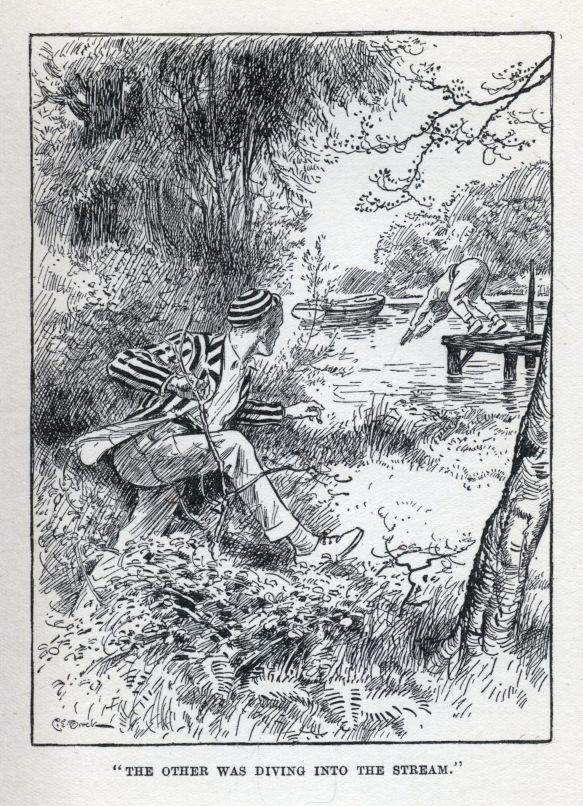
"THE OTHER WAS DIVING INTO THE STREAM."
"What mad trick----"
He cut short his exclamation, for his long strides had brought him to the pier, and he saw the cause of Pratt's desperate haste. The motor-boat, broadside to the stream, was drifting down the channel. Already it was some thirty yards beyond the spot where Pratt had taken the water, and Pratt was swimming after it with the ease of a water-rat.
Feeling that there was no reason why himself should get soaked too, Armstrong forged his way through the vegetation at the brink of the channel, but made slow progress compared with the swimmer. Pratt was rapidly overhauling the boat. Watching him, instead of his own steps, Armstrong tripped over a creeper, and fell headlong. By the time he had picked himself up, Pratt had disappeared. Armstrong's momentary anxiety was banished by the sight of the boat moving slowly in towards the shore of the island.
"Good man," he shouted. "You headed it off splendidly."
Pushing and swimming, Pratt was evidently making strenuous efforts to drive the boat into the bank before the current swept it past the island. If he failed, Armstrong saw that he would have to change his tactics and run it ashore on the left bank--his uncle's property. It would then be necessary for Armstrong to swim across, for Pratt had never taken the trouble to learn the working of the engine.
"Stick it, old man," he called.
In a few moments more Pratt contrived to edge the boat among the low branches of an overhanging tree. Its downward progress thus partly checked, he was able to exert more force in the shoreward direction. When Armstrong, after a rough scramble, arrived at the spot, he had just rammed the boat's nose securely into a tangled network of branches, and was clambering, a dripping, bedraggled object, up the bank.
A prolonged "Coo-ee!" sounded from far up the river.
"There's old Warrender, shrieking like a bereaved hen," said Pratt, shaking himself. "And it's all through his not tying the thing up properly! Armstrong, water is very wet."
"I say, did you ever know Warrender not tie it up properly?"
"How else would it break away?"
"You didn't see it break away?"
"No, you can't see our camping-place from the ruins. It was a good way down before I caught sight of it."
"Well, they've kicked off; the game's begun!"
"What on earth do you mean?"
"Wring yourself dry, and we'll talk."
CHAPTER VI
A SCRAP OF PAPER
Pratt had just stripped off his clothes, and spread them to dry, when Warrender arrived in the dinghy.
"What's the game, you chaps?" he inquired. "Why a second bath, Pratt?"
"Eyes left!" responded Pratt. "The sight of my habiliments basking in the sunlight will inform you that I have just been performing a cinema stunt--plunging fully clothed into the boiling torrent to rescue the heroine, whom the villain----"
"Dry up!" said Armstrong.
"Just what I am trying to do. But you are bursting with information, old chap. Expound. I am all ears."
"You tied up the boat as usual, Warrender?" Armstrong asked.
"Of course. Why?"
"Pratt saw her drifting down the stream, that's all, and had to dive in to prevent her getting right past the island."
"That's rum," said Warrender. "The knot couldn't have worked loose. Who's been monkeying with her?"
"That's the point," said Armstrong. "There's some one else on the island, and whoever it is, wants the place to himself. Setting the boat adrift seemed to him a first step to driving us away, which shows he is a juggins."
"Q.E.D.," said Pratt. "Now the corollary, if you please."
"Wait a bit," Warrender interposed. "It may be only a stupid practical joke--the sort of thing the intelligence of that poacher fellow might rise to."
"It may be, of course," returned Armstrong, "but I think it's more. You remember what Miss Crawshay and the people at the inn told us about the island being haunted, you know? Well, rumours of that sort are just what might be set going by some one who has reasons of his own for keeping people away. It may be Rush; we found a rabbit-snare this morning; but if it is, there's some one else in the game. Last night, as I was returning to camp, I saw a face in the thicket, just for a moment; it was gone in a flash; but it wasn't Rush's face; it was a different type altogether."
"Why on earth didn't you tell us?" asked Warrender.
"Well, I might have been mistaken; moonlight plays all sorts of tricks; besides----"
"Just so, old man," said Pratt. "Are there visions abroad? The witching hour of night----"
"Let's keep to cold fact," Warrender put in. "You saw a face, and it wasn't Rush's; but Rush lied to us about the island to keep us off it; therefore Rush and some unknown person are in league. What next?"
"Pratt saw some one in one of the rooms of the ruined cottage as we approached it an hour or so ago. We hunted through the place, but couldn't find any one. I noticed one strange fact: that while some of the rooms are thick with dust, the staircase and one of the rooms upstairs are pretty clear, although there's no sign whatever of anybody living there. There's not a stick of furniture. What is the cottage used for?"
"Is there anything particular about the upstairs room?" Warrender asked.
"Nothing that I could see," replied Armstrong.
"Except that it gives a magnificent view," Pratt added. "You can see my uncle's grounds, and up and down the river. It was when I was looking out of the window that I saw the boat adrift."
"Well, I think I'll have a look at the place," said Warrender, "and if you'll take my advice, Percy, you'll go up in the dinghy, get into dry togs, and give an eye to the camp."
"Righto! There ought to be some one at home to receive callers. You'll be back to lunch, I suppose?"
Warrender nodded, and strode off with Armstrong towards the ruins. Together they explored the house from roof to cellar, seeking, not for an inhabitant, but for some clue to the puzzle suggested by the partly cleared floors. No discovery rewarded them. It was not until they were inspecting the cellar that Armstrong remembered the scrap of paper he had picked up there. Taking it out of his pocket when they returned to daylight, he handed it to Warrender.
"Is it Greek?" he asked.
"No," replied Warrender. "I fancy it's Russian; a scrap torn from a Russian newspaper, by the look of it. Pretty old, too, judging by the colour."
"I don't know. It's brown at the edge, but that's due to the scorching it got when the other papers were burned. It's fairly clean everywhere else. You can't read it, then?"
"Not a word; how should I? Russian's a modern language; belongs more to your side than mine. Besides, what if I could? A newspaper wouldn't tell us anything."
"Very likely not. But a Russian newspaper would hardly be in the possession of anybody but a Russian, and what was a Russian ever doing here?"
"Ah! I think I see daylight. What if it belonged to one of what Pratt calls his uncle's menagerie of foreigners? They might come here in their off times. There's nothing very wonderful about it after all; but as there's nothing valuable in the ruins, they can't have any object in trying to keep us out. My belief is that that fellow Rush set the boat drifting out of sheer mischief, and we'd better keep our eye on him."
On leaving the ruins it occurred to Armstrong to examine the surroundings more narrowly than he had yet done. The flower-beds and the moss-grown path in the direction of the jetty showed the impress of his own and Pratt's feet, but another path, which they had not trodden, also bore slight marks of use. Following it up with Warrender, he found that it led to a narrow track through the undergrowth, leading southward almost in a straight line. In single file they made their way along this, and came presently to a shallow indentation in the western shore, near its southern end.
"Pratt and I must have crossed this track a while ago," said Armstrong; "but I didn't notice it, and I'm sure he didn't."
"Look here," said Warrender, who had bent down to examine the grass and shrubs growing on the low bank. "Wouldn't you say that a boat had been run in? In fact, it's been drawn up on to the bank. Here's a distinct mark of the keel--a small rowing-boat, I should think."
"Not very recent, is it?"
"But certainly not very ancient, or it wouldn't be so distinct. It's on Crawshay's arm of the river, though. D'you know, Armstrong, I shouldn't be surprised if it turns out we're a set of jackasses. I dare say the place teems with rabbits, and there are plenty of fellows besides Rush who'd be glad of getting their dinner for nothing, and would want to keep other people out of their preserves. Let's be getting back."
On arriving at their encampment they took the precaution of drawing the bow of the motorboat well on to the bank, and securing it firmly to a stout sapling. The dinghy, which Pratt had tied to a projecting root, they carried ashore, and placed behind the tent.
Pratt was sitting on his chair, tuning his banjo.
"You perceive I have not been idle," he said. "You couldn't have carried the dinghy with such agile ease if I hadn't emptied her first. Your marketing was a success, Warrender?"
"Yes, I got everything we wanted except petrol. By the way, Pratt, there's a rival troubadour in the village."
"I say! Surely not a banjo?"
"A banjo it is, and the player is no other than that general dealer fellow--what's his name? Blevins. I went up to the shop to get a can of petrol, and heard the tum-ti-tum and a tenor voice as good as your own----"
"Don't crush me quite!"
"Warbling one of your own songs out of the open window above the shop--'Love me and the world is mine.' Really it might have been you, only the fellow has a little more of what you call the tremolo, don't you?"
"Vibrato--if you want to know. But hang it! The glory is departed. Another banjo, another tenor--and singing my songs! Pity we're not in Spain."
"Why on earth?" asked Armstrong.
"Because then we'd meet on some delicious moonlit night under the window of some fair senorita, and after trying to sing each other down like a couple of cats, we'd have a bit of a turn-up, and I'd have a chance to show I'm the better man. But how do you know it was the general dealer? It might have been some fair swain as comely as myself."
"I'll tell you. I went into the shop, and asked the sheepish young fellow there for one of the cans of petrol I saw against the wall. He declared they were all for Mr. Pratt at the Red House. There were at least half a dozen, and I protested that Mr. Pratt couldn't possibly want them all at once, and insisted on his fetching his employer. The singing had been going on all the time. It stopped a couple of seconds after the fellow had gone into the house, and the man Blevins came into the shop. It's a fair deduction that he and the singer were one."
"It is, it is," murmured Pratt, mournfully, throwing a glance across the river.
"What are you squinting at?" asked Armstrong. "I've noticed you several times; what's there to look at?"
"There's me," replied Pratt, quickly. "Look at me, old chap, or at any rate, don't look that way; tell you why presently. Well, what about old Blevins, Warrender? My hat! what a name for a light tenor!"
"I asked him for one can to go on with. He was very polite--oily, in fact;--regretted extremely that he couldn't oblige me; the whole supply had been ordered for Mr. Pratt, and he daren't offend so good a customer."
"But I thought my uncle was away from home."
"Of course. Why didn't I remember that? Anyhow, while he was talking, in came that little foreign chauffeur we saw yesterday--an Italian, I fancy: he talked just like those Italian waiters at Gatti's. He had come to order a car; said that Mr. Pratt's car had broken down, and he had had to tow it to Dartmouth for repairs. He'd keep Blevins's car until the repairs were done. Blevins was a bit offhand with me after that. I suppose it was the regular tradesman's attitude to a less important customer. Anyhow, he told me rather bluntly that I couldn't have any petrol till to-morrow, and I came away."
"Quite right. You couldn't argue with a fellow who sucks up to my uncle, and sings my songs. I say, I think I shall go in for diplomacy. Don't you think I'd make a first-class attaché, or whatever they call 'em?"
Astonished at the sudden change of subject, they looked at him. He winked.
"You know," he went on--"one of those fellows in foreign capitals whose job it is to see and hear everything, and look innocent, while inside they're as wily as the cunningest old serpent. Your chronicle of Blevins is very small beer, Warrender; and while you've been yarning on about your old petrol, I've been corking myself up with something vastly more interesting, and you hadn't the least notion of it. That's why I'm sure I'd make no end of a hit in the diplomatic corps. Just keep your eyes fixed on my goodly countenance, will you? and I'll enlighten your understanding."
He took up his banjo, which he had laid across his knees, struck a note or two, then proceeded--
"After I'd changed, and carried up your purchases, I sat me down to beguile the tedium of waiting for you with my unfailing resource. Happening to glance across the river, I caught sight of some one watching me from the thick of a shrub, and my lively imagination conjured up the goose-flesh sensations of old Armstrong last night. With that presence of mind which will serve me well in my climb up the diplomatic ladder to a peerage, I hummed a stave of 'Somewhere a voice is calling,' and turned my head away with the grace of a peacefully browsing gazelle; but the fellow's been watching me for the last half-hour, and I bet he doesn't know he's been spotted. Armstrong, you've got the best eyes. While I go on gassing, just look round as if you were jolly well bored stiff--no, I've a better idea; go into the tent, and take a squint through that small tear on the side facing the river, and fix your eyes on the shrub--I fancy it's a lilac past its prime--that fills the space between two beeches in the background. I don't flatter myself that the fellow was attracted by my dulcet strains, and if he's watching me, you may be sure he's watching all of us."
Armstrong got up, thrust his hands into his trousers pockets, and strolled nonchalantly into the tent. In a couple of minutes he returned in the same unconcerned way.
"You're right," he said, drawing up his chair beside Pratt's. "I saw a slight movement among the leaves, and a face. I'm not quite sure, but I believe it's that poacher fellow. It's certainly not the face I saw last night."
"Well, now, what interest do you suppose Siren Rush takes in us? And what's he doing in my uncle's grounds? D'you think my uncle's a bit potty, and sets Rush to keep watch like a warder on a tower? Is he afraid of some one squatting on his land in his absence? I don't suppose we're far wrong in accusing Rush of setting the boat adrift, but what's his motive in watching us? It's not mere curiosity; but if not curiosity, what is it?"
"We must wait and see," said Warrender.
"That's very prudent, but it promises poor sport," Pratt rejoined. "By the way, I suppose you didn't find anything fresh in the ruins?"
"Nothing. But Armstrong picked up a scrap of paper in the cellar this morning--a bit of a Russian newspaper. Hand it over, Armstrong."
"No," said Pratt, quickly. "Don't show it. I don't suppose Siren Rush can read Russian any more than I can; the paper can't be his, but he'd better not see us examining anything. Where did you find it, Armstrong?"
"In the cellar, by a heap of paper ash."
"Incriminating documents, as they say in the police courts. But why Russian? Look here, I know a man in London who reads Russian; he seems to like it. Give me the paper presently. We'll go into the village this afternoon and post it to him. I can't see how it will throw any light on things here, but we can at least get it translated. And now, let's have lunch."
CHAPTER VII
TIN-TACKS
That night, Warrender was unusually wakeful. As a rule he slept as soundly as his companions; but now and then, when he had anything on his mind, he wooed sleep in vain. The strange incidents of the past two days had affected him more, psychologically, than either of the others. Armstrong, as soon as his doubts were removed, would suffer no more mental disturbance until something fresh, outside his experience, again upset his balance; while Pratt was one of those happy souls to whom life itself is a perpetual joy, and events only the changing patterns of a kaleidoscope.
Envying the two placid forms stretched on either side of him, Warrender was trying to grope his way through the labyrinth of mystery in which they seemed to have been caught, when he was surprised by a sudden slight rattling sound upon the tent, like the patter of small hailstones; it ceased in a second or two. The night had been fine, without any warning of a change of weather; the air was still; it seemed strange that a storm could have risen so rapidly, without a premonitory wind. His companions had evidently not been awakened. Moving carefully, so as not to disturb them, he crept across to the flap of the tent, and looked out. The stars glittered in a vault of unbroken blue; the tree-tops were silvered by the sinking moon; not a wisp of cloud streaked the firmament.
There was no repetition of the sound, and Warrender, thinking that he must, after all, have been dreaming, returned to his sleeping-bag. As often happens in cases of insomnia, the slight exertion of walking had the effect of inducing sleep, and he woke no more until morning.
Armstrong, as usual the first to rise, clutched his towel, and sallied forth barefoot for his dip. He had no sooner passed into the open, however, than he uttered what, with some exaggeration Pratt called a fiendish yell. Hurrying out to learn the cause of it, the others saw him standing on one foot and rubbing the sole of the other.
"Which of you blighters dropped a tin-tack here?" he asked.
"Got a puncture, old man?" said Pratt, sympathetically. "Your skin's pretty tough, luckily. Now, if it had been me--ough!"
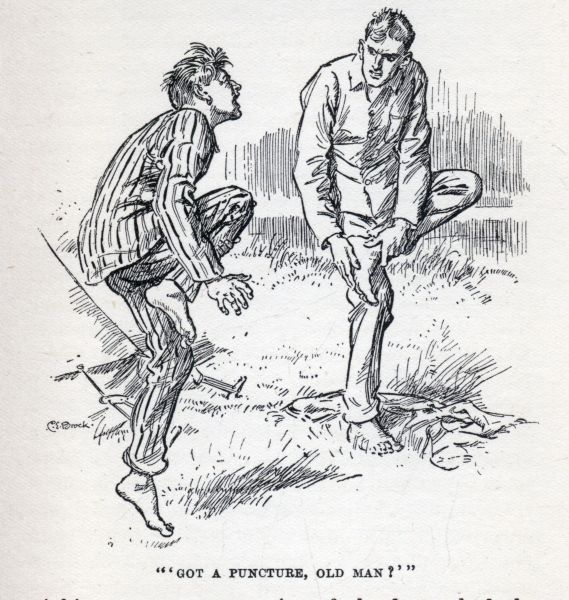
"'GOT A PUNCTURE, OLD MAN?'"
He, too, hopped on one foot, and crooked the other leg, his face contorted for a moment out of its wonted cherubic calm.
"Told you so," he cried, picking a blue tack from between his toes. "I'm a very sensitive plant, I can tell you. I see blood. Warrender, I'd have yours if you weren't such a thundering big lout."
"Not guilty," said Warrender, who had prudently stood still. "You had better both come and put your boots on. We haven't any tacks in our outfit, so--I say!"
"What do you say?" said Pratt.
"Last night I heard a sound like a sharp shower of rain or hail on the tent. Just wait till I pull my boots on."
In half a minute he was out again, shod, and began to examine the grass around the tent.
"As I thought," he said. "There's a regular battalion of the beastly things; another trick of that blackguard Rush, no doubt. He's trying frightfulness."
"I'll wring his neck if I catch him," cried Armstrong.
"No, you don't, my son," said Pratt. "The law would say 'neck for neck,' I'm afraid. I shouldn't object to your blacking his eyes. But when you come to think of it, perhaps Rush isn't the culprit after all. We've never seen him on this side of the channel. It may have been the other fellow."
"What's clear is that some one is making a dead set at us," said Warrender, "and I don't like it. It will mean our moving camp."
"You surely won't let this sort of thing drive you away?" said Armstrong.
"What's to be done, then? They first monkey with the boat--by Jove! they may have cut her loose again."
"No, I spy her nose," said Pratt. "They believe in variety, evidently. But I quite agree with you. We shall always have to leave one on guard, and that will spoil the trio. Two's company, three's fun. All the same, the position is so jolly interesting that I shouldn't like to go right away and leave the mystery unsolved--I mean their objection to our company. We haven't had the cold shoulder anywhere else; and here, first old Crawshay, then these unknown--look here, you fellows, I vote we take the job up in earnest, and get to the bottom of it. It will alter the Arcadian simplicity of our holiday, but for my part I'd risk any amount of brain fag over a good jigsaw puzzle like this."
"We'll think it over," said Warrender. "The principal thing is not to lose my boat, and the hundred odd pounds she cost."
On their way down to the river, Pratt espied a greyish object sticking in a bush. Shaking it down, he picked up a broken cardboard box on which was printed a description of "Best quality tin-tacks: British made."
"A clue!" he cried. "Sherlock Holmes would have built a whole theory on this. I don't think I was cut out for diplomacy after all. Criminal investigation is my forte. I'll go down to remote posterity as the most brilliant detective of this Pratt lost no time in taking a first step in his new career. At breakfast Warrender suggested that the tent had better be removed from its surrounding of tacks, which were too numerous to be easily collected.
"Very well," said Pratt. "You and Armstrong are the hefty men. You won't want my help, so I'll scull the dinghy up to the ferry, and start my investigations."
"Don't talk too much," said Armstrong.
"My dear chap, speech was given us to conceal thought. There's an art, some ancient said, in concealing art, and I bet I'd say more and tell less than any old Prime Minister that ever lived."
Leaving the dinghy in charge of the ferryman, he smiled a greeting to Rogers, the innkeeper, whose jolly face he caught sight of at the window, walked on to the village, and entered the general dealer's shop.
"Fine morning," he said to the aproned youth in attendance. "D'you happen to have any tenpenny nails?"
"We've got some nails three a penny, sir."
"No good at all. You couldn't hang a pirate on one of those, I'm sure. I suppose the tenpenny nail has gone out of fashion, but perhaps you have some tin-tacks. I dare say they'll do as well."
"Ay, we've got some tin-tacks--two sorts, white and blue."
"Not red?"
"No; I don't know as ever I seed 'em red."
"Well, I particularly wanted red; they don't show their blushes, you know. If you haven't, you haven't. I'll try blue; they won't look any bluer however hard you hit 'em." The assistant, staring at him like an amazed ox, handed him a box. "Yes," he went on, "now I look at them, I couldn't wish for better. They're a most admirable shade of blue, and exactly match my Sunday socks. I don't suppose there's much demand for 'em; my hosier assured me my socks were a very special line, so, of course, there couldn't be many people wanting tacks of that colour. I dare say you haven't sold a box of these since last season."
"Ah, but we have," said the simple youth, catching at something at last within his comprehension. "Only yesterday one of they furriners up at Red House bought three boxes."
"You don't say so! What an appetite he must have! I suppose it was that big fellow who talks through his nose? He wears a red waistcoat, so I dare say he has blue socks."
"It warn't him. He's the groom. 'Twas the gardener chap."
"Of course. What was I thinking of? He wanted them to tack up his vines. They wouldn't be any good for horse-shoes, and there's no question of socks at all. You needn't wrap it up, the box won't catch cold in my pocket. Sixpence ha'penny? Dirt cheap. I think they're worth quite a guinea a box, but you daren't charge that, of course, or they would haul you up as profiteers. Thanks so much."
He had noticed that the full box exactly matched the broken one taken from the bush.
Elated at the success of his first move, Pratt returned at once to the camp.
"You're soon back," said Warrender. "Changed your mind again?"
"Not a bit. I'm inclined to think diplomats and detectives are of one kidney. I've been magnificently diplomatic, and I've made a discovery."
"Well?"
"My old uncle's as mad as a hatter!"
"A family failing," Armstrong remarked. "But what's that to do with it?"
"Why, this, old tomato. He employs a lot of foreigners; that's mad, to begin with. He goes away, and leaves them in the house with instructions to sow tin-tacks on No Man's Island. If that isn't stark madness, I'd like to know what is."
"Hadn't you better tell us plainly what you've been about?" said Warrender.
"In words of one syllable. I bought a box of tin-tacks. Here it is, and here's the one we found in the bush. You see, they're twins. They were bought at the same shop, to wit, the one owned by Samuel Blevins, general dealer and banjoist, I understand. My uncle's gardener bought three yesterday. Now, I ask you, would any man's gardener sprinkle inoffensive campers with tin-tacks unless instructed to? It's all as plain as a pikestaff. My mad uncle has a morbid horror of trespassers. He leaves word that they are to be chevied away by means fair or foul----"
"But No Man's Island isn't his," Warrender interrupted.
"Certainly. That proves his madness. He thinks anybody who gets a footing here has designs on his property. It's a sort of Heligoland. He employs an ex-poacher to guard his own domains, and the foreigners to clear his outpost. Nothing could be plainer."
"Rot!" exclaimed Armstrong.
"Have it your own way. The facts are undeniable. Rush and the foreigners are in league to get rid of us, and they can't have any motive except their master's interest."
"We don't know that," said Warrender. "Your imagination runs too fast, young man. We don't even know for certain that Rush and the foreigners are working together. All we really know is that some one wants to make the place too uncomfortable for us. The question is, what shall we do?"
"Stick it," said Armstrong. "It means keeping watch by night; we can take turns at that. We'll soon find out if----"
"Ahoy, there!" cried a voice from the river.
Unperceived, a skiff had run in under the bank, and its occupant, a stout old gentleman in flannels, was stepping ashore.
"Old Crawshay!" murmured Pratt.
They got up to meet their visitor.
"Good-morning, my lads," said he, genially. "Surprised to see me, I dare say. We didn't part on the best of terms, but--well, let's shake hands and forget all about that. My daughter told me that you very kindly came to her assistance the other day. I'm obliged to you. I'm only sorry it didn't happen before we--but there, that's wiped up, isn't it? If you knew how I'd been pestered! By the way, one of you is related to my neighbour across the river, I understand."
"Yes, sir, that's me," said Pratt. "We're not on calling terms, though."
"Neither am I," rejoined Mr. Crawshay, with a smile. "We don't hit it together. He's a little----"
"Potty, sir," said Pratt, as the old gentleman caught himself up. "It's a sore trial to the rest of the family. We were only talking about his distressing affliction just before you came. He really ought to be shut up."
"Indeed! I wasn't aware that it was as bad as that. That is certainly very distressing."
"A most unusual form of mania, too. I never heard anything like it before. Of course, there are people who crab their own country and countrymen, but it's more talk than anything else. My poor uncle, however, goes so far as to employ foreigners, who stick tin-tacks into people."
"Bless my soul!"
"Pratt draws the long bow, sir," said Warrender, thinking it time to intervene.
"And hits the bull's-eye every time," Pratt rejoined. "You can't deny that twenty yards away the grass is simply bristling with tin-tacks."
"The fact is, sir," said Warrender, "that some one is trying to annoy us. Yesterday morning our motor-boat was set adrift, and in the night some one showered a lot of tin-tacks round our tent. The motive seems to be the wish to drive us away. And Pratt thinks that his uncle gave instructions to the men at the house to prevent camping either on his ground or on the island. They've chosen a very annoying way of going about it."
"Outrageous! Scandalous!" cried Mr. Crawshay. "He has no rights on the island. It's criminal. I'm a magistrate, and I'll issue you a warrant against the ruffians."
"The difficulty is that we haven't caught any one in the act," Warrender pursued. "I believe that warrants can't be anonymous. We've seen a fellow named Rush hanging about----"
"A notorious gaol-bird. I've had my eye on him."
"But the tacks were bought at Blevins's shop by my uncle's gardener," said Pratt. "I pumped that out this morning. I dare say we could find out the man's name."
"But it's no crime to buy tin-tacks," said Warrender. "We don't know who actually scattered them. Indeed, we've no evidence at all; only inferences."
"Nothing to act on, certainly," said Mr. Crawshay. "It seems to me you had better cross the river, and camp on my ground after all; or, better still, come to the house; I've plenty of room."
"It's jolly good of you, sir," said Warrender, "but it goes against the grain to knuckle under. We'd like to catch the fellows, and find out, if we can, what their game really is. I don't think even Pratt believes his uncle is responsible, even indirectly."
"Not responsible for his actions, unfit to plead, to be detained during His Majesty's pleasure," said Pratt. "We talked it over, and decided to stick it, sir. It's a matter of pride with me. I'm thinking of taking up criminal investigation as a profession."
"Indeed!"
"He's just cackling, sir," said Armstrong, impelled to utterance at last.
"I suspected as much. Well, you've made up your minds, I see. I understand. At your age I should have done the same. If you want any help, you've only to row across the river. My house is about half a mile through the woods and across a field. You must come up one day in any case, and have lunch or dinner with me, and discuss the situation. And, by the way, if you're fond of shooting, my coverts are positively overstocked. I can provide guns, and you're welcome to 'em."