Front matter (continued 3)
Reading edition
"Well, we----" Pratt began, but Warrender interrupted him.
"No, we hadn't time," he said. "The fire came on us too suddenly. By the way, we shall have to buy some new things. I suppose Blevins can provide us with a tent?"
"Surely, sir; he've most everything somewhere about. I always thought no good 'ud come of camping on that island. There's a fate in it."
"How long has it had this ill name?" asked Armstrong.
"Not so long, sir. You see, nobody bothered much about it after the old man died years ago. It didn't belong to no one, seemingly; there was nothing to take any of the folk there; and 'twasn't till a month or two ago that they began to talk of sperits. Nick Rush came in all of a tremble one night--he'd been away for a bit--and said he was setting a snare there when he heard most horrible groanings and moanings. He took some of the folk along, and they heard 'em too, and ever since then the village have give it a wide berth. You're well out of it, that's what I say. Not as ghosts carry matches, though; I reckon 'twas one of you young gentlemen a-smoking as did the mischief."
"A lesson to us, Rogers," said Pratt, gravely. "Smoking is a very bad habit, according to our masters at school--who all smoke like furnaces--they ought to know."
They had hardly finished breakfast when Mr. Crawshay drove down to the ferry in a light trap, crossing on foot.
"It's true, then," he said, as he entered the parlour. "I knew nothing about it until an hour ago. A lighted match, they say."
Pratt got up and closed the door.
"Let them say, sir. We were burnt out."
"You don't say so! Upon my word, it's time something was done. Have you lost much?"
"Almost everything but our clothes."
"Scandalous! Then you'll come up to the house?"
"We'd rather keep to our arrangement, sir," said Warrender. "It will give us a better chance of running the fellows to earth. We think of making a thorough search on the island. The difficulty is that we can't do it by daylight; we are sure to be watched, at any rate for a day or two. There's another difficulty. They're sure to keep their eye on our motor-boat and dinghy; it will be too risky to use them. Of course, we could swim the river, but it would be a bit of a nuisance."
"I can help you there. You had better not use my skiff, but I've an old Norwegian pram in one of my outhouses----"
"A what, sir?" asked Pratt.
"A pram--a sort of abbreviated punt. At one time I used it for fishing on the river. It's small and very light; two of you could carry it. You had better fetch it yourselves; my men might talk in the village. I have set them clearing a camping-place for you, by the way. It's about half-way between here and the island. But I can't lend you a tent."
Warrender explained that he proposed to buy one of the general dealer.
"Very well," said Mr. Crawshay. "I shall expect you to lunch. We'll talk over things then more at leisure."
While Warrender went off to do the necessary shopping, Armstrong and Pratt, in the dinghy, set out for their new camping-place. It lay on the shore of a little natural bay some fifteen yards deep and about half that width. Mr. Crawshay's gardeners had already mown the long grass and lopped some of the lower branches of overhanging trees. A ten minutes' walk through the wood and across fields brought the two boys to the house, where Mr. Crawshay had already arrived. Having seen that none of his men were about, the old gentleman led them to the outhouse in which he kept his pram; and by the time that Warrender, conveying his purchases in the motor-boat, reached the new encampment, the others had carried the odd little craft across the fields, and found a secure hiding-place for it in the wood a little distance from the bay, almost opposite to the north end of the island, near a spot convenient for landing under cover of the trees. With it Mr. Crawshay had lent them a couple of light oars.
After erecting their new tent--a sorry specimen compared with the one that had been destroyed--they went up to the house for lunch, discussed their plans with Mr. Crawshay privately in his study, and returned to fence the camp with barbed wire and get things in order. So far there had been no sign of the enemy; but in the course of the afternoon Armstrong climbed a tree from which, unobserved himself, he could obtain a view of the opposite bank of the river, and discovered without surprise that a spy was lurking among the bushes. No doubt all their ostensible proceedings had been watched, and they congratulated themselves on the illusion of mere defensiveness which their business-like activity must have created.
During the remainder of the day they were careful not to depart from their usual procedure. They had an early supper; when they had cleared away and washed up, they placed three oddly assorted and shabby deck-chairs, purchased from Blevins, in front of the tent, and while Armstrong and Warrender read newspapers, Pratt warbled sentimental ditties to the accompaniment of his banjo.
Just before dark Pratt and Armstrong went into the tent to go to bed, while Warrender perambulated the camp armed with a thick club. The spin of a coin had decided that he should remain on guard while the others paid a nocturnal visit to the island.
About midnight, when it was quite dark, the two raiders crept out of the tent, and striking inland for a little, made their roundabout way to the spot where the pram was hidden. Reconnoitring carefully, to assure themselves that their movements had not been followed, they lifted the pram, lowered it gently into the water, and pushed off, floating on the tide near the bank, and steering with one oar in the stern. They struck the shore of the island about midway, seized a projecting branch, and drawing their craft into the bank, pulled it up among the reeds at the edge. Then they started to cross the island.
It was pitch-dark in the thicket. Spreading roots and trailing brambles tripped their feet; their faces were lashed by the foliage as they pushed their way through; thorns caught at their clothes. It was difficult to avoid noise. Twigs snapped underfoot, branches creaked and rustled, and every now and again there was a strident shriek of rent clothing as they tore themselves from the embrace of some clinging bramble. Heedless of the obstacles, hot and weary, they plodded doggedly on, and presently, after making unconscionably slow progress, they emerged upon the bank of the river. The stream looked much wider than they had expected.
"Whereabouts are we?" whispered Pratt.
"We've come too far south, I fancy," returned Armstrong.
They peered up and down, trying vainly to discover some landmark. They stood listening; there was breeze enough to cause the moaning, but they heard no sound except the rustle of the leaves and the gentle gurgle of the tide. They cast about, taking wary steps up stream and down; hoping in one direction or the other to come upon the wilderness garden.
Suddenly Pratt whispered: "I say, this isn't a tidal river, is it?"
"No; it always flows down," replied Armstrong. "Why?"
"Because----"
And then he stopped.
"Look here," he murmured to Armstrong behind him.
Armstrong looked, and there, at Pratt's feet, was the dark shape of the pram, nestling in its bed of reeds.
"Hang!" exclaimed Armstrong. "We've been going in a circle."
"Just so. Everybody does it!" said Pratt, with a chuckle. "I suspected it when I noticed the way the stream was flowing."
"Nothing to chortle about," Armstrong growled. "We've had all our trouble for nothing. Absolutely waste time!"
"But look how we've enlarged our experience! I think I'd like to be a traveller, like my old uncle. I've read about these circular tours often enough, but never believed in 'em. Why can't one walk straight in the dark?"
"Ask your grandmother! I'm fed up; scratched all over, too. I'll not try this again without a luminous compass. Let's get back."
It was nearly two o'clock before they trudged wearily into camp.
"Any luck?" asked Warrender, still doing sentry-go.
Pratt related what had happened.
"Well, I'm glad for once I lost the toss," said Warrender, smiling. "We'll certainly get a luminous compass, and I fancy we'd be the better for a few lessons from the Boy Scouts."
CHAPTER XV
UNDERGROUND
The change of camp had relieved the boys of one irksome tie. There was no longer any need for a constant guard. The barbed wire, and Warrender's patrolling of the camp, were merely ruses for the deception of the enemy. Next morning, therefore, for the first time since their arrival, all three went off together in the motor-boat, to make a trip down the river and along the coast westward. They threw a keen glance at Rush's hut as they turned the point. Its door was closed; nobody was about; and the only human being they saw in the course of their expedition was one solitary figure moving slowly along the top of the cliff--possibly a coastguard.
They lunched on the boat, and did not return until afternoon. Leaving the others to prepare tea, Warrender went on to the village, bought a small luminous compass, and an electric torch from Blevins's miscellaneous stock, and a few buns at the baker's. When he regained the camp, his companions reported that there was no sign of its still being kept under observation--by this time the enemy was probably persuaded that their only wish was to be left alone. While they were having tea, Rush rowed slowly past, going down stream. He did not turn his head towards them, but Pratt declared that he had given them a sly glance out of the tail of his eye.
To keep up appearances, they decided that one of them should remain on guard that night as before. The lot fell upon Pratt. At nightfall the others, equipped with the compass and torch and two short stout sticks, put off in the pram, and, landing on the island, without much difficulty struck their old clearing--now clearer than ever, and redolent of smoke and fire---and wound their way to the ruined cottage. The moaning sounded more eerie than they had yet heard it, rising and falling with the fitful gusts.
When they reached the old garden, they bent low, approached the ruins under cover of the tallest plants, and waited a while at the foot of the wall before venturing into the entrance. Warrender kept guard on the lower floor while Armstrong, who knew the place better, explored the upper storey thoroughly with the aid of the torch, which he kept carefully shaded from outside view. Above his head, somewhere on the roof, the dismal note sounded continually. He went into the eastern room from which he had seen the signal light. No light was visible. Returning below stairs, he examined the whole of the premises with equal care. Everything was as it had been. There was nothing to indicate that any one had entered the place since his last visit.
"We shall have to make a night of it," said Warrender. "It was morning when Pratt saw some one in the lower room. It doesn't follow that he comes every morning, or, indeed, that he has ever come again; but we had better wait on the chance."
"Let us go upstairs, then, and sit against the wall where we can see the window. I don't believe that signal can be seen from the sea, and the fact that it can be seen from here seems to show that the signaller expects some one to be at the cottage. It won't be easy to keep awake, but we mustn't fall asleep together."
With backs against the wall, arms folded, and legs stretched on the floor, they sat watching. No light shone; there was no sound but those produced by the wind in the leaves and that monotonous, provoking, doleful wail from the roof. Hour after hour passed. Now and then each got up in turn to stretch his limbs. One or the other dozed at times. The still hours crept on; nothing happened; it seemed that their patience was to meet with no reward.
It was not until the faint grey tint of early dawn was stealing up the eastern horizon that a sound below caught Armstrong's attentive ear. He nudged Warrender dozing by his side. Grasping their sticks, they rose and tiptoed to the doorway. Some one was clumsily mounting the stairs. They peeped out. At the farther end of the landing a large, dark shape rose from the staircase, turned at the head, and went into the western room. Slipping off his boots, Warrender crept stealthily along the wall and looked in after the intruder. The room was dark, but, against the twilight framed by the window-opening, he saw the legs and feet of a man disappearing upwards outside. In a few moments there came scraping sounds from the roof; the moaning suddenly ceased, and after a little the man's feet reappeared; he was lowering himself into the room. Warrender stole back; at Armstrong's side he watched the man return across the landing to the staircase, and heard his heavy footsteps as he descended.
"Watch from this window; I'll go to the other," whispered Warrender.
From these posts of observation, commanding almost the whole of the surroundings of the cottage, they looked for the emergence of the visitor. He did not appear; nor, after his footsteps had ceased, did they hear a sound. Had he gone into one of the lower rooms? Leaving Armstrong to keep watch at his window, Warrender, in his stockinged feet, stole down the stairs, and peeped into each of the rooms and the kitchen and scullery in turn. The dawn was growing; but the man was not to be seen. All was silent. A slight whistle summoned Armstrong; together the boys quietly and rapidly ranged the lower floor, taking advantage of the increasing light to search for some secret hiding-place, some recess or cranny in the wall. There was nothing. The walls were too thin to enclose space enough for a man to hide. Where had he gone? He had not left the place by doorway or window; he must be somewhere within.
"The cellar!" said Armstrong, remembering the scrap of paper he had found there.
Warrender ran upstairs, slipped on his boots, and returned. The door at the head of the cellar staircase was closed. They opened it gently, listening. There was no sound from below. Cautiously, step by step, they descended. At the foot of the staircase they held their breath for a moment. Then Warrender flashed the torch. The cellar was empty. They examined every inch of the walls up to the height of a man. The brick-work was whole; not a brick was displaced, not a seam of mortar missing. They tramped over the black, dusty floor; everywhere it was solid; there was no hollow ringing beneath their feet. Scraping away a little of the coal dust, they found that the floor also was of brick except at the foot of the steps, where there was a large flagstone. Something caught Armstrong's eye. He stooped.
"Look here," he said. The joint between the flagstone and the brickwork of the floor had a sharp, well-defined edge. The crevice was free from coal dust.
"A little suspicious, eh?" said Warrender. "Stamp on the stone."
"Hold hard! What if that fellow is underneath it?"
"We've got to the point where we must take risks. But it's not credible that any one actually lives down below, even if there is a below. Try a kick or two."
But there was no ringing sound when Armstrong stamped; the stone was either laid firmly on the earth, or it was so thick that, if there was a hollow beneath it, the fact would not be detected. Nor, when Armstrong trod heavily all over its surface, was there the slightest sign of movement.
"Feel along the edge," Warrender suggested.
Armstrong went down on hands and knees and drew his finger along the base of the lowest step.
"A slight crack here, at the left end," he said.
"Big enough to get your finger in?"
"No; it can't be more than an eighth of an inch wide. It's upright, between the step and the wall. Looks as if the stone has shifted."
"Well, if you can't get your finger in, try your knife blade."
"Wait a bit, there's another crack, smaller still, right along the edge of the step, between it and the upright slab."
They had both lowered their voices to a whisper. Armstrong gave the upright a push, near the middle. It was firm, unyielding. But pushing leftwards, he felt a slight movement, and at the extreme end, a very gentle pressure caused the slab to swing inwards easily, the right half of it at the same time moving outwards.
"By gum, it works on a pivot!" exclaimed Armstrong, under his breath. "We're on the track! But this opening's only about six inches wide; nobody but a baby could crawl through it."
For a few moments they held their breath, listening for sounds. All was silent. Then Warrender dropped on all fours and shone his torch into the dark gap. The space was empty. Armstrong thrust in his hand, and felt over the earthen floor, then along the edge of the flagstone, and finally beneath it.
"There's a hollow space here," he said. "And, I say, here's a metal hand-grip just below the flagstone."
He tugged it; there was no movement. He pushed it on each side in turn, still without result. Baffled, he sat on his haunches.
"What's the hand-grip for?" he said. "Obviously for moving something. Then why doesn't anything move?"
"Perhaps it can only be operated from below," Warrender suggested. "If this is an entrance to the cellar, it may be left open when any one comes this way."
"That's not likely. An entrance that can only be opened from one side isn't worth much. No, something sticks, and if that fellow went through a few minutes ago, it can't be for want of use. Why does it stick, then?"
Armstrong pondered for a few moments, then said suddenly, "Possibly it's my pressure on the stone. Let's try."
He moved back, so that the weight of his body bore upon the rear instead of the fore end of the stone. Then, however, he found that he could not reach the hand-grip.
"Why not try the other side?" said Warrender. "There may be another grip there."
The other side of the staircase was open to the cellar, and Armstrong was able to thrust his arm into the aperture below the step without treading on the flagstone.
"Got it!" he said, a moment later. "There's a grip here. It moves in a quarter-circle. Something--a disk of stone, I fancy--is revolving."
He pressed on the flagstone; still there was no distinct movement downwards, though it seemed to have yielded a trifle.
"Clearly it won't shift until the other grip is turned," he said. "But how to get at that?"
After a little consideration he had another idea. Going a few steps up the staircase, he turned, and crawled down head first until he was able to get his hand under the edge of the stone.
"All right, old man," he said, cheerfully. "I've moved the grip now. Keep clear of the other end of the stone."
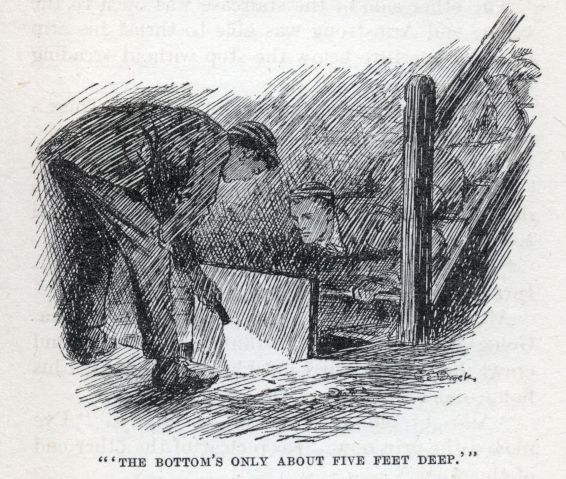
Lying full stretch on the staircase, he pressed on the stone beneath him. It sank gently; the other end moved upwards, and in a few seconds the stone stood upright in the middle of a dark gap. Warrender bent down, holding the electric torch just above the opening.
"The bottom's only about five feet deep," he said. "It's the end of some sort of passage. Come down, old man, and we'll explore it together."
"'THE BOTTOM'S ONLY ABOUT FIVE FEET DEEP.'"
They dropped lightly into the cavity. By the light of the torch they saw that on each side a flat circular wheel of stone, lacking one quadrant, moved on an iron axle in such a way that a half-turn of the hand-grip removed the support of the flagstone and allowed the corner to drop down. The flagstone was nicely balanced on a revolving iron rod let into a socket at each end. This contrivance formed the entrance to a narrow tunnel about four feet wide, and something over five feet high in the centre. Neither of the boys could stand upright in it. The floor was of hard-beaten earth; the walls and the arched roof were of ancient brick, covered with an incrustation of slimy moss.
"An old smugglers' tunnel, I'll be bound," said Armstrong. "It will be very odd if we have struck a lair of modern smugglers. Just look at your compass and see what direction it takes."
The needle swung almost perpendicular to the course of the tunnel.
"Eastward," said Warrender. "That's strange. I thought it probably ran south, to somewhere near that place at the end of the island where we saw the marks of a boat the other day."
"It seems to shelve downward slightly. Looks as if it runs under the channel."
"Towards Pratt's uncle's grounds. Let's explore."
"Better switch off your light, then. We can find our way in the dark by touching the sides."
They went forward in single file, stepping gingerly, and bending their heads to avoid the roof. The air smelt musty and dank, and was unpleasant and oppressive. For a time the floor sloped gently downwards, but presently they were aware that it had taken an upward trend.
"We've crossed the channel," said Armstrong in a whisper that the vaulted walls made unnaturally loud.
A little later they noticed ahead of them a space dimly illuminated. Moving forward cautiously, they found themselves at the bottom of a circular shaft. Far above them they saw daylight in parallel streaks.
"A dry well," murmured Warrender, "roughly boarded over." Consulting his compass, he added, "Still eastwards. Rummy if the tunnel goes to the Red House."
Pursuing their way in utter darkness as before, the floor still rising very slightly, they became aware by and by that the tunnel had enlarged. From the centre they could not touch the wall on either side, and the greater lightness of the air gave them a sense of spaciousness. Suddenly Armstrong, who was leading, stumbled over something on the floor and fell forward. His hands, instinctively thrust out, were arrested by a bundle encased in tarpaulin. He straightened himself. For a moment or two they waited, straining their ears. There was no sound.
"A light," murmured Armstrong.
The light revealed that they had arrived at a small chamber about twelve feet square and seven or eight feet high. The farther end was broken by the tunnel. In each side wall, a foot below the roof, were let a couple of iron rings, deeply rusted.
"For holding torches," said Armstrong.
The chamber was empty except for three bundles on the floor. It was over one of these that Armstrong had stumbled. Two of them were completely covered with tarpaulin, and roped; the third was partly open at the top.
"They're like the bundles I saw Rush and the other fellow carry up from the boat," said Armstrong.
"Queer smuggling," said Warrender, bending over the open bale. "It seems to hold nothing but paper."
He took up the topmost sheet. It was a thin, semi-transparent paper, and crackled to the touch.
"This isn't newspaper," he said.
"Cigarette paper, perhaps," said Armstrong. "But where's the 'baccy?"
"Can't smell any. I wonder how much farther the tunnel goes?"
Entering it at the extreme end of the chamber, Warrender came within a yard to a contrivance similar to that which gave access from the cellar.
"Here's the end," he said. "Look, the grips are turned. Shall we risk lifting the stone?"
"Dangerous," said Armstrong. "Goodness knows where we'd find ourselves."
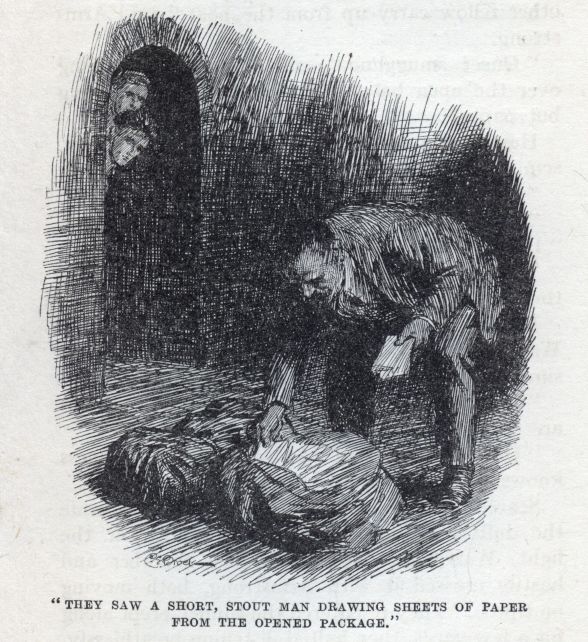
Scarcely had he spoken when from above came the dull sound of footsteps. Switching off the light, Warrender backed into the chamber and hastily crossed it with Armstrong, both moving on tiptoe. They re-entered the tunnel, crept along for a few yards, then halted, listening breathlessly. They heard the footsteps of one man in the chamber they had just left. The footsteps ceased, and were followed by a rustling. It seemed clear that their presence was unsuspected, and they ventured to tiptoe back until, near the opening of the tunnel, they were able to peep into the chamber. By the dim light that came through the aperture left open by the revolved flagstone on the farther side, they saw a short, stout man drawing sheets of paper from the opened package. He counted them as he took them up, and presently turned, carried them through the opening, and let down the flagstone behind him. There was not light enough by which to identify him.
"THEY SAW A SHORT, STOUT MAN DRAWING SHEETS OF PAPER FROM THE OPENED PACKAGE."
The boys re-entered the chamber, and listened until the sound of his retreating footsteps above had died away. Then Warrender switched on the light, took a sheet of paper from the top of the bale, folded it, and put it into his breast pocket.
"Now for home," he whispered. "We've something for Percy to start a new theory on."
CHAPTER XVI
WATERMARKS
As they began to retrace their steps through the tunnel, Armstrong said--
"If we count our paces we shall have some sort of an idea where we've been to. We know the tunnel runs pretty nearly due east from the ruins, and there must be a building at the end. It seems to me it's a choice between the Red House and that old tower. There's no other."
"True. Well, we'll both count. Bet you we don't agree."
"People never do agree when the count is a long one. Besides, we can't keep step in the dark, unless we left-right all the way, and I'm hanged if I do that!"
They started. Suddenly Warrender stopped.
"I say, we shall look pretty green if some one has discovered that open trap in our absence--Rush, for example."
"Frightful mugs, the two of us. We ought to have closed it. But it's still very early in the morning. Let's hope Rush isn't up with the lark. Hang it. I've forgotten how many steps I'd counted. What do you make it?"
"Fifty-eight. Concentrate your mind, my son."
"I'll start at fifty-nine, then. Don't you think we might venture on a light now?"
"Not for anything. The tunnel's straight, and if you've ever been in a straight railway tunnel you'll know a light can be seen for miles. Better be on the safe side."
They completed the course in darkness.
"Well, what's your total?" asked Warrender.
"Two hundred and eighty-three."
"Mine's two hundred and ninety-one. Not so bad."
On emerging into the cellar, they replaced the flagstone and made sure that the hand-grips were turned as they had found them. Then they mounted to the upper floor of the cottage.
"I want to discover how that moaning is caused," said Armstrong.
"But it means shinning up to the roof," said Warrender. "It's broad daylight now. You might be seen."
"So I might. Well, let's take a look over Ambrose Pratt's grounds."
They went into the eastern room. The tower, a little south of the house, appeared to be slightly the nearer to them, but, ignorant as they were of the exact length of their paces, they agreed that the end of the tunnel might lie beneath either of the buildings.
Going then into the room facing south, they started back from the window. Rush was tramping along the weedy path leading to the southern end of the island.
"Lucky I didn't climb!" murmured Armstrong.
They watched the man. He seemed to be a little suspicious, stopping every now and again to listen and look round. Presently he disappeared into the thicket.
"Safe to go now?" asked Armstrong.
"Let's wait a bit."
Warrender kept his eyes fixed on the stretch of river which was visible over the low trees southward. After a while he saw a small boat moving slowly down stream.
"All right now," he remarked. "I dare say he's been spying out on our camp from the north end. Hope he hasn't missed us."
"Or found our pram! Come on, I want my breakfast."
They stepped out of the cottage, regained the western shore, discovered the pram where they had concealed it, and, having crossed the river unobserved, so far as they knew, laid the craft in its former hiding-place, and returned to camp. Pratt was busy at the paraffin stove.
"What ho!" he exclaimed. "One must feed, even when pain and anguish wring the brow. I made sure the spooks or some one had got you, and after fortifying myself with bacon and eggs I was going up to ask old Crawshay whether an inquest would be necessary. You look very much washed out. Been on the tiles?"
"I'll wring your neck if you don't hand over that frying-pan," said Armstrong.
"Thy necessity is greater than mine. As you know, I'd lick Philip Sidney or any other old paladin in chivalry. Eat, drink, and be merry. There's enough coffee brewed for us all. Make a fair division of the bacon and eggs between you, and I'll fry some more in a brace of shakes. I say, I am jolly glad to see you! I've had the deuce of a time!"
"More pin-pricks?" asked Warrender.
"No. But I'm blessed--or cursed--with a very vivid imagination, as you are aware. I stayed up till daybreak, expecting you back every minute, and when you didn't come I got in a regular stew, saw you tumble from the roof, and your members all disjected over the garden--horrid sight! Saw you knocked on the head, trussed and gagged in the cellar; boated off to France; growing white-haired in a dungeon like that fellow in the Bastille--you know, finger nails a yard long--mice and rats and toads. Toads were the last straw, I saw 'em hopping about, and----"
"That bacon done?" said Armstrong. "How many bottles of ginger-beer did you drink?"
"I am not drunk, most noble Festus. But I say, what did happen?"
"I'd have told you already," said Warrender, "only I couldn't get a word in."
"That's the reward of patience! I only twaddled, you juggins, to give you a chance to feed. You did both look awfully done up. The hue of health is returning now. Fire away, then!"
Warrender, between the mouthfuls, related the experiences of the night, Pratt showing unusual self-restraint as a listener.
"My poor old uncle!" he exclaimed at the conclusion of the story. "He can't be convicted as an accessory, can he?"
"Of course not," replied Warrender. "No one could hold him responsible for what his foreign crew are doing in his absence. It's a pity you don't know where he's gone. A cable or a Marconigram would bring him home post-haste."
"I might, perhaps, ask Gradoff for his last address."
"The less we have to do with Gradoff the better, until we have got to the bottom of the business. Just run down to the boat, will you, and bring up our map."
The scale of the map was two inches to the mile. A moment's examination proved that the tower, marked on the map, lay within a radius of one-eighth of a mile from the island.
"There isn't much doubt that the far end of the tunnel is under the tower," said Warrender. "The house is a trifle beyond. Didn't you ever hear of the smugglers' passage, Percy?"
"Never. All I know about it is the tradition that some one was starved in the tower centuries ago. My sister and I used to play in it as kids; it was a mere ruin then; no roof, no boarding on the windows."
"I wonder if a local guide-book would give any information?" said Armstrong.
"Good idea! We'll see presently," said Pratt.
"But we're not studying antiquities," Warrender remarked. "The essential point is, what are those beggars using the place for now? What are they doing with those bales of paper? Come into the tent, and I'll show you the specimen I bagged."
Within the shelter of the tent he unfolded the sheet, and the others bent over it curiously, fingering it.
"It has a sort of parchmenty feel, and it's much too thick for cigarette paper," said Pratt. "Is there a watermark?" He held it up to the sunlight.
"Jiminy!" he exclaimed. Whipping out his pocket-book he took a pound note, and held it beside the larger sheet. "Look here! The watermark's almost, but not quite, the same. A dashed clever imitation. Here are the words, 'One pound,' crowns, diagonal hatchings--everything. The beggars are forging Bradburys."
The sinister discovery almost robbed the others of breath. There could be little room for doubt. Such paper, so marked, could be used for only one purpose. A flood of light was poured on all the mysterious events of the past week. The paper was brought from abroad, and landed as a rule on the island in preference to the coast, to avoid the risk of interference by coastguards; also, no doubt, for greater ease of transport. Rush was employed because he was a well-known figure in the neighbourhood, and could go up and down the river in his boat without awakening suspicion. He might or might not know the contents of the bales; what was clear was that the printing of the notes must be done either in the tower or in Mr. Pratt's house. The foreigners had entered his service with no other end in view than their criminal work. Gradoff, the head of the gang, had probably known in advance of Mr. Pratt's intention to travel, and had astutely seized the opportunity of carrying on his operations in this remote spot, on the premises of an eccentric gentleman who was something of a recluse, and prone to quarrel with his neighbours.
"They're clever blackguards," said Pratt. "No wonder the island is haunted! And I say, Molly Rod's peculiar actions the other day are explained. She has found out what's going on, and being a decent Englishwoman, wants to stop it, husband or no husband. You may say what you like, Jack; I'm certain it is she who makes those signals, and, of course, my poor old uncle is absolutely ignorant of everything. He'll be in a terrific bait when he knows."
"What's our next move to be?" asked Warrender. "Inform the police?"
"Certainly not that fellow who yarned about arson the other night," said Armstrong. "It's a matter for the Chief Constable."
"Or Mr. Crawshay? He's a magistrate," suggested Pratt.
"And an impetuous old hothead," rejoined Armstrong.
"Plenty of common sense, though," said Warrender. "You remember, he said a good case is often lost through being ill prepared? Well, we've still only suspicion to go on. There's no earthly doubt about it, of course; but wouldn't it be best to catch the forgers in the act before we call in the law?"
"It means loss of time," said Armstrong.
"That doesn't matter to us. You see, if we set the authorities at work now, they might send a bobby to the house to make inquiries, and give clever scoundrels like those a chance to get away. But if we can go to them and say definitely, 'An international gang of forgers is printing notes in the Red House, and here's one of the forgeries,' the matter becomes much more important, and they'd take steps to secure the whole crowd without the possibility of failure. To my mind we'd better keep everything a dead secret until we've got positive proof."
"I concur with my learned brother," said Pratt. "Besides, we've got so far with it that I own I should hate to see it taken out of our hands. Furthermore and finally, it's good sport, and a ripping holiday adventure."
"That's the best argument of the lot," said Armstrong. "The only sound one. I confess I'd like to get into the tower, and see them at it."
"We'll go through the tunnel again to-night," said Warrender. "If we can't find an entry that way, we'll try the outside."
"I make a third to-night," said Pratt.
"We must leave some one in camp, if only for appearance's sake," said Warrender. "I think Armstrong and I had better go again, as we know the course. Hope you don't mind. Your turn will come, Percy."
"Well, I'd like to feel myself a martyr, but unluckily I've got a certain amount of common sense, and I can't help admitting you're right. Hadn't you better take a snooze, then?"
"I intend to," said Armstrong. "We'll sleep till lunch; this afternoon we'll go to the village and get a guide-book. We want some more bacon, too."
"And I'll start preparing our case," said Pratt. "We'd better have it in writing, so I'll draw up an account of our discoveries so far. Shouldn't wonder if it becomes a classic document in the archives of Scotland Yard."
After lunch Armstrong and Warrender set off up the river in the dinghy for the sake of exercise. They made various purchases in the village, and obtained a small guide-book at the post office. It contained a few lines about the tower, which Warrender read aloud as they returned to the ferry: "In the grounds of the Red House are the remains of a square tower, believed to date from the troublous times of King Stephen. There is a tradition that in the thirteenth century a certain baron was incarcerated there by an ancestor of the present owner, and starved to death. At one time open to the public, since tourists cut their initials in the oaken beams it has been closed to sightseers."
"Not a word about smugglers, you see," remarked Warrender. "The secret was evidently very well kept."
Rogers happened to be cleaning his windows as they passed, and they turned to have a chat with him. Warrender discreetly led the conversation to the subject of the tower.
"Ay, 'tis the only old ancient curiosity we've got in these parts," said the innkeeper. "I know the place, though I haven't been there since I was a nipper, thirty odd years ago. Us youngsters used to like to climb the winding stairs; 'twas open in those days. Had no roof then. Mr. Pratt a few years back did some restoring, as they call it; put on a flat roof. My friend Saunders, his old butler, told me the top room was used as a sort of museum; Mr. Pratt kept there a whole lot of curiosities he'd collected in his travels. I mind as how my neighbour Parsons, the builder, was affronted because the building job was done by a firm from Dartmouth, and so far as I know none of the village folk have been inside the place since. Mr. Pratt was very particular after he'd rigged up his museum; wouldn't let anybody in except his special cronies; and 'tis always locked up when he's away, so if you young gents had an idea of visiting it, I'm afeard you'll be disappointed."
"We should certainly have liked to see the museum," said Warrender. "There's nothing else very interesting, apparently. But no doubt the curiosities are valuable, and Mr. Pratt is quite right to lock up the place. Have you seen your sister, by the way?"
"Not a sign of her. She've deserted us quite. She won't even see Henery Drew's milkman, I suppose becos Henery fought her husband's friend, Jensen. I call it downright silly, but there, who'd be so bold as to say what a woman'll do next? There's my missus----"
"Now, Joe," called Mrs. Rogers from within, "get on with they winders, my man. There's all the pewters to shine afore opening time."
Rogers gave the boys his usual rueful smile, and they went on their way. Rowing with their faces up stream, they did not notice until they pulled in to the landing-place above the camp that the motor-boat no longer lay at her moorings.
"Have those beggars let her drift again?" said Warrender, angrily. "Pratt!" he called.
There was no answer. They looked down the river. The boat was not in sight. Hurrying to the tent, with the expectation of finding Pratt asleep there, they discovered that it was untenanted.
"What the dickens!" exclaimed Warrender. "Surely he hasn't gone larking with the boat? He always prided himself on knowing nothing about her working!"
"Seems to me they've run off with him and the boat too," said Armstrong. "Where's his banjo, by the way?"
It was neither in the tent nor on the chair outside, where Pratt sometimes left it.
They looked blankly at each other for a moment, then Warrender exclaimed--
"Come on! This is serious! I can't believe he's kidnapped. What's the use of that? Let us row down--perhaps he hasn't gone far."
They ran to the bank, sprang into the dinghy, and sculled rapidly down stream, every now and then turning their heads to scan the river, the banks, the island, for a sign of the motor-boat. They had almost reached the mouth when Armstrong suddenly cried--
"Listen! Isn't that a banjo?"
They shipped oars. Faintly on the breeze from seaward came the strains of "Three Blind Mice." A few strokes brought the rowers round the slight bend. Looking out to sea they descried, about half a mile away, the motor-boat, stationary, lapped by white-crested wavelets.
"By George! He's picked up some girls," exclaimed Armstrong.
There were certainly two parasols, a pink and a blue, at the stern of the boat.
"The young dog!" cried Warrender. "And got them stranded on a sandbank. But 'Three Blind Mice!' He's a rummy idea of entertaining girls."
The sound of the banjo ceased. "Ahoy!" came from the boat, and the two parasols were agitated. The scullers pulled on.
"Heavens! It's Mrs. Crawshay and her daughter," said Warrender, after glancing over his shoulder. Armstrong grinned.
"Twig?" he said. "Master Percy has been showing off."
"Silly young ass! Jolly lucky he hasn't wrecked 'em! I shall have to talk to him."
They rowed almost up to the boat, keeping clear of the sandbank.
"Hullo, old sports," said Pratt. "Really, Phil, you ought to carry a chart--an up-to-date one, you know, that would show all the coral reefs and other traps for the hapless navigator. The Admiralty ought to mark 'em with buoys or lightships or something, but you can never expect anything from the Government. There's no danger, of course. I assured the ladies that they needn't be the least bit nervous or frightened, but it's annoying to be pulled up when you don't want to be. I'm sure a 'bus conductor must get frightfully annoyed when the old 'bus is spanking along and somebody wants to get in or out. I dare say you've noticed it, Mrs. Crawshay; the conductor is so ratty at being interrupted that he simply won't see the umbrella you're waving at him from the kerb. Mrs. Crawshay and Miss Crawshay were kind enough to pay a call on us at the camp this afternoon. It was just after you had gone, and as it was far too early for tea, I thought it would be interesting--what they call a treat, you know"--Pratt's impetuous tongue had fairly run away with his savoir faire--"to take the ladies for a spin, especially as they had never been in a motor-boat before. I promised faithfully to bring them back to tea; you got some meringues and things, of course--and I have a distinct grudge against fate for making me out to be not a man of my word. There's no armour against----"
"Oh, Mr. Pratt, please!" Lilian Crawshay implored. "Mr. Warrender, can you get us off?"
"I have given up all hope of tea," said Mrs. Crawshay, good-temperedly. "We have friends coming to dinner, and Mr. Pratt tells me that we must wait till the tide turns. Will that be long?"
"Three hours or so, I'm afraid," replied Warrender.
"Dear, dear! We shall be very late, Lilian," said Mrs. Crawshay.
"Can't you tug us off?" asked the girl.
"I'm sorry to say we haven't a hawser. But I think we could pull the dinghy near enough for you to get into it, if Mrs. Crawshay would venture?"
"I'll venture anything rather than wait here three hours," said the lady, "though Mr. Pratt has been most kind. I have really quite enjoyed it, but three hours more, you know----"
"It would be rather awful!" said Warrender, with a glance at Pratt, who having succeeded in his object, to prevent certain disclosures, was mopping his brow in the background. Now, however, he came forward.
"That's right, Phil," he said. "No nearer, or you'll run aground too."
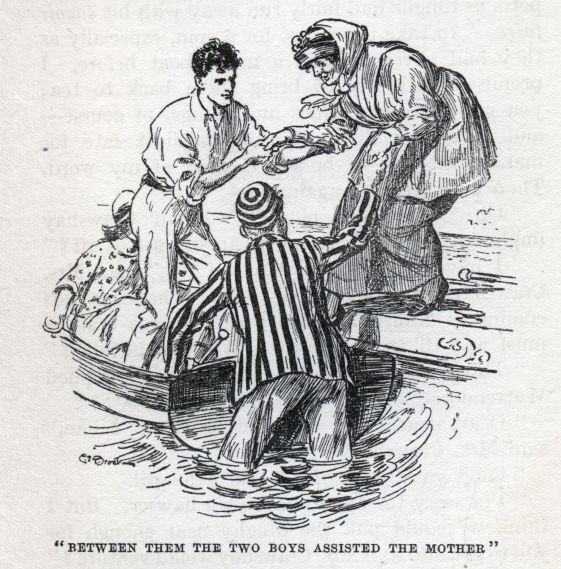
He leapt overboard, and stood up to his knees in water. "I'll hold the boat's nose, Mrs. Crawshay. Or perhaps I might take you in my arms and----" "Bless the boy! You're getting your feet wet. No, no! I don't think you shall take me in your arms."
"Or try pick-a-back? Or shall I make myself into a gangway for you to walk over? I'd stand perfectly firm."
"If you would give me a hand! Lilian, my dear, jump in first. Then you can each give me a hand, and I shall manage very nicely. Dear me! What an adventure for an old woman!"
"Not at all," said Pratt. "I mean----"
"I am sure you do," said Mrs. Crawshay, interrupting. "Will you take my parasol?"
Pratt meekly relieved her of the parasol, then turned to help the girl into the dinghy. Lilian, however, sprang in without his aid, and between them the two boys assisted the mother, who gave a sigh of relief as she sank down upon the thwart.
"BETWEEN THEM THE TWO BOYS ASSISTED THE MOTHER"
"We'll come back for you presently, Pratt," said Warrender, stiffly. "Don't attempt to run up, mind."
"Good-bye, Mr. Pratt," said Mrs. Crawshay. "And thank you so much. When you come up to dinner, be sure to bring your banjo."
The two boys pulled off, Pratt climbing back into the motor-boat.
"What a clever, amusing person Mr. Pratt is," said Mrs. Crawshay to Armstrong, facing her. "So ready! And an excellent performer on the banjo! We could never be dull in his company. He talked most amusingly, then sang us song after song. Don't you think 'Two Eyes of Blue' very pretty, Mr.----"
"Rather sentimental, isn't it?" said Armstrong, blushing.
"All his songs are sentimental. He was playing a very funny tune, though, when you came round the bend. I was sure his voice was getting tired, and asked him just to play. The tune was quite unknown to me, but I thought it very cheering."
Meanwhile, at the other end of the boat, Lilian had been giving explanations to Warrender.
"He intended just to bring us to the mouth of the river, but seemed to have some difficulty in turning round. I think he said he wanted more sea-room. At any rate, he ran out to sea, and then we stuck on that wretched sandbank. He talked and sang to amuse us; he has quite a pleasant voice, but his songs are dreadfully sentimental, aren't they?"
"Frightful tosh!" returned Warrender.
"Well, it was very good of him, especially when he must have been much annoyed at the mishap, which, of course, wasn't his fault."
"No, of course not," said Warrender.
"You speak as if you thought it was."
"Oh, no. Any one might run on a hidden sandbank. But the fact is----"
"Yes?"
"You see, he was in charge of the camp."
"You mean he oughtn't to have come at all?"
"Naturally he thought it would please you and Mrs. Crawshay, but----"
"Oh!"
The girl said no more.
"She thought I was jealous, or huffy, or something," Warrender confided to Armstrong later. "I wonder what she'd have said if I'd told her that the idiot had never run a motor-boat before?"
CHAPTER XVII
THE TOPMOST ROOM
It was in the evening twilight that Armstrong and Warrender put off in the pram for their second expedition to the tunnel. On reaching the ruins, Warrender posted himself in one of the lower rooms, while Armstrong mounted to the upper floor, intent on discovering the source of the ghostly moans. Climbing out of the window opening, and pulling aside the ivy, he found that steps had been made in the brickwork of the crumbling wall, by means of which any one with a steady head might with ease ascend to the roof. And there, behind one of the gables, partly protected from the weather, he came upon a long metal organ pipe laid flat, and near it a large funnel-shaped object. A strong breeze was blowing from the south-west, but the organ pipe gave forth no sound.
Still puzzled as to the manner in which the sound was produced, and reflecting that Pratt would probably have jumped to it at once, Armstrong heard a low whistle from below. He scrambled hastily down, and had only just slipped into the eastern room when he heard lumbering footsteps upon the stairs. From the doorway he watched the man whom he had seen in the morning. A minute or two after the new-comer had entered the western room, the moaning broke out. Armstrong waited until the man had descended and all was quiet again, then once more climbed upon the roof. The mystery was solved. The funnel had been so adjusted as to catch the wind, and direct it with some force into the mouth of the organ pipe. It turned like a weather-cock, so that the sound was independent of the veering of the wind.
Rejoining Warrender, Armstrong informed him of the discovery, and suggested that he should examine the contrivance for himself.
"I'll take your word for it," said Warrender, smiling. "I don't care about steeple-jack feats in half darkness. We'll wait a little before we follow that fellow through the tunnel. Let's go up and watch for the signal."
It was perhaps half an hour later when the light appeared above the tree-tops.
"Most certainly it's S.O.S.," said Armstrong, after counting the recurring glows.
"I shouldn't wonder if Pratt is right after all, and it's Molly Rod signalling. He was right about the organ pipe."
"Doesn't it occur to you that the light may come from the tower?"
"But if the forgers are at work there, why should any one signal?"
"Can't we discover whether it's from the tower or the house?"
"We can't take any bearings in the dark. Stay, though. If we move back from the window, and go to the side of the room, perhaps we'll find a spot where the light just becomes invisible. I'll mark that on the floor, and in daylight there'd be no difficulty."
Acting on this suggestion, they were not long in discovering the required spot. Warrender scratched a pencil mark on the floor; then they descended to the cellar, cautiously lifted the flagstone, and groped their way through the tunnel until they came to the chamber at the end. Nothing was altered there, except that the opened bale of paper had been removed. They had intended to enter the archway on the farther side, and lift the flagstone which, they suspected, closed the entrance to another cellar; but from above there came dully a succession of regular thuds which proved that somebody was about, and active.
"I dare say that's the press at work," said Warrender in a whisper, after they had listened for a few minutes.
"Doing overtime," said Armstrong. "I suppose, not knowing exactly when Mr. Pratt will return, they want to make the most of their opportunity. Who knows how many thousands of pounds of spurious money are getting into circulation? No doubt Gradoff had his trunk full of notes that morning we saw him driving off in the car."
They seated themselves on the unopened bales, hoping that work would presently cease, and the man would leave the tower. But the thuds continued with monotonous regularity.
"Every thud means a forged note," said Armstrong. "They may be going on all night. How long can you stick it?"
"We'll wait till eleven; then if they're still at it, we'll go back and reconnoitre the outside."
"Perhaps they have a sentry."
"Perhaps; but I fancy they'll feel pretty safe now that they've chevied us from the island."
At eleven o'clock the work was still going on. The boys retraced their course to the ruins, regained the pram, and allowed it to drift on the current down channel to the south of the island. There they lay to for a few minutes, listening, peering through the darkness. There was no moon; the starlight scarcely revealed the outlines of the trees. Presently, with careful, soundless movements of the sculls, they rowed across to the left bank, and, pulling the craft out of sight, landed a little below the island, and laboriously pushed their way through the thicket, guiding themselves by the compass. Some fifty yards from the bank the vegetation thinned, and they found themselves in a wood of taller trees. Here the going was easier, though once or twice they stumbled over trunks that had been felled and stripped ready for carting. Emerging from the wood into park-like ground, where there were large trees only at intervals, they progressed still more rapidly, and at last caught sight, on their left, of the dim, square shape of the tower. Behind a broad elm they stood for a minute or two, watching. There was no light in the tower. Its base was surrounded by a mass of low-growing shrubs. The doorway, no doubt, was on the farther side from them. The walls were covered with ivy, except at the window openings, where the recent boarding was visible as faint grey patches.
"Now for it," whispered Warrender.
They stole forward over the long grass. As they drew nearer to the tower they heard the dull regular thudding; there was no other sound. Armstrong posted himself at one corner, while Warrender gently pushed a way through the shrubs to the wall. He examined the boarded window, apparently an old embrasure much widened. The boards were on the inside; the outside was protected by cross bars of iron. He went round the building. There was only one other window opening on the ground floor. At the north-eastern angle he halted, looking out for a possible sentry, then crept along until he reached the entrance, a low iron-studded door flush with the wall. Putting his ear against the wood, he heard more clearly the metallic thuds, and men's voices. A footstep approached. He slipped back to the corner, and crouched in the shelter of a shrub. The door opened outwards, creaking on its hinges, and letting out a stream of light. A short, stout figure emerged from the tower, carrying a number of cans which rattled as he walked.
"Fermez la porte!"
The words, in a savage, half-suppressed shout, sounded from some little distance away in the direction of the house. The man addressed hastily closed the door behind him, and went on. Warrender saw another man meet him. They stopped and exchanged a few words. Rod continued his way to the house, his progress faintly marked by the rattling cans. The other man came towards the tower. He opened the door quickly, slipped inside, and shut it. In the one second during which the light shone out, Warrender recognised the pale face of Paul Gradoff.
He hurried round to the spot where Armstrong had remained on guard.
"All right!" he whispered. "No sentry. Rod has just gone to the house; Gradoff has gone in."
"Well," returned Armstrong, "what can we do?"
"We'll try the door first of all. Come on!"
They moved with slow, careful steps round the tower, came to the door, and gently tried the handle. There was no yielding; the door was fastened. They went on to the western face of the tower. Here also there was a window opening on the ground floor, as securely boarded up as the other. At equal intervals above it were two other embrasures, similarly blocked.
"No way of getting in," murmured Armstrong.
The sound of the door creaking sent them scurrying to cover in the undergrowth. When all was silent again, Warrender whispered--
"Come among the trees. We can talk more freely there."
They crept over the ground, and took post under a tall, thick-leaved beech nearly a hundred yards away.
"I don't see any chance of getting in," said Warrender, "and that's a pity. I wanted to see them actually turning out their forged notes."
"I suppose it was Gradoff going out again we heard just now," said Armstrong. "If he and Rod are both away, there can't be more than four others in the tower, probably not so many. They'll take turns at night-work."
"That doesn't matter. Any forcible entry is quite out of the question, if that's what you're thinking of. I say, isn't that a light up the tower?"
More than half-way up the wall a faint streak of light was visible.
"Evidently there's some one in the top room," said Warrender. "Some one sleeps there, I suppose. The machine is on the ground floor. Where light gets out, we should be able to see in. You've done some climbing already to-night; are you game to clamber up the ivy? There's no other way."
"I weigh eleven stone," said Armstrong, dubiously.
"But ivy's pretty tough. It may support you. You may find foothold in the wall."
"Hanged if I don't try. You'll stand underneath and break my fall if I tumble. I reckon it's about thirty feet up; plenty high enough to break one's neck or leg."
They hastened to the foot of the tower. With Warrender's help, Armstrong got a footing in the lower embrasure. Then, taking firm hold of the stout main stem of the ivy, he began to swarm up, seeking support for his feet in the thick, spreading tendrils and in notches of the stone-work. Warrender watched him hopefully. Slowly, inch by inch, he ascended. He gained the second embrasure, rested there a few moments, then climbed again, and was almost half-way to his goal, when he felt the ivy above him yield slightly. Digging his feet into the wall, he hung on, but at the first attempt to ascend he felt that the attenuated stem would no longer support his weight, and began slowly to lower himself.
At this moment Warrender heard the door creak, and threw up a warning whisper. Armstrong stopped, effacing himself as well as he could amongst the ivy, to which he clung with the disagreeable sensation that he was dragging it from its supports above. Voices were heard; heavy footsteps. After a few moments they ceased. Were the men turning to come back? Had they heard anything? Then came the scratching of a match. Warrender drew relieved breath; some one had halted, only, it appeared, to light his pipe or cigarette. The footsteps sounded again, gradually receding, and finally died away.
"All safe!" whispered Warrender.
Armstrong let himself down, and stood beside his friend.
"A quivery job," he murmured. "My arms ache frightfully. It's not to be done, Phil. Another foot up and I should have dragged down the whole lot, possibly a stone or two as well. We're fairly beaten."
"The sound inside has stopped. They've apparently knocked off work; it's past midnight. I wonder if any one's left inside?"
"Why should there be?"
"Well, there was some one up above. Is the light showing still?"
They walked some distance away from the tower, and looked up. The thin streak of light, so faint that it might have escaped casual observation, still showed at the level of the topmost room. They went to the door and again gently tried it. It was shut fast.
"We had better get back," said Warrender. "There's nothing to be done."
"Unless we try the tunnel again, now that all is quiet inside."
"If you like."
They crossed the grounds with the guidance of the compass, and presently came among the medley of prostrate trunks.
"I've an idea," said Armstrong. "It'll take a long time to get back through the tunnel. Why not shift one of these poles, and put it up against the tower? I could climb then, and take a look in at that upper window."
"Good man! We must take care to get one long enough."
They found a straight fir stem that appeared to be of the required length, carried it to the tower, and raised it silently until the top rested in the ivy, just above the left-hand corner of the window.
"Steady it while I climb," said Armstrong. "Don't let it wobble over."
He began to swarm up. For the first eighteen or twenty feet it was easy work; then with every inch upward his difficulties grew, for not only was there less and less room between the pole and the wall, but the pole itself showed more and more tendency to roll sideways, in spite of Warrender's steadying hands below. Slowly, very slowly Armstrong mounted, maintaining equilibrium partly by clutching the ivy. At last, gaining the level of the window, he gripped one of the iron bars that stretched across it, rested one knee on the wide embrasure, and peeped through a narrow crack between two of the boards.
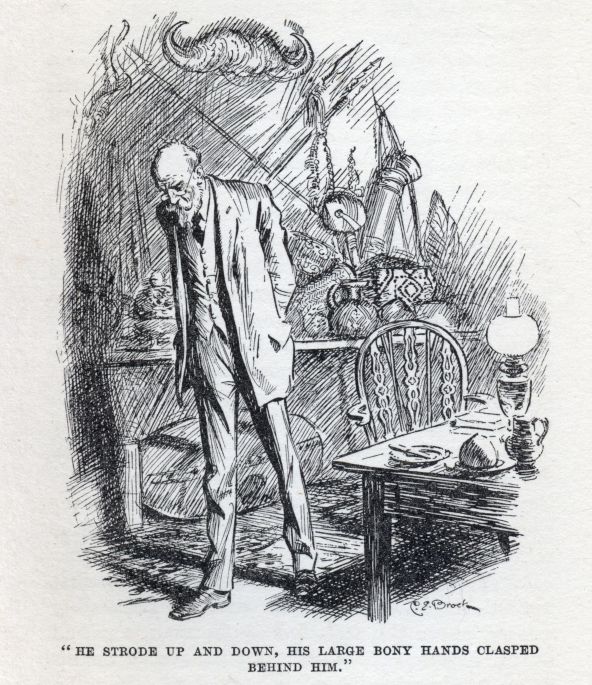
He was transfixed with amazement. The first object that caught his eye was the figure of an elderly man, bald, with thick grey moustache and beard, seated at a table, resting his head on his hands as he read by the light of a small paraffin lamp the book open before him. On one end of the table stood a couple of plates, one holding a half-loaf of bread, a knife, and a jug. Upon the walls beyond him hung animals' horns, tusks, savage weapons, necklaces of metal and beads. The remainder of the room was out of the line of sight.
As Armstrong gazed, the inmate got up and paced to and fro. He was tall and lank; his clothes--an ordinary lounge suit--hung loosely upon his spare frame. There was a worn, harassed look in the eyes beneath a deeply furrowed brow. He strode up and down, his large bony hands clasped behind him; sighed, sat down again, and began to take off his clothes.
"HE STRODE UP AND DOWN, HIS LARGE BONY HANDS CLASPED BEHIND HIM."
Puzzled as to the identity of this solitary, wondering whether he, and not Gradoff, was the head of the gang, Armstrong backed down to make his descent. The pole swayed as his full weight came upon it, and he saved himself from crashing to the ground only by desperately clinging to the ivy, and forcing the top of the pole into a tangled mass of the foliage. Then he slid rapidly down, barking his hands on the rough stem.
"Quick!" whispered Warrender. "You made too much row."
He ran backwards, letting down the pole; Armstrong caught up the lower end, and they hurried away with it, laying it in the wood among the others. Meanwhile they had heard sounds of movement from the tower. Some one had come out. There were low voices, footsteps coming towards them. Without an instant's delay they pushed on in the direction of the river, thankful for the darkness of the night and the overshadowing trees. Only when they had gained the shelter of the thicket did they dare to pause for a moment to consult the compass. On again, but more slowly, lest the rustling leaves should betray them.
At length they came to the channel. The island was opposite to them. Turning southward, they groped along the bank until they stumbled upon the pram. They launched it, and floated down stream. When they were well past the southern end of the island they pulled round into the broader channel, and, closely hugging the right bank, rowed quietly up the river to their landing-place.
Only then did Warrender venture a whispered question--
"What did you see?"
"An oldish man, reading."
"Not one of those we have seen?"
"No. Can't make it out."
They returned to camp. It was past two o'clock. Pratt sprang up from his chair before the tent, and held a small paraffin lamp towards them.
"Well?" he asked, guessing from their aspect that they brought news.
"They were working in the tower," said Warrender. "We heard the machine, and couldn't risk going up from the tunnel. But we came back and reconnoitred the outside, and Armstrong climbed up and peeped through a crack in the boarding of the top room. What did you see, Jack?"
"An old man reading by the light of a paraffin lamp."
"Another one of the gang!" exclaimed Pratt.
"I don't know. Perhaps. He looked haggard and anxious."
"No wonder. What was he like?"
"Tall and thin, with grey moustache and beard."
"A foreigner?"
"Couldn't tell. He might well have been English. A queer old johnny--hook-nosed, high bald head: might have been a 'varsity professor."
"What!" shouted Pratt. "Bald! Beard! Hook nose! Like a professor! Great heavens--my uncle!"
CHAPTER XVIII
ZERO
A half truth, some one has said, is the greatest of lies: perhaps there is nothing more staggering to the intelligence than a half discovery--a discovery which solves one problem only to propound another.
"My old uncle, for a certainty," said Pratt. "He has been bald as long as I can remember him: lost his hair in the wilds of Africa, I believe. Years ago his man stuffed me up with the tale that a lion clawed his tresses out by the roots. Lucky he didn't marry, or his wife might have plagued him about wearing a wig, like Mother Rogers. That's the mystery of the signal solved, then."
"Is it?" said Armstrong. "No signal was ever shown from the window of that top room; that I'd swear. The light we saw to-night was the merest streak: came through a slit certainly not more than a quarter of an inch wide."
"But hang it all!--there's the poor old chap a prisoner: who else would signal for help?"
"I thought you suggested Molly Rogers," remarked Warrender.
"I've given that up. Didn't Rogers say she knows nothing about signals? But that doesn't matter. The point is that those foreign blackguards have him under lock and key while they're committing a criminal offence on his premises. I shouldn't wonder if it killed him, or made him clean potty. He's over sixty, and solitary confinement----"
"I say, it's very late," Armstrong interrupted. "We've none of us had much sleep lately. Let's see what's to be done and then get all the rest we can before morning. I foresee a thick time to-morrow."
"We must set old Crawshay moving," said Pratt. "No doubt he's hand in glove with the Chief Constable."
"We talked about Crawshay before," rejoined Armstrong. "The affair is complicated now. We've got your uncle's safety to consider. You may be sure that those ruffians won't stick at trifles, and if any action is taken against them publicly it's quite on the cards that they'd put a bullet into the old man. I'm inclined to think it's up to us."
"What do you mean?" asked Warrender.
"We know the subterranean entrance to the tower. Can't we get in and release him ourselves? He'd be valuable outside as a witness."
"But, my dear chap, if the prisoner disappeared the foreigners would know the game was up," said Warrender. "They'd clear off before they could be caught."
"Look here, old man, he's my uncle," said Pratt earnestly. "The poor old boy has been cooped up there goodness knows how long. He's over sixty, accustomed to an active life: imagine what it means to him. It's just the sort of thing to send him to a lunatic asylum for the rest of his days. I'd never forgive myself if I didn't make some effort to get him out of it. If you put it to me, I say I don't care a hang whether the forgers are caught or not. The personal matter quite outweighs any other. If we go interviewing magistrates and constables we'll lose precious time: you know what officials are. The thing is, to rescue my old uncle without a moment's delay, and let the rest take its chances."
Pratt's unwonted gravity had its effect upon his companions.
"Shall we try it?" asked Warrender, turning to Armstrong.
"I'm game," was the ready reply. "It's risky: no good blinking that. We are three to six or seven, if we include Rush; and there's not the least doubt they're armed. Fellows like that always carry automatics. We've got cudgels! We can't fight 'em; our only chance is to get in when there are few of them about."
"That's during the morning," said Warrender. "You remember that Gradoff has twice gone off in the car, and that morning we went up all the men were at the house."
"Except Rush," added Armstrong, "and that ugly fellow we weren't introduced to."
"Well, then, I tell you what," said Pratt. "I'll go into the village in the morning and find out whether the car has left as usual. We want some eggs, and some spirit for the stove. I'll get that at Blevins's, and see if I can pump a little information out of him or his assistant. If Gradoff and the chauffeur are away the odds against us will be reduced, and with luck we might get into the tower in their absence. What do you say?"
"There seems nothing better," said Warrender. "Let us turn in and get four or five hours' sleep."
Soon after breakfast next morning Pratt went off alone in the dinghy.
"By the way," Warrender said as he was pulling away, "bring an ounce of pepper, and a large tin of sardines. We can't bother about cooking to-day, and sardines want a little condiment."
"A packet of mustard, too," called Armstrong. "There's none for to-morrow's bacon."
"Righto," shouted Pratt. "I shan't be long."
Arrived at the village, he made his purchases at the little provision shop, thrust them into his pocket, and went on to the general dealer's for a can of spirit. As he approached, he heard a high-pitched, angry voice from the depths of the yard at the side of the shop.
"You go at vunce, at vunce, I say. Ve hire your car; vat is ze goot? Always it break down, one, two, tree times. It is too much."
"Ay, and you owe me too much already," replied Blevins gruffly.
Pratt halted, straining his ears towards the altercation.
"You pay up: that's what I say," Blevins went on. "You've had my car a week or more, and over-drive, that's what you do. And not a penny piece have you paid."
"But zat is all right," expostulated the foreigner. "Mr. Gradoff he pay at end of ze month. He say so; vell, you vait all right. You have--vat you call it?--a bike; it is ten mile, but vat is zat? You go quick."
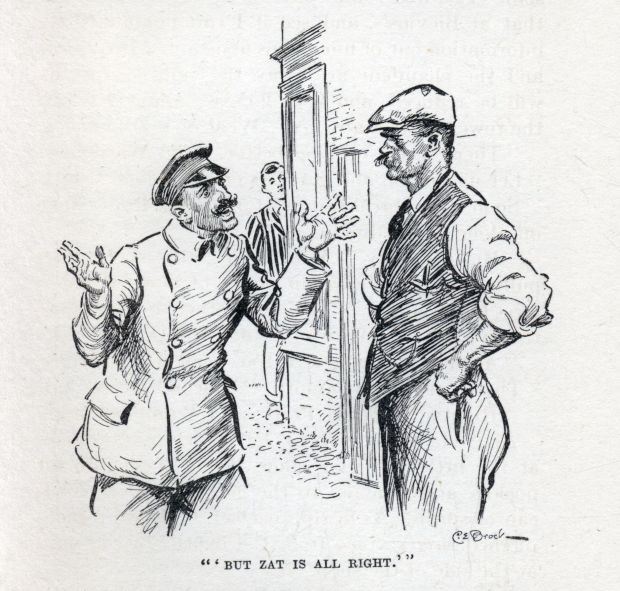
"'BUT ZAT IS ALL RIGHT.'"
"And you think I'm going to ride twenty mile for a commutator. Not me. What do you want the car for, anyway? Driving in and out nigh every day, scorching along fit to bust up any machine. What's your game? Do 'ee take me for a fool? You're up to some hanky-panky while your master's away. Think I didn't know that all along? Nice goings on! A pretty tale the village 'll have to tell him when he gets back! Spending his money like I don't know what. Spending, says I; running up bills, that's what it is. You pay up, and you shall have a commutator. I don't need to ride no bikes to fetch it: I've got it on the spot; only I'll see your money first."
The men had begun to walk up the yard. Pratt slipped into the shop. Evidently the car would not be used to-day, he thought, if Blevins remained obdurate. Evidently, also, Blevins was suspicious of the doings at the Red House, though it was clear that he had no well-defined idea of what those doings were, or any knowledge of Mr. Pratt's whereabouts. He went past the shop, still bickering with the Italian. Pratt had a free field.
His former acquaintance, the youthful assistant, came forward to attend to him.
"Good-morning," said Pratt, genially. "It seems quite an age since I saw you. I've often thought of that pleasant little conversation we had. But I'm in rather a hurry to-day. I want some methylated spirit: that's what you call it, isn't it?--the stuff that burns with a blue flame. Rummy how often blue comes into business affairs, don't you think? Last time I was here I wanted blue tacks, I remember. By the way, I suppose your friend, the gardener at the Red House, hasn't bought any more tacks?"
"No friend o' mine," growled the youth.
"Indeed! It's a pity not to be friends. Friendship oils the machinery of life, don't you know. Still, I am sure it's not your fault. Why doesn't he reciprocate the amiable sentiments you cherish towards him?"
The youth gave Pratt a puzzled stare. "I don't know nothing about that," he said slowly. "All I do know is, I hate furriners, I do so. Fair cruel they be. Why, the feller comed in here not a hour ago and wanted six foot of iron chain--to chain up a dog. 'Twas cruelty to animals, and so I told 'un."
"Perhaps the dog feels the heat and gets snappy."
"But the thickness of it! Look 'ee here, sir; here's the chain I cut. 'Tis thick enough to hold a mad bull. Do 'ee call that a chain for a dog? He wouldn't have a little small chain, as was proper."
"Well, after all, you haven't seen the dog. It may be a whopper of a brute. Give him the benefit of the doubt. You'll feel better now you've told me."
He paid for the can of spirit and left the shop. Blevins and the chauffeur were a little way up the road, still quarrelling. Forgetting the eggs that were part of his commission, Pratt hastened back to the ferry, and found that his friends had just arrived in the motor-boat.
"We saw Rush pulling down stream," said Warrender, "and hurried up to meet you and save time. He's one less. Any news of the car?"
"It appears to have broken down," replied Pratt, going on to relate what he had heard. "Pity Gradoff won't be away. But the Italian is still squabbling with Blevins, and if we look sharp we may get into the tower before he returns to the house. That will make them two short."
He had placed on the deck the can of spirit and the tin of sardines while he was speaking, then tied the dinghy astern and jumped aboard.
"Rush wasn't going to the island?" he asked.
"We watched him row past it," said Warrender. "He's probably off to his hut. Let's hope that the other fellows are at the house and not at the tower."
"It's 'over the top' now," remarked Armstrong, as the boat sidled away from the landing-stage.
CHAPTER XIX
THE PRISONER
Pratt was the only one of the three who had the curiosity to look at his watch when they descended into the cellar of the ruined cottage. It was twelve minutes past ten.
They had tied up the motor-boat at its moorings below the camp, and after a careful look-out in all directions, had crossed to No Man's Island by Mr. Crawshay's pram. For weapons Pratt and Armstrong each carried a short thick cudgel; Warrender at the last moment caught up his spanner, remarking that he might need a knuckle-duster.
The flat stone was revolved. They sprang lightly into the cavity below.
"Shall we leave it open in case we have to come back in a hurry?" asked Warrender in a whisper.
"Better close it," said Armstrong. "If Rush or the other fellow turns up and finds it open we may be fairly trapped."
Having made all secure they stood for a few moments listening. There was no sound.
"Now," said Warrender, moving to the front with his electric torch. "You're lucky, Pratt; you're the only one of us who can walk upright."
"'Were I so tall to reach the pole,'" Pratt quoted.
"Shut up!" said Armstrong, in a murmur. "Every sound carries. You can recite your little piece when we're through with it."
Slowly, quietly, in pitch darkness, they groped their way. Warrender thought it prudent not to switch on his light. At the dry well they halted to listen once more. On again, until they reached the vaulted chamber at the end. From overhead came the dull regular thud of the working machine. This was a disappointment. They wondered how many men were above. Did the trap here give entrance to a cellar as in the cottage? Was the printing done in such a cellar, or on a higher floor? They could not tell. The least movement of the flagstone might be noticed; they might be overwhelmed before they could emerge; but it was no time to weigh risks.
Armstrong went forward, and by a momentary flash from Warrender's torch saw the positions of the hand-grips. With infinite care he moved them round, and let the flagstone drop for a fraction of an inch. The sound from the machine was scarcely louder; only a subdued light shone through the crack. He lowered the stone noiselessly a little more; again a little more. The thuds continued; there was no other sound. No longer hesitating, Armstrong turned the stone over until it stood upright and peered over the edge of the cavity. He saw a large, dimly lit chamber, evidently underground, one side of which was filled with packing cases, crates and boxes. On the other side was a wooden staircase with a short return, giving access to the room from which came, more distinctly now, the thud of the printing press. It was only through the opening at the head of the staircase that light, apparently from a lamp, penetrated into the chamber.
Armstrong scrambled up; Warrender was following him, when the thuds suddenly ceased. The boys held their breath. Had they been heard in spite of their care? There was no movement above. Warrender signed to Pratt to clamber up. Whether from excitement, or because he was shorter than the others, Pratt dropped his stick, which fell with a crack upon the floor. A voice from above called out two or three words which none of the boys understood. They had the rising inflection of a question; the last seemed to be a name. With quick wit Pratt uttered a low-toned grunt as if in answer. Armstrong flung a glance at his companions--a look in which they read resolution and a claim for their support. Then he walked boldly up the stairs.
On turning the corner he saw the well-remembered figure of Jensen the Swede in his shirt-sleeves, bending over, examining the platen of a small hand printing press. No daylight penetrated into the room, which was illumined by a powerful lamp hanging from the ceiling. Jensen's back was towards the staircase. He did not at once look up; Pratt's grunt had apparently satisfied him; but he growled a few words in a tongue unknown to the boys, as if he was finding fault with the machine. Receiving no answer, he glanced up. At the sight of Armstrong he remained for an instant in his bent position, motionless, as though turned to stone. Then he dashed towards the farther wall, where his coat hung from a nail.
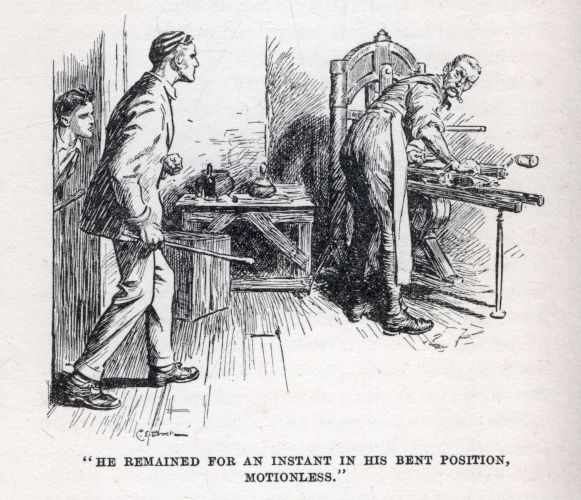
"HE REMAINED FOR AN INSTANT IN HIS BENT POSITION, MOTIONLESS."
His momentary hesitation was his undoing. Armstrong sprang after him. Before the man could withdraw his hand from the coat pocket Armstrong struck down his left arm, raised instinctively to ward off a blow, with a smart stroke from his cudgel, following it up with a smashing left-hander between the eyes, which drove his head against the wall. While he still staggered, Armstrong seized him about the middle and flung him to the floor, wrenching from his hand the automatic pistol he had taken from his pocket.
"Hold his legs," cried Armstrong to Warrender, who had joined him. "Pratt, bring up some rope; there's plenty on the packing cases below."
The Swede heaved and writhed, but the firm hands of Armstrong and Warrender held him to the floor until Pratt had neatly bound his arms and legs. He filled the air with curses while the pinioning was a-doing. Warrender caught up some sheets from the pile of paper that had already been printed, and twisting them into a wad, stuffed it between the man's teeth. Laid helpless against the wall, the Swede concentrated all the bitterness of his rage and resentment in his eyes, which followed every movement of his captors.
Armstrong had already shot the stout bolt that defended the heavy oaken door on the inside. Having disposed of their victim, they threw a hasty glance at the small hand press, the piles of paper, printed and unprinted; in their eagerness to achieve their purpose they did not stay to make a thorough examination.
"Jack, will you close the trap-door below and remain on guard here?" said Warrender. "Take this fellow's pistol. You can spy out through a chink in the boarding, and if you see any of the others coming, sing out."
"Righto," said Armstrong.
Pratt was already through the low doorway in the north-east corner of the room. Warrender followed him, and found himself at the foot of a dark stone staircase, which wound so rapidly that Pratt was even now out of sight. The stairs were much worn in the middle, and in their haste to ascend the boys were glad to avail themselves of the rope that ran along the inner wall, supported by rusty iron stanchions.
When they had mounted a score of steps by the light of Warrender's torch, they came to an open doorway giving access to a low room lined with bookcases, except on the eastern wall, where a window, closely boarded up, looked towards the Red House. A desk stood in the centre of the floor; there was no other furniture, no occupant, only an array of small tin cases along one of the walls. Going higher, they presently halted before a closed door, the top of which was only a few feet below the massive timbers of the roof. Pratt turned the large iron ring; the door did not yield. He rapped smartly on the oak: there was no reply. Stooping, he peeped through the enormous keyhole. The interior of the room was dark. Warrender held the torch to the hole.
"The door's four or five inches thick," said Pratt. "No wonder he can't hear--if this is the room. Bang with your spanner."
Warrender smote the door vigorously, Pratt listening at the keyhole. There was no reply, but Pratt declared that he heard a slight movement, and putting his mouth to the keyhole he cried--
"Can you hear? We are friends."
Still there was no voice in answer. The only sound was a clanking of metal.
"Is your uncle deaf?" asked Warrender.
"He wasn't ten years ago. You try, Phil; your voice may carry better than mine."
"Are you Mr. Ambrose Pratt?" Warrender shouted, then turned his ear to the hole.
"Yes. Who are you?"
The words were spoken in tones so low and hollow that Warrender could scarcely distinguish them.
"Friends," he replied. "Your nephew Percy. Come to the door."
"What did you say?"
"Come--to--the--door!" Warrender bawled, spacing out the words.
"Why do you mock me? You know I cannot."
Again came the clanking of metal.
"He must be deaf," said Pratt.
"We have come to help you," cried Warrender, slowly and distinctly. "Can you open the door?"
"To help me!" The clanking was louder, more prolonged. "Are the villains gone? Who are you?"
"This is rotten," said Warrender to Pratt. "Shall I never make him understand? Please be still and listen," he called. "We are friends. We have come to let you out. Can you help us?"
"No. The door is locked. That man Gradoff has the key, and I am chained."
"Good heavens!" ejaculated Pratt. "Can we burst in the door?"
Standing on the narrow top step of the staircase, with winding stairs behind them, they were unable to bring any momentum to bear, and the pressure of their shoulders did not cause the heavy timber to yield a fraction of an inch. Warrender tried to force first the head of his spanner, then the narrower end of the handle between the door and the side-post. He failed.
"Get Jensen's pistol and blow it in," suggested Pratt.
Warrender hurried down the stairs. Returning with the pistol, he called through the keyhole--
"We will try to blow the lock in. Keep away from the line of fire."
"Fire away. I am at the side of the room," said the prisoner.
Warrender placed the muzzle in the keyhole and fired. There was the crack of shattered metal, but still the door did not yield. He fired a second time and pushed.
"It is giving. Shove!" he said.
Pratt turned his back to the door, and thrusting his feet as firmly as he could against the curving wall, he drove backwards with all his force. The fragments of the broken lock clattered upon the floor within, and the door swinging open suddenly, precipitated Pratt headlong into the room.
Warrender flashed his torch upon the scene. Against the left, the eastern wall, sitting on a roughly contrived bunk supported between two massive oaken beams that stretched from floor to roof, was the tall lank figure that Armstrong had described. He was chained by the leg to one of the beams, the chain forming a loop around it, the last link being riveted to one in the longer portion.
Ambrose Pratt gazed in speechless surprise at the two schoolboys.
"Uncle!" exclaimed Pratt, going forward with outstretched hand.
Mr. Pratt looked with an expression of utter bewilderment and incredulity.
"Don't you remember me? I'm your nephew Percy," said the boy.
"My nephew!" murmured Mr. Pratt.
"Let us postpone explanations," said Warrender. "We have to get away. Hold the chain, Percy. I'll smash it with the spanner."
But the chain, which the general dealer's assistant had described as strong enough to hold a mad bull, resisted all the vigorous blows Warrender rained upon it.
"Run downstairs, Pratt," he said, "and see if there's a hammer and chisel below--or any tool about the printing press."
During Pratt's absence he repeated his efforts with the spanner, but made no impression on the tough steel. Pratt returned with a long steel rod which he had found lying near the press, and inserting this in one of the links, they tried to burst it.
"No good!" declared Warrender. "Nothing but a chisel and hammer will do it. I've both in my tool box in the motor-boat. We must have them. It's the only chance. You had better go for them, Pratt. Jack and I could tackle the foreigners if they came up."
"All right," said Pratt. "What's the chisel like?"
"What's it like?" exclaimed Warrender. "Like a chisel! Hang it! We can't risk a mistake. I'll go myself. You stay with your uncle. Jack will keep guard below, with the pistol. The door's strong, and we may be able to keep the enemy out until I have time to get back, suppose they come. I'll be as quick as I can: afraid I can't do it under half an hour. Good luck!"
CHAPTER XX
THE PACE QUICKENS
"So you are my nephew Percy," said Mr. Pratt when Warrender had gone. "Light the lamp and let me look at you. I don't recognise you. When was our last meeting?"
"About ten years ago," replied Pratt, surprised at his uncle's calm demeanour. "You tanned me for picking one of your peaches."
"Did I?" Mr. Pratt smiled. "You were always a mischievous young ruffian. But how do you come here? Do you bear an olive branch from that cantankerous father of yours?"
"I came through the tunnel," Pratt began, ignoring the aspersion upon his father. Mr. Pratt interrupted him.
"What tunnel?"
"The tunnel between No Man's Island and this tower. Didn't you know of it?"
"I never heard of it before. Who told you about it?"
"We discovered it by accident. My chums and I came for a boating holiday, and camped on the island. We have had----"
"You saw my signals?" his uncle interposed.
"Yes, and----"
"And the police are informed? These villains will be arrested?"
"Well, as a matter of fact, Uncle," said Pratt, and was again interrupted.
"You did not? Then I am afraid you and your companions have tumbled into a hornets' nest, young man. As we are to have apparently a few minutes' leisure, I think you had better put me wise, as our American friends say, about the essential facts of the situation. How many do you muster?"
Pratt, in the exalted mood of a rescuer, and himself bursting with questions, was a little dashed by his uncle's cool matter-of-fact manner.
"There are three of us," he said. "We got in through the tunnel, and found one man below at the printing press."
"A printing press! Indeed! What literature are my guardians disseminating?"
"Forged notes."
"Forgers!" ejaculated Mr. Pratt, for the first time showing signs of agitation. "Things are worse than I dreamed. You are sure of what you say?"
"Absolutely. We found the watermarked paper."
"The scoundrels! You had better get away. If these fellows are an international gang of forgers they will have no scruples. The lives of you and your companions are not worth a rap. Leave me. Get away while there is time. Inform the police and leave matters in their hands."
"It's too late for that," said Pratt. "We have trussed up the man downstairs. Our only idea was to rescue you. If we left you now the others would find Jensen and know that the game is up. They might shoot you. We must get you away now at all costs."
"It is utter folly. Hare-brained adventuring! I fear you are right; it is too late. I must join forces with you when this chain is broken. I blame myself that my signals have let you young fellows into this terrible trap."
"We had suspicions before we saw them--in fact, ever since we heard about your staff of foreign servants."
"Yes, yes. I have been frightfully deluded. No doubt it is the talk of the village. I engaged my cook and gardener through an advertisement. The cook introduced that scoundrel Gradoff as an unfortunate Russian nobleman driven from his country. The plausible wretch engaged the others. They seemed a respectable, hard-working set of men. I was making hurried arrangements for a trip to North Africa via Paris. Gradoff gave me every assistance. I was on the point of starting. They kidnapped me and shut me up here. I thought their sole motive was robbery. Gradoff tried to get me to sign cheques for large amounts. I flatly refused, of course. They adopted starvation tactics, threatened to murder me; but I have looked death in the face too often to purchase life at such a price. They dropped these efforts some time ago, but I suspected that Gradoff was forging my name, and thought he would liberate me as soon as he had fleeced me bare."
"And how did you signal, with the windows boarded up?" asked Pratt.
"With handfuls of flock from my mattress dipped in paraffin, stuck on a lath from my bed and poked up the chimney. Gradoff discovered me last night. I was in the chimney. He had gone to the roof, saw the flame emerge, and snatched the lath from my hands. He whipped out his pistol and threatened to shoot me. I laughed at him; asked him whether he wished to add murder to forgery; he gave me a curious stare at that. I reminded him that we still retain capital punishment. He cursed me and left. This morning he brought the chain. No doubt he would have killed me if there had been anything to gain by my death; but he must have supposed that the signals had not been seen; they had had no apparent result. You say you had suspicions before you saw the signals. Why?--apart from the usual British distrust of foreigners."
Pratt was beginning to recount the series of incidents that had occurred since the arrival on No Man's Island when there came a hail from below. He went to the top of the stairs.
"What is it, Armstrong?"
"Can you come down for a moment?"
Pratt ran downstairs.
"I didn't want to alarm your uncle," said Armstrong, "but just now, looking through a chink in the boards, I saw four men coming towards the tower. What are we to do?"
Pratt went to the boarded window and looked out.
"Gradoff and the chauffeur," he said. "The other two I haven't seen before. We might have tackled two; let 'em in and bagged them. But four!--probably armed, like Jensen. It's no go."
"We can only lie low, then, and play for time. The door's a stout piece of timber, and it's not so easy to blow off a bolt as to blow in a lock."
"Don't speak," whispered Pratt, "they're just here."
The handle of the door was turned. Then came a sharp knock. A pause of a few seconds; then a more peremptory knock and Gradoff's voice.
"Jensen!"
The Swede prostrate against the wall wriggled and emitted a low gurgling noise through his gag. The boys glanced at him; he was unable to release his limbs; the sound could not have been heard through the thick door.
A third time Gradoff knocked. He rattled the door-handle, repeated his call, with the addition of sundry violent expletives. The boys remained tensely silent.
The voices without subsided. Conversation was still carried on, but in lower tones.
"Probably they think he is downstairs getting paper," whispered Pratt. "There's nothing alarming at present."
"But they'll smell a rat if he doesn't soon answer. What then?"
"They may think he has fallen ill or something."
"And then?"
"Well, I can't answer for the intelligence of Gradoff and company, but if I were in his shoes I should either break in the door or send some one round by the tunnel. You see, he can't have the ghost of an idea what has happened. And if his game were discovered, he wouldn't expect to find the place merely closed against him."