Front matter (continued 2)
Reading edition
"Many thanks indeed, sir," said Warrender.
"And you'll keep me informed? I'll take action the moment you have evidence. It's atrocious."
They escorted him to his boat, gave him a shove off, and watched him until he was out of sight. Returning to the tent, Pratt remarked--
"D. Crawshay seems to be a dashed good sort after all."
CHAPTER VIII
PIN-PRICKS
Late that afternoon, Warrender and Pratt started for a spin in the dinghy to the mouth of the river, intending to return on the tide. In accordance with their newly formed plan, Armstrong remained on guard in the camp.
Just before the scullers gained the river mouth they overtook a weather-beaten old fisherman leisurely rowing his heavy tub out to sea. Pratt gave him a cheery hail as they came abreast of him, and learning, in answer to a question, that he was proceeding to inspect his lobster pots nearly a mile out, they asked if they might accompany him.
"Ay sure, I've nothing against it," said the old man.
"Nor against us, I hope," rejoined Pratt, smiling.
"Not as I knows on."
"Then we're friends already. I always make friends in two seconds and a half, and being, like Cæsar, constant as the northern star, I stick like a limpet. You can't shake me off."
"Same as a lobster when he gets a grip."
"Ah! you know more about lobsters than I do. Is that a lobster pot on the beach there?"
He indicated a low wooden hut, standing a little above high-water mark, on the shore curving away to the east.
"You be a joker, sir," said the fisher, his native taciturnity thawed. "That be a fisherman's hut. Fisherman, says I, but 'tis little fishing as goes on hereabouts nowadays. I mind the time when there was a tidy little fleet in these waters, but that was long ago. There was good harbourage in those days, but the sea have cast up a bar across the mouth of the river; we're going over it now; and it makes the passage dangerous for a boat of any draught. One or two old gaffers like me goes out now and again, but 'tis not what it was in my young days."
"That hut looks a bit dilapidated--is it yours?"
"No, it belongs to Mr. Pratt, up along at the house."
"You don't say so! I dare say you'll be surprised to hear it, but it wouldn't be fair to you to keep it a secret; Mr. Pratt is my uncle."
"Do 'ee tell me that, now?"
"But I hope you won't think any the worse of me. It's not my fault--I'm sure you'll admit that."
"Think the worse of 'ee! I reckon 'tis t'other way about. He be my landlord, and a rare good 'un; never raised my rent all the thirty years I've knowed 'un. We thinks a rare lot of 'un in village."
"I say, do you mean that?"
"What for not? He never gives us no trouble, and if you can say that of the landlord as owns best part o' the village, you may reckon there ain't much wrong with 'un. Not but what he've a bit of a temper, and can't abide being put upon; but treat him fair, and he'll treat you fair. Ay, and more. That there hut, now. It do belong to him, but I doubt he's never been richer for any rent paid him for't."
"Who rents it, then?"
"Uses it, I'd say. Nick Rush never paid no rent, that I'd swear."
"Siren Rush again, Phil," said Pratt, in an undertone, to Warrender. "I thought Rush was a poacher," he added, to the fisherman.
The old man made no reply. Pratt guessed that for some reason or other he was unwilling to commit himself.
"My uncle, as you say, can't stand being put upon," he went on. "Which makes it the more surprising that he should allow a rascal like Rush to use his hut rent free. I wonder he doesn't turn him out."
"He did, a year or two back," said the fisherman, tersely.
"That was when Rush went to gaol for poaching, of course?" said Pratt, with the air of one who was well acquainted with the circumstances. "I should have done the same myself. No one would be hard on a poor fellow who kept straight, but when Mr. Crawshay had to sentence him for poaching, that was the last straw. But how is it that he has been allowed to come back? Has he turned over a new leaf?"
"The hut was empty for a year or two, and was falling to pieces," answered the fisherman. "When Rush came back to these parts he mended it a bit, and Mr. Pratt having gone to furrin parts again, I reckon his secretary didn't think it worth while to bother about the feller."
"I dare say that was it. In these days it's not easy to get rid of an unsatisfactory tenant, I understand. But my uncle won't be pleased when he comes home, I'm sure. The secretary ought to know that."
"Ay, and so he would if 'twas an Englishman, but with these furriners, there's no accountin' for them. The village do have a grudge against Mr. Pratt on that score; the folk don't like 'em. I feel a bit strong about it myself. There's my son Henery, as owns a dairy farm up yonder, was courting Molly Rogers, sister of Joe at the inn, afore the war; terrible sweet on she, he was; and everybody thought, give her time, they'd make a match of it. But bless 'ee, afore he was demobbed, as they call it, these furriners come along, and daze me if the smallest of 'em weren't Molly's husband inside of a month. And to make matters worse, it do seem as she've cast off all her old friends, becas nobody sees nothing of her these days. But there 'tis; you can't never understand a woman."
The greater part of this conversation took place while the old man was lifting his lobster pots--the others lying by. He went on to give them information about the coast--where good line-fishing could be had, rocks where crabs could be picked up at low tide. Having bought a couple of lobsters, Warrender turned the dinghy's head for home.
The sun was going down as they approached the island. Near its southern point they met Rush, slowly pulling a tubby boat down stream. He did not look at them as they passed; his square countenance was expressionless.
Rowing straight along the narrow channel to their camping-place, they lifted the dinghy ashore, and carried it towards the tent. Armstrong was not to be seen.
"The sentry has deserted his post," remarked Pratt. "But I dare say he's not far."
He gave a shrill whistle. An answer came distantly from the woods, and presently Armstrong appeared, pushing his way through the thickets on the western side of the clearing.
"All quiet, old man?" asked Warrender.
"Until a little while ago," Armstrong replied. "I heard a rustling and crackling in the thicket yonder. I couldn't see anything, and for a time I simply kept on the watch; but it went on so long that I got sick of doing nothing, and started off quietly to investigate, and nab the fellow if I could. But though I couldn't see him, it's clear he could see me. What his game was, I don't know; I only know that I could always hear him moving some little distance ahead of me, and before I realised how far I had got, I found myself pretty near the farther shore. I just caught a glimpse of a back among the bushes, but when I got to the place there was nothing to be seen or heard either. It occurred to me then that I'd been decoyed away while some one played hanky-panky here, and I cursed myself for an ass and hurried back, but things look undisturbed."
They glanced around the camp and inspected the interior of the tent. Their various properties appeared to be exactly as they had been left; nothing was obviously missing.
"I suppose it was another little freak of Siren Rush," remarked Pratt. "We met him rowing down as we came up. No doubt he was going to visit his hut on the beach."
He retailed the bits of information derived from the fisherman, dwelling particularly on the surprising fact that, "potty" though he might be, Mr. Ambrose Pratt was respected, and even liked, by the country folk.
It was not until they began to make preparations for their evening meal that a new light was cast on the mysterious movements in the thicket. Armstrong took their kettle and bucket down to the river. Neither would hold water. Examining them, he found a hole in the bottom of each, clean cut as if made by a bradawl. Meanwhile Pratt had discovered that their tea was afloat in the caddy, and the wick had been removed from their stove.
"More pin-pricks," he said. "Any one would think the blighters had learnt ragging at a public school."
"Pin-pricks be hanged!" cried Armstrong, wrathfully. "They're much worse than a jolly good set-to--much more difficult to deal with. If they'd come out into the open, we'd jolly well settle their hash."
The others guessed that Armstrong's anger was largely due to his own failure as a watchman.
"One thing is clear," said Warrender, considerately. "Whoever played these tricks, it was not Rush. He couldn't possibly have drawn you to the shore, cut round here and done the damage, and then got back to his boat and dropped down stream to where we met him, while you were coming straight across. On the other hand, if he had got into his boat directly after he disappeared, he could just have done it. If he was the decoy, who was the confederate?"
"'Time's glory is to calm contending kings,'" quoted Pratt, "and among other stupendous feats, 'to wrong the wronger till he render right.' But I'm not disposed to leave old Time to his own unaided resources. These island Pucks are decidedly annoying, but they're also uncommonly interesting. 'Life is a war,' some one said. Well, it's to be a war of wits, by the look of it, and I'll back our wits in the end against sirens or sorcerers, or any old scaramouch. Only I'm bound to confess that up to the present the enemy is several points up."
CHAPTER IX
REPRISALS
"What about dividing the night into watches?" asked Armstrong, when they had cleared away their evening meal.
"Dark to dawn is about eight hours," responded Warrender. "By summer-time, nine to five."
"And three into eight will go with a recurring decimal," added Pratt. "I don't mind being the recurring decimal, which as a matter of practicality I take to mean that I'll come on every tenth hour; that is to say, I'll have ten hours' sleep unbroken, and turn up, fresh as a lark, at seven in the morning."
"Very ingenious," said Warrender, "but I prefer my fractions vulgar. Two-thirds of an hour is forty minutes, and you'll do your two hours forty minutes like us two. We'll start alphabetically, shall we? Armstrong first--then the vulgar fraction, then me."
"I always thought the middleman got the best of it in life," said Pratt. "Here's an exception, any way. The first and last men will each have five hours twenty minutes' sleep on end; the middleman won't get any, because he won't fall asleep at all in the first watch, from over-anxiety, or in the third, because it won't seem worth while. Still, if we permutate--APW, PAW and so on--we'll all suffer in turn. I warn you, when I'm middleman I shan't be able to keep awake without the solace of my banjo."
"I bar that," said Armstrong. "It'd give me nightmare."
"Well, I've warned you. If the Assyrian comes down like a wolf on the fold, somewhere about midnight, don't blame me."
But when, about seven o'clock in the morning, they compared notes, they found that none of them had been disturbed, and Pratt had a good deal to say on the advantages of the midnight hours for the refreshment of the inner man. Two empty ginger-beer bottles beside his chair approved his sentiments.
"It's only a respite, of course," he said. "They wouldn't have started their tricks without a reason; they won't give them up until they find them useless; and they'll make that discovery all the sooner if we open a defensive offensive. I propose to go into the village after breakfast; an idea's occurred to me; and I'll call at the post office and see if any answer has come from the fellow I sent that Russian newspaper to. You had better come with me, Jack; it's Phil's turn to be house-dog."
So it was arranged. Pratt and Armstrong rowed the dinghy to the ferry. Joe Rogers was standing at his inn door.
"Morning to 'ee, young gentlemen," he said. "You be Mr. Pratt's nephew, sir," he added to Pratt.
"How do you know that?" asked Pratt.
"Old Gaffer Drew telled me when he came home along last night. He said as 'twas the young feller whose tongue went like a clapper, so I knowed 'ee at once."
"Well, I'd rather be known by my tongue than by my finger-prints, wouldn't you?"
"Ay, we've all got our weaknesses. Mine is baldness, come of a fever I took aboardship when we was off Gallapagos. My old woman will make me wear a wig, though I could do without it this hot weather. And how do 'ee find No Man's Island, sir?"
"A place of enchantment, equal to Prospero's island. We know there's a Puck, and we suspect there's a Caliban, but more of that anon."
"You do talk like a book, sir. Well, I'm glad you be comfortable. Good day to 'ee."
They called at the village post office. There was no letter from Pratt's friend.
"Let's go on and have a look at my uncle's house," said Pratt, when they came out. "It's about a mile beyond the village, on that by-road we saw the other day. The road winds a good deal, and though I don't propose to leave my card at the house, I'd like to take a peep at it once more, closer than we can get from the river."
They went on, turned into the by-road, and after about three-quarters of a mile came to a brick wall on the right, in which there was a massive gate, and within it a small lodge. The gate was padlocked, the lodge closed and shuttered. A few hundred yards beyond was a second gate and lodge. The latter also was evidently unoccupied, but the gate was open.
"It's the shortest way from the house to Dartmouth," said Pratt. "We can't see the house for the trees, but if I remember rightly the ground's more open a little farther along."
In a minute or so they came to a spot where, by mounting the wall, they were able to obtain a clear view of the building. It stood above a terraced garden some three hundred yards from the road. Fine though the day was, they were both struck by a sense of gloom. The windows were all closed; those on the ground floor were shuttered; and but for a thin wisp of smoke rising from one of the chimneys the house might have been supposed to be untenanted.
"The servants' quarters are at the back," said Pratt. "The foreigners at any rate don't play high jinks in the front rooms while my uncle is away. But it looks pretty dreary, doesn't it, old man? Makes me think of Mariana in the moated grange."
"Don't know the lady," said Armstrong. "But look! there's a car coming out of the garage at the side."
"That used to be the stables," said Pratt, as the doors were flung wide, and an open four-seated touring car emerged. "That's not the car we saw the other day, though the chauffeur's the same."
Perched on the wall they remained watching. The chauffeur stopped the car, got out, and shut the doors of the garage. Meanwhile the big fellow whom Armstrong had felled came round the other side of the house carrying a small leather trunk. Behind him walked a short, dapper little man, wearing a grey Homburg hat and a light overcoat. From his gestures it appeared that he ordered the big man to strap the trunk on to the luggage-carrier at the rear of the car. When this was done, the small man got into one of the back seats, and the chauffeur, already at the wheel, started the car along the right-hand fork in the drive leading to the open gate.
"Down! They mustn't see us," said Pratt.
They dropped from the wall into the grounds, and shinned up a small tree whose thick-laden branches overhung the edge of the road. Half a minute later the car ran past, swung to the right outside the gate, and dashed rather noisily in the direction of Dartmouth.
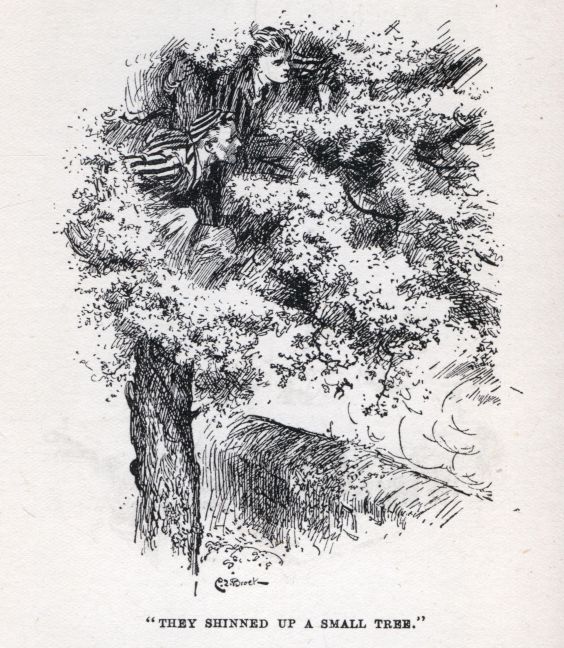
"THEY SHINNED UP A SMALL TREE."
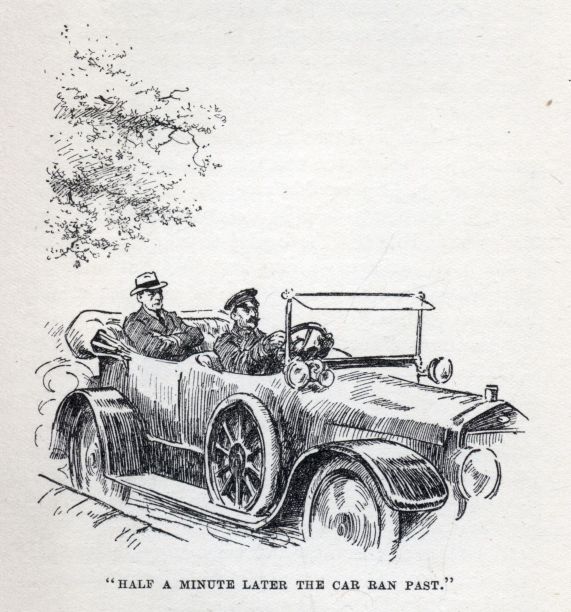
"HALF A MINUTE LATER THE CAR RAN PAST."
"The passenger is my uncle's secretary, I suppose," said Pratt. "I wonder which of the many nations of the world claims him? He might pass for an Englishman, but you can't tell from a fugitive glance when a man's clean-shaven."
"I thought he looked a decent sort of chap," said Armstrong, as they returned to the road; "not the kind of fellow to consort with a man like Rush."
"No. I dare say Rush is playing some game of his own with one of the underlings. I'll tell you my idea, by the way. Leaving us alone last night struck me as rather suspicious. They've probably got something in hand for to-night. Well, it occurred to me that if Rush comes prowling around our tent, with more tin-tacks or who knows what, it would be rather a good dodge to trip him up and collar him before he can hook it."
"He'll guess we're on the watch. No man would be such an ass as to suppose we'd let him do the tin-tack trick a second time."
"That may be. Very likely he kept off last night just for that reason. As you say, he'd guess we'd be on the watch, and probably thinks we're all jolly sick to-day because nothing happened, and won't be inclined to keep vigil again. Anyhow, if he does come again, he won't expect any danger until he gets near to the tent, and I propose to nab him before then."
"How?"
"Stretch a cord two or three inches above the ground just where the thicket ends at the edge of the clearing. He wouldn't see it, even by moonlight, because it would be pretty well hidden by the grass. But he'd be bound to catch one of his hoofs in it, and a lumbering lout like that couldn't pick himself up before any one of us three would be down on him."
"But how d'you know which way he'd come?"
"He wouldn't come across the clearing, that's certain. Well, the tent is about six yards from the thicket behind, and the edge of the thicket makes a sort of rough half-circle. A cord of fifty or sixty yards would be plenty long enough. I dare say we'll get one at old Blevins's shop. We'll pay him a call on the way back."
The shop was unattended when they entered it, but a rap on the counter brought Blevins himself, wearing the polite tradesman's smile.
"Good-morning, Mr. Blevins," said Pratt. "You've a motor-car for hire, I believe?"
"Well, yes, sir, I do have as a rule, but 'tis out to-day. In fact, I don't know when it will be back. 'Tis hired for the Red House, Mr. Pratt's being under repair."
"Ah! that's a pity. We'll have to put off our joy-ride. Well, it can't be helped. Perhaps you could let us have a skipping-rope instead?"
"A skipping-rope, sir?"
"Yes. Didn't you know? Skipping is one of the most beneficial exercises any one could indulge in. It brings into play I forget exactly how many muscles, develops a perfect co-ordination between the brain, the eye, the hands and feet; and if you ever go to Oxford, I dare say you'll see on any college lawn all the brainiest men of the rising generation skipping about under the eyes of their revered tutors. If the mountains could skip like rams, as we're told they did, there's nothing surprising in a future Prime Minister skipping like a giddy goat, is there? And there are hundreds of future Prime Ministers imbibing the milk of academic instruction at Oxford to-day."
Blevins had listened with a stare of puzzlement. The short, chubby youth appeared to be serious; his companion's face showed no flicker of a smile; yet the general dealer, remembering what his assistant had told him, had a dim suspicion that he was dealing either with a joker or with a lunatic. To get rid of his dilemma he confined himself to the severely practical.
"Well, sir," he said, "I don't keep skipping-ropes as such, but I've a cord which the neighbours do make clothes-line of."
"The very thing!" cried Pratt. "We haven't made any arrangements about our washing, and, as laundry prices have gone up beyond all bearing, we may have to do our own. Of course we shall want a clothes-line for hanging out our shirts and things on, and as my friends are regular nuts, and possess a very extensive wardrobe, we shall want a long line--quite fifty yards. Add ten yards for a skipping-rope, that makes sixty; we'll take sixty yards, Mr. Blevins; and as you can't possibly make a neat parcel of that, you'd better twist 'em round the hefty frame of my friend here; sort of bandolier, you know."
The man proceeded to measure out the cord from a bale which he rolled from his back premises.
"You be camping on No Man's Island, 'tis said," he remarked.
"We are," replied Pratt. "We're followers of the simple life; fresh air, cold water, and plain fare. We drink nothing stronger than ginger-beer, and eat nothing more luxurious than macaroons, and I suppose we can't get even them in a place like this? What's the consequence? We never have bad dreams, like people who stuff themselves and sleep in stuffy rooms."
"And you haven't been troubled by the sounds, sir?"
"What sounds?"
"Well--some folks do talk of terrible groans they've heard if so be they've rowed past the island by night, and 'tis said the place is haunted by the spirit of the old gentleman as used to live there."
"He hasn't disturbed our rest, I assure you. I dare say he's been soothed by my banjo; I usually tune up a little before I go to bed. You play the banjo yourself, I hear; you know how grateful and comforting it is--sweet and low, not like the squeaking scrape of the violin, or the ear-splitting blast of the cornet. I think you're a man of taste, Mr. Blevins, and as a fellow-musician I congratulate you.... That's sixty yards? Now, Armstrong, stick out your chest, and Mr. Blevins and I between us will rig up your bandolier."
When they had left the shop, Pratt asked: "I say, what's he mean by those old groans?"
"I heard a sort of moaning the night I first saw the cottage," Armstrong replied; "but I put it down to the wind, of course."
"There's been no wind to speak of since we settled on the island. I'd like to hear those sounds. Strikes me they're an acoustical phenomenon. Sure it wasn't an owl?"
"Nothing like it; the note was deeper and more prolonged."
"Well, if it's the wind in the eaves the sound will be heard by day as well as by night, and I'll trot over to the cottage the first breezy morning and listen."
Warrender had nothing to report when they regained the camp. He thought well of Pratt's idea of a trap, and they spent the greater part of the day in cutting a number of stout pegs from saplings in the woods. These they drove into the ground, at intervals of a few feet, in a long semi-circle at the edge of the clearing, and stretched the clothes-line upon them about six inches from the ground. One or other of them kept a careful look-out while the work was in progress, and nothing was seen of Rush or any other human being. Before dusk the task was completed, and they had provided themselves in addition with stout cudgels.
It was Pratt's turn to take first watch that night. On the previous night each had sat out in the open, but it occurred to Pratt that a better place would be just within the tent. Accordingly, when the others encased themselves in their sleeping-bags, he posted himself on his chair at the entrance, shaded from the moonlight by the projecting flap.
More than two hours had passed; he was growing sleepy, frequently glancing at his watch to see when it would be time to awaken Warrender. Just before half-past eleven he heard a slight sound from the thicket on his right. Seizing his cudgel, he looked in the direction of the sound. The edge of the clearing on that side was deep in shadow. He stood up; it might be a false alarm; he would not awaken his companions.
Suddenly there was a heavy thud, followed by smothered curses. Pratt dashed out of the tent and across the clearing. At the edge of the thicket a man was struggling to his feet. Even at that moment Pratt was too much of a sportsman to use his cudgel. He closed with the man, gripped him by the collar, and hauled him into the moonlight, crying, "What are you doing here?" The man attempted to wriggle loose. Pratt dropped his cudgel, got a firm grip with both hands, and with a dexterous use of his knee threw the intruder heavily to the ground. Next moment he was struck violently on the left side of his head, and fell half-stunned.
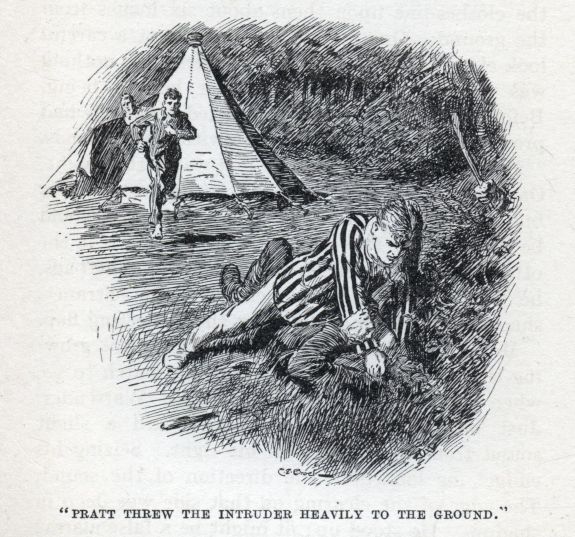
"PRATT THREW THE INTRUDER HEAVILY TO THE GROUND."
Meanwhile the sounds had wakened Armstrong and Warrender. Heaving themselves out of their sleeping-bags they rushed in their pyjamas across the clearing. Pratt was sitting up, dazedly rubbing his head.
"What's the row?" asked Armstrong.
"Diamond cut diamond," murmured Pratt. "Help me up, you fellows. Everything's whirling round."
They helped him back into the tent and sponged his head. Presently he was able to tell them what had happened.
"Was it Rush you collared?" asked Warrender.
"No, a bigger man, with a broad face, high cheekbones, and a bent-in nose."
"The face I saw in the thicket!" exclaimed Armstrong. "Who was the other chap?"
"I don't know. I didn't see him, confound the fellow! Just my luck! And it was my scheme!"
CHAPTER X
A SOFT ANSWER
There was no more sleep that night for any of the party. When Pratt's bruised head had been bathed and bandaged the three placed their chairs at the tent entrance, and sat in the still, warm air, discussing the situation more seriously than they had yet done. They had learnt definitely from the recent incident that at least two men were concerned in the campaign of petty annoyance. One of these--the man whose face Armstrong had seen in the thicket--looked like a foreigner, and apparently either lived somewhere on the island or had means of reaching it from the mainland. What more probable than that the second man was Rush, and that his boat was placed at the foreigner's disposal?
"The more I think of it," said Warrender, "the more likely it seems that Rush and one of the foreigners are playing some private game of their own. I haven't a notion what the game is, but I can't believe that Pratt's uncle left instructions to worry trespassers on an island that isn't his, or that any decent fellow in his secretary's position would encourage it."
"That assumes the secretary is a decent fellow," remarked Armstrong.
"Well, why not?" asked Pratt. "A man may be mad without being a fool, and my old uncle, though he's mad enough to hate English servants, wouldn't be such a fool as to engage foreigners without inquiring about their characters."
"That fellow Armstrong knocked down wasn't an attractive specimen," said Warrender.
"He was drunk," said Pratt. "Some of the most estimable characters--the most respectable of English butlers, for instance--may now and then take a drop too much."
"That fellow is a sot," said Armstrong. "It's marked all over him."
"Well, I tell you what I think we had better do," said Warrender. "Go up to the house, see the secretary, and put the case to him. If he's a decent fellow, and the man you tripped, Pratt, is one of his crew, he'll put a stop to this foolery. Will you go up with me to-morrow?"
"Better take Armstrong," Pratt replied. "If my uncle were at home I'd go and beard him, and jolly well tell him a few things for his good. But I'd rather not show up in his absence. Besides, I shall have a head to-morrow, and a swelling the size of a turnip. I feel the growing pains; I'll be fit for nothing."
"Rough luck!" said Warrender, commiseratingly. "Very well. Jack and I will go, and I dare say that'll be the end of our troubles."
At nine o'clock next morning Armstrong and Warrender rowed off in the dinghy; at a quarter to ten they entered the grounds of the Red House. The paths were weedy, the grass untrimmed, the flower-beds untidy.
"The foreigners don't overwork," remarked Armstrong, as they walked along the drive towards the house. "The place is a disgrace to the neighbourhood."
"It certainly looks very much neglected," said Warrender. "The house might be uninhabited but for that smoke from one of the chimneys, and the car waiting at the door."
"The same car Pratt and I saw yesterday. It belongs to old Blevins. I wonder whether they use it for joy-riding, or what? The secretary may be away, by the bye; yesterday he went off with a trunk."
"A nuisance if he is. But we'll see."
The front of the house faced south-east, and the drive wound from the gate in a wide arc to the left. The lower windows were shuttered; at some of those on the upper storey the blinds were drawn; but as the visitors approached there appeared at a small upper casement on the side of the house facing them the form of a woman, At first it seemed that she had not seen them; she stood looking out in an attitude of idle immobility. They could not distinguish her features through the small square panes of the casement; she was stout in build, and dressed in the print of a domestic servant.
Suddenly, as her eyes fell on them, she gave a perceptible start. She turned her head quickly from the window, as if to see whether any one was behind her; then raised her hands, apparently to undo the catch. Next moment she dropped them with a gesture of impatience or despair. The boys saw her shake her head, and, lifting an arm, make a sweeping movement with it towards the rear of the house. A moment later she left the window hurriedly, as a servant might do in answering a call.
"Rummy!" said Warrender. "That's Rogers's sister, I suppose; wife of the chef, you remember. What did she mean?"
"It looked as if she wanted to open the window and couldn't," returned Armstrong. "She wanted to speak to us."
"That movement of her arm--was it a warning to us to go away?"
"Too late in any case. That's the secretary coming out; he's seen us."
The dapper little man whom Armstrong had seen on the day before, dressed as he was then, was hurrying down the steps from the front entrance when he caught sight of the boys. He stopped short, gave a swift glance behind him, then descended the remaining steps and came towards them. His movements were quick, his step was light, and as he drew nearer they were aware of a very vivid personality, accentuated by dark eyes of great brilliance, set rather closely together.
"Yes, gentlemen," he said, smiling, "what can I do for you?"
His voice was low and smooth; the intonation, rather than the accent, alone suggested a foreign origin.
"Can you give us a few minutes alone?" said Warrender.
The chauffeur had just come down the steps, carrying a box, and stood with it still in his arms, beside the car, looking on with an air of startled curiosity.
"Certainly," replied the man, "if it is only a question of minutes. As you see, I am about to drive out, and my time is short. Henrico"--he addressed the chauffeur--"put the box down and go into the house. Now, gentlemen."
"You are Mr. Pratt's secretary, I believe," said Warrender, feeling a little awkwardness in the situation, and wishing that the voluble banjoist were in the office of spokesman instead of himself.
"Yes. My name is Gradoff--Paul Gradoff."
"Well, Mr. Gradoff, I'm sorry to trouble you, but you may be able to throw some light on a puzzle that's rather annoying to us."
"Anything I can do----"
"We are camping on the island over there, and ever since our arrival have been the object of annoying and--I'm afraid I must say--malicious attacks. We have reason to believe that one of the aggressors is not an Englishman, and knowing that your staff here is largely foreign, we have come up to--to----"
"Complain?" suggested Gradoff, as Warrender hesitated.
"Well, rather to ask if you can help us," Warrender went on. "I should explain that we fell foul of one of your men on the evening of our arrival, and it occurs to me that he, or one of his mates, may be retaliating."
"Ah yes; I had heard of that little matter from my man, Jensen," said Gradoff, suavely. "You could hardly expect him to be amiable, could you? He was insulted by a yokel, very properly chastised him, and was then suddenly set upon by one of you young men, and before he could defend himself was seriously hurt."
"That's nonsense, Mr. Gradoff!" exclaimed Armstrong. "The man dealt a foul blow, and I stepped in."
"It was you?" rejoined Gradoff, in his suave, smooth tones. "The version is different: tot homines tot sententiæ--being students you will recognise the allusion. It is so very difficult to reconcile conflicting stories, especially in common brawls. But, come; it is not like Englishmen to make a fuss about trifles, and Olof Jensen is not the man to bear malice. If that is the sum of your complaint----"
"But it is not," Warrender broke in, nettled by the Russian's suavity and his Latin. "We hadn't been twelve hours on the island when our motor-boat was set adrift----"
"My dear young man, quandoque dormitat Homerus--you will correct me if I do not quote accurately; my schooldays, alas! are a distant past. Even the most experienced sailors--and I am far from saying I do not include you among them--may tie a careless knot; make a slip, as you English say. And the current is strong when swollen by the rain. Really, my dear sir----"
"At any rate tin-tacks don't rain from heaven. We had a shower of them over our tent one night, and in the morning----"
"Latet anguis in herbâ! Come, come; you were dreaming. I am told that in the past the island was a favourite resort of trippers, a class of people who reprehensibly leave behind them much rubbish--paper bags, bottles, tin cans; why not tin-tacks?"
Warrender was fuming, irritated by his lack of evidence as well as by the secretary's manner. He wished that he had ignored the minor incidents, and confined his statement to the latest.
"We'd no proof--I know that--till last night," he said. "A fellow tripped over a rope snare we had rigged up. One of us caught him, and knocked him out; he was clearly a foreigner----"
"And you have him in custody? Ah, now we are getting to something substantial! He was a foreigner; on the principle ex pede Herculem--you recognise the proverb?--you infer that he belongs to my staff. And you did not bring him with you for confrontation?"
"He was rescued by----"
"By another foreigner?"
"We don't know who by; he gave my friend a blow from behind."
"That is more serious, truly. But what do you tell me? You are camping on the island--with permission? No, of course not; is it not No Man's Island? Well, what is no man's is all men's. What more likely than that others are camping there also? One of them falls over your rope, and is knocked out by your friend; your friend is, in turn, knocked out by a friend of the tripper. It is the lex talionis--the term is familiar to you? That, of course, is only a theory, but I commend it to your consideration. And now, I take it, I have the sum of your complaints. I put it to you, do they make a case against my staff?"
"I wasn't making a case against your staff," said Warrender. "I merely stated the facts."
"But with a bias; yes, with a bias, natural enough to youth and hot blood. I do not blame you; but you will agree that I am somewhat concerned for the good name of the men under my charge. Lest you should still harbour doubts about them, I will summon them. You shall see them. They number four. There is Jensen, the Swede, whom you, sir"--turning to Armstrong--"so unhappily misjudged. But you shall see them all. There is a woman, too, the wife of the chef, an amiable countrywoman of yours. It is perhaps not necessary to summon her? You do not suspect her of sowing tin-tacks or falling over your rope?"
He smiled, and without waiting for an answer went to the open house-door and called his chauffeur, to whom he gave instructions. Meanwhile, the two boys, chafing under his politeness with its touch of irony, exchanged looks of silent sympathy.
"The men will be here immediately," said Gradoff, rejoining them. "What a delightful summer we are having! Per æstivam liquidam--you remember the line? How I envy you your daily browsing on the Classics! Ah, here come the four suspects! Two, you perceive, are tall; two are short. I will align them in order of their heights, as they do in your army, I believe. Halt, men! Stand in line: Jensen at one end, then Radewski, then Prutti, last of all, Rod. Now, my dear sirs, inspect the company."
"There's no need," said Warrender. "We've seen them all in or about the village. None of these is the man you saw, Jack?"
"No," replied Armstrong, shortly.
"But darkness, even moonlight, is deceptive," said Gradoff, in his suavest manner. "Really, I am concerned to convince you thoroughly; I should regret your going away harbouring the least particle of suspicion. I will interrogate them in turn. Jensen, you do not amuse yourself by sowing tin-tacks on No Man's Island?--Jensen, I may explain, is Mr. Pratt's horsekeeper, in particular, and handy-man in general. Well, Jensen?"
"Nope," replied the man, gruffly, eyeing Armstrong with a scowl.
"And you, Radewski?--Radewski is the gardener." The boys recognised him as the passenger in the car that had collided with the farm-wagon.
"No, of course not," answered the Pole, smiling.
"And now you, Prutti?--the chauffeur, as you see."
"It is silly, stupid; I say ze question----" began the Italian, volubly.
"Yes, yes; but I want no comments. Just say yes or no," Gradoff interrupted.
"No, zen; I say no. I say ze question----"
"He comes from the south, gentlemen," said Gradoff, deprecatingly. "Now, Rod, what have you to say?"
"Sacré nom d'un----"
"Now, now. Maximilien Rod is the chef, gentlemen, accustomed to the use of the diction of the menu. Plain English, Rod, if you please."
"Zen I say zat ze man vat accuse me of so imbecile, so--so--so----"
"Contain yourself, Rod. Yes or no?"
"No, no; not at all--no!"
"Four negatives do not make an affirmative," said Gradoff, turning to the boys, and smiling with the persistent urbanity they were beginning to detest. "These are all my staff--with the exception of the excellent woman, Rod's wife. Would you like to pursue your inquiries?"
"Thank you, it is unnecessary," replied Warrender, in as even and polite a tone as he was master of.
"Then the men may return to their duties, and I may begin my journey. May I give you a lift as far as the cross-roads? Or, stay! You are here very near the river. You may prefer to take a short cut through the grounds, and avoid the long walk on the dusty road."
"Thank you," said Warrender, ready to accept any suggestion that would remove him quickly from the presence of Mr. Gradoff; "if some one will show us the way."
"Certainly. Quite a happy thought," said the Russian. He called to the chef, the rearmost of the party filing away. "Rod, show these gentlemen the shortest way to the river; bring them opposite to the island. Good-morning, gentlemen. I am sorry you have found me a broken reed. But I do hope your holiday will not be spoilt; I have such keen memories of my own happy holidays--liberatio et vacuitas omnis molestiæ: you remember your Cicero? Good-morning."
He sprang into the car, in which the chauffeur was already seated, and with a smile and a wave of the hand was driven away.
CHAPTER XI
INFORMATION RECEIVED
"Sarcastic swine!" muttered Armstrong, savagely, as he set off with Warrender behind the rotund little chef.
"So confoundedly polite I could have kicked him," returned Warrender, in the same undertone. "His beastly Latin, too! What did he take us for?"
"What we are--a couple of mugs. And Pratt's worse, with his absurd theories. Of course these chaps aren't in it. Rush is at the bottom of it, and the other fellow, though he looked like a foreigner, is very likely only some ugly freak of a Devonian after all."
"Well, I'll be hanged if I stand any more of Rush's nonsense. Next time anything happens, I'll get old Crawshay to set that bobby moving we saw the other day. I'm sick of it."
Ill-humour had for the moment got the upper hand, and they were conscious only of their soreness as they followed their guide through the unkempt grounds. Their attention was attracted presently by the tower that reared itself out of a thicket some little distance on their left. It was a square much-dilapidated building of stone, encrusted with moss and ivy, reaching a height of some fifty or sixty feet. The window openings were boarded up with deal planks that were evidently new.
"Is the tower used for anything now?" Warrender asked the Swiss.
"Ze tower? No, it is ruin, fall to pieces," replied the man.
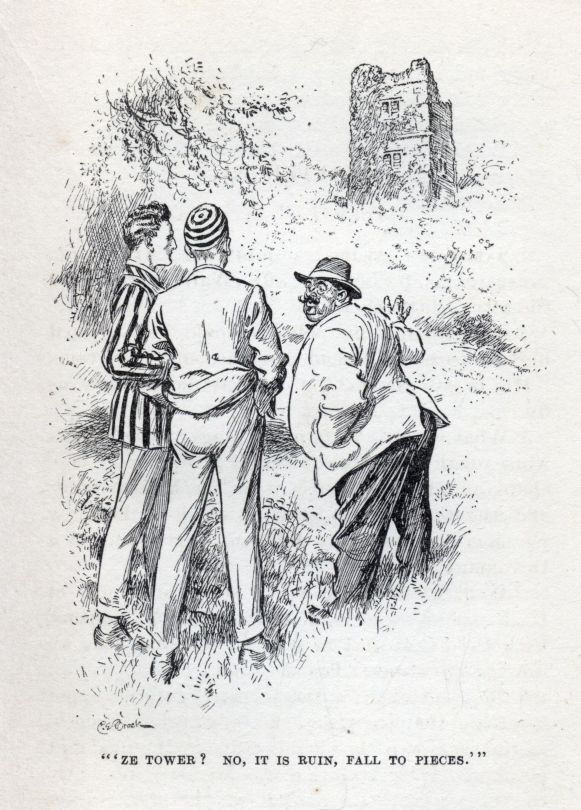
"'ZE TOWER? NO, IT IS RUIN, FALL TO PIECES.'"
"I say, we are a couple of lunatics!" cried Armstrong. "We've left the dinghy at the ferry. What's the good of the short cut? Pratt can't work the motor."
"Hang it! I'd clean forgotten."
"Zen ve go back?" said the guide, eagerly. He had come to the end of the open grounds; the rest of the way lay through a wilderness of shrubs that promised laborious walking.
"No, I'm hanged if we do," said Warrender. "Now we've come so far we'll not go back."
"Zen how you cross ze river?"
"Swim it. You needn't come. We'll forge straight ahead. Thanks."
He tipped the man, and plunged with Armstrong into the thicket. Ten minutes' battling with the intricately woven mass of greenery brought them to the brink of the stream almost exactly opposite to their camping-place. They stripped, bundled their clothes upon their heads, and made short work of the thirty-foot channel.
"My aunt! In native garb!" cried Pratt, as they walked up still unclothed. "'Here be we poor mariners.' Shipwrecked? Lost the dinghy?"
"No, only our tempers," replied Armstrong. "The dinghy's still at the ferry."
"I say, my uncle hasn't got back, has he?" asked Pratt.
"No. Why?"
"I thought perhaps you had met him, and got a taste of his temper, that's all. 'Tell me not in mournful numbers'--but tell me anyhow you like the cause of this Ulyssean exhibition."
Warrender began the narrative as he towelled himself, continued it through his dressing, and concluded it when he had dropped into his chair by Pratt's side. Pratt listened with ever-growing merriment.
"You priceless old fatheads!" he exclaimed. "When the beggar chucked Latin at you why didn't you pelt him with Greek, Phil?--or with sines and hypotenuses, and all that, Jack? Don't you remember how some Cambridge josser floored a heathen bargee by calling him an isosceles triangle? I wish I'd gone."
"I wish you had!" echoed Warrender. "But when a fellow's so dashed polite----"
"Polite! I tell you what it is: you're both too serious for this flighty world. When you consider that it's gyrating at the rate of I don't know how many thousand miles a minute, it's unnatural, positively indecent, for any one to be so stuggy. The art of life is to effervesce. But, you know, the important feature of your morning's entertainment seems not to have sufficiently impressed you."
"What's that?" asked Armstrong.
"Rod's wife. Cherchez la femme! You oughtn't to have come away without having had a word with her."
"How on earth could we?" said Warrender. "We weren't asked into the house, and if we had been----"
"My dear chap, if a fair lady beckoned to me out of her casement window I'd find some means of receiving her behests. Rod's wife, née Molly Rogers, didn't make signs to you for nothing, and I foresee that I shall have to turn our skipping-rope into a rope ladder, and----"
"Oh, don't go on gassing," Armstrong interposed, irascibly. "Can't you be serious?"
"Solemnity itself. We've got to fetch that dinghy. I want to go to the post office. Very well, after lunch Phil shall run me up in the motorboat. I'll have a word with Rogers on the way, and I bet my boots I won't come back without some little addition to our dossier."
Pratt's programme was carried out. Warrender and he found Joe Rogers pulling spring onions in his garden behind the inn. The man had placed his wig on a pea-stick, and his bald pate glowed in the sunlight like a pink turnip.
"Good-afternoon, Joe," said Pratt, genially. "I wonder how it is that you sailormen so often take to gardening when your sea days are over?"
"I can't tell 'ee, sir, 'cept it be as we loves the look o' vegetables, being without 'em so long at a time. The old woman do say it keeps me out o' mischief."
"Now, Rogers," called his better half from an upper window, "put on your hair this minute. Drat the man! Do 'ee want to catch your death of sunstroke?"
Rogers gave a sly look at his visitors as he donned his wig.
"It do make my skull itch terrible," he said. "But she's a good woman."
"I jolly well hope I shall be looked after as well when my time comes," said Pratt. "But I'm not thinking of matrimony yet. What age did you marry at, Joe?"
"Thirty-one, just the same age as my sister Molly, but not in such a hurry. My missus took a deal o' courting; 'twas five years' hard labour; whereas Molly give in in less than a month."
"He came, he saw--he conquered. Must be something fascinating about him. Has she lost her cold, by the way? My friends happened to see her this morning."
"Well now, if that ain't too bad. She haven't been nigh me for a good fortnight, and she didn't ought to go about the village without looking in."
"They saw her at the house. She seemed to be catching flies or something at the window. I gather you don't like her husband."
"I've nothing against him, 'cept his name and furren nature. My missus told her she was cutting a rod for her own back."
"Surely he doesn't beat her?"
"That wasn't her meaning. Rod's his name, and the missus do have a way of taking up a word and twisting of it about, you may say. 'A rod in pickle,' says she. 'Tis just a clappering tongue; there's no sense in it. But it do seem as Molly have turned her back on all her old friends. 'Tis like this: they furriners bain't favourites in the parish, and Molly sticks to her husband, as 'tis her duty. That's what I make of it."
"Well, I dare say she chose the pick of the bunch. How many are there of them, by the bye?"
"Four, leaving out the secretary. They don't go about in the village much. None of 'em comes here 'cept that feller you saw t'other day, and he don't come often. I don't get no good of 'em. 'Twas different in the old days."
"Things will take a turn," said Pratt, consolingly. "When my--when Mr. Pratt returns I dare say he'll quarrel with the foreigners, and get English servants again."
"And be ye all right on the island, sir?"
"Having a ripping time. We're always on the look-out for the ghost, but he seems rather shy. I can sympathise with him, being so bashful myself."
"You do seem to have a bit of a bump one side of the head, sir. No inseck have been poisoning 'ee, I hope."
"No. Insects love me too well to disfigure me. I'm inclined to think it was a worm, or something like a leech, perhaps. It's a trifle; a molehill, not a mountain. To-morrow both sides will be equal, and the angles subtended at the base as right as ever. Good-bye; keep your hair on."
"Well, old man, we've spent a profitable quarter of an hour," said Pratt, as he went on with Warrender to the village. "The number of Gradoff s staff is confirmed; therefore the chap I collared is not one of them. As to Rod's wife, there's no mystery about her. She's disgusted, as any sensible person would be, at the petty narrow-mindedness of the natives who dislike her husband simply because he's of another breed, and so she cuts 'em dead."
"But what did her movements at the window mean?" asked Warrender. "It certainly looked as if she wanted help or something."
"Nothing of the sort, depend upon it. She was waving you off; she's as careful of Rod as Rogers's missus is of him; she was afraid Armstrong would go for Rod as he went for the Swede. I'm always ready to own up when I'm wrong. My old theories won't hold water. I think I'll give up detecting and go in for the Bar. You only have to stick to your brief; needn't have an idea of your own."
"Well, it seems to me we're not much for'arder."
"Quite a mistake. The issue is narrowed down. Clear our minds of the foreign menagerie and all that, and concentrate on Rush. That's the ticket."
Calling at the post office, he was handed a letter from his London friend, who reported that the scrap of paper was torn from a copy of the Pravda. Only part of the date of issue was visible--the word June; and the incomplete paragraph of text appeared to relate to the high prices of perambulators.
"There you are," said Pratt. "Much cry and little wool. It proves nothing except that some one, some time or other, had a Russian newspaper, which was partly burnt along with other papers, no doubt equally uninteresting and unimportant. What we have to do is simply to weave a spider's web for Rush."
"You change your mind twice a day, and are cock-sure every time," Warrender remarked.
"A clear proof that I ought to go in for politics, after all. I'm glad it's settled at last. Percy Pratt, M.P.--reverse 'em, you get P.M., Prime Minister; then Sir Percy, Bart.; Baron Pratt, Viscount, Earl--why not Duke while I'm about it? But do dukes play the banjo, I wonder?"
"You're better qualified for the part of Mad Hatter, I fancy. Come, let's step it out."
The evening of that day turned out rather cool and overcast. A breeze sprang up in the south-west, refreshing after the still heat. After early supper, Armstrong, declaring that he was getting flabby for want of exercise, set off in the dinghy for a pull down the river. Pratt thought it a good opportunity for testing Armstrong's report of the sounds he had heard in the cottage, and went off alone, leaving Warrender on guard at the camp.
He had not yet come within sight of the ruins when, above the rustle of the stirred leaves, a strange moaning broke upon his ear. He stopped to listen. While far more impressionable than Armstrong, he had solid musical knowledge which his schoolfellow lacked, and he was struck at once by an unusual quality in the sound he heard.
"That's not the wind in the eaves," he thought. "It's more like the whining of an organ pipe when a lazy blower is letting the wind out."
He hurried on. The sound rose and fell. For some moments it maintained a steady, pure organ note; then with rising pitch it became almost a shriek.
"I don't wonder the rustics are a bit scared," he thought, "but no ghost could produce a tone like that--unless he'd been a cathedral alto in his lifetime. It's due, I expect, to some metal chimney-pot that's got displaced and partly closed. Wonder if I can find it?"
He entered the ruins, and ran up the staircase. A roseate twilight suffused the western sky. Led by the persistent sound, he came to the unroofed room facing the west. The moaning proceeded from some spot above his head. He tried to clamber up the mass of broken masonry that littered the floor, but found that he could not gain the level of the roof except by climbing the jagged brickwork of the broken wall, a feat too perilous in the half light.
"That's the worst of being fat," he said to himself. "I believe Armstrong could do it."
Leaving the room presently, he went idly, without definite motive, into the second room, facing east and overlooking the river and his uncle's grounds. In this direction dusk was already deepening into night; the nearer trees were still distinguishable, but beyond the river all individual objects were blurred by the darkness.
He sat on the paneless window-sill, listening to the strange sound from above, looking out towards the Red House, wondering whereabouts in the wide world his uncle was travelling. All at once, far away, almost on a level with his eyes, he thought he saw a faint red glow. It disappeared in a moment--so quickly that it seemed an illusion. But there it was again, indubitably some small luminous body. "Some one with a lamp in one of the top rooms of the Red House," he thought. Again it disappeared, only to show again after an interval--a third time--a fourth.
To Pratt these phenomena were at first merely sensations of sight, not perceptions of intelligence. But by and by he was struck by the fact that the glow always appeared at the same spot, not here and there, like a lamp carried by a person moving about a room. Then he found himself mentally measuring the intervals between its appearances, expecting their occurrence as regularly as the beats of a striking clock. It was with surprise and a sort of disappointment that he discovered that the intervals were irregular, and with curiosity, after a while, that they were regular and irregular both, as it seemed, fitfully; the glow appeared two or three times at equal intervals, then the intervals became shorter or longer. "Signals, of course," he thought, when the impression of order and purpose became fixed in him. "Who is it? Where is it? What's the game?"
The alternations continued for several minutes, then finally ceased. Pratt got up, left the ruins, and made his way with some difficulty back to camp.
"Armstrong back?" he asked.
"Not yet," replied Warrender. "Time he was. This is the darkest evening we've had. See any one?"
"Not a soul. All quiet here?"
"Absolute peace. You weren't here."
"Thanks. Glad you missed me. Will the sweet, melodious strains of my gentle banjo disturb your serenity?"
"Not a bit. Strum away. But hadn't you better turn in? It's past nine. Old Jack won't get much sleep before second watch if he isn't here soon; no reason why you shouldn't have your full whack, especially after last night's affair."
"I'll stay up till he comes."
Pratt softly thrummed his strings, musing on his discoveries. Half-past nine came; ten o'clock.
"I say, what's happened to Armstrong?" said Warrender. "Surely he hasn't been carried out to sea? Come and help me shove off; I'll run down and see if I can find him. You won't turn in, so you won't mind taking part of my watch."
"Righto! But I dare say Jack's enjoying himself."
They were just about to launch the motor-boat when they caught the dull sound of oars in the distance. They waited. The rising moon struggled through the rack, and cast a faint light on the stream. Presently the dinghy appeared from among the overarching foliage. Armstrong was sculling very quietly.
"Thought you were lost," said Warrender. "It's past ten; your watch starts at eleven-forty."
"All right. Pratt, tie up, will you? Come with me, Warrender."
Armstrong led the way at a long, rapid stride across the clearing and into the thicket. He said nothing, and did not pause until he came to the shore of the western channel.
"Keep well behind this tree," he said, in a whisper, placing himself in shadow.
In a few minutes they heard the splash of oars. A boat emerged from the shades down stream, lit up fitfully by the transient moonbeams. It passed close beneath their hiding-place. It held a single oarsman, whose thickset frame would have been unmistakable even if the moonlight had not touched his face. He pulled out of sight.
"What's he been up to?" said Warrender.
"Let's get back," replied Armstrong. "I wanted a second witness. Pratt will wish to start a new career now, I expect."
CHAPTER XII
QUEER FISH
When Armstrong had started in the dinghy for a pull down the river his intention was to scull easily on the current to the mouth, then to turn westward, and exercise his muscles more strenuously in a contest with the wind. On reaching the coastline, however, he found that there was much more force in the breeze than had appeared inland, and a considerable swell on the sea, and he contented himself with hugging the shore, protected in some measure by the cliffs that swept round to a promontory in the distance.
After a stiff pull for half an hour or so he turned. The last faint radiance of sunset was behind him, and as he approached the river mouth, being himself shadowed by the cliffs, he noticed signs of activity about the fisher's hut on the beach beyond the farther bank. Two men were carrying what appeared to be fishing gear down to a boat at the water's edge. The weather seemed scarcely to promise good fishing, and, knowing from his friends that the hut was in the occupation, if not the possession, of Rush, he was sufficiently interested to decide upon watching the men's proceedings. He pulled a little more closely inshore, shipped his oars, and lay to under cover of a mass of rock.
In a few minutes the men got aboard the boat, and pulled out to sea in the direction of a small tramp steamer which was just visible on the eastern horizon, and, as the trail of smoke from its funnel showed, was coming down channel. It seemed to Armstrong a good opportunity for examining the hut; possibly he might find there some clue to Rush's mysterious activities. Assured that under the shadow of the cliffs he would be invisible to the boatmen, he pulled across to the opposite beach, and ran the dinghy ashore in a small, sheltered cove two or three hundred yards from the hut. Leaving the boat high and dry, he made his way back along the beach at the foot of the cliffs, and approached the hut, which stood on a rocky platform above high-water mark. As he neared it he was careful to keep it between himself and the boat at sea; Rush, if he were one of the two, was probably long-sighted.
By the time he reached the hut the boat was nearly a mile out, and the men appeared to be letting down a net. He slipped in through the open door, and threw a glance round the interior, seizing the last moments of twilight for his rapid scrutiny. He saw, as might have been expected, the usual fisherman's gear: old nets, lobster pots, cork floats, a broken oar, part of a rudder, an old sou'wester, baskets, ropes--nothing that had any particular interest or significance. But, just as he was about to leave, he noticed in the darkest corner half a dozen tins strung by the handles upon a length of trailing rope. Their shape suggested paraffin or petrol rather than any material useful to fishers; yet they were not the common petrol cans; they were larger and wider-necked than those that held the ordinary motor-spirit. He lifted one; it was empty, but very firmly corked, as likewise were the others.
Armstrong took one of the cans, stretching the rope, towards the door, to examine it more closely in what was left of the twilight. On the shoulder, enclosed in a panel, was an embossed description, the characters reminding Armstrong of the printed letters of the Russian newspaper.
"Rummy," he thought. "Gradoff, judging by his name, is a Russian, and the only Russian hereabouts. Yet we find a Russian newspaper in the cellar, and Russian petrol tins in Rush's hut. Queer!"
He replaced the cans, and left the hut. As he did so he saw, out at sea, the steamer he had noticed as a distant smudge some twenty minutes before. No smoke was now pouring from her funnel; apparently she had stopped or slowed down some distance beyond the small boat. While he was watching, the vessel went ahead. The small boat rowed farther out; then appeared to beat about for a time; finally stopped, and from the movements of the figures Armstrong saw aboard, they were lifting something from the water. The steamer, meanwhile, was proceeding steadily on her course down channel.
The growing dusk had rendered it impossible for the watcher to discern anything clearly; steamer, boat, and men were merely indistinct shapes. But the boat, without doubt, was the one that he had seen leave the beach; its movements were strange, and Armstrong decided to await its return. Who were its occupants? What was their errand? What were they bringing back with them?
The enlarging boat was evidently coming ashore. Armstrong looked rapidly around, and spied, close to the hut, and, between that and his own boat, a ridge of rock that would give him cover. Posting himself there, he waited. The dusk deepened. Presently he heard the faint, slow, regular thuds of oars in the rowlocks, then low voices. He could now discern the boat as a dark patch on the white crests of the rollers. It came steadily in, grounded; the two men sprang into the surf. The tide was going out. They did not haul the boat up, but lifted from it the bundles of gear and carried them into the hut. But there was no fish. They passed Armstrong's hiding-place near enough for him to recognise them. The first of them was Rush; the second--even in the dusk Armstrong knew again that broad, flat face. It was the face he had seen in the thicket--the face of the mysterious assailant Pratt had described.
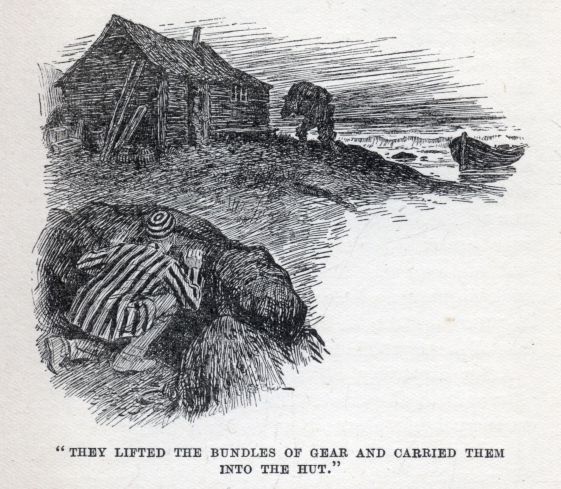
"THEY LIFTED THE BUNDLES OF GEAR AND CARRIED THEM INTO THE HUT."
After disposing of their gear in the hut, they returned to the boat. The stranger, a big man, came up again alone, bent under a bulky package, to which a string of petrol tins was attached. "Smugglers, by jiminy!" thought Armstrong. The package appeared to be encased in tarpaulin. The man halted at the door of the hut, let down his load, detached the cans, and waited. In a few seconds Rush joined him, helped him to hoist the package to his back, and bade him a gruff "Good-night." The man marched heavily up the beach to the east, towards a narrow rift in the cliff. Rush took the cans into the hut, shut and locked the door, and, with his hands in his pockets, moved slowly down towards his boat. Fearing that as he rowed back he might discover the dinghy in the cove, Armstrong hurried quietly away, shoved off, and had turned into the river when he heard the splash of Rush's oars. Pulling quickly but steadily, he was out of sight by the time Rush reached the mouth, and when he arrived at the camping-place guessed that he and Warrender could cross to the western shore of the island before Rush rowed past.
Such was the story Armstrong quietly told his companions as they sat on their chairs before the tent.
"Smugglers!" ejaculated Pratt, lowering his voice as if instinctively. "I thought the smuggling days were over long ago. D'you think Rush does a roaring trade in Dutch tobacco, and finds the foreign gang at the house good customers? Tobacco weighs light for its bulk. How big was the bundle, Jack?"
"Two or three feet square, I think," replied Armstrong. "But tobacco is light, as you say. I fancy this was something else, for Rush had to help the other fellow lift it."
"And he took it eastward up the cliff?"
"Yes, in the direction that would lead to your uncle's house, unless I'm out in my bearings."
"Well, I'm hanged! Won't my old uncle rave when he hears what his pet foreign domestics are up to in his absence! He's a terrible stickler for law and order, not the kind of man to wink at smuggling, as the county folk used to do in days of yore. That explains the light I saw."
"What light?" asked the others.
"I wended my way to the ruins to hear the spooks groan. They groan jolly well--a mellow note, mostly on B flat, I fancy, though it sometimes shrieks up a chromatic scale to what you may call vanishing point. Of course, it's caused by the wind, but what surprises me is how the wind can fetch such a musical tone out of a chimney-pot. It must be a tube of some sort, and what else could it be but a chimney-pot? I tried to find it, but that required an acrobatic feat too difficult for a man of my avoirdupois."
"But the light?" asked Warrender.
"Oh yes, I was forgetting! I was looking over towards my uncle's place when I saw a reddish sort of glow, just about the level of the tree-tops. It came and went, and presently it dawned upon my usually alert intelligence that it stood a good deal upon the order of its comings and goings; in fact, that it was a signal. It must have been just about the time that tramp steamer came in sight."
"But why on earth should anybody at the house, even if they are customers of Rush's, signal to the smuggling steamer?" asked Armstrong. "There aren't any revenue officers about here, and if there were any about the coast the people at the house wouldn't know anything about them."
"My dear chap, there are wheels within wheels," said Pratt, oracularly. "You have two contemporaneous phenomena--jolly good phrase, that!--the signal light, and the accosting of a tramp steamer by a poacher and a burglar. That's circumstantial evidence good enough for me."
"Well, drop theories, and come to practice," said Warrender. "Whatever the game is, we're going to find it out. It's time for us to take the offensive. These fellows have stalked us; it's now for us to stalk them. I vote we leave the island, and accept old Crawshay's offer. The enemy will chortle at having succeeded in driving us away, and will very likely be off his guard. Then we'll chip in."
"Just so; we'll reculer pour mieux sauter--you recognise the phrase, as your Gradoff would say? Your suggestion smiles to me, Phil. We carry it unanimously, and we'll strike camp the morn's morn. I say, listen!"
The wind had increased in force, and there came from the direction of the ruins the musical moan which Warrender, alone of the three, had not yet heard.
"'The horns of Elfland faintly blowing,'" quoted Pratt. "Really, it seems a pity, after all, to leave a spot which one can imagine the haunt of fairies, the seat of an enchanted palace, the----"
"Don't start the sentimental strain!" Armstrong interposed. "Suppose your horns of Elfland are a signal, too?"
"Jehoshaphat! What a synthetic mind you have, old bird! I shouldn't be surprised if---- But no! it won't wash. A signal that depended on the wind wouldn't be any good. Leave me some of my illusions, Jack. Let me revel in my romantic imaginings. Call it Roland's horn, appealing vainly for succour when the paladin was fighting fearful odds in the pass of Roncesvaux."
"I think you'd better turn in, old man," said Warrender. "It's your last watch to-night. We none of us got much sleep last night, and that crack on the head----"
"I'm cracked. All right--wake me at two-twenty."
He withdrew into the tent. His companions, tired though they were, resolved to keep each other company, and patrol the neighbourhood of the camp till it was time to awaken Pratt. Hour after hour passed. Nothing disturbed them. The wind increased to the force of half a gale, and the sound from the ruins persisted with scarcely a variation of pitch. When two-twenty came they agreed to let Pratt sleep on, and kept vigil until the eastern sky was streaked with dawn.
"D'you hear the sound?" asked Warrender, suddenly.
"No; it's stopped. But the wind is higher than ever," Armstrong replied.
"That's queer. The wind is in the same direction, too. Darkness and light oughtn't to make any difference."
"Perhaps it has blown the old chimney-pot clean off the roof. I'll go down and have a look presently. I'm dog-tired. We might take a couple of hours' sleep now, don't you think?"
CHAPTER XIII
FIRE!
About eleven o'clock next morning Warrender and Pratt landed from the motor-boat at the ferry, and, inquiring of the ferryman the way to Mr. Crawshay's house, struck up the hilly road that ran westward from the right bank of the river. Mr. Crawshay, it was true, had invited them to make straight for the house across the fields; but they had decided that it would be more becoming, on this first visit, to observe the customary forms.
The house stood amid well-kept grounds, about as far west of the river as Mr. Pratt's was in the opposite direction.
The apple-cheeked maid-servant who answered their ring announced that her master was out, and would not return till the afternoon. Disappointed, they were leaving when Lilian Crawshay, who had recognised Warrender's voice as she descended the stairs, called to them.
"You wanted to see my father, Mr. Warrender?" she asked, as they turned back.
"Yes; I'm sorry he's out, but we'll call again this afternoon."
"What a pity, when you have so far to go! Can't I give him a message? Won't you come in and see Mother?"
"It's very good of you, but we have some shopping to do in the village, or Armstrong will get no lunch. It will be no trouble to come again. We get up and down very quickly in the motor-boat."
"Well, then come up in time for tea. Father will be home then; he has only gone on some stupid business of quarter-sessions. And bring Mr. Armstrong with you. Mother was greatly interested in the 'Three Musketeers.'"
"Thank you very much."
"Good-bye, then, for the present. Tea is at half-past four."
"Why didn't you tell her we can't all come?" said Pratt, as they walked away.
"Because it's clear that the old man hasn't said anything about our affairs, and I couldn't anticipate him with explanations. We'll toss for the odd man."
On returning to the ferry Pratt went on to the village to make some necessary purchases, leaving Warrender to forestall gossip by informing Rogers of their change of plan. Warrender rapped on the door.
"Bain't opening time yet," called a voice from above. Mrs. Rogers's head appeared at an open window. "Oh, beg pardon; 'tis you, sir. We have to be that careful; Constable Hardstone be always on the prowl. You'll find Rogers in the garden, sir--through that little gate. And if so be you find he haven't got his hair on, I beseech 'ee to mind him of it; he's that careless of his brains, and I know they'll be broiled some day."
The innkeeper, with his wig awry, was pinching out his tomatoes. He smiled when Warrender told him of the projected removal of the camp.
"'Tis what I expected--ay, and all the village likewise," he said.
"We find the island a trifle inconvenient, you know," said Warrender, in pursuance of the understanding he had come to with his companions that their real reason should not at present be disclosed.
"Ay sure, that's what we all said. The neighbours wondered how long you'd stand it."
"Stand what?" asked Warrender, wondering whether any whispers of the truth had got abroad.
"Why, them sperits. Flesh and blood you can deal with, but when it comes to sperits they're bound to get the better of you, give 'em time. You can't get hold of 'em no way. Smite 'em, you might as well smite the wind. I've been here and there about the world in my time, and I tell 'ee I wouldn't spend a night on that island not if you doubled my pension."
"Well, we did hear some very queer sounds last night. Of course, it was very windy. I expected rain to-day, but it has cleared up. By the way, are there any coastguards about here?"
"There's Lloyd's signal station away at the point yonder. I go over now and again for a crack and a smoke with an old messmate of mine."
"How far is it?"
"Four mile or so. You go past Mr. Crawshay's, then sheer off to the left and get into the old coastguard track over the cliffs."
"I'll take a walk out there some day. We haven't seen much of the neighbourhood yet. There's no signal station in the village, of course."
"No; we're too far from the sea. Have 'ee heard what they're saying about Mr. Pratt, sir?"
"What's that?"
"Ah, poor gentleman. 'Tis feared he've gone a-lost, or been swallered by lions, or summat. 'Tis the end of many a poor traveller."
"Why do they fear that? Is there any news?"
"No; that's where 'tis; there be no news at all. 'Tis five weeks since he went off, not a soul knowing, as his way is; and Susan Barter up at post office was saying only yesterday that there's not been a single line from him to any o' they people at the house. 'Tis never been knowed afore. As a rule there's a letter from Paris, or Marseilles, or Brindisi--ay, from places farther away; but this time not a line. He'll be missed in the parish, sir, if so be he've gone aloft, like poor Tom Bowling."
Rogers proceeded to relate anecdotes of his landlord--instances of his peppery outbursts and splenetic quarrels with his county neighbours, but more of kindly deeds and unobtrusive generosity among his poorer tenants.
"And your friend be his nephew, to be sure!" he added. "Well, don't worrit the poor young gent yet awhile. No news is good news; maybe there'll be word of him one of these days. Susan Barter is sure to tell us."
Presently Pratt returned, laden with sundry parcels. The boys took leave of Rogers, and by half-past twelve were back in camp. Armstrong had nothing to report. He declined at first to make one of the tea-party, but when the spin of a coin elected him against Pratt, he yielded to Warrender's argument that it would appear discourteous if only one of them accepted the invitation. Promptly at half-past four the two, wearing grey flannels for the occasion, entered the grounds of Mr. Crawshay's house, and were met on the drive by the owner himself.
"Glad to see you, my lads," he said, heartily. "You've something to tell me? I guessed it. Now, not a word before the ladies. I haven't told them anything of your troubles; best not to disturb them, you know. We'll have a talk in private, after tea."
The consequence was that presently Armstrong found himself left in the company of Mrs. Crawshay and her daughter, while Warrender was taken by Mr. Crawshay to his study.
It had been decided that nothing should be said to the old gentleman about the visit to the Red House, the mysterious doings of Rush at sea, or the strange light Pratt had seen among the trees. Determined as the lads were to probe the mystery to the bottom, they felt that their purpose might be defeated by any premature activity on the part of the county magistrate. Accordingly, when Mr. Crawshay and Warrender were seated in deep armchairs facing each other, and the former said, "Now, my lad, what is the latest news?" Warrender simply related the incident of the midnight visit to the camp, concluding--
"And so, sir, we have decided to accept your offer of a camping-place on your land, not merely to escape these annoyances--we should rather like to hold our ground in regard to them--but because we think we should stand a better chance of discovering what really is going on."
"Ah, what does that mean? There's more in it than appears?"
"If you don't mind, sir, I won't tell you details now; but we have found out one or two facts that have given rise to certain suspicions. By removing from the island we feel that we shall be better able to put them to the test, and when our information is complete we will lay it before you."
"Well, I won't press you. Many a rogue has escaped justice because the case against him has been badly prepared. Tell me all in your own time. Now as to your camp. There's a little natural dock in my bank of the river. I'll put on my gardener and odd man to make a small clearing for you. It's too late to-day; the men knock off at five--eight hours' day, you know. But you can bring your boat up the river, and put up for the night with me."
"Thank you, sir; but we have a little errand at the signal station before we go back--it might be rather late before we could get everything packed up. I think we had better wait till the morning."
"Very well. You may have fresh light on the matter then. I shall expect all three to lunch to-morrow. On my land you won't need to guard your camp."
Taking leave a little later, the boys walked across the cliffs to the signal station. On inquiry from the man in charge they learnt that the steamer seen late on the previous evening was the Katarina, from Helsingfors for New York.
"Did you notice a small boat pull out to her?" asked Armstrong.
"Rush's boat," replied the man. "It didn't pull out to her; 'twas out before she came in sight. Rush has some lobster pots out there. He's a well-known character in these parts."
They thanked their informant, and retraced their steps.
"She was a Russian boat," remarked Armstrong. "No secret about her name or course. All the same--a Russian newspaper, a Russian secretary at the Red House, Russian petrol cans, a Russian steamer. Queer coincidences, at the least."
It was nearly eight o'clock when they regained the camp. Pratt was humming "I dreamt that I dwelt in marble halls" to the accompaniment of his banjo.
"And how is the fair lady of the punctured tyre?" he asked. "Did she deplore my absence?"
"She did say something about 'that amusing Mr. Pratt,'" Armstrong replied. "I like her mother."
"We're all going up to lunch to-morrow," said Warrender, and explained the arrangements made.
"Then, as it's our last night on this island of spooks, I vote that Armstrong and I go to the ruins and track that weird sound," said Pratt. "The wind is high; we'll have time before dark."
Armstrong and he set off. The breeze was blowing in the same direction, and almost as strongly, as on the night before, but no moaning met their ears. Arriving at the cottage, they heard the characteristic whistle and hiss of wind playing about the eaves, but not the tuneful, mellow note that had reminded Pratt of an organ pipe. They searched around the base of the walls for a recently fallen chimney-pot. There was none.
"Extraordinary!" said Pratt. "No wonder the rustics are jumpy. Of course, there must be some simple explanation--some slight change of direction in the wind, I expect. If you've ever tried to play the penny whistle you'll know that you can't always get a note, when you're a beginner. We've had our walk for nothing."
They were half-way back to the camp; dusk was just merging into darkness, when the organ-note, riding, as it were, upon the rustle of the leaves, struck upon their ears.
"By George!" exclaimed Pratt. "One would think the spook was just waiting for the dark. Come back. This is an acoustical phenomenon worth writing about to some scientific rag."
They hurried back to the ruins, and sprang up the staircase. Pratt tracked the sound, as before, to the partially unroofed room on the west side. Armstrong tried to climb up the jagged brickwork of the outer wall, but found the footing too insecure to persevere. Baffled, they stood for a while listening.
"It's no good," said Armstrong at last. "It's a job for daylight. Besides, it's of no importance; we've got more interesting mysteries to fathom."
"True, old matter-of-fact. You haven't a disinterested passion for science. Well, I'll show you where I saw the light from last night."
They went into the other room, and looked across the river into the darkness, faintly patterned by the nearer trees. Suddenly, high up, a glow appeared, shone for a second, disappeared, recurred. They watched in silence. Presently Armstrong spoke.
"They're certainly signals. Keep your eye on them; count them."
There was a period of complete darkness; it seemed that the signalling had ceased. Then the glow peered over the tree-tops again; it was repeated at regular intervals, at first short, then longer, then short again.
"It's like Morse," said Armstrong. "Did you count?"
"Nine times."
"In groups of three?"
"Four, three, and two, I thought."
"So did I. Well, if it's Morse, that spells VGI. What on earth does that mean?"
"Goodness knows. It's stopped. Wonder if it'll start again?"
A minute or two passed. Again the glow appeared, at intervals as before. Again they counted its appearances.
"Nine times. Three groups of three--longs and shorts. I make that ROD."
"Well, that's a word, at any rate; and the chef's name, by gum! But what about VGI?"
"Perhaps I was mistaken. We'll wait for the next."
But though they remained some ten minutes at the window the glow appeared no more.
"A dashed fruitless expedition!" exclaimed Pratt, as they descended the stairs. "They used to divide science into sound, light, and heat. We're flummoxed by sound and light; it only wants heat to biff us altogether."
Before many hours had passed they had reason to remember that almost prophetic utterance of Pratt's. It was his turn again to take the middle watch, and at eleven-forty Armstrong wakened him.
"Hang you, Jack!" he cried. "I was dreaming I was blowing fire-balloons out of an organ pipe, and I wanted to see the end of it. All serene?"
"Not a mouse stirring."
"Well, the air doesn't bite shrewdly. I cap your quotation, you see. It's a warm sou'wester. Can you hear that sound?"
"Just faintly. I say, I believe I understand that signal. I've been thinking it over. I've had no particular practice in reading signals; perhaps the fellow signalling is a novice, too. In that case one or other of us might easily make a mistake. It's clear he made three letters each time; I fancy they weren't either VGI or ROD."
"What then?"
"S.O.S."
"What-ho! The signal of distress at sea. But, I say, this is on land, old man."
"Yes; but I take it that it's a signal for help that any one knowing Morse might make."
"But who wants help? In my uncle's grounds? Wait a jiff. It was in the direction of the house. I have it! What a pudding-head I am! Of course, Rod's wife. You remember she tried to signal to you and Phil. She's in trouble. She's being ill-treated, or something. She's calling for help. We're to be knights-errant--Perseus rescuing Andromeda----"
"Oh, shut up! Is it likely that an innkeeper's sister would know Morse?"
"Mark my words, I'm right. A woman knows everything she wants to. Turn in, old chap. I wanted something to keep me awake, and I'll cogitate a plan for rescuing Molly Andromeda from the jaws of the Minotaur."
Pratt, however, found that cogitation was an ineffectual preventive against drowsiness. Three disturbed nights in succession was an experience unknown to him heretofore. He paced about for a little, sat down and lit a cigarette, dozed over it, started up and walked again. Once more he sat down, ruminated, nodded--and presently awoke, sniffing. What was that smell of burning? He looked on the ground, where the half-smoked cigarette lay. It was dead. He got up. The smell was in the air. He took a few steps, looking around. His eye caught a flicker of flame to windward--two, three flickers some yards apart. For a moment his drowsy intelligence failed to respond to his senses; for a moment only. Then he shouted--
"Hi, you fellows! Fire! Fire!"
Already the flickers had been whipped by the wind into a wall of flame, advancing with a hiss and low roar from the thicket across the little clearing. The heat of the last few days had dried the grass, which, though much trampled around the tent, was still long. The fire swept over it like a ruddy tide. Smoke surged across the open space; twigs and leaves crackled in the surrounding thicket. When Armstrong and Warrender, awakened by the shouts, the reck, the roar and crackle, tumbled out in their pyjamas, they choked and spluttered and fell back before the intolerable heat and smother.
It was only too clear that the camp was doomed. There was not time to lower the tent. They rescued what they could. Armstrong dashed into the tent, and returned dragging the three Gladstones that held their clothes. Pratt caught up a petrol can and his banjo; Warrender secured his razor-case and sponge-bag. Driven by the remorseless flames, they retreated hurriedly towards the river, working round to the right until they arrived at a spot on the bank that lay out of the course of the wind. There they stood, coughing, watching the scene, fascinated. Springing from the south-west, the fire raced across the island, like a giant cutting with blazing scythe a path through the tough undergrowth. There was nothing to stay its advance. The low flames danced beneath the trees, red goblins in a dust of smoke, twigs and branches crackling, the sappy wood adding rather to the smother than to the blaze.
"Sound, light, and heat!" murmured Pratt. "What a magnificent spectacle!"
"We've paid pretty dearly for our tickets!" said Armstrong, morosely.
"And some one shall pay pretty dearly before I've done with them!" cried Warrender. "We're homeless. We'd better run up to the Ferry Inn, and get Rogers to bed us."
"We'll be the talk of the village for a hundred years," said Pratt. "We'll pass into legend; future ages will tell of the three magicians who exorcised the spooks of No Man's Island with fire."
"Come and help shove off the boat," said Warrender. "We've still got that, thank goodness!"
The fire had burnt itself out at the north-east of the island by the time the boat passed. At the ferry was assembled a crowd of the natives. Rogers was in the act of setting off in Fisherman Drew's boat, along with Blevins, Hardstone, the village constable, and one or two more.
"Praise be!" exclaimed the innkeeper, as the motor-boat ran alongside the stage. "I was afeared as you young gentlemen might be cinders."
"We're only smoked at present, dry-cured," said Pratt. "Saved our bacon, you see."
"I want to know summat about this," said the constable. "I'll have to make a report. If so be you set fire to that there island, with the terrible destruction of growing trees, I won't say but 'twill be brought in arson, and that's five years' penal. Which one of you was it chucked down the match?"
"My dear good man," said Pratt, blandly, "we're only too anxious to give every assistance to the officer of the law; but, as you see, we're in a great state of nervous agitation. D'you think Shadrach, Meshach, and Abednego were in a condition to answer questions after their experience of the fiery furnace? Abed we go, if Mr. Rogers will oblige us. Come up in the morning, constable; you're all losing your beauty sleep. In the morning we'll swear affidavits, or whatever it is you want. To-night we're too tired even to swear. Good-night."
CHAPTER XIV
A CIRCULAR TOUR
Fatigued though they were, the boys lay long awake in the room Mrs. Rogers provided for them, discussing the situation into which they had been thrown by the fire, and their plans for the future. They had saved next to nothing but their clothes. If they were to start another camp a new tent--almost a complete new outfit--would be necessary. Pratt suggested that they should accept Mr. Crawshay's offer and take up their abode with him until the mystery of the island had been solved; but this idea was opposed by the others, Armstrong in particular pointing out that they would stand a better chance of success if they remained more closely in touch with their former encampment.
"We must do our best to throw the beggars off the scent," he said. "If we rig up barbed wire round our new camp, they'll imagine we're merely on the defensive, and the longer we keep up that illusion, the better."
"I agree," said Warrender. "There can't be the slightest doubt now that something is going on on the island that they'll stick at nothing to prevent our discovering. We've got to make them believe we can't see farther than the ends of our noses, so we must keep quiet, pretend we think the fire was caused by our cigarettes--anything to put them off their guard. But, of course, we must take the first opportunity of making another search in the ruins. It's as plain as a pikestaff that that moaning sound is artificial; that is to say, they've got some sort of an instrument rigged up that catches the wind just when they wish, and only then. And that signal must have something to do with their schemes; I'm inclined to think you're mistaken, Armstrong, and it's not S.O.S. at all."
"Perhaps," replied Armstrong.
"I stick to it that Molly Rogers or Rod is in distress," said Pratt. "Rogers was a seaman, and there's nothing unlikely in his sister knowing something of Morse. I had a passion for ciphers at one time, and my sister Joan was very keen on it, I can tell you. Anyway, we'll ask Rogers in the morning."
They got up to a late breakfast. Rogers brought them their bacon and eggs, and they were struck by a peculiarity in his appearance.
"I say, Rogers, what's happened to your beautiful auburn locks?" asked Pratt.
The innkeeper looked profoundly depressed.
"I begged and prayed the missus, but 'twas no good," he answered. "She will have me wear a nightcap at night, and my hair by day, no matter how hot it be. I said as every one will laugh at me, and she said as health comes afore feelings."
"A very wise woman. Still, as a mere matter of scientific curiosity, we'd like to know how that brown became apple-green."
Rogers snatched off his wig and held it out with a gesture of indignation.
"'Tis a trick of some blessed young scug in the village, and if I catch him I'll give him all the colours of the rainbow. I did but set my hair on a pea-stick while I was digging yesterday, the missus being out for the day. I own I forgot it, and when, come night, I thought I'd better put it on, bless me if I could find it. Half an hour after I'd closed the door the missus came home. 'Here's a parcel on the doorstep,' says she, and then she undoes it, and gives a shriek. 'You wicked man!' says she: 'you've done it just to rile me.' As if the cussed thing warn't bad enough brown, for one to want it green! Of course I telled her as how I'd put it down and missed it, and she went on like one o'clock, said I'd have to wear it, green or blue, and I'd better stand out in the first shower of rain and see if it'd wash clean, and 'twould be a lesson to me. Don't you never go bald, young gentlemen: 'tis the way to break up a happy home."
"Hard luck, Rogers," said Pratt. "But the colour will soon wear off. You'll be piebald for a bit, I dare say--sort of mottled, you know; but nobody will think the worse of you. I say, you and your sister were great pals, weren't you?"
"Till the missus come along, sir."
"And no doubt you taught her how to splice ropes and reef sails, and make signals, and all that?"
"There you're wrong, sir. The lass don't know more than a babby about such things; and as for signals, I don't know nothing about 'em myself."
Pratt looked crestfallen.
"One theory exploded," remarked Armstrong.
"Did 'ee signal for help last night?" asked Rogers.