Front matter (continued 4)
Reading edition
"I dare say you're right. But don't you think you had better go through the tunnel and hurry Phil up? We should be in a pretty tight place if Gradoff did send a man or two round, and we found, when we had released your uncle, that the exit at the other end was blocked."
"I don't care about leaving you alone. Suppose they broke in while I was away?"
"Two wouldn't be much better than one against four armed ruffians. And they'd guess that you and Phil had gone to fetch the police, and I fancy they'd be too anxious to save their skins to bother much about me. At any rate, I'll risk it. I think you had better go. In fact, when you meet Phil, why not go and tell Mr. Crawshay how things stand? Phil and I will get your uncle away if it's possible, and though I don't suppose Crawshay could do anything to secure the gang--there's apparently only one policeman--he might 'phone or wire the authorities, and set every one on the qui vive for miles around."
"All right. If I'm going, better go at once, before any one has time to go round by the cottage. I'll consult Phil about your suggestion, and go to Crawshay if he agrees. I wish I had the torch. I shall have to grope my way along the tunnel, but I'll be as quick as I can."
He ran noiselessly down the stairs. The flagstone was upright, as it had been left. He jumped into the cavity, crossed the store-room, entered the tunnel on the farther side, and hurried along as rapidly as the darkness allowed. Now and again he stopped to strike a match and to listen for Warrender's footsteps, but he reached the end without having seen or heard anything of his friend.
By the light of a match he saw that the flagstone was slightly depressed. Then he caught sight of Warrender's electric torch lying on the ground, and was seized with a vague uneasiness. He picked up the torch. Revolving the stone, he heard something slide with a metallic rattle along its surface, and felt a smart blow on one of his feet. He flashed the torch, and saw a hammer and a chisel. Still more uneasy, he clambered up into the cellar, and without lowering the flagstone, climbed on to the staircase.
"You there, Phil?" he called up.
There was no answer. The door at the top was open. He rushed up, ran through the kitchen and the corridor to the front of the cottage, and looked anxiously around. No one was in view.
"What on earth is he doing?" he thought.
It was clear that Warrender had fetched the tools from the motor-boat and returned to the cellar. Why then had he left them there? Where had he gone? What could have interrupted him?
Pratt felt himself on the horns of a painful dilemma. He had now the instruments of his uncle's deliverance; one impulse urged him to hurry with them back to the tower. On the other hand, Warrender's disappearance argued that something untoward had happened, and he was loth to leave the spot without making an attempt to find him. For a few moments he stood in the doorway, weighing the one course against the other. A search for Warrender might prove fruitless, and in any case would take time. Meanwhile affairs at the tower might be developing in a way that would nullify the prime motive that had actuated them all--the release of his uncle. It seemed that this had a paramount claim upon him, and he turned, reluctantly, to retrace his steps to the cellar.
As he passed the foot of the staircase to the upper floor, it occurred to him that from the windows there, giving a wider outlook over the surroundings of the cottage, he might see Warrender approaching: perhaps, indeed, as the result of an after-thought, he had made a second visit to the motor-boat. Pratt ran upstairs, and going from room to room, threw a searching glance upon the prospect. Neither on the eastern side nor on the western was there anything to attract his attention. But looking out of the window of the room facing south, he noticed that the foliage of the thicket beyond the weedy path was violently disturbed. Some one was moving in it, towards the ruins. He watched eagerly: surely it was Warrender returning. Presently two legs came into view; but they were not Warrender's. They were encased in rusty brown leggings. In another moment the figure of Rush emerged from the thicket upon the path, and immediately behind him was a second form, that of a tall and heavily built man with a broad flattish face. When free from the thicket they quickened their pace.
Pratt hesitated no longer. The men were evidently making for the ruins: perhaps they intended to proceed along the tunnel. It was imperative that he should anticipate them. He hastened downstairs, and had just reached the cellar when he heard clumping footsteps overhead. Leaping into the cavity, he swung the stone over, turned the hand-grips, and by the light of the torch bolted along the tunnel. After running about twenty yards he switched off the light and stopped. Voices came from behind him; then he heard two heavy thuds in succession; the men had jumped into the tunnel. The flagstone banged as it was swung carelessly into place; the men were coming after him. Without more delay he set forward with all speed, guiding himself by touching the walls with his outstretched hands.
CHAPTER XXI
TRAPPED
Meanwhile, what had happened to Warrender?
On entering the cottage by way of the tunnel and the cellar, he went upstairs to make a careful survey of the surroundings, saw no sign of the enemy, and hurried across the island to the pram, in which he crossed the river unobserved. In less than ten minutes he was back at the cottage with the hammer and chisel taken from his motor-boat. As he was on the point of re-opening the trap, he found that the electric torch showed a much feebler light than before, and if it gave out before Mr. Pratt was brought away, the flight through the tunnel might be dangerously delayed. It seemed worth while to pay another rapid visit to the camp for the purpose of getting a small hand lamp or a couple of candles. Laying the hammer and chisel under the staircase, he went up again, once more crossed the island, found one candle in the motorboat, and returned without delay.
It happened, however, that as he left the cottage on this second journey, Rush and his big flat-faced companion were approaching it from the south. Unseen themselves, they caught sight of Warrender as he emerged from the entrance, watched him until he had disappeared into the thicket, waited a few minutes, then entered the cottage and descended to the cellar. They had no light, and Warrender had taken the precaution of carefully replacing the flagstone; but in his haste he had omitted to close the upright slab beneath the lowest step, leaving open the access to the handgrips. Rush was suspicious. The gap might have been left open, of course, by one of the confederates; on the other hand, it was possible that the secret passage had been discovered by the boy he had seen leaving the cottage. The boy might return, and Rush allowed his curiosity to delay the visit to the tower on which he had been summoned. It was an error of judgment that had important consequences.
He posted himself with his companion in a remote corner of the cellar, and waited.
Some ten minutes later, Warrender came down the steps. He flashed his torch to light the opening, retrieved the hammer and chisel, and laid them down on the flagstone while he inserted his arm in the gap to turn the hand-grips. All the time his back was towards the men lurking within twenty feet of him. As he sprawled over the stone, there was a sudden noise behind him. Hastily withdrawing his hand, he half rose, but too late. Seized by powerful hands and taken at a disadvantage, he was helpless. His torch fell into the gap, and in the darkness he was dragged up the stairs between his captors.
"Cotched 'en!" chuckled Rush, as they lugged him through the hall. "What'll we do with 'en, Sibelius?"
"Kill!" said the Finn. "Throw in river!"
"No, no, that won't do!" said Rush. "He bain't alone. There's the other young devils. It bain't safe. I think of my neck. No; we'll take 'en down to the hut and tie 'en up; he'll be out of harm's way there, and in a few hours it won't matter."
Like most Englishmen in speaking to a foreigner, he shouted, and the Finn warned him to speak more quietly: the prisoner would hear all he said.
"What do it matter?" laughed Rush. "Let 'en hear--by the time his friends find 'en we'll be far away. Curious 'tis, that we've cotched 'en the very last day. If it'd a been yesterday, we might have had to kill 'en. We'll stuff up his mouth, though; t'others may be about."
Pulling Warrender's handkerchief from his pocket, he rolled it up, and thrust it between the lad's teeth. Warrender ruefully reflected that just in such a way had Jensen been gagged that morning. Then the men hauled him through the thicket towards the point of the island where Rush moored his boat.
"I say, Sibelius," remarked Rush, when they were half-way there, "I reckon we'd better not take 'en to the hut after all. 'Twill take time, and we don't know where his mates be. Better go and tell the boss all about it; he'd be fair mad if anything spoilt his game the last moment."
"What we do, then?" asked the Finn.
"We'll truss 'en up: plenty of rope in the boat; and put 'en in among the bushes. He'll be snug enough there."
He chuckled. Dismayed at the prospect opened before him, Warrender, who had hitherto offered no resistance, made a sudden dive towards the ground, at the same time throwing out his leg in an attempt to trip the bulkier of his captors. But though he succeeded in freeing one arm, and causing the Finn to stumble, he had no time to wrench himself from Rush's grip before the other man had recovered his balance and seized him in a clutch of iron.
"Best come quiet!" growled Rush, "or there's no saying what we might do to you. I've got a tender heart," he chuckled, "but my mate 'ud as soon kill a man as a rat."
Arrived at the boat, they threw him into the bottom, and the Finn held him down while Rush swiftly roped his arms and legs together. Then they carried him a few yards into the thicket, and laid him down in a spot where he was completely hidden from any one who might pass within arm's length of him.
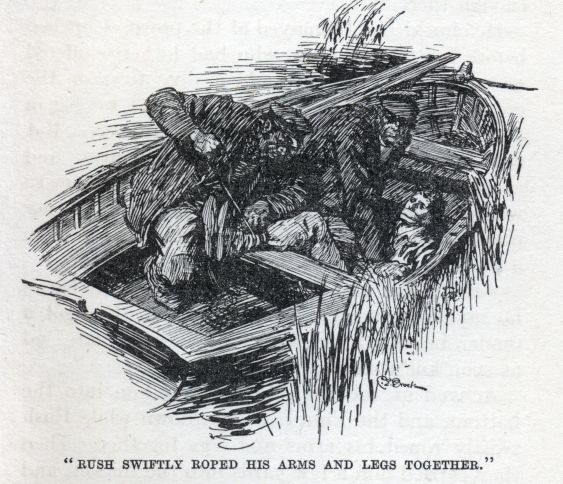
"RUSH SWIFTLY ROPED HIS ARMS AND LEGS TOGETHER."
"Now we'll traipse through to the tower," said Rush. "He'll take a deal of finding, I'm thinking!"
The men struck away towards the ruins, satisfied that their victim could not escape, and that his hiding-place was not likely to be discovered until discovery mattered nothing. They had not noticed, however, that while the trussing was in progress, Warrender's cap had fallen off, and now lay between two of the thwarts of the boat.
Pratt, hurrying along the tunnel with the hammer and chisel, and knowing that he was pursued, felt that he had done rightly in not making a prolonged search for Warrender. His sole pre-occupation now was the necessity of outstripping his pursuers by an interval sufficient to allow him time to block up their ingress to the tower. If Armstrong was still unmolested, and Mr. Pratt could be set free, the three were capable of dealing with the two men in the tunnel, and might make good their escape before Gradoff and his confederates at the tower door had any inkling of the true situation.
He soon understood that he was gaining on the men behind; but he presently became aware that, not far ahead of him, daylight seemed to have percolated into the tunnel. For a moment he was nonplussed until he remembered the dry well. It then occurred to him in a flash that some one must have removed the boards that had lain across the top of the well, and he was seized with a misgiving. Had Gradoff, unable to obtain admittance to the tower, bethought himself of this opening into the tunnel from above, and lowered one or more of his men, who had already made their way to the end, and perhaps overpowered Armstrong?
Taking advantage of the faint illumination of the tunnel, he quickened his pace. In a moment or two he saw to his consternation a man swing down the well, and on reaching the ground, begin to release himself from the rope that was looped under his arms. It was not a time for hesitation. Pratt dashed forward, flung himself against the man before he was free from the rope, and drove him doubled up against the wall. The man yelled; from the top of the well forty feet above them came excited shouts; and out of the tunnel behind sounded hoarse reverberating cries from the pursuers, who must have seen what had happened. Pratt plunged into the tunnel beyond, and, sprinting along with reckless haste, arrived in a few minutes breathless at the end, where the flagstone was still raised as he had left it.
He sprang up, slammed down the flagstone behind him, and let out a lusty cry for Armstrong to join him.
"They're after me--at least three of them!" he exclaimed, as Armstrong came leaping down the stairs. "Help me to lug these boxes on to the flagstone."
The crates and boxes ranged along the wall were empty, and their weight alone would not have sufficed to resist the pressure of determined men below. But the roof was low-pitched, and the boys saw that by piling box upon box they could create an obstruction which would defy all efforts to remove it. With feverish haste they dragged the boxes across the floor, and had already placed them one upon another when they heard footsteps beneath, and felt a movement of the flagstone.
"Another box will do it," said Armstrong. "You must heave it up while I stand on the stone."
He placed himself on the half of the stone that moved upwards as it revolved, and bore down with all his weight. Pratt pulled over a fourth box, and, standing on the projecting edge of that which formed the base of the pile, managed with some difficulty to shove it on to the top, where a space of no more than two or three inches separated it from the roof.
"Good man!" said Armstrong, stepping off the stone.
The pressure below raised it perhaps three inches, then it stuck.
"We'll put another pile on each side, to make all secure," said Armstrong. "Then I think we needn't worry."
With less haste they erected the buttress piles, listening grimly to the hoarse curses of Rush, and shriller cries from a foreigner by whose voice they recognised the Italian chauffeur. In a few minutes their work was done. Short of an explosion, nothing could dislodge the jam of boxes between the flagstone and the roof.
Panting from the strain of their exertions, they went up into the tower.
"Where's Phil?" asked Armstrong.
"I don't know," replied Pratt, going on to relate rapidly his discovery at the end of the tunnel.
"They've got him, I expect," said Armstrong. "Though I can't make out how they came to leave this hammer and chisel."
"What has happened here?" asked Pratt.
"Nothing. Gradoff and the others waited outside for a bit, talking quietly. I couldn't understand what they said. Then Gradoff sent the chauffeur towards the house, and by and by went off himself in the direction of the river, leaving the two strangers behind. Evidently he had sent the chauffeur for a rope. Perhaps he thought Jensen had drunk himself silly, and decided to let a man down the well--a much shorter way than going across to the island and entering by the tunnel. The fat's in the fire now. If we release your uncle we can't get him away."
"No," replied Pratt, looking through the chink in the boards. "Here they come: Gradoff, Rod, the Pole, the whole gang except the fellows below. It strikes me we are squarely trapped."
Looking towards the prisoner on the floor, Armstrong fancied he caught a malignant gleam in the man's eyes.
"On the whole," he said quietly, "I'm inclined to agree with you."
CHAPTER XXII
A PARLEY
"You're more hefty with tools than I am," said Pratt to Armstrong. "So if you'll run upstairs and smash that chain off my uncle, I'll keep an eye on what's happening outside."
"Right," replied Armstrong. "The hammer strikes me as a bit light for the job, but one can only try. Yell if you want me."
Taking the hammer and chisel, he leapt up the winding staircase to the topmost room. Mr. Pratt was thoughtfully drawing his fingers through his beard.
"So you are the third member of the trio," he said.
"Yes, I'm Armstrong. If you'll kindly stretch the chain tight over the edge of the bed, I'll do my best to break a link. I'm afraid I shall jar you, but----"
"Don't consider that. Make your break as near my leg as you can."
"I'll break the loop. Are you ready, sir?"
"Quite."
For perhaps two minutes the room echoed and re-echoed with the metallic din of hammering. The chisel was of finely tempered steel, and Armstrong compensated the lightness of the hammer by the vigour of his blows. A link snapped, the chain clanked upon the floor, and the prisoner stood up, free.
"Very neatly done," said he. "And now I will go below and join you and your companions in a council of war."
"There are only two of us now, sir," said Armstrong. "Warrender didn't come back."
As they went downstairs he related succinctly the events of the last three-quarters of an hour. Mr. Pratt made no comment. Entering first the room at the bottom, he threw a glance on the printing press, the piles of paper, and the Swede glowering on the floor; then he turned to his nephew.
"Well, Percy, what is going on?" he asked.
"Nothing, Uncle. I haven't seen any of the men. D'you think they see the game is up, and have bolted?"
"I think not, judging by what your friend has just told me. It appears that they have captured the other man--Warrender, I think you called him--and they know that you two are here. It seems improbable that they will decamp already. They outnumber you hopelessly, and it is more than likely that there is a large number of forged notes in the tower which they will secure if they can."
"Well, as the coast seems clear, can't we get away?" asked Percy. "We came to rescue you; our job's done."
"But, if you'll permit me, mine is just beginning," said Mr. Pratt. "Do you suppose that I'd be content to walk meekly away, and let the pack of scoundrels who have made my house a hotbed of crime get off with the fruits of their villainy?" The old gentleman spoke warmly. "I've knocked about the world for more than thirty years, been in many tight corners, and I've never knuckled under to man, beast, or circumstance. This is the tightest of them all, and, by the Lord Harry, I'll make a fight for it. You young fellows----"
"We're with you, sir," cried Armstrong, enthusiastically.
"Rather!" exclaimed Pratt. "If you're game, Uncle Ambrose----"
"Let us keep cool," returned his uncle. "I'm no longer under any illusions as to the character of the wretches I was misguided enough to employ. They are forgers--that is bad enough--but before they were forgers they were anarchists, members of that fraternity of fools whose ideas, put into practice, would turn the world into a hell. There are no more reckless malefactors than these international gangs who exercise their criminal propensities under the cloak of political enthusiasm. Make no mistake, young fellows; in resisting Gradoff and his gang we take our lives in our hands. In their eyes we are of less value than rats."
"We've got to keep 'em out, then," said Percy.
"Let us keep cool, I repeat. Let us discuss the situation."
"Yes, sir," said Armstrong, somewhat amazed at the professional manner of the old gentleman; "but time's flying, and----"
"Therefore it is vitally important that we should focus our attention. As I read the situation, we shall have to stand a siege. Gradoff determines to save his forged notes, if not his accomplice yonder. The question is, what will he do?"
"I know what I'd do if I----" began Pratt, but his uncle silenced him with a gesture.
"What you would do is not in question. What Gradoff will do we must infer from the probabilities. His final aim must be to get away quickly with his booty. His booty is inaccessible while we hold the tower. Therefore he must either persuade or compel us to let him in. Finding persuasion, reinforced by menace, futile, he will attempt compulsion. That is to say, he will bring up all his men and try to force the door. It is useless for us to blink facts--just peep through the crack, Percy, and see if he is already moving."
Percy reported that still there was no one in sight.
"Then we will continue our calm conference. Gradoff had four men under him at my house. One of them, Jensen, the Swede, lies there. From what you tell me he employs also Rush, and another foreigner whom I have never seen. You tell me that two strangers--by their appearance foreigners--came with him to the tower to-day. Therefore we are three against eight."
"But we are inside," said Percy.
"As a chicken is inside an egg. The shell can be cracked. That door, stout as it is, can be hacked through, blown in, or battered down. Probably they will not risk an explosion; it might attract even our stolid village policeman to the scene. Defending our position with such poor weapons as we have, we cannot prevent the enemy from sooner or later forcing an entrance."
"These are surely arguments for scuttling, sir, while we have time," said Armstrong.
"I am not arguing, but calmly stating facts," returned Mr. Pratt. "Scuttle! Is it conceivable that I shall scuttle for fear of this pirate crew, who have half-starved me, chained me up, carried on their dastardly work under my roof? But let me keep cool," he added, checking the tide of indignation. "The villains break in, I say, sooner or later. What then? With your assistance I propose to defend the stairs. The winding of the staircase is in favour of the defence. In so narrow a space the assailants lose the advantage of numbers. With resolution we shall hold our own."
"But that can't go on indefinitely, Uncle," said Pratt. "They could starve us out."
"Hardly; for this reason. You will be missed from your camp. Mr. Crawshay, you tell me, knows that you are making investigations. Your prolonged absence will alarm him; he will raise a hue and cry. Gradoff is perfectly aware that what he has to do must be done quickly. If we can withstand him for twenty-four hours, he is a beaten man."
"You think, then, sir, that they will give it up within twenty-four hours and then bolt?" said Armstrong.
"That is my forecast. They will save their skins and lose their forged notes, which are no doubt hidden away somewhere in the tower. Take another look out, Percy."
The boy peered through the crack in the boarding, and again reported no one in sight.
"Come with me to the roof," said his uncle. "From there we can survey a wide extent of the park. Armstrong will oblige me by remaining on guard."
He led the way up the stairs to the topmost room. Here he opened a low door in the wall, which gave access to a short flight of steps leading to the flat roof. Looking out towards the river, they saw a group of men gathered about the well-head. A moment later they caught sight of Gradoff and the two strangers approaching the tower from the direction of the house. Mr. Pratt leant over the parapet in full view, watching them. One of the strangers noticed him, and caught Gradoff by the arm. The Russian looked up, halted, and seemed for a moment to be taken aback. The three men spoke rapidly together, then advanced to the foot of the tower. Gradoff tried the door. Retreating a few steps, he called up--
"Holà!"
"Well?" said Mr. Pratt, leaning on the parapet.
"Come down and open the door. I have a proposition to make."
"Make it now. I can hear you quite well."
"You have Olof Jensen in the tower?"
"He is a prisoner. Yes."
"I also have a prisoner--one of three boys. I exchange him for Jensen, on condition that you come out with the other two."
"And then?"
"You shall go free, provided you promise to remain quietly in the park for two hours and do not approach the house."
"You would accept my promise?"
"Certainly."
"And what assurance have I that you would keep yours?"
"You have my word, witnessed by my friends here."
"And what is your word worth, by whomsoever witnessed?"
Gradoff's habitual smoothness left him. Shaking his fist, he shouted--
"I will show you what my word is worth. If you do not unbolt the door we shall kill you like--like a dog. I give you one minute."
Mr. Pratt leant motionless on the parapet, gazing down at the three men with a grim smile. Beside him his nephew, tingling with excitement, felt unbounded admiration for this strange uncle of his. The minute passed in silence. Gradoff, watch in hand, paced restlessly about. His friends stood together.
At the end of the minute Gradoff thrust his watch into his pocket.
"Look out, Uncle!" cried Percy.
One of the strangers had whipped out a revolver with extraordinary rapidity and fired point-blank at the motionless figure above. Mr. Pratt did not wince--showed neither fear nor agitation. Slowly unfolding his arms, he stood erect and turned to his nephew.
"Come," he said, "I think it is time we went below."
CHAPTER XXIII
"VI ET ARMIS"
When uncle and nephew regained the lower floor they found that Armstrong had not been idle. From one side of the room he had hauled a long, stout table and set it up endwise against the door, between that and the printing press.
"Capital!" said Mr. Pratt. "You have doubled the thickness of our armour. But, in default of sandbags, we must find something to strengthen our defences still further."
"I had thought of that, sir," said Armstrong. "There's nothing but this bale of paper and the sheets already printed. I think they will pretty well fill the space between the press and the door; if not we can get some of the boxes from below. They are no longer needed there."
"Excellent idea! You young fellows set about that while I keep watch."
In a few minutes the boys had wedged the paper and a number of boxes into the vacant space, so as to form almost a solid block. Mr. Pratt meanwhile reported the movements of the enemy without.
"Gradoff is surrounded by his gang. He is haranguing them. Two of them have gone away towards the river. Nick Rush looks a little uncomfortable. No doubt he prefers stealth and secrecy, and has visions of the interior of a prison cell. Wonderful how brave a man can be if he thinks he will not be found out. They are taking off their coats. Aha! They are going to ram us. The two men have returned with a long pole. A pity I had those trees felled; pity, too, that I had the parapet so thoroughly repaired, or we might have hurled stones upon our assailants in the manner of our ancestors. They used boiling oil, too, molten lead, and various other pleasant devices which are out of our power. Ah! The performance is about to begin. Six of them have lifted the pole--a fine, straight piece of timber. One of the strangers, I observe, is lending a hand. Gradoff is usually so calm and self-contained that the excitement with which he is now giving orders is somewhat amusing. What weapons have we, by the way?"
"I have that fellow Jensen's pistol, sir," said Armstrong. "Besides that we have only short cudgels."
"And the hammer and chisel," added Percy.
"We are unexpectedly well off," said Mr. Pratt. "I think I will take the pistol; no doubt I am a little more used to that sort of thing than Armstrong. For the rest--come, my lads, Gradoff has finished. Stand ready!"
The position now was that before an entry could be forced, the door must be broken, and the barricade of table, boxes and paper overthrown. Mr. Pratt and the boys had just posted themselves beside the printing press, when there was a thundering crash at the door. The room seemed to quiver; some of the upper sheets of paper rose and fell as if a wind had blown upon them; and the vibration caused the printing press to give forth a low ringing note. But the stout oaken door had not yielded. There were shouts outside. A few moments passed; then the building shook under the impact of a second stroke.
"Heart of oak!" exclaimed Mr. Pratt, with satisfaction. "The door is oak; the ram, I think, is beech. Listen."
The tones of Gradoff's voice, soaring to an unnatural pitch, were heard chiding, urging, encouraging. A third time his men advanced, not with the cheery unisonal "Yo! ho!" of British tars, but each man raising his particular cry.
"More vim in that," remarked Armstrong, as the shattering blow resounded. "And look, sir."
About a foot below the upper hinge of the door, which was not covered by the table, a jagged streak of light shone through.
"Yes," said Mr. Pratt, coolly. "They have cracked the shell. The hinges will give. In five or six minutes they will be scrambling over our barricade. I find I have only four cartridges; they must be reserved for the critical moment. Percy, run upstairs and bring down the hammer and chisel--yes, and the chain. I have no objection whatever to turning the enemy's weapons against him."
While Percy was absent, the assailants, who had evidently marked the damage already done, again rammed the door, on the same side. There was a flood of light through a gap nearly a foot square; splinters of timber across the upturned end of the table fell at Armstrong's feet. At the next blow the door split from top to bottom, and the whole of the upper part fell inwards. Apparently the enemy guessed that some attempt at a barricade had been made, for their next stroke was delivered lower down, with such force that it broke through the door, drove the table in, and sent some of the piled-up boxes toppling.
"Won't you now try a shot, sir?" said Armstrong.
"They have drawn back; next time," replied Mr. Pratt. "Stand clear."
Once more the battering-ram was rushed forward. It could now be seen that the shorter men held the fore part; the taller men were behind. Mr. Pratt raised his arm, but before he could take deliberate aim the forceful stroke carried the remnants of the door inwards, and hurled the shattered table, broken boxes, and flying sheets of paper in one indistinguishable mass upon the printing press, which gave way and fell with a mighty crash upon the floor. Mr. Pratt barely escaped being overthrown with it. He staggered backward, and the pistol was knocked from his hand. The small figure of the Italian chauffeur leapt into the breach, and began to clamber over the wreckage. Armstrong darted forward, and, before the man had time to swing round, Armstrong's cudgel descended with a resounding crack upon his skull, and he fell sprawling among the litter.
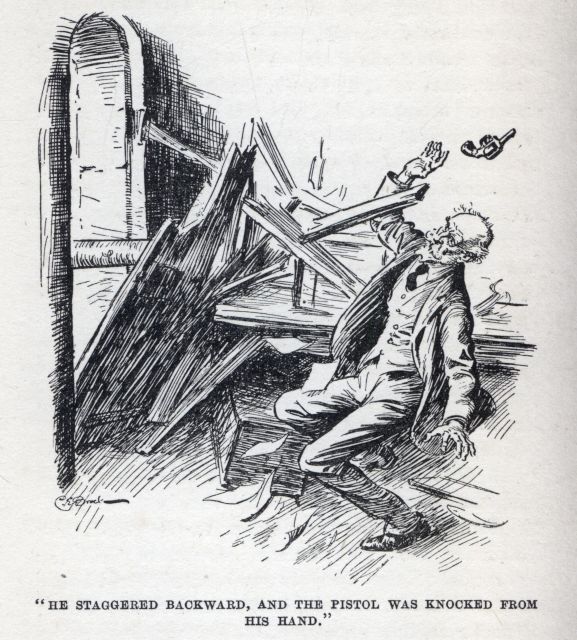
"HE STAGGERED BACKWARD, AND THE PISTOL WAS KNOCKED FROM HIS HAND."
But Maximilien Rod was at his heels. Stumbling over him, the cook plunged head foremost among the boxes, only his fall saving him from Armstrong's club. Immediately behind him dashed the tall Pole. Having no time to swing his cudgel, Armstrong jabbed at him, and catching him under the chin sent him reeling against the doorpost. Meanwhile Mr. Pratt had disengaged himself from the obstructing press and regained his pistol, just as Rush and his big comrade of the island forged through the opening. The Pole had sprung to his feet with catlike agility. A revolver cracked. Mr. Pratt recoiled, rapidly changed his pistol from the right hand to the left, and fired.
There was a sudden lull. Rush and the Finn had slipped back out of harm's way. Through the smoke Armstrong saw two men on the floor--the chauffeur whom he had felled, and the Pole, victim to Mr. Pratt's pistol.
"Back to the stairs!" murmured the old gentleman. He tottered.
"Are you hit, sir?" cried Armstrong, darting to his support.
"Yes. Leave me and hold the stairs."
At this moment the entrance was darkened by the forms of the remaining members of the attacking party, Rush and the Finn, urged forward by Gradoff and his friends. Armstrong, holding Mr. Pratt, felt that the game was up. But now came Percy leaping down the winding stairs. Into the room he dashed, carrying a long bar of iron. Taking in the situation at a glance, he flung himself at the foremost intruders. Rush doubled up under his vehement onslaught; Sibelius recoiled upon Gradoff; and the momentary check gave Armstrong time to haul Mr. Pratt out of the light to the foot of the dark stairway. Swiftly withdrawing from the heap of wreckage, Percy had barely joined them and helped to draw his uncle up a few steps to the protection of the curving wall, when four pistols cracked, and chips of stone fell clattering upon the stairs.
Immediately afterwards a burly arm and shoulder showed itself in the round of the wall. Quick as thought Percy lunged with his iron bar and jabbed the intruder just below the elbow. The man threw out a hoarse, savage cry, and disappeared. For a brief space there was silence; then came the noise of heavy feet kicking aside the debris in the room below, and rushing towards the stairway.
"Leave me," said Mr. Pratt again, sitting on one of the steps.
Armstrong sprang down, and darting in front of Percy, came face to face with one of the strangers, who was rounding the corner, brandishing a pistol. Unprepared, apparently, for sudden counter-attack, and incommoded by the right-hand twist of the narrow staircase, the man let slip his momentary chance of firing point-blank, but had enough presence of mind to dodge the blow Armstrong aimed at him. If there had been room for two abreast on the stairs it might have gone ill with Armstrong then; he staggered forward and thrust his hands against the wall to save himself from falling. Behind him, however, Percy had swiftly taken his cue. With his extemporised pike he caught the stranger in the middle. The man recoiled upon his companions in the rear. A storm of curses broke from them, but in a few moments the din subsided, and nothing was heard except the low voices of the enemy in consultation.
"Jolly good weapon," whispered Armstrong, indicating the iron bar. "Where did you get it?"
"Wrenched it off my uncle's bedstead," replied Percy.
"Any more?"
"One."
"Well, leave me this and go and get it, old chap. It's more useful than the club."
"Is there time?"
"I think so. They won't know quite what to do. But hurry up. I'll look after your uncle--give him first aid. He ought to go upstairs; by the time you're down again I'll have him ready to move."
"Much hurt, Uncle?" asked Pratt, bending down.
"A furrow ploughed in my forearm; nothing vital. Perhaps one of you will bind up the wound for me."
"I'll do that, sir," said Armstrong. "Cut away, Percy."
CHAPTER XXIV
A LEVY EN MASSE
To lie on one's back, bitted like a horse, trussed like a chicken, with flies and midges disporting themselves, unchecked, about one's features, and ants making adventurous journeys among one's clothes, is a situation that, to say the least of it, puts a strain upon a man's patience and equanimity. It is not greatly eased by the liberty of his eyes when their range is limited by dense overhanging foliage, which stirs in the breeze, opening tantalising glimpses of a sunbright sky.
On his turfy couch Warrender lay, groaning inwardly, cursing himself for delaying his errand, and Fate for bringing his enemies just then upon the scene; vexing his soul with visions of his companions caught unawares, and of Mr. Pratt still chained to his post; blaming himself, with the insight of the afflicted, for having countenanced a scheme that usurped the functions of the officers of the law. A fly feasted on his nose; gnats buzzed in and out of his ears; ants chased one another over his neck and up his arms, causing him to feel one multitudinous and intricate itch.
He had tried to wriggle himself free from his bonds, but Rush had not been poacher and fisher for nothing. Desisting from his vain struggles, he lay mumbling his gag, shaking his head like a tormented horse, and, as the minutes passed, sweating with alarm.
Presently his straining ears caught the faint regular thud of oars turning in rowlocks. The sound drew nearer. He tried to shout, but was capable of nothing more than a gurgling grunt. The knowledge that a boat was rounding the southern end of the island set him a-throb with hope, anxiety, despair--for what should bring the oarsman to shore? If, indeed, he should land, what should draw him to this overgrown spot, or cause him to pry among the bushes? The sound began to recede; the boat was passing on down the river; his momentary hopefulness was crushed under the weight of disappointment.
But after a little while his numb spirit was revivified by the sound of oars approaching again. He listened with throbbing eagerness. The movements were not now so regular; they were interrupted; presently they ceased altogether. Then he heard a rustle, and a slight thud as of some light-footed person jumping ashore. Again he tried to shout, but only the feeblest groan issued. All was silent. The new-comer, whoever it was, had seemingly not moved. But--was that not a cry?--a faint coo-ee, like an attenuated echo rather than a substantive sound. It came again, a little louder. After an interval, a third time, louder still. But there was no footstep, no rustling of branches, or swishing in trodden grass.
Frenzied by the thought of some one standing within easy reach of him--some one, too, who was seeking, if not him, at any rate somebody--Warrender jerked his jaw until he succeeded in shifting a little the handkerchief knotted behind his poll; and, blowing out his cheeks, he fetched from the depth of his throat a note like the boom of a bull-frog. He heard--or was it fancy?--a muffled exclamation. Again he boomed. Then--surely he was not mistaken?--a light-toned voice, asking, with the breathless utterance of surprise, "Who is it?" He could but reply with his inarticulate bass note. Footsteps came towards him; then hesitated. He boomed encouragement.
"Where are you?"
The words were scarcely above a whisper. Boom, boom! The swishing footsteps advanced, leaves clashed together, twigs snapped, and Warrender, feeling that his throat would crack and his cheeks burst, kept up his hollow note in moto continuo--accelerando--crescendo, as the hoped-for relief drew nearer.
Presently, after what seemed an age, the foliage above his head was gently, timorously parted, and his eyes beheld amazement, concern, indignation in the face of Lilian Crawshay.
"Oh!" she exclaimed, pushing through the shrub. "What--why--oh, you poor thing!"
She dropped on her knees, lifted his head, and swiftly untied the knot in the handkerchief.
"Thank you," he gasped.
"Who did it? What does it mean? But presently--presently. Your arms!"
Turning, she sought to untie the knots. They were too firm, the rope too coarse, for her little fingers.
"My knife--coat pocket," murmured Warrender.
In a trice she found the knife; even its keen blade she had to use as a saw before the bonds were severed. Warrender got up, stiffly. He stretched his aching arms, shook himself, stamped his feet.
"I can't thank you enough," he said, the words coming hoarsely through his parched lips.
"But who had the wickedness----? Never mind; tell me presently. What can I do? There is something--something terrible, I know. What can I do to help?"
"Will you row me to our camp? As we go, I shall be able to explain. My voice is coming back."
"Yes, let us go. Let me help you."
She took his arm, hurried him on his cramped legs to the skiff that lay half on the bank, and, hauling this into the water, assisted him to the stern thwart. Then she turned, ran a few steps to Rush's boat, and brought from it Warrender's cap.
"But for this----" she began. "Oh, it's too horrible!"
Springing to her seat facing him, she unshipped the sculls and began to pull up stream.
"I rowed to your camp," she said. "My father gave me a message for you. I was surprised to find it deserted, and came down, thinking I might see some of you on the water. But there was no sign of you, and I was returning when I caught sight of the cap in Rush's boat. I wondered. I knew it belonged to one of you, and it surprised me to find it there. I got ashore. Did you hear me coo-ee? It was very soft; I hardly knew what to think."
Warrender nodded.
"Then I heard that strange sound. I was a little frightened; but after a moment I thought it might be Mr. Pratt; he is funny sometimes. It was when you didn't answer that I thought something must be wrong, and--well, you know. I am so glad I didn't run away. How long had you been in that dreadful position?"
"I don't know--an age."
"And was it Rush?"
"Yes. I must tell you. The foreigners at the Red House----"
"Oh, I guessed! Dear old Father was so mysterious. Did he tell you to keep it from me?"
"Well, yes, he did."
"I knew it. Why does a man like to play the ostrich? I knew ages ago there was something strange happening, and we poor women creatures mustn't be startled, shocked. Daddy is an Early Victorian. Is it so very horrid?"
"It's a long story. D'you mind if I tell you later? I want you to land, if you will, at the camp, and go across to your house as quickly as possible, and ask Mr. Crawshay to bring every man he can muster, armed, to the tower in Mr. Pratt's grounds. One thing I had better tell you at once: the foreigners had Mr. Pratt a prisoner in the tower."
"Good gracious! Mr. Ambrose Pratt?"
"Yes. Here we are. Please give my message at once. Mr. Crawshay will partly understand. Impress on him that speed is vital."
"And you?"
"I am going to rush up to the village in the motor-boat."
"But are you able?"
"Quite. The stiffness is wearing off. Tell Mr. Crawshay I am taking some men--all the able-bodied men I can collect--to the tower, and if he can somehow send a message to the nearest town for the police----"
"Yes; I understand. We've no telegraph or telephone in this benighted place, but it shall be done. You are quite sure you can manage alone? I don't think you are fit for much exertion, you know."
"I'm quite all right," replied Warrender, smiling as he handed the girl ashore. "By the way, Pratt and Armstrong are in the tower. Will you tell Mr. Crawshay that? And speed is all important."
"I'll run like a hare. Good-bye. I do hope----"
She left her thought unsaid, and, gathering her skirt, fled across the field towards her home.
Ten minutes afterwards, Warrender ran the motor-boat alongside the landing-stage, sprang ashore, and hurried up to the Ferry Inn. The door was open--it was the mid-day interval for refreshment--and he saw a good many familiar figures with their elbows on the bar, or tipping up the pots which Joe Rogers, in his shirt-sleeves, had drawn for them. His arrival precisely at this moment could not have happened more luckily. Rogers greeted him with a smile; Henery Drew and one or two others nodded and went on drinking. No one spoke; the countryman takes a minute or two to think of an opening.
"Rogers, my friends, I want your help," said Warrender. The rustics looked at him solemnly. He went on, not pausing to choose his words: "Those foreigners are forging Treasury notes in Mr. Pratt's tower. They have Mr. Pratt himself a prisoner there." Eyes widened; pots were suspended in mid course. "My chums have got in and are holding the place against them. I want every man of you to come with me and lend a hand. With your help we'll collar the whole gang. There's no time to lose."
No one moved. Rogers stood staring, with his hand on the draw-pull. The others gaped.
"Don't you understand?" cried Warrender. "Mr. Pratt's in danger. They're desperate criminals--six or eight of them against three. You, Mr. Drew--you're a soldier. Rogers----"
"What have they done to my sister Molly?" shouted Rogers. "Neighbours all, do 'ee hear? Mr. Pratt, as we thought abroad--'od rabbit it all, come on!" He darted round the counter.
"Got a gun, Rogers?" asked Warrender.
"Ay, there's a fowling-piece in the parlour," cried the man, running back again.
"I've got one up along," said Drew. "Do 'ee say now! I'll fetch 'en."
"Stay!" said Warrender. "There isn't time. You must bring what you can. Don't delay. Sticks, forks, spades--you've a mattock there," he added, addressing a man on the settle against the wall. "Bring it along. All of you bring what you can lay hands on. Mr. Drew, you're an active man. Run up into the village and collect all the men you can find, and take them up to the Red House by the road. Set a couple to guard the gate, lead the rest on to the tower. You others, borrow some garden tools from Rogers--or anything; and come with me. Here's Rogers." The innkeeper, minus his wig, came back with his fowling-piece. "You'll lend your tools?"
"Ay sure. In the shed, neighbours; you do know the way. My poor Molly!"
"I give you five minutes!" cried Warrender. "Come down to the ferry. I'll wait for you--five minutes only."
He hurried out, followed by Rogers. The younger men among the rest, bestirring themselves at last, went round the inn into the garden. Within five minutes a group of seven, armed with hoe, rake, spade, mattock, fork, fowling-piece, and coal-hammer, was gathered on the landing-stage.
"Squeeze into the boat," said Warrender. "I'll run you down and land you opposite No Man's Island. You must pack tight."
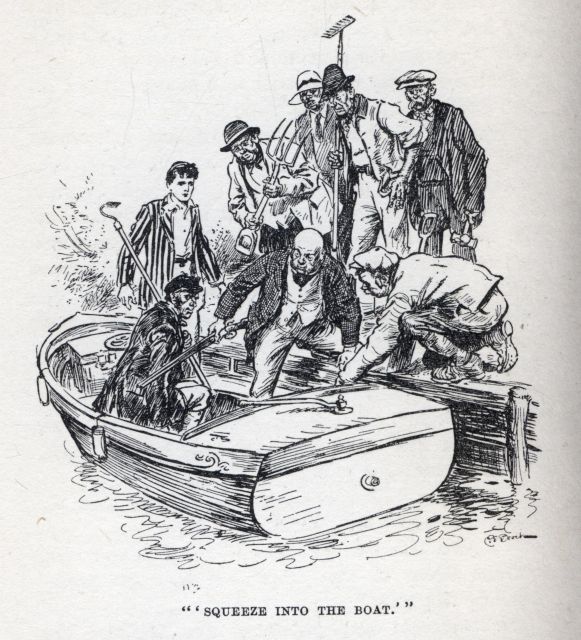
"'SQUEEZE INTO THE BOAT.'"
They crowded into the boat. Warrender opened the throttle. A shriek was heard, and Mrs. Rogers came flying out of the inn, flourishing her husband's wig.
"Joe, you gawkhammer, you've left your hair behind."
"Make it into a stew and be jowned to it!" shouted Rogers, as the boat hummed away.
Landing on the bank opposite the cottage, the party hurried through the plantation, Warrender taking the lead.
"No talking, men," he said.
They emerged into the park. The tower came in sight. From the roof a dense column of brown smoke rose straight into the still air. Rogers groaned.
"God send we be in time!" he murmured, as he pounded heavily along.
CHAPTER XXV
SQUARING ACCOUNTS
Armstrong profited by the enemy's first check to bind his handkerchief round Mr. Pratt's arm.
"Hadn't you better go upstairs, sir, out of harm's way?" he asked.
"Call myself a casualty and slink to the rear? No, thank you, my lad. Not while I can stand and use my left arm. We must hold our ground here at all costs."
"Here, sir?"
"Yes. They must not drive us beyond the first floor. No doubt they have released the man you tied up, and the fact that they still attack us shows there is something upstairs they don't want to leave."
"I saw some tin cases in the room above."
"Filled with forged notes, beyond doubt. But what's this? Do you smell burning?"
"Smoke--wood smoke. D'you hear the crackling? They have fired the tower."
"Not they. They won't burn their notes. They want to drive us above. It is very ingenious--and very unpleasant."
The pungent smoke from burning wood rolled up the staircase in ever-increasing volume. Percy came running down, carrying, not an iron bar, but an assegai taken from the wall of the top room.
"Didn't notice it before," he said.
"Run up again and open the door to the roof," said his uncle. "We may as well stave off asphyxia as long as we can."
Armstrong caught sight of a head peering up from the round of the wall below. He raised his hand suddenly as if to fire. The head disappeared.
"Spying to see if we have gone," chuckled Mr. Pratt.
With the opening of the door above, the smoke rose more rapidly. Mr. Pratt coughed.
"I have the misfortune to be a trifle asthmatical," he said. "It is very unpleasant."
"May as well cough, too. It will encourage 'em," said Armstrong, with a grim smile. "Percy, you can manage a churchyard cough."
They both coughed, at first deliberately, but as the smoke thickened, involuntarily.
Suddenly there was a rush of feet below. Armstrong bent forward, thrusting out his iron bar; but the foremost of the assailants, the Swede, seemed to have expected the move, for he slipped aside, bent almost double, crying to his comrade behind him, and sprang towards Percy. The boy, having just run downstairs and only at that moment caught up the assegai, was a little late with his lunge. Jensen seized the head of the weapon and tugged at it, forcing Percy down a step or two. To save himself, Percy let go; the Swede staggered backward against Radewski, who was in the act of discharging his revolver at Armstrong. The jostling of the man's arm spoilt his aim, and the bullet, which, fired point-blank, would probably have found its billet in Armstrong's breast, struck him on the right shoulder and spun him half round. Mr. Pratt had hitherto been unable to use his pistol for fear of hitting one or other of the boys; but now, seeing that both were for the moment at a disadvantage, he dashed between them, fired with his left hand at the Pole, only two steps below, and sent him rolling down the stairs with a shot in his groin.
But the enemy were not this time to be denied. Jensen, inspired with lust of vengeance, had quickly recovered his footing. Immediately below him Rod and Sibelius, pointing their revolvers, only awaited an opportunity of firing as soon as there was no risk of hitting their own comrade. Mr. Pratt, who was weaker than he knew, had just pulled his trigger without effect; either the chamber was empty or something had jammed. Armstrong, with a wound in the shoulder, was leaning, for the moment overcome with pain, against the wall of the staircase. Taking in the whole scene, Percy felt that all was over. His own weapon was gone; even if he should seize Armstrong's bar, single-handed he must soon be overpowered.
At this crisis, by one of those tricks of the mind which no one can account for, he suddenly remembered the packet of pepper he had bought in the village, and one of the uses to which pepper could be put. It was still in his pocket. Snatching it out, he swiftly unfolded the top of the cone-shaped paper bag, and holding the bag by the screwed-up end, he scattered its contents upon the face of Jensen, just rounding the bend. With a howl of rage and pain the Swede recoiled on his comrades behind, driving them back upon the remainder of their party at the foot of the stairs. The volume of wood smoke had lessened when they started the attack; and now the cloud of pepper, floating down slowly upon the fumes, spread over the whole width of the staircase. A chorus of sneezes soared up--a chorus in many parts, from the shrill tenor of Prutti, the Italian chauffeur, to the resonant bass of the corpulent Swiss, Maximilien Rod. Gradoff's sneeze was distinguishable from Jensen's, and the two strangers performed a duet in sternutation. There were interludes of cursing and yelling; Rush's sense of humour appeared to be tickled, as well as his nostrils; for Pratt declared that he heard him guffawing between his sneezes. After all, Rush was an Englishman.
The performers were still busy--the audience on the stairs was about to move a little higher up--when there came, from some spot without, a sound of cheers. Never was applause so unwelcome to a foreign band. With the sneezes now mingled cries of alarm, the noise of feet scuffling amid litter, a running to and fro. Percy, with a whoop of delight, dashed downstairs, picking up his assegai on the way. When he reached the room below, he was momentarily checked by a sneeze; then, through the clearing smoke, his streaming eyes beheld two figures struggling on the floor. A second glance distinguished them as Jensen and his old enemy, Henery Drew. The farmer was uppermost.
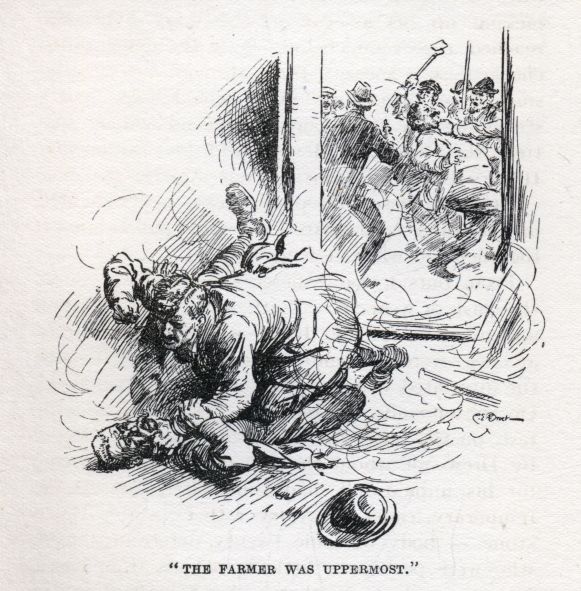
"THE FARMER WAS UPPERMOST."
"Come and see fair play, Jack," Pratt shouted up the stairs to Armstrong, who had pulled himself together and was following him.
From outside came fierce shouts, pistol shots, the clash of weapons. Pratt dashed out. Gradoff and his gang (all but Rush, who had surrendered at once) were sustaining an unequal struggle with the infuriated villagers who had closed upon them. On the one side Warrender, with Rogers and the rest, on the other the group of villagers collected by Drew--of whom the general dealer, smarting for his unpaid bill, had constituted himself the temporary leader in rivalry with Constable Hardstone--a body of some twenty determined men, who were perhaps a little breathless from haste. Not so with the others. As Samson lost his strength with his hair, so these international adventurers, desperate, courageous enough, holding life cheap, became as children under the debilitating pungency of pepper. A man cannot sneeze and fight. Some few shots were fired; a bullet grazed Rogers's shining skull; another struck out of Blevins's hand the mallet he carried; a third carried away the lobe of an ear from a young carter, who refused to leave the field until he had found it. Short, sharp, decisive, the battle ended in a general capitulation. Only one of the foreigners escaped; Gradoff, seeing that all was lost, kept his last bullet for himself.
From the doorway Mr. Pratt had watched the pinioning of the prisoners. A cheer broke from his neighbours and tenants. And, just as a move towards the house was being made, Mr. Crawshay and two of his men, armed with shot-guns, came trotting across the sward.
"God bless you, Pratt, my dear fellow," cried the old gentleman, grasping his neighbour by the hand, and shaking it vigorously up and down.
Mr. Pratt sneezed.
"And you, Crawshay," he said. "But try the other hand, my friend; my right arm bears an honourable wound."
EPILOGUE
It was Saturday afternoon. The spacious lawn in front of Mr. Crawshay's house was spread with bamboo tables and deck-chairs. At the porch stood Mr. Crawshay and Mr. Ambrose Pratt side by side, smoking long cigars, chatting and laughing with the familiarity of old friends. Mr. Pratt's right arm was in a sling.
"It's time they came," said Mr. Crawshay, taking out his watch. He wore a large panama, and his suit of spotless ducks gave him a festal air.
"They're probably squabbling for precedence," said Mr. Pratt; "not on social grounds, but for modesty. It's an ordeal, you know, Crawshay; and when they see your rig, and that purple tie of yours, they'll be abashed."
"What'll they say to the women, then?" returned Mr. Crawshay. "Upon my soul, Pratt, I think you are right to come in your old clothes; they'll feel more at home. It never occurred to me."
"Oh, well, you're lord of the manor; I dare say you're right to look the part. But here they come, in a bunch. Mrs. Rogers is, perhaps, a shade ahead."
Mr. Crawshay turned and called through the open door. His daughter, in a dainty confection of muslin and lace, and a straw hat trimmed with pink silk, came running out, followed by her mother, an impressive figure in blue, and our three campers, in flannels and blazers. Armstrong also had an arm in a sling.
Grouped in front of the porch they awaited the coming of the party that had just entered the drive. Mrs. Rogers, in stiff black silk, and a wonderful bonnet, marched along a little in advance of her husband, hardly recognisable in his Sunday suit of blue serge and a bowler hat sitting uneasily on the back of his head. Samuel Blevins, the general dealer, had affected a long frock coat and a tall hat. Henery Drew, magnificent in a brown bowler and a suit of large-checked tweed, walked beside Hardstone, the constable, disguised in habiliments that might have become a prosperous plumber. The rest of the company, whose names we do not know, were alike in one respect; all had donned their "Sunday best." Every face, without exception, wore an air of deep solemnity.
Mr. Crawshay took a step forward.
"Glad to see you, neighbours," he said, genially. "We are lucky in a fine afternoon."
He shook hands with them individually, a greeting that inflicted on them various degrees of embarrassment, deepened by the smiling welcome of his wife and daughter. Mr. Pratt contented himself with a general salutation; it was not until the boys began to crack jokes with them that the prevailing gloom lightened.
"You didn't bring your sister, Rogers?" said Mr. Crawshay to the innkeeper.
"True, sir; she bain't come along."
"She couldn't face 'ee, sir," added Mrs. Rogers. "I always did say as she was making a rod for her back, though never did I think Rod was such a downright wicked feller. And Henery Drew, as would have made her a good husband as far as husbands do go, and now he can't marry her without committing bigamy."
"Well, well! We must hope for the best," said Mr. Crawshay. "Now, my friends, we're all here. Take your seats, and we'll have tea."
The company seated themselves. Maids brought from the house trays filled with good things. Mrs. Crawshay poured out tea, and Lilian and the boys carried round the eatables. Under the influence of good cheer the villagers' stiffness wore off, and they began to descant upon the moving events of the past days. For the first time in its history the village had become a place of importance. Visitors had flocked to it from all parts; journalists with cameras had interviewed the actors in the drama, and expressed themselves very freely on Mr. Pratt's refusal to admit them to his grounds, and to pose for his photograph. His modesty in this respect was a standing puzzle to his humble neighbours. Mrs. Rogers, for instance, was extremely proud of the portrait of her husband that had appeared in the previous day's picture paper.
"The scar shows beautiful," she said, complacently.
"Dear me," said Mrs. Crawshay, with a discreet glance at Rogers's broad face, "I wasn't aware----"
"Take off your hat, Joe, and show the lady."
Removing his hat, Rogers displayed a red furrow that ran across his shiny pate.
"What a narrow escape!" exclaimed Mrs. Crawshay.
"Ay sure, ma'am, 'twas so," said Mrs. Rogers. "And I'm certain a widow's cap wouldn't have suited me."
"Well, Mrs. Rogers, you won't be so particular about Joe's wig after this," said Percy Pratt. "You see, if he'd worn his wig, his scalp wouldn't have been touched; think what millions of people have had the pleasure of admiring your husband, talking about his bravery, discussing the track of the bullet across his skull. No one wanted to take my photograph."
"They took 'ee unbeknownst, then, becos there you be, next to Joe, with 'Pepper and Salt' printed underneath; very clever, I call it, Joe being once a sailor."
"Oh, I say," exclaimed Pratt, "did they get the others too?"
"No, sir. Not as I think it a very good likeness. You've got your two eyes half shut, and your mouth is a very queer shape, like as if you was expecting of somebody to pop something in it--a drop of physic, maybe."
The villagers looked merely interested, the others frankly amused. Pratt blushed.
"He must have caught you when you were singing a particularly sentimental song, old chap," said Warrender, smiling.
"That reminds me," said Mrs. Crawshay. "Do bring out your banjo, Mr. Pratt, and sing us something."
"Wait a minute," said Mr. Crawshay. "Before we begin the--entertainment, shall I call it?--I want to say a word or two."
"Hear, hear!" exclaimed Blevins. "'Tis what I call an event."
"No heroics, for goodness' sake, Crawshay," murmured Mr. Pratt.
Mr. Crawshay assumed the look of one determined not to be interfered with.
"I just want to say, neighbours," he proceeded, "how glad I am to see you all here this afternoon, in celebration of what Mr. Blevins rightly calls an event in the simple history of our little parish. You all had a part in the frustration of the most nefarious criminal conspiracy that has ever come within my long experience as a county magistrate. Thanks to the ingenuity and perseverance of my dear young friends, their refusal to be intimidated, their sleepless vigils and untiring watchfulness, the secrets of that criminal conspiracy were laid bare, my old friend and neighbour was rescued from a most distressing situation, and you, anticipating the slow operation of the law, but sanctioned by the presence among you of an officer of the law, were able to secure the apprehension of the whole band of criminals, who are now awaiting in the darkness of the county gaol the due reward of their deeds. Our village is to be congratulated on the visit of three young men, typical products of our renowned public school system, and on the public spirit of its own inhabitants, who, when the call for action came, forgetting all class distinctions, regardless of personal risk, braved the murderous weapons of unscrupulous villains, and nobly carried out the first duty of the patriotic citizen. I am speaking the mind of you all," the worthy magistrate went on, warming to his subject, "when I say that we shall long treasure the memory of our young friends, their high spirits, their unfailing cheerfulness under persecution, their courage and ingenuity; and it is a matter of regret that, yielding to paramount claims, the claims of parental affection, they are leaving us to-day. But it will please you all to hear that, in response to my invitation--I may say to my insistence--they have agreed to visit us again next year; and I understand from my old friend and neighbour, Mr. Pratt, that he intends to acquire No Man's Island, so long derelict, and restore the cottage as a holiday hostel for boys of our public schools."
Here there were general cheers.
"Dear old Father!" whispered Lilian to the boys. "He gets so few chances of making a speech, and he does love it so."
"I won't detain you longer," Mr. Crawshay went on. "No doubt Mr. Pratt would like to say a few words."
"Hate it!" exclaimed Mr. Pratt. "One thing only. I've had a bad time. I deserved it. I was over-hasty. My old servants are scattered; if any of you know where they are, tell them to come to me. I'll reinstate them--if we can agree about wages."
Under cover of the villagers' applause, Percy seized the opportunity of unbosoming himself to a select audience, his companions and Lilian Crawshay.
"Are we blushing, Miss Crawshay?" he asked. "I don't think we are, because, you see, we are supremely conscious of each other's merits. We really are benefactors, you know--public and private. Who would ever believe that the two old gentlemen were not long ago calling each other luna----"
"Now, Mr. Pratt," the girl interrupted.
"Well, X and Y then," rejoined Pratt. "It's undeniable, isn't it, that they're reconciled through us? And as for my uncle and me, we're quite pally; the old feud is healed, and before long I expect my father and Uncle Ambrose will kiss again with tears. Tennyson, you know. Anyway, it's been a ripping holiday, and----"
"Now, Mr. Pratt, we are all waiting," said Mrs. Crawshay, amiably.
Pratt obediently went into the house, brought out his banjo, and trolled out ditties of the most sentimental order. Presently Warrender announced that it was time to go if they meant to reach Southampton before dark. The whole company trooped down to the bank with them, and watched them board the motor-boat, already loaded with their camp equipment. Last good-byes were said; Warrender opened the throttle; and as the boat panted down stream there came to the ears of the silent spectators the gentle strumming of the banjo, and Pratt's melodious tenor--
"Our hearts were once divided,
But now they beat as one;
The clouds roll by across the sky,
And yonder shines the sun."
THE END