Part 397 — Speculations About Peace, September, 1914
Reading edition
Report by James W. Gerard, American Ambassador at Berlin, to President Wilson.
By The Associated Press.
WASHINGTON, Sept. 17.—Germany has suggested informally that the United States should undertake to elicit from Great Britain, France, and Russia a statement of the terms under which the Allies would make peace.
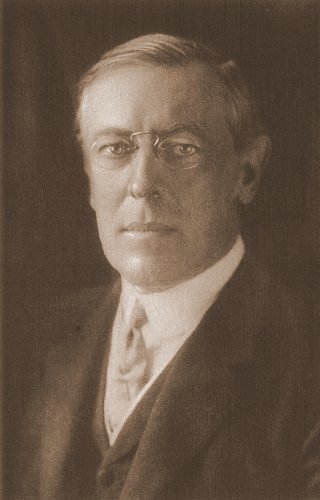
WOODROW WILSON, President of the United States of America. (Photo (C) by Bradley Studio.)
The suggestion was made by the Imperial Chancellor, von Bethmann-Hollweg, to Ambassador Gerard at Berlin as a result of an inquiry sent by the American Government to learn whether Emperor William was desirous of discussing peace, as recently had been reported.
No reply was made by Emperor William himself, nor did the Imperial Chancellor indicate whether or not he spoke on behalf of the Emperor. Ambassador Gerard, in a cable dispatch to President Wilson, repeated the Chancellor's remarks from recollection, substantially as follows:
Germany was appreciative of the American Government's interest and offer of services in trying to make peace. Germany did not want war, but had it forced on her. Even if she defeats France, she must likewise vanquish both Great Britain and Russia, as all three have made an agreement not to make peace except by common consent. Similarly, England has announced through Premier Asquith and her diplomatists and the newspapers that she intends to fight to the limit of her endurance. In view of that determination on the part of Great Britain, the United States ought to get proposals of peace from the Allies. Germany could accept only a lasting peace, one that would make her people secure against future attacks. To accept mediation now would be interpreted by the Allies as a sign of weakness on the part of Germany and would be misunderstood by the German people, who, having made great sacrifices, had the right to demand guarantees of security.
The above is all that Ambassador Gerard communicated as to his conversation. He added only the brief comment that he, himself, thought the way might possibly be opened to mediation. President Wilson did not regard the message, however, as bringing anything tangible. He referred to the Chancellor's conversation as non-committal and incidental to the acknowledgment of the American Government's inquiry. The President indicated that he rather expected a reply to the inquiry to be sent eventually from the Emperor himself, although he realizes that the Imperial Chancellor may have consulted the Kaiser by telegraph before talking informally with the American Ambassador.
President Wilson took no action as a result of the message, waiting to hear from Ambassador Gerard whether anything of a more formal character could be obtained by him which the United States might communicate to Great Britain, France, and Russia. It was understood tonight that the British and French Ambassadors who are in Washington were not informed officially or unofficially by Secretary Bryan of the conversation between the Imperial German Chancellor and Ambassador Gerard.
Germany's position is that she will give her opinion on terms of peace when she has received a definite statement from the Allies of their proposals. The statement that Germany did not want war, but had it forced upon her, as well as the declaration that she wanted a lasting peace, is almost identical with the remarks which Sir Edward Grey made to Ambassador Page in London last week. The British Foreign Secretary said England wanted no temporary truce, but a permanent peace, and one that would safeguard her against sudden attacks such as Germany had made.
President's Future Course.
The general belief in well-informed circles tonight was that the President, after waiting a few days for more information from Berlin, probably would instruct the American Ambassadors at London, Paris, and Petrograd to communicate what the Imperial German Chancellor had said to Ambassador Gerard. It was believed the Ambassadors would be asked to reiterate the wish of the American Government to be of service in bringing about peace and to point out the readiness of the United States to communicate to Germany and Austria any statement of terms which the Allies might care to make.
Diplomatists are disposed to believe that through such informal conversations something definite in the way of peace terms may yet be obtained as a working basis. If a concord of opinion for the discussion of peace terms were reached President Wilson then would endeavor to obtain an acceptance by all the belligerents of the original tender of good offices. This would not mean a cessation of hostilities, unless the mediating power specifically made it a condition of mediation and all the belligerents agreed to it. An armistice would not hinder military movements or preparations, serving merely as a truce while peace was discussed.
President Wilson already has indicated that he believes that the final reckoning of the war should be made in a conference of the European powers, and it would be the function of the United States to preside at such a conference if its services as a mediator were accepted.
Various reports were current today that Germany had named several conditions under which she would make peace, that she had refused proposals to alter the territorial status of her empire and possessions, and would cede no territory or dismantle her fleet, but it was said authoritatively that nothing of this character was contained in any of the messages from Berlin to the American Government.
A statement made at the White House today was the first authoritative acknowledgment that any inquiry on the subject of Germany's attitude concerning peace had been made by the United States. Officials heretofore have maintained silence in regard to the effort made by the Government to get at the bottom of the expression in favor of peace reported to have been made by the German Emperor to the Imperial Chancellor and mentioned in a private conversation in New York by Count von Bernstorff, the German Ambassador to the United States.
What was said by Count von Bernstorff in that conversation brought Oscar S. Straus post-haste to Washington, and as a result of what he told Secretary Bryan instructions were sent to Ambassador Gerard to ascertain whether the remarks attributed to the Emperor were to be taken as an indication that the German Government would not be averse to the exercise of the good offices of the United States in an effort to end the hostilities in Europe.
The conversation at which the German Ambassador made the statement occurred at the house of James Speyer, the banker, in New York. Oscar S. Straus, a member of the Permanent Tribunal of Arbitration at The Hague, was present. In the course of a discussion of the war in Europe and the prospects of peace Count von Bernstorff, it is understood, said that, while he had no advices from the Imperial Government since he had left Berlin, he recalled that the Imperial Chancellor had told him that he believed Emperor William would be willing to discuss a proposal of peace through mediation.
With the permission of Count von Bernstorff, Mr. Straus came to Washington and told Secretary Bryan of what the German Ambassador had said. On the following day Count von Bernstorff made a trip from New York to Washington and had an interview with Secretary Bryan.
It has been understood that Mr. Bryan, in an excess of caution, desired to ask Count von Bernstorff personally if he would consent to having Ambassador Gerard instructed to make inquiry of the German Government as to whether the conversation between the Emperor and the Imperial Chancellor might be regarded as indicating that an offer of mediation of the United States would not be unwelcome to Germany. Count von Bernstorff is understood to have assented to Mr. Bryan's suggestion, and the instructions to Mr. Gerard followed.