Part 397 — MANIFESTO.
Reading edition
To my peoples! It was my fervent wish to consecrate the years which, by the grace of God, still remain to me, to the works of peace and to protect my peoples from the heavy sacrifices and burdens of war. Providence, in its wisdom, has otherwise decreed. The intrigues of a malevolent opponent compel me, in the defense of the honor of my Monarchy, for the protection of its dignity and its position as a power, for the security of its possessions, to grasp the sword after long years of peace.
With a quickly forgetful ingratitude, the Kingdom of Servia, which, from the first beginnings of its independence as a State until quite recently, had been supported and assisted by my ancestors, has for years trodden the path of open hostility to Austria-Hungary. When, after three decades of fruitful work for peace in Bosnia and Herzegovina, I extended my Sovereign rights to those lands, my decree called forth in the Kingdom of Servia, whose rights were in nowise injured, outbreaks of unrestrained passion and the bitterest hate. My Government at that time employed the handsome privileges of the stronger, and with extreme consideration and leniency only requested Servia to reduce her army to a peace footing and to promise that, for the future, she would tread the path of peace and friendship. Guided by the same spirit of moderation, my Government, when Servia, two years ago, was embroiled in a struggle with the Turkish Empire, restricted its action to the defense of the most serious and vital interests of the Monarchy. It was to this attitude that Servia primarily owed the attainment of the objects of that war.
The hope that the Servian Kingdom would appreciate the patience and love of peace of my Government and would keep its word has not been fulfilled. The flame of its hatred for myself and my house has blazed always higher; the design to tear from us by force inseparable portions of Austria-Hungary has been made manifest with less and less disguise. A criminal propaganda has extended over the frontier with the object of destroying the foundations of State order in the southeastern part of the monarchy; of making the people, to whom I, in my paternal affection, extended my full confidence, waver in its loyalty to the ruling house and to the Fatherland; of leading astray its growing youth and inciting it to mischievous deeds of madness and high treason. A series of murderous attacks, an organized, carefully prepared, and well carried out conspiracy, whose fruitful success wounded me and my loyal peoples to the heart, forms a visible bloody track of those secret machinations which were operated and directed in Servia.
A halt must be called to these intolerable proceedings and an end must be put to the incessant provocations of Servia. The honor and dignity of my monarchy must be preserved unimpaired, and its political, economic, and military development must be guarded from these continual shocks. In vain did my Government make a last attempt to accomplish this object by peaceful means and to induce Servia, by means of a serious warning, to desist. Servia has rejected the just and moderate demands of my Government and refused to conform to those obligations the fulfillment of which forms the natural and necessary foundation of peace in the life of peoples and States. I must therefore proceed by force of arms to secure those indispensable pledges which alone can insure tranquillity to my States within and lasting peace without.
In this solemn hour I am fully conscious of the whole significance of my resolve and my responsibility before the Almighty. I have examined and weighed everything, and with a serene conscience I set out on the path to which my duty points. I trust in my peoples, who, throughout every storm, have always rallied in unity and loyalty around my throne, and have always been prepared for the severest sacrifices for the honor, the greatness, and the might of the Fatherland. I trust in Austria-Hungary's brave and devoted forces, and I trust in the Almighty to give the victory to my arms.
FRANZ JOSEF.
DECLARATION OF WAR.
Published in Special Edition of Official Gazette, Vienna, July 28.
The Royal Government of Servia not having given a satisfactory reply to the note presented to it by the Austro-Hungarian Minister in Belgrade on July 23, 1914, the Imperial and Royal Government of Austria-Hungary finds it necessary itself to safeguard its rights and interests and to have recourse for this purpose to force of arms. Austria-Hungary, therefore, considers itself from this moment in a state of war with Servia.
"DAYS OF WORLD'S HISTORY."
Congratulatory Telegram to Kaiser Wilhelm II., Aug. 27.
Victory after victory. God is with you. He will be with us also. I most sincerely congratulate you, dear friend, also the young hero, your dear son, the Crown Prince, and the Crown Prince Rupprecht, as well as the incomparably brave German Army. Words fail to express what moves me and, with me, my army, in these days of world's history.
"FRANZ JOSEPH."
WILL OF WILHELM II. THAT SWUNG THE SWORD.
Kaiser Franz Josef's Address in Bestowing the Great Cross on the German Kaiser, September, 1914.
The glorious victories, so crushing to the foe, which the German Army has won in battle under your chief command owe their begetting and their success to your iron will, which sharpened and swung the heavy sword.
To the laurel that crowns you as victor I wish to add, if I may, the highest military honor which we possess, in begging you to take in true brotherhood of arms and as a token of my appreciation the Great Cross of my military Order of Marie Theresa. The decoration itself, dear friend, shall be handed to you by a special envoy as soon as it is convenient for you.
A PURELY DEFENSIVE WAR.
By Count Berchtold, Foreign Minister for Austria-Hungary.
(Copyright, Evening News Publishing Company of Newark, N.J., 1914.)
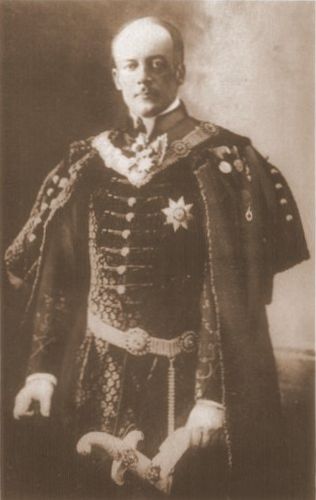
COUNT LEOPOLD BERCHTOLD. Austro-Hungarian Minister for Foreign Affairs. (Photo from Underwood & Underwood.)
Austria-Hungary looks upon this war as a purely defensive one, which has been forced on her by the agitation directed by Russia against her very existence. Austria-Hungary has given many proofs in late years of her peaceful intention. She refrained from any interference with arms in the Balkan war, though her interests were at stake. Subsequent events have proved what a serious danger the increase in territory and prestige which it brought Servia were for Austria-Hungary. Servia's ambitions have since grown and have been solely directed against the Dual Monarchy. Russia has tacitly approved of Servia's action because Russian statesmen wish to form an iron ring of enemies around Austria-Hungary and Germany in order that Russia's grasp on Constantinople and on Asia should never again be meddled with. Austro-Hungarian soldiers are fighting for their homes and for the maintenance of their country, the Russians are fighting to help the Russian Czar to gain the rule of the world, to destroy all his neighbors who may be dangerous to Russian ambitions. England is helping the Russians to oust her German rival. She feared for some time that German culture and German scientific methods would prove the stronger in a peaceful competition, and she now hopes to crush Germany with the help of Russia and France. And France is fighting to win back Alsace-Lorraine, to take her revenge on Germany, which the French nation has been aiming at for the last forty-four years.
That is how Austria-Hungary looks upon the war. She never wished for territorial increase, she wished for peace and that her people should develop in safety.
Germany equally had nothing to gain by a war, but Germany knows that Austria-Hungary's enemies are her enemies and that the dismemberment of the Hapsburg monarchy would mean the isolation of the German Empire.
And so, after all efforts to keep Russia and England from breaking the peace of Europe had failed, she drew her sword to defend her and her allies' (ally's) interests.
Truth and honor are on the side of the two empires in this war, the unspeakable inventions and prevarications published by the French, Russian, and English press in the last weeks alone must prove to the American people who can afford to tell the truth and nothing but the truth in this war.
The Austro-Hungarian and German people have a clear conscience and need fear no misrepresentation of their action.
A DISCORDANT NOTE.
By Count Michael Karolyi, Leader of Hungarian Independent Party, New York, July 27.
If Austria had pursued a policy of directly helping the Balkan countries, if Austria had in the past made it a point to be actively their friend, this war would not confront us. Since it has come, of course all Hungarians will support the empire and internal differences will be dismissed while the empire is imperiled.
As for the loyalty of the many Serbs within Austria-Hungary it is hard to say. There again we must hope that they will take the Austrian side. But the Austrian policy toward the Balkan countries has been wrong, all wrong.