Part 397 — DECLARES FOR WAR.[01]
Reading edition
DECLARES FOR WAR.[01]
Speech Delivered in the Reichstag, Berlin, Afternoon of Aug. 4.
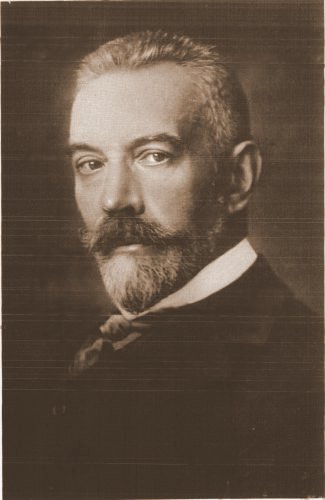
T. VON BETHMANN-HOLLWEG, German Imperial Chancellor. (Photo from Brown Brothers.)
A mighty fate has descended upon Europe. Because we were struggling for the esteem of the German Empire in the world, we have for forty-four years lived in peace and safeguarded the peace of Europe. In peaceful industry we have become strong and mighty and in consequence envied. With patience we have borne that, under the pretext that Germany was desirous of war, hostility toward us was being nursed and chains forged for us both in the East and in the West.
We wished to continue to live in peaceful industry, and, like an unexpressed vow, there was passed on from Kaiser to the youngest soldier: "Only in defense of a righteous cause shall our sword be drawn." (Hearty applause.) The day when we must draw it has appeared, contrary to our desire, contrary to our honest efforts to avoid it. Russia has applied the firebrand to the house. We find ourselves in a forced war with Russia and France.
Gentlemen, a series of documents, composed in the rush of events, is in your hands. Allow me to place before you the facts which characterize our attitude.
From the very beginning of the Austrian conflict we strove and worked toward the end that this trouble remain confined to Austria-Hungary and Servia. All Cabinets, especially that of England, take the same stand; only Russia declares that she must have a word in the decision of this conflict. Therewith the danger of European entanglements arises. As soon as the first authentic reports of the military preparations in Russia reached us we declared in a friendly but emphatic manner in St. Petersburg that war measures and military preparations would force us also to prepare, and that mobilization is closely akin to war.
Russia asserts in what is an apparently friendly manner that she is not mobilizing against us. In the meantime England tries to mediate between Vienna and St. Petersburg, in which she is warmly supported by us. On July 28 the Kaiser telegraphed the Czar, asking him to consider that Austria-Hungary has the right and that it is her duty to defend herself against Servian intrigues, which threaten to undermine her existence. The Kaiser called the attention of the Czar to their common monarchical interests with regard to the Serajevo outrage, and asked him personally to support him in order to establish harmony between Vienna and St. Petersburg.
At about the same hour in which this telegram was sent the Czar asked the Kaiser for his support and requested him to advise Vienna to be moderate in its demands. The Kaiser assumed the role of mediator. Hardly had he begun his activity when Russia mobilized its entire fighting force against Austria-Hungary. Austria-Hungary, however, had mobilized only those army corps which were directed against Servia; in the north there were only two army corps and these far from the Russian border.
The Kaiser immediately called the attention of the Czar to the fact that this mobilization of his forces against Austria-Hungary made his position as mediator difficult or absolutely impossible. In spite of this we continued our mediatorial activities in Vienna, going to the utmost limits of consistency with the terms of our federal treaty. ["Very true! Hear, hear!"] During this time Russia again spontaneously assured us that her military preparations were not directed against us. ["Hear, hear, fie!"]
The 31st of July arrived. In Vienna the decision was to be made. In the meantime we had succeeded with our negotiations to reaching a point where Vienna resumed intercourse with St. Petersburg, which for some time had been discontinued, but before the final decision was reached in Vienna the news arrived that Russia had mobilized its entire fighting force, which meant also against us. ["Hear, hear!"]
Russia's Mobilization.
The Russian Government, which from repeated admonitions knew what mobilizing on our borders meant, did not notify us of this mobilization and gave us absolutely no explanation. ["Hear! hear!"] Not until the afternoon of July 31 did the Kaiser receive a message from the Czar in which he assured him that the attitude of his army was not hostile toward us. ["Hear! hear!" and laughter.]
However, the mobilization against us on the Russian border was on the night of July 31 already in full progress. While we, at the request of Russia, were mediating in Vienna, the Russian Army appeared on our long, almost entirely open border. France, although not yet mobilizing, was making preparations for war. And we, up to this point, had intentionally not then called a single soldier of the reserve, for the sake of European peace. ["Bravo!"]
Should we continue to wait with patience until the powers by which we are surrounded choose the moment for attack? ["No!"] To expose Germany to this danger would have been criminal! [Stormy, concerted, prolonged "Very true and bravo!"—also from the Social Democrats.] Therefore, on July 31 we demanded that Russia demobilize, this being the only measure which could save the peace of Europe. [Hearty approval.] The Imperial Ambassador received, furthermore, the order to declare to the Russian Government that in case they did not comply with our demands they should consider that a state of war exists.
The Imperial Ambassador performed this mission. Up till the present we have not learned Russia's answer to this demand. ["Hear, hear!"] Telegraphic reports concerning it have not yet reached us, although the wire still transmits less important messages. ["Hear, hear!"] Therefore, on Aug. 1, at 5 o'clock, when the appointed period of grace was long past, the Kaiser considered it necessary to mobilize.
At the same time we had to make sure of the position France would take. To our direct question whether in case of a German-Russian war she would remain neutral, France answered that she would do what she had to do in her own interests. [Laughter.] That was an evasive if not a negative answer to our question.
Declares France Began War.
In spite of this the Kaiser gave the order that the French border should be respected. The command was strictly enforced, with a single exception. France, which mobilized simultaneously with us, declared that she would respect a zone of ten kilometers from the border. ["Hear, hear!"] And what happened in reality? There were bomb-throwing flyers, cavalry patrols, invading companies in the Reichsland, Alsace-Lorraine. ["Unheard of!"] Thereby France, although the condition of war had not yet been declared, had attacked our territory.
Concerning the French complaints in regard to violations of the border, I have received from the Chief of the General Staff the following report: Only one offense has been committed. Contrary to an emphatic order a patrol of the Fourteenth Army Corps, led by an officer, crossed the border on Aug. 2. They apparently were killed. Only one man returned. However, long before the crossing of the border French flyers were dropping bombs in Southern Germany, and at Schluchtpass the French troops had attacked our border troops.
Until the present our troops have confined their activity to the protection of our borders. They are now on the defense, and necessity recognizes no law. ["Very true!"]
Our troops have occupied Luxemburg, and perhaps have also found it necessary to enter Belgian territory. [Hearty applause.] This is contrary to international law. The French Government has declared in Brussels they will respect the neutrality of Belgium as long as she respects the opponent. We knew, however, that France was ready to invade Belgium. ["Hear, hear!"] France could wait; we, however, could not, because a French invasion in our lower Rhein flank would have proved fatal.
So we were forced to disregard the protests of the Luxemburg and Belgian Governments. We shall try to make good the injustice we have committed as soon as our military goal has been reached. [Applause.] Who like we are fighting for the highest, must only consider how victory can be gained. [Enthusiastic applause in entire house.]
Gentlemen, we are standing shoulder to shoulder with Austria-Hungary. With reference to England, the declaration which Sir Edward Grey made in the House of Commons yesterday plainly shows our attitude. We have assured England that as long as she remains neutral our fleet will not attack the northern coast of France and that the territorial integrity and independence of Belgium will not be violated. This declaration I repeat before the whole world, and I can add that so long as England remains neutral we are prepared in case of reciprocity to refrain from all hostile operations against French merchant vessels. [Applause.]
Gentlemen, so much for the events. I repeat the words of the Kaiser: "With a clear conscience Germany goes to the battlefield." [Enthusiastic approval.] We are fighting for the fruits of our peaceful industry, for the inheritance of a great past, and for our future.
The fifty years of which Moltke spoke, and in which we should stand armed and ready to protect our inheritance and the acquisitions of 1870, have not yet passed. The hour of trial for the German nation has struck, but we are facing it with confidence. [Stormy approval.]
Our army is in the field, our fleet is ready for battle, and behind it stands the entire German Nation. [Enthusiastic applause from the entire house.] The entire nation! [with a gesture particularly directed toward the Social Democrats. Renewed applause, in which the Social Democrats also joined.] You, gentlemen, realize your duty in its entirety. The question needs no further consideration, and I request speedy action. [Enthusiastic applause.]