Volume 1 — FIRST JOURNEY. (continued 3)
Reading edition
Hence you see the four other cultivated islands, which lie on the south, or the most remote part of the cataract. They are named as follows: Nuba, Gamnarty, Ducully, and Suckeyr: on the north side are two others, called Dorge and Tabai. These islands are inhabited by a race of people who may be looked on as living in 142the most primitive state; for no one ever goes to them, nor do they ever quit their island. They are very few in number—in some of the islands not more than five or six; and they live on the produce of the few spots of ground they find on them, which they continually irrigate with the common machine named hade, consisting only of a piece of sheepskin and two sticks, by which they draw up the water. They have also a few sheep; and fabricate a cloth from cotton produced in the islands, in the same manner as they make that of wool.
On the left of the cataract the soil differs from that on the right. It consists of soft whitish stones and sand. From this spot it may be seen, that the course of the river is for a considerable extent among the rocks; and the summits of two high mountains are to be seen at a great distance. This part is not frequented by travellers; for there is no mode of conveyance, and no inhabitants on that side of the cataract. Boats never venture thither: when the water is low, it is impossible; and, when high, it would require a very strong north wind, to stem the rapid current against the boat.
We returned slowly to the bark, and took our course towards the island we had left in the morning; but unfortunately the wind, being 143very strong, drove us to the island of Gulgé. The Reis wished to pass the whole night there; but in the evening the wind shifting a little, we returned to the island we were at before. But again, notwithstanding the proof we had given of our harmless intentions, the natives were not to be seen; and even the two men who had been with us in the boat no sooner landed than they disappeared. The son of the Reis, however, was preparing some food; and we were glad to have escaped the danger of so many eddies and rocks.
I forgot to mention that on the island Gulgé I perceived the remains of an ancient wall, in the form of a church, and built of sun-baked bricks. It was in the centre of the island, and consisted of three divisions.—See Plate 32.
15th.—In the morning we would not leave the island without seeing the inhabitants. The men soon appeared for their bakshis; and at last came the women, to see Mrs. Belzoni, who made them presents of glass bead-necklaces, with which they were wonderfully pleased: though, as it is their custom to take all, and give nothing, they did not even return us thanks for what they received; but took their presents, laughed, and ran away immediately.
We now descended the river with a strong 144north wind against us; and though some authors assert, that the Nile has no waves, but runs quite smooth, I can assure the reader, that we were this day tossed about as if by a gale at sea. The wind blowing fresh against a strong current naturally caused this effect.
We arrived in the afternoon at the village of Iskus, and went to see Osseyn Cacheff, who was returned, and to whom we had a letter from his brother Mahomet at Deir. I had landed with my interpreter and the Janizary, and entered a kind of house made in the shape of an angle of a propylæon. These houses would not stand the weight of an upper apartment, if they were built perpendicularly; for the clay walls, of which they are made, would fall outward. The Cacheff’s house was adorned with an old mat spread on the ground as usual, a water jar, and a chain with two hooks made in a particular manner. This was that same Osseyn, who was one of the two brothers that caused Mr. Burckhardt to return from Tinareh. He was about sixty-eight years of age, five feet eleven inches high, stout and robust, and able to support the charge he was born to hold. He was surrounded by thirty men, all armed, some with matchlock guns and long swords, and some with spears and shields instead of guns. He 145was clothed in a long tunic down to his feet, made of white woollen cloth, with a belt round his waist, to which his sword, flint, and steel were attached. Over his shoulder he had a long shawl, made of the same stuff as the tunic, thrown partly over his head, so as to cover it from the sun. He had also a red turban, and on his feet a pair of ragged shoes. Notwithstanding his dress, there was an air of superiority about him, which distinguished him at once above all the rest. It is worthy of observation, that even among barbarians great respect is paid to superiors; and those very men, who would murder a fellow-creature in a difference about a few pipes of tobacco, almost tremble at the frown of a single and sometimes harmless old man. His inquiries concerning my business were very minute; but I soon brought the affair of the temple forward, which did not a little surprise him. He said he knew the entrance into the place very well; that the round ball on the large head was the door of the great Dere, as he named it, and if removed I could immediately enter. This round ball was no other than the globe on the head of the hawk-headed Osiris, which stood over the door, as I mentioned before. At first he stated to me the great difficulty, if not impossibility of 146opening this place; and at last, when I had endeavoured to remove these obstacles, he made me promise, that, if I found the temple full of gold, I should give him half. To this I agreed, on condition that if I found only stones, they should be all my own property; and he immediately assented, for he said he wanted no stones. Upon this he gave me a letter to his son at Ybsambul, and when I left him, and went on board, I sent him some trifling presents, which he received with pleasure, and sent us a lamb.
When I came to the bark I found it crowded with women, who had learned from our crew, as we passed upwards, that there was a woman on board; and as soon as we arrived, on our return, they all ran to the shore. Mrs. Belzoni, not supposing they would come in such numbers, made a present of some glass beads to one of the wives of the Cacheff. This was enough: they increased in crowds, and we had to please them all.
Next morning we continued our voyage, and arrived very early at Ybsambul. I went to see a small temple on the south side, opposite the village; but it is of no consequence, only it may be remarked as the last on the Nile on this side of the cataract. It has served as a chapel 147to the Christian Greeks; and the figures of the Apostles remain nearly perfect painted on the wall and roof. We crossed the river, and I went immediately to Daoud Cacheff. Having presented the letter from his father, he sent for the men who were intended to work. I found these people complete savages, and entirely unacquainted with any kind of labour. They had changed their minds since I was there last; and, though I had the authority of the Cacheff, they would not work. My persuasion was of no avail; first, because they were not inclined to such labour; secondly, they did not know the value of money, &c. At last I pretended to give up my project, and go away. When the Cacheff saw that I meant to go, and that he should lose many a good present, he began to talk to them; and at last, with much difficulty, reduced the payment to one half of what they had demanded before. On my agreeing to this, they immediately insisted, that I should employ as many as they chose. It was in vain I told them, thirty were more than sufficient for my purpose; they would not hear of less than a hundred. With this it was impossible for me to comply; so I rose, and took leave of the Cacheff, ordering the Reis to go on board, and set off immediately. This, however, 148was not satisfactory to the parties; they had still more to say, and at last it was concluded, that I should take forty men, who were to be at the bark before the sun rose next morning, as it was nearly two miles from the village to the temple. I went on board, heartily wishing I had done with these people.
17th.—Early in the morning when I expected to see these wild men, for such I must call them, I was greatly disappointed: the sun was very high, and no one appeared. I then returned to the Cacheff, to inquire whether the men meant to make a joke of the business, or to work. Not being accustomed to be disturbed so early, he rose very slowly, and sent a party of his soldiers to search for the men, some of whom at last made their appearance, while others pretended they could not come. Their excuse was, that they saw a Bedoween in the desert, and they were all on the watch. The day before they wanted to be employed to the number of a hundred, and to-day they were unwilling to be employed at all. At length some arrived by land, some by water, but very late, and we went at last to the temple. I took it patiently, and began the work in such a direction, that the sand should fall off from the centre of the front of the temple, where naturally 149the door must be. They had a long stick, with a cross piece of wood at the end, at each extremity of which was a rope. One man drew the long stick back, and another pulled it forward. This is the method they use in removing the earth in their cultivated ground, and I found it very useful in clearing away sand also. As it was the first day of our enterprise, they went on better than I expected; and all their thoughts and talk were on the quantity of gold, pearls, and jewels, we should find in the place. I did not discourage them in their supposition, as I considered it to be the best stimulus they could have to proceed. At noon I gave them some boiled lentils, and bread soup, with which they were pretty well pleased. The Cacheff, who attended to the work himself, partook of what I ate. At night I paid the men, and recommended them to be there again early in the morning. The Cacheff and part of his court came on board, and we returned to the village for the night.
18th.—In the morning we went to the temple, and the Fellahs came after us rather late, and we began the work again very slowly. I had to use a great deal of persuasion this day; for the savages were led to think, they had laboured too hard on the first day, so that they were obstinate, 150and I had much ado to prevail on them to continue. As they complained of being very much tired, I promised, that they should not work the next day, but be allowed to rest themselves. We ended this day’s work before sunset, and returned to the village. Finding ourselves but ill supplied with provision in this place, I offered more than usual for a sheep, but to no purpose: I was obliged to eat rice and water, and very little of that, as we had not much on board. Our stock of butter was quite finished, and milk was very scarce.
19th.—In the morning I went to see the Cacheff, to speak about some palm wood. I found him quite changed in his behaviour, starting a thousand difficulties; in particular, that the Fellahs would not come to work any more, as it was useless for them to fatigue themselves for a little money; adding, that it was impossible to get any palm wood; though at the same time we were surrounded by it. I answered, that this was not our agreement; and, as I kept my word, and paid the Fellahs according to our first engagement, I expected them to perform their part of the bargain. After much debate, it was at last concluded, that I should see the Fellahs at night, and try myself what could be done, for he could not serve me. In short, I 151could make nothing of him; but his interpreter soon gave me to understand, that all this difficulty arose from my not having made him any considerable present; and the soldier who was with me from Siout told me, that I ought not to omit giving him a brace of pistols, or some other valuable thing. I saw their meaning immediately; but I also knew that these people never feel grateful for any thing after they receive it, but think only of contriving new tricks to extort more, if possible; so that it is just the same whether you give or not. However, I took a middle course, and told the interpreter, that I would provide a good bakshis both for his master and himself, if they would interest themselves in my favour. In the afternoon the savages were all assembled, and I was sent for. The brother of the Cacheff, whom I saw the first time we arrived at Ybsambul, was there: his behaviour however was altered, and much for the better; so that he, who at first was rough, became smooth, and the smooth became rough. I inquired about the wood, and was told, that I must go to a place two leagues off, where I should find some; but this was said only to start new difficulties, as I knew there was plenty in the village. With respect to the savages, I was informed, that they would 152not come to work so hard, unless I doubled the numbers. It was in vain for me to tell them, that a man does not work more when alone, than when accompanied by multitudes. They were obstinate, and I could do nothing with them; for had I consented to employ a hundred, I should soon have been called on to make it up two hundred. I promised to give bakshis to the brother of the Cacheff, who began to talk to them in their own language; and to my astonishment all at once they agreed to come to the number of forty only; on condition, however, that I should give them the sixth part of an ardep of corn to make bread with. The Cacheff seemed displeased with the influence of his brother, and rose and walked off. A barbarian from Deir, who was a stranger in the island, and had come thither to cultivate a piece of ground, had bought some wood to build a sakias, or water machine; but as he could not agree with the savages at Ybsambul, and was going away, he proposed to sell his wood to me; and I gladly availed myself of the opportunity, and thus got over this difficulty.
Next day (20th), in the morning the people came slowly to work, but upon the whole we went on very well, though I had much ado to make them proceed in the right way. The 153Cacheff, with his attendants, came to see how we were proceeding, and gave me to understand, that he intended dining with me. I told him I was very glad of his company, but had nothing except boiled rice, unless he would order his people to kill a sheep for us, which I would gladly pay for. They consulted about who could afford to part with a sheep, and receive piastres in payment, and at last the order was given to an old man, who had five, which was a greater number than any body else. When the sheep was brought to us, the difficulty was to fix the price of it. Being the first ever sold for money in that place, to put a high price on it would have increased the value of sheep in general, and consequently would have been against the interest of the Cacheff; for when he receives his revenue in these animals, he sets them at a very low price, that he may have the more given him. To estimate it at a low price would be worse, for it would be against them all in the exchange of sheep for dhourra with the other villages. Finding it a dangerous point to decide, it was at length resolved, that no price at all should be put upon the sheep, but that the man should make me a present of it, and I should give any thing I pleased in return. To prevent any standard being established 154from what I gave the man, I paid him in soap, tobacco, and salt.
At dinner the sheep was brought in pieces in two wooden bowls, and the Cacheff and his attendants seated themselves in a circle on the sand near the temple. The extremities of their filthy hands were soon washed in the liquor, and in a few seconds the whole was devoured. Not being accustomed to this unceremonious sort of feasting, I stood but a poor chance; but in subsequent occurrences of this kind I contrived to take my share without interfering with their scramble. Soon after dinner coffee was brought up from the boat, and I went on board to take my dinner with Mrs. Belzoni, who had boiled rice and water for her fare, in preference to the chieftain’s mess of mutton. In a short time the Cacheff approached, and signified his wish to speak to me in secret. We retired, and his principal interpreters were called to us. The great secret was this: on the night before, as he stood on the bank close to our boat, he saw me drinking a coffee cup of red liquor that I poured out of a bottle; and having inquired what it was, was told it was nebet (wine). Now he had heard that the wine of the English was much better than what they made in their own country with dates; he 155wished, therefore, to have some to drink also, but in a secret way. Fortunately I had a few bottles left from our stock in Cairo, which we preserved for extraordinary occasions; and I sent my interpreter down to the boat to fetch one. When the wine was first poured out into a cup and presented to the Cacheff, he sternly looked at the interpreter, and told him to drink first. The interpreter, who was a Copt, and had been in the French army for several years, did not want much persuasion to make a libation to Bacchus; so with a smile he soon convinced the Cacheff of the purity of the contents of the bottle, and the Cacheff did not hesitate to drink the next cup. At the first taste it did not appear to him so strong as he had supposed; but at last he found it so good, that in three days my scanty stock was nearly finished. I had much reason to repent having taken a Janizary with me, for instead of assisting me in my dealing with these people, I found he was the first to suggest to them what they never would have thought of. It is not to be supposed that a Mussulman will ever take the part of a Christian dog, against any of his own religion, unless he is responsible for the life of the stranger; and then he does it for his own sake, and not from any attachment to the European. 156The work went on very slowly this day; but altogether we had made a considerable advance in the sand, towards the centre of the front of the temple.
Next morning (21st), the people took it into their heads to come in such numbers, that I could not employ them all, as the work was directed only to one point. There was warm debating on the subject; but, as I would not spend one farthing more than I had promised from the first, they agreed at last that the pay should be divided amongst them all; and thus, instead of forty men, I had eighty for the same price, which was less than sixpence a day. The anxiety to see the inside of the temple, and to plunder all that it might contain, brought the two brothers on board very early in the morning. They soon gave me to understand plainly, that all that was there was their own property; and that the treasure should be for themselves. Even the savages began to lay their account in the division of the spoil. I assured them that I expected to find nothing but stones, and wanted no treasure. They still persisted, that, if I took away the stones, the treasure was in them; and, if I could make a drawing, or likeness of them, I could extract the treasure from them also, without their perceiving it. Some proposed, 157that, if there were any figure discovered, it should be broken before I carried it away, to see the inside of it. Thus I plainly perceived, that, on entering the temple, I should not be at liberty either to take notes of what was in it, or to make any drawings, much less to take away any statue, or any thing else that might be found. We went on with our labour, however, and, as I made a palisade with the palm wood I had bought, I had no need of so many men, as they had only to clear the space between the palisade and the temple.
In the course of the morning, two of the men left the work, and went down the Nile to our boat. Finding Mrs. Belzoni on board, with only a little girl from the village, they were rather impertinent to her, and attempted to go on board in spite of all she could say to them, intending to rob the boat. At last she presented a pistol to them, on which they immediately retired, and ran up the hill. She followed, but they mixed with a number of their fellow savages, and it was impossible to find them out; for they were all like so many lumps of chocolate seated on the sand at work, and not to be distinguished the one from the other. At night, when I paid the men, the Cacheff’s brother said, the money must be counted all in one heap, 158before it was divided among the people. My interpreter, who was also my treasurer, accordingly counted the money on a piece of a ragged shawl, which he had no sooner done, than the Cacheff’s brother threw himself on it, and seized every piastre. The men looked at each other, but no one dared to say a word about it; and he took it all away with him. I observed to him, that his magic was much more sure in its operation than mine, for obtaining money. But I was pleased to find they had begun to know the worth of it so well.
I naturally expected, that no one would come to work the next morning (22nd); but in this I was mistaken. So much of the sand had been taken away, that the first palisade became useless. I made another, therefore, directly before the place where I supposed the entrance to be, to prevent the sand from falling against it. I now began to perceive clearly, that this work would employ more time than I could spare in that country, and the period I had meant to dedicate to it was already elapsed; but this would not have deterred me from proceeding, and no doubt I should have accomplished my undertaking, had it not been for a material cause which compelled me to quit the work for a time. This was the want of that 159very article which, a few days before, was so despised and unknown; and now I absolutely could not proceed without it. It was money, which, even here, had shown its usual power among mankind, of exciting avarice, and of which those wild people soon became very fond. I had some water brought up from the Nile, and poured down close to the wall over the door. This stopped the sand from running, till I had a hole made so deep, that I could perceive it required a longer time to reach the door than I could stay, and more money than I could then afford. I had by this time removed so much sand, as to uncover twenty feet in the front of the temple. The colossal statues above the door were completely exposed; and one of the great colossi sitting before the temple, on the north side, which was buried in the sand, appeared with his face and shoulders like his companion on the south. Having obtained a promise from the Cacheff, that he would not let any one touch the place till my return, which would be in a few months, I contented myself with putting a mark where the sand was before I commenced the operation; and after taking a drawing of the exterior of the temple, quitted it, with a firm resolution of returning to accomplish its opening. We brought our boat to the 160village, and, after making some trifling presents to the Cacheff, set off the same evening.
We descended the Nile rapidly, as the current was very strong, which was a fortunate circumstance for us, for we were almost without provisions on board. Two hours after we left Ybsambul, a Turkish soldier on a dromedary hailed us from the right bank of the Nile; but, without attending to him, we continued our voyage. He turned back, and followed us a considerable way; and when he came to a place, where the current brought us near the shore, he fired a pistol, as a signal to stop. We were greatly at a loss to conjecture who he could be, as it was not to be supposed, that a Turkish soldier would venture alone into this country. At length, as we drew near the bank, he said he had letters for me from the Bey of Esne. This was not true. He produced two letters in Arabic, signed by two different persons not in existence, which ordered me, in an insolent tone of command, to desist from any work I might have begun in Nubia, and return to Cairo. The reason why these letters were sent to me, by whom, and for what purpose, is one of those mysteries which, for the present, must remain unknown.
The soldier came on board, and sent the dromedary back by his servant; for in that country 161every soldier has a servant, to take care of his camel, horse, or asses, if he have any. Thus, when a body of five thousand men marches against an enemy, there are always at least six thousand people more to encumber it, and eat up the provision: for not only every common soldier has a man, but every officer has two or three; and those of the higher rank, as Beys, Cacheffs, &c. have ten or more.
As the current was so rapid, the next day (23d), in the evening, we arrived at Ibrim, and early on the 24th at Deir. I went to see the temple, but in a cursory way, reserving my observations to my next visit. We took in some provision, set off immediately, arrived in the evening at Nobat, and the next night (25th), stopped at El Kalabshe. Here we visited the temple a second time, but rather too late for much inspection.
Next day (26th,) we visited the two temples at Taffa, my humble observations on which I shall give in my next voyage in Nubia. Here a barbarian, armed with a spear and shield, called to me to stop, which I did, as he said he had something to communicate. He demanded my money in a resolute manner, and with a savage look; but when I made the interpreter inquire 162of him if he demanded the money per force, or as a voluntary bakshis, he laughed and ran off.
Continuing our voyage, at Cardassy I saw the remains of some very extensive buildings, and of some quarries, where a small chapel is cut in the rock, containing many Greek inscriptions, which I regretted I had not time to copy. We next came to Gamby, where, on the east, is a small temple, but almost even with the ground, and a few figures and hieroglyphics on the stones. This temple, that of Deir, and the one opposite Ybsambul, are all I have seen on the eastern side of the Nile above the first cataract. We came down to Deboude in the afternoon, and went to see the ruins of that place, as I shall describe in my next journey.
Next day (27th), brought us to the Shellal, or first cataract. The soldier of Derow, who brought the letters, set off immediately, and I never saw him afterwards. I took particular notice of a small obelisk which was lying before the propylæon, and which, if brought to England, might serve as a monument in some particular place, or as an embellishment to the metropolis. I sent for the Aga of Assouan, and a Reis who knew the channels in the Shellal, and in the meantime took a general view of 163these superb ruins. I observed in the southern part of the island the remains of a small temple, quite in ruins, with blocks of stone scattered here and there, and remarked, that a part of the remaining wall contained the legs of several figures in basso relievo finely finished. I examined the blocks that had been thrown down from the wall, and found they contained the upper parts of the figures, which had formed a group of seven in all. When the Aga and the Reis came, I made an agreement with them to have the obelisk taken down the cataract; but, for want of a boat, it could not be effected that season. The obelisk is twenty-two feet long, by two wide at the base; so that it required a pretty large boat to convey it. It was agreed, and perfectly understood, that I took possession of this obelisk in the name of his Britannic Majesty’s consul-general in Cairo; and I gave four dollars to the Aga, to pay a guard for it till my return.
I entreat the reader here to pause, and to recollect what caution I took in securing this piece of antiquity; as he will find, in the course of this work, that the obelisk in question has caused me more trouble and persecution than any thing else I succeeded in removing from Egypt. Indeed, it nearly cost me my life; and 164for such disinterested exertions I received, in return, the meanest insults. Unfortunately such was my situation in Egypt, that some of the very people I had to deal with, though I was acting for the credit both of their country and of themselves, could not restrain the impulse of jealousy, which they nourished in their breasts, and which always operated to my disadvantage. In a future work, that I intend to lay before the public, I shall perhaps unfold these matters; so that any one who has common feeling will wonder how I could persist so long in my researches under such circumstances.
The blocks of stone, which formed the compartment of fourteen feet long and twelve wide, were twelve in number. When they were put together on the ground, they were a beautiful group, consisting of the great god Osiris seated on his chair, with an altar before him, receiving offerings from priests and female figures; the whole surrounded by flowers and hieroglyphics. The blocks were three feet six inches long, and three feet wide: but as they were two feet three inches thick, they were too bulky to be embarked whole. As they could be easily cut, being a calcareous gritstone, I made an agreement for one hundred piastres, to have them cut to six inches thickness. I left the money 165in the hands of the Aga; and it was understood, that these stones were to be embarked by the first opportunity of a boat, and sent down to Luxor. The Aga hinted, that he should be happy to know what I meant to give him for permission to take away the obelisk; for though I was authorised by the firman of the Bashaw to take what stones or statues I pleased, yet these fellows think they have a right to demand something; and if they cannot openly refuse, still they have it in their power to throw such obstacles in the way, as to entirely defeat your undertaking. It was agreed, that he should give orders to the Sheik of the island to guard the stones and the obelisk, so that no one should injure them; for which guard, as before stated, he received four dollars; and that on the removal of the obelisk he should receive three hundred piastres, equal to thirty dollars.
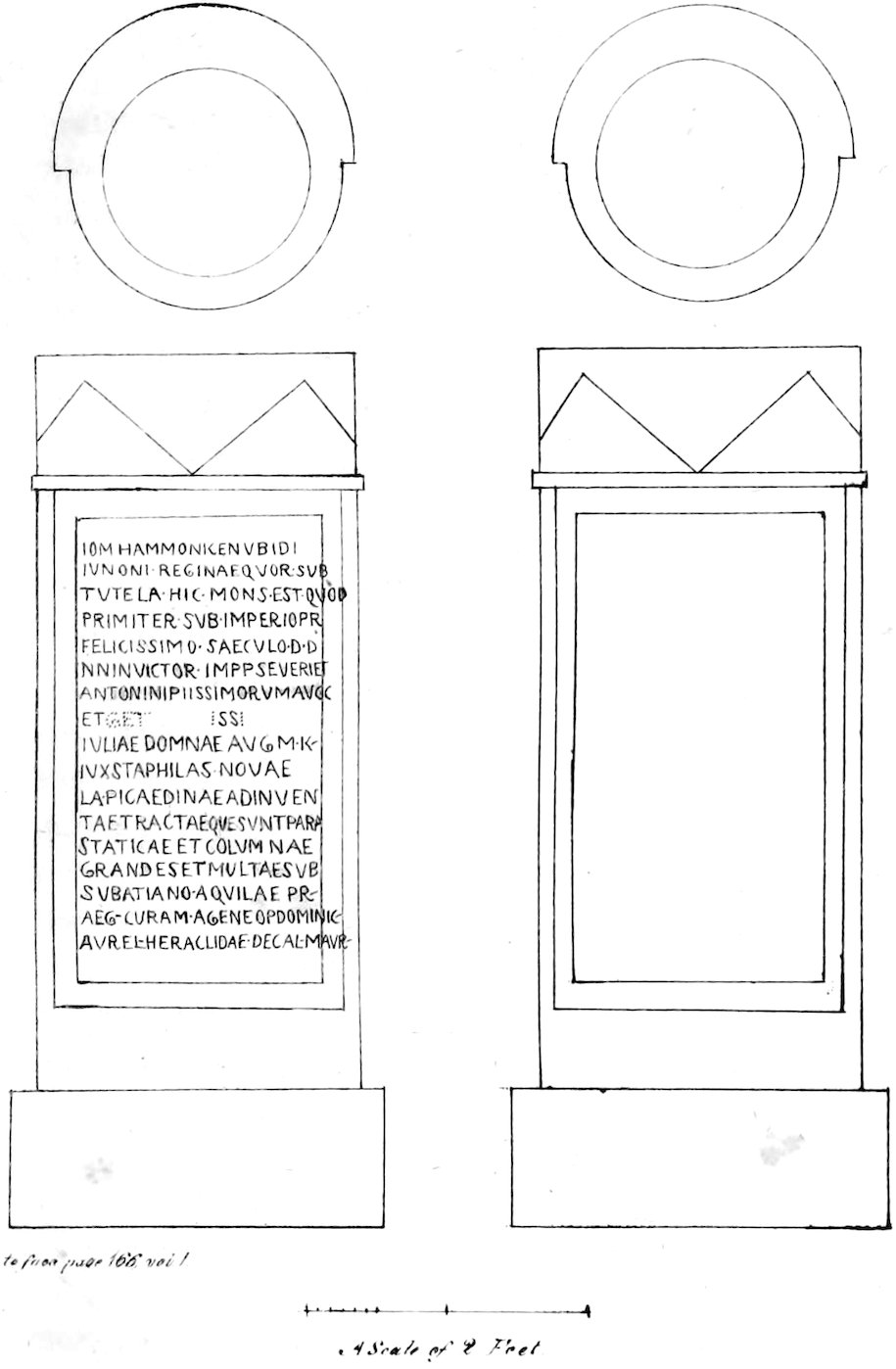
Next day, the 28th of September, we came to Assouan by land; just one month from the day on which we first entered that place. On our arrival, we were informed, that there were no boats to take us to Esne; and, in spite of all our haste, we were obliged to wait till some came from the north. We therefore took another tour in the island of Elephantine, and on the next morning, (29th), I set off for the granite 166mountain, about two hours and a half south-east of Assouan. I took an Arab of that place with me as a guide, and walked about the greater part of the day. I saw a great many granite quarries, which plainly showed, that the ancients took the granite intended for the temples, statues, and ornaments, from these places; and in one of these excavations I saw two large basins in the rough, cut out of the rock, one of which was ready to be taken away, as it was nearly finished. It appeared to me, by what I could observe, that the pieces of granite were procured by cutting a line with a chisel, about two inches deep, round the stone intended to be removed, and then by giving a great blow with some machine, which separated the part like glass when cut with a diamond. In this basin were pieces, which plainly showed the fact of this operation. On my return towards the west, I was fortunate enough to find a column lying on the ground, with a Latin inscription, as in the annexed plate. It proves, that the Romans used to take granite from these quarries, and, no doubt, chiefly for religious purposes, like the Egyptians.
On my return to Assouan, no boat had arrived, and I became impatient, for I wished to reach Thebes. We were seated under a grove 167of palm-trees, eating our soup of rice and meat with the Aga, when an Arab came to him, and whispered in his ear, as if he had something of great importance to communicate. The Aga rose, though his dinner was not finished, and went away with the air of a man of great business. Half an hour after he returned, accompanied by two other persons of distinction, and the old man who came before. They all seated themselves round me, and after introducing the affair with a degree of caution, I was asked, whether I wished to purchase a large piece of diamond. I considered, that I was no diamond merchant; but in a case like this, I would have contrived to become a jeweller, and have procured the money from Esne, if it had been to my advantage; for, in the times in which we live, jewels are no despicable articles, if they can be obtained at a cheap rate. I told the Aga, that if the article were good, I would purchase it, if we could agree; but it was necessary that I should see it. He said, the piece had been found by one of the natives of that place; and, as he was not in want of money, it had been preserved in the family for many years. This original proprietor being now dead, his successors wished to dispose of it. I requested to see it; so we retired some distance out of 168the way of the people. The old man then with great solemnity took a small wooden box from a pocket in his leathern belt. In this was a paper, which he unfolded; after that, two or three others, till at last he opened the sanctum sanctorum. I took its contents in my hands with no small degree of expectation: but, alas! how did I look, when I saw it was only part of the stopple of a common glass cruet, of the size of a hazel-nut, with two or three little gilt flowers on it! All my hopes vanished; and as the others were anxiously observing my motions, they could not fail to see disappointment so strongly marked in my countenance, as decided their fate, and destroyed their great expectations of wealth from this invaluable jewel. When I told them, that it was only a piece of glass, the words affected their minds like the unhappy tidings of some great misfortune: they walked off in solemn silence, not without giving me an inquiring look, to learn whether I were really in earnest. But I also shared their disappointment, and the smile on my face could give them no hopes.
Another day passed, but no boat appeared. At last I thought of bespeaking two camels, and proceeding to Esne by land, with Mrs. Belzoni and the interpreter, and letting the Janizary remain 169there, to follow by the first boat, and bring the implements we should leave behind. But when the Aga saw, that I had taken this resolution, he sent for a boat, which was hidden about a league distant, and there were two or three more concealed in other places. I found, that all this was done to keep us a few days in that place for the benefit of the town, strangers being of course obliged to spend money while they are there. After the boat was hired, at a great price, I found it belonged to the Aga himself; and the Captain or Reis told us, afterwards, that he ordered him to hide it, to compel me to give what he liked for the hire of it.
Some travellers give us the notions they have formed of the Arabs and Berberys; but it is to be observed, that there is a very great difference in the manner in which different persons travel; and the methods pursued in going through a country may afford one more opportunities of seeing and judging than another.
A traveller who has all the accommodation possible, and nothing to do with these people but in passing, can never judge of their ideas, their system of conduct, and their rapacious manners; for in the little interval, and the limited business he has to transact with them, they do not appear to be the people they really 170are. Some travellers even receive civilities, with which they are mightily pleased; without having time to discover, that the very persons, whom they suppose to be naturally civil, are so only to serve their own interested views. They pass on, and in their journal of remarks say, that they were received civilly at such and such a place. But let a traveller deal with them in any transaction, where their interest is concerned, and where their execution of any undertaking is required, he will soon find, that in every point they are the most cheating people on earth. Their deception is extreme. A traveller passing by a village stops his bark for an hour or two: what good people he finds! Some bring him a small basket of dates, others a few eggs, another some bread and milk; with which he is so pleased, that he immediately gives them five or perhaps ten times more than the worth of what he receives, without being aware, that it is through such an expectation they bring him these things; and exclaims, that in Europe they do not treat a stranger so civilly. But let him take the smallest of these presents without giving any thing in return, or even no more than it is worth, they will not fail to murmur at him. If he give only double the price, they have the art of returning the money with scorn 171and contempt, in order to shame him to give more:—and if he take the money returned, or give them nothing from the beginning, he must not expect, that they will let him go away without paying them for what they brought him. All this is unknown to a traveller merely passing by; for there is no one in this character, who would be so mean as to accept any thing, without returning double or treble its value. From these trifles it may be presumed what they are in all their dealings: to-night one word for such a thing, to-morrow another: their intrigues are beyond description: they have the art of making one thing appear like another so well, that it is very difficult to avoid falling into their trap.
There are two extremes in travellers. One who is just arrived, has never before been in the country, and of course has no knowledge of customs and things, cannot see one fourth of what he should see: the other is so thoroughly initiated into their customs and manners, that those things which strike at first sight, lose their effect on him; he almost forgets his own ways, and does not reckon any thing he beholds extraordinary or worth attention, though perhaps even of great consequence.
At last, after settling all my affairs with the Aga, and satisfying his demands of oil, vinegar, 172and some empty bottles, we left Assouan in the morning of the 30th, and two days brought us to Esne, the current being very strong. Khalil Bey was not there, and his Hasnadar or treasurer did not know any thing about the orders, which were sent to me in Nubia: but on seeing the Bey sometime after, he said he never sent me any such orders. On the morning of the 4th of October we arrived at Luxor. Seeing that no boat had arrived from Cairo, though the consul had sent me some money, I set off next day in the same boat to Gheneh, arrived there the next morning, and went to see Mr. Sokiner, a person whom I knew, and who served me much in this business. We went to the Cacheff, who could not give me a boat, in consequence of a fresh order from Cairo to press all boats that passed; and I was therefore obliged to despatch a courier again to Cairo, for an order from the consul to obtain one.
On the 7th, in the morning, we endeavoured to obtain a boat, but we lost the whole day in this manner, and I was nearly despairing of success; but, repairing the next morning to the Cacheff, I begged him to give me an order to press a courier, and he complied immediately, for he was of a very different cast from the Cacheff of Erments. The courier received his despatch 173about noon, and was to go and return from Cairo in sixteen days. He was on the point of setting off, when a large boat appeared, which brought Messrs. Jacque and Caliad, two agents of the French consul, who were going to Assouan. On inquiry I found that the boat was at liberty to be engaged after it arrived at Assouan. Accordingly I bespoke it of the Reis, before the Aga, who made him promise not to retract his agreement. The courier had not yet set off, and there was now no necessity of sending to Cairo, as I was assured of having this boat.
On our arrival at Thebes, the boat happened to be fastened to the bank, where the colossal head was. I will not waste my time in describing the remarks made by the two French agents of Mr. D., on seeing the head: suffice it to say, they positively declared, in spite of the evident mark it bore on its breast, that the French invaders did not take it away, because they thought it not worth the taking! On hearing of my fortunate success in collecting several valuable pieces of antiquity, their Dragoman, a renegade Frenchman, observed to me, that, if I persevered in my researches, I should have my throat cut, by order of two personages; one was the Cacheff of Erments, the other I shall 174not mention at present. I told him I was greatly obliged to him for his information, but did not believe any one would make such an attempt. They went to visit the soldiers, who lived in the tombs among the people at Gournou, and assembled several Arabs of that place before the two agents, who told them plainly in my presence, that, if they sold any article of antiquity to the English party, they would have them well beaten by the Cacheff of Erments, who commanded over them. From this moment I perceived, that I should have much opposition and many difficulties to encounter; but as my stay there was to be short, I did not regard them, and continued my business, after Mrs. Belzoni had been lodged in the house of an Arab at Luxor.
The same day I went to Carnak, and set twenty men at work on a spot of ground, that I chose according to a simple calculation I made, of which I shall have to speak hereafter. I re-embarked for Esne again, on board of the same boat, as I had to conclude the contract with the Reis of it, and to pay a part of the money as earnest. The two Frenchmen were on board also. We proceeded during the whole night, being favoured with a good strong wind, and arrived at Esne the next day at noon.
175I hope the reader will not think that I employ my pen in useless accounts, or to make a display of the difficulties I encountered in my operations, merely to enhance any merit on my part: on the contrary, I can assure him, that I study, by all means possible, to be brief, and not to insert the least thing but what is necessary to be known, as will be seen. I went to the house where all the owners of the boats were assembled, who at first were of one accord, that it was impossible to put the head on board the boat, alleging that it would break it to pieces, if such a mass of stone were placed in it. They then strove to persuade me to leave the stone, as they were disposed to believe that there was no gold in it; and, if I took it, and found none after I had spent so much, I should lose all. Notwithstanding their simplicity, when I persuaded them that no accident would happen, and that I took all risks upon myself, they did not fail to ask me an enormous sum for the hire of the boat. I was in a dilemma, fearing, that, if I missed this boat, I might lose the high water, which would have obliged me to wait till next year; and in a country like this, changing from one day to another its government and way of thinking, I did not know what might happen. I therefore thought it best to 176secure myself from any future extortion, and give an enormous hire for the boat. This was three thousand piastres, equal to seventy-five pounds sterling, from that place to Cairo.
After all this was settled, and half the money paid down, the boat was to ascend the Nile as far as Assouan, to unload at that place, and to return immediately. I sent my Janizary with some presents to the Aga, and some trifles for Osseyn Cacheff, to be forwarded to him at Ybsambul, by the first opportunity from Assouan to that place; thinking by this trifle he would be convinced, that I intended to return to that country to finish the operation, and be induced to keep his promise, not to let any one undertake the accomplishment of what I had begun. The Janizary was likewise to take on board the twelve stones which I left there to be cut, &c. When all this was arranged, I set off for Thebes at night, and arrived there the next morning. On my arrival, I went immediately to Carnak, to see what had been done the day before by the twenty men.
Here, reader, was the beginning of those discoveries, which have caused me so much trouble, not from the exertion and arduous labour required in these researches, but in the atrocious persecution they have drawn on me, from malice, 177jealousy, and envy to such a degree, that to this day, the very goddess Fortune, who has been apparently so propitious to me, I had reason to call barbarous and unkind. Notwithstanding which, I did not relinquish my undertaking, till I reached the accomplishment of my wishes. Let me add, I have further enterprises in view, which, I hope, will convince my adversaries, that their persecution has had no other effect on me, than that of strengthening me to perseverance in my undertakings. Had I not determined to stand, like a pyramid defying the wind, against all their numerous attacks, which poured on me like a torrent, I should not have been able to proceed, even from the commencement. On the other hand, I must acknowledge, that at the moment when I was persecuted on one side, I received marks of kindness and good wishes on the other; and fortunately, thank God, the well disposed far outnumbered the others, though few like to enter into, or interfere with matters which do not concern themselves. Many travellers of various nations, at the time of my researches, witnessed, that the greatest difficulties I had to encounter were not in the discovery of antiquities, which I consider the smallest part of my task, but in controlling the complicated intrigues of my 178enemies and false friends. I am more inclined to excuse Count Forbin, as the erroneous and false accounts he gives are so confused and contradictory to the facts, that he openly exposes himself to ridicule and contempt, than to pardon some others, who should have been above such paltry proceedings.
The works in Carnak were begun when I returned from Esne, but nothing was found, and there was no likelihood of finding any thing. The place whence the French had taken their lion-headed statues, at the time of the invasion, is where a temple stood, surrounded on three sides by a lake. It faces the avenue of the great sphinx to the north, and not a single wall or column remains standing. On the exterior side of the wall are several fragments of the above statues, which were there before the French army invaded Egypt, but they made some excavations on the east side of the temple, and made discoveries, the fruits of which are now to be seen in the British Museum, they having been captured at sea. The Count de Forbin asserts, that after all these sphinxes had been discovered they were covered up again by some French gentlemen who superintended the work. But the Count did not mention the names of those persons, for he knew very well 179that no such thing ever took place. The account he published of the statues, which he acknowledges to have been found twenty feet below the surface, and backed by a strong ancient wall, was taken from my own letters, which I gave him myself in Cairo, of which I shall have to speak hereafter, and which he promised to give to the world as they were. Instead of this, the only use he made of them was to throw all the facts into confusion, and prevent the real truth from coming before the public.
Now to more obvious facts. According to a calculation I had made, I dug on the west side of the temple, where no one had ever made any excavation before, nor did any traveller previous to me take any thing thence but what was in sight; the French having taken theirs from the east. The earth, bricks, and stones, were so strongly cemented together by time, particularly on the surface, that it clearly proved the ground never to have been touched from the earliest ages. In the course of a few days I discovered about eighteen lion-headed statues, six of which were perfect, and among them a white statue as large as life, supposed to be of Jupiter Ammon, which is now also in the British Museum.
180I here beg leave to make an observation which I hope will convince the world of the erroneous statement of Count de Forbin. The French Consul, Monsieur Drouetti, who had been making researches for fifteen years in that country, and who was naturally attached to the interest of France, had been to Thebes twice previous to my arrival in Egypt. How was it, that, in the course of so long a period, he never came to know from the natives, that such statues had been found there by the French, and covered up again? and how happened it, that the person who covered them up never mentioned it to him, or to any one else, even after a general peace took place? We should suppose, that as soon as the seas were cleared of the English cruisers, whose watchful eyes did not let even a water-rat pass into France, there was no fear that these statues should have been taken, and thus a second loss incurred: but independent of all this, there was nothing to prevent Mr. Drouetti from bringing them safe to Alexandria, as he did other antiquities, which were the sole object of his ascending the Nile. I should not enter on this subject, had it not been for the petty means which have been employed to depreciate every thing I have done, and which are a compound of erroneous assertions, 181that I believe originated in the volcanic brains of Count de Forbin himself.
The place where I found these statues must have been the interior of the pronaos; but there were many others in various places, and it is difficult to determine their original stations. In another temple in Gournou, which is yet unknown, and of which I shall speak in this work, I found several statues of the same sort, and by the pedestals it appears they were within the space from one column to another. The same may have been the case in this temple. The situation in which I found them was by no means their original place, and it was clearly to be seen by their irregular positions, that they had been brought thither in great hurry and confusion. Some brick walls had been built, as if to hide them from the destructive hands of an invader, and the white statue lay among the rest in an irregular manner.
During the time of this excavation I scrutinized the ruins of Carnak, and perceived a great number of spots that deserve digging. I saw the famous altar, with the six deities mentioned in the great French work, and the colossal arm, both of which I formed the project of removing even at that period. Fortunately on this side of the water the difficulty of obtaining 182people to work was less than I had found it on the other. The Cacheff was ready to do all he could for me, and every thing went on very smoothly. The only impediment here was that the Fellahs of Carnak would insist upon coming to work in greater numbers than those of Luxor; for they said the others had no right to come to labour on these grounds, and sometimes this dispute ended in blows. These people were quite the reverse of those in Gournou, who, having become opulent by the trade in antiquities, and tricking travellers, were not so anxious to gain thirty paras a day. During the same excavation I turned up a fine standing colossus without a head, part of which projects above the ground, and which had not been seen by any body. For my part I think it one of the most finished pieces of Egyptian sculpture I ever saw.
It would be too tedious to the reader, to mention all the particulars that occurred during my researches. Unfortunately I was again without money to proceed, and had to go to Esne, to borrow some from a Greek I happened to know in that place, who would supply me with any sum; but as I expected a remittance from the consul, I only took what was necessary to transport the lion-headed statues from 183Carnak to Luxor, ready for embarkation. On my return to Carnak, I found, that an order had come from the Cacheff of Gous to the Caimakan of Luxor, not to let me take any thing away: this being contrary to the order I had from Mahomet Ali Bashaw, I set off for Gous immediately; and finding, on my arrival, that the Cacheff was gone to Gheneh, I directed my course to that place. As the current was very strong, we went on pretty fast. About midnight we saw two cangias coming up. I inquired what party it was, and was told it was Calil Bey, my good friend, on his return from Cairo. I was pleased at this circumstance, as I meant to complain against the conduct of the Cacheff; but, on approaching the cangias, I found that the Cacheff was there also. Calil Bey was well pleased to see me returned from Nubia, and was anxious to inquire how they received me in that country. I told him, that they obeyed his firman, and that I had done all I wished to do in respect to the temple at Ybsambul; but not being able to finish my undertaking that year, I should return the next. He desired to know, whether the two brothers, Mahomet and Osseyn Cacheff, were friends again; a question to which I was unable 184to reply; but I told him the country was perfectly quiet at that time.
I returned to Gous with him, and the next morning took an opportunity to inquire of the Cacheff the reason of his sending the order to the Sheik not to let the English take away any thing that was found. He said, he knew nothing about it; although I had seen the order myself. However, he was ready to give me any order I pleased. No doubt this was in consequence of the Bey being there, otherwise I should not have found him so easy to deal with.
Calil Bey was an Albanian, who had married the sister of Mahomet Ali Bashaw of Egypt, and held the command of the provinces in Upper Egypt from Esne to Assouan; and for a Turk was much attached to European travellers. He was continually inquiring concerning things he did not know, and had a degree of sound judgment; a quality very scarce among Turks: but for all this he was a complete slave to superstition, and to the belief of magical powers. On our arrival at Gous, he took his seat in the garden of the Cacheff, under an arbour of vines, shaded all round by banana trees, which formed a very pleasing and cool 185recess. A large mat was spread on the ground, and on this a fine carpet, and cushions, as usual. The Cacheff was seated at his right, and a Turkish Sheik on his left. Two Hadgees sat by the Cacheff, and I was requested to take my seat near the Holy-man. Next to me was a Turkish merchant, and after him a fool or Santon quite naked. All the rest of the followers, soldiers, and attendants, stood in a crescent before us. Pipes were brought in for the Bey, the Cacheff, the Holy-man, and myself. Coffee was served all round to the persons who were seated, and the conversation turned on the harvest, that was to be the next season, according to the inundation of that year. It was then the beginning of November. They were wondering at the great quantity of corn the Bashaw was sending continually to be embarked at Alexandria, particularly at this season. Some supposed, that the Europeans were about to make war against the Porte, and that, previous to the declaration, they made provision of corn, as without a supply from Egypt they would be unable to maintain their troops. Others observed, if this were the case, Mahomet Ali would not send them corn, till he knew for what purpose it was wanted. One said, he thought the corn was sent into Russia, as he 186heard that the French had set all that country on fire; and he then inquired of me, whether it were not so. I told him, that I did not know what the French did in that country; but I knew that the corn was sent into Europe, in consequence of a scarcity in the harvest that year, through the whole of that quarter of the globe. The Bey agreed it must be so, and asked whether it would be the same the next season. I told him I hoped not, for, in general, after a scarcity came a plenty. Yes, says the Bey, but the Bashaw will sell the corn at a high price for three or four years to come, till your granaries are filled again. “But pray,” added he, smiling, “have you a scarcity of stones also in Europe, that you come here to fetch them away?” I answered, that we had plenty of stones, but we thought those of Egypt were of a better sort. “O ho!” replied he, “it is because you find some gold in them perhaps, thank God!” This is the first instance of my hearing the word “perhaps” employed; for they are so positive on this point, that they never make any doubt of it.
The dinner was brought in a large tray. It consisted, as usual, of very poor rice soup, which, after eating three spoonsful, was taken away, and a dish of roast mutton brought forward. 187No sooner had we begun to eat of that, than a man came in with his hand full of large green peppercorns, and let them fall on the tray, which, being of metal, sounded like a drum-head. After him came another, with half-a-dozen onions peeled, which he let fall in like manner, and they rolled about the tray like billiard balls; and a third followed with peeled garlic, &c. After eating the mutton, a dish of very small fried fish was served up. They were about half-a-dozen, and we were eight of us, so that we could not eat too much of this. It was soon removed, and a kind of tart was produced; but neither the Bey, the Cacheff, the Sheik, nor myself, could eat a single bit of it. The fruit consisted of a water melon, which having demolished, they finished their repast by washing their beards. It was rather too mean to set before the Bey, as I have seen the Cacheff take a better for himself at other times; but it is a general system among these people, both Turks and Arabs, always to make themselves appear poor in the presence of their superiors. As the Cacheff had furnished me with an order for the Caimakan of Luxor to let me carry away what stones I pleased, I took my leave of the Bey and set off.
On my arrival at Carnak, the work to be done 188consisted only in transporting the six sphinxes and the white statue to Luxor for embarkation, a distance of nearly a mile, without a road. In many parts the water had left a soft ground where the statues had to pass; and, as there was no mechanical power to assist, the Arabs had enough to do to carry them to the place of destination. With this all my labour at Carnak ended, in this voyage; and while thus waiting for the boat from Assouan, and the cash from Cairo, I paid a daily visit to the tombs in Gournou. These sepulchres are excavated in all directions in the rocks, but generally with the entrance facing the east, as the chain of these mountains runs from north to south. They are intermixed of all sizes; and some of them have porticoes hewn out of the rocks before the entrance; but, generally, they are within the outer door, which is most adorned with well-finished figures and hieroglyphics, and generally the watchful fox is represented at each side of the inner door leading to the grotto. Some of them are very extensive, and run down in various directions, something like winding stairs, having on each side, at regular distances of a few paces, small chambers to deposit the mummies. Some have deep shafts, or wells, with excavations on each side of the 189shaft to receive the mummies; and at the bottom of the wells are passages leading to smaller apartments, with endless winding recesses. It was here that I had first leisure to examine and find the means of ascertaining where the entrances were to many of the tombs, which had been hidden for centuries from the eye of mankind.
The extensive ruins of Medinet Aboo are, in my humble opinion, best worthy the attentive scrutiny of a traveller of any on the west of Thebes. The descriptions given by Messrs. Hamilton and Denon are sufficient to convey a correct idea of these edifices, which contain propylæa, temples, and dwelling-places. It seems that here was the residence of some of the sovereigns of Egypt; for in no other edifices of ancient Egypt have I seen the remains of habitations as they are in this place. There are two separate temples, of which the first that meets the view going from the Memnonium is of a less ancient date than the other. On the west side of the portal are stones with hieroglyphics upside down, evidently belonging to a former temple. The pronaos is surrounded by a portico of pilasters, at each side of which are two chambers: one on the right of the entrance has been used as a Christian chapel. 190The cella contains various apartments, quite dark; in one of which, on the right side, is a monolite temple of red granite, without hieroglyphics. It is wider than the door, and must have been placed there before the cella was erected. The hieroglyphics and figures of this edifice differ from those of the other temple in proportion as the two temples differ from each other. On the north side of this little temple was a small lake, or rather a tank for water, which is now filled up with earth and rubbish; and there must have been statues all round it, as I found part of one and fragments of others in an excavation I made in that place. Perhaps it might have been used for the same purposes as the small lakes near the temple of Carnak, which may be supposed to have been the public baths destined for the religious visitors to the temple. On the south of these ruins is a building something like a square tower, with a large gateway, which I opened and went through. It is nearly in a line with the gates leading into the great temple. Above the gateway is a chamber with two square windows, looking over it at each side. There are also two doors opposite each other on the sides. Above this chamber was another, with two windows like those below; but the fore part of the upper 191chamber is fallen in. There are recesses at the sides of the windows, no doubt to place the shutters. No hieroglyphics are to be seen within this building, though on the outside it is every where covered with them. The two lateral walls in front of this place form an avenue to the gateway.
Further on, about two hundred yards to the west, stands the great temple. There is a large propylæon, with the entrance into the inner yard. The walls are covered with hieroglyphics, deeply cut. The gateway, which is also adorned in like manner, leads into a large yard, with a wall opposite to the propylæon, and a gateway into another yard. At each side of this yard is a portico. On the right are seven pilasters, with colossal figures before them; and on the left eight columns, with capitals in the form of the lotus. Both of these porticoes are also adorned with hieroglyphics, deeply cut. The next yard has a gallery, or area, all round it, of pilasters and columns. The walls are beautifully embellished with battles, men on chariots, captives, and slaves; together with which are distinctly visible procession offerings, initiations, and sacrifices so well described by Mr. Denon. The excavation of these works shows, that they are of a very ancient period. 192The hieroglyphics are uncommonly deep, more so than any I have seen in other buildings in Egypt. In some parts the figures retain their colours pretty well, particularly in the ceiling on the capitals of the columns. This edifice has been used as a Christian church; and the rude columns, employed in a more modern building within this yard, show the wonderful difference between the arts of the two ages. Further on, through the last gate, was the entrance to the pronaos and cella: but now these are buried under the earth, and several Saracenic buildings have been raised on it. The exterior wall of these ruins is filled with historical subjects, such as land and sea fights, lion hunting, processions of captives, and various national emblems. Further to the south of the town is a small temple, which now serves for the shepherds to keep their cattle in at night. The whole town, in my opinion, appears to have been rebuilt twice or three times successively on the ruins of the former.
It was at this period, that I began to make some researches in the valley adjacent to that of Beban el Malook. I had seen all the tombs of the kings: as I did not go there, however, with any intention of making researches, my curiosity must have been greater than that of many who 193had been there before, as I went into every little recess of these valleys. It was in the western valley that one of the French savans discovered a large tomb, which he found open, but was quite unknown before his time. I went to visit this tomb, and found it very extensive, and in pretty good preservation. My curiosity did not end here. I went farther on in the valley; and in one of the most remote spots saw a heap of stones, which appeared to me detached from the mass. The vacancies between these stones were filled up with sand and rubbish. I happened to have a stick with me, and on thrusting it into the holes among the stones, I found it penetrate very deep. I returned immediately to Gournou, and procured a few men, to open these places. Unfortunately, both Mrs. Belzoni and myself had been much afflicted for some time with the ophthalmia, which was so severe on me at this time, that I could scarcely see any thing before me.
I took the men into the same valley the next morning; but in consequence of my eyes being so bad, it was some time before I could find the spot again. On removing a few stones, we perceived that the sand ran inwards; and, in fact, we were so near the entrance into a tomb, that in less than two hours all the stones were taken 194away. I had caused some candles to be brought, and I went in, followed by the Arabs. I cannot boast of having made a great discovery in this tomb, though it contains several curious and singular painted figures on the walls; and from its extent, and part of a sarcophagus remaining in the centre of a large chamber, have reason to suppose, that it was the burial-place of some person of distinction. The tomb consists of three chambers, two corridors, and a staircase; but the remote situation in which it was found renders it remarkable: and I declare, that I owe this discovery merely to fortune, not to any premeditated research, as I went into these mountains only to examine the various places, where the water descends from the desert into the valleys after rain. It is singular to observe, that though rain falls very seldom, perhaps not more than once or twice a year, yet such is the effect of the climate and the sun on the spots where the water passes, that they are as strongly marked, as if it were continually running over them, and much harder than the rest of the masses.
The higher part of the mountain on the west of Thebes extends in wide plains, which rise gradually towards the west; and when rain falls upon them, the water takes its course towards the Nile, descending into the valleys of Egypt. 195There are very few places in these mountains where water gathers in such quantities, as in the valley of Beban el Malook, and its adjoining branch on the west side. For some time the water forms a small torrent, that carries every thing before it. Mr. Salt superintended the making of a road from the tombs of the kings to the Nile, for the purpose of transporting a large sarcophagus, and one of these falls of water from the desert destroyed the whole road. For the present, however, I shall leave this valley, as I shall have to speak of it in another part of this work, on my second journey to Thebes and Nubia.
The time having elapsed, in which I expected to receive letters from Cairo, I was rather uneasy, and resolved to return to Kenneh. On my arrival at this place, I found the courier had just entered it. He brought me letters from Mr. Salt, with an order for money on the Seraf, or banker, of Kenneh. I quickly finished my business there, and speeded to Luxor, where I was pleased to find the boat returned from Assouan, to take the colossal bust on board: but I was soon informed by the proprietor, that it was loaded with dates, and that he was come himself from Esne, to return the money I had paid as earnest; for they could not think of 196taking that large stone into the boat, as it would crush it to pieces. All my persuasions were useless; and though I had a written agreement in my hands, they signified to me, that it was of no use, they never would take the stone on board. I had much to say to them, as may be imagined in such a case; for I was so circumstanced, that if the present opportunity of transporting the bust were lost, the water in the Nile would have become much too low, and the conveyance could not have been effected till the next season. At the same time I was informed by my Janizary, whom I sent to Assouan in the same boat with the two agents of Mr. D., that it was owing to them the owner would not take the stone on board: for they told him he would lose his boat, and never receive any recompense for it; and that the agreement I made with them was good for nothing when in Cairo. In fact, these gentlemen had so much warped the minds of the crew, that they were resolved not to perform their contract.
The twelve stones I had left in the island of Philoe, and which were to have been conveyed in the same boat, in like manner could not be embarked, as the Reis said there were no small boats to take them down the cataract: and I 197afterwards learned, that this also was owing to the same influence. The unfortunate history of these stones will not be read without exciting sentiments of detestation towards the parties concerned: they had been mutilated, and rendered useless; how, and by whom, I shall mention hereafter. My situation with regard to the boat was far from pleasant, and I had no resource, but to take the owner to Esne and lay the case before Khalil Bey, who by this time must have arrived at that place: but even then I did not know how far he would interfere in compelling these people to keep to their agreement, as he had himself observed, that he thought the stone would break the boat. This, however, was the only step I could take.
Fortune sometimes brings troubles on mankind merely that they may taste the fickleness of her nature and uncertainty of the favours she condescends to bestow on them. My vexation was great, thinking all my efforts and exertion in bringing the bust to the Nile were to no purpose, and that very probably it would never reach England, as the underhand machinations against it were so powerful. At that moment, however, a soldier arrived from Erments, acquainting me that the Cacheff was returned from Cairo; and he gave me at the same time 198a letter from him, with a present which he had sent of two small bottles of anchovies and two of olives. Strange as it may appear, it will be seen that the effects of a few salted little fish contributed the greatest share towards the removal of the colossus, which I had so much at heart, and which, in all probability, but for them, would not have been in the British Museum to this day. The letter contained a very gratifying invitation to a feast to be given by the Cacheff, and the present was in token of a friendly disposition towards me. I was not a little surprised at this change, but I soon discovered the reason. The soldier acquainted me, that the Cacheff was in a terrible rage with a certain correspondent and friend of his, a Frank, who for some time had raised his expectation of having some valuable presents sent him; but, instead of this, he received at last only a few bottles of insignificant fish, which may be had in plenty from the Nile, and a few olives, not worth a pipe of tobacco. I took care, that this should not be told to the owner of the boats; and, as it was arranged that we should go to Esne for the decision of the affair, I took them on board the little boat which I had hired, and we set off for that place, leaving the large one at Luxor. Knowing in what humour the Cacheff 199must be in from his disappointment, I thought to strike while his mind was hot.
On our arrival before Erments I begged the two owners of the boat to wait a little, as I had business with the Cacheff of the village. It was already an hour after sunset, and the village is about a mile from the Nile. I took my interpreter and Janizary with me, and set off alertly to my anchovy and olive man. I found him seated on a mat in the middle of a field, a stick fastened in the ground with a lantern attached to it, and all his attendants standing before him. On seeing me, he made a great parade of compliments; I suppose because he thought, that, as he was disappointed of presents from one quarter, he would make the best market he could by trying the other. Pipes and coffee were brought as usual; and an offer was made me, to send as many men as I liked to have to work, that I might take away the great head early the next morning, and the cover of the sarcophagus, or any thing else I pleased. Had I requested him to let me take the two large colossi of Thebes, Tommy and Dummy, as the Arabs call them, he would have had no objection to my putting them on board my little boat that night. I then introduced the affair of the boat, produced the written agreement I had drawn up at Esne 200with the two owners, and mentioned the money I had paid, which amounted to half the sum of what they were eventually to receive. He immediately said, I need not go to Esne for the decision, the affair belonging to himself, as the boat was to be loaded on a bank in his province. The two gentlemen from Esne were sent for, and when they heard, that the cause was to be tried at Erments, they were thunderstruck. They considered the boat lost to them, though I repeatedly told them, that I would be answerable for any damage that might be incurred in the embarkation or landing; but it was all to no purpose. The Cacheff, however, insisted that they should keep their agreement with me; and still more to accommodate matters, as they were at a loss what to do with the dates, offered them his canja, which would contain as much as was necessary to be taken out of the boat, as I did not wish to unload it entirely. Meanwhile, as he did not like to appear too openly decided in my favour, he proposed that in the morning the owners should be summoned, and the case brought to a fair hearing. They then retired to pass the night on board. In continuing his civilities and protestations of friendship, the Cacheff came to an explanation of his former conduct, and, in particular, of the letter 201he sent to his brother respecting the sarcophagus. It was written, he said, before he saw Mr. D.; but now that he found how things were, I might have the sarcophagus, or any thing else; that he would guard it for me as long as I desired; that no one else should have it; and added a thousand other obliging things.
So extraordinary a change led me to suppose, that Mr. Salt had made him some handsome present when in Cairo; but I was mistaken, for, a little after, asking him what he thought of the consul, to my surprise he told me, that he did not see him. The consul invited him, he said, to his house, and prepared a dinner for him; but that, on the day he was to go, news arrived of the death of Tusoon Bashaw, the eldest son of Mahomet Ali; and he was ordered to come away immediately, which put an end to the pleasure of seeing the consul, for he loved him like his right eye. The story was equally well invented, and well told; and I saw plainly he was so ashamed of his late conduct towards me, that he could not face the consul. He caused dinner to be brought, and carried his civilities to such a height, that I began to be alarmed, suspecting him of some diabolical trick. On my thanking him for the bottles of anchovies and olives, he said, they were the whole of 202the French consul’s present to him while he was in Cairo. I took the opportunity of observing, that it would have been well for him, if, while he was there, he had called on the English consul. To which he replied, that he had been told the consul had a fine brace of pistols for him; but that unfortunately it was out of his power to go to see him. I answered, I had no doubt he would make him some present when the stone should reach Cairo; on which he immediately rejoined, that there was nothing he would not do either for him or for me; but I must not think that what he did was with any view of interest. I said, I was quite persuaded of the contrary; and should trouble him for an order to be given to the people at Gournou to come to work. He protested he would comply with all I wished; but added, with a smile, “What will you do, if the trial should go against you?” I told him I should proceed to Esne, where the agreement was made in the presence of the Sharif, and show that I was in the right. He laughed, put his hand on my shoulder, and said, “You may sleep in peace, for to-morrow I will myself see the boat unloaded of every date that is in it, and you may re-load it at your pleasure.” I answered, that I had no doubt he would do what was just, and, taking 203leave, I returned on board the little boat for the night.
13th.—In the morning I found him in his chamber of audience, surrounded by several Arabs, Sheiks of the village. He made me sit down on his right hand, and coffee and pipes were brought; for no judgment could be pronounced without these luxuries. He had explained the cause to the gentlemen of the jury, who said, without hearing the other side, that what he intended to do was perfectly equitable, and they would have said the same whether I had been right or wrong; for these juries are not so deficient in politeness as to contradict the judge. The other parties came, and he received them politely, but with a frown on his brow, from which I have no doubt they sufficiently augured their fate. However, not to keep them in suspense, they were soon plainly told, that the bark, except only eighty ardeps, an indulgence to which I had agreed, must be unloaded; and he saw no other way of settling the business. He then referred to the gentlemen of the jury, to know whether they had any thing to say. To my astonishment they answered, that, as the other parties made no defence, they of course acknowledged themselves wrong; and, having nothing more to do, 204they all instantly rose and walked off. The defendants then partook of what was before them; but I believe never made a worse breakfast in their lives. They began to talk about where to find a boat, though they were obliged of necessity to hire one of the Cacheff, being fully aware of his design, which was to get the best part of the money for himself. The contract was soon made, and they paid him two-thirds of what they were to receive from me, which, indeed, they were glad to do, lest he should scrutinise the business, and, finding the freight to be double what was mentioned in the bill of lading, they should thus lose still more. I then took leave of the Cacheff, that I might hasten to Gournou, to settle what business was to be done there. He had given me a tiscary for the soldier to furnish me with what I wanted, gave orders to the Fellahs to do all I desired, and take out the sarcophagus; and on going on board, I found that he had sent me two sheep, a jar of cheese, and some bread. We set off immediately. One of the sheep died in the evening, the other next day, and the cheese was full of vermin. We arrived at Luxor in the afternoon, and a few hours after went to Gournou, and saw the Sheik el bellad of that place. I sent my Janizary to the soldier, 205and it was concerted, that the Fellahs I wanted should be ready for me in the morning.
Early on the 14th, I went again to Gournou to begin the work, and was not a little surprised when I saw no Fellahs assembled. By one whom I met, I was told, that they were afraid, being ordered not to work for the English. I applied as before to the soldier, who sent a man to collect the Fellahs; but it was too late: they were all dispersed. Accordingly, I contented myself this day with only having the apparatus, necessary to embark the head, conveyed over from Luxor. The Cacheff’s boat from Erments arrived, and that at Luxor came also to Gournou to unload.
15th.—The next day we collected, though not without trouble, a hundred and thirty men; and I begun to make a causeway, by which to convey the head down to the river side; for the bank was more than fifteen feet above the level of the water, which had retired at least a hundred feet from it.
Next morning a soldier came from the Cacheff, to say that I was not to pay the Fellahs any thing, as they were ordered to work for me for nothing as long as I required, and that he made me a present of their labour. I thanked him, but desired the soldier to tell him, at the 206same time, that it was not my custom to have the labour of men for nothing, nor would the consul of England accept of such a present. I this day finished the causeway down the bank, and had the head brought to the edge of the slope, ready to be embarked.
On the 17th of November, I succeeded in my attempt, and the head of the younger Memnon was actually embarked. I cannot help observing, that it was no easy undertaking to put a piece of granite, of such bulk and weight, on board a boat, that, if it received the weight on one side, would immediately upset; and this was to be done without the smallest help of any mechanical contrivance, even a single tackle, and only with four poles and ropes: the water was about eighteen feet below the bank where the head was to descend. The causeway I had made gradually sloped to the edge of the water close to the boat, and with the four poles I formed a bridge from the bank into the centre of the boat, so that when the weight bore on the bridge, it pressed only on the centre of the boat. The bridge rested partly on the causeway, partly on the side of the boat, and partly on the centre of it. On the opposite side of the boat I put some mats well filled with straw. I necessarily stationed a few Arabs in the boat, 207and some at each side, with a lever of palm wood, as I had nothing else. At the middle of the bridge I put a sack filled with sand, that, if the colossus should run too fast into the boat, it might be stopped. In the ground behind the colossus I had a piece of a palm-tree firmly planted, round which a rope was twisted, and then fastened to its car, to let it descend gradually. I set a lever at work on each side, and at the same time that the men in the boat were pulling, others were slackening the ropes, and others shifting the rollers as the colossus advanced.
Thus it descended gradually from the mainland to the causeway, when it sunk a good deal, as the causeway was made of fresh earth. This, however, I did not regret, as it was better it should be so, than that it should run too fast towards the water; for I had to consider, that, if this piece of antiquity should fall into the Nile, my return to Europe would not be very welcome, particularly to the antiquaries; though I have reason to believe, that some among the great body of its scientific men would rather have seen it sunk in the Nile, than where it is now deposited. However, it went smoothly on board. The Arabs, who were unanimously of opinion that it would go the bottom of the river, or crush the boat, were all attention, 208as if anxious to know the result, as well as to learn how the operation was to be performed; and when the owner of the boat, who considered it as consigned to perdition, witnessed my success, and saw the huge piece of stone, as he called it, safely on board, he came and squeezed me heartily by the hand. “Thank Heaven!” I exclaimed, and I had reason to be thankful; for I will leave it to the judgment of any engineer, whether it would not be easier to embark a mass ten times larger on board a competent vessel, where all sorts of mechanical powers can be procured, instead of being destitute, as I was, of every thing necessary.
The boat then crossed the water to Luxor, for what was to be taken in there, which was done in three days, and on the 21st we left Thebes on our return to Cairo.
I had just finished my business, when I was again so affected with ophthalmia, that for twelve days I kept myself shut up in the cabin of the boat, so that I can give no account of this voyage, till we reached Siout. I could then just peep at the light; but it gave me great pain whenever I attempted to open my eyes. At Siout I went to see the Deftardar Bey, to return him thanks for the firman he had given me when I ascended the Nile. I 209found him in his tent in the middle of a field of high clover, which had nearly reached its growth, and his horses were all out at grass. He was pleased to hear that I had succeeded in my undertaking, and requested to be remembered to the English consul, to whom he sent a letter by me.
Next morning we set off for Cairo, and reached it on the 15th of December, having been twenty-four days from Thebes. Thus I had been five months and a half in continual activity and exertion; but I must not let pass the unjust observation made by the ever veracious Count de Forbin, who asserted, that I employed six months solely in taking the colossal bust on board the boat. It is true, I was absent five months and a half from Cairo, and six months had elapsed before I reached Alexandria; but this time was not all devoted to the removal of the bust, as I employed only eighteen days in that operation, and but a single day in embarking it: the greater part of the time was spent in more arduous researches; and the various pieces of antiquity which I brought down the Nile will bear infallible testimony to my labour.