Front matter (continued 8)
Reading edition
The road from Borisov to Studianka was choked with non-combatants, sick and wounded barely capable of dragging themselves along, straggling soldiers, disbanded skulkers, fugitives from Moscow, camp-followers, men, women and children, huddled in a helpless mass, all streaming mechanically to Studianka with the last of the organised fighting men. Vlastov’s division coming into the road at Staroï Borisov about 3 a.m., cut the line of retreat and the rearward portions of the mob fled back towards Borisov, whence Partouneaux moved out to fight his way through. His division was now only 4000 strong. Delaître had about 500 Saxon and Berg horsemen. Two tracks led from Borisov to Studianka, dividing a short distance west of the town. That to the left skirted the bank, but it was full of stragglers, and Partouneaux, believing that the right-hand one would take him directly to Studianka, struck into it. This movement brought him right against Vlastov’s division. After a most gallant attempt to fight their way through the French were forced to give way. Partouneaux and Billard were taken prisoners with the poor remains of the latter’s brigade, and the remaining three fell back towards Borisov, to find it occupied by Wittgenstein. They passed a fearful night in the snow, without food, fire, or shelter. Next day almost all the wounded and weaker men were dead, and the benumbed and starving survivors could only surrender. A single battalion, about 160 strong, which had luckily taken the left-hand track, reached Studianka. The French loss was over 4000 men, including 500 cavalry and 4 guns.
In the evening of the 27th Yermólov entered Borisov. As soon as the French left the town Chichagov repaired the bridge with pontoons, and direct communication being thus established, a general attack was concerted for next day. Wittgenstein was to complete the destruction of Victor’s corps, while Chichagov, supported by Yermólov and Platov, pressed Ney and Oudinot, and endeavoured to throw them back upon Zembin.
The whole country was partially wooded except on the marshy banks of the Berezina, and in places the woods became very thick. On the western bank, about 3 miles south of Studianka and nearly half-way between the villages of Brilova and Bolshoï Stakhov, stood Ney and Oudinot. Their front was about a mile long, Ney’s force being on the left, resting on the river, Oudinot on the right, supported upon a dense wood. Guns could not be brought into action on either side except on the road, where 8 pieces, equally divided between the two armies and continually replaced, fought each other all day. In reserve behind Ney and Oudinot stood the Guard.
At 8 a.m. Chaplitz and Pahlen began an attack on the 2nd Corps with 7 regiments of Chasseurs, and soon a furious conflict raged in the woods. At first the attack made headway, and the French and Swiss soldiers, who had passed a wretched night, began to give ground. When the roar of firing swelled up all the disbanded men took to flight, disordering and carrying away the reserves, while Oudinot was disabled by a wound. Ney, always at the point of danger, rushed to take his place, rallied the 2nd Corps and, calling up some of his own troops in support, checked Chaplitz’s advance and began to drive him back upon Stakhov. Some hundreds of prisoners were taken. Sabaniev, who was moving up to support Chaplitz, stayed Ney’s advance, but was suddenly charged in the most gallant fashion by Doumerc’s Cuirassiers. They burst from the woods upon Cherbatov’s division, broke through its skirmishing line, and charged its squares with desperate courage. Some 2000 Russians were sabred and captured. The Cuirassiers were of course nearly destroyed, but their splendid behaviour saved the army for the moment. Chichagov sent forward Voïnov to sustain Sabaniev, but though nearly twice as numerous the Russians could make no headway. The French losses were fearful. General Zayonczek, who had defended Praga against Suvorov in 1794, had his leg shattered; Legrand, Rapp, Amey, Dombrowski, and Kniaziewicz were also wounded. Half the survivors of the 2nd Corps were killed or disabled; but at night their shattered ranks still held their own, and if courage and devotion could have saved the Grande Armée, that end would have been achieved.
Meanwhile on the left bank Victor’s corps, with equal heroism but less success, had been contending with Wittgenstein. Most of Victor’s artillery and the Baden brigade were already across, but Napoleon now sent back the latter, adding to them apparently the Baden battalion at Head-quarters. The bridges were so blocked that the artillery could not return. Victor took up a position nearly perpendicular to the river, just south of Studianka, on some rising ground partially wooded. On the right, close to the river, there was a thick clump of wood. This was defended by the Badeners. Next on the left stood the Berg brigade when it arrived in line, then Gérard’s 3 Polish regiments, with Löw’s Saxon brigade beyond them. On the extreme left stood General Fournier with his two remaining cavalry regiments (Baden and Hesse). Victor had under his hand only 15 guns, and his entire strength was not more than 8000 infantry and 500 cavalry (according to his own account only 7400). The Berg brigade had moved forward to endeavour to rescue Partouneaux.
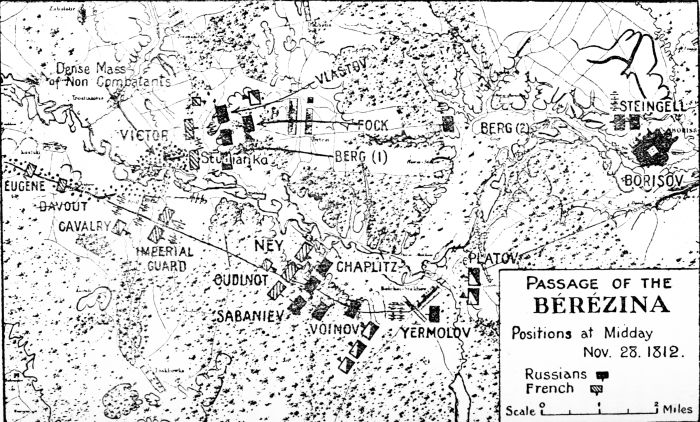
Passage of the BEREZINA Positions at Midday Nov. 28, 1812.
Wittgenstein left Steingell at Borisov to disarm the prisoners; the rest of his army was directed upon Studianka. Vlastov drove back the Berg troops into the main line of the 9th Corps; but was then checked, though a battery established by Diebich made terrible havoc among the wild crowd which was surging around the entrance to the bridges. All the non-combatants, when the balls began to fall among them, crowded to the river marge in utter confusion and there remained, huddled in a mass more than 200 yards deep and extending for three-quarters of a mile. The panic was fearful, and the horrors that took place in the crowd will never be known. Men fought their way ahead by any and every means, and drove their vehicles remorselessly through the press. Men, women, and children were murdered, trodden down, and forced helplessly into the river, while all the while the Russian cannon-balls were falling with the snow. Many of those who reached the bridges were thrust off them and drowned or crushed beneath the wheels of vehicles. Many committed suicide to avoid a worse fate: there is at least one well-authenticated case of a mother who, herself mortally wounded, killed her child before she died. Yet carriages of Napoleon’s staff and of the Generals of the Guard were laden with helpless women and children whom their protectors made every effort to save. Marshal Bessières and General Laborde in particular earned by their humanity laurels fairer than any which they had gained upon the field of battle.
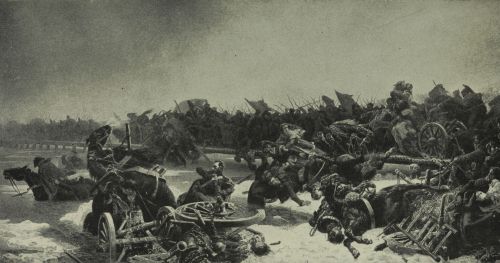
CROSSING THE BEREZINA The Baden Brigade crossing the upper bridge during the night of the 28-29th of November, 1812 From the painting by J.A. Nikutowski at Carlsruhe
General Berg’s first division quickly supported Vlastov. The Badeners on the right were driven back; but Napoleon at once took the Russians in flank by establishing a battery on the other side of the river. The Badeners reoccupied their position and held it all day against incessant assaults—at grievous cost to themselves. Further to the left Victor’s Polish troops executed a fierce counter-attack, and were on the point of piercing the Russian centre when Fock arrived with his division and restored the conflict. Victor’s men were now hopelessly outnumbered, but they fought on with magnificent tenacity until nightfall. An attempt to turn the left was checked by a gallant charge of Fournier’s troopers and repulsed by the Saxons and a Polish regiment. Berg’s second division, owing to some misunderstanding, did not arrive until the action was over. Victor’s left was thrown back, but he still covered the bridges.
At 9 p.m. Victor received orders to cross, and began to withdraw. All round the bridges huddled the living mass of human beings and animals, heaving sluggishly with convulsive movements to escape, but practically inert. The eastern outlets were blocked by a hideous heap of broken vehicles and dead or dying human beings and horses piled one upon another in the trampled and blood-stained snow, through which it was impossible to make way. Eblé and his engineers literally had to make a cutting through the horrible heap and pile up the corpses on each side to keep back the unhappy mob. Through this ghastly passage, and along others like it made for them by the pioneers, the weary remains of the German and Polish regiments defiled, but even so they often had to fight their way. It was not until 1 a.m. on the 29th that they were at last across. Victor and Eblé vainly endeavoured to persuade some of the mob to follow, but most of them were torpid with misery and hopelessness and would not move. At dawn on the 29th a small detachment of the 9th Corps which had remained to the last was withdrawn. Eblé’s orders were to fire the bridges at 8 a.m., but he waited until 8.30, hoping to save some more lives. A few of the non-combatants followed Victor’s rear-guard, but the passages were soon blocked. At 8.30 Eblé fired the bridges, and there was a last scene of horror. Many of the unhappy wretches, at last alive to the situation, strove to dash through the flames, others endeavoured to cross on the thin ice between the bridges, many threw themselves into the icy stream to wade or swim. It is useless as well as painful to dwell longer upon the tragedy, the details of which may be gathered from countless works. Perhaps no event in history has ever so completely united in itself every element of misery.
The loss of life at the passage of the Berezina will never be exactly known. The Grand Armée lost 1200 officers killed and wounded, which may perhaps indicate a total of all ranks of 12,000 to 15,000. The 2nd and 9th Corps lost half their effective strength. Including prisoners and deaths from cold and misery during the three days the army was probably diminished by from 20,000 to 25,000 men. Enormous quantities of baggage were lost, but few guns—the Russians claimed 23. The loss of life among the non-combatants must have been enormous; almost all who were captured died of hunger or cold; their captors had little to spare them, and if the Russian regular soldiers often behaved with kindliness, the wilder Cossacks stripped their captives of everything. Perhaps the most awful incident was the fate of 500 women who were huddled in a barn at Borisov, without food for several days, and almost without fires. Only some 20 survived.
There is reason to believe that the Russian armies lost at the Berezina not less than 10,000 killed, wounded, and prisoners. Langeron says that Chichagov alone lost 7000. Of the 1500 prisoners many died of want before the survivors were retaken by the Russians.
It cannot be said that Napoleon showed to any advantage at the Berezina. The selection of the point of passage was due to the skill and energy of Oudinot; the credit for the splendid resistance on the 28th is to be attributed to Ney and Victor; while the true heroes of the episode were General Eblé and his pontonniers. Eblé died of his hardships a month later, and of his devoted 400 not 40 ever saw their homes again.
FOOTNOTES:
CHAPTER XIV
CONCLUSION OF THE CAMPAIGN. LOSSES AND RESULTS
The passage of the Berezina practically put an end to the existence as an organised body of the remains of the Grande Armée. Of the 45,000 or 47,000 combatants whom Napoleon had near Studianka on the 26th, there probably remained on the 29th little more than 25,000, a total which rapidly diminished through slaughter, fatigue, famine, despair and, above all, the steadily increasing cold. The 2nd and 9th Corps had sacrificed themselves heroically to cover the passage, but the double ordeal of battle and hasty retreat was too heavy for them to bear, and they began to disband like the rest of the army. They had already been reduced to a mere handful. In a report on the evening of the 30th Victor stated that he had only 60 mounted horsemen left. He believed that he still had 4000 infantry—the surviving half, as he explained, of the 2 divisions which had fought so gallantly on the 28th—but on calling the roll he found that they had already dwindled to 3300.
While the battles of the 28th were raging the corps of Davout and Eugène had defiled on Zembin. The effects of the neglect of Chaplitz to break down the long wooden bridges over the marshes were now apparent; the marshes were hardly as yet solid enough to bear vehicles, and had the bridges been destroyed nothing could have passed. Before daylight on the 29th Napoleon started with the Guard, followed by Victor and Ney, but the passage over the long narrow bridges was so slow that at 10 p.m. Ney was only at Zembin, 7 or 8 miles from Studianka. With him were Eblé and the remnant of his pontonniers, and when the last troops had passed they fired and blew up sections of the bridges to check the pursuit of the Russians.
On November 26th Kutuzov, who was then at Staroselie, 12 miles west of Kopis, seems to have awakened to the probability that Napoleon would escape. At any rate, he suddenly acted with convulsive energy, and during the next 2 days the Corps de Bataille marched 42 miles. The effort, of course, exhausted it, and on the 29th it could only cover 11. In any case it was too late. Napoleon himself was already safe, and, though only followed by a remnant of his once mighty host, was able and willing to give endless trouble to Europe.
Miloradovich reached Borisov on the 28th, too late to take part in the battles. Wittgenstein was retarded by the necessity of bridging the Berezina at Studianka, for which purpose he had to avail himself of Chichagov’s pontoons from Borisov. He directed Kutuzov II, who had just joined him, to pursue Wrede towards Vilna, and Orlov-Denisov, reinforced by some cavalry and mounted infantry, to follow Napoleon. Chichagov pushed forward Chaplitz, and prepared himself to follow with the bulk of his army.
For the relics of the Grande Armée there was now, as De Chambray says, no resource but in hasty flight. Wrede, after reoccupying Glubokoië, had moved southward to Dokchitsi, and was directed to cover the right flank of the retreating army; but his force, at first about 10,000 strong, rapidly dwindled from the ravages of cold and hardships, and the steady harassing of Kutuzov II. To expect that he could check Wittgenstein, who crossed the Berezina on the 31st, and began to pursue by roads roughly parallel to the main highway, was hopeless.
The country between the Berezina and Vilna had not been completely wasted; the towns still existed; there were small garrisons and magazines in some of them. But the increasing cold rapidly shattered every semblance of organisation. It rapidly became so fearful that all energy was absorbed in fighting it and endeavouring to preserve existence. The number of men actually with the colours dwindled fast. On December 1st Ney sent the eagles of the 3rd Corps with their guards and the regimental officers to take refuge with the head-quarters and the few thousand troops who still marched with it. When he had sent them off there remained to escort him only a company of 100 fighting men! The others, under General Ledru, tramped doggedly on for two days and three nights, only halting for necessary rest, and joined the head-quarters at Molodechno.
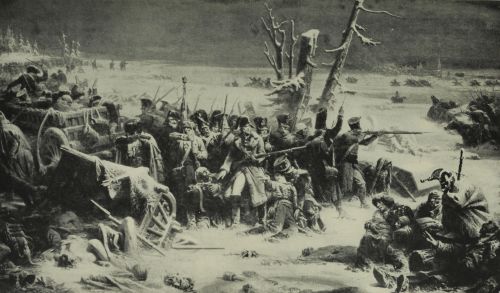
MARSHAL NEY SUPPORTING THE REAR-GUARD DURING THE RETREAT FROM MOSCOW From the painting by Yvon
The flight to Vilna contains little of military interest. It was a mere rout of the most pitifully helpless condition, the mass of fugitives trailing mechanically along the road, followed, surrounded, and massacred by the Cossacks, while Chichagov’s army and Yermólov’s division marched steadily in the rear, ready to overwhelm any solid resistance that might be made. But, in truth, little could be offered. On November 29th Lanskoi’s cavalry detachment seized Plechenitzi on the French line of retreat, nearly capturing the wounded Marshal Oudinot, whose staff heroically defended the house in which he lay. Chaplitz crossed the Zembin marshes by strengthening the ice with planks and brushwood, followed up the French rear-guard, and captured 7 guns and hundreds of stragglers. On the next four days there were further rear-guard actions, all much alike and all resulting in loss of guns and prisoners to the unhappy French, whose misery and demoralisation prevented them from responding to the splendid example still set them by their heroic leader. The hopeless condition of affairs may be gauged by the fact that on December 2nd there remained hardly 13,000 men with the colours (De Chambray says only 8800). With the head-quarters there were still perhaps 6000 or 7000; Ney had about 2500[10]; Victor perhaps as many; while the 1st, 4th, and 8th Army Corps and the cavalry could not muster 1000 armed men between them. There was still a considerable number of armed officers, but they fell sick or broke down daily. Disorganisation was complete. Disbanded men who had hitherto kept their weapons now threw them away. Forage could be procured; and food in quantity sufficient to support life was not lacking. But rest was now more necessary even than food, and it was impossible to obtain it. The bulk of the men were already broken by misery and fatigue, and were forced to continue their weary march amid a cold which grew ever more severe. On December 3rd it became intense; on the 5th the thermometer fell to 20° below zero (Réaumur); on the 6th to 24°; on the 7th to 26°; and it is said to have fallen still lower later on. Its severity struck even men like Löwenstern, accustomed to the winters of the Baltic provinces.
At Vilna Napoleon might expect his last powerful reinforcement—Loison’s division of the 11th Corps, which reached the Lithuanian capital in the last week of November with two cavalry regiments of D’Estrée’s Neapolitan division in Danzig. There were besides in Vilna 6000 or 7000 troops of all kinds—régiments de marche and Polish and Lithuanian levies. Maret, with the best intentions but disastrous results, ordered Loison’s division forward to Ochmiana to take position and cover the retreat of the relics of the army into Vilna. It was composed of young French and German recruits, and three or four days of the cruel weather nearly destroyed it. How many men actually died and how many disbanded cannot be ascertained; it is only certain that on December 7th there remained in the ranks less than 3000 men!
At Molodechno on the 3rd, just as the cold was becoming deadly, Napoleon, who already contemplated leaving the army, issued practically his last direct orders. The remains of the Polish divisions were sent off south-west towards Warsaw, which they eventually reached in safety with such guns as they had preserved. Here Napoleon received the first posts which had reached him for several days, the others having presumably been intercepted by the Cossacks. Here also he composed and sent off the 29th Bulletin. It is so well known that little reference to it is necessary. It is, however, to be observed that it is as grossly mendacious as any of the Napoleonic series; and the Emperor’s total lack of appreciation of the often heroic conduct of his troops throws a very disagreeable light upon his character. Certainly no one, reading its paragraphs, would conclude that the campaign had been an annihilating catastrophe. Every post brought shoals of letters to Maret, enquiring about the food supplies at Vilna, furiously attacking the Poles for not supporting him, and his own agents for not having urged them to do so! One most remarkable question is as to whether Vilna and Kovno are fortified. Surely Napoleon should have given orders on this point. The fact seems to be that at first he had been over-confident of success, and later had overlooked the necessity of protecting his bases—witness the case of Minsk. On the 29th of November he had ordered the minister to clear all the diplomatic body away from Vilna, lest they should be witnesses of the awful state of the army.
On December 3rd, Victor—much against his will—relieved Ney of rear-guard duty. He was weary of the war, and desired chiefly to save the relics of his corps. The result was a quarrel between the two marshals. The survivors of the 9th Corps succeeded in holding off Chaplitz in an engagement on the 4th, but next day Victor reported that it was completely used up, and could not receive the lightest attack. He hurried on to Smorgoni with the few hundred frost-bitten men who remained to him.
Napoleon himself reached Smorgoni at 8 a.m. on the 5th. There he called to his presence Murat, Eugène, Berthier, Davout, Ney, Lefebvre, Mortier and Bessières, and announced to them his intention of proceeding forthwith to Paris. There can be no doubt that this was his wisest course of action. His presence at the capital was imperatively necessary to direct new levies, and to sustain public spirit. The army practically existed no longer, and could gain nothing by his remaining with it; finally, any longer delay might render it impossible for him to reach his own frontier across Germany.
Murat, by virtue of his rank, succeeded to a command which was merely nominal. It was no doubt wise to leave all the corps commanders with the army, since the circumstance might impose upon the Russians; but otherwise it was a measure of doubtful utility. Ney, the hardest fighter of them all, and apparently the only one who persistently held firm to his duty, was on bad terms with Davout and Victor, and Davout and Murat quarrelled whenever they met. As it was, there being hardly anything to command, their squabbles counted for less than they might otherwise have done.
Napoleon left in his carriage at 7 p.m., accompanied by Caulaincourt. Duroc and Lobau followed in a sledge; and on the box of the carriage were the Mameluke Rustan and Captain Wasowicz of the Polish Lancers of the Guard, who acted as interpreter. Believing the road to be clear, he was escorted only by a small detachment of Neapolitan cavalry—and thus the mighty conqueror stole away from the scene of his ruin, leaving the survivors of his gigantic host to the climate and the arms of Russia.
As a fact, he had a very narrow escape from capture, since Seslavin that day made a dash at Ochmiana. Loison’s division, however, or what remained of it, had reached the town just before; Seslavin was driven out, and bivouacked for the night a little way to the south, so that the Emperor arrived in safety. At Medniki, the next stage, he met Maret, who had come out to meet him. The minister informed him of the enormous magazines which had gradually collected in Vilna. Presumably, as De Chambray suggests, Maret’s returns under this heading had failed to reach the Emperor, for he expressed his great relief, and directed Maret to tell Murat to halt for eight days in the city, in order to restore the physique and morale of the army. He arrived at Vilna on the 6th, leaving again, after a brief halt, for Warsaw. There, on the 10th he had the interview with De Pradt which the latter has so graphically described. He started again in a few hours via Dresden for Paris, which he reached on the 18th.
At Vilna, indeed, there were 4,000,000 rations of biscuit and flour and 3,600,000 of meat, besides an immense quantity of grain; 27,000 spare muskets, 30,000 pairs of boots, and great stores of clothing and equipment. But little of this was destined to be of use to the unhappy victims of Napoleon’s overweening ambition. The scenes on the road between Vilna and the Berezina would pass all belief were there not trustworthy witnesses, both French and Russian, to bear testimony to them. The road and its borders were strewn with dead men and horses and abandoned guns and vehicles, often broken and half-burned, the fugitives having endeavoured to utilise them as fuel. Along this way of sorrow trailed an endless stream of human beings of both sexes, falling at every step to mingle with the corpses upon which they trampled. Those who fell were quickly stripped of their wretched rags by the passers-by—themselves doomed to the same fate before long. To dwell upon the horrors which marked every mile of the flight is useless. They may be gathered from countless works composed by eyewitnesses. The sense of humanity had been in many cases extinguished, and there are well-attested incidents of cannibalism. Langeron vouches for having seen bodies from which the flesh had been hacked. The intense cold produced insanity; men took refuge in heated ovens and were roasted to death, or sprang into the fires. To be taken prisoner brought no alleviation of the lot of the hapless fugitives. The Cossacks usually stripped them; often, too, the Russians, exasperated at the destruction of Moscow and the ravages of the invaders, gave no quarter even to those who surrendered. Besides, they could do nothing to provide for them even had they the will. Prisoners died, as before, by the roadside, stripped, famished, frozen; at Vilna they were packed into buildings where pestilence raged amid cold, filth, and lack of proper food.
On towards Vilna, to which they looked forward as a haven of rest, the wretched horde streamed. The Cossacks hung about the route, dashed at will into the huddled mass, mixed with the crowd, and killed and plundered with deadly dexterity. Around the head-quarters still moved a considerable but steadily diminishing body of fighting men, but discipline had vanished, and even the Guard marched in confusion, and paid little heed to orders. Here and there among the piteous crowd that followed were to be found groups of armed officers and men, often sick and worn out, but retaining spirit to sell their lives dearly when attacked, but these were few. Even the rear-guard was not an organised body—merely a band of desperate warriors held together, usually, by the personal influence of the one Marshal of France who returned from Russia with added renown.
On the heels of the French rear-guard marched Chaplitz’s division, attacking at every opportunity, picking up abandoned guns and vehicles mile by mile and disarming prisoners, who were then left to live or die as they might. After Chaplitz, always between a piteous double stream of “prisoners” whom it could neither care for nor guard, tramped the Army of the Danube, everyone from the Admiral downwards marching on foot to escape frost-bite, and carefully taking every precaution against it. Sometimes the road was so choked with dead that the dismounted cavalry in the advance had to clear it before the guns and trains could be got forward. Langeron says that, despite the weather, fatal cases of frost-bite were almost unknown among these veterans of the Turkish War.
It is distressing, amid the stories of the universal misery and destitution, to read of the waggon-loads of luxuries belonging to Napoleon, Murat and other generals which were taken by the Russians. There is a grim humour in learning that the uncouth captors often took perfumes for spirits and liqueurs, and ate pomade in mistake for butter!
Victor on reaching Ochmiana found, instead of Loison’s strong division, 3000 or 4000 half-frozen recruits who would waste away entirely in a couple of days. He continued his retreat in all haste, followed and harassed by Chaplitz and Platov, who picked up prisoners by thousands and cannon by scores. On the 9th, a little way short of Vilna, Wrede arrived. His force had dwindled from cold, dispersion, and losses in skirmishing to a remnant of less than 3000 men, but he still possessed several guns. Murat and the head-quarters had reached Vilna on the 8th; but as early as the 6th bands of ragged and destitute fugitives had begun to enter the city to the consternation of the inhabitants. Even in Murat’s column there was panic and disorder, which was only checked for a while by the Chasseurs of the Old Guard, who held together in the mob and prevented a mad rush. But when they had entered the crush became terrible, and order impossible. The gates were choked and, amongst others, Davout and his staff could only enter by a gap in a wall. The fugitives poured through the streets seeking for food and shelter—often vainly, for the horrified inhabitants barricaded themselves in their houses—and when they could not obtain it, dropped down to die. The Jewish tradesmen sold food to the helpless wretches literally for its weight in gold; but when the city was evacuated, unless all accounts lie, they murdered and robbed them wholesale.
To stay in Vilna, even for a few days, was impossible. Seslavin and his Cossacks actually entered the city on the 9th, but were, of course, obliged to retreat almost immediately. But the action showed the absolute recklessness of the Russians, and the French army was destitute of power to resist. So many of the men dispersed in the city that on the 10th only 6000 or 7000 at most were under arms. A large part of the fugitives never left Vilna again. Many were worn out by sickness and fatigue, and having once lain down to rest had not power to rise. Many died through drinking spirits, in the hope of resisting the cold. Many more were frost-bitten, and sudden warmth added to neglect produced gangrene. Nearly 20,000 helpless creatures were left, mostly to perish, in the city when the remainder pursued their way to the Niemen. No news as to the actual state of affairs had been allowed to reach Vilna, and the consequence was that no preparations had been made for the reception of the army. Murat simply lost his head; at the first sound of the cannon at the advance posts he left the palace in which he had established himself and hurried to the Kovno gate to be ready to escape. Berthier issued hasty orders to destroy the arms and ammunition in the arsenal. Eblé, whose noble life was almost spent, and who had set the crown upon his reputation by his unfailing heroism and self-sacrifice during the last stages of the retreat, was charged with this melancholy duty, Lariboissière being even nearer his end. Directions were given to issue food and clothes to everybody abundantly and without attention to forms. Orders were sent to Schwarzenberg to withdraw to Bielostok, while Macdonald was instructed to retreat to Tilsit. The hopeless task of holding back the Russians was thrown upon the shoulders of Ney.
Wrede with his frozen and disorganised remnant was driven in upon Vilna by Platov on the 9th. The Cossacks were already all round the town skirmishing with the defenders. Apart from the destruction wrought by the cold the latter suffered considerable loss. The Lithuanian Tartar Squadrons, destined to form part of the Guard, were completely annihilated. In the night Murat evacuated Vilna, and next day Ney abandoned it, the Cossacks following him through the streets.
A few miles from Vilna the road to Kovno leads over a steep hill. The remains of the army trains and those from Vilna, which were following the army, found themselves blocked at the foot of the icebound slope, up which the horses were utterly unable to drag them. The last remaining guns and most of the waggons had to be abandoned. The army pay-chests, containing 10,000,000 francs, were abandoned and partly pillaged by the soldiers. Only Napoleon’s private treasure and carriages, and a very small proportion of the trains, were by desperate exertions preserved, 20 horses being necessary to drag a single vehicle up the hill. In the midst of the disorder and pillage the Cossacks arrived. Platov opened on the crowd with his light guns, but his wild horsemen for the most part fell upon the spoil and apparently disdained to take prisoners. The disaster was due to sheer lack of management, since the Novi Troki road, which was level and little longer, turned the hill to the south, and might easily have been used for the retreat.
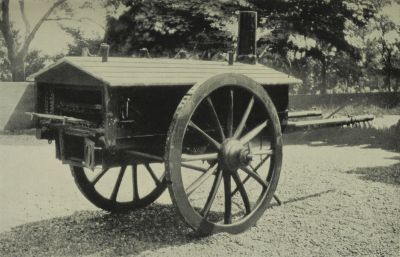
NAPOLEON’S TRAVELLING KITCHEN It was taken to Moscow and afterwards captured on the field of Waterloo Photographed for this work at the Royal Artillery Museum, Woolwich
It was as hopeless to attempt to hold firm at Kovno as at Vilna. There were 42 guns in the town, partly those of Loison’s division, which had been left there, great magazines of food and clothing, and about 2,500,000 francs in cash. There was a feeble tête du pont, but the Niemen was frozen and could be crossed anywhere on the ice. On the 12th the main body poured into the town— about 20,000 men, mostly in the last stage of misery and despair and nearly all disarmed. The Guard mustered 1600 bayonets and sabres. Ney, who had been fighting with Platov all the way from Vilna, reached the town in the evening; with the garrison troops added to the relics of the rear-guard he had not 2000 men. Efforts were made to distribute the stores and re-arm the disbanded troops, but the men threw away the muskets. The magazines were pillaged, the miserable wretches naturally fastening upon the spirit stores. Men drunken and dying lay in heaps in the snow-covered streets. Most of the benumbed fugitives lacked even the sense to avail themselves of the ice on the river; they crowded mechanically over the bridge, fighting for precedence, stifling and trampling each other down, as at the Berezina and Vilna. Murat placed some guns in battery on the left bank of the Niemen, and left for Königsberg on the 13th, while Ney and the rear-guard occupied the town, which they held until dark. Platov sent across a detachment on the ice, which captured the guns on the left bank and barred Ney’s retreat. His men were largely huddling in the houses; he had only a few hundred armed soldiers. He turned down the left bank of the river and then diverged to the left across the Pelwiski forest, eventually making his way by Gumbinnen to Königsberg. He abandoned in the forest Loison’s 16 guns, almost the last artillery that the army retained.
The Russians did not immediately cross the political frontier, and bitterly as the Prussian peasantry hated the French they did not actively ill-treat them. Many isolated fugitives were disarmed, but their misery was such as to melt even hearts steeled by hatred and the memory of recent oppression. De Fezensac says that the happiness of being fed and lodged prevented them from noticing the hostility of the people. The bulk of the mob of fugitives reached Königsberg by the 20th, and thence cantonments were spread along the Vistula. On that day the infantry of the Guard counted about 2500 officers and men, of whom 1000 were sick. The 1st, 2nd, 3rd, and 4th Corps mustered between them on January 10th, 1813, some 13,000 men sound and sick, of whom 2500 were officers. As to the condition of the army, nearly all the troops were disarmed and had to be furnished with new muskets from the vast magazines at Danzig. On December 23rd Eblé, now in chief command of the artillery, reported that of all the vast train which had entered Russia with the Central Army there remained but 9 guns and howitzers, and 5 caissons!
Two days before Lariboissière had died, and on December 30th Eblé also passed away. Colonel Pion des Loches, a man who rarely has a good word to say for his superiors, expresses himself thus concerning them: “Both were victims of their zeal and devotion. Our army lost in them its pillars and supports ... and what are all our other generals worth beside them?” As his comrades in arms laid Eblé to rest in the Roman Catholic cemetery at Königsberg, Napoleon was signing the decree which created him First Inspector-General of Artillery. Eblé’s grave has vanished, for the cemetery has been destroyed, but his glory far outshines that of thousands of better known men.
Marshal Kutuzov reached Vilna on December 12th to control the hitherto independent movements of Chichagov and Wittgenstein. His own troops were following under Tormazov, but they were so shattered by the long march from Moscow that their offensive power was for the time at an end, and they were cantoned about Vilna. Chichagov was to follow to the Niemen to support Platov and the advance-guards which hung on the heels of the retreating French. Wittgenstein was ordered to intercept Macdonald on his expected retreat to the Niemen, while Paulucci was to press him in rear. Sacken’s army, supported by the Mozyr force, now under Tuchkov II, and a detachment from Bobruisk, was to deal with Schwarzenberg. The Emperor Alexander reached Vilna on December 22nd, and at once devoted himself to the task of endeavouring to save the lives of his captured enemies. The hospitals were choked with the Russian sick, and the French prisoners, almost all ill and helpless, were perishing wholesale. Biscuit and bread they received, but there was no other help for them. Gangrened wounds, frost-bite, and typhus produced by filth, hunger, and putrefaction, swept them away. In three weeks 15,000 are said to have died. Alexander and Constantine made magnificent efforts to cope with the awful mass of human misery. Reckless of personal danger, they personally superintended the relief operations; the Grand Duke nearly died of the fever which he caught in the midst of his labour of humanity. St. Priest was transferred from the work of collecting the Russian stragglers to that of superintending the hospitals of the prisoners, for which his French origin especially fitted him.
Macdonald, before Riga, received his orders to retreat on December 18th, and started next day in two main columns, he himself leading the way with Grandjean’s division, a Prussian infantry brigade, and Massenbach’s cavalry; while Yorck followed a day’s march behind the rest of the Prussians. Wittgenstein himself could hardly intercept him; but the flying detachments of Kutuzov II and Diebich, thrown far forward, might hope to impede Macdonald’s march. The Marshal on reaching Koltiniani divided his own column, taking advantage of two roads thence to Tilsit, and intending to reunite his whole corps at Tauroggen. Kutuzov II was too weak to intercept him; but Diebich, with his 1500 cavalry and a few sledge-guns, got between Macdonald and Yorck on the 25th, and boldly proposed to the latter a conference in order to prevent useless bloodshed. After some hesitation Yorck at last made up his mind, and on the 30th concluded the famous convention of Tauroggen, by which the Prussians were declared neutral. The results were incalculably important, but belong rather to the history of the German War of Liberation. The immediate consequence was that the wreck of the Grande Armée was weakened by 16,000 or 17,000 excellent soldiers and 60 guns.
Macdonald, meanwhile, was pursuing his retreat, and on the 27th repulsed Vlastov’s divisions, which had come up to support Kutuzov II, capturing some prisoners and a gun. But at Tilsit, on the 31st, he was deserted by Massenbach and was forced to fall back on Königsberg. He marched rapidly and steadily, and reached the Prussian capital in safety. On January 3rd, 1813, his rear-guard, under Bachelu, was driven through Labiau, after a hard fight, by Wittgenstein’s advance-guard under Chepelev. At Königsberg Macdonald was joined by Heudelet’s division, but Yorck’s defection ended all hope of being able to make a stand on the Pregel, and the retreat was continued to Danzig. When the blockade of Riga was raised, Paulucci sent Lewis with 8000 men to pursue Macdonald, and himself with 3000 made a dash for Memel, which he reached on December 15th, after an amazing march of 200 miles in 8 days. The place immediately surrendered.
While Schwarzenberg had been contending with Sacken, General Kosinski with his Poles had once more invaded Volhynia, but was repulsed after a little skirmishing by Musin-Pushkin.
Schwarzenberg, turning from his pursuit of Sacken, reached Slonim again on December 7th; but on learning of the catastrophe of the Grande Armée he retreated on the 14th to Bielostok, arriving there on the 18th. Reynier drew back behind the Bug. On the advance of Sacken and Tuchkov, to assist whom Kutuzov also directed a column under Miloradovich, Schwarzenberg steadily withdrew, there being nothing but the most insignificant fighting. The Austrians eventually fell back into their own territory, while Reynier retreated towards Saxony. The Polish troops remained in the Vistula fortresses, and were mostly captured in the following year. The little field army which Poniatowski was able to collect was allowed to join Napoleon in Saxony, since its blockade employed too many troops.
Thus in the last days of December the Russian territory had been freed from the vast host which had threatened to overwhelm it. The immediate result of the campaign was the all but complete destruction of an army nearly 700,000 men strong and its immense material. In all it would appear that, exclusive of Polish stationary troops and local levies other than those already mentioned, some 674,000 combatants crossed the Vistula against Russia, of whom about 640,000 actually took part in military operations. Of these 640,000 there remained as organised troops at the end of the campaign only the forces of Schwarzenberg and Macdonald, perhaps 68,000 combatants in all. All the other corps and divisions were represented by about 25,000 disorganised and generally disarmed men—largely officers—without cavalry and with scarcely any artillery. The number of guns which actually entered Russia is somewhat doubtful, but appears to have been over 1300, exclusive of the Riga siege train. Of these some 250 can be accounted for as having returned. The Russians claimed 929 as captured; the rest were no doubt abandoned and never recovered. More than 200,000 trained horses were lost; and it was the want of them which, even more than the deficiency of trained men, ruined Napoleon’s chances in 1813. The total chasm in the Napoleonic ranks was over 550,000 fighting men. As prisoners the Russians claimed 48 generals, 3000 officers, and 190,000 men, but it is to be feared that half of them were captured only to die. Even without making allowance for this, more than 350,000 soldiers must have perished, besides the tens of thousands of camp-followers, refugees, and other non-combatants.
The Russian losses are extremely difficult to compute. It is impossible to work upon the number of men successfully put into the field, and those remaining active at the close of the campaign, since the deficiency does not, as in the case of the Napoleonic army, represent absolute loss. There are reasons for believing that the actual loss of fighting men was nearly 150,000. The number of non-combatants—largely peaceful inhabitants of the country—who perished must have been enormous.
The ultimate results of the Russian victory were the general uprising of northern Germany against Napoleon, the adhesion of Austria—after considerable hesitation—to the anti-Napoleonic coalition, and the complete overthrow within little more than a year of the empire of force which he had built in Europe. Britain had long since destroyed Napoleon’s efforts at gaining power on the sea, and had struck heavy blows at his prestige on land. As the Russian army lay at Tarutino it was gladdened by the news of Wellington’s victories. And the prestige of Napoleon, shaken in Spain, was now shattered in Russia, and his material military power so broken that he was never really able again to face his antagonists on equal terms. It is perhaps true to say that the enthusiastic uprising of Germany was the chief factor in Napoleon’s downfall in 1813, but it was Russia who gave the impulse and cleared the way; and her military aid was of vital importance.
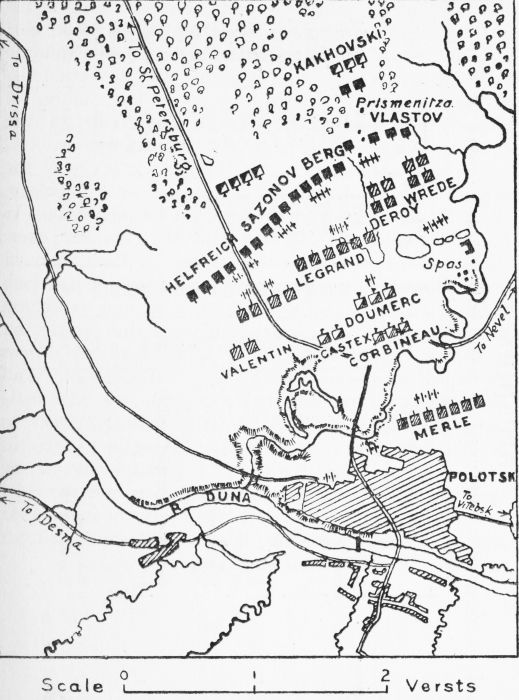
FIRST BATTLE OF POLOTSK (August 17th and 18th, 1812)
APPENDIX A
FORCES SUCCESSIVELY EMPLOYED BY NAPOLEON AGAINST RUSSIA IN 1812
Date of Muster Roll. Battalions. Squadrons. Infantry and Foot Artillery. Cavalry and Horse Artillery. Total. Guns.
Grand Head-quarters June 24 3,075 908 3,983 (?)
1st Corps d Armée ” ” 88 16 68,627 3,424 72,051 150
2nd ” ” ” ” 48 16 34,299 2,840 37,139 92
3rd ” ” “ ”@ 45 24 35,755 3,587 39,342 86
4th ” ” “ 30 54 20 42,430 3,368 45,798 116
5th ” ” ” 24 33 20 32,159 4,152 36,311 70
6th ” ” July 1 28 16 23,228 1,906 25,134 58
7th ” ” June 24 18 16 15,003 2,186 17,189 50
8th ” ” ” ” 18 12 15,885 2,050 17,935 34
9th ” ” Sept 3 43 12 31,663 1,904 33,567 80
10th ” ” June 24 36 16 30,023 2,474 32,497 84
Austrian Corps ” ” 26 44 26,830 7,318 34,148 60
Imperial Guard Estimated (except Cavalry) 38 28 25,000 6,279 31,279 112
1st Cavalry Corps June 24 — 54 — 12,077 12,077 30
2nd ” ” ” ” — 52 — 10,436 10,436 30
3rd ” ” ” ” — 50 — 9,676 9,676 30
4th ” ” ” ” — 40 — 7,964 7,994 24
32nd Division Nov 2 18 — 13,592 — 13,592 20
34th ” Nov 18 19 6 13,290 700 13,299 16
Engineers,Artillery Reserves, etc. 10,000(?) 230
410,849 83,279 504,128 1,372
Absentees who rejoined — — — 37,100 —
Lagrange’s Division (Drafts) — — — 13,408 —
Foreign Guard Battalions}
Kosinski’s Polish Brigade}
Austrian Reserve Brigade} circa — — 70,000 18
2 German Regiments }
Drafts of all kinds}
624,636
In Duchy of Warsaw and on Vistula }
5 Foreign Guard Battalions}
Heudelet’s Division (20 Battalions)}
Destrée’s Division (Neapolitans) at Danzig} — — — 50,000 32
New Levies, Drafts, etc.}
Garrisons on Vistula}
674,636 1,422
====== ======
It is extremely difficult to compute the numbers of reinforcements, etc., since a proportion of them consisted of convalescents and rejoining stragglers.
No allowance is made for the large number of transport drivers and other non-combatants.
APPENDIX B
COMPOSITION OF THE NAPOLEONIC GRAND ARMY BY NATIONALITIES
Imp. Guard, Head-quarters, Army Corps 1-10, Austrians, 4 Cavalry Corps, 32nd and 34th Divisions.
Battalions. Squadrons.
French and New French 239 214
Poles 51 69
Italians 22 14
Croats and Dalmatians 7 —
Spaniards 4 —
Portuguese 6 3
Swiss 12 —
Bavarians 30 24
Saxons 22 32
Westphalians 22 20
Württembergers 12 16
Badeners 7 2
Berg Troops 8 4
Mecklenburg Troops 3 —
Hesse-Darmstadt 6 2
Small Rheinbund States 11 —
Austrians 26 44
Prussians 20 24
Various (Mamelukes) 1
APPENDIX C
FORCES SUCCESSIVELY EMPLOYED BY RUSSIA AGAINST NAPOLEON IN 1812
FIRST ARMY OF WEST. APPROXIMATE STRENGTH
Force. Battalions. Squadrons. Cossack Regiments. Batteries. Infantry and Engineers. Cavalry. Cossacks. Artillery. Total. Guns.
1st Army Corps 28 16 1 8 17,100 2,250 880 1,620 21,850 96
2nd ” ” 24 8 — 7 14,400 1,120 — 1,340 16,860 84
3rd ” ” 26 4 1 7 15,360 600 550 1,340 17,850 84
4th ” ” 22 8 — 6 12,960 1,120 — 1,120 15,200 72
5th ” ” 26 20 — 6 15,840 2,880 — 1,400 20,120 80
6th ” ” 24 8 — 7 14,400 1,120 — 1,340 16,860 84
1st Cavalry Corps — 24 — 1 — 3,480 — 220 3,700 12
2nd ” ” — 24 — 1 — 3,360 — 220 3,580 12
3rd ” ” — 20 — 1 — 2,800 — 220 3,020 12
Cossack Corps — — — 1 — — 6,160 220 6,380 12
Artillery Reserve — — — 3 — — — 720 720 36
95,060 18,730 7,590 9,760 126,140 584
SECOND ARMY OF WEST
Force. Battalions. Squadrons. Cossack Regiments. Batteries. Infantry and Engineers. Cavalry. Cossacks. Artillery. Total. Guns.
7th Army Corps 24 8 — 7 14,650 1,120 — 1,340 17,110 84
8th ” ” 22 20 — 5 12,000 2,800 — 1,040 15,840 60
4th Cavalry Corps — 24 — 1 — 3,360 — 220 3,580 12
Cossack Division — — 9 — — — 3960 220 4180 12
27th Infantry Division 12 — — — 7,200 — — — 7,200 —
33,850 7,280 3,960 2,820 47,910 168
THIRD ARMY OF WEST
Force. Battalions. Squadrons. Cossack Regiments. Batteries. Infantry and Engineers. Cavalry. Cossacks. Artillery. Total. Guns.
Kamenski’s Corps 17 8 — 4 9,970 1,120 — 780 11,870 46
Markov’s ” 24 8 — 7 14,400 1,120 — 1,340 16,860 82
Sacken’s Reserve 12 24 — 2 4,000 2,500 — 440 5,940 24
Lambert’s Corps — 36 — — — 5040 — — 5040 —
Irregulars — — 9 — — — 3,960 — 3,960 —
Reserve Artillery — — — 1 — — — 240 240 12
28,370 9,780 3,960 2,800 44,910 164
ARMY OF THE DANUBE
Force. Battalions. Squadrons. Cossack Regiments. Batteries. Infantry and Engineers. Cavalry. Cossacks. Artillery. Total. Guns.
Langeron’s Division 12 8 3 4 6,000 1,000 1,000 700 8,700 48
Essen III’s Division 12 8 3 4 6,000 1,000 1,000 700 8,700 48
Voïnov’s Division 11 12 3 4 5,500 1,500 1,000 700 8,700 48
Bulatov’s Division 6 20 1 4 3,000 2,500 300 700 6,500 48
Sabaniev’s Division 9 8 1 1 4,500 1,000 300 200 6,000 12
Lüders’ Division 9 8 2 1 4,500 1,000 600 150 6,250 12
29,500 8,000 4,200 3,150 44,850 216
ARMY OF FINLAND
Force. Battalions. Squadrons. Cossack Regiments. Batteries. Infantry and Engineers. Cavalry. Cossacks. Artillery. Total. Guns.
Steingell’s Corps and Field Detachments 22 6 1 4½ — — — — 14,000 54
Garrison Detachments 4 — 1 — — — — — 2,500 12
16,500 66
RESERVES AND GARRISONS IN JUNE
Depôt, Troops, etc. 87 54 — ? — — — — 35,000 —
CRIMEAN GARRISON
Detachments 8 — — 2 — — — — 5,000 24
Militia, Marines, Recruits, Cossacks, etc. 90,000
Total 410,310
=========
APPENDIX D
STAFF OF NAPOLEON’S GRAND ARMY OF RUSSIA, 1812
Commander-in-Chief:
H.I.M. the Emperor and King Napoleon I.
Chief of Staff Marshal Berthier, Prince of Neuchatel
” Cavalry H.M. the King of Naples (Marshal Murat)
” Artillery Général de Division Comte Lariboissière
” Engineers ” ” Comte Chasseloup
” Bridge Trains ” “ Baron Eblé
Intendant General ” ” Comte Mathieu Dumas
CHIEF MINISTERS, COURT OFFICIALS, ETC., ACCOMPANYING THE EMPEROR
Maret, Duke of Bassano Minister of Foreign Affairs
Comte Daru Secretary of State
General Duroc, Duke of Friuli Grand Marshal of the Palace
” Caulaincourt, Duke of Vicenza Grand Equerry
Baron Ménéval Secretary of the Portfolio
” Fain ” ” Archives
” Mounier ” ” Cabinet
Colonel Baron de Ponton ” ” ”
State-Council Auditor Lelorgne d’Ideville Chief Interpreter
Baron Bacler d’Albe Director of Topographical Cabinet
THE GENERAL STAFF
General Officer. Department or Command.
Général de Division Junot, Duc d’Abrantes First Aide-de-Camp
” ” Lebrun, Duc de Placentia Aide-de-Camp
” ” Mouton, Comte Lobau ”
” ” Comte Rapp ”
” ” Comte de Narbonne ”
” ” Comte Durosnel ”
” ” Comte Sokolniki Polish Officer Attached
” ” Comte Sanson Topography and History
” ” Baron de Caulaincourt Grand Head-quarters
” Brigade Comte Bailly de Monthion Chief of Berthier’s Staff
” ” Baron Guilleminot Small Head-quarters
” ” Baron Jomini History
“ ” Comte Lauer Gendarmerie
There were in Napoleon’s train a large number of General Officers “disposable.” Most of these were appointed to commands later, and mostly appear in the list of Commandants of districts.
GENERAL OFFICERS COMMANDING IN THE DISTRICTS OF THE ARMY (11TH AUGUST)
Government of
General of Division Comte Hogendorp Lithuania
” ” Baron Durutte Berlin
” ” Comte Dutaillis Warsaw
” ” Comte Charpentier Vitebsk
” ” Gomès Freyre Glubokoië
” ” Marquis d’Alorna Mohilev
” ” Baillet-de-la-Tour Elbing
General of Brigade Castella Königsberg
” ” Corsin Pillau
” ” Plauzonne Plock
” ” Ferrière Bielostok
” ” Tarayre Kovno
” ” Voyezinski Thorn
” ” Wedel Wilkowiski
” ” Brun Grodno
” ” Bronikowski Minsk
Corps. Division. Division General.
1st Corps 1st Infantry Morand
(Maréchal Davout, 2nd ” Friant
Prince d’Eckmühl) 3rd ” Gudin
4th ” Dessaix
5th ” Compans
Cavalry Girardin (Sept.)
Artillery Baron Pernety
2nd Corps 6th Infantry Legrand
(Maréchal Oudinot 8th ” Verdier
Duc de Reggio) 9th ” Merle
Artillery Dulauloy
3rd Corps 10th Infantry Ledru
(Maréchal Ney, Duc 11th ” Razout
d’Elchingen) 25th ” Prince Royal of Württemberg
Artillery Foucher
4th Corps 13th Infantry Delzons
(His Imperial 14th ” Broussier
Highness 15th ” Pino
Prince Eugène) Artillery Danthouard
5th Corps 16th Infantry Zayonczek
(General Prince 17th ” Dombrowski
Poniatowski) 18th ” Kamienicki
Artillery Pelletier
6th Corps 19th Infantry Deroy
(General Gouvion 20th ” Wrede
Saint-Cyr)
7th Corps 21st Infantry Lecoq
(General Reynier) 22nd ” De Funck
8th Corps 23rd Infantry Tharreau
(General Vandamne) 24th ” Ochs
(later General Junot)
9th Corps 12th Infantry Partouneaux
(Maréchal Victor, 26th ” Dändels
Duc de Belluno) 28th ” Gérard
10th Corps 7th ” Grandjean
(Maréchal Macdonald, Prussians (1) Grawert
Duc de Taranto) (2) Yorck
Cavalry Massenbach
11th Corps 30th Infantry D’Heudelet
(Maréchal Augereau, 31st ” Lagrange
Duc de Castiglione) 32nd ” Durutte
33rd ” Destrées
34th ” Morand
CAVALRY RESERVE
Commander-in-Chief:
The King of Naples.
Chief of the Staff:
General Belliard.
Corps. Division. Division General.
1st Corps 1st Light Cavalry Bruyère
(Nansouty) 1st Heavy Cavalry Saint-Germain
5th ” Valence
2nd Corps 2nd Light Cavalry Sebastiani
(Montbrun) 2nd Heavy Cavalry Wathier
4th ” Defrance
3rd Corps 5th Heavy Cavalry Doumerc
(Grouchy) 6th ” Lahoussaye
3rd Light Cavalry Chastel
4th Corps 4th Light Cavalry Rozniecki
(Latour-Maubourg) 7th Heavy ” Lorge
APPENDIX E
STAFF OF RUSSIAN ARMIES OPPOSED TO NAPOLEON, JULY, 1812
FIRST ARMY OF THE WEST
Commander-in-Chief General of Infantry Baron Barclay de Tolly
Chief of Staff Major-General Yermólov (July)
Quartermaster-General Colonel Baron Toll (July)
General “of Service” Colonel Kikin
Chief of Artillery Major-General Count Kutaïsov
Chief of Engineers Major-General Trusson
Army Corps. Corps Commander. Division. Divisional Commander.
I Lieut.-General Count Wittgenstein 5th Infantry Major-Gen. Berg
14th ” Major-Gen. Sazonov
1st Cavalry Major-Gen. Khakovski
II Lieut.-General Baggohufwudt 4th Infantry Major-Gen. Prince Eugen of Württemberg
17th ” Major-Gen. Olsuviev
III Lieut.-General Tuchkov I 3rd ” Lieut.-Gen. Konovnitzin
1st Grenadier Lieut.-Gen. Strogonov
IV Lieut.-General Count Ostermann-Tolstoï 11th Infantry Major-Gen. Choglokov
23rd ” Major-Gen. Bakhmetiev
V General H.I.H. Grand Duke Constantine Imperial Guard
(Infantry) Lieut.-Gen. Lavrov (July)
Combined Grenadiers
1st Cuirassier Major-Gen. Depreradovich
VI General of Infantry Dokhturov 7th Infantry Major-Gen. Kapsevich
24th ” Major-Gen. Likbachev
1st Cavalry Corps Lieut.-Gen. Uvarov
2nd Cavalry Corps Lieut.-Gen. Baron Korff
3rd Cavalry Corps Major-Gen. Count Pahlen II
Cossacks General of Cavalry Platov
SECOND ARMY OF THE WEST
Commander-in-Chief General of Infantry Prince Bagration
Chief of Staff Major-General Count de St. Priest
Quartermaster-General ” ” Vistitski II
General of Service Colonel Marin
Chief of Artillery Major-General Baron Löwenstern
Chief of Engineers ” ” Förster
Army Corps. Corps Commander. Division. Divisional Commander.
VII Lieut.-General Raievski 12th Infantry Major-General Kolubakin
26th ” ” ” Paskievich
VIII Lieut.-General Borozdin I 2nd Grenadier ” ” Prince Karl of Mecklenburg
Combined Grenadiers ” ” Count Voronzov
2nd Cuirassier ” ” Knorring
4th Cavalry Corps ” ” Count Sievers
27th Infantry ” ” Neverovski
Cossacks ” ” Ilovaïski V
THIRD ARMY OF THE WEST
Commander-in-Chief General of Cavalry Tormazov
Chief of Staff Major-General Inzov
Quartermaster-General ” ” Renne
Chief of Artillery ” ” Sievers
Army Corps. Corps Commander. Division. Divisional Commander.
Lieut.-General Count Kamenski 18th Infantry Major-General Cherbatov
Combined Grenadiers ?
Lieut.-General Markov 9th Infantry ?
15th ” Major-General Nazimov
Reserve Lieut.-General Sacken Reserve Battalion & ” ” Sorokin
Squadrons (Skeleton)
Cavalry Corps Major-General Count Lambert 4 Brigades ?
Irregulars ?
ARMY OF THE DANUBE (JULY 31)
Commander-in-Chief Admiral Chichagov
Chief of Staff Lieutenant-General Sabaniev
Quartermaster-General Major-General Berg
General of Service ” ” Tuchkov II
“Corps” Divisional Commanders
I General of Infantry Count de Langeron
II Lieutenant-General Essen III
III ” ” Voïnov
IV Major-General Bulatov
Reserve Lieutenant-General Sabaniev
Detachment Major-General Lüders
ARMY OF FINLAND
Commander-in-Chief: Lieutenant-General Count Steingell
3 Divisions (about half brought to front in September)
STAFF OF THE MAIN RUSSIAN ARMY, OCTOBER 18, 1812
Commander-in-Chief Marshal Prince Golénischev-Kutuzov
(Commander—in—Chief of all Russian Armies)
Chief of Staff General of Cavalry Baron Bennigsen
General of Service Lieutenant-General Konovnitzin
Intendant-General Privy-Councillor Lanskoï
Chief of Artillery Major-General Baron Löwenstern
Quartermaster-General Colonel Baron Toll
Commander of Corps de Bataille General of Cavalry Count Tormazov
Commander of Advance-Guard General of Infantry Miloradovich
FOOTNOTES:
BIBLIOGRAPHY
FRENCH AND GERMAN
Bonnal, Gen. Le Manœuvre de Vilna. Bertin de la Martinière. Campagnes de Bonaparte. Bertin. La Campagne de 1812 (Témoins Oculaires). Bourgeois, Dr. René. Tabléau de la Campagne de 1812. Bousset, L.F.J. de. Mémoires. Bignon, Baron. Souvenirs d’un Diplomat. Bourgogne, Sergeant. Mémoires. Bourgoing, Baron de. Souvenirs Militaires. Blaremburg, Lt.-Gen. von. Erinnerungen. Castellane. Journal du Maréchal de. Chambray, Marquis de. Histoire de l’Expédition de Russie. ” ” La Vérité sur l’incendie de Moscow. Chuquet. Collected Letters, etc. ” Human Voices from the Campaign of 1812. Coignet, Le Capitaine. Mémoires. Denriée, Le Baron. Itinéraire de Napoléon. Fantin de Odoards. Journal du Général. Faber du Faur, Major (Württemberg Artillery). Camp of 1812. Fain, Baron. Précis des Événements de 1812. Fabry, Captain (Editor). Campagne de Russie (French Staff History, June 23-August 20, 1812). Fezensac, Duc de. Mémoires. François, Captain. Mémoires. Girod de l’Ain. Vie du Général Eblé. Grabowski. Mémoires Militaires. Gouvion St. Cyr, Marshal. Mémoires. Gourgaud, Gen. Examen Critique (of Ségur’s History). Griois, Gen. Mémoires. Gardaruel, A. Relation 1812. G.L.D.L. Moscow ... le retraite de 1812. Jomini, Gen. Précis ... de 1812-14. Labaume, E. Relation complète de la Campagne de 1812. Lejeune, Baron. Mémoires. Labeaudorèire, J.P. de. La Campagne de Russie de 1812. Margueron, Commandant. Campagne de Russie (French Staff History, January, 1810-January, 1812). Moniteur Universel, Le. Maringoné, L.J. Vionnet de. Fragments de Mémoires. Napoléon. Correspondance, Mémoires, etc. Picard. La Cavalerie dans les Guerres de la République et de l’Empire. Pion des Loches, Col. Mes Campagnes. Paixhans, H.J. Retraite de Moscow. Notes. Partouneaux, Comte. Explications. Pradt, M. de. Histoire de l’Ambassade (to Warsaw). Roguet, Comte. Mémoires. Roos, Ritter H.O.L. von. With the Grand Army of Napoleon. Rapp, Comte. Mémoires. Ségur, Comte de. Histoire de ... 1812. Solignac, Armand de. La Berezina. Seruzier, Col. Baron. Mémoires Militaires. Thirion, A. Souvenirs Militaires. Vlijmen, Gen. van. Vers la Berezina (Documents). Vaudoncourt, G. de. Relation Impartiale de la Passage de la Berezina. Zimmerman, G. Autobiography (Commissariat).
There are innumerable volumes of memoirs which deal in part with the campaign. Some need using with caution—e.g. Marbot’s.
RUSSIAN, ETC.
Archives. (1) Published by P.J. Schukin. (2) Published by Russian War Office. Bennigsen, Gen. Baron. Memoirs. Buturlin. History of War of 1812 (French Translation). Bogdanovich. History of War of 1812 (German Translation). Chichagov, Admiral. Mémoires (French). Clausewitz, Gen. K. von. Der Feldzug von 1812 (English Translation). Danilevski. History of War of 1812. Eugen von Württemberg. Memoirs. Jensen. Napoleon’s Campaign in Russia (Danish). Langeron, General. Mémoires (French). Löwenstern, Baron. Mémoires (French). Okunev, General. Considerations, etc. (French). Osten-Sacken, Freiherr von der. Der Feldzug von 1812. Rostopchin, Count. La vérité sur l’incendie de Moscow (French). Zapiski. Memoirs of Yermólov.
ENGLISH
Cathcart, Lt.-Gen. Sir George. Commentaries. George, H.B. Napoleon’s Invasion of Russia. Porter, Sir R. A Narrative. Wilson, Sir R., Gen. Narrative. Wolseley, Viscount. Decline and Fall of Napoleon.
Note.—The number of works in the French language dealing with the campaign of 1812 is so enormous that no attempt has been made to give more than a selection.
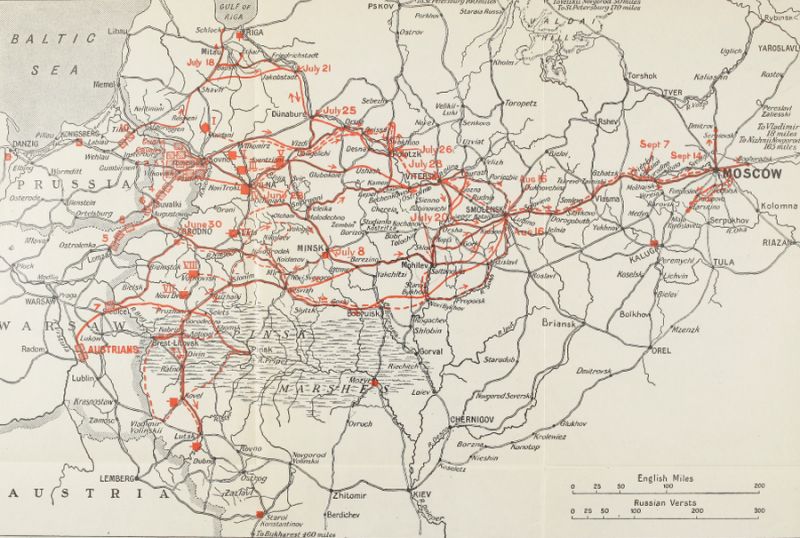
THE ADVANCE TO MOSCOW Napoleonic forces indicated by shaded blocks. Russian ” ” solid ” Arabic numerals indicate Napoleonic Corps d’Armée. Roman numerals indicate Russian Corps d’Armée. Napoleonic lines of march indicated by solid lines. Russian ” ” ” broken lines. The dates are those of the various stages of the French advance or on which they occupied important points. Each larger block, whether solid or shaded, indicates approximately 20,000 men.
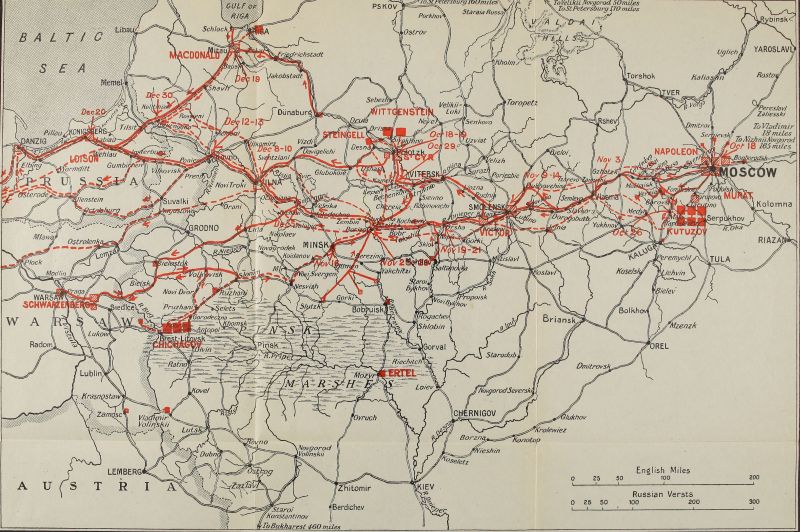
THE RETREAT FROM MOSCOW Napoleonic forces indicated by shaded blocks. Russian ” ” solid ” Napoleonic lines of march indicated by solid lines. Russian ” ” ” broken lines. The dates are those of the various stages of the French retreat or on which they abandoned or lost important places. Each larger block, solid or shaded, indicates approximately 20,000 men.
INDEX
A Aa, River, 171, 172, 173, 294 Abo, Treaty of, 286 Achard, Colonel of French 108th, 96 Adamovskoë, 300, 308 Alexander I, Tzar of Russia, 1-15, 18, 72, 74, 75-80, 108, 123, 144, 145, 158, 160, 186-188, 235, 243, 245, 246, 248, 249, 258, 387 Alexiev, Russian Major-General, 299 Alorna, Pedro d’Almeida, Marquis d’, Portuguese General in French Service, 116, 357 Amey, French Général de Brigade, 302 Andréossy, General, French Ambassador at Constantinople, 11, 287 Antopol, 163 Arakcheiev, Count Alexei Andréievich, 3, 84, 124, 187 Aubry, Claude Charles, French Général de Brigade, 359 Augereau, Pierre François Charles, Duc de Castiglione, Marshal of France, 261 Augereau, French Général de Brigade, 325 Augustowo, 67, 69, 80 B Babinovichi, 102 Bachelu, French Général de Brigade, 388 Badajoz, 12 Baggohufwudt, Karol Feodorovich, Russian Lieut.-General, 69, 74, 78, 138, 149, 153, 154, 193, 203, 208, 216, 217, 258 Bagration, Prince Peter Ivanovich, Russian General, 15, 16, 19, 51, 57, 58, 63, 65-69, 73, 77, 78, 81, 82, 83-86, 93-98, 100, 108, 117-121, 123-125, 129-138, 145, 146, 156, 157, 158, 192, 193, 194, 201-211, 246, 247 Bakhmetiev, Russian Major-General, 102, 104, 215 Balashov, Alexander Dmitrievich, Russian Lieut.-General, 75 Balk, Russian Major-General, 305 Balla, Russian Major-General, 141 Banco, Italian Colonel, 113 Baraguay d’Hilliers, Comte, French Général de division, 252, 260, 273, 315, 325, 332 Barclay de Tolly, Mikhail Bogdanovich, Baron, Russian General and War Minister, 3, 4, 5, 6, 7, 15, 16, 19, 50, 57, 58, 63, 65-70, 73, 74, 78-80, 81, 82, 98-107, 108, 117-121, 123-125, 129-158, 169, 187, 192, 193, 194, 201-219, 226-229, 238, 245, 246, 247, 248 Baste, French Rear-Admiral, 59, 73 Battles and Engagements— Vilkomirz, 74 Davigelishki, 80 Mir, 84, 85 Romanovo, 86 Saltanovka, 94-97 Drissa, 100 Ostrovno, 102-104 Vitebsk, 105 Velizh, 113 Inkovo, 121 Krasnoï, 126-128 Smolensk, 129-143 Gedeonovo, 147, 148 Lubino, 148-155 Kobrin, 162, 163 Pruzhani, 164 Gorodeczna, 164-168 Eckau, 1st, 172 Schlock, 1st, 172 Jakubovo, 173, 174 Oboiarzina, 175, 176 Svolna, 177 Polotsk, 177-182 Slavkovo, 194 Gridnevo, 197 Kolotskoï, 197 Borodino, 197-219 Mozhaïsk, 222, 223 Krymskoië, 224 The Pakhra, 239 Czerikovo, 239 Voronovo, 239 Spaskuplia, 239 Vinkovo, 255, 259 Vereia, 1st, 245 Vereia, 2nd, 272 Maloyaroslavetz, 274-285 Kreminskoië, 284 Biala, 292 Slonim, 292 Dahlenkirchen, 293 Eckau, 2nd, 294, 295 Sivokhino, 295 Polotsk, 2nd, 299-305 Viasma, 315-319 Dorogobuzh, 324 Vop, 325, 326 Solovievo, 327 Chasniki, 328 Volkovisk, 329, 330 Liakhova, 325 Krasnoï (Battles), 334-343 Smoliani, 346, 347 Dahlenkirchen, 2nd, 347 Novi-Swergen, 348, 349 Borisov, 350, 351 Lochnitza, 355 Berezina, 338-373 Plechenitzi, 376 Vilna, 384 Kovno, 385 Koltiniani, 388 Labiau, 388 Bausk, 171, 294, 295 Bavaria, Maximilian Joseph, King of, 9 Bechenkowiczi, 61, 102, 114, 304, 305, 327, 328 Beguichev, Russian Major-General, 299, 300 Belliard, Austin Daniel, French Général de Division, 122 Benkendorff, Alexander, Colonel, Russian, 81 Bennigsen, Levin August Gottlieb, Baron, Russian General (Hanoverian), 19, 52, 57, 72, 129, 144, 145, 188, 199, 203, 217, 226-228, 238, 245, 255, 256, 258, 259, 308 Berezina, 6, 56, 61, 84, 85, 89, 90, 92, 98, 287, 292, 306, 348-373, 374, 375, 385 Berezino, 90, 92, 349 Berg, Russian Major-General, 173, 175, 178, 182, 299, 300, 346, 366, 370, 371 Bernadotte (Crown Prince Karl Johann of Sweden), 13, 286 Berthier, Alexandre, Prince de Neufchâtel, Marshal of France, 34, 180, 195, 242, 279, 290, 309, 379, 383 Bessières, Jean Baptiste, Duc d’Istria, Marshal of France, 38, 238, 279, 282, 370, 379 Beurmann, Paris Ernest, French Général de Brigade, 121, 122, 320 Bezdizh, 161 Biala, 292 Bianchi, Austrian Lieut.-General, 165, 166, 168 Bibikov, Russian Privy Councillor, 305 Bielostok, 62, 63, 84, 163, 260, 291, 329, 383, 388 Bielsk, 62, 80 Bielovezhi, 329, 330 Billard, 356, 366 Bobr, 61, 89, 328, 356, 359 Bobruisk, 6, 61, 62, 84, 85, 90, 91, 92, 93, 108, 122, 159, 160, 262, 293, 358, 386 Bogdanovich, quoted, 200, 219, 256, 292 Boghorodsk, 244 Bolshoï-Stakhov, 365, 367, 368 Bonami, 209, 210 Bordesoulle, Etienne Tardif de Pommereaux, Comte de, French Général de Brigade, 89, 90, 98 Borisov, 6, 61, 89, 90, 189, 260, 306, 348, 353, 355-356, 358, 359, 361, 364, 365, 366, 367, 372, 375 Borodino, 57, 196, 197, 198, 199, 200-207, 220, 221, 223, 241, 248, 249, 310 Borovsk, 269, 272, 273, 274, 280, 284 Borozdin I, Mikhail, Russian Lieut.-General, 84, 86, 90, 93, 94, 97, 136, 137, 203, 205, 209, 216, 279 Borozdin II, Nikolai Mikhailovich, Russian Major-General, 212 Bourgogne, Sargent, quoted, 231, 264 Bug, 59, 108, 161, 163, 291, 388 Bulatov, Russian Major-General, 287, 289, 330 Buturlin, Dmitri Petrovich, Count, Russian military author, quoted, 219, 232, 275, 304 Bukharest, 11, 168, 287, 289 Brazhino, 193 Brest-Litovsk, 19, 59, 62, 63, 84, 159, 161, 162, 291, 292, 306, 329, 330 Bridzievo, 99 Brilova, 358, 367 Bronikowski (Pole), French Governor of Minsk, 260, 348-350, 352 Broussier, Jean Baptiste, Comte, French Général de Division, 38, 105, 207, 209, 214, 239, 240, 270, 276, 278, 285, 318, 326 Bruyère, French Général de Division, 38, 74, 102, 105, 148, 149, 152 C Castex, Bertrand Pierre, French Général de Brigade, 74, 180, 299 Caulaincourt, Comte Auguste, French Général de Division, 214, 215 Caulaincourt, Armand Marquis de, Duc de Vicenza, 10, 379 Cavaignac, French Général de Brigade, 261 Chabachevichi, 358-362 Chaplitz, Russian Major-General, 162, 164, 165, 168, 292, 328, 348, 349, 358, 361, 363, 367, 368, 374, 375, 376, 378, 381, 382 Chambray, Georges, Marquis de, French soldier and author, 139, 172, 205, 242, 267, 268, 325, 346, 364, 375, 376, 380 Charpentier, French Général de Division, 116, 123, 252 Charrier, French Général de Brigade, 270 Chasniki, 305, 327, 328 Chasseloup-Laubat, François, Comte, French Engineer-General, 356, 359 Chastel, Pierre Louis Aimé, Baron, French Général de Division, 127 Chelkanovo, 325, 333 Chepelev, Russian Major-General, 388 Cherbatov, Alexei Grigorievich, Prince, Russian Major-General, 165-167, 292, 368 Cherechev, 164, 165, 166 Chereia, 328, 345, 347, 356 Chernishev, Colonel Alexander Ivanovich, 10, 291, 292, 348, 353 Chernishnia, 239, 240, 244, 258 Chichagov, Pavel Vasilievich, Russian Admiral, 11, 53, 168, 169, 262, 286-292, 296, 306, 328, 329, 331, 345, 348-368, 372, 375, 376, 381, 382, 386 Chilova, 333, 334 Choglokov, Pavel Nikolaievich, Russian Major-General, 102, 150, 152, 319, 333, 340 Ciudad Rodrigo, 12 Claparède, Michel, Comte, French Général de Division, 39, 90, 92, 97, 104, 148, 224, 231, 238, 240, 256, 259, 280, 281, 284, 334, 337, 357, 362, 364 Clausewitz, General, quoted, 80, 98, 105, 145, 170, 188, 192, 193, 197, 199, 200, 213, 224, 227, 245, 254, 255, 356 Colbert, French Général de Brigade, 83, 88, 90, 104, 238 Compans, Jean Dominique, Comte, French Général de Division, 38, 83, 92, 94, 97, 140, 191, 202, 205, 206, 279 Constantine Pavlovich, H.I.H. Grand Duke, brother of Alexander I, 119, 136, 137, 144, 146, 248, 353, 387 Continental System, 15 Corbineau, Jean Baptiste Juvenal, French Général de Brigade, 173, 178, 181, 182, 299, 302, 305, 327, 347, 353, 360 Coutard, French Général de Brigade, 251, 296, 347 Czerikovo, 239 D Dahlenkirchen, 293, 294 Dändels, Hermann Willem, Dutch General, 305, 327, 328, 366 Danilevski, quoted, 75 Danzig, 3, 15, 16, 19, 61, 67, 261, 377, 386, 388 Daru, Comte, French Minister, 254 Dashkova, 94, 96, 97 D’Auvray (Dauvray), Saxon Major-General in Russian service, 170, 177 Davidov, Russian Colonel (Cossacks), 250, 325 Davout, Louis Nicholas, Prince d’Eckmühl and Marshal of France, 13, 15, 16, 18, 35, 70, 71, 73, 78, 79, 81-84, 86, 88, 89-98, 112, 113, 114, 115, 117, 122, 126, 132, 134, 138, 140-144, 145, 147, 148-156, 159, 191, 195, 197, 204-218, 221, 222, 224, 270, 272, 278, 280, 281, 282, 284, 307, 308, 310, 312, 314, 315-319, 332, 334, 335, 336, 337-340, 344, 354, 356, 359, 362, 364, 366, 374, 379, 382 Delaître, French Général de Brigade, 366 Delzons, Alexis Joseph, Baron, French Général de Division, 103, 207, 213, 216, 271, 272, 276, 285 Delzons, Captain, 276 Deroy, Bernard Erasmus, Bavarian General, 178, 180, 181, 182 Desaix, Joseph Marie, Comte, French Général de Division, 38, 83, 92, 94, 97, 114, 140, 205, 206 Desna, 61, 298, 300, 302, 304 D’Estrées, French Général de Division, 261, 377 Diebich, Russian Major-General (Prussian), 170, 180, 370, 387 Dmitrov, 244 Dnieper, 6, 11, 60, 61, 84, 90, 97, 98, 109, 117, 121, 122, 123, 125, 126, 132, 136, 139, 144, 148, 327, 342 Dniester, 287 Dode, French General of Engineers, 357 Dokhturov, Dmitri Sergievich, Russian General, 55, 68, 70, 78, 79, 80, 81, 106, 132, 137-143, 145, 147, 155, 202, 203, 207, 213, 216, 226, 227, 247, 271, 272, 273, 274-279, 284, 352 Dolgoruki, Prince, Russian Lieut.-General, 336 Dombrowski, Jan Henryk, Polish General, 122, 123, 260, 293, 348-351, 355, 361, 364, 368 Doronimo, 202 Dorogobuzh, 155, 192, 193, 194, 196, 320, 321, 324, 325 Dorogomilov Suburb (Moscow), 230, 231 Dorokhov, Ivan Semenovich, Russian Major-General, 73, 78, 82, 83, 84, 97, 105, 237, 239, 244, 250, 270, 271, 272, 274, 284, 285 Dorsenne, General, 122 Doumerc, Jean Pierre, Baron, French Général de Division, 78, 173, 174, 180, 182, 260, 296, 299, 305, 368 Drissa, 7, 61, 80, 87, 88, 98-100, 101, 104, 109, 169, 173, 174, 176, 177, 295 Druia, 80, 173, 297, 298, 299 Dubno, 289, 290 Dubrovna, 98, 335 Duka, Russian Major-General, 203, 340 Dukhovchina, 324, 326 Dumas, Mathieu, Comte, French Général de Division, 116 Düna, 2, 6, 11, 60, 61, 79, 80, 84, 99, 100, 102, 105, 109, 114, 123, 170, 172, 173, 176, 178, 179, 180, 293, 295, 297, 298, 299, 300, 302, 303, 304, 305, 306, 347 Dünaburg, 6, 7, 60, 61, 62, 80, 89, 100, 109, 169, 170, 172, 173, 176, 295, 304 Dufour, French Général de Brigade, 222, 224, 240, 256, 259 Duroc, General; Napoleon’s Grand Marshal of Palace, 379 Durosnel, Comte, French Général de Division, 230 Durutte, Joseph François, French Général de Division, 261, 329, 330 Duverger, Paymaster, quoted, 236 E Eblé, Jean Baptiste, Baron, French Général de Division (Artillery), 71, 122, 148, 334, 344, 345, 356, 359-362, 371-373, 375, 383, 386 Eckau, 171, 172, 294 Ekeln, Russian Colonel, 294, 296 Engelhart, Russian Major-General, 351 Ertel, Feodor Feodorovich, Russian Lieut.-General, 262-287, 293, 328 Essen I, Ivan Ivanovich, Russian Lieut.-General, 170, 172, 262, 293, 294, 295, 347 Essen III, Peter Kirillovich, Russian Lieut.-General, 287, 289, 292, 328, 330 Eugen of Württemberg, Prince, Russian Major-General, 13, 18, 36, 56, 141, 142, 143, 147, 148, 154, 208, 216, 318, 319, 234 Eugène de Beauharnais, Prince, Viceroy of Italy, 13, 16, 63, 64, 66, 68, 69, 80, 100-105, 114, 119, 121, 122, 126, 132, 148, 192, 193, 197, 205, 207, 223, 230, 244, 270, 271, 272, 273, 276-279, 280, 284, 314, 315, 316-319, 320, 324, 325, 326, 332, 334, 335, 336, 337, 345, 354, 362, 364, 366, 374, 379 Evers, French Général de Brigade (Dutch), 259, 262, 284, 314 F French Army, Organisation, Armament, Discipline, Clothing, Equipment, etc., 17, 21, 22, 23-29, 30, 31-33, 39, 63-76, 77, 109-116, 261-269, 309-314, 321-324, 331-333, 344-345, 364, 365, 375, 376, 380, 384-386 French Army Corps— 1st Corps, 13, 15, 17, 18, 64, 68, 71, 72, 73, 83, 89, 90, 92, 94-97, 114, 122, 126, 132-143, 193-225, 284, 307, 314, 315-320, 332, 333, 334-343, 364 2nd Corps, 13, 16, 18, 64, 68, 73, 75, 100, 114, 173-182, 295, 296, 298-306, 345-347, 353-373, 374 3rd Corps, 13, 16, 17, 18, 64, 68, 73, 100, 114, 121, 122, 126, 127, 132-143, 147-155, 193-225, 284, 307, 314, 315-321, 324, 327, 334-343, 364 4th Corps, 16, 18, 63, 64, 69, 76, 78, 88, 100, 102-106, 114, 122, 126, 132-143, 193-225, 273-282, 284, 307, 314, 315-320, 325-327, 332, 334-343, 364 5th Corps (Poles), 15, 16, 18, 63, 64, 67, 81, 84, 91, 92, 114, 122, 126, 132-143, 193-225, 238-240, 255-259, 284, 307, 314, 315-320, 334 6th Corps (Bavarians), 18, 63, 64, 69, 76, 88, 100, 114, 176-182, 295, 296, 298-306, 347, 375, 382-384 7th Corps (Saxons), 13, 15, 16, 18, 19, 63, 64, 67, 80, 81, 91, 92, 114, 159, 169, 292, 328-331 8th Corps, 13, 16, 18, 19, 63, 64, 67, 80, 81, 84, 87, 91, 92, 114, 122, 126, 132-143, 193-225, 284, 307, 314, 333, 364 9th Corps, 14, 114, 251, 252, 260, 296, 297, 305, 325, 327, 328, 345-347, 356-373, 374-378 10th Corps, 63, 64, 68, 73, 114, 171-173, 293, 295, 347, 348 11th Corps, 14, 114, 261, 373 Imperial Guard, 13, 16, 18, 22-23, 25, 63, 64, 68, 73, 88, 114, 115, 122, 126, 132-143, 193-225, 284, 307, 314, 332, 334-343, 364 Reserve Cavalry, 13, 16, 18, 29, 63, 64, 68, 70, 72, 73, 74, 78, 86, 90, 91, 100, 121, 122, 126, 127-129, 132-143, 148, 152, 193-225, 238-240, 255, 259, 284, 307, 314, 332, 334-343, 364 Artillery, 13, 75, 241, 265, 268, 332, 334-343, 364 Fain, Baron, Napoleon’s Private Secretary, 242 Fatova, 94, 96 Federovskoië, 316, 318 Ferrier, French Général de Brigade, 239 Fezensac, Raymond de Montesquiou, Duc de, French Colonel, 88, 112, 234, 244, 312, 320, 364, 385 Figner, Russian Captain, 250, 253, 325 Fili, 226 Fock, Alexander, Russian Major-General (Holsteiner), 346, 366, 371 Fominskoië, 269, 271, 272, 280 Fournier, French Général de Brigade, 368, 371 Foy, Maximilien, French Général de Division, 13 François, Captain, quoted, 142, 209, 221 Frankfort-on-Oder, 16 Friant, Louis, Comte, French Général de Division, 38, 78, 115, 122, 140, 205, 208, 209 Friederichs, French Général de Brigade, 94, 96, 238, 240, 340 Frimont, Austrian Lieut.-General, 166, 330 Froelich, Austrian Cavalry Brigadier, 166 G Gablenz, Saxon Cavalry Brigadier, 166 Gaszinski, Polish poet, 9 Gedeonovo, 147, 149, 153 Gérard, Etienne Maurice, French Général de Brigade, 152-155, 205, 207, 214, 279, 316, 338 Gérard, Jean Baptiste, French Général de Division, 366, 368 Girod, General Baron, quoted, 197 Glogau, 13, 15, 16 Glubokoië, 61, 88, 100, 116, 305, 347, 375 Golénischev-Kutuzov, Mikhail Hilarionovich, Prince, Russian Marshal and Commander-in-Chief, 52, 57, 188, 194, 203-219, 221, 222, 223, 224, 225-229, 243, 245, 247-251, 255, 256, 258, 259, 261, 270, 271, 274, 276, 279-284, 291, 307, 308, 314, 316, 318, 333-342, 351, 352, 363, 375, 386 Golénischev-Kutuzov, Major-General (Russian), 326, 375, 387, 388 Golitzin I, Dmitri Vladimirovich, Prince, Russian Lieut.-General, 249, 250, 276, 318, 337-340 Gomès, Freyre, Portuguese General in French service, 116 Gonsherevo, 307 Gorbunovo, 131, 146, 147, 148 Gorchakov, Alexei, Prince, Russian Lieut.-General, 57, 201, 202, 203 Gorki, 198, 200, 202, 216 Gorodnia, 279, 281, 282 Gorodeczna, 164-168, 169, 185, 289 Gouvion, St. Cyr, Laurent, Comte, Marshal of France, 36, 50, 114, 176, 177, 178, 179-182, 185, 260, 286, 287, 295-304 Grant, U.S. General, example, cited, 245 Grandjean, Charles Louis Dieudonné, Baron, French Général de Division, 89, 171, 172, 294, 295, 387 Grawert, Prussian General, 171, 172, 293, 294 Gridnevo, 197, 201 Grodno, 59, 62, 64, 69, 78, 80, 81, 82 Grouchy, Emmanuel, Marquis de, French Général de Division, 27, 78, 90, 92, 100, 126, 127, 148, 205, 207, 215, 345 Gudin, Charles Etienne César, Comte, French Général de Division, 38, 78, 122, 134, 140, 149, 150, 152 Guilleminot, Baron, French Général de Brigade, 276, 278, 318 Guyon, French Général de Brigade, 123, 189 Gzhatsk, 194, 196, 197, 200, 201, 252, 259, 269, 284, 314 H Hamen, Russian Major-General, 176, 177, 182, 305 Hardenberg, Baron, Prussian Prime Minister, 297 Harpe, Russian Major-General, 328 Haxo, French Général de Division, 70, 71 Helfreich, Russian Major-General, 175, 177, 178 Hesse-Darmstadt, Prince Emil of, 115 Hesse-Homburg, Prince of, Austrian Major-General, 165, 166 Heudelet, French Général de Division, 261, 388 Hogendorp, Dirk van, Dutch Lieut.-General, 296 Hohenlohe, Prince, Württemberg Colonel, 80 Horodetz, 163 Huard, French Général de Brigade, 103, 104 Hügel, Württemberg Brigadier-General, 145 Hunerbein, Prussian Major-General, 294, 295 I Iachvil, Lev Mikhailovich, Prince, Russian Major-General, 175, 178, 299, 300, 303, 346, 366 Ielnia, 130, 269, 273, 315, 320, 325 Ignatiev, Russian Major-General, 93 Igumen, 61, 90, 91, 349 Illuxt, 295 Ilovaïski IV, Cossack General, 315 Ilovaïski V, Cossack Major-General, 65 Ilovaïski IX, Cossack Colonel, 284, 306 Inkovo, 121, 122 Insterburg, 61 J Jakobstädt, 61, 173 Jakubovo, 173, 174 Jassy, 289 Jerome Napoleon Bonaparte, King of Westphalia, 18, 63, 64, 69, 77, 78, 80, 81, 82, 84, 87, 88, 91 Jomini, French Général de Brigade (Swiss), 116, 184, 255, 308, 334, 357 Junot, Andoche, Duc d’Abrantes, French Général de Division, 116, 126, 139, 146, 148, 149, 152, 155, 223, 259, 263, 270, 281, 284, 309, 310, 324, 325, 332, 333, 334, 335, 354, 364 Jurovo, 333 K Kaisarov, 250 Kakhovski, Russian Major-General, 173, 178 Kalisch, 15, 16 Kaluga, 117, 118, 227, 237, 238, 254, 255, 269, 307 Kamenetz-Podolski, 289 Kamenski, Sergei Mikhailovich, Russian Lieut.-General, 161, 164, 165 Kapsevich, Russian Major-General, 128 Karpenko, Russian Colonel, 207 Karpov, Russian Major-General (Cossacks) 138, 140, 141, 142, 143, 147, 148, 152, 250 Kasplia (Lake), 124, 136 Katan, 121, 124, 125, 132, 134, 136 Keidani, 68, 73, 74 Khovanski, Prince, Russian Major-General, 164, 165, 168 Kiev, 6, 61, 62, 66, 160, 348 Kleist, Prussian Major-General, 294 Klengel, Saxon Major-General, 159, 161-163 Kliastitzi, 173 Kniaziewicz, Karol, Polish General of Division, 140, 368 Kobrin, 62, 159, 161-163, 164, 168 Koidanow, 349 Kolomna, 228, 237 Kolopenichi, 359 Kolotskoï, 196, 197, 201, 209, 213, 220, 223, 310 Kolotza, 197, 198, 199, 200, 205, 207 Koltiniani, 387 Kolubakin, Russian Major-General, 96, 131, 209, 210 Königsberg, 15-16, 18, 19, 67, 76, 163, 261, 385, 386, 388 Konopka, Polish General, 260 Konovnitzin, Peter Ivanovich, Count, Russian Lieut.-General, 56, 57, 103, 104, 137, 138, 140, 143, 150-153, 187, 194, 195, 197, 201, 206, 209, 211, 227, 239, 248, 259 Kopis, 342, 352, 375 Korff, Feodor Karolovich, Baron, Russian Lieut.-General, 64, 80, 136, 145, 146, 147, 148, 149, 153, 154, 203, 249, 258, 276, 315, 319, 337 Korythnia, 127, 128, 129, 337 Kosinski, Polish General, 164, 169, 388 Kossecki, Polish General of Brigade, 348, 349 Kotschubey, Count, 187 Kovel, 168 Kovno, 59, 61, 62-64, 67, 68, 70-73, 80, 260, 383, 384 Kozakovski, Russian Major-General, 175, 182 Krasnoï, 125, 126, 127, 128, 130, 333, 334, 335-343, 351 Kreminskoië, 284 “Kremlin,” The (Russ. Kreml), 230, 231, 234, 235, 236, 241, 270, 273 Kreutz, Russian Major-General, 79, 203, 210 Kruchov, Russian Major-General, 161, 163 Krupki, 354, 359 Krymniki, 289 Krymskoië, 224 Kubinskoi, 224 Kudachev, Prince, Russian Colonel, 244, 250 Kulnev, Yakov Petrovich, Russian Major-General, 74, 75, 100, 173-175 Kurland, 108, 170, 171, 260 Kurakin, Prince Alexander Borisovich, Russian Ambassador to Paris, 10, 11 Kutaïsov, Alexander Ivanovich, Count, Russian Major-General, 57, 153, 210 L Labiau, 388 Laborde, Comte, French Général de Division, 225, 243, 270, 337, 370 La Houssaye, Armand Lebrun, Comte de, French Général de Division, 127 Lambert, Comte Charles (French), Russian Major-General, 160, 161, 162, 164-168, 290, 328, 348-351 Lanchantin, French Général de Brigade, 341 Langeron, Alexandre Andrault, Comte de, French General in Russian Army, 251, 287, 289, 328, 349, 350, 351, 358, 359, 363, 372, 381, 382 Lanskoï I, Russian Privy Councillor, 237 Lanskoï II, Russian Major-General, 376 Lariboissière, Jean Ambroise Baston, Comte de, French General in Artillery, 241, 383, 386 Larionovo, 337 Larrey, Surgeon-General, Baron, 116 Latour-Maubourg, Marie Victor Nicolas Fay, Marquis de, French Général de Division, 38, 80, 86, 91, 98, 113, 114, 126, 139, 159, 191, 205, 210, 212, 256, 332, 334, 335, 337 Lauriston, Comte, French Général de Division, 10, 243, 251 Lavrov, Russian Lieut.-General, 203 Lecoq, Karl Christian Erdmann Edler, Saxon Lieut.-General, 166 Lecchi, Theodoro, Italian General of Brigade, 216 Ledru des Essarts, François Roch, French Général de Division, 38, 112, 134, 140-143, 150, 153, 205, 206, 280, 318, 376 Lefebvre, François Joseph, Duc de Danzig, Marshal of France, 38, 236, 379 Legrand, Claude Juste Alexandre, Count, French Général de Division, 38, 100, 173, 174, 175, 176, 178-182, 300, 303, 304, 327, 328, 368 Lejeune, Louis François, Baron, French Général de Brigade, 212, 215, 354 Lepel, 61, 90, 91, 305, 327, 365 Lesseps, M., 230 Lewis, Russian Lieut.-General, 171, 172, 173, 293, 294, 347, 388 Liadi, 126, 132, 334, 338, 340 Lida, 64, 65, 68, 73, 78, 79 Lieven, Count Christopher, Russian Diplomatist, 99, 249 Lieven, Count, Russian Major-General, 328, 330 Likhachev, Russian Major-General, 138, 141-143, 210, 214, 215 Lilienberg, Austrian Major-General, 166 Liozna, 114, 122 Lithuania (Modern Western Russia), 60, 76, 116, 190, 191 Lobau, Comte (General Mouton), 100, 101, 102, 104, 379 Lochnitza, 350, 352, 355 Loison, Louis Henri, Comte, French Général de Division, 163, 261, 377, 379, 382, 384 Lopuklin, Prince, 187 Lossmina, 2, 126-128, 334, 335, 337, 338, 341 Löw, Saxon Major-General, 296, 368 Löwenstern, Colonel Baron, 118, 153, 187, 204, 214, 215, 216, 226, 239, 251, 253, 256, 276, 278, 327 Löwenstern, Baron, Major-General of Artillery, Russian, 256 Lubino, 131, 146-155, 183 Lublin, 64, 67, 69, 160 Lubra, 335 Luchizza, R., 104, 105 Lüders, Russian Major-General, 262, 288, 348 Lukoml, 346 Lukomlia, R., 327, 328, 346 Lukovkin, Cossack Colonel, 350, 351, 358 Lutsk, 15, 16, 19, 62, 159, 160, 168 Luzha, R., 275, 279, 282 M Macdonald, Jacques Etienne Joseph Alexandre, Duke de Taranto, Marshal of France, 37, 64, 171, 172, 176, 260, 287, 293, 347, 348, 386-388, 389 Maison, French Général de Division, 300, 303 Malakova Gate of Smolensk, 130, 140, 141, 145 Maliavka, 359 Maloyaroslavetz, 269-285, 307, 309 Marchand, Jean Gabriel, Comte, French Général de Division, 81, 116 Maret, Hugues Bernard, Duc de Bassano, French Minister for Foreign Affairs, 146, 269, 296, 331, 377, 378, 380 Maria Louisa, Empress of the French, 2, 18 Markov I, Russian Lieut.-General, 161, 164, 165, 166, 168 Markov II, Count, Russian Lieut.-General, 200 Marthod, French Major, 244 Massenbach, Prussian Lieut.-General, 347, 387, 388 Maximovo, 316 Meade, U.S. General, example cited, 245 Mecklenburg, Prince Karl of, Russian Major-General, 85, 93, 202 Medyn, 269, 280, 307, 308 Melissino, Russian Major-General, 161, 162-164, 165, 330 Memel, 388 Merle, Pierre Hugues Victor, Comte, French Général de Division, 38, 173, 174, 178, 179-182, 299, 300, 303, 304 Merlino, 336 Metternich, Prince, Austrian Prime Minister, 3, 8, 116, 297 Michino, 199, 202 Mikalevka, 321, 334, 345 Miloradovich, Mikhail Andreïevich, Russian General, 55, 57, 194, 200, 203, 224, 225, 229, 230, 237, 238, 239, 240, 247, 250, 256, 258, 259, 270, 271, 274, 289, 307, 308, 309, 314-320, 324, 333, 334-341, 352, 375, 388 Minsk, 61, 62, 64, 65, 69, 73, 77, 78, 81, 82, 83, 84, 89, 91, 115, 159, 189, 190, 260, 269, 286, 292, 306, 328, 329, 345, 348, 349, 351, 353, 362 Mir, 81, 83, 84, 85 Mitau, 59, 61, 63, 89, 171, 172, 293, 294, 295 Mogelnitza-on-Bug, 91 Mohilev, 61, 84, 90, 91, 92, 93, 94, 97, 104, 108, 109, 113, 122, 123, 130, 260, 293, 357 Molodechno, 357, 376, 377 Momonovo, 225 Montbrun, Louis Pierre, Comte, French Général de Division, 38, 78, 102, 104, 105, 122, 123, 126, 127, 152, 206, 214 Montholon, Comte, quoted, 263 Morand, Louis Charles Antoine Alexis, Comte, French Général de Division, 38, 71, 78, 140, 149, 154, 204, 205, 207, 209, 214 Mordvinov, Chamberlain, 305 Mortier, Edouard Adolphe Casimir Joseph, Duc de Treviso, Marshal of France, 38, 88, 223, 224, 230, 231, 270, 273, 274, 281, 284, 309, 315, 338, 340, 379 Moscow (Moskva), 62, 65, 185, 186, 194, 218, 219, 225-240, 242-244, 259, 261, 263-270, 271, 273, 289, 306, 315 Moskva, R, 198-200, 237 Mourier, French Général de Brigade, 139 Mozhaïsk, 197, 198, 217, 221, 222, 223, 224, 225, 237, 259, 281, 283, 284, 307, 308, 309, 310, 311 Mozyr, 62, 93, 161, 262, 287, 293, 328, 349, 386 Mstislavl, 97, 106, 130 Müller, Rear-Admiral von, Russian, 293 Müller Zakomelski, Peter Ivanovich, Russian Major-General, 249, 250, 256, 258 Murat, Joachim Napoleon, King of Naples, Marshal of France, 14, 37, 73, 78, 101, 102-104, 106, 113, 121, 122, 126, 127-129, 132, 134, 138, 140, 141, 152, 191, 195, 210-216, 222, 223, 224, 229, 230, 231, 238, 239, 240, 244, 255, 256, 258, 259, 271, 279, 282, 309, 379, 380, 382, 383, 385 Musin Pushkin, Russian Major-General, 328, 388 N Nadva, 124 Nansouty, Etienne Marie Champion de, Comte, French Général de Division, 37, 38, 79, 100, 102, 103, 104, 122, 126, 127, 148, 152, 189, 206, 209, 256 Napoleon I, Emperor of the French, 1-16, 18, 19, 33, 34, 37, 63, 67-73, 75, 77, 78, 81, 83, 87, 88, 89, 100-102, 104-107, 108, 113-117, 120, 122, 123, 134-144, 146, 148, 149, 155, 156, 158, 159, 160, 161, 171, 172, 176, 177, 183-186, 188-192, 193-197, 201, 202, 204-219, 220-223, 225, 229-231, 235-240, 241-244, 254, 255, 259, 263-271, 273, 279-283, 306, 307, 308, 309, 310, 321, 324, 325, 333-340, 342, 343, 344, 345, 351-362, 364, 365, 368-373, 374, 377-380, 386, 389, 390 Nara, 245, 256 Narbonne, Comte, 11 Narew, R., 81 Nelson, Admiral, example of, quoted, 212 Nesvizh, 62, 81, 84, 85, 86 Nevel, 296 Neverovski, Dmitri Petrovich, Russian Major-General, 56, 65, 98, 120, 125, 126-129, 131, 132, 202, 206 Ney, Michel, Duc d’Elchingen, Marshal of France, 13, 17, 35, 73, 100, 101, 102, 104, 105, 112, 114, 116, 121-123, 126-129, 132-135, 139-143, 145, 147, 155, 191, 205-218, 220, 224, 234, 244, 270, 271, 272, 274, 280, 307, 314, 316-320, 321, 324, 327, 332, 333, 334, 336, 337, 341, 342, 354, 357, 362, 364, 367-373, 374-381, 384, 385 Niemen, R., 18, 19, 59-61, 63-70, 72, 73, 75, 76, 80, 82, 89, 108, 191, 348, 384, 385, 386 Nikolaev, 82 Nitcha, R., 174 Nizhnii Novgorod, 227 Norway, 13 Novi Bykhov, 97, 106 Novi Dvor, 65 Novi Svergen, 62, 348 Novi Troki, 77, 80, 88 Novigrodek, 62, 82, 84 Novosilki, 96, 97 O Oboiarzina, 174, 175 Ochmiana, 61, 79, 81, 377, 379, 382 Ochs, Westphalian General of Division, 152 Oder, R., 3, 261 Okunev, General, quoted, 66, 158 Oldenburg, 2, 3 Olsuviev, Zacharii Dmitrievich, Russian Major-General, 154, 208 Orani, 73, 78 Orders (Russian)— St. George, 247 St. Andrew, 192 St. Vladimir, 247 St. Alexander Nevski, 247 Orlov-Denisov, Vasilii Vasilievich, Russian Major-General, 150, 152, 250, 256, 258, 325, 375 Ornano, Polish General of Division, 207 O’Rourke, Russian Major-General, 358 Orsha, 60, 61, 90, 91, 92, 94, 104, 114, 156, 189, 260, 305, 334, 336, 342, 343, 344, 350, 351, 353, 354 Ostermann-Tolstoï, Alexander Ivanovich, Count, Russian Lieut.-General, 102-104, 138, 203, 207, 215, 216, 227, 247, 258, 337 Ostrog, 62, 286, 289 Ostrovno, 102, 104, 105 Oudinot, Charles Nicolas, Duc de Reggio, Marshal of France, 13, 35, 74, 75, 78, 100, 101, 114, 172, 173-179, 182, 345, 346, 353, 355, 357-359, 361, 362, 364, 365, 367, 368, 372, 376 Ozharovski, Count, Russian Major-General, 250, 272, 334, 336, 338 P Pahlen I, Peter Petrovich von der, Count, Russian Major-General, 79, 105, 106, 136, 147, 203 Pahlen II, Pavel Petrovich, Count, Russian Major-General, 353, 355, 358, 359, 363, 367 Pajol, Claude Pierre, French Général de Brigade, 72, 78, 79, 90, 92, 123, 189, 196 Pakhra, R., 237, 238, 239, 240 Panki, 229 Paris, 380 Partouneaux, Louis, Comte, French Général de Division, 346, 356, 366, 367 Paskievich, Ivan Feodorovich, Russian Major-General, 57, 93, 96, 97, 120, 129, 131, 158, 209, 210, 307, 308, 310, 316, 318, 319, 336, 341 Paulucci, the Marchese di, Russian Lieut.-General (Italian), 99, 101, 347, 388 Pelletier, French Général de Brigade, 319 Perebrod, 100 Petrovski Palace, 236 Phillipon, Baron, French Général de Division, 336 Phull, Baron Karl, German Lieut.-General in Russian Service, 7, 54, 66, 80, 98, 99, 100 Pilwiski, 67, 68, 385 Pino, Dominico, Comte, Italian General, 38, 189, 205, 217, 223, 242, 278, 285, 336 Pinsk, 91, 162, 286, 293 Pinsk Marshes, 16, 19, 41, 60, 62, 86, 161, 163 Pion des Loches, Colonel, quoted, 386 Pire, French Général de Brigade, 102 Platov, Matvei Ivanovich, Russian General of Cossack, 53, 65, 66, 73, 78, 81, 82, 83, 84, 85, 86, 93, 97, 105, 121, 138, 193, 194, 203, 213, 216, 222, 223, 224, 227, 249, 250, 270, 274, 282, 307, 308, 314, 316, 318, 319, 320, 324, 325, 326, 333, 337, 342, 352, 354, 364, 367, 382-384, 385, 386 Plauzonne, French Général de Brigade, 207 Plechenitzi, 376 Plock, 15 Poddubno, 165, 166 Poland, 2, 8, 60 Polonka, 163 Polota, R., 177, 178, 299, 300 Polotsk, 61, 100, 101, 102, 104, 169, 173, 176, 177-182, 185, 254, 260, 261, 287, 295, 296, 298-304, 305, 306, 347 Poniatowski, Joseph Anthony, Polish Prince and General, 36, 80, 81, 92, 98, 135, 140, 141, 148, 193, 204, 207, 208, 216, 223, 224, 256, 271, 272, 281, 307, 314, 315, 316, 318, 319, 326, 389 Poniemon, 70, 71 Population of Russian Towns, 63 Poriechie, 106, 109, 114, 118, 121, 124, 132, 156, 157 Posen, 16 Potemkin, Russian Colonel, 216, 224 Pouget, Baron, French Général de Brigade, 328 Pradt, Dufour de, Archbishop of Malines, 9, 191 Praga, 291, 368 Pregel, R., 388 Preising, Graf von, Bavarian Major-General, 116, 207, 331 Prenn, 80 Prikaz Vidra, 121, 123, 136 Prizmenitza, 180, 181 Propoïsk, 106 Prudichevo, 131, 137, 148, 152 Prussia, Friedrich Wilhelm III, King of, 10, 297 Prussia, 4, 7, 8, 10, 19, 66 Prussian Army, 13, 15, 16, 18, 19 Pruzhani, 19, 91, 162, 163, 164, 291, 328 Pskov, 169 Pushnitzki, Russian Colonel, 141 Putna, R., 289 R Radziwil, Prince, Polish General of Brigade, 172 Raievski, Nikolai Nikolaievich, Russian Lieut.-General, 55, 84, 85, 86, 92, 94, 96, 97, 109, 125, 129, 131-137, 138, 143, 202, 216, 227, 237, 238, 247, 276, 278, 279, 336 Rapp, Jean Baptiste, French Général de Division, 206, 242, 282, 368 Rasasna, 122, 123, 126 Razitzi, 173, 176, 177 Razout, Jean Nicolas, Baron, French Général de Division, 134, 140, 142, 150, 152, 205, 280, 318, 324, 341 Reynier, Jean Louis Ebenezer, Comte, French Général de Division, 36, 69, 80, 81, 84, 87, 92, 159, 160, 161, 162, 163, 164-168, 292, 329, 330, 388, 389 Riazan, 228 Ricard, French Général de Division, 340, 341 Riga, 6, 60, 61, 62, 89, 109, 170, 171, 172, 260, 287, 293, 294, 295, 297, 347, 387 Rochechouart, Comte de, French Officer in Russian Service, 352 Rogachev, 113, 123 Roguet, François, Comte, French Général de Division, 284, 336, 337, 338, 340 Romanovo, 85, 86 Romœuf, French Général de Brigade, 209 Rosen, Grigorii Vladimirovich, Baron, Russian Major-General, 121, 340 Rossi, Russian Major-General, 141, 142 Rossi, R., 329, 330 Rossieni, 64, 68, 73, 171 Rostopchin, Feodor Vasilievich, Comte, Governor-General of Moscow, 186, 225, 226, 232, 233 Rosniecki, Alexander, Polish Cavalry General, 84, 86 Roussel, 103 Royal Citadel of Smolensk, 130, 131, 135, 138 Rüdiger, Russian Colonel, 304 Rudnia, 106, 121, 122 Rumiantzev, Count Nikolai Petrovich, Grand Chancellor of Russia, 45, 248 Rurikovich Tzars of Russia, 117 Rusa, 223 Russian Army, 43-50, 63, 65, 66, 68, 108-109, 245-256, 287, 289, 298, 333, 382 Russian roads, 6, 59, 61, 67, 79, 80 Rustan, Napoleon’s Mameluke attendant, 379 S Sabaniev, Russian Lieut.-General, 287, 289, 328, 348, 349, 358, 363, 368 Sacken, Fabien von der Osten, Baron, Russian Lieut.-General (German), 56, 66, 160, 161, 168, 292, 328-331, 348-386, 388 Sahr, Saxon Brigadier, 166 St. Genies, French Général de Brigade, 100 St. Germain, Comte, French Général de Division, 38, 102, 256 St. Petersburg, 144 St. Priest, Emmanuel, Comte de, Russian Major-General (French), 119, 147, 202, 387 Saltanovka, 92, 109 Saltikov, Nikolai Ivanovich, Count, Russian Field-Marshal, 72 Salza, Baron, Russian Staff Officer, 153 Saumarez, Sir James de, British Admiral, 12 Sazonov, Russian Major-General, 173, 175, 178, 179, 304 Scharnhörst, Prussian General, 99 Scheler, Württemberg Lieut.-General, 116, 134, 140, 142, 150, 153, 205, 230 Schlock, 172, 293, 294 Schwarzenberg, Karl Philip, Fürst von, Austrian General, 19, 60, 66, 69, 81, 87, 91, 92, 159, 160, 163-169, 251, 260, 287, 290-292, 296, 306, 328-331, 348, 351, 383, 387, 388, 389 Sebastiani, Francesco Horatio Bastien, Comte, French Général de Division (Corsican), 38, 80, 114, 121, 122, 123, 230, 239, 256, 258, 259 Sebezh, 169, 173, 174, 295 Selets, 94, 96 Semenovskoï, 198-200, 203, 206-216 Semlevo, 194, 315, 320 Semlino, 223 Sereth, R., 289 Seslavin, Captain, Russian, 250, 272, 325, 379, 383 Shakovski, Ivan, Russian Major-General, 216 Shavli, 16 Sheïn Ostrog, 138, 148 Shevardino, 201, 206 Shevich, Russian Major-General, 106 Shuvalov, Pavel Andreïevich, Count, Russian Lieut.-General, 69, 102 Siberia, 186 Siberia, Prince of, Russian Major-General, 305 Sieben, Bavarian Major-General, 181, 182 Siegenthal, Austrian Lieut.-General, 165, 166 Sienno, 328 Sievers I, Count, Russian Major-General, 93, 94, 97, 125, 203, 206 Sievers II, Count, Russian Colonel of Engineers, 298, 299, 300 Sigismund III, King of Poland, 130 Sissoiev, Cossack Colonel, 93, 94, 96 Sivokhino, 173, 174, 176, 182, 286, 295, 298 Skalon, Russian Major-General, 141 Sklov, 114 Slavkovo, 194, 308 Slonim, 16, 62, 64, 81, 84, 91, 159, 260, 292, 329, 330, 348 Slutsk, 62, 85, 86, 90 Smolensk, 61, 62, 70, 97, 99, 106, 108, 116-121, 123-127, 128, 129, 144, 145-148, 156-158, 183, 184, 187, 189, 190, 193, 194, 251, 252, 254, 259, 260, 269, 305, 306, 308, 310, 315, 324, 325, 326, 327, 331-335, 337, 340, 341 Smoliani, 346, 347 Smorgoni, 64, 73, 83, 378, 379 Sokal, 59 Sokolnicki, General (Polish), 135 Solovievo, 131, 137, 146, 154, 155, 158, 192 Soltyk, Comte, Polish Officer, quoted, 71 Sorbier, Jean Barthelemy, Comte, French Général de Division, 215, 216 Sparrow Hills, 229, 230 Spas, 178-181 Spas Kuplia, 239, 250, 258 Staroi Borisov, 364, 366 Staroi Bykhov, 61, 93-97 Staroï Konstantinov, 160, 289 Staroi Selie, 375 Stavidzki, Russian Colonel, 131 Steingell, Thaddeus, Count, Russian Lieut.-General, 58, 171, 262, 286, 287, 291, 295, 297, 298-304, 327, 366, 370 Stragan, R., 149, 150, 153 Strogonov, Pavel Alexandrovich, Russian Major-General, 104, 138, 207, 208, 250 Struria, 299, 300 Studianka, 353, 357, 358-362, 364-372, 374, 375 Styr, R., 168, 286, 289, 290, 291 Subervie, French General of the Brigade, 80 Surazh, 106, 113, 114, 118 Suvorov (Field-Marshal Prince), mentioned, 188 Sventsiani, 61, 64, 66, 68, 73, 74, 75, 78, 79 Sver, 78, 79 Svislocz, on Berezina, 85 Svislozh, 330 Svolna, 177 Sweden, 12, 13 T Tarutino, 239, 240, 245, 248, 269, 250, 251, 256, 258, 261, 269, 270, 272, 274, 276 Tauroggen, 387 Teveli, 168 Tharreau, Jean Victor, Baron, French Général de Division, 38, 91, 92, 139, 208 Thorn, 15 Tilsit, 5, 11, 59, 61, 63, 64, 68, 73, 387, 388 Tilsit, Treaty of, 5 Toll, Karl, Baron, Quartermaster-General of 1st Russian Army, 54, 101, 119, 148, 192, 196, 227, 228, 255 Tolochin, 334, 353 Tormazov, Alexander Petrovich, Count, Russian General, 19, 52, 58, 66, 69, 91, 159, 161-169, 250, 286, 287, 289-291, 296, 337-340, 386 Tornov, Russian Colonel, 149 Torres Vedras, 7 Tuchkov I, Nikolai Alexeivich, Russian Lieut.-General, 69, 104, 136, 137, 149, 152, 202, 203, 207, 208, 213 Tuchkov II, Peter Alexeivich, Russian Major-General, 349, 386, 388 Tuchkov III, Pavel Alexeivich, Russian Major-General, 147, 148-154 Tuchkov IV, Alexander Alexeivich, Russian Major-General, 101, 104, 206, 208, 209 Turno, Polish Brigadier-General, 84, 85 Turshaninov, Russian Colonel, 303 Tutulmin, Director of Moscow Foundling Hospital, 233, 243 Tyskiewicz, Polish Cavalry General, 85, 86, 284 Tzarévo, 198, 203, 211, 212 U Uchach, 104, 302, 305 Ula, R., 327, 346 Uspenskoïe, 198 Usveia, 346 Utitza, 198, 199, 202, 206, 207, 208, 216 Uvarova, 334, 338 Uvarov, Feodor Petrovich, Russian Lieut.-General, 64, 74, 75, 101, 103, 118, 136, 147, 150, 193, 213, 214, 224, 227, 318, 336 Uzha, R., 192 V Valence, Cyrus Marie Alexandre, Comte de, French Général de Division, 78, 83, 92, 94 Valentin, French Général de Brigade, 181 Vandamme, Comte, French Général de Division, 87 Vassilchikov, Hilarion Vasilievich, Russian Major-General, 85, 96, 97, 125, 137, 249, 258, 276, 315, 318, 337 Vaudoncourt quoted, 354 Veliaminov, 293 Velikii Luki, 254 Velikii Novgorod, 169 Velizh, 113, 114 Verdier, Jean Antoine, Comte, French Général de Division, 38, 174, 175, 176, 178-182 Vereia, 245, 269, 271, 272, 274, 281, 284, 307, 309, 310 Verkalobovo, 97 Veselovo, 350 Viasma, 2, 194, 196, 262, 284, 309, 310, 314-320 Viazema, 224, 225 Victor (Claude Victor Perrin), Duc de Belluno, Marshal of France, 14, 37, 251, 252, 260, 296, 297, 305, 315, 325, 328, 345-347, 356, 359, 363, 364, 366-373, 374, 377, 382, 387 Vileika, 88 Vilia, 2, 67, 72, 73, 74 Vilkomirz, 64, 74, 75, 78, 79 Villata, Italian Brigadier-General, 113 Villeblanche, M. de, French Intendant of Smolensk, 252 Vilna, 15, 16, 59, 61, 62, 64, 65, 67-80, 108, 115, 116, 146, 188, 190, 191, 251, 269, 287, 305, 347, 376, 377, 378, 380, 381, 383, 384, 385, 386, 387 Vinkovo, 239, 256, 259, 262, 274 Virgin of Smolensk, the, 202 Vistitski II, Russian Major-General, 196 Vistula, 2, 15, 16, 61 Vitebsk, 60-62, 100, 101, 102, 104, 105, 106, 107, 109, 113, 114, 115, 116, 120, 173, 182, 260, 283, 305, 308, 328, 351 Vladimir, 227, 231, 244, 246 Vladimir Monomakh, King of Russia, 231 Vlastov, Russian Major-General, 178, 295, 304, 327, 356, 370 Voïkov, Russian Artillery Colonel, 154 Voïnov, Russian Lieut.-General, 287, 289, 291 328, 348, 349, 350, 355, 358, 363 Volkhonski, Peter Mikhailovich, Prince, Alexander’s Adjutant-General, 65 Volkovisk, 19, 62, 65, 66, 69, 77, 81, 329, 385 Vologin, 82 Volokovaia, 124, 125, 136 Vop, R., 325, 326 Voronovo, 232, 239, 258, 271, 272 Voronzov, Mikhail Semenovich, Count, Russian Major-General, 56, 85, 97, 202, 203, 206 W Warsaw, 8, 15, 16, 62, 63, 67, 159, 160, 164, 191, 291, 329, 378 Warsaw (Grand Duchy), 2, 3, 7, 8, 9, 15, 16, 18, 59, 61, 62, 64, 67, 92, 292 Wasowicz, Captain, Polish, 379 Wellesley, Lord, British Minister, 12 Wellington, Arthur Wellesley, Duke of, 7, 199, 390 Wengrow, 260, 291 Witte, Russian Colonel, 329 Wittgenstein, Peter, Count, Russian Lieut.-General (German), 55, 58, 66, 67, 68, 69, 73, 74, 78, 79, 80, 100, 101, 104, 105, 114, 169-182, 245, 261, 262, 286, 287, 295, 296, 297-304, 305, 306, 325, 327, 328, 331, 345-347, 352, 353, 356, 358, 359, 363, 364-371, 375, 386 Wilson, Sir Robert, British Major-General, 120, 141, 144, 219, 225, 232, 239, 246, 251, 275, 280, 281, 288, 311, 354 Winzingerode, Ferdinand, Baron, Russian Lieut.-General (Hessian), 117, 118, 122, 230, 244, 250, 270, 273, 315, 326 Wollzogen, Colonel von, German Officer on Russian Staff, 98, 118 Wrede, Karl Philip, Comte, Bavarian General, 178-182, 295, 299, 300, 304, 347, 375, 382, 384 Württemberg, Prince Alexander of, 99, 153 Württemberg, Friedrich Wilhelm, King of, 3 Wylie, Doctor Sir James, 211 Y Yefremov, Russian Colonel, 250 Yermólov, Alexei Petrovich, Russian Major-General, 54, 101, 119, 124, 125, 147, 150, 210, 227, 246, 256, 272, 352, 359, 364 Yorck, Prussian Lieut.-General, 294, 295, 387, 388 Yukhnov, 269, 284 Yurí “Dolgorúki,” Founder of Moskow, 231 Yurkovski, Russian Major-General, 324, 327 Z Zamosc, 164, 169 Zapolski, Russian Major-General, 93 Zaslavl, 160, 289 Zayonczek, Joseph, Polish General, 140, 326, 332, 335, 354, 368 Zea Bermudez, Spanish envoy, 12 Zechmeister, Austrian Major-General, 166 Zembin, 349, 350, 356, 361, 362, 376 Zvenigorod, 223