Front matter (continued 5)
Reading edition
On the right Poniatowski captured Utitza, held only by the outposts, without difficulty; but on the knoll beyond Tuchkov had massed a strong force of artillery, supported by Strogonov’s division, while the Chasseurs in the wood to the north brought a flanking fire to bear upon the Poles. Poniatowski ranged 40 guns in advance of the village, but they failed to silence Tuchkov’s artillery, and for some hours the action in this quarter was reduced to cannonading and skirmishing.
Kutuzov, seeing that nearly the whole French army was moving against his centre and left, about 7.30 a.m. ordered Baggohufwudt to march the bulk of his corps to the support of Bagration. But as the movement would take some time, and Bagration appeared to need immediate support, the Ismailovski and Lithuanian Guards, some Grenadiers, and a brigade of Cuirassiers, were sent forward, much to the disgust of Barclay, who held strong views about depleting reserves until the last moment. He hurried to Kutuzov, and begged him not to use up the Guard until things became critical, and Kutuzov assented. His action during the greater part of the battle indeed seems to have been confined to approving his lieutenants’ measures.
Davout and Ney, after being forced from the redans, reformed their troops for another assault. Friant’s division was called up in support, and Tharreau’s division of the 8th Corps sent forward by Napoleon against the wood to the south, from which the Russian light infantry were keeping up a heavy fire. When the Westphalians began to penetrate the wood matters appeared critical for Bagration, exposed to attacks in front and flank at the same time; but at 9 a.m. Baggohufwudt’s corps arrived to his support. Eugen’s division was placed in reserve behind Semenovskoï; two of Olsuviev’s regiments reinforced Tuchkov IV, while the remaining four pushed into the wood and drove the Westphalians out again.
The attack on the wood had, however, caused the cessation of the flanking fire which had annoyed the Poles; and Poniatowski attacked and carried the knoll behind Utitza. The success was but momentary. Strogonov rallied his broken division; Tuchkov I himself led forward the Pavlovsk Grenadier regiment; while Olsuviev broke out of the wood with two regiments of Chasseurs. Attacked in front and flank, and charged by Olsuviev in the rear, the Poles were unable to stand and were thrust back to Utitza. The Russian success was achieved at the cost of the life of Tuchkov, who was mortally wounded as he led on his Grenadiers.
The arrival of Baggohufwudt enabled Bagration to steady his line against the renewed advance of Davout and Ney. The struggle on the low heights was indescribably close and desperate. Behind the furiously fighting masses of infantry hovered the cavalry, charging again and again as opportunities presented themselves. By 10 a.m. the French had once more taken the redans; and the 15th Léger, of Friant’s division, fought its way into the ruins of Semenovskoï. Borozdin, charging with four regiments of Grenadiers, drove it out again past the redans, but was then set upon by Nansouty’s cavalry and forced back; and the struggle raged more furiously than ever as the French once more stormed the redans, to be hurled out again by a counter-attack of Tuchkov IV’s division, led by Konovnitzin. Already the losses had been fearful. Romœuf, Davout’s chief-of-staff, had fallen, and on the Russian side General Tuchkov IV, the second of his family to die for Russia on the field of Borodino.
Eugène, having crossed the Kolotza by the temporary bridges, placed batteries in position to bombard the Great Redoubt, and formed Morand’s division opposite that of Paskievich, which held the knoll. Broussier moved forward in support on Morand’s left, while Gérard was still crossing the stream. Paskievich’s troops outside the redoubt were so shattered by the fire of the French batteries that they sought refuge behind the shoulder of the knoll; and General Bonami, with the 30th of the Line, saw his chance. As the regiment advanced up the knoll it suffered fearfully in its close formation, but nevertheless pressed on dauntlessly and stormed the work, after a furious struggle with the Russian infantry and gunners, who proved, as Captain François says, worthy antagonists.
This sudden piercing of the centre of the Russian line produced an immediate counter-attack, while Morand’s other regiments appear to have been too busy with Kolubakin’s division to support Bonami. A message was hurriedly sent to Barclay; but without waiting for orders all the officers on the spot immediately did the right thing. Yermólov, who was at hand, picked up a battalion of the Ufa regiment (Likhachev’s division) and was joined by Colonel Löwenstern, Barclay’s aide, with one of the Regiment of Tomsk. Likhachev hurried up the 19th and 40th Chasseurs. Vassilchikov promptly turned a battalion of Kolubakin’s division against the lost redoubt, and Paskievich, rallying his broken division, again pushed forward. The improvised attack was completely successful. Unsupported, except by one battalion of the 13th Léger, the gallant 30th was lost. The redoubt was recaptured and Bonami desperately wounded and taken. As the remains of the regiment streamed away down the knoll, Barclay came upon the scene, and let loose a brigade of Kreutz’s Dragoons. The 30th was almost completely destroyed, only 11 officers and 257 men being able to rally. The Russians had not come off scatheless. Count Kutaïsov was killed as he led the charge with Yermólov, and the latter was wounded. To cover the escape of the remains of the 30th Eugène concentrated a tremendous artillery fire on the redoubt, in which Barclay replaced Paskievich’s shaken division by Likhachev’s.
The Great Redoubt was retaken at about 11 a.m., and at the same time Ney, Davout and Murat made a last and determined assault on Bagration’s position about Semenovskoï. The last reserves of the 1st and 3rd Corps were thrown into the fight; Napoleon sent up the rest of the 8th Corps; behind the infantry were ranged Nansouty’s and Latour-Maubourg’s corps and the Corps Cavalry, and the attack was covered by the fire of over 250 guns.
This final assault was made by the French and Germans with magnificent courage. Under the furious fire of the Russian artillery and musketry the attacking columns pressed steadily on. The sight of their advance roused Bagration to generous admiration. Believing that it could not be stayed by artillery and infantry fire, he determined to make a counter-attack, and sent forward every available battalion. Again the opposing forces closed in deadly strife—Frenchmen, Russians and sturdy Germans, Spaniards and Portuguese enlisted in a quarrel not their own, fighting to the death around the blood-stained derelict redans. The cavalry joined in the conflict, individual regiments and squadrons striking in whenever an opportunity occurred. Bagration was desperately wounded in the leg; and Löwenstern tells how he found him lying among his staff behind the line, while Sir James Wylie, Alexander’s surgeon, attended to his wound. He said to Löwenstern, “How goes it with Barclay? Tell him that the safety of the army depends upon him. All goes well here at present”—and then seeing that Löwenstern was himself wounded, he kindly added: “Get yourself bandaged.” This touch helps one to understand the personal admiration which Bagration undoubtedly inspired in nearly everyone who came in contact with him; and it is certain that his fall caused a serious slackening in the vigour of the defence. Once more the stubborn Russians were driven from the redans and past Semenovskoï; and this time they were not to regain their lost positions.
After Bagration’s wound the temporary command devolved upon the brave soldier Konovnitzin; but he was unable to check the retreat which had now definitely set in. The whole of the defending force gave back towards Tzarévo, and upon it Murat launched his great masses of cavalry. Still there appear to have been no signs of demoralisation, and little real disorder; and, though clearly worsted, the Russian infantry maintained a desperate resistance. Behind Semenovskoï the Ismailovski and Lithuanian Guards, which had not yet been seriously engaged, were drawn up in squares; and, their heavy fire checked the advance of the French cavalry. Murat brought up some batteries which opened fire against them, while in the intervals of the cannonade Latour-Maubourg’s corps charged their shattered battalions. The Guards suffered fearfully, but closed their ranks and held firm, repelling three charges of the Saxon Cuirassiers, who were almost annihilated. The two regiments must, however, have been destroyed also but that Borozdin II came to their rescue with a Cuirassier brigade, checking the French horsemen by countercharges and enabling the Guards to follow in the retreat, leaving their position outlined in squares of dead and dying.
In the rear of Semenovskoï the ground was covered with struggling hordes of infantry and cavalry. Out of the confusion at length emerged some sort of order, the Russians taking up position along the Tzarévo plateau, covered by the fire of batteries from the reserve, while Davout and Ney reformed in front of Semenovskoï. Davout had been hit four times, but declined to leave the field, though obliged to withdraw for a short time, during which Ney and Murat exercised the command. The King of Naples behaved with all his usual reckless bravery; and Baron Lejeune speaks with admiration of the splendid figure presented by Ney, as he stood directing the battle from the parapet of a redan. And on the other side Barclay, now practically in sole command of the Russian army, was setting an example no less heroic, apparently wishing to meet his death on the field of Borodino. As the stress of battle grew, the Russian generals for the most part concealed the insignia which made them conspicuous; not so the slandered War-Minister, who faced the storm wearing full-dress uniform and all his decorations. It is impossible not to appreciate the heroic impulse that prompted him, like Nelson and many another fiery spirit, to expose himself to death decorated with the badges won on the field of honour. His staff were almost all killed or wounded, and he had two horses shot under him, but escaped with the slightest injury.
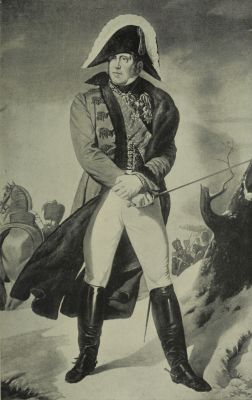
MARSHAL NEY Commander of the 3rd French Army Corps. The hero of the Retreat After the picture by Langlois at Versailles
As he saw Bagration’s line driven in, Kutuzov had ordered the 4th Corps also to draw in to the centre. By noon the Russian position was peculiar. Dokhturov on the right and Tuchkov on the left still faced the French in nearly their old positions, while the rest of the army stretched in a convex between them. To drive back Dokhturov and Tuchkov was Napoleon’s next object, and he was about to order forward part of his Guard when, apparently a little after noon, he received intelligence that his left was being attacked.
Early in the day Platov, reconnoitring towards the right, had ascertained that there were comparatively few French troops north of the Kolotza, and had proposed to the commander-in-chief a cavalry attack on their flank and rear. Kutuzov assented, and for the purpose detailed Uvarov’s cavalry corps,[6] some 3500 sabres strong. Clausewitz, who was then on Uvarov’s staff, criticises the movement severely. Certainly 3500 regular, and 4000 irregular, horsemen could not of themselves effect much; but it is a little difficult to concur in his opinion that the detachment of Uvarov’s corps was a rash weakening of the line. It is easier to agree with him when he says that the movement was made too early in the day. Uvarov, however, was very slow and did not cross the Kolotza until past eleven. About 11.30 he approached the Voïna (a little stream which enters the Kolotza at Borodino), at Besubovo, about a mile and a half from the former village. On the Russian side of the stream stood Guyon’s cavalry brigade and a regiment of the Italian Guard, which withdrew over a mill dam before the fire of Uvarov’s artillery to join the rest of the Guard and Delzons’ division, which occupied Borodino. Platov now came up, and his wild horsemen dashed through a ford and among the Italian infantry, followed, without orders, by the Cossacks of the Guard, who lost heavily in charging the squares. Uvarov, however, would not risk his regulars, halted, sent for orders and finally withdrew. Clausewitz’s comment is that he was not the man to lead such an attack. Löwenstern fumes at his slowness and hesitation. More, undoubtedly, might have been achieved with a bolder commander. Even so his feeble diversion brought Eugène back across the Kolotza with Broussier’s division, and delayed the advance against the Great Redoubt. He finally withdrew about 3 p.m., but before this Eugène had returned across the Kolotza.
All this time a tremendous and unprecedented cannonade was being kept up. Between Borodino and Utitza some 900 guns were in action. The Great Redoubt was being furiously bombarded by Eugène’s artillery, while Ney’s batteries brought a converging fire to bear upon it from the southward. To storm it Eugène detailed Gérard’s division, hitherto but lightly engaged, while Morand and Broussier supported; and Napoleon ordered Montbrun, with his Cuirassier divisions, to charge the Russian line on Gérard’s right. Montbrun was killed as he led forward his men, and General Caulaincourt, brother of the Duke of Vicenza, came hastily from the Emperor to take up the command. “Don’t stop to lament!” he said to the dead general’s aides. “Follow and avenge him!” The mass of mail-clad horsemen broke through the Russian line south of the redoubt, wheeled to the left and came thundering upon its rear, just as Eugène’s infantry reached it in front. For the four regiments of Likhachev’s division which held it there was no escape—at least as regards the major part. Some of them who were outside the work succeeded in saving themselves; but those within were trapped and, after maintaining a desperate resistance against the charges in front and rear, were almost all cut to pieces. Likhachev, who was very ill, flung himself among the assailants, and had almost found the death which he sought when some French soldiers, attracted by his insignia, took him prisoner, severely wounded. Caulaincourt was struck down as he led the triumphant charge of his Cuirassiers—one more victim of the fatal “Battle of the Generals.”
The capture of the redoubt opened a huge gap in the Russian line, through which Eugène’s and Grouchy’s cavalry poured to complete the victory. Against them Barclay hurled all the horsemen whom he had under his hand—the 2nd and 3rd Cavalry Corps and the Cuirassiers of the Guard—leading more than one charge in person, while Ostermann-Tolstoï’s corps, supported by the yet unengaged portions of the 5th Corps, was ordered to make a counter-attack towards Semenovskoï. Ostermann-Tolstoï, as he had shown at Ostrovno, was not the man for an emergency; Löwenstern says that he appeared to have entirely lost his head. He moved forward so slowly that Ney, Davout and Murat were able to make preparations to receive him. The French infantry were almost fought out; the cavalry had literally “foamed themselves away” in endeavouring to shatter the resistance of the stubborn Russian infantry; the fire of the Russian artillery was as steady and effective as ever. The Marshals sent again and again for some part of the Guard to support their weary men, but Napoleon refused to risk it. The Russian writers express astonishment at his caution. All that he would do was to send forward the reserve of heavy artillery, under Comte Sorbier. Sorbier swore at Lejeune, who brought the order to advance. “I ought to have had it an hour ago!” was his comment.
The Marshals had got together 80 guns wherewith to oppose the Russian advance; and when Sorbier came up the 4th Corps was overwhelmed with a crushing cannonade, against which it could not make way. Its losses were terrible. General Bakhmetiev had his leg carried away; Ostermann-Tolstoï himself and several of his staff were wounded. The supporting cavalry charged with splendid audacity, and some of them actually re-entered the Semenovskoï redans. All was in vain. Sorbier’s battery had turned the scale against the Russians, and by about 4 o’clock they were in full retreat. The infantry and cavalry on both sides were fairly fought out, and the struggle was maintained only by the artillery, except on the extreme left of the Russian line, where Tuchkov’s force, now commanded by Baggohufwudt, was practically isolated. The Polish Corps, supported by the Westphalians on the left, succeeded about 5 p.m. in carrying the Utitza knoll, and Baggohufwudt, still barring the road, drew back into line with the centre and left. There was a last flicker of hostility near Semenovskoï, where the Finnish Guards repulsed an advance of some French battalions, and then the battle died away in a dwindling cannonade, until a thick fog shrouded in a merciful veil the awful scene of slaughter. The Russian line, reformed by Barclay, stretched from beyond Gorki along the edge of the Tzarévo plateau to the old Moscow road. Four Chasseur regiments, under Colonel Potemkin, were on the right with Platov’s Cossacks. The remains of Dokhturov’s corps, supported by Uvarov, held Gorki. Next came Ostermann-Tolstoï’s corps; and thence Raievski and Borozdin, with Prince Eugen’s and Shakovski’s (late Tuchkov IV’s) divisions, continued the line to Baggohufwudt’s position. The cavalry was in rear, and the 5th Corps in reserve behind the centre. The French lay opposite, Delzons and Lecchi north of the Kolotza and, to the south of the river, the 4th, 3rd, 1st, 8th and 5th Corps in succession from Borodino through Semenovskoï to a point about 1200 yards east of Utitza.
The consensus of opinion of eyewitnesses on the Russian side is that the spirit of the Russians was unbroken, and that there was little confusion in the ranks. Löwenstern says that he offered to attack the Great Redoubt at break of day, and that Barclay approved. Kutuzov, however, when he learned the extent of the slaughter in his army, decided to retreat. It is quite certain that he must have retired in a day or two, since he had no reserves, while Napoleon had 11,000 fresh troops (Laborde and Pino) approaching the field. Barclay, however, was bitterly angry; and when he received the order to retreat broke into a fierce invective against Bennigsen, to whose influence he attributed Kutuzov’s resolution.
Under cover of darkness the Russian army quietly withdrew, and on the 8th took up a position in front of Mozhaïsk. The retreat was effectually covered by the Cossacks, who displayed great audacity, and in the night of the 7th-8th repeatedly disturbed the French bivouacs. The French cavalry, shattered and exhausted, could do little or nothing, and the Russians remained all through the 8th at Mozhaïsk, employing the time in reorganising, and in evacuating towards Moscow as many as possible of their wounded. Nevertheless many were left to inevitable death on the field, and thousands more abandoned at Mozhaïsk to the mercy of the French, who, themselves in a sorely distressed condition, simply cast them out to die of misery in the fields.
Regarding the major tactics of the battle of Borodino there is little to say. Napoleon had deliberately chosen to make a frontal attack upon the Russian army in place of turning it; and in the practical absence of his personal supervision the battle almost fought itself. The idea of taking advantage of the extension of the Russian right by overwhelming the left was an excellent one. It was foiled by the determination of Bagration’s resistance, which permitted Baggohufwudt’s corps to be moved across to his support. On the part of the Russians the occupation in force of the position north of the new road proved a blunder, which the remarkable solidity of the Russian resistance enabled the generals to repair in time.
As regards what is often considered Napoleon’s fatal error in not throwing in the Guard it is very doubtful whether it was an error at all. It must be remembered that Ney’s and Davout’s troops were almost, if not quite, fought out, that the Russians were still solid and undemoralised, and holding a position quite as strong as that from which they had been evicted; and that Kutuzov still had some almost untouched reserves. The Guard would have had no easy victory, and Napoleon was probably right when he refused to expose it to severe and perhaps fatal losses. He knew that the Russians were neither routed nor in disorder; and if they stood to fight again nearer Moscow he might yet have sore need of his Guard. He was 1200 miles from the frontier of his dominions, and in case of disaster all must depend upon it.
Of the minor tactics little need be said. On both sides they were crude and wasteful. There was a deficiency of infantry on the French side, and the cavalry was freely employed to supplement it, with the result that it was half destroyed. The infantry formations were dense and clumsy, it was a case of heavy mass pushing against heavy mass, with cavalry mingled in the melée, and all under the fire of a thousand or more pieces of artillery. It is no wonder that the losses were unprecedented on both sides.
Napoleon gave his loss at 10,000. French writers admit the suspicious round number of 28,000—6547 killed and 21,453 wounded—but Martinien’s lists show 49 generals and 1934 officers killed and wounded, and even allowing for the fact that many of the effectives were now low, and the proportion of officers to rank and file therefore higher than usual, this can scarcely imply less than 43,000 casualties. Even the troops which had never been sent forward had suffered somewhat from the cannonade.
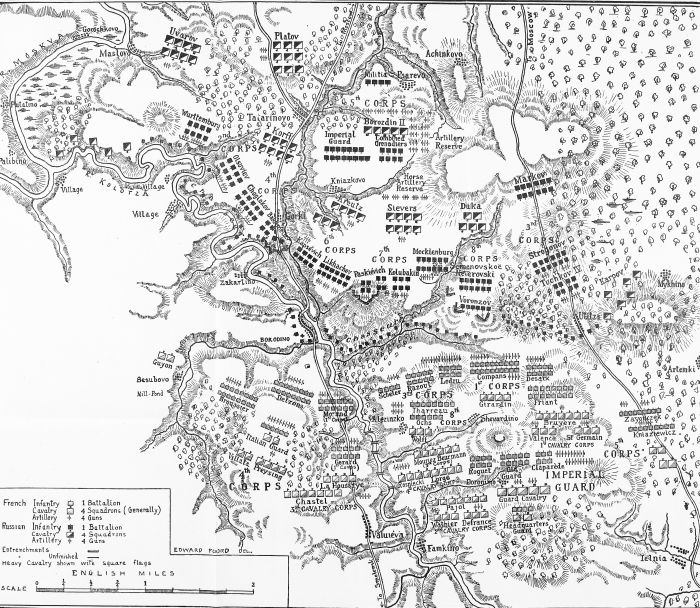
BATTLE OF BORODINO (September 7th, 1812)
The losses of the First Russian Army from the 4th to the 7th of September are stated by Bogdanovich at 9252 killed and 19,226 wounded. Those of the Second Army may perhaps, since it contained only 54 battalions and 52 squadrons as against Barclay’s 122 battalions and 112 squadrons, be estimated at 12,000. Adding the losses of the militia, a total is obtained of possibly 41,000 or 42,000. Sir Robert Wilson estimates it at 1500 officers and 36,000 men. Buturlin gives 15,000 killed and 30,000 wounded.
Prisoners there were few—perhaps 1000 or 1200 French and 2000 Russians. The estimates of guns captured are somewhat vague. Kutuzov’s official figure of French guns taken and carried off by the Russians is 8. There may, of course, have been others disabled. The Russians seem to have lost about 18 in all.
On the field Borodino can scarcely be described as anything but a drawn battle. Napoleon had gained a little ground, but the Russian army was unbroken and apparently quite willing to renew the contest next day. Strategically the French appeared to have obtained a slight success, since they were able to continue their advance to Moscow. On the other hand, the battle, which ruined the cavalry and seriously shattered the infantry, brought ultimate ruin distinctly nearer. Perhaps its most noteworthy result was the extent to which the morale of the Napoleonic army was broken.
FOOTNOTES:
CHAPTER VIII
THE OCCUPATION AND DESTRUCTION OF MOSCOW
The morning of the 8th of September found the army of Napoleon bivouacked among the dead and wounded on the field of Borodino. Only the Guard was really ready for further combat. The corps of Davout and Ney were terribly cut up; the 17th, 30th and 106th Regiments were nearly destroyed. The cavalry, which had to compensate for Napoleon’s comparative weakness in infantry, had suffered fearfully. Nearly all its corps and divisional commanders were killed or wounded; several regiments were almost annihilated. The four corps of the reserves counted some 19,000 men on September 2nd; on the 20th they could muster little more than 10,000. Thousands of horses had been killed, and there was no present possibility of being able to replace them, while the wounded animals were mostly doomed to perish from lack of forage and proper care. The cavalry of the Guard alone was in a state for serious combat.
The fate of the wounded was horrible. Means of every kind for tending them were lacking, and fortunate were those whose end was hastened by the incurable nature of their hurts, or thirst and starvation. Days elapsed before all had received so much as first aid; and this was but the commencement of their miseries. The great monastery of Kolotskoï became the principal hospital, and in its buildings the victims of Borodino were huddled literally in heaps, without beds even of straw, without food or fire, and without a tenth of the medical aid that was needed. Some of the wounded officers were able to buy food, at enormous prices, from the convoys which passed these dens of horror; but for the unhappy rank and file, who possessed little or no money, there was no hope. Sanitation there was none, and the unfortunate beings died in thousands, amid filth, pestilence and neglect. François says that in one hospital a dead officer was found who, in the agonies of starvation, had devoured his own arm to the bone. It is a painful task even to touch upon these sickening details, but to fail to do so is to neglect the primary duty of an historian.
Besides the enormous diminution of the effective strength, the state of the ammunition-trains was by no means reassuring. There is reason to believe that the artillery had fired 90,000 rounds during the 5th and 7th; the infantry must have expended millions of cartridges. It is certain that, immediately after Borodino, Napoleon was anxiously pressing for fresh supplies of ammunition; and it is doubtful if he could have delivered another pitched battle before they arrived.
Worse than all, the spirit of the troops was grievously depressed. The gaiety which commonly characterises Frenchmen, even in untoward circumstances, had vanished. Gloomy silence reigned during the march and in the bivouacs. The negative results of the great battle had completed the discouragement of the troops. The French soldiers, at any rate, were too intelligent not to have some inkling of the disasters that might too probably lie before them.
On the whole Kutuzov might perhaps have remained longer on the field of battle. It is, however, probable that his withdrawal to Mozhaïsk was wise. He had dealt a tremendous blow at the efficiency and morale of Napoleon’s army, but in doing so his own forces had been fearfully shattered. Had he remained in position the circumstance might have decided Napoleon to use the almost untouched Guards, and so at the last moment wring a victory from frowning Fortune.
When the sun dissipated the autumn fog which had enwrapped the field, the Russian position was seen to be guarded only by the hovering pulks of Platov’s Cossacks. Against them Murat moved such of his exhausted horsemen as could be rallied; and before the advance of regular squadrons the riders withdrew. Behind them, however, were supports of infantry—the four Chasseur regiments of the 2nd Corps. They gave back very slowly, and did not reach Mozhaïsk until 4 p.m. By that time a large number of the Russian wounded had already been evacuated. The town, however, was still choked with disabled men, many of whom were in a state to be moved, and to cover this operation Kutuzov directed Platov to hold it as long as possible. The Russian main body was in position behind it.
Napoleon, as soon as he was assured that the Russians had really retired, ordered Murat to press their retreat. The King had the four reserve cavalry corps and the light horse of Ney and Davout as before,—a total now of not more than 14,000 lances and sabres—but Compan’s shattered division was replaced by that of Dufour (vice Friant wounded). The Emperor apparently at first believed that Kutuzov was in full retreat, and the head-quarters baggage was directed on Mozhaïsk; but Murat, as aforesaid, made little or no headway against Platov; and the head-quarters could not be transferred. Desultory skirmishing and cannonading went on until nightfall, when Platov was still in possession of Mozhaïsk.
The firm front shown by Platov must have convinced Napoleon that the spirit of the Russians was unbroken. He spent a part of the day in going over the battle-field, examining the positions and reviewing the troops according to his custom. In the afternoon he went forward to join Murat, and on the way received another unpleasant reminder of the unabated courage of his foes, some foragers being driven in by Cossacks, and an alarm caused. On this day, however, a much needed reinforcement arrived in the form of Pino’s Italian division.
At about 10 a.m. on the 9th Platov was fiercely attacked by Murat, expelled, and driven along the Moscow road. Murat’s pursuit was checked by a reinforcement of twelve battalions and a heavy battery sent back by Kutuzov, but Mozhaïsk was lost, and Napoleon transferred his head-quarters thither. Some thousands of the most seriously injured of the Russian wounded were still there; and there were hideous scenes as they were cast out of the houses for those of the French army, who, in carriages and waggons, or dragging themselves along on foot, streamed in piteous procession in rear of the leading troops. The Russian main body retired deliberately to Semlino (or Shelkovka) about 12 miles east of Mozhaïsk.
Napoleon himself remained for three days at Mozhaïsk recovering from his cold, and transacting arrears of business. Already on August 27th he had sent orders to Victor to bring the 9th Corps from the Niemen up to Smolensk; and from Mozhaïsk fresh directions were despatched for him. From Mozhaïsk also was sent the bulletin announcing the battle of Borodino. As his cold rendered him speechless Napoleon wrote it with his own hand; and, being at best an execrable writer, the result may be imagined. The French losses are stated in it at 10,000. This would, according to Napoleon’s usual standard, indicate from 40,000 to 50,000 casualties.
Meanwhile the Russian army was still steadily retiring on the high-road to Moscow, and Murat deliberately following. Eugène, as before, marched on the north by a track running roughly parallel with the main road by the towns of Rusa and Zvenigorod, while Poniatowski formed the right flank guard on the south. Junot remained at Borodino and Kolotskoï to guard the hospitals. In support of Murat marched Mortier with the divisions of Roguet and Claparède; and behind him Davout and Ney in the order named.
Kutuzov was displeased with Platov for abandoning Mozhaïsk prematurely, as he considered, and superseded him in the command of the rear-guard by Miloradovich. On the 10th the Russian main body made another deliberate march of about 8 miles, while Miloradovich stood to fight at Krymskoië, some 3 miles short of Kutuzov’s evening position. His force consisted of six weak regiments of Chasseurs, four line regiments, Uvarov’s nearly intact cavalry division, and some Cossacks. He occupied a low, partly wooded ridge; his left was covered by a marsh, his right by woods, while in the centre the high-road approached the ridge by a narrow gully which was commanded by the Russian guns. Clausewitz, however, who was present, does not consider that the position was particularly advantageous. The twenty defending battalions can hardly have mustered over 6000 bayonets. Murat came up towards 5 p.m., and developed a fierce attack by Dufour’s division upon the right of the position, defended by three Chasseur regiments under Colonel Potemkin. After a hard struggle Potemkin was forced back from the summit of the ridge, but he held firm, supported by three regiments sent to his support by Miloradovich. Uvarov’s horsemen succeeded in keeping Murat’s broken regiments at bay; and the Russians fought on doggedly until darkness put an end to the contest. The Russian loss is stated, probably with some exaggeration, at 2000. As Martinien’s lists show 71 officers killed and wounded between the 8th and 10th, the French can scarcely have lost less than 1200.
On the 11th the main Russian army marched 16 miles to Viazema (Viazma on modern maps). Miloradovich retired to Kubinskoi, 8 miles from Krymskoië, unpursued by Murat. Eugène and Poniatowski were nearly level with Murat on the north and south, Mortier and Davout some distance behind, and Ney only a short way past Mozhaïsk. On the 12th Kutuzov retrograded to Momonovo, a bare ten miles from Moscow, while Miloradovich withdrew to Malo Viazema, 12 miles to the westward, leisurely followed by Murat. On the same day Napoleon left Mozhaïsk for the front.
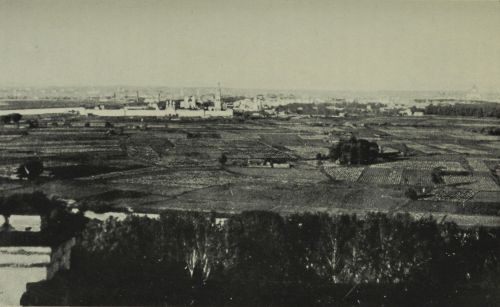
MOSCOW FROM THE SPARROW HILLS This is practically the scene which Napoleon contemplated in 1812
The question of the fate of Moscow was now imminent. It is at least possible that Kutuzov would have risked another battle had there been a fair prospect of success. But it cannot be said that this was the case. All the way from Mozhaïsk the militia had been steadily joining, but even so the army mustered less than 90,000 men, and of these only 65,000 were regulars, as against over 90,000 still under Napoleon’s hand. Many of the militia were as yet unequipped with fire-arms, and all were raw and without training. Kutuzov could expect no further reinforcements of regulars for weeks, whereas Napoleon would be joined within ten days by Laborde’s division as well as by some régiments de marche. The defective state of his ammunition Kutuzov did not know. The spirit of the Russian troops was indeed excellent, but against it was the greatest military genius of modern times, backed by an army wearied indeed, and in part much disheartened, but not yet demoralised, and including 20,000 untouched and undiscouraged veterans.
On June 10th Count Feodor Vasilievich Rostopchin, a former favourite and confidant of the ill-fated Emperor Paul, and a fanatical opponent of the French alliance, had been appointed Governor-General of Moscow. Whether he was the right man for his position must be questioned. It does not appear that anything was done to organise and arm the inhabitants or fortify the city. Nevertheless Rostopchin was furious at the idea of abandoning Moscow. According to Wilson he never forgave Kutuzov for keeping him in ignorance of the critical state of affairs.
As a fact he must have known that the evacuation of the city was to be expected; and he appears to have been steadily clearing it as far as possible of its inhabitants. This was the more practicable because in the summer Moscow was considerably less populated than in the winter, the nobles and their large households of serfs and retainers being absent on their estates. Otherwise the Governor, who was not a soldier, seems to have considered a good many rather wild plans of resistance. It would have been perfectly feasible to defend Moscow with the 90,000 troops of Kutuzov, but its destruction would thereby have been rendered inevitable. As regards Rostopchin’s project of arming the inhabitants, it is certain that such muskets as were available were obsolete and of bad quality. For the rest, 200,000 human beings cannot abandon their homes in a day, and since the French found the city nearly deserted it is obvious that the exodus of the Muscovites had long been in progress.
On the 13th the Russians fell back to Fili, and took up a position on the east side of Moscow, chosen by Bennigsen, who eulogises it in his memoirs, saying that its only defect was that it was rather long. On arriving Barclay proceeded to inspect it, while Kutuzov, who could ill support the fatigue of the campaign, rested. Dokhturov, who apparently had a touch of the courtier about him, proceeded to serve him a meal, but the little picnic was quickly interrupted by Colonel Löwenstern asking for Dokhturov, with whom Barclay wished to confer.
“As usual!” said Barclay as he sent off Löwenstern. “There they all are, dancing attendance on the Prince, and not troubling about what they (the French) may do. Fetch Dokhturov here, even if his mouth is still full.”
Kutuzov apparently rather enjoyed Dokhturov’s disappointment on being thus interrupted. “You must not keep General Barclay waiting,” he remarked. “I shall manage very well by myself,” and therewith proceeded with his meal, while poor Dokhturov was obliged to go. Barclay and he studied the position and came to the conclusion that it was too weak.
A council of war was called for four o’clock in the afternoon. Bennigsen, still busy examining the position, kept the other generals waiting until six. There were present Kutuzov, Barclay, Bennigsen, Dokhturov, Konovnitzin, Raievski, Uvarov, Ostermann-Tolstoï, Yermólov, Toll, and, later on, Platov. Bennigsen opened the discussion by asking whether it was better to give battle or to abandon the capital. Kutuzov interrupted him, pointing out that the question was not of Moscow, but the salvation of all Russia, and that this clearly depended upon the preservation of the army.
Barclay strongly supported Kutuzov, and he was followed by Raievski, Konovnitzin, and Ostermann-Tolstoï. Barclay appears otherwise to have had no great confidence in the ability of the Russian troops, diluted with militia, to manœuvre. When fighting generals such as Raievski and Konovnitzin ranged themselves with him the question was practically decided. According to Bennigsen he was supported by Dokhturov and Platov; but his claim to have had the votes of Konovnitzin and Yermólov is elsewhere contradicted. To his suggestion that battle should be delivered Ostermann-Tolstoï replied with a blunt question as to whether he was ready to answer for victory. Bennigsen evaded this embarrassing query; but Kutuzov, who had perhaps already made up his mind, ended the discussion by deciding upon retreat. As to its direction Barclay appears to have considered that it should be to the eastward on Vladimir and Nizhnii Novgorod; but Toll, thinking more of the question of supplies, suggested a retirement towards Kaluga. A direct retreat on the latter place would have exposed the army to one of Napoleon’s dreaded flanking attacks. Strategically Barclay’s suggestion was sound enough, if perhaps over-cautious. Clausewitz points out that Napoleon’s offensive power was exhausted, and that he could scarcely have pursued.
Kutuzov decided that the line of the retreat should be by Kolomna on Riazan, thus intermediate between that suggested by Barclay and that proposed by Toll. By taking it no opening was afforded for a flank attack; and it would be easy to manœuvre on either wing should occasion arise. The commissariat of the army would be assured since it would have at its back the fertile “Black Soil” provinces; and it would furthermore be in easy communication with the manufactories of arms at Tula and elsewhere. Orders were therefore issued for the retreat of the army by the Kolomna road. Bennigsen was extremely discontented, and showed his displeasure by leaving the council. He attributed it to Barclay, and their relations, already strained, became more hostile than ever.
There can be no doubt that Kutuzov and Barclay were correct in their resolution to retreat, but it was no light thing to make it. Kutuzov was greatly agitated; he passed a sleepless night, and more than once tears were seen to roll down his cheeks. No Englishman can perhaps fully understand what it meant to a Russian to leave “White-Walled Moscow,” the mother of the Russian land, to the mercy of an enemy.
Barclay, though now in bad health, took executive command of the evacuation. At 2 a.m. on the 14th the army began its passage through the city. The troops, in the deepest dejection, tramped through the streets with furled standards and silent bands, many of them, officers and men, sobbing with rage and despair. The foreign commandant of the Kremlin garrison regiment began the evacuation with band playing, according to the usages of war, and there was a violent outcry among the retreating soldiery. They indignantly shouted that he was rejoicing, and the music had to cease.
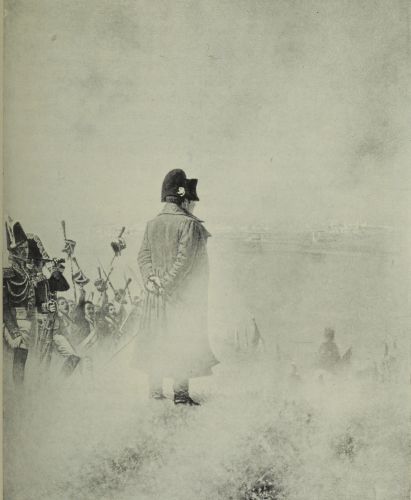
NAPOLEON’S FIRST VIEW OF MOSCOW The Emperor is standing on the Sparrow Hills, from which an imposing view of the old Russian capital is obtained. From the painting by Verestchagin.
Barclay stationed his staff-officers along the line of retreat to enforce order. Knowing the especial weakness of the Russian soldiers, he issued strict orders that anyone found in a beer-shop or intoxicated was to be summarily punished. He worked himself to death in directing the march, and was on horseback for eighteen hours. He complained bitterly of the inefficiency of the staff, which, as usual, did little or nothing to facilitate the march. There was frequently disorder among the retiring columns. None the less it must be said that the operation was remarkably successful. By 9 o’clock in the evening, after eighteen hours of incessant toil, 90,000 fighting men, more than 600 guns and thousands of vehicles, had been passed through the great city and were on the Kolomna road. Kutuzov himself traversed Moscow in the morning. An eyewitness states that he saw him near the Kolomna gate sitting in his carriage quite alone, resting his head on his hands, silent and sad, while before him troops, guns, and waggons poured in an endless stream. The head of the army halted for the night at Panki, a village about ten miles from the city, where Kutuzov established his head-quarters.
Meanwhile, early on the 13th, Napoleon halted his army, fearing that Kutuzov was manœuvring to attack his right flank. That he could conceive such an eventuality shows how completely, and not for the first time in the campaign, his cavalry had failed to keep touch with the enemy. At 10 a.m., however, he became convinced that the Russian army was still in his front, and resumed his march. At 1 p.m. on the 14th Murat’s vanguard crowned the Sparrow Hills, about a mile and a half west of Moscow, and saw before them in the plain the Russian rear-guard, and beyond it the widespreading city—the goal which they had toiled so strenuously to attain.
The Russian army was still pouring through the streets, and Miloradovich sent an officer to Murat to propose a short armistice, adding that if it were not granted he should defend the city step by step, and fire it as he fell back. After a while a sort of informal suspension of arms until 7 p.m. was made between Miloradovich and Sebastiani, now commanding the 2nd Cavalry Corps. The Russians evacuated the Dorogomilov suburb at 3 p.m., and Murat quietly followed. At about the same time Napoleon reached the Sparrow Hills. He is said to have gazed long and eagerly upon the goal of his wishes, now spread out before his greedy eyes; but he may well have muttered the words attributed to him: “It is full time!”
The Emperor approved of the informal truce concluded by Murat. The peaceful occupation of Moscow was an end bought cheaply enough at the price of the quiet withdrawal of the Russian rear-guard. Mortier was to be Governor, General Durosnel Military Commandant, and M. Lesseps, who had formerly been French Consul-General at St. Petersburg, Intendant of the province of Moscow. Orders were issued to prevent the ingress of plunderers. Eugène and Poniatowski were ordered to halt some miles short of the city. Mortier was directed to occupy the Kremlin, and to maintain order by severe methods. As the day wore on the 1st and 3rd Corps and the old Guard closed up on Murat. It is a characteristically French touch that the men had decked themselves out in their parade uniforms to take part in the triumphal entry.
As Miloradovich evacuated quarter after quarter of the city Murat advanced, dreading surprise, and taking great precautions against it. The streets were deserted; silence reigned everywhere. Near the Kremlin a tumultuous gathering of citizens and stragglers opened a scattering fire. They were dispersed by cannon shots, and Murat moved on, only to find silence and apparent desertion. Miloradovich marched through the city and established himself for the night some 4 miles from the Kolomna gate. Winzingerode’s detachment, which had been falling back before Eugène, was on the St. Petersburg road, and another cavalry detachment was escorting the public treasure and the archives of Moscow to Vladimir.
When at last it became evident that Moscow was indeed deserted by most of its native inhabitants, a deputation of foreign residents was collected to be presented to Napoleon. His mortification was extreme. He quartered himself in the Dorogomilov suburb, and, between his anxiety and the dirt and vermin of an ill-kept abode, spent a restless night.
Mortier had duly occupied the Kremlin with Roguet’s division, sending Claparède to support Murat. The silence of the city impressed even the reckless soldiery of Napoleon. Sergeant Bourgogne naïvely expresses it by remarking how disappointed they were to see not even a pretty girl listening to the regimental bands. With darkness disorder broke forth everywhere. It was impossible to prevent ill-fed and ill-clad men from pillaging when all that they needed, not to speak of wealth, which appeared to their ignorance inconceivable, lay ready to hand. In the evening fires were already breaking out. In the morning of the 15th Napoleon, escorted by the Old Guard, took up his residence in the Imperial Palace in the Kremlin.
It should here be said that the Kreml, or citadel, commonly known in Western Europe as the “Kremlin,” was the original fortress or walled town of Moskva, fortified in 1147 by Prince Yurí Dolgorúki (Long-handed George), the son of the famous Great Prince Vladimir Monomakh. Around it grew up in the course of ages various suburbs, and these were in their turn walled. As the streets were wide, and there were many very large buildings—palaces, monasteries, and the like—often standing in spacious gardens or enclosures, the city covered an enormous area. It had the characteristics in general of a vast country suburb rather than of a city.
A volume might be written concerning the burning of Moscow. The catastrophe has been described in the works of numerous eyewitnesses, and lengthy reference to the event itself hardly falls within the compass of this work. Three points must, however, be dealt with: the causes of the conflagration; its extent; and its effects upon the fortunes of Napoleon.
As regards the origin of the fire it may be regarded as certain that it was not the outcome of Russian patriotic frenzy. The whole evidence is to the contrary; and the fury and grief of the Russians at the destruction of their holy city were obviously genuine. It was equally not due to the deliberate action of the invaders, who had every motive for preserving the city for their own convenience. It remains to be considered whether it was the act of Rostopchin or due to mere accident, assisted by a fortuitous combination of circumstances.
Public opinion at the time attributed the conflagration to Rostopchin. Two of his own residences were destroyed, and a few weeks later he deliberately fired his country mansion at Voronovo in order to prevent its seizure by the French. Sir Robert Wilson, who had means of knowing, says that Rostopchin’s design was notorious, and that in order to prevent him from carrying it into execution Kutuzov repeatedly announced his intention of delivering battle before Moscow. Buturlin, the contemporary Russian historian, also attributes the fire to the Governor.
Rostopchin’s own testimony cannot unfortunately be trusted. He, at the time, admitted the responsibility of having burned Moscow. Nevertheless later, as a voluntary exile abroad, he repudiated it. All that can be said is that either he was really responsible, or that if not he claimed the credit in the belief that the burning of Moscow would be regarded as an heroic action, and only disowned complicity when he found that it was generally considered atrocious.
The French believed that the fire was caused by Rostopchin’s incendiaries, and hundreds or thousands of the Muscovites remaining in the city were hanged, bayoneted, or shot as such. The French, however, as all their history goes to show, have an unhappy tendency to lose their heads at a crisis, and it is certain that during the burning of Moscow they were wellnigh insane with panic. For the rest, they were utterly ignorant of their victims’ language.
Certain facts appear to emerge from the confusion as proved:—
(1) The city was by no means entirely deserted by the more respectable classes. Tutulmin, the director of the foundling hospital, remained at his post; and a certain number of merchants and gentlemen, some of Francophil leanings, did not leave. The foreign colony—chiefly French—also remained.
(2) The lowest of the lower classes naturally remained; and the disreputable elements probably preferred to take their chance of making their profit out of the invaders. The criminals in the prisons had also been released.
(3) Whatever may have been the case as regards the mass of ordinary private dwellings, the palaces and mansions, of which Moscow was full, as well as most of the many warehouses and shops, were abandoned, as a seaman might say, “all standing.”
(4) The fire was beginning as the Russian rear-guard left the city.
(5) Plundering on the part of the invaders commenced almost immediately after their entry.
(6) The wind changed its direction more than once.
(7) The French captured and utilised a vast quantity of gunpowder.
(8) Several thousand Russian wounded were left in the city.
The obvious deduction from (1) and (3) is that Moscow was hurriedly evacuated, and this is further supported by the evidence of (7) and (8). Had there been any settled plan of destruction one does not see why the powder-magazines were not fired, and the buildings of most importance to the invaders ruined. Nothing of this description was attempted, and the ammunition was for the most part saved by the French, to their great advantage. For the rest, with a mob of soldiery, together with a mixed horde of camp-followers of all nations, beggars, criminals, and prostitutes, plundering indiscriminately, there was every opportunity for wanton destruction. The frequent changes of the wind helped to spread the conflagration, and it was further assisted by the fact that the great majority of the private dwellings were wooden constructions.
On the whole, regarding the question solely from the standpoint of the established facts, it seems at least possible that the conflagration of Moscow, like most events of the kind recorded in history, was accidental in its origin.
It is probable that four-fifths of Moscow vanished in the conflagration, but it is doubtful if the material injury inflicted upon the invaders was very serious. In the city itself some 500 secular buildings of stone and brick survived, besides many churches and convents. The Kremlin was little injured. It is also clear that there were available great stores of food and other supplies. Forage alone was lacking. De Fezensac, who now commanded the 4th Regiment of Ney’s corps, which was generally encamped outside the city, speaks of trouble in obtaining supplies, and of poor and coarse fare, but not of actual want. In Moscow itself there appears to have been a superfluity of food, though flour was less abundant than other less necessary supplies. Clothing and materials for manufacturing it were seized in quantities, and no doubt the whole army could have been refitted had organised attempts been made to that end.
It was the possession of Moscow which exercised a disastrous influence upon the fortunes of Napoleon. Having failed to crush the Russian field-army, and thereby force Alexander to make peace, he had now become obsessed with the idea that the occupation of Moscow would bring about the desired consummation of his hopes. There was, indeed, hardly ever the slightest chance of their fulfilment, but Napoleon could not bring himself to admit this, and lingered among the ruins for week after week.
It is certain that fires were already commencing as the Russians evacuated the city; but the first serious outbreak appears to have occurred at a Government spirit store. It was extinguished, but soon afterwards the great bazaar in which, as at Constantinople and other Oriental cities, the bulk of the retail trade of Moscow was concentrated, was found to be on fire. Both spirit stores and shops would be natural marks for plunderers. The wind rose, drifted inflammable wreckage across the city, and scattered it among the wood-built suburbs, through which the conflagration spread with terrifying rapidity. The stories that the fire engines had disappeared, and that the ropes of the wells had been cut, may be taken for what they are worth. It is obvious that little organised endeavour to control the conflagration of a vast and largely wood-built city was, or could be, made. The Guards in the central quarters soon abandoned all efforts to fight the flames in order to devote themselves to plunder, and the officers of the corps encamped outside, convinced that it was vitally necessary to fill their nearly empty store-waggons, permitted, or connived at, the entry of their own men to take part in the sack.
Napoleon himself remained in the Kremlin until the 16th, when a change in the wind brought the conflagration from the suburbs to the inner quarters of the city, and rendered residence in the Imperial Palace dangerous, more especially since the larger part of the captured powder-magazines were within the citadel. The Emperor left by the river gate—the land fronts of the walled enclosure being practically encircled by the flames—and proceeded along the quays, eventually reaching the Imperial palace of Petrovski, some 2 miles on the Petersburg road.
With Napoleon’s departure pillage became universal. Some officers endeavoured to induce their men to take food and clothing, but apparently with little success, and that vast quantities of food were saved was due to the fact that the half-famished troops naturally turned to it. Murder and outrage went hand in hand with pillage. Many inhabitants were massacred by the soldiery, maddened with licence and intoxicating liquor; many others perished in the flames of their homes, or in attempting to escape from them. The miscellaneous horde of female camp-followers behaved as badly as the men. Paymaster Duverger relates how he knocked down a ruffianly cantinière who was robbing a sick and helpless Russian lady. There is unhappily evidence that many of the officers set a disgraceful example. Some pillaged openly; others made a levy upon the plunder of their men. The Guards had the best opportunities and gained an unenviable pre-eminence in misconduct. Drunkenness was everywhere rife. The men of the 1st Corps were almost as bad as the Guards, and probably this carnival of licence was the event which contributed most to the destruction of their discipline early in the retreat. It is worthy of note that Ney’s corps, which took little direct share in the sack, was the one which kept the best order amid the horrors of the retreat. Marshal Lefebvre was furious at the disorder in the Old Guard, and issued a severe order on the subject.
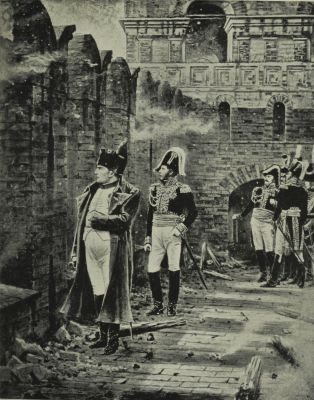
NAPOLEON WATCHING THE BURNING OF MOSCOW From the picture by Verestchagin
On the 19th the conflagration began to die away, partly owing to the equinoctial rains, and on the 20th Napoleon returned to the Kremlin. Useless efforts were made to induce the inhabitants to return to the ruined city, and the peasants to bring their produce to market. For payment Napoleon had provided a supply of forged Russian paper rúbles; but opportunities for uttering them were not forthcoming, though some were distributed to the surviving inhabitants and to charitable institutions. A few merchants and tradesmen accepted office under the French, but after the destruction of Moscow the Russians who entertained any feeling towards the invaders but that of bitter hatred were few indeed.
On evacuating Moscow the Russian army made two leisurely marches on the Kolomna road to where it crossed the Moskva, about 20 miles from the capital. Kutuzov appears at first to have intended to continue his march to Kolomna; but a conference with the Intendant-General Lanskoï convinced him that there would be difficulty in diverting the line of supply, and he decided to manœuvre towards Kaluga. On the 17th, therefore, leaving Raievski’s corps to cover the rear, he turned westward, and marched along the Pakhra, a rivulet which here joins the Moskva, until he reached the Moscow-Kaluga road. On the 21st he took up a position behind the Pakhra, with an advance-guard, composed of the 8th Corps and the 1st Cavalry Division, under Miloradovich at Desna, only some 10 miles from Moscow. At the same time Dorokhov, with the hussars of Yelisabetgrad, the Dragoons of the Guard, and three regiments of Cossacks, was detached towards Mozhaïsk. This last movement was perhaps premature, since it gave Napoleon early warning of an intention to operate against his communications.
During the night of the 15th the glare of a vast conflagration had reddened the sky to the north-west. All through the next four days the bivouacs of the Russians were illuminated by the flames of their burning “Mother City,” while by day dense banks of smoke lay upon the horizon, and charred fragments were frequently borne by the fierce gales among their marching files. The effect upon the soldiers may perhaps better be imagined than described. Whether the destruction of Moscow were deliberate or accidental in its origin, it kindled in the Russian army a flame of vengeful desire that endured until it marched triumphantly into Paris in 1814.
Murat, with his advanced guard, strengthened by Claparède’s division, and supported by Poniatowski, was following the Russians. At the Pakhra he lost touch, and not until the 23rd was the true direction of Kutuzov’s march ascertained and followed up, Raievski retiring on the main army. Napoleon apparently did not believe that Kutuzov’s whole force was to the south of Moscow—at all events he adopted a dangerous half-measure, which might have resulted in disaster. Murat was to press the Russians’ right, while a column under Bessières marched from Moscow against their front. Bessières’ force comprised the infantry division of Friederichs (vice Desaix), now increased by the 33rd Léger, a brigade of light cavalry, Colbert’s Lancers, and the 3rd Cavalry Corps detached from Murat. Its strength cannot have exceeded 11,000 men, while Murat certainly had not more than 25,000. Barclay and Bennigsen urged an attack, and it is clear that Murat must have been destroyed, or forced to retreat in haste. The cautious Kutuzov, however, inferred that Bessières was merely Napoleon’s advance-guard—as a fact the Emperor did on the 28th issue orders for a general advance on the Pakhra. As Kutuzov envisaged the situation, he would have the whole Grande Armée, enormously superior in regular troops, upon his own weakened forces. The superior condition of his cavalry and artillery could scarcely be relied upon to give him more than a doubtful success. On the other hand, every day would bring the winter nearer and ensure the steady increase of the Russian numbers. He accordingly decided to retire towards Kaluga. The 4th Corps was detailed to strengthen Raievski, and Miloradovich took command of the rear-guard. On the 27th there was a brisk encounter of cavalry on the Pakhra. On the 29th another engagement took place at Czerikovo. Poniatowski’s infantry were checked; General Ferrier was wounded and taken, and the advantage was, on the whole, with Miloradovich, who retired very slowly, contesting every mile of country.
On October 2nd the main Russian army reached Tarutino on the Nara, some 50 miles from Moscow, and took up a position, to protect which entrenchments were immediately commenced. Next day Sebastiani, always unlucky, experienced a slight check near Voronovo, but when Murat’s main column began to arrive Miloradovich retreated to Spas Kuplia, 10 miles north of Tarutino. The 4th and 7th Corps were drawn back towards the main army, covered by the 8th and most of the cavalry. Early on the 4th Murat and Poniatowski surprised the Russians. Spas Kuplia was carried and the 8th Corps driven back behind the Chernishnia rivulet, half-way to Tarutino. Konovnitzin, with whom was Sir Robert Wilson, was nearly captured, but he rode out of the danger-zone, his night-cap, in which he had been surprised, showing under his cocked hat, puffing coolly at his pipe all the time. So Löwenstern describes the scene. The 8th Corps rallied and held firm upon the Chernishnia until night, and eventually retired across the Nara to Tarutino. The 2nd, 3rd and 4th Cavalry Divisions (the first two now amalgamated) and some Cossacks remained in observation of the French north of the Nara. Murat’s offensive power had exhausted itself, and he halted, disposing the bulk of his force along the Chernishnia, with his advance troops at the village of Vinkovo.
Meanwhile the presence of Dorokhov south-east of Moscow had caused Napoleon to send some twenty miles on the road to Mozhaïsk, Broussier’s infantry division, the light cavalry of the 4th Corps, and the Dragoons and Chasseurs of the Guard. This for the moment relieved the road to Mozhaïsk, but the whole route to Smolensk was infested by Cossacks; and Napoleon was obliged to issue an order that no body of troops less than 1500 strong was to be risked along it. Kutuzov’s withdrawal to Tarutino seems for a short time to have improved matters near Moscow. Murat, with the reserve cavalry, the bulk of the light horse of the 1st and 3rd Corps, the 5th Corps, Dufour’s and Claparède’s divisions, remained on the Chernishnia. Broussier was stationed about 9 miles west of Moscow; Friederichs on the Pakhra; the Guard Cavalry returned to Moscow. Foraging detachments were despatched over the surrounding country to gather in food and fodder—with poor results—and in this manner a fortnight passed away.
CHAPTER IX
THE FRENCH SOJOURN IN MOSCOW
For almost a month after Napoleon’s return to Moscow on September 20th, the main French army lay almost inactive about the city. The Emperor’s anxieties on the score of supplies had been to some extent relieved by the quantities of food and ammunition captured. He says himself in a letter to Lariboissière, the Chief of Artillery, that he has taken 300,000 pounds of powder, and an equal amount of sulphur and saltpetre, besides an immense number of cannon-balls and 2,000,000 cartridges. It can scarcely be imagined that, however much the habit of lying had become ingrained in him, he would wilfully mislead the man whom, most of all, it was necessary to furnish with correct information.
A number of cannon were captured, but all practically useless. The Kremlin, in fact, was and is a museum of ancient weapons, mostly preserved as trophies of Russia’s victories over her enemies. Among them now are hundreds of the guns of the Napoleonic Grande Armée of 1812. The cannon had no carriages, but about twenty of them were mounted by the French artillerymen on the walls of the ancient citadel. The captures of ammunition were of extreme value. Napoleon exultantly declared that he could fight four battles of the magnitude of Borodino.
Forage, however, was seriously deficient. The cavalry and artillery of the Guard, which received supplies in advance of the other corps, remained in fair condition, but that of the rest of the army rapidly deteriorated. The horses died in great numbers. At the beginning of October De Chambray estimates that already 4000 troopers were dismounted. The misery in the advance-guard was great; breadstuffs could hardly be obtained, and the men lived chiefly upon horse-flesh.
In Moscow matters were by no means satisfactory. The troops had indeed shelter and food; but these advantages were dearly bought at the price of a fatal relaxation in discipline. The privileged Guards were bad offenders, and Napoleon himself had at last to complain of their misconduct. The 1st Corps was little better. The 3rd and 4th Corps were mostly outside the city. They lived chiefly from hand to mouth as before, and though a considerable amount of flour had been warehoused at Moscow Napoleon would not permit it to be issued, even when Berthier reported Pino’s division as being completely destitute. No issue was made of clothing material until October 17th, nor were any preparations made for rough-shoeing the horses. In the general relaxation of discipline little was done by the men themselves. In the face of proven facts such as these the statements as to Napoleon’s unerring and all-pervading foresight and activity, made even by respectable witnesses such as Rapp and Fain, make somewhat foolish reading.
In a sense, indeed, Napoleon did provide for much—that is, he issued orders which had they been at all applicable to the situation might have effected a great deal. Such an order was that for the provision of hand-mills for the troops. The need for them had been apparent during the advance, and had they been provided earlier they would doubtless have been invaluable. As it was the first convoy of them only came to hand during the retreat, when they were useless.
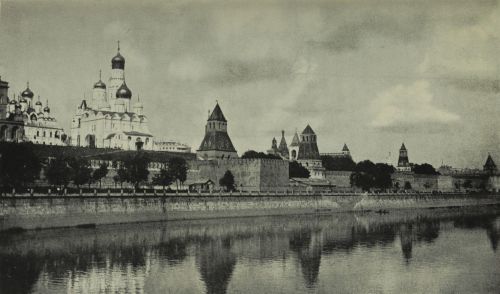
THE KREMLIN, MOSCOW On the extreme left is the Great Red Staircase—the State entrance to the Palace. Next is the Uspanski Sabor, or Cathedral of the Assumption, in which the Tzars are crowned. Behind it appears the Bell Tower of Ivan Velikii
Others of the Imperial orders were simply incapable of execution. One of them, for example, gives directions for exploring the country for two or three leagues on each side of the highway so as to find parallel roads passing by villages and cultivated tracts. It would have been extremely difficult to find such roads in fertile and well-peopled Germany, and to expect to discover them in Russia was merely absurd. As a fact, had they existed, the country was laid waste for a breadth of forty or fifty miles by the destructive passage of two great armies. The only criticisms that can be made in reading this order is that Napoleon’s intellect was either failing or so affected by pride and over-confidence as to be fatally debilitated.
Yet in spite of his fatal optimism Napoleon was growing uneasy. On his return to Moscow he induced Tutulmin, the director of the Foundling Hospital, to be the bearer of a letter to Alexander. It was a diplomatic document after Napoleon’s fashion, compounded of blandishments and threats; a characteristic touch is the careful detailing of the war material which has been captured. The Tzar would not deign to reply. Napoleon waited for a fortnight and then sent General Lauriston to endeavour to open negotiations with Kutuzov.
However, gloomy as the prospect might appear to intelligent observers, the bulk of the army was at rest, and, save in the vital matter of horses, increasing in strength. During the latter half of September there entered Moscow Laborde’s division, the 1st battalion of Hesse-Darmstadt Guards, three battalions of the 33rd Léger, and several régiments de marche—in all some 10,000 infantry and over 4000 cavalry. In the first half of October there arrived nearly 17,000 men—régiments de marche, mostly infantry, and the battalions which had been left in garrison at Orsha, Dorogobuzh, Viasma, and elsewhere. The muster rolls were also swelled by a certain number of convalescents. The fighting strength of the 5th and 8th Corps, which were harassed by constant skirmishing, remained stationary or declined; and the number of mounted horsemen steadily dwindled. But in the 1st and 3rd Corps there was a steady increase in the numbers of the infantry and artillery. Reinforcements of artillery also arrived; there were, indeed, more guns in Moscow than the enfeebled teams could draw.
The movements of the French main army during this period of comparative quiescence were not very important. Eugène early in October pushed an advance-guard to Dmitrov, some miles north of Moscow, while Ney moved to Boghorodsk, about 25 miles eastward on the road to Vladimir. The Russian cavalry screen, under Winzingerode, gave back before the advance of the French columns, and there was little fighting. Ney ordered the construction of barracks for winter quarters at Boghorodsk, but De Fezensac pessimistically remarks that the sham deceived nobody. Ney and Eugène were soon recalled to Moscow, and the entire army, except Murat’s advance-guard, was concentrated there on the 15th.
Meanwhile Murat, isolated on the Chernishnia at a distance of nearly 50 miles from the main army, and with a vastly superior army in his front, was in a position of great danger. The peril was aggravated by the scantiness of supplies and by the lack of forage, which was steadily killing the over-worked horses. Skirmishing was continually taking place, with general ill fortune to the invaders. Foraging parties had to be pushed farther and farther afield, and needed larger and larger escorts to protect them against the enterprising regular and irregular cavalry of the Russians. On one occasion a foraging party of Dragoons of the Guard, under Major Marthod, accompanied by a detachment of the 33rd Léger, was attacked and cut up. On October 9th Colonel Kudachev with two regiments of Cossacks made a successful attack upon a large foraging party, and carried off 200 prisoners. Similar skirmishes were continually occurring. On October 10th Dorokhov, who had been reinforced by five battalions and some more cavalry and artillery, stormed Vereia, killing or capturing its garrison of 500 Westphalians, and thus establishing himself dangerously near the Moscow-Smolensk road.
It has been seen that on October 4th Kutuzov had begun to entrench himself at Tarutino. Bennigsen criticises the position severely. The Nara in its front was everywhere fordable, and on the left there were some unoccupied heights which might be seized by an assailant. However, as matters went, there was little fear of an immediate attack, and the Russians were so strong in cavalry that they could obtain early warning of any move of the French from Moscow.
Soon after reaching Tarutino Barclay left the army. He had been deeply wounded by the rancorous attacks made upon him by the ultra Russians, and his relations with Bennigsen were very strained. Kutuzov had treated him with great respect, and after Borodino had given him the chief command of both Russian armies. But when a supreme commander is present at the head-quarters of an army difficulties are certain to arise. In 1864 the presence of General Grant with Meade’s army of the Potomac did not make for unity of command, though both officers were men of the finest character. Barclay soon found his position intolerable, and resigned. He was bitterly hurt, and told Clausewitz, who had just been appointed to a post on Wittgenstein’s staff, that he might thank heaven that he was well out of it. It is impossible not to sympathise with him, and at the same time not difficult to see that his departure made for unity of command. Whether Kutuzov was the right man for the post of commander-in-chief is another question. Barclay was abominably ill-treated and insulted by the populace on his way to St. Petersburg, but Alexander never lost confidence in him, and he emerged from his retirement in 1813 to take command of the Russian armies in Germany. His departure occasioned a show at least of regret among the officers of the army, many of whom perhaps felt conscience-stricken at the memory of ill-conditioned murmuring and mutiny. Most of the generals came to bid him farewell; and Yermólov, who had been his worst and most treacherous enemy, actually wept—an episode to which allusion has elsewhere been made.
On the 24th of September, at a mansion on the road to Vladimir, Bagration died. It is probable that travelling on the bad Russian roads had brought on gangrene. On his death-bed he was visited by Wilson, who was returning from his visit to Alexander. The Tzar, very wisely, had judged it best to overlook the insubordination of the generals, and had sent by Wilson the strongest assurances of his determination to continue the resistance. He would, he said, sooner let his beard grow to the waist and eat potatoes in Siberia, than permit any negotiations so long as an armed Frenchman remained in Russia. The language may perhaps be thought a little high-flown, but it possesses dignity in that it was the expression of the firm resolution of the united Russian nation. To the dying soldier Wilson repeated the brave words of the Tzar. Bagration pressed his hand convulsively. “Dear general,” he said, “you have made me die happy, for now Russia will assuredly not be dishonoured. Accipio solatium mortis.” So passes from the scene the fine Georgian soldier whose life had been spent in faithful service to his adopted country. Wilson eulogises his good qualities, the kindness and graciousness which his fiery temper perhaps at times concealed, his generosity and chivalrous courage. Wilson was his devoted admirer—the two had much in common. But in sober fact Bagration, whatever his faults, had ever proved himself a worthy descendant of the warrior-kings of the Bagratid line; and having adopted Russia, the steady protector of the Caucasian Christians, as his country, he had served her faithfully to the end. It is difficult not to feel a sense of decline in passing from Barclay, the simple, devoted servant of his country, and Bagration, the chivalrous descendant of kings, to the caution and cunning of the pleasure-loving old aristocrat Kutuzov, and the hardly disguised self-seeking of the soldier of fortune Bennigsen.
Kutuzov, from the field of Borodino, had sent a first brief and hasty despatch stating that he had held his own and captured some guns. As has been seen, the statement was only true in a general sense, since the Russian troops had certainly been driven back a short distance. This report was perhaps hurriedly penned in the exultation of finding that he had fought the terrible conqueror for a long day without real ill-success. A second despatch told the truth or something near it, describing the battle as a drawn one—which it tactically was—estimating Napoleon’s loss as probably the greater, and insisting upon the necessity of retreating in order to reorganise after the tremendous losses. A third despatch attributed the chief merit of the balanced success of the day to Barclay and Bennigsen. Alexander did not publish the second despatch—whether wisely or not it is difficult for an Englishman to judge. Kutuzov was promoted Field Marshal, and received a grant of 100,000 rúbles. Barclay was decorated with the order of St. George (2nd Class), and Bennigsen with that of St. Vladimir (1st Class). Bagration, who wore all the Orders of Russia, received a grant of 50,000 rúbles. Miloradovich, Dokhturov, Ostermann, and Raievski received the order of St. Alexander Nevski. Each soldier was awarded a gratuity of 5 rúbles—which, it may be hoped, was paid in silver, not in the depreciated paper currency.
When in the midst of announcements of victory and of rewards the news arrived that Moscow had been abandoned, the discouragement was naturally great. In the army itself Kutuzov certainly felt very dubious of success. At St. Petersburg the state archives were sent into the interior, and the fleet was sent to winter in England. The Empress Dowager, the Grand Duke Constantine, and the Grand Chancellor Rumiantzev, were strongly in favour of peace; but neither domestic nor political pressure, nor public alarm, appear to have shaken for a moment the stern resolution of the commonly yielding, sensitive, and dreamy Tzar.
Alexander’s reply to the fall of Moscow was a proclamation to his people calling upon them to rise superior to the loss, and to overwhelm the invaders, whose position was painted in colours perhaps darker than the reality. Preparations for continuing the war were energetically pushed forward. Count Lieven was despatched as ambassador to London, and with an assurance of Alexander’s immovable determination to continue the struggle at all hazards. For the present he asked nothing but munitions of war. Later, when he had saved Russia, he intended to do his best to free Europe from French domination, when he hoped that Britain would not be sparing of her wealth. At this moment, be it remembered, Napoleon was encamped among the ruins of the sacred capital of Russia.
Meanwhile at Tarutino the reorganisation of the Russian army was being energetically proceeded with. The man immediately responsible for it, who justly received the major part of the credit, was Konovnitzin, who has already been repeatedly met with in his country’s battles. Konovnitzin was a strong adherent and admirer of Barclay, and seems to have possessed his chief’s virtues of modesty and devotion to duty.
Borodino and the subsequent actions had grievously shattered all the regiments, and some had been practically destroyed. These were either dissolved or sent back into the interior to reform; the combined Grenadier battalions were broken up and distributed; and the militia and new recruits then drafted in. The experienced Russian generals did not make the mistake committed by the leaders of the Spanish uprising in 1808-1809 and swamp the battalions with raw levies. Only the picked men who had received some training were sparingly introduced among the war-seasoned soldiers. Even so Kutuzov was very distrustful of his infantry.
Horsemen cannot be trained so easily as foot-soldiers, and the Russian cavalry could not be greatly increased in strength. Such reinforcements as it received must have consisted of small drafts and rejoining convalescents. It included the same regiments as had fought at Borodino, but all were in a greatly reduced condition. The men, however, were in high heart and the horses in excellent condition. The artillery was also in admirable order.
Alexander had made an appeal to the loyalty of the Don Cossacks, which was seconded by the great personal influence of Platov. By the middle of October there were present in the Moscow theatre of war some fifty regiments of irregular horsemen.
Reorganisation and steady reinforcement had their effect. The numerical strength of the Russian army at Tarutino began to rise at once, and its efficiency steadily increased. The number of battalions had fallen to 147 by October 18th, but they had all been brought up to an average strength of over 500 bayonets, except those of the Guard, which, having no depôts at hand, were rather weaker. By October 23 the strength of the Russian Grand Army, including its detachments, had risen to 105,000 regulars, including 12,000 cavalry, and nearly 20,000 Cossacks, with an artillery train of some 650 guns excellently appointed and horsed.
Kutuzov made certain changes in the organisation. The entire regular cavalry was massed in four unequal “Corps,” one of which consisted of Cuirassiers. Lieutenant-General Prince Golitzin I received the command of the Cuirassier Corps, and the 1st and 3rd were given to Major-Generals Baron Müller Zakomelski and Vassilchikov respectively. Baron Korff continued to command the 2nd, which was increased to 8 regiments of Dragoons, and 1 or 2 of light cavalry. The various army corps still retained their old leaders, except the 3rd, which was now commanded by Strogonov.
At the same time some changes were made in the higher commands. Miloradovich practically took the place of Bagration—by no means unworthily—while General Tormazov was called from the west to succeed Barclay.
Strategically the army was organised by Kutuzov into an advanced guard, under Miloradovich, a Corps de Bataille, under Tormazov, six Flying Columns, and six Cossack detachments. The advanced guard included the 2nd and 4th Army Corps, the 2nd and 3rd Cavalry “Corps,” and 4 regiments of Cossacks. The Corps de Bataille consisted of the 3rd, 5th, 6th, 7th, and 8th Army Corps, and Golitzin’s and Müller-Zakomelski’s cavalry. The Flying Columns were: (1) Platov’s, comprising 13 regiments of Cossacks, 1 of light infantry, and a horse battery; (2) Winzingerode’s, of 1 regiment of Hussars, 1 of Dragoons, 7 of Cossacks, and a battery, observing Moscow on the north; (3) Dorokhov’s, observing Mozhaïsk, ultimately increased by detachments to 5 battalions, 16 squadrons, a battery, and some Cossacks; (4) Orlov-Denisov’s, consisting of 6 regiments of Cossacks and 6 guns; (5) Karpov’s, comprising 7 regiments of Cossacks; and (6) that of Major-General Count Ozharovski, composed of 4 regiments of Cossacks, 1 of Hussars, a regiment of light infantry, and 6 guns. The Cossack detachments which infested the Moscow-Smolensk road, were those of Colonel Kaisarov (3 regiments), Colonel Prince Kudachev (2 regiments), Colonel Yefremov (2 regiments), Lieutenant-Colonel Davidov (2 regiments), Captain Seslavin (1 regiment), and Captain Figner (1 regiment).
The Russian army at Tarutino experienced little or no privation. Supplies of food were plentiful. Forage after a time grew scarce in the immediate neighbourhood, and it was necessary to send to some distance to obtain it, but the horses remained in excellent condition. Löwenstern says that the army had never fared better; it was even possible to obtain luxuries from the merchants who visited the camp. Dry fuel alone was lacking. To obtain it the villages within the Russian lines were almost entirely demolished.
While making a show of preparations for the fortification and provisioning of Moscow the French Emperor, on October 4, sent his aide-de-camp, General Lauriston, who had been Ambassador at St. Petersburg before the war, on a mission to Kutuzov. Lauriston’s real object was to ascertain the chances of peace. It was certain that his mission could have no success. Apart from the firm resolve of the Tzar the generals at Tarutino were bitterly determined, and kept a close watch upon their commander-in-chief. Kutuzov consented to receive Lauriston; and thereupon his subordinates requested Wilson to inform him that if he conferred privately with Lauriston he would be deposed from the command. Kutuzov himself, not very confident of the ability of his army to beat Napoleon’s, persisted in his determination to receive Lauriston, but consented to do so publicly in the first instance. He then had a private conversation with the French general, of which he afterwards gave an account to Count Langeron. He ultimately consented to pass on a letter brought by Lauriston to St. Petersburg; but declared that he had no power to conclude an armistice.
The successes of Schwarzenberg and St. Cyr appeared to make the French line of communications fairly safe, and the calling up of Victor’s 9th Corps to Smolensk was an additional measure of security. The 9th Corps crossed the frontier on September 3. It was increased by the addition of four German regiments to a strength of 33,500 men. Victor left Coutard’s German brigade at Vilna, and with the rest of the corps marched for Smolensk, where he arrived on September 27. Napoleon had appointed Comte Baraguay d’Hilliers Governor-General of the province of Smolensk, but he could do little to collect supplies and keep the roads clear. The country was infested by small parties of Cossacks and of armed peasantry on the one hand, and on the other by numbers of stragglers, disbanded troops and marauders belonging to the invading army.
Until the arrival of the 9th Corps troops were entirely lacking wherewith to suppress the disorder, and it will soon be seen that Victor could make but a brief stay at Smolensk. Baraguay d’Hilliers, worried and distracted by Napoleon’s angry complaints, gave his master the facts of the situation in two letters, which enable us to appreciate the precise state of things in rear of the Grande Armée.
The armed peasants and Cossack detachments checked foraging operations and cut off detachments. At Smolensk, indeed, there was a strong garrison. A provisional administration had been organised, on paper, under the superintendence of M. de Villeblanche; but the town was ruined and nearly deserted. General Charpentier could organise strong foraging parties, but had no artisans to construct barracks and bakeries, or to manufacture clothing and equipment. From Smolensk to Gzhatsk there was hardly any protection for the road. Baraguay d’Hilliers declared that, after providing for the necessary garrisons of the posts, he could dispose of only 600 men, in three detachments, for police and foraging operations on a line of some 200 miles! As to establishing markets as Napoleon ordered, he frankly exposed the utter absurdity of the idea. For removing wounded and forwarding supplies there were not a fifth of the vehicles required.
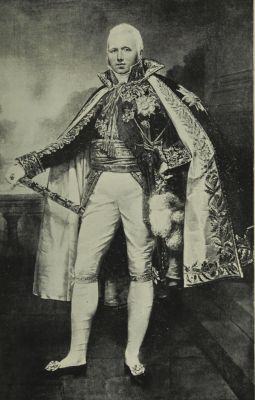
MARSHAL VICTOR, DUKE OF BELLUNO Commander of the 9th French Army Corps From the painting by Gros at Versailles
Detachments on the march to Moscow straggled for many miles north and south of the high-road in order to forage, and it was impossible to keep them in hand. One officer, in charge of a convoy, reported that his escorts melted away one after another; and he entered Moscow alone! The marauders committed nameless atrocities, which amply explain and to some extent justify the terrible retaliations of the peasants during the retreat. It is an ungrateful task to allude to these horrors, but one hideous incident given by Löwenstern must be mentioned, if only to afford a proper impression of what a state of warfare in Napoleonic days implied.
Among the Russian leaders of irregulars Captain Figner early acquired a terrible reputation for blood-thirsty cruelty towards his French and Polish foes, to whom he gave no quarter in battle, and whom, when captured, he massacred without pity. His savagery was strongly reprobated in the Russian army, except in the case of a number of fierce spirits whom the sufferings of their country had maddened. Even the wild irregulars looked askance at Figner; and for the execution of his savage orders he could not always rely upon them.
Figner himself declared that he acted from conscientious motives. While on one of his expeditions he surprised a marauding party—evidently consisting of Frenchmen and Poles—in a village which they had sacked. In the church they had penned a number of women and girls, and outraged and tortured them with horrible barbarity, crucifying them about the building—partly in order the more easily to gratify their brutal lust, partly no doubt from sheer love of cruelty. Into this hideous orgy burst Figner and his Cossacks. Most of the ravishers were captured. The unhappy victims—such of them as survived—were rescued; and there and then, before the desecrated altar, the Russian leader swore a solemn oath never to spare a Frenchman. He shut his prisoners up in the church and fired it over them; and thereafter, until he was killed in the following year, Frenchmen were to him but as vermin to be exterminated. It is futile to comment upon the moral ethics of his determination. It is only evident that in Russia, as in Spain, the brutality and lust of the French conquerors sowed the seeds of a terrible harvest of vengeance.
In spite of the disorder in Napoleon’s rear there is no doubt that the French numbers rose steadily during the halt. Presumably the stragglers therefore—or such of them as survived the Cossacks and armed peasants—drifted in eventually. But it is hardly necessary to point out that such a method—or lack of method—of marching was the worst possible preparation for a retreat in which strict discipline and careful order would be before everything necessary.
What Napoleon’s own plans were is extremely doubtful. The troops generally anticipated that they would winter in Moscow—but this of course implies nothing. Count Daru certainly suggested doing so, positively stating that to his knowledge the supplies were sufficient and shelter ample. But on the other hand the lines of communication were already seriously threatened, and though the army in Moscow might have been preserved it must have lost most of its horses, and Napoleon would have been cut off from France for several months.
The Emperor is credited by Fain with the intention of advancing upon St. Petersburg. This project was a most extraordinary one, and it passes human comprehension how Napoleon could have imagined it. It is useless to give it in detail. The essential part is that the army is to march upon Velikii Luki, about 90 miles north-east of Polotsk, and 300 from Moscow, through a fertile country (it is actually quite the reverse), and thus threaten St. Petersburg—200 miles farther on, over barren and sparsely-peopled country. The time allowed for accomplishing the movement appears to be about fifteen days! Farther comment is surely unnecessary.
Clausewitz considers that Napoleon must always have intended to retreat by the direct road to Smolensk, the only one in any sense guarded and furnished with magazines. On the Kaluga road, he says, the army would have starved within a week. He therefore infers that in marching upon Kaluga, as he eventually did, Napoleon merely intended to manœuvre or push Kutuzov out of the way.
The facts, of course,—which Clausewitz may not at the time have known accurately—were that the country along the Smolensk-Viasma-Moscow road was absolutely devastated, that forage could not be obtained upon it, while farther south matters were better; and that east of Smolensk there were practically no magazines.
Jomini is of opinion that Napoleon would have done best to retreat upon Vitebsk. The country, however, was poor and thinly peopled, and the roads were very bad; the only advantage of the plan was that the army would have gained a considerable start of Kutuzov.
Finally, there was the design of retiring by Kaluga on Smolensk. The roads were bad, but probably better than those on the north, since there were upon them some considerable towns. The country was tolerably fertile and—for Russia—fairly well peopled; there were, besides, magazines at Kaluga and elsewhere which might be captured. Further, there was the opportunity of destroying the factories of arms and ammunition at Tula.
How long Napoleon would have remained at Moscow is doubtful. His orders during October for the evacuation of the hospitals show that he meditated departure; but he still waited, hoping against hope that the stubborn Tzar would at length give way, until on October 18th came the news that Kutuzov had taken the offensive.
Kutuzov himself appears not to have had very much confidence in the solidity and ability to manœuvre of his army. Murat’s position, however, was such as to tempt even a cautious commander; and Kutuzov gave way to the energetic representations of Bennigsen and Toll. An attack was fixed for October 17th, but bad staff arrangements compelled it to be postponed until the 18th. Bennigsen gives no reasons. Bogdanovich and Löwenstern both blame Yermólov. Löwenstern says that recalling the horses from their distant foraging grounds caused great delay and that Yermólov did not inform General Baron Löwenstern, the artillery commander, in time.
The Nara, flowing from the west, turns sharply to the southward some 5 miles north of Tarutino; and soon after is joined on the left by the Chernishnia rivulet. Close to Tarutino it again turns abruptly eastward. The road from Kaluga runs northward through Tarutino for nearly 5 miles to Vinkovo, a village about 2 miles from the mouth of the Chernishnia, and then proceeds for 5 miles to Spas-Kuplia, where it passes between two woods.
Murat’s line stretched from the confluence of the Chernishnia with the Nara to the hamlet of Teterinka, some 5 miles to the westward, and about 4 south of Spas-Kuplia. Vinkovo, which lay south of the Chernishnia, was occupied by Claparède’s Poles, supported by the 3rd Cavalry Corps, under General St. Germain, and a division of the 1st. To the left rear of Vinkovo lay Dufour’s division, with the rest of Nansouty’s cavalry corps on its left. Still farther to the south of the Chernishnia stood Poniatowski’s corps, with Sebastiani’s cavalry on the extreme left. Latour-Maubourg was watching the Nara on the right rear. Murat’s whole strength hardly exceeded 25,000 men; he was encumbered rather than supported by about 180 miserably horsed guns; and his 9000 or 10,000 cavalry were in a wretched state.
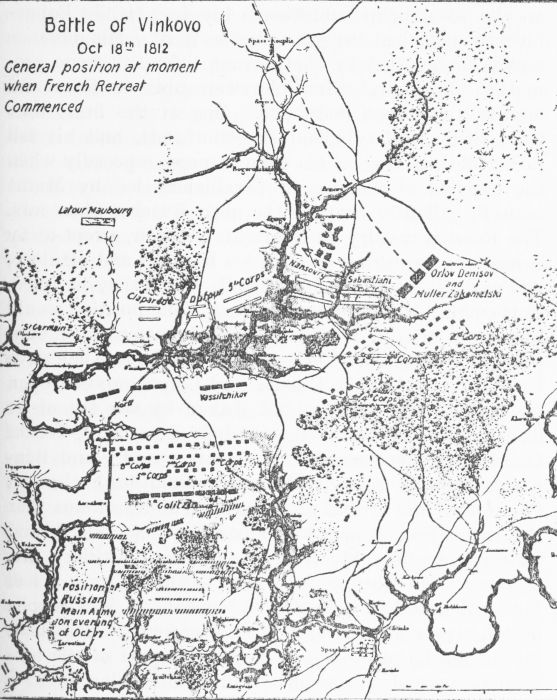
PLAN OF BATTLE OF VINKOVO, OCTOBER 18TH, 1812 General position at moment when Murat’s retreat began
The Russian plan contemplated a demonstration by part of the bulk of the army against Murat’s extended front, while Bennigsen, with a force composed of the 2nd, 3rd, and 4th Corps, Müller Zakomelski’s cavalry, and 10 regiments of Cossacks under Orlov-Denisov, turned his left. Miloradovich was to move towards Vinkovo with Korff’s and Vassilchikov’s cavalry, while behind him the rest of the army debouched from Tarutino.
Orlov-Denisov and Müller Zakomelski fell, about 7 a.m. on the 18th, upon Sebastiani’s bivouacs, while Baggohufwudt attacked the 5th Corps in front. His advance had been revealed by the growing light and some premature shots, and the Poles were able to form and oppose a vigorous resistance. One of the first shots from their artillery killed Baggohufwudt, and his fall rather dashed some of his young troops, especially when the remains of the French Carabiniers, led by Murat himself, gallantly charged the 48th Russian Chasseurs. The Russian cavalry on the right, however, swept away Sebastiani, capturing most of his baggage and artillery, and pushed on towards Spas-Kuplia, which they occupied, thus cutting Murat’s line of retreat. The position would have been critical had the Russian horsemen been supported by infantry. The whole of the French line gave back in haste, but the Russian 2nd Corps, imposed upon by Murat’s bold charge, and shaken by the fall of its leader, followed very cautiously. Ostermann-Tolstoï failed to advance with the necessary speed; and Bennigsen thought himself obliged to hold back the 3rd Corps until the arrival of the 4th. The result was that the entire French army, in great disorder, indeed, and suffering considerably from the Russian artillery fire, succeeded in effecting its retreat. Orlov-Denisov and Müller Zakomelski were obliged to abandon Spas-Kuplia as infantry came up; and the line of retreat was clear. Meanwhile Kutuzov was executing his part of the programme very slowly or not at all. Only Miloradovich’s cavalry, supported by five infantry regiments, crossed the Chernishnia and pressed the rear of the retreating columns towards and through Spas-Kuplia, where the pursuit ceased. Murat retreated to Voronovo, where he rallied his shaken troops, while the Russian main body tranquilly returned to Tarutino. Miloradovich with the now formally constituted advance-guard was stationed at Vinkovo.
The French returns, which are manifestly incomplete, show a loss of 2795 men, of whom 1151 were prisoners or missing. The bulk of the diminution was in the 5th Corps and Sebastiani’s cavalry; Claparède and Dufour were scarcely engaged. Two generals were killed and two wounded. The Russians claim to have lost only 502 killed and wounded. They captured 37 guns, a standard, and a mass of baggage.
Bennigsen was exasperated at Kutuzov’s tardy and slight support, though his own conduct had not been too energetic, and the breach between them widened. It was already great, Kutuzov relying upon the retiring and hard-working Konovnitzin far more than on Bennigsen.
The Russian success at Vinkovo, incomplete as it was, none the less dealt a heavy blow to the already shaken morale of the Napoleonic army.
As the period of Napoleon’s evacuation of Moscow has now been reached, it appears necessary to survey the positions occupied by the various sections of the opposing forces.
Dealing first with the invaders—
The Imperial Guard, Grand Head-quarters, the Cavalry Reserve, and the bulk of the 1st, 3rd, 4th, and 5th Army Corps were encamped, under Napoleon’s personal command, in the environs of Moscow. About Mozhaïsk was the 8th Corps, under Junot, the total combatant strength of this, the original Grand or Central Army, including engineers, gendarmerie, etc., being nearly 125,000 men.
At Viasma was a column of drafts under General Evers, which with the garrisons at Gzhatsk and elsewhere may be estimated at about 5000 men.
About Smolensk there were the 129th and Illyrian regiments from Ney’s corps, three 3rd battalions of the Vistula Legion, and some of the Hesse-Darmstadt Guards belonging to the Imperial Guard, a Mecklenburg regiment and a battalion of the 33rd Léger (1st Corps); a Polish cavalry regiment (5th Corps); and about 8000 men in régiments de marche—say 16,000 in all, including 1500 cavalry under General Baraguay d’Hilliers.
In the neighbourhood of Smolensk also was cantoned the 9th Corps, under Victor, some 26,000 strong.