Front matter (continued 4)
Reading edition
The French had on the field at Lubino about 50,000 men, of whom perhaps 37,000 were seriously engaged. The number of Russian troops successively brought into action was probably about 30,000. The losses were naturally heavy. Gérard alone reported 2297 killed and wounded, and Ney can hardly have lost less than 4000. Junot probably overestimated his losses at 700, but, including casualties among Murat’s cavalry, the French total must have been over 7000. The losses of the Russians were probably rather less, as they were standing on the defensive, and for the most part succeeded in repelling attack, nevertheless, they were very heavy—probably in the neighbourhood of 5000. Few prisoners were taken—not more than some hundreds on both sides.
It is impossible to conclude this chapter without some remarks upon the strategy which led up to the battles about Smolensk. It is tolerably certain, judging from the evidence of documents, that Napoleon’s plan of marching upon Smolensk by the left bank of the Dnieper was a preconceived one. Considered by itself, there is little to say of the manœuvre. It was in no way hazardous, since the left flank of the columns moving from Vitebsk was covered by forests, and once across the Dnieper the march was protected by the river against a Russian flank attack. Moreover, having two lines of supply, Napoleon risked nothing by moving his army across from one to the other.
The manœuvre was certainly unexpected by the Russian leaders—except perhaps by Bagration—and it is clear that it was only the firmness of Raievski and the prompt return of the main army that saved Smolensk from falling into Napoleon’s hands.
Nevertheless, when we turn from the manœuvre to its purpose it seems doubtful whether it was by any means the best under the circumstances.
Napoleon’s object was the bringing to bay of the Russian main army and the crushing of it in a decisive battle. As the Russians had chosen to take the offensive, the opportunity was apparently in his hands. Barclay might march fast enough to force an engagement before Davout could arrive from Orsha, but even so Napoleon could meet him with equal or superior numbers. If Barclay returned to the defensive, Napoleon’s best manœuvre was to advance to Poriechie, threatening the Russian communications with Moscow. To reopen them Barclay and Bagration must either give battle or retreat eastward in all haste, in which case Smolensk would fall of itself. The utmost that could be expected of the march south of the Dnieper was that the Russians might be forestalled at Smolensk.
The modern French opinion appears to be that this forestalling was the essence of the plan, and that Napoleon, having occupied the city, intended to debouch from it and attack Barclay and Bagration in the rear.
To the writer it appears that all criticism must necessarily base itself upon the fact that Napoleon’s strategy was preconceived. Before he knew anything of the Russian plans he had practically made up his mind to advance on Smolensk by the left bank of the Dnieper. The offensive movement of the Russians produced no change in his resolution.
It is highly probable that his determination was taken on grounds not purely military. He must by now have recognised that warfare in Russia was subject to conditions which did not obtain in Germany or Austria. His opponents were elusive; but there were certain places regarded by soldiers and people as holy, which the popular voice would probably force the generals to make a show of defending. He therefore resolved to threaten Smolensk directly, believing that thereby the Russian army would be constrained to give battle.
Even so it appears somewhat doubtful whether this end could not have been as well attained by manœuvring on the right bank. The advance by the left appears to have assumed that Smolensk would be uncovered and undefended, and that the Russian field army would be too far away to return to its rescue. Napoleon, on this hypothesis, would have been able to occupy it and give battle to his outmanœuvred opponents with all the prestige of the capture of the sacred city behind his onset. As a fact Barclay had provided for speedy information by his flank-guard under Neverovski, and his resolution not to move far from Smolensk afforded the means of frustrating Napoleon’s strategy. That he only arrived in the nick of time hardly affects the discussion, since his obsession about an attack from the direction of Poriechie delayed him for a day. On the other hand, Napoleon’s hesitation, owing to the appearance of Bagration’s army at Katan, also caused him to lose a day, during which Barclay was able to arrive.
According to Barclay’s memoir to the Tzar he had no intention of wasting his army in the defence of Smolensk, a place of no military value, and merely held it in order to allow Bagration time to occupy Solovievo. Bagration and the majority of the Russian generals appear to have expected that he would have made it the centre of the Russian operations. It is, of course, possible that Barclay, harassed and perplexed, did make some conditional promise as to defending Smolensk should a favourable opportunity offer. General Okunev—who may perhaps voice the views of Paskievich—apparently thinks that it could have been held. But it must be said that as the Russians’ line of retreat was in extension of their left flank such a policy would have been hazardous at best. There seems every reason to believe that Barclay’s ideas were sound; what he lacked was commanding strength of character to enforce them on his unruly officers.
Napoleon’s assault upon Smolensk is very difficult to account for: and led to little but waste of human life.
FOOTNOTES:
CHAPTER VI
THE OPERATIONS IN VOLHYNIA AND ON THE DÜNA
It has been seen that when King Jerome resigned his command, the 5th and 8th Corps went to reinforce Davout, Latour-Maubourg to observe Bobruisk, while the 7th Corps returned to Slonim. Reynier was instructed to take the place of Schwarzenberg in guarding the frontier of the Grand Duchy of Warsaw, while the latter marched on Minsk. Reynier himself was convinced that his corps was far too weak for the prescribed duty, while he had better information than his master of Tormazov’s real strength. Nevertheless he endeavoured to carry out Napoleon’s orders. On the 19th he ordered Klengel’s infantry brigade and a regiment of cavalry to take the place of an Austrian detachment at Kobrin. On the same day Schwarzenberg informed Napoleon that Tormazov had some 30,000 men at Lutsk. The Emperor, however, was sceptical. On the 22nd he ordered Reynier to enter Volhynia, saying that Tormazov’s “army” was merely a collection of reserve battalions. On the same day he told Davout that Tormazov had only 8000 men of 3rd battalions. The movements which he had ordered continued, and by the 24th the Austrians were about Slonim, on the way to Minsk, while the 7th Corps, moving in the opposite direction, was approaching Kobrin, some 30 miles east of Brest-Litovsk.
Napoleon’s information was hopelessly inaccurate. So far he could not be accountable for the unforeseen situation which was now to disclose itself. But his refusal to believe Schwarzenberg and Reynier is distinctly blameworthy, and can only be attributed to the fatal optimism which had now become fixed in him.
General Tormazov, when hostilities broke out, commanded an army which was neither concentrated nor complete in its organisation. Three infantry divisions, a brigade of combined Grenadier companies, 3 regiments of Hussars, and a cavalry corps 36 squadrons strong, were scattered over western Volhynia. General Sacken’s reserve troops—12 depleted battalions and 24 squadrons—were at Zaslavl and Staroï Konstantinov near the frontier of Podolia, and the irregulars were scattered along the Austrian and Polish borders. It was not until the middle of July that a respectable force was at last concentrated near Lutsk.
Tormazov’s original task was the defence of Volhynia, but Napoleon showed no intention of making any eccentric movements in that direction. On hearing of Bagration’s retreat on Bobruisk, he thought that he himself might be obliged to fall back towards Kiev, in order not entirely to lose touch with the Second Army. By the middle of July, however, the situation became clearer. The allied troops were pouring along the Warsaw-Smolensk road, and there were only few and small detachments guarding the Polish frontier. He therefore determined to invade the Grand Duchy of Warsaw by way of Lublin; and General Lambert, his cavalry commander, had already crossed the Bug, when he was recalled.
On July 17th instructions reached Tormazov from Alexander to advance northward against the flanks and rear of the forces that were opposed to Bagration. It is probable that this manœuvre promised more immediate results than the contemplated advance on Warsaw. At the same time it is by no means certain that Tormazov was wrong in his original decision. The capture of Warsaw would have been a terrific shock to Napoleon’s prestige. The Russians could not have held it long, but they would have been able to destroy the depôts there collected, and might have cut up Reynier’s corps had Napoleon, as was probable, urged it in overhasty pursuit of an enemy whose strength he underestimated. In that case Napoleon would have been obliged to divert against him not merely Schwarzenberg’s Austrians, but perhaps also the 8th Corps. In any case he would have been forced to employ some of his new formations in the rear to meet the irruption.
The plan now imposed upon Tormazov had the advantage that it must, in the nature of things, call back Schwarzenberg from his march to reinforce Davout. On the other hand, it involved passing the Pinsk Marshes, which would oppose a dangerous barrier to retreat in case of a reverse; and the chances of crushing the 7th Corps were minimised, since a few concentric marches would unite Reynier and Schwarzenberg.
General Sacken with his reserves had been left in eastern Volhynia; some of his troops were detached to strengthen the force at Mozyr. On July 22 Tormazov ordered Lambert to leave General Kruchov, with a brigade of dragoons and 2 regiments of Cossacks, to observe the Polish frontier, and with 4 battalions, 16 squadrons, 5 Cossack regiments and 6 guns, to march by both banks of the Bug upon Brest-Litovsk. Four battalions and 7 squadrons, under Major-General Melissino, were to make a demonstration towards Pinsk, while the corps of Kamenski and Markov advanced upon Brest-Litovsk and Kobrin. Tormazov’s strength, exclusive of Kruchov, was probably about 36,000 men, with 144 guns. He was consequently nearly three times as strong as Reynier’s corps; but the latter could be sustained within a few days by 30,000 Austrians.
On the 24th Reynier’s main body was about Bezdizh on the Brest-Litovsk-Pinsk high-road. Klengel’s brigade occupied Kobrin. Two squadrons of cavalry were at Brest, and another detachment was on the road to Pinsk. Reynier’s small corps was thus spread out over a line of 80 miles. Reynier appears to have realised his danger, and provided against it to the best of his ability by keeping his main body together. He was perhaps to blame in detaching Klengel, but in justice it must be said that his duties were out of all proportion to his strength.
On the 24th Lambert expelled the Saxon cavalry from Brest-Litovsk. Melissino drove in the outposts on Reynier’s left, and occupied Pinsk, expelling its Austrian garrison and capturing a gun. Reynier was thus alarmed on both flanks, and doubted in which direction to turn. Early on the 27th Tormazov’s advanced guard, under Major-General Chaplitz, approached Kobrin from the south, while at the same time Lambert’s cavalry came up from the west. His infantry, who were fatigued by hard marching, he had left in the rear.
Klengel’s brigade consisted of only about 2600 men with 8 guns. Obviously he could make no effective resistance to the Russian army; but he considered himself bound by Reynier’s orders to defend Kobrin to the last extremity. Reynier’s comment was that, being the advanced guard of the corps, the brigade should have retired when it became obvious that it ran the risk of being surrounded. It appears to be a somewhat uncertain point among military men as to how far detachment commanders are justified in departing from the letter of their orders. On the morning of the 27th Klengel’s line of retreat on Pruzhani was certainly open. On the other hand, his corps commander would probably come by the Pinsk road; and he appears to have made at least one attempt to break through in that direction, which gives some index to what was passing in his mind. By midday Lambert had cut the road to Pruzhani, and the brigade was surrounded. The Saxons were driven by overwhelming numbers from their hasty entrenchments into the town, and after a gallant resistance, and having expended all their ammunition, were forced, about 2 p.m., to surrender. They had lost 76 killed and 182 wounded, including 13 officers. Seventy-six officers and 2382 rank and file were captured, with 8 guns and 4 standards.[3] Reynier’s advance-guard had only reached Horodetz, about 11 miles east of Kobrin, when it was met by fugitives who bore tidings of the disaster.
Tormazov, with diplomatic courtesy, complimented the Saxon officers on their really creditable defence, and returned them their swords. He could not, however, push his advance. His commissariat was defective and supplies were running short. He had also his prisoners to dispose of. His infantry were fatigued with hard marching on execrable roads. He therefore was obliged to halt for two days, which Reynier utilised to effect his retreat. He appealed for help to Schwarzenberg, who informed Napoleon that Reynier was too weak to resist Tormazov, who was estimated to be 40,000 strong, and that he must perforce turn back to his rescue from Nesvizh. On August 2nd he reached Polonka, 18 miles from Slonim, now occupied by Reynier. Tormazov, leaving Kobrin on the 30th, occupied Pruzhani and Antopol and pushed out detachments; while Kruchov’s force crossed the Bug and made reconnaissances towards Warsaw. The Poles were panic-stricken; and Loison, the Governor of Königsberg, thought it necessary to advance towards Bielostok with nearly the whole of his force—some 10,000 men. More than this Tormazov could not do. He was still very short of supplies; every march in advance took him farther from his base, and he had the Pinsk Marshes in his rear.
Napoleon, probably with some misgivings, informed Schwarzenberg on July 31st that he was to support Reynier according to his information, which, as he was on the spot, must necessarily be better than that of the Emperor. On August 2nd he placed the 7th Corps under his orders, and instructed him to march against Tormazov and drive him into Volhynia. The Government at Warsaw meanwhile was making desperate efforts to form a field force at Zamosc, under General Kosinski.
On August 3rd the Austrians and Saxons were in close communication, and on the 4th the united force began to advance. Tormazov’s advanced guards were attacked on August 8th and driven back, except at Pruzhani, from which Lambert was only expelled on the 10th after a well-contested rear-guard action. Tormazov, finding his outposts everywhere assailed by superior forces, ordered Markov and Kamenski to Gorodeczna, about half-way from Pruzhani to Kobrin. Lambert and Markov united there in the night of the 10th-11th, and next day Kamenski also arrived. Melissino’s detachment and the other advanced guards, under Generals Chaplitz and Prince Khovanski, could not rejoin under some days. Tormazov therefore had only 24 battalions, 36 squadrons, and 3 regiments of Cossacks, amounting with artillery to about 21,000 men. In artillery, however, he was strong, having 84 pieces, a large proportion of which were heavy.
The Russian position was a fairly strong one, if defended by adequate numbers. The Pruzhani-Kobrin road passes over a low plateau, at the foot of which flows a marshy stream. This plateau is some three miles long and a little less in breadth. It extends roughly east and west, its eastern extremity being opposite Gorodeczna. West of it is a valley about a mile in breadth, beyond which rises a second plateau, thickly wooded, through which another road leads from the village of Cherechev to join that to Kobrin some miles south-west of Gorodeczna. The eastern end of the plateau was also shut in by woods. Besides the causeway across the marsh at Gorodeczna, there was a second at Poddubno about three miles above, and a third a mile farther on at the Cherechev road. Obviously all should have been guarded; but only that at Gorodeczna was actually held. The reasons for this extraordinary oversight are not clear. It is possible that Tormazov expected a turning movement on the right rather than the left. It is also possible that he did not intend to fight a general action, but only a rear-guard engagement, in order to gain time for Chaplitz, Khovanski and Melissino to close up. Apparently also he considered that Schwarzenberg and Reynier were following him in one column on the Kobrin road. In any case he merely kept the bulk of his force opposite Gorodeczna. His opponents were moving in two columns, the Austrians upon Gorodeczna, Reynier with the Saxons on the right towards Poddubno. Schwarzenberg had made considerable detachments to guard his communications, but his entire force can hardly have numbered less than 36,000 men, including 12,000 Saxons, with 96 guns.
Reynier pointed out to Schwarzenberg that Tormazov’s negligence afforded opportunities for a flanking movement. Schwarzenberg assented and supported him with Siegenthal’s division, Hesse-Homburg’s brigade of Bianchi’s division, and a brigade of light cavalry, while with the rest of his forces he observed the main Russian force. Tormazov was drawn up in three lines on the Kobrin road, facing Gorodeczna, Markov’s 12 battalions in front line, Kamenski’s 12 (temporarily commanded by Prince Cherbatov, Kamenski being ill) a verst to the rear, Lambert with the cavalry behind Cherbatov.
In the night of the 11th-12th a Saxon detachment seized the Poddubno dyke. Tormazov apparently heard of this about 9 a.m. on the 12th and promptly sent Cherbatov with 10 battalions, 2 dragoon regiments and 24 guns to Poddubno. This appeared temporarily to secure the left, but about noon Siegenthal arrived and threatened a direct attack, while Reynier, who had moved the bulk of his corps along the Cherechev road, debouched from the woods and menaced the Russian rear. Tormazov at first simply fronted Cherbatov to the left, leaving the guns and a single infantry regiment at Poddubno, and covered the new front with the fire of 24 more guns brought up from the reserve. It soon, however, became evident that the turning movement was being executed by considerable forces, and that Cherbatov could not withstand it unaided. Tormazov thereupon called up Markov with 8 battalions to prolong Cherbatov’s line, and Lambert with 4 battalions and 24 squadrons to cover the left flank. Lambert deployed across the Cherechev road, barring it against the farther advance of General Zechmeister with his Austrian cavalry and Saxon infantry. Schwarzenberg on his side, instead of attacking the weak detachment now before him at Gorodeczna, sent another infantry brigade and one of cavalry to the right, and himself proceeded thither.
At 3 a.m. Frimont’s Austrian cavalry and Trautenberg’s infantry at Gorodeczna were demonstrating against weak detachments, while nearly the whole Russian army had faced to the left and rear. Tormazov, considering that the extension of the hostile line afforded an opportunity for piercing it, developed a fierce attack by Cherbatov’s infantry upon Sahr’s Saxon brigade, which was driven back, barely saving its artillery from capture by the Russian dragoons. To extricate it General Bianchi led forward Lilienberg’s brigade, while Schwarzenberg, now at Poddubno, ordered Hesse-Homburg’s across the stream, and Siegenthal sent forward part of his division. By these combined efforts the advance of the Russians was brought to a stand and finally converted into a retreat. The brigades of Lilienberg and Sahr moved forward together, Hesse-Homburg joining in on the left, Lecoq’s Saxon division prolonging the line to the right, while Zechmeister, reinforced by Froelich’s Austrian and Gablenz’s Saxon cavalry, renewed his attacks on Lambert. The latter had hitherto held his own with considerable success, but was now driven back and forced to seek shelter behind Markov’s line. Night ended the conflict, and under cover of darkness Tormazov rallied his detachments and retreated on Kobrin, covered by a rear-guard, under Lambert. At Teveli, 7 miles from the battle-field, Chaplitz rejoined and took over rear-guard duty from Lambert.
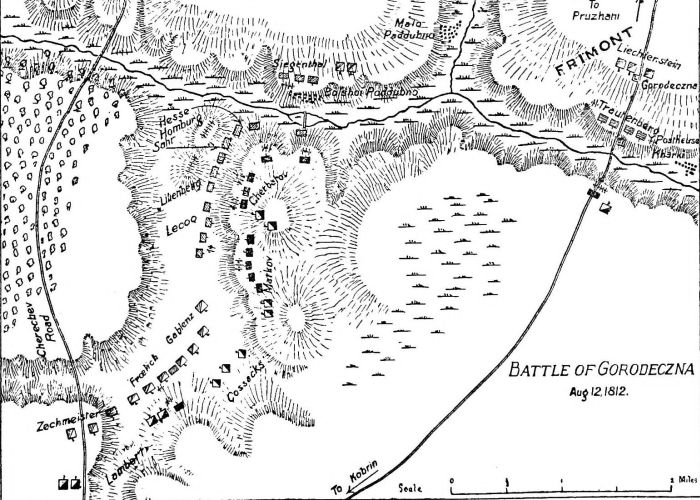
BATTLE OF GORODECZNA Fought between Napoleon’s detached right wing (Austrians and Saxons) under Prince Schwarzenberg against the Russian Army of Volhynia
The Russian loss appears to have been about 3000 men out of a total of about 18,000 actively engaged: of these perhaps 500 were prisoners. That of the allies was probably a little less. Schwarzenberg estimated the loss of the Austrians at about 1300, of whom 865 were in Bianchi’s division. Reynier only admitted 931 casualties.
Tormazov did not stay his retreat at Kobrin, but continued on his way southward, intending to make for the Styr and stand on the defensive behind it. His resolution was undoubtedly wise. With Chaplitz’s and Khovanski’s troops he had in hand 30,000 men, and might abide the chances of another battle. But his force was too small to rout Schwarzenberg’s, and a heavy defeat might leave Admiral Chichagov, who was at last on the way from Bukharest, too weak to face Napoleon’s right wing. On the other hand, by retreating on Lutsk he would lessen the distance between himself and the Admiral, would be in closer communication with his base at Kiev and Sacken’s reserves, and his position behind the marshy Styr might well induce the cautious Austrian general and his half-hearted or openly disaffected lieutenants to call a halt.
On the 13th there was some rear-guard fighting on the Kobrin road, but it was not serious, and Tormazov continued his retreat to Kovel, which he reached on the 24th. There he apparently would have stood firm, but Schwarzenberg threatening to turn his left he abandoned his position and marched towards Lutsk, where he arrived on the 29th. Schwarzenberg’s pursuit was not very energetic, owing to scarcity of supplies and the difficulty of the Pinsk fenlands.
Tormazov therefore found himself at the beginning of September in the same position which he had occupied five weeks before. His strategy had been far from faultless: in particular his detachments previous to the battle of Gorodeczna seem to have been unnecessarily large. His tactics at Gorodeczna had been bad at the outset, however much his boldness and energy may have compensated for his earlier carelessness. Still, whatever his faults, he had inflicted a heavier loss than he had sustained, and had drawn upon himself, away from the main theatre of war, the whole of the Austrian auxiliary army and the 7th Corps, as well as Kosinski’s Polish column from Zamosc. Moreover, Admiral Chichagov’s advanced guard was only fourteen or fifteen marches away, and might be relied upon to join him by the middle of September.
It has already been seen that when Barclay evacuated Drissa he had left Count Wittgenstein to cover the road to St. Petersburg. Wittgenstein had for his principal bases of operations the ancient towns of Pskov and Velikii Novgorod; his advanced depôt was Sebezh, some 60 miles from Polotsk, on the road to Pskov. In addition to his own 1st Corps he was given the bulk of the depôt troops at Drissa and Dünaburg, and his artillery was strengthened by a heavy battery. The 18 reserve battalions hardly mustered 5700 bayonets, but the 15 depôt squadrons could furnish 1900 sabres and lances, and included those of the Imperial Guard, some of the finest in Europe. Wittgenstein’s fighting strength, after the departure of Barclay, totalled some 29,000 men, of whom 4500 were cavalry and Cossacks, with 108 guns. Of this total 10 reserve battalions and 4 squadrons, about 3700 strong, were at Dünaburg; the rest were united under Wittgenstein’s immediate command.
The 1st Corps contained in its staff a considerable foreign element. Wittgenstein, his chief-of-staff, Major-General D’Auvray, and the Quartermaster-General Diebich, were all Germans. Wittgenstein himself was a man of no special talent, but active and energetic, and in the prime of life. D’Auvray was an older man, but possessed plenty of vigour, and was a good theoretical officer, though somewhat deficient in practical experience of warfare. Colonel Diebich, a Prussian, only twenty-seven years of age, was probably the most intellectually distinguished of the three. His enduring fame as “Zabalkanski”—the Balkan-Passer—dates from the year 1829, when he commanded in chief against the Turks. For the present all that need be observed is that the command of the Russian army of the Düna was in vigorous hands. Clausewitz notes that D’Auvray, especially, could “lay about him” at need; and doubtless the process was often necessary in dealing with the gallant but amateurish and frequently indolent Russian officers.
From Dünaburg to Riga, a distance of some 130 miles, there were practically no Russian troops. In the great Baltic port and its neighbourhood there were 30 depôt battalions, 8 squadrons, and some Cossacks and field artillery, which, with garrison troops, totalled perhaps 14,000 men, sufficient to defend the fortifications and outlying places, but not to furnish any considerable detachment for the field. Riga was furthermore defended by Russian and English gunboats and bomb-brigs; and naval assistance to almost any amount was available from the British Baltic fleet, should it be necessary. Riga was practically secure against any but a very large army. Its commander, Lieutenant-General Essen I, was an officer of no great ability, and in poor health.
The Russian forces therefore available for the defence of Kurland and the line of the Düna amounted in all to perhaps 43,000 men, but could be reinforced to nearly double that number by militia and regulars, the latter partly depôt troops, but chiefly belonging to Count Steingell’s army of Finland, soon rendered disposable by the conclusion of peace with Sweden.
Towards Riga Napoleon had directed the so-called 10th Corps, under Marshal Macdonald. It had, in fact, as Macdonald complained, no proper corps organisation or administration; and consisted of two distinct bodies—Grandjean’s Polish and German division, formerly attached to the 1st Corps, and the bulk of the Prussian contingent under General Grawert. The operations of the corps were languid; it certainly was not strong enough to besiege Riga; and Napoleon paid curiously little attention to it. It would almost seem as if his real object in constituting it at the last moment was to have the notoriously disaffected Prussian contingent accompanied and watched by a competent force of troops drawn from states which he regarded as devoted to him.
The 10th Corps, having swept the right bank of the Niemen, concentrated on Rossieni, whence it set out on July 8th for Riga, Grawert advancing directly on the port by way of Mitau, while Grandjean’s division, accompanied by Macdonald, moved on the right. Before the 30,000 or 32,000 men of the 10th Corps the Russian detachments in Kurland were helpless, and fell back at all points into Riga. By the 18th the invading forces were ranged along the Aa river, which passes by Mitau, the capital of Kurland, and, flowing nearly parallel to the Düna, enters the Baltic some 20 miles west of Dünamunde. Mitau, Bausk, and the other towns along the Aa were occupied, and the Prussians reached out with their left to the sea. Essen could form for field operations only a force of 8 depôt battalions, 8 squadrons, a battery and some Cossacks—4500 men at most, with 10 guns—which he sent under Lieutenant-General Lewis towards Bausk. Lewis was too late to defend Mitau or Bausk, and took up a defensive position at Eckau between the latter place and Riga. Against him Grawert advanced on July 19th with 7 battalions, 4 squadrons and 4 batteries—5000 men and 32 guns. Lewis was beaten with a loss of over 600 prisoners besides killed and wounded, and driven back upon Riga. The Prussians moved up nearer to the city, and Essen, on July 22nd, losing his head, ordered the suburbs to be fired. There was absolutely no need for this reckless step. Macdonald had not a siege gun within reach. The misery and destitution occasioned were, of course, terrible; the mere immediate material loss is said to have been valued at 15,000,000 paper rúbles (about £600,000).
Macdonald, after Eckau, moved with Grandjean’s division towards Jakobstädt, and established his head-quarters there on the 22nd. His advance-guard of 4 Polish battalions, under Prince Radziwil, moved down the left bank of the Düna on Dünaburg. Radziwil occupied the place on the 30th and 31st, the garrison having been withdrawn by Wittgenstein, and on August 8th Macdonald arrived with the rest of Grandjean’s division. He blew up the half-finished fortifications, and destroyed all the artillery, ammunition and tools which he could not carry away. De Chambray blames him for this, saying that he should have retained them for the siege of Riga; he also criticises him for not crossing the Düna and striking at Wittgenstein’s communications. It seems, however, clear that Macdonald’s appointed task was the siege of Riga; and he obviously could not undertake independent operations without Napoleon’s order. His position, as he told Oudinot, was very difficult. His force was scattered over a wide extent of country, and in the absence of any proper staff he was burdened with petty details.
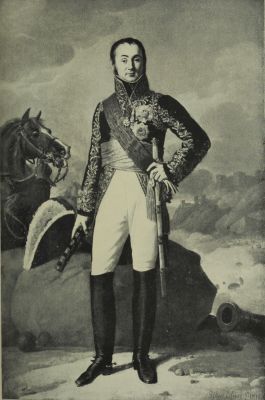
MARSHAL OUDINOT, DUKE OF REGGIO Commander of the 2nd French Army Corps From the painting by Robert Lefèvre at Versailles
On August 7th Essen made an attack on Schlock, the port at the mouth of the Aa, with 6 British and 13 Russian sloops and gunboats, and about 1000 troops, all under General Lewis. Schlock was taken, but the light craft could not pass the Prussian batteries on the Aa, and Lewis abandoned Schlock and withdrew.
Oudinot, after his fruitless attack on the bridge-head of Dünaburg on July 13th, moved up the left bank of the Düna to join in the general advance on Vitebsk. He also endeavoured to render the works at Drissa indefensible. Wittgenstein, realising that Macdonald and Oudinot could not easily combine their operations, at first resolved to attack the 2nd Corps as it passed up the Düna; but on receiving a report that Macdonald was bridging the river at Jakobstädt he took up a position near Razitzi (? Pazitzi), about 16 miles from Druia on the road to Sebezh, and awaited events.
Oudinot, moving up the left bank of the Düna, left Merle’s division, chiefly Swiss, and Corbineau’s brigade of light cavalry to watch the river about Drissa, and with the rest of the 2nd Corps and Doumerc’s Cuirassier division, occupied Polotsk on the 26th. On the 28th, leaving a battalion at Polotsk, he advanced on Sebezh to cut Wittgenstein’s communications with St. Petersburg. He crossed the Drissa at Sivokhino and, early on the 30th, reached the hamlet of Kliastitzi, some 34 miles from Sebezh. As he was very badly informed as to Wittgenstein’s movements he decided to halt and send out reconnaissances.
Meanwhile Wittgenstein, informed of Oudinot’s advance, had determined to attack without delay. On the 30th he was within easy reach of Oudinot’s left flank; and about four in the afternoon his advance-guard came into contact with Legrand’s division at Jakubovo, about 2 miles west of Kliastitzi, posted on a narrow front between two woods.
Wittgenstein had with him the whole 1st Corps and 6 depôt battalions, in all about 21,000 men and 96 guns, organised into a vanguard, under Kulnev, 2 infantry divisions under Major-Generals Berg and Sazonov, and a mixed division commanded by Major-General Kakhovski.
Kulnev, a fiery cavalry officer, at once attacked Legrand, sending to Wittgenstein for reinforcements. Legrand was posted between the woods on a front of apparently only 800 yards, half of which was occupied by the mansion and hamlet of Jakubovo. Verdier and Doumerc were on the main road, there being no room wherein to deploy. An obstinate action ensued as reinforcements were thrown in on both sides and without any special success for either. Legrand’s narrow front, though it enabled him to concentrate his infantry, only permitted him to bring into action twelve guns as against 36 Russian pieces. On the 31st Wittgenstein, having collected his whole force, ordered a general attack. The fighting was very fierce. Jakubovo, defended by the 26th Léger, was taken and retaken; but on the whole the French held their own, and there was no sound reason for the retreat which Oudinot ordered. He says that he feared for the security of his left flank, threatened by an enemy twice as strong as himself! This latter idea is scarcely in accordance with his confident advance upon Sebezh. At any rate, he evacuated Jakubovo and retreated across the Nitcha, southward to Sivokhino, pursued and harassed by the Russians who, not unnaturally, claimed the affair as a complete victory. Wittgenstein had actually engaged 18 battalions. He claimed to have taken 900 prisoners and much baggage, but the estimates of the French losses in the Journal of the 1st Corps are greatly exaggerated. The Russians, also, must have lost severely in the fierce fighting about the mansion of Jakubovo; and Oudinot claimed 500 prisoners.
At Sivokhino Oudinot was rejoined by Merle’s division, coming from Drissa. He deliberately left the ford unguarded; and took up a position a little to the southward at the hamlet of Oboiarzina, with his flanks thrown forward and his whole force skilfully concealed in the woods and gullies with which the country abounded.
At daybreak on the 1st of August the impetuous Kulnev was leading the pursuit. He had with him some companies of sharpshooters, 7 infantry battalions, 6 squadrons and a horse battery, with which he crossed the ford and pushed forward into the sort of cul-de-sac formed by Oudinot’s position to the southward. The Marshal had more than 40 guns ranged in a deep curve round the advancing Russian columns. As they opened fire Kulnev realised that something more serious than a mere rear-guard action was toward, and requested Sazonov, whose division was following, to support him. Sazonov sent forward the Tula Regiment and a heavy battery at once, but it was too late. The vanguard was overwhelmed by a furious cross cannonade, and broke before the charge of Verdier’s and Legrand’s infantry. The reinforcements were swept away in the rout; and the Russians poured back through the ford in a wild crowd of struggling men and horses, amid which the French fire made terrible havoc. Kulnev strove desperately to repair the consequences of his fatal impetuosity, but in vain. He was following the retreat when a cannon-ball shattered both his legs, ending at once his despair and his life. He bade his aides carry away his orders and insignia—“lest these French triumph over a Russian general”; and so passed a fiery and enthusiastic spirit who might have rendered his country good service.
Verdier’s division, driving before it the broken Russians, pressed through the ford in hot pursuit. Wittgenstein, who was advancing with his whole force, sent on Major-Generals Prince Iachvil and Helfreich to rally the vanguard, and took up a position at the hamlet of Golovitzi to sustain it, with 48 guns ranged before his line. Berg’s division was on the right and Kosakovki’s on the left. As soon as the remains of the vanguard had passed behind the batteries they opened a heavy cannonade, and Berg and Kozakovski moved forward to the attack. Wittgenstein’s second line, under Sazonov, also moved forward, and as the leading divisions diverged somewhat in their advance some of its battalions filled up the gap thus opened. Verdier, assailed by a greatly superior force, was unable to bear up against it; and was driven back, fighting hard but losing heavily, to Sivokhino, where he repassed the Drissa, covered by Legrand’s division.
The losses of the 2nd Corps from July 30th to August 1st amounted according to Oudinot’s returns (which appear trustworthy) to 464 officers and men killed, 2925 wounded, and 1596 prisoners and missing. This was certainly a gaping chasm in an effective strength of about 28,000 men; but the Russians admitted 4300 casualties, and again there was no solid reason for the French retreat upon Polotsk next day. Napoleon was greatly annoyed, and expressed his angry astonishment at the movement, which appeared to him entirely unnecessary. He ordered Oudinot to resume the offensive and, on August 4th, directed St. Cyr, with the 6th Corps, to reinforce him.
Wittgenstein on August 1st had been wounded, and had handed over the command to D’Auvray. The really indecisive nature of the fighting is shown by the fact that no attempt was made to pursue the French. On the contrary, D’Auvray withdrew by his right towards Dünaburg, in order to rally Hamen’s detachment, which was now to join the 1st Corps. On August 7th he once more took position at Razitzi. He decided to cross the Düna and to destroy Macdonald’s small force at Dünaburg; and to this end was already bridging the river, when he was recalled by a fresh advance of Oudinot from Polotsk.
St. Cyr, with the suffering remains of the Bavarian infantry and artillery—about 12,000 bayonets—reached Polotsk on August 7. Apart from his feeling that his troops were being sacrificed, he was angry at his subordination to Oudinot. St. Cyr had, in truth, a far better right to the Marshal’s bâton, and nothing but Napoleon’s dislike for him had hitherto deprived him of it. Oudinot, leaving the 6th Corps to follow, started westward from Polotsk with the 2nd on the 7th, and on the 9th reached Valéinzi, 8 miles from Drissa. Next day D’Auvray marched from Razitzi; and on the 10th the Russian advance-guard, now under Helfreich, collided with Oudinot’s advance, consisting of his light cavalry, supported by the 11th Léger, at Svolna, a few miles north of Valéinzi. D’Auvray arrived with his main body on the 11th. Expecting that Oudinot would advance in full force, he at first stood on the defensive, but, finding that the bulk of the 2nd Corps remained inactive at Valéinzi, attacked the advance-guard and drove it back. Thereupon, with curious timidity, Oudinot once more, on the 13th, retrograded to Polotsk, where he arrived on the morning of the 16th. On the 13th Hamen joined the Russian 1st Corps, and next day Wittgenstein resumed the command.
Polotsk, a place of much importance in the struggles between Poland and Russia during the 15th and 16th centuries, lies on the right bank of the Düna, at the point where it is joined by the little river Polota. The country around was in 1812 wooded to within a few miles of the town. Polotsk was traversed from north-west to south-east by the Riga-Vitebsk high-road, to which that from St. Petersburg united itself some miles out. From the south-west the Vilna road reached the town across the Düna. A fourth road left the Riga highway on the right a little way from Polotsk, and ran north-eastwards to Nevel.
The advance-guard of the Russians came in contact with the French outposts during the afternoon of the 16th, and the sound of the firing broke up a council-of-war which Oudinot had called to consider the situation.
During the evening the French troops took up position. Oudinot’s plan of action is difficult to understand. He left nearly the whole of Verdier’s and Merle’s divisions and the bulk of his cavalry on the left bank of the Düna. On the right bank, along the Polota, stood St. Cyr’s weak corps, with its right at the village of Spas, about a mile from Polotsk. Wrede’s division was in front line and Deroy in reserve. To the left of the Bavarians were Legrand’s division, 1 regiment of Verdier’s, and Corbineau’s cavalry brigade. Oudinot’s whole force was over 35,000 strong, with about 130 guns.
The Russian 1st Corps and the reserve troops attached to it—the latter now combined into regiments—totalled about 23,000 or 24,000 men and 99 guns. It was distributed in three mixed divisions, under Major-Generals Berg, Sazonov and Kakhovski, and two mixed brigades commanded respectively by Major-General Helfreich and Colonel Vlastov.[4]
Wittgenstein and his staff considered that Oudinot’s position about Polotsk was too strong, defended as it was by superior forces, to be attacked, and decided to confine themselves to a vigorous demonstration upon Spas to cover the bridging of the Düna and a raid on Oudinot’s communications. Early on the 17th, covered by Helfreich and Vlastov, the Russian main body debouched from the woods and deployed. The divisions as usual were broken up in the line of battle. In general, however, it may be said that Vlastov’s detachment formed the extreme left opposite Spas, and thence Berg’s division and Helfreich’s vanguard continued the line towards the Düna. Sazonov and Kakhovski were in reserve.
Vlastov, and part of Berg’s division, under the general direction of Prince Iachvil, attacked Spas, which was gallantly defended by the Bavarians. To sustain the attack Wittgenstein was obliged to direct to the left the rest of Berg’s division, replacing it by only two battalions of his second line. Oudinot thereupon ordered Legrand to attack the weakened Russian centre, but after some sharp fighting this was repelled by the advance of fresh battalions from Sazonov’s division. Legrand renewed his attacks, but was again forced to retire, but to repulse him nearly the whole of Sazonov’s division had to be employed. Around Spas a furious conflict raged all day, the Russian attacks being repelled time after time by a much smaller force of Bavarians. The outlook for Oudinot was entirely promising; by night almost all Wittgenstein’s army had been engaged and had been held at bay by the division of Legrand, about half of Wrede’s and one regiment of Verdier’s. All this time two strong divisions were inactive south of the Düna. It was probably fortunate that in the evening Oudinot was severely wounded and forced to transfer the command to the stronger hands of St. Cyr.
The latter general made up his mind that the badly shaken morale of his army, no less than the Emperor’s interests, imperatively demanded a victory, and determined to give battle. But he was too wary to deprive himself of the advantage of allowing the Russians to waste their strength against his defensive position before himself taking the offensive. He therefore waited during the morning of the 18th for Wittgenstein to come on. The latter, on his side, having driven Oudinot again into Polotsk, decided to withdraw, his mission being to defend the St. Petersburg road, and greatly overestimating the strength of the force opposed to him. His troops were to commence their march at 9 p.m.
St. Cyr during the morning made a parade of retiring his trains and reserve parks through the town towards Vitebsk, while Merle and Verdier were brought nearer to it as though to cover an evacuation. Some of the cavalry also defiled along the southern bank of the Düna with their horses laden with forage. These devices do not appear to have tricked the Russian staff into the belief that Polotsk was about to be abandoned; but they did give it the impression that there was no fear of an attack. The Russian army lay bivouacked in the order in which it had fought on the 17th, and head-quarters were at the hamlet of Prizmenitza, only half a mile from Spas.
St. Cyr, finding that Wittgenstein did not show any sign of attacking, and doubtless marking the obvious unpreparedness of the Russians, decided to take the offensive. About 2 p.m. Verdier’s division began to cross the Düna, screened from the sight of the Russians by the houses of Polotsk and the high banks of the Polota. Merle, Doumerc, and Castex’s light cavalry followed. Meanwhile at Spas Deroy’s division relieved Wrede’s, and a battery of 31 guns was massed at the village.
St. Cyr’s plan, as he defines it, was to smash Wittgenstein’s line by a heavy and concentrated attack of four infantry divisions advancing at the double, Wrede’s Bavarians leading on the right, Deroy to their left rear, Legrand and Verdier in echelon on the left of Deroy, while the cavalry followed in support, and Merle’s division stood in reserve at Polotsk. St. Cyr in his report to Berthier says that he had intended to commence the attack at 4 p.m., but the bringing up of the troops from the left bank of the Düna proved a tedious operation; and it was not until nearly 5 that St. Cyr was able to give the signal to commence the battle.
The French and Bavarian artillery opened a tremendous cannonade against the unsuspecting Russians, with great effect, especially among two batteries in advance of Prizmenitza, which lost nearly all their horses, and had a number of guns and waggons disabled or blown up against the Bavarian artillery. Diebich skilfully placed some guns in a battery on the extreme Russian left, which, being masked, caused considerable loss, but could not silence the far stronger array of pieces ranged before Spas.
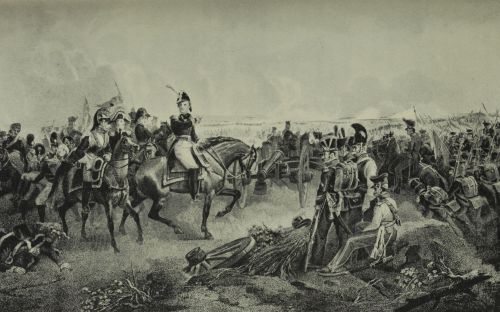
THE FIRST BATTLE OF POLOTSK Gained by General St. Cyr (in succession to Marshal Oudinot wounded) on 18th August, 1812
For some reason which is not very apparent the infantry attack did not take place immediately. Possibly St. Cyr hoped that the fire of his 130 guns or thereabouts would soon demoralise the Russians, but he was deceived. Wittgenstein’s troops fell quickly into their places in the line, and their artillery stoutly responded to the greatly superior mass of Franco-Bavarian batteries.
After a cannonade of about an hour’s duration, Wrede moved forward, threatening to turn the Russian left, while Deroy marched straight against Prizmenitza. Legrand’s division, however, moved forward rather slowly, and Verdier’s division (temporarily commanded by General of Brigade Valentin) was still farther to the rear. The result was that the Russian resistance was by no means crushed by the impetus of a combined charge. As the Bavarians advanced they screened the fire of their guns, and the Russian artillery was able to play heavily upon the infantry. Deroy, a venerable officer respected by all, was mortally wounded as he directed his division, and the Bavarians, shaken by their losses, began to give way. Legrand, now in line on their left, carried Prizmenitza, but was driven out again by Hamen with seven battalions of Sazonov’s division. St. Cyr himself hastened to the front and directed a fresh advance of Legrand against Prizmenitza, supported by Sieben’s brigade of Deroy’s division. Wrede was directed to assume the command of the whole 6th Corps, and himself rallied and led on Deroy’s shaken troops. The four French and Bavarian infantry divisions, now supported by Merle on the left rear, moved forward together, breaking down the obstinate resistance of the Russians and forcing them back into the woods. The Russian cavalry charged repeatedly and brilliantly to cover the retreat of their infantry, and the combined Guard regiment created a panic in Corbineau’s brigade, and rode almost up to the walls of Polotsk. St. Cyr himself, who had been slightly wounded on the 17th and was obliged to use a carriage, was nearly captured, and the daring horsemen were only checked by the fire of the reserve artillery. They were fired into from all sides, and charged by one of Doumerc’s Cuirassier regiments, but the survivors regained the Russian line, sorely diminished in numbers, but covered with glory. The Russian army, badly defeated but by no means routed, made good its retreat during the night to Sivokhino, where it halted. St. Cyr did not pursue. He was not strong in light cavalry, and Corbineau’s brigade was obviously demoralised. Still it seems that more use might have been made of Merle’s Swiss regiments, which had scarcely fired a shot; several of Verdier’s and Wrede’s regiments also had not been heavily engaged.
The losses on both sides had been very heavy. Wrede gave the Bavarian loss as 118 officers and 1161 men killed and wounded. That of the 2nd Corps, which had 190 officers hors de combat, can hardly have been less than 3500. The Russians admitted a loss of 5000 killed and wounded. St. Cyr claimed 1000 prisoners; and 14 Russian guns were captured.
On the French side General Deroy was mortally wounded. Oudinot, St. Cyr, Verdier and Wrede were wounded. Of the brigade leaders the Bavarian Sieben was killed, and two French and two Bavarians wounded. The Russians had Generals Berg, Kozakovski and Hamen wounded.
Polotsk was hardly a very glorious victory, St. Cyr having some 35,000 men on the field against Wittgenstein’s 23,000 or 24,000 at most, but it had important results in freeing Napoleon from anxiety for his left flank. He showed his satisfaction by at last giving St. Cyr his Marshal’s bâton.
FOOTNOTES:
CHAPTER VII
SMOLENSK TO BORODINO
The battle of Lubino concluded the bloody fighting about Smolensk; and, though there was practically no pause in the operations, it marked the term of another stage in the campaign, as poor in results as the preceding ones. At Vilna the Russians had deliberately refused to fight, and had withdrawn out of reach. At Vitebsk they had almost accepted the chance of battle, but then, on better information, had slipped out of their great opponent’s closing grasp in the nick of time. At Smolensk it seemed that the desired great battle would at last be delivered and elusive victory crown the eagles of Napoleon. Whatever be thought of the wisdom of the Emperor’s manœuvres, they had been admirably carried out, and his troops had fought splendidly. Yet the results of the great effort had been completely negative. The Russian army had wrought its way out of the great conqueror’s clutches, and had inflicted decidedly more damage that it had itself received. A few guns, a few prisoners and a ruined and nearly deserted city—these constituted the poor reward of so much skill and courage.
It may be regarded as certain that Napoleon had originally intended to conclude the campaign of 1812 at Smolensk. When he first began to contemplate a change of plan cannot be determined, but it is possible that it was at a comparatively early period of the campaign. The elusive strategy of his opponents cannot but have kept before his eyes the probability either of being forced to extend the area of his operations, or of taking up winter-quarters with his self-imposed task unfinished. Jomini points out that the fact that he did not then disclose his purpose may merely indicate that he wished to encourage his weary troops by the prospect of a speedy end of their toils. On the other hand, it is highly probable that his decision was not formed until after the battle of Smolensk. The absolutely negative results of that engagement forced him to consider the necessity of pushing on to strike a crushing blow. Had he succeeded in disorganising the main Russian army by a heavy defeat he would probably have stayed his advance, and devoted the rest of the campaigning season to solidly organising his communications, and crushing Tormazov and Wittgenstein.
So much for the time at which Napoleon decided to continue his advance. His reasons fall under three headings—military, political and personal.
Napoleon played many parts on the stage of history, but he was in the first instance and before everything a soldier. Military reasons may therefore justly take priority of place. Since crossing the frontier in June he had kept steadily before him the crushing of the principal forces of Russia in a great battle. This purpose he had failed to effect. The Russian armies were yet unbroken, and had suffered, relatively to their numbers, less heavily than their opponents. They were retiring upon their resources, and, slow and difficult as was the organisation of reinforcements, the Russian national spirit was thoroughly roused, and the vanguard of the new levies was beginning to reach the fighting line. But for the moment this fighting line was much weaker than the forces immediately under Napoleon’s command, and would probably succumb to them in a pitched battle. Were it allowed to manœuvre rearwards, and rally and assimilate the new levies which were being collected and drilled, the chances of Napoleon’s success would be greatly diminished. His lines of communication were already troubled by Cossacks, and time would mean the increase of these vexatious irregulars both in numbers and efficiency, thus compelling larger detachments and weakening the striking force upon which everything really depended. It was practically certain that the elusive Russians would never abandon “White-Walled Moscow” without a battle, and it was necessary to go forward to seek it while the striking force was yet strong enough to deal a decisive blow. It would also appear that the halt on the Düna and Dnieper had permitted the accumulation of supplies sufficient to subsist the army as far as Moscow, at any rate with the addition of what might be obtained by foraging.[5] Finally, the victory of Schwarzenberg at Gorodeczna on August 12th, and that of St. Cyr over Wittgenstein at Polotsk on the 17th and 18th, appeared to assure the immediate security of Napoleon’s flanks.
Political reasons also must have weighed much with Napoleon. The continuance of his empire, as he himself probably understood better than anyone, depended upon continued military success. His own position rested almost solely upon the force of his own personality. To remain for several months, perhaps a year, away from France might lead to his downfall. Moreover, whatever the dynasts might say or do, Germany was full of discontent; and in his absence revolt might break out in his rear. To confess failure by a retreat was not to be contemplated. In short, there was practically no alternative to an advance.
To the influence exercised by sound military and political argument must be added that of Napoleon’s personality. He had never yet experienced failure so far as his own personal enterprises had been concerned, and exasperated as he was by the lack of success, up to the present, of the campaign, every prompting of his fierce and impetuous nature impelled him to go forward.
On the other hand, the Russians—in so far as there was any public opinion in Russia—were by no means contented with the progress of the campaign. Alexander, before leaving the army, had issued two proclamations, one to the people at large, the other to the city of Moscow, calling upon the nation to make great efforts to expel the invaders. He then hastened to Moscow, where, on July 27th, an assembly of nobles and merchants was convoked under the presidency of the Governor-General, Count Rostopchin. The nobles offered for war a levy of one man in ten from the population of their estates. The merchants volunteered a contribution by an assessment upon the capital of each; and a special subscription opened on the spot realised in an hour nearly £200,000. In the midst of these enthusiastic proceedings the Tzar entered the assembly, and ended a speech, in which he set forth the national peril, by a declaration that he intended to continue the struggle until the bitter end.
Alexander wisely restricted the new levies to provinces which were not yet the seat of war. He also decided that a proportion of 2 per cent. generally, and 1 per cent. in Siberia, would be sufficient. Men were not lacking, but arms and equipment were deficient, so also were officers capable of organising and training the new recruits. The collection of the levies was an operation requiring much time and trouble: it was even more difficult to realise the money contribution, part of which was not finally received until the following year. But considering the vast extent and poverty of the empire the immediate results were exceedingly creditable. We shall soon have occasion to note the rapid strengthening of the Russian army.
With all this enthusiasm and patriotic endeavour there was not unnaturally mingled a good deal of distrust and discontent among the nobles, who voiced such public opinion as existed. These feelings were justified to a great extent by the foolishness of the Government, which reported non-existent military successes, and misrepresented the operations which were in progress. A certain amount of reliable news, however, filtered through from the front. It gradually became clear that, despite the so-called successes of the Russians, the armies were steadily retreating, and that cities and provinces were being abandoned to the invader.
The general results of all this was a more or less openly expressed desire that the conduct of the war should be changed. To a certain extent it was the outcome of genuine conviction that the command might be in better hands, but it was also largely the reflection of the insubordinate discontent among the army officers, which had reached its height at Smolensk. The outcry was chiefly against Barclay, whose foreign name was made the platform for every kind of unjust accusation. It appears to have chiefly been the sentiments of Bagration and his adherents which made themselves heard in the capital. Barclay had few friends—Löwenstern says that Konovnitzin was almost the only general officer attached to him—and had neither leisure nor talents for defending his reputation against intriguers. Alexander apparently always trusted and liked him; but on the abandonment of the offensive early in August the clamour became so loud that he was constrained to give way, though he angrily declared that he would not assume responsibility for any evil consequences. He appointed a committee consisting of Arakcheiev, the Vice-Chancellor Count Kotschubey, and Prince Lopukhin, to consider the question of a different conduct of the war. The action was probably merely nominal, for both the remedy and the man to apply it had been practically agreed upon. The committee met on the 17th of August. It recommended the appointment of a commander-in-chief of all the Russian field armies, and for the post submitted to the Tzar the name of General Prince Golénischev-Kutuzov.
There were practically only two candidates for the onerous position. One was Kutuzov. The other was Bennigsen, who in his own estimation was fully equal to the responsibility. Others, however, did not think so highly of his merits, or of those of his campaign of 1807 against Napoleon. Alexander knew him as one of his father’s assassins, and probably distrusted his vain and selfish character. Besides, he was a foreigner. Kutuzov’s military reputation was estimated as highly as Bennigsen’s; his laurels were recent; and, above all, he was a native Russian, popular with the army and believed to be the exponent of the hard-fighting tactics of far-famed Suvórov.
On the 18th Alexander nominated Kutuzov to the position of commander-in-chief. Bennigsen was appointed chief-of-staff. The reasons are somewhat obscure. Clausewitz considers that Bennigsen procured his appointment in the hopes of succeeding to Kutuzov’s place if, as seemed not unlikely, the old man’s health should break down. Bennigsen himself says that, at Vilna, Barclay informed him that Alexander wished to employ him again. It is possible that Alexander appointed him in view of such a contingency as Clausewitz suggests; certainly he was senior to all the generals with the army, so that, in the event of Kutuzov’s retirement, he would naturally assume the command. He seems to have regarded himself rather as his chief’s colleague than his assistant. Kutuzov did not take his appointment very kindly, and the yoking together of the two veterans, one a Russian noble and the other a German soldier of fortune, was not a happy expedient.
While at Smolensk, Napoleon regulated his main line of communications, which was now to run by Vilna, Minsk, Borisov and Orsha, to Smolensk. Smolensk became the advanced depôt of the army, and Vitebsk being of only secondary importance, Charpentier was transferred to the former place with the greater part of his garrison. Winzingerode, however, was so active in the neighbourhood of Vitebsk that on the 21st Napoleon detached Pino’s Italian division thither to support Pajol. The alarm was a false one, for Winzingerode had, as we know, only a weak detachment of cavalry. On receiving intelligence of the retreat of the Russian main army he fell back towards Moscow, and Napoleon called Pino, Pajol and Guyon towards him, but only the cavalry were able to rejoin in time for the battle of Borodino.
Orders were given to construct bakeries at Smolensk, and to form magazines and hospitals. The city, however, was little better than a heap of ruins. Nearly all the inhabitants had fled, and artificers and materials were lacking to carry out the works ordered by Napoleon. It is a favourite saying of the Emperor’s apologists that his orders were neglected. The truth is that they were too frequently impracticable. The hospitals, choked with some 15,000 sick and wounded, were in a frightful condition. So great was the dearth of supplies that the parchment of the city archives and gun-waddings were utilised for bandages.
Nor was the condition of the army at large satisfactory. Food was for the moment sufficient; but clothing and equipment were already wearing out. Nansouty declared that he had never seen cavalry in so wretched a condition as his own 1st Corps; there were Cuirassiers half naked. The number of broken-down horses was alarmingly large. Discipline was worse than ever. Napoleon declared in a moment of depression that two-thirds of the army were stragglers. There was small prospect of these evils being remedied. The army, having made an all too brief halt about Vitebsk and Orsha, and a yet briefer one at Smolensk, was about to be pushed forward for another 250 miles. Napoleon had, in a sense, provided for everything; that is, he had issued orders which anticipated most contingencies. But De Fezensac, himself a soldier of merit, puts his finger on the weak point of the elaborate arrangements, and sums up the situation in a single damning paragraph: “Mais il ne suffit pas de donner des ordres, il faut que ces ordres soient exécutables; et avec la rapidité des mouvements, la concentration des troupes sur un même point, le mauvais état des chemins, la difficulté de nourrir les chevaux, comment aurait-il été possible de faire des destributions régulières et d’organiser convenablement le service des hôpitaux?” The army swept the country through which it was moving clear in a few hours; it became literally and without exaggeration a wilderness. Stores of every kind were being poured into Vilna and pushed forward with all diligence to Minsk and Smolensk, but bad roads, lack of horses and sometimes mismanagement delayed the advance of the convoys. The main army, for whose benefit they were intended, was constantly moving forward, and they could never attain it. When on October 19th, Napoleon turned back from Moscow his nearest considerable magazine was at Smolensk, and it contained only six or seven days’ supplies.
There was depression and growing discontent among the generals. Napoleon noticed it and made angry and bitter comments thereupon. Ney alone seems to have been undaunted. Just after Lubino he wrote to the Emperor suggesting that an attempt should be made to overtake the Russians by three or four forced marches.
In the rear also events were far from answering to Napoleon’s expectations. He complained bitterly that Lithuania did nothing. It was to some extent true. Lithuania was a poor country; it had been wasted by the passage across it of the bulk of the Grande Armée, and it could furnish practically no supplies. The levies ordered by the provisional government existed largely upon paper, and the troops actually enrolled were of very poor quality. Had Napoleon frankly re-established the Kingdom of Poland better results might have been obtained, but it is not very probable. It is impossible, after reading his minute directions to De Pradt, his agent at Warsaw, and his ambiguous replies to the Polish deputies who waited upon him at Vilna, not to perceive that he was deliberately trading upon the hopes and enthusiasm of the Poles. Moreover, he had on entering Lithuania committed a blunder by proclaiming liberty to everyone. The serfs naturally interpreted this as granting permission for plunder and general licence. The nobles, whom Napoleon should certainly, from the point of view of his own interests, have conciliated, were alienated, as were the Jews, who practically monopolised such trade and industry as existed. At best it can scarcely be said that Lithuania was actively favourable to Napoleon. It was necessary to garrison the principal towns and to escort all convoys as if the country had been hostile instead of nominally friendly. For all practical purposes Napoleon’s base continued to be on the Niemen and Vistula, and supplies had to be brought up thence.
On the 20th of August, apparently, Napoleon finally made up his mind to continue his advance, and on the 21st and 22nd the army was set in motion. Ney’s shattered corps could no longer fulfil the duties of support to the advanced guard, and Davout’s took its place. Murat led the way with the 1st, 2nd and 3rd Corps of Cavalry, and the light horse of the 1st and 3rd Army Corps. Behind Murat marched the 1st Corps, with Compans’ division leading; the 3rd and 8th Corps and the Imperial Guard followed. The 4th Corps formed the left flank-guard; the 5th and Latour-Maubourg’s Corps (less three Polish regiments left on the Dnieper) that on the right. On the 23rd intelligence arrived that the Russians had taken up a position for battle near Dorogobuzh, 22 miles east of Solovievo. Eugène and Poniatowski were drawn in towards the centre and the muster-rolls called. They showed an effective strength of 147,000 men, of whom 31,000 were cavalry, with nearly 590 guns—exclusive of the head-quarters troops.
On leaving Lubino Barclay had sent forward Toll to look for a favourable field of battle. While the First Army was marching to Solovievo, Bagration moved on towards Dorogobuzh. Toll, who was accompanied by Clausewitz, found a position, which he considered satisfactory, about 5 miles west of the town, behind the small river Uzha, which here flowed into the Dnieper from the south. It was open in front, giving free play to the action of the powerful Russian artillery, and woods behind afforded cover for reserves. On the right, however, a hill beyond the Uzha commanded part of the main position, and thus appeared to Barclay and Bagration, who met to confer, a cardinal defect. Barclay, whose temper had probably scarcely been softened by persecution, blamed Toll, and the latter, always gruff to the verge of rudeness, growled a reply to the effect that he could not make positions—if they were not to be found that was the fault of the country. Barclay, recognising that there was reason in the answer, if little courtesy, refrained from an angry reply; but Bagration was furious, and his natural generosity impelled him to praise the very man whom he had recklessly assailed.
“If you cannot choose positions,” he told the luckless young Quartermaster-General, “that is not to say that others cannot! How dare you, you unlicked cub, address the commander-in-chief so? He owes his position to his great qualities, and deserves every consideration. I am his senior, but I set the example by serving under him. You and your blue riband! (Toll was a Knight of St. Andrew.) You think that you honour him by serving under him; but it is the other way about. It is disgraceful that a young swelled-head like you should hold such language towards the man on whom depends the fate of the army and the empire. Thank his generosity that worse does not befall you, for if I had my way I would change that blue riband for a common soldier’s belts!”
The threat was by no means an empty one, for a Russian commander-in-chief had power to degrade officers to the ranks. Bagration’s words certainly afford food for reflection, seeing his remarks of a few days since, but it is good to know that one of the last actions of his honourable life was to endeavour to make some amends to his ill-used colleague.
The position being deemed unfavourable, Bagration suggested another in front of Dorogobuzh. Clausewitz describes this—perhaps partly out of pique—as very bad. It at any rate appears that it was intersected by the Dnieper, though the river was not here a very formidable obstacle.
The rear-guard, under Platov, consisting of 3 regiments of Hussars, 1 of Lancers, 6 of Chasseurs and some Cossacks, had on the 22nd a brisk action with Murat, rejoining the main army on the 23rd. On the same day Napoleon himself left Smolensk, and Eugène and Poniatowski were called in. Poniatowski’s march to the south of the road indicated an intention to turn the Russian left; and Bagration counselled a retreat. It seems obvious that he had at last definitely ranged himself on the side of Barclay. His example may have served to improve the sense of subordination among the other generals. It had fallen so low that Platov personally insulted Barclay a few days after the evacuation of Smolensk. The position was evacuated in the night of the 23rd-24th and the retreat continued, the main body retiring to Brazhino on the Moscow road, Baggohufwudt and Uvarov proceeding level with it on the north bank of the Dnieper. The rear-guard fell back to Dorogobuzh.
Barclay’s resolution to give battle before Dorogobuzh was bold to the verge of rashness. His entire strength was probably not more than 107,000 men, of whom 3000 were raw militia-men from the province of Smolensk, and certainly neither of the positions in advance of the town was strong enough to compensate for a numerical inferiority of 40,000 men. It almost appears as if he had grown desperate at the persecution to which he was subjected, and had resolved to stake everything on a single throw of the dice.
On the 27th the two armies reached Viasma. Napoleon on the same day was at Slavkovo, about 27 miles westward. There was a rear-guard fight between Murat and Platov, as the result of which the latter, to avoid being turned, retired to Semlevo, nearer Viasma. Platov, being indisposed, was succeeded by Konovnitzin. On the 28th Napoleon entered Semlevo; and on the 29th Barclay and Bagration reached Tzarévo-Zaïmichi. On the same day General Miloradovich was at Gzhatsk with 14,466 infantry and 1123 cavalry—depôt troops, convalescents and recruits. Barclay and Bagration now decided that with this reserve force within reach, they might safely stand to fight, and took up a position. It appears to have been fairly strong in the centre, but, like most positions in Central Russia, its flanks were exposed. This weakness the generals proposed to remedy by entrenchments. In the evening Kutuzov arrived and assumed the supreme command.
Kutuzov decided not to give battle in the Tzarévo-Zaïmichi position. The decision was a perfectly sensible one. The responsibility was now his, and he as yet knew nothing of his army. He would naturally desire to become better acquainted with it, and as it was still some 130 miles from Moscow he might hope to find a stronger position. Toll and his staff were sent on ahead, and the army resumed its retreat, Konovnitzin with a force now augmented to 26 battalions and 72 squadrons covering the rear.
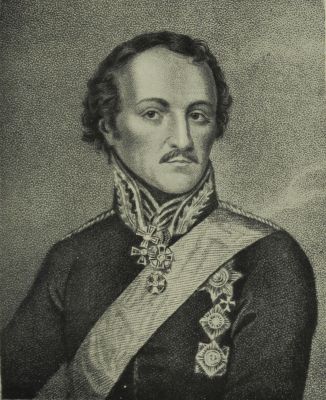
GENERAL OF CAVALRY COUNT PLATOV Ataman of the Don Cossacks
Meanwhile the French were doggedly following, suffering much from fatigue and heat, and troubled, as usual, by internal dissensions. Davout accused Murat, apparently with great justice, of wasting the cavalry, and exhausting them by useless manœuvres and lack of proper care for their subsistence. He said that it wrung his heart—not a very tender organ—to see the wretched state of the reserve cavalry divisions, and declared that he would not allow his infantry to be so over-worked. Matters came to a head on August 28th in an open quarrel between the two leaders in Napoleon’s presence. Murat retorted to Davout’s accusation by a counter-charge of over-caution, and declared that they had better settle their differences by a duel! Napoleon rather added fuel to the flames, for he insinuated that had Murat been in Davout’s place in July he might have intercepted Bagration. Davout was also on bad terms with Berthier. There is no discovering the real cause of this, but it is certain that Davout’s fierce temper and rough manners made him many enemies.
The march of the army was toilsome. The wide road was occupied by the artillery and trains, five or six vehicles abreast, while along both sides tramped the infantry in heavy columns of companies or “divisions.” They suffered much from heat, which was aggravated by the dense clouds of dust raised by the marching columns; and the supply of water was scanty. Even the Russians occasionally felt the want of it, and it was naturally worse for the French, who found the wells drunk dry and the streams trodden into mud. At the same time it does not appear that the diminution in the ranks owing to these causes was exceptional, though it was certainly serious. The worst losses were among the horses, which suffered at once from lack of proper forage and from thirst. Corn and hay became more and more difficult to procure, and the rations of the unfortunate animals were made up with rye straw. The wastage among them was all the more serious because there was little hope of being able to replace them.
The villages along the route, and the few small towns, were for the most part deserted by their inhabitants, and in part at least destroyed. This was not invariably the case. Dorogobuzh—“Cabbage-town,” as the French soldiers called it from the cabbage fields amid which it lay—was uninjured, and three months later still contained some of its inhabitants. Gzhatsk also was uninjured. Viasma was partly destroyed, owing to fire spreading from a depôt of flour and spirits which the Russians had fired before retreating. Otherwise it is difficult to decide whether the destruction of houses and villages was due to French or Russians. It may be attributed to both at various times according to circumstances.
The Russians retired eastward through Gzhatsk, covered by their powerful rear-guard. On September 1 they were about Kolotskoï, a great monastery about 75 miles from Moscow, the rear-guard being a day’s march behind. At Kolotskoï Toll and Vistitski II, Bagration’s Quarter-master-General, recommended a defensive position at Borodino, a few miles farther on—probably in despair of being able to find anything better between it and Moscow. Napoleon either learned on the same day that the Russians had definitely turned to bay, or inferred that they were about to do so, for he stayed his advance at Gzhatsk in order to rally his forces for the impending struggle. The musters for the 2nd of September, including men temporarily detached or straggling who might rejoin within two or three days, and exclusive of head-quarter troops, showed nearly 135,000 sabres and bayonets. Two battalions of the 8th Corps were garrisoning Dorogobuzh and Viasma. Before the battle Napoleon was rejoined by Pajol’s division and by the 1st and 12th Light Cavalry Brigades—nearly 4000 sabres in all. For the head-quarters troops 3000 is a conservative estimate.
Napoleon made great efforts at this time to grapple with the disorder in his rear, and especially to reduce the vast trains of vehicles which impeded the march. There is abundant evidence that they were out of all proportion to the strength of the army, and the superfluity consisted chiefly of private carriages. Napoleon’s efforts produced little effect. He issued stringent orders, and himself directed the firing of some vehicles; but Baron Girod tells of at least one instance in which the fire was extinguished as soon as the Emperor’s back was turned, and in general the order remained a dead letter.
During the halt there was a good deal of rain, which did not improve the indifferent roads, but relieved the distress for water. The 4th, however, was fine, and early in the morning the French army resumed its advance. The order was as before, but, to Davout’s disgust, Compans’ division was placed under Murat’s direct orders. A provisional battalion of the Vistula Legion was left to garrison Gzhatsk. Konovnitzin made a stand at Gridnevo, about half-way to Borodino, withdrawing when Murat’s infantry turned his flank, his cavalry skirmishing steadily with the leading French squadrons. On the 5th he made another stand at Kolotskoï, and it was not until he saw Eugène’s corps marching past his right flank that he fell back into the main army behind the Kolotza.
The Borodino position has often been spoken of as an admirable one for defence. Clausewitz, who knew it, is of a very different opinion; and in all probability it was selected simply because there was no likelihood that anything better would present itself in the endless plain-lands. It had one grave strategic defect. Some way to the west the great road forks, the branches uniting again at Mozhaïsk, about 6 miles east of Borodino. It was therefore necessary to hold two roads instead of one, and to be strong on both. At Borodino they are 2½ miles apart, the new road, on which Borodino stands, lying to the north.
The Kolotza rivulet makes a very acute angle with the new road, running for a considerable distance nearly parallel with it, always in a gully with steep banks. After passing Borodino, which lies on its left bank, it flows north-eastward with a very sinuous course to join the Moskva, about 2¾ miles farther on. The Moskva itself flows south-eastward to the high-road at the village of Uspenskoïe, three miles from Borodino, where it turns eastward towards Mozhaïsk.
In the angle formed by the two streams lies a low partly wooded plateau, its base formed by a rivulet which joins the Kolotza at Borodino. At its south-western angle stood the hamlet of Gorki, about a mile from Borodino. A few hundred yards higher up another streamlet joined the Kolotza from the south-east. This streamlet, called after the hamlet of Semenovskoï, about a mile and a quarter south of Borodino, flows in a little ravine, and the ground between it and the Gorki rivulet forms another low plateau, not more than 30 feet high, but with a fairly steep western drop. It descends very slightly towards the east for about a mile, until it is crossed by another brook flowing in a gully. The eastern bank of this gully is the higher, and the ground extends eastward in another low plateau on which lies the village of Tzarévo, a mile and a half east of Semenovskoï. Just west of Gorki there is a low knoll, and another a mile due south-east of Gorki, and about 1100 yards north of Semenovskoï. From Semenovskoï to the old road at the village of Utitza is about a mile and a quarter, and from the latter village extended northward for about 1000 yards a thick wood. Three-quarters of a mile east of Utitza is a knoll, and a little eastward again another low plateau. South of the old road extended marshy woods, though a little south of Utitza there was a clearing round the hamlet of Michino. Patches of wood were scattered over the whole position. The villages were all log-built and useless for defence. From Utitza by Borodino to the junction of the Kolotza with the Moskva is a distance of almost 5 miles.
To the west of the Borodino-Utitza line the country is of the same character, only slightly lower. At the village of Shevardino, a mile westward from Semenovskoï, is a low knoll. The villages were of so little consequence that it is superfluous to name them.
It will probably be gathered from this description that the general position afforded no great advantages to the weaker side. Clausewitz, indeed, says that in places it was difficult to tell which had the advantage of the ground. The northern plateau was fairly advantageous for defence, but the Kolotza ravine in its front prevented the troops posted on it from making counter-attacks. The old road afforded opportunities to an enterprising foe of a turning movement. It was therefore necessary to hold it strongly, but the wood south of Semenovskoï almost cut the troops about Utitza from the main line farther north. Bennigsen criticises the whole position most bitterly, as far too extended, but represents it as being 2 miles longer than it really was. He was himself an advocate of very narrow positions, and French critics declared that his line at Eylau was far too close and heavy. He says in his memoirs that he perfectly understood that Napoleon’s concentrated attacks could only be repulsed by a concentration of defence. In principle he was no doubt right, but the defensive concentration, as Wellington had been teaching an unappreciative Europe for years, should have been one of effective muskets, not of crowded columns. Bennigsen was too self-satisfied to see this; but it is perhaps fair to add that probably the British army was the only one in Europe sufficiently highly trained to execute linear tactics. The Russian soldiers were extremely steady and accurate in manœuvre, but not rapid, and scarcely highly trained; French observers criticise their clumsiness. Clausewitz thinks that the reserves were too near the front. The bulk of the army was massed on a front of four miles; both flanks were covered by Cossacks.
The Kolotza entered the Moskva amid marshy ground; the right was accordingly supported on a wood a mile and a half further south. In front of this and on its left towards Gorki were various field works. In front of Gorki was a parapet with redans, and on the knoll south of Borodino a large earthwork, called by the French the “Great Redoubt.” Semenovskoï had been destroyed, the houses being mere shell traps. At its western end a parapet had been marked out, and to the south three flèches or redans. The Gorki work, the Great Redoubt and the Semenovskoï redans were the only entrenchments at all complete, and they were very hastily finished and of poor profile. Engineers and sappers were few in the Russian army, and tools seem to have been lacking.
The strength of the army gathered to defend this very mediocre position cannot be exactly estimated. Russian figures vary, and none seem to be accurate in details. Bogdanovich, for example, reckons 14,500 artillery and sappers present, which, allowing for 1000 of the latter, gives an average of 250 per battery—more than in June!
The only very certain fact about the Russian strength is that when the army reached Gzhatsk it cannot have contained much over 100,000 men, of whom 3000 were militia and 7000 Cossacks. Miloradovich’s 15,500 men were drafted into the regiments, presumably with a view to bringing them up as far as possible to equal strength. On the 4th the army was joined by 7000 militia from Moscow under Count Markov, the vanguard of the great national levy. The total may be fairly estimated at nearly 125,000 men. The militia were absolutely raw troops; some of them were merely employed on police and fatigue duties. There were over 17,000 excellent regular cavalry, 7000 Cossacks, and 640 guns and howitzers, admirably appointed and horsed.
Napoleon had left perhaps 700 men in Gzhatsk, and allowing 1000 men for casualties at Gridnevo and Kolotskoï, and 2000 for stragglers or men who failed to rejoin, he had still over 131,000 men on the 5th of September, exclusive of the head-quarters guard, at least 3000 men, who must be counted as present no less than the Russian militia. Between the 5th and 7th the army was reinforced by 4000 cavalry, giving a total of 138,000 men available. There were about 32,000 cavalry, but their superiority in numbers hardly compensated for the inferior condition of the horses. The weight of metal thrown by the 584 guns was slightly superior to that projected by the 640 opposing pieces; and the former—with the exception of the regimental artillery—were undoubtedly more efficiently served, but here also the horses were in poor condition.
After the fight at Kolotskoï the French moved forward,—the main column by the new road, Eugène to the left rear, Poniatowski by the old road on the right—Konovnitzin and his troops retiring steadily before them. The Russian army was not yet definitely ranged for battle, the direction of Napoleon’s attack being still uncertain. Barclay, with the 2nd, 4th and 6th Corps, was behind Borodino, Bagration about Semenovskoï with an advanced guard, under his second in command Prince Gorchakov, at Shevardino, where a redoubt had been thrown up and armed with 12 heavy guns. Gorchakov’s force comprised the 27th Division, Sievers’ cavalry corps, the 2nd Cuirassier Division, and a light infantry regiment from the 2nd Corps. The 3rd and 5th Corps, with the militia, were for the present held in reserve.
It was not until 3 p.m. that Konovnitzin retired from Kolotskoï, and probably not before 5 that Murat attacked Gorchakov. The 3rd Chasseurs were ejected from the hamlet of Doronimo by the 61st Regiment, which marched at the head of Compans’ division; and the French infantry attacked the redoubt. It was a hastily constructed work; but the 27th Division fought with steady determination and contested its possession fiercely, the cavalry co-operating by means of repeated charges, in one of which the Russian Cuirassiers captured 5 guns. The position was taken and retaken three times, and Bagration seems to have contemplated holding it definitely, for at 8 he relieved Neverovski’s troops by the division of Karl of Mecklenburg. But by this time Poniatowski was well advanced along the old Moscow road on the left; and about 10 p.m. Bagration, by Kutuzov’s orders, withdrew to the main position. The losses on both sides had been considerable. Bagration, who had exposed himself in his usual reckless fashion, was slightly wounded, as were also Gorchakov and St. Priest.
The French army was not yet fully concentrated, and Napoleon occupied the 6th in reconnoitring the Russian position and arranging his plan of attack, while the troops already on the field rested. On the Russian side the army was placed in position, and the day was for the most part spent in religious exercises, culminating in the progress of the Virgin of Smolensk, which had been rescued from the city, through the camps.
The Russian commanders realised that they ran the risk of being turned by the old Moscow road. Tuchkov’s corps was therefore withdrawn from the general reserve and posted at Utitza, with the Moscow militia behind it in support, and 6 regiments of Cossacks under Karpov on its left near Michino. On the plateau to the north of the new road were the 2nd and 4th Corps, the 2nd on the right and the latter to the left, near Gorki. Dokhturov, with a brigade of Voronzov’s Grenadiers attached, stood between Gorki and the Great Redoubt. Raievski’s weak corps occupied the space between Dokhturov and Semenovskoï and garrisoned the Great Redoubt, while the 8th Corps (less Voronzov’s detached brigade) and the 27th Division held Semenovskoï and the redans. The wood between Borozdin’s left and Tuchkov was occupied by 4 regiments of light infantry. Every corps had its Chasseur regiments thrown out in front. Borodino was garrisoned by the Chasseurs of the Imperial Guard. Kutuzov and Bennigsen were stationed between Gorki and Tzarévo, whence they could overlook nearly the entire field.
Behind the first line stood the cavalry, each reserve corps having attached for the day a regiment of Corps-Hussars. Uvarov, having also the Cossacks of the Guard, was with Baggohufwudt, Korff behind Ostermann-Tolstoï, Kreutz (vice Pahlen invalided) in rear of Dokhturov, and Sievers behind Semenovskoï, with Duka’s Cuirassier division. Platov had 5 Cossack regiments watching the right flank, and 9 more in rear of the 2nd Corps. The 5th Corps, now under General Lavrov, was at Tzarévo, with an artillery reserve of about 240 field and horse guns.
These dispositions have not escaped criticism. Clausewitz considers that there were too many troops on the right, and as they had eventually for the most part to be brought over to the left he was probably correct. Bennigsen says that he saw that the left would be attacked in force, and that Bagration needed reinforcing. Both opinions have rather the air of wisdom after the event, and the manœuvre proposed by Clausewitz of forming a huge reserve, allowing Napoleon to drive back Bagration, and then attacking his advancing line in flank, seems rather a hazardous one.
The Russian line comprised four sections. Miloradovich commanded the 2nd and 4th Corps and the 1st and 2nd Cavalry Corps; Dokhturov the 6th Corps and the 3rd Cavalry Corps; Gorchakov the 7th and 8th Corps and Sievers’ cavalry; and Tuchkov the 3rd Corps and the Moscow militia. Finally, Barclay was in charge of the right half of the line, Bagration of the left. This multiplicity of generals was a nuisance. Barclay and Bagration sent orders direct to the divisional and brigade commanders.
The precise part which Kutuzov took in the battle is uncertain: the general impression is that he left Barclay and Bagration to direct the movements of the troops, except in a few instances.
It is a little doubtful if the Russian commanders intended nothing but a mere obstinate defensive. As has been already mentioned, Borodino was garrisoned and the bridge left intact; and from Barclay’s actions and remarks, as recorded by Löwenstern, he seems to have contemplated a counter-offensive on the right. The vigour of the French attack, however, in any case rendered this idea, if entertained, fruitless.
As regards the French plans, there is little information to be gathered from Napoleon’s orders, which merely provide in the simplest manner for massing batteries and opening infantry attacks, after which directions would be given according to circumstances. Poniatowski was to turn the Russian left by the old Moscow road—a task for which he had not enough troops. Probably, owing to the interposing woods, the Russian force on the old road had not been estimated at its real strength. Davout endeavoured to be allowed to make a strong flanking movement, but Napoleon characterised it as too hazardous. Probably his real fear was that the Russians would evacuate their position under its menace, and so rob him of the battle which he anxiously desired. The battle resolved itself into a general assault of the bulk of the French army upon the Borodino-Utitza line, which, to withstand the attacks upon it, was ultimately manned by the greater part of the Russian host. It is certain that Davout was in a state of sullen rage at the rejection of his advice, as well as at the fact that Morand and Gérard were detached from the 1st Corps, and placed for the day under the orders of Eugène.
Napoleon was certainly unwell. To say that he had a cold appears little to those who do not reflect that a cold may be very troublesome. Whatever the precise degree of Napoleon’s sickness there can be no doubt as to his lack of activity, and for a circumstance so remarkable there must have been strong reasons. It was no small cause that could keep the great conqueror, during a battle upon which his fortunes depended, lying listlessly on a rug behind his line.
During the 6th the French sappers raised three battery-emplacements in front of the 1st, 3rd and 4th Corps, each for 24 guns; but they were placed at too great a distance from the Russian line and played no part in the battle.
The night of the 6th-7th was foggy. Early on the 7th, while the troops were forming, the usual Imperial proclamation was read by the Colonels. It was a brief and uninspiring document, which can hardly have done much to raise the spirits of the men. De Chambray says that it was coldly received. Kutuzov’s proclamation, which was read to the Russian troops after the religious services on the 6th, was a much more effective production.
The French army was disposed in the following order from right to left. The 5th Corps was on the old Moscow road. Davout, with the divisions of Friant, Compans and Desaix, stood opposite Borozdin’s position and the wood to its south. Ney continued the line to the Kolotza with Ledru’s and Razout’s divisions; the relics of Scheler’s Württemberg division, now consolidated into only 3 battalions, were in reserve. North of the Kolotza, communicating with the other troops by means of five trestle bridges, was Eugène with the 4th Corps (less Pino’s division), Morand’s and Gérard’s divisions, Grouchy’s cavalry corps and Preising’s Bavarian horsemen.
In rear of Ney were the 8th Corps and Latour-Maubourg’s cavalry. Nansouty’s cavalry corps supported Davout. The Imperial Guard, with Montbrun’s cavalry corps, just rejoined by its light division, formed the general reserve, its final position being about the Shevardino redoubt captured on the 5th, near which Napoleon stationed himself.
About 6 a.m. the artillery of Davout’s corps, speedily supported by that of Ney, began a furious cannonade of the Russian left centre. Very soon afterwards Davout opened the infantry attack, sending forward Compans’ division against the Semenovskoï redans, while Ney supported by moving forward Ledru on Compans’ left. The Russian entrenchments were so slight that there was little difficulty in entering, but to hold them was a very different matter. Redan No. 2 was carried by the 24th Léger and the 57th of the line, but Voronzov, charging with his six Grenadier battalions formed in square, supported by Neverovski and some of Sievers’ dragoons, drove them out again, and the fight raged fiercely about the almost useless earthworks, which were taken and retaken as the generals on either side threw in reinforcements.
Bagration, seeing the heavy masses advancing against him, and fearing that he would be overpowered, ordered Tuchkov to send Konovnitzin’s division (now commanded by Tuchkov IV, Konovnitzin being on Kutuzov’s staff) from Utitza. This reinforcement was necessary, for by 8 Voronzov and Neverovski, no longer able to bear up against superior numbers, were evicted from all three redans, Voronzov being wounded. Tuchkov came up in time to rally the retreating battalions, and Bagration promptly led forward a fresh counter-attack which was successful in recovering the lost position, though Compans was now supported by Desaix. Already the terrible “Battle of the Generals” was earning its name. Compans was disabled first, then Desaix, while Rapp, sent by Napoleon to succeed Compans, received four wounds in about an hour.
On the left Eugène had attacked Borodino with Delzons’ division of the 4th Corps. The attack was made under cover of the mist which still hung over the field, and the village was carried with a rush. The Guard Chasseurs lost 30 officers in a quarter of an hour, and were driven in wild confusion to and across the Kolotza. The bridge was taken, and the 106th French Regiment poured across it in pursuit. The garrison would have been destroyed but for the 1st Chasseurs, under Colonel Karpenko, who hurried up to the rescue. Charged by them, and smitten by the fire of Ostermann-Tolstoï’s guns from the farther bank, the 106th lost heavily. General Plauzonne was killed as he endeavoured to rally it, and its remains were driven back across the stream. Karpenko’s charge was stopped by the 92nd Regiment, but he succeeded in destroying the bridge. Eugène left Delzons to watch the Kolotza north of the village, placed the Royal Guard in reserve, stationed the cavalry of the 4th Corps and Preising’s division, now united under General Ornano, to cover the left flank, and turned Morand’s, Gérard’s and Broussier’s divisions, supported by Grouchy, against Dokhturov and Raievski.