Front matter (continued 7)
Reading edition
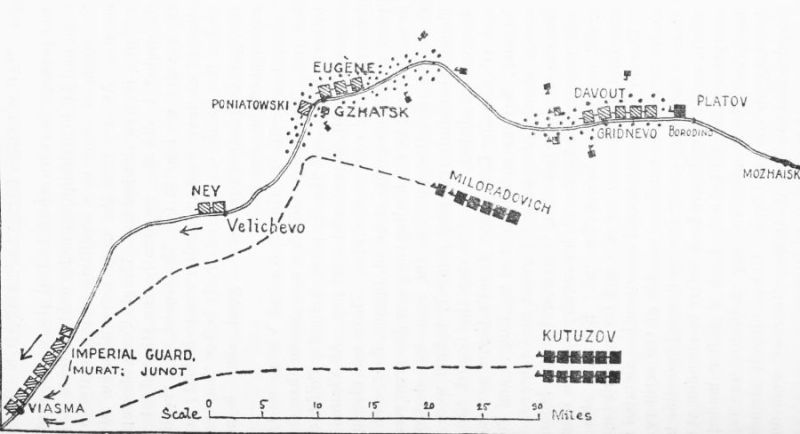
Plan of the approximate positions of the French and Russian Main Armies on October 31st, to indicate the danger incurred by Napoleon’s extended order of march
Napoleon, with the Guard, reached Viasma on October 31st. The cold on this day was greater than it had hitherto been; and the Emperor donned a Polish dress of green, heavily furred, and a fur cap. At Viasma was General Evers’ column of drafts. There was also in the place a small magazine of bread, biscuit, flour, and rice. It was pillaged by the leading troops, and so great was the demoralisation that much of the town was destroyed, though thousands tramping painfully behind were thus deprived of shelter. On this day the Guard, the 2nd and 4th Cavalry Corps, and Junot’s Corps were about Viasma; Ney one march short of it; Eugène and Poniatowski about Gzhatsk, and Davout at Gridnevo. The line was nearly 70 miles long from front to rear. Miloradovich was near at hand with his cavalry, but his infantry could not arrive before the 3rd. Kutuzov also was marching for Viasma, but was still 60 miles distant.
Davout’s slow withdrawal was doubtless dictated by a desire to save as much as possible of the artillery and trains; but in the circumstances it was impossible to do much, and it would have been better to abandon at once everything that fell behind. Lack of shelter, inadequate food, and the steady harassing of Platov was rapidly breaking up the 1st Corps. It had already abandoned 20 guns and much of its trains; the roads were dotted with men and horses dead of fatigue.
Napoleon remained for 36 hours at Viasma, principally occupied with desk-work. He informed the generals in the rear of his retrograde march, representing it as a purely voluntary movement made to come into touch with his wings. From Baraguay d’Hilliers he learned that he had advanced to Selnia, and despatched orders for him to return to Smolensk. From Victor he became aware that the 9th Corps had been forced to support St. Cyr.
General Ilovaïski IV, temporarily commanding Winzingerode’s detachment, had reoccupied Moscow on October 23rd. He found there some 1500 sick and wounded whom Mortier had been unable to evacuate, and 42 mounted guns, of which 24 were French.
Ney’s corps reached Viasma on November 1st. Miloradovich continued to move parallel to the road, hastening the march of his infantry and anxious to strike a blow. At 11 a.m. on the 2nd Napoleon left for Semlevo. Davout in the evening arrived at a point about 9 miles from Viasma and a little more than 1 east of the village of Federovskoië. Eugène and Poniatowski were between Viasma and Federovskoië. Ney was to take over rear-guard duty as soon as Davout should pass Viasma. Napoleon was angry with the slowness of the latter; but the orders which he issued to hasten the march of the trains could not be executed owing to the deplorable state of the horses. The orders to prevent straggling were equally impossible of execution. None the less, Davout had certainly moved very slowly, and there was some excuse for the Emperor’s irritated remark that “the Prince of Eckmuhl keeps the Viceroy and Poniatowski waiting for every band of Cossacks that he sees.” In justice to Davout it must be said that the young and inexperienced Eugène appears often to have delayed him by his own lack of speed.
At 8 a.m. on the 3rd Miloradovich with Korff’s and Vassilchikov’s divisions reached Maximovo, a village some 2 miles from Federovskoië, and about 1 mile south of the high-road. Davout was passing through Federovskoië, his leading division—Gérard’s—being nearly abreast of Maximovo. The Hussars of Akhtyrka, supported by a brigade of dragoons, boldly charged the head of Gérard’s column, while the Russian horse artillery opened a brisk cannonade on his flank. The 2nd Corps could not come into action before ten; while Kutuzov was only just leaving Dubna, nearly 30 miles from Viasma.
Gérard’s division, attacked without warning, was checked in its march upon Viasma. Platov was close on Davout’s rear, and as soon as he heard the sound of Miloradovich’s cannonade he pressed home his advance, Paskievich marching straight upon Fedorovskoië, while Platov turned it on the left. Davout saw that there was not a moment to lose in clearing the way before the arrival of Miloradovich’s infantry, and hurried his divisions up at the double to support Gérard. Eugène turned back to his colleague’s support, while Poniatowski took up a position in advance of Viasma to support Eugène. Ney posted his corps to the right of the town, behind the Viasma river; he threw a bridge across it in order to facilitate the retirement of his colleagues’ trains. The river makes an acute angle a little south of the town, so that Ney had it both before and behind him; he threw a second bridge over it to assure his own retreat.
Miloradovich had available for the conflict the 2nd and 4th Army Corps, Paskievich’s division of the 7th and Platov’s Flying Corps, perhaps 30,000 or 32,000 combatants in all, with some 120 guns. The estimates of the French force vary. Davout may have had 20,000 infantry and artillery, Eugène perhaps 15,000, Ney probably 8000, Poniatowski about 3500. The remains of the corps cavalry and of the 1st and 3rd Reserve Corps probably could not muster 4000 mounted men. The artillery could still count over 300 guns, but the worn-out state of their teams rendered them incapable of manœuvring. The troops, with the exception of those of Ney, were demoralised.
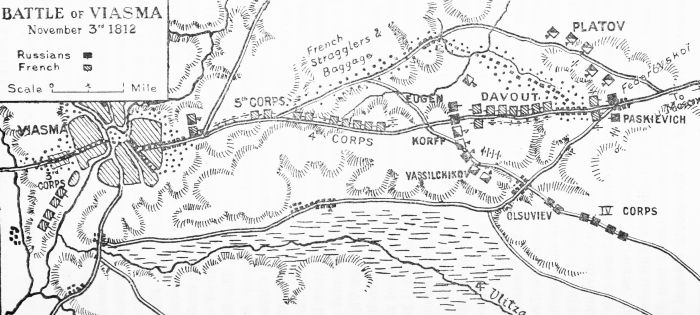
BATTLE OF VIASMA Positions about 10 a.m.
Davout’s troops, ranged in dense battalion columns, attacked the Russian cavalry on the road and broke through, scattering the hostile squadrons, some of which had to retreat towards the north to join Platov. This appears to have occurred at about 10 a.m. Paskievich meanwhile had carried Federovskoië, and Platov was harassing the French on the right; while Prince Eugen’s division of the 2nd Corps formed across the road just as the Russian horsemen gave way and poured a heavy fire into the head of Davout’s column. The Marshal’s position was extremely critical. The Viceroy, however, was now close at hand with Broussier’s and Guilleminot’s divisions and the 5th Corps. He cannonaded the flank and rear of the 4th Division and attacked it with a cloud of skirmishers. Its commander believed that he could hold his own, but Miloradovich was of a different opinion, and, seeing the force which was coming from Viasma, he was probably correct. Eugen drew back into line with the rest of the Russian infantry on the south of the road, and Davout’s troops were able to defile past. But they had suffered considerably, and the disorder among them was increased by the cannonade beneath which they had to march. The trains streamed away to the north of the road to reach Viasma, while the 1st Corps inclined to the south to come into line with the 4th and 5th Corps. Eugène formed across the road with Poniatowski in support; but as Platov spread to the north he threw back his right wing. Davout’s troops were on Eugène’s right, nearly parallel with the line of the road. To support and steady them Ney advanced Razout’s division, while Ledru’s remained to check Uvarov, who was now coming up with Kutuzov’s advance-guard. Uvarov, however, who had only the bulk of Golitzin’s Cuirassiers under his command, could only confine himself to a desultory cannonade. The head of Kutuzov’s column reached Bykovo, 5 miles from Viasma, in the afternoon, but it had marched 22 miles already and could hardly engage that day.
Miloradovich, after Davout had passed, deployed his whole force across the road and marched forward, Eugen’s, Paskievich’s and Choglokov’s divisions in first line, the remaining two in reserve, Platov pushing forward on the right, Korff and Vassilchikov in reserve and on the left. The French generals, fearing that at any moment Kutuzov might debouch in their rear, held a conference on the road, and decided to retreat. The final withdrawal commenced at about 2 p.m. Eugène and Poniatowski succeeded in passing through the town in fair order; but Davout’s shaken troops fell back in confusion, hotly pressed by Paskievich and Choglokov. Ney covered the retreat of his colleague to the utmost of his power, and retired through Viasma, burning such of it as remained intact. The French bivouacked in the woods on the west of the town. The night proved bitterly cold.
The French losses are usually stated at 4000 killed and wounded. Those of the Russians may have amounted to 2500. Miloradovich captured 3 guns and about 2000 prisoners, besides some thousands of the disbanded mob. Among the prisoners was General Pelletier, commanding the artillery of the 5th Corps. The French writers attribute the defeat mainly to Davout’s error in inclining to his right as he fell back instead of his left, but it is doubtful whether this was more than a subsidiary cause.
On the 4th Kutuzov remained inactive at Bykovo. His troops may have needed rest, but it is extraordinary that he made no attempt to crush or at least to harass the weary, half-starved and beaten French army behind the Viasma. Perhaps he was imposed upon by Ney’s bold show in the rear, and the good order of the undemoralised 3rd Corps. It is perhaps difficult to judge him, since we can scarcely appreciate the vast influence exercised by the prestige of the Napoleonic army upon the minds of its opponents everywhere save in Britain. But to say the least, he could and should have done much more.
Ney, early on the 4th, took up a strong position on the edge of the woods. Beurmann was detached to the right to observe Uvarov, whom he held in check during the day. Meanwhile the 1st, 4th and 5th Corps defiled on the road to Dorogobuzh. All were in the greatest disorder. The men were worn out with fatigue and appeared hopelessly discouraged, only the Royal Guard of Italy still marched in fair order. The number of stragglers, of whom the majority had thrown away their arms, was enormous. Ney was much impressed by the disorder of the 1st Corps, and his despatch upon the battle contained some bitter remarks upon it, as well as the haphazard conduct of the engagement.
The substitution of the 3rd Corps for the 1st rear-guard duty was another proof that Napoleon did not really understand the critical state of affairs. Ney was an ideal rear-guard leader, and the 3rd Corps was an intact and undiscouraged force, but it consisted of only two divisions (the Württemberg troops having been amalgamated with the other two) as against the five of the 1st.
At daybreak on the 5th the 3rd Corps withdrew in good order, but followed and impeded by at least 4000 disbanded men of the other corps. De Fezensac, in bivouac that night, ordered all able-bodied skulkers to be driven away by force from the fires. Near Semlevo there was an action with the leading troops of Miloradovich, but the 3rd Corps was not molested on the 6th. Kutuzov, had he pushed forward on the 4th, would certainly have destroyed Ney and probably Eugène also. The Russians were so strong in cavalry that they could always retard the French retreat by employing it vigorously to harass the moving columns. However this may be, Kutuzov on the 5th bent south-westward to Ielnia, while Miloradovich and Platov continued to follow and harass the French rear-guard. Many stragglers were slain or taken by the Cossacks and waggons were abandoned in numbers; but no impression was made upon Ney’s corps, which continued its march to Dorogobuzh and there took up a position.
Napoleon had intended to receive battle east of Dorogobuzh. His plan appears in his correspondence, and it can only be characterised as utterly impracticable. It assumed that the whole Russian Army was following on the main road, and also counted upon being able to ambuscade their advance-guard. Even had the army been less reduced and demoralised this would have been impossible, the Russians being so strong in cavalry. The plan was not executed; by the time that he had drawn it up Napoleon had probably read Ney’s despatch of the 4th, in which the marshal stated his conviction that only a part of the Russian army was at Viasma. Next day Ney reported that he had learned that Russian columns were passing him on the right; and Napoleon retreated with the Guard upon Mikalevka.
On the 6th and 7th the weather, which had hitherto been by day comparatively mild, changed for the worse, with violent gales and heavy snowstorms. After this the destruction of the army proceeded apace. The horses were the first to suffer; it was impossible to obtain any forage with the ground covered deep with snow. No provision had been made for rough-shoeing the horses, except by the Polish cavalry; and on the slippery surface of the trodden snow they fell in hundreds, to be preyed upon by the starving troops. Vehicles of every kind had to be abandoned; and each was instantly plundered by a group of wolfish stragglers, often to the accompaniment of murder. The number of disbanded men rapidly increased, and their lawlessness and savagery grew even more quickly. Had it been possible to maintain better discipline the state of the army might have been less intolerable. Terrible as the conditions were, they could have been somewhat ameliorated had there been a better sense of comradeship among the troops, which might have prevented so many of them from disbanding and degenerating into veritable wild beasts.
But in truth the misery was so great that the finest loyalty and steadiness could not greatly have alleviated it. Had there been a sufficiency of even the coarsest food, the troops might have withstood the cold. But almost the only resource remaining was the unwholesome flesh of the worn-down horses. Even the officers were often little better off as regards meat, though they could still procure small quantities of biscuit or flour. The troops as a whole were insufficiently clad and, above all, ill-shod; those who succeeded in obtaining a little food were often disabled by frost-bite or injuries to their ill-protected feet. In the hope of guarding against the deadly cold the men overloaded themselves with clothing of every kind and quality, often filthy rags torn from the dead and dying. In their fear of taking a fatal chill they never removed them even for necessary purposes, and dared not wash. In their ravening hunger they ate like wild beasts, tearing the raw or half-cooked horse-flesh with their teeth, and covering themselves and their wretched garments with blood and offal. Their appearance soon became indescribably hideous, and the result of their panic-born neglect was, of course, loathsome disease. Selfishness increased with misery; men thrust their weaker comrades from the bivouac fires, and fought for the wretched carrion on which they strove to maintain their existence; while those who fell were robbed and stripped by passers-by.
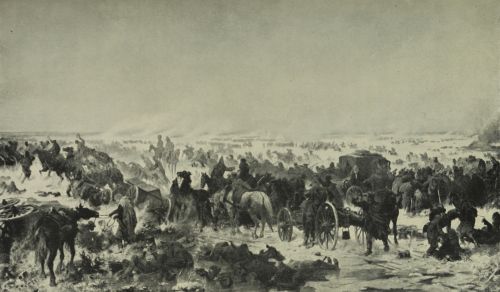
THE RETREAT OF THE FRENCH FROM MOSCOW From the painting by Adam
Amid all this misery and lack of self-respect there was much that redounds to the credit of human nature. Many soldiers added to their hardships by endeavouring to assist the women and children who followed the army. Officers who possessed private carriages gave them up to these unhappy fugitives; those attached to the head-quarters, which was better provided than the rest of the army, succeeded in saving many. Unhappily the most necessary requisite was food, and this the chivalrous protectors could not often give their charges. The hardy female followers could protect and provide for themselves to some extent, but too many of the officers’ wives or connections were utterly helpless, and their fate was a piteous one.
One of the most awful incidents of the retreat was the fate of the Russian prisoners, of whom some 2000—stragglers, convalescents, and civilians—were dragged with the army, under a guard made up of fragments and detachments of every nation. From the first the captives were treated with gross cruelty and neglect. The weakly ones who fell behind were done to death without mercy. Every night the survivors were huddled together, fireless, on the bare ground, without food save a little raw horse-flesh. Before long even this was not forthcoming, and the miserable prisoners, driven along and herded together like wild beasts by men who were losing the traces of humanity, perished amid horrible misery. Cannibalism is said to have raged among them. There is no darker stain on the escutcheon of Napoleon (who must be held ultimately responsible) than this treatment of men who were at any rate open enemies, and some of whom were not even combatants.
Day by day the number of men in the ranks dwindled. Every bivouac was the graveyard of hundreds of men and thousands of horses; the line of march resembled a long battlefield. The roads were strewn with dead or dying men and horses, abandoned guns and vehicles, and wreckage of every kind. Amid this streamed westward in wild confusion the endless procession of disbanded men and male and female camp-followers, accompanied by vehicles of all kinds, through which the troops still with the colours could scarcely force their way. Many men were already so weak that they could hardly stumble along. Some became idiotic with privation and the spectacle of the misery about them. The plight of the troops in the ranks was no better; their devotion to duty only prolonged their sufferings. Ill-clad, starving, stricken with cold and disease, often half-blind from the effects of the glaring snow by day and the smoke of the fires at night, it is wonderful that they ever managed, as they did, to make some kind of fight. Their duties, when they had strength to carry them out, were confined to beating off the hovering Cossacks, and to destroying guns and waggons that would otherwise have been abandoned.
From Dorogobuzh Eugène’s corps was diverted towards Dukhovchina with the intention of directing it thence upon Vitebsk to relieve the pressure upon Victor by Wittgenstein. The result was its practical destruction.
On November 7th Eugen of Württemberg attacked Razout’s division before Dorogobuzh and after some obstinate fighting, partly owing to the indecision of its short-sighted commander, forced it to retreat through the town with a loss of several hundred men and 4 guns. Ney, who had hoped to delay Miloradovich for a day, was obliged to fall back towards Smolensk. Dorogobuzh was choked with disbanded men, who were ruthlessly murdered or stripped by the exasperated inhabitants. A watchmaker boasted of having killed 11 Frenchmen with a knife which he had concealed for the purpose! Miloradovich, however, was then obliged to draw off his infantry towards the south for the sake of food and shelter against the cold. He left the pursuit of Ney to Major-General Yurkovski with a brigade of dragoons and some Cossacks, while Platov followed Eugène towards Dukhovchina.
At Mikalevka Napoleon learned of Malet’s audacious conspiracy in Paris, and the tidings doubtless did not tend to relieve his mind. On the 8th Junot’s corps arrived at Smolensk; but the day before that ruined town had been invaded by crowds of disbanded troops. Junot was not allowed to pass his corps into it, and cantoned it in villages on the Mstislavl road. Napoleon himself arrived on the 9th, only to be met by bad news from every side.
Victor was proving unable to hold back Wittgenstein. Baraguay d’Hilliers’ division, as has been related, had pushed out to Ielnia, and was retiring upon Smolensk, when on this day his rear-guard brigade, 2000 strong, under General Augereau, was surrounded in the village of Liakhova by Orlov-Denisov, with his own flying detachment and those of Davidov, Seslavin, and Figner. Augereau was without artillery, and not being supported by Baraguay d’Hilliers, who showed great irresolution, was forced to surrender. Baraguay d’Hilliers retreated hastily to Smolensk with the rest of his division, and was very properly ordered home for trial. Besides Augereau’s brigade several depôts or posts of troops were captured by the Russian advanced detachments. Kutuzov reached Chelkanovo on the Smolensk-Mstislavl road, about 25 miles from Smolensk, on the 12th. He had not marched very rapidly—some 120 miles in 9 days—but it is true that both roads and weather were terrible. The Russians were well clothed and fairly well fed; but many of the Russian troops were young, and the snowy bivouacs had disastrous effects upon their unformed constitutions.
On this same disastrous day, the 9th, Eugène’s corps, after 3 days’ struggling through the snow, reached the small river Vop, only 30 miles from Dorogobuzh. The Viceroy had already lost 1200 of his remaining horses and much of his artillery. He had sent on a detachment to bridge the stream, but materials were lacking, and the wretched soldiers were forced to wade. The Royal Guard led the way, with Eugène in their midst, with ice and water up to their waists, formed on the opposite bank and drove away Platov’s vanguard, which was already across. Platov himself was tormenting the rear-guard with his light artillery, and threatening the unhappy column in flank and rear. When Eugène had crossed an effort was made to bring over the artillery and baggage. The steep banks of the stream had been hurriedly made practicable for vehicles, but the inclines were quickly covered with ice; the ford was soon choked by guns and waggons sticking fast in the mud, and eventually all but the small proportion which crossed first had to be abandoned. There were terrible scenes on the bank when this became known. A turmoil of fighting, pillage and murder reigned. Many worn-out soldiers, struggling through the icy water, were overcome by the cold and drowned: many others died in the night. Broussier’s division covered the rear against Platov all night, and only crossed on the morning of the 10th, leaving behind them many sick and wounded, a vast quantity of baggage and some 60 guns. Hundreds of men, overcome by cold, threw away their arms. The bulk of the corps streamed along the road to Dukhovchina completely disorganised; only the Royal Guard and Broussier’s division still moved with some show of order. Dukhovchina was already occupied by Cossacks—the leading regiments of Winzingerode’s old detachment, now under Major-General Golénischev-Kutuzov. They, however, of course had to retire before the advance of the Royal Guard, and Eugène occupied the town. It had not yet been plundered, and the exhausted remnants of the 4th Corps were able to obtain food and a little rest. On the 12th Eugène set fire to Dukhovchina and retreated on Smolensk, where he arrived on the 13th, surrounded and harassed all the way by the indefatigable Cossacks. He had with the colours only 6000 or 7000 armed men, and 20 guns at most out of over 100.
Davout’s and Poniatowski’s[7] troops made their way from Viasma to Smolensk with little opposition from the Russians, but disintegrating day by day under the influence of cold, fatigue and hunger. The Poles seem to have completely broken up, and only about 800 privates reached Smolensk. On the other hand, they saved a large proportion of their artillery, owing to their sensible precautions in rough-shoeing their horses.
Ney reached the Dnieper at Solovievo on the 19th. The approach to the bridge was choked for more than half a mile with abandoned guns and waggons; and before passing Ney ordered his men to fire them. In doing so they came upon some remnants of food supplies and some spirits. In the woods on both sides of the road were thousands of stragglers, largely wounded, whom the omnipresent Cossacks massacred and plundered under the very eyes of their comrades. In the evening the 3rd Corps passed the river and destroyed the bridge. It defended the passage against Yurkovski’s brigade, the Cossacks, and some supporting infantry, until the 12th, and then retreated on Smolensk, in weather so awful that even the Russian Löwenstern speaks of it as something exceptional. It was impossible to halt for fear of freezing, while the icebound road was fatal to hundreds of exhausted men. A terrible night in bivouac put the capstone on the sufferings of the devoted 3rd Corps. On the 4th it entered Smolensk—some 4000 men left of more than 11,000 who had marched from Moscow.
It is now necessary to turn aside to follow the fortunes of Napoleon’s wings. On October 29th Victor joined Merle at Chasniki, at the junction of the little river Lukomlia with the Ula, about 17 miles south-west of Bechenkowiczi. Dändels had already joined Legrand. Wittgenstein and Steingell united at Lepel on the same day and reached the Ula on the 30th. They were, however, owing to the detachment of Vlastov’s division, not more than 33,000 strong, while the 2nd and 9th Corps, even in the absence of Corbineau, mustered 36,000 infantry and 4000 cavalry. Victor therefore decided to attack, and sent to call in Dändels and Legrand. Owing to misunderstandings, however, neither Legrand nor the cavalry of the 9th Corps arrived, and Victor hesitated to attack. Wittgenstein drove Victor’s advance troops over the Lukomlia, and brought a mass of artillery into action, which gained the advantage over the French guns. After a long cannonade the action died away, and before dawn on November 1st Victor retreated upon Sienno, about 25 miles east of Chasniki. He had suffered no reverse, and, indeed, had hardly engaged his troops. He may have thought, as De Chambray says, that it would be better to temporise until he was reinforced by Napoleon. Wittgenstein did not pursue, but moved Harpe’s division towards Bechenkowiczi to observe Victor’s movements. The latter, after remaining for two days at Sienno, turned south-westward to Chereia, about 20 miles north of the Smolensk-Minsk road at Bobr. Whether this move was due to his fear for the highway cannot be determined, but the result was disastrous. On November 7th Harpe attacked Vitebsk, which was now uncovered. The small garrison, under General Pouget, was either killed or captured.
On October 29th, Chichagov started from Brest-Litovsk for Minsk. To hold back Schwarzenberg he left with Sacken the divisions of Bulatov, Lieven, and Essen III, a total of about 27,000 combatants, with 96 guns. Under his own command were the 2 corps of Voïnov and Sabaniev, forming together the Corps de Bataille under Langeron, and two advance-guards commanded by Lambert and Chaplitz—33,000 men with 180 guns. Chichagov sent orders to Ertel to advance from Mozyr to meet him. General Musin Pushkin was left with 4000 or 5000 men to guard the Volhynian frontier. The Admiral left Pruzhani on the 30th and reached Slonim on November 3rd. He might have moved more rapidly, but he explained to the Tzar that he hoped to draw Schwarzenberg upon him and be able to strike hard at him before marching upon Minsk. He waited about Slonim until November 8th in this expectation, then, feeling that further delay would be dangerous, started for Minsk. He had, in fact, waited too long already.
Schwarzenberg, having left Kosinski’s Poles to cover Warsaw and one of Durutte’s regiments to garrison that capital, concentrated the rest of his army at Bieloslok, and marched for Volkovisk, which he reached on November 8th, Chichagov being nearly 60 miles in advance with his way clear before him. On the 14th Schwarzenberg was at Slonim with his Austrians, while Reynier and Durutte were at Volkovisk. Sacken broke up from Brest-Litovsk on November 1st. He left Colonel Witte with 3 battalions and 2 newly joined Cossack regiments to cover his base, and marched for Volkovisk. Between him and his objective lay the extensive forest of Bielovezhi, which he had to skirt, but on November 12th he was nearing Volkovisk, throwing forward his right in order to interpose between Schwarzenberg and Reynier. The latter, fearing to be assailed in flank, fell back upon Volkovisk.
Volkovisk lies upon the right bank of the river Rossi, which flows northward to the Niemen. Hard by the town a rivulet entered the Rossi. Both were now frozen. North of the town are some low heights, and on these the bulk of Reynier’s army was posted; but his head-quarters were in Volkovisk itself.
Sacken decided that his best course was to vigorously attack Reynier, so as, at least, to bring back Schwarzenberg to his assistance. It was a bold but perilous resolve, since Sacken was not greatly superior even to Reynier in numbers, and might be taken in rear by the Austrians. In the night of the 14th-15th his advance-guard surprised Volkovisk, driving out its garrison and nearly capturing Reynier. The advance of the Russian column, however, was then checked by Durutte.
On the 15th Reynier took up a position behind the town, his right, consisting of Saxons, resting on the wooded bank of the Rossi, Durutte in the centre, and more Saxons on the left. Sacken was drawn up south of the town, with Bulatov on the right, Essen in the centre, and Lieven on the left.
Early on the 15th Durutte retook Volkovisk. Sacken did not attempt to recover it. The day passed in desultory cannonading, except on Reynier’s left, where the Russian cavalry of Bulatov’s corps, under Melissino, endeavoured to take advantage of a movement of Saxon infantry to charge, but was handsomely repulsed by their horsemen.
Schwarzenberg, informed of Sacken’s advance, left Frimont with about 7000 men at Slonim, and returned towards Volkovisk with the remaining 18,000. On the 15th his advance-guard was already well on the way; but Sacken, misled by the false reports of some prisoners, decided to press home his attack upon Reynier. On the 16th he recaptured Volkovisk, and about midday developed a heavy attack upon Reynier’s left, when guns were heard on the road to Slonim nearly in rear of Sacken’s centre, and fugitives from the guards of baggage which had been sent there announced that Schwarzenberg was at hand. Sacken at once began to withdraw towards the left, first Lieven, then Essen, finally Bulatov. It was dark before even Essen began his march, and the army retreated safely to Svislozh on the Brest-Litovsk road.
He was hotly pursued by Schwarzenberg and Reynier, the latter following him on the main road, while Schwarzenberg threatened to turn his right, and interpose between him and the Bielovezhi Forest. During the next ten days there was constant rear-guard fighting, though never of a very severe description, as Sacken made his way back towards Brest-Litovsk. On the 25th he took up a position to cover that place, but his opponents were manifestly too strong for him, and on the 26th it was reoccupied by Reynier. The net result of Sacken’s operations was that he had drawn Schwarzenberg far away from the decisive point on the Berezina. On the 25th the Austrian general received a letter from Maret at Vilna, bidding him turn back to support Napoleon. This he at once did, but whatever he might or might not wish it was now far too late. On the 27th, when he set out to remeasure his steps, Napoleon was already crossing the Berezina, threatened by Chichagov and Wittgenstein. Sacken’s losses during his brief campaign had been heavy, though certainly they had not approached the figure of 10,000, at which the French estimated them. He had lost also a considerable part of his trains. The losses of his opponents were perhaps about 3000 killed, wounded, and prisoners. The importance of the strategic success of the Russians is not, however, to be expressed in terms of losses.
The remains of the central Napoleonic army were collected at Smolensk by November 13th. The leading troops had thus some five days’ rest from marching, but little alleviation of their misery. There had been some 1500 beef-cattle in the villages round the town, but most of these were swept up by the Cossacks who preceded the march of the main Russian army. In Smolensk itself there were considerable stores of flour, grain, and brandy—probably enough to supply the remains of the army for several days. There was also a certain quantity of biscuit, rice, and dried vegetables. The Guard as usual was unduly favoured. Napoleon ordered that it should have 15 days’ supplies issued to it, while the other unhappy corps were only to have six. Judging, however, from narratives of members of the Guard, it never received anything like the amount ordered. The men, hungry and improvident, seem to have largely gorged themselves on their rations; a good many sold them at exorbitant prices to others; in this way the survivors of Preising’s Bavarian horsemen were able to obtain a little food. Portable mills, which had by this time begun to arrive, were also issued. Even in their misery the soldiers made bitter jests at this provision for grinding flour which was not to be had. Shelter there was little. Eyewitnesses give grim accounts of the wretchedness within the walls. As corps after corps reached the town in their misery the hospitals were choked with sick and wounded, who were literally heaped into these dens of horror without provision of any kind. The cold was worse than it yet had been, and the men were frost-bitten by hundreds. It was fortunate for Napoleon that a thaw set in on the 14th. While in the town the troops had at any rate food enough for immediate needs, the troops of Junot and Zayonczek in the villages outside were left unprovided for, with the result that they pillaged such convoys as passed near them, and ate hundreds of serviceable horses.
The army received indeed considerable reinforcements at Smolensk. Baraguay d’Hilliers’ column was distributed among the corps as they arrived. The Vistula Legion was joined by its 3rd battalions, Ney’s corps by the 129th Regiment and that of Illyria. It is difficult to state the strength of the army on the 14th, but it may be perhaps estimated at nearly 60,000 men. The Guard still retained about 2500 badly mounted horsemen; all the other cavalry divisions did not muster more than 3000 mounted men between them. The remnant of the Cavalry Reserve—some 2000 sabres—was collected under the command of Latour-Maubourg. Much of the artillery, which had been so far dragged along, could no longer proceed, and 140 pieces were abandoned in Smolensk.
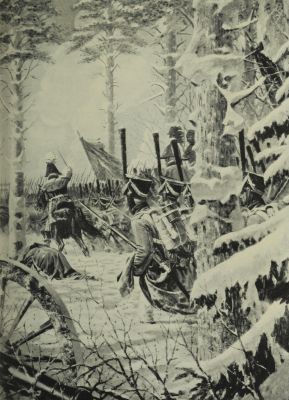
RUSSIAN GRENADIERS PURSUING THE FRENCH ARMY From the picture by Verestchagin
On the 13th the remains of Eugène’s corps poured in wild confusion into the town. An issue of rations was commenced, but the starving men broke from control and pillaged the magazines. Order was restored by desperate exertions, but there had been much damage and waste of precious food. Next day the 1st Corps flooded into Smolensk in a state as pitiable as that of the 4th, and the disorder of this erstwhile best disciplined of the army corps could not be restrained. The storehouses were broken open amid frenzied scenes of disorder and violence; the miserable wretches murdered one another at the doors and in the streets. The provisions were pillaged, a great part of them being of course destroyed in the confusion. Nothing was left for Ney’s brave men, who were sacrificing themselves to save the rest of the army, except such remnants as they could obtain by searching for them.
Kutuzov meanwhile was advancing with a slowness and caution which exasperated the more eager of his subordinates and caused some of them to mutter angrily about treachery. On the 14th he marched 13 miles from Chelkanovo to Jurovo, and halted for a day. It may well be, as Clausewitz reasonably remarks, that his firmness was shaken by the deteriorating condition of his own army, which was suffering severely from the cold, and perishing in bivouac at an alarming rate, though, of course, less rapidly than the Grande Armée, since the soldiers were fairly well fed. This, however, would probably have impelled a younger and more energetic man to deal a deadly blow at his opponents before his own force melted away. Kutuzov, however, was undoubtedly too old and infirm for the present crisis. Moreover, it is clear that the Russian scouts greatly overrated the French numbers largely because the stragglers were frequently mistaken for fighting men. A good many of them still possessed weapons. Miloradovich left Choglokov’s division to watch Ney before Smolensk, and himself with the bulk of his force moved round the town to join his commander-in-chief, while Platov moved past it on the north. On the 16th Kutuzov moved on to Chilova, 4½ miles south-east of Krasnoï, and there halted.
On the 13th Napoleon directed Junot, with the 8th Corps and the remnant of the dismounted cavalry, and Zayonczek, with the 5th Corps, upon Krasnoï. Generals Eblé and Jomini had already been sent forward with detachments of sappers to repair bridges and facilitate the march. But already the disbanded troops had drawn ahead of the organised bodies and were streaming along the highway, pillaging convoys and spreading disorder everywhere. There were small magazines of food at Krasnoï, Liadi, Tolochin, and other places, and a larger one at Orsha. The situation was thus in one sense less unfavourable than before. Unfortunately, however, the Russian army at Chilova was within easy reach of the high-road; and now Napoleon, as though his evil-genius ever directed him in 1812 to do the wrong thing, moved the remains of his army along its front with a day’s interval between its corps!
Claparède’s Poles, escorting the treasure and head-quarters baggage, and the little left of the reserve artillery, followed Junot. On the 14th Napoleon left Smolensk with the Guard and Latour-Maubourg. Eugène was to leave on the 15th, Davout on the 16th, Ney on the 17th, after destroying the ramparts. Davout was to reinforce Ney with one of his divisions.
On the 14th Count Ozharovski’s flying column entered Krasnoï, and began to destroy the stores collected there, but was driven out by Claparède’s division, and withdrew to Uvarova, on the Lossmina, 2 miles to the south-east. Early on the 15th Miloradovich, with the 2nd and 7th Corps and the 1st Cavalry Division, reached Riavka, a little way west of Korythnia, just as Napoleon and the Guard were passing. He opened with his artillery, but did not venture to attack the infantry of the Guard, though the opportunity was surely worth seizing. He moved down into the road when the last closed bodies had passed, and picked up 11 abandoned guns and 2000 stragglers. He then moved along the road to Merlino, and took position across it with his front covered by a rivulet, flowing as usual in a difficult gully. Napoleon reached Krasnoï in safety, and the Guard camped about the little town.
Though a thaw was setting in this brought little relief to the sufferings of the Grande Armée. Snow fell heavily, and the fatigue of tramping through it was enormous, while the damp foggy weather told almost as heavily upon the men as the bitter cold of previous days. The horses appear to have completely broken down, when after some kind of rest they had to resume the road. The artillery of the Guard, the best appointed of the army, took 22 hours to cover the first 13 miles out of Smolensk, and on reaching Krasnoï 12 of the 24 horse guns had to be abandoned. Half of Latour-Maubourg’s cavalry remnant were dismounted in 2 days, while divisions abandoned and destroyed their reserve parks wholesale, being utterly unable to get them through the broken country west of Smolensk. The ravine of the Lossmina, east of Krasnoï, was one of the most fatal to the trains; guns, waggons and vehicles of every kind were literally heaped together to the east of it, where the road passed through a defile.
Eugène left Smolensk on the 15th, but it was difficult to get the worn-down troops and their fatal incubus of non-combatants away from the town, and the 4th Corps by evening had only reached Lubna, about 7 or 8 miles on the road to Krasnoï. On the 16th it continued its march, harassed all the way by clouds of Cossacks. On the afternoon of the 16th it found its way barred by Miloradovich, Kutuzov on the same day reaching Chilova. Napoleon appears at last to have awakened to the necessity of uniting his scattered columns, and remained at Krasnoï in order to allow the 4th, 1st and 3rd Corps to close up. Davout on this day left Smolensk with 4 divisions, and Zayonczek arrived at Dubrovna. The shattered relics of the Grande Armée were thus scattered on a line of 60 miles. Even if the Poles and Junot be discounted, owing to their small numbers, the main force was spread over 30 miles of road, while Kutuzov, with his whole army, seriously reduced but in fine heart and fair condition, lay close to its head.
Miloradovich, at Merlino, had the 2nd Corps, under Prince Dolgoruki, drawn up across the road, while Raievski lay parallel with it on the south. Uvarov’s cavalry were in reserve. The relics of the 4th Corps totalled only some 6000 combatants and a few guns, besides about 1200 armed stragglers, whom Guilleminot succeeded in collecting and forming. These latter, however, were quickly repulsed, and driven behind the remains of the 4th Corps, which, with Broussier’s division on the left, Phillipon’s (formerly Delzons’) in the centre and Pino’s on the right, steadily awaited destruction, cheering defiantly in answer to the heavy cannonade of the Russians. Eugène, of course, rejected with disdain Miloradovich’s proposal of surrender, and moved forward. Paskievich’s extreme flank brigade was for a moment disordered by Broussier’s gallant advance, but the attack was speedily repulsed, and only darkness saved the survivors of the 4th Corps. Leaving Broussier to cover the rear, Eugène filed the other divisions to the right and reached Krasnoï early on the 17th. He had only about 4000 men left. The last guns had been captured, and Broussier’s division almost annihilated.
On the 16th, before daylight, Roguet’s division of the Young Guard had expelled Ozharovski’s detachment from the villages which it occupied to the south of Krasnoï. Roguet, of course, could not pursue his slight success, as the whole Russian army was now nearing Krasnoï, but its effect was to render Kutuzov more than ever cautious and circumspect.
The arrival of Eugène convinced Napoleon that if Davout and Ney were to be saved he must make a stand in order to allow them to close up upon him. The 4th Corps was incapable of taking any part in the action, and he ordered it to defile on the road to Orsha. The infantry of the Guard was drawn up to the south of Krasnoï, Claparède’s division in the town, Laborde in the centre, Roguet on the left near the Lossmina ravine. The Old Guard, the cavalry, and Latour-Maubourg’s few remaining mounted troopers, with 30 guns were to move back towards Smolensk to meet Davout. Napoleon’s total strength amounted to less than 18,000 men, of whom 2500 were cavalry in miserable condition; while only the light artillery of the Young Guard could manœuvre away from the road.
Davout had left Smolensk on the 16th, and his leading division bivouacked for the night about 2 miles past Korythnia. There the Marshal learnt of Eugène’s disaster. Sending off messengers to warn Ney that he must hasten his march, he broke up at 3 a.m.
Kutuzov on his side had made up his mind to attack. Prince Golitzin, with the 3rd Corps and the 2nd Cuirassier division, was to attack the Guard in front. Miloradovich, strengthened by Korff’s cavalry, was to take position about Larionovo, a little east of the Lossmina, and let Davout go by; but was then to fall vigorously upon his rear, and incline to the left to support Golitzin. Tormazov with the 5th, 6th and 8th Corps, and the 1st Cuirassier Division, was to move to the left and bar Napoleon’s line of retreat. Ostermann and Vassilchikov were some distance to the rear, but could easily come up during the day. Exclusive of Platov, who was north of the Dnieper, and the various flying columns, Kutuzov probably disposed of nearly 70,000 regulars, with about 450 well-horsed cannon.
As regards his plan of action, one does not see why Miloradovich should not had attacked Davout directly, Golitzin was too weak to hold the Guard in check, while Tormazov’s column was too strong for its purpose. None the less, had the over-elaborate design been vigorously executed, Napoleon’s small available force of some 28,000 men might easily have been destroyed.
Early on the 17th Golitzin moved upon Krasnoï, but was checked by Roguet, who momentarily captured the village of Uvarova, driving Ozharovski’s detachment across the Lossmina. Golitzin therefore decided to await Miloradovich’s co-operation before pressing his advance; while Kutuzov, hearing that the whole Imperial Guard, whose strength and fighting power he enormously overestimated, was at Krasnoï, kept back Tormazov.
Davout’s leading division (Gérard’s) reached the Lossmina between 8 and 9 a.m., and came into line with Roguet; the remaining three followed. The confusion in the rear was frightful; the trains of the 1st Corps streamed away to the north of the road with the Russian cavalry and Cossacks ranging among them. The panic-stricken drivers cut the traces and fled with the horses, and much of the remaining baggage of the 1st Corps was taken, the spoil including Davout’s private carriages, containing, amongst other things, his Marshal’s bâton and a valuable collection of maps. Of organised resistance there was little except from small bodies of brave men, who formed here and there to face the cavalry, and for the most part met their death in the performance of their duty. The effect of Napoleon’s diversion was that the 1st Corps succeeded in crossing the Lossmina, but its loss was very severe, for it had to defile in square or close column to withstand the charges of the Russian cavalry, exposed all the time to a heavy cannonade.
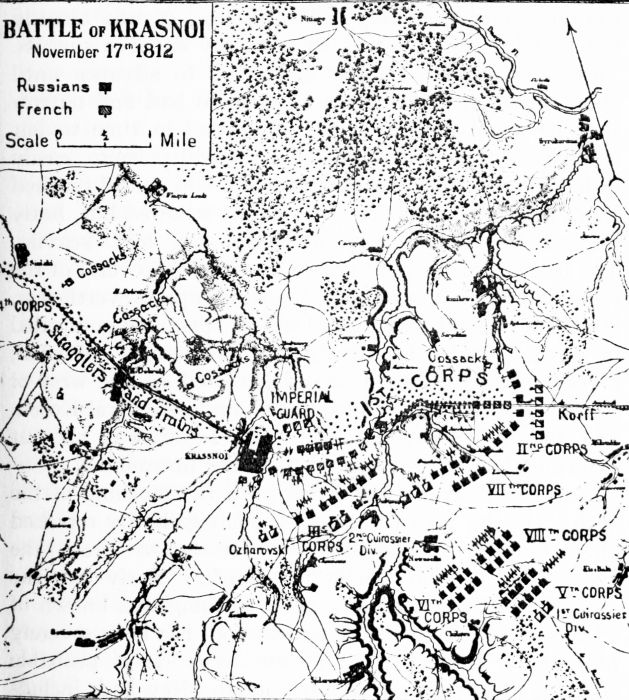
Positions about 10 a.m. on the 17th when Davout effected his junction with Napoleon
As soon as Davout and Mortier had established communication, Napoleon began to retire upon Liadi with the Old Guard and the cavalry, except the Dutch Grenadiers and Lancers, whom he left to support Mortier. Miloradovich and Golitzin were now in touch, and began to press vigorously. A murderous cannonade was directed upon the thin French line south of Krasnoï, and under cover of it the Russian infantry advanced. The Dutch Grenadiers, shattered by artillery fire, fell out of the line, and the young “Flanqueurs-Chasseurs,” who were ordered by Roguet to take their place, could not bear up against the iron hail. To support them Roguet sent the 1st Voltigeurs and the Fusilier-Grenadiers. The Flanqueurs were extricated, but the Voltigeurs were charged by Duka’s Cuirassiers and destroyed, only forty wounded men escaping. Nevertheless, it was already too late for the Russians to gain any decisive success. Tormazov did not receive his orders to advance until about midday, and the tracks were so bad and narrow that he could not reach the high-road in time to bar Napoleon’s march. Some light cavalry were easily dislodged and the Head-quarters and Old Guard reached Liadi in safety. Mortier and Davout followed but, hotly pressed by Miloradovich and Golitzin, lost heavily. The Dutch Guards were nearly destroyed; several of the regiments of the Young Guard were cut up. Nevertheless, Mortier’s troops and three of Davout’s divisions succeeded in getting away to Liadi, but Friederichs’ division, fiercely pressed in the rear, was assailed on the west of the town by Tormazov’s vanguard, under General Rosen, and nearly destroyed. The 33rd Léger was all but exterminated, only 25 men remaining unwounded.
Ney had defended Smolensk until the morning of the 17th. On the 15th the 4th Regiment gallantly repulsed an attempt of Choglokov’s Division to press the evacuation of the northern suburb. Early on the 17th the force left for Krasnoï. Nothing was known of what was occurring ahead, and Davout has been severely blamed for neglecting to inform Ney. It is probable that his messengers were intercepted. Ney had, including Ricard’s division of the 1st Corps, perhaps nearly 9000 men, but with hardly any cavalry, and only 18 wretchedly horsed guns. He was also encumbered by a horde of 7000 non-combatants. Five thousand sick and wounded were left to perish in Smolensk, many being killed by the explosion of the mines which, in obedience to orders, Ney had laid beneath the ramparts. The first day’s march was unmolested, but on the 18th Ricard’s division, which was in advance, blundered in the fog against Miloradovich, who was in position behind the Lossmina. Surprised and outnumbered by six to one the division lost heavily, and was driven back in disorder along the road to Smolensk. This, however, might have helped Ney, for Miloradovich believed that Ricard’s force was really the whole 3rd Corps, and was therefore taken by surprise when Ney, after rallying the remnants of the 2nd Division, came up towards 3.0 p.m. The Russians, on the advice of Paskievich, formed line as they stood, a battery of 24 guns being placed across the road. Ney’s force, which looked very formidable through the fog, was much overestimated, and the promptitude with which the marshal cleared away some cavalry from a bivouac on his left impressed the Russians. He, on his side, hoped that he had to deal only with a detachment, though Miloradovich sent an officer to summon him to surrender, and informed him that he had the whole Russian army in his front. Ney detained the officer, shots having been fired during the parley, and ordered the attack. Razout’s division went forward with splendid heroism, entered the ravine, breasted its further bank under a furious fire, and almost reached the Russian front when it was crushed by the cannonade and musketry and driven back in wild disorder by a counter-attack of Paskievich’s division. The Uhlans of the Guard charged the relics of the 18th Regiment and captured its eagle. General Razout was wounded, General Lanchantin captured; and only a mere remnant of the gallant force succeeded in withdrawing under cover of Ledru’s division, which sacrificed itself nobly to cover the retreat. At 4.0 p.m. Ney retreated, and so impressed had Miloradovich been by the magnificent audacity of the attack that he made no effective pursuit.
Ney retrograded a short distance on the road to Smolensk, and then turned to the north. He resolved to cross the Dnieper on the ice and make his way to Orsha by the right bank. He had the ice on a streamlet broken to ascertain its direction, and followed its course until the Dnieper was reached. He made a show of bivouacking at a village, but left his fires burning, and, guided by a captured peasant, found a place where the ice on the great river would bear. A thaw was, however, setting in, and though the fighting men mostly succeeded in crossing, the ice broke under the first vehicles. Guns, trains, and wounded were left to their fate on the farther bank; there remained with Ney about 3000 exhausted and starving foot-soldiers. The only favourable circumstance was that the cold had ceased. But on the 19th Platov was upon them with his Cossacks, and all the way to Orsha they marched in the midst of his squadrons, repeatedly cannonaded by his sledge-artillery. The details of the daring march are vividly related by De Fezensac, but in a work such as this there is little space for them. Ney kept the weary handful of troops together by the sheer magnetic force of his personality. On nearing Orsha the road was found to be barred by fires, but the Marshal ordered the charge, and they were found unguarded, having been lighted in order to terrorise him into halting. At midnight on the 21st the force reached the Vitebsk road about 8 miles from Orsha, where a column which Eugène had led forth to succour it was encountered. So the heroic episode ended. Of the 3rd Corps and Ricard’s division there survived not 1500 armed men.
While Ney was making his way to Orsha by the north bank of the Dnieper, Napoleon had arrived there on the 19th. Krasnoï, ill-planned and ill-fought as it was, was Kutuzov’s last—or only—serious effort. He remained in the neighbourhood of the battle-field until the 19th, made two marches, halted for a day, and then made two easy marches to Kopys on the Dnieper, south of Orsha. His army was certainly greatly weakened and fatigued; but he might have achieved much by a persistent and resolute advance. The result of his practical inaction was that the small remains of Napoleon’s fighting force were able to make their way to Orsha unmolested by the enemy.
In spite of mismanagement and timidity the fighting round Krasnoï was fearfully disastrous. The Napoleonic army had lost probably 10,000 men in action. The Russians claimed 26,170 prisoners, but at least half of these were the disbanded fugitives; over 100 guns were taken on the field, and 112 more had been abandoned. Baggage had been taken literally in heaps. As against this the Russians only admitted a loss of 2000 men; and it is possible that this is not a gross misstatement.
FOOTNOTES:
CHAPTER XIII
ORSHA TO THE BEREZINA
Napoleon reached Orsha on November 19th, and at once set strenuously to work to restore order. Stringent orders were given that all stragglers were to rejoin their respective corps in specified localities. What effect these orders produced cannot easily be estimated; demoralisation was so advanced and the mass of disbanded troops so great, that it appears that little could be done to reform the skeleton units.
Something, however, could be done to rally and refresh the scanty relics of the fighting force. There were in the town stores sufficient to supply the troops with food for some days. There were, apparently, fifty guns, some hundreds of horses, and Eblé’s reserve train of sixty pontoons with all its equipment. Six batteries were organised out of the artillery, each of six guns. Two went to Davout, who had saved only eight guns out of 150; two to Eugène, who had not one left; two were assigned to Latour-Maubourg—for what reason is not very clear. Mounted cavalry officers were collected into what was called the Sacred Squadron, under Grouchy. It has been stated that it was destroyed as soon as created; but it was certainly in existence a week later.
Severe orders were issued to destroy superfluous vehicles, and to hand over the horses thus freed to the artillery. Generals were restricted to a single vehicle, and soldiers were forbidden to possess carts or pack-horses. These orders were largely non-effective; there were not gendarmes and faithful troops enough to execute them, and too many people interested in resisting or neglecting them—as the passage of the Berezina was soon to show.
Reasonable and necessary as it undoubtedly was to diminish the mass of baggage and assist the artillery, it was surely the height of imprudence to destroy the bridge-train. Eblé, alive to the danger, pressed to be allowed to keep fifteen pontoons, but in vain, and he could only save 2 field forges, 2 waggons of charcoal and 6 of implements. At Smolensk he had seen to it that each man carried a tool, and a supply of clamps and large nails. To his wise precautions the piteous remnants of the Grande Armée were to owe their salvation. When Napoleon gave the order to burn the pontoons, Chichagov had been four days in possession of Minsk, and was already close to Borisov with his advance-guard! Comment is needless.
Victor remained at Chereia until November 10th. Oudinot, who had now recovered from his wound, resumed the command of the 2nd Corps. The army at Chereia was thus commanded by two independent generals who would probably disagree. Victor was the senior officer, but not definitely the commander-in-chief; and Napoleon in his orders merely bids him to concert measures with Oudinot. Probably on the 9th, Victor received an urgent order written by Napoleon at Mikalevka, to take the offensive and drive back Wittgenstein. He was told that the safety of the Grande Armée depended upon him. The Emperor admitted that it was much fatigued and that the cavalry was dismounted. “March!” ordered the falling giant. “It is the order of the Emperor and of necessity!”
On receipt of this pressing order Victor and Oudinot got under way. But the army was no longer what it had been a fortnight previously. The troops appear still to have been well clothed; they had availed themselves of convoys intended for the Poles. Food does not appear to have been lacking. But the weather was bitterly cold, the ground covered with snow, and the numbers were steadily dwindling. It is probable that the two corps did not muster over 30,000 men on November 14th. Wittgenstein, exclusive of Vlastov, had as many, and his position behind the Ula and the Lukomlia was strong. His army was now distributed in four small corps under Lieutenant-Generals Count Steingell, Prince Iachvil, Berg, and Major-General Fock.
Oudinot is said by De Chambray to have advocated a direct attack, but Victor considered it too risky, and it was decided to endeavour to turn the Russian left. On November 11th, therefore, the French army, the 9th Corps leading, advanced to Lukoml, about 10 miles south of Chasniki, and thence moved eastward across the Lukomlia and the Usveia upon Smoliani, a village lying beyond Wittgenstein’s left flank. On the 13th Partouneaux’s division, which formed the advance-guard, found that of Wittgenstein in position across the road and drove it back upon Smoliani with heavy loss, including several hundred prisoners. Wittgenstein, seeing that his left was threatened, changed front in that direction and sent forward Prince Iachvil to reinforce and rally the advance-guard. With the rest of his army he took up a position along the Lukomlia. His line extended for about a mile and a half, generally in advance of the frozen stream, its front being covered by three large ponds, beyond which lay Smoliani. Steingell’s troops were on the right and Berg’s on the left. Iachvil’s would form the centre. Fock’s division was stationed in the bend of the Ula below Chasniki.
On the morning of the 14th Partouneaux’s division moved upon Smoliani, Iachvil retiring steadily before him into the Russian main line. Partouneaux developed an attack on the village, and easily captured it, but was checked by the fire of the Russian artillery. Steingell then sent forward some troops and retook Smoliani. Round this outpost of the Russian line a brisk conflict lasted through the rest of the short winter’s day. Its possession was, indeed, of slight importance; and, since the Russians declined to be cowed by the threat of a turning movement, Victor’s bolt was practically shot. Except for an attempted demonstration by Victor’s cavalry on his right, the fighting elsewhere was confined to a cannonade. The 2nd Corps and the bulk of the Russian army were not engaged at all. On neither side were the losses heavy. Victor may have had about 1400 killed and wounded. The Russians claimed 900 prisoners—probably a great exaggeration. Their own losses during the two days probably totalled 2000.
Victor could now only retreat. He did not know the real state of the central army, but he did know that his dwindling force was Napoleon’s last reserve. On the 17th the two corps were once more about Chereia. There they might at least hope to hold back Wittgenstein from the vitally important high-road.
Wrede, after Polotsk, had, as has been seen, fallen back to cover Vilna. He retired through Glubokoië to Danilovichi, and was there reinforced by Coutard’s brigade, Lithuanian levies, and various drafts, until on November 18th he had some 11,000 men. Vlastov, after the action of Smoliani, had been drawn in by Wittgenstein, and Wrede reoccupied Glubokoië on the 19th, having previously sent Corbineau to rejoin Oudinot.
At Riga Essen had been succeeded in the command by Paulucci. The field force of the garrison was spread out on the left bank of the Düna. Its line was very extensive, and the troops on the left, under Lewis, were dangerously exposed. On November 15th, therefore, Macdonald made an attack upon them with Massenbach’s Prussian cavalry division, a brigade of Prussian infantry and one of Poles. Lewis, cut off and hotly pressed, only succeeded in escaping by crossing the Düna on the ice. This sharp lesson made Paulucci cautious, and some weeks passed away in tranquillity, Macdonald growing more and more uneasy at the bad news which began to filter through to him, and not at all on good terms with Yorck.
While Schwarzenberg was following Sacken, Admiral Chichagov pursued his way to Minsk. The town was full of vast magazines of every kind, besides thousands of sick and wounded. Yet no attempt had been made to fortify it, and the force immediately available for its defence consisted only of two small French battalions, a weak Württemberg regiment, some depôts, and 4 Lithuanian battalions and 4 squadrons newly raised and untrustworthy. Instead of keeping his troops united near Minsk and Borisov, Bronikowski formed a field force under General Kossecki, which he sent forward on the road to Slonim. Dombrowski, hearing of Chichagov’s advance, hastened to collect his division, but it was so scattered in his effort to fulfil his multitudinous duties that it could not arrive in time.
Having once made up his mind to ignore Schwarzenberg and push on to Minsk, the Admiral wasted no time. He sent off Colonel Chernishev with a regiment of Cossacks to explain the situation to Wittgenstein, and on November 9th started Lambert and Sabaniev for Minsk. In defence of his slowness hitherto it must be said that, besides the menace of Schwarzenberg in his rear, he was much pestered by orders from Kutuzov, which were usually too old to be applicable to the situation. He was directed to entrench himself on the Berezina, and he had only a single competent engineer officer. He was ordered to reinforce the garrison of Kiev, lest Napoleon should follow the example of Charles XII and move southward! To further weaken his army was madness, but Chichagov diverted some drafts to Kiev, and held on for Minsk, Lambert leading, Sabaniev and Voïnov following, and Chaplitz bringing up the rear. At Nesvizh, on the 12th, General Lüders joined. On the 13th Kossecki’s column was found by Lambert holding the bridge over the Niemen at Novi-Svergen. Kossecki had only 4 Lithuanian battalions and a solitary gun. He had vainly represented to Bronikowski the strength of the advancing enemy, and begged permission to retire. Lambert easily carried the bridge, capturing the gun and about 1000 prisoners. Kossecki fell back towards Minsk, and on the way was reinforced by a small battalion of the French 46th, 300 French cavalry, 150 Württembergers and 2 guns. On the 15th he was overtaken by Lambert at Koidanow, 18 miles from Minsk, and, after a running fight of several miles, his force was destroyed, only the remnant of the French cavalry, which had fought splendidly, reaching Minsk. The consequences were fatal. Dombrowski was still over 20 miles distant with his advance-guard; not 1500 troops remained in Minsk and Borisov; and Lambert was already half-way from Koidanow. Dombrowski, who had himself hurried on in advance of his troops, saw nothing for it but to abandon Minsk. Next day Bronikowski, with about 1000 men, retreated on Borisov, while Dombrowski turned his troops back to Berezino, hoping thence to reach Borisov before the Russians. Minsk was occupied by Lambert in the afternoon, and there he found no less than 2,000,000 rations of food and 4700 sick and wounded. The hospitals were found to be in a shocking condition.
Chichagov’s whole army was in Minsk by the 18th, and a halt was made to rough-shoe the horses and rest the men. Ertel should have been at hand with his corps; but on pretext of sickness he was still at Mazyr, and only a detachment of 6 battalions, 4 squadrons and a Cossack regiment had been sent forward to Igumen. Chichagov at once despatched Major-General Tuchkov II to supersede him.
On the 19th the Admiral started Lambert for Borisov and Chaplitz for Zembin. Next day Sabaniev marched in the track of Lambert, and Voïnov after Chaplitz. Chichagov accompanied Voïnov, while Langeron was with Sabaniev. A small garrison was left in Minsk, and the Cossack Colonel Lukovkin sent towards Igumen to observe Dombrowski.
Bronikowski had at Borisov and Vseselovo less than 2000 men. Dombrowski reached Borisov at midnight on the 20th, bringing with him 6 battalions and 6 squadrons of his division; his other infantry regiment and 2 squadrons were still behind. Arriving in the dark he bivouacked on the left bank. A French battalion occupied the tête du pont, the 7th Württembergers Borisov; the rest of Bronikowski’s force was at Veselovo, several miles higher up the river opposite Zembin.
Lambert had with him 5 infantry regiments, 28 squadrons and some Cossacks—about 8000 men and 36 guns. Against him Dombrowski could bring less than 5000 in all, with, apparently, 34 guns.
Lambert attacked the bridge-head early on the 21st. The French battalion was driven out, but the Württembergers hurried up from the rear, repulsed the Russians, and gave Dombrowski time to arrive. Again and again Lambert assaulted the works in vain; and the fight raged obstinately well into the afternoon, the 1st and 6th Polish regiments, with their French and German comrades, resisting with magnificent courage. Lambert himself was dangerously wounded. Towards evening, however, the 14th Chasseurs succeeded in turning the works on the right by slipping through a gully, while the bulk of Lambert’s division again assailed them in front. They were finally carried, and the adventurous 14th pressed on so impetuously that they passed the bridge with the flying foe and saved it from destruction. The remains of Dombrowski’s force were hurled through the town in utter confusion, despite their desperate attempts to rally, and pursued by the Russian cavalry towards Lochnitza, on the road to Orsha. Langeron arrived with his leading troops towards the close of the action, and in the evening was joined by Chichagov and Voïnov.
On the Russian side more than 1500 men were killed and wounded, General Engelhart being among the former and Lambert among the latter. Dombrowski’s force lost over 3000 men killed, wounded, and prisoners. Twenty-four guns were taken by the victors.[8] Dombrowski’s rear-guard regiment was attacked on the march by Colonel Lukovkin, and severely mauled before it could recover from the surprise and beat off the Cossacks.
The position of Napoleon now appeared desperate. Seventy thousand men, inspirited by success, were preparing to bar his retreat to the frontier; Minsk and Vitebsk with their magazines, Borisov with its all-important bridge, had passed into the enemy’s hands, and Schwarzenberg, with the one powerful force that remained at Napoleon’s disposal, had been drawn far away to the south-west. The Emperor had with him about Orsha only some 25,000 demoralised men, surrounded by a helpless mob of 40,000 non-combatants of both sexes, the majority in the last stages of misery and despair. He had scarcely any effective cavalry, and not more than 110 badly horsed guns, while to his left rear was a pursuing army three times his strength. So must the position of the defeated conqueror have presented itself to his dismayed followers. It now remains to review the circumstances which rendered it, terrible as it undoubtedly was, somewhat less critical than it might have been.
After Krasnoï, Kutuzov had practically abandoned the pursuit. The condition of his army was very serious; the number of men in the ranks was diminishing daily, while the horses were rapidly breaking down under the effects of hard marching, little forage, and constantly remaining saddled. Buturlin states that the loss by fatigue and hardship since October 24th already amounted to 30,000 men.
In direct pursuit of Napoleon, Kutuzov sent forward the various flying columns and Cossack detachments, and a special force under Yermólov, consisting of the Chasseurs of the Guard, six battalions of Dokhturov’s corps, 2 regiments of Cossacks and 12 guns. The united force of these detachments may be estimated at 20,000 men and 40 guns. The vanguard of Miloradovich, which was to follow in support, totalled also about 20,000 men. A regiment of Chasseurs had been left to garrison Smolensk. With the rest of the army Kutuzov marched slowly to Kopys, which he reached on the 24th, Miloradovich being about two marches farther on, and Yermólov and Platov were in advance of the vanguard. Kutuzov left the guns of 12 batteries at Kopys, using their men and horses to complete weakened units, and detailed to escort them the remains of the light cavalry of the Guard. On the 26th he left Kopys with a force reduced now to about 40,000 men and 200 guns. Napoleon was already at the Berezina, and for all practical purposes the Russian Grand Army was off the board at the decisive moment. What was worse, though his information was naturally out of date, Kutuzov still endeavoured to control the operations of Chichagov and Wittgenstein.
Chichagov on the Berezina was in a state of great uncertainty. His army was not now more than 33,000 strong, and his 10,000 cavalry were almost useless on the wooded and marshy banks of the river. He was without information of the main armies later than the evacuation of Moscow. On the evening of the 21st the Comte de Rochechouart, one of the Admiral’s French émigré staff-officers, found among Bronikowski’s half-burnt papers a despatch from Victor, stating that Napoleon would probably reach Borisov on the 23rd. The news must have been something of a shock to Chichagov, since he naturally expected to be attacked by greatly superior numbers. His conduct at this juncture has been sharply criticised, yet one does not well see what else he could have done. He moved forward the advance-guard, now commanded by Major-General Pahlen II, towards Lochnitza, on the Orsha road, to give warning of any hostile advance, established his head-quarters in Borisov, and kept the bulk of his force on the right bank of the river. His errors appear to have been that he allowed too much of his baggage trains to cross, and permitted a large detachment of his cavalry to disperse to forage; the latter step may, however, have been necessary. The point is that Chichagov was ignorant of the deplorable condition of the Moscow army, and rather expecting to be himself attacked.
Wittgenstein, on his side, possessed very scanty information about the general state of affairs, and his staff estimated Napoleon’s strength as at least 60,000. The result was that his movements were extremely slow and circumspect.
In other words, while the destruction of the remnant of Napoleon’s forces was inevitable if all his adversaries showed energy, it was already becoming apparent that this would not be the case, and that he would have an opportunity of escaping.
Napoleon learned of the fall of Minsk while on the march to Orsha, and despatched orders to Oudinot to march to Borisov to secure the passage. On the 20th Victor was directed to cover the march on Borisov, which he was to reach on the 26th.
Oudinot was timed to arrive on the 24th, and since he had only about 50 miles to march, the Emperor did not imagine the position to be desperate. Oudinot, perhaps more alive to it, reached Borisov on the 23rd. On the 22nd he was rejoined by Corbineau, who, after a skirmish with Chernishev’s Cossacks, found himself cut off from Borisov by Chichagov’s army, and was guided by a peasant to a ford at Studianka, about 8 miles higher up.
Napoleon, with the Guard and head-quarters, left Orsha on the 20th and arrived on the 22nd at Tolochin. There were in the place considerable stores, and Napoleon halted for 24 hours. There he was joined by Ney with the relics of his command, Davout now resuming rear-guard duty. Platov occupied Orsha on the afternoon of the 21st. He captured 21 abandoned guns, some stores, a mass of trains, and thousands of sick and wounded, all of whom perished. The Russians had not the means of succouring them, even had they possessed the will to do so.
Junot and Zayonczek, with the remains of the 5th and 8th Corps and the dismounted cavalry, were in advance; then came the Guard and head-quarters, Ney, Eugène and Davout. Davout may have had remaining about 6000 men, Eugène perhaps 3000, Ney 1500, Junot and Zayonczek possibly each 1000; to the former were attached about 1000 dismounted horsemen. The Guard may have been 9000 infantry and artillery and 1500 cavalry strong. A few hundred only of the line cavalry still retained horses. It was with the greatest difficulty that the fighting troops could force their way through the helpless horde of stragglers and disarmed fugitives which covered the road. The armed soldiers themselves presented a miserable spectacle. A mournful silence reigned in the shattered ranks; the men plodded along mechanically, huddling themselves in their rags; little was heard save the shuffling of feet in the snow and slush. Vaudoncourt records his feelings of horror when he met the advance-guard and saw the dismounted Cuirassiers, ragged, bare-footed, emaciated, wretched beyond belief, dragging themselves painfully along the roads.
An incident typical of the absolute callousness to which misery had reduced everyone is related by Lejeune, who had succeeded Romœuf as Davout’s chief-of-staff. At Krupki, near Borisov, Davout’s staff found two babies in the house occupied by them. Lejeune begged the Marshal’s steward to try and give them a little broth. None was forthcoming, and the steward at last, distressed by the continued wailing of the little creatures, drowned them! Wilson, too, tells how the Grand Duke Constantine, out of sheer humanity, as he declared, “put out of his misery” a stripped and perishing French officer.
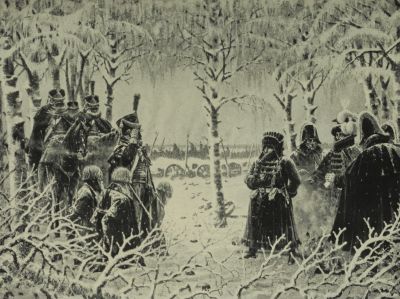
NAPOLEON, BERTHIER, MURAT, AND RAPP (IN THE ORDER NAMED) ROUND CAMP FIRE Russian peasants brought in prisoners by French Chasseurs-à-cheval From the picture by Verestchagin
On the 22nd Napoleon heard from Oudinot that Chichagov had captured Borisov and that he himself was on the way to retake it. The Emperor replied in a somewhat incoherent letter, instructing him to seize a point of passage, and interspersing orders and intelligence with agitated appeals to the Marshal’s energy and devotion. The last were not needed. Oudinot’s intellectual capacity was not great, but his devotion was undoubted, and he never served Napoleon so well as in the terrible days that followed.
Oudinot on the 23rd picked up Dombrowski and the remains of his force. He placed the remains of his cavalry at the head of the advance, with Legrand’s division in support; and in the afternoon fell upon Pahlen near Lochnitza. The Russians were taken entirely by surprise, largely apparently because of their leader’s negligence, and, veterans as they were, broke and fled headlong. They poured in mad panic into Borisov just as Chichagov and his staff were dining. Everybody seems to have lost his head, and the place was abandoned in haste and complete disorder. All the baggage which had crossed the river was left behind as the prey of the 2nd Corps—much to its benefit. Voïnov hurried up 4 battalions, which occupied the houses near the bridge, and enabled the panic-stricken mob to crowd across in safety. The bridge was then broken, and despite their really brilliant success the passage of the river was closed to the French. The Russians had lost in their panic flight about 1000 men in all and a quantity of baggage, including the Admiral’s camp service and portfolio; but no guns were lost—probably rather owing to good fortune than good management. Langeron sneers bitterly at his chief, but the fault was obviously that of Pahlen and his advance-guard, who should not have permitted themselves to be surprised by a small force of cavalry.
On November 23rd Napoleon with his leading troops reached Bobr, a town of 300 houses, about 35 miles from Borisov. Victor was falling back towards the road from Chereia, and on this day Billard’s brigade of Partouneaux’s division had a sharp encounter with Wittgenstein’s advance-guard under Vlastov. Billard was driven back with considerable loss, which was, however, much exaggerated by the Russians, though a battalion of the 126th Regiment was completely destroyed. Wittgenstein might have done much more, but he was very circumspect and timid, and Clausewitz hints that he was not greatly disposed to co-operate cordially with Chichagov. The latter expected him to unite with his own army behind the river, according to the Tzar’s directions; and so also did Napoleon, who ordered Victor to endeavour to bar his march on Zembin. The Marshal could not obey, for he was already too far south, having acted upon previous instructions given when Napoleon was still uncertain as to the point at which he should cross the Berezina. Otherwise Napoleon till the last dangerously underestimated Wittgenstein’s strength, and wrote as if Victor could easily defeat him.
At Bobr Napoleon received the crushing news of the failure to save the bridge of Borisov. All now depended upon the bridging of the river. Eblé, with his pontonniers and his inestimable convoy of implements, was ordered forward, while General Chasseloup was directed also to the Berezina with all the sappers and artificers who could be collected, but they were without forges and almost destitute of ordinary hand tools. Stringent orders were given to destroy superfluous vehicles and hand over their horses to the artillery. Needless to say, they were generally evaded. Davout was directed to hold firm as long as possible in order to give the miserable mob of non-combatants time to escape. It would have been better had the humane order never been issued. Most of the non-combatants were doomed, and the lives of devoted officers and soldiers were wasted in protecting them. At Bobr d’Alorna rejoined with the garrison of Mohilev. His 1500 men and the remains of the 5th Corps and Claparède’s division were united to the relics of the 3rd Corps, thus giving Ney a force of about 6000 men and 30 guns.
Oudinot also, on the banks of the Berezina, was doing his best. He was, as usual with Napoleon’s generals, timid of responsibility; but having made up his mind he acted with excellent judgment. Having obtained, despite all difficulties, information as to the points of passage, he, about midday on the 24th, selected Studianka, and directed thither his small, ill-trained, and ill-equipped force of artificers. He informed Napoleon frankly of the difficulty of his task; the enemy were keenly watching the course of the river. To distract Chichagov he made demonstrations above and below Borisov, and noted that the Russians seemed inclined to expect the French advance rather below than above. Napoleon, after a conference with Generals Dode and Jomini, who knew the course of the river, also decided to force a passage above Borisov, and indicated the ford at Veselovo, 15 miles above that town. When the order arrived, however, the Marshal had already selected Studianka.
The frost, which had ceased since the 18th, was now setting in again. On the one hand, the slightly alleviated misery in the army now again began to increase. On the other, it hardened the low, marshy banks of the Berezina and enabled the French to transport their artillery and trains. Opposite to Studianka, about a mile from the right bank, ran the Borisov-Zembin road, by which the army must defile in order to gain the Minsk-Vilna highway at Molodechno. Behind Studianka the ground rose, and artillery could be placed in position to command the low opposite bank. Studianka itself was a fair-sized village, and its houses afforded timber useful for the construction of bridges.
We must now turn to Chichagov, who has been made by Russians the scapegoat for the escape of Napoleon. In the first place, he believed that Napoleon had 70,000 or 80,000 men against his 32,000. Next, he had been informed by Wittgenstein that Napoleon was, in his opinion, retreating in the direction of Bobruisk. The Admiral was confirmed in this by intelligence that Austrian cavalry scouts were on the Minsk-Bobruisk road. Chichagov’s dispositions in these circumstances were perfectly sound. Chaplitz, who had been watching the upper Berezina for some time, remained near Brelova, nearly opposite Studianka; while Voïnov and Sabaniev, with Pahlen’s rallied force, were concentrated round Borisov, ready to act in force in any direction.
On the 25th he received a despatch from Kutuzov. It was not a direct order, but, coming from the commander-in-chief, it naturally had great weight with the Admiral. It suggested that Napoleon would probably move southward towards Bobruisk to cross the lower Berezina. At the same time, Major-General O’Rourke and Colonel Lukovkin reported that they had found Polish troops lower down (these were Dombrowski’s belated detachments).
Chichagov, assuming that Kutuzov had good reason for sending his despatch, and considering the intelligence sent by his detachment commanders, concluded that Napoleon’s rumoured southern movement was a reality; and, on the 25th, leaving Pahlen at Borisov, and ordering Chaplitz to draw in to him, he marched off with Voïnov and Sabaniev to Chabachevichi, some 15 miles down the Berezina. Langeron says that both he and Sabaniev endeavoured to dissuade him—Sabaniev apparently losing his temper. Chichagov, however, persisted, and considering everything it is difficult to see what else he could have done, misled as he was by bad information from every side. On the 25th Napoleon himself reached Borisov, and was seen by Langeron and his staff, much to their consternation, as the only force at hand to oppose him was Pahlen’s weakened advance-guard. The French Guards were in Borisov; the rest of the Moscow remnant between Borisov and Krupki, two marches to the rear. Oudinot was at Studianka; Victor rather to the north of Davout at Krupki, in order to cover him against Victor. Davout since Orsha had been only harassed by Cossacks. The bulk of Wittgenstein’s slowly advancing force was at Kolopenichi, 27 miles north-east of Borisov: Platov was east of Krupki, and Yermólov at Maliavka, near Bobr.
General Aubry, Oudinot’s chief of artillery, began to fell trees and construct trestles for bridges immediately upon arriving at Studianka, but unfortunately they proved too weak. As soon as it was dark Oudinot started his artillery for the selected point of passage, and as night drew its veil over the dreary banks of the Berezina, Generals Eblé and Chasseloup reached Studianka with their men and their slender equipment, and began in earnest to construct bridges. All night they laboured to prepare the supports, and at 8 a.m. on the 26th the first trestle was fixed in position. It had been hoped to throw three bridges, but there were scarce enough materials for two. Chasseloup soon saw that the hopeless deficiency of equipment of his engineers would prevent him from doing anything independently; he therefore brought his men to help Eblé, the engineers working at the preparation of trestles and floors while the pontonniers fixed them.
The fate of the relics of the Grande Armée now rested, humanly speaking, in the hands of a prematurely aged and physically broken man of fifty-five years of age, who had never, under Napoleon, received employment equal to his merits. The name of Jean Baptiste Eblé is one to be uttered with all honour and reverence as that of a man who, besides being a master of his profession, was in very truth a hero, upright, modest, self-sacrificing, and literally faithful unto death. One seeks not for purity or an exalted standard of duty among the rough and greedy fighters about Napoleon. Exceptions there were, but they were comparatively few; and so one turns with peculiar respect towards the simple, gracious figure of Eblé.
Early on the 26th Eblé verified the width and depth of the river. The latter had increased, owing to a freshet, since Corbineau’s crossing from 3½ feet to 5.
Besides pushing on the preparations for the bridges, the engineers constructed three small rafts, by which some 400 infantry were ferried over to guard the bridge-head, accompanied by some of Corbineau’s troopers, who forded the river with foot soldiers behind them.
The cold was bitter; the water was already freezing; and the pontonniers would have to work in it up to their shoulders. The ordeal meant certain death to almost all; but the men answered the call of their chief with a heroism as high as his own. They were relieved every 15 minutes and were promised special rewards, but five-sixths of them perished. There were 7 companies in all, about 400 men, of whom 100 were Dutch.
The bridges were placed 200 yards apart. Each had 23 sets of trestles (chevalets). That on the right was intended only for troops. It was terribly weak. Suitable wood for the roadway was lacking, but the engineers patched up one of planks nailed one upon another, and laid brushwood and twigs upon it to lessen the strain. The roadway was in places nearly level with the water; there were no rails. The left-hand bridge was intended for artillery and baggage. It was more solid than the other; but still very weak, and as there was no time to square them the roadway was constructed of rough logs, the passage over which of vehicles occasioned continued joltings which impaired the stability of the frail structure.
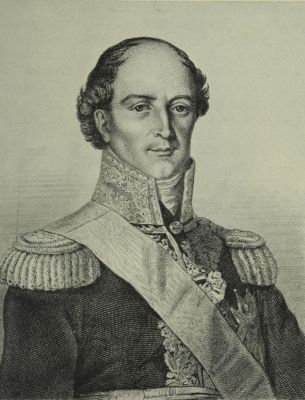
GENERAL BARON EBLÉ Commander of the Bridge Trains of the Grand Army in 1812
Napoleon himself, with his Head-quarters and Guard, reached Studianka early on the 26th. He came to the head of the bridges and there remained until they were completed, personally supervising the construction. In the intervals when he could do nothing he sat on a pile of logs on the bank, gloomily gazing upon the slowly progressing structures on which his last hopes rested. More than once he asked Eblé to hurry. The General pointed to his devoted pontonniers working themselves to death in the icy stream, and the Emperor could say no more. What he could do to relieve them he apparently did, sometimes helping with his own hands to serve them out brandy.
The artillery of the Guard and of the 2nd Corps was massed behind Studianka ready to open fire as soon as the Russians should show themselves. But Chaplitz was already withdrawing through the woods to Borisov; only a weak rear-guard with 2 light guns remained opposite the village. Chaplitz’s worst fault was to neglect to destroy the long wooden bridges on which the Zembin road crossed the marshes. He was a brave and a good officer, but on this occasion failed much in the performance of his duty.
At 1 p.m. the right-hand bridge was completed, and at once Napoleon gave the order to Oudinot’s corps to cross. With the addition of Dombrowski’s Poles it appears to have been nearly 11,000 strong. Some of its regiments were reduced to mere skeletons; but others were still relatively strong. They were generally well clothed and in good order, and their still unbroken spirit appeared in the lately unaccustomed cheers with which they hailed Napoleon as they defiled past him. The Swiss regiments were especially solid and eager. Only 2 guns were taken across for fear of injuring the bridge. The advance-guard easily cleared away Chaplitz’s feeble rear-guard, and moved forward on the Borisov road until it found Chaplitz, reinforced by Pahlen, in position across its path. Reconnaissances despatched to Zembin found the Vilna road clear, and the Emperor decided to give up any intention of reaching Minsk and to move upon Vilna.
The heavier bridge was ready at 4 p.m., and the artillery of the Guard and Oudinot’s corps began to pass. At 8 p.m. three sets of trestles gave way. Half the pontonniers were called upon and, worn out with desperate toil and sunk in sleep as they were, they answered Eblé’s call. By 11 p.m. the breakage was repaired, and the rest of the artillery, the remains of the reserve park, and Ney’s corps began to cross.
At 2 a.m. on the 27th the bridge broke in the centre; three sets of trestles were destroyed. The second half of the pontonniers were called upon. Eblé himself chose good sound wood and superintended the making of new ones, while the heroic pontonniers sacrificed themselves as nobly as before. At 6 a.m. the damage was repaired and the passage proceeded. The bridge broke again at 4 p.m., two trestles giving way. It was repaired by 6 p.m.
The supports of the troop bridge held firm, but the weak roadway was continually breaking, and the devoted engineers were at work upon it with little intermission. It was so frail and swayed so badly that it is remarkable that it did not collapse.
Napoleon, with the Head-quarters and the Guard (less Claparède), crossed about 1 p.m. on the 27th. As yet no very great number of the non-combatants had arrived, and they were mostly employees of the army who crossed with their corps. The disbanded mob was flocking into Borisov ahead of Eugène and Davout. It was amenable to no control, and, as aforesaid, Napoleon’s order to the rear-guard to hold back was little likely to save it from destruction.
Chichagov, on reaching Chabachevichi, sent patrols across the river which failed to locate the enemy, and the Admiral became aware that he had been misled. He once more turned his troops towards Borisov, which they re-entered on the evening of the 26th. He directed Langeron to do what he could to reinforce Chaplitz, adding that he was coming up with all speed. Everybody, according to the bitter Langeron, was cursing “this miserable sailor.” They, however, did not know the circumstances, and might have cursed the high and well-born Prince Golénischev-Kutuzov with better reason. Langeron took forward Pahlen’s infantry to reinforce Chaplitz; he says—certainly with exaggeration—that there were only 1200 of them. Voïnov’s and Sabaniev’s troops, after a 30 miles march in frost and snow, were in no condition for battle, and the Army of the Danube had to remain at rest on the 27th. Without wishing entirely to absolve Chichagov, it appears to the writer that the chief blame must be laid upon Kutuzov, who lagged behind and sent misleading intelligence. Blame also attaches to Chaplitz for his negligence at Zembin. Yet it must be observed that he probably expected, with the rest of Chichagov’s officers, that Napoleon would retreat upon Minsk, and therefore drew in the detachment, which might otherwise have been cut off. Chichagov cannot be blamed for resting during the 27th. Borisov was full of French, who might attempt to force a passage there. They were mostly non-combatants, but this could not of course be ascertained with certainty. For the rest his troops were weary.
Wittgenstein was probably more blameworthy than the much abused Admiral. His pursuit of Victor was unenergetic; despite his double superiority of numbers, he made no attempt to press. He was in fear that Napoleon would turn his own right flank and retreat by Lepel to Vilna; and this was in fact one of the Emperor’s alternative plans. He moved so cautiously that on the 25th his advance-guard did not touch the rear-guard of Victor, who fell back unmolested towards the high-road at Borisov. Reconnaissances made it clear that Napoleon was not moving past the Russian right and Wittgenstein advanced to Kostritza, only 8 miles from Borisov and about 10 east of Studianka. Victor reached Borisov in safety; and Eugène and Davout moved on to Studianka, where they arrived at dusk on the 27th. Victor’s move, however, had evil effects; his troops came upon the line of march of the unhappy fugitives from Moscow, and the awful condition of the latter spread demoralisation in the ranks of the 9th Corps. The 2nd Corps had already come in contact with the woeful relics of the Guard and Ney’s corps, and their morale was affected. At Kostritza Wittgenstein learned that the French were at Studianka, but instead of marching thither he directed part of his troops on the 27th on Borisov, part on Staroï Borisov, some miles above the former place. Platov was in touch with Wittgenstein, and Yermólov was on the march to Borisov. There were thus, of Russian troops, on the Berezina the army of Chichagov, 32,000 strong with 180 guns, that of Wittgenstein at least 31,000, and Yermólov’s and Platov’s columns, say 12,000 men and 30 guns, in all 75,000.
As against this large and eager, if partly irregular, force Napoleon is said by De Chambray to have had barely 31,000 men. This figure is certainly too low. De Fezensac believes that he had 50,000 men; and on the whole it is possible that the total number of combatants was about 47,000. It was composed as follows: Guard (less Claparède) 8500, Ney about 5000, Davout 3000, Eugène 2000, Junot 1500 (including dismounted cavalry), Oudinot 11,000 (including Dombrowski), Victor 13,500, Head-quarters 2500. The last item is usually ignored by historians. There were between 250 and 300 guns, and perhaps 5500 effective cavalry, of whom 1500 belonged to the Guard and Head-quarters. But of these troops nearly a third were so worn down by hardship as to be hardly capable of making any great effort.
Eugène and Davout on reaching Studianka crossed in the night, the bitter cold of which went far to achieve the destruction of their few remaining troops. Even Oudinot’s troops, still in comparatively good condition, suffered greatly in their wretched bivouacs in the woods of Stakhov. Behind the 1st and 4th Corps the horde of non-combatants came pouring down to the bridges. The road from Borisov to Studianka was choked with their throngs. Every age and sex was represented in the helpless mass; and there was to be seen human misery in its most hideous aspects. Even more harrowing than the misery and hideous aspect of the fugitives was their utter apathy and helplessness. The crowd heaved itself sluggishly along the tracks in whatever direction it chanced to take or was pushed by moving troops. Most of the wretches who composed it seem to have lost their senses no less than their appearance as more or less civilised human beings. The instincts of comradeship and humanity were almost extinct, and progress was constantly retarded by the brawling and fighting for places in the column of the mass of degraded savages which once had been Napoleon’s Grande Armée.
Snow fell heavily during the night upon the unfortunates huddled shelterless among the woods and marshes. The non-combatants on reaching Studianka would go no further, despite the efforts of Eblé and Chasseloup to induce some of them to cross. Napoleon had issued orders that the passage was to be kept up day and night, but they probably could not be, at any rate were not, executed. The luckless people continued to stream down towards Studianka until the bank for miles was covered with them, and apathetically bivouacked as best they could among their vehicles. Very few appear to have attempted to cross; those who did probably created blockages and disorder, being amenable to no kind of control. The pontonniers and engineers were too few and too weary to enforce order in such a mass. More might have been done had Napoleon personally exerted himself to supervise the passage; unfortunately after the 27th he did nothing.
Victor’s corps on the 26th became the rear-guard, Davout and Eugène passing in advance with the scanty relics of their troops. Victor left Borisov for Studianka on the 27th. The Baden brigade of Dändel’s division marched first and crossed the bridges soon after Napoleon. Victor himself with the rest of Dändel’s troops, Gérard’s Poles and Saxons, and the artillery made his way out of Borisov towards midday, while Partouneaux’s division with 4 guns and Delaître’s cavalry brigade formed the rear-guard. It was to remain at Borisov until dark. Platov was marching upon Borisov; behind him came Wittgenstein with Steingell’s and Berg’s troops. Yermólov was behind. Vlastov’s division was marching upon Staroï Borisov and Fock’s reserve on the way to rejoin.[9]