MY STRANGE RESCUE (continued 5)
Reading edition
The Ribston mansion stood well back from the road, and the orchard lay to its rear.
Charlie therefore thought it well to leave the road before he reached the gate, and to take a slant through the fields that brought him up to the orchard fence about fifty yards behind the house.
Here he crouched down, and listened, with strained ears and throbbing pulses, for the slightest sound that might indicate the proximity of a dog. But not a growl, or bark, or even sniff, broke the clover-scented stillness.
As it chanced, he had hit upon a particularly favourable night for his enterprise, the good squire being wont to spend his Friday evenings with admirable regularity at Doctor Aconite's, where the genial rector of St. David's and important Judge Surrebutter helped to make up a quartette that could play whist by the hour without so much as winking.
For the sake of company on the way home the squire always took his dogs with him, so that until his return, which was never later than eleven o'clock, the Ribston premises were entirely unguarded.
Encouraged by the perfect silence, Charlie gently got over the fence, and making his way to the August pippin-tree, set diligently to work to fill his pillow-slip.
The boughs were bending low beneath their weight of juicy fruit, and he had no need to shake them. There were far more apples within easy reach of his hand than he could carry home.
Five minutes sufficed to fill the pillow-slip, and then, with a vast sigh of relief, he crawled back over the fence, hastened across the field, and came to the fence beside the road.
Knowing nothing of the squire's whist club, he took it for granted that all danger was practically over, and without looking to right or left, he tossed his bag over the fence and vaulted lightly after it.
Hardly had his feet touched the ground than a sharp, suspicious bark came from only a few yards away, and the next moment a collie dog, followed closely by a fox-terrier, bounded toward him, barking fiercely, while looming dimly through the darkness the portly form of their owner could be descried, as he demanded angrily,—
"Who are you? and what are you about?"
Charlie could have answered both questions easily enough had he chosen to do so. But the time did not seem to him altogether favourable, and instead of a verbal reply he picked up his pillow-slip, threw it over his shoulder, and took to his heels, with the dogs after him in full cry.
"Catch him, Grip; catch him, Oscar!" shouted the squire to his dogs, as he joined in the chase with all his might.
Although hardly in condition for a sprinting match, Squire Bibston had been renowned for fleetness of foot in his younger days, and he showed a surprising turn of speed as he dashed down the road after the fleeing boy.
Now, had Charlie dropped his heavy pillow-slip, he might have distanced his human pursuer easily, and as the dogs seemed to be content with barking, and to have no idea of biting, the irate squire would never have known more about the daring raider of his orchard than his strong suspicion that it was one of those rascally Twin Elm boys.
But to let go his burden was the last thing Charlie thought of doing.
To his daring, determined nature only two alternatives presented themselves—escape with his booty or capture red-handed.
So away he sped, holding tight to the pillow-case, the collie and terrier punctuating his strenuous strides with short, sharp barks.
After his first furious spurt, the squire's speed rapidly slackened until it became little more than a laboured jog-trot; and by the time he reached the entrance to the long avenue leading from the main road to the academy, Charlie was under the window and jerking the sheet-rope by way of a signal to the boys to haul him up.
Unfortunately, they were so occupied with some of their nonsense that they did not at first observe the signal, and precious moments were lost before they responded, so that Charlie's anxious ears caught the sound of the squire's panting as he toiled gamely along the avenue.
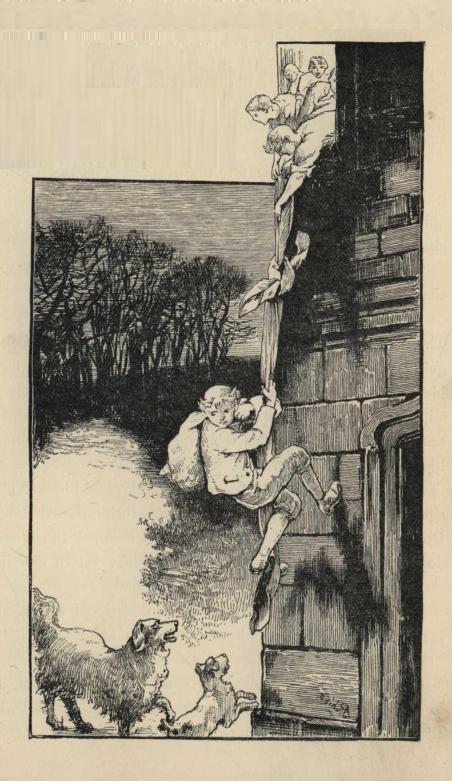
(Charlie climbing the sheet-rope)
"Hurry up, boys!" he called, as loudly as he dared; "the squire's after me!"
The boys responded with a sudden jerk that snatched him off the ground, and nearly made him drop the apples. Then up he went more steadily, foot by foot.
But he was not half-way to the window when the squire, guided by his clever dogs, arrived upon the scene, and in spite of the semi-darkness his keen old eyes took in the situation at a glance.
"Aha, you young scoundrel! I have you now. Take that!"
And he hurled his stout oak cane at the ascending boy. The result greatly exceeded his expectations, for the stick, going straight to its mark, gave Charlie such a stinging blow that he involuntarily let go of the weighty pillow-slip, and down it dropped full upon the squire's pate, crushing his tall gray beaver over his eyes and sending him headlong to the ground.
It was some moments before he could pick himself up again, and by that time Charlie was safe inside the window. Beside himself with wrath, the squire assailed the front door with furious blows, bringing both the tutors out in startled haste.
To them, as well as his breathless, disordered condition permitted, he explained himself, and was at once invited to enter, while Mr. Butler went for Professor Rodwell.
On the professor's arrival all the boys were summoned to appear in the school-room, and presently in they flocked, all but the members of the A. & H. O. A. S. (who, by the way, had managed to get into their night-gowns with marvellous celerity), manifesting their innocence by their unmistakably startled, sleepy faces.
"Are all the boys here?" asked the squire suspiciously, on finding every one arrayed in his night-gown.
Professor Rodwell counted heads carefully.
"Yes, squire, all the boys are present," he replied.
"Humph!" snapped the squire. "A clever trick; but they can't pull the wool over my eyes in that way."
An anxious, expectant hush following, Professor Rodwell addressed the boys in grave yet not unkindly tones:—
"Young gentlemen, it is clear beyond possibility of denial that some of you have been guilty of robbing Squire Ribston's orchard. Now, I dare say, it will not be difficult to trace out the culprits, but I would much prefer that they should acknowledge their wrong-doing of their own accord. I therefore wait to give them the opportunity."
There was but a moment's pause, and then Charlie Draper, stepping forward, said in a steady voice, looking full at Professor Rodwell,—
"It was I that took Squire Ribston's apples. Let me bear all the punishment."
A look of mingled surprise and relief came into the professor's troubled face, and even the squire's anger-wrinkled countenance seemed to take on a softer expression, touched with approval of this frank avowal.
"Charles Draper, I am very sorry," said Professor Rodwell slowly. "Although you've been but a short time with us, I had thought better things of you than this."
Charlie's eyes fell and his lip began to tremble. He was already feeling deep regret for his part in the matter, and these gentle words touched him to the heart.
He was just about to express his contrition and ask for sentence upon himself, when the squire exclaimed,—
"Charlie Draper! is that Charlie Draper?"
"It is," replied Professor Rodwell, wondering why the squire asked.
"The same boy that saved my little grandson Hughie from drowning in Deep Pool a week ago?"
"Yes, squire, the same boy," replied the professor, now beginning to catch the old gentleman's drift.
"Then," cried the squire, who was as quick of generous impulse as he was of temper, jumping from his seat and advancing toward Charlie, "I don't want this thing to go any further.—Here's my hand, my brave lad. You're welcome to every apple on the tree, if you'll only come after them in honest, manly fashion, and not be playing such foolish pranks, skulking through the fields when you ought to be abed.—Come, now, Professor Rodwell, let's cry quits. I'm willing to let the matter rest. Boys will be boys, and if your boys will promise never to go out robbing orchards again, I'll promise to let 'em into my orchard on Saturday afternoons and take every apple they find in the grass so long as the crop lasts."
For a moment the boys were so bewildered by these astounding words that they could hardly credit their ears.
Then a spontaneous cheer burst from their throats, and the upshot of the whole matter was that they heartily gave the promise the squire asked; and the professor, relieved beyond measure at the turn affairs had taken, dismissed them with the understanding that the night's doings should be no further inquired into, provided good behaviour was maintained in future.
The pledge thus given, taking away from the A. & H. O. A. S. its principal reason for existing under that name, did not, however, put an end to its career. It simply altered its title and amended its ways, and continued to flourish as vigorously as before, with Charlie Draper as one of its most popular and active members.
LOST ON LAKE ST. LOUIS.
The great river St. Lawrence, as if not content with its ordinary ample breadth, a few miles above the city of Montreal spreads out into a wide sheet of water which is known as Lake St. Louis. Lake St. Louis is about twelve miles long by eight in width at its widest part, and being famous for its cool breezes, the people from the city go out there in throngs every summer, so that its shores are well populated as long as the thermometer keeps well above the seventy point.
In winter, however, it is very different. Then Jack Frost has a confirmed habit of sending the mercury away down, down, down, not only below freezing-point, but below zero even; and the blue waters of the lake turn into a floor as hard as steel, over which the snows drift and pile up and scatter again in fantastic windrows, until the warm spring sunshine melts them into soggy slush, and a little later rends the solid floor itself asunder and sends it careering down the current in great jagged ice-floes.
There is nothing undecided about a Canadian winter. The frost-king means business from the start, and for three long months keeps a tight grip upon the land. Some winters, of course, he is more tyrannical than others. The Ross boys, for instance, thought that he had never before in their experience been so unmerciful as during the season that the event happened about which I am now going to tell. Day after day for weeks at a time the thermometer would not get up to the zero mark at all, while it would at night drop as much as thirty points below it.
"'Pon my word, this sort of weather isn't fair at all," said Bob Ross, in an impatient tone, at the breakfast-table one morning. "A fellow can hardly stir out of doors without getting his nose or ears nipped. My nose was frost-bitten for the third time last night, and that's a little too much of a good thing for me."
"Right your are, Bob," chimed in Phil, his elder brother, from across the table. "My poor ears have been nipped nobody knows how often. I expect one of them will drop off some fine day."
"It's a keen winter, boys, no doubt," assented Mr. Ross. "I don't remember many as sharp. But the longest winter has an end, and you'll forget all about the cold the first warm day that comes."
"That may be, father," answered Bob, "but I'd like a little mild weather right now if the weather-clerk has no objections. You know we're going over to the church festival at Beauharnois to-morrow night; and an eight-mile tramp in this cold weather is not just what I'm hankering for—though I mean to go all the same."
"Tut! my lad, when I was your age I would have thought nothing of double the distance, if only a certain person were at the end of it," replied Mr. Ross, with a meaning smile at his wife as he added, "But perhaps you have no such attraction."
"Not I," laughed Bob. "I'm going for the sake of the supper; but I won't answer for Phil," looking quizzically at his brother, who blushed violently and made a timely diversion by springing up and saying,—
"Come along, Bob; let us get at our work, cold or no cold."
Whereupon the two lads went off together.
Mr. Eoss owned one of the largest and finest among the many farms that bordered upon Lake St. Louis. Although he was what might be called a gentleman farmer, he was a thoroughly practical farmer too. He made his farm pay him handsomely, and thought so well of his occupation that he had brought up his two boys to follow it also. When they were grown men he would divide the greater part of his property between them, reserving only sufficient to keep himself and his wife in independent comfort during the remainder of their days.
The two sons, Phil and Bob, at the time of my story about sixteen and fourteen years of age respectively, were as satisfactory a pair of boys as parents could wish. One, the elder, tall and dark, the other short and fair, both were strong, healthy, hearty lads, full of spirit, and fond enough of having their own way, but thoroughly sound at heart and passionately fond of father and mother. Although trained to all kinds of farm work, their education had not been by any means neglected. They had had a good share of schooling, and Mr. Ross never went into the city without bringing back a new book or the latest magazine, so that they might keep up with the spirit of the times.
The church festival Bob spoke of was to take place the following evening at Beauharnois, a village that stood straight across the lake "as the crow flies" a distance of about eight miles. The snow was in capital condition for snow-shoeing, and the two sturdy boys thought nothing of the tramp there and back. They would start from home at four in the afternoon, make Beauharnois about six, enjoy themselves there to the best of their ability until ten, and then set off for home, where they ought to turn up soon after midnight.
Much to their gratification, the cold next morning showed signs of moderating.
"Looks as if the weather-clerk was interested in the festival," remarked Phil in the course of the morning, his beaming face revealing clearly enough that others than the weather-clerk were interested in the same event.
"I'm glad it isn't quite so keen as yesterday," answered Bob. "A fellow will enjoy the spread all the better for not going to it with his nose frozen."
"I shouldn't wonder if we had a regular change," said Mr. Ross, casting a searching glance at the sky, which was evidently losing its sharp blue tinge and becoming ashen gray in colour. "We often do have a soft spell about this time of the year. There'll most likely be snow soon. I hope it won't begin before you get home, boys."
"Oh, I think not," replied Phil confidently. "It can't come much sooner than the morning."
The hours of the day slipped quickly by, and sharp at four o'clock the two boys set forth on their long tramp. They certainly were a prepossessing pair in their white blanket-coats, that became them so well, tied with broad scarlet sashes, and blue caps with scarlet tassels on their heads. Bidding good-bye to their parents, who stood at the door watching them with fond pride, Phil and Bob strode swiftly down the slope to the lake, and soon were tramping over its broad bosom, upon which the snow lay deep in undulating waves. Barring the leaden hue of the sky, the afternoon could hardly have been finer. The stinging cold was gone, yet the air was keen enough to be bracing. There was little or no wind. The snow was well packed; and, full of joyful expectations, the brothers walked on side by side, their broad snow-shoes bearing them easily upon the very surface of the drifts. Eight miles in two hours was no remarkable performance for two such expert snow-shoers as they, and they accomplished it without difficulty, reaching their destination just as the bell in the tower of the church boomed out six solemn strokes. Leaving their coats and snow-shoes at a friend's house, they hastened to the place where the festival was in full swing, and entered heartily into the enjoyments, each following his own bent. The expectations of both were fully satisfied. The supper presented more dainties on its generous bill of fare than even the capacious appetite of Bob could comfortably sample, and Phil was not disappointed in the light that shone from a certain pair of brown eyes that for some mysterious reason had more attraction for him than anything else the entertainment offered.
Ten o'clock came all too soon for him, especially as the festival was not entirely over, although some of those who lived at a distance had already left; but Bob was rather glad, as the last hour had been somewhat slow, from his point of view. So siding up to Phil, he whispered discreetly in his ear,—
"Time to go, Phil; it's 'most ten o'clock."
Phil pulled out his watch with an incredulous look; but, alas! it told the same story as Bob, and dearly as he would have liked to linger, he knew well enough that the sooner they started now the better. So, with a very regretful adieu to the one whose presence had "made the assembly shine," he joined his brother at the door.
When they got outside, the look of the night and the feel of the air told them that the snow was nearer at hand than they had expected. In fact, a few soft, sly flakes were already dropping noiselessly. The friend at whose house they had left their coats and snow-shoes suggested their staying all night; but although Bob was nothing loath, Phil would not be persuaded.
"Father said he'd wait up for us," he objected, "and he'll get anxious if we're not home by twelve o'clock.—Come along, Bob."
Accordingly, off they went into the darkness of the night. When they reached the shore of the lake, they could just see the glimmer of the village lights by which they were to be guided—their home lying about half-a-mile to the left. Although their pace was far from a loitering one, they did not get over the snow by any means so fast as in the afternoon.
Bob was not only tired and sleepy, but provoked with Phil for refusing to stay all night at their friend's house. Indeed, he hoped his brother would yet repent and return, and so his feet dragged not a little. Noticing this, Phil said briskly,—
"Step out, Bob; we'll have all we can do to get across before the snow comes."
"All well enough to say 'step out,'" answered Bob gruffly. "Why couldn't you stay overnight? I'm too tired to walk fast anyhow, snow or no snow."
"Oh, you're not tired, Bob. You've eaten a little too much supper, that's all," rejoined Phil pleasantly.
Bob vouchsafed no answer, and for some time the brothers tramped along in silence. As they neared the centre of the lake, the snow-flakes, which had at first been few and far between, thickened rapidly, and the wind at the same time rose into gusts that blew them sharply into the boys' faces.
A thrill of alarm shot threw Phil, and grasping Bob's arm he called out,—
"It looks nasty, Bob; let's put on a spurt."
At this appeal Bob roused himself; and quickening their pace to a trot, they hastened onward, their snow-shoes rising and falling in steady, unbroken step. Every minute the snow and wind increased, until at length the storm in full force burst upon the boys and almost blew them off their feet. All around them the air was filled with flakes of white whirling about in bewildering myriads, splashing like fine spray into their faces and stinging like small shot, for the wind was bitterly cold. Presently Phil halted, and, peering hard into the blinding storm, cried anxiously,—
"What's become of the lights, Bob? I can't see them a bit; can you?"
"N-n-no," panted Bob. "Let's turn back."
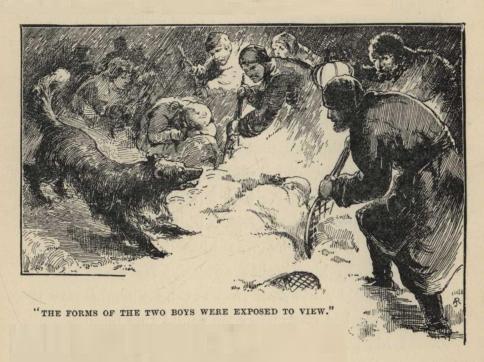
"THE FORMS OF THE TWO BOYS WERE EXPOSED TO VIEW."
"No use in that," replied Phil, turning round. "I can't see those behind us either. There's nothing for it but to push ahead."
"O Phil! are we lost?" asked Bob, with quivering lips.
Phil was more than half afraid they were; but to reassure Bob he answered cheerfully,—
"It's all right. I know how to steer. Come along." And grasping Bob's hand he started off again.
On and on they plodded through storm and snow, Phil half dragging Bob, who, between fright and real weariness, found difficulty in making progress at all. For half-an-hour more they struggled thus, until at last Bob dropped his brother's hand and flung himself down in the snow, sobbing out despairingly,—
"It's no use, Phil, I'm dead beat; you'll have to go on without me."
"Nonsense, Bob," said Phil, taking him by the shoulder. "Jump up and go at it again."
Thus helped to his feet, Bob made another attempt, but had not gone more than a quarter of a mile in a way that was staggering rather than walking before down he slipped again; and this time all that Phil could do failed to rouse him from his stupor. The cold and exhaustion had completely overcome him. He had but one thought, and that was—to be allowed to sleep. Phil fully realized the danger, and, tired as he was himself, put forth every exertion to keep his brother awake. He even tried to drag him along by his sash in what he thought was the right direction, but of course soon found this impossible.
Desert his brother he would not, though they died together; so, in order to keep himself from falling into the same state, he made a circle around him, walking slowly. While doing this he encountered a high drift whose lee afforded some shelter from the blast. An idea flashed into his mind which he instantly proceeded to execute.
Returning to Bob he dragged him with infinite difficulty to this spot. Then slipping off one of his snow-shoes, he proceeded to cover his body with snow, leaving nothing but his head exposed; the poor boy, now fast asleep, offering no objection to such strange bedclothes. Then sitting down beside him, with the big drift protecting his back, he let the snow gather over himself, hoping he hardly knew for what, and praying for the Lord who sent the snow-storm to have mercy on them both.
In a vague way—for the stupor was fast creeping upon him too—he wondered if his father had begun to miss them yet, and whether he would come out in search of them. He even dimly pictured his father sitting in the parlour at home reading his book, and pausing every now and then to listen for his boys' voices. His mother, he knew, would have gone to bed long ago. He felt relieved that the snow no longer stung his face, and that the wind had gone down completely, and so his thoughts wandered on until he knew no more.
One hour, two hours passed, and the drifting snow had hidden the forms of the two boys from sight, when a long line of men might have been seen coming from the village and scanning carefully every mound and swell of the snow as they hastened onward. In advance of the rest strode Mr. Ross, his face full of grave anxiety, his eyes intent upon the white plain before him that seemed to have so little to tell. Now bounding on ahead and now returning to look up in his face with inquiring eyes was his wise old collie, Oscar, without whom he never went abroad.
"Find them, Oscar, find them, good dog," would Mr. Ross say encouragingly, and the sagacious animal would dart on again. Presently he stopped beside a drift now grown to huge proportions, sniffed sharply at the snow, and then proceeded to dig into it with eager, vigorous paws. Observing his action, Mr. Ross uttered a cry of joy and sprang forward to the dog's side. Going down on his knees he tore at the snow-bank in a frenzy of haste. In another moment a red tassel appeared, then a blue cap, then a white, still face, and, others coming to his aid, the forms of the two boys were exposed to view, Phil still sitting up with his head bent over his knees, and Bob lying comfortably beside him. That they were both alive was clear enough, for they were breathing—very faintly, to be sure, but undoubtedly breathing.
Mr. Ross caught up one after another in a passionate embrace. Then litters were quickly improvised out of blanket-coats stripped from willing backs, and soon the unconscious boys were speeding homeward as fast as stalwart arms could bear them.
The rest of the story is quickly told. Thanks to the sturdy frames and perfect constitutions, the brothers were only temporarily the worse for their experience. They both were frost-bitten, of course, Bob's poor nose and Phil's feet coming in for the worst of it; but a few weeks' good nursing cured everything, and no scars remained to remind them, had they ever been likely to forget it, of the night they were lost.
ICE-SKATING IN CANADA.
It is a glorious winter afternoon, and having left the smoke and din and dust of the city far behind, we are standing together at the foot of the first of the Dartmouth lakes. Straight before us, and spreading far out on either hand, lies a glistening expanse, whose polished surface flashes back the cheerful sunshine. Three unbroken miles in length, and more than one in width, this icy plain awaits us in its virgin purity. It were strange, then, did not our fingers tremble with impatience and our acmes snap with feverish haste. They are on at last, and now for the supremest luxury of motion. The crisp, cool air is charged with electricity; every answering nerve tingles delightfully, and the blood leaps responsively through the throbbing pulses. Once out upon the ringing ice, and we seem to have passed from the realm of solid flesh and blood to that of "tricksy, dainty Ariel." We have broken loose from the bonds of gravitation, and as with favouring wind we speed away to the farther shore, every stroke of our steel-shod feet counting good for a quartette of yards, the toiling and moiling of the work-a-day world seem to have found at the margin of the lake a magic barrier beyond which they may not follow us, and with spirits light and free we glide off into a new sphere where care and labour are unknown. Mile after mile flashes past, yet our muscles weary not, nor does the breath grow short. But what is this? Is our flight already ended; and must we turn back so soon? The fir-clad shores, which were a little while ago so far apart, have drawn together, until they seem to meet not far ahead, and put a bar to further progress. A cunning turn, a short, quick dash over the dangerous spot, where the current runs swiftly and the ice bends ominously, and, behold! we are out again upon a second lake, still larger than the first, and dotted here and there with tiny ever-green islets that look like emeralds in a silver setting. For three miles more our way lies before us smooth and clear; and then at last, as having reached the limit of our enterprise we throw ourselves upon a fallen tree, to rest our now tired limbs and catch our diminished breath, I ask which, of wheelman, horseman, yachtsman, sculler, or skater, enjoys the finest exercise?
No country in the world presents better facilities for indulgence in the luxury of skating than Canada. Holland may with propriety boast of her smooth canals, Norway of her romantic fiords, Scotland of her poetic lochs; but for variety of lake, river, canal, pond, and frozen sea, from the majestic St. Lawrence to the humblest stream that affords delight to the village red-cheeked lads and lasses, Canada is unsurpassed. It is no wonder, then, that the Canadians are a nation of skaters, and that the skating-rinks should be as indispensable an adjunct to every city, town, and village as the church and the concert-hall. With a season extending over four and often five months, the managers of rinks can count upon receiving profitable returns upon their capital; and so those institutions multiply.
Owing to the great quantity of snow which every winter brings, the season for outdoor skating in Canada is very short, consisting usually of the middle weeks of December, when Jack Frost, by thoughtfully anticipating the snow, allows of a fortnight's skating in the open air before the mantle of winter hides his handiwork from sight and use. As a natural consequence, Canadians are not remarkable for long-distance skating; and two winters ago the swiftest fliers of our land had to lower their banner before Mr. Axel Paulsen, the renowned Norwegian skater, who made a triumphant tour through Canada and the United States.
On the other hand, the long season enjoyed by the rinks enables all who will take the trouble, and do not shrink from a novitiate of bumps and bruises, to become exceedingly expert at fancy skating; and it is hardly debatable that the rinks of Toronto, Montreal, Halifax, and St. John can send forth skaters who, for grace, precision, and intricacy of movement, would find no superiors in the world. When Mr. Paulsen attempted to teach the Canadians fancy skating, he was somewhat chagrined to find himself soon reduced to the position of learner. As an ice-acrobat he did indeed perform one or two feats that were novel, but they had only to be seen to be immediately copied; while some of the Canadians were able to open his eyes to possibilities of "didoes" which he thought it not best to hurriedly attempt. His visit was of permanent value, however, because it awakened a deeper interest in long-distance skating; and one may safely venture to prophesy that, should Mr. Paulsen come this way again, he will find the defeat of his whilom opponents at long distances not quite such a holiday task as on the occasion of his last visit.
What is known in England as "figure-skating," and there very ardently indulged in by well-to-do members of the various clubs, who can afford to acquire the art in Norway or Scotland, is but little practised in Canada. It is not suitable for rinks, as it requires so much room, and can only be done to advantage in large, open spaces, which the "figurists" may have all to themselves.
Figure-skating is undoubtedly very effective and striking when executed by a band of well-disciplined skaters who thoroughly understand one another. But it is so elaborate, and takes so much time both in preparation and performance, that it is not suited to the latitude of a colony where the majority of those who skate have no surplus leisure, and want to make the most of the time at their disposal for recreation.
There is one phase of figure-skating, however, which does flourish throughout Canada—to wit, dancing; and it would delight the heart of Terpsichore herself to watch a well-skilled quartette of couples gliding through the mazes of the lancers or quadrille, or sweeping round in airy circles to the music of the waltz. The evolutions differ somewhat, of course, from the steps taken on the floor, but the identity of the dance is far from being lost, and the pleasure of the dancer is greatly enhanced through the surpassing ease of motion. This dancing on the ice may be seen in its perfection at Halifax, the capital of Nova Scotia, which, being a garrison city, enjoys the unique privilege of military bands; and the officers as a rule becoming enthusiastic skaters, the ladies who grace the fashionable rink by their presence have a grand time of it gliding entrancingly about to the bewitching strains of delightful music, and bringing all the artillery of their thrilling eyes, tempting cheeks, and enslaving lips to bear upon the gallant sons of Mars, who oftentimes find the slippery floor more fatal than the tented field.
The finest rinks in Canada are those in Montreal, Halifax, and St. John. The rink at Halifax is really the Crystal Palace of the exhibition grounds, and for size, appearance, and convenience is surpassed by none. One of the most cheerful sights imaginable is this vast building on band-night, when the snow-white arena is almost hidden beneath a throng of happy skaters, youths and maidens, circling round hand in hand—the maiden glowing with pride at her admirer's dexterity, the youth enraptured by his charmer's roseate winsomeness. Here doth Cupid bid defiance to the chilling blasts of winter, and although the poets and painters have conspired to confine him to a garb appropriate to the dog-days, the sly wielder of the fatal bow must in winter enwrap himself in furry garments, and like a tiny Santa Claus perch his chubby form unseen among the rafters, and from that coigne of vantage let fly his shafts thick and fast into the merry company beneath.
One of the chief attractions of skating for the ambitious disciple is that there is practically no limit to its possibilities in the way of invention and combination. It would be extremely difficult to prepare for any skating tournament a hard-and-fast programme which would meet every requirement. Hence in competitions of this kind the custom is to lay down some twenty or thirty of the best-known feats which every competitor is supposed to do, and then leave each contestant to superadd thereto such marvels of skill as he may have picked up or invented. At the same time, of course, there may be almost as many degrees of skill represented in the execution of the set programme as there are competitors, and the judges must take this fully into consideration when making their award, and not allow their judgment to be dazzled by some particularly striking "extra." Skating tournaments, however, are not as frequent as they ought to be. While every other recognized sport has its regularly recurring trials of proficiency, skating has hitherto been inexplicably neglected. Surely nothing could be more interesting or attractive than a gathering of accomplished skaters of both sexes vying with one another in the ease and grace with which they can illustrate the intricacies of the "grape-vine," the difficulty of the "giant swing," or the rapidity of the "locomotive." Trials of speed are common enough at all rinks, and are undoubtedly more popular and exciting than trials of skill, but the more refined and less demoralizing competition should not be entirely neglected.
The speed attained by those who race in rinks, it need hardly be explained, affords no criterion whatever whereby to judge of what fast skaters are competent to accomplish. The incessant turns, the sharp corners, the confined area, all tend to materially reduce the rate of progression; and only out on some broad lake or long-extending reach of river can the skater do his best. I have no records at hand as I write, but my own experience justifies me in venturing the assertion that a champion skater in perfect form, and properly equipped with long-bladed racing skates, would prove no mean antagonist for Maud S—— herself over a measured mile, while at longer distances he would have the field to himself.
Like all other amusements, skating in Canada waxes and wanes in popular estimation, according to the mysterious laws of human impulse. One winter skating will be voted "not the thing," and the rinks will be deserted; the next, they will be crowded, and even the heads of families will be fishing out their rusty "acmes" from the lumber-closet, and renewing their youth in the icy arena. As a means of exercise during the long, weary months of winter, when the deep snow renders walking a toil devoid of pleasure, and the muscles are aching for employment, the skating-rink is an unspeakable boon, especially to him whose lot it is to endure much "dry drudgery at the desk's dead wood." An hour's brisk spinning around will clear the befogged brain, brace up the lax frame, and give a keenness to the appetite that nothing else could do. Then the rink has its social as well as its sanitary advantages. During the winter months it affords both sexes a pleasant and convenient rendezvous, where, unhampered by the conventionalities of the ball-room, and aided by the cheerful inspiration of the exercise, they can enjoy one another's society with a frequency otherwise unattainable. On band-days, indeed, the rink becomes converted into a spacious salle d'assemblée, where the numbered programme of musical selections enables Corydon to make engagements in advance with Phyllis, and thus insure the prosperous prosecution of his suit.
A carnival on ice—and every rink has one or more during the season—affords a rarely interesting and brilliant spectacle. For these occasions the building dons its gala dress, the gaunt rafters are hung with banners, the walls are hidden beneath variegated bunting and festooned with spruce embroidery, lights gleam brightly from every nook and corner, and the ice is prepared with special care. Then, as the motley crowd glides swiftly by, one may behold representatives of every clime and nation mingling together in perfect amity. It is true the tawny Spaniard, the dark-eyed Italian, the impassive Turk, the appalling Zulu, the soft and silent Hindu, and others whose home lies beneath the southern skies, betray a familiarity with the ice which seems to cast some doubt upon its genuineness.
But when his Satanic Majesty himself, with barbed tail and cloven hoof, confesses to an intimacy with the mazy evolutions of the "Philadelphia grape-vine," the incongruity attaching to visitors from cooler climes appears less striking, and they may go on their way unchallenged. Sometimes masks are de rigueur at these carnivals, and then the inevitable clown and harlequin have unlimited license, till even Quakers and friars, infected by their bad example, vie with them in mad pranks, and the fun soon waxes furious. Masked or unmasked, the carnival skaters have a joyous time, and the hours steal away with cruel haste.
Such are some of the phases of ice-skating in Canada. If this article has seemed to be devoted principally to indoor skating, it is because that can be pursued through so much greater a portion of the winter than the outdoor kind. Skating in its perfection is of course only to be had in the open air, and my most delightful recollections are associated with the Dartmouth lakes, of happy memory. Connected with the same lakes, however, there is a recollection too thrilling to be delightful, and which, in view of what might have been, brings a shudder even now while I rehearse it.
It happened in my college days. I had been skating all the afternoon, and, as the dusk grew on apace, found myself away down at the head of the second lake, full six miles from the point where I had got on the ice; so, girding up my loins, I set my face towards home, and struck out lustily. After going about one hundred yards, I thought I heard the sound of my name come faintly to me over the ice.
Wheeling sharply about I saw nothing, except a dark form some distance away, which through the gathering gloom resembled a log or tree-branch; and I was just about to start off again, when once more my name was called, this time so clearly as to leave no chance for doubt, the sound evidently coming from the seeming log. Hastening over to it with all speed, I was startled to find the professor of classics at my college—who did not allow the loss of an arm to debar him from the pleasure of skating—lying on the ice, with his left leg broken sharp and clear a few inches above the ankle, the result of a sudden and heavy fall. Here, indeed, was a trying situation for a mere lad to cope with. We were alone in a wilderness of ice, and six miles away from the nearest house. The shadows of night were fast closing around us. Those six miles had to be gotten over in some way, and there was not a moment to be lost. Hurrying to the shore I cut down a small spruce tree. Upon this the helpless sufferer was laid as gently as possible, and bound to it with straps. Then upon this rude ambulance I slowly dragged him down the lake, while he, with splendid self-control, instead of murmuring at his terrible agony, charmed away my weariness by his unconquerable heroism. It was a toilsome task, but help came when we reached the first lake, and once the shore was gained, a long express waggon filled with mattresses made the homeward journey comparatively painless. "All is well that ends well." The broken leg soon mended, and the following winter found the professor skating as briskly as ever.
Yet I cannot help wondering sometimes with a shudder how it would have fared with the interpreter of Greece and Rome had not that first faint call reached my ears. A bitter cold night, a wide expanse of polished ice, a solitary man lying prone upon it with one arm missing at the shoulder, and one leg broken at the ankle—it were little less than a miracle if ice-skating in Canada had not been clouded by one more catastrophe that winter night.
THE WILD DOGS OF ATHABASCA.
Old Donald M'Tavish was a wonderfully interesting character. In the service of the Hudson Bay Company, which for nearly two hundred years held regal sway over the vast unknown north-west of Canada, he had spent half a century of arduous and exciting service, living far away from civilization, one of a mere handful of white men in the midst of a wilderness sparsely inhabited by the Indian and the half-breed, but abounding in deer, buffaloes, bears, wolves, and the smaller wild animals.
He had risen rapidly in the service, for he was a fearless, stanch, trustworthy man, and for the latter half of two terms had filled the important post of chief factor at different forts; for it was his somewhat undesirable if honourable lot to be sent to those stations that gave the most trouble and the least returns to the company. Such was his reputation for shrewdness, courage, and fidelity, that it was felt by the authorities that no other man could so soon set matters straight as Donald M'Tavish.
Having filled out his fifty years with entire satisfaction to his employers and no small credit to himself, he had retired on his laurels to spend a hale and hearty old age, in the enjoyment of the comfortable pension awarded him by the company which he had served so well.
It was the delight of his declining days to recount for the benefit of younger ears the many thrilling incidents of his adventurous career, and one of his favourite stories was that which I shall now attempt to tell, as nearly as possible in his own words.
"It was early in the Fifties, when I had charge of old Fort Assiniboine, away out on the Athabasca River, not far from the Rockies. Sir George Simpson, the governor of the colony at Red River, like the thoughtful man he was, had sent out to me by the spring brigade a splendid Scotch stag-hound, one of half-a-dozen he had just brought with him from the dear old land.
"O man, but he was a dog! His back was on a level with my belt, and when he raised himself on his hind legs he could put his fore paws on my shoulders and rub noses with me; yet I stood a good six feet in my stockings in those days.
"His hair was as grizzled as old Ephraim's, and coarse, and curled like what they stuff beds with. His body was long and lean, and so was his head, but he had a noble eye; and then the way he could run, and leap over everything that came in his path, it was a sight to see, I warrant you.
"We soon got very much attached to each other, and wherever I went Bruce went too. He did not seem to take to any one else, and I was just as well pleased that he did not, for I never wanted him out of my sight.
"That same summer a new hand was sent to the fort. He was an Englishman, who gave his name as Heathcote, and he brought with him a pure white female bull-dog that was one of the most dangerous-looking brutes I ever laid eyes on. She minded nobody but her master, of whom, to do her credit, she seemed fond enough.
"I never much cared for that breed of dog, but I must say Vixen was about perfect in her way. As to good-breeding, there certainly wasn't much to choose between her and Bruce.
"I was a little uneasy as to how the two dogs would get on, and at first it did look as if there might be trouble, for Bruce, who utterly despised the rabble of curs hanging about the fort, evidently felt disposed to resent the coming of this possible rival; but almost before I knew it, the two were the best of friends, and would eat their dinner side by side like two well-behaved children.
"After a while they took to going out a-hunting together, and grand times they had. They would work along in company until a herd of deer was started, and then Bruce would make for the fattest doe, his tremendous speed soon bringing him to her throat; while Vixen, following at her best rate, would come up just in time to help him to finish her, and then they would have a fine feast.
"Once the dogs got into these ways neither Heathcote nor I had much more satisfaction out of them. They were never on hand when wanted. They kept growing wilder and wilder, and finally, toward autumn, they disappeared one day, and were never seen at the fort again.
"We hunted for them high and low, sending out the half-breeds as far as Lake La Crosse on the east, and to the foot-hills of the Rockies on the west, but not a sign or trace could we find of them. When winter came and they did not return, we gave them up as lost, thinking that something must have happened to them on one of their hunting forays, or that perchance they had been killed by the Indians.
"Two years went by, and Bruce and Vixen were almost forgotten, when stories began to reach the fort of a strange and fierce kind of wild dog that was being seen now and then by hunters and trappers in the out-of-the-way valleys and ravines of the foot-hills.
"It was not an easy job to get at the bottom of these stories, for they passed from mouth to mouth before reaching us; but at last a trapper turned up who had seen a pack of the dogs himself, and after hearing his description I had no longer any doubt but that these wild dogs which were making such a stir were the offspring of our two former pets which had gone away in company.
"By all accounts they were evidently dangerous brutes to meet. From Bruce they had got wonderful speed and endurance; from Vixen, ferocity and fearlessness. Swift, savage, stubborn, and always going in large packs, there was not an animal on the plains or up among the mountains for which they were not more than a match.
"I felt eager to get a sight of the creatures, even though it should mean some risk; for while, like all wild dogs, willing enough to give men a wide berth, there was no telling what they might do if pressed by hunger. It was therefore good news when, a year later, orders came from Red River for me to make a trip to Fort George on the other side of the Rockies, where there were some matters that needed straightening up, as either going or coming back I would run a good chance of seeing something of the famous dogs.
"I left Fort Assiniboine in the autumn, and although a sharp look-out was kept by all the party as we went over to Fort George, not a sight nor sign of the dogs did we stumble upon.
"But on my way back in the spring I had better luck, and I certainly shall never forget my first and last sight of those terrible brutes.
"We had crossed the Rockies, and were descending the eastern slopes, getting down among the foot-hills. One day Heathcote and I pushed on together in advance of the rest, both of us having the dogs on our mind.
"Early in the afternoon we came to a bluff that overlooked a lovely little valley, which we at once decided would be our camping-place for that night. A bright stream ran along the centre of the valley. Having a thought that perhaps a herd of deer might put in an appearance if we kept out of sight, wo stretched ourselves out comfortably on the bluff and awaited developments. They proved to be interesting beyond all our expectations.
"We had been there about an hour, perhaps, when Heathcote, who had been looking over at the opposite bluff, suddenly grasped my arm, saying under his breath.—
"'Look there, M'Tavish! What do you think of that?'"
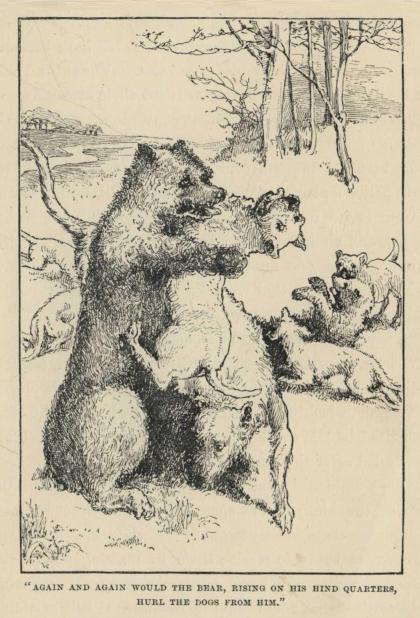
"AGAIN AND AGAIN WOULD THE BEAR, RISING ON HIS HIND QUARTERS, HURL THE DOGS FROM HIM."
"A break in the bluff had made a sort of easy descent into the valley, and down this were coming, in single file, one, two, three, four—no less than a dozen bears of the large and dreaded silver-tip kind; splendid fellows most of them, bent on having a good time on the sunny slopes beside the stream.
"We hardly dared to stir or breathe. To have attacked them would have been utter madness. Thankful might we be if we could crawl away without their attacking us.
"While lying there motionless, and wishing to the bottom of our hearts that the rest of the party were on hand to make matters even, a fierce bark came from the bluff a little above where the bears first showed themselves. It was followed by a whole chorus of deep-mouthed baying, and an instant later there rushed into view, fairly tumbling over one another in their impetuous haste, a great pack of dogs that we at once recognized as those we wished to see.
"They were certainly a fearsome lot of creatures. Some were long, lean, and shaggy, like Bruce; others were thick-bodied and smooth of hair, like Vixen,—and all were powerful, ravenous-looking brutes, a dozen of whom might eat a good-sized buffalo for dinner without feeling uncomfortably overloaded after their meal.
"They sighted the bears the moment they reached the edge of the bluff, and at once rushed down to the attack, barking as though they would split their throats. The bears made ready to receive them by massing together at the top of a little knoll near the water, and before we could fully realize what was taking place the fight had begun.
"So far as we could make out the dogs numbered fifty at least, so that, considering their size and strength, the odds were a good deal in their favour; but the bears fought like heroes.
"At first they crowded together in a sort of circle, with heads facing out; while the dogs ran round them, snarling and barking, and watching their chance to spring. A few moments later the circle was broken up into a dozen roaring, writhing, yelping groups, composed of a bear with four or five of the dogs clinging tenaciously to different parts of its body.
"It was the Vixen strain that told now. Again and again would the bear, rising on his hind quarters, hurl the dogs from him with mighty sweeps of his huge fore paws, only to be penned at once, and brought to the ground by a fresh attack.
"At frequent intervals an agonizing death-howl would pierce its way through the horrible clamour, as some unfortunate dog, caught in the grasp of its maddened enemy, would be crushed to death in his resistless embrace.
"The minutes slipped by, and the fight still raged, but there could be no doubt how it would result. The dogs had the best of it as to numbers, and they were the equals of the bears in courage, ferocity, and endurance, if not in sheer strength.
"One by one the big brown bodies rolled over in the stillness of death. At the end of about half-an-hour the fight was over. Not a bear breathed, and around their torn carcasses lay between twenty and thirty of the dogs, as dead as themselves—the best possible proof of how fiercely and obstinately they had fought.
"Not a word had passed between Heathcote and myself while all this went on. We were too much taken up with the extraordinary conflict going on before our eyes even to look at each other: but when it was all over, and the surviving dogs, having satisfied themselves that the bears were really all dead, lay down to lick their many wounds before they began upon the feast their brave victims had provided for them, I touched Heathcote on the shoulder, and whispered,—
"'We've seen the dogs; let's take good care they don't see us.'
"After such a proof of their powers as we had had, we were in no mind to claim a nearer acquaintance with them on the score of having once owned their ancestors. Accordingly we crawled noiselessly away, and making a long circuit, rejoined our party in time to prevent their turning down into the valley, which we no longer considered a good place to camp in for the night.
"That was my first and last sight of the wild dogs of Athabasca. The following autumn I went east, and never returned to Fort Assiniboine. Whether the dogs have since been all killed off or are still running wild among the far recesses of the Rockies, I don't know; but that wonderful battle in the valley was one of the greatest sights of my life, the like of which no one perhaps will ever again see on this continent."
BIRDS AND BEASTS ON SABLE ISLAND.
If you will take your atlas and turn to the map of Canada, you may, by looking very carefully, discover a small spot in the Atlantic Ocean almost due east from Nova Scotia, and close beside the sixtieth parallel of longitude. This little lonely spot is Sable Island, There it lies in the midst of the waves, a long, low bank of gray sand without a single tree upon it from end to end; nay, not so much as a bush behind which a baby might play hide-and-seek. It seems, therefore, at first sight to be one of the most unfavourable places in the world for the study of either birds or beasts. Yet, strange as it may seem, this island, which is now but twenty miles long, and at its greatest breadth but a mile and a half wide—once it was quite double that size—has a wonderfully interesting history of its own, of which not the least entertaining chapter is that relating to its furry and feathered inhabitants.
Although when first viewed from the sea Sable Island appears to be nothing better than a barren sand-bank, on closer acquaintance it reveals inside its sloping beaches vales and meadows that in summer-time seem like bits out of a Western prairie. There are green, grassy knolls, and enchanting dells with placid ponds in their midst; and if you only come at the right time and stay long enough, you may gather pink roses, blue lilies, China asters, wild pea, gay golden-rod, and, what is still better, strawberries, blueberries, and cranberries in bountiful profusion.
Our concern at present, however, is not with the fruits and flowers, but with the fur and feathers of this curious place.
Seeing that Sable Island has no trees on the branches of which nests may be built, it follows naturally that its winged inhabitants are altogether of the water-fowl and sea-bird variety. All over the sides and tops of the sand-hills, which rise to the height of thirty, forty, or fifty feet, the gulls, gannets, terns, and other aquatic birds scrape together their miserable apologies for nests, and hatch out their ugly little squab chicks, making such a to-do about the business that the whole air is filled with their chattering, clanging, and screaming.
They are indeed very disagreeable neighbours; for besides the horrid din they are ceaselessly making, they are the most untidy, not to say filthy, of housekeepers. After they have occupied their bird-barracks, as their nesting-places might appropriately be called, for a few weeks, the odour the wind bears from that direction could never be mistaken for one of those spicy breezes which are reputed to "blow soft o'er Ceylon's isle."
Then they have not the redeeming quality of being fit to eat; for unless one were on the very edge of starvation, one taste of their flesh, rank with suggestions of fish and train-oil, would be sufficient to banish all appetite.
They have one or two good qualities. They are brave; for at the peril of their lives they will dauntlessly attack any rash intruder upon their domains, swooping down upon him with sharp cries and still sharper beaks.
Their movements illustrate the poetry of motion, as they come sailing grandly in from the ocean spaces, and circle about their own particular hillock in glorious dips and curves and mountings upward, that fill the human observer with longing and envy.
Much more satisfactory, however, are the black duck, sheldrake, plover, curlew, and snipe, which nest by uncounted thousands in the dense grass that girts the fresh-water ponds, and afford dainty dishes for the table. It is easy work to make a fine bag on a favourable day, and grand sport may be had by any one who knows how to handle a double-barrel.
Many are the interesting stories connected with bird life on Sable Island, but a single one, and that the oddest of them all, must suffice. I give it upon the unimpeachable authority of Dr. J. Bernard Gilpin.
About forty years or more ago a lot of rabbits were sent there as an experiment. The idea was, if they prospered, to furnish the human inhabitants of the island with a pleasant variety from the salt junk which generally adorned their tables.
The experiment succeeded admirably. Bunny found the firm, dry sands just the thing for his burrows, while the abundant wild pea and other herbage furnished unstinted food for his prolific brood. But one fateful day in spring—a dark day in the annals of rabbitdom—a big snowy owl, that had somehow lost his bearings and been driven out to sea by a westerly gale, dropped wearily upon the island to rest his tired pinions.
While sitting on a sand-heap, thankful at his escape from a watery grave, he looked about him, and to his amazed delight beheld—of all sights the most welcome in the world to a hungry owl—rabbits! Rabbits young and rabbits old, rabbits plump and rabbits lean, rabbits in sixes and rabbits in sevens, were frisking about in the long grass and over the sand, merrily innocent of their peril.
At first Sir Owl could scarcely believe his eyes, for it was a bright, sunny day, and owls cannot see very well when the sun is shining; but presently, as he still squatted on the sand, perfectly motionless except his eyelids blinking solemnly, a thoughtless little rabbit, which had grown too much excited over a game of chase with his brother to look where he was going, ran up against the bewildered bird.
This awoke the owl thoroughly. With a quick spring that sent all the other little cotton-tails scampering off to their burrows in wild affright, he fastened his long claws in the back of his unfortunate disturber, and, without even stopping to say grace, made a dinner off him on the spot.
That was a red-letter day in the owl's calendar. Thenceforth he revelled in rabbit for breakfast, dinner, and supper, and, had he been a very greedy owl, might have kept his discovery of a rabbit bonanza all to himself; but he didn't. With a splendid unselfishness which some bipeds without feathers might advantageously imitate, he had no sooner recruited his strength than off he posted to the mainland to spread the good news.
Four days later he came back, but not alone this time. Bearing him company were his brothers, his sisters, his cousins, his uncles, and his aunts, in such numbers that ere the summer ended there was not a solitary bunny left upon the island!
Since then the place has been restocked, and there having been no return of the owls, the rabbits, despite the fact that great numbers of them are killed for food, have so multiplied as to become a positive nuisance, and the experience of Australia being in view, the advisability of their extermination is seriously considered.
Besides the rabbits, there have been, at different times, the following animals upon Sable Island—namely, the black fox, white bear, walrus, and seals; wild horses, cattle, and swine; rats, cats, and dogs. That makes quite a long list. Of course so small and bare an island could never have held them all at once.
Now they are all gone except the rabbits, the horses, of which several hundreds still scamper wild over the sand dunes, and the seals, which come every year to introduce their shiny little whelps into the world, and to grow fat on the fish hurled continually upon the beach by the tireless breakers.
It is a great many years since the black fox, white bear, and walrus were last seen upon the island. Too much money could be made out of them when dead for the fishermen, who knew of their presence, to let them live long; and so with powder and shot and steel they were ruthlessly exterminated. The beautiful skins of the black fox, worth one hundred golden crowns each, went principally to France, where they were made up into splendid robes for royalty.
Just how the wild horses and cattle found their way to Sable Island is not positively known.
They were first heard of in those early days when ships loaded with cattle, grain, and farming utensils were coming over in little fleets from Europe to help to settle America. In all likelihood some of these vessels got cast away on the island—for it has ever been a dreadful place for wrecks—and in some way the animals managed to scramble safe ashore, and thus the place became populated.
The wild cattle disappeared early in the century; but the horses, or rather ponies, are still there, and very interesting creatures they are.
Winter and summer they are out on the sand in all weathers. Indeed, they scorn to go under cover even in the wildest storms; and although shelters have been built for them, they will not deign to enter them. Another curious thing about them is that they are never seen to lie down, and apparently go to sleep standing.
There are now about four hundred of these ponies, divided into troops, each under the charge and control of an old stallion, whose shaggy, unkempt mane and tail sweep the ground as he stands sentinel over his numerous family.
They belong to the Dominion Government, and it has been usual to cull out some forty or fifty of the best of them each year and send them up to Halifax, where they command good prices.
They are stanch, sturdy little animals, and very serviceable when properly broken. In my boyhood days I rejoiced in the possession of a fine bay that, barring a provoking habit of pitching an unwary rider over his head, was a great source of enjoyment.
The manner of catching the ponies is for a number of mounted men to surround a band and drive it into a corral in which a tame pony has been placed as a decoy. This is often a very exciting experience: the cracking of whips, shouting of men, neighing of ponies, combine with the plunging of the frightened captives and the gallant charges of the enraged stallions to make up a scene not readily forgotten.
Once safely corraled, the best males are picked out and lassoed, and the rest turned loose to breathe the salt air of freedom once more.
As the breed has been observed to be degenerating greatly of late years, means have been taken to improve it, and it is probable that ere long Sable Island ponies will be more desirable than ever.
A very amusing thing in connection with animal life on Sable Island is the story of the rats, cats, and dogs.
First of all were the rats, who are reputed to be very clever about deserting sinking ships, and who here found plenty of opportunity to show their cleverness, for wrecks are always happening. They thus became so plentiful that they threatened to eat the human inhabitants out of house and home. Indeed, they did make them do without bread for three whole months upon one occasion.
This state of things, of course, could not be tolerated. A large number of cats were accordingly imported, and they soon cleared the premises of the rapacious rodents. But it was not long ere the pussies in their turn grew so numerous, wild, and fierce as to become a source of serious trouble. A small army of dogs was therefore brought upon the scene, and they made short work of the cats, thus rounding out a very curious cycle.
Did space permit I could tell something about the seals, and their very quaint and attractive ways and manners. But perhaps enough has been already written to convince readers that however lonely, barren, and insignificant Sable Island may seem, it has an interesting story of its own which is well worth the telling.
THE BORE OF MINAS BASIN.
Upon the side of one of the rounded hills that rise up gently from the wonderful sea of verdure which Longfellow, without ever looking upon it for himself, immortalized in his "Evangeline," Acacia Villa nestled cozily in the midst of many trees. Long lines of poplars stood sentinel-like up and down the house front, and marked out the garden boundaries, furnishing abundant supplies of "peppers" for the boys in spring-time; and, better still, a whole regiment of apple and pear trees marshalled itself at the back, filling the hearts (and mouths) of both young and old with delight in the autumn, when the boughs bent so temptingly beneath their burden of fruitage. There could hardly be a more attractive location for a boarding-school; and seeing what comfortable quarters Mr. Thomson provided, and how thoroughly he understood the business of teaching, it was no wonder that boys came not only from all parts of Nova Scotia and New Brunswick, but even from the United States, to be grounded in classics, mathematics, and literature under his direction.
The last boarder left Acacia Villa long ago, but twenty years back its dormitories were filled to their utmost capacity with lads of all ages and sizes, and the whole neighbourhood felt the stirring influence of twoscore lively, hearty, noisy boys in its midst. For nearly ten months out of the year the school was like a hive of bees in honey-time—the term beginning in September and finishing in June. It was coming on toward midsummer now, and excitement ran high throughout the school; for while the drones were looking forward longingly to the holidays which would release them from all horrid lesson-learning for a couple of months, the workers were even more eagerly expecting the final examinations, when books, bats, balls, knives, and other things dear to the schoolboy's heart, were offered by wise Mr. Thomson to the boys who came out ahead in the different branches of study. The two boys strolling down toward the river this fine summer afternoon were good representatives of the two classes—Frank Hamilton being one of the brightest and most ambitious, as Tom Peters, or "Buntie" in the saucy slang of his schoolmates, was one of the dullest and least aspiring in the school. Yet, somehow or other, they had been great chums ever since they came by the same coach to the Villa two years before. One could easily understand that lazy, good-natured "Buntie" should find much to admire and love in handsome, manly, clever Frank, who was indeed a born leader; but just what Frank found in Tom to make him so fond of him puzzled everybody, from Mr. Thomson down. In whatever lay the secret, the fact was clear that the boys loved each other like brothers; and the master, who delighted in classical allusions, used to greet them as Damon and Pythias when he encountered them together. They were discussing the approaching examinations, and speculating as to the prizes Mr. Thomson would offer this year.
"No apples for me on that tree," said Tom; adding with rather a rueful smile, "If Mr. Thomson would only offer a prize for the most lickings and impositions, I guess I'd run the best chance for it."
"Never mind, old boy," said Frank, consolingly. "You weren't cut out for a scholar, that's clear; but you'll come out all right at something else, and perhaps make a bigger name than even 'Yankee' himself, although it wouldn't do to let him hear you say so."
"I'm 'fraid I'd have a poor sight to beat Yankee at anything," answered Tom. "But say, Frank, how do you feel about giving him the go-by for the Starr prize? It 'ud break my heart if you didn't come out first."
"Well, to tell the truth, Buntie, I don't feel any too cocky about it. Yankee's a tough customer to beat," replied Frank. "But, hush! he's coming right behind us. Must be going down to the river too, though it's more like him to stick in his room and grind."
And as a tall, slight, dark-faced lad of about sixteen went past them without exchange of greetings, the two friends stopped talking and went on in silence.
"Yankee" was the nickname given to one of the American boys at the school. He had been thus distinguished because both in face and figure he bore some resemblance to the typical Uncle Sam, being longer, leaner, and sallower than any of his companions. He was of a quiet, reserved disposition, and had few friends. Indeed, he did not seem to desire many, but kept very much to himself, so that a lot of the boys disliked him. Yet, on the other hand, others respected although they might not love him; for not only did he divide with Frank Hamilton, whom they all worshipped, the highest honours in scholarship, but once, when scarlet fever broke out and seized upon six of the smallest boys before they could escape to their homes, "Yankee," or, to give him his proper name, Emory Haynes, although he had never had the fever himself, stayed with Mr. Thomson through many anxious weeks, and watched night after night by the sufferers' bedsides, showing such tact and devotion as a nurse that the doctor said at least two of the boys would never have been saved from death had it not been for his help.
Walking with a rapid, almost impatient step that was characteristic of him, Emory Haynes passed the two friends, all three directing their course toward the Gaspereaux River, which cuts a wide red gash through the Grand Pré before adding its turbid torrent to the tossing waters of Minas Basin.
"If Yankee beats me for the Starr prize, it will be the biggest disappointment of my life," continued Frank. "It's not every day that a fellow can get hold of five pounds in bright big gold pieces; and father has promised if I win it to chip in as much more and buy me a splendid boat."
"O Frank, you're sure to get it. Yankee works like a slave, to be sure, but he hasn't half as good a head on him," answered Tom confidently.
"I'm not by any means certain of that, Tom. Just see how easily he gets through his mathematics. He's sure to beat me on that, and I'll have to make up for it by beating him in classics. Anyhow, it is no use worrying about it now. Let's hurry up and have a dip."
So dropping the subject, the two boys ran off at a rate that soon brought them to the river bank.
Here a lovely picture awaited them. From their feet the red banks of clay and sand stretched hundreds of yards away (for the tide was out), until they were lapped by the river, now shrunk into a narrow, sluggish stream. To right and left and beyond the river the wide, level marsh lands, redeemed from the water by the patient toil of the Acadians, were waist-deep in verdure that swayed in long lines of light and shadow before the summer breeze. Not far off began the great dikes that sweep clear round the outer edge of the Grand Pre, the only elevation on all that vast plain, and now waving to their summits with "dusty-blossomed grass." Behind them the hills rose gently in fold upon fold, their broad shoulders flecked with frequent patches of golden grain or the dark foliage of the orchards; while over all rose a glorious summer sun that seemed to thrill the whole landscape with life and warmth and glory.
But the boys had no eyes for all this beauty. They were far more concerned about the tide, and felt inclined to resent very warmly the fact that it should be out just when they wanted to have a swim.
"What a fraud!" exclaimed Frank. "'Pon my word, I believe the old tide is twice as much out as it is in; now isn't it, Buntie?"
"It is, sure's you're born," assented Tom. "There's nothing for it, I suppose, but to wait;" and so saying, he threw himself down in the long grass, his friend immediately following his example.
Twenty yards away Emory Haynes was already seated with his face turned riverward, apparently lost in deep thought.
"Wonder what Yankee's thinking about?" remarked Tom. "Puzzling out some of those confounded problems he does so easily, perhaps," he added feelingly, for he had had some humiliating experiences of his own inability to get over the Pons Asinorum safely, or to explain why a was equal to x under certain perplexing circumstances.
"More probably planning what he'll do with that five pounds," said Frank, half petulantly. "I guess it's more likely to go into books than into a boat if he gets hold of it."
"But he isn't going to get hold of it," objected Tom; and then, without giving Frank a chance to reply, he burst out, "Oh, I say, Frank, suppose instead of waiting here we go down to meet the bore and have a race back with it."
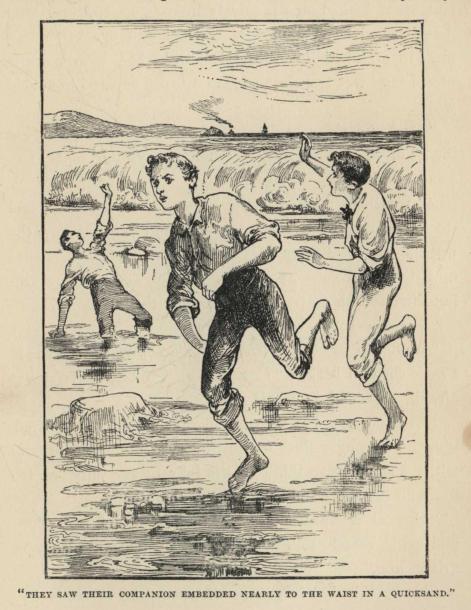
"THEY SAW THEIR COMPANION EMBEDDED NEARLY TO THE WAIST IN A QUICKSAND."
Frank hesitated a moment before answering, for what Tom proposed was a very rash thing to do. What is known as the "bore" is the big wave produced by the onrush of water in a place where the tides rise forty, fifty, or even sixty feet, according to the time of year. The Bay of Fundy, of which Minas Basin is a branch, is famous for these wonderful tides, and the movements of the water make a sight well worth watching. The two boys had often looked on with lively interest as the returning flood rushed eagerly up the channel and over the flats, until in an incredibly short time what had been a waste of red mud was transformed into a broad expanse of turbid water.
"Rather a risky business, Tom, but I don't mind trying it. I'm in the humour for almost anything to-day; so come along."
And without more ado the boys doffed their boots and stockings, rolled up their trousers, and set out for the water's edge. Emory Haynes watched them in silence until they had gone about fifty yards. Then, as if divining their foolish design, he called after them,—
"Frank—Tom—where are you going to?"
"Going to meet the bore. Don't you want to come?" Frank shouted back. "Come along, Yankee, if you're not afraid," he added, in a half scornful tone.
Not the words, but the tone in which they were uttered, brought an angry flush out on Emory's sallow cheeks, and without stopping to think of the folly of the thing, he too flung off his boots and started after the others.
"Blessed if Yankee isn't coming, after all," said Tom, under his breath, to Frank. "The chap's got plenty of grit in him."
Side by side, but in silence—for somehow or other they felt ill at ease—the three boys picked their way carefully over the slippery mud and soft sand, keeping a sharp look-out for the sink-holes or quicksands, in which they might easily sink to their waists, or even deeper, at one plunge. Hardly had they reached the edge of the channel when Frank, who had been gazing down intently toward the Basin, called out,—
"There it comes, fellows. Doesn't it look grand?"
A good way off still, but drawing nearer with astonishing speed, a wall of dark foam-topped water came rushing up the channel and over the thirsty flats. It was several feet in height, and behind it followed the whole vast volume of the tide.
The three lads had never been so close to the bore before, and they stood still and silent watching the grand sight until a shout from Emory broke the spell.
"Now then, boys, let's run for it."
As fast as their feet could carry them they sped over the treacherous greasy flats, leaping the gaping gullies, turning aside from the suspicious spots, and steering straight for the place where they had left their shoes. Frank and Tom were both famous runners, and soon outstripped Emory; in fact, they were more than half-way to the bank, when a sharp cry of alarm made them stop and turn to see what was the matter. One glance was enough to tell them. Twenty yards behind they saw their companion embedded nearly to the waist in a quicksand, from which he was madly struggling to extricate himself, while his efforts seemed only to sink him the deeper. His situation was one of extreme peril. The bore had somewhat spent its force, but still advanced steadily. Unless Emory was rescued without delay, he would be buried beneath its pitiless flood.
For one brief instant Frank hesitated, and Tom, as usual, waited for him to lead. Thoughts of the personal risk, the small chance of succeeding, and even—though ever after the mere recollection of it made his cheek burn with shame—of the advantage it would be to have his rival out of the way, throbbed through his brain. But it was only for an instant; and then with a shout of "Keep cool, Yankee; we're coming!" he grasped Tom's arm, and together they sprang to the rescue. Running with all their might, they reached their imperilled schoolmate just a second before the bore did, and standing on either side the treacherous spot were able to each seize a hand, and with one tremendous effort draw him out of its deadly embrace ere the great wave came sweeping down upon them, tumbling them over like nine-pins into the midst of its muddy surges. Fortunately, however, all three were good swimmers, and they had only to allow the water to work its will with them, for after a little tossing about it landed them safely on a sand-bank, whence they could easily wade ashore.
Emory did not say much to his rescuers. It was not his way. But no one could mistake the depth of feeling expressed in the few words,—
"Frank, you've saved my life, and I'll never forget it."
Two weeks later the examinations came off, and amid the applause of the school Frank Hamilton was declared winner of the Starr prize, Emory Haynes being only just a few points behind him. Mr. Thomson was very well pleased at the result; but there was one thing that puzzled him a good deal—Emory, who was by far the best mathematical scholar in the school, had somehow or other done by no means so well in that branch as usual. In fact, he had actually left several not over-difficult questions altogether unanswered, and this more than anything else had lost him the prize. Mr. Thomson mentioned the matter to Frank Hamilton, at the same time expressing his surprise.
"I'm not surprised," said Frank, as something that looked very like tears welled up in his eyes. "When I saved Yankee's life he said he'd never forget it. That's how he kept his word."
Mr. Thomson needed no further explanation.
THE GAME OF RINK HOCKEY.
The part performed by Canada in making contributions to the list of the world's amusements has been by no means slight. Lacrosse and canoeing for the warm bright days of summer, snow-shoeing and tobogganing for the crisp cold nights of winter, these make up a quartette of healthy, hearty sports, the superiors of which, in their appropriate season, any other country might safely be challenged to show. But apparently this ambitious colony is not content with the laurels already won, and in the bringing of the game of rink hockey to perfection would add another to her garland; for this fine game, as played in the Canadian cities to-day, is, without question, a distinctly home product.
Not that hockey is native to the soil in the same sense as lacrosse. In a simpler form, and under different names, it has long existed in England; but the difference between the game as played there on the green and played in Canada on the ice, is as great as that between an old-fashioned game of rounders and a professional game of base-ball.
The most ancient account of hockey is to be found in that dear, delightful old book, Strutt's "Sports and Pastimes of the People of England," where it figures under the name of "bandy ball,"—what is now called the hockey stick being then known as the "bandy;" and there is attached to the description a comical little woodcut representing two boys in short frocks, each wielding bandies almost as big as themselves, playing with a ball half the size of their heads.
As first played in Canada, hockey went by various names, some of which were apparently merely local—hurley, shinny, rickets, and so forth, It was played only upon the ice in winter-time, and there was not much pretence to rules, each player taking part as best he knew how. No effort toward systematizing the game appears to have been made until the year 1875, when the members of the Montreal Football Club, in search of some lively athletic amusement for the long winter months, recognized in hockey the very thing they wanted.
At first the rules adopted for the regulation of the game were modelled upon those of the English Hockey Association. But as the game developed, many changes were found necessary in adapting it to the requirements of a rink, and the rules now used by the Amateur Hockey Association of Canada are in the main original with it.
Starting from Montreal, the game has made its way to Halifax and St. John on the east, and to Ottawa and Toronto on the west, and from the enthusiasm with which it has been taken up at these cities, it actually threatens to displace tobogganing and snow-shoeing in the affections of the young men.
Let me now try to give my readers some idea of the game and the way in which it is played. Please picture to yourselves a skating-rink with an ice surface one hundred and fifty feet in length by seventy-five feet in width. At either end, close to the platform, are the goals, consisting of two slender poles placed six feet apart, and standing four feet high, with small red flags at their peaks. Such is the field of battle, and upon it the players take their places. They are dressed much as they would be for football, except that their feet are shod with skates of a peculiar make, the heel projecting more than in an ordinary skate, in order to guard against getting a nasty fall when heeling up suddenly. Each player is armed with a hockey stick, as to the size of which the only rule is that it shall not be more than three inches wide at any part. A good stick should be made of a single piece of ash, bent, not sawed, into the proper curve, of the length and weight the player finds to suit him best. The bone of contention between the contending sides is called the puck, and is a circular piece of vulcanized rubber one inch thick all through, and three inches in diameter. It is slightly elastic, and will rebound from the board sides of the rink if sent violently against them; a fact which enables an expert player to evade an opponent charging down to wrest it from him, as by striking the puck against the boards, and picking it up again on the rebound, he can keep on his way unchecked.
The teams are arranged in the following manner:—Goal-keeper takes his place between the posts, and a little forward of them; point stands about four yards out, and a little to one side, so as not to interfere with the goal-keeper's view down the centre; cover-point's position is from ten to fifteen yards out from goal, and on the opposite side to point; centre's post is indicated by his name; and the same may be said of the right and left forwards, and the half-back, who supports centre.
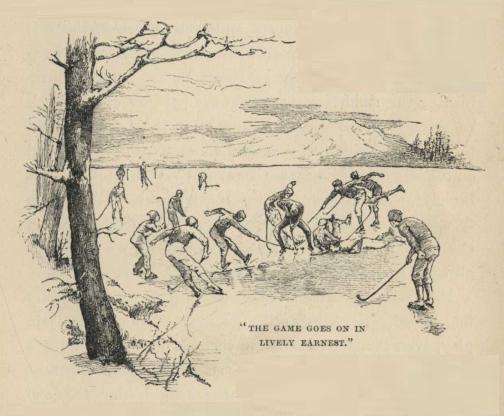
"THE GAME GOES ON IN LIVELY EARNEST."
For the control of the game there are a referee, who follows it about as does the referee at football, and two umpires, one at either goal, the sole business of the latter being to decide whether or not the puck has passed between the posts, and not above the flags.
Play begins with a bully—that is, the puck is placed between the two centres in the centre of the rink, and they, after solemnly striking their sticks together, three times, scramble for its possession, trying either to drive it ahead into their opponents' territory, or behind to the half-back, who immediately passes it to one of the forwards. Then the game goes on in lively earnest; and when the teams are expert and well matched, there is nothing on ice to compare with it for brilliancy and excitement. The exceeding swiftness of the players' movements; the sudden variations in the position of the puck as, under the impulse of sinewy arms, it darts from end to end, from side to side, of the rink; the incessant grind and clatter and ring of the skates; the crack of the hockeys, and the shouts of the eager players—all combine to work up the deepest interest among the spectators; and the announcement of a match between two good teams always insures a large and enthusiastic attendance.
The rules by which the game is governed are easily understood. So long as the puck is on the ice it is in play, even though it be behind the goal line. Of course a goal can be won only from the front; but an opponent who is not off-side may follow the puck behind the goal line, and fight for the privilege of bringing it out again. The rules as to on-side and off-side are precisely the same as in Rugby football; that is to say, a player must always be between his own goal and the puck when he plays on it. A violation of this rule calls for a bully at the spot where the wrong stroke was made. The referee is the sole judge in all matters of this kind, and from his decision there is no appeal. The puck may be stopped, but not carried or knocked on by any part of the body. In striking it the stick must not be raised above the shoulder. The object of this rule is to check violence, and the effect of it is to make the stroke move of a push than a blow, insuring greater accuracy in shooting for goal or a fellow-player, and adding greatly to the grace of the game. A practised player will, with wonderfully little manifest effort, send the puck from end to end of the rink if the ice is at all in good condition.
Another mode of propelling the puck which is at present permissible, but is in danger of being ruled out, is "lifting." I cannot very well explain in words how it is done; but by a deft turn of the wrist, gained only by diligent practice, the rubber is made to spring into the air and fly in the desired direction. It is a very effective but dangerous way of gaining ground, the danger consisting in the liability of players to be struck by the weighty missile, and ugly blows have often been received in this way. A "lift" at the goals is very hard to stop, if sent in low and swift, as I know by personal experience; for once, when tending goal, the point of my opponents charged down the length of the rink, and, without slackening speed, "lifted" the puck, and sent it past me like a bullet, while I was making ready to receive it on the ice, not imagining that he could lift successfully while at full speed.
No charging from behind, tripping, collaring, kicking, or shinning is allowed; and if any player offends after two warnings, it is the duty of the referee to order him off the ice for the remainder of the match. If the puck goes off the ice behind the goals, it must be taken five yards out, at right angles from the goal line, and there "faced" as at the beginning of the game. When it goes off the ice at the sides, it must be faced five yards at right angles from the side boundary.
The goal-keeper must not during play lie, kneel, or sit upon the ice, but must maintain a standing position. He may stop the puck with his hands or feet, but may not throw or kick it away from the goal. He must play it properly with his stick.
Two half-hours, with an intermission of ten minutes to regain breath and wipe off the perspiration, is the time allowed for a match, the team winning the most goals being the victors. There are no other points than goals to be scored.
Such are the principal rules; and now for a few words in conclusion of a general character. Only those who are in good condition and at home on their skates should undertake to play hockey. It is a violent game, and tests both wind and muscle to the utmost. The player must make up his mind to many falls, and no lack of hard knocks on shins and knuckles; for such things will happen, however faithfully the contestants try to keep to the rules. At the same time, these very characteristics make hockey one of the manliest of sports. Strength, speed, endurance, self-control, shrewdness, are the necessary qualities of one who would excel in it. Combination play is just as effective in it as in football, and there is no practical limit to the skill that may be attained.
A very important feature of hockey is that it may be played at night. Since the introduction of the electric light our rinks are made as bright as day, and then the many hard-working young men who are too busy all day to take part in any sport have the opportunity of an hour's splendid exercise after their work is over.
Take it all in all, there is perhaps no winter sport exclusively for men that is destined to become more popular, or have more enduring favour. In Canada new associations are rapidly springing up, and local leagues that arrange a schedule of matches for the season. The boys are taking hold of the game with great zest, closely imitating the tricks and artifices of their big brothers, and it is safe to say that hockey has definitely taken its place among the national sports of Canada.
ON THE EDGE OF THE RAPIDS.
"Hurrah, Lon! we've got the sort of day we've been looking for at last," cried Alec Pearson, as he met his chum one lovely still summer morning. "No trouble about getting over to Deschenes to-day."
"Right you are, Alec! This is just the correct thing. We'll start straight after breakfast—hey?"
"As soon as you like, provided mother's got the grub ready. Can't think of going without that, you know."
"No, sir. A basket of grub's half the fun. And mother's promised me a big one."
"Ditto mine," responded Alec. "So there's no fear of our starving for a while, even if we get cast away on one of the islands."
"Cast away on one of the islands!" echoed Lon. "That's a great idea! Wouldn't it make a great sensation?"
"Perhaps it would," replied Alec, who was of a more cautious and unimaginative cast of character. "But I'm not hankering to try it all the same. To get over to Deschenes will be enough fun for me."
The speakers were two boys of about sixteen years of age, sitting upon the front steps of a summer cottage, and looking out across the splendid stretch of water that flashed like a flawless mirror beneath the fiery morning sunshine.