MY STRANGE RESCUE (continued 4)
Reading edition
So she ate a little of the bread and meat, and took a sup out of the bottle of milk, and then, feeling refreshed, renewed her tramp, first listening eagerly, but in vain, for the sound of her father's axe.
All that afternoon the lost child alternately walked and rested, often crying softly to herself, then drying her tears and seeking to take heart from the hope of yet finding her father before darkness came on.
She was a brave little thing, accustomed to a good deal of outdoor life, and to running through the woods; but when night closed around her and the forest shade deepened into impenetrable gloom, poor Edie gave up the struggle, and sank down in a mossy hollow, shivering with terror.
Yet so weary was she that presently she fell asleep, and did not awake until dawn, when, though feeling very stiff and sore from the unwonted exertions of the day before, she ate her breakfast out of the basket and renewed her progress.
The following day she wandered about, only getting deeper and deeper into the forest. Her basket was empty before evening, and she was fain to make her supper of the berries, which fortunately were very plentiful. They were not altogether satisfying, but they were better than nothing.
Another day passed, the weather providentially continuing bright, clear, and warm, and the little wanderer still kept on, not knowing whither she was going. That night strange things began to happen. She was more wakeful than usual, and as she lay at the foot of a tree, she saw some large animals moving about in the dim light, and her bosom thrilled with joy, for she thought they must be her father's oxen. So she called out,—
"Buck! Bright! Come here!"
"HE LEVELLED HIS RIFLE IN READINESS TO FIRE."
But at the sound of her voice they started as if greatly frightened, and at once dashed off through the woods at the top of their speed; which showed her that they must have been moose, such as her father sometimes shot.
The following night two great, black, shaggy dogs, which she supposed must be neighbour Hewett's, came near her; but when she called them by their names they seemed more surprised than the moose, for they stood up on their hind legs, looked very hard at her for a few moments, and then, dropping down on all fours, hastened away into the darkness again, where, as Edie thought, she heard them howling. In this, however, she must have been doubly mistaken.
What she took to be dogs were no doubt black bears, then quite numerous in that district, being, attracted by the berries; and the howling, of course, was done by wolves, which, luckily, seemed afraid to attack her.
On the fourth afternoon, Edie, by happy chance, came across the deserted shanty of an early pioneer, standing in the middle of a clearing that was thickly overgrown with raspberry bushes.
Here she remained for three days, feeding upon the berries during the daytime, and sleeping in the shanty at night. The nights were so warm that she needed no fire, and inside the shanty she was safe from the attacks of bears or wolves. It was dreadfully lonely, yet still she hoped that her father would come and find her.
A whole week thus passed away. Edie had been given up for lost by her heart-broken parents, and the neighbours who were assisting in the search had returned to their homes, when a gentleman—Mr. Barker by name—had an experience such as no sportsman surely ever had before.
He had been out on a hunting expedition for a fortnight, and that day came to the banks of Bear Creek.
He was preparing to cross on a fallen log almost spanning the stream, when his keen ear caught the sound of soft footsteps, accompanied by a continuous rustling movement in the thicket of wild raspberries that covered the opposite bank.
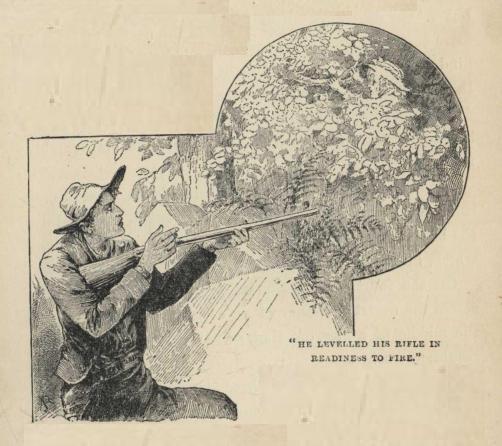
At once with a tremor of delight he suspected the approach of a deer, or possibly a bear, and dropping behind a bush, he levelled his rifle in readiness to fire.
The next moment, as his eager eyes intently scanned the raspberry bushes, his sportsman's feeling of delight suddenly changed to a thrill of horror when a tiny brown, berry-stained hand was quietly raised to pull down a loaded branch of fruit.
"Well, of all things!" cried the hunter, as his finger fell from the trigger that had so nearly sent the bullet upon its fatal mission. "What an awful mistake I almost made!"
Throwing down his rifle he sprang across the log, to catch in his arms a little girl not more than eight years old, whose torn garments, tangled locks, soiled hands, and thin, pale face, told in a glance the story of many days' hapless wanderings.
Oh, how glad poor Edie was to see him, and how artlessly she told the story of her wonderful adventures! And how thankful to Providence the hunter was that he had chanced to find her ere it was too late!
Forgetting all about his hunting, her rescuer now applied himself to the task of getting her home. They were far from the nearest house, and the poor child was so weak from lack of proper food that he had to lift her up on his broad shoulders.
But Mr. Barker was as strong as he was kind-hearted, and he pushed resolutely on, guiding himself by his compass, until at last, just as dusk was closing around them, and he began to fear they would have to pass another night in the forest, they came upon a clearing, at the far side of which stood a neat log house.
Edie shouted her joy at the sight. It meant that all her perils were over; and the hunter, putting on a big spurt, dashed across the clearing at a run and deposited her on the doorstep, exclaiming in a tone of vast relief,—
"There now, my child, that's the end of your wanderings!"
The good people of the house gave them both a warm welcome. Edie received every attention; and the following morning, looking altogether a different girl, with dress mended, hair neatly brushed, hands free from berry-stains, and face radiant at the prospect of returning to her parents, she took her seat in the farmer's waggon to be driven home.
How shall the joy of the Hazens be described when the little daughter they had mourned for as dead came back to them, looking thin and worn, it is true, but otherwise not a whit the worse for her thrilling experience!
Mr. Barker watched them with brimming eyes, murmuring, as he fondly patted the stock of his Remington,—
"The best day's work you ever did was when you didn't go off at all. A lucky chance, indeed!"
MRS. GRUNDY'S GOBBLERS.
Mrs. Grundy (or, as the boys disrespectfully called her, Mrs. Grumpy) was certainly not a favourite with the young people of Westville. In the first place, she did not like children. The fact that she had never been blessed with any of her own no doubt had a great deal to do with this dislike for other people's, which she manifested by vigorous use of hand and tongue at the slightest provocation.
Many a sharp speech and stinging slap did Mrs. Grundy inflict—and not always upon those who deserved it most, either; for so hot was her temper, so hasty her action when irritated, that she would visit her wrath upon the first youngster she could reach, without waiting to investigate the extent of her luckless captive's guilt.
Another reason why Mrs. Grundy was not popular was that, although she owned the finest orchard and garden in all Westville, not one crimson strawberry, purple plum, or golden apple was she ever known to bestow upon boy or girl; and woe betide the adventurous urchin that dared to take one unbidden, even though it be a half-spoiled windfall, if he fell into her strong hands! Forthwith he was marched off, amid a storm of slaps and scolding, despite his sobs and vows of penitence, into the awful presence of Squire Hardgrit, and, his alarmed parents having been duly summoned, was in their presence condemned to that most appalling of punishments—a whole day in the house of detention!
This method of dealing with the would-be or actual fruit-filchers had one advantage, so far as Mrs. Grundy was concerned—it gave her a sharer in the burden of her unpopularity, which perhaps might otherwise have proved insupportable; for so hard, cold, and unsympathetic was Squire Hardgrit, and such evident pleasure did he take in imposing his penalties, that if the Westville boys hated anybody as cordially as they did Mrs. Grundy, it was certainly the stern, severe squire.
For some time past the relations between these two worthies and the boys had, as the newspapers say about the great Powers, been more than usually strained. Not content with fiercely defending her garden and orchard from juvenile depredation, Mrs. Grundy had asserted her right to keep everybody off the broad, smooth plot of grass that lay between her cottage and the road, and had been upheld in her claim by the squire, to the profound disgust of the boys, who had long made it their gathering-place in the summer evenings; for although too small to play a game of baseball upon, it was big enough for pitching and catching, chase, leap-frog, and that sort of thing.
This appropriation of the grass plot, which had hitherto been regarded as public property, was quite too much for the boys. It was the last drop in the cup of bitterness, and in desperation they called a meeting to be held in Thompson's barn on Saturday night to consider the situation.
Saturday night came, and a dozen of the brightest boys of Westville gathered in solemn conclave around a lantern to see if some way could not be devised of getting even with Mrs. Grumpy and the squire.
As the barn belonged to his father, Charlie Thompson was chosen chairman, and he promptly opened the meeting as follows:—
"Now, fellows, we can't stand this sort of thing any longer. Something must be done, if we perish in the attempt. The honour of the country demands" (Charlie, whose memory was particularly good, had not yet forgotten the last 4th of July oration) "that measures should be taken to show to our oppressors that we are not slaves and cowards. The meeting is now open, and the chair will be pleased to receive suggestions."
And amid a vigorous round of boot-heel applause Charlie sat down, feeling that he had proved himself quite equal to the occasion.
For a few moments there was a dead pause, all having some sort of a scheme, more or less hazy, in their heads, but none wishing to speak first.
At last little Tommy Short, the youngest in the group, piped out,—
"Let's tar and feather 'em. Father has lots of tar in his back shop, and I know where there's a big pot."
A roar of laughter greeted this suggestion, the impracticability of which was exceeded only by its absurdity, could it have been carried out.
Dame Grundy and Squire Hardgrit would certainly have made a most mirth-provoking sight, done up in suits of tar and feathers.
The speech served its purpose, however, in loosening the other tongues, and plans and projects now poured in thick and fast.
"S'pose we burn their barns down," said Dick Wilding, who was a great reader of cheap-novel literature.
But all the rest shouted "No" at once.
"What do you say to ham-stringing their horses?" asked Bob Henderson, in rather a dubious tone, as if he had not much confidence in the wisdom of his scheme, which, in fact, just occurred to him because he had read that that was the way the Arabs treat their enemies' horses when they get the chance.
"Stuff and nonsense!" cried the chairman. "That's not the sort of thing we mean at all. We're not hankering after the penitentiary."
"Give us your plan, then, Mr. Chairman," said Dick Wilding.
"Well, fellows, I'll tell you what I was thinking of. Let us hook the old lady's gobblers, and hide them until she thinks they're gone for good. You know what a heap she thinks of them, and it will worry her awfully to lose them."
"Capital! capital!" shouted the rest of the boys "The very thing!"
"But where shall we hide them?" asked Sam Lawson. "It'll have to be a pretty safe place, for Mrs. Grumpy will turn the town upside down hunting for her precious turkeys, you may be sure."
While all this talk was going on, Harold Kent had been sitting on an upturned box which served him as a chair, without opening his mouth. Now, however, taking advantage of the pause which followed Sam's question, he said quietly,—
"Why not hide the gobblers in one of the empty rooms in Squire Hardgrit's building? You know, the squire's been trying to get these Bronze Gobblers from Mrs. Grumpy for ever so long, and she won't let him have them; and if they're found on his premises, she'll be sure to think that he had something to do with hooking them."
It was just like Harold to propose something so original and daring in its conception as to fairly take his companions' breath away, and they now looked at him with feelings divided between admiration and amazement.
The chairman was the first to speak. Bringing his hand down upon his knee with a crack that made the others jump, he cried,—
"Magnificent! Boys, we'll do it, or perish in the attempt."
Whereat the others shouted in chorus,—
"Hoorah! We'll do it!"
"Since we're all agreed, then," said Charlie, "the next business before the meeting is to plan how to do it."
As before, all sorts of wild suggestions were put forward, and again it was left for Harold Kent to advance the most practicable scheme.
This was it: the shed in which Mrs. Grundy's famous flock of turkeys was carefully secured at night stood at some distance to the back of her house, and as she slept in one of the front rooms, there was slight risk of her seeing or hearing anything. What Harold proposed was, that, slipping out of their rooms after everybody was asleep, they should meet behind the turkey-shed, bringing with them three gunny sacks and a dark lantern. Having got the gobblers safely into the sacks, they would then creep round the back way to the building in which the squire's office was situated, climb in through a lower window, and so upstairs to the room in which the turkeys were to be left.
"You've a great head, Hal," said Jack Wilding admiringly, when all this had been detailed, "and you can count on us every time—can't he, boys?"
"You bet he can," chorused the crowd.
A satisfactory plan of campaign having thus been settled upon, the meeting was adjourned until Monday midnight, then to assemble behind Mrs. Grundy's turkey-shed. The eventful night came; and as midnight drew near, one by one the boys gathered with throbbing hearts at the rendezvous.
At length all but Tommy Short, whose courage had failed him, and Bob Henderson, whose father had nabbed him in the act of slipping out, and sent him back to bed with a spank, turned up.
"THEY WERE TOO BEWILDERED BY THE BLAZE TO MAKE ANY NOISE. Page 227"
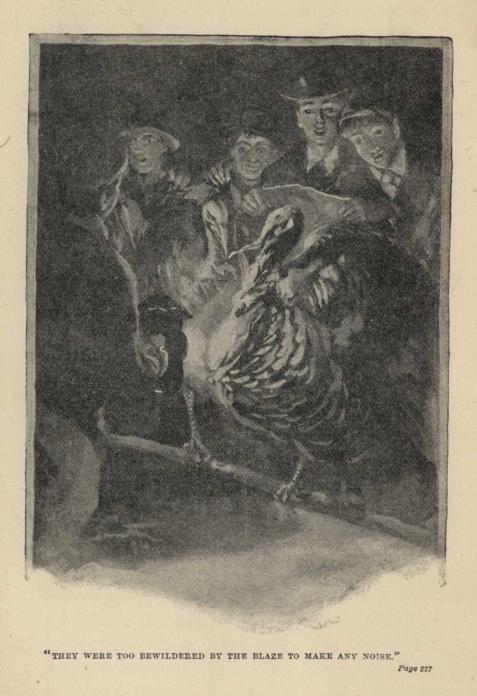
It was an intensely dark night and blowing half a gale. all of which was in favour of the enterprise. The shed door was found to be simply secured with a wooden latch, and lifting this the conspirators tip-toed inside; and then Charlie Thompson, who carried the dark lantern, suddenly turned its glare full upon the startled gobblers as they nodded solemnly side by side upon their roost.
They were too bewildered by the blaze to make any noise, and before they could recover their self-possession sufficiently to exclaim at so extraordinary an apparition, the other boys had stepped behind them, and with quick, deft movements slipped the big sacks over their heads, thus reducing them at one bold stroke to helpless captives.
The poor turkeys struggled and "gobbled" a good deal in their narrow quarters, but all to no purpose; and full of terror, no doubt, at their strange treatment, were hurried out of the shed into the lane, and thence through dark and silent ways to the rear of the squire's building. Here the conspirators paused for breath and consultation.
"Now, fellows," whispered Harold Kent, "we needn't all go inside, you know. I'll take the lantern, while the three biggest of you carry the gobblers, and the rest will stay here until we come back."
Somewhat reluctantly this was assented to, for all wanted to share the danger as well as the fun; and then Harold, lantern in hand, followed by Dick Wilding, Sam Shaw, and Frank Cushing, each bending beneath a bag of struggling, "gobbling" turkey, climbed in through the low window, crept softly in stocking feet along the narrow hall and up the creaking stairs; while their companions, with hearts beating like trip-hammers, shrank close together in the darkest corner outside and anxiously awaited their return.
It was no easy task that the four boys had in hand. True enough that the building was uninhabited at night, but there were people living next door, and any unusual noise could hardly fail to be heard through those thin wooden walls; while, late as the hour was, the sound of footsteps on the plank side-walks would ever and anon send a chill of terror through the anxious watchers below.
Moreover, to carry three big turkeys up a flight of stairs and deposit them in an empty room without filling the whole place with their noise was the hardest part of all. Nevertheless they succeeded admirably.
Five minutes after they disappeared they rejoined their companions, trembling but triumphant, having left their captives in good order and condition in the front room, just across the room from Squire Hardgrit's office, where they would be certain to make themselves seen and heard in the morning.
This done, the boys scattered to their homes, creeping back noiselessly to their beds, in which, being thoroughly tired out, they slept as soundly until morning as if they had not been up to any mischief whatever.
The great gathering-place of the Westville boys was the blacksmith's forge, which stood across the road from Mrs. Grundy's, and thither the conspirators came one by one the following morning in expectation of seeing the fun.
Nor were they disappointed. Their enemy thought too much of her precious turkeys to intrust any person else with the duty of feeding them, and so every morning carried them a big dish of corn-meal mush after she had finished her own breakfast.
"There she goes!" exclaimed Dick Wilding presently, as the boys were laughing and talking somewhat nervously together.
And, sure enough, Mrs. Grundy's portly figure emerged from the house and went slowly toward the shed.
Soon after a sharp cry of "Susan! Susan!" cut the still morning air, and the prim maid-servant was observed to hurry to her mistress.
A moment later the two women could be observed running hither and thither through the garden and orchard, calling, "Turkey! turkey! turkey!" at the top of their voices.
Great indeed was Mrs. Grundy's concern, and soon the whole neighbourhood was made aware of her loss.
"It's those rascally gipsies, sure's I'm alive," she cried. "Who else would steal my beautiful gobblers, that I wouldn't sell even to the squire? I'll have every one of them sent to jail, see if I don't. Just wait till the squire comes!"
And so she stormed while awaiting the arrival of the squire at his office.
The moment he appeared she poured her woful tale into his ears, while a curious crowd gathered outside, eager to see what the majesty of the law could effect.
Most prominent in the crowd were, of course, the boys, who alone held the clue to the mystery, and were now eagerly expecting the grand denouement.
It was not long in coming. Mrs. Grundy had only about half finished her confused recital of facts, suspicions, and theories to the gravely listening squire, when a vigorous "Gobble-gobble-gobble!" was distinctly heard coming from somewhere near at hand, just as a shout broke in from the street of,—
"There they are—up in Squire Hardgrit's room! Look at them!"
Before the squire could take in the situation, his excited client sprang to her feet, rushed out of the office, across the hall, threw open the door into the opposite room, and there, behold! as large as life, and as cross as three gobblers could be, were her missing turkeys, who, the instant the door was opened, charged straight through it, almost upsetting their mistress, and went flapping violently downstairs and out into the street, where they were greeted with a shout of laughter from the surprised spectators.
It would be impossible with either pen or pencil to give an adequate conception of the old lady's countenance as she returned to the squire's office, and met that worthy magistrate just rising from his chair.
Surprise, suspicion, indignation, and wrath chased one another swiftly across her features, and, once her feelings found utterance, there was poured upon the amazed squire such a torrent of reproach and contumely that he was fairly stunned into silence; and before he could recover himself sufficiently to make his defence, his accuser, with a scornful swing of her ample skirts that was simply magnificent, flounced out of the office, while he sank back into his chair, the very picture of helpless bewilderment.
That he, Squire Hardgrit, the incorruptible guardian of the people's rights, should be suspected of having stolen, or causing to have stolen for him, the turkeys of a neighbour, whose situation as a lone widow was such as to make the crime seem particularly heinous—that any person should for one moment suspect anything so abominable; and not only suspect it, but charge him to his face with his supposed guilt before the whole village (for the squire was well aware that Mrs. Grundy's shrill utterances had been audible clear across the street), it was awful, perfectly awful, and not to be borne for a moment! He must see Mrs. Grundy immediately, and compel her to listen to him.
Accordingly, away he posted to the widow's cottage, where he arrived just in time to check the poor dame from going off into a fit of hysterics.
Her turkeys being once more safely in her yard, and her anger pretty well abated, Mrs. Grundy was quite willing to listen believingly to the squire's indignant denials, and graciously accept his assurance that no pains would be spared to ferret out the real delinquents.
The former harmony was restored, and an alliance, offensive and defensive, sealed with a glass of gooseberry wine, for both were strongly of the opinion that "those wicked wretches of boys" were at the bottom of the whole mischief.
Thanks to those same boys holding their tongues, however, neither Mrs. Grundy nor the squire could ever get hold on any evidence more solid than their own suspicions, and they both had too much sense to take any action upon them.
But the nocturnal travels of the turkeys were not in vain; for their mistress, realizing that the boys, if pressed too far, might do something worse next time, thought it wise to mitigate her severity toward them, and even softened to the extent of calling a lot of them into her orchard that very autumn to fill their pockets with the windfalls.
This stroke of diplomacy was not lost upon the boys, who reciprocated after their own fashion: and thus matters went smoothly on, until at length most harmonious relations were established, and in all the countryside no creatures were safer from the youngsters' mischief than Mrs. Grundy's gobblers.
ON THE WRONG SIDE OF THE SNOW-RIDGE.
One of the Fur Commissioners of the Hudson Bay Company at Winnipeg was entertaining a number of the factors and other officials at Christmas dinner, and after the successive courses had received appreciative attention, the guests settled themselves at ease about the table to enjoy the excellent cigars and one another's conversation.
Made up as the gathering was of men who had for ten, twenty, thirty years or longer, in the pursuance of their vocation, experienced most moving adventures by flood and field, good stories followed fast. One told of a thrilling trip through the dangerous rapids of the Portage of the Drowned; another, of the narrow escape from meeting death at the hands of a grizzly among the foot-hills of the Rockies; while a third held the attention of all as he graphically described the fearful struggle that he had with a wounded bull bison in the valley of the Bow River.
Thus the story-telling went around until it reached Hugh M'Kenzie, one of the oldest officials in the active service, who, in response to a unanimous demand, spun the following interesting yarn of mountain-sheep hunting.
"It was in the third year of my clerkship, and they had sent me away out to Fort George, right in the heart of the Rockies. I would rather have stayed on the plains, where the buffalo were in plenty; but you're not asked as to what you'd like best in the company. You're just told to go, and there's an end of it. I found it very dull at Fort George, and to while away the time I did all the hunting I could. To help me in this I had two fine dogs, of whom I was extremely proud. They were half-bred collies, not particularly handsome creatures, but full of pluck, and as knowing animals as ever wagged tails.
"Having had pretty good luck with bear and other game to be found in the neighbourhood of the fort, I became possessed of a strong desire to secure the head of one of those Rocky Mountain sheep which have their home high up among the peaks, and are as difficult animals to hunt as there are in the world.
"Again and again I went out without success, although my dogs, Bruce and Oscar, seemed as eager to get sheep as I was myself; but instead of becoming disheartened, I grew all the more determined, and longed for the winter to come, when the snow, by covering their higher pasturing grounds, would drive the sheep lower down the mountain, and thus make them more getatable.
"The winter began with a series of heavy snowfalls which shut us all up in the fort for several weeks, and it was early in December before I thought it safe to have another try after the sheep.
"Then one fine, bright morning I started off, feeling very hopeful that I would return with my much-coveted prize. The dogs, of course, went with me, but I had no other companion, nobody else having sufficient sporting ardour to share in the risks of my expedition; for it certainly was full of risks, and had I been older and wiser I would never have undertaken it. But I was young and strong and full of spirit, and my eagerness to obtain a set of horns had become a bit of a joke against me with the fellows; so that I was not in the mood to soberly weigh the pros and cons of the matter.
"Thinking it possible I might be out all night, I rolled up some provisions and matches in my thick plaid, and strapped it on my shoulders. With hatchet and hunting-knife in my belt, a full powder-horn at my side, snowshoes on feet and rifle in hand, I set out amid the good-humoured chaffing of my fellow-clerks.
"Up into the mountains I climbed, keeping a keen look-out for signs of the game I was seeking, while Bruce and Oscar ranged right and left, so that we covered a good deal of ground between us. By mid-day the climbing became so steep and difficult that I had to take off my snow-shoes, and strapped them on my back. They were no longer necessary, at any rate, for the snow was covered with a crust which bore me up admirably, and made easy going for my moccasined feet.
"It was not until afternoon that the first sheep were sighted, and, much to my delight, they seemed not far away, and easy to get at. There were five in the flock: a huge ram with superb horns—just the thing I hankered after—and four fine ewes, which, however, had nothing to fear from me.
"Calling the dogs to heel, I proceeded to stalk the unsuspecting creatures with all the skill I possessed. It proved a harder job than I thought. They were on a kind of ledge several hundred feet above me, and in order to get a proper shot without giving them warning, it was necessary to make a wide circuit, so as to reach a point opposite their ledge from which a capital chance might be had.
"By dint of great exertion, however, I reached the point all right, and was just waiting a moment to catch my breath before taking aim at the ram, when Oscar's impatience overcame him, and he gave a sharp bark. Instantly the whole live animals started to flee. I threw the rifle to my shoulder and pulled the trigger. It was nothing better than a snap-shot, yet it did not miss; for with the report the ram sprang into the air, stumbled as he came down, and then dashed off again, leaving behind him a plain trail of blood-drops on the white snow.
"With an exultant shout I sent the dogs forward, and followed as fast as I could. I had to go down into a ravine and get up the other side before reaching the bloody trail. Forgetting everything else in my wild excitement, I pressed on, guided by my dogs' sharp barking. It was terribly hard work, and I had many a slip and stumble; but the red splashes in the snow grew larger the further I went. Bleeding at the rate he was, the ram surely could not keep up his flight for any great distance.
"Presently I came to a place that at any other time would have brought me to a full stop. A ridge of hard frozen snow stretched between two rocky ledges. On the one side it reached down to the edge of a precipice, which then fell away abruptly into an unknown depth. On the other side, in one unbroken sheet, it sloped down full five hundred feet to a level upon, which the snow lay in great drifts. The ram was already half-way across the ridge, although evidently in distress, and the dogs were hard at his heel, barking fiercely, for they knew that victory was not far off.
"Throwing all considerations of prudence to the winds, I set out to follow them. So narrow was the ridge that I could not stand erect, but had to sit astride it, and push myself forward by using both hands and feet. I never glanced below me, lest I should lose my head; and at length, almost completely exhausted, I succeeded in making the other side.
"Here awaiting me was my quarry, standing at bay against the cliff, and butting off the dogs that were springing for his throat. It was some minutes before my nerves were sufficiently steadied for me to use my rifle; then one shot was sufficient. With a convulsive spring the noble animal scattered the dogs and fell dead at my feet.
"Oh, but what a proud moment for me! The horns were splendid. A man might not get a finer pair in a lifetime. With the utmost care I detached the head, and then, for the first time since the chase began, sat down to rest.
"I was so tired that I would have been glad to camp here for the night. But there was absolutely nothing in the way of shelter, and it promised to be bitterly cold and windy. I must get back to the lower level before darkness came on.
"Securing the ram's head on my shoulders, where I must say it felt abominably heavy, I returned to the ridge. Not until then did I realize into what a critical position my reckless ardour had brought me. One look at that perilous passage-way was sufficient to assure me that in my wearied and unnerved condition to recross it was a feat utterly impracticable. My dogs—two clever, sure-footed creatures as they were—shrank back in evident dismay, although I sought to urge them forward; yet for me to remain on that exposed ledge meant death by freezing before morning.
"I was in a terrible predicament. Little more than an hour of daylight remained. Whatever was to be done needed to be done right away. While I stood there bewildered and irresolute, Oscar again ventured out a little distance on the ridge, but, becoming frightened, tried to turn back. In so doing he lost his footing, and, despite desperate efforts to regain it, shot swiftly down the slope that ended in a level five hundred feet below.
"With keen concern I watched him through the waning light rolling helplessly over and over until after a final tumble he landed in a great drift, out of which, to my great joy, he emerged the next moment, shook himself vigorously, and sent back a brisk bark as though to say, 'Come along; it's not so bad as it looks.'
"Instantly I caught the idea. If my dog made the descent uninjured, why could not I? Great as the risk might be, it was, after all, no worse than staying on the ledge all night. To think was to act. Loosening the ram's head from my back, I sent it down after Oscar. It sped to the bottom and buried itself in a snow-bank. Next I tied my rifle, hatchet, and hunting-knife on one of the snow-shoes, and despatched them. They, too, made the trip all right, and vanished in the snow. Then came my turn. Rolling up the plaid I lashed it on the remaining snow-shoe, and committed myself to this extemporized toboggan.
"What followed is more than I can tell. So steep was the slope that I seemed to drop into space. I was not conscious of touching anything, but simply of being shot through the icy air, blinded by particles of snow, and choking for lack of breath, until I was hurled like a stone from a catapult into a mass of loosely-packed snow, and lost consciousness.
"When I came to myself, Bruce and Oscar were both beside me, licking my face with affectionate anxiety. At first I could not move, and my whole body was so full of pain that I feared I had been seriously injured. But, after lying still awhile, I made shift to get upon my feet, and to my vast relief found myself none the worse of my wild descent, save for a scratched face and a severe shaking.
"My next thought was for the horns. I had no difficulty in extricating them or the rifle from their snowy bed, and found both were uninjured. Strapping them once more on my shoulders, and adjusting my snow-shoes, I set off down the ravine.
"To get back to the fort that evening was, of course, out of the question, but I hoped to find some cavity in the cliff where I could spend the night safely. Just before dark I discovered a snug little place, perfectly protected from the wind; and there, with my plaid wrapped tight around me, and my dogs curled up close against me, I put in quite a comfortable night. As soon as the day broke I started for the fort, and reached it by noon, half starved and very tired, but as proud of my trophy as David was of Goliath's head."
A hearty round of applause followed the conclusion of the old Scotchman's story, and by general consent it was voted the best told during the evening.
THROUGH THE TRACKLESS FOREST.
The two features of nature in which her might, her majesty, her mystery, find fullest expression, are the ocean and the forest. Regarding their vastness and their unchanging character, in our weak endeavour to find terms for the infinite we have made them symbols of eternity. Irresistible, perennial is the fascination they possess for man, and all-satisfying the measure with which they respond to his demands. On ocean's bosom or in the forest's heart he finds free play for his noblest qualities. In making them subservient to his will he has achieved his grandest development.
Nowhere round the globe are the forests finer than on this continent of ours. Boundless in extent and endless in diversity, the eye never wearies of resting upon them or seeking to penetrate their depths. Happily free as they are from the dense matted undergrowth that makes progress through the forests of the tropics a continuous penitential pilgrimage, they present glorious vistas of silvan shade, shot through with golden shafts of sunlight, down which you may wander at your ease in unchecked communion with nature.
By way of comparison just place these two pictures side by side.
Seeking to give some conception of the interminable Congo forest, in which he spent so many months of misery, Stanley exclaims: "Take a thick Scottish copse dripping with rain; imagine this copse to be a mere undergrowth, nourished under the impenetrable shade of ancient trees, ranging from one hundred feet to one hundred and eighty feet high; briers and thorns abundant; lazy creeks meandering through the depths of the jungle, and sometimes a deep affluent of a great river. Imagine this forest and jungle in all stages of decay and growth—old trees falling, leaning perilously over, fallen prostrate: ants and insects of all kinds, sizes, and colours murmuring around; monkeys and chimpanzees above, queer noises of birds and animals, crashes in the jungle as troops of elephants rush away; rain pattering down on you every other day in the year; an impure atmosphere, with its dread consequences, fever and dysentery, gloom throughout the day and darkness almost palpable throughout the night."
Turn now to Parkman, who knows and loves his forests as Miss Murfree her mountains, and who has once and for all time painted the picture of the great American forest: "Deep recesses, where, veiled in foliage, some wild, shy rivulet steals with timid music through breathless caves of verdure; gulfs where feathered crags rise like castle walls, where the noonday sun pierces with keen rays athwart the torrent, and the mossed arms of fallen pines cast wandering shadows on the illumined foam; pools of liquid crystal turned emerald in the reflected green of impending woods; rocks on whose rugged front the gleam of sunlit waters dances in quivering light; ancient trees hurled headlong by the storm to dam the raging stream with their forlorn and savage ruin; or the stern depths of immemorial forests, dim and silent as a cavern, columned with innumerable trunks, each like an Atlas upholding its world of leaves, and sweating perpetual moisture down its dark and channelled rind—some strong in youth, some gouty with decrepit age, nightmares of strange distortion, gnarled and knotted with wens and goitres, roots intertwined beneath like serpents petrified in an agony of contorted strife: green and glistening mosses carpeting the rough ground, mantling the rocks, turning pulpy stumps to mounds of verdure, and swathing fallen trunks, as, bent in the impotence of rottenness, they lie outstretched over knoll and hollow like mouldering reptiles of the primeval world, while around, and on, and through them springs the young growth that fattens on their decay—the forest devouring its own dead. Or, to turn from its funereal shade to the light and life, to the open woodland, the sheen of sparkling lakes, and mountains basking in the glory of the summer noon, flecked by the shadows of passing clouds that sail on snowy wings across the transparent azure."
No pestilent fever or insidious deadly miasma lurks in our forests. On the contrary, their pure, piny breath brings back health to many an ailing mortal, and beneath their feathery hemlocks and aromatic spruces one may lie down at night in sweet security from snakes, or centipedes, or other crawling horrors that make each night in a tropical forest a period of peril.
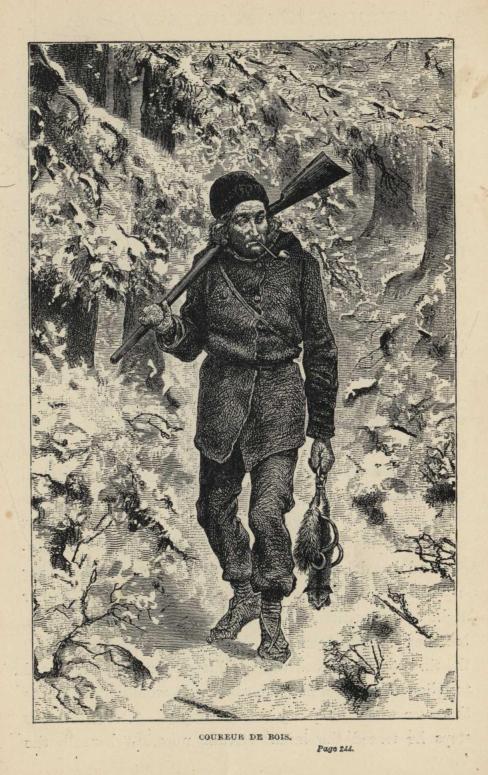
Is there one of us recalling the life of the coureurs de bois, the men who above all others made the trackless forest their own, does not feel a stirring of the pulses of admiration and envy, and a pathetic regret that those romantic days in which they flourished are over for ever? They were the natural outcome of the beaver trade, which in the earliest stage of Canadian history formed the struggling French colony's chief source of support. All that was most active and vigorous in the colony took to the woods, thereby escaping from the oppressive control of intendants, councils, and priests, to the savage freedom of the wilderness. Not only were the possible profits great, but in the pursuit of them there was a fascinating element of adventure and danger, which irresistibly appeals to the spirit of enterprise and daring that civilization has not yet quite extinguished within our breasts.
Though not a very valuable member of society, and a thorn in the side of princes and rulers, the coureur do bois had his uses, at least from an artistic point of view; and his strange figure, sometimes brutally savage, but oftener marked with the lines of a dare-devil courage, and a reckless, thoughtless gaiety, will always be joined to the memories of that grand world of woods which the nineteenth century is fast civilizing out of existence.
COUREUR DE BOIS. Page 244.
Lost in the forest! What a thrill runs swift to the heart as we repeat the words! Ever since our young eyes overflowed at the immortal legend of the babes in the wood, sleeping the sleep that knew no awakening beneath the leafy winding-sheet brought them by their bird mourners, we seem to have had a clear conception of all the terrors the phrase implies, and we follow with throbbing pulses and bated breath the recital of such an experience as the foremost and noblest of all the pioneers of these North American forests had.
One eventful autumn, nearly three centuries ago, Champlain had caught sight of a strange-looking bird, and left his party to go in pursuit. Flitting from tree to tree, the bird lured him deeper and deeper into the forest, then took wing and vanished. On essaying to retrace his steps Champlain found himself at a loss. Whither should he turn? The day was clouded, and he had left his compass in camp. The forest closed around him, trees mingled with trees in limitless confusion. Bewildered and lost he wandered all day, and at night slept fasting at the foot of a great tree. Awaking chilled and faint, he walked until afternoon, then happily found a pond upon whose bosom were water-fowl, some of which he shot, and for the first time broke his fast. Kindling a fire he prepared his supper, and lay down to sleep in a drenching rain. Another day of blind and weary wandering succeeded, and another night of exhaustion. He found paths in the wilderness, but they had not been made by human feet. After a time the tinkling of a brook touched his ear, and he determined to follow its course, in the hope that it would lead him to the river where his party was encamped. "With toilsome steps he traced the infant stream, now lost beneath the decaying masses of fallen trunks or the impervious intricacies of matted windfalls, now stealing through swampy thickets or gurgling in the shade of rocks, till it entered at length, not into the river, but into a small lake. Circling around the brink, he found the point where, gliding among clammy roots of alders, the brook ran out and resumed its course." Pressing persistently forward, he at length forced his way out of the entanglement of underbrush into an open meadow, and there before him rolled the river, broad and turbulent, its bank marked with the portage-path by which the Indians passed the neighbouring rapids. The good God be praised! he had found the clue he sought. Inexpressibly relieved, he hastened along the river-side, and in a few hours more was being joyfully welcomed by his companions, who had been anxiously searching for him. "From that day forth," we are told, "his host, Durantal, would never suffer him to go into the forest alone."
Although the coureur de bois has long since made his exit, there still remains in Canada a class of men who have somewhat in common with him. These are lumber-scouts or bush-rangers, whose business it is to seek for "limits" that will pay handsome profits. It is boards, not beavers, they have upon their minds. They are often Indians or half-breeds, and the skill of these self-taught surveyors is sometimes very remarkable. They will explore the length and breadth of the terra incognita, and report upon the kind and value of its timber, the situation, and capability of its streams for floating out the logs, and the facilities for hauling and transportation. They will even map out the surface of the country, showing the position of its streams and lakes, its groves of timber, and its mountainous or level appearance, with a skill and accuracy bewildering to ordinary mortals, in whose eyes the whole district would be one great confused wilderness.
No more interesting experience in woodcraft could be had than a scouting excursion in such company. The trackless forest has no terrors, no mysteries for them. To them Nature opens her heart, and tells all her secrets. In lightest marching order, each man's entire equipment being carried in a shoulder-pack upheld by a "tump-line" around the forehead, they plunge into the wilderness. With unerring instinct they pursue their way, now following the course of some winding stream, now circling a tiny lake lying gem-like in a verdurous setting, now scrambling amongst cliffs, where, to paraphrase Parkman, seeing but unseen, the crouched wild-cat eyes them from the thicket; now threading a maze of water-girded rocks, which the white cedar and the spruce clasp with serpent-like roots; then diving into leafy depths where the rock-maple rears its green masses, the beech its glistening leaves and clear smooth stem, while behind, stiff and sombre, stands the balsam fir, and the white pine towers proudly over all.
When night falls they make their simple bivouac, and their roaring camp-fire like a magician's wand strangely transforms the scene. As the flame casts its keen red light around, wild forms stand forth against the outer gloom—the oak, a giant in rusty mail; the mighty pyramid of the pine; the wan and ghastly birch, looking like a spectre in the darkness. The campers gather close around the ruddy flame made welcome by the cool breath of approaching autumn, and after the broiled trout or roast duck have disappeared, and an incense offering of fragrant smoke ascended from their pipes, they curl up in their blankets, and sleep as only those who live such a life can sleep, serenely oblivious of the harsh shriek of the owl, the mournful howl of the wolf, or the soft footfall of some prowling beast that breaks in upon the breathless stillness.
Splendid as our forests are at midsummer when the delighted eye roams unweariedly over their billowy expanses of sumptuous verdure, it is in the autumn time that they reach their rarest beauty. Then for a brief space before they strip themselves of their foliage to stand bare and shivering through the long, cold winter, they change their garb of green into a myriad of hues of gold and flame.
A keen frosty night following upon the decline of summer heat, and lo, as though some mighty magician had been at work, a marvellous transformation awaits our admiration! Where yesterday a single colour in various tints prevailed, to-day we behold every possible shade of brilliant scarlet, tender violet, sombre brown, vivid crimson, and glittering yellow. The beech, the birch, the oak, and above all, the maple, have burst forth into one harmonious and entrancing chorus of colour—the swan song of the dying foliage—the stern, straight fir alone maintaining its eternal green, as if it said: "Behold in me the symbol of steadfastness." Verily, the wide world round, a more splendid and enchanting silvan panorama cannot be found.
WRECKS AND WRECKERS OF ANTICOSTI.
Right in the mouth of the great St. Lawrence, which without exaggeration has been called "the noblest, the purest, the most enchanting river on all God's beautiful earth," lies a long, narrow island that might with equal propriety be called the dreariest, most inhospitable, and most destructive island on the earth; for it is doubtful if any other spot of corresponding size has caused so many shipwrecks and so much human suffering.
In ten years, according to official records, there have been as many as one hundred and six wrecks, including seven steamships and sixty-seven sailing-ships or barques, having on board no less than three thousand precious souls, and cargoes worth millions of pounds.
Years ago, before the Canadian Government erected lighthouses and established relief stations, the wrecks were more numerous still, and were rarely unattended with loss of life. But times are better now, and when a wreck occurs, unless it be in one of those terrible winter storms that seem to make this ill-omened isle their centre, the crew generally manage to make the land in safety, where they are well cared for by the government officials.
Far different was it in 1737, when the French sloop-of-war La Renommée stranded upon a cruel ledge of rocks, hardly a mile off shore, about eight leagues from the southern point of Anticosti.
It was in the month of November, just as winter, which could nowhere have been more dreadful than on that bleak, barren, shelterless island, was fast closing in. In their mad haste to reach the land—for the waves were breaking high over the vessel—the crew took little food with them, although gallant Captain de Freneuse did not forget to take the ship's colours.
When in the gray, grim morning they came to reckon up, they found, to their dismay, that with six months of hopeless captivity before them, they had barely enough food for forty days, allowing the scantiest of daily rations to each of the sixty-five men who had survived the shipwreck.
The sequel, as related with simple, graphic pathos by Father Crespel, one of the few who ultimately emerged from the terrible ordeal, constitutes as grand a record of human courage and endurance and as harrowing a history of human suffering as ever has been told.
The poor castaways had nothing but a little canvas to shelter them from the keen, biting blasts. Fever presently broke out amongst them. Then half of them set forth in two small boats to coast around that merciless shore for forty leagues, after which they made a hazardous dash across twelve leagues of open sea to Mingan, where French fishermen were known to winter.
The "jolly-boat" was swamped after they had been five days out, and its thirteen occupants were thus spared further misery. At last the ice setting in made the progress of the other boat impossible, and they had no alternative but to go into winter quarters and wait for the tardy spring.
With two pounds of damp, mouldy flour and two pounds of unsavoury fox-meat per day, these seventeen men, housed in rude huts of spruce boughs, prepared to endure the long agony of winter. Once a week a spoonful of peas was served out to each man; which constituted such a treat that, as Father Crespel naively puts it, "On those days we had our best meal."
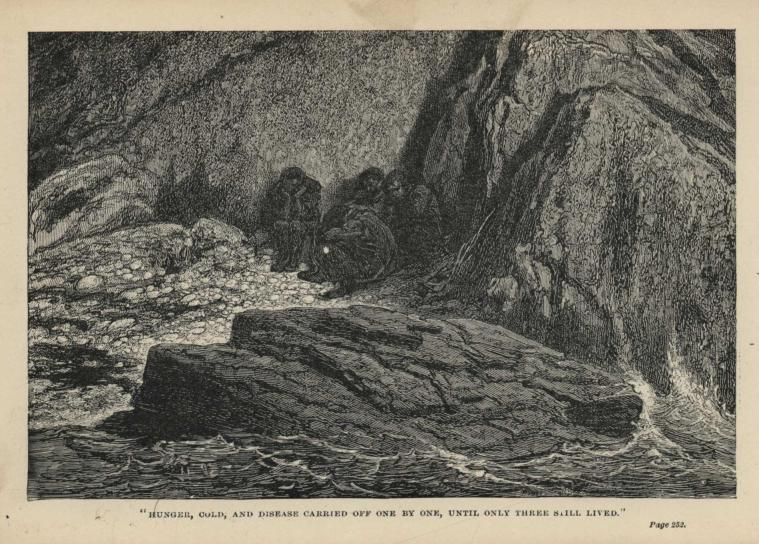
Hunger, cold, and disease carried off one by one as the months dragged themselves along, until at length only three still lived, when a band of Indians came just in time to save this remnant from perishing.
All this and more is told by heroic Father Crespel with a quaint simplicity, a minuteness of detail, and a perfect submission to the Divine will, that renders his recital extremely touching.
Not less saddening is the story of the stout brig Granicus, which in 1828 went to pieces off the east end of the island, also in the month of November. Many of the crew escaped to land, but with little more than the clothing they wore.
"HUNGER, COLD, AND DISEASE CARRIED OFF ONE BY ONE, UNTIL ONLY THREE STILL LIVED. Page 252"
Winter soon closed in upon them. No succour came. Their provisions gave out, and what followed may be judged from the awful sight that met the eyes of some government officials when the following spring they stumbled across a rude hut strewn with human skeletons, and, in the pot that hung over the long-dead ashes, some bones that were not those of an animal.
Those dreadful days are happily past and gone. Few lives are lost on Anticosti now. Four fine lighthouses send their cheering rays across the anxious mariner's path, signal-guns and steam-whistles sound friendly notes of warning when the frequent fogs dim the lights, and half-a-dozen telegraph-stations at different points are ready to speed at once the news of disaster to the mainland by means of the submarine cable.
Where wrecks are plentiful, and the controlling hand of the law is absent, wreckers are sure to be plentiful also. Anticosti has been no exception to this rule. The island has had its share of those who did not hesitate to pursue this nefarious business.
From the earliest times the place has held out attractions to the fisherman and the hunter. The cod, halibut, herring, and other fish that it pays to catch, abound along the coast; huge lobsters play hide-and-seek among the sea-weeds, and very good salmon and trout may be caught in some of the streams, while round-headed, mild-eyed seals spend the greater part of the year sporting in the waves or basking on the shore.
Then away inland there are, or used to be, bears, otters, martens, and foxes, to be had for the shooting or trapping.
Coming first to fish and hunt, the fishermen and hunters in many cases stayed to play the part of wreckers. There was a good deal more money to be made out of the flotsam and jetsam that the storms sent their way than out of fish or fur, and they made the most of their opportunities.
One thing, however, must be said in their behalf. They have never been accused of luring vessels to destruction by false lights, or of confirming their title to the goods cast up by the sea by acting upon the principle that dead men are not competent witnesses in court, and by despatching any of the shipwrecked who might have survived the disaster. On the contrary, more than one unfortunate crew have owed the preservation of their lives to these very wreckers.
The most renowned of them all—a man of whom it might in truth be said that there was not a St. Lawrence pilot or a Canadian sailor who knew him not by reputation, or a parish between Quebec and Gaspé where marvellous tales were not told about him around the evening fire—was Louis Olivier Gamache. In these stories he figured as the beau-ideal of a pirate, half ogre, half sea-wolf, who enjoyed the friendship and special protection of a familiar demon.
The learned and loquacious Abbé Ferland, in his dainty little volume of "Opuscules," which I hold in my hand, tells us about this wonderful Gamache, that, according to popular rumour, he had been seen to stand upright upon the thwarts of his sloop, and command the demon to bring him a capful of wind. Instantly his sails were filled, though the sea around him was in a glassy calm, and away he went, while all about him were vessels powerless to move.
During a trip to Rimouski he gave a grand supper to the devil, not to a devil of the second class, but to the veritable old gentleman himself. Aided by invisible assistants, he had massacred whole crews, and appropriated to himself the rich cargoes of their vessels. When hotly pursued by a government boat sent to capture him, and just about being overtaken, both sloop and Gamache suddenly disappeared, leaving nothing behind but a blue flame that went dancing over the waves in mocking defiance of the disappointed minions of the law.
Upon such thrilling legends as these was founded the reputation of the "Wizard of Anticosti," and so generally were they believed that the genial abbé assures us that the majority of the mariners in the gulf would rather have attempted to scale the citadel of Quebec than to approach by night the bay where Gamache was known to have his stronghold.
We can put plenty of confidence in the abbé, for in the year 1852 he had the courage to pay the wizard a visit, and I am sorry that I have not room to give the full particulars of that visit as they are brightly presented by this ever-entertaining writer.
He found the terror-inspiring Gamache to be a tall, erect, and vigorous old man, with snow-white hair but piercing eyes, who came forward to meet his visitors with an easy, dignified bearing that betrayed no concern or troubled conscience.
His house appeared to be a perfect arsenal of deadly weapons. No fewer than a dozen guns, many of them double-barrelled, grimly adorned the walls of the first room they entered, and every other room up to the very garret had at least two or three more, loaded and capped; they hung upon racks, surrounded by powder-flasks, shot-bags, swords, sabres, daggers, bayonets, and pistols, in most imposing profusion.
The house itself was something of a fortress. Every possible precaution had been taken to prevent persons entering it without the permission of its master. All the doors and windows were strongly barred and shuttered, and so complete were the defences that one man inside might have defied twenty outside. In the sheds, arranged in the most orderly manner, were long rows of barrels, bales, casks, and other gifts of the sea.
Such was the den of the dreaded wrecker, a man not one tithe so bad as wild rumour made him, but who, nevertheless, took pains to intensify the public feeling about himself, in order that he might be the more undisturbed in the solitude he had chosen for himself in that strange, wild place.
He had not always been alone, either. Twice had a woman been found willing to brave the rigours of his life for love of him, and in both cases they had succumbed to the terrible loneliness and desolation. His second wife died suddenly, while he was off on a hunting-trip in mid-winter; and he returned, after a fortnight's absence, to find her frozen form clasping to its icy breast the bodies of their two little children, the one five and the other six years old.
"That is how they will find me some day. Each one in their turn. Ah! well—since she is dead we can only bury her."
That was all the strange, taciturn man said to his companion, a hunter who had been with him, and yet he had always shown his wife the greatest kindness and affection. It was not that he was heartless, but that he would rather have died than reveal the depth of his feeling.
He amused the abbé very much by relating the various devices to which he had resorted in order to heighten his reputation for diabolic associations. He would go to a country inn, for instance, order a supper for two to be served in a private room, stating that he expected a gentleman in sable garments to share it with him.
When the supper was ready he would then lock himself up in the room, polish the supper off unaided, and summon the astonished landlady to clear the remains away, as he and his friend had supped and were satisfied. He would further increase their mystification by sundry rappings, and inexplicable openings and shuttings of doors.
He could also employ more sinister means of protecting himself when necessary. One day, when he was quite alone, a canoe glided into the bay, and presently a gigantic Montagnais Indian stepped ashore, armed to the teeth, and advanced with a firm step towards the house.
He was evidently crazed with fire-water, and Gamache felt in no mood to try a tussle with so brawny an opponent. Standing in the doorway, with a rifle in his hands, he called out in his sternest tones,—
"Stop! I forbid you to advance."
The intruder took not the slightest notice of him.
"Take another step and I fire," shouted Gamache. The step was taken, but before it could be repeated, the rifle spoke and the Indian fell, his thigh-bone smashed with the bullet. In an instant Gamache was beside the wounded man. Removing his weapons, he lifted him to his shoulder, and bore him tenderly to the house, and there nursed him until he was completely recovered.
Then filling his canoe with provisions, he sent him back to his tribe, with a warning never to intrude upon Gamache again unless he wanted a bullet through his head instead of his thigh.
In 1854, Louis Olivier Gamache died, like his poor wife, alone and unattended. For weeks no one had visited his abode, and when at last some seafarers chanced that way they found only the corpse of the once dreaded wizard, whose supposed league with evil spirits did not avail to save him from fulfilling his own prophecy.
The wrecks continue at Anticosti. Not long ago the shattered skeletons of four fine ocean steamers might have been seen upon its fatal shores, but with Gamache the reign of the wreckers ended, never to return.
A LUMBER CAMP.
There is no summer in a Canadian lumber camp; that is to say, there is nobody in the camp in summer, which amounts to the same thing. The season of activity in the camps, or the "shanties" as they are generally called, extends from late September to early April, and all summer long they are left to the care of birds that chirp and squirrels that chatter on the roof.
In the month of September the Canadian lumberman joins the gang of sturdy, active men who are bound for the "shanties," where a winter of hard work awaits them. For him the forests exist only to be remorselessly cut down; but though he may never stop to think about it, his is a very romantic and fascinating occupation.
September is one of the loveliest months in the Canadian calendar. The days are still long and sunny. The heat of summer has passed away, and the chill of autumn not yet come. One cloudless day follows another, and nature seems to be doing her best to make existence a delight. This is the time when the shantymen gather into gangs, and by rail or steamer journey northward until they pass the limits of settlement. Then taking to "shanks' mare" they make their way into the depths of the forest.
Let us follow a gang that is going upon a "limit" still untouched by the axe, far up the Black River, a tributary of the Ottawa, a hundred miles or more from the nearest village. This gang consists of about forty men, including the foremen, clerk, carpenter, cook, and chore-boy, all active, sturdy, and good-natured fellows. Most of them are French-Canadians—habitans, as the local term is—but English, Scotch, and Irish are found among them too, and quite often swarthy, wild-eyed men whose features tell plainly of Indian blood.
Scouts have previously selected the best site for the camp. It is usually in the midst of the "bunch" of timber to be cut, so that little time may be lost in going and coming. On arriving, the first thing done by the gang is to build the shanty, which is to be its home during the long, cold winter.
This edifice makes no pretence to architectural beauty, but nothing could be better adapted to its purpose. It is an illustration of simplicity and strength combined. With all hands helping heartily, a shanty forty feet long by twenty-eight feet wide can be put up in five days. Meantime the builders live in tents.
This is the way they go about it:—First of all, a number of trees are cut down. The trunks, cleared of all their branches, are sawed into proper lengths, and then laid one upon another until an enclosure with walls eight feet high is obtained. Upon the top of these walls strong girders are stretched, which are supported in the centre by four great pillars called "scoop-bearers."
Then comes the roof. A Canadian shanty roof is neither tiled nor shingled, but "scooped." What is a "scoop"? It is a piece of timber something like a very long railway tie, one side of which is hollowed out, trough-wise, clear to the ends. Place two of these side by side, with the concave sides upward, and then lay another on top of them, concave side down, so that the edges overlap and fall into the troughs, and you have a roof that will defy the heaviest rains or wildest snow-storms that Canada can produce.
A floor of roughly-flattened timbers having been laid and a door cut, it only remains to construct the "camboose," or fireplace, and the bunks, and the shanty is complete; provided, of course, every cranny in the walls has been chinked with moss and mud, and a bank of earth thrown up all around the outside to make sure that no draughts can sneak in when the mercury is far below zero.
The "camboose" is quite an important affair, and occupies the place of honour in the centre of the room between the four massive scoop-bearers. Its construction is as rude and simple as that of the rest of the shanty. A bank of sand about two feet deep and six feet square makes the hearth. Over it hang two wooden cranes that hold the capacious kettles, which are always full of the pea-soup or fat salt pork that constitute the chief items in the shantymen's bill of fare.
A mighty fire roars and crackles unceasingly upon the hearth, its smoke escaping through a square hole in the roof—a hole so big that one may lie in the bunks and study the stars. This rude chimney secures the best of ventilation to the shantymen. The bunks, which are simply sloping platforms about seven feet in length, running around three sides of the room, offer the sweet allurement of the soft side of a plank to the tired toilers at the close of the day.
Such is a shanty of the good old-fashioned sort. In later days such refinements of civilization as windows, stoves, and tables have been added by progressive lumbermen, but there are still scores of shanties to which the above description applies.
The shantymen are now ready to begin operations against the great trees that have been standing all about, silent, unconscious spectators of the undertaking. The forty men are divided according to the nature of their work. The clerk, cook, and chore-boy are the "home-guard." The others, according to their various abilities, are choppers, road-cutters, teamsters, sawyers, and chainers.
The only duty requiring explanation is that of chore-boy. It is usually performed by the youngest member of the gang, although sometimes it falls to the lot of a man well up in years. The chore-boy is the cook's assistant and general utility worker of the shanty. He has to chop the firewood, draw the water, wash the dishes, and perform a multitude of such odd jobs, in return for which he is apt to get little thanks and much abuse.
The choppers have the most important and interesting part of the work. They always work in pairs, and go out against the trees armed with a keen axe apiece and a crosscut-saw between them. Having selected their victim—say a splendid pine, towering more than a hundred feet in the air—they take up their position at each side. Soon the strokes of the axes ring out in quick succession. For some time the yellow chips fly fast, and presently a shiver runs through the tree's mighty frame. One of the choppers cries warningly to the other, who hastens to get out of the way. A few more strokes are given with nice skill. Then comes a rending crack, whose meaning cannot be mistaken; and the stately tree, after quivering a moment as though uncertain which way to fall, crashes headlong to the ground, making a wide swath through the smaller trees standing near.
A good chopper can lay his tree almost exactly where he likes, and yet somehow accidents are of frequent occurrence. Every winter additions are made to the long list of men whom the trees have succeeded in involving in their own ruin. A gust of wind, the proximity of another tree, or some such influence may cause the falling trunk to swerve, and fall with fatal force upon the unwary chopper.
The tree felled, the next proceeding is to strip it of its branches, and saw it up into as many logs as can be got from it. Two, three, four, or even as many as five logs may be obtained from a single tree—the length of each being thirteen and a half feet or sixteen and a half according to the quality. The odd half-foot is allowed for the "brooming" of the ends as the logs make their rough journey down the streams to the mills.
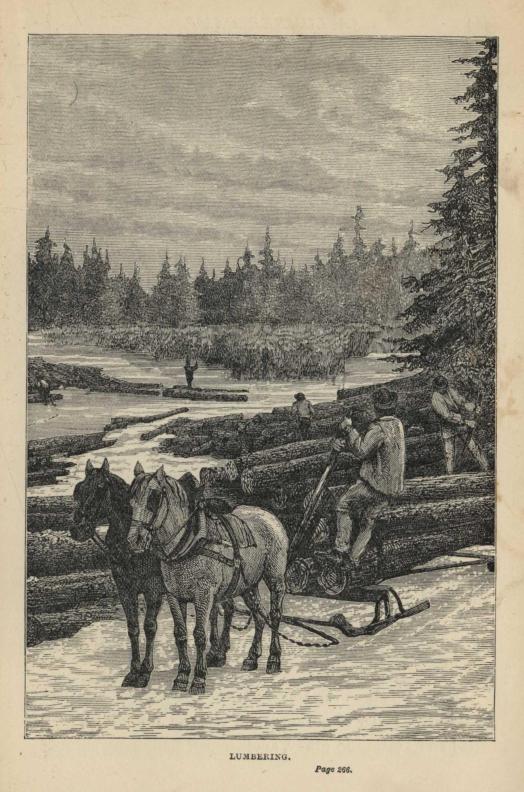
LUMBERING. Page 266.
Eighty logs felled, trimmed, and sawed is quite an ordinary day's work for one pair of choppers; and when the choppers have been "striving"—that is, each pair trying its best to outdo the others—six hundred logs have been turned in by a single pair as the splendid result of a week's work.
The logs are at first piled up on "roll-ways," which are simply two tree-trunks placed a little distance apart. Later on, when the road-makers have done their part, the teamsters bear them off to the bank of the stream or out upon the ice of the lake, where they wait the coming of spring to begin their journey by water to the mills.
The shantyman leads a free, hearty, healthy life. From dawn until dark he works in the open air, exercising lungs and muscles. When the autumn rains are over, and the snow has come to stay, he breathes for four months the clear, cold, bracing air of the Canadian winter, fragrant with the scent of pine and cedar. No matter how fond of drink he may be, not one drop of liquor can he have, although he may and does drink long and deep from the "cup that cheers."
His fare possesses at least two sterling merits. It is substantial in quality and unlimited in quantity. He enjoys it most when the day's work is over, and, no less weary than hungry, he trudges home to the shanty. There he finds the warm welcome of a steaming supper awaiting him.
Drawn up about the blazing fire he sees a pot of excellent pea-soup, a boiler of strong tea, a big pan full of fat pork fried and floating in gravy, another pan containing slices of cold boiled pork, huge loaves of bread baked in great iron pots buried deep in the ashes of the "camboose"—and better than city baker ever made—and a pile of bright tin basins.
Picking up two of the basins, he fills one with soup and the other with tea. Helping himself to a generous slice of the hot bread, he makes use of it as a plate for a slice of the pork. Then he retires to the edge of his bunk, and with the aid of his clasp-knife discusses this solid if not varied repast.
There is not much change in the bill of fare all winter. Occasionally, perhaps, if the roads permit, fresh beef "on foot" will be sent up from the depot, and the lumbermen may enjoy the luxury of steaks and roasts. Quite often, too, a bit of game will fall in their way while they are working in the woods. Great is the rejoicing when François or Alec succeeds in bringing down a fat deer. Bear-steak, too, is not unknown. The bear is trapped in a "dead fall," or small hut above the door of which a heavy log is hung in such a way that it drops with crushing force upon the bear pushing in to get at the bait.
Sometimes the shantymen do a little trapping on their own account. One of them, who wished to obtain a fine bear-skin, paid dearly for his prize. He had set his steel spring trap, and returning after an interval, found that it had disappeared. The marks in the snow made tracking easy; and hurrying along, he presently reached a great log over which the trap had evidently been dragged. His haste made him careless, and springing across the broad trunk without stopping to reconnoitre, he threw himself right into the arms of the bear. The animal, weary of dragging the heavy trap, was resting on the other side.
The hunted creature was furious with pain. The shanty-man's only weapon was his sheath-knife, which he drew and stabbed the bear again and again in the breast. But stab as he might he could not loose the brute's fatal grasp. Next day his comrades, anxiously following up his trail, found him dead, with the dead bear's paws still holding him fast.
The shantyman's recess comes when the evening meal has been despatched. He has an hour or more before bed-time. It is pipes all round, and song and joke and story win generous applause from the not over-critical audience. The French-Canadians are especially fond of singing. They have many songs, some of which, like "À la claire fontaine" and "En roulant ma boule," are full of spirit and beauty. If François or Alec has remembered to bring his fiddle with him—and he seldom forgets it—the singing is sure to be followed by dancing as the evening goes on.
Bedtime comes early in the shanty. By nine o'clock, at the latest, all have "turned in." The process of going to bed consists simply in taking off one's coat and boots, and rolling up snugly in a couple of thick blankets. Many a millionaire would gladly give one of his millions for the ability to sleep as soundly and restfully in his soft bed as does the shantyman upon his pine boards.
In the dusk of early morning the foreman's loud voice is heard calling to the men,—
"Turn out now, and get your breakfast!"
The lumberman has been asleep ten good hours, but he feels as if he had just lain down!
Sunday is the day the shantyman likes best. No work is done upon that day. He can spend the time as he pleases. Generally he is content to lounge about smoking, and enjoying the luxury of doing nothing. A religious service is so rare a treat that when there is one all attend it without reference to their creed.
Thus the long winter slips by. The logs accumulate upon the river bank or out upon the icy lake. When the warm days of spring come the lumberman's labours are at an end, so far as the shanty is concerned. The great spring drive begins. The logs start upon their journey southward, and the shantyman becomes a river-driver. Armed with pike-pole or camp-hook, he hurries his awkward squads of logs down stream as a shepherd drives his flock to market.
This is often a very exciting and dangerous occupation. The Canadian rivers abound in falls and rapids, past which the flocks of tree-trunks have to be guided skilfully. Many a time the river-driver's life is in peril as he wades through the turbulent, ice-cold water, or leaps from rock to rock, or from log to log, in his efforts to prevent his charges from stranding.
When the drive is finished the shantyman's labours are over, until the return of autumn recalls him to the forest.
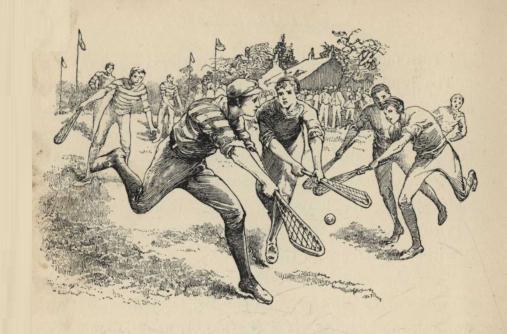
Lacrosse headpiece
LACROSSE.
What the game of cricket is to England, and the game of base-ball to the United States, is the game of lacrosse to Canada; and yet it is worth noting that, both cricket and base-ball flourish in Canada, which goes to show that the young Canadian seeks for quantity as well as quality in his sport.
The Indians invented lacrosse, just as they invented the canoe, the snow-shoe, and the toboggan, and it is not likely that their pale-face brother will be able to invent something surpassing any of them. How long ago they invented lacrosse is a question not even Parkman nor Catlin can tell us. The redskins have never had newspapers, and seem to have been poor hands at keeping diaries; consequently we can never hope to know when first the Iroquois champion team, led by the famous chief "Throw-the-ball-half-a-mile," defeated the Cree champions under the no less renowned "Stop-it-with-his-stomach-every-time."
Catlin, who saw it played by six hundred, eight hundred, or even one thousand Choctaws at a time, tells us that the players would trip and throw each other, and sometimes take flying leaps over the heads of their stooping opponents, or dart between their extended legs. "There are times," he adds, "when the ball gets to the ground, when there is a confused mass of sticks, shins, and bloody noses." I may add on my own account that those times are not altogether past and gone. Scratched shins and crimsoned noses are still to be found on the lacrosse-field.
There is, of course, a good deal of difference between lacrosse as played by the whites to-day and as it was played by the redskins half a century ago. In the first place, the ground was not a level, smooth-shaven lawn, with a cinder path around it, and beyond that rows of seats for spectators, but a glade in the forest, interspersed with stumps of trees, fallen trunks, and clumps of young spruce. The goals were single poles or stakes, about eight feet high, and the distance between them varied, in proportion to the number of players, from five hundred yards to half-a-mile, or even more. Then the crosse was much shorter, and smaller as to its netting, while among some tribes no netting at all was used, but instead thereof two sticks having spoon-shaped ends, between which the ball was caught and carried. As to the dress of the players—well, the difference is not so very great. The white men wear a little more on their backs, and canvas shoes instead of moccasins on their feet, and that is about the sum of the matter.
I will now try to describe the game as it is played by the Canadian clubs to-day. The ground should be a smooth, level field one hundred and fifty yards in length by one hundred in breadth at the very least, and for championship matches another fifty yards each way is most desirable. The goals should be one hundred and twenty-five yards apart, but a lesser distance may be agreed upon between the two captains if the nature of the ground requires it. The side boundaries are formed by the fence or ring of spectators, as the case may be. If the ball goes over the one, or gets tangled up with the other, it has to be brought out and "faced." The nature of "facing" will be explained further on. The goals are simply two poles six feet high and six feet apart, and in front of them, at a lacrosse stick's length from their base, a line is marked with whitewash, inside of which no attacking player must enter unless the ball has preceded him. If he enters in advance of the ball, the goal-keeper may drive him out at the point of his stick, and use any violence necessary for that purpose.
The side consists of twelve players and a captain. The captain does not play; he simply runs round and shouts at the other fellows. It looks like an easy job, but it is far from being so. Upon the captain very often depends the fate of his team, and he should always be a cool, clear-headed, experienced player, thoroughly up to all the tricks and subtleties of the game. The lacrosse-sticks, or crosses as they are called, are light, strong sticks, made of either hickory, ash, or rock elm; the Indian preferring the first because of its strength, and the white man the other two because of their lightness. There is no rule as to the length of a stick, but practical experience has shown that the most convenient length is equal to the distance from the toe to the hollow under the arm. Each player can therefore suit himself in the matter. The netting is of gut, and should be about twenty-nine inches long, and must not be more than twelve inches wide at its widest part. Nine inches is a good average width. There must be no "bag" to the netting, and to guard against this the referee is required to inspect the crosses carefully before allowing the match to begin. The ball is of sponge india-rubber, about half-an-inch less in circumference than a base-ball, and weighing about four ounces. It should bounce freely, as this adds greatly to the uncertainty and interest of the game.
All the preliminaries having been satisfactorily arranged, a fine day, a good ground, and a large gathering of spectators secured, we will suppose that a championship match between the representative teams of Montreal and Toronto is about to take place. At the appointed hour the teams issue from their dressing-rooms amid the cheers of their adherents and line up before the referee and umpires. That is, they face one another in two parallel lines, and then the referee proceeds to examine their crosses lest they should be "bagged," and their shoes lest they may be spiked. He also addresses a word of warning to them upon the subject of rough play, which, unhappily, has become far too common of late. He then dismisses them, and they take up their places on the field. When this is done they take their positions in pairs, each man having an opponent opposite him. Thus the Montreal goal-keeper has the Toronto "inside home" just in front of him; each of the fielders has a man to "cover" him, as the term is, and there is a Toronto "centre" as well as a Montreal centre.
The game is begun by the two centre fielders. They half kneel opposite each other, and lay their crosses on the ground, face to face, every nerve and muscle tingling with excitement, for much may depend upon which gets the advantage at the start. This is called "facing the ball," and when the referee is satisfied that everything is in readiness, he places the ball between the two crosses, taking care that it is exactly in the middle. At his shout of "Play," the two centres strive, by a sharp, sudden twist of the crosse, each to draw the ball in his own direction. The successful one immediately passes it to the nearest fielder on his own side, who is instantly pounced upon by his "cover," and then the fun begins in fierce earnest.
It is quite out of the question to convey through the medium of print any adequate conception of the interest and excitement that a game of lacrosse between two well-matched teams affords. For brilliancy of individual effort as well as of combined team play, for incessant movement and thrilling situations, for cheer-inspiring displays of undaunted pluck or untiring fleetness, there is no game that can compare with it. The ball flies all over the field, now soaring like a bird through the air, now skimming along the ground like a frightened field-mouse. First one goal is in danger, and the players crowd so thickly about it that you cannot see the goal-keeper. Then a long throw from his skilful stick sends the rubber away off to the side, or perhaps almost down to the other goal, and two dangers are over for the time. Next an artful dodger will catch the ball on his crosse, and turning, twisting, dodging this way and that, dropping the ball when checked, only to pick it up again deftly after the checker is eluded, will, amid the shouts and cries of spectators and players alike, carry it clear down the whole length of the field, and perhaps, if he be very lucky, send a "grounder" between the goal-posts ere the goal-keeper has time to recover from the surprise of his onset.
In the throwing, catching, checking, running, and dodging which the game calls for, every muscle and sinew is given fullest exercise, and every man in the team has a share of the work. There is no "loafing" possible in lacrosse, as there is in base-ball and cricket, when the out-field are getting nothing to do. Even the goal-keeper has plenty of hard work, for whenever the ball goes behind the goal-posts he must go after it, and struggle for it until he can send it either to one of his own side or far down the field. Indeed, the ability to play well "behind the flags" is as important a quality in a goal-keeper as an argus-eyed watchfulness over what is going on in front of him.
While individual brilliancy—"grand-stand play," as it is sometimes called—is all very well in its way, good team-playing is far more effective in the end, and it is just because the whites excel in the latter that they have become more than a match for the redskins, from whom they have adopted the game. One of the prettiest sights imaginable is to see two expert players "tobying" to one another for perhaps half the length of the field before they can be stopped. This tobying consists in their running along ten or fifteen yards apart, and throwing the ball from one to the other so soon as there is danger of the one carrying it being checked.
Another valuable accomplishment in a lacrosse-player is knowing how and when to "uncover"—that is, to stop away from the opponent who has been deputed to cover him, and consequently be free to snatch up the ball the moment it comes his way. When one team understands this better than the other, the result is to convey the impression that it must have more players, because there always seem to be two of them at least wherever the rubber is.
The game is won by the ball being thrown between the goal-posts, not higher than an imaginary line drawn across their tops. It must, of course, be thrown through from in front. Formerly a match was decided by the winning of three games, "best three out of five;" but in one of the two lacrosse associations now existing in Canada a change has been made, and unless one team wins three games straight, play must be continued for two hours, and then the team having the most games wins the match. The reason of the change was that in some cases a team would take three games from their opponents in a few minutes, and at this the spectators grumbled.
The most interesting recent event in the history of the game in Canada is the visit of the famous Toronto twelve to Great Britain. They are a splendid lot of players, and seem to have it all their own way, as might be expected. The fact, however, that there are enough lacrosse clubs in the Old Country to make it worth their while to go over, proves that the game is making progress round the world. Indeed, it has been already heard of from Australia, India, China, and other far-away quarters of the globe.
In the United States it is spreading rapidly, and the time cannot be far distant when we shall have international struggles for supremacy in lacrosse as well contested as we already have in some other sports. Some years ago a team from the United States crossed the Atlantic to contend against their British cousins, and succeeded in winning every match they played but one.
A PILLOW-SLIP FULL OF APPLES.
"A. & H. O. A. S.
"The arch-room—ten o'clock to-night. Bring a sheet and pillow-slip. ABRACADABRA."
Charlie Draper gazed at the piece of paper containing these simple words and mysterious signature with mingled feelings of pride and trepidation—pride because it was the first time since his coming to Twin Elm Academy that he had been the recipient of one of these much-prized missives, and trepidation because he had very vague notions of what his accepting the invitation it bore might entail.
He was a new boy, just finishing his first month at the academy, and being of rather reserved disposition, had been slow in forming acquaintances. Indeed, but for an incident that suddenly brought him into prominence, he might have made still poorer progress in this direction than he did.
A few days before this communication from "Abracadabra," a party of the boys were bathing in the river near Deep Pool. A youngster who could not swim rashly ventured too near the pool, and disappeared in its dark depths. There arose an immediate chorus of cries from his companions, but no intelligent effort was being made at rescue, when Charlie Draper, who had not been of the party, came rushing up, threw off his cap and coat, plunged into the pool, and brought out the drowning boy at the first try.
Of course he was a hero at once, and the leaders of the "A. & H. O. A. S."—the secret society of the academy, of which Charlie had already heard much, and admittance to which was the desire of his heart—lost no time in deciding that he was beyond question one of the right sort, and that he must become one of them forthwith. Hence the short but significant summons whose contents have been already given.
Promptly at ten o'clock, Charlie, in his stocking feet, and provided with pillow-slip and sheet, crept cautiously up the long stairs that led to the arch-room.
All the students, except those who belonged to the society, were already sound asleep, and the two tutors who lived in the building, knowing nothing of this exception, and imagining that every cot was duly occupied, had settled down for a comfortable smoke and chat in the cozy sitting-room of Mr. Butler, whose quarters were farthest away from the arch-room.
Upon all this the members of the society had astutely reckoned, and the coast was accordingly clear for them to do as they pleased as long as they did not make too much noise about it.
Bearing his note of invitation as a passport, Charlie approached the door of the arch-room. Suddenly out of its shadow a masked and draped figure darted, and putting its hand to his throat, inquired in a very husky voice,—
"What doest thou here?"
For answer, Charlie held up his sheet and slip of paper.
"'Tis well. Pass on," said the husky mystery.
And with palpitating heart Charlie tiptoed through the door.
The moment he passed the portal, two other masked and draped figures seized him by either arm, and hurried him before a fourth figure, who occupied a sort of throne at the far corner of the room.
"Whom do you bring before me?" asked this potentate, in the husky tone which seemed to be characteristic of the society.
"Charles Draper, may it please your sublimity," was the reply, accompanied by a reverent obeisance, in which Charlie was directed to join.
"He hath been well recommended to us. Let him be put to the tests. If he doth survive them and will take the oaths, he may be admitted into membership."
Then followed a lot of the usual elaborate nonsense such as boys delight to invent and execute in connection with their secret societies; and at the end of fifteen minutes or so, Charlie, flushed and excited, but triumphant, was handed a gown and mask, and informed by the figure on the throne, whose official title was the same as the signature to the invitation, that he was duly admitted into the membership of the society, whose full name he now learned was The Ancient and Honourable Order of Apple Stealers.
The next piece of information he received rather staggered him. It was that, according to the rules of the society, he must at once justify the confidence its members had reposed in him by proving his prowess as an apple-stealer.
The August pippins in Squire Ribston's orchard were reported to be ready to drop into one's mouth. Upon the novice, Charles Draper, devolved the perilous duty of securing a generous sample of those juicy golden globes, so that the ancient and honourable order might pronounce judgment on their excellence.
So soon as he understood this, Charlie began to wish he had not been in such a hurry to join the society. He had been at Twin Elm long enough to learn that old Squire Ribston's dogs were as good in their way as his apples were in theirs, and he did not at all relish the prospect of having an argument with them in their own territory at the dead of night.
But he was too stout of heart to back out, or even to show any signs of flinching, as his sublimity proceeded to give him his instructions.
Each member had brought a sheet with him. These were quickly converted into a rope, which reached from the window of the arch-room to the ground.
Stuffing the pillow-slip into his pocket, and putting on his shoes, Charlie, amid the whispered commands of his companions—to "Be sure and fill the pillow-slip," "Don't call the dogs bad names," "Give the compliments of the order to the squire if you happen to meet him," and other inspiring injunctions—climbed carefully out of the window, and let himself down hand over hand to the ground.
Pausing only to kiss his hand circus-fashion to the faces at the window, he hastened off noiselessly over the dew-laden grass in the direction of the squire's orchard.
He knew his route well enough, and the distance was not quite half-a-mile, so that a few minutes' quick walking brought him to his destination.