MY STRANGE RESCUE (continued 2)
Reading edition
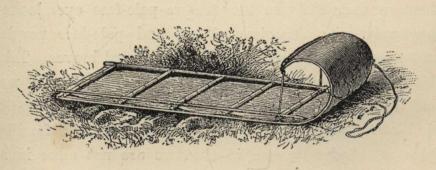
From two to six people can sit comfortably on a toboggan, according to its length. The perfect number is four—a man at the front to bear the brunt of danger, and ward off the blinding spray of snow, two ladies next, and then the steerer bringing up the rear, and responsible for the safety of all. Ah me! but what a grand thing it is to be young enough to thoroughly enjoy the tobogganing season.
The toboggan has many advantages over the sled such as is used for coasting. Wherever a sled can go, a toboggan can go also, while on many a hill that offers splendid tobogganing, a sled would be quite useless. Again, it is much lighter than the sled, which means that you do not have to work half so hard for your fun. A third advantage is its safety, more especially in the hands of children. It has no sharp iron-shod ends to make ugly gashes in little legs. Tobogganing has its perils, of course, and I might, if I chose, tell some experiences that would perhaps cause a nervous thrill; but what sport is absolutely free from danger? And since Mark Twain has earned the gratitude of us all by proving that more people die in their beds than anywhere else, why should the most timid be deterred by the faint possibility of peril from enjoying one of the finest and most healthful winter amusements in the world?
Tobogganing tailpiece
A MIC-MAC CINDERELLA.
The dear old stories that delighted us in our nurseries as mother or sister lured the lingering dustman to our eyes by telling them over and over, do not by any means belong to us alone. They are the common property of mankind. Even the most rude and ignorant peoples have them in some form or other, and the study of these myths and the folk-lore associated with them is one of the most interesting branches of modern philology. "Jack the Giant-Killer," "Puss in Boots," "Aladdin and his Wonderful Lamp," and all the rest of them, have their parallels in the farthest corners of the globe. They are to be found, too, among the dusky race whose mothers told them to their children long before pale-face eyes looked covetously upon American shores and pale-face powder sent terror into the hearts of brown-skinned braves. Take this pretty legend of Tee-am and Oo-chig-e-asque as it was told to an unforgetful listener beside a Mic-Mac camp-fire in Nova Scotia, and, comparing with our own familiar fable of Cinderella, see if the two are not alike in so many points as to make it easy to believe they had a common origin.
In the heart of one of those vast forests that used to cover the Acadian land with billowy seas of verdure as boundless seemingly as the ocean itself, lay a large, long lake, at one end of which an Indian village of more than usual size had grown up. It was a capital place for a settlement, because the lake abounded with fish, the surrounding forest with game, and near at hand were sunny glades and bits of open upon which sufficient corn, beans, and pumpkins could be raised for the needs of the inhabitants. So highly did these village folk value their good fortune that they would allow no other Indians to share it, and any attempt to settle near that lake meant the massacre or flight of the rash intruders. A little way from the village the lake shore rose up into a kind of eminence having a clump of trees upon its crown, and in the midst of this clump stood a wigwam that had more interest for the maidens of the place than any other. They would often watch the smoke-wreaths curling up through the trees, and wish that in some mysterious way they could get into the interior of that wigwam without the occupants having any warning; and many times they would, quite by chance, you know, wander off in that direction, or along the beach below, where the owner's canoe would be drawn up when he was at home, looking out very eagerly and very hopefully from their brown eyes, but always returning from their quest disappointed.
Now what was the reason of their curious conduct? Well, I'll tell you in a few words. In this wigwam, which was larger and finer than any in the village, lived a young chief named Tee-am (the Moose), who was not only very handsome and very rich, but who—most aggravatingly attractive quality of all—possessed the power of making himself invisible at will, so that he could be seen only by those to whom he was pleased to reveal himself. Taking these three things into account, and adding a fourth—to wit, that Tee-am was generally understood to be meditating matrimony—is it any wonder that the dusky lasses with seal-brown eyes and ebon locks took a particularly lively interest in the wigwam on the Point?
As was very natural under the circumstances, the possessions, merits, and designs of Tee-am formed the most important item of village gossip, especially as he had made it known that he would select his wife after so curious, not to say ungallant, a fashion; for instead of his going awooing among the girls, he proposed that the girls should come awooing to him. Adorned in their bravest attire, and looking their very prettiest, the maidens were to present themselves before him, and the first one that could see him plainly enough to describe what he had on, he would marry. The way they went about it was as follows:—They washed their faces, anointed their heads, bedecked themselves with their brightest ornaments, and then directed their steps to the wigwam of Tee-am, arranging it so as to arrive there a little before the hour of the young chief's return from his daily hunting foray. Tee-am's sister, who kept house for him, and of whom he was very fond, would receive them graciously, and together they would go down to the shore to await the hunter's coming. Presently a fine canoe would be seen gliding swiftly over the lake's calm surface. Eagerly the maidens peer through the gathering shadows; but the canoe seems impelled by magic, for no human hand is visible. As it nears the shore the sister asks,—
"Nemeeyok richigunum?" (Do you see my brother?)
Every eye is strained in the direction of the canoe, and some over-eager maiden—imagination coming to the aid of desire—would perhaps pretend she could see its mysterious occupant.
"Coo-goo-way wisko-book-sich?" (Of what is his carrying-strap made?) is then asked.
This was a poser. But a lucky guess might possibly hit the mark; so the aspirant for the chief's hand would make answer that it was a piece of raw hide, or withe, or something else that had been known to be applied to such a use.
"Oh, no!" the sister would reply softly, but crushing out all hope. "Let us go home. You have not seen my brother."
And so they would go back to the wigwam, where, a little later, they would be tantalized by seeing the sister taking a load of game apparently from the air, and a pair of moccasins from feet that obstinately refused to be visible. Thus they were convinced that there was no deception—that Tee-am was really present, although they could not see him. One after another the village maidens had tried their luck "Moose-hunting," as they called it; but all had failed alike to catch even a glimpse of the provoking master of the wigwam on the Point.
Matters had gone on in this unsatisfactory fashion for some time, and the fastidious Tee-am bid fair to be an old bachelor, when he was saved from so sad a fate in the way I shall now proceed to relate. Near the centre of the village stood a large wigwam, in which dwelt a widower who had three daughters, the eldest of whom was a tall, fine-looking girl: the second a medium-sized, rather plain girl; and the youngest a short, slight, delicate little creature, with a pretty, pleading face, who was despised by her big sister, and very cruelly treated by her, because she seemed so weak and useless. In fact, poor Oo-chig-e-asque led a wretched life of it; for her sister, who was of course mistress of the tent, would lay far heavier tasks upon her than she could possibly perform, and then if they were not done, would beat her most unmercifully, and sometimes even burn her with brands from the fire. When her father, who, to tell the truth, was but an indifferent sort of a parent, would find her covered with burns and bruises, and ask the meaning of it, the elder sister would reply that she had fallen into the fire, or tripped over a tree root, or something of that kind; and neither Oo-chig-e-asque nor the second sister dared contradict her, they were both so much afraid of her strong hands. So this shameful state of affairs continued until the poor girl's condition was most pitiable; for her hair was singed off close to her head, her face and body scarred with burns and bruises, and her back bent with toil it was not strong enough to bear.
"'WE ARE DISCOVERED AT LAST,' HE SAYS."
Of course the two elder sisters had been among the candidates for Tee-am's hand: and, proud as they were of their good looks and of their finery, both had failed utterly to see the mysterious chief. Their despised little sister knew of their going only too well, for her persecutor gave her a wicked beating when she came home disappointed, by way of working off her ill-humour. One day, when Oo-chig-e-asque was sitting alone in the wigwam weeping over her hard fate, the thought suddenly flashed into her mind—why should she not try her fortune at Moose-hunting? It seemed absurd, of course, but it could hardly make things any worse; and even though Tee-am would not think her worth marrying, he might in some way not very clear to the poor girl's troubled mind shield her from her sister's cruelty.
Oo-chig-e-asque had no fine clothes to put on. A few beads given her by a compassionate squaw were her only ornaments. But this did not deter her. Gathering a quantity of birch-bark, she fashioned for herself an odd, misshapen gown, that was ill-fitting enough to give even an Indian modiste "a turn;" an old pair of her father's moccasins were soaked to soften them, and drawn over her bruised feet; and then, with a queer head-dress to hide her singed poll, and her scanty beads arranged to the best advantage, she set off quietly one afternoon toward the camp on the Point. Her big sister, seeing the direction she was taking, screamed after her to come back; but she only hastened her steps forward. The people of the village stared rudely at her as she passed, and, divining her purpose, hooted derisively after her; but she kept steadily on, and paid no heed to them. Her whole heart was in her enterprise, and she felt as though she would die rather than turn back. At length she reaches Tee-am's lodge. Tee-am's sister comes to the door, and receives her pleasantly. At the proper time she conducts her to the landing-place, where they await the hunter's return, the sister soothing her visitor's throbbing pulse by gentle inquiries as to her life and kindly sympathy for her woes. Just at dusk a canoe comes toward them, shooting swiftly over the water, and the sister says,—
"That's my brother's canoe. Can you see him?"
"Yes," murmurs Oo-chig-e-asque, her heart beating high with hope.
"Of what, then, is his carrying-strap made?"
"Muncwan," is the quick reply. "It is a piece of rainbow."
"Very good," responds the sister, with a brilliant smile. "You have indeed seen my brother. Let us go home and prepare for him."
So they hasten back to the wigwam, Oo-chig-e-asque's heart palpitating betwixt delight at her success and anxiety lest Tee-am, when he found what an insignificant little creature she really was, might refuse to keep his promise to marry the girl who should first be able to see him. As soon as they reach the tent the sister proceeds to prepare her visitor for the nuptial ceremony, and the young girl gives herself unhesitatingly into her hands. The uncouth birch-bark dress is stripped off and flung into the fire, and a handsome robe, richly adorned with beads, takes its place. Pure spring water is brought, and as the kind sister dashes it over the girl's face, and rubs the scarred features softly with her hands, lo! every scar and spot and blemish vanishes, and the face comes out fair and beautiful as it never was before. Realizing the wondrous change, the young girl utters an exclamation of delight; then checks herself, and puts her hand to her head.
"Ah!" she says sadly, "I have no hair. Tee-am will despise me when he sees I have no hair."
"Never fear, little one," the sister answers reassuringly, and, passing her hands over the singed and frizzled hair, behold another marvel! for it springs out in richer profusion than ever before, and falls in long thick tresses down the back of Oo-chig-e-asque, now too happy to speak. Catching it up, the sister coils it deftly round the young girl's head; and then, just as the toilet is complete, and radiant with joy, hope, and beauty Oo-chig-e-asque stands in the centre of the lodge. Tee-am comes bounding in with his load of game. At sight of the charming girl before him he stops short, and looks inquiringly at his sister. Then the situation dawns upon him.
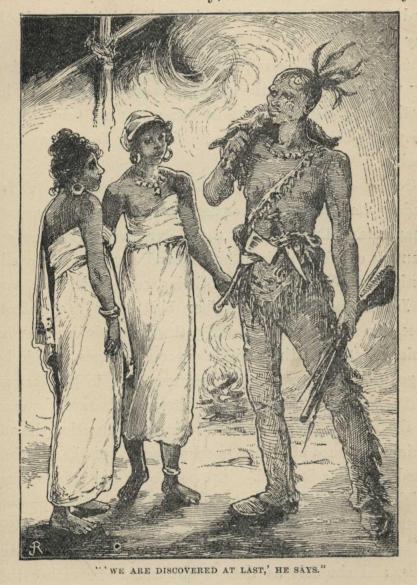
"Way-jool-koos" (We are discovered at last), he says, with a bright smile, taking the young girl's hand.
"Yes, brother, your wife has come at last," replies the sister, "and is she not a beauty?"
So Tee-am and Oo-chig-e-asque were married, and, like the heroes and heroines of all true fairy tales, lived happily ever after.
COD-FISHING ON THE BANKS OF NEWFOUNDLAND.
BLUE-NOSE FISHER FOLK.
Scattered up and down the rocky, foam-fringed shore of Nova Scotia, sometimes standing out bravely upon a promontory that projects into the very midst of the breakers, sometimes nestling away cosily in the curve of a quiet bay, the white cottages of the hardy fisher folk give touches of warmth and life to a scene that would otherwise be one of unredeemed desolation.
They are not very imposing edifices, and viewed from the respectful distance which the dangers of that inhospitable coast compel the passing ship to keep, they seem still smaller than is really the case; but they are all homes, and in their two or three cramped rooms boys and girls have been born and bred, the young people made love and mated, and the old people closed their eyes in the last long sleep, as generation has succeeded generation.
So it is no wonder that the lads who thence go forth into distant parts of the world, as many of them do, find their hearts turning longingly back to the little cottage by the sea, and that they often return to spend their last years in the old place.
Voyaging along the coast some lovely summer afternoon, and from your comfortable chair on the steamer's deck watching these pretty cottages with their black roofs and white sides coming into view as point after point is opened out, and noting how trim and secure they seem, and the glorious prospect they command from the windows which look out from either side the central door, like sleepless eyes, it is easy to imagine that the fishermen's sons must have a fine, free, healthy life of it, and be far better off than the boys in the dusty, noisy, over-crowded cities.
Well, no doubt they are better off in some respects. They have plenty of fresh air and sunshine, and room to grow in, while nothing could be more wholesome than their food of fish and potatoes. But their life is a hard one, nevertheless, and I doubt if many city-bred lads would be eager to exchange with them, could they first have a year's experience of it.
If the mackerel, herring, cod, and haddock upon which the fisher folk depend for their living, were more regular in their habits, ami turned up at the same place at the same time every year, so that the men with the nets and hooks could count upon their harvests as the men with the scythes and hoes can upon theirs, the fisherman's lot would be a fairly comfortable one.
But there is nothing in this world more uncertain than fish. Not the slightest reliance can be placed upon them. They are here to-day, and off somewhere else to-morrow. One season, school after school of mackerel will pour into the little bay where Norman Hays and John Mackesey and George Brown have their fishing "berths," as the area assigned to each man is called, and fill the seines of these lucky fellows to repletion again and again as fast as they can spread them.
Then perhaps one, two, three seasons will pass without enough fish putting in an appearance to make one good haul.
The mackerel catching is the most interesting as it is the most profitable phase of the fisherman's toil, and for both reasons the boys like it the best, although from its being at the same time the most uncertain in its results, they know very well it cannot be depended upon for a living.
The season for these beautiful and delicious fish begins about the end of June, and so soon as it is time for them to appear, the highest points along the coast are taken possession of by men and boys, who stay there all day long watching intently the surface of the sea below them for the first sign of the silver scales which, when caught, can be turned into silver coins.
It is often long and weary work this watching. Day succeeds day without bringing anything: but through scorching sun or soaking rain, fine weather or foggy weather, the look-outs patiently persevere. At last some bright morning, when the sea seems still asleep, Jack Hays' keen young eyes descry a curious ripple on the water far beneath his eyrie.
His heart gives a throb, and his pulses beat like trip-hammers, but he is afraid at first to shout, for fear it is only a morning zephyr. Shading his eyes with his hand, and fairly quivering with excitement, he gazes intently for one moment more, and then shouting, "A school! a school!" at the top of his strong young voice, he goes bounding down the hill-side like a loosened boulder, till he reaches the cluster of cottages far below.
In an instant all is activity and bustle. The men spring into the boats lying ready at the little wharves, the boys tumble in pell-mell after them, the wives and daughters fling their aprons over their heads to keep off the sun, and run out to the end of the wharves, or climb up on the flakes, so that they may see as much as possible.
In a minute more the boats are heading for the mackerel as fast as brawny arms can drive them. Half a mile away the calm blue water is dark and disturbed for a space about the size of an ordinary tennis-court; it looks, in fact, as if it were boiling and bubbling just there, though all around is still and smooth.
Toward this spot the boats are hurried. Presently they reach it. Then they stop. One of the smaller boats goes up to the long flat-bottomed, high-stemmed craft that carries the seine, and takes one end of the net on board. Everything is done quietly, for the fish are easily frightened, and if alarmed will sink right down into the deep water, where they cannot be got at.
As quickly as sinewy arms can send her along, the small boat describes a circle round the fish, that continue to frisk about, all unconscious of their peril.
At length a shout of joy announces that connection has been made. The two ends of the seine are joined, and, if it be a purse-seine, the bottom is drawn together also, and then the tired, excited fishermen can take a little rest, and they try to guess how many barrels this "stop" of mackerel will make. Jack Hays and the rest of the boys can hardly contain themselves with delight, for won't they all have a trip up to the city so soon as the fish are ready to be sold, and these trips are the great events of their life.
Having got the fish nicely caught inside the seine, the next thing is to get them out again. The big net with its precious load is drawn as near the shore as possible, the boats crowd round it, and a busy scene ensues, as the blue-backed, silver-bellied beauties are taken from the meshes, and piled up in the boats until these little craft can hold no more.
In a little while all the fish are safely on shore, and then comes the splitting and salting, in which not only the boys, but the girls and their mothers too, take a hand, for the more quickly it is done the better.
The dexterity shown by the workers is astonishing. Holding a sharp knife in their right hand, they stand before a pile of glistening mackerel. With one motion they seize a fine fat fellow, with another they split him open from head to tail, with a third they despoil him of his entire digestive apparatus, with a fourth they put in its place a handful of salt, with a fifth fling him upon a pile beside them, and the whole operation is done in the twinkling of an eye.
To see the girls at this—and none are more expert than they—takes a good deal of the romance out of one's ideas of fisher-maidens; but it cannot be helped. They cannot afford to be romantic, or look picturesque. Their life is too hard for that kind of amusement.
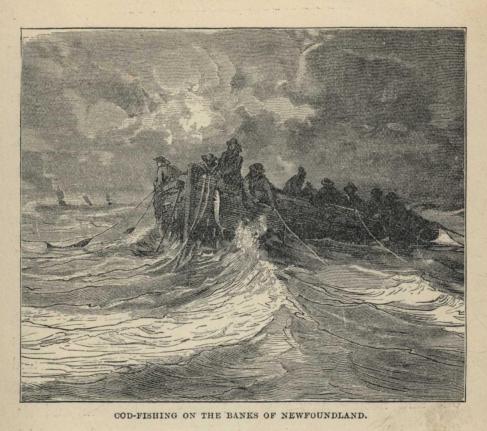
In the catching of mackerel and herring there is not much danger, and the fishermen need not go far from home. But it is different with the cod and haddock and hake. To get these big fellows you must go out upon the Banks, as those strange, shallow areas in the Atlantic Ocean are called; and going out upon the Banks means being away for long weeks at a time, and exposed to many dangers.
Storms are frequent there, and the waves run mountain high, so that stanch and trim as the fishing craft are, and thoroughly expert their masters, hardly a season passes without the loss of a Nancy Bell or Cod-Seeker with all on board. Often, alas! do
"The women go weeping and wringing their hands,
For those who will never come back to the town."
Another danger ever present, ever indeed growing greater, is that of being run down some foggy night by the great ocean steamers that are thronging past in increasing numbers.
Picture to yourself a dense, dark night, when you can hardly see your hand before your face; a little schooner tossing at anchor on the Banks, all but one of her crew asleep in their bunks. Suddenly there falls upon the solitary watcher's ear a sound that thrills him with terror: it is the throbbing of mighty engines and the onward rush of an ocean greyhound as she spurns the foaming water from her bows.
Springing upon the poop he shouts with all his might, the crew below leap from their berths, and though only half awake join him in the cry.
But it is of no avail. The mast-head light is seen by the steamer's look-out too late to change her course. There is a splintering crash, the iron monster feels a slight shock, hardly enough to waken the lightest sleeper in her staterooms, and the sharp prow cuts through the little schooner as though it were but another wave.
Then the frenzied shrieks of strong men in their agony ring out upon the midnight air; then all is silent again, and the steamer speeds on to her destination, while to another home in Herring Cove comes the dreadful experience of which the poet says,—
"How much of manhood's wasted strength,
Of woman's misery,—
What breaking hearts might swell the cry,
They're dear fish to me."
Yet it is the ambition of every boy at Herring Cove or Shad Bay to have a share in a Banker, or, better still, to own one all by himself; and to this he looks forward, just as city boys do to being bank presidents or judges or editors of newspapers.
Hard work, much danger, a little schooling, and still less playing is the summary of a fisher-boy's life. It makes him very healthy, brown, and strong, but it never makes him rich. The most he can do is to earn enough to build and furnish a cottage when he marries, and provide plain food and coarse clothing for the family that soon springs up around him.
Now and then—that is, whenever he has fish to sell—he goes up to the city; and this is his only holiday. While still a boy he generally behaves himself well enough on these visits, but, growing older, he does not always grow wiser, I am sorry to say, and I have often seen sad-faced wives rowing the heavy boat wearily home, while their husbands lay in the stern-sheets in a drunken stupor.
LOST ON THE LIMITS.
(A CHRISTMAS STORY.)
"I wish you had taken my advice and stayed at the shanty, Harry."
The speaker was a stalwart young man, so closely wrapped in a blue blanket capote that only a portion of his face showed itself, and the one addressed was a boy of sixteen, similarly accoutred.
"I felt more than half-afraid of this storm overtaking us," the young man continued; "and now we're in a pretty fix. I can't imagine how we'll ever reach the depot."
There was something so despondent in his tone that one might have expected his words to exercise a dispiriting effect upon his companion; but, instead of that, Harry answered brightly,—
"Reach the depot! Of course we will; and in good time for our Christmas dinner, too! You mustn't worry on my account, Mr. Maynard. If anything should happen, it would be all my own fault, you know. You wouldn't be the least bit to blame."
Mr. Maynard shook his head negatively.
"It's very good of you to say so, Harry, but I can't help feeling responsible all the same. Oh!" he cried, with a gesture of irritated protest against the situation, "what a plague this snow is! Surely we had enough of it already, and didn't need this storm."
John Maynard was the bush superintendent on one of the great timber limits of Booth and Bronson, the millionaire lumbermen of Canada.
The duty devolved upon him of driving about from one "shanty" (as the permanent camps of the log-cutters are called) to another, taking account of the work done, and giving directions as to the bunches of timber next to be attacked.
This was a very arduous occupation, entailing as it did long and lonely drives through forest roads, passable only in winter, across the broad bosoms of frozen lakes, and along the winding courses of ice-bound rivers. For this purpose he had a pair of powerful horses and a low, strong sleigh, made altogether of wood, that had accommodation for just two persons and some baggage.
As a rule he made these journeys alone, but this winter he had been favoured with a companion in Harry Bronson, the eldest son of a member of the firm, who had asked permission to spend the winter at the "shanties."
His request had been readily granted, for he would have to take his father's place in the business in due time, and the more thoroughly he knew its details the better. Consequently Mr. Bronson was very glad to let him go, while Harry rejoiced at getting away from the confinement of the office, and at the prospect of having some exciting experiences before he returned.
So far he had been having a very good time. John Maynard was as pleasant a companion as he was a competent bush superintendent, and, while going the round of the shanties, there were many chances for shots at partridges or rabbits, and always the exciting possibility of encountering a bear.
Then at the shanties their welcome was always so warm, and the French-Canadian shantymen were so amusing with their exhaustless fund of song and dance and story, that Harry never knew what it was to feel dull for a moment.
Christmas week found him at the shanty on the Opeongo—the one that stood farthest away of all from the depot at which Maynard made his headquarters, and to which it was his intention to return in time to celebrate Christmas there.
The superintendent was particularly anxious to get back by that time, because, having completed a round of the shanties, he could leave them unvisited for a fortnight or so, and he proposed to spend Christmas week in Montreal, where he had many friends.
Harry on his part was hardly less anxious to get to the depot; for, although he did not intend going any further, he had been promised lots of fun there by the clerk in charge, and a first-class Christmas dinner into the bargain.
Accordingly, when certain infallible signs of a change for the worse in the weather, which had hitherto been almost perfect, made their appearance, and Maynard, willing to take any risk himself, but reluctant to expose Harry to danger, suggested that the boy should remain at the Opeongo shanty until the threatened storm passed, and then get back to the depot by one of the ordinary teams, Harry would not hear of it.
"No, no, Mr. Maynard," said he stoutly. "If you can stand the storm, I can too. I'm going with you."
Clearly enough the superintendent would have to either allow Harry to accompany him or stay at the shanty himself. He could not accept the latter alternative, so he replied,—
"Very well then, my boy, we'll start; and if bad weather catches us, we'll have to do the best we can."
The distance between the Opeongo shanty and the depot, as the crow flies, was fifty miles; but the circuitous route that was necessary in order to avoid ranges of rocky hills and impassable gullies made it full half as long again, and, in view of the state of the road, Maynard calculated that two days might be required to make their destination. Accordingly they set out in the morning of the second day before Christmas.
It hardly needed the practised eye of a wood-ranger to foretell a coming change in the weather.
The sun's bright face was hidden behind a dense veil of sullen clouds; the air, that had been so crisp and clear, seemed dank and heavy like a dungeon's; and both man and beast moved about in a listless way, as if every movement was an effort.
More than once the superintendent's mind misgave him ere they had gone many miles. He was naturally a cautious, far-seeing man, not disposed to run unnecessary risks, although utterly regardless of personal peril in any matter of duty.
Not that he felt any concern on his own account; but he would have felt much easier in his mind had Harry been persuaded to stay at the shanty.
Yet how could he reasonably expect that, when he himself was pushing on to the depot?
Harry's argument, that if the superintendent could stand the storm he could also, was not easy to answer, and it prevailed.
"If this confounded road was only in better shape, we might get there to-night," said Maynard impatiently that afternoon as the sleigh slowly toiled up a steep ascent, the horses sinking above their fetlocks in the fine dry snow at every step.
Had their way been as well broken as a city street they might indeed have accomplished this feat, but under the circumstances the best they could hope for was to reach the depot early on Christmas eve.
Harry, understanding that he was the chief object of the superintendent's concern, felt it incumbent upon him to take as hopeful a view of matters as possible, so he responded in his cheeriest tone,—
"Oh, we'll get there to-morrow afternoon right enough! We're more than half way to Wolf Hollow now, aren't we?"
"Yes, a good bit more; but there's the snow beginning. We must drive ahead as fast as we can. It'll soon be dark."
The horses accordingly were urged to the utmost speed possible, and, by dint of some rather reckless driving, Wolf Hollow was safely reached in the face of a blinding snowstorm ere the darkness fell.
At this place there stood a shanty which had been abandoned some years before, all the timber being cut in the neighbourhood, and here Mr. Maynard proposed to spend the night.
The building was found to be in good condition—quite storm-proof, in fact—and it did not take long to gather an abundant supply of firewood wherewith to expel the cold, damp air that filled it.
The horses could not be left out, of course, exposed to the pitiless storm, so they were allotted the farthest corner of the long, low room. The sleigh, too, was brought inside with all its contents.
A substantial supper was prepared and enjoyed, the horses were given a good feed of oats, and then both the travellers being thoroughly tired, they fitted up one of the bunks with the sleigh robes, and, so as to waste no heat, lay down side by side, and were soon sound asleep.
At daybreak the superintendent got up and hastened to see how matters looked outside. The prospect was anything but cheering.
Snow had been falling heavily all night, and there seemed no sign of its ceasing. All marks of the road were completely obliterated, and it would evidently test to the utmost his knowledge of woodcraft to keep in the right track.
Such was the condition of affairs that called forth the exclamation reported at the beginning of this story.
However, there was nothing to gain by delay, so hardly waiting to snatch a bite of food and to allow their horses to finish their portion of oats, they harnessed up and drove forth into the storm.
Even had the track been easily distinguishable, they could not have made rapid progress, for the snow came in big, blinding flakes that were very bewildering, and had already covered the ground to a depth of nearly a foot.
By the aid of familiar landmarks, Mr. Maynard was able for a time to direct their course accurately enough; but about mid-day they reached a wide lake which they had to cross, and here their real difficulties began.
The broad expanse of Loon Lake had presented a fine playground for the wind, and upon it the snow was heaped in vast drifts, far surpassing anything met with in the woods, where the trees afforded protection.
In these drifts the horses and sleigh soon stuck so fast that their extrication was evidently quite beyond the power of the passengers.
There seemed no alternative but to abandon them to their fate, and to continue the journey on snow-shoes, which, fortunately, were lashed to the back of the sleigh.
Mr. Maynard felt sorely reluctant to desert his faithful horses, but no time could be spared for unavailing regrets.
"There's no help for it, Harry," he said resolutely. "We'll have to leave them where they are. We cannot get them out, and we've enough to do to look after ourselves."
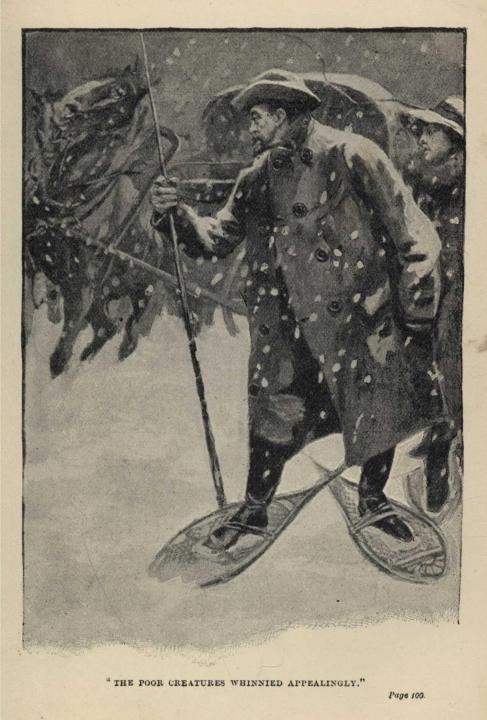
The poor creatures whinnied appealingly as their human companions moved off, and made frantic efforts to follow, but the remorseless snow-drift held them fast.
"THE POOR CREATURES WHINNIED APPEALINGLY."
It was certainly a pity to leave two such fine animals to perish, but yet what could be done?
Striding along on the snow-shoes, in the use of which they were both expert, the superintendent and Harry made better progress than they had been doing in the sleigh, and now the chief anxiety was to hit the right spot on the other side of the lake, where the road continued through the woods.
On a clear day Mr. Maynard would have found little difficulty in doing this, but in the midst of a blinding snowstorm it was no easy task; yet their very lives depended upon its successful accomplishment.
When they reached the middle of the lake they were dismayed to discover that the heavily-falling snow shrouded not only the shore for which they were making, but the one which they had left. They were absolutely without a mark to guide them.
Here was an unexpected peril. Mr. Maynard halted and strove to peer through the ominous obscurity of white, but on every side it was the same.
"What are we to do now, Harry?" he cried in a tone of deep concern. "I can't make out our way at all."
By this time Harry's spirits, which had hitherto been keeping up bravely, were beginning to fall, for he was growing weary of the long struggle with the storm.
"I'm sure I don't know," he responded ruefully. "I suppose there is nothing else to do but to push ahead and take our chances of hitting the shore somewhere."
"That's about all, Harry," was the superintendent's reply. "Just rest a minute to get your breath, and then we'll make a dash for it."
For a little space they stood still and silent, the mind of each absorbed in anxious thought, and then Mr. Maynard called out,—
"Come along now, Harry. Keep right in my tracks, and I'll see if I can't make the shore all right."
For half-an-hour they toiled steadily onward, and well it was for both that they had such skill in the use of snow-shoes. Without them they could not have made a hundred yards' headway, so heavy was the snow. Even as it was, the hard work told upon Harry, and presently he had to call to his companion,—
"Hold on a minute, Mr. Maynard; I'm out of breath."
The superintendent stopped short and came back to him.
"Not played out already, are you, Harry?" he asked, peering anxiously into his face.
"Oh, no!" and the boy made a gallant effort at a reassuring smile. "I just want to get my wind; that's all. This abominable storm nearly suffocates me."
As they rested again for a few minutes, the wind suddenly shifted, parting the whirling snow to right and left, and through the rift thus made, Mr. Maynard's keen eyes caught a glimpse of a dark mass rising dimly into the air a little more than a mile away.
With a shout of joy he slapped his companion upon the back, crying,—
"Eagle Rock, Harry. See!" and he pointed with a quivering finger to the spectral appearance. "Once we make that, I can find the road all right enough. Come along!"
Cheered by the sight, which the next moment the snow-curtain again hid from them, they pushed forward with renewed energy.
It was terribly hard walking. Their snow-shoes sank deep into the drifts at every step, and it was an effort each time to release them. The afternoon was also waning fast, and they had not more than an hour of daylight left at best. Truly they were in desperate straits.
On they went over the drifts that seemed to be determined to bar their way, the superintendent straining his eyes for another glimpse of Eagle Rock. At last, as Harry was about once more to cry halt, his companion exclaimed joyfully,—
"There's Eagle Rock, Harry! I see it. We're making straight for it. A few minutes more will take us there."
The cheering announcement revived the boy's failing energies for another effort. He shut his lips upon the request for a rest, and doggedly tramped on after his guide.
Ten minutes more and they were at the foot of the lofty crag called Eagle Rock, in a friendly recess of which they found welcome shelter from the furious wind.
"Thank goodness!" ejaculated Harry, throwing himself wearily down upon a snow-bank, "we've got thus far anyway. How many miles more, Mr. Maynard?"
"About ten, Harry," was the answer, given in quite a matter-of-fact tone.
"Ten!" echoed Harry in dismay. "I hoped it would only be about five. I'll never do it in the world."
"Oh yes, you will, my boy!" replied Mr. Maynard. "I'll help you you know."
To their vast relief the snow now began to abate, and presently ceased falling altogether.
"That's something to be thankful for," said the superintendent. "Are you ready to start again?"
"Go ahead," was the response.
But no sooner had one danger passed than another presented itself. The light began to fail, for night was at hand.
A ten-mile tramp on snow-shoes through a desolate forest was not much to be desired under any circumstances. To accomplish it in the dark, tired as they both felt already, was a feat the achieving of which seemed more than doubtful.
Mr. Maynard had his misgivings, but he carefully concealed them from his companion, and even started whistling a lively march as he led the way along the faintly discernible road.
Never will either of them ever forget that awful tramp.
The night soon enfolded them, leaving only the scant light of the glimmering stars for guidance. Every step they took had to be carefully considered, lest they should stray from the track and be hopelessly lost.
Again and again the silence through which they marched was broken by the blood-curdling cry of the lynx or the dismal howl of the wolf, seeking what they might devour.
The superintendent's rifle hung at his back, and Harry had a good revolver; but they prayed in their hearts that they might have no occasion to use them.
Every little while they had to pause that the boy might take a brief rest. Then on they went again.
Mile after mile of the dreary, toilsome way was slowly yet steadily overcome, each one adding to poor Harry's weariness, until he felt as if he must give up the struggle and throw himself down in the snow to die.
But Mr. Maynard cheered him up and helped him, and kept him going, knowing well that to give up really meant death.
At last the exhausted boy sank down with a piteous wail,—
"It's no use, Mr. Maynard, I can't take another step."
"Oh yes, you can, Harry!" said the superintendent soothingly; "just take a little rest, and then you'll be all right."
While Harry rested he went on ahead a short distance, for it seemed to him that they could not be very far from the depot.
Presently there came from him a glad hurrah, and running back he put his arm around his companion, and helped him to his feet, exclaiming joyfully,—
"I can see a light, Harry. We're safe now. It's the depot."
And he was right. They were within half a mile of their haven. Forgetting all their weariness, they put on a gallant spurt, and in less than ten minutes were in the midst of their friends, telling the story of their thrilling experience.
All's well that ends well. The superintendent kept his appointments in the city; Harry had a royal Christmas time with the clerks in the depot; and, happy to relate, the horses were not lost, for a relief party that went out the following morning with a big sledge found them still alive, and brought them and the sleigh back to the depot, little the worse for the long imprisonment in the snow-drift.
A STRANGE HELPER.
"There's nothing for it, Maggie, but to let the place go. I've tried my best to raise the money, but those that are willing to help a fellow haven't it to lend, and those that have it ain't willing to help. It's mighty hard lines, I tell you," and, with a groan of despair, Alec M'Leod buried his head in his hands, as he leaned heavily upon the table.
Hard lines it was, indeed, as no one knew better than Moses Shearer, the money-lender, to whose conduct was due Alec the miller's anguish of mind. He had chosen that particular time for enforcing satisfaction of his claim, because he understood that it could not be done without a sale of the mill property; and this was just what he desired, as he intended to bid it in for himself.
It did seem a cruel thing for Mr. M'Leod to be sold out of the snug, well-equipped mill that represented his whole fortune; and all for a debt of one hundred pounds, incurred under special circumstances for which he was in no wise to blame.
No wonder that he was sorely cast down, and that gloom reigned in his household, which consisted of a devoted wife and two children—Robert, the elder, a sturdy, enterprising lad of fourteen, and Jessie, a sweet, fair-haired lassie two years younger. They were all in the room when the miller gave voice to his despair, and Rob, full of sympathy, hastened to say something comforting, with all the hopefulness of youth.
"Don't give up yet, father," said he. "The sale is more than a week off, and you may be able to get the money somehow before then."
Mr. M'Leod shook his head without raising it from his hands. He had exhausted every available resource, and saw no way in which help could come. He was not a religious man, although of unblemished integrity of character, and had no faith to sustain him in his grievous trial; nor did his wife know how to lay hold upon God, and claim the fulfilment of his promises.
In this they both had much to learn from their own children, for, thanks to sound teaching in Sunday school, Rob and Jessie believed in the prayer of faith. They believed God was always ready and willing to respond in his wisdom to the petitions of his children, and when they learned of their father's trouble, their thoughts took the same direction.
That night, when Rob went up to his room, he found Jessie there.
"O Rob!" she hastened to say, "I've been waiting for you to come."
"What do you want to do, Jessie?" inquired Rob.
"Why, Rob, you know when father told us of his trouble, I made up my mind to ask God to help him out of it. What is that in the Bible about God doing anything that two of his people agree to ask for?"
Proud of his memory, Rob promptly repeated the verse: "If two of you shall agree on earth as touching anything that they shall ask, it shall be done for them."
"Yes, that's it!" exclaimed Jessie. "Now then, Rob, can't we agree to ask God to help father to pay off that dreadful Mr. Shearer?"
"Of course we can," responded Rob heartily; "and we'll do it right away."
So down on their knees they went, and each in turn presented an earnest, simple petition to God that aid should be granted their father in the present emergency. When they rose their faces were radiant.
"It will be all right now, won't it, Rob?" said Jessie, as she went to her own room.
The following day passed without any sign of an answer, and so did the next. Rob, boy-like, began to grow impatient, but Jessie was more trustful. Each night they renewed their united requests.
On the third night Rob, the window of whose room overlooked the mill-pond, happening to awake about midnight, thought he heard a most unusual splashing noise coming from the pond. Sitting up in bed, and listening attentively, he asked himself:—
"What can it be? Has somebody fallen into the pond? No, it can't be that, or there would be cries for help. Oh! it's only some old cow that's fooling around."
He was about to accept this explanation and settle down to sleep again, when there was added to the frantic splashing a hoarse bellow such as no domestic animal ever uttered.
"I must see what that is," said he to himself. So out of bed he jumped, hurried on his clothes, and slipping quietly out of the house, hastened across the yard to the mill-platform, from which he could command a view of the whole pond.
It was a bright, clear night, with the moon at the full, and the still waters of the pond reflected its silver rays like a huge mirror. At first the boy could see nothing to account for the strange noises he had heard, but presently he discovered a big creature, whose exact nature he could not make out, in the deepest part of the pond, where, surrounded by the floating logs which had rendered futile all its efforts to extricate itself, it was, for the moment, resting quietly as though exhausted.
Rob's appearance upon the platform evidently aroused the creature to fresh exertions, and it proceeded to fling itself about with reckless fury, in the course of which its head emerged from the shadow into a broad band of light, and with a cry of astonishment Rob, who had been bending over the edge of the platform, sprang to his feet.
"Why, it's a moose!" he exclaimed; "and a monster one, too. And I'm going to catch him." Then looking down at the imprisoned animal, he added: "Just stay there, my beauty; I'll be back in a jiffy to look after you."
Darting over to the house he quickly aroused his father, who, as soon as he had assured himself that his son's story was correct, hastened to call up some of the neighbours. He did not stop to think what he would do with the moose when he had him safely secured. He was merely glad of a diversion that would help him to forget his troubles for a while.
But Rob already had a scheme worked out in his mind, of which, however, he intended to say nothing until the capture had been successfully accomplished. Then he would let it be known.
The neighbours responded readily to Mr. M'Leod's summons, and in a quarter of an hour half-a-dozen men were upon the scene, some armed with pitchforks, others with stakes, and all eager to have a share in the honours of the capture.
Many and various were the suggestions as to the best plan for getting the animal out of the pond uninjured, but no sooner had Mr. M'Leod offered his than it was unanimously adopted as the best.
By pushing away the logs a clear space could be made leading to the incline up which the logs were drawn to meet their fate at the saw's teeth, and the miller's idea was to lasso the moose by the antlers, drag the creature through the water to the foot of the incline, then attach the rope to the chain for drawing up the logs, and turn on the water-power.
The strongest animal that ever stood on four legs could not resist the tug of the chain, and thus the moose would be drawn up on the platform, and kept there, a safe prisoner, until he could be removed to the barn.
Mr. M'Leod had little difficulty in getting the rope fastened to the big branching antlers, and not much more in towing his captive around to the foot of the incline. But then came the rub. The monarch of the forest fought frantically against being drawn out of the water, and it seemed as if he might kill himself in his desperate efforts for freedom.
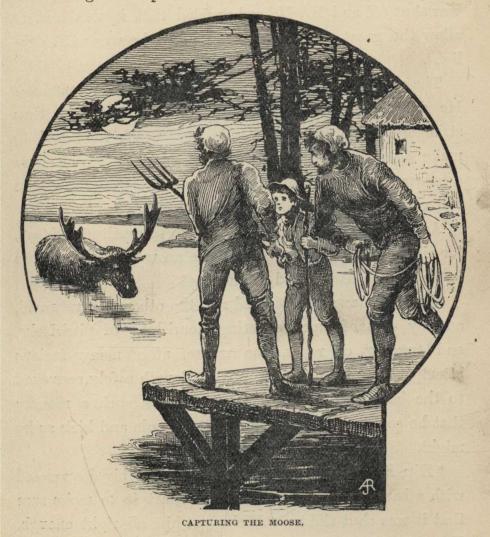
CAPTURING THE MOOSE.
There was no resisting the inexorable strain of the log-chain, however, and foot by foot he was compelled to ascend the incline until he reached the platform. Then the power was shut off, and Mr. M'Leod decided that it was best to allow the great creature to stay where he was until daylight.
The men all went back to their beds, but Rob remained. He did not want to leave the prize which had thus strangely fallen into his hands, and which he hoped to make signally helpful in his father's trouble. So he chose a corner of the platform where he could keep the moose in full view, and composed himself to wait for the morning.
As he sat there his heart went up in gratitude to God, for right before him had he not the answer to the prayer he and Jessie had united in offering?
With the dawn Mr. M'Leod and the other men returned, and by dint of much shouting, flourishing of pitchforks, and tugging of ropes, the moose, after many furious attempts at breaking away, was at length safely conveyed to the barn, and securely fastened up in such a manner that he could do himself no hurt, struggle and kick as he might.
"Hip, hip, hurrah!" shouted Rob as the big door closed with a bang, and he flung himself against it to make sure that it was shut tight. "We've got him all right enough. He can't get out of there until we want him."
"And now that you have got him, Robby," said the miller, laying his hand affectionately on the boy's shoulder. "perhaps you'll tell us what you are going to do with him."
Up to this point Rob had kept his own counsel, because his Scotch shrewdness told him it would be best to do so until the capture was successfully effected. But now there was no longer need for reserve.
"You remember that gentleman who was here hunting last winter, don't you, father?" said he, looking up eagerly into Mr. M'Leod's face.
"You mean Professor Owen from New York."
"Yes. Well, you know he said he'd give a hundred pounds for a full-grown moose alive; and now you must write and tell him you've got a beauty for him, and to come along and get it."
The miller's face became radiant as his son spoke. He now understood what had been in Rob's mind, and why he had shown such intense anxiety to secure the moose uninjured.
"God bless you, my boy!" he exclaimed, throwing his arms around his neck, for the revulsion of feeling broke down his characteristic reserve. "I see what you've been driving at. You always were a bright lad, and now, maybe, you're going to save me from ruin. I won't wait to write Professor Owen; I'll telegraph him. He left me his address so that I might let him know when the hunting was good."
Mounting his best horse, Mr. M'Leod hastened to the village, and sent this despatch to the professor: "Have a splendid live moose in my barn. Do you want him?"
Before many hours the reply came: "Am coming for him by first train."
The following evening Professor Owen appeared. When he saw the moose he fairly shouted with delight.
"A perfect specimen, and in the very prime of life," he cried. "I'll give you a hundred pounds for him on the spot. Will that be right?"
The offer was gladly accepted; and as soon as the necessary arrangements could be made, the moose was taken away to become the chief attraction in a famous zoological garden.
On the day before the sheriff's sale Mr. M'Leod, greatly to the money-lender's chagrin, paid his claim in full, and cleared his property from all encumbrance.
That night they had a praise-meeting at the mill; for when Mr. M'Leod was told about Rob and Jessie praying together for his deliverance from the grasp of Moses Shearer his heart was deeply stirred, and he joined in thanking God who had thus signally answered the children's petitions. Not only so, but both he and his wife were moved to withhold no longer from God's service, and they became active, happy members of the church.
As for Rob and Jessie, their faith was wonderfully strengthened, and often afterwards the recollection of this incident helped them to be trustful in the midst of many difficulties.
FORTY MILES OF MAELSTROM.
The Canadian Pacific train, speeding swiftly on toward Winnipeg, had just dashed over an iron bridge which threw its audacious spider-web across a foaming torrent. Pointing down at the tumbling water beneath, one of the men in the smoking compartment of a palace car exclaimed,—
"I'd like to try that rapid in my Rice Lake."
"Are you so fond of a wetting as all that?" asked Charlie Hall with a smile.
"Oh, I'd risk the wetting. I've been through worse rapids than that without so much as being sprinkled." He proceeded to support his assertion by relating some of his adventures.
When Jack Fleming came to the end of his tether, the others had their say, for they had not been without experiences of a similar nature. Meanwhile, the fourth member of the group had been listening with interested attention, as if their stories were so novel that he did not wish to lose a word of them. He was merely a chance acquaintance, who had fallen into conversation with his fellow-travellers through the freemasonry of the pipe. They knew his name; Ronald Cameron, but they knew nothing more about him.
It was more for the sake of saying something courteous than with any idea of drawing the stranger out that Fleming turned to him and said, "Perhaps you know something about running rapids too?"
The stranger's bronzed face broke out into a smile, which meant unmistakably, "As well ask Grant if he knew something about fighting battles;" but there was not the faintest trace of boastfulness in his tone as he replied, "I have run a few rapids in my time."
"Well, it's your turn now; tell us your experience," said Fleming, and without much urging Cameron began.
"I must explain that I am in the employ of the Hudson Bay Company, and have spent many years in the North-west districts. My duties have required frequent long trips by York boat and bark canoe, in the course of which I have had my full share of tussles with rapids of all kinds. I could tell you half-a-dozen rather exciting little episodes, but I'll give you only one just now, namely, my passage of the Long Cañon of the Liard in a canvas boat."
"In a canvas boat?" broke out Fleming, half incredulously.
"Yes, in a canvas boat," repeated Cameron. "Not a particularly seaworthy craft, I must confess. But it was a notion of my own in order to get over the difficulty in which I was placed. I had been over in British Columbia, and was on my way back to Athabasca. The season was growing late, and I had only two men with me—an Indian and a half-breed. The Indian was a splendid canoe-man, but the half-breed was not of much account. The first part of the journey could be made by boat easily enough, but for us three men to drag a heavy boat over Grizzly Portage, which is about six miles long, and has a portage-path that climbs a thousand feet up the mountain side, was quite out of the question.
"So before I started I had a boat made out of tent canvas, which would be no trouble to carry. The wooden boat was to be left at the head of Grizzly Portage to take care of itself.
"Well, we got on smoothly until we passed the portage, and the Long Cañon opened out before us. As I looked at its wild rush of water, and realized that this was only the beginning, and far from the worst of it, I confess I felt tempted to turn back. But my pride soon banished that thought, and I set about getting my frail craft ready for the trip. Dennazee, the Indian, did not show the slightest concern; but Machard, the half-breed, was evidently much frightened.
"Assuming a cheery indifference I by no means felt, I went about the work in the most matter-of-fact way, and, with Dennazee helping heartily, the canvas boat was put together and set afloat.
"But it became evident immediately that she was not minded to stay afloat long. Although I had taken the precaution to give the canvas a good coat of oil, no sooner were we on board than, the treacherous stuff leaked through every pore. Clearly this must be remedied before we could attempt the passage.
"Bidding the men gather all the gum and balsam they could find, I put the whole of our bacon, some ten pounds at least, half-a-dozen candles, and the gum and balsam into our pot, set it over a brisk fire, and produced the most extraordinary compound you can imagine.
"With this we thickly daubed the outside of the boat from stem to stern, and then left her for the night. The next morning she was as tight as a drum, and we started off, the poor half-breed muttering prayers in full expectation of a watery grave, the Indian as stolid as a statue, and myself much more anxious at heart than I cared to have either man know.
"The cañon is about forty miles long, and in that distance the river falls quite five hundred feet. Old Lepine, who has piloted boats up and down the Liard for thirty years or more, asserts that once, when the water was unusually high, he went through the whole length of the cañon in a York boat in two hours. The old man may be a few minutes short of the record, but there is no doubt that in the spring, when the snow is melting on the mountain slopes, the river runs at a fearful rate. I had hoped for low water, but, as luck would have it, a sudden spell of intensely hot weather had set the snow going, and the Liard was just high enough to be a very ugly customer.
"Well, we paddled out into the current, and then there was nothing to do but steer. I had the stern, and Dennazee the bow, while Machard clung tightly to the centre thwart, and was useful only as ballast. Like an arrow our little boat sped down stream, darting this way and that, dipping and dancing about like a cork, doing exactly what the water willed.
"At the very first swirl I found out something that gave me an additional shiver. This was that the boat could bear very little pressure from the paddle. If the water pulled one way and the paddle the other, the frail thing squirmed and twisted like a snake instead of obeying the steersman, so that it was quite impossible to make her respond readily or to effect a sharp turn. No doubt Dennazee discovered this as soon as I did, but he gave no hint of it, as with intent face and skilful arm he did his part of the work to perfection.
"The first few miles were not very bad, but we soon came to a place where whirlpool followed whirlpool in fearfully quick succession, and I no sooner caught my breath after escaping one than we were struggling with another. Our canvas cockle-shell appeared to undulate over the frothing waves rather than cut through them. I seemed to feel every motion of the water through her thin skin. In the very thick of it I could not help admiring the wonderful skill of the Indian in the bow. Again and again he saved us from dashing against a rock, or whirling around broadside to the current.
"For mile after mile we were tumbled about, and tossed from wave to wave like a chip of bark. My heart was in my mouth. I could scarcely breathe. My knees quaked, though my hand was firm, as, with eyes fixed upon Dennazee, I instantly obeyed every motion of his paddle.
"In this fashion, one hairbreadth escape succeeding another, we did half the distance unscathed, and made the shore by the aid of an eddy at the head of the Rapids of the Drowned. These rapids got their forbidding name from the fate of eight voyagers, who lost their lives while attempting to run them in a large canoe. Being studded with rocks, these rapids are extremely dangerous. As the cañon widens out sufficiently to leave a narrow beach at this point, we preferred portaging our canvas boat to impaling her on one of the rocks.
"It was a strange thing that our sudden appearance should have so startled two moose who were standing on the shore that, instead of retreating up the hill, they plunged boldly into the river, of whose pitiless power they evidently knew nothing, and were borne helplessly away to destruction. A little later we saw their bodies stranded on a shoal, and the sight gave me a chill as I thought that that perhaps would be our fate, too, before we escaped from the Long Cañon.
"We had hard work getting the boat and ourselves over the broken, boulder-strown beach beside the Rapids of the Drowned, and the boat had more than one 'close call' as we slipped and stumbled about. I've no doubt Machard would have been glad to see it perforated with a hole beyond repair. But by dint of great care and hard work we did manage to bring it through uninjured, and then we halted for a rest and a bit of dinner.
"When it came to starting again, Machard vowed he would not get aboard. He pleaded to be allowed to follow us on foot; but I would not listen to him. I needed him for ballast in the first place, and moreover, if we did get through alive, I could not afford to waste half a day waiting for him to overtake us. Drawing my revolver, I ordered him to get on board. He obeyed, trembling, and we started again, Dennazee as imperturbable as ever.
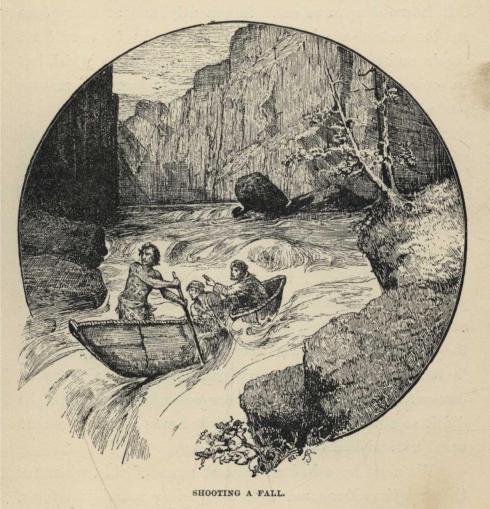
SHOOTING A FALL.
"We had the worst part of the passage still before us. The sides of the cañon drew close together until they became lofty walls, between which the river shot downward like a mill-race. The great black cliffs to right and left frowned upon us as if indignantly, and at every turn in the cañon a whirlpool yawned, ready to engulf us. Again and again I thought we were caught in a whirl, but in some marvellous manner Dennazee extricated us, and we darted on to try our fate with another.
"Extreme as our peril was, it had a wonderful thrill and excitement about it, and in the midst of it I found myself thinking that were I only in a big York boat I would be shouting for joy instead of filled with apprehension.
"The great difficulty was to keep our boat straight with the stream, for, as I have already told you, she was so pliant that she bent and twisted instead of keeping stiff, and more than once I felt sure she would cave in under the tremendous pressure upon her thin sides. To make matters worse she began to leak again, and although I commanded Machard to bail her out with a pannikin, he did it so clumsily in his terror that I was afraid he would upset us, and had to order him to stop.
"We must have had an hour or more of this, when for the first time Dennazee spoke. Turning round just for a moment he pointed ahead, and exclaimed, 'Hell Gate!'
"I knew at once what he meant. We had almost reached the end of the cañon. There remained only Hell Gate, and our perils would be over. Only Hell Gate! I've not been much of a hand at praying, but I'm not ashamed to confess that I imitated poor Machard's example then. As for him, the moment he heard what Dennazee said, he fell on his knees in the bottom, and, clinging to the thwart, set to praying with all his might and main.
"With a thrilling rush we swept around the curve and plunged into Hell Gate. It is an awful place. The walls of the cañon are two hundred feet high, and not more than a hundred feet apart. The deep water spins along at the rate of twenty miles an hour, while at the end is a sort of drop into a black, dreadful pool, where the whirls are the worst of all.
"We got through the narrow passage all right, and then, with a dive that made my heart stand still, entered the whirlpools. There were three of them, and we struck the centre one. In spite of our desperate efforts, it got its grip full upon us, and round and round we went like a teetotum.
"It is not at all likely that I shall ever forget that experience. Our flimsy craft seemed to be trying to collapse every moment. It writhed and squirmed like a living thing, and at every turn of the awful circle we drew nearer to its centre, which yawned to engulf us.
"I had given up all hope, and was about to throw away my paddle and prepare for the last struggle, when suddenly there came a great rush of water down the cañon. The whirlpools all filled up and levelled over; for one brief minute the river was on our side.
"With a whoop of delight Dennazee dug his paddle deep into the water, and put all his strength upon it. I seconded his efforts as well as I could. The boat hesitated, then obeyed, and moved slowly but surely forward; and after some moments of harrowing suspense we found ourselves floating swiftly but safely onward, with no more dangers ahead."
Cameron ceased speaking, and picked up his pipe. There was a moment of silence, and then Fleming, drawing a deep breath, said with a quizzical smile, "Perhaps you do know something about running rapids."
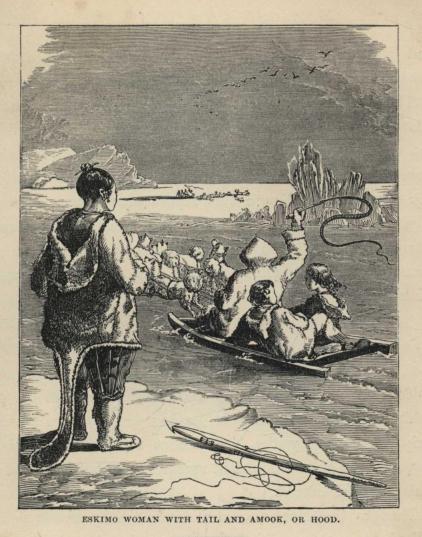
ESKIMO WOMAN WITH TAIL AND AMOOK, OR HOOD.
THE CANADIAN CHILDREN OF THE COLD.
After centuries of seclusion and neglect, broken only by the infrequent visits of ambitious seekers for the north pole, or mercenary hunters for the right whale, and by the semi-religious, semi-commercial ministrations of the Moravian missionaries, the Eskimos of the Labrador and Hudson Bay region suddenly had the eyes of the world turned inquiringly upon them.
The shocking story was published far and wide that a winter that did not change to spring in the usual way had cut off their supply of food, and that in consequence they were devouring one another with the ghastly relish of a Fiji cannibal. Although this report proved untrue, happily, the Eskimos are sufficiently interesting to attract attention at all times, and are little enough known to furnish an adequate excuse at this time for a brief paper upon them.
I.
To aid me in presenting the earliest glimpses of the Eskimos, I am fortunate in having before me a manuscript prepared by the late Robert Morrow of Halifax, Nova Scotia, an accomplished student of the literatures of Iceland and Denmark.
That to the Norsemen and not to the Spaniards rightfully belongs the credit of first discovering America is now settled, and that when the Norsemen first touched American soil they found the Eskimos already in possession is also certain. Yet it was not these bold adventurers that gave these curious people the name by which they are most commonly known. In the expressive Norse tongue they were described as "Skraelings"—that is, the "chips, parings." The intention was not, of course, to convey the idea that they were cordially accepted as "chips of the old block," but, on the contrary, to show that they were regarded by their handsome and stalwart discoverers as little better than mere fragments of humanity—a view which, however unflattering, their squat stature, ugly countenances, and filthy habits went far to justify.
The name "Eskimo" was given to them by the Abenaki, a tribe of Indians in southern Labrador. It is an abbreviation of "Eskimautsik," which means "eating raw fish," in allusion to their repulsive custom of eating both fish and flesh without taking the preliminary trouble of cooking it. The Eskimos themselves assert very emphatically that they are "Innuit"—that is, "the people"—just as though they were the only people in the world (and, by the way, it is worth noticing that each particular tribe of these "Huskies" thinks itself the entire population of the globe until undeceived by the advent of visitors). Their national name, if they have one at all, is "Karalit," the plural of "Karalik," meaning "those that stayed behind."
With reference to this latter title, Mr. Morrow points out a curious fact, which is suggestive. Strahlenburg, in his description of the northern part of Asia, states, on the authority of the Tartar writer Abulgazi Chan, that Og, or Ogus Chan, who reigned in Tartary long before the birth of Christ, made an inroad into the southern Asiatic countries, and as some of his tribes stayed behind, they were called in reproach "Kall-atzi," and also "Karalik." Now this "Karalik," with its plural "Karalit," is the very name that the Eskimos give themselves. So striking a resemblance, amounting in fact to identity, can surely be accounted for in no other way (and for this suggestion I must assume all responsibility) than that those who stayed behind in Tartary subsequently moved over to the American continent.
When Eric the Red sailed across from Iceland to Greenland (somewhere about the year 985), he found many traces of the Eskimos there: and when Thorvald, some twenty years later, ventured as far south as Vinland, identified as the present Martha's Vineyard (with which he was so delighted that he exclaimed, "Here is a beautiful land, and here I wish to raise my dwelling"), the unexpected discovery of three skin boats upon the beach affected him and his followers much as the imprint of a human foot did Robinson Crusoe. They found more than the boats, however, for each boat held three men, all but one of whom they caught and summarily despatched, for reasons that the saga discreetly forbears to state.
But retribution followed fast. No sooner had the invaders returned to their ships than the Skraelings attacked them in great force, and although the Norsemen came out best in the fighting, their leader, Thorvald, received a mortal wound. He charged his men to bury him upon the cape "at which he had thought it best to dwell;" for, as he pathetically added, "it may happen that it was a true word that fell from my mouth that I should dwell here for a time." His men did as they were bid. They set up two crosses over his grave, whose site is now known as Summit Point. They then hastened homeward.
After the lapse of two years, one Thorfinn Karlsifori, fired by what he heard in Iceland of the wonderful discoveries made by the hardy sons of Eric the Red, fitted out an imposing expedition, his boats carrying one hundred and sixty men, besides women, cattle, etc., and set sail for Vinland. He reached his destination in safety, and remaining there for some time, improved upon his predecessor's method of treating the Skraelings. Instead of aimlessly killing them, he cheerfully cheated them, getting huge packs of furs in exchange for bits of red cloth. He has thus described his customers' chief characteristics: "These men were black and ill-favoured, and had straight hair on their heads. They had large eyes and broad cheeks." All of which shows that although the Eskimos have changed their habitat since then, they have not altered much in their appearance.
After two years of prosperous trading, the relations between the Norsemen and the Skraelings became strained from a cause too amusing not to be related. As already stated, the visitors brought a few of their cattle with them, and it happened one day that a huge bull had his feelings excited some way or other, perhaps by a piece of red cloth thoughtlessly paraded in his view; at all events he bellowed very loud, and charging upon the terrified Eskimos, tossed them about in the most lively fashion. They incontinently tumbled into their boats, and, without a word of farewell, rowed off, to the vast amusement of the bull's owners. But the latter's laughter vanished when presently the runaways returned "in whole ranks, like a rushing stream," and began an attack in which the Norsemen were vanquished by sheer force of numbers, and deemed it prudent to make off without standing upon the order of their going.
II.
With the departure of the Norsemen, the curtain of obscurity falls upon the Eskimos, and is not lifted again until we find them, not luxuriating amid the vine-entangled forests of Vinland, but scattered far and wide over the hideous desolation of the far north, and engaged in a ceaseless struggle with hunger and cold. Just when they thus moved northward, and why, does not yet appear. If their innate and intense hatred of the Red Indian be of any service as a clue, it is, however, within the bounds of reason to believe that they were driven from their comfortable quarters by their more active and warlike fellow-aborigines, and given no rest until they found it amidst the icebergs and glaciers of Labrador and Hudson Bay, where they may now be met with in bands numbering from a dozen to a hundred or more. Throughout the whole of this Arctic region they fearlessly range in search of food.
The Eskimos are, in fact, the only inhabitants of a vast territory, which includes the shores of Arctic America, the whole of Greenland, and a tract about four hundred miles long on the Asiatic coast beyond Behring Strait, thus extending over a distance of five thousand miles from east to west, and three thousand two hundred miles from north to south. Notwithstanding this wide distribution, there is a remarkable uniformity, not only in the physical features of the Eskimos, but also in their manners, traditions, and language. Consequently very much that may be said of the Canadian Children of the Cold (that is, the Eskimos of Labrador and Hudson Bay) would be equally true of the other branches of the race.
For a great deal of interesting information concerning them we are indebted to the writings of such men as Ribbach and Herzeburg, Moravian missionaries, who, with a heroic zeal that only those familiar with their lot can adequately appreciate, have devoted themselves to "the cure of souls" among the Eskimos. There are six of these Moravian missions scattered along the eastern coast of Labrador. Nain, the chief one, was established as far back as 1771, Okkak in 1776, Hopedale in 1782, and Hebron, Zoar, and Ramah more recently.
The bestowal of so attractive Biblical names helps very little, however, to mitigate the unfavourable impression produced by the forbidding surroundings of these tiny oases almost lost in a seemingly illimitable desert. Sheer from the sea, except where broken by frequent gulf and fiord, the coast line towers up in tremendous and unpitying sternness, and at its base the breakers thunder with a force and fury that knows little pause throughout the year. From end to end the shore is jagged like a gigantic saw with innumerable bays and inlets, sprinkled thick with islands and underlaid with hidden reefs, which makes these waters difficult to find and dangerous to navigate.
The interior of the country is equally repellent. Although toward the west it becomes less mountainous and slightly undulating, like the American prairie, it presents nothing but an inhospitable and savage wilderness, covered with immense forests, broken by numerous swamps and lakes, and untouched by human foot, save when now and then a band of Red Indians venture thither, lured by the hope of food and fur.
The Eskimos upon the eastern coast of Labrador are, as a rule, small of stature, not much exceeding five feet. Those upon the western shore, however, are taller and more robust; they are quite strongly built, with hair and beard sweeping down over the shoulders and chest. When the good seed sown by the patient missionary finds lodging in a Husky's heart, he usually signalizes his adoption of Christianity by indulging in a clean shave, or at least by cutting his beard short with a pair of scissors, in deference perhaps to the judgment of St. Paul that "if a man have long hair, it is a shame unto him."
They have small, soft hands, broad shoulders, big flat faces, large, round heads, and short, stubby noses,
"Tip-tilted, like the petals of a flower,"
and very generous mouths, which, being nearly always on the broad grin, make free display of fine rows of sharp, white teeth. In complexion they are tawny and ruddy, and the face is of a much darker shade than the body. At spring-time, when the sun's burning rays are reflected from glistening banks of snow, they become almost as black in the face as negroes; but new-born babes may be seen as fair as any English child. Their eyes are small and almost uniformly black, and peep brightly out at you from underneath a perfect forest of brow and lash. Their hair is black, also, and very thick and coarse.
Their ordinary food is the flesh of the seal, with its attendant blubber, and the fish that abound along the shore. They are not particular whether their dinner is cooked or not, and I seriously question whether a professional pugilist in the height of his training could swallow his beef-steak as "rare" as the Eskimos will their seal cutlets. They are also very partial to tallow, soap, fish oil, and such things, which they look upon as great delicacies, a big tallow candle being rather more of a treat to an Eskimo youngster than a stick of candy to a civilized small boy.
That these peculiar and decidedly repulsive tastes are, after all, bottomed on the laws of nature, is clearly shown by the fact that when the natives around a mission station adopt a European diet (and they soon become passionately fond of bread and biscuits) they inevitably grow weak and incapable of standing the intense cold. When Joe, that heroic Eskimo who supported Hall's expedition by his hunting, after Hall himself had died, was transplanted to America and thence to England, he soon languished and grew consumptive, despite every effort to preserve his health. On joining Captain Young in the Pandora, his only remark, uttered with a depth of eager, confident hope that was very touching, was, "By-and-by get little seal meat; then all right,"—a prediction that was fulfilled to the very letter when he regained his native ice. As soon as they killed their first seal Joe was given free rein, and he began to revive at once. His hollow cheeks resumed their old-time chubbiness (and smeariness too, no doubt), his languor left him, and he was, in short, another man.
The seal is, in fact, everything to the Eskimo. What the buffalo was to the American Indian, what the reindeer is to the European Laplander, all that, and still more, is the seal to these Children of the Cold. Upon its meat and blubber they feed. With its fur they are clothed. By its oil they are warmed and lighted. Stretched upon appropriate framework, its skin makes them sea-worthy boats and weather-proof tents. While, unkindest use of all, with its bladder they float the fatal harpoon that wrought its own undoing. To sum it all up in one sentence, take away the seal, and the Eskimo could not exist for a month.
There is not much room for fashion's imperious sway in Labrador. Seal-skin from scalp to toe is the invariable rule; and there would be no small difficulty in distinguishing between the sexes, if the women did not indulge in a certain amount of ornamentation, upon their garments, and further indicate their femininity by appending to their sacques a curious tail reaching almost to the ground, which they renew whenever it becomes so dirty as to shock even their sluggish sensibilities. Still another distinguishing mark, permissible, however, only to those who have attained the dignity of motherhood, is the amook, a capacious hood hung between the shoulders, which forms the safest and snuggest of all carrying places for babies that otherwise would be "in arms."
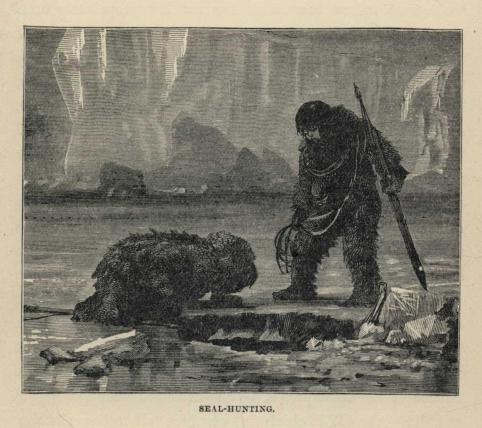
SEAL-HUNTING.
III.
In addition to the records of the Moravian missionaries, the reports of the Arctic explorers and the stories brought back by whalers concerning the Eskimos, much information has been gained of late through the measures taken by the Canadian Government to determine the practicability of Hudson Bay as a commercial highway. For three successive years expeditions on an extensive scale have been despatched to that little-known region, and observing stations have been maintained throughout the year at different points along the coast of Labrador and the shores of that great inland sea which has not inappropriately been termed the "Mediterranean" of Canada. As one result of these expeditions, much attention has been drawn to the natives. Lieutenant Gordon, who has commanded all three, has many kind words for them. He finds them docile, amiable, and willing to work, and apparently much pleased with the prospect of increased intercourse with the white man. Occasionally one is met that has been sufficiently enterprising to acquire the English language, while many others understand well enough what is said to them in that language, although they cannot be persuaded to speak it.
They are wildly fond of any article of civilized clothing, and the head-man at one settlement exhibited no little pride in the possession of a stand-up linen collar, almost worthy to be placed beside one of Mr. Gladstone's. Although he displayed it to the utmost advantage, he did not, like the Fiji chieftain, consider all other clothing superfluous.
When stores were being landed at the stations, the Eskimos would gather about and offer their services, which were always accepted, and then all day long they would toil cheerfully side by side with their white brethren, requiring no other remuneration than biscuits. When so much has been written by Arctic explorers about the incorrigible kleptomania of the natives, it is no less a matter for surprise than for gratification that Lieutenant Gordon can bear this testimony as to the moral status of the Eskimos at Hudson Bay: "One word may be said in regard to their honesty. Although scraps of iron and wood possess a value to them which we can hardly appreciate, they would take nothing without first asking leave. Not even a chip or broken nail was taken without their first coming to ask permission of the officer who was on duty!"
No doubt the fact that practical prohibition prevails has something to do with this highly commendable showing. The law, aided and abetted by the vigilant missionaries, shuts out everything stronger than lime-juice, and the path of the Eskimo is free from the most seductive and destructive of all temptations, except when some unprincipled whaler offers him a pull out of his flask. This, however, is a rare occurrence, and there is no record of any such disturbance ever having been raised as would in more highly civilized communities call for the interference of the police. Although the simplicity of their life and their freedom from many modern vices conduce to longevity, these advantages are more than counterbalanced by the strain put upon their constitutions by the severity of the climate and the incessant struggle for food. Consequently they soon age, and seldom live beyond sixty years.
The doctrine that cleanliness is next to godliness finds few adherents in Eskimo land. The rule seems to be to eschew washing throughout the year, and many a mighty hunter goes through life innocent of a bath, unless, indeed, he should happen to be tumbled out of his kayak by some irate walrus with other than sanitary designs in mind. Mr. Tuttle, the historian of the first Hudson Bay expedition, is authority for the statement that the children, when very young, are sometimes cleaned by being licked with their mother's tongue before being put into the bag of feathers that serves them as bed, cradle, and blanket; but one cannot help thinking that this particular version of "a lick and a promise" is rather too laborious to have extensive vogue.
So familiar has the world been made through the medium of Arctic exploration literature with the igloos (huts), kayaks and umiaks (boats), sledges, dogs, harpoons, and other possessions of these people, which are precisely the same wherever they may be found, that reference to them seems unnecessary, especially as the Canadian Eskimos offer nothing peculiar. But, before concluding, a few words must be added as to the intellectual and moral characteristics of the race. Their intelligence is considerable. In some instances they display not only a taste but a talent for music, chart-making, and drawing. One case is mentioned where a mere lad drew an excellent outline of the coast for over a hundred miles, indicating its many irregularities with astonishing accuracy. They are capital mimics, and are apt at learning the songs and dances of their white visitors. But they are poor men of business. They generally leave to the purchaser the fixing of the price of anything they have to sell.
It is said that in their private lives their state of morality is low, although they avoid indecency calculated to give public offence. Stealing and lying were unknown among them until these "black arts" were introduced by the whites as products of civilization, and, unhappily, the natives are proving apt pupils. They are also somewhat given to gambling. Although by no means without courage, they seldom quarrel, and never go to war with one another.
As to religion, the Eskimos, before they accepted Christianity, had little or none that was worthy of the name. They believe in the immortality of the soul, but liberally extend this doctrine to the lower animals also, which they endow with souls. They hold, also, that human souls can pass into the bodies of these very animals.
With respect to the higher powers, their creed is that the world is ruled by supernatural beings whom they call "owners;" and as almost every object has its owner, this would seem to be a kind of Pantheism. After death human souls go either up or down; but in curious contrast to the belief of all other races, the good, in their opinion, go to the nether world, where they bask in a land, not of milk and honey, but of inexhaustible seal meat and blubber. The bad, on the other hand, go to the upper world, where they suffer what a fashionable preacher euphemized as "eternal uneasiness," not from excess of heat but from frost and famine. There they are permitted to lighten their misery by playing ball with a walrus head, which diversion, by the way, in some inexplicable fashion, gives rise to the aurora borealis.
Like all aborigines they have their own legend of the deluge, and to this day they proudly point out a large island lying between Okkak and Hebron, rising to the height of nearly seven thousand feet, which they claim was the only spot left uncovered by the flood, and upon which a select party of their antediluvian ancestors survived the otherwise all-embracing catastrophe.
The future destiny of this interesting race may be readily forecast. In common with the Red Indian of the plains, the swarthy Eskimo may adopt with reference to the white man those words of fathomless pathos uttered by John the Baptist in reference to the Messiah, "He must increase, but I must decrease." It is merely a question of time. All over the vast region he inhabits are signs showing that his numbers were far greater once than they are at present. The insatiable greed of his white brothers is rendering his existence increasingly difficult. The seal and the walrus are ever being driven farther north, and that means a sterner and shorter struggle for life. As the Indian will not long survive the buffalo, so the Eskimo will not long survive the seal. There are, perhaps, fifteen thousand of them now scattered far and wide over the tremendous spaces between Labrador and Alaska. Each year their numbers are growing less, and ere long the last remnant of the race will have vanished, and the great lone North will return to the state of appalling solitude and silence that only the Canadian Children of the Cold had the fortitude to alleviate by their presence.
FACE TO FACE WITH AN "INDIAN DEVIL."
There were three of us, and we were all untiring explorers of the forests and streams within reach of our homes in quest of such possessors of fur, fin, or feather as our guns and rods could overcome.
Plenty of luck did we have too, for we lived in a sparsely-settled part of Nova Scotia, and the trout and partridges and rabbits had not had their ranks thinned by too much hunting. It was no uncommon thing for us to bring back, as the result of an afternoon's whipping of the brooks, two or three dozen speckled trout weighing from half-a-pound to three pounds each, while less than a dozen brace of plump partridges or bob-tailed rabbits was looked on as a very poor bag for a day's shooting.
Adventurous and enterprising as we were, however, one stream of which we had knowledge remained undisturbed by our lines. It was known among the Mic-Macs, a band of whom roamed about the neighbourhood, as Indian Devil Run, being so called because of their belief that the dense dark forest in which it took its rise was the fastness of a family of panthers, of which they stood in great dread.
Nor was the name without good foundation, for one autumn a hunter with gun and trap ventured into this place, and returned with the body of a panther, stating that he believed others still remained.
Indian Devil Run began somewhere in the North Forest, ran through its heavy shadows for several miles, and then appeared to add its contribution to the Digdequash River, at which point we made its acquaintance.
We often talked about following it up into the depths of the forest, but the Indian stories made us pause, until at last one evening in September, Jack Johnston, craving some fresh excitement, dared us to make the attempt, and we rashly accepted the challenge.
The following morning we set off, letting no one know the object of our expedition. We were armed in this fashion: Charlie Peters bore an ancient Dutch musket, warranted when properly loaded to kill at both ends; Johnston had a keen tomahawk, which the Indians had taught him to use like one of themselves; and I carried an old-fashioned smooth-bore shot-gun, dangerous only to small game.