MY STRANGE RESCUE (continued 3)
Reading edition
"Now, if we come across an Indian devil, Charlie," said Johnston, "you give him a broadside from 'Dutchie,' and I'll finish him with my tomahawk."
"And where do I come in?" I asked, with a smile.
"You? Oh, you blaze away at him with your pepperpot; you might perhaps put his eyes out, you know," Jack laughingly responded, and so our order of battle was settled upon.
We crossed the Digdequash in a canoe, hid our craft in the underbrush, and in high feather entered upon the exploration of Indian Devil Run.
It proved to be a succession of falls and rapids, overshadowed by huge trees for several miles, and we had hard work making our way up its course. But we toiled steadily on, and just before mid-day were rewarded for our pains by reaching a lovely spot, where the banks of the stream widened to form an enchanting pond encircled by a meadow, and offering every inducement to stay and rest.
Glad were we to do so. The pond evidently swarmed with trout. Quickly adjusting our fishing-tackle, we got to work. Shade of Izaak Walton! what a paradise for anglers! The water fairly boiled as the hungry trout fought for the privilege of being hooked. In one hour we landed as many as we could carry home, and they were fine fellows every one of them.
"The greatest place for trout I ever struck!" exclaimed Charlie Peters, throwing down his rod. "I positively haven't the heart to catch any more. It seems like taking a mean advantage of them."
So we stopped the slaughter—apparently much to the disappointment of our prey, who hung about asking to be made victims—and proceeded to dispose of the ample lunch with which our thoughtful mothers had provided us. Then we had a refreshing plunge in the clear water, scaring the trout nearly out of their skins, and by this time it was necessary that we should retrace our steps.
On our way up I had brought down a fine brace of birds, and to save carrying them to and fro had hung them to a high branch, intending to pick them up on the return journey.
"Don't forget your partridges, Hal," said Jack to me, as we shouldered our bags heavy with trout.
"No fear of that," I replied. "I know exactly where I left them."
Hitherto we had seen and heard nothing to justify the Indians' superstitious dread of the locality. No signs of wild animals were visible, and in high spirits at having discovered so rich a fishing-ground we hastened homeward.
"I guess the Indian devils have got tired of this place and left," remarked Charlie Peters. "But don't let us give it away all the same. We must keep this run all to ourselves as long as we can."
Hardly had he spoken when an appalling shriek pierced the silence of the woods, and brought us to a sudden stop, while we looked into one another's faces with an apprehension we made no attempt to conceal. We were close to the tree where the partridges had been hung.
"It's the Indian devil!" exclaimed Jack Johnston, under his breath. "He's eaten the partridges, and now he wants to eat us."
We fully realized our danger, and after the first shock of fright braced ourselves to meet it with a determined front. Johnston, as the eldest and coolest of the three, took command.
"Charlie," said he, "you must let him have Dutchie full in the face the moment we sight him.—Hal, you blaze away with your shot-gun, and I'll stand by to finish him with my tomahawk."
nodding assent to these directions, we stood side by side, gazing eagerly into the forest gloom.
"There he is!" said Johnston. "See! on that big limb."
We followed the direction of his finger, and saw the brute clearly enough, stretched upon a limb not twelve yards away, his great green eyes glaring horribly at us.
"Quick, Charlie!" cried Jack. "He's going to spring. Rest your gun on my shoulder, and aim for his chest."
Charlie did as he was bid, and pulled the trigger. Bang went the old musket with a tremendous report. Over went Charlie on his back, his shoulder well-nigh dislocated by the kick of his weapon; and down came the panther to the ground, badly wounded in his neck and breast. The instant he touched ground I let him have the contents of my shot-gun. But they only served to bother him for a moment, and looking terrible in his fury, he was just gathering himself for a spring into our midst, when Johnston, stepping forward, sent his tomahawk whizzing through the air with all the force of his strong right arm.
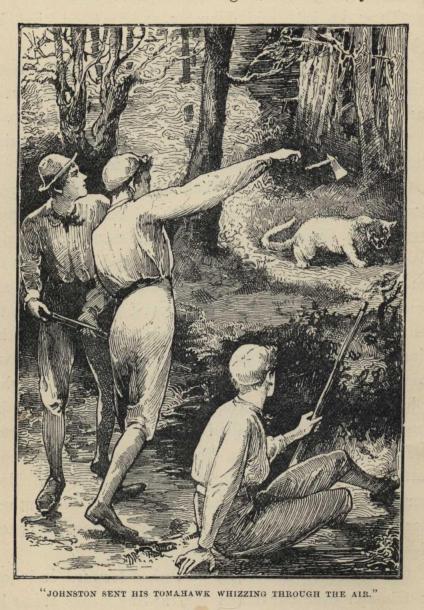
"JOHNSTON SENT HIS TOMAHAWK WHIZZING THROUGH THE AIR."
It was a perfect throw. No Mic-Mac could have done it better. Like a flash of lightning the bright steel blade went straight to its mark, and buried itself in the panther's forehead right between those awful eyes, whose malignant gleam it extinguished for ever.
Lifting Charlie to his feet we rushed forward, and stood in triumph over our fallen foe, shaking hands across his mighty body. How our hearts swelled with pride at the thought of the sensation our exploit would make!
With a twisted withe for a rope we laboriously dragged our prize to the canoe, and so got it across the river. Here we met the Indian who had been Johnston's teacher in the art of tomahawk-throwing. He seemed immensely relieved at seeing us.
"Me see you boys go over this morning, then hear devil scream this afternoon, and hear you go bang. Me 'fraid you all deaded this time."
Then as he discovered the fatal gash in the brute's head, his face lit up with pride.
"Johnston, you do that!" he cried. "Ah! smart boy. Me learn you how throw tomahawk like that."
Jack blushingly acknowledged the fact, and gave his Indian instructor due meed of praise for having taught him so well.
It was too big a job to get the heavy carcass of the panther any further, so the Indian took off the head and skin for us, and we presented him with the body, which he said was good to eat, and would "make Indian strong."
Our arrival at home with the trophies of our triumph over the terror of the forest caused great rejoicing. We were the heroes of the hour, and Charlie quite forgot his bruised shoulder in the pleasant excitement of the occasion.
We often revisited Indian Devil Run after that, and took many a fine fare of fish from its well-stocked waters, but we never saw another panther. We had apparently killed the last of the brood.
IN THE NICK OF TIME.
"Will you be out to practice this evening, Charlie?" asked Rob M'Kenzie of his friend Kent, as the two, who had been walking home from the high school together, parted at a corner.
"Indeed, that I will," was the reply; "and every evening, too, until the match comes off. It'll take all the practice we can put in to beat those Riverside chaps, I can tell you."
"Pshaw! What makes you think they'll be so hard to beat this time?" returned Rob. "We've always had our fair share of the games so far."
"So we have; but they didn't have Sam Massie playing with them."
"Sam Massie! who's Sam Massie?" exclaimed Rob, in surprise.
"Don't you know who Sam Massie is? Why, he's one of the first twelve of the Torontos," replied Charlie, looking somewhat astonished at his friend's ignorance.
"Then how on earth can he play with the Riversides?" asked Rob. "Can't we protest?"
"Oh, that's all right enough. His uncle lives in Riverside, and he is staying with him for a while, so we can't object to his playing."
"Humph!" growled Rob. "It's a pity we can't. We've got nobody to match him."
"I don't think it's a pity at all," returned Charlie cheerfully. "I'd a good deal rather see a crack player like Sam Massie, and get some points from him, than object to his playing, even if he gains the match for the other fellows. We'll do our best to give him a good day's work, any way. So let's practise hard." And Charlie went off whistling.
There was an intense rivalry between the villages of Riverside and Heatherton in the matter of lacrosse. Each village had a good club, in which not only the players but the people also took a hearty interest, and the matches that were played once a month alternately in each village during the season never failed to draw out to see them everybody in the population that could possibly manage to be present. They were always played on Saturday, because then the farmers from round about came in to the village to do their week's business early in the morning, and by rushing things a little could easily get through by three o'clock, and then they and the shopkeepers and the rest of the village folk would adjourn to the lacrosse-field and have a lively time of it, shouting, and cheering, and laughing as the game went on before them.
Charlie Kent and Rob M'Kenzie were the two youngest members of the Heatherton lacrosse twelve, and they naturally felt very proud of their position, which they had won by proving themselves the best players in the high school, and thereby attracting the attention of the Heatherton captain quite early in the season. The day when big Tom Brown called them both aside and invited them to play with the first twelve was one of the proudest in their lives; and Tom had had no reason to regret his invitation on any game that summer, for the two "young cubs," as he called them, proved themselves very useful additions, being quick, careful, plucky, and, best of all, thoroughly obedient, always doing exactly what he told them.
The next match with Riverside was of special importance, because it would be the final and decisive one of five which the two clubs were playing for a fine set of silk flags, which had been offered as a trophy by some generous friends of lacrosse in both villages. Each club had won two matches, and now on the approaching Saturday the fifth and final match would take place, rain or shine.
The rumour of Sam Massie being with the Riversides had reached Heatherton early in the week, and caused no little concern, some of the players being disposed to make a protest if he appeared on the field, and even a refusal to play. But Tom Brown would not listen to them. Sam Massie was, for the time being at least, a resident in Riverside, and to object to his playing would be acting in a way he did not approve of, so the dissatisfied ones were fain to hold their tongues.
The eventful Saturday came, and was as fine as heart could wish. It was Heatherton's turn to have the match, and the home team rejoiced at this, because it would in some measure compensate them for the advantage their opponents undoubtedly possessed in having Sam Massie with them.
Never before had so large a crowd assembled to watch the match. It really seemed as if half the population of Riverside and three-fourths of the population of Heatherton had turned out. The whole field was surrounded with a fringe of spectators, ready to applaud every good point in the game.
In due time the Riverside team made their appearance, looking very jaunty in their blue jerseys, caps, and stockings, and white knickerbockers, and all eyes were turned upon them to discover the redoubtable Sam Massie. It was easy to distinguish him from the others, and he certainly was a dangerous-looking player.
He was not of more than medium size, but the perfection of his condition, the graceful ease and quickness of his movements, and the unfailing accuracy of his catching and throwing, as the team indulged in the usual preliminary exercise, impressed everybody with the idea that he fully merited his reputation.
Charlie Kent's place was centre-field, his quickness and steadiness entitling him to that important position, while Rob M'Kenzie was the next man between him and the opponent's goal. Charlie was very anxious to see where the Riversides would put Massie, and was not at all sorry when that player took his place at cover-point, for now he would be certain to cross sticks with him more than once during the match, and find out just how strong a man he was.
Amid the breathless suspense of the spectators the two teams lined up, were briefly adjured by the referee to indulge in no rough play or fouls, and then in pairs departed to their places, the white and blue of the Riversides contrasting picturesquely with the white and crimson of the Heathertons as the players strung out from goal to goal.
"Are you all ready?" cried the referee.
The captains nodded their heads, the two centre-fields kneeled opposite one another for the face, the ball was placed between the lacrosse sticks, and with a shout of "Play" the referee sprang aside, and the struggle began.
There was a second's scuffle between the two centres, and then the Heathertons raised a shout; for Charlie had got the ball away from his opponent, tipped it cleverly to Rob, who, after a short run, had thrown it to "outside home," and the Riverside goal was in danger.
But before outside home could do anything, Massie was down upon him with the swoop of an eagle. With a sharp check he knocked the ball off his stick, then picked it up at once, and dashed away down the field, dodging in and out between his two opponents like a veritable eel. Not until he reached the Heatherton cover-point was he obliged to stop, and then he took a shot at goal, which, but for the plucky goalkeeper putting his broad chest squarely in the way, would certainly have scored.
Back the ball went, however, to the other goal, and continued thus to travel up and down for fully fifteen minutes before some skilful passing and sharp dodging on the part of the Heathertons brought it in front of the Riverside goal, when, after a hard tussle, it was swiped through by a lucky stroke from Charlie Kent.
Great was the elation of the Heathertons at scoring the first game.
"Guess they're not invincible, after all, if they have Sam Massie," said Charlie to Captain Brown.
"Mustn't crow too soon, Charlie," replied Brown cautiously. "We've got the afternoon before us yet."
When the Riversides, thanks to a brilliant run of Massie's, won the next game in five minutes, Charlie felt somewhat less confident; and when, after a severe struggle, they by a pure piece of luck took the third game in twenty minutes, he began to feel a little down in the mouth.
But the winning of the fourth game by the Heathertons braced him up again, and he went into the fifth and final struggle with a brave and determined heart.
The excitement had now become intense. It had been agreed before play commenced that the game should be called at six o'clock, and if not then finished, played over again at Riverside the following Saturday.
The Heathertons fully appreciated the advantage of playing oh their own ground, and were determined to settle the fate of the flags before six o'clock if at all possible.
The Riversides were equally determined to play out the time if they could do nothing better. Accordingly they concentrated all their strength upon the defence, and surrounded the redoubtable Sam Massie with the best men in the team.
Once more Charlie Kent won the face, and again tipped to Rob, who did not fail to send it well down towards the goal, but the stone-wall defence quickly sent it back. Again and again the rubber sphere went flying through the air or bounding along the ground towards the Riverside goal, and again and again it returned, not even being permitted to stay there a moment.
The minutes passed quickly, and six o'clock drew near.
"Charlie, can't you and Rob manage to get that ball down between you? Never mind your places; just play for the goal," said Captain Brown earnestly to Charlie.
"All right, captain, we'll do our best," replied Charlie, as he passed the word to Rob.
As luck would have it, the Riversides, grown bold by their success, opened out their defence just then, and moved nearer the Heatherton goal. Charlie's quick eye noted the change of tactics instantly.
"Look sharp now, Rob," he called, and Rob nodded meaningly.
A moment later the ball came flying his way, and springing high he caught it cleverly, amid a howl of applause from the spectators. Then, signalling Rob to keep parallel with him, he dashed off at full speed towards the Riverside goal.
Charlie was lightly built and long-winded, and constant practice had made him the fastest "sprinter" in Heatherton. But he had never run before as he had then.
The onlookers held their breath to watch him as he sped on. One, two, three opponents were safely passed! by brilliant dodging, and now only Sam Massie stood between him and the goal.
He knew it would be useless to try to dodge Sam. But there was a better play. Before Sam could reach him he tipped the rubber over to Rob. Instantly Sam turned upon Rob, and brought his stick down upon Rob's with a resounding whack. But the ball was not there. Already it was rolling towards Charlie, who had continued straight on, and scooping it up from the ground, with a straight, swift overhand throw he sent it flying through the goal-posts just in time to allow the cry of "Goal! goal!" to be triumphantly raised ere the six-o'clock whistle sounded the hour for calling the game.
Charlie Kent was, of course, the hero of the day. Sam Massie, brilliantly as he had played, was quite forgotten. But he did not forget to come up and clap Charlie warmly on the back, saying,—
"Bravo, my boy! You'll make a championship player some day. You must come up to Toronto. We want your kind up there."
SNOW-SHOEING.
Three things have the "red children of the forest" given to the white children of the cities which are so perfect in their way that it is hardly possible there will ever be an invention filed in the pigeon-holes of the patent-office that will surpass them. The canoe for shallow water and what might be called cross-country navigation, the toboggan, and the snow-shoe for deep snow, seem to be the very crown of human ingenuity, even though they are only the devices of ignorant Indians. One cannot help a feeling of hearty admiration when looking at them, and noting how perfectly they fulfil the purpose for which they were designed, and are at the same time as light, graceful, and artistic in form and fashion as the most finished work of highly-civilized folk. They all follow the line cf beauty so closely that it is no wonder the ladies love to decorate their drawing-rooms and boudoirs with them, or to have their pins and brooches modelled after them.
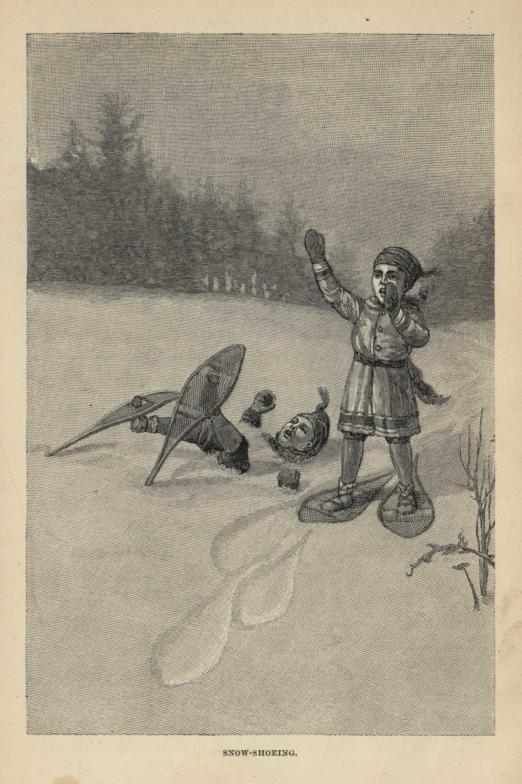
SNOW-SHOEING.
To the Indian the canoe, snow-shoe, and toboggan were quite as important implements as the spade, the plough, and the rake are to the farmer. Without them he could not in winter-time have roamed the snow-buried forests, whose recesses supplied his table, or voyaged in the summer-time upon the broad rivers and swift-running streams, whose bountiful waters furnished him their ready toll of fish. His white brother has in adopting them put them to a different use. He had no particular need for them in his work, but he was quick to see how they would help him in his play, and erelong they had all three become favourite means of sport and recreation.
Snow-shoeing disputes with tobogganing the honour of being Canada's national winter sport; for although snow-shoes have been seen in Siberia and Tartary, and are used to some extent in Scandinavia, in none of these places do the people derive much amusement from them. Simple as the snow-shoe seems, I would not advise any one to try to make a pair for himself. Only the Indians can do this really well, and even in Canada the vast majority of shoes are put together by dusky hands.
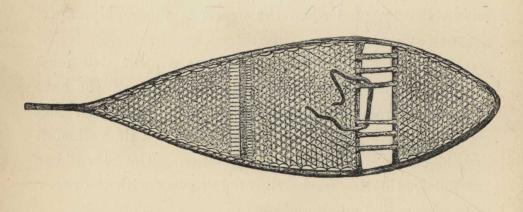
This is how they make a shoe of three feet six inches, which is a fair average size:—A piece of light ash about half-an-inch thick, and at least ninety inches in length, is bent to a long oval until the two ends touch, when they are lashed strongly together with catgut. Two strips of tough wood about an inch broad are then fitted across this frame, one being placed about five inches from the curving top, the other some twenty inches from the tapering end. The object of these strips is to give both strength and spring to the shoe. The three sections into which the interior of the frame has thus been divided are then woven across with catgut, each having a different degree of fineness in the mesh, the top section being very fine, the middle section, upon which almost the whole strain comes, coarse and strong, and the end section a medium grade between the other two. The gut in the middle section is wound right around the framework for the sake of greater strength, but in the other two is threaded through holes bored at intervals of an inch or so. Just behind the front cross-bar an opening about four inches square is left in the gut netting, in order to allow free play for the toes in lifting the shoe at each step. Both wood and gut must be thoroughly seasoned, or else the one will warp, and the other stretch and sag until the shoe is altogether useless.
The shoes are made in many shapes and of many sizes, ranging from two to six feet in length, and from ten to twenty inches in breadth. But for all practical purposes a shoe measuring three feet six inches by twelve or fifteen inches is the best. In racing, narrower shoes are used, but they rarely go below ten inches, that being the regulation measurement for club competitions. Then, again, some snow-shoes are turned up in front like tiny toboggans, instead of being flat, this kind being worn principally by ladies.
And now supposing that we have a pair of shoes entirely to our satisfaction, let us constitute ourselves members of a snow-shoe club, and take a tramp with it. Snow-shoeing is immensely popular in Montreal, as all visitors to the winter carnival well know. There are twenty or more organized clubs there, the membership in most cases being rigidly confined to the masculine gender, and every fine night in the week, all winter long, some club or other has a meet. Discipline is pretty strictly enforced at these club tramps, and seeing how earnestly the members go about the business, an onlooker might well be pardoned for thinking that there was quite as much work as play in this particular amusement. The pace set and the distance travelled are both beyond the powers of beginners, so that unless one is willing to stand a good deal of merciless chaffing, and have a pretty hard time of it altogether, it is better to wait until fairly familiar with the use of the raquet (the French name for the snow-shoe) before joining a club.
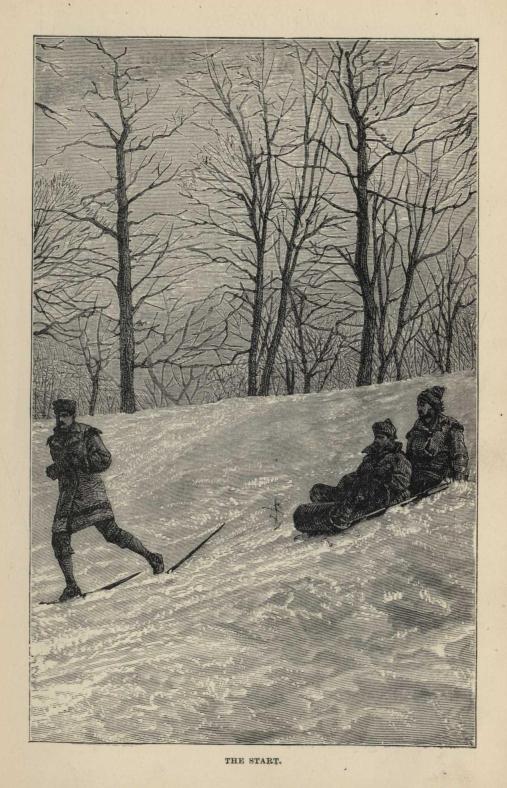
THE START.
Let us imagine, then, that it is one of those glorious nights in midwinter when this dull old earth of ours seems transformed into fairy-land. The snow lies in white depths upon the ground, dry and firm as ocean sand; Jack Frost has brought the mercury away down some points below zero, and the keen air sets every nerve a-tingle; a superb full-orbed moon swings high in the heavens, flooding the wintry world with her silver splendour, and a hundred active, muscular young fellows have gathered at the rendezvous, clothed in white blanket coats with rainbow borders, brilliant blue sashes and tuques (conical knitted caps sacred to snow-shoeing), knickerbockers of the same material as the coats, and stockings of the same colour as the sashes, while on their feet are soft moccasins skilfully decorated by Indian fingers. Sharp on time the club captain arrives, and in a trice all hands are down upon their knees fastening the raquets to their feet.
"Are you all ready?" shouts the captain. A hearty chorus of "Ay, ay," rings out on the keen air. "Off, then!" he answers, striding rapidly away, his followers stringing out in a long line behind, for the walking is always done in Indian file, and they set forth to attack the mountain, which towers up so grandly behind the city, forming one of the finest parks in the world.
The line of march is made up very simply. The captain who is selected for that much-coveted position because of his renown for speed and endurance, as well as his knowledge of the best routes, takes the lead. The rank and file follow in any order they please, and the rear is brought up by the whipper-in. Although the post of whipper-in is not much coveted, that officer ranks next in importance to the captain, and should be one of the strongest and most experienced members in the club. His really arduous duties are to quicken up the laggards, assist the unfortunate, and inspire the despondent, for upon him it depends to have the club all in together at the end of the tramp. Wending along the snow-covered tree-bordered paths, or diving deep into the forest where there are no paths at all, the long thin line climbs steadily upward, growing longer as the steep ascent begins to tell upon the weaker ones, and they lag behind. At length the summit is reached, and a halt is called for a few minutes, that the panting, perspiring climbers may get their breath, and close up the gaps in their ranks.
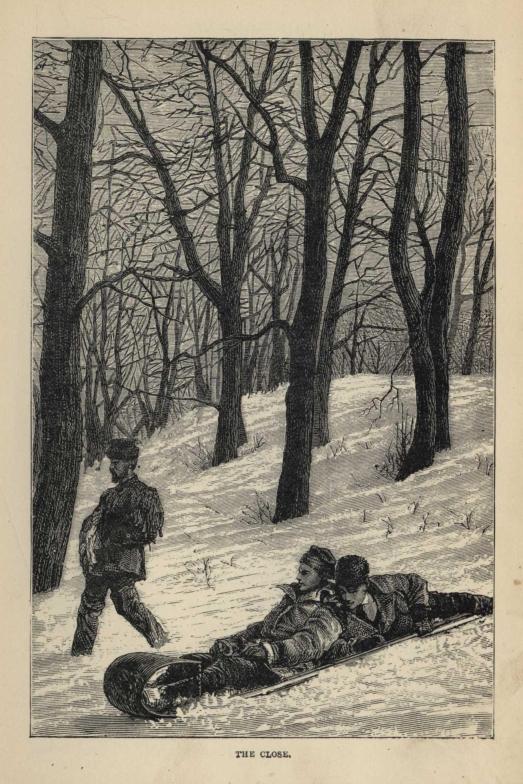
THE CLOSE.
"All up?" inquires the captain. "All up," is the cheery response. "Then forward!" and off they go again, this time down instead of up, with head thrown back, shoulders braced firmly, muscles at high tension, and eyes alert for dangers in the shape of hidden stumps or treacherous tree branches. Faster and faster grows the pace as the impetus of the decline is more and more felt, the shoes rattle like castanets, and the long line of white-coated, blue-capped figures undulates in and out among the tree clumps, appearing, vanishing, and reappearing like some monstrous serpent in full chase after its prey.
Ha! What's that? A fence right across the path? What is to be done now? The leader soon answers this question, for over the obstacle he goes as lightly as a bird, and his followers imitate him as best they may, some being content to crawl gingerly across by dint of hands and knees. One luckless wight, tripping on the top, takes a sudden header into the snow-bank on the other side, leaving only a pair of legs in sight to mark the place of his downfall. But the whipper-in comes to the rescue, and soon has him on his shoes again. What between fences, hedges, ditches, and other difficulties, the line is far from being well kept up. Gaps are frequent and wide. Some have fallen, and lost time in getting upright; others have been outstripped; but the leaders, like time and tide, wait for no man, and soon the welcome lights of the club-house, nestling in the valley, flash cheeringly across the snow.
Then the captain pauses a few minutes, that those who have been distanced may regain their places; and all being once more together, a final spurt at racing speed brings them, with shouts of joy and sighs of relief, to their goal. Here shoes are slipped off tired feet, coats and tuques thrown gleefully aside, and parched mouths cooled with refreshing drinks. An hour or more is spent in rest and frolic, and then the return journey made by the well-beaten road with the shoes strapped upon the back.
The distance "across the mountain" is nearly three miles, yet it has been done by an amateur in sixteen minutes twenty-eight seconds, which, considering the nature of the course, is remarkably good going. The best amateur time for a hundred yards on the flat is twelve and a half seconds, so that, clumsy and cumbersome as the raquets may seem at first glance, they are really a very slight bar to speed when the wearer is thoroughly expert in their use.
Hare and hounds on snow-shoes is a sport that must commend itself to all strong and vigorous boys who have a taste for cross-country work, if only for the reason that the snow-shoes make the sport possible at a time when it would otherwise be out of the question. The "hare" can be followed by his tracks, thus doing away with the necessity of carrying cumbrous bags of paper "scent."
Snow-shoeing differs from many other sports in being very easy to learn. Once you have mastered the art of sliding one shoe over the other with very much the same motion that you would make in skating, instead of lifting it up high as though you were wading in deep snow, as you are sure to do at first—once you properly understand this your chief difficulty is conquered, and proficiency comes with a little practice.
Throughout the length and breadth of Canada snow-shoeing is popular with young and old. Every centre of population has its clubs. Competitions are held every winter, at which tempting prizes are offered to the winners in races at different distances, from one hundred yards up to ten miles.
Snow-shoeing tailpiece
THE SWIMMING MATCH AT THE ARM.
"Frank, Frank: Hold on there a second," cried Jack Stone breathlessly, as he ran after his friend.
Frank halted until Jack caught up to him.
"Well, Jack, what's your news? You seem to be excited about something," said he.
"So I am," panted Jack, "for I've big news to tell you. Uncle William has offered a sovereign to the fellow that makes the best time swimming across the North-west Arm. What do you think of that?"
"Why, I think it's just splendid of him, and I'm going to try, for one."
"And I, too, you may be sure. And George Murray and Hal Hemming say they're going in. I was telling them about it this morning. Of course we can't all win, but the more the merrier, you know, and I think you and I will stand as good a chance as any of them."
"Just about as good," assented Frank. "That is, if none of the big boys are allowed to try. Did your uncle make any rule about that?"
"Of course he did," replied Jack. "Nobody over fifteen can compete."
"Oh, that's all right! And it's only fair, too," said Frank, evidently much relieved.
"S'pose we go out and have a practice this afternoon," suggested Jack. "It's so hot that the water ought to be as warm as milk."
"All right!" said Frank. "Just wait till I leave this parcel at the house and get a couple of towels, and then I'm with you."
Accordingly, a few minutes later the two boys, with towels in hand, were trudging toward the North-west Arm, impatient to be in the water, for the sun was sending down lots of heat that summer afternoon.
Frank Brookfield and Jack Stone were very great friends; had been so, indeed, almost from their nursery days. They got along about as well together as two boys who had each his own share of spirit and selfishness could; and although they were rivals in a good many of their boyish sports, they had a wise way of looking at the matter, for, next to coming out first himself, each was eager that the other should, and consequently they had no occasion to quarrel over the result.
In the science of swimming they were very evenly matched; what Jack lacked in strength as compared with Frank, who stood an inch taller, being about made up by a superiority in style that was natural to him in everything he did.
Hot as the afternoon was, they were too eager for their dip to walk slowly, and when they reached the projecting rock from which they were accustomed to bathe—Black Rock it was called, being a mass of dark, rusty iron-stone—they were both very warm and in a high state of perspiration.
This, however, would not have mattered much if they had undressed immediately and plunged right in; but instead of doing so, they laid aside their outer clothes and then sat down to cool off, thus allowing a reaction to set in that came near having serious consequences.
When they thought they had cooled sufficiently, they finished their undressing and were ready for the water.
"I've half a mind to swim clear across," said Frank, as they stood out on the end of the rock, hesitating for a moment, as all swimmers do, before diving into the cool, green depths.
"Better not," said Jack, who was the more cautious of the two. "You might be too tired to swim back."
"Well, then, I'll tell you what we'll do. We'll swim out to the middle and back again, and that'll be just the distance for the race."
"All right! Here goes!" assented Jack.
And with a plump! plump! the two boys, like two gigantic bull-frogs, went head first into the water, coming up again three or four yards away, with dripping heads and blinking eyes, and striking out vigorously toward the centre of the Arm.
"Ah, but it's cold!" exclaimed Frank, half gasping.
"You bet," concurred Jack, very heartily—"cold as ice! What business has the water to be so cold on such a broiling day as this?"
"Oh, it's just a little way it has," said Frank. "But cold or not cold, I'm going out to the middle."
And with a powerful overhand stroke he ploughed his way through the rippled brine, his shoulders gleaming white as he bent to his work.
Jack, using the ordinary breast stroke, kept close up to him, and they worked too hard to do much talking until the centre of the Arm was reached, and they could see the whole beautiful sheet of water from end to end.
Then they paused, and Frank, saying he was beginning to feel tired, turned over on his back for a little rest, Jack forthwith imitating his example.
"Sakes alive, but this water is cold!" cried Jack. "If we stay in it much longer we'll be getting the cramps. Let's make for the shore."
"All right! Go ahead; I'm after you," replied Frank.
Jack accordingly turned his face shoreward, and, trying the side stroke now, was making pretty good progress, having got about half-way in, when a cry from Frank, who was a few yards behind, made him stop suddenly and wheel round to see what was the matter.
"Come here, Jack," said Frank, in a troubled voice.
And Jack immediately went back to him.
"What's the matter, old chap?" asked he anxiously
"Why," answered Frank, "I seem to be losing all my strength. See! I can hardly take a stroke."
And, sure enough, his strength seemed to have left him. and instead of the wide, powerful sweeps he usually made, he could manage to do little more than paddle enough with his hands to keep his head afloat.
The fact of the matter was that he had been seized with muscular cramp, and was in great danger, for there was no boat in sight, and the shore lay nearly fifty yards away, with water deep enough between to swallow an ocean steamer.
Jack fully realized the danger, but was too sensible to say so. Taking a firm, grasp of Frank's right shoulder with his left hand, he said cheerily,—
"Come along now; I'll give you a lift."
Then, putting forth all his strength, he pushed Frank forward; while the latter could just manage to keep his head above water, and pointed in the right direction.
In this fashion they crept slowly along, Frank growing more helpless and Jack more tired every yard. Frank now could not even keep his mouth above water, for the deadly cramp was drawing him all together, his back being bent like a bow, and his arms and legs contracted until they were almost altogether useless.
Jack, too, began to feel the cruel cold fastening upon him, and his strength departing from him. His heart sank as he looked at the distance still ahead, and felt himself weakening at every stroke.
In his extremity, the temptation to let go of Frank, and strike for the shore alone, even flashed into his mind, only to be contemptuously dismissed with the silent resolution to stay by his friend whatever happened.
At length, by dint of grim determination, Jack got Frank within ten yards of the shore, and then, feeling as though any further effort on his part were impossible, he gave him a big push forward, saying,—
"Now then, Frank, do the rest yourself."
With a muffled, half-finished cry of "For heaven's sake, Jack!" poor Frank, utterly helpless, went under, half turning over on his back as he did so.
Not for a moment did Jack hesitate. Weak and chilled as he was, the sight of his playmate's peril nerved him to fresh exertions, and summoning all his energies for one supreme final effort, he grasped Frank's shoulder once more, and with desperate spasmodic strokes fought his way through the water.
Never will he forget that wrestle with death. Frank, fortunately, still keeping collected and quiet, could get but an occasional breath, for now nearly his whole face was submerged, and Jack himself seemed to be swimming in some dense fluid that stubbornly opposed the movements of his arms. But foot by foot he struggled on, until at length, just when every atom of strength and hope seemed exhausted, he saw below him the dark, seaweed-covered rock, and putting down his foot, found solid bottom beneath him.
"Thank the merciful Father, we're saved, Frank!" he cried, half sobbingly, as he drew his companion up on to the rock.
"God bless you, Jack! you've saved my life," replied Frank, with a fervour that showed how clearly he understood the magnitude of the peril through which he had passed. "Yes, Jack, you've saved my life, and some day I'll show you how grateful I am."
"Oh, that's all right!" said Jack. "You'd do the same for me if you had the chance."
"I hope I won't have the chance, all the same," answered Frank, "for perhaps I wouldn't keep as cool as you did; and then where would we be?"
Half-an-hour's basking in the hot sun took all the cramp out of the boys' bodies, and they went back home, not a whit the worse for their experience, and a good deal wiser. They kept the matter to themselves, prudently thinking it would only alarm their parents if it came to their ears, and perhaps make them worry, while really there was no occasion for further anxiety.
The following Saturday afternoon was the time fixed for the swimming race, and the two friends practised diligently, determined that the sovereign should fall to one of them at all events, or perhaps be divided between them if they came out a tie.
The eagerly-anticipated day dawned sunnily, and proved as fine, bright, and warm as heart could wish. A great deal of interest was felt in the swimming race, for at least six boys had entered for it, and in the afternoon the Arm, at the place where the swimming would take place, was dotted over with boats, containing the fathers, mothers, sisters, cousins, aunts, and friends of the different contestants.
Uncle William (or, to give him his proper title, Mr. William Cunard) was the judge at the finish, and the six boys, wearing the scantiest possible bathing suits, were rowed across to the other side of the Arm in boats.
"I'm awfully excited," said Jack Stone to Frank Brookfield on the way over, in so low a tone that none of the other boys heard him. "Father says he'll double the prize if I win. But if I don't win, I hope to goodness you will."
"Whoever wins will have a hard fight for it," said Frank. "Both George and Hal can swim like fishes. I don't know about the other two."
Presently the boat touched the shore, and the boys all leaped out and took up their positions upon the ledge of rock from which they were to start.
"Are you ready?" called out the starter. "Then go."
And with a tremendous splash the whole six plunged into the water like one man.
The next moment they were all at the surface again, and cleaving the calm water at the top of their speed.
Frank was using his favourite overhand stroke, Jack the side stroke, and the rest the ordinary breast stroke.
For some distance there was little difference between them. You might have covered them with a handkerchief, so to speak. Then, little by little, Frank and Jack, keeping well together, began to draw away from George and Hal, who in their turn led the other two.
By the time the centre of the Arm was reached, it was plain to all that the race lay between the two friends, and amid cheers and shouts of "Go it, Frank!" "Hit her up, Jack!" "Pretty work, both of you; keep it up!" they ploughed through the water side by side.
"JACK FELT HIMSELF WEAKENING."
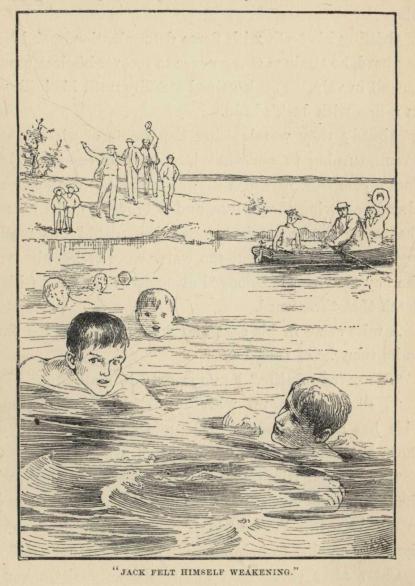
Three-fourths of the distance was now covered, and their positions were unchanged, when with a pang that went right to his heart Jack felt himself weakening.
Inch by inch his stroke shortened, and first Frank's head, then his neck, then his shoulders slipped past him.
Gritting his teeth with fierce determination, and breathing hard, he strained every nerve to recover his lost ground; but all in vain. Frank gained steadily until his heels were in a line with Jack's head.
Already they were raising the shouts of victory, when Frank, turning to see what lead he had, caught sight of Jack's pale face, in which disappointment and despair were already showing themselves, and it brought up in his mind that same face a week before, when, pallid but resolute, just as it was now, it cut the water close beside him, while the boy to whom it belonged struggled so bravely with the death that threatened.
A mist came in his eyes and a lump rose in his throat as he thought of this.
"He saved my life," he murmured to himself.
"Hallo! what's up with Frank?" said Mr. Cunard. "He has almost stopped. He must be done out. Just shove out that boat there toward him, will you?"
"Go on and win, old chap," said Frank to Jack, when the latter came up to him. "I'm used up. I'll just paddle in slowly. Oh, I'm all right," he added, as Jack showed signs of stopping to help him, "Tired out, that's all."
Cheer after cheer rang out as Jack, nearly exhausted himself, but undaunted in spirit, swept by Frank, now paddling quite leisurely, and finished the course amidst a general chorus of congratulation.
He felt as proud as Punch, and when Frank came ashore, threw his arms around him affectionately, saying,—
"You're a dear, good fellow to let me beat you."
Not that he had the slightest suspicion as to how it had really happened.
Frank never told him. Indeed he never told anybody except his mother, and she alone of all the people who witnessed it knew the secret of Frank Brookfield's sudden collapse in the swimming match at the Arm.
HAROLD'S LASTING IMPRESSION.
"Harold, Harold, Harold!" cried Mrs. Owen, at the top of her clear, strong voice, her anxiety increasing as no answer came back. "Mercy on me! what can have become of that boy? As sure as anything, he has gone down to the wharf again—and after all that I have said to him too. I do wish something would make a lasting impression upon him." And with a feeling of uneasiness she could not shake off, the troubled mother went back to her house-work, sighing over her boy's disobedience.
Now Harold Owen was not really a bad boy. He loved his mother dearly, and always felt sorry when he had grieved her; but he was such a thoughtless little chap. Eight years old last October; stout, cheery, and brave; full to overflowing of animal spirits; eager to do everything he saw the older boys doing, and always wanting to be with them; quite as heedless and forgetful as he was affectionate and obliging, sturdy little Hal was just the kind of boy to make a mother whose only child he was no less anxious than proud about him. And in these lovely summer days, when nobody wanted to be indoors between daylight and dark, except to eat their meals, poor Mrs. Owen had her hands full in trying to keep track of her son, who would stray off in spite of her orders to stay near home. You see, Harold did not just mean to flatly disobey his mother. For days together he would do exactly what she told him, and make her very happy. But every now and then some of the boys in the neighbourhood—Jack Hardie, perhaps, or Frank Lawson—would come along, and get talking with Hal over the garden fence; and as sure as they did, it ended in the little fellow's forgetting all about his mother's commands, and going off to the wharves, where sometimes he stayed so long as to give his mother quite a fright.
That was exactly what had happened this glorious July morning, when Mrs. Owen, missing her boy's shouts from the front garden, ran out to the door, her bare arms all white with flour, for she had been making a cake, and called "Harold, Harold, Harold!" so loud that you might have heard her half-way down to the wharves. If, indeed, she could have been heard all the way down, perhaps her call might have brought Harold back; and in that case he should not have got his lasting impression, and I would have had no story to tell. But just at this time our little man was altogether too much taken up with what Jack Hardie was telling him to hear anything less noisy than a steam-engine.
"I'll bet my boots, Hal, you never saw such a funny little chap in your life. He is about as big as our baby, but nothing like so fat, and he has long hair all over him—over his face too—and he jumps around, and talks away at the fellows, and sits up on his hind legs to eat nuts and crackers. Oh, I tell you he's lots of fun!"
RESCUER AND RESCUED.—See page 183.
This was part of Jack's account of a very interesting monkey belonging to the black cook of a large ship then at the wharf; and it was the promise of showing him this monkey—what eight-year-old boy could resist such a temptation?—that had lured Hal away from home. Down to the wharf they ran as fast as their legs could carry them, and there they found half-a-dozen other youngsters much about their own age, all evidently bent on the same errand. The stately Roseneath lay right across the end of the wharf, and was being fed with long, yellow, sweet-smelling deals that would make houses in England some day. The boys stood for a while watching the huge planks sliding through the bow-ports into the dark mysterious hold, and then there was a general rush for the stern, where they expected to find the rope-ladder by which they would climb on board. But, much to their disappointment, no ladder could they see, and no way of climbing up except a thick rope that dangled over the side, reaching quite down to the wharf; the truth of the matter being that the sailors, getting rather tired of the boys' frequent invasions, had taken away the ladder and put the rope in its place, thinking thus to put a stop to their coming on board. The tide was high, and the great black hull of the ship towered above the wharf like the side of a house. The boys looked pretty blank at first; but then you know it takes a good deal to stop an enterprising boy when his heart is set on anything; and presently, after a little talk together, Jack Hardie said he would see if he couldn't shin up the rope. So he clasped the rope tight in his brown fists, twined his strong legs around it, and up he went, not very fast, to be sure, but gaining a bit at every wriggle, until at last he reached the bulwarks, and the boys gave him a cheer as he called out, "Come along, fellows; it's not so hard; you can all do it." Frank Lawson tried next, and he got up all right. Then Charley Wright followed. And now Master Harold thought he would try his luck. So, too, did Jim Norton; and when Harold got the rope first, it made Jim so cross that, like the rough, heedless chap he was, he gave Hal an angry push just as the little man had let go from the wharf, and was clinging to the rope.
Of course, Jim did not really mean any harm, but he came pretty near doing dreadful harm all the same; for his push was such a hard one that it loosened unlucky little Hal's hold upon the rope, and with a cry of fright down he dropped between the vessel and the wharf, falling with a great splash into the dark green water.
Poor little Hal! you may well wish you had not disobeyed your mother's orders, for now there is small chance of your ever being able to disobey them again. The tide had begun to run out, and although Harold struggled up to the surface twice, so that his terrified playmates caught a glimpse of his pale, frightened face for a moment, the cruel current dragged him down again, and the horrid salt water rushed into his mouth, as he opened it to cry for help. His father had given him some lessons in swimming that summer, and he tried to put them in practice now, striking out bravely with his plump fists and sturdy legs; but of course such swimming as that could not help him, and he sank deeper and deeper. Then at last he gave up trying to save himself. He lost all sense of suffering, and as he drifted passively away with the current, a strange thing happened to him—something that he will never forget, though he lives a hundred years—and it was this: all his past life appeared before his mind in a series of pictures, in fact, just like the panorama of the American rebellion he had enjoyed the winter before. All his doings, good and bad, but more particularly the bad ones, seemed to come up clearly before him, and as he saw what a naughty, thoughtless boy he had been, he felt sorry enough never to disobey his dear, fond mother again. But wasn't it too late now?
* * * * *
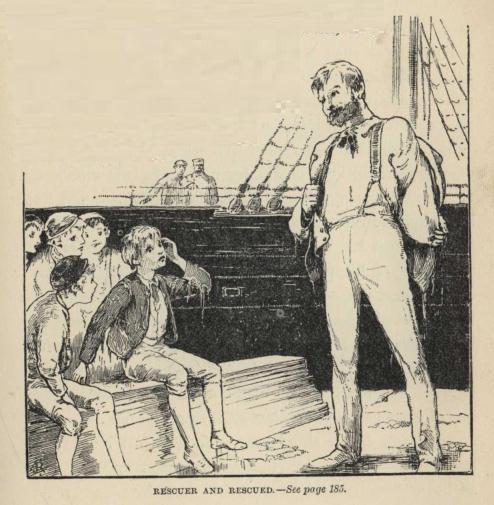
What! up in the sunshine once more, and sitting on the solid yellow deals, with his companions crowding round him, laughing and crying, and patting him on the back, and acting so comically, while all the time the water is dripping down off his clothes, and making a puddle at his feet, and he does feel so uncomfortable underneath his blouse. And who is the big strong man standing near, just as wet as himself, and looking at him with his handsome bronzed face full of pride and pleasure? And isn't that father coming down the wharf as hard as he can run, with face so white that he looks like a ghost?
Bewildered little Hal couldn't at first understand what it all meant; and when his father, catching him up in his arms, pressed him passionately to his breast, the little man just burst out crying, and hid his wet face on his father's shoulder. In this fashion he went back home, the boys following in a triumphal procession.
An hour afterwards, when Master Harold had got rid of the uncomfortable feeling under his blouse, and put on a warm, dry suit of clothes, Jack Hardie told him how, when he fell plump into the water, the boys had all shouted out for help; and how the mate of the Roseneath had sprung out of his cabin at the first cry, and, directed by Jack, without waiting even to take off his coat, had dived right down into the deep, dark water: how he had come up once without finding Hal, and, after taking breath, had gone down a second time in search of him; how he had hunted around in the water until at last, seeing something black below him, he had stretched down his leg, and his toe catching Hal under the chin, the gallant mate drew him up into his arms, and then made for the daylight; and how, when Harold first came out of the water, he seemed to be dead, but in a few minutes came to life again, and sat up, blinking his eyes like a young baby. All this, and more too, did Jack Hardie, proud of having such an audience—for, besides Mr. and Mrs. Owen, a dozen or more of the neighbours had run in to hear all about it—relate with great gusto. And as Harold realized how very near he had come to losing his life, and looked into his darling mother's face streaming with tears of joy and gratitude, which but for the brave sailor would have been tears of bitter sorrow, he gathered up his little features into a most determined expression, and said,—
"Mother, I'll never disobey you again."
Thus did his mother get her wish, and Master Harold his lasting impression, which many a time saved him from falling again into disobedience.
HOW WILBERFORCE BRENNAN VISITED WHITE BEAR CASTLE.
"Wilby! Wilby! come here; I want you," called a woman's shrill voice at the foot of the stairs. And down from the little attic room came the answer promptly,—
"All right, mother; I'm just coming."
A minute later a stout, hearty lad of fifteen presented himself before his mother, and dutifully awaited her commands.
"Why, Wilby," said she, "I was just thinking I had better send you over to Aunt Matilda's to tell her that your father was going to town to-morrow. She's pretty sure to want him to do something for her, and he goes so seldom nowadays she'll be disappointed if we don't let her know."
"Well, mother," replied the boy, looking rather doubtfully out of the window, from which a vast expanse of desolate, snow-covered fields could be seen, "it's not just the best kind of an afternoon to be going away over to aunty's. There's a heap of snow on the ground, it's awfully cold, and the wind's rising."
"Tut! what does a big strong boy like you care for the cold? Besides, you can put on your snow-shoes, and take the short cut through the wood-lot. You won't feel the wind in the woods. I really must send Aunt Matilda word, and father won't have time to go over himself."
"Very well, mother, if I must I must, I suppose; but, all the same, I wish it could wait till to-morrow."
So saying, Wilby, with a sigh of resignation, went off to get ready for his tramp.
It was no trifling affair, this errand over to Aunt Matilda's, I can tell you. She lived six good miles away by the road, and even taking the short cut through the pasture and wood-lot, it was not less than four miles.
Of course, with fine weather and good going, four miles was not much of a task for Wilby's sturdy legs, and he never failed to get so warm a welcome and such delicious cake at his aunt's that generally he was only too glad to go. But in mid-winter, with four feet of snow on the ground, the thermometer right down to zero, and the wind cutting like a knife, it seemed a very different matter.
However, Wilby, as his mother called him for short (Wilberforce being kept for company or for when she wanted to be very emphatic), was quite as plucky as he was obedient, and a quarter of an hour after his mother first called him he started out on his errand, muffled up to the eyes, with his snow-shoes well strapped to his feet, and his good dog Oscar trotting along beside him. It was well for him that he did have wise old Oscar, as we shall presently see.
Bending his head low, so as to protect his face as much as possible from the keen wind, and swinging his arms to and fro in time with his stride, Wilby went swiftly down the hillside, across the river, and up the other slope, until he reached the shelter of the woods, where the wind bothered him no longer, and he could take things more quietly.
Oscar ran soberly along at his heels, and Wilby was glad of his company, for the short winter day was already drawing to a close, and the lonely wood-lot was not the most cheerful place in the world to be in at that time.
Wilby was a great boy for books, and had just finished reading Colonel Knox's delightful story, "The Voyage of the Vivian," of which the most interesting part to him had been that relating to the polar bears; and now, as he trudged steadily along through the silent woods, he fell to thinking about these bears, and wondering what he should do supposing he should meet one.
Of course, he knew well enough that the nearest white bear was at least a thousand miles away, and that even an ordinary black bear had not been seen in that neighbourhood for years; but, all the same, he could not get those cruel white monsters out of his thoughts. In fact, he became quite nervous over them, and would peer eagerly ahead and anxiously around, just as if one of them might rush in upon him at any minute.
At length his nervousness got so much the better of him that walking seemed altogether too slow, and he started off on the hard run. Only two miles of the distance to Aunt Matilda's was left at this time, and one of these soon disappeared as Wilby hurried onward, with Oscar bounding joyfully beside him.
Ten minutes more at the farthest, and they would be safe at their destination. Already Wilby thought he could catch through the trees a gleam of light from the kitchen window, when suddenly something unfortunate happened.
It had been hard work keeping to the wood path, so buried was it under the snow; and he must have strayed a little from it, for he found his way barred by a huge tree-trunk, which certainly ought not to have been there.
The wisest thing, of course, would have been to retrace his steps a bit; but instead of that, Wilby rashly tried a running leap over the obstacle, and it was not a success.
Without snow-shoes he might have cleared it easily; but with these encumbrances on his feet, he not only made a very poor attempt, but in some way or other they got entangled together, and in a violent effort to keep his balance, he sprained his right ankle so badly that, to his great dismay, he found he could no longer bear any weight upon it.
Here was a pretty state of affairs indeed! A whole mile from Aunt Matilda's, not yet clear of the woods, not a living soul within reach of his voice, his right leg utterly useless and hurting awfully, and the cold growing more intense every minute!
It did not take poor Wilby long to realize that he was in no little danger. As he could do nothing with his snow-shoes, he took them off, and tried to get along without them; but the snow was so dry and soft that he sank right into it, and could make no advance at all.
His only hope seemed to be to shout at the top of his voice on the small chance of somebody hearing him. So he called for help with all his might.
Oscar was much puzzled by his master's conduct, and circled impatiently around him, as if to urge him onward.
For quite a long time Wilby shouted, until what between cold and weariness there was no more shout left in him. Presently he felt an intense longing to sleep stealing over him. He strove desperately hard to shake it off, for he knew well what it meant; but in spite of all his efforts the deadly drowsiness crept steadily and surely over his senses, and he was just lapsing into unconsciousness when there was a crashing in the underbrush ahead, and before he had time to ask himself what it could be, the small trees in front of him parted violently, and out stepped a great white bear.
"What do you mean by all this shouting?" he demanded rather crossly.
Curiously enough, Wilby was not quite so terrified as he expected he would be if a white bear happened along, and found courage to say very humbly,—
"Please, Mr. Bear, I hope I didn't disturb you. But, you see, I've sprained my ankle badly, and I was shouting for some one to come and help me."
"Ho, ho! you are hurt, are you?" was the reply, in rather a gentler tone. "Well, I'll look after you."
And so saying, the bear picked the big boy up in his arms as though he had been a little baby, and marched off with him through the woods at a rapid rate.
Wilby knew resistance was vain, so he just made up his mind to take things as quietly as possible; which, under the circumstances, was a very wise thing to do.
After about five minutes' walking, his captor came to a large tree which had been torn up by the roots. Under this he quickly dodged, and entered what seemed to be a long, dark passage.
In spite of his good resolution, Wilby could not help a kind of groan at this.
"Shut up!" growled the bear, giving him a by no means gentle cuff on the side of the head.
Wilby did shut up, and for a time nothing was to be heard save the soft thump, thump, thump of the bear's broad feet on the hard floor of the passage.
At last they stopped. The bear gave something a kick, a door flew open inward, and then there burst upon the bewildered Wilby such a sight as he had never even dreamed of in his life before.
He found himself in a large room, flooded with light and warmth from a glorious wood fire that was crackling away in a huge fireplace at one end. At first he thought the whole place had just been newly whitewashed, but soon discovered his mistake.
Everything in and about that room was marble—white marble—pure and glistening as the snow outside. Floor, walls, ceiling, tables—they were all marble alike, and they looked wonderfully fine, with the firelight flashing upon them.
But before Wilby had time to take much more in, he heard a deep bass voice asking,—
"Hallo, Major! what have you got there?"
And turning his head, he saw a splendid white bear, a good deal bigger than his rescuer, coming toward them from the far end of the room.
"Some farmer's son, Max," answered the Major, at the same time gently depositing his load on a couch near the fire. "I found him 'most frozen to death in a snow-drift.. I guess we can make him all right again."
"Of course we can," exclaimed another voice, much livelier in tone than the first speaker's, and a third bear, quite as white but not so tall as either of the others, emerged into the firelight from a dark corner, where he had been attending to some household duty.
"Of course we can, if you say so, Minor," growled the one called Max, good-humouredly. "We'll begin by giving him a good dinner, at all events."
By the way, I forgot to mention that the full names of Wilby's new friends were Ursa Minor, Ursa Major, and Ursa Maximus, but for convenience' sake they called one another simply Minor, Major, and Max.
Feeling surprisingly at his ease, in view of his strange surroundings, Wilby stretched himself out on his comfortable couch, and almost forgot the pain from his sprained ankle in his delight at his novel experience.
"What a lot I'll have to tell them at home!" he said exultingly to himself. "They won't believe one-half of it, I know."
Maximus was evidently head of the household, and superintended in a dignified way, while Major and Minor bustled about getting dinner ready.
In a little while all the preparations were complete, and Major, who seemed to feel especially responsible for Wilby, brought him a steaming bowl of something which the hungry boy was not long in sampling. And it proved to be such delicious rabbit-stew that he could not help exclaiming,—
"My sakes, but this is fine! Mother couldn't make a better stew herself,"—which compliment pleased Minor, who had prepared the stew, so much that he filled Wilby's bowl up again before it was fairly empty.
Besides the stew there were roast partridges and baked potatoes, and also apples and nuts, so that Wilby had just about as much as he could comfortably eat—in fact, perhaps a little more. At all events, his waistband began to remind him it was there.
Dinner over, the dishes were cleared away and the room set in order again, Wilby watching everything with the liveliest interest, determined to have such a story to tell as would make him the hero of the country-side for a whole month at least.
He was particularly struck with the deftness with which the bears went about their work. Although their big paws looked clumsy enough, the dear knows, they did things as handily as Wilby himself could have done them.
When every sign of the dinner had vanished, Max, Major, and Minor drew up their chairs (for they each had a big arm-chair) in front of the fire, and sat down to talk over the events of the day, quite ignoring the addition to their family,—who, indeed, was very well pleased at being left alone, as he much preferred using his eyes to his tongue, when everything around him was so delightfully novel.
The bears' voices were so low and deep that Wilby could not make out one-half they were saying. Besides, what with the warmth of the room and his own weariness, he began to feel very sleepy again, especially as the couch was extremely comfortable. In fact, he had just about dozed off, when he was awakened by Maximus jumping up from his chair, and saying in a loud tone,—
"Come, fellows, let us have a song, and then we'll turn in."
Whereupon the three of them stood up together around the fire, and sang very heartily the following song, the words of which, so far as he heard them, Wilby had no difficulty in remembering, although the tune went completely out of his head. He had not much of an ear for music, any way.
"Three jolly white bears are we,
Who can sing right merrily.
For our hearts are light and free
From any care.
We have always lots to eat,
And we keep our house so neat
That it's really quite a treat
To be a bear.
"Yes, indeed, we're happy bears,
Since nobody knows our lairs,
Where we mind our own affairs
So quietly.
Of course we have to work,
But none of us ever shirk;
For who'd be a lazy lark,
Don't you see?
"When the snow is on the ground,
We go hunting all around
For the bunnies which abound
Among the trees.
And when summer-time is here,
How the berries disappear
Down our throats—"
But Wilby never heard the end of the third verse, for the simple reason that sleep overcame him just then, and song, singers, and marble palace alike faded away into nothingness.
He had no idea how long he slept, but when he awoke he was both surprised and disappointed to find himself on the sofa in Aunt Matilda's very plain, though cozy, sitting-room, instead of on his couch in White Bear Castle, while now not only his ankle but his whole body gave him pain—every nerve tingling, and face and hands smarting dreadfully.
Minor, Major, and Maximus were all gone too, and in their place dear old Aunt Matilda and kind Uncle Lemuel were bending over him, with faces full of relief at his return to consciousness.
"O Wilby dear, how glad I am to see you open your eyes again!" exclaimed Aunt Matilda joyfully. "You were so long coming to that I began to fear that it might be all over with you."
"Yes, Wilby, my boy," added Uncle Lemuel, "you've had a close shave. But for Oscar there would not be much life left in you by this time."
Wilby was too dazed for some time to understand it all, but later on his uncle explained the matter.
It seemed that wise old Oscar, as soon as Wilby lost his senses, scampered off to Uncle Lemuel's as hard as he could go, and by barking and scratching at the door soon let them know he was there. Then by signs whose meaning they were not long in guessing, he persuaded them to go back with him, until poor Wilby was found where he had fallen beside the big tree.
Oscar capered about, wild with delight, when his master was carried off to the house, and Uncle Lem could not say enough about his cleverness.
Wilby felt very grateful to Oscar and to his uncle also, and thankful that he had not lost his life. Yet he could not help a twinge of regret at the thought of never seeing his white bear friends again, seeing how kindly they had treated him in spite of their character for cruelty.
However, it was no small consolation to have such a rattling good story to tell, and tell it he did very graphically many a time, much to the enjoyment of his hearers.
Whether they all believed it or not is a question that, if you do not mind, I will leave it to you to settle.
OUTSIDE THE BOOM.
Mort Henshaw was a boy who had implicit faith in himself. He cherished the firm conviction that whatever any other boy could do came within the range of his capabilities. He had only to find out the way it should be done in order to accomplish it.
This was a pretty large view to take of things in general, yet it must be confessed that Mort was not without a fair degree of justification for having what the Scotch would call so good a conceit of himself.
Blessed with a strong, symmetrical frame, a quick eye, a sure hand, a perfect constitution, and abundant courage, he came easily by a mastery of the different sports he entered into, and had few equals, and fewer superiors, at cricket, football, lacrosse, baseball, swimming, rowing, and the other amusements of the day.
There was one pastime, however, of which, although he had heard much, he knew nothing, and that was sailing. The pretty little stream which ran by his home afforded no facilities for this glorious sport, and the pleasures of it he knew about only from the descriptions of his more fortunate companions.
Great, then, was his delight when the spring that found him fifteen years of age brought with it an invitation from one of his uncles to spend the whole summer with him at his cottage on Lake Deschenes, a splendid sheet of water not far from the city of Ottawa.
The invitation mentioned, as one of the attractions of the place, that he would be able to have all the sailing that his heart could wish.
"Hurrah! hurrah!" shouted Mort, capering about the room with a face beaming like the sun. "All the sailing I want! Just think of it! Won't that be grand? The very thing I've been looking for."
"It will be grand, Mort dear," said his mother, "provided you take good care not to run any unnecessary risks. You must do exactly what your uncle tells you, just as if he were your father."
"Oh yes, mother, I'll do that," quickly responded Mort, ready to promise anything in the exuberance of his joy. "I'll be his crew, you know, and obey orders just as if I were at sea with him."
Very impatiently did Mort await the coming of the day when he should set forth for Deschenes. His uncle was principal of the Collegiate Institute at Ottawa, and had three months' vacation, which he usually spent at the lake in sailing, rowing, bathing, and fishing, until the return of autumn recalled him to his duties.
It was the last week in June when Mort arrived at Lake Deschenes, and his first question, after exchanging greetings with his uncle and aunt, was,—
"Will you show me your boat, please, uncle?"
Smiling at his eagerness, Mr. Turner took him over to the boathouse, where a number of boats and canoes lay upon the floor, or were suspended upon racks against the wall.
Mort had never seen so many or such fine boats in his life before. They were nearly all built of cedar, and were varnished instead of being painted, the copper fastenings dotting their shining sides with regular lines. The boy gave a great gasp of admiration, and it was some time before he recovered himself sufficiently to ask,—
"And which is your boat, uncle?"
Mr. Turner pointed to one lying just in front of them.
"Oh, what a beauty!" cried Mort. "She's the best of them all."
His uncle smiled a complacent assent, for that was precisely his own opinion. As to beauty of lines, perfection of finish, completeness of outfit, and speed on any tack, he considered the Gleam without a superior on Lake Deschenes, and Mort's prompt recognition of the fact pleased him as much as the cordial praise of her baby does a young mother.
"You are not far from right, my boy," said he. "The Gleam is both a beauty to look at and a good one to go, as you shall see for yourself very soon."
The Gleam belonged to the class of boat known as the "St. Lawrence skiff," the swiftest and safest boats of their size—when not over-canvassed—that carry sails. She was about twenty-two feet long, and had a half-deck all round, with a six-inch combing to keep out the water. Two tall masts carried big bat-wing sails, which would have soon toppled her over but for the heavy iron centre-board that kept her stiff in an ordinary breeze. Everything about her was of the best, and Mort thought her the most beautiful object his eyes ever beheld.
That afternoon he had his first sail in the Gleam, and as, responding perfectly to every puff of the wind and turn of the tiller, she went flying across the lake, his heart thrilled with delight, and became filled with a passionate desire to master the art of handling such a craft.
"O uncle, won't you teach me how to steer and to manage the sails before I go back home?" he pleaded, looking earnestly into Mr. Turner's face.
"Certainly, Mort, certainly," was the kindly reply; "and I think you ought to make a very apt pupil, too."
Mr. Turner was altogether as good as his word. He took much pains in initiating Mort into the mysteries of sailing, teaching him the way to tack, when it was permissible to jibe, how to run before the wind, and so forth, until, by the end of the first month, Mort had become tolerably proficient, and could be trusted to manage the Gleam alone in an ordinary breeze.
This special privilege he was then allowed to exercise, provided he did not go outside the "boom"—that is, the long line of shackled logs which enclosed the bay where the boathouse stood, and which was intended to keep the saw-logs from stranding on the beach.
Inside the boom was a stretch of shallow water nearly a mile long by a quarter of a mile wide, on which plenty of sailing might be had without going out through the gap into the body of the lake.
For a time Mort was content with this enclosed space, and, whenever his uncle permitted him, would get the boat out, and go tacking up and down from end to end, feeling almost as proud of his newly-acquired skill as if he had been discoverer of the science of sailing.
But of course it was not many days before he began to cast longing eyes beyond the line of swaying logs, and to feel that the thing he most desired in the world was to be allowed to sail the Gleam across the lake and back.
But when he hinted as much to his uncle he met with no encouragement.
"No, no, Mort. You must be content with staying inside the boom; for, besides the chance of a squall, there is the danger of being caught in the current and carried into the rapids, which would soon make an end of both you and the boat."
Now it happened that one morning both Mr. and Mrs. Turner had to go into the city, not to return until by the night train, and Mort was left entirely to his own resources. Of course he turned to the Gleam for company, and as soon as the morning breeze came up, taking with him two other lads about his own age, he launched the boat, and went skimming from end to end of the bay.
"This is good fun," said Ted Day, "but it would be better still outside the boom."
"Oh yes!" cried Charlie Lister. "Do go outside; just a little bit, Mort."
Mort shook his head, and tried to look very decided. His own heart was beating a lively response to the suggestions of his companions, but his answer was,—
"No, Charlie; uncle does not allow me to go outside, you know."
Once the idea had been mooted, however, it refused to go to rest again. The morning seemed a perfect one. There was a steady breeze from the north-west, just the direction best suited for a slant across the lake and back without having to tack at all.
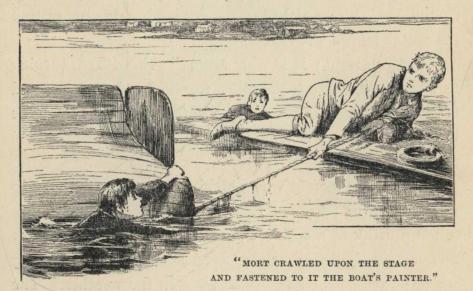
"MORT CRAWLED UPON THE STAGE AND FASTENED TO IT THE BOAT'S PAINTER."
Ted and Charlie begged and coaxed Mort to make one trip out, any way. Mr. Turner would never know anything about it, and they could easily be back before mid-day.
Mort's resolution, which had been rapidly weakening, finally gave way altogether.
"All right," said he, allowing a sudden spirit of reckless ambition to submerge his compunctions at doing what he knew well enough was a mean betrayal of his uncle's confidence in him. "We'll just make one trip across. It does seem a pity to lose the chance this glorious morning."
So out through the gap the Gleam darted, as if glad of her freedom, and went flying over the blue water toward Blueberry Point.
"My, but this is grand!" exclaimed Charlie rapturously, as the boat careened before the freshening breeze, so that the water lapped the lee-combing.
"You are right; it is—eh, Mort?" echoed Ted, turning to Mort, who, holding the tiller in one hand and the end of the main sheet in the other, watched every move of the boat with feelings strangely divided between anxiety and proud delight.
The passage across was quickly made, and then, being thirsty, Charlie proposed that they land for a few minutes to get a drink at a spring near the shore. After the drink Ted suggested a bathe; and thus an hour slipped by, during which an ominous change took place in the weather. The sky clouded over, the wind, which had been steady, began to come in fitful gusts.
"I don't like the look of things," said Mort, in a tone of concern. "I wish we were inside the boom."
"Well, let's hurry and get there as quickly as we can," responded Ted.
It was all well enough to say this, but with the change of weather had come a change of wind, which was now against them, so that they would have to tack all the way home.
By dint of careful sailing they had got about a third of the distance, when suddenly the sky darkened, some large drops of rain, pattered upon them, and the next moment a sharp squall struck the Gleam full upon her quarter.
In order to give his whole attention to the steering, Mort had asked Charlie to hold the main-sheet, impressing upon him to take only one turn around the cleat. But Charlie, who was of the lazy sort, finding the sheet hard to hold, had taken two turns, and done it in such a way that the rope had jammed. Consequently, when Mort shouted to him, as he put the tiller hard a-port, "Let go the main-sheet instantly, Charlie!" and he attempted to obey the order, he could not do so in time to meet the emergency, and the next instant, amid simultaneous shrieks from all three boys, the Gleam went over on her beam ends.
Fortunately they were all good swimmers, and did not get entangled in any of the ropes, so that, without much difficulty, they succeeded in climbing up on the side of the boat, where it was easy enough to hold on for a while.
There was no fear of the Gleam sinking, as she bore no ballast to carry her down, and had air-tight compartments in both bow and stern. Nevertheless, the position of the boys was one of great peril, for the boat was right in the channel leading to the rapids at the lower end of the lake, in the direction of which the wind was now blowing. To get into these rapids meant utter destruction for both boys and boat, yet to keep out of them was impossible without help, while to swim ashore was far beyond their powers.
They shouted and shrieked for aid, but there was no one in sight to hear them, and soon the storm burst upon them in full fury, blotting out the shore on both sides, and threatening to beat them off the boat as it tossed up and down in the white-caps.
How bitterly Mort regretted having ventured beyond the boom, and how fervently he vowed never to do so again if he could only be saved this time!
When the squall passed and the air cleared, he saw that they were fast drawing near the rapids.
"O Charlie," he groaned, "why did you make me go outside the boom?"
Charlie made no reply. He could think of nothing else but his imminent danger.
Steadily and surely the Gleam drifted downward. In another fifteen minutes she would be in the remorseless grasp of the rapids. The wind went down almost to a calm, but the current grew stronger, so that there was no slacking of her speeding toward destruction.
The boys held desperately on to the keel, saying nothing to each other, but praying as best each could.
On, on the boat moved. Oh, was there no chance of help? Must they go down, to death in sight of so many homes?
A couple of hundred yards above the rapids was a floating stage, strongly moored, which was used by the men looking after the saw-logs that came down the river in great droves from time to time. As they neared this a bright thought flashed into Mort's mind.
"Say, boys," he cried, "I've got it! Do you see that float? Let's push the Gleam over to it."
The others caught the idea at once. All getting on the same side of the boat, they proceeded to push her toward the stage by swimming with their legs.
It was exhausting work, but they were encouraged by seeing that they were making headway, and they persevered until at last success crowned their efforts, and with a glad cry of relief Mort crawled upon the stage and fastened to it the boat's painter.
All actual danger was now over, and at once Mort regained his self-possession. Under his directions the masts were taken out, the boat righted and bailed dry, and everything stowed snugly aboard. Then with the oars she was rowed back to Deschenes, not a whit the worse for her wetting.
As soon as his uncle returned, Mort told him the whole story.
Mr. Turner was very sorry to learn of his nephew's breach of trust, and, as a penalty therefor, withdrew from him for the rest of the summer the privilege of taking the boat out alone, which was a sore deprivation; but Mort felt that it was richly deserved, and it only strengthened his resolution to be more obedient to orders in the future.
FOUND AFTER MANY DAYS.
"Edie! Edie!" rang out in a clear, strong voice from the door of a farmhouse, where stood a comely, brown-faced woman, shading her eyes with her right hand, as she swept the sunny space around in search of her daughter.
"I'm coming, mother," was the prompt response.
And the next instant there appeared from behind the barn a little girl not more than eight years old, who looked the very picture of health and happiness.
"You know where your father's chopping to-day, don't you, Edie?" asked Mrs. Hazen, with a glance of affectionate pride at the sturdy little figure before her.
"Oh yes, mother," replied Edie, swinging around and pointing with her plump forefinger, stained by the juice of the raspberries she had just been picking, to the top of the hill that sloped upwards from the other side of the road. "Father's over there in the back pasture, near the blackberry patch."
"That's right, pet," said Mrs. Hazen, lifting up the bright face for a hearty kiss. "And now wouldn't you like to take him his dinner?"
"Indeed I would," cried Edie, dancing around and clapping her hands. "And may I stay with him until he comes home?"
"I suppose so—if he wants you," assented Mrs. Hazen. "But in that case you must come in and have your own dinner first."
A half-hour later, with a well-filled basket on her arm, and her mother's parting injunction not to loiter on the way in her ears, Edie set forth full of joy on her mission.
"She's a little thing to send so far," mused the mother, following the retreating figure with eyes full of tender concern. "But she does so love the woods, and seems to make her way through them like an Indian."
With heart as light as any bird chirping by the wayside, Edie hastened through the gate, across the road, between the lower bars of the pasture gate, and then, climbing the hill behind which lay the back pasture, entered the bush, in which her pink calico sun-bonnet soon vanished from view.
Mr. Hazen's farm stood on the very edge of civilization, in the northern part of New Brunswick. The most of his acres he had cleared himself, and he never lost an opportunity of hewing his way further and further into the mighty forest, whose billows of birch, pine, and hemlock rolled away northward, eastward, and westward for uncounted leagues.
This day he was working at a bunch of timber a little beyond the eastern edge of the clearing, called the "back pasture."
As mid-day drew near he began to feel hungry, and more than once paused in his work to go to the edge of the clearing, to see if there were any signs of an approaching dinner.
"I hope Esther hasn't forgotten me to-day," he thought, after doing this for the third time to no result. "It's not like her to do it."
The great golden sun moved steadily on to the zenith, and then inclined westward, but still no messenger appeared bearing the needed refreshment.
Mr. Hazen felt strongly tempted to shoulder his axe and go home. But the day was so favourable to his work that, after a good deal of grumbling at what he supposed to be his wife's neglect, he decided not to quit it. So, tightening his belt, he grasped his axe anew and strove to forget his hunger in the ardour of his toil.
He did not, however, work as late as common that day, for in addition to his hunger, there grew upon him a feeling of uneasiness, which at length became so disturbing that he could not endure it. Accordingly, fully an hour before his usual time, he shouldered his axe and strode off homeward, saying to himself,—
"I hope nothing's gone wrong; but I don't know what gives me such an apprehensive feeling."
When he approached the farmhouse, he caught sight of his wife coming up the road that led to the nearest neighbour, about half-a-mile away.
Hurrying on to meet her, he asked in a tone not altogether free from irritation at his needless fears,—
"Why, Esther, where have you been? And where is Edie?"
"I ran over to neighbour Hewett's for the paper," Mrs. Hazen responded. "But"—and her face filled with sudden alarm—"Edie? Wasn't Edie with you?"
"Why, no!" replied Mr. Hazen, while in his face was reflected the expression of his wife's; "I haven't seen her since breakfast."
"Not seen her!" repeated Mrs. Hazen. "O Henry, what has happened? I sent her with your dinner just before mid-day, and she asked me if she might stay with you until you came home."
Mr. Hazen was a man prompt to action. Taking his wife's arm and fairly pushing her along the road, he said,—
"There's not a moment to lose, Esther. Edie's lost her way, and we must go after her."
Without returning to the farmhouse, they pressed up the hill and through the back pasture into the forest.
Hither and thither they hunted, now one and now the other raising the echoes of the leafy fastness by calls of "Edie! Edie!" but getting no response save the cries of startled birds or the mocking chatter of a squirrel.
As night drew on Mr. Hazen realized that a more organized effort was necessary; and hastening home with harrowed hearts, his wife got ready some food, while he rode over to Hewett's to obtain assistance.
Both Mr. Hewett and his eldest son returned with him. They hurriedly snatched a meal, and then, provided with guns and lanterns, set off to renew the search.
All that night they tramped through the gloom of the forest, meeting from time to time to take counsel together, and then separating, to cover as much ground as possible.
But the day dawned without bringing any comforting news for the haggard woman who anxiously waited their return at the gate, and, when they came without her daughter, sank down on the ground, half fainting with uncontrollable grief.
As soon as possible the eager search was renewed, and continued from day to day, until at last even the heart-broken parents had to give up all hope, and strove to resign themselves to the awful conviction that their darling Edith—their only one—had met her death all alone in the depths of the great forest, having either died of hunger and exposure or fallen a victim to the bears and wolves with which its solitudes abounded.
In the meantime, how had it fared with Edie, who had gone forth so joyously to carry her father's dinner to him?
Her intention at the start was certainly to make a straight course to her destination. But the attention of little folks is easily attracted, and in this instance, just as she entered the edge of the forest, and should have turned off to the left, a saucy little squirrel challenged her on the right, and in trying to get near him Edie pushed further and further into the forest, until presently she began to wonder if she had not lost her way.
At once losing interest in the squirrel, she put down her basket to look about her. With a pang of sharp dismay, the child realized that she had lost her bearings, and did not know which way to turn.
Just at that moment her keen ear caught a sound that she immediately recognized. It was the regular blows of an axe falling upon a tree-trunk.
Her face lit up, and she clapped her hands for joy.
"That's father chopping!" she exclaimed. "Now I know which way to go!"
And picking up her basket, Edie trotted off in what she took to be the direction from which the sound came.
On she trudged bravely for some distance, hoping each minute to come upon her father, until, growing weary of her burden, she put it down to rest a moment.
As she rested it seemed to her that the sound of chopping had grown fainter—so much so, indeed, she could hardly make out which way it came to her ears.
"Oh dear!" she sighed; "where can father be? I'll call for him." And she made the place ring with shrill cries of "Father! father! Where are you?"
But they evoked no response, and then, more alarmed than ever, Edie picked up her basket again, and pushed on with all her little strength.
Unhappily every step increased the distance between Mr. Hazen and herself; for it was not the real sound of the chopping Edie had followed but the echo, and instead of making toward him, she had been going in directly the opposite direction.
At the end of an hour she felt very tired, and throwing herself down on a bank of moss at the foot of a forest monarch, gave way to the tears that hitherto she had resolutely restrained.
"Oh dear!" she said, "I'm lost, I'm lost! and how ever will father find me?"
After the first passion of tears had passed, Edie began to be conscious of the pangs of hunger, and the thought came that she might as well eat something out of the basket, as she could not find her father to give it to him.