THIRD PERIOD
Reading edition
Travels West and East
We arrived at Fort Sedgwick on October 16th.
My quarters were half a knock-down double house, made in Chicago, the other half occupied by the adjutant, Lieutenant Potter.
When Nannie first heard the drums beat for guard mount, she called, "Anson, where in the world did all these officers come from?" referring to the gaily decked soldiers assembling for guard, showing how little she knew of the army. There were only half a dozen officers in the post.
The day we arrived, Mr. and Mrs. Potter asked us to luncheon. Potter sat at the head of the table facing a door opening into the yard.
While we were seating ourselves, a large yellow cat came in, jumped on a chair, and looked over the table. Potter excitedly raised his hands above his head, exclaiming, "Lizzie! Lizzie! Look at that cat. I hate a cat, but damn a yellow cat!"
Nannie as yet knew nothing of the army or the West, and I could see that she was about ready to run, impressed with the idea that Potter had gone stark mad. But my former classmate, though eccentric, was an excellent man and officer, and Nannie grew to like him as her acquaintance with him and the army progressed.
Potter's five-year-old boy often came to our dining room and invited himself to meals. He asked numberless unanswerable questions, one of which—while helping himself to the sugar, was "Why does a sugar bowl have two handles?"
The South Platte country around Fort Sedgwick is supposed to be that visited by Coronado in his far northward explorations from Mexico (see my address to the Society of Indian Wars).
It is also claimed by the Book of Mormon that here were the final battles between the descendants of the two lost tribes of Israel, supposed to have made their way to North America. Legend has it that one of the tribes developed into a highly civilized white race, the other into a dark-skinned race of roving habits, ancestors of our Indians. The two became enemies and the white race was exterminated; more than a million men, women and children being killed. The book claims this contest between the Indians and the civilized whites, who had built cities and made great advancement in civilization, continued for many hundreds of years throughout the continent with varying defeats and victories, but the final disappearance of the white race occurred in this part of the West.
We purchased a one-horse buggy, with which Nannie and I explored many miles in every direction through the roadless prairie country. The only road followed the North Platte toward Denver. The Indians were comparatively peaceable, and we went where we would, with an escort of two or three cavalrymen.
For household help, Nannie had a woman cook, and her soldier husband, Lenon, did many chores about the house, but otherwise Nannie managed the household; made my shirts, underwear and stockings, doing all the mending and keeping me neat. We apportioned certain allowances from my salary for necessities, cutting everything to the lowest possible cost. Table supplies purchased from the commissary were to cost no more than thirty dollars per month. It was Nannie's work to keep within the allowances, so that we might lay by money each month for a rainy day. She kept this rule throughout our equal partnership.
Although her education in household economy and management was incomplete, she was quick to learn. But her time was not all spent in housekeeping. The garrison of five companies of the 18th Infantry and two of the 2d Cavalry had an occasional dance or ball, which she greatly enjoyed and became prominent as a dancer and in the social life of the post.
There were no settlements for a hundred miles in any direction. Julesburg, three miles across the river, was one of the largest stations because of its proximity to the post. The river was a torrential stream, half a mile wide, and its quicksands made it almost impassable. In the winter, when ice crowded the channels, it was difficult to cross with any kind of vehicle. The nearest posts were Fort Omaha, Nebraska, three hundred and fifty miles east, and Fort D. A. Russell, at Cheyenne, two hundred and fifty miles west. These distant points were the only ones with a sufficient degree of civilization to entice visits. The Union Pacific, just completed to these points, with the capable assistance of the army, adopted the generous policy of giving passes to officers and their families desiring to visit these remote posts, so that during our six months' stay at Sedgwick we attended a regimental ball of the 9th Infantry at Omaha, and a regimental ball of the 30th Infantry at Fort D. A. Russell. These were about the only diversions we had from the monotonous life of the garrison at Sedgwick.
Nannie knew the expense of visiting home would be so great she probably would not see her family again for two years, and she did not; but she was sometimes homesick, and more than once I saw her with dampened eyes.
Feeling the necessity for a large army obviated by the nearly accomplished reconstruction, Congress passed a law decreasing the army from sixty to thirty thousand, in 1870. The law stopped promotions pending that event to absorb as many surplus officers as possible. In April, 1869, my regiment was ordered to Atlanta, Georgia, with five others, to be consolidated into three regiments of infantry. Half the officers of these regiments were on sick leave or detached service, but when it was announced that the officers retained would be those best suited for service, nearly every ill officer in each regiment immediately recovered! No one wanted to be ordered home for discharge, with even a year's pay and allowances.
We left by rail to Omaha, took steamboat to Memphis, and finished the journey to Atlanta by rail.
The influx of these six regiments, with almost a full complement of officers, rendered even the quarters of a complete regimental post insufficient. The unmarried officers lived in tents, the married ones crowding the houses. It often happened that eight captains with their wives would be quartered in eight rooms. This discomfort, added to summer heat, rendered life almost unbearable, but deciding who was to remain and who to be sent on waiting orders occupied time. Meanwhile, concentration of too many people caused various contagious diseases, especially typhoid, to become epidemic.
However, the consolidation was finally accomplished, the 16th merging with the 18th, retaining that designation, and I retaining my captaincy in Company H.
General Ruger was mustered out as General of Volunteers and assigned to the colonelcy of the 18th. A most excellent executive officer, he soon had us organized and assigned to comfortable quarters with nearly all the officers present. General Upton was assigned as lieutenant colonel. He was then developing his tactics and selected Captain Christopher and myself to review with him every Saturday the progress he had made, and to apply during the week his new principles of tactics in drilling our companies, and occasionally a battalion.
Nannie and I had now lived long enough together to discover our appraisement of each other was correct. We each had sufficient sentiment to make us permanent lovers and, better still, we each had such perfect digestions and such an intense sense of the humorous as to make us content with our surroundings wherever and whatever they might be. Best of all, we were each blessed with enough courage, self-denial and ambition.
I purchased foot-power lathes, drills, etc., to develop models of my various patents in belts and equipment. I installed them in one of her best rooms in each succeeding one of perhaps twenty posts, soiling the carpets with grease, filings and shavings, which would have driven most wives mad. Nannie not only endured patiently, but encouraged and assisted in the work. She was also my amanuensis for sixteen years, until I became proficient on the typewriter, I believe the first army officer to do so.
The Secretary of War ordered that any officers of the newly organized regiments of infantry and artillery who so desired could apply for transfer to the cavalry, to fill the vacancies caused by the stoppage of promotions. I was so restive and likely to be contentious that duty in the infantry, where I would have little to do, I feared might lead me into controversies. I thought the better opening for success would be in the cavalry, but as I knew the cavalry would be among the hostile Indians and farthest away from civilization, I left it to Nannie to decide whether our mutual success would be enhanced by the transfer and whether she was willing to make it. She decided that my prospects would be bettered by participation in the hazardous and more serious duties of the cavalry, so I applied for transfer.
After recovering from a severe case of typhoid that summer, Nannie, by her lively character and natural accomplishments, assumed a prominent place in the regiment, and was one of the chief organizers of the many dances, balls, and other social gatherings which we had during our stay at this post.
A large regimental ball was scheduled for December 29th, and Nannie invited her sisters, Lulie and Katie, to visit her in time for this event. In those days it was unusual for young ladies to travel long distances alone, and their parents were uneasy about the journey. They should have arrived at Christmas, but floods intervened, and they reached Atlanta on the 28th at four o'clock in the morning.
I wrote my parents-in-law immediately, handing the letter to Captain Ogden, who promised to mail it. Some days after, I received a telegram inquiring what had become of the two girls. On questioning Captain Ogden, I found he still had the letter in his pocket!
Lulie and Katie were beautiful, and in the prime of their girlhood, and were much sought after at dances and other social gatherings.
Among their admirers was Captain Kline of the regiment, an efficient but reserved young officer, who took a fancy to Lulie, and early asked if I would permit his attentions to my sister-in-law, to which, of course, I found no objection. On account of his reserve, he had more difficulty in speaking than I had in similar circumstances, and another embarrassment intervened when he was ordered with his company to Barnett, South Carolina, a full day's journey away. However, a court martial was being organized, and knowing how agreeable duty at Atlanta would be for him, friends procured his assignment to the court.
Still he was not entirely happy. We had only four rooms and a kitchen, and were therefore pretty crowded; and the hall was our dining room. Nannie, Katie, Lulie and I occupied the sitting room in the evenings, so his chances alone with Lulie were few.
The court, of which I was president, often had officers absent for a few days at a time. Regulations prescribed that a returning absentee retire until the case being tried was finished; the formula of the presiding officer being, "Those members of the court who have not participated in previous proceedings will please retire." One evening, when Captain Kline appeared rather early, and we were engaged in conversation in which Lulie and the Captain did not appear to be interested, I called out, "The members of this court who have not participated in previous proceedings will please now retire," whereupon Nannie, Katie and I sprang to our feet and retired to our room upstairs.
In one of her letters to her mother, Nannie wrote, "Doesn't the mother of Pauline say, in the 'Lady of Lyons,' something about 'losing a daughter, but gaining a prince.' Well, if being a mighty good, honest fellow is any claim to royalty, you will gain a prince surely when Major Kline becomes a son-in-law."
No two girls ever had a gayer time for the four months they were with us. They had a large mirror with a dressing table under it, and when they left we discovered they had worn out the carpet for a space of five feet in diameter in front of it, primping before the glass.
They left us reluctantly the first of May, much to the disappointment of the numerous unmarried youngsters. Lulie shortly after married Captain Kline. Katie married Mr. George H. Stewart, of Zanesville, where they still live.
Next autumn, with two months' leave, we went to visit my wife's parents, whom she had not seen for two years. Nannie was delighted when a passenger, surmising from our conduct that we were bride and groom, asked if we were on our honeymoon.
Mr. and Mrs. Cassel were happy to have us with them again. In these two months I made a most intimate acquaintance with my father-in-law. He took me everywhere, to his office in the daytime and to his clubs at night. An expert driver and an admirer of horses and horse racing, he often drove me behind fast trotting animals, sometimes to the races. Neither he nor Mrs. Cassel, like my own parents, attended church. All four greatly respected all religious denominations, but saw none they honestly believed was the only true church.
Mrs. Cassel was very affectionate, and her children were very near to her, so she was much distressed at Nannie's long absence. Mr. Cassel asked me if it would not be better for me to resign, offering to start me in his occupation, the milling business. He proposed to give me sufficient means and go with me to Kansas to establish the enterprise. I had seen enough of the world to understand the uncertainty and vicissitudes of business life compared to a commission in the regular army. So I thanked him, but said that, notwithstanding I knew it would be a great gratification to Mrs. Cassel, I was certain of my present calling for life, and although my compensation was slight, Nannie was satisfied, and loved the profession as much as I did. In this point of view he finally concurred, and Mrs. Cassel also became reconciled.
Returning to my regiment at Atlanta, I found my company with E Company had been ordered to Laurens Court House, South Carolina, because South Carolina was then in the throes of reconstruction, with carpetbaggers and Ku Klux Klan in full swing.
We had rail transportation to Newberry, but from Newberry the railroad had been denuded of rolling stock, so that our journey to Laurens was made on a handcar, propelled by two soldiers.
The two companies were quartered in abandoned Confederate residences. Nannie and I stayed at Mr. George F. Mosely's hotel. He was a kind and generous host, who took particular care to meet our wants. During the few weeks Nannie remained we made many acquaintances, being invited out to dine by the best people in the town.
One dinner was given by Col. Wm. D. Simpson (later Governor and still later Chief Justice of his State), previously in affluent circumstances, but now poor. In the dining room he remarked that as his servants had all left him he had devised a round center table which turned on its support to take their place. All the courses were arranged so, as a guest wanted anything, he could turn this table until the contents arrived opposite his plate!
We had been guests at the hotel for several weeks when a young man in the uniform of a captain of cavalry arrived at the hotel to see me privately. In my room he told me he was not an army officer, but a United States marshal, direct from the Secretary of War, with warrants for the arrest of about sixty prominent persons of Laurens County. He did not wish to arrest all for whom he had warrants, but only those most guilty of participation in the riots and murders. Under instructions from the Secretary he read me the names on the warrants and asked suggestions as to whom he should eliminate. Among these names was that of my host. As I had heard nothing to lead me to think him guilty, I suggested that his name be stricken from the list, which was done.
I immediately sent Nannie to Newberry on the handcar. At one place on the way the Ku Klux obstructed the rails with ties presumably to rescue prisoners that we might attempt to spirit away. At another place, where the highway was near the rails, she met General Carlin at the head of the 16th Infantry marching toward Laurens with the band playing martial airs. More than a thousand hilarious and frenzied negroes of all kinds, from the aged to babes in arms, followed the band. Nannie stopped the car to enjoy the amusing spectacle, and finally burst out in a laugh, when her servant, Maria, who had gone with her, exclaimed, in disgust, "Mrs. Mills, niggers ain't got no sense nohow!"
That night I arranged a room in the abandoned railroad depot for the prisoners, disposing my men behind cotton bales piled upon the platform to resist any efforts at rescue by the Ku Klux organizations. The marshal informed me that Lieutenant Colonel Carlin would arrive at about twelve o'clock with sixteen companies of infantry, and convey the prisoners to Columbia.
Two small detachments, under the command of Lieutenants Adams and Bates, made the arrests, while Lieutenant Hinton, officer of the day, took charge of the prisoners as they arrived. The marshal went first with one, then with another, detachment. Colonel Jones, the sheriff, was one of the first arrested, and by ten o'clock we had some fifteen of the sixty mentioned. My host, Mr. Mosely, appeared and said excitedly, "Why, Colonel, what does all this mean? Is it true that you have arrested Colonel Jones?"
"Yes," I said, "he is in the building."
"Well, Colonel, I want to see him."
Fearing some complication, I said, "Mr. Mosely, if you will take my advice you will go back to your hotel and remain quiet."
"But, Colonel, Jones is my brother-in-law. We are in business together. Are you going to take him away? I must see him if you take him away—no one will be here to attend to his business. I must see him. Does his family know he has been arrested?"
I replied, "I don't know," and advised him to go quietly to the hotel and remain there until the excitement subsided.
He became offended and said, "Colonel Mills, after all the kindness I have shown you and Mrs. Mills, I think it is as little as you can do in return to allow me the poor privilege of seeing my friend in his distress."
"Very well," said I, "you can see him," and calling the officer of the day, Lieutenant Hinton, I gave the necessary instructions. Upon Mosely's entrance, Colonel Jones called his name and proclaimed his pleasure in seeing him. The marshal pulled out his list and said, "Excuse me, is your name George F. Mosely?" Informed that it was, the marshal served the warrant and made him a prisoner. When I entered he burst into tears, declaring he was the biggest fool in South Carolina; that I had given him the best advice he had ever had, and he had not known enough to take it. He begged me to tell his family his condition, which I did.
Later, a Mr. A. Kruse, a United States commissioner, served a writ of habeas corpus upon me, demanding the body of prisoner S. D. Garlington. I had no experience with writs of habeas corpus, and was at a loss what answer to make. To delay him until Carlin's arrival, I questioned his authority as such commissioner. Courteously he informed me that he had a commission at home with President Johnson's signature. He left, and soon returned with the document. I invited him to my room, from which I had a view of the Newberry highway, over which Carlin's command would approach, and kept him there until I saw Carlin's command. Then I told him it was an army regulation that an officer, not in a permanent station, only commanded within a radius of one mile, and that I had a senior in the person of Lieutenant Colonel Carlin of the 16th Infantry, then approaching, the proper person on whom to serve the writ. Kruse accepted the situation, and I introduced him to Colonel Carlin, who, however, directed me to endorse upon the writ "refused, by order of the Secretary of War."
A Mr. Hugh Farley (brother of Farley of the U. S. Ordnance Corps), reputed to be at the head of the Ku Klux which gathered in numbers, approached Colonel Carlin frequently with requests to see different prisoners. As he gave no good reason, his requests were refused. He followed Carlin's command to camp that night, strenuously insisting upon another request; whereupon the marshal arrested him, his name on one of the warrants having been omitted at my suggestion.
Sixteen were carried to Columbia, South Carolina, and imprisoned in the State penitentiary, but I understood none of them were convicted.
Order being restored in Laurens, I was directed to take station with my two companies at Columbia. There being no public quarters, the quartermaster's agent took us to an old-fashioned southern building. It was comfortable and commodious, with outside quarters for the colored servants. This house had belonged to the late Dr. Gibbs, father of a classmate of mine, Wade Hampton Gibbs, who went South, joined the Confederates, and became a Colonel on the staff of General Lee.
Major Van Voast, 18th Infantry, with his wife, arrived two days later, assumed command of the post, and took quarters with us in the Gibbs House.
Carpetbagging was in its prime about this period. The governor, Chamberlain, had been appointed by the Federal authorities. Both senate and house elected under Federal laws were almost entirely colored. The president of the senate and the speaker of the house (Moses) extended the privileges of the floors of those chambers to Major Van Voast, myself, and our wives, and, partly to acquaint ourselves with governmental affairs and partly through curiosity, we often attended, the Major and I dressed in uniform.
The trouble at Laurens originated by the Ku Klux arming themselves and arresting and murdering the county officers. Carpetbaggers and negro supporters proposed a large army to protect them against the Ku Klux. While we were at a session of the house, a bill to create a State force of some thirty negro regiments and money to buy thirty thousand Remington arms was introduced. Seeing the folly of placing so much power in the hands of the colored people, some white man introduced an amendment that the colonels of these regiments should be selected from the regular army. A colored member denounced the amendment, protesting that the two army officers were present to promote this bill, and should be ejected from the floor. This placed us in a very embarrassing position. To leave the hall in indignation would betray weakness, so we sat it out for an hour, hearing many bitter and insulting references.
Knowing I wished to transfer to the cavalry, Colonel Carlin, who was going to Washington, offered me seven days' leave and to introduce me to the Secretary of War. But, Captain Mack had already arranged my transfer, and on January 1, 1871, I was transferred to the 3d Cavalry and ordered to the headquarters of the regiment at Fort Halleck, Nevada, and to proceed thence via San Francisco and San Pedro to Fort Whipple, Arizona.
Nannie's Impressions of the West
In a letter to her parents from Washington, January 17th, Nannie describes our good-bye to our company, as follows:
I can not tell you how sorry I was to leave Columbia. I really had become very much attached to the place, and I believe like it better than any city I was ever in. I suppose one never knows how much one is thought of 'til they take their departure. The day before we left, Anson received a note requesting his presence at his company quarters. He went over, and saw a table nicely covered with a red cloth, and on it something which was covered up. The first sergeant then made him a little speech in behalf of the company and then, with a majestic wave of his hand, uncovered the article and presented him with a splendid pair of epaulets and a case containing two very handsome pistols, the whole costing nearly eighty dollars. On a paper inside was written "The compliments of Company H, 18th Infantry, to their beloved Captain, Anson Mills, 3d Cavalry." I went with Anson when he bade his old company good-bye, and it really was very sad. I cried, and Anson almost did. He went along shaking hands with each one. It is something to be very proud of when sixty men without one exception like their commander, and one of them told Anson that there was not a man in the company but regretted his going away. I do not believe there are many company commanders who have won the affections of their men so completely.
We could take but little baggage, so in Washington I asked a delay of thirty days to leave our belongings with Nannie's parents in Zanesville. General Sherman had, a few days before, ordered that there should be no more delays. When I applied, he said, "Well, Captain Mills, I can not revoke my order; but in your case I don't object to your taking a 'French,' and I don't think your colonel will make any trouble with you if you arrive thirty days late. Should he do so, refer him to me and I'll see that you get into no trouble in the matter."
The headquarters and band at Halleck were ordered to Fort Whipple via San Francisco, where I purchased an ambulance for the land journey.
We sailed February 2d on the Government transport Orizaba. We had never been to sea, and as it was a beautiful day and the waters of the bay were smooth as glass, we congratulated ourselves that we could hardly have a bad time. But when we struck the bar outside, the ship seemed to rise at least fifty feet, and otherwise moved and rolled in every possible manner. Nannie proved to be a poor sailor, which affliction she retained through life. I fared better, but was not immune and never have been.
Among the many military passengers was Captain I. M. Hoag, who occupied a stateroom next ours. As we passed down the smooth bay he claimed never to be seasick. I soon recovered sufficiently to take lunch, after which I took a chair by our stateroom to be near Nannie. The stewardess, passing, asked if she could not bring Nannie some "nice jelly cake," when Hoag's coarse voice broke out, "Jelly cake! jelly cake! Oh, my God, why does that woman want to come around talking about jelly cake! Give me my bucket. Give me my bucket!"
We arrived at San Pedro (Drum Barracks) near Wilmington, March 4th.
Nannie described the eventful march from San Pedro to Whipple Barracks in letters to her parents, better than I could describe it now, as follows:
March 5th.
My Dear Mother:
As you may imagine, we are very busy making arrangements for our wagon trip. Anson is having our vehicle fixed up 'til a queen might be proud to ride in it. He is having it covered with white canvas, and he bought an elegant green blanket to line the top to keep off the heat and protect the eyes. It has curtains all 'round to roll up to let the air in, and at night we can take out the seats, make up a bed in the bottom, and there is a large front curtain which shuts everything in and keeps out the damp. He is going to have pockets inside to put little articles in, and altogether it is as convenient and elegant a thing as one could imagine, and I am very proud of it, especially as he got it on purpose for me. We expect to have a very nice time on the route. There are quite a number of officers going, but no other ladies. I am very glad we are going with this party, as we would not have had as good a chance probably for a long time, and very likely would have had to go by stage, which would have been very unpleasant.
Anson is ordered on a court martial at Date Creek, which is on our road, so we will have to stop there. We received a letter from Lieut. Ebstein (you remember his picture in the group), who is at Date Greek, asking us to stop there.
I do not expect to get really settled this year, for there does seem to be some truth in the old saying about the first of January determining the rest of the year.
If possible I will write to you while we are on the march, but if I do not you need not be surprised, although I think I shall, but you know it is very hard to write after riding so far and getting so tired, but I shall try to write to you if it is only a few lines, so as to keep you from being anxious.
This place (Drum Barracks) is on the coast and twenty-five miles from Los Angeles, which latter place is said to be the paradise of the whole United States. A woman came here today from there, and she was carrying in her hand a branch broken from an orange tree, just full of large oranges, just as we at home might have a branch full of apples.
March 9th.
We actually did leave this morning, and made twenty-five miles, which is a pretty long trip for a first day's march. The day was lovely, and the road a nice, level one, nothing particularly interesting, however, 'til we neared Los Angeles, which has been called the garden of the United States, and then we came to the orange groves with the ripe fruit hanging on the boughs, peach trees in bloom, lemon trees, and we saw in one place some men harvesting barley. Rank green weeds grew all along the roadside, in some cases as high as your head, while pretty little red and yellow wild flowers covered the meadows, and the meadow larks sang so gaily that it inspired Anson to repeat a piece of poetry on the lark, not that I mean to say that my hubby dear mounted the little songster to spout forth the flow of poetic words, but the subject of the piece was "The Lark." My first day's experience in this line has been very pleasant. We are camped in a beautiful spot before getting to which we had to cross one of my much dreaded streams, which was nothing at all and wouldn't scare a chippy. Los Angeles is quite a town, and if any angels take a notion to visit this mundane sphere and namesake, I advise them to put up at the Pico House, where we went in to dinner. The house is a clean, nice place, Brussels carpet, lace curtains, mirrors, piano, etc., in the parlor, and a very nice dinner—fresh peas, cauliflower, etc.; but that which struck my fancy most was an open court in the center of the building in which a fountain was playing, and in a gallery running all 'round the second story, looking down on this fountain, were fastened numerous plants in pots and bird cages. As we left the house three Mexicans were playing on a harp, violin and flageolet, which completed a very romantic picture.
We invested eighteen dollars in apples, lemons and oranges, and Anson also found some fresh tomatoes, all, of course, grown in the open air, for it never frosts here. It looks strange to see the tropical fruit growing while snow-capped mountains look down on them.
Our tent is pitched, our bed made down, and everything is very easy; our only regret is that dear Lizzie did not come with us. Anson repeatedly expresses his regret that she did not.
Our carriage is perfectly splendid; in fact I don't see how people can possibly exist without a carriage.
I was made very happy last night by receiving a letter from home, the first one since we left. It was addressed to Drum Barracks. We have not as yet received those directed to Halleck, but they will be forwarded to us. We also got two newspapers, and one the day before, which were devoured.
March 12th.
We are camped in the loveliest spot you ever saw. A little mountain stream runs rapidly down on one side of us, the mountains on another, the wagon road on another, and on the other the valley stretches miles and miles away in the direction where lies our road. The ground (Cocomonga Ranch) belongs to a Mexican who owns a tract of land nine miles square, over fifty thousand acres. One hundred and seventy of it is planted in a vineyard. All of this work is done by Indians, civilized, of course. Anson brought one boy down to see me, or rather for me to see him. They jabbered away in Mexican together at a great rate. Anson can speak a good deal of Spanish, carried on a conversation very well, and is fast relearning what he had forgotten of it.
I forgot to tell you that we saw flying fish and porpoises while we were coming down on the steamship.
Last night Anson and I climbed a mountain, and a mighty steep one it was, but we were rewarded when we reached the summit by a most lovely view on all sides. I think the mountain is probably an extinct volcano, as something like lava was all over it. It also had quantities of wild flowers on it.
The nearer you get to the Indians the less you hear of them. There are no wild Indians this side of the Colorado River, and very few tame ones. It is perfectly safe to travel alone as far as the Colorado River, which is almost half of our journey; after that, an escort is necessary, although the mail coach travels almost all the way with no escort at all. You need have no fears for us, as even if they do not furnish a regular escort in the Indian country, there are enough of us to do without, as there are thirty men in the party. By the time you get this we will probably be at Date Creek, where we stop for a while on that court.
March 21.
When I last wrote to you we had gone ten miles on the desert; we have now gone one hundred and twenty-three miles over the same desert, only some was worse, and I suppose it is the same thing until we reach the Rio Colorado, which is now only forty-nine miles. To fully describe the trip since my letter would be impossible, for one can have but a faint idea of it unless they were to go over the same country. I had no idea that such a forlorn district was comprised within the limits of the United States. To begin at the beginning, after leaving the Sulphur Springs of which I told you, we traveled eighteen miles through deep sand, which is the hardest thing imaginable on the poor mules, for their feet being very small sink deep in, the last few miles being through choking dust. We reached Indian Wells, a large station consisting of one house, or, more properly speaking, hovel, where they sell water. There are some poor Indians here whom one can not help but pity. They had heard that the government intended moving them away onto a reservation, and when they found our train was coming said they wanted to see an officer. The chief and the interpreter (who spoke Indian and Spanish) came down, and Anson went over to talk to them. The poor old chief said he did not want to harm any one, but he was born in that place, and he wanted to die there, which assertion you would wonder at, could you but see the place and know that they have not even tents or huts to live in, but lie down in the sand. Anson brought them over to our tent to give them something to eat. The old chief was, I suppose, gotten up for the occasion, and was attired in a clean white shirt and a hat, that's all, which was at the same time unique and cool. They both shook hands with Anson on leaving, and trudged off, barefooted, through the sand and cactus to their home (?). It made me feel badly to see them, the descendants of Montezuma, reduced to such a state of humiliation. They have a strange custom in regard to their dead. They burn the body, and then break over the ashes all the oyas or earthen jars which once belonged to him. The next day we went eighteen miles through a dreadful sand-storm, which blinded and choked men and mules. After reaching Martinez, however, the sand stopped blowing over us, or we might have been compelled to eat for dinner the same kind of pies which we used to make when we were children—mud pies.
The next day we traveled 26 miles to "Dos Palmas," which means two palms; but someone burnt up one of them, so the name is hardly proper now. Anson told me to be sure to tell you that we have seen a real palm tree, and he went bathing under its foliage. It was indeed an oasis in the desert to see this beautiful tree standing alone in its glory. I wish you could have seen it, for it was most lovely. Something else there was not quite so lovely; we had some rolls baked by the man who keeps the station house, and for ten large rolls he charged three dollars in coin. The next day at half past five we were on our way again, traveled sixteen miles, where they rested and watered the mules, and then on again to a dry camp, which explains itself, there being no water for the mules. We could carry with us enough to drink, but in the morning we rubbed off our faces with a wet towel, for we could not spare water for a greater ablution. We were off very early next morning, for the mules could get no water 'til we had traveled twenty-four miles. There is a stretch here of thirty-five miles where they always have to make a dry camp. Three more days and we reach the river, where we rest a few days, and then only six more days. At Martinez, one of the mules had a great big piece taken out of its breast by a bull dog, and Anson actually turned Vet. and sewed it up, and did it well, too. A horse died at this place last night, and today the Indians are making merry over its carcass, eating it. I was interrupted while writing this letter by the tent blowing down.
March 28.
We camped at Ehrenberg four days, during that time had two dreadful wind-storms. Anson had great big stones piled on all the tent pins, as the ground was not very hard, but the tent shook and flapped until it would have been almost a relief to have had it go over. We went to bed, however, and in about fifteen minutes after, a terrific gust brought the whole thing down with a crash. The worst feature of it was that it tore a piece out of the tent so that it could not be put up again, so we very coolly slept under the ruins all night. This is Tuesday, and we expect to be at Date Creek on Saturday. They say they are making great preparations there, and are going to have a dance, and expect some ladies down from Fort Whipple.
March 29th.
We came twenty-eight miles today. Wind-storm part of the way, which is heavy enough to make us fear another blow-down, so we are going to sleep in the ambulance. Anson has taken out the seats and we will have the bed right on the floor, which is large enough to be very comfortable. I am in it now and feel perfectly satisfied, as I have none of that nervous, uncomfortable feeling, which the flapping of a tent in the wind is sure to give one.
Date Creek, April 1st.
Although this is All Fools' Day, what I am going to tell you is no joke, but sober reality. Yesterday found us forty-five miles from the creek, and as Captain Meinhold, Mr. Kimball, one of the wagons and four mounted men were going to make it in one day while the rest of the party would have to be two days, we concluded to go on with the small escort, as everyone assured us there was not the least bit of danger. We rode gaily along, and were within eleven miles of the post, when Anson saw one of the horsemen ride up to something, stop and, taking out his carbine, cock it. He looked again, saw a lot of wagons, and said, "there is a train." We rode a few yards farther and found that a train of five wagons and forty-eight mules had been attacked by Indians (as we afterwards learned only a few hours before we got there). Three miles before we reached there I forgot to tell you that we heard a wailing sort of sound and saw a stray mule. This sound was undoubtedly a signal from an Indian sentinel to the party robbing the train, giving them warning that another party was coming, and for them to get off. The Indians were no doubt at work on the train when we heard this noise. Imagine the feelings of all. We did not know but that Indians were lurking behind every bush. They had cut the harness from all the mules and captured all of them excepting three. They had emptied out sack after sack of flour and carried off the sacks to make clothes, leaving the flour piled all around. Boxes were broken open, and it really was a dreadful sight, when the position of affairs which we were in was thought of, and my being there was the first thing that they all thought of. They concluded to turn 'round and go to meet the rest of the train to give them warning, as well as for the safety of ourselves. For one moment I wanted to cry, the next I laughed actually a little bit, and after that I was not in the least afraid. Anson directed me not to shoot until they got pretty close, if we came across them. I laid the pistol on the seat of the ambulance, and my hand on the pistol, ready to cock it at a moment's warning, and I feel sure if Mr. Lo had made his appearance I should have hurt at least one of them. They supposed by not seeing any bodies lying around that the men had escaped to the post and sent men out after the Indians. We met our train, and camped for the night. The next morning (today) we started for the post. When we came up to where the attack was made we found that soldiers had been sent and were guarding the place. I should have been glad that all this scare happened in order to teach everybody caution, but that it came too late to teach one poor fellow, and perhaps another, for one teamster was killed and another badly wounded, and they were both lying somewhere near when we came up, but the wounded one must have been unconscious or he would have heard us and let us know he was there. There were eight men with this captured train, plenty to have defended it had they been prepared, but in an Indian country, they were traveling with but two guns and three rounds of ammunition. It has taught me one good lesson. I shall never go outside of the post without a sufficient escort, and when we get to Whipple I never mean to go even to Prescott, which is only a mile distant, but mean to stay inside of the post 'til we change stations. Everybody has felt so safe all about here, and ladies from this post would ride with only one gentleman for miles and miles over the hills, but they are well scared now. This train was mostly filled with government stores, and I am very much afraid that the papers will make a big talk about it, and as it was so close to ours, you will think it was ours, and worry unnecessarily about it before you receive my letter. You need have no fears about our safety, as there is no danger of their attacking soldiers that travel in such numbers as we will hereafter.
We were very happy in getting a lot of letters today which had been sent down from Whipple. We got three of home written to Halleck, one from Texas, Washington, Kentucky, Columbia, London, Fort Shaw, Fort Laramie. Quite a variety, and as another mail comes in tonight, we expect some more in the morning.
I am sorry to hear of dear mother's being so sick after we left, but glad she is well again.
Mrs. Ebstein has her sister with her. They are very pleasant and very kind to us. They tell us that Whipple is one of the healthiest of places, and also has about the best quarters in the territory.
I forgot to tell you that one of the savages dropped a quiver full of arrows as he was hurrying off with his plunder, and one of the soldiers gave it to me. The quiver is an ugly thing, but I shall bring you one of the arrows when we come home next time as a memento of our first, and I hope last, Indian scare.
April 21. (Fort Whipple, Ariz.)
We have been here a week, and both of us like the post very well, although it is far from being a handsome post either on the outside or inside, but you know one's content is measured in a great degree by comparison with others that surround you, so we are more than contented with a log house, when we remember that Fort Whipple is one of the few posts in this territory where they have any quarters at all, almost all being quartered in tents, men, women and children. We have fixed up very comfortably, have the carpet on the parlor and gunny sacks on the dining room and bedroom. We have the damask and lace curtains up at the parlor windows, which are arranged so as to hang a good piece from the windows, making a sort of bow window (bowed the wrong way, however), and as it stands a good way into the room it helps fill up, which is a very good thing, as articles of furniture are very scarce at present; the company carpenter is busily at work. He has made us one table and a place to hang clothes. He was fixing the latter, and after he had finished I gave him some newspapers to read and some oranges, when he informed me that he could make anything I wanted, that he hadn't much to do and might as well do that as anything else. I suppose you would like to see how our house is arranged as to rooms, so I will make a plan of the ground floor, and if you can find any other floor you are smarter than I. I wish I could draw, and I would send you a sketch of the view from our window, which is very beautiful, mountains covered with pine. The wind roaring through the pines sounds just like the cars. Anson has laughed a great deal at me because I vowed that never would I leave Fort Whipple 'til we changed stations or went home, and actually I hadn't been in the post twenty-four hours before I was off for town with Mrs. King, and have been down town once since then. There is no danger between here and town, as it is only a short distance, and before one gets out of calling distance of the post the hospital is reached, and before you get out of sound of that the town is reached. There is not much in Prescott to tempt one, and well it is for our pockets that this is so, for the price of some things would make your hair stand on end, although other things are quite reasonable. Luckily for us we can get anything we want almost in the commissary, as it is excellently supplied. Everything has fallen in price even in Prescott, and flour there is now only thirty-six dollars a barrel; it was forty-two a short time ago. We only pay seven dollars in the commissary. Butter is two dollars, eggs the same. I saw some of the commonest kind of heavy Delft soup plates marked fifteen dollars a dozen. We bought a lamp in San Francisco for which we paid seventy-five cents. Mrs. King has two just like it which cost five dollars each, and a parlor lamp like that which cost us three dollars in San Francisco was sold here for twenty-five dollars, and kerosene oil is only five dollars a gallon. Mrs. King tells a good joke on the chaplain. She went with him to town one day to assist him in making some purchases. After buying some things and paying for them he spied some quart cans for filling lamps, empty, of course. He wanted one, so asked the price. He was told "seven dollars." The chaplain put down his bundles and money, raised his hands, heaved a deep groan and uttered his favorite ejaculation, "tre-men-jious." There is only one lady here besides myself, and fortunately she is a very pleasant one, Mrs. King. Tell Gussie Porter I met her friend Mrs. King at Camp Halleck, not the Mrs. King who is here, but another one. She met Gussie at Lancaster, and is now in our regiment. She was very pleasant.
Nannie describes this journey so completely I can add little to it.
Mr. Lummis, librarian of the Los Angeles Public Library, asked me, in 1908, as one having something to do with the development of the country, to write something descriptive of its wonderful growth, to be placed in an album for strangers visiting the library. I contributed the following:
In 1871, as Captain 3d Cavalry, with the headquarters and band, my wife in an ambulance, I traveled from San Pedro to Whipple Barracks, Prescott, Arizona. The route lay through Los Angeles, then a small adobe village, where we stopped March 9th at the Little Pico House, then by the now beautiful City of Redlands, at that time a waterless cactus desert, and through the Salton Sink.
In all the tide of time I think there has not been a more instructive example of the efforts of man to "replenish the earth" than shown by the brave men of Southern California in the intervening thirty-seven years.
To those who may look over this volume of autographs in the future, I think this simple statement of facts will be more interesting than any literary effort I could possibly render.
The desert over which we traveled, purchasing water at twenty-five cents a bucket, is now productive and beautiful. The Salton Sink, through which we passed, is a depression in the earth one hundred and fifty miles long by seventy-five wide, with its lowest point two hundred and fifty-six feet below sea level. It was formerly the northern end of the Gulf of California, but ages past was cut off by the sand and silt deposited by floods of the Colorado River, the water evaporating in the arid atmosphere and extreme heat. Immense deposits of salt from evaporated sea water were visible, and we saw on the foot of the adjacent mountains the water-mark of the sea level.
We arrived at Fort Whipple on April 14th, only to be ordered to Fort McDowell on the Verde River, one hundred and twenty-five miles distant, over an almost impassable road. Nannie tells the story of that journey:
May 12 (New River).
Our first three days' travel was very pleasant, as we had good roads, and it is much better to travel with one's own company. We have four mules in our ambulance, the back seat of which I occupy alone in my glory as Anson rides his horse. We have five six-mule wagons, a teamster, of course, to each, and over seventy men, so you see we have a very large escort. Our fourth day's travel was a little the worst of anything I have ever seen. Anson and Mr. Wessels have traveled a great deal and over very bad roads, but they both say that this was the worst one that they have ever seen. You may judge how bad it was when we were from seven o'clock in the morning 'til six at night going about fifteen miles, and the wagons were an hour later. The first nine miles was over rocks that jolted the ambulance so that I could hardly sit in the seat, and I was almost wearied out. The rest of the road was up hill and down hill, and the most terrible hills that I ever saw—they were almost perpendicular. I walked several miles, because the hills were so bad I was afraid to ride. Anyone living in the States would think it an utter impossibility to take vehicles up some places where we went. One wagon was upset, and that of course caused a delay. You would have been amused to see how they brought one wagon up a hill. The wagons were all lightly loaded and had six mules; they put an extra pair of mules in, one man rode one of the wheel mules, another walked on one side with a whip, and two boys were on the other with stones, pelting the mules, and with a volley of oaths and cracking of whips, up they came. One wagon was eased down a hill by twenty men taking hold of a rope behind, and another was helped up with the men's assistance. It was a wearisome day for men and mules. This morning, when we were about a mile out, the lead bar of our ambulance broke, which caused another delay to fix. Mr. Wessels' horse got lame, and a horse kicked one of the mules so badly that they couldn't use him. We have had a chapter of accidents for two days, and in addition, today we ran across a fresh moccasin track, evidently made today.
May 18th (Camp McDowell).
We reached here on the 15th, being just seven days on the road. The day before we got in we rested a day, as one of the men who had been over the road said there was a thirty-five miles march without water, and the weather being warm the men and animals can do with less water by traveling at night, so we left our last camp at about five o'clock in the evening and traveled 'til midnight, then rested for four hours, spreading our bedding in the sand and with the sky for a covering, then at four in the morning starting again, and got in the post at six, finding that the man had made a mistake in the distance, as it was only twenty-three miles. One of the mules strayed away and was not found again.
We lived very well on the road, as we had quails, fresh fish, and best of all, Anson shot a large deer with his revolver. It was a mighty good shot, as the deer was a hundred yards off. It weighed over a hundred pounds dressed. We had one hind quarter, kept the other one for Major Dudley, who is in command here, and the rest made a meal for all the men, teamsters and laundresses, so you see it was a pretty large one. I told Anson father would have enjoyed it. You know you thought it would be so unpleasant for us to be without vegetables, well today for dinner we had peas, lettuce, and young onions out of the government farm. Anyone can have a garden here if he chooses to take the trouble.
Our quarters are very comfortable; the houses are built of adobe and have three rooms and a kitchen. On first entering the quarters you would say, "It would be folly to put down carpets or attempt in any way to fix up here, for it would only serve to make the rest look worse," but you have no idea how much good a little fixing up does. The floors are mud, which is as hard and as dry as a bone. I have spread the curtains out to hide as much of the wall as possible, and as there is only one window I have arranged the remaining curtains in festoons over and around the front door, which is half of glass. The parlor is only twelve by twelve, so I ripped off one breadth of the carpet and turned it in over a yard on the length. The post is almost destitute of furniture, so we have a large barrel covered with a board, then a red blanket which, with Anson's desk on top, makes a respectable piece of furniture; then a chest with the ambulance cushions on top and covered with the carriage blanket, does duty as a divan, which, with two tables and three chairs furnishes (?) the parlor, the bedroom being luxuriously filled with a bedstead and a washstand, and the dining room being amply furnished with one table. The worst of it is there is no lumber in the post to make any of. I have sent by one of the wagons that went back to Whipple for a few articles of furniture I left in the house, as they have plenty of wood up there to make more. I do not know whether I will get it or not, as it is not customary to send furniture from one post to another. They have also sent there for lumber, so we will be able to have things made.
En route we stopped to examine an ancient fort of eight rooms with embrasures on all sides for defense probably for bows and arrows. The walls were twelve feet high, but the roof had been destroyed. Inside one of the rooms was a scrubby cedar tree, perhaps a hundred years old. While walking around on these walls, which were made of thin broad granite rocks, evidently once held in place by mortar, I displaced a stone which rolled down the mound, frightening a large deer, which I killed with my pistol. Tied to my horse's tail after the fashion of the Indians, I dragged it to the train. It is this deer of which Nannie writes.
At Cave Creek, where there were many cougars (Mexican lions), I found in a cave near the spring, which was some distance from our camp, the remains of many deer which had been caught by these lions, dragged into the cave and devoured, some of them being only partly eaten.
McDowell was the most unhappy post at which we ever served. Its commander was of an overbearing, tyrannical disposition, and much addicted to drink. The post traders abetted him and brought about many quarrels between the commander and the officers so that, in the garrison of five companies, there were few friendships.
At this unhappy station Nannie lost about twenty and I thirty pounds in weight.
One day she said to me, "Anson, I am going to Europe some day."
"Whom are you going with?" I asked. It was a joy for me to see her so much more cheerful than I.
"You," she replied.
I never had any such hope, but, as will be seen later, she actually accomplished it. (Text, 178.)
Nannie was for about a year the only lady in the post. On December 1, 1871, to our great relief, we received orders to exchange posts with the 2d Cavalry, at Fort McPherson, Nebraska, the regiments exchanging horses to save transportation.
Western Experiences
Just as we left Arizona a new second lieutenant, Schwatka, joined me. He served with me for eight years, one of the most interesting officers Nannie and I ever met. He afterwards gained a national reputation in his search for the remains of the Franklin Expedition.
Three companies and the band went by wagon train to Fort Yuma, where we sold our ambulance to Captain Taylor, 2d Cavalry. Here we embarked on a river vessel for Puerto Isabel at the mouth of the Colorado, where we took the government steamer Newbern for San Francisco.
So disgusted with our Arizona experience were all the officers that when the boat pulled out from Yuma, we took off our shoes and beat the dust of Arizona over the rail, at the same time cursing the land.
The bore created by the contraction of the north end of the Gulf of California forces tides, sometimes eighteen feet high, along the lower Colorado, and the river is so tortuous that the distance from Yuma is three times what it is in a straight line. On our trip down, there being a very high tide, the captain endeavored to make a cut-off over the sand bars to save twelve miles. But the tide stranded the boat several miles from the main channel, and when morning came we could see no water. We remained until high tide the next night.
After a long but eventful journey we arrived at McPherson January 17, 1872, General Reynolds, who had been serving as general of volunteers in the reconstruction of Texas, assuming command of the regiment.
May, 1872, I was assigned to the sub-post of North Platte, in the fork of the North and South Platte Rivers on the Union Pacific Railroad. Here we met Spotted Tail, chief of the Brulé Tribe. (Appendix, 397.)
In July, 1872, General Sheridan ordered two companies of my regiment to escort Professor Marsh, of Yale College, with thirty students of that institution, on a paleontological expedition in the Bad Lands along the Niobrara River (one hundred miles north of the North Platte). We spent two months on that very interesting and successful duty, recovering from the washing sands of the steep banks of the Niobrara several wagon loads of prehistoric bones.
On December 2, 1872, Nannie and I spent three months of leave with her parents in Zanesville, during which we purchased an elaborate and very fine ambulance, shipping it to North Platte.
Next year General Sheridan detailed me to escort Lord Dunraven and three friends on a hunting expedition on the Loop River. Accompanied by Buffalo Bill (Cut, 154), the party was very successful in killing many elk, deer and antelope, remaining out about six weeks. One night Lord Dunraven came to my tent and we talked until long after midnight. I have never forgotten his declaration that the possibilities of the development of the American Republic were greater than any ever known in history; adding, "the curse of my country is its nobility."
In 1873 the agent for the Ogallala and Brulé Sioux gave permission for a large party of those sub-tribes to hunt buffalo on the Republican River, southern Nebraska, near the Kansas line. Unfortunately, the agent of the Pawnees gave a large party of that tribe permission to hunt in the same direction. These tribes were traditional enemies. I warned both agents of possible trouble, but without avail. The Pawnees arrived first; placed their women and children in camp and started out for the buffalo. When the Sioux arrived, their scouts discovered the Pawnee families, attacked the camp and killed one hundred and twenty-five, all save one or two children and a squaw, found by Captain Meinhold of the 3d Cavalry, sent out from Fort McPherson the next day. These were so badly wounded that they died.
The Pawnees, inferior to the Sioux, were compelled to return in sorrow to their reservation; the Sioux continuing their hunt.
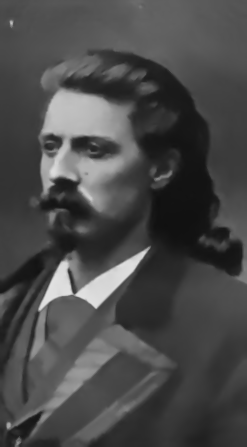
W. F. Cody (Buffalo Bill). (Text, 153.)
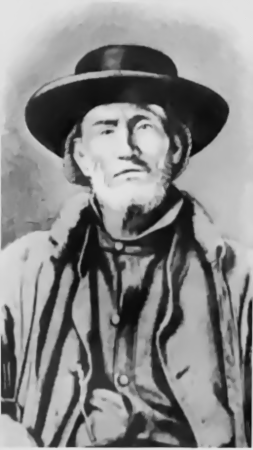
Jim Bridger. (Text, 107.)
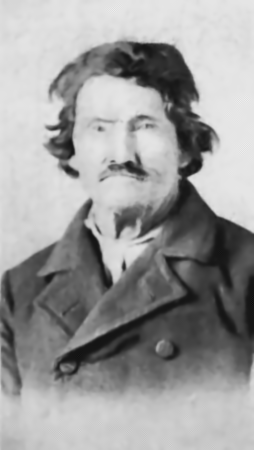
Jack Robertson.
In September, 1874, the Sioux entered the parade grounds at Forts Fetterman and Steele, and killed several soldiers (Appendix, 399). General Ord selected me to take five troops of cavalry, and two companies of infantry by rail to Rawlins, Wyoming, thence to Independence Rock, cross the Rig Horn Mountains, and destroy a camp of hostiles supposed to be near old Fort Reno. Unfortunately the Indians discovered our movements, and moved north beyond our reach.
April 14, 1875, General Crook ordered me to take command at Camp Sheridan, Nebraska. This march (Nannie accompanying me in her ambulance) was through a roadless, sandy country, with many streams and difficult crossings, practically unexplored.
Relieving Captain Sutorious of the command, I found Spotted Tail, chief of the Brulés, with about five thousand Indians at his agency, some of them Ogallalas. All were much excited at the encroachments of the whites on the reservation, and the scarcity of food. Spotted Tail declared the agent, Mr. Howard, deprived them of their governmental rations. The winter had been very severe and the snow very deep, driving the game out of the country.
Finding his statements true, I complained to the agent, who said he gave them all they were entitled to, and if they starved it wasn't his fault. There was no telegraphic communication, so without authority, I issued them several thousand dollars' worth of bacon and hard bread, telling the agent and reporting it to the War Department. Very shortly Jesse M. Lee, a first lieutenant of infantry, arrived with his appointment as Indian agent, dispossessing Howard.
Reef was issued by driving it in on the hoof, but flour, which was the principal ration, supplied by a contractor in Baltimore, was shipped to Cheyenne by rail, and there loaded onto wagons.
On the plea that so long a wagon journey would break single bags, and spill the contents, 100 pounds of flour was covered with three sacks. At Cheyenne a Federal inspector marked and weighed the bags.
The Baltimore contractor arranged with this inspector to stamp each sack "100 pounds." This trebled the weight, as the agent emptied the flour into vessels brought by the squaws and kept the sacks as evidence that he had delivered three times the actual weight. Lee, finding that flour was delivered unweighed, looked at the sacks, found they were certified to contain one hundred pounds by the inspector, reported the trick and the contractor was arrested, tried and convicted.
Many of Spotted Tail's young men were getting up war parties to drive back the miners and settlers who were organizing on the Missouri River to enter the Black Hills. It was a violation of our treaties with the Indians, and it was part of the duty of the army to see that the treaties were respected. Captain Fergus Walker, 1st Infantry, wrote me from a point eighty miles east of Wounded Knee, May 15, 1875, that he had captured one such invading party and sent it under guard to Fort Randall, but that his thus greatly weakened force was unable to cope with others, particularly Major Gordon's mining company. He asked me, accordingly, to co-operate with him in this work, and arranged for the Indian scout by whom he sent the letter to intercept him on the Niobrara River with my reply.
General Sheridan's General Order No. 2, of March 17th, directed commanding officers in Indian reservations adjacent to the Black Hills "to burn the wagon trains, destroy the outfits and arrest the leaders, confining them at the nearest military post," of trespassers found on a reservation. Accordingly, with two companies of cavalry and a battery of gatling guns, commanded by Lieutenant Rockefeller, I marched to relieve Captain Walker.
Arriving at Antelope Creek at night, I sent two men in citizens' clothes to Walker's camp to tell him I would at daylight surround Major Gordon's mining company. At daybreak I threw my companies into line, the battery in the center, and when Walker's force appeared, Gordon's men, wakened by the noise, found themselves utterly helpless. Gordon's camp was in a river bend, between precipitous bluffs, with only a few hundred yards' space for entrance or exit.
Seizing Gordon and putting him in a bull pen, I ordered his second in command, Mr. Brockert, to parade his men and surrender their arms. While doing this, one of their guns went off. I called out they might have the first shot, but we would have the last, when they submissively declared they would make no resistance.
The prisoners were sent back to Fort Randall under Captain Walker, except Gordon, whom I took to Sheridan, where he was put in the guard house.
Both the newspapers and the public at Sioux City made complaints about my "arbitrary and unlawful act," and the grand jury found true bills against me, but I never had service.
Gordon was a Mason, as was my post trader at Sheridan. They concocted a scheme for Gordon's release. One Sunday morning the post trader approached and read me his commission as United States Commissioner, serving a writ demanding the delivery of Major Gordon. I told him if he did not tear up his commission I would put him in the guard house with his friend Gordon, as there was not enough room in that post for a commanding officer and post trader who, as U. S. Commissioner, would attempt to dominate the action of the military authorities. He destroyed his commission. Later, Gordon was transferred to the guard house at Fort Omaha, Nebraska, and was there held under indictment for violating the Indian non-intercourse laws. What finally became of him I never knew.
The government contemplated building a permanent post (the one then occupied was temporarily constructed of logs) and furnished a saw mill, lathe, shingle machine, sash and doors, and thirty skilled artisans to take timber from the pine forests, and construct the post as rapidly as possible.
While absent on this expedition, General Crook, who had relieved General Ord, appeared at the post with some of his staff on inspection. He left an order for me to select a new location for a five-company post and construct it after my own plans, which I did.
Having an excellent quartermaster in Lieutenant Rockefeller, we accomplished the most expeditious post construction in the history of the army. Each captain constructed his own barracks and quarters, after plans I prepared, dividing the skilled artisans between them. As the men were anxious to get into their new homes, trees felled in the morning were often part of buildings before sundown, Lieutenant Lemly of the cavalry being particularly active, and all the officers strove hard to complete their quarters as soon as possible. We were comfortably housed before the first of October. All the buildings were constructed as a shell of upright inch boards around a framework, lined with the ordinary sized unburnt bricks, dried in the sun and plastered inside.
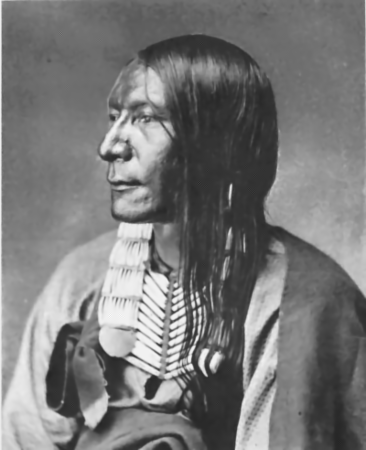
Meanwhile, Nannie formed an agreeable acquaintance with Spotted Tail, whom she liked from first sight. He was a fine-looking man, with engaging manners, perfectly loyal to the government, a lover of peace, knowing no good could come to his people from war with the army. He had the highest respect for and confidence in officers.
There was a sub-chief under Spotted Tail named No Flesh, a weakling, not thought much of by the head chiefs. Nannie frequently invited Spotted Tail to dinner, sometimes with other most respected chiefs, and No Flesh tried in every way to establish friendly relations with her. He proffered his services to paint her some pictures of his exploits as a warrior, for which she paid him. In one of these pictures he represents himself engaged in a great battle with U. S. Cavalry, killing a captain. I regret I can not reproduce his detailed description of his heroism.
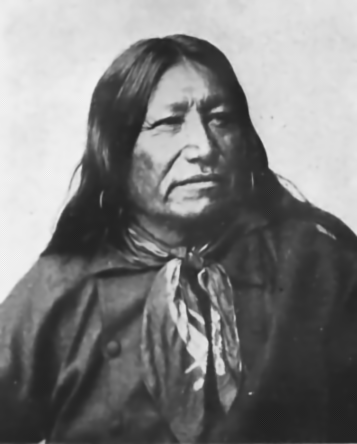
Courtesy, Smithsonian Institution.
Brulé Chief Spotted Tail.
Courtesy, Smithsonian Institution.
Brulé Chief No Flesh.
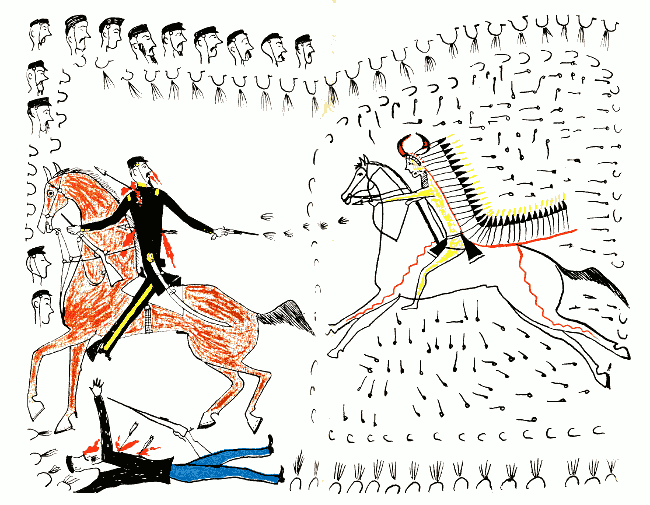
No Flesh Battle Picture.
The shod horse tracks in the picture represent the cavalry, and the unshod pony tracks represent Indian ponies. The faces on the margin are the attacking cavalry. It will be seen that he killed a soldier before he killed the captain.
Engaged in this work, he would remain at the house for hours, hoping to gain favor with Nannie.
Observing Nannie had great influence with me and with Spotted Tail, and noticing she bought fruits and paid for them herself, he knew of course that she was no squaw, and that she had authority.
One day Captain McDougall and several officers of the 7th Cavalry arrived at the post, with a scouting command to rest for a few days and secure supplies.
Nannie invited the officers to dine with Spotted Tail, Standing Elk, and White Thunder, but, as usual, did not include No Flesh. No Flesh learned the news rather late, but, a few moments after we had taken our seats, announced himself at the door and was seated in the parlor by the orderly.
When dinner was over we returned to the parlor and shook hands with No Flesh. Having held his seat during the dinner in the hope that he might at least be invited to a second table, he was somewhat sullen. After a while he exclaimed, "Well, you must have had a great deal to eat."
"Why do you think so?" I asked.
"Because it took you so long to eat it," he rejoined.
Seeing he was not likely to receive an invitation, and convinced from Nannie's demeanor toward him that the fault lay with her, he shook hands in a very dignified manner with everyone in the room save Nannie. She was sitting near the door, and when he came near he drew himself up in a most scornful manner and passed quickly out.
This amused not only the officers, but the Indians.
Soon after, when strolling together through the Indian encampments, I remarked, "Suppose we call on No Flesh." "Very well," she said, "I would just as soon."
No Flesh appeared much astonished, but he invited us in his tent, asking us to be seated on the ground, which we did. Two squaws and several children were present. He looked sternly in my face for some moments, and then exclaimed:
"You—no chief!" pointing to me with his forefinger. Then pointing with his left forefinger to Nannie, he held it up vertically, thus, as representing her; and pointing to me with his right forefinger, held it up thus, as representing me. He then placed them vertically together, thus, as representing our relative standing in authority.


All nomadic Indians have a common sign language and communicate with each other without the use of words.
No Flesh intended the most absolute insult one man could give another. We burst out together in laughter. This greatly puzzled No Flesh, who could not conceive how any man, much less a soldier, could brook such an insult. It was with great effort, stoical as the Indian is, that he preserved his equanimity.
One day while overlooking the construction of the post, Spotted Tail said through his interpreter, "Well, I have been wondering if you were going to stay; now I know you are." I asked him how he knew, and he replied, "I have been among white men long enough to know when they put rocks under their houses they are going to stay."
The old commanding officer's quarters, the best in the old post, was preserved intact, with all its furniture, cooking stove and utensils. When we moved to the new post I formally presented this house to Spotted Tail, in the name of the Great White Father, with General Crook's authority. He and his wives and children were very thankful in their hope for better comforts in the future. A short time thereafter, I saw the house was vacant and found Spotted Tail was again living in tepees under the cottonwood trees in the midst of his village. Asking him why, he replied his squaws found it impossible to keep the house clean. They threw the bones and refuse on the floor and could not learn to sweep out or wipe up, so that flies and maggots became so intolerable they were compelled to move. They could move tepees in a few minutes to fresh sward, as had been Indian habit for generations. With all my knowledge of the Indian habits, this surprised me as I suppose it will surprise the reader.
One day Spotted Tail brought Lone Horn, a Minneconjou chief, to my tent, asking me to show him some courtesy. He had never been in a military post or on an Indian reservation. The trader supplied a can of lemon sugar and I made some lemonade. Lone Horn had ridden far, on a very hot July day. He emptied his glass; then Spotted Tail exclaimed, "Have you drank all that? You had better lie down and hold on to the grass, for the whole world will begin to turn over in a few minutes."
Lone Horn, seeing the rest of us had drank only a portion, was really alarmed and imagined he felt the influence. I mention this to show Spotted Tail's humor, notwithstanding the popular opinion that Indians have none.
Efforts to enter the Black Hills had excited the entire Sioux confederation, and they began to talk of war. The leading chiefs of all the tribes except the Minneconjous and Ogallalas tried to restrain them, but it was difficult. In each reservation the young men organized war bands and went ostensibly to hunt but really in hope they would find opportunity to attack and destroy emigrants, prospectors or stock-men unawares, which they often did.
The great unrest among the Indians and the settlements adjoining their reservations alarmed the Indian Department. Before the winter had fairly set in, the President authorized the War Department to chastise some of the war-like tribes that were encamped not far from their reservations in the West, ostensibly for hunting purposes, but really to organize war parties for depredations in the spring. General Crook was therefore directed to begin a winter campaign. He organized a command at Fort D. A. Russell of ten companies of the 3d Cavalry, including mine, several of the 2d Cavalry and four of the 4th Cavalry. I was stationed at Fort D. A. Russell for the winter, Nannie accompanying me.
So many troops made Cheyenne a large and interesting post, Nannie becoming prominent in the garrison. One day she took me to a meeting of the officers and ladies at the post hospital to organize an amateur theatrical company. The call was issued by Major Dubois, who announced the object of the meeting, when, to my surprise, I was called as permanent chairman, the first time, I believe, I ever presided. Three young second lieutenants were appointed to devise a program and name the actors for the monthly meetings. Later a program was sent around in which I, who make no pretensions to theatricals, was designated to act Sir Toby Tittmouse, a leading part.
Nannie and these youngsters had entrapped me. I told her I could not in months commit to memory the long part I was given, but Nannie reminded me I had, as presiding officer, approved the proceedings and that I could not back out! She rehearsed me and taught me to play my part, sitting up many nights, conscious that Sir Toby's loud and turbulent language would impress the help in the kitchen that we were quarreling. Taking an interest in it I found it not so difficult after all, and Nannie rigged me up in a costume that would have surprised Sir Toby himself. She constructed a remarkable wig of angora wool, and made me knee breeches and large buttoned coat, which, with a cane, fitted the character so well that when the play was produced, my own colonel, Reynolds, declared that he did not know who was playing the part. This gave me courage, and I afterward acted a principal part as Mr. Potter in "Still Waters Run Deep."
Early in 1875, the campaign intended to subdue the rising war spirit of the Indians took definite shape, and our command left Fort D. A. Russell and proceeded towards old Fort Phil Kearny, where it was reported some outlying bands were located on Powder River.
We took thirty days' beef on the hoof, which was issued as rations. Two days from Fort Fetterman, crossing Cheyenne Creek, the command was surprised by some Indians; every head of cattle was driven off, one of the herders killed and one or two soldiers wounded, leaving the troops without any fresh meat. When we reached Phil Kearny, we abandoned every wheel, resorting to pack mules, and struck out for Powder River.
There had been a deep snow some weeks previous, and cold weather succeeding warm created a crust that would sometimes hold a horse. The night after we left Phil Kearny there came another severe snowstorm with high, intensely cold winds. The drifting snow and hard crusts rendered it difficult for our animals to travel.
We followed Otter Creek, which runs into the Yellowstone, parallel to Powder River, to an abandoned Sioux camp, thirty miles from Powder River, in which we found the remains of a captured and killed Blackfoot Indian.
Scouts reported a hunting party of Sioux in the direction of Powder River, in what in their opinion was a village. General Crook directed Reynolds to take eight troops with two days' rations (leaving him with the pack train and two troops to follow), and capture the village if he could find it.
At daybreak, on the banks of the river, the scouts reported the village. Preparations were made to attack.
Owing to the age and feebleness of Colonel Reynolds and the bitter feud that existed in the regiment (similar to that in the 7th Cavalry between Colonel Sturgis and his friends and Colonel Custer and his friends, that proved so disastrous at the Little Big Horn), this attack on the village on Powder River proved a lamentable failure. Reynolds disobeyed Crook's order to hold the village until his arrival, abandoning the field and retiring in the direction of Fetterman. It is perhaps better not to go into details here in regard to this humiliating failure, further than to say that several officers were tried for misconduct.
We were out of rations and other supplies, so there was nothing left but to return without successfully accomplishing the object for which we had been sent.
Through agents the Indian Department then took a hand and endeavored to quiet the Indians, but with little success. On June 18, 1875, Mr. Ed. P. Smith, the Commissioner of Indian Affairs, organized a commission to treat with the Sioux. It was composed of very distinguished men. Senator William B. Allison was the president, and General Terry among the thirteen members who met at Fort Robinson, September 20, 1875. I commanded the escort, consisting of my own and Captain Eagan's white horse company of the 2d Cavalry.
The majority of the Indians refused to enter the post, declaring they would make no treaty under duress. The commission agreed to meet in a grove on the White River, eight miles northeast of the post. Spotted Tail, who accompanied me from Fort Sheridan, warned me it was a mistake to meet outside the post, and kept his best friends around my ambulance.
The commission sat under a large tarpaulin, the chiefs sitting on the ground. Senator Allison was to make the introductory speech, and Red Cloud and Spotted Tail were scheduled to reply favorably to the surrender of the Black Hills for certain considerations.
There were present perhaps 20,000 Indians, representing probably 40,000 or 45,000 of various tribes. Probably three-fourths of the grown males of the consolidated tribes were present and might have subscribed to a new treaty in accordance with its provisions, that it be with the consent of three-fourths of the Indians, which supposedly meant the grown people, although the treaty did not so state. The Indians were given to understand that the whites must have the land, so that they became alarmed, and most of them threatened war.
Eagan's mounted company, drawn up in single line, I placed on the right of the commission, my own on the left. Allison began his address, during which hostile Indians, well armed, formed man for man in the rear of Eagan's men. "Young-Man-Afraid-of-His-Horses," a captain of a company of friendly Indians, asked permission to form his men in the rear of the hostile Indians, to which I consented.
When Red Cloud was about to speak, "Little Big Man," astride an American horse, two revolvers belted to his waist, but otherwise naked save for a breech clout, moccasins and war headgear, rode between the commission and the seated Indian chiefs and proclaimed, "I will kill the first Indian chief who speaks favorably to the selling of the Black Hills."
Spotted Tail, fearing a massacre, advised that the commission get back to the fort as quickly as possible. General Terry consulted with Allison, and then ordered the commission into the ambulances to make for the post. I placed Eagan's company on each flank and my own in the rear of the ambulances. At least half the men warriors pressed about us threatening to kill some member of the commission.
One young warrior in particular, riding furiously into our ranks, frenziedly declared that he would have the blood of a commissioner. Fortunately we reserved our fire.
A friendly Indian soldier showed him an innocent colt grazing about one hundred yards away and told him he could appease his anger by killing it. Strange to say, he consented, rode out and shot the colt dead, and the whole of the hostile Sioux retired to the main body at the place of our meeting. Thus ended the efforts of this commission to formulate a treaty.
Failure of both Crook's expedition and the efforts of the commission made it certain that hostilities would be resumed in the spring, so that General Terry, commanding the Department of Dakota, and General Crook, commanding the Department of the Platte, were instructed to organize large commands for the purpose of pursuing and punishing all Sioux found away from their reservations.
The Commissioner of Indian Affairs instructed his agents to warn the chiefs to call in all Indians away from the reservation, notifying that all found away would be punished. This only excited the war-like young bucks and caused them to move in the early spring as far west as they could go. At that time the buffalo were driven by encroaching settlements and the railroads from their southern grazing grounds into the country west and north of the Sioux reservation.
Crook first met the Indians in a slight engagement on Tongue River, Montana.
Terry, meanwhile, so separated from Crook by distance and hostile Indians as to prevent communication, had searched for the hostiles on the north. He discovered their trail on the Yellowstone at the mouth of the Rosebud, and organized an expedition under General Custer with the entire 7th Cavalry to pursue it.
General Crook's expedition is described in detail (Appendix, 400), save what occurred after his separation from General Terry's command.
The hostile Indians separated, some going to Canada and others turning eastward. General Crook determined to follow the latter, depending entirely on pack mules for transportation. With scanty rations, he undertook a long and distressing march through the dry and barren country, with little knowledge of its streams and trails. Both men and officers became restless and many of the horses were shot for want of sustenance.
When near the Missouri River, Crook turned southwest toward the Black Hills, crossing the North and South Cannonball rivers. Here many officers and men became dismounted, and it was feared they might perish for want of rations. There was no game, many ate horse flesh, and had no knowledge of woodcraft, course, or direction.
On the 8th of September, as I was bringing in the rear squadron of the command, having shot seventy horses that day, General Crook, in consultation with General Merritt, directed me to select one hundred and fifty of the best men and horses from my regiment, take Chief Packer Moore, with fifty pack mules, to Deadwood, in the Black Hills, and bring back supplies to the command. His last words were that should I encounter a village I should attack and hold it. It was nine o'clock before I could collect my command, and I left so hurriedly that no medical officer was sent with me. The night was very dark. I took with me Grouard, one of the best scouts we had, especially proficient in woodcraft.
Although there were no stars and insufficient light to see the surrounding land, somehow Grouard took us in the right direction. About midnight he lighted a match and showed me the fresh tracks of ponies on the banks of a little lake. We were close to the Indians. It began to rain as we lay down, holding the lariats of our horses, and it was with difficulty that we obtained a little sleep.
It was still raining at daylight, but we were early up and off, seeing by the mountain ranges we were going toward the Black Hills.
In the afternoon Grouard signaled a halt, saying we were near an Indian village. He had observed Indian hunters with their ponies packed with game. We were on the banks of a small stream, which Grouard said was near Slim Buttes. We hid under the banks and cottonwood trees, drenched with cold rain, until three in the morning, when I determined to attack. I did not know its strength, but was willing to take my chances in view of General Crook's positive orders.
Moving as close to the village as possible, I left the quartermaster, Lieutenant Bubb, with the pack mules and twenty-five soldiers. My plan was to dismount fifty men under Crawford and fifty under Von Luettwitz, retaining twenty-five mounted, under Schwatka, to charge through the village and drive the ponies away as soon as we were discovered, when Crawford would attack them on the right and Von Luettwitz on the left.
The Indian ponies near the village discovered us by smell and stampeded into the village. Schwatka charged through the village, driving the horses as far as he could, and Crawford and Von Luettwitz carried out their instructions and drove most of the Indians pell-mell from their tepees, which were laced on the side facing us. These lacings, being wet, were so hard to untie that the Indians cut their way through on the other side of the elkskin tepees and ran to the rocks on the opposite side of the stream, taking only their arms with them.
Von Luettwitz, standing near me on a slight elevation, was shot through the knee; I caught him as he fell. We found the village rich in fruit and game, and I despatched three couriers at intervals, to inform General Crook that we would hold the village until he came.
The Indian Chief, American Horse, was mortally wounded in the stomach. With some of his followers, mostly women and children, he took refuge in a cave in a ravine, where they entrenched themselves with the soft clay. There were fifty tepees in this village and probably two hundred and fifty Indians, mostly warriors. Grouard got into conversation with some and tried to persuade them to surrender, but they said that they had dispatched runners to the main body of the Sioux, less than eight miles distant, and would hold out until they were relieved.
The leading part of Crook's command, those with the best horses, arrived about 11.30. The rest of his command appeared soon after, at the same time the Indian forces arrived to relieve their distressed comrades. They came in great numbers, but when Crook deployed almost an equal number, the Indians retired and we held the village.
Some of my men, entering the village, discovered a little girl three or four years old, who sprang up and ran away like a young partridge. The soldiers caught her and brought her to me. She was in great distress until I assured her, by petting her and giving her food, that she was in no danger, when she became somewhat contented.
After General Crook's men had persuaded the Indians hidden in the cave to surrender, there being many killed and wounded among them, I and my orderly took this little girl down to see the captives and the dead. Among others, the soldiers had dragged out the bodies of two fine looking half-breed squaws, only partly dressed, bloody and mangled with many wounds. The little girl began to scream and fought the orderly until he placed her on the ground, when she ran and embraced one of these squaws, who was her mother.
On returning to my station on the hill, I told Adjutant Lemly I intended to adopt this little girl, as I had slain her mother.
The Indian chief was taken to one of the tepees and the surgeon told him he would die before midnight. He accepted his doom without a blanch or shudder, and soon died.
Crook told me to take the same command and at daylight proceed to the Black Hills and execute my mission. Before starting, Adjutant Lemly asked me if I really intended to take the little girl. I told him I did, when he remarked, "Well, how do you think Mrs. Mills will like it?" It was the first time I had given that side of the matter a thought, and I decided to leave the child where I found her.
We arrived at Deadwood at nine the next night. Everyone was in great excitement, because communication with the outer world was shut off by the surrounding Indians. All readily assisted me in collecting supplies sufficient to load the fifty pack mules. With fifty head of cattle, we met Crook's command, the second morning, forty miles distant. They were in practically a starving condition, having subsisted on the ponies I captured at Slim Buttes.
Some time in June, 1914, the historian of South Dakota, Mr. Doane Robinson, sent me a volume in which he published the reports of the Battle of Slim Buttes, and also a map of the battle-ground by the State engineer, which purported to give in detail the topography in Section 27, Township 17 north, Range 8 east. On examining it, I could not recognize it as representing the location.
Meanwhile, Mr. W. M. Camp, editor of the Railway Review, had called on me to get some details of this fight, stating that he was writing a history of the Indian War of 1876. Showing him Mr. Robinson's book, I told him that, having no faith that he had made the proper location, I had invited General Charles Morton, who was present at the fight, to go with me in July and try to find the true location, and asked him to go with us, which he readily consented to do.