THIRD PERIOD (continued 3)
Reading edition
The sheriff and court reporter then corroborated my report of the conversation which they heard concealed behind the bed.
Asked if they wanted to be heard again, Compton and Hunt hung their heads, Compton only replying, "No, it's no use; they were behind the bed."
The Judge announced a mistrial, honorably discharging all members of the jury but Compton and Hunt, who were confined in jail to await the action of the grand jury. True bills were found against them and they were tried, convicted and sent to the penitentiary.
This narrative is compiled from official records of the case which I possess.
Returning home one Sunday from a walk down El Paso Street, Nannie said, "Anson, we had thought to make El Paso our home, but if you do, you will have to live alone. I saw nothing but saloons and gambling dens with the cries of gamblers and singing of women among them!"
Not until 1905 did strength enough appear to overcome the lawless, when Horace B. Stevens (Cut, 254) took the matter in hand, assisted by such brave and self-sacrificing men as J. A. Smith, W. S. McCutcheon, R. B. Bias, William H. and R. F. Burges, H. D. Slater, Rev. Henry Easter, Felix Martinez, Waters Davis, Millard Patterson, W. M. Coldwell, Frank Powers, U. S. Stewart, and many others. Success was not attained until after many public meetings, Waters Davis becoming the head of an organization for that purpose. Mr. A. L. Sharp was elected to the legislature and at the request of his constituents procured a bill closing the gambling houses by injunction. This bill was prepared at the suggestion of Richard Burges by Judge W. M. Coldwell, and stood all court tests.
All these reformers were foremost among the builders of the now great city. J. A. Smith, who began with its beginning and never faltered either in successes or honest failures, either in statesmanlike politics or brave progressive business enterprises, is particularly a noteworthy figure. H. B. Stevens and Waters Davis, in this long fight, not only sacrificed their financial interests, but risked their personal safety.
The reform movement was so successful that El Paso today is one of the best governed cities in the United States. Notwithstanding the addition to its population during the past two years of fifty thousand United States soldiers (well disciplined men, however), it has stood the test of good, safe government.
Mexico
Youthful knowledge of our war of 1847 with Mexico, and a residence of four years at El Paso, where I employed many Mexicans in the construction of buildings and surveying, gave me a great interest in its government, its people and affairs generally. History told me Cortez in his conquest destroyed a civilization better than his own, leveling to the earth a beautiful city of five hundred thousand inhabitants, and rebuilding one less beautiful by the enslavery of its people, reduced from civilization to abject serfdom by Spanish authorities. For two hundred years these people suffered cruel wars before their efforts to acquire independence were successful. Later, Mexico was again victim of foreign nations, and finally America, too, was guilty, as I believe, of making a needless and unrighteous war upon her in 1847. In evidence, I quote the following from page 53 of Grant's Memoirs:
"For myself, I was bitterly opposed to the measure, and to this day regard the war which resulted as one of the most unjust ever waged by a stronger nation against a weaker nation. It was an instance of a republic following the bad example of European monarchies in not considering justice in a desire to acquire additional territory."
The peace treaty promised we were to pay Mexico many millions for territory acquired by force, but much of this money was withheld until a commission of our own people determined how much be finally kept in payment of claims alleged to be due our citizens—the pretext for the war. This commission could not find claims enough to exhaust the money withheld, so much of it was given back to Mexico.
My brother, W. W., lived on the border for fifty years, ten of which he was consul in Chihuahua. Another brother, Edgar Allen, after spending twenty years on the Rio Grande border, lived and traveled in various parts of Mexico in different business capacities from 1886 to 1901. He was employed at Escalon, the City of Torreon, Culiacan, the capital of Sinaloa, and the City of Jiminez, traveling through the states of Sinaloa and Durango to Jiminez, then to Sombrerette, and then to Gutierrez and state of Zacatecas, thence to Chihuahua. He found Mexico a tranquil nation with a people satisfied with their government; where a great majority of the foreigners were likewise satisfied with the government and their treatment, and where the people were glad to see foreigners and treated them well.
From all foreign nations, however, but principally from our own, came a disturbing element of ne'er do wells, itinerant visitors awaiting a hoped-for conquest and exploitation of that country to get their innings. Somewhat lawless, these people did much for which they would be arrested at home. Occasionally they were arrested by Mexican authorities. Many brought money procured from friends and relatives at home to enable them to establish themselves in a new country. They spent it rapidly, became troublesome, got into difficulty with the officials and made loud complaints to our government. These, perhaps, did not represent one-fifth of the American residents in Mexico.
Another class on the border of Texas, Arizona and New Mexico, were native citizens of Mexican descent, born on American soil, but good citizens of neither country, and continually in trouble with one or the other. Together with lawless Americans these fostered trouble from year to year.
Of the probable fifteen million inhabitants of Mexico, at least eleven million are pure Indians, with no admixture of Spanish or other foreign blood. These Indians are much as when Cortez found them, few speaking Spanish or any other common language, but speaking at least fifty-five different Indian languages. They have never taken any interest in what is known to us as politics; have no desire to vote, and do not know what it means. Yet they are, or were, as contented and happy as other peoples, satisfied with their governing classes, and as kind and gentle in their intercourse with each other as the people of the average nation.
More Mexicans, or people of the Mexican race, lived on the American side of the border in Texas, New Mexico, Arizona and California than on the Mexican side, because no American markets are available to Mexican producers. They could not afford to pay the duty required to enter the American market and compete with producers on the American side, so that most produce was raised on the American side to which adjacent population gravitated.
As a citizen in Mexico, an officer on the border in Texas, and as boundary commissioner for twenty years, I can testify Mexico possessed a tranquil government, and that my wife and family felt as well protected from violence on the streets of the great cities as they would have felt in the United States. My brother, W. W., also found in his official connection as consul, that this state of affairs existed.
In October, 1909, President Taft and President Diaz, by mutual agreement, met for greetings and congratulations at El Paso and Juarez, and gave each other dinners on each side of the river. Physically splendid men, it is a compliment to each to say they resembled each other, both in physical appearance, in language, and in gesture. In Juarez, I was a guest of the Mexican Government; in my diplomatic capacity, I sat near both Presidents, who were seated vis-à-vis. In their speeches the two Presidents seemed to vie with each other in congratulations on the good relations and tranquil governments on both sides of the border. The hundred guests in the great hall of the custom-house heard them with profound interest and respect. No one could doubt the sincerity of each; yet in a few months the two nations were practically at war. How it came about will be a mystery forever, but there is no disputing the fact that the rebellion against Diaz was organized, armed and equipped on the American side.
When the trouble began six years ago, as boundary commissioner, I advised the Government that our neutrality was so inadequate, or laxly administered, or both, that nearly all the insurrectos then in arms in Mexico were organized in the United States, and practically all the arms and munitions of war were unlawfully or at least unrighteously introduced from this country. Living in El Paso during much of the hostilities, I knew that many secret service men, detectives and others in the employ of the Government, were seeking something. But neither I, nor so far as I know, either of my brothers were ever approached regarding conditions in Mexico.
The original Francisco I. Madero, said to be of Jewish descent, as a young man lived near Matamoras, when General Taylor crossed the Rio Grande for Monterey. The army was unable to procure wagon transportation, and Madero suggested pack animal transportation to General Taylor as more feasible because of difficult sandy roads. Our Government gave Madero large contracts to transport the baggage and supplies of Taylor's army to Monterey and Saltillo, by which he accumulated a considerable fortune. After the war he received large concessions from the Mexican Government.
The family was very prolific, Francisco I having twelve or thirteen children, Francisco II about the same number, and Francisco III, presidential candidate, having many, as did nearly all his brothers, sisters, uncles and aunts. When the revolution against Diaz broke out, the Madero family embraced four or five hundred souls, nearly all more or less wealthy. Madero II was a Diaz supporter, as were about half his brothers. The rest were adherents of Madero III. The family is now dispersed and many have died.
I was personally acquainted with Francisco Madero III, and his father, Madero, Jr., was an extreme agitator similar to our Debs. The greatest qualification friends in each case claimed for their candidates for the presidency was that they had been confined in jail by their two countries for violations of laws!
Mr. Madero stated in all sincerity that he hoped to be to his country what Washington was to mine. I never met Mr. Debs, but I dare say he had similar ambitions and with about the same reason! Debs received relatively as many American votes when candidate for president as Madero did when he claimed election.
Our assistance given to such men as Madero, Orosco, and Villa in driving Diaz, the greatest ruler Mexico ever had, from his tranquil government to exile, set back for fifty years the advancement that Diaz had given in his twenty-seven years of authority. Until Mexico discovers another such noble man as Diaz, it will never have the tranquil and stable government it had. Some day Mexico will erect a monument to his memory as resplendent as that of Guatemozin or Montezuma. Were it not that our country is now so absorbed in the greater war in Europe, our jingoes might ere this have caused another war of conquest, subjugation and exploitation in Mexico.
I also knew Huerta personally. A graduate of their military academy, an officer of forty years' service in the army, I do not believe it possible that he had guilty knowledge of Madero's murder.
Equitable Distribution of the Waters of the Rio Grande
Because settlements in Colorado and New Mexico appropriated so much water from the Rio Grande in the flood season the river ran dry before it passed through the arid region around El Paso. Thus grapevines and fruit trees perished, and because it was impossible to cultivate vegetables, wheat, corn and other cereals, the settlers on both sides of the river were abandoning the country. In 1888, the city council of El Paso asked me to devise some remedy for their distress.
I recommended the construction of a dam three miles above the city, where the formation in the valley gave ample room for immense water storage. At the council's request I went to Washington and presented a statement of their distress to the Secretary of State.
I saw Mr. Bayard on the 9th of December, and on the 10th, at his request, presented the following communication:
Ebbitt House,
Washington, D. C., December 10, 1888.
Sir: Agreeable to promise at our interview this a.m., I have the honor to submit the following general outline of my projected scheme for an international dam and water storage in the Rio Grande River, near El Paso, Tex., for the control of the annual floods and the preservation of the national boundary to the Gulf, and for other purposes.
The Rio Grande, 1,800 miles long, rises from an unusual number of tributaries in the very high altitudes of southern Colorado and northern New Mexico, where the rain and snowfall is extraordinary, and the ice formed therefrom in the long winter enormous. As it flows southward the precipitation gradually decreases for 600 miles, when the Mexican boundary is reached at El Paso, Tex., where there is neither snow nor ice, and but 8 inches annual rainfall; from thence 1,200 miles south to the Gulf of Mexico the rainfall is only sufficient to compensate for the loss by evaporation (which latter is very great), and for these reasons the river has but few tributaries and no increase of flow below El Paso.
The annual floods, caused by the melting of snow and ice in the mountains, take place in May and last for about seventy-five days, during which period the average flow may be estimated at 200 yards in width by 2 yards in depth, with a velocity of 5 miles per hour, although in recurring periods of about seven years it is much greater. During the remaining two hundred and ninety days of the year the average flow is perhaps not over 30 yards wide by 1 yard deep, with the same velocity; and in the same recurring periods, in the intervals between the high tides, the river goes dry for months, as it is at this time—or at least has no current, with not enough water in the pools to float the fish.
There is at present popular opinion that this want of water comes from its diversion by the numerous irrigating canals lately taken out in Colorado and New Mexico, and while it is problematical what effect this may have, if any, I am of the opinion that most of this water returns to the stream again, either through the atmosphere, by evaporation and precipitation, or by the earth, through overflow and drainage, as from personal observation I know that these seasons of flood and drought were of about the same character thirty years ago.
After leaving the mountains the river passes through low valleys of bottom lands from 1 to 12 miles wide and from 4 to 8 feet above low-water level, of a light, sandy alluvium formed during annual overflows by sedimentary deposits from silt, which the water always carries in a greater or less degree.
In meandering along the Texan bank of the river as a land surveyor, from the New Mexican line to a point below Fort Quitman, in 1858, 1859, and 1860, I observed that the deposit was from one-half inch to 3 inches annually, that during the floods the bed of the river was constantly changing by erosion and deposit, and that in regular cycles it shifted from one of its firm rocky or clay banks to the other, as the deposits had raised the side of the valley through which it then flowed above the level of the opposite side. Generally this change took place slowly, by erosion and deposit of matter entirely in suspension; but frequently hundreds of acres would be passed in a single day by a cut-off in a bend of one channel, and sometimes the bed would suddenly change from one firm bank to the other, a distance of perhaps 20 miles in length by 6 in width. For instance, when surveying "El Canutillo," a valley a short distance above El Paso, the river was moving westward, and about the middle of the valley, which was some 6 miles wide. Old Mexicans who had lived in the vicinity informed me that in 1821 the river ran close along the eastern bluff, where its bed was plainly to be seen, as was also a less plainly outlined bed along the bluffs on the opposite side, where the river flows at this date, and gives evidence of returning abruptly to the eastern bluffs again at the next greatest high tide, to its old channel along the bed of the track of the Santa Fe Railroad.
In another case, more recent and extensive, in the great valley below El Paso, some 12 miles in width and 20 miles long, the river, as was plainly evident at the time I was surveying the land, had made a sudden change from the bluffs on the eastern or Texan side to the western or Mexican side of the valley.
Mexicans who had been residents continuously in that vicinity informed me that this change took place in 1842.
Again, in 1884, in this vicinity, the river swept suddenly from the Mexican side, crossed the Southern Pacific Railroad, and destroyed both track and bed for a distance of 15 miles, stopping traffic for a period of three months and causing the removal of the road to hills above the valley.
Though these are the most extensive changes that came within my personal observation, similar ones are being made annually, from El Paso to the Gulf, which not only prevent the settlement and development of such of the lands as are sufficiently above the overflow (were the banks and boundaries secure), but by reason of the river being the national boundary between the United States and Mexico for over 1,200 miles, cause fatal embarrassments to the citizens and officials of both Republics in fixing boundaries and titles to lands, in preventing smuggling, collecting customs, and in the legal punishment of all crimes and misdemeanors committed near the supposed boundary line, it being easy at almost any point in its great length to produce evidence sufficient to raise a reasonable doubt in the minds of the jurors as to which side of the line the arrest was made or the act committed.
At the last session of Congress the House passed a joint resolution (No. 112) requesting the President to appoint a commission, in conjunction with a similar one from the Republic of Mexico, to consider the matter above referred to. While surveying these lands in 1858, and prospecting for a crossing of the Rio Grande for the Memphis, El Paso and Pacific Railroad, which was then projected—and in fact in course of construction—I examined the pass about three miles above the present city of El Paso, and discovered that it had solid rock bed and walls, the latter but about 400 feet apart, and that the valley above which came close down to the spur of the Rocky Mountains which crossed the river and formed the pass was from 4 to 8 miles wide, with a fall of about 4 feet to the mile, so that it would be an easy matter to build a dam in this pass and create an immense lake.
The water coming through this pass for ages has deposited at its lower end a great mass of rocks, over which is formed rapids with about 12 feet fall, and the aborigines of prehistoric ages made use of this to carry the water on to the lands below, no one knows how long ago, but it is known that the Mexicans have used it for two hundred years under most disadvantageous and unsatisfactory circumstances.
I have witnessed, each succeeding year, hundreds of Mexicans piling loose stones on the top of this drift of rocks to raise the level to that carried away by the floods of the preceding year; and it has been estimated by a Federal engineer sent from the City of Mexico, that, had the labor thus expended been reduced to silver, the dam could have been built of the solid metal. The difficulty has been and always will be that there is neither bed rock nor solid earth in the bottom or banks, each being composed of quicksand.
In other places in the valley temporary willow dams 1 or 2 feet high are made at convenient places, and the water carried several miles below on to the lands that are above the usual overflow; but these dams are carried away annually and have to be rebuilt, and frequently the river bed moves miles away from the mouth of the ditch or acequia, rendering it useless; but even if these difficulties in carrying the water from the bed of the river to the lands are overcome in the usual manner, it is evident that by reason of a great overflow, say, every seventh year, and a dry river in a like period, no system of irrigation for the Rio Grande can prove satisfactory that does not embrace a grand storage system sufficient both to restrain, to a great extent, at least, the tidal flow and maintain a constant annual flow, especially since the great immigration and settlement in its valley is constantly doubling the demand for water.
Being on leave of absence in the city of El Paso recently, where I was a citizen before the war, having surveyed the first plat of the town and being well known to most of its citizens, I was invited by the city council to submit to it a plan for water supply and irrigation that would overcome the difficulties above referred to.
It at once occurred to me that as the Rio Grande was the joint property of the two nations, and especially as the Mexicans had used its waters since time when "the memory of man runneth not to the contrary," that any plan to be acceptable and satisfactory must be international in character, and the works, both before and after completion, under the joint federal control of the two nations, the more so as riparian rights in this country, so far as regards irrigation, are not well defined by law, and could be best brought about in this instance by treaty stipulations between the two countries.
The matter of restraining the tidal flow by storing the water, and thus protect the constantly changing national boundary, occurred to me—if it could be introduced into the project—as likely to secure encouragement and substantial aid in money from both governments.
And further, that El Paso, being now a city of over 11,000 population, and having every prospect of being a large manufacturing city at no distant day—there being no place within 500 miles likely to compete with it—the subject of water power ought also to enter into the problem, which of necessity is of such vast proportions as to require all incidental aid possible to attach to it to insure its success.
It will be apparent, from what has been written, that the Rio Grande is one of the first magnitude, not only in length and breadth, but for short annual periods in devastating flow of waters, and that its general characteristics, as compared with other rivers with reference to irrigation, are so abnormal as to require different or more heroic treatment.
I therefore projected a scheme which may be briefly outlined as follows:
To build a strong dam of stones and cement—say, 60 feet high—in the pass before referred to, and by submerging about 60,000 acres of land now subject to overflow and of little comparative value, create a vast lake 15 miles long by 7 wide, with a probable storage capacity of 4,000,000,000 cubic yards of water; place gates on each side of the river in the dam at the 50-foot level for waste-weirs and irrigating canals to supply each side of the river and keep up a flow in its bed which would bring the water in the canals 70 feet above the streets in the cities of El Paso and Juarez, respectively.
The gates at the 50-foot level would give an available reserve of water of 10 feet over the entire surface of the lake—over 2,000,000,000 cubic yards—which would be exhausted during the long season of little flow for the purposes of irrigation and other needs, as well as maintaining a constant stream in the river beds so arranged as to exhaust the reserve about the period of annual flood, which would be checked and held in reserve for the next season of little flow, and in this manner produce a comparatively constant and unvarying flow of water for each entire year below the dam, redeeming many times the number of acres submerged above in the lake from overflow below, and fixing permanently the national boundary, the banks of the river, as well as the boundaries and titles to private lands, and making it an easy matter to collect duties and prevent smuggling, detect crimes and misdemeanors generally, arrest and punish criminals, as it is along other national boundaries.
The assumed flow given for the 75 days of high-water will give about 6,500,000,000 cubic yards, and that for the remaining 290 days 1,500,000,000, making an aggregate annual flow of 8,000,000,000 cubic yards. If we allow 2,000,000,000 of this for loss by evaporation and other wastes, which former in this dry atmosphere is very great, perhaps 80 inches, we have 6,000,000,000 cubic yards remaining. This should be divided into three equal parts, one for each side of the river, for irrigation and other needs, and the third for overflow, through water motors, to furnish power to the future manufacturing cities on each side and to maintain a constant flow in the river below to the Gulf, as would no doubt be demanded by the people there as their right ere they would permit the scheme to be carried out.
The 2,000,000,000 cubic yards falling a distance of 50 feet over the dam, estimating the weight of a cubic yard of water at 500 pounds, and 1 horse-power the energy required to lift 33,000 pounds 1 foot in a minute, would expend energy equal to over 10,000 horse-power for 8 hours every day in the year, and produce a constant stream in the bed of the river 26 yards wide by 1 foot deep, running with a velocity of 5 miles per hour, to say nothing of the probability that the greater part of the other two-thirds would find its way again to the river bed through the earth and air, the whole flowing in a steady, continuous stream to the mouth of the river, to be used as required at any season of the year, instead of, as is now the case, three-fourths of the entire mass of the annual flow going rapidly to the Gulf in the short period of 75 days untaxed.
Estimating the amount of water required for annual irrigation at 20 inches, the water reserved for that purpose would be sufficient for 100,000 acres on each side of the river—all that could be reclaimed from the desert for 100 miles below.
To carry out this project I recommended to the people on each side of the Rio Grande that they petition to the executive authority of their respective nations for the creation of a joint commission to draw up the necessary treaty stipulations to protect the work and the rights of all interested in them, the fundamental feature of which should certainly be that each nation should have the right to divert no more than one-third of the flow at any period, and that one-third of the flow should be maintained in the bed of the river; and that this international commission have charge and control of the work after completion as well as during construction.
That the legislative authorities of the two nations be asked to appropriate, after complete investigation and estimates have been made, money sufficient to complete the work, probably $100,000 for the dam proper, $100,000 for the condemnation of the 50,000 acres of land to be submerged, and $100,000 for the removal of some 15 miles of the road-bed of the Atchison, Topeka and Santa Fe Railroad to bluffs above the old bed of the river, where the track now lies, subject to annual damage, and sooner or later total destruction, unless removed.
It will also be apparent that the waters of this great lake will be clear and fresh, the silt held in suspension in the current of the river being precipitated as soon as it enters the still water of the lake, doing away with the great trouble and expense now necessary in keeping the canals and ditches cleansed of sedimentary deposits, and a further great benefit derived from using water reduced in temperature by exposure for months in a warm climate far below that used in the early spring, which comes in three days from snow and ice and is immediately applied to the young and tender sprouting plants, chilling and checking their growth.
I know of no point in the Rio Grande between Albuquerque and the Gulf of Mexico where nature has provided both the natural basin and rim for a lake of such great dimensions, for, indeed, it can be made 100 feet deep if desired, and it may be questioned whether a depth of 60 feet, with 10 feet reserve to draw from, will afford sufficient storage to control perfectly the tide at its highest flow.
This project was well received by the people and has been earnestly discussed in the public press of the locality ever since with general approbation and a disposition to endeavor to carry it out as quickly as possible. The only question exciting any general distrust is that the sedimentary deposit in the lake, it is held by some, will shorten the life of the reservoir by filling the lake at such an early period as to render the scheme of doubtful expediency, and opinions differ very widely upon this subject, which is, indeed, a problematical one, and can only be determined, even approximately, by actual measurements of a great majority of the annual flow, for the quantity of sediment changes with flow and season.
That the bed of the river will eventually be filled, of course, is only a matter of time, but whether in fifteen or one hundred and fifty years can only be ascertained by prolonged, actual measurements; but even if filled in the near future it seems to me that the difficulty may be overcome by raising the dam, unless, indeed, that should be required too often.
The matter has already been referred to Major Powell, chief of the Geological Survey, who has sent Captain Clarence Dutton, of his Department, to El Paso to investigate and report on the feasibility of the scheme; but as the initial steps, should it be pronounced feasible, must come from your Department in the nature of international treaty stipulations, I have thought it proper to thus early acquaint you with the grand project.
I beg to refer you to Hon. Mr. Lanham, member of Congress from Texas, who is acquainted with me personally and my projected scheme.
Anson Mills,
Major Tenth Cavalry, Brevet Lieutenant Colonel,
United States Army.
The Secretary of State,
Washington, D. C.
In April, 1888, at the instance of Major Powell, I had received orders from the War Department to report to the commanding officer at Fort Bliss, with instructions to lend whatever aid I could to the Interior Department and its Geological Survey party, investigating the redemption of irrigable lands in the Rio Grande Valley.
Major Powell also wrote, asking me to act as advisory agent of the survey, and to give it my opinions and advice regarding this work, as well as to supervise a gauge station they were to construct for measuring the annual river flow, evaporation, etc.
The Geological Survey was authorized to investigate the feasibility of reclaiming arid lands by dams and water storage. Colonel E. S. Nettleton, of Denver, Colorado, was appointed supervising engineer of the southwestern district, and I was appointed his assistant, as supervising engineer of the district of El Paso, with money to employ engineers and other assistants to make plans and estimates for the proposed international dam at El Paso. With Mr. W. W. Follett, one of the best hydraulic engineers in the United States as my aid, I proceeded to carry out the work as speedily as possible. The Senate Committee on Irrigation, of which Senator Stewart was Chairman, intended to visit El Paso later and examine the location, plans, specifications and estimates, so that, if approved, they could recommend an appropriation to construct it.
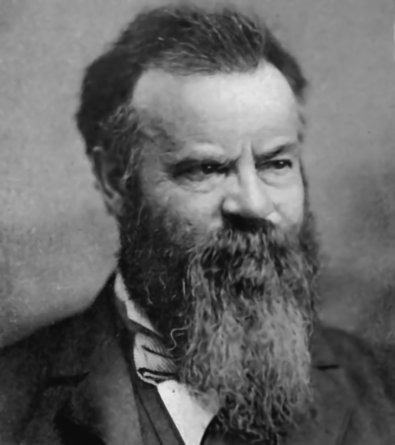
Major James W. Powell.
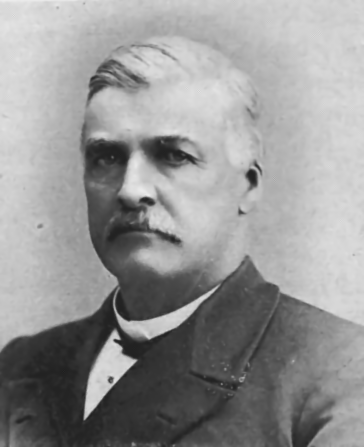
Colonel E. S. Nettleton.
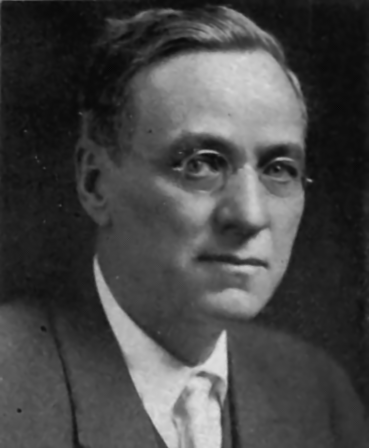
W. W. Follett.
While engaged in this investigation an apparently unrelated incident occurred which had a most unfortunate effect upon our labors.
The Secretary of War, Mr. Proctor, ordered me to Fort Selden.
Here an irrigation company, represented by Mr. W. H. H. Llewellyn, held a revocable license to construct a canal through the Selden Reservation. The Mexican citizens, assembled in force with arms, had forbidden the workmen to construct the canal, and I was to make a thorough investigation as to the trouble, and report to the Secretary personally in Washington.
After two days investigation I found the canal company charter authorized them to build their canal through and over the community canals of the settlements along the river, in use for over one hundred years, and compel the Mexican farmers to pay water rent for new canals. The farmers, having prior right to the use of the water, objected.
In Washington, the Secretary proposed a hearing on February 2, 1889, and asked a written report from me, to be read at the meeting, in which I recommended the license be revoked.
Senator Reagan, of Texas, the delegate from New Mexico, Mr. Llewellyn, and many others interested, were present at the meeting. After reading my report and a full hearing of both sides, the Secretary revoked the license and instructed the commanding officer of Selden to remove Llewellyn's workmen from the reservation. Mr. Llewellyn grew violently angry at me, and on my return to the hotel I found the following note:
The Ebbitt House,
Washington, D. C.,
Feb. 2nd, 1890.
Dear Major:
I have wired Messrs. Davis and Morehead to have their people keep out, that if there is no new ditch at Las Cruces there will be no new dam at El Paso.
W. H. H. Llewellyn.
Davis and Morehead advocated the El Paso dam.
When the committee reached El Paso, August 20, 1889, Major Powell, Colonel Nettleton, Mr. Follett and I explained our plans in detail. They and the members from that district and Mr. Lanham, who was much interested in the project, all approved.
Meanwhile the Mexican Government demanded compensation from the United States for the appropriation by American citizens of the waters of the Rio Grande, to which Mexico claimed prior right. A bill was introduced in both Houses of Congress making an appropriation for the construction of the El Paso dam by the United States, provided Mexico relinquished all claims for indemnity in return for half the water to be stored.
This bill was thoroughly discussed in both Houses of Congress during the session of 1889 and 1890, and was apparently satisfactory to all parties concerned, and it was generally supposed that it would pass. On April 26, 1890, having finished the duties required of me, the War Department relieved me and I rejoined my regiment.
When it was evident the United States was committed to building a dam at El Paso and dividing the water with Mexico, Dr. Nathan Boyd, of New Mexico, obtained a charter from New Mexico to build a similar dam at Elephant Butte, one hundred and twenty-five miles above El Paso, with the apparent intention of holding up the waters of the Rio Grande and the United States Government and compelling it to supply water to Mexico through his company. (See Colonel Engledue's address to the stockholders of Boyd's company, p. 343, vol. 2, Boundary Commission Proceedings.)
The Mexican Government protested in 1896, stating that before they could accept their share of the water to be stored by the proposed international dam at El Paso, as indemnity for their loss of water taken out on the upper river, investigations should ascertain whether there would be sufficient water in the Rio Grande to supply both dams. If not, measures should be taken to restrain the projectors of the Elephant Butte dam from using waters to which Mexicans had prior right.
This protest was referred to me by the Secretary of State, who asked my opinion.
I reported that in my opinion that it would be unsafe to rely on a sufficient flow to restore to Mexico the water to which she claimed prior right unless the Elephant Butte corporation could be restrained from the use of such water. Suit was instituted by the Attorney General to enjoin the company. So began a contest which lasted for many years, going three times to the Supreme Court of the United States, before the Elephant Butte Company was permanently enjoined from constructing their dam.
These complications delayed both projects for several years. A protocol, dated May 6, 1896, between the Secretary of State, Richard Olney, and Ambassador Romero, directed F. Javier Osorno and myself, Boundary Commissioners for Mexico and the United States, to continue the investigation and report on the following matters:
First, the amount of Rio Grande water taken by the irrigation canals constructed in the United States.
Second, the average amount of water in the river, year by year, before and since the construction of the irrigation canals.
Third, the most feasible method of so regulating the river as to secure to each country and its inhabitants their legal and equitable rights and interests in said water.
Captain George McC. Derby, U. S. Engineers, was ordered to report to me, and Señor Don J. Ramon de Ibarrola, engineer on the part of Mexico, was ordered to report to Mr. Osorno.
The Commission worked diligently on this investigation until November 25, 1896, when it reported its opinion that the most feasible means of attaining the ends desired was to construct the dam and reservoir projected by Mr. Follett and myself under the investigations made by the Geological Survey, provided Mexico could be protected in some way which would prevent the taking from the Rio Grande by dams and water storage of water to which she had prior right. I was authorized by the Secretary of State to formulate with Ambassador Romero a draft of a treaty to that effect, which we accomplished, submitting copies to the Secretaries of State of both nations.
The two nations were willing to consummate the proposed treaty. Congress appeared to be ready to appropriate the necessary money but, again, the unexpected happened. Making violent charges against me to the Secretary of State, Dr. Boyd demanded that President McKinley dismiss me from the Boundary Commission or he would defeat his re-election by his control of two or three western States; and threatened to horsewhip Secretary Hay if he did not do his bidding. Mr. Wilkie, of the Secret Service, reported Dr. Boyd to be a dangerous man, so he was denied further personal conferences in the State Department. (I knew nothing of this for years afterwards.) Boyd then strove to influence Roosevelt (who had become President) against me and the international dam. Mr. Roosevelt, without consulting the Commission having the project in charge, placed it in the hands of Mr. Newell, of the Reclamation Service, with directions to build the dam at Elephant Butte. After some delay another treaty with Mexico (concerning which I, though still Mexican Boundary Commissioner, was not consulted), was effected for building the dam at Elephant Butte. By the terms of this treaty Mexico is to receive a share of the water to be stored by the dam and relinquishes all claims for indemnity for the diversion of the waters of the upper Rio Grande by American citizens.
As Llewellyn threatened, there never was a "new dam at El Paso," largely owing to himself and Boyd. After twelve years, at a cost nearly four times as great as estimated for the international dam at El Paso, the Elephant Butte dam is complete; but it is doubtful whether it will ever be of any great benefit to the valleys near El Paso because of the great distance over which the water has to be carried through arid wastes. Full details may be found in my published reports under the head of "Equitable Distributions of the Waters of the Rio Grande, Vol. 2."
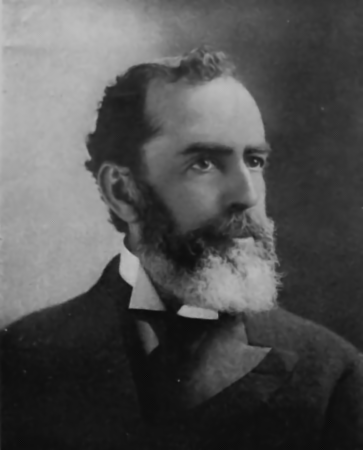
Jacobo Blanco.
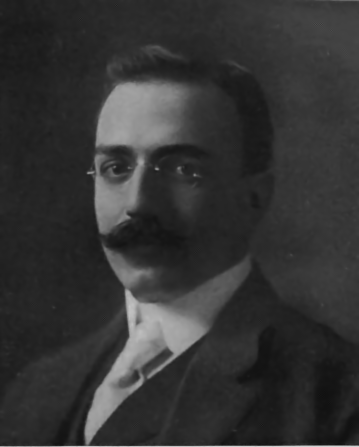
F. Beltran Y Puga.
Mexican Boundary Commissioners. (Text, 300.)
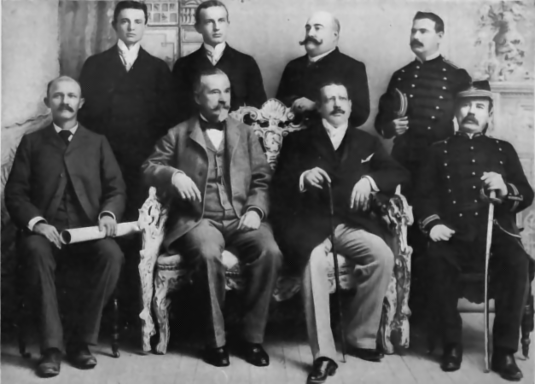
Joint U. S. and Mexican Boundary Commission. Cunningham, Happer, Maillefert, Cuellar, Dabney, Mills, Osorno, Corella
Boundary Commission
I have already explained how this Commission came to be formed and how I was appointed and entered upon the duties as sole Commissioner on the part of the United States (Text, 207). I have also explained the relation of the Commission to the international dam for the equitable distribution of the waters of the Rio Grande, the subsequent Commission by protocol of Commissioner Osorno and myself for the same purpose (Text, 263), and the later Commission for the equitable distribution (Text, 273).
The duty of the International Boundary Commission, briefly stated, is to apply the principles agreed upon by the two governments in the boundary treaties to the varying conditions caused by the kaleidoscopic changes in the current of the Rio Grande.
The boundary treaties of 1848 and 1853 make "the middle of" the Rio Grande the boundary, while the treaty of 1884 provides that the boundary shall "follow the center of the normal channel * * * notwithstanding any alterations in the banks or in the course" of the river "provided that such alterations be effected by natural causes through the slow and gradual erosion and deposit of alluvium and not by the abandonment of an existing river bed and the opening of a new one." Article II of this same treaty provides that "any other change, wrought by the force of the current, whether by the cutting of a new bed or when there is more than one channel by the deepening of another channel * * * shall produce no change in the dividing line."
The treaty of 1889, which established the International Boundary Commission, provides that "when owing to natural causes, any change shall take place in the bed of the Rio Grande * * * which may affect the boundary line, notice of that fact shall be given by the proper local authorities * * * on receiving which notice it shall be the duty of the said Commission to repair to the place where the change has taken place or the question has arisen, to make a personal examination of such change, to compare it with the bed of the river as it was before the change took place, as shown by the surveys, and to decide whether it has occurred through avulsion or erosion for the effects of Articles I and II of the convention of November 12, 1884."
The Commission was organized January 8, 1894, in the office of the Mexican Consul, in El Paso, as follows:
On the part of Mexico:
Jose M. Canalizo, Commissioner
Lieut. Col. E. Corella, Consulting Engineer
Salvador F. Maillefert, Secretary
On the part of the United States:
Col. Anson Mills, Commissioner
Frank B. Dabney, Consulting Engineer
John A. Happer, Secretary
The Commission recommended rules for its future government, which were approved by the Secretaries of State of both governments. Before we completed the first case referred to us, Commissioner Canalizo died, and F. Javier Osorno was appointed as his successor.
September 28, 1894, the full Commission again met at El Paso and proceeded to an examination upon the ground of the cases of Banco de Camargo, Banco de Vela, Banco de Santa Margarita and Banco de Granjeno.
These so-called bancos were formed by a combination of "slow and gradual erosion" coupled with "avulsion" in the following manner: Where the river passes through low alluvial bottoms with banks of fragile consistency and slight fall the channel continually changes from right to left, eroding the concave bank and depositing on the convex. This occurs in low as well as high water, though the changes are more marked during high water stages. These erosions are greatest where the water in a tangent from a curve strikes the bank at an acute angle, ceasing when the angle becomes so obtuse that the water is readily deflected by the consistency of the bank. When the curve forms a circle the radius of which is dependent on the consistency of the earth and the volume and velocity of the water, erosions practically cease and the river turns upon itself in a circle and forms a "cut-off," leaving the land thus separated (called a banco) somewhat in the form of a pear or gourd, with the stem cut by the river's current at the moment of separation. (See cut of the double Banco de Santa Margarita. Proceedings Boundary Commission, Vol. I, p. 191.)
In many cases through ensuing changes in the channel an American or Mexican banco would be entirely cut off even from the river and wholly surrounded by land within the jurisdiction of the other country.
The origin of these bancos was so different from our expectations that both the Mexican Commissioner and I, after deliberate consideration, concluded that their process of formation, their form and constantly changing character, could not have been contemplated by the conventions creating the treaties of 1884 and 1889. We both suggested to our governments the reconsideration of Articles I and II of the treaty of 1884, as far as they related to these bancos, to the end that provision might be made for transferring all such bancos to the sovereignty of the United States or Mexico according as they lay on the American or Mexican side of the present river channel, without disturbing the private ownership as it might be ascertained.
This treaty was negotiated and ratified in 1905 and has since then worked to the satisfaction of both governments and resulted in the "elimination" of perhaps 75 of these bancos and the maintenance of the international boundary line in the center of the running river.
Some of the difficulties under which the Commission did much of its work on the lower Rio Grande will appear from the following incident which occurred while the Commission was considering the case of the Banco de Granjeno, near Havana.
The day before the Congressional elections in Texas the Mexican Commissioner joined our camp on the river. Coming by carriage through Havana, he observed a procession of grotesquely clad Americans and Mexicans carrying a flag and beating drums. Mr. Osorno's first experience with United States election methods, the several hundred people in the little town of not more than 20 or 30 inhabitants excited his curiosity as to where all these people had come from. As Reynoca was a large city on the Mexican side, he suspected that many of them were from Mexico. A portly Mexican, much resembling Sancho Panza and clad very much after his style, carried the flag.
The Joint Commission had summoned nine witnesses to appear at our camp the next day at 9 o'clock and testify in the case. But the witnesses did not appear.
Two hours later a messenger from the village stated the witnesses were indisposed from the excitement of the night previous and would not be over until later in the afternoon. At 4 o'clock we observed a party headed by this identical flag-bearer. Not speaking English, he addressed himself to Mr. Osorno, stating that he had been summoned as a witness.
The Commission Regulations prescribe that the witnesses shall be sworn by the Commissioner representing the country of which the witness is a citizen. Asked to state his country, the flag-bearer said he was a Mexican citizen. Mr. Osorno looked astonished.
"Then, you a Mexican citizen?" he asked.
"Yes, sir," answered Sancho Panza.
"Did not I see you at Havana in Texas, yesterday, carrying an American flag?"
"Oh, yes, sir."
"How does it come that you would carry an American flag in Texas if you are a Mexican citizen?"
"Oh, it was election time."
"Election time," said Mr. Osorno; "what have you to do with elections in Texas?"
"Oh, we all go over there for elections!"
Understanding the habits of the frontier people better than Mr. Osorno, I suggested asking if he had voted. Rather reluctantly Mr. Osorno said:
"Did you vote in Texas?"
"Oh, yes, sir."
"Well, how can you be a Mexican citizen if you vote in Texas?"
"Oh," said Sancho, "if you don't believe I am a Mexican citizen I will show you a certificate of my consul!" pulling out a paper signed by the Mexican Secretary of the Boundary Commission, formerly Mexican Consul at Brownsville, certifying he was a Mexican citizen.
Though Mr. Osorno was a lawyer and well versed in international law and custom, he was much perplexed but finally administered the oath. During the course of the examination of the other nine witnesses examined we found six claimed to be Mexican citizens though admitting they had voted in Texas the day before, which explained the fact that although the registered voters in that county numbered but 650, the Democratic majority footed up over 1,200!
The population along this part of the river, on both sides, speak Spanish almost exclusively, and their habits, sympathies, and general characteristics are entirely Mexican. The people are the poorest and least progressive of any I have ever seen, except the North American Indians. The extreme drought for the seven preceding years had made them poorer than for generations, and their numbers were less than for the past hundred years. Most of our witnesses were unable to tell their ages, or where they had lived during particular years. Most claimed citizenship in Mexico, but voting rights in the United States.
The jurisdiction of the Commission included a great variety of cases involving questions as to location of the boundary lines as affected by changes in the channel of the river, "elimination" of the bancos, unduly projecting jetties or other obstructions in the channel of the Rio Grande, marking of international bridges, question of artificial cut-offs in the river channel, etc., etc.
The nature of the Commission's work can perhaps best be explained by treating two important and typical cases in some detail.
The Horcon Ranch case grew out of an artificial cut-off of the river channel. The Rio Grande at the Horcon Ranch near Brownsville, Texas, formed two loops. (Cut, 288.)
The natural course of the water appeared to be about to form a cut-off at A, whereby the upper loop would have been eliminated. The result would have been to deprive the American riparian proprietors on the upper loop of the water they had theretofore enjoyed for irrigation.
Among these was the American Rio Grande Land and Irrigation Company, which had a large pumping station at B, on the upper loop. To counteract the threatened danger the American proprietors, after vainly striving for months to prevent the cut-off at A by defensive works, dug an artificial channel at C, across the neck of the lower loop, straightening the river, relieving the pressure at A and averting the threatened disaster to the company's pumping station. This deprived Mexican riparian proprietors, on the lower loop, of the water they had been accustomed to use and to which they were entitled. The boundary treaties expressly forbid such artificial cut-offs and provide that they shall not affect the international boundary.
The Mexican Government brought the case to the Commission, which promptly held the cut-off a clear violation of the treaty. Not feeling clear as to its power to take the necessary remedial measures, the Commission reported its findings to the two governments and asked for instructions. The American State Department approved the findings, but thought the Commission had fully discharged its duty, and that subsequent proceedings should be taken in the ordinary courts. It asked the Department of Justice for an opinion. The Attorney General concurred in these views and at the instance of the State Department brought a suit in equity in the name of the United States against the American Rio Grande Land and Irrigation Company, asking a mandatory injunction to compel the defendant company to restore the river to its original channel, or, as an alternative, for the conveyance of land in the upper loop owned by the company to the Mexican riparian proprietors so they might have a river frontage, together with the payment of compensatory damages to these proprietors and both compensatory and punitive damages to the United States.
The President of the American Rio Grande Land and Irrigation Company, Mr. Edward C. Eliot, of St. Louis, and its general counsel, Mr. Duvall West, now a Federal District Judge, were men of the highest type. When the matter was brought to their attention they recognized the correctness of the position of the government. By agreement between the representatives of the Government and these gentlemen, the company admitted the cause of action and the truth of the material allegations in the government's bill, and submitted to the alternative relief prayed. An order was accordingly entered by the court which not only adjusted the matter to the satisfaction of the Mexican Government and the Mexican citizens interested, but brought home to the people of both countries along the river the intention and power of the two governments to live up to their treaty obligations. (For full particulars see the pamphlet published by the Boundary Commission, which gives all the important papers in the case, including the proceedings both before the Boundary Commission and before the Federal court.)
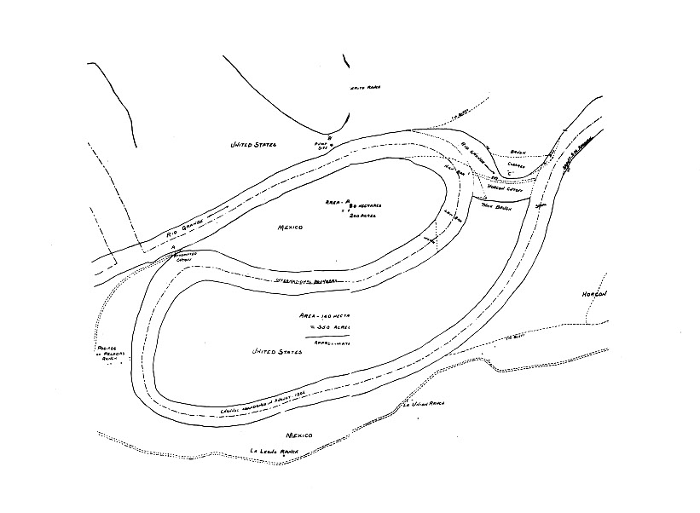
Horcon Cut-off. (Text, 286.)
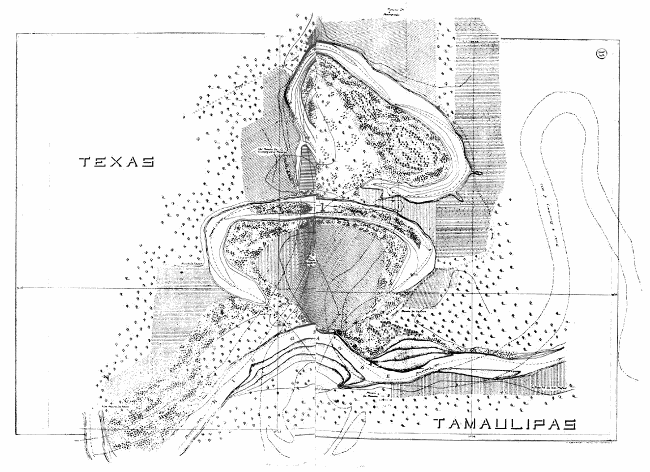
Banco de San Margarita. (Text, 283.)
Further to illustrate the work of the Commission, I call attention to Chamizal case at El Paso, Texas. The Chamizal tract is a body of land of some 600 acres south of the channel of the Rio Grande as it ran when surveyed by Emory and Salazar in 1853 and north of the present river channel. In 1894 the Chamizal case was referred by the Mexican Foreign Office to the Commission on the complaint of one Garcia, a Mexican citizen, who claimed to own land in the Chamizal tract which had been cut off from his holdings on the Mexican side by the change in the course of the river.
The question at issue, under the provisions of the boundary treaties, as formulated by the American Commissioner and accepted by the Mexican Commissioner at the session of the Commission on November 6, 1895, was "whether or not the river in its passage moved over the land by gradual erosion from the Mexican bank and deposited on the United States bank, as described in Article I of the treaty of 1884, or by sudden avulsion, by cutting a new bed or deepening another channel than that which marked the boundary."
The case was tried at El Paso by Commissioner Osorno and myself; Messrs. Maillefert and Happer being the secretaries of the Commission, and Messrs. Corella and Dabney consulting engineers. We limited the witnesses to four of the most trustworthy of the older inhabitants on each side. Their testimony showed there was no basis for any claim that there had been any avulsion or cutting of a new bed. The change in the channel was clearly erosive, although at certain or rather "uncertain" times and places during floods the erosion had been much more rapid than others, and had been visible to the naked eye, since as the lower substratum of sand was washed out, the upper layer of clay along the concave or Mexican bank would cave in, sometimes in considerable chunks. The building up of the convex or American shore, however, had always been imperceptibly gradual.
The Mexican Commissioner reduced his argument to the following syllogism:
"Major proposition: Any change other than slow and gradual does not alter the boundary line (Article I of the Convention of November 12, 1884).
"Minor proposition: Since the change of the river in the case denominated 'El Chamizal' was not slow and gradual, but, on the contrary, violent and at periods of time of unequal intermissions (which has been fully demonstrated above).
"Conclusion: Thence, the change of the river at the lands of 'El Chamizal' does not alter the boundary line marked in 1852 by the International Boundary Commission (Article II of the Convention of 1884)."
I held that the treaty "clearly specifies but two classes of changes in the river," namely, erosive and avulsive, and that "any other unspecified change, as is implied in the major proposition of the syllogism of the Mexican Commissioner, we have no authority to consider, but that our respective conclusions must be in favor of one or the other, as specifically stated in the treaty."
I furthermore held that:
"The syllogism of the Mexican Commissioner must be rejected, not only because its minor proposition is not proven, but because it is abundantly disproven by every witness who testified in the case save Serna."
I further pointed out that in my opinion:
"* * * If the change at El Chamizal has not been 'slow and gradual' by erosion and deposit within the meaning of Article I of the treaty of 1884, there will never be such a one found in all the 800 miles where the Rio Grande, with alluvial banks, constitutes the boundary, and the object of the treaty will be lost to both governments, as it will be meaningless and useless, and the boundary will perforce be through all these 800 miles continuously that laid down in 1852, having literally no points in common with the present river save in its many hundred intersections with the river, and to restore and establish this boundary will be the incessant work of large parties for years, entailing hundreds of thousands of dollars in expense to each government and uniformly dividing the lands between the nations and individual owners, that are now, under the suppositions that for the past forty years the changes have been gradual, and the river accepted generally as the boundary, under the same authority and ownership; for it must be remembered that the river in the alluvial lands, which constitutes 800 miles, has nowhere today the same location it had in 1853."
Commissioner Osorno and I disagreed on the proper construction of the words "slow and gradual, erosion and deposit of alluvium" rather than on matters of fact. No decision could be rendered and the disagreement was reported to our governments, where the matter remained in a diplomatic state until 1910, when it was again referred to the Commission, enlarged for this case only by the appointment of a (presiding) commissioner, a Canadian jurist, to be selected by the two governments. The case was again brought to trial in El Paso in 1911, with the Commission constituted as follows:
Hon. Eugene Lafleur, of Montreal, Canada, Presiding Commissioner.
On the part of Mexico—
F. Beltran y Puga, Commissioner.
E. Zayas, Consulting Engineer.
M. M. Velarde, Secretary.
On the part of the United States—
Anson Mills, Commissioner.
W. W. Follett, Consulting Engineer.
Wilbur Keblinger, Secretary.
The two governments were represented as follows:
On the part of Mexico—
Señor Joaquin de Casasus, Agent.
W. J. White. K. C., of Montreal, Canada, Counsel.
Seymour Thurmond, of El Paso, Associate Counsel.
On the part of the United States—
William C. Dennis, Agent.
Walter B. Grant, of Boston, Mass., Counsel.
Richard F. Burges, of El Paso, Associate Counsel.
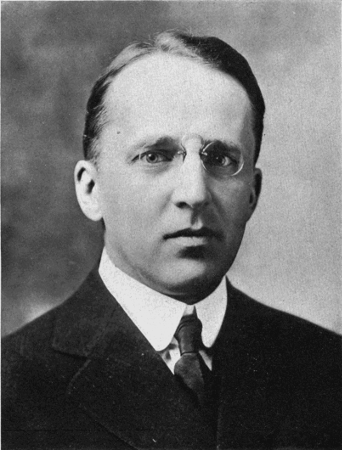
William C. Dennis.
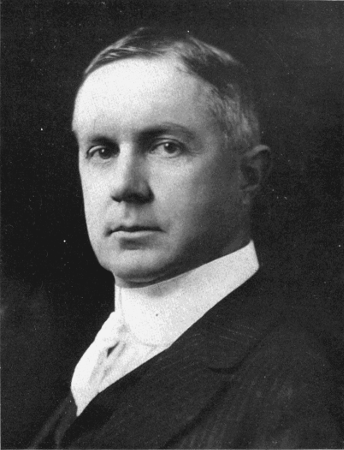
Richard F. Burges.
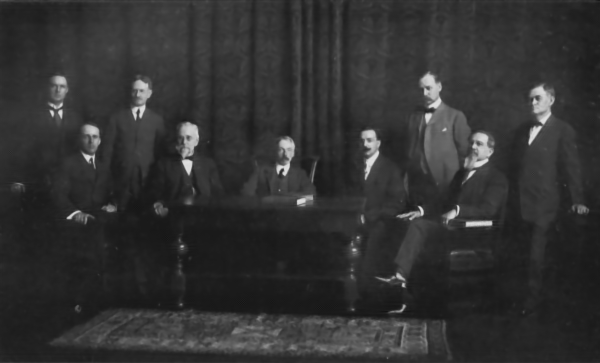
Chamizal Arbitration Commission.
Burges, Dennis, Grant, Mills, La Fleur, Puga, White, Casasus, Thurmond.
In the second trial, Mexico advanced a wholly different theory from that developed in the diplomatic discussions between the first and second trials. Mexico now maintained that the boundary treaties of 1848 and 1853 had laid down a "fixed line" between the two countries in the centers of the channel of the river as surveyed at that time by Commissioners Emory and Salazar, which boundary line remained immutable irrespective of any subsequent change in the course of the river, whether erosive or avulsive, until this was changed for the future by the treaty of 1884. Mexico contended this latter treaty was not retroactive but applied only to river changes taking place after 1884.
Driven to concede that in this view the treaty of 1884 had really no meaning, Mexico insisted the two governments were under a misapprehension when this treaty was negotiated, that it was inoperative and that the general rules of international law governing river boundaries had no application because the Rio Grande was in a technically legal sense not a river at all, but merely an intermittent torrential stream.
The United States denied that the boundary treaties of 1848 and 1853 established a fixed line, and contended the treaty of 1884 was retroactive in any event, and applied to the Chamizal dispute, and that this treaty was merely declaratory of the general rule of international law. Furthermore, the United States claimed the Chamizal tract by prescription.
The case was argued during sessions of the Commission extending over a month. The presiding Commissioner, Mr. Lafleur, rendered an opinion holding squarely against the Mexican contentions with respect to a fixed line and the non-retroactivity and non-applicability of the treaty of 1884. His discussion of these subjects is detailed and masterly. After holding against the American claim based on prescription, he appeared to assume that the treaty of 1884 contemplated some tertium quid aside from erosion and avulsion, which might perhaps be called "violent" erosion and which had the same effect as an avulsive change, namely, to leave the boundary line in the abandoned bed of the river. Applying this latter doctrine he found the erosion at the Chamizal tract from 1852 to 1864 had been gradual within the meaning of the treaty of 1884, and therefore the boundary during this period had followed the river, but that the floods of 1863 brought about a violent erosion, whereby the boundary line was left in the middle of the bed of the river "as it existed before the flood of 1863." He therefore awarded that portion of the tract between the channel of 1852 and the channel of 1864 before the flood, to the United States, and the remainder to Mexico.
The Mexican Commissioner filed a separate opinion dissenting from that part of Mr. Lafleur's opinion relating to the fixed line and the retroactivity and applicability of the treaty of 1884. Overruled on these points, Mr. Puga felt himself justified in joining with the Presiding Commissioner in construing the treaty of 1884 and therefore united in the award dividing the Chamizal tract between the two countries along the line of the river bed as it existed before the flood of 1864.
I filed an opinion dissenting from that portion of the Presiding Commissioner's opinion construing the treaty of 1884. I held the Commission was not empowered by the two governments to divide the Chamizal tract but was called upon to render a clean-cut decision in favor of one or the other government. I recorded my conviction that it would be "as impossible to locate the channel of the Rio Grande in the Chamizal tract in 1864 as to re-locate the Garden of Eden or the lost continent of Atlantis." And finally I pointed out, as I had in 1896, the impossible situation which would arise if any attempt were made to apply the principles of the majority opinion in other cases, concluding as follows:
"The American Commissioner does not believe that it is given to human understanding to measure for any practical use when erosion ceases to be slow and gradual and becomes sudden and violent, but if this difficulty could be surmounted, the practical application of the interpretation could not be viewed in any other light than as calamitous to both nations. Because, as is manifest from the record in this case, all the land on both sides of the river from the Bosque de Cordoba, which adjoins the Chamizal tract, to the Gulf of Mexico (excepting the canyon region), has been traversed by the river since 1852 in its unending lateral movement, and the mass, if not all of that land, is the product of similar erosion to that which occurred at El Chamizal, and by the new interpretation which is now placed upon the Convention of 1884 by the majority of this Commission, not only is the entire boundary thrown into well-nigh inextricable confusion, but the very treaty itself is subjected to an interpretation that makes its application impossible in practice in all cases where an erosive movement is in question.
"The Convention of 1910 sets forth that the United States and Mexico, 'desiring to terminate * * * the differences which have arisen between the two countries,' have determined to refer these differences to this Commission enlarged for this purpose. The present decision terminates nothing; settles nothing. It is simply an invitation for international litigation. It breathes the spirit of unconscious but nevertheless unauthorized compromise rather than of judicial determination."
Of course, I dissented from the award. When the award and the opinions of the three Commissioners were presented at the final session of the Commission, the United States agent made a formal protest on substantially the same grounds I had taken. My dissenting opinion and the protest of the American agent were sustained by the Department of State and the United States has declined to admit the validity of the award. The whole matter has therefore become the subject of diplomatic negotiations, which it is believed are progressing satisfactorily.
It is as much to the interest of Mexico as of the United States to reach an arrangement whereby the Chamizal tract divided from Mexico by the channel of the Rio Grande as it now runs, shall be definitively admitted to be American territory, because it forms an integral part of El Paso, upon which thousands of citizens have their homes.
During my service as Commissioner, Mexico was represented by four Commissioners: Mr. Canalizo, whose death has already been noted; Mr. Osorno, who participated in the first trial of the Chamizal case, and who subsequently resigned; Mr. Jacobo Blanco, who died after serving seven years, and Mr. Fernando Beltran y Puga, who sat at the second trial of the Chamizal case and remained with the Commission until our activity was suspended and he removed from office by the Madero government, leaving me the sole survivor of the four Mexican Commissioners.
These gentlemen were all equal in legal and judicial attainments to similar officials of our own government. They sought always to attain righteous decisions, and I think succeeded in the many cases that came before us.
Of my associates on the American section of the Commission, Messrs. J. A. Happer and Wilbur Keblinger, Secretaries, and P. D. Cunningham and W. W. Follett, Consulting Engineers, deserve special mention. Mr. Cunningham unfortunately lost his life in the service of the Commission through the overturning of his boat in the rapids of the Rio Grande near Eagle Pass in July, 1901. Messrs. Happer, Keblinger and Follett rendered invaluable service during many years, Mr. Follett in spite of a painful illness which would have incapacitated most men for work. Mr. Happer resigned to go into business in El Paso, where he has become a leading citizen. Mr. Follett died shortly after retiring from the Commission. Mr. Keblinger is serving with distinction as United States Consul at Malta.
Our proceedings were published in both languages, and the evidence, maps, plans and monuments were explained not only in scientific but in popular language, so that officials, surveyors, lawyers and judges of each country could readily understand the location of the boundary. (See Volumes 1 and 2, Proceedings Boundary Commission, Treaties of 1884 and 1889, and Equitable Distribution of the Waters of the Rio Grande, Roma to the Gulf, reports and maps, and many other reports on the same subject.)
I have presented copies of all my printed reports and maps and all proceedings published by both governments with respect to the Chamizal Arbitration, to the El Paso Carnegie Library, together with many reports and maps of the Barlow Commission and the Emory Survey, with the understanding that they will be kept as reference books subject to the examination of all interested.
During the sixteen years of our active service (the revolution in Mexico in 1911 having put an end to our activities), the Commission tried over one hundred cases of all kinds, disagreeing only in the Chamizal case, and preserved the peace and quiet of the entire Rio Grande border for these long years to the satisfaction of both governments and the people of the two nations.
Late Saturday afternoon, January 31, 1914, without any previous warning, I received by messenger a letter from Mr. Bryan, the Secretary of State, peremptorily dismissing Mr. Wilbur Keblinger, the Secretary of the American Section of the Commission, and appointing as his successor John Wesley Gaines, a discarded member of Congress, the bare mention of whose name to his former colleagues proved "a source of innocent merriment."
Mr. Gaines presented his appointment as secretary to me on Monday morning, stating he had been appointed associate Mexican boundary commissioner with me, and that he had been directed by Mr. Bryan to act as chairman.
He suggested I turn my books over to him, after the manner of a policeman who seizes a suspected culprit in the hope of finding stolen goods in his possession.
I informed Mr. Gaines that, while I recognized the legality of his appointment as secretary, I had theretofore been allowed to choose the American secretary of the Commission. As I had not asked for him, I told him he could go home and I would send for him when I wanted him in that capacity. I would not acknowledge him as an associate commissioner, as I was the only commissioner authorized by treaty, and told him he could inform the Secretary of State I would have nothing to do with him in that connection or his attempted authority over me as chairman.
Mr. Keblinger and I had already been summoned to appear before the Foreign Affairs Committee of the House at ten a.m. that day. I telephoned the Secretary of State for permission to take Mr. Keblinger with me as the official secretary. Mr. Bryan sent for me (it was the first time I ever saw him) and stated that there was no objection to my taking Mr. Keblinger as an individual, but I could not take him in an official capacity. I protested he had always appeared with me and greatly assisted me in my explanations to the committee; he was an honorable man and I felt the Secretary could not be aware of the great injustice he had done him. I told Mr. Bryan that Keblinger was too proud to appear voluntarily while under such unjust humiliation.
Finally the Secretary announced he might go with me temporarily in an official capacity. He turned upon me, and, "by questions dark and riddles high," charged me with prostituting my high public trust for purposes of private gain.
I told him I had served my government for fifty years as an army officer and in various capacities and in different departments of the government, and under eight of his successive predecessors in office—Secretaries Gresham, Olney, Sherman, Day, Hay, Bacon and Knox—without ever receiving from any one such language, and that I would not submit without resenting it. I invited him to put his best sleuths on my trail. While I was anxious to separate myself from official connection with him, I had been taught in the army it was not honorable to resign under charges. I told him I would not resign until he was able to state that his investigation found nothing wrong in my twenty years' administration under the State Department. I did not believe he could induce the President to dismiss me, and I told him I believed he had been deceived by such men as Dr. Boyd, who, during the administration of nearly all of his eight immediate predecessors had persistently made charges against me verbally, in writing and in published pamphlets. None of the Secretaries under whom I had served had thought it worth while even to notify me officially of these charges. I only learned about them in detail during the latter part of Secretary Knox's administration, when I found Dr. Boyd had several times been investigated by competent officers of the Department. Chief Wilkie, of the Secret Service, had reported him a dangerous man, when he had threatened in writing to horsewhip Secretary Hay. Thereafter he was denied the privilege of personal conferences with the Department.
Notwithstanding these explanations, Mr. Bryan appeared before the Foreign Affairs Committee, with Mr. Gaines, on the 5th. After a two days' hearing, in which I was questioned and cross-questioned regarding all my transactions for twenty years as Commissioner, my hearing closed with the following, which is quoted from the official report of the hearing:
"Gen. Mills: Mr. Chairman, I crave about three minutes, in which I hope to clarify this whole subject.
"I have met you here for the last twenty years. I have met also the committee in the Senate. And I have always been treated with such courteous consideration by the Department of State that I was encouraged to believe that my work was satisfactory, and it was desired that I should continue, especially so as after about sixteen years' service I was selected without solicitation by the Department as a member of a high commission to arbitrate the Chamizal case, and also that my dissenting opinion from a majority of the judges in that case was approved by the Department and by the President in his message, and I believe it is still maintained by the Department that kept me here. Had I considered my own personal convenience I would have resigned long ago. For obvious reasons I intend now to separate myself, if I can do so with honor, from this commission, and shall not have the personal pleasure of meeting you again. I thank you very kindly personally, and as I can not anticipate or hope to meet you again officially, I bid you adieu.
"The Chairman: Gen. Mills, I want to say for the committee that nothing has been done or said by the committee to tend to reflect upon either the character of your work or your intentions in disbursing the funds in your hands.
"Gen. Mills: I appreciate that, sir.
"The Chairman: We all realize that you have done a valuable work down there, and you have done it splendidly, but certain matters developed here that we were not aware of, and that you had been led into by the State Department, and we thought it our duty to investigate them and right them, and no reflection was intended upon you or Mr. Keblinger.
"Gen. Mills: Mr. Chairman, I want to say to one and all of you that I have been treated with the utmost fairness in all of my intercourse. My troubles are not here, but in another direction." (See printed report of the committee, containing sixty-five pages.)
Notwithstanding this absolute acquittal by an American jury—there were twelve members of the committee present, all intensely interested—Dr. Boyd's old charges, rehabilitated by Mr. Bryan's apparent support, led Senator Thomas, of Colorado, to deliver a two days' speech on the floor of the Senate. (See Congressional Record of March 23 and 24, pages 5984 to 6006, inclusive.) He mentioned my name fifty-two times, including such references as "this man Mills," charging me with the most disgraceful conduct with which an American officer can be charged. Called to my attention several days after its delivery, I brought it to Senator Root's notice, asking him to confer with Senator Thomas and see if an amicable adjustment could not be had by Senator Root's explaining I had served under him while he was Secretary of State, and could not be guilty of such misconduct.
Senator Thomas stated he had his information from reliable authority, whereupon Senator Root had my rejoinder published in the Congressional Record. (See pages 13424 to 13426, inclusive, of the Record of July 18, 1914.)
Mr. Thomas replied on the floor of the Senate (see Record, July 20, pages 13479 to 13480, inclusive), admitting he obtained much of his information from Dr. Boyd. He added, "My information comes, however, from the State Department and, until I am satisfied of its incorrectness, I shall insist that my statements are in accord with the facts."
I asked the State Department what their records showed upon the point in question. The matter was handled in the Department by the Honorable John E. Osborne, Assistant Secretary of State. He could have informed himself by a telephone conversation with an accounting officer of the Department. But he referred my letter to Mr. Gaines, who was absent. Followed delay, evasion, equivocation and confusion of the issue, the giving of unsought information about matters not in dispute, and withholding information needed for my defense, which it was the duty of the Department to give.
When finally cornered, after a four months' correspondence, Mr. Osborne wrote me the Department did not know the source of Senator Thomas' information. Mr. Osborne may have deceived himself into thinking that there was technical justification for his statements, but no one who reads the correspondence can have any more doubt as to the real situation than Senator Thomas, or as to the complicity of State Department officials in Senator Thomas' attack upon me.
When I sent the correspondence to the Senator he wrote me as honorable a letter of apology as could be expected, doing his best to let the State Department down easy, presented all the correspondence upon the floor of the Senate and asked for its publication, which will be found on pages 272 to 275, inclusive, of the Record of December 16, 1914.
I cheerfully acquit the Senator of everything except bad judgment. He felt justified by the information he received from officers of the Department to which he, perhaps not unnaturally, gave a credence proportionate to their official status rather than to their actual knowledge.
Mr. Bryan, however, has never offered any explanation. I am reconciled to the situation, believing he could write me nothing I would value in that connection.
The President accepted my resignation on June 24th, to take effect July 1st, on the conditions I stated, that the Department had found no evidence of neglect or wrong-doing on my part.
The President soon restored Mr. Keblinger to official favor. He suspended the regulations governing the Consular Service by executive order, in order to appoint this man, whom Secretary Bryan had summarily dismissed for alleged cause, as United States Consul at Malta, where he is serving with distinction, and where he was recently promoted. His defamers, Bryan, Osborne and Gaines, have returned, voluntarily or otherwise, to private life, while the Department of State is once more in the hands of gentlemen qualified by their training and ability to guide the foreign affairs of a great nation.
Woman's Suffrage
From what has gone before readers will understand that Nannie and I were always fervent advocates of woman's suffrage throughout our lives, and, as far as we could with respect to the popular prejudices of the day, tried to advance it.
Because of my diplomatic service under Secretary of State Gresham, the president of Indiana University, Dr. William Lowe Bryan, honored me with an invitation to the commencement of 1911, and showed me marked courtesy. My friend, Norman Walker, of El Paso, president of the class of 1906, accompanied me from El Paso and introduced me to members of the various classes.
The Indiana University is coeducational; of the 975 students, 231 were young women. Diplomas were given the graduates in the open air in a large sugar tree orchard in the presence of five thousand persons. When the president called the first name, a young lady in graduating garb presented herself. When several more young ladies followed I asked the president if he was calling women first out of courtesy to the sex. "Oh, no," he said, "they are honor graduates." Of the five highest graduates three were women. Asked how this was accounted for, the president said, "Because they are the best students. No one should suspect any partiality is shown them by their instructors. They deserve everything given them." This reinforced me in my lifelong opinion that women, if given an equal chance, were the equal of men in all the essentials of life's successes. I could but think how my mother would have felt if she could have survived to witness that scene, and when I returned home and told Nannie, it encouraged her to take a more prominent part in the cause of woman's rights generally, and especially woman's suffrage.
In February, 1913, a meeting of suffragists was held in Washington. Mrs. Carrie Chapman Catt was our guest, and a very interesting, well informed and courageous advocate of her cause we found her, as well as a most charming woman.
We attended several of their meetings in Washington and aided them materially. The association decided to hold a parade March 3, 1913. Nannie and I were members of the advisory committee, and about ten days before the date set Miss Paul, who had charge of that parade, told me that she was having difficulty in getting permission to march on the avenue. As I was personally acquainted with Mr. Rudolph, General Johnston and Colonel Judson, the District Commissioners, I introduced her to them. They treated her with the greatest courtesy; the chairman, Mr. Rudolph, both encouraged her and expressed his sympathy with her attempt to get permission and secure protection during the march, as did Colonel Judson. General Johnston was a little lukewarm; reasonably so, however, because he was not in favor of woman's suffrage. But they did not grant the permission.
General Johnston objected to the selection of the day before the Presidential inauguration, but others thought if permission was to be granted at all, it was better to have the two parades as near together as possible.
I advised Miss Paul to ask the Secretary of War for military protection from Fort Myer. Judson agreed, and, in his presence, Miss Paul made the application through the District Commissioners to the Secretary. Later she showed me a letter from the Secretary of War, declining to furnish the escort. Although the committee feared the parade would not be protected, most people believed the police would not so disgrace themselves as to fail to protect them from insult and humiliation, or to allow their parade to be broken up, as it practically was. Failing to get the permit from the Commissioners, Miss Paul applied to Congress, and the day before the parade Congress authorized it and made an appropriation for extra policemen. The parade was organized as systematically, as brilliantly and as efficiently as any parade of men ever held.
I believe that on that 3d day of March, 1913, woman's suffrage won its fight. Some of its members have acted foolishly since, as members of reform movements often do, but the day is won, and nothing but absolute reversion to barbarism can prevent women, as long as this country remains a republic, from having some voice in its government.
We both marched in the parade, Nannie with the homemakers. Another army officer, General Charles Morton, U. S. A., had the courage to march with his wife in this procession, as did a few Senators and members of the House. What happened is history. As it is fully related in Hearings Before Senate Committee, District of Columbia, 63d Congress, special session, under Senate Resolution 499, part first, wherein Nannie and I each testified, pages 101 to 116, inclusive, I will not relate it here.
But, notwithstanding the insults and humiliation heaped upon these brave and fearless women to the shame of many of the officials of the government, and particularly the Washington police, it was a proud day for women. Probably no marcher has ever regretted her participation in that parade, but is still proud.
Nannie enjoyed the victory to the utmost. While she continued to assist the society, she felt that the day of battle was past, and the problem would work out by the common sense of the men and women of this country, as it will.
"Be shame to him of woman born, Who hath for such but thought of scorn."
It is remarkable that up to this time no candidate for President ever admitted any sympathy with woman's suffrage. Since that date, no candidate for President has failed boldly to announce (I hope sincerely) that he was whole-heartedly in favor of woman's suffrage. And I believe that in the future no candidate will fail to make this declaration.
Prohibition
Another cause in which Nannie and I were enthusiastic was that of prohibition, to restrain the intemperate use of intoxicants. We always kept liquor in the house and often offered it to guests, but we early learned to exclude it from the table when very young officers were present, because such an example might encourage them to form habits which they later would not be able to restrain. Unfortunately, Congress and the War Department authorized the canteen, an organization formed by the officers of military posts. Originally intended to dispense only such articles as were not furnished the soldier in the ration, clothing, and other allowances, it gradually came to dispense the strongest beverages, sometimes of a very poor and dangerous quality. Throughout the country, especially in States having anti-liquor laws, hostility to this privilege awarded to the army grew generally. Strong efforts were made to have Congress prohibit the canteen on the ground that the young soldiers, entering to buy ordinary supplies would be brought into the presence of comrades indulging in liquor and thus induced to participate.
The War Department ordered that the selling of beverages should be conducted in a separate room from that of other goods. This rule, however, was not generally obeyed. Politicians, employed by the liquor interests to circumvent the action which they feared Congress would take, would apply to the War Department to send circulars to officers of prominence asking his opinion as to whether it was to the interest of the army to allow the sale of beverages. The liquor interests selected copies of many favorable reports, together with a few of those that mildly objected, and published them throughout the country, carefully suppressing those vigorously opposing the use of liquor in the canteen. The canteen continued authorized for many years after the best judgment of the army decided against it, but Nannie and I both lived to see it entirely abolished, to the great joy and benefit of all save the conscienceless purveyor.
In like manner the highly taxed traffic was allowed among the people long after public sentiment disapproved of it, but thanks to the intelligence of Americans and the free discussion of the subject, Nannie and I lived to see it suppressed throughout much of our land. That it will soon disappear entirely, not only from this country, but from the whole world, seems assured.
Trip to Europe With General Miles
As General Miles had previously invited me to go with him to Europe, in 1906 I accepted an invitation to accompany him. We sailed on "La Provence" for France, and spent some two months in France, Ireland, Scotland, England and Switzerland, traveling most of the time by automobile.
Mr. Colgate Hoyt, of New York, president of the American Automobile Society and brother-in-law to General Miles, with his wife and daughters, Elizabeth and Anna, had invited us to accompany them on various journeys in their automobile, and we found them very enjoyable traveling companions.
Our most interesting sojourn was in Dublin, where we met the genial, strange, though interesting race of Irishmen. We were much interested in the jaunting cars, which are to this day the principal passenger vehicles of the cities of Ireland, and exclusively confined to Ireland. Curious to know why they were used there and nowhere else, we inquired, and found that the British Government, in their eagerness to collect all the taxes they could from such properties, levied a tax on vehicles per wheel, and on domiciles for window panes. To avoid this, the stubborn Irishmen would use nothing but two-wheeled vehicles and, unfortunately, they would put just as few panes of glass in their houses as possible, and this custom is carried out there to this day. The jaunting car, while not presenting to one unacquainted with it a very enticing invitation to ride, is, after all, when you become used to it, a very interesting vehicle, and General Miles and I invariably rode in them.
Our visit was at the time of the horse show and, being cavalrymen, we were interested in the exhibition and racing of the animals.
From Dublin we were invited by a Mrs. Galt-Smith, who was the owner of an old Irish castle, to visit her, and we spent some days as her guests at Kilwaughter Castle, in the north of Ireland.
Mrs. Galt-Smith took us around her neighborhood and we became acquainted with the peat bogs, which we had never seen before, where a great part of the fuel of the country was taken from dried up peat bogs, and, strange to say, the undried bogs were such that even horses became drowned when they tried to pass over them.
From there, we also visited the "Giant's Causeway," one of the geological curiosities of the world.
We passed from there through Scotland, through the country described by Sir Walter Scott, and saw in Edinburgh what is known as the "King's Inn," a national prison.
We traveled through the western part of Austria, adjoining Switzerland, where we saw the most unhappy people probably then on earth, poor and helpless, surrounded by soldiers on all sides and influenced by priests, who caused them to build wayside shrines at short distances from each other along the roads where the people would pause and make their obeisance to images. So unhappy and ignorant were these people that they would make grimaces at us while riding by in the automobile, and by gesture and physiognomy showed how much they hated those who were better situated than they were.
Returning, we visited London, stopping at the fashionable Carlton Hotel, where the people seemed less isolated from the world than on my former visit, less exalted in their estimate of themselves, and more appreciative of the progressive features of others, having adopted street cars, tunnels, elevators and electric lights, and become themselves personally more cosmopolitan, but they were still loudly English, proud of their Emperor, his empire and his royal family and accompanying dukes and nobles, so amusing to the rest of the intelligent world.
My Cartridge Belt Equipment
The invention, development and manufacture of the woven web ammunition carrier and its accompanying web equipment (which has taken the place of leather throughout the world), was my greatest material achievement. I only regret that they were not designed for construction rather than for destruction.
In 1866 our army adopted the breech-loading rifle with metallic ammunition, comparatively non-perishable by exposure to the elements. The almost cylindrical stem of the cartridge with the projecting flange on its head, made it possible to make a belt with closely fitting cylindrical loops, in which the cartridge was held in place by friction, prevented from dropping through by the flange.
When captain of the 18th Infantry, I equipped my company with my invention, using belts made of leather, with sewed-on leather loops. These did not prove entirely satisfactory. The acid in the leather acted on the copper in the shell, producing verdigris, causing the shells to stick in the belt or, after firing, in the chamber of the gun.
Belts of this character were submitted to every equipment board organized between 1866 and 1879, but so wedded were the authorities to the use of ancestral methods that no board even made favorable mention of my invention. Meanwhile, the cavalry and infantry on active service against Indians adopted these belts of this character, fabricating them themselves.
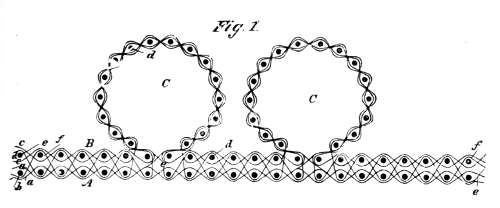
Fig. 1. Longitudinal Section Through Main Web A B, and Two Loops, C C, Showing Warp and Woof Threads.
Fig. 2. Cross Section of Main Fabric, Showing Extra Threads g, in Tube of Selvedge.
Mills Belt, Pattern of 1887.
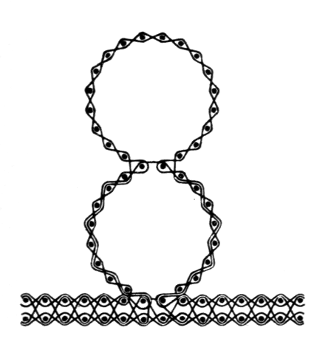
Section Through Double Loop Belt, Showing Continuous Fabric.
Mills Double Loop Belt, Carrying 90 Rounds, Calibre .30.
Mills Nine Pocket Belt, Holding 90 Rounds, Calibre .30.
Mills Infantry Belt, Dismounted. Model of 1910, Ten Pockets, 20 Clips, 100 Rounds, Calibre .30.
Becoming known at Washington, two ordnance inspectors were sent to inspect the equipment of the armies of General Terry and General Crook, confronting the hostile Sioux, in 1876. They reported it was impossible to compel soldiers on the frontier to use the regulation McKeever cartridge boxes, and recommended the manufacture of a uniform belt at arsenals. The Chief of Ordnance approved, and thirty thousand sewed canvas belts were made at Watervliet. Their uniformity and the facility with which they could be procured made them more satisfactory than those previously used, but the loops were still apt to rip and enlarge.
My experience with looms as a boy, gave me the idea of weaving the whole belt, body as well as loops, in one piece without sewing the loops, uniform in size and incapable of ripping or enlarging.
In search for advice as to the feasibility of this plan, I visited the Russell Manufacturing Company, at Middletown, Connecticut, and found Mr. Hubbard in charge.
I asked if he could not help devise a method for weaving the loops on the belt. He told me that thirty years' experience in textile fabrics told him it was utterly impossible, and that I should know that every string had two ends!
"You an army officer?" he asked; "Will you get angry if I give you some good advice?"
"No."
"Do you see that building?" pointing to the insane asylum. "Well, there are smarter men than you right in that building who got there by having just such things as this on their minds too long. I advise you to get it off."
Notwithstanding his advice, I did not get the matter off my mind until I had accomplished my conception.
In 1878 the War Department organized a board of officers consisting of Colonels Miles, McKenzie and Morrow, Major Sandford and Captain Benham, all officers of frontier experience, to consider the best method of carrying the new metallic cartridges.
They reported unanimously in favor of the belt, adding, "In this connection the board is very favorably impressed with the means devised by Major Anson Mills, 10th Cavalry, for weaving the cartridge belt and recommends it for adoption by the Ordnance Department and their manufacture."