THIRD PERIOD (continued 4)
Reading edition
This report was approved by General Benet, Chief of Ordnance; General Sherman, commanding the army, and the Secretary of War.
A few of these belts were made for presentation to the board on a hand loom manipulated by a skilled Scotch weaver, but we found it difficult to produce a web with loops of proper consistency and resilience. In spite of all we could do the web would be more or less fluffy or inconsistent (unable to retain its form), and was not satisfactory. I had more difficulty in producing webbing of proper consistency than in inventing the web belt and a loom to weave it all in the same piece. However, by procuring cotton of the very best fiber, twisted into multiple threads with such hardness of twist that neither the warp nor woof threads would break under a strain of nine pounds each, I finally produced a web with a better consistency and resilience than the best leather itself, notwithstanding the old adage that "there is nothing like leather."
Mr. George Crompton, of Worcester, the textile manufacturer, told me there was no hand machine which could not be duplicated by a power machine. So my next effort was devoted to making a power loom. I visited many textile factories in England, France and Germany, but found nothing to meet my requirements, and in a shop with two assistants I constructed the first loom, in Worcester, in 1879.
The Chief of Ordnance sent his senior officer, Colonel Hagner, to inspect the loom and report whether it was practicable to weave the loops on it. Its work was so satisfactory he recommended the discontinuance of the manufacture of the sewed belts made under his charge at Watervliet.
The Secretary of War adopted the belt for field service, continuing the McKeever box in the garrisons only. On August 24, 1895, the box was permanently abandoned and the belt became universal throughout the army.
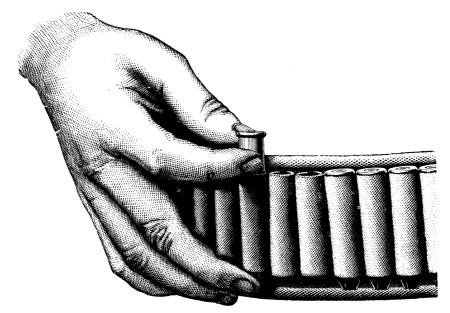
Proper Method of Extracting Cartridges from Loops.
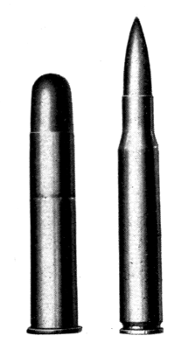
Calibre .45 Compared With Calibre .30 Cartridge.
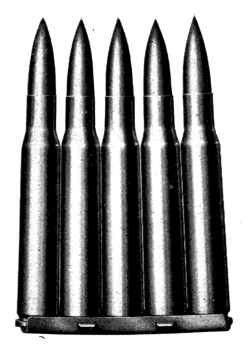
Clip of Five .30 Calibre Cartridges.

Gold Medal Awarded by New Zealand International Exposition, 1882.
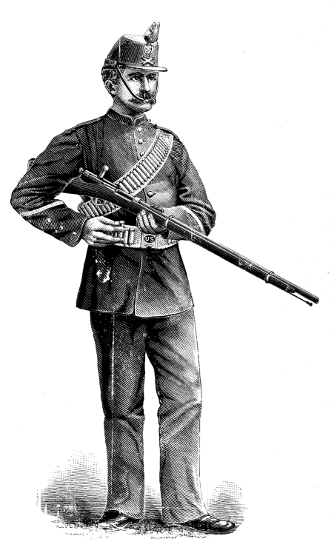
U. S. Infantryman With Mills Equipment of 1887.
Its superiority over all other methods for carrying ammunition are too apparent to need any general description here, but among its practical qualities may be named the easy access, the ready inspection, the instant detection of loss or exhaustion; the expressive martial purpose at sight, important in the suppression of riots, the ease with which it is carried, fitting closely to the body with weight so equally distributed as to lead the soldier almost to feel it a part of his person; the economy in weight and expense, neither being more than the leather belt to which the box, pouches, etc., of other methods were attached.
As an active army officer, I could not contract with the government to manufacture the belt.
On September 22, 1879, I offered, through the Chief of Ordnance, General Benet, to give the invention to the government if he would manufacture the belts in his department, thus advertising its worth to the sporting trade and to other nations. He preferred purchasing the belts in open market. The Gilbert Loom Company, of Worcester, agreed to furnish forty thousand single loop belts, paying me a small royalty. The forty thousand belts supplied the army for five years, so that neither Mr. Gilbert nor I received any large compensation. But we supplied a larger number to the sporting trade for different sized arms, rifles and shotguns, and so had sufficient income to keep the factory going. The Winchester Arms Company had the sole right to sell the sporting goods for five years, yet at the end of that period we received from both sources less money net than I had expended in the twelve years from 1866 to 1878 in perfecting and exploiting my improvements.
The cartridges for army belts were forty-five caliber. More than fifty loops on a belt for an ordinary man were not possible; yet, for rapid fire, it was necessary to have more than fifty cartridges on the person, and it was too cumbersome to carry two belts.
At the expiration of Mr. Gilbert's contract I entered into a contract with my brother-in-law, Mr. T. C. Orndorff, by which he was to devote his entire attention to building up the factory and perfecting the belt. He agreed that by diligent application and industry there was a fortune in the prospective improvements of the web belt and equipments and substitutes for leather, and entered heartily into the spirit of the work. He took over ten looms from Mr. Gilbert and the contract for furnishing the sporting trade from the Winchester Arms Company. I agreed to pay him an annual salary and ten per cent of the net profits. During the first three years, owing to difficulties with the trade and the Winchester Company, there were no profits; indeed, I advanced the factory a large sum of money. But he never lost courage.
Mr. Orndorff employed Captain Henry R. Lemly, U. S. A. (retired), to canvass the South American republics, and he obtained sufficient orders there to increase the net receipts. I was gradually regaining the money invested when the unexpected happened. The difficulty with Spain arose, and, on the passage of the "Fifty Million Bill," we received telegraphic orders from the Chief of Ordnance to equip a factory capable of turning out at least a thousand belts per day. The department wanted three hundred thousand belts as soon as possible. Orndorff contracted for equipping the factory for day and night work at a large expense, for which we had to go into debt.
We had about completed the order, but had delivered only two hundred thousand, when notice was sent that no further belts would be received. The ninety days' war was over! This put us in a practically bankrupt condition, a hundred thousand belts on hand and no market for them, and a large indebtedness. But we had no written contract and could not compel the government to take or pay for the belts.
Two Canadian regiments were assembling at Quebec to leave for South Africa and the Boer War. Orndorff and I concluded to make the two regiments a present of our belts. Hurriedly packing sufficient belts to equip the two regiments, he started for Quebec, October 28, 1899, consigning the shipment to Colonel Otter, commanding the contingent steamship "Sardinia-Quebec."
Arriving two hours before sailing, the colonels commanding the two regiments made much of Orndorff, gave him a dinner, and formally accepted the belts with many thanks in commendation of the "blood that is thicker than water."
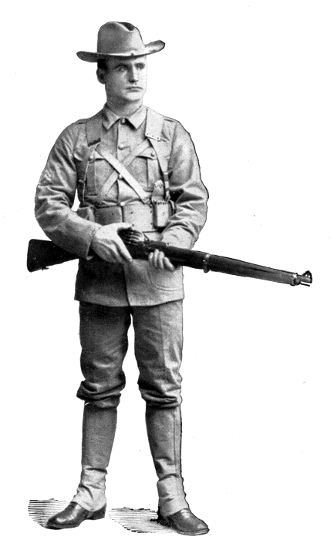
U. S. Infantryman, With Complete Mills Web Equipment, Front View.
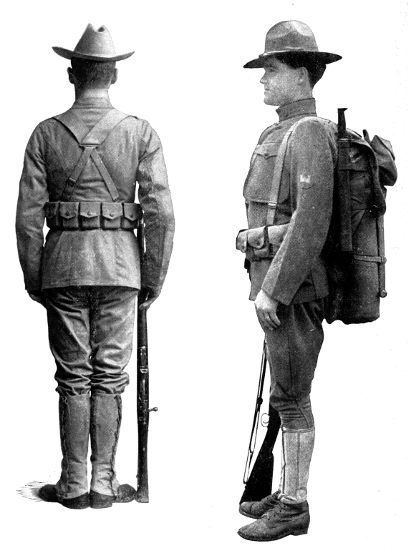
U. S. Infantryman, With Complete Mills Web Equipment, Back and Side Views.
In 1898 Mr. Hiram Maxim, of London, England, manufacturer of the one-pound automatic gun, wanted seamless belts for feeding his gun with large cartridges. He came to our factory, examined the looms and furnished riveted models for Orndorff's guidance.
During this visit I took Mr. Maxim and his wife to the Springfield armory and introduced them to the officers, whom Maxim hoped to get interested in his gun.
Then Maxim contracted with Orndorff to introduce our belts into the British army. Furnished with a number of samples to present for trial, both he and Mrs. Maxim went before the Army Board at Aldershot, of which Colonel Tongue was president, but the British army authorities were so wedded to ancestral methods that he failed in spite of eleven years of effort.
A Mr. Leckie, associated with Maxim, obtained some small orders for belts for the colonial troops in Australia, and Captain Zalinski, a retired artillery officer, tried to sell the belts in Europe, but in spite of energetic efforts, he failed. Orndorff visited Europe and applied at the British War Office before he ever saw Maxim, Leckie or Zalinski, but received no encouragement.
Orndorff bought much cotton yarn from Mr. William Lindsey, of Boston, who became familiar with our belt by visiting General Shaffer's army at Montauk. Seeing an opportunity, Lindsey solicited a contract to manufacture and sell belts to England, with exclusive rights.
We told him we had a tentative agreement with Messrs. Maxim and Leckie and, as they might claim compensation for any orders he might get, we expected him to stand between us and any claims presented by Maxim and Leckie, or either. Lindsey visited England and saw Maxim and Leckie, after which we contracted with Lindsey, binding him to expend a certain sum of money of his own in establishing and promoting the business. We loaned him a loom, furnished a skilled weaver, and sold him sufficient material to keep it going. On October 25, 1899, he sailed for England.
He possessed indomitable energy. Practically all his small fortune was invested in this undertaking of storming the British War Office, an impregnable fortress to most Americans.
The War Office soon learned that the Boers were equipped with our cartridge belt, save that they were sewed. The British troops were being defeated principally by the cumbersome, inadequate and heavy British equipment. By June, 1901, Lindsey had orders to equip the 300,000 British troops in Africa. The equipment gave such satisfaction that the War Office adopted the belt for universal use, and by the end of the year Lindsey established a large factory in London, and small ones in both France and Germany, making his venture as well as ours a complete financial success.
These factories have since been much enlarged, the buildings of the Worcester establishment now covering over two acres of ground.
The United States adopted a new magazine repeating rifle, after the Spanish War, with a thirty caliber cartridge, instead of fifty, but greater in length, necessitating carrying the cartridges in clips of five each. The loop belt was unsuited to cartridges in clips. It was necessary to replace the loops with pockets, carrying one or more clips. A bottom was woven in the pocket to keep the clips from falling through, and a flap was provided to button over the top to hold them in. Orndorff and I invented this belt. The belt usually has nine pockets, containing four clips of five cartridges each, which enables it to carry one hundred and eighty cartridges. When filled, these belts average about ten pounds in weight. It was found necessary to have attached straps, so the weight is partially carried by the shoulders.
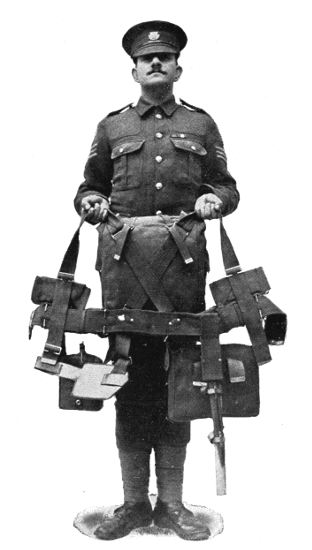
British Infantryman With Mills-Burrowes Web Equipment.
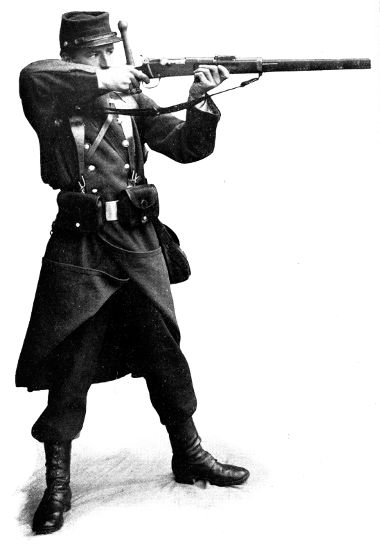
French Infantryman With Mills Web Equipment.
For the marching equipment, we devised full kits of webbing so that no leather appeared in the whole outfit. Knapsack, haversack, and canteen are almost entirely of tightly woven waterproof webbing.
After the Boer War the British Government changed its single-loading rifle to a clip rifle and the double loop belts and bandoleers which Lindsey had manufactured became obsolete. The development of the pocket belt, however, enabled the foreign business to continue with a new product.
I gradually increased Orndorff's interest to thirty per cent of the profits of the business. Our long partnership was never marred by any friction or trouble. He had the harder part, as he had to submit to my dictation, I having the controlling interest. He was one of the most genial men with whom I ever associated.
After twenty-seven years' hard work, his health failed, and in July, 1901, he asked me to buy out his interest. I gave him a sum with which he was more than satisfied. Added to what he had accumulated, he had a competence greater than he needed during the rest of his life. He and his wife moved to Redlands, California, where Nannie and I visited them a year later. He was contented and happy, but he never grew strong again, and died in August, 1905. (Cut, 330.)
Twelve years ago, when I was offered enough for my factory and its good will to enable me to retire with a similar competence, I had the good sense to accept. I have not had one dollar's interest in it since September 11, 1905.
In twenty-seven years we never had a strike, never a serious discontent with any number of our employees, and we retain to this day the loyal good will of those who bought us out. The factory is still known as the Mills Woven Cartridge Belt Company, and my portrait is in the office with a legend telling of the foundation of the factory. Every article they make, now hundreds in number, is labelled and catalogued with my name.
Mr. Frank R. Batchelder, the present manager and sole controller, engaged in service with us in a subordinate capacity twenty years ago. He has made a fortune, which he has faithfully and honestly earned. He is very able and competent and as long as he lives will maintain the name of the factory in all its worth and integrity.
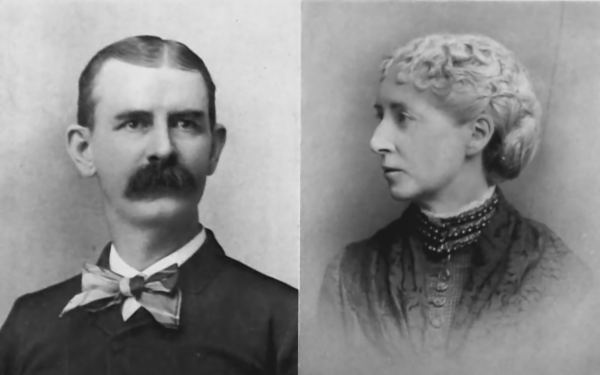
Mr. and Mrs. Thomas C. Orndorff. (Text, 329.)
It has been my good fortune during most of my efforts to associate myself with young men, like Orndorff and Batchelder, of happy, sociable temperaments, able and industrious. I shall always remember them for the earnest, faithful and assiduous manner in which they forwarded my interests and at the same time afforded me a happy association with them socially.
Many connected with these factories at home and abroad are making more out of them than ever I made, but I have no envy. I received more than I expected or deserved, and am perfectly content. I enjoy the reputation more than the money.
To the day of her death, Nannie felt the same gratitude. In fact, it was she who first suggested that I had made enough, and that it was time to stop.
The League to Enforce Peace
On Saturday, May 27, 1916, Nannie and I attended by invitation, the national meeting in Washington of the League to Enforce Peace. Made an honorary vice-president and member of the executive committee, I attended its monthly meetings in New York. Officials of the society asked me to aid it by public speeches or written articles, and the editor of the New York Evening Mail requested my views on the League for publication. I referred a copy of my letter to the Mail, to the President, Mr. Taft, and Dr. Lowell, chairman of the executive committee. It was approved by them for publication over my name as a member of the League, although of course not as an expression of the League itself; President Taft suggested that I send a copy to Secretary Short for publication by the League as a part of its literature, which I did.
After making changes suggested by Dr. Lowell, the article which follows was published by the Mail:
November 28, 1916.
To the Editor of the Evening Mail:
Sir: Your favor has just reached me.
You ask my opinion "as to what should be done at once or in the near future, and what steps should be taken by the League to Enforce Peace to help the national government create an atmosphere wherein the voice of the American people may be heard and heeded."
To the first I answer—Nothing. There are at present, counting Greece, seventeen of the most powerful and civilized nations of the world engaged in the most causeless, vengeful and barbarous of all wars known to history.
There are perhaps actively engaged twenty-five or thirty millions of the most destructive soldiers that ever trod the earth, representing perhaps five hundred millions of the earth's best civilization, whose judgment has "fled to brutish beasts," and nothing this nation or its people can do will change its course or affect its termination one iota.
In fact, we have no remedies for our wrongs, more than a bystander in a street fight, and must bide our time, meanwhile playing the Good Samaritan under difficulties as best we can, leaving the various roads to the various Jerichos devastated and unpoliced.
The art and science of war has so enhanced the means of defense and taken the pomp and circumstance from war that all the world in arms can not again conquer and abjectly subjugate an enlightened, homogeneous and loyal people of fifty millions. This war can be settled only by exhaustion of many years and a truce of perhaps a year to compose many compromises.
We have an example in our own civil war, where England, France and Austria sought to intervene, to their own mortification and regret, and where we (but one nation then as contrasted now with seventeen) were as vengeful as the present combatants; but we were all patriots, and when there came a Lincoln, a Grant and a Lee we learned to know each other better, as in due time these hundreds of millions of the very best, most civilized and most patriotic people of the world will learn to know each other better when they have developed (as they will develop) their Lincolns, Grants and Lees, "with charity for all and malice toward none."
They have "taken many captives home" (perhaps near four millions each in fair proportion), but they can not as of old by slavery "their general coffers fill"; on the contrary, their care and keep will be a great expense and burden. Meanwhile the captives will be learning the language of their foes and earnestly preaching their country's cause and their own patriotism—none entirely without reason.
Our people and nation have much mixed up the preparedness frenzy—appropriating hundreds of millions for the best arms and munitions—paying little heed to the "man behind" them, who also should be the best. They, however, insult his intelligence by offering him $15 a month, while he knows that the nation employs as many policemen as it does soldiers, and pays (the lower grades) from $75 to $100 per month, and as many letter-carriers at similar rates. The soldier is as well worthy of his hire. Statistics show the soldier's pay to be about 14 per cent of the cost of our great wars.
Preparedness will be complete when the private's pay is $50 on entrance and graded upward. This would be less expensive than to "make his trade the trade of all" by universal conscription. Desertions, recruiting stations, guard-houses and courts martial will virtually disappear. The very best and most intelligent single men in the country will qualify and each captain will have a long waiting list of men who will need little training or discipline. We shall have a democratic army from which intelligent and efficient officers can be raised.
There is no such tangible thing as "international law." All real laws are "rules of action" entered into and agreed upon by communities of individual rational and soul-possessing human beings, where each individual surrenders some of his natural rights that greater good may come to the greater number, and where there is a latent police force (subject to call) with a moral environment of its soul-possessing members sufficient to make the call and enforce its mandates.
Without these two elements of the individual human conscience there is no community on earth so civilized and righteously inclined as to be able to conduct in peace and order a prayer-meeting, a bank, a fair or a public game, but with these two elements well developed, what is known as a "gentleman's agreement" could be carried out by the righteous soul-consciousness of public sentiment.
So-called international law has no such elements. Its rules are generally established by powerful nations in great wars who, in dire disaster, for self-preservation disregard and violate previously accepted rules to suit their success and also proclaim new rules not hitherto known or accepted, enforcing them to serve the same ends as far as they have the power, thus establishing precedents, leaving the wronged of the world no remedy against such might-made laws save the might-made remedy of war, and so so-called international law is created, the individual rational soul-possessing human being having no voice in its creation, repeal or enforcement.
These "precedents" are without the two essential elements, "latent police force" and "soulful moral environment," to compel observance. Hence there is no such tangible thing as "international law."
Perhaps the League to Enforce Peace would be in a better position at the close of this war to present its scheme had we adhered to the contribution of General Jackson to so-called international law. In 1818, when General Jackson with a punitive expedition after Creek Indians captured Pensacola, then under Spanish sovereignty, he arrested two British subjects, Ambrister and Arbuthnot (one a British army officer), and tried and executed them for selling arms to the Creek Indians.
This was accepted by England, then the ruling power of the world, and her predecessor, Spain, and approved by the United States.
In this present war it is obvious to all, combatants as well as neutrals, that we are luxuriously feasting on the blood and tears of all the combatants, and to some extent the neutrals. For a long time custom has approved this. Now envy and jealousy on the part of some and a conviction on the part of many that it is unrighteous, is bringing to bear upon us a widespread prejudice which will continue to increase in a progressive ratio until the war ends.
This may impair our efficiency as an advocate of a league to enforce peace.
Now, as to "what steps should be taken by the League to Enforce Peace." I know that it realizes the magnitude of its undertaking; but owing to the great international communication, general intelligence, and common interest of the people of the world, with the opportune conditions we shall have at the termination of the war—perhaps no greater an undertaking than that devolving upon Washington, Jefferson, Franklin and their associates of the convention of the thirteen former free and independent colonies, then thirteen free and independent states.
Their problem was then much as ours is today. That is to say, to form a community of individual states after the methods and manners of the communities of individual men above described, wherein each individual state was to surrender some of its minor natural rights for the greater good of the greater number.
There was then, as there are now, great misgivings and doubts even among ourselves. The rest of the world held, through the despotism of custom, the false doctrine that war was the natural state of man. Academic lawyers and diplomats held, as they do now, that there were "state's rights" and "non-justiciable interstate cases" more potent than the rights of human beings. So that outside America the scheme was ridiculed as visionary and impracticable.
Our people and the colonies (then states) had become so abhorrent of the devastation, blood and tears of a seven years' war that they decided, through the wise men of this convention, that the states would surrender to the general good the few rights "without remedies" they might have and, so to speak, charge them to "profit and loss."
This wise convention surprised the world with a constitution of "league of states" so perfect in all its detail of "legislation," "adjudication" and "execution" (reducing the loss of rights without remedy to the minimum) that for 128 years (with one regrettable exception) the nation had played the Good Samaritan for the natural afflictions of pestilence, flood and famine to all its people of the thirteen states (gradually increased to forty-eight), meanwhile preventing the unnatural afflictions of war and keeping open and well policed all the roads to all the Jerichos within them. In the case of the exception, the force provided proved sufficient and effective to restore order and contentment.
To a rational mind giving the matter reasonable study it is hard to conceive a conclusion other than that similar results may be accomplished with a similar league of the nations of the world.
Anson Mills.
While there were some forty-six members of the executive committee, it was difficult to get a legal quorum of fifteen and there were never more than twenty members present, almost all from New York City or New England. It was in fact a close North Atlantic seaboard corporation.
Believing we could not organize national sentiment in favor of the League's program with so sectional a representation, I moved that the next meeting be held at Kansas City, or some other central location, to obtain a better representation of the sentiments of the whole people. I was refused a vote, but the motion was referred to the committee on management, which smothered it.
At the meetings I attended never more than fifty minutes were devoted to the discussion of an intelligent propaganda solely in the interests of the League, but there was much discussion by a few as to inducing the President, Congress, or both, to intervene in the European war. The efforts a few of us made to declare the League an organization formed to maintain a neutral attitude regarding the European war, so that when peace should come the society might have greater opportunity to carry its righteous propaganda successfully to both victors and vanquished, were uniformly referred to the Committee on Management and never heard of again.
When the United States declared war the few members of the committee present declared the League not neutral but belligerent. My view, expressed in a letter to the Secretary, was that since our Government had accepted the gage of "Trial by Combat" it was the first duty of every American to put forth every energy to attain success, postponing nobler aspirations until flags of truce should be flying from both friends and foes. To that end I suggested we postpone our next meeting until victors and vanquished alike be so prostrated with wretchedness, poverty and shame for their cruelties and barbarities, that they would lend more willing ears to the propaganda we had so much at heart. This course not being taken, I notified the Secretary, that by participating in the war as an organization, the League had in my opinion so destroyed its capacity for good that my further attendance at the Executive Committee meetings could serve no useful purpose. My resignation was accepted.
In my opinion, the League made two serious errors: First, in Article III of its constitution where it excepted "non-justiciable" cases from the control of the proposed league. It is unsafe to devise any law or rule of action which permits of too numerous or too ill-defined exceptions. If criminal law exempted non-justiciable questions from the jurisdiction of courts, no criminal, even the most heartless murderer, could be convicted. The ingenuity of lawyers could always prove some non-justiciable element entered into the crime. The same would be true of nations. Those most powerful and best prepared for war would assume greater latitude in defining what was justiciable and would show less punctiliousness in endeavoring to establish their definition than nations smaller and less well prepared. Statesmen and diplomats working in secret would easily show any question about to lead to war as "non-justiciable" and not to be presented to the international court set up by a league composed of many nations too weak to be respected by the powerful.
The second mistake was to yield, as an organization, to the allurements of "Trial by Combat," and to endeavor, as a league, to induce our nation to intervene in the present war. Members might take this course as individuals, but, when they made it the act of a league for peace they stultified the league, and in my opinion, destroyed any great power for usefulness the league might have in the future.
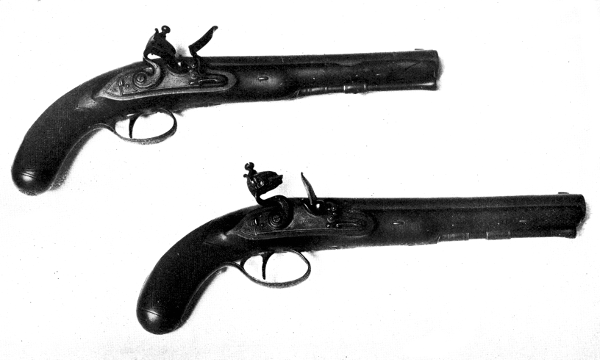
Duelling Pistols Brought from England by Nannie's Great Uncle.