MY FIRST BOOK
Reading edition
THE EXPERIENCES OF
WALTER BESANTR. M. BALLANTYNE
JAMES PAYNI. ZANGWILL
W. CLARK RUSSELLMORLEY ROBERTS
GRANT ALLENDAVID CHRISTIE MURRAY
HALL CAINEMARIE CORELLI
GEORGE R. SIMSJEROME K. JEROME
RUDYARD KIPLINGJOHN STRANGE WINTER
A. CONAN DOYLEBRET HARTE
M. E. BRADDON'Q.'
F. W. ROBINSONROBERT BUCHANAN
H. RIDER HAGGARD ROBERT LOUIS STEVENSON
WITH AN INTRODUCTION BY JEROME K. JEROME AND 185 ILLUSTRATIONS London CHATTO & WINDUS, PICCADILLY 1894
INTRODUCTION CONTENTS LIST OF ILLUSTRATIONS FOOTNOTES
INTRODUCTION
By JEROME K. JEROME
'PLEASE, sir,' he said, 'could you tell me the right time?'
'Twenty minutes to eight,' I replied, looking at my watch.
'Oh,' he remarked. Then added for my information after a pause: 'I haven't got to be in till half-past eight.'
After that we fell back into our former silence, and sat watching the murky twilight, he at his end of the park seat, I at mine.
'And do you live far away?' I asked, lest, he having miscalculated, the short legs might be hard put to it.
'Oh no, only over there,' he answered, indicating with a sweep of his arm the northern half of London where it lay darkening behind the chimney-fringed horizon; 'I often come and sit here.'
It seemed an odd pastime for so very small a citizen. 'And what makes you like to come and sit here?' I said.
'Oh, I don't know,' he replied, 'I think.'
'And what do you think about?'
'Oh—oh, lots of things.'
He inspected me shyly out of the corner of his eye, but, satisfied apparently by the scrutiny, he sidled up a little nearer.
'Mama does not like this evening time,' he confided to me; 'it always makes her cry. But then,' he went on to explain, 'Mama has had a lot of trouble, and that makes anyone feel different about things, you know.'
I agreed that this was so. 'And do you like this evening time?' I enquired.
'Yes,' he answered; 'don't you?'
'Yes, I like it too,' I admitted. 'But tell me why you like it, then I will tell you why I like it.'
'Oh,' he replied, 'things come to you.'
'What things?' I asked.
Again his critical eye passed over me, and it raised me in my own conceit to find that again the inspection contented him, he evidently feeling satisfied that here was a man to whom another gentleman might speak openly and without reserve.
He wriggled sideways, slipping his hands beneath him and sitting on them.
'Oh, fancies,' he explained; 'I'm going to be an author when I grow up, and write books.'
Then I knew why it was that the sight of his little figure had drawn me out of my path to sit beside him, and why the little serious face had seemed so familiar to me, as of some one I had once known long ago.
So we talked of books and bookmen. He told me how, having been born on the fourteenth of February, his name had come to be Valentine, though privileged parties, as for example Aunt Emma, and Mr. Dawson, and Cousin Naomi, had shortened it to Val, and Mama would sometimes call him Pickaniny, but that was only when they were quite alone. In return I confided to him my name, and discovered that he had never heard it, which pained me for the moment, until I found that of all my confrères, excepting only Mr. Stevenson, he was equally ignorant, he having lived with the heroes and the heroines of the past, the new man and the new woman, the new pathos and the new humour being alike unknown to him.
Scott and Dumas and Victor Hugo were his favourites. 'Gulliver's Travels,' 'Robinson Crusoe,' 'Don Quixote,' and the 'Arabian Nights,' he knew almost by heart, and these we discussed, exchanging many pleasant and profitable ideas upon the same. But the psychological novel, I gathered, was not to his taste. He liked 'real stories,' he told me, naïvely unconscious of the satire, 'where people did things.'
'I used to read silly stuff once,' he confessed humbly, 'Indian tales and that sort of thing, you know, but Mama said I'd never be able to write if I read that rubbish.'
'So you gave it up,' I concluded for him.
'Yes,' he answered. But a little sigh of regret, I thought, escaped him at the same time.
'And what do you read now?' I asked.
'I'm reading Marlowe's plays and De Quincey's Confessions (he called him Quinsy) just now,' was his reply.
'And do you understand them?' I queried.
'Fairly well,' he answered. Then added more hopefully, 'Mama says I'll get to like them better as I go on.'
'I want to learn to write very, very well indeed,' he suddenly added after a long pause, his little earnest face growing still more serious, 'then I'll be able to earn heaps of money.'
It rose to my lips to answer him that it was not always the books written very, very well that brought in the biggest heaps of money; that if heaps of money were his chiefest hope he would be better advised to devote his energies to the glorious art of self-advertisement and the gentle craft of making friends upon the Press. But something about the almost baby face beside me, fringed by the gathering shadows, silenced my middle-aged cynicism. Involuntarily my gaze followed his across the strip of foot-worn grass, across the dismal-looking patch of ornamental water, beyond the haze of tangled trees, beyond the distant row of stuccoed houses, and, arrived there with him, I noticed many men and women clothed in the garments of all ages and all lands, men and women who had written very, very well indeed and who notwithstanding had earned heaps of money, the hire worthy of the labourer, and who were not ashamed; men and women who had written true words which the common people had read gladly; men and women who had been raised to lasting fame upon the plaudits of their day; and before the silent faces of these, made beautiful by Time, the little bitter sneers I had counted truth rang foolish in my heart, so that I returned with my young friend to our green seat beside the foot-worn grass, feeling by no means so sure as when I had started which of us twain were the better fitted to teach wisdom to the other.
'And what would you do, Valentine, with heaps of money?' I asked.
Again for a moment his old shyness of me returned. Perhaps it was not quite a legitimate question from a friend of such recent standing. But his frankness wrestled with his reserve and once more conquered.
'Mama need not do any work then,' he answered. 'She isn't really strong enough for it, you know,' he explained, 'and I'd buy back the big house where she used to live when she was a little girl, and take her back to live in the country—the country air is so much better for her, you know—and Aunt Emma, too.'
But I confess that as regards Aunt Emma his tone was not enthusiastic.
I spoke to him—less dogmatically than I might have done a few minutes previously, and I trust not discouragingly—of the trials and troubles of the literary career, and of the difficulties and disappointments awaiting the literary aspirant, but my croakings terrified him not.
'Mama says that every work worth doing is difficult,' he replied, 'and that it doesn't matter what career we choose there are difficulties and disappointments to be overcome, and that I must work very hard and say to myself "I will succeed," and then in the end, you know, I shall.'
'Though of course it may be a long time,' he added cheerfully.
Only one thing in the slightest daunted him, and that was the weakness of his spelling.
'And I suppose,' he asked, 'you must spell very well indeed to be an author.'
I explained to him, however, that this failing was generally met by a little judicious indistinctness of caligraphy, and all obstacles thus removed, the business of a literary gent seemed to him an exceptionally pleasant and joyous one.
'Mama says it is a noble calling,' he confided to me, 'and that anyone ought to be very proud and glad to be able to write books, because they give people happiness and make them forget things, and that one ought to be awfully good if one's going to be an author, so as to be worthy to help and teach others.'
'And do you try to be awfully good, Valentine?' I enquired.
'Yes,' he answered; 'but it's awfully hard, you know. I don't think anybody could ever be quite good—until,' he corrected himself, 'they were grown up.'
'I suppose,' he added with a little sigh, 'it's easy for grown-up people to be good.'
It was my turn to glance suspiciously at him, this time wondering if the seeds of satire could have taken root already in that tiny brain. But his eyes met mine without flinching, and I was not loath to drift away from the point.
'And what else does your Mama say about literature, Valentine?' I asked. For the strangeness of it was that, though I kept repeating under my breath 'Copy-book maxims, copy-book maxims,' hoping by such shibboleth to protect myself from their influence, the words yet stirred within me old childish thoughts and sentiments that I, in my cleverness, had long since learnt to laugh at, and had thought forgotten. I, with my years of knowledge and experience behind me, seemed for the nonce to be sitting with Valentine at the feet of this unseen lady, listening, as I again told myself, to 'copy-book maxims' and finding in them in spite of myself a certain element of truth, a certain amount of helpfulness, an unpleasant suggestion of reproach.
He tucked his hands underneath him, as before, and sat swinging his short legs.
'Oh—oh lots of things,' he answered vaguely.
'Yes?' I persisted.
'Oh, that—' he repeated it slowly, recalling it word for word as he went on, 'that he who can write a great book is greater than a king; that a good book is better than a good sermon; that the gift of being able to write is given to anybody in trust, and that an author should never forget that he is God's servant.'
I thought of the chatter of the clubs, and could not avoid a smile. But the next moment something moved me to take his hand in mine, and, turning his little solemn face towards mine, to say:
'If ever there comes a time, little man, when you are tempted to laugh at your mother's old-fashioned notions—and such a time may come—remember that an older man than you once told you he would that he had always kept them in his heart, he would have done better work.'
Then growing frightened at my own earnestness, as we men do, deeming it, God knows why, something to be ashamed of, I laughed away his answering questions, and led the conversation back to himself.
'And have you ever tried writing anything?' I asked him.
Of course he had, what need to question! And it was, strange to say, a story about a little boy who lived with his mother and aunt, and who went to school.
'It is sort of,' he explained, 'sort of auto—bio—graphical, you know.'
'And what does Mama think of it?' was my next question, after we had discussed the advantages of drawing upon one's own personal experiences for one's material.
'Mama thinks it is very clever—in parts,' he told me.
'You read it to her?' I suggested.
'Yes,' he acknowledged, 'in the evening, when she's working, and Aunt Emma isn't there.'
The room rose up before me, I could see the sweet-faced lady in her chair beside the fire, her white hands moving to and from the pile of sewing by her side, the little flushed face of the lad bending over his pages written in sprawling schoolboy hand. I saw the love light in her eyes as every now and then she stole a covert glance across at him, I heard his childish treble rising and falling, as his small finger moved slowly down the sheet.
Suddenly it said, a little more distinctly:
'Please, sir, could you tell me the time?'
'Just over the quarter, Valentine,' I answered, waking up and looking at my watch.
He rose and held out his hand.
'I didn't know it was so late,' he said, 'I must go now.'
But as our hands met another question occurred to him.
'Oh,' he exclaimed, 'you said you'd tell me why you liked to come and sit here of an evening, like I do. Why?'
'So I did, Valentine,' I replied, 'but I've changed my mind. When you are a big man, as old as I am, you come and sit here and you'll know. But it isn't so pleasant a reason as yours, Valentine, and you wouldn't understand it. Good-night.'
He raised his cap with an old-fashioned courtesy and trotted off, looking however a little puzzled. Some distance down the path, he turned and waved his hand to me, and I watched him disappear into the twilight.
I sat on for a while, thinking many thoughts, until across the rising mist there rang a hoarse, harsh cry, 'All out, All out,' and slowly I moved homeward.
CONTENTS
PAGE
READY-MONEY MORTIBOY. By Walter Besant3
THE FAMILY SCAPEGRACE. By James Payn15
THE WRECK OF THE 'GROSVENOR.' By W. Clark29
PHYSIOLOGICAL ÆSTHETICS AND PHILISTIA. By Grant Allen43
THE SHADOW OF A CRIME. By Hall Caine53
THE SOCIAL KALEIDOSCOPE. By George R. Sims75
DEPARTMENTAL DITTIES. By Rudyard Kipling91
JUVENILIA. By A. Conan Doyle99
THE TRAIL OF THE SERPENT. By M. E. Braddon109
THE HOUSE OF ELMORE. By F. W. Robinson123
DAWN. By H. Rider Haggard135
HUDSON'S BAY. By R. M. Ballantyne151
THE PREMIER AND THE PAINTER. By I. Zangwill163
THE WESTERN AVERNUS. By Morley Roberts181
A LIFE'S ATONEMENT. By David Christie Murray193
A ROMANCE OF TWO WORLDS. By Marie Corelli206
ON THE STAGE AND OFF. By Jerome K. Jerome221
CAVALRY LIFE. By 'John Strange Winter' (Mrs. Arthur Stannard)239
CALIFORNIAN VERSE. By Bret Harte257
DEAD MAN'S ROCK. By 'Q.'269
UNDERTONES and IDYLS AND LEGENDS OF INVERBURN. By Robert Buchanan283
TREASURE ISLAND. By Robert Louis Stevenson297
LIST OF ILLUSTRATIONS
The images may be view enlarged by clicking on them. (note of ebooks transcriber.)
PAGE
Jerome K. JeromeFrontispiece
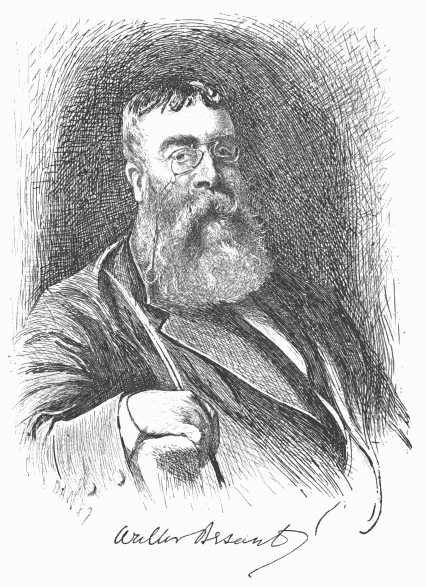
Walter Besant2
James Rice5
Julia7
Mr. Besant's Study9
The Oyster Shop12
A Book Plate13
A Wicked Sister16
James Payn17
It 'took off' from his Shoulder18
Mr. Payn's Study19
Count Gotsuchakoff21
'Would you mind just Reading a Bit of it?'22
The Servant came to put Coals on the Fire23
Mr. Payn's Office at Waterloo Place24
Killed by Lions25
Clark Russell28
Clark Russell as a Midshipman of Seventeen29
I was a Child of Thirteen30
Neatby31
Anchored in the Downs32
Some of the Crew33
The Magistrates34
The Wreck of the 'Grosvenor'35
Mrs. Clark Russell37
The Boatswain of the 'Grosvenor'38
The 'Hougoumont'39
Poor Jack!40
Grant Allen42
Fiction44
Science45
Andrew Chatto49
A Shelf in the Study50
'Thank you, sir'51
I left it54
Hall Caine55
My MS. went Sprawling over the Table56
Derwentwater57
Sty Head Pass58
Wastwater from Sty Head Pass59
The Horse broke away60
Something strapped on its Back61
The Castle Rock, St. John's Vale62
Thirlmere63
Rossetti walking to and fro64
Dante Gabriel Rossetti65
Mr. Hall Caine in his Study68
Mrs. Hall Caine69
Coming up in the Train71
12 Clarence Terrace75
The Hall76
George R. Sims77
George R. Sims78
The 'Social Kaleidoscope'79
The Snuggery80
Mr. Sims's 'Little Dawg'81
The Dining-room82
The Library83
'Sir Hugo'84
The Balcony85
'Beauty,' an old Favourite, Twenty Years old86
The Drawing-room87
'Faust up to Date'88
Mr. Sims's Dinner Party89
The Newspaper Files91
'Your Potery very good, sir; just coming proper Length to-day.'92
Rudyard Kipling93
Sung to the Banjoes round Camp Fires96
Departmental Ditties97
A. Conan Doyle98
I was Six99
On the Prairies and the Oceans100
My Début as a Story-teller101
'With the Editor's Compliments'102
'Have you seen what they say about you?'103
'Mrs. Thurston's little Boy Wants To See You, Doctor'105
Mr. Andrew Lang107
Lichfield House, Richmond110
The Hall111
The Dining-room112
The Drawing-room113
The Evening-room115
The Smoking-room116
The Library117
Miss Braddon's favourite Mare119
The Orangery120
Miss Braddon's Cottage at Lyndhurst121
Miss Braddon's Inkstand122
At Twenty124
F. W. Robinson125
Elmore House126
At Thirty127
Mr. Robinson's Library128
The Garden129
The Drawing-room130
At Forty131
Mr. Robinson at Work132
H. Rider Haggard134
The Front Garden135
Mr. Rider Haggard and his Daughters137
The Hall139
Mr. Rider Haggard's Study141
Some Curios143
A Study Corner145
Mr. Rider Haggard147
The Farm149
Where I wrote my First Book151
R. M. Ballantyne153
Mr. Ballantyne's House at Harrow155
Trophies from Mr. Ballantyne's Travels157
The Study159
Mr. R. M. Ballantyne161
Looking for Toole164
I. Zangwill165
I sat down and wrote something166
Arthur Goddard167
It was hawked about the Streets168
A Policeman told him to get down169
Such Stuff as Little Boys scribble upon Walls171
Life in Bethnal Green173
We sent it round175
Mr. Zangwill at Work177
Editing a Comic Paper178
A Fame less widespread than a Prizefighter's179
Mr. Morley Roberts180
Before the Mast181
I Married them all off at the End182
An American Saw-mill where Mr. Roberts worked183
Defying the Universe185
Cowboy Roberts186
The very Prairie Dogs taught me187
The California Coast Range189
By the Camp Fire190
D. Christie Murray192
I handed him Two Chapters194
I sent all my People into a Coal-mine195
They invested him with the Medal197
Consulting old Almanacs199
She drew from it a Brown-paper Parcel201
If there had been no 'David Copperfield'202
The Stock was transferred203
Some Novels204
The Drawing-room209
The Library211
The Study213
Facsimile of Marie Corelli's MS. as prepared for the Press217
My First-born222
Jerome K. Jerome223
'He and you had to carry Lisa Weber across the Stage'226
That Brilliant Idea227
I hated the dismal little 'slavey'230
The Study231
I am remembering234
Mr. Jerome K. Jerome237
Three Soldiers and a Pig239
John Strange Winter241
Mr. Arthur Stannard243
'The Firm' considering246
He Squinted!247
Miss Stannard248
'The Twins'—Bootles and Betty249
Long-legged Soldiers251
Cavalry Life253
I took up the 'Saturday Review'255
Bret Harte256
We settled to our Work258
A Circulation it had never known before259
'Consider them at your Service'261
I was inwardly relieved263
The Book sold tremendously265
A. T. Quiller Couch268
'Q.' Junior269
'The Haven,' Fowey273
Mr. and Mrs. Quiller Couch275
Fowey Grammar School Crew and Mr. Quiller Couch277
The old Study279
Mr. and Mrs. Quiller Couch in a Canadian Canoe281
Robert Buchanan285
Mr. Buchanan's House287
The Study291
Mr. Robert Buchanan and his favourite Dog295
Robert Louis Stevenson299
Mr. Stevenson's House in Samoa301
Mrs. R. L. Stevenson305
Stevenson telling 'Yarns'307