MY FIRST BOOK (continued 4)
Reading edition
Of the mechanical part of my work there is little to say. I write every day from ten in the morning till two in the afternoon, alone and undisturbed, save for the tinpot tinkling of unmusical neighbours' pianos, and the perpetual organ-grinding which is freely permitted to interfere ad libitum with the quiet and comfort of all the patient brain-workers who pay rent and taxes in this great and glorious metropolis. I generally scribble off the first rough draft of a story very rapidly in pencil; then I copy it out in pen and ink, chapter by chapter, with fastidious care, not only because I like a neat manuscript, but because I think everything that is worth doing at all is worth doing well; and I do not see why my publishers should have to pay for more printers' errors than the printers themselves make necessary. I find, too, that in the gradual process of copying by hand, the original draft, like a painter's first sketch, gets improved and enlarged. No one sees my manuscript before it goes to press, as I am now able to refuse to submit my work to the judgment of 'readers.' These worthies treated me roughly in the beginning, but they will never have the chance again. I correct my proofs myself, though I regret to say my instructions and revisions are not always followed. In my novel 'Wormwood' I corrected the French article 'le chose' to 'la chose' three times, but apparently the printers preferred their own French, for it is still 'le chose' in the 'Favorite' edition, and the error is stereotyped. In accordance with the arrangement made by Mr. George Bentley for my first book, I retain to myself sole possession of all my copyrights, and as all my novels are successes, the financial results are distinctly pleasing. America, of course, is always a thorn in the side of an author. The 'Romance,' 'Vendetta,' 'Thelma' and 'Ardath' were all 'pirated' over there before the passing of the American Copyright Act, it being apparently out of Messrs. Bentley & Son's line to make even an attempt to protect my rights. After the Act was passed, I was paid a sum for 'Wormwood,' and a larger sum for 'The Soul of Lilith,' but, as everyone knows, the usual honorarium offered by American publishers for the rights of a successful English novel are totally inadequate to the sales they are able to command. American critics, however, have been very good to me. They have at least read my books before starting to review them, which is a great thing. I have always kept my 'Tauchnitz' rights, and very pleasant have all my dealings been with the courteous and generous Baron. All wanderers on the Continent love the 'Tauchnitz' volumes—their neatness, handy form, and remarkably clear type give them precedence over every other foreign series. Baron Tauchnitz pays his authors excellently well, and takes a literary as well as commercial interest in their fortunes.
FACSIMILE OF MARIE CORELLI'S MS. AS PREPARED FOR THE PRESS A page of the "Romance of Two Worlds"
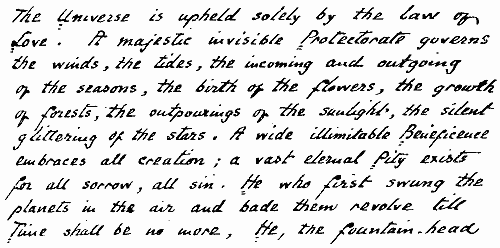
Perhaps one of the pleasantest things connected with my 'success' is the popularity I have won in many quarters of the Continent without any exertion on my own part. My name is as well known in Germany as anywhere, while in Sweden they have been good enough to elect me as one of their favourite authors, thanks to the admirable translations made of all my books by Miss Emilie Kullmann, of Stockholm, whose energy did not desert her even when she had so difficult a task to perform as the rendering of 'Ardath' into Swedish. In Italy and Spain 'Vendetta,' translated into the languages of those countries, is popular. Madame Emma Guarducci-Giaconi is the translator of 'Wormwood' into Italian, and her almost literal and perfect rendering has been running as the feuilleton in the Florentine journal, La Nazione, under the title 'L'Alcoolismo: Un Dramma di Parigi.' The 'Romance of Two Worlds' is to be had in Russian, so I am told; and it will shortly be published at Athens, rendered into modern Greek. While engaged in writing this article, I have received a letter asking for permission to translate this same 'Romance' into one of the dialects of North-west India, a request I shall very readily grant. In its Eastern dress the book will, I understand, be published at Lucknow. I may here state that I gain no financial advantage from these numerous translations, nor do I seek any. Sometimes the translators do not even ask my permission to translate, but content themselves with sending me a copy of the book when completed, without any word of explanation.
And now to wind up; if I have made a name, if I have made a career, as it seems I have, I have only one piece of pride connected with it. Not pride in my work, for no one with a grain of sense or modesty would, in these days, dare to consider his or her literary efforts of much worth, as compared with what has already been done by the past great authors. My pride is simply this: that I have fought my fight alone, and that I have no thanks to offer to anyone, save those legitimately due to the publisher who launched my first book, but who, it must be remembered, would, as a good business man, have unquestionably published nothing else of mine had I been a failure. I count no 'friend on the Press,' and I owe no 'distinguished critic' any debt of gratitude. I have come, by happy chance, straight into close and sympathetic union with my public, and attained to independence and good fortune while still young and able to enjoy both. An 'incomprehensibly successful' novelist I was called last summer by an irritated correspondent of Life, who chanced to see me sharing in the full flow of pleasure and social amusement during the 'season' at Homburg. Well, if it be so, this 'incomprehensible success' has been attained, I rejoice to say, without either 'log-roller' or 'boom,' and were I of the old Greek faith, I should pour a libation to the gods for giving me this victory. Certainly I used to hope for what Britishers aptly call 'fair play' from the critics, but I have ceased to expect that now. It is evidently a delight to them to abuse me, else they would not go out of their way to do it; and I have no wish to interfere with either their 'copy' or their fun. The public are beyond them altogether. And Literature is like that famous hill told of in the 'Arabian Nights,' where threatening anonymous voices shouted the most deadly insults and injuries to anyone who attempted to climb it. If the adventurer turned back to listen, he was instantly changed into stone; but if he pressed boldly on, he reached the summit and found magic talismans. Now I am only at the commencement of the journey, and am ascending the hill with a light heart and in good humour. I hear the taunting voices on all sides, but I do not stop to listen, nor have I once turned back. My eyes are fixed on the distant peak of the mountain, and my mind is set on arriving there if possible. My ambition may be too great, and I may never arrive. That is a matter for the fates to settle. But, in the meanwhile, I enjoy climbing. I have nothing to grumble about. I consider Literature the noblest Art in the world, and have no complaint whatever to urge against it as a profession. Its rewards, whether great or small, are sufficient for me, inasmuch as I love my work, and love makes all things easy.
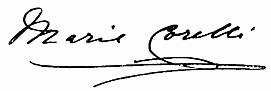
Note.—Since writing the above I have been asked to state whether, in my arrangements for publishing, I employ a 'literary agent' or use a 'type-writer.' I do not. With regard to the first part of the query, I consider that authors, like other people, should learn how to manage their own affairs themselves, and that when they take a paid agent into their confidence, they make open confession of their business incapacity, and voluntarily elect to remain in foolish ignorance of the practical part of their profession. Secondly, I dislike type-writing, and prefer to make my own MS. distinctly legible. It takes no more time to write clearly than in spidery hieroglyphics, and a slovenly scribble is no proof of cleverness, but rather of carelessness and a tendency to 'scamp' work.
'ON THE STAGE AND OFF'
By JEROME K. JEROME
THE story of one's 'first book' I take to be the last chapter of one's literary romance. The long wooing is over. The ardent young author has at last won his coy public. The good publisher has joined their hands. The merry critics, invited to the feast of reason, have blessed the union, and thrown the rice and slippers—occasionally other things. The bridegroom sits alone with his bride, none between them, and ponders.
The fierce struggle, with its wild hopes and fears, its heart-leapings and heart-achings, its rose-pink dawns of endless promise, its grey twilights of despair, its passion and its pain, lies behind. Before him stretches the long, level road of daily doing. Will he please her to all time? Will she always be sweet and gracious to him? Will she never tire of him? The echo of the wedding-bells floats faintly through the darkening room. The fair forms of half-forgotten dreams rise up around him. He springs to his feet with a slight shiver, and rings for the lamps to be lighted.
Ah! that 'first book' we meant to write! How it pressed forward an oriflamme of joy, through all ranks and peoples; how the world rang with the wonder of it! How men and women laughed and cried over it! From every page there leaped to light a new idea. Its every paragraph scintillated with fresh wit, deep thought, and new humour. And, ye gods! how the critics praised it! How they rejoiced over the discovery of the new genius! How ably they pointed out to the reading public its manifold merits, its marvellous charm! Aye, it was a great work, that book we wrote as we strode laughing through the silent streets, beneath the little stars.
And, heigho! what a poor little thing it was, the book that we did write! I draw him from his shelf (he is of a faint pink colour, as though blushing all over for his sins), and stand him up before me on the desk. 'Jerome K. Jerome'—the K very big, followed by a small J, so that in MY FIRST-BORN many quarters the author is spoken of as 'Jerome Kjerome,' a name that in certain smoke-laden circles still clings to me—'On the Stage—and Off: The Brief Career of a would-be Actor. One Shilling.'
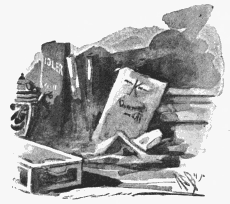
I suppose I ought to be ashamed of him, but how can I be? Is he not my first-born? Did he not come to me in the days of weariness, making my heart glad and proud? Do I not love him the more for his shortcomings?
Somehow, as I stare at him in this dim candlelight, he seems to take odd shape. Slowly he grows into a little pink imp, sitting cross-legged among the litter of my books and papers, squinting at me (I think the squint is caused by the big 'K'), and I find myself chatting with him.
It is an interesting conversation to me, for it is entirely about myself, and I do nearly all the talking, he merely throwing in an occasional necessary reply, or recalling to my memory a forgotten name or face.
We chat of the little room in Whitfield Street, off the Tottenham Court Road, where he was born; of our depressing, meek-eyed old landlady, and of how, one day, during the course of chance talk, it came out that she, in the far back days of her youth, had been an actress, winning stage love and breaking stage hearts with the best of them; of how the faded face would light up as, standing with the tea-tray in her hands, she would tell us of her triumphs, and repeat to us her 'Press Notices,' which she had learned by heart; and of how from her we heard not a few facts and stories useful to us. We talk of the footsteps that of evenings would climb the creaking stairs and enter at our door; of George, who always believed in us (God bless him!), though he could never explain why; of practical Charley, who thought we should do better if we left literature alone and stuck to work. Ah! well, he meant kindly, and there be many who would that he had prevailed. We remember the difficulties we had to contend with; the couple in the room below, who would come in and go to bed at twelve, and lie there, quarrelling loudly, until sleep overcame them about two, driving our tender and philosophical sentences entirely out of our head; of the asthmatical old law-writer, whose never-ceasing cough troubled us greatly (maybe, it troubled him also, but I fear we did not consider that); of the rickety table that wobbled as we wrote, and that, whenever in a forgetful moment we leant upon it, gently but firmly collapsed.
'Yes,' I said to the little pink imp; 'as a study the room had its drawbacks, but we lived some grand hours there, didn't we? We laughed and sang there, and the songs we chose breathed ever of hope and victory, and so loudly we sang them we might have been modern Joshuas, thinking to capture a city with our breath.
'And then that wonderful view we used to see from its dingy window panes—that golden country that lay stretched before us, beyond the thousand chimney pots, above the drifting smoke, above the creeping fog—do you remember that?'
It was worth living in that cramped room, worth sleeping on that knobbly bed, to gain an occasional glimpse of that shining land, with its marble palaces, where one day we should enter, an honoured guest; its wide market-places, where the people thronged to listen to our words. I have climbed many stairs, peered through many windows in this London town since then, but never have I seen that view again. Yet, from somewhere in our midst, it must be visible for friends of mine, as we have sat alone, and the talk has sunk into low tones, broken by long silences, have told me that they, too, have looked upon those same glittering towers and streets. But the odd thing is that none of us has seen them since he was a very young man. So, maybe, it is only that the country is a long way off, and that our eyes have grown dimmer as we have grown older.
'And who was that old fellow that helped us so much?' I ask of my little pink friend; 'you remember him surely—a very ancient fellow, the oldest actor on the boards he always boasted himself—had played with Edmund Kean and Macready. I used to put you in my pocket of a night and meet him outside the stage door of the Princess's; and we would adjourn to a little tavern in old Oxford Market to talk you over, and he would tell me anecdotes and stories to put in you.'
'You mean Johnson,' says the pink imp; 'J. B. Johnson. He was with you in your first engagement at Astley's, under Murray Wood and Virginia Blackwood. He and you were the High Priests in "Mazeppa," if you remember, and had to carry Lisa Weber across the stage, you taking her head and he her heels. Do you recollect what he said to her, on the first night, as you were both staggering towards the couch?—"Well, I've played with Fanny Kemble, Cushman, Glyn, and all of them, but hang me, my dear, if you ain't the heaviest lead I've ever supported."'
'HE AND YOU HAD TO CARRY LISA WEBER ACROSS THE STAGE'
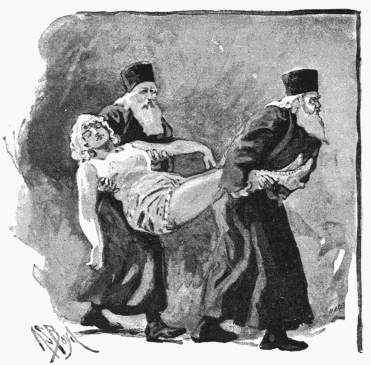
'That's the old fellow,' I reply; 'I owe a good deal to him, and so do you. I used to read bits of you to him in a whisper as we stood in the bar; and he always had one formula of praise for you: "It's damned clever, young 'un; damned clever. I shouldn't have thought it of you."
'And that reminds me,' I continue—I hesitate a little here, for I fear what I am about to say may offend him—'what have you done to yourself since I wrote you? I was looking you over the other day, and really I could scarcely recognise you. You were full of brilliancy and originality when you were in manuscript. What have you done with it all?'
By some mysterious process he contrives to introduce an extra twist into the squint with which he is regarding me, but makes no reply, and I continue:
'Take, for example, that gem I lighted upon one drizzly THAT BRILLIANT IDEA night in Portland Place. I remember the circumstance distinctly. I had been walking the deserted streets, working at you; my note-book in one hand and a pencil in the other. I was coming home through Portland Place, when suddenly, just beyond the third lamp-post from the Crescent, there flashed into my brain a thought so original, so deep, so true, that involuntarily I exclaimed: "My God, what a grand idea!" and a coffee-stall keeper, passing with his barrow just at that moment, sang out: "Tell it us, guv'nor. There ain't many knocking about."
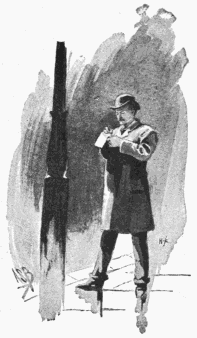
'I took no notice of the man, but hurried on to the next lamp-post to jot down that brilliant idea before I should forget it; and the moment I reached home I pulled you out of your drawer and copied it out on to your pages, and sat long staring at it, wondering what the world would say when it came to read it. Altogether I must have put into you nearly a dozen startlingly original thoughts. What have you done with them? They are certainly not there now.'
Still he keeps silence, and I wax indignant at the evident amusement with which he regards my accusation.
'And the bright wit, the rollicking humour with which I made your pages sparkle, where are they?' I ask him, reproachfully; 'those epigrammatic flashes that, when struck, illumined the little room with a blaze of sudden light, showing each cobweb in its dusty corner, and dying out, leaving my dazzled eyes groping for the lamp; those grand jokes at which I myself, as I made them, laughed till the rickety iron bedstead beneath me shook in sympathy with harsh metallic laughter; where are they, my friend? I have read you through, page by page, and the thoughts in you are thoughts that the world has grown tired of thinking; at your wit one smiles, thinking that anyone could think it wit; and your humour your severest critic could hardly accuse of being very new. What has happened to you? What wicked fairy has bewitched you? I poured gold into your lap, and you yield me back only crumpled leaves.'
With a jerk of his quaint legs he assumes a more upright posture.
'My dear Parent,' he begins in a tone that at once reverses our positions, so that he becomes the monitor and I the wriggling admonished; 'don't, I pray you, turn prig in your old age; don't sink into the "superior person" who mistakes carping for criticism, and jeering for judgment. Any fool can see faults, they lie on the surface. The merit of a thing is hidden within it, and is visible only to insight. And there is merit in me, in spite of your cheap sneers, sir. Maybe I do not contain an original idea. Show me the book published since the days of Caxton that does! Are our young men, as are the youth of China, to be forbidden to think, because Confucius thought years ago? The wit you appreciate now needs to be more pungent than the wit that satisfied you at twenty; are you sure it is as wholesome? You cannot smile at humour you would once have laughed at; is it you or the humour that has grown old and stale? I am the work of a very young man, who, writing of that which he knew and had felt, put down all things truthfully as they appeared to him, in such way as seemed most natural to him, having no thought of popular taste, standing in no fear of what critics might say. Be sure that all your future books are as free from unworthy aims.'
'Besides,' he adds, after a short pause, during which I have started to reply, but have turned back to think again, 'is not this talk idle between you and me? This apologetic attitude, is it not the cant of the literary profession? At the bottom of your heart you are proud of me, as every author is of every book he has written. Some of them he thinks better than others; but, as the Irishman said of whiskies, they are all good. He sees their shortcomings. He dreams he could have done better; but he is positive no one else could.'
His little twinkling eyes look sternly at me, and, feeling that the discussion is drifting into awkward channels, I hasten to divert it, and we return to the chat about our early experiences.
I ask him if he remembers those dreary days when, written neatly in round hand on sermon paper, he journeyed a ceaseless round from newspaper to newspaper, from magazine to magazine, returning always soiled and limp to Whitfield Street, still further darkening the ill-lit room as he entered. Some would keep him for a month, making me indignant at the waste of precious time. Others would send him back by the next post, insulting me by their indecent haste. Many, in returning him, would thank me for having given them the privilege and pleasure of reading him, and I would curse them for hypocrites. Others would reject him with no pretence at regret whatever, and I would marvel at their rudeness.
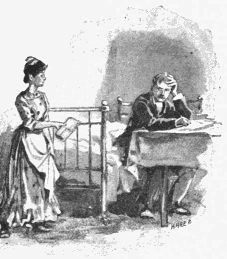
I hated the dismal little 'slavey' who, twice a week, on an average, would bring him up to me. If she smiled as she handed me the packet, I fancied she was jeering at me. If she looked sad, as she more often did, poor little over-worked slut, I thought she was pitying me. I shunned the postman if I saw him in the street, sure that he guessed my shame.
'Did anyone ever read you out of all those I sent you to?' I ask him.
'Do editors read manuscript by unknown authors?' he asks me in return.
I HATED THE DISMAL LITTLE 'SLAVEY'
'I fear not more than they can help,' I confess; 'they would have little else to do.'
'Oh,' he remarks demurely, 'I thought I had read that they did.'
'Very likely,' I reply; 'I have also read that theatrical managers read all the plays sent to them, eager to discover new talent. One obtains much curious information by reading.'
'But somebody did read me eventually,' he reminds me; 'and liked me. Give credit where credit is due.'
'Ah, yes,' I admit; 'my good friend Aylmer Gowing—the "Walter Gordon" of the old Haymarket in Buckstone's time, "Gentleman Gordon" as Charles Matthews nicknamed him—kindliest and most genial of men. Shall I ever forget the brief note that came to me four days after I had posted you to "The Editor—Play":—"Dear Sir, I like your articles very much. Can you call on me to-morrow morning before twelve?—Yours truly, W. Aylmer Gowing."'
So success had come at last—not the glorious goddess I had pictured, but a quiet, pleasant-faced lady. I had imagined the editor of Cornhill, or the Nineteenth Century, or The Illustrated London News writing me that my manuscript was the most brilliant, witty, and powerful story he had ever read, and enclosing me a cheque for two hundred guineas. The Play was an almost unknown little penny weekly, 'run' by Mr. Gowing—who, though retired, could not bear to be altogether unconnected with his beloved stage—at a no inconsiderable yearly loss. It could give me little fame and less wealth. But a crust is a feast to a man who has grown weary of dreaming dinners, and as I sat with that letter in my hand a mist rose before my eyes, and I—acted in a way that would read foolish if written down.
THE STUDY (From a photograph by Fradelle & Young)
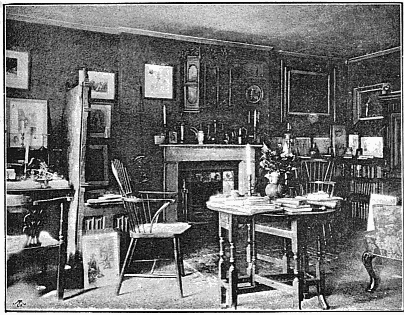
The next morning, at eleven, I stood beneath the porch of 37 Victoria Road, Kensington, wishing I did not feel so hot and nervous, and that I had not pulled the bell-rope quite so vigorously. But when Mr. Gowing, in smoking-coat and slippers, came forward and shook me by the hand, my shyness left me. In his study, lined with theatrical books, we sat and talked. Mr. Gowing's voice seemed the sweetest I had ever listened to, for, with unprofessional frankness, it sang the praises of my work. He, in his young acting days, had been through the provincial mill, and found my pictures true, and many of my pages seemed to him, so he said, 'as good as Punch.' (He meant it complimentary.) He explained to me the position of his paper, and I agreed (only too gladly) to give him the use of the book for nothing. As I was leaving, however, he called me back and slipped a five-pound note into my hand—a different price from what friend A. P. Watt charms out of proprietors' pockets for me nowadays, yet never since have I felt as rich as on that foggy November morning when I walked across Kensington Gardens with that 'bit of flimsy' held tight in my left hand. I could not bear the idea of spending it on mere mundane things. Now and then, during the long days of apprenticeship, I drew it from its hiding-place and looked at it, sorely tempted. But it always went back, and later, when the luck began to turn, I purchased with it, at a second-hand shop in Goodge Street, an old Dutch bureau that I had long had my eye upon. It is an inconvenient piece of furniture. One cannot stretch one's legs as one sits writing at it, and if one rises suddenly it knocks bad language into one's knees and out of one's mouth. But one must pay for sentiment, as for other things.
In The Play the papers gained a fair amount of notice, and won for me some kindly words; notably, I remember, from John Clayton and Palgrave Simpson. I thought that in the glory of print they would readily find a publisher, but I was mistaken. The same weary work lay before me, only now I had more heart in me, and, having wrestled once with Fate and prevailed, stood less in fear of her.
Sometimes with a letter of introduction, sometimes without, sometimes with a bold face, sometimes with a timid step, I visited nearly every publisher in London. A few received me kindly, others curtly, many not at all. From most of them I gathered that the making of books was a pernicious and unprofitable occupation. Some thought the work would prove highly successful if I paid the expense of publication, but were less impressed with its merits on my explaining to them my financial position. All kept me waiting long before seeing me, but made haste to say 'Good day' to me.
I suppose all young authors have had to go through the same course. I sat one evening, a few months ago, with a literary friend of mine. The talk turned upon early struggles, and, with a laugh, he said: 'Do you know one of the foolish things I love to do? I like to go with a paper parcel under my arm into some big publishing house, and to ask, in a low, nervous voice, if Mr. So-and-so is disengaged. The clerk, with a contemptuous glance towards me, says that he is not sure, and asks if I have an appointment. "No," I reply; "not—not exactly, but I think he will see me. It's a matter of importance. I shall not detain him a minute."
'The clerk goes on with his writing, and I stand waiting. At the end of about five minutes, he, without looking up, says curtly, "What name?" and I hand him my card.
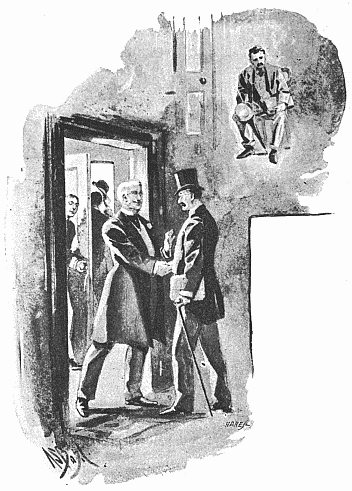
'Up to that point, I have imagined myself a young man again, but there the fancy is dispelled. The man glances at the card, and then takes a sharp look at me. "I beg your pardon, sir," he says, "will you take a seat in here for a moment?" In a few seconds he flies back again with "Will you kindly step this way, sir?" As I follow him upstairs I catch a glimpse of somebody being hurriedly bustled out of the private office, and the great man himself comes to the door, smiling, and as I take his outstretched hand I am remembering other times that he has forgotten.
In the end—to make a long story short, as the saying is—Mr. I AM REMEMBERING Tuer, of 'Ye Leadenhall Press,' urged thereto by a mutual friend, read the book, and, I presume, found merit in it, for he offered to publish it if I would make him a free gift of the copyright. I thought the terms hard at the time (though in my eagerness to see my name upon the cover of a real book I quickly agreed to them), but with experience, I am inclined to admit that the bargain was a fair one. The English are not a book-buying people. Out of every hundred publications hardly more than one obtains a sale of over a thousand, and, in the case of an unknown writer, with no personal friends upon the Press, it is surprising how few copies sometimes can be sold.
I am happy to think that in this instance, however, nobody suffered. The book was, as the phrase goes, well received by the public, who were possibly attracted to it by its subject, a perennially popular one. Some of the papers praised it, others dismissed it as utter rubbish; and then, fifteen months later, on reviewing my next book, regretted that a young man who had written such a capital first book should have followed it up by so wretched a second.
One writer—the greatest enemy I have ever had, though I exonerate him of all but thoughtlessness—wrote me down a 'humourist,' which term of reproach (as it is considered to be in Merrie England) has clung to me ever since, so that now, if I pen a pathetic story, the reviewer calls it 'depressing humour,' and if I tell a tragic story, he says it is 'false humour,' and, quoting the dying speech of the broken-hearted heroine, indignantly demands to know 'where he is supposed to laugh.' I am firmly persuaded that if I committed a murder half the book reviewers would allude to it as a melancholy example of the extreme lengths to which the 'new humour' had descended.
'Once a humourist, always a humourist,' is the reviewer's motto.
'And all things allowed for—the unenthusiastic publisher, the insufficiently appreciative public, the wicked critic,' says my little pink friend, breaking his somewhat long silence, 'what do you think of literature as a profession?'
I take some time to reply, for I wish to get down to what I really think, not stopping, as one generally does, at what one thinks one ought to think.
'I think,' I begin, at length, 'that it depends upon the literary man. If a man think to use literature merely as a means to fame and fortune, then he will find it an extremely unsatisfactory profession, and he would have done better to take up politics or company promoting. If he trouble himself about his status and position therein, loving the uppermost tables at feasts, and the chief seats in public places, and greetings in the markets, and to be called of men, Master, Master, then he will find it a profession fuller than most professions of petty jealousy, of little spite, of foolish hating and foolish log-rolling, of feminine narrowness and childish querulousness. If he think too much of his prices per thousand words, he will find it a degrading profession; as the solicitor, thinking only of his bills-of-cost, will find the law degrading; as the doctor, working only for two-guinea fees, will find medicine degrading; as the priest, with his eyes ever fixed on the bishop's mitre, will find Christianity degrading.
'But if he love his work for the work's sake, if he remain child enough to be fascinated with his own fancies, to laugh at his own jests, to grieve at his own pathos, to weep at his own tragedy—then, as, smoking his pipe, he watches the shadows of his brain coming and going before his half-closed eyes, listens to their voices in the air about him, he will thank God for making him a literary man. To such a one, it seems to me, literature must prove ennobling. Of all professions it is the one compelling a man to use whatever brain he has to its fullest and widest. With one or two other callings, it invites him—nay, compels him—to turn from the clamour of the passing day to speak for a while with the voices that are eternal.
'To me it seems that if anything outside oneself can help one, the service of literature must strengthen and purify a man. Thinking of his heroine's failings, of his villain's virtues, may he not grow more tolerant of all things, kinder thinking towards man and woman? From the sorrow that he dreams, may he not learn sympathy with the sorrow that he sees? May not his own brave puppets teach him how a man should live and die?
'To the literary man, all life is a book. The sparrow on the telegraph wire chirps cheeky nonsense to him as he passes by. The urchin's face beneath the gas lamp tells him a story, sometimes merry, sometimes sad. Fog and sunshine have their voices for him.
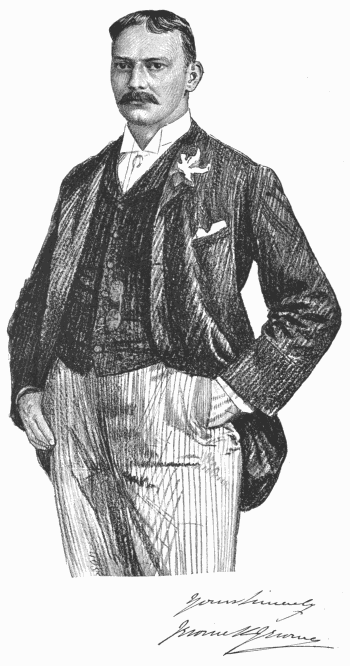
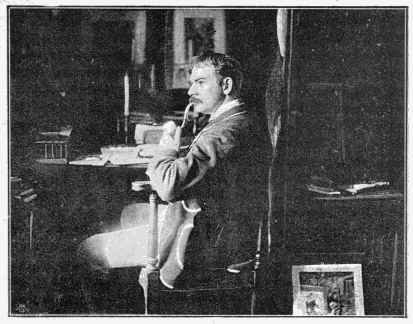
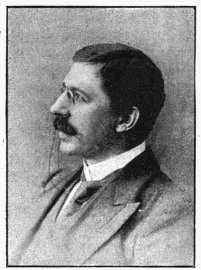
MR. JEROME K. JEROME (From a photograph by Fradelle & Young)
'Nor can I see, even from the most worldly and business-like point of view, that the modern man of letters has cause of complaint. The old Grub Street days when he starved or begged are gone. Thanks to the men who have braved sneers and misrepresentation in unthanked championship of his plain rights, he is now in a position of dignified independence; and if he cannot attain to the twenty thousand a year prizes of the fashionable Q.C. or M.D., he does not have to wait their time for his success, while what he can and does earn is amply sufficient for all that a man of sense need desire. His calling is a password into all ranks. In all circles he is honoured. He enjoys the luxury of a power and influence that many a prime minister might envy.
'There is still a last prize in the gift of literature that needs no sentimentalist to appreciate. In a drawer of my desk lies a pile of letters, of which if I were not very proud I should be something more or less than human. They have come to me from the uttermost parts of the earth, from the streets near at hand. Some are penned in the stiff phraseology taught when old fashions were new, some in the free and easy colloquialism of the rising generation. Some, written on sick beds, are scrawled in pencil. Some, written by hands unfamiliar with the English language, are weirdly constructed. Some are crested, some are smeared. Some are learned, some are ill-spelled. In different ways they tell me that, here and there, I have brought to some one a smile or pleasant thought; that to some one in pain and in sorrow I have given a moment's laugh.'
Pinky yawns (or a shadow thrown by the guttering candle makes it seem so). 'Well,' he says, 'are we finished? Have we talked about ourselves, glorified our profession, and annihilated our enemies to our entire satisfaction? Because, if so, you might put me back. I'm feeling sleepy.'
I reach out my hand, and take him up by his wide, flat waist. As I draw him towards me, his little legs vanish into his squat body, the twinkling eye becomes dull and lifeless. The dawn steals in upon him, for I have sat working long into the night, and I see that he is only a little shilling book bound in pink paper. Wondering whether our talk together has been as good as at the time I thought it, or whether he has led me into making a fool of myself, I replace him in his corner.
'CAVALRY LIFE'
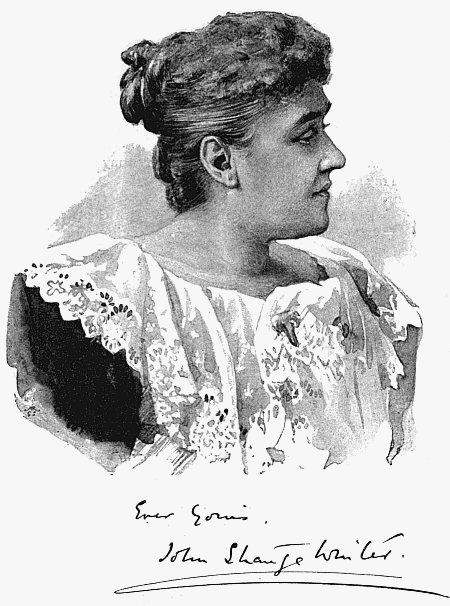
By 'JOHN STRANGE WINTER'
(MRS. ARTHUR STANNARD)
MY first book 'as ever was' was written, or, to speak quite correctly, was printed, on the nursery floor some thirty odd years ago. I remember the making of the book very well; the leaves were made from an old copybook, and the back was THREE SOLDIERS AND A PIG a piece of stiff paper, sewed in place and carefully cut down to the right size. So far as I remember, it was about three soldiers and a pig. I don't quite know how the pig came in, but that is a mere detail. I have no data to go upon (as I did not dream thirty years ago that I should ever be so known to fame as to be asked to write the true history of my first book), but I have a wonderful memory, and to the best of my recollection it was, as I say, about three soldiers and a pig.
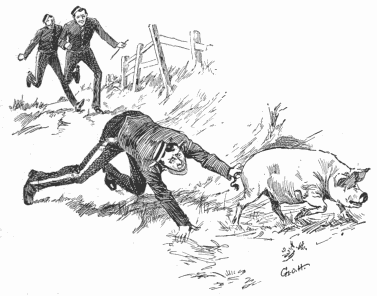
It never saw the light, and there are times when I feel thankful to a gracious Providence that I have been spared the power of gratifying the temptation to give birth to those early efforts, after the manner of Sir Edwin Landseer and that pathetic little childish drawing of two sheep, which is to be seen at provincial exhibitions of pictures, for the encouragement and example of the rising generation.
So far as I can recall, I made no efforts for some years to woo fickle fortune after the attempt to recount the story of the three soldiers and a pig; but when I was about fourteen my heart was fired by the example of a schoolfellow, one Josephine H——, who spent a large portion of her time writing stories, or, as our schoolmistress put it, wasting time and spoiling paper. All the same, Josephine H—— 's stories were very good, and I have often wondered since those days whether she, in after life, went on with her favourite pursuits. I have never heard of her again except once, and then somebody told me that she had married a clergyman, and lived at West Hartlepool. Yes, all this has something to do, and very materially, with the story of my first book. For in emulating Josephine H——, whom I was very fond of, and whom I admired immensely, I discovered that I could write myself, or at least that I wanted to write, and that I had ideas that I wanted to see on paper. Without that gentle stimulant, however, I might never have found out that I might one day be able to do something in the same way myself.
My next try was at a joint story—a story written by three girls, myself and two friends. That was in the same year. We really made considerable headway with that story; and had visions of completely finishing it and getting no less a sum than thirty pounds for it. I have a sort of an idea that I supplied most of the framework for the story, and that the elder of my collaborators filled in the millinery and the love-making.
(From a photograph by Russell & Sons, Wimbledon)
But—alas for the futility of human hopes and desires!—that book was destined never to be finished, for I had a violent quarrel with my collaborators, and we have never spoken to each other from that day to this.
So came to an untimely end my second serious attempt at writing a book; for the stories that I had written in emulation of Josephine H—— were only short ones, and were mostly unfinished.
I wasted a terrible deal of paper between my second try and my seventeenth birthday, and I believe that I was, at that time, one of the most hopeless trials of my father's life. He many times offered to provide me with as much cheap paper as I liked to have; but cheap paper did not satisfy my artistic soul, for I always liked the best of everything. Good paper was my weakness—as it was his—and I used it, or wasted it, which you will, with just the same lavish hand as I had done aforetime.
When I was seventeen, I did a skit on a little book called 'How to Live on Sixpence a Day.' It was my first soldier story—excepting the original three soldiers and a pig—and introduced the 'sixpence a day' pamphlet into a smart cavalry regiment, whose officers were in various degrees of debt and difficulty, and every man was a barefaced portrait, without the smallest attempt at concealment of his identity. Eventually this sketch was printed in a York paper, and the honour of seeing myself in print was considered enough reward for me. I, on the contrary, had no such pure love of fame. I had done what I considered a very smart sketch, and I thought it well worth payment of some kind, which it certainly was.
After this, I spent a year abroad, improving my mind—and I think, on the whole, it will be best to draw a veil over that portion of my literary history, for I went out to dinner on every possible occasion, and had a good time generally. Stay—did I not say my literary history? Well, that year had a good deal to do with my literary history, for I wrote stories most of the time, during a large part of my working hours and during the whole of my spare time, when I did not happen to be going out to dinner. And when I came home, I worked on just the same until, towards the end of '75, I drew blood for the first time. Oh, the joy of that first bit of money—my first earnings! And it was but a bit, a mere scrap. To be explicit, it amounted to ten shillings. I went and bought a watch on the strength of it—not a very costly affair; a MR. ARTHUR STANNARD (From a photograph by Frances Browne, 135 Regent Street, W.) matter of two pounds ten and an old silver turnip that I had by me. It was wonderful how that one half-sovereign opened up my ideas. I looked into the future as far as eye could see, and I saw myself earning an income—for at that time of day I had acquired no artistic feelings at all, and I genuinely wanted to make name and fame and money—I saw myself a young woman who could make a couple of hundred pounds from one novel, and I gloried in the prospect.
I disposed of a good many stories in the same quarter at starvation prices, ranging from the original ten shillings to thirty-five. Then, after a patient year of this not very luxurious work, I made a step forward and got a story accepted by the dear old Family Herald. Oh, yes, this is really all relevant to my first book; very much so, indeed, for it was through Mr. William Stevens, one of the proprietors of the Family Herald, that I learned to know the meaning of the word 'caution'—a word absolutely indispensable to any young author's vocabulary.
At this time I wrote a great deal for the Family Herald, and also for various magazines, including London Society. In the latter, my first 'Winter' work appeared—a story called 'A Regimental Martyr.'
I was very oddly placed at this point of my career, for I liked most doing the 'Winter' work, but the ordinary young-lady-like fiction paid me so much the best, that I could not afford to give it up. I was, like all young magazine writers, passionately desirous of appearing in book form. I knew not a single soul in the way connected with literary matters, had absolutely no help or interest of any kind to aid me over the rough places, or even of whom to ask advice in times of doubt and difficulty. Mr. William Stevens was the only editor that I knew to whom I could go and say, 'Is this right?' or 'Is that wrong?' And I think it may be interesting to say here that I have never asked for, or indeed used, a letter of introduction in my life—that is, in connection with any literary business.
Well, when I had been hard at work for several years, I wrote a very long book—upon my word, in spite of my good memory, I forget what it was called. The story, however, lives in my mind well enough; it was the story of a very large family—about ten girls and boys, who all made brilliant marriages and lived a sort of shabby, idyllic, happy life, somewhat on the plan of 'God for us all and the devil take the hindermost.' Need I say that it was told in the first person and in the present tense, and that the heroine was anything but good-looking?
I was very young then, and thought a great deal of my pretty bits of writing and those seductive scraps of moralising, against which Mr. Stevens was always warning me. Well, this very long, not to say spun-out, account of this very large family of boys and girls, did not happen to please the 'readers' for the Family Herald—then my stay-by—so I thought I would have a try round the various publishers and see if I could not get it brought out in three volumes. Of course, I tried all the best people first, and very often, when I receive from struggling young authors (who know a great deal more about my past history than I do myself, and who frequently write to ask me the best and easiest way to get on at novel-writing, without either hard work, or waiting, or disappointment, because, if you please, my own beginnings were so singularly successful and delightful) the information that I have never known of any of their troubles, it seems to me that my past and my present cannot be the past and present of the same woman. Yet they are. I went through it all; the same sickening disappointments, the same hopes and fears; I trod the self-same path that every beginner must assuredly tread, as we must all in time tread that other path to the grave. I went through it all, and with that exceedingly long and detailed account of that large and shabby family, I trod the thorny path of publishing almost to the bitter end—ay, even to the goal where we find the full-blown swindler waiting for us, with bland looks and honeyed words of sweetest flattery. Dear, dear! many who read this will know the process. It seldom varies. First, I sent my carefully written MS., whose very handwriting betrayed my youth, to a certain firm which had offices off the Strand, to be considered for publication. The firm very kindly did consider it, and their consideration was such that they made me an offer of publication—on certain terms.
Their polite note informed me that their readers had read the work and thought very highly of it, that they were inclined—just by the way of completing their list for the approaching September, the best month in the year for bringing out novels—to bring it out, although I was, as yet, unknown to fame. Then came the first hint of 'the consideration,' which took the form of a hundred pounds, to be paid down in three sums, all to fall due before the day of publication. I worked out the profits which could accrue if the entire edition sold out I found that, in that case, I should have a nice little sum for myself of 180l. Now, no struggling young author in his or her senses is silly enough to throw away the chance of making 180l. in one lump. I thought, and I thought the whole scheme out, and I must 'THE FIRM' CONSIDERING confess that the more I thought about it, the more utterly tempting did the offer seem. To risk 100l.—and to make 180l.! Why, it was a positive sin to lose such a chance. Therefore, I scraped a hundred pounds together, and, with my mother, set off for London, feeling that, at last, I was going to conquer the world. We did a theatre on the strength of my coming good fortune, and the morning after our arrival in town set off—in my case, at all events—with swelling hearts, to keep the appointment with the kindly publisher who was going to put me in the way of making fame and fortune.
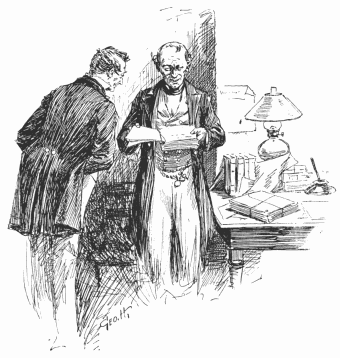
I opened the door and went in. 'Is Mr.—— at home?' I asked. I was forthwith conducted to an inner sanctum, where I was received by the head of the firm himself. Then I experienced my first shock—he squinted! Now, I never could endure a man with a squint, and I distrusted this man instantly. You know, there are squints and squints! There is the soft uncertain squint feminine, which is really charming. And there is a particular obliquity of vision which, in a man, rather gives a larky expression, and so makes you feel that there is nothing prim and formal about him, and seems to put you on good terms at once.
HE SQUINTED!
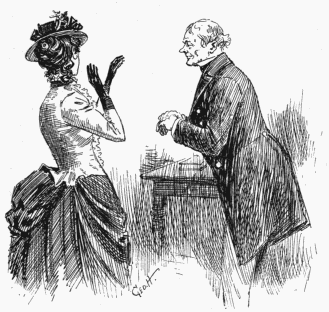
And there is a cold-blooded squint, which makes your flesh creep, and which, when taken in connection with business, brings little stories to your mind—'Is anyone coming, sister Anne?' and that sort of thing.
Mr.—— asked me to excuse him a moment while he gave some instructions, and, without waiting for my permission, looked through a few letters, shouted a message down a speaking-tube, and then, after having arranged the fate of about half-a-dozen novels by the means of the same instrument, he sent a final message down the tube asking for my MS., only to be told that he would find it in the top right-hand drawer of his desk.
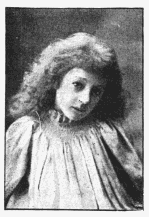
As a matter of fact, all this delay, intended to impress MISS STANNARD (From a photograph by H. S. Mendelssohn) me and make me understand what a great thing had happened to me in having won attention from so busy a man, simply did for Mr.—— so far as I was concerned. Instead of impressing me, it gave me time to get used to the place, it gave me time to look at Mr.—— when he was not looking at me.
Then, having found the MS., he looked at me and prepared to give me his undivided attention.
'Well,' he said, with a long breath, as if it was quite a relief to see a new face, 'I am very glad you have decided to close with our offer. We confidently expect a great success with your book. We shall have to change the title though. There's a good deal in a title.'
I replied modestly that there was a good deal in a title. 'But,' I added, 'I have not closed with your offer—on the contrary, I—— '
He looked up sharply, and he squinted worse than ever. 'Oh, I quite thought that you had definitely—— '
'Not at all,' I replied; then added a piece of information, which could not by any chance have been new to him. 'A hundred pounds is a lot of money, you know,' I remarked.
Mr.—— looked at me in a meditative fashion. 'Well, if you have not got the money,' he said rather contemptuously, 'we might make a slight reduction—say, if we brought it down to 75l., solely because our readers have spoken so highly of the story. Now look here, I will show you what our reader says—which is a favour that we don't extend to everyone, that I can tell you. Here it is!'
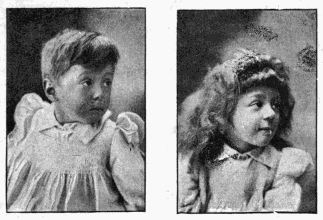
'THE TWINS'—BOOTLES AND BETTY (From photographs by H. S. Mendelssohn)
Probably in the whole of his somewhat chequered career as a publisher, Mr.—— never committed such a fatal mistake as by handing me the report on my history (in detail) of that very large family of boys and girls. 'Bright, crisp, racy,' it ran. 'Very unequal in parts, wants a good deal of revision, and should be entirely re-written. Would be better if the story was brought to a conclusion when the heroine first meets with the hero after the parting, as all the rest forms an anti-climax. This might be worked up into a really popular novel, especially as it is written very much in Miss—— 's style' (naming a then popular authoress whose sole merit consisted in being the most faithful imitator of the gifted founder of a very pernicious school).
I put the sheet of paper down, feeling very sick and ill. And the worst of it was, I knew that every word of it was true. I was young and inexperienced then, and had not nous enough to say plump out that my eyes had been opened, and that I could see that I should be neither more nor less than a fool if I wasted a single farthing over a story that must be utterly worthless. So I prevaricated mildly, and said that I certainly did not feel inclined to throw a hundred or even seventy-five pounds away over a story without some certainty of success. 'I'll think it over during the day,' I said, rising from my chair.
'Oh, we must know within an hour, at the outside,' Mr.—— said very curtly. 'Our arrangements will not wait, and the time is very short now for us to decide on our books for September. Of course, if you have not got the money, we might reduce a little more. We are always glad, if possible, to meet our clients.'
'It's not that,' I replied, looking at him straight. 'I have the money in my pocket; but a Yorkshire woman does not put down a hundred pounds without some idea what is going to be done with it.'
'You must let me have your answer within an hour,' Mr.—— remarked briefly.
'I will,' said I, in my most polite manner; 'but I really must think out the fact that you are willing to knock off twenty-five pounds at one blow. It seems to me if you could afford to take that much off, and perhaps a little more, there must have been something very odd about your original offer.'
'My time is precious,' said Mr.—— in a grumpy voice.
'Then, good morning,' said I cheerfully.
My hopes were all dashed to the ground again, but I felt very cheerful, nevertheless. I trotted round to my friend, Mr. Stevens, who gave a whistle of astonishment at my story. 'I'll send my head clerk round for your MS. at once,' he said, 'else you'll probably never see it again.'
And so he did, and so ended my next attempt to bring out my first book.
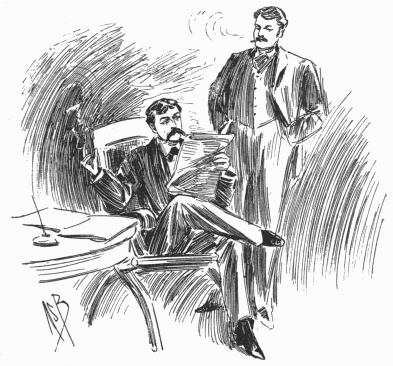
After this I felt very keenly the real truth of the old LONG-LEGGED SOLDIERS saying, 'Virtue is its own reward.' For, not long after my episode with Mr.——, the then editor of London Society wrote to me, saying that he thought that as I had already had several stories published in the magazine, it might make a very attractive volume if I could add a few more and bring them out as a collection of soldier stories.
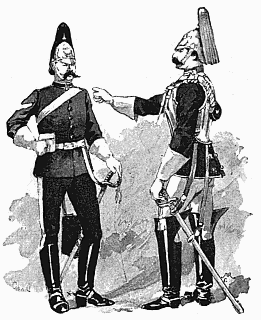
I did not hesitate very long over this offer, but set to work with all the enthusiasm of youth—and youth does have the advantage of being full of the fire of enthusiasm, if of nothing else—and I turned out enough new stories to make a very respectable volume.
Then followed the period of waiting to which all literary folk must accustom themselves.
I was, however, always of a tolerably long-suffering disposition, and possessed my soul in patience as well as I could. The next thing I heard was that the book had very good prospects, but that it would have its chances greatly improved if it were in two volumes instead of being in only one.
Well, youth is generous, and I did not see the wisdom of spoiling the ship for the traditional ha'porth of tar, so I cheerfully set to work and evolved another volume of stories, all of smart, long-legged soldiers, and with—as Heaven knows—no more idea of setting myself up as possessing all knowledge about soldiers and the Service than I had of aspiring to the Crown of the United Kingdom of Great Britain and Ireland. But, even then, I had need of a vast amount of patience, for time went on, and really my book seemed as far from publication as ever. Every now and then I had a letter telling me that the arrangements were nearly completed, and that it would probably be brought out by Messrs. So-and-so. But days wore into weeks, and weeks into months, until I really began to feel as if my first literary babe was doomed to die before it was born.
Then arose a long haggle over terms, which I had thought were settled, and to be on the same terms as the magazine rates—no such wonderful scale after all. However, my literary guide, philosopher, and friend thought, as he was doing me the inestimable service of bringing me out, that 20l. was an ample honorarium for myself; but I, being young and poor, did not see things in the same light at all. Try as I would—and I cannot lay claim to trying very hard—I could not see why a man, who had never seen me, should have put himself to so much trouble out of a spirit of pure philanthropy, and a desire to help a struggling young author forward. So I obstinately kept to my point, and said if I did not have 30l., I would rather have all of the stories back again. I think nobody would credit to-day what that special bit of firmness cost me. Still, I would cheerfully have died before I would have given in, having once conceived my claim to be a just one. A bad habit on the whole, and one that has since cost me dear more than once.
Eventually, my guide and I came to terms for the sum for which I had held out, namely, 30l., which was the price I received for my very first book, in addition to about 8l. that CAVALRY LIFE I had already had from the magazine for serial use of a few of the stories.
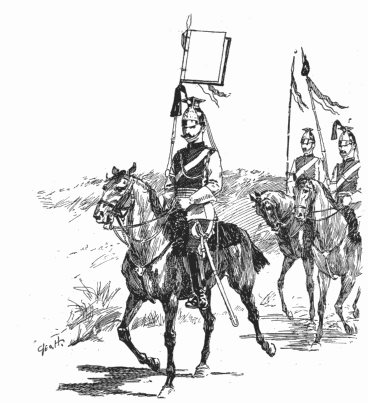
So, in due course, my book, under the title of 'Cavalry Life,' was brought out in two great cumbersome volumes by Messrs. Chatto & Windus, and I was launched upon the world as a full-blown author under the name of 'Winter.'
So many people have asked me why I took that name, and how I came to think of it, that it will not, perhaps, be amiss if I give the reason in this paper. It happened like this. During our negotiations, my guide suggested that I had better take some nom de guerre, as it would never do to bring out such a book under a woman's name. 'Make it as real-sounding and non-committing as you can,' he wrote, and so, after much cogitation and cudgelling of my brains, I chose the name of the hero of the only story of the series which was written in the first person, and called myself J. S. Winter. I believe that 'Cavalry Life' was published on the last day of 1881.
Then followed the most trying time of all—that of waiting to see what the Press would say of this, my first child, which had been so long in coming to life, and had been chopped and changed, bundled from pillar to post, until my heart was almost worn out before ever it saw the light. Then, on January 14, 1882, I went into the Subscription Library at York, where I was living, and began to search the new journals through, in but faint hopes, however, of seeing a review of my book so soon as that; for I was quite alone in the world, so far as literary matters went. Indeed, not one friend did I possess who could in any way influence my career, or obtain the slightest favour for me.
I remember that morning so well; it is, I think, printed on my memory as the word 'Calais' was on the heart of Queen Mary. It was a fine, cold morning, and there was a blazing fire in the inner room, where the reviews were kept. I sat down at the table, and took up the Saturday Review, never dreaming for a moment that I should be honoured by so much as a mention in a journal which I held in such awe and respect. And as I turned over the leaves, my eyes fell on a row of foot-notes at the bottom of the page, giving the names of the books which were noticed above, and among them I saw—'Cavalry Life, by J. S. Winter.'
For full ten minutes I sat there, feeling sick and more fit to die than anything else. I was perfectly incapable of looking at the notice above. But, at last, I plucked up courage to meet my fate, very much as one summons up courage to have a tooth out and get the horrid wrench over. Judge of my surprise and joy when, on reading the notice, I found that the Saturday had given me a rattling good notice, praising the new author heartily and without stint. I shall never, as long as I live, forget the effect of that, my first review, upon me. For quite half an hour I sat without moving, only feeling, 'I shall never be able to keep it up. I shall never be able to follow it up by another.' I felt paralysed, faint, crushed, anything but elated and jubilant. And, at last, through some instinct, I put my hand up to my head to find that it was cold and wet, as if it had been dipped in the river. Thank Heaven, from that day to this I have never known what a cold sweat was. It was my first experience of such a thing, and sincerely I hope it will be my last.
I TOOK UP THE 'SATURDAY REVIEW'
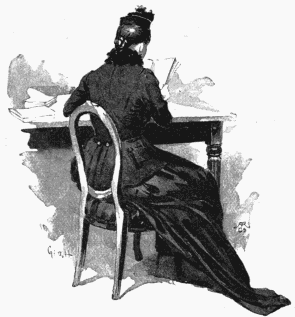
A Sketch from Life
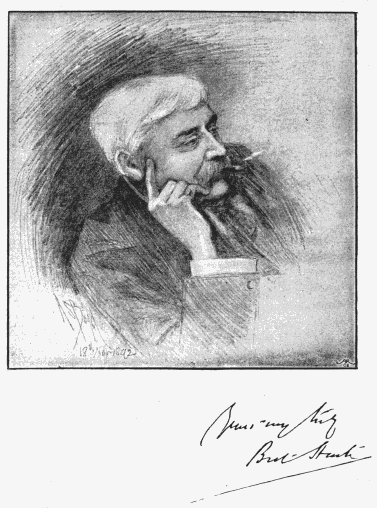
'CALIFORNIAN VERSE'
By BRET HARTE
WHEN I say that my 'first book' was not my own, and contained beyond the title-page not one word of my own composition, I trust that I shall not be accused of trifling with paradox, or tardily unbosoming myself of youthful plagiary. But the fact remains that in priority of publication the first book for which I became responsible, and which probably provoked more criticism than anything I have written since, was a small compilation of Californian poems indited by other hands.
A well-known bookseller of San Francisco one day handed me a collection of certain poems which had already appeared in Pacific Coast magazines and newspapers, with the request that I should, if possible, secure further additions to them, and then make a selection of those which I considered the most notable and characteristic for a single volume to be issued by him. I have reason to believe that this unfortunate man was actuated by a laudable desire to publish a pretty Californian book—his first essay in publication—and at the same time to foster Eastern immigration by an exhibit of the Californian literary product, but, looking back upon his venture, I am inclined to think that the little volume never contained anything more poetically pathetic or touchingly imaginative than that gentle conception. Equally simple and trustful was his selection of myself as compiler. It was based somewhat, I think, upon the fact that 'the artless Helicon' I boasted 'was Youth,' but I imagine it was chiefly owing to the circumstance that I had from the outset, with precocious foresight, confided to him my intention of not putting any of my own verses in the volume. Publishers are appreciative; and a self-abnegation so sublime, to say nothing of its security, was not without its effect.
WE SETTLED TO OUR WORK
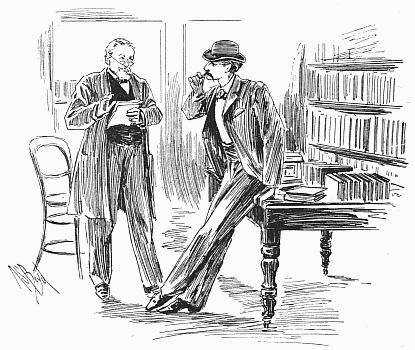
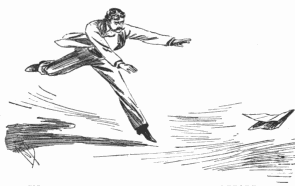
We settled to our work with fatuous self-complacency, and no suspicion of the trouble in store for us, or the storm that was to presently hurtle around our devoted heads. I winnowed the poems, and he exploited a preliminary announcement to an eager and waiting Press, and we moved together unwittingly to our doom. I remember to have been early struck with the quantity of material coming in—evidently the result of some popular misunderstanding of the announcement. I found myself in daily and hourly receipt of sere and yellow fragments, originally torn from some dead and gone newspaper, creased and seamed from long folding in wallet or pocket-book. Need I say that most of them were of an emotional or didactic nature; need I add any criticism of these homely souvenirs, often discoloured by the morning coffee, the evening tobacco, or, Heaven knows! perhaps blotted by too easy tears! Enough that I knew now what had become of those original but never re-copied verses which filled the 'Poet's Corner' of every country newspaper on the coast. I knew now the A CIRCULATION IT HAD NEVER KNOWN BEFORE genesis of every didactic verse that 'coldly furnished forth the marriage table' in the announcement of weddings in the rural Press. I knew now who had read—and possibly indited—the dreary hic jacets of the dead in their mourning columns. I knew now why certain letters of the alphabet had been more tenderly considered than others, and affectionately addressed. I knew the meaning of the 'Lines to Her who can best understand them,' and I knew that they had been understood. The morning's post buried my table beneath these withered leaves of posthumous passion. They lay there like the pathetic nosegays of quickly-fading wild flowers, gathered by school children, inconsistently abandoned upon roadsides, or as inconsistently treasured as limp and flabby superstitions in their desks. The chill wind from the Bay blowing in at my window seemed to rustle them into sad articulate appeal. I remember that when one of them was whisked from the window by a stronger gust than usual, and was attaining a circulation it had never known before, I ran a block or two to recover it. I was young then, and in an exalted sense of editorial responsibility which I have since survived, I think I turned pale at the thought that the reputation of some unknown genius might have thus been swept out and swallowed by the all-absorbing sea.
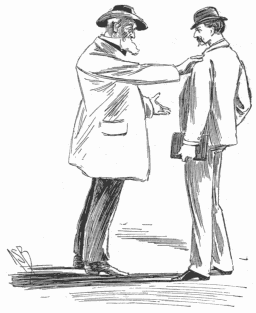
There were other difficulties arising from this unexpected wealth of material. There were dozens of poems on the same subject. 'The Golden Gate,' 'Mount Shasta,' 'The Yosemite,' were especially provocative. A beautiful bird known as the 'Californian Canary' appeared to have been shot at and winged by every poet from Portland to San Diego. Lines to the 'Mariposa' flower were as thick as the lovely blossoms themselves in the Merced Valley, and the Madrone tree was as 'berhymed' as Rosalind. Again, by a liberal construction of the publisher's announcement, manuscript poems, which had never known print, began to coyly unfold their virgin blossoms in the morning's mail. They were accompanied by a few lines stating, casually, that their sender had found them lying forgotten in his desk, or, mendaciously, that they were 'thrown off' on the spur of the moment a few hours before. Some of the names appended to them astonished me. Grave, practical business men, sage financiers, fierce speculators, and plodding traders, never before suspected of poetry, or even correct prose, were among the contributors. It seemed as if most of the able-bodied inhabitants of the Pacific Coast had been in the habit at some time of expressing themselves in verse. Some sought confidential interviews with the editor. The climax was reached when, in Montgomery Street, one day, I was approached by a well-known and venerable judicial magnate. After some serious preliminary conversation, the old gentleman finally alluded to what he was pleased to call a task of 'great delicacy and responsibility' laid upon my 'young shoulders.' 'In fact,' he went on paternally, adding the weight of his judicial hand to that burden, 'I have thought of speaking to you about it. In my leisure moments on the Bench I have, from time to time, polished and perfected a certain college poem begun years ago, but which may now be said to have been finished in California, and thus embraced in the scope of your proposed selection. If a few extracts, selected by myself, 'CONSIDER THEM AT YOUR SERVICE' to save you all trouble and responsibility, be of any benefit to you, my dear young friend, consider them at your service.'
In this fashion the contributions had increased to three times the bulk of the original collection, and the difficulties of selection were augmented in proportion. The editor and publisher eyed each other aghast. 'Never thought there were so many of the blamed things alive,' said the latter with great simplicity, 'had you?' The editor had not. 'Couldn't you sort of shake 'em up and condense 'em, you know? keep their ideas—and their names—separate, so that they'd have proper credit. See?' The editor pointed out that this would infringe the rule he had laid down. 'I see,' said the publisher thoughtfully—'well, couldn't you pare 'em down; give the first verse entire and sorter sample the others?' The editor thought not. There was clearly nothing to do but to make a more rigid selection—a difficult performance when the material was uniformly on a certain dead level, which it is not necessary to define here. Among the rejections were, of course, the usual plagiarisms from well-known authors imposed upon an inexperienced country Press; several admirable pieces detected as acrostics of patent medicines, and certain veiled libels and indecencies such as mark the 'first' publications on blank walls and fences of the average youth. Still the bulk remained too large, and the youthful editor set to work reducing it still more with a sympathising concern which the good-natured, but unliterary, publisher failed to understand, and which, alas! proved to be equally unappreciated by the rejected contributors.
The book appeared—a pretty little volume typographically, and externally a credit to pioneer book-making. Copies were liberally supplied to the Press, and authors and publisher self-complacently awaited the result. To the latter this should have been satisfactory; the book sold readily from his well-known counters to purchasers who seemed to be drawn by a singular curiosity, unaccompanied, however, by any critical comment. People would lounge into the shop, turn over the leaves of other volumes, say carelessly, 'Got a new book of California poetry out, haven't you?' purchase it, and quietly depart. There were as yet no notices from the Press; the big dailies were silent; there was something ominous in this calm.
Out of it the bolt fell. A well-known mining weekly, which I here poetically veil under the title of the Red Dog Jay Hawk, was first to swoop down upon the tuneful and unsuspecting quarry. At this century-end of fastidious and complaisant criticism, it may be interesting to recall the direct style of the Californian 'sixties.' 'The hogwash and "purp"-stuff ladled out from the slop bucket of Messrs.—— & Co., of 'Frisco, by some lop-eared Eastern apprentice, and called "A Compilation of Californian Verse," might be passed over, so far as criticism goes. A club in the hands of any able-bodied citizen of Red Dog and a steamboat ticket to the Bay, cheerfully contributed from this office, would be all-sufficient. But when an imported greenhorn dares to call his flapdoodle mixture "Californian," it is an insult to the State that has produced the gifted "Yellow Hammer," whose lofty flights have from time to time dazzled our readers in the columns of the Jay Hawk. That this complacent editorial
I WAS INWARDLY RELIEVED
jackass, browsing among the dock and thistles which he has served up in this volume, should make no allusion to California's greatest bard, is rather a confession of his idiocy than a slur upon the genius of our esteemed contributor.' I turned hurriedly to my pile of rejected contributions—the nom de plume of 'Yellow Hammer' did not appear among them; certainly I had never heard of its existence. Later, when a friend showed me one of that gifted bard's pieces, I was inwardly relieved! It was so like the majority of the other verses, in and out of the volume, that the mysterious poet might have written under a hundred aliases. But the Dutch Flat Clarion, following, with no uncertain sound, left me small time for consideration. 'We doubt,' said that journal, 'if a more feeble collection of drivel could have been made, even if taken exclusively from the editor's own verses, which we note he has, by an equal editorial incompetency, left out of the volume. When we add that, by a felicity of idiotic selection, this person has chosen only one, and the least characteristic, of the really clever poems of Adoniram Skaggs, which have so often graced these columns, we have said enough to satisfy our readers.' The Mormon Hill Quartz Crusher relieved this simple directness with more fancy: 'We don't know why Messrs.—— & Co. send us, under the title of "Selections of Californian Poetry," a quantity of slum-gullion which really belongs to the sluices of a placer mining camp, or the ditches of the rural districts. We have sometimes been compelled to run a lot of tailings through our stamps, but never of the grade of the samples offered, which, we should say, would average about 331/3 cents per ton. We have, however, come across a single specimen of pure gold evidently overlooked by the serene ass who has compiled this volume. We copy it with pleasure, as it has already shone in the "Poet's Corner" of the Crusher as the gifted effusion of the talented Manager of the Excelsior Mill, otherwise known to our delighted readers as "Outcrop."' The Green Springs Arcadian was no less fanciful in imagery: 'Messrs.—— & Co. send us a gaudy green-and-yellow, parrot-coloured volume, which is supposed to contain the first callow "cheepings" and "peepings" of Californian songsters. From the flavour of the specimens before us we should say that the nest had been disturbed prematurely. There seems to be a good deal of the parrot inside as well as outside the covers, and we congratulate our own sweet singer "Blue Bird," who has so often made these columns melodious, that she has escaped the ignominy of being exhibited in Messrs.—— & Co.'s aviary.' I should add that this simile of the aviary and its occupants was ominous, for my tuneful choir was relentlessly slaughtered; the bottom of the cage was strewn with feathers! The big dailies collected the criticisms and published them in their own columns with the grim irony of exaggerated head-lines. The book sold tremendously on account of this abuse, but I am afraid that the public was disappointed. The fun and interest lay in the criticisms, and not in any pointedly ludicrous quality in the rather commonplace collection, and I fear I cannot claim for it even that merit. And it will be observed that the animus of the criticism appeared to be the omission rather than the retention of certain writers.
THE BOOK SOLD TREMENDOUSLY
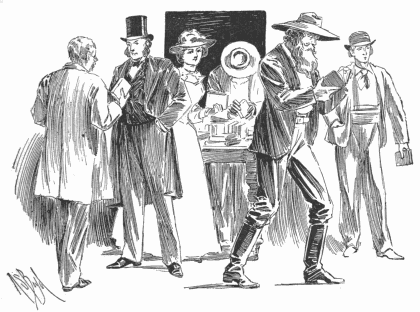
But this brings me to the most extraordinary feature of this singular demonstration. I do not think that the publishers were at all troubled by it; I cannot conscientiously say that I was; I have every reason to believe that the poets themselves, in and out of the volume, were not displeased at the notoriety they had not expected, and I have long since been convinced that my most remorseless critics were not in earnest, but were obeying some sudden impulse started by the first attacking journal. The extravagance of the Red Dog Jay Hawk was emulated by others: it was a large, contagious joke, passed from journal to journal in a peculiar cyclonic Western fashion. And there still lingers, not unpleasantly, in my memory the conclusion of a cheerfully scathing review of the book which may make my meaning clearer: 'If we have said anything in this article which might cause a single pang to the poetically sensitive nature of the youthful individual calling himself Mr. Francis Bret Harte—but who, we believe, occasionally parts his name and his hair in the middle—we will feel that we have not laboured in vain, and are ready to sing Nunc Dimittis, and hand in our checks. We have no doubt of the absolutely pellucid and lacteal purity of Franky's intentions. He means well to the Pacific Coast, and we return the compliment. But he has strayed away from his parents and guardians while he was too fresh. He will not keep without a little salt.'
It was thirty years ago. The book and its Rabelaisian criticisms have been long since forgotten. Alas! I fear that even the capacity for that Gargantuan laughter which met them, in those days, exists no longer. The names I have used are necessarily fictitious, but where I have been obliged to quote the criticisms from memory I have, I believe, only softened their asperity. I do not know that this story has any moral. The criticisms here recorded never hurt a reputation nor repressed a single honest aspiration. A few contributors to the volume, who were of original merit, have made their mark, independently of it or its critics. The editor, who was for two months the most abused man on the Pacific slope, within the year became the editor of its first successful magazine. Even the publisher prospered, and died respected!
'DEAD MAN'S ROCK'
By 'Q.'
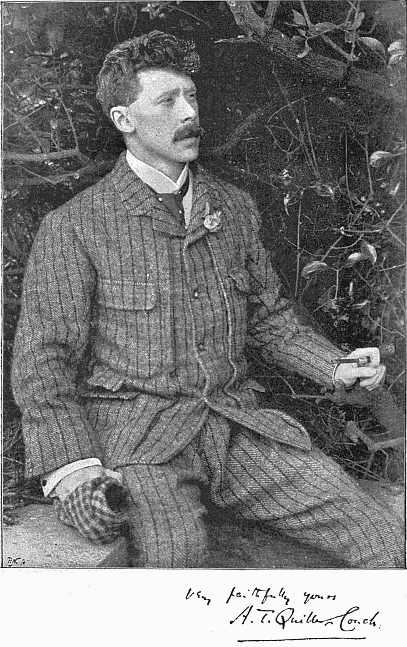
I CHERISH no parental illusions about 'Dead Man's Rock.' It is two or three years since I read a page of that blood-thirsty romance, and my only copy of it was found, the other day, in turning out the lumber-room at the top of the house. 'Q.' JUNIOR Later editions have been allowed to appear with all the inaccuracies and crudities of the first. On page 116, Bombay is still situated in the Bay of Bengal, and may continue to adorn that shore. The error must be amusing, since unknown friends continue to write and confess themselves tickled by it; and it is stupid to begin amending a book in which you have lost interest. But though this is my attitude towards 'Dead Man's Rock,' I can still look back on the writing of it as on an amusing adventure.
It was begun in the late summer of 1886, and was my first attempt at telling a story on paper. I am careful to say 'on paper,' because in childhood I was telling myself stories from morning to night. Tens of thousands of small boys are doing the same every day in the year; but I should be sorry to guess how much of my time, between the ages of seven and thirteen, must have been given up to weaving these childish epics. They were curious jumbles; the characters (of which I had a constant set) being drawn indiscriminately from the 'Morte d'Arthur,' 'Bunyan's Holy War,' 'Pope's Iliad,' 'Ivanhoe,' and a book of Fairy Tales by Holme Lee, as well as from history; and the themes ranging from battles and tournaments to cricket, wrestling, and sailing matches. Anachronisms never troubled the story-teller. The Duke of Wellington would cheerfully break a lance with Captain Credence or Tristram of Lyonesse, and I rarely made up a football fifteen without including Hardicanute (whom I loved for his name), Hector (dear for his own sake) and Wamba (who supplied the comic interest and scored off Thersites). They were brave companions; but at the age of thirteen they deserted me suddenly. Or perhaps after reading Mr. Stevenson's 'Chapter on Dreams,' I had better say it was the Piskies—the Small People—who deserted me. They alone know why—for their pensioner had never betrayed a single one of their secrets—or why in these later times, when he sells their confidences for money, they have come back to help him, though more sparingly. Three or four of the little stories in 'Noughts and Crosses' are but translated dreams, and there are others in my notebook; but now I never compose without some pain, whereas in the old days I had but to sit alone in a corner or take a solitary walk and invite them, and they did all the work. But one summer evening I summoned them and met with no response. Without warning the tales had come to an end.
From my first school at Newton Abbot I went to Clifton, and from Clifton in my nineteenth year to Oxford. It was here that the old desire to weave stories began to come back. Mr. Stevenson's 'Treasure Island' was the immediate cause. I had been scribbling all through my school days; had written a prodigious quantity of bad reflective poetry and burnt it as soon as I really began to reflect; and was now plying the Oxford Magazine with light verse, a large proportion of which was lately reprinted in a thin volume, with the title of 'Green Bays.' But I wrote little or no prose. My prose essays at school were execrable. I had followed after false models for a while, and when gently made aware of this by the sound and kindly scholar who looked over our sixth-form essays at Clifton, had turned dispirited and wrote scarcely at all. Though reading great quantities of fiction, I had, as has been said, no thought of telling a story, and so far as I knew, no faculty. The desire, at least, was awakened by 'Treasure Island,' and, in explanation of this, I can only quote the gentleman who reviewed my first book in the Athenæum, and observed that 'great wits jump, and lesser wits jump with them.' That is just the truth of it. I began as a pupil and imitator of Mr. Stevenson, and was lucky in my choice of a master.
The germ of 'Dead Man's Rock' was a curious little bit of family lore, which I may extract from my father's history of Polperro, a small haven on the Cornish coast. The Richard Quiller of whom he speaks is my great grandfather.
'In the old home of the Quillers, at Polperro, there was hanging on a beam a key, which we as children regarded with respect and awe, and never dared to touch, for Richard Quiller had put the key of his quadrant on a nail, with strong injunctions that no one should take it off until his return (which never happened), and there, I believe, it still hangs. His brother John served for several years as commander of a hired armed lugger, employed in carrying despatches in the French war, Richard accompanying him as subordinate officer. They were engaged in the inglorious bombardment of Flushing in 1809. Some short time after this they were taken, after a desperate fight with a pirate, into Algiers, but were liberated on the severe remonstrances of the British Consul. They returned to their homes in most miserable plight, having lost their all, except their Bible, much valued then by the unfortunate sailors, and now by a descendant in whose possession it is. About the year 1812 these same brothers sailed to the island of Teneriffe in an armed merchant ship, but after leaving that place were never heard of.'
Here, then, I had the simple apparatus for a mystery; for, of course, the key must be made to unlock something far more uncommon than a quadrant; and I still think it a capital apparatus, had I only possessed the wit to use it properly. There was romance in this key—that was obvious enough, and I puzzled over it for some weeks, by the end of which my plot had grown to something like this: A family living in poverty, though heirs to great wealth—this wealth buried close to their door, and the key to unlock it hanging over their heads from morning to night. It was soon settled, too, that this family should be Cornish, and the scene laid on the Cornish coast, Cornwall being the only corner of the earth with which I had more than a superficial acquaintance.
So far, so good; but what was the treasure to be? And what the reason that stood between its inheritors and their enjoyment of it? As it happened, these two questions were answered together. The small library at Trinity—a delightful room, where Dr. Johnson spent many quiet hours at work upon his 'Dictionary'—is fairly rich in books of old travel and discovery; fine folios, for the most part, filling the shelves on your left as you enter. To the study of these I gave up a good many hours that should have been spent on ancient history of another pattern, and more directly profitable for Greats; and in one of them—Purchas, I think, but will not swear—first came on the Great Ruby of Ceylon. Not long after, a note in Yule's edition of 'Marco Polo' set my imagination fairly in chase of this remarkable gem; and I hunted up all the accessible authorities. The size of this ruby (as thick as a man's arm, says Marco Polo, while Maundevile, who was an artist, and lied with exactitude, puts it at a foot in length and five fingers in girth), its colour, 'like unto fire,' and the mystery and completeness of its disappearance, combined to fascinate me. No form of riches is so romantic as a precious stone with a heart in it and a history. I had only to endow it with a curse proportionate to its size and beauty, and I had all that a story-teller could possibly want.
'THE HAVEN,' FOWEY[E]
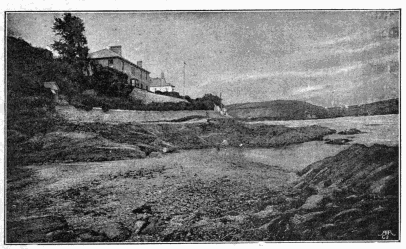
But even a treasure hunt is a poor affair unless you have two parties vying for the booty, and a curse can hardly be worked effectively until you introduce the fighting element, and make destiny strike her blows through the passions—hate, greed, &c.—of her victims. I had shaped my story to this point: the treasure was to be buried by a man who had slain his comrade and only confidant in order to enjoy the booty alone, and had afterwards become aware of the curse attached to its possession. And the descendants of these two men were to be rivals in the search for it, each side possessing half of the clue. It was at this point that, like George IV., I invented a buckle. My buckle had two clasps, and on these the secret of the treasure was so engraved as to become intelligible only when they were united.
My plot had now taken something like a shape; but it had one serious defect. It would not start to walk. Coax it as I might it would not budge. Even the worst book must have a beginning—this reflection was no less distressing than obvious, for mine had none. And there is no saying it would ever have found one but for a lucky accident.
In the Long Vacation of 1885 I spent three weeks or a month at the Lizard pollacking and reading Plato. Knowing at that time comparatively little of this corner of the coast, I had brought one or two guide books and local histories in the bottom of my portmanteau. One evening, after a stiff walk along the cliffs, I put the 'Republic' aside for a certain 'History and Description of the Parish of Mullyon,' by its vicar, the Rev. E. G. Harvey, and came upon a passage that immediately shook my scraps of invention into their proper places.
The passage in question was a narrative of the wreck of the 'Jonkheer Meester Van de Wall,' a Dutch barque, on the night of March 25, 1867. I cannot quote at length the vicar's description of this wreck; but in substance and in many of its details it is the story of the 'Belle Fortune' in 'Dead Man's Rock.' The vessel broke up in the night and drowned every soul on board except a Greek sailor, who was found early next morning clambering about the rocks under cliff, between Polurrian and Poljew. This man's behaviour was mysterious from the first, and his evidence at the inquest held on the drowned bodies of his shipmates was, to say the least, extraordinary. He said: 'My name is Georgio Buffani. I was seaman on board the ship, which belonged to Dordrecht. I joined the ship at Batavia, but I do not know the name of the ship or the name of the captain.' Being shown, however, the official list of Dutch East Indiamen, he pointed to one built in 1854, the 'Kosmopoliet,' Captain König. He then told his story of the disaster, which there was no one to contradict, and the jury returned a verdict of 'Accidentally drowned.' The Greek made his bow and left the neighbourhood.
MR. AND MRS. QUILLER COUCH
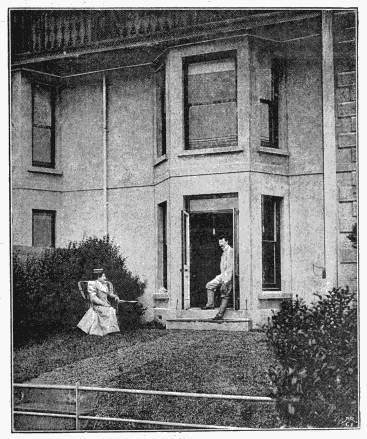
Just after the inquest Mr. Broad, Dutch Consul at Falmouth, arrived, bringing with him the captains of two Dutch East Indiamen then lying at Falmouth. One of them asked at once 'Is it Klaas Lammerts's?' Being told that the 'Kosmopoliet' was the name of the wrecked ship, he said, 'I don't believe it. The "Kosmopoliet" wouldn't be due for a fortnight, almost. It must be Klaas Lammerts's vessel.' The vicar, who had now come up, showed a scrap of flannel he had picked up, with '6. K. L.' marked upon it. 'Ah!' said the Dutchman, 'it must be so. It must be the "Jonkheer."' But she had been returned 'Kosmopoliet' at the inquest, so there the matter rested.
'On the Friday following, however,' pursues the vicar, 'when Mr. Broad and this Dutch captain again visited Mullyon, the first thing handed them was a parchment which had been picked up meanwhile, and this was none other than the masonic diploma of Klaas van Lammerts. Here, then, was no room for doubt. The ship was identified as the "Jonkheer Meester van de Wall van Puttershoek," Captain Klaas van Lammerts, 650 tons register, homeward bound from the East Indies, with a cargo of sugar, coffee, spices, and some Banca tin. The value of the ship and cargo would be between 40,000l. and 50,000l.' It may be added that on the afternoon before the wreck, the vessel had been seen to miss stays more than once in her endeavour to beat off the land, and generally to behave as if handled by an unaccountably clumsy crew. Altogether, folks on shore had grave suspicions that there was mutiny or extreme disorder of some kind on board; but of this nothing was ever certainly known.
I think this narrative was no sooner read than digested into the scheme of my romance, now for some months neglected and almost forgotten. But the Final School of Literæ Humaniores loomed unpleasantly near, and just a year passed before I could turn my discovery to account. The following August found me at Petworth, in Sussex, lodging over a clockmaker's shop that looked out upon the Market Square. Petworth is quiet; and at that time I knew scarcely a soul in the place; but lovely scenery lies all around it, and on a hot afternoon you may do worse than stretch yourself on the slopes above the weald and smoke and do nothing. There is one small common in particular, close to the monument at the top of the park, and just outside the park wall, where I spent many hours looking across the blue country to Blackdown, and lazily making up my mind about the novel. In the end—it was some time in September—I called on the local stationer and bought a large heap of superior foolscap.
FOWEY GRAMMAR SCHOOL CREW AND MR. QUILLER COUCH
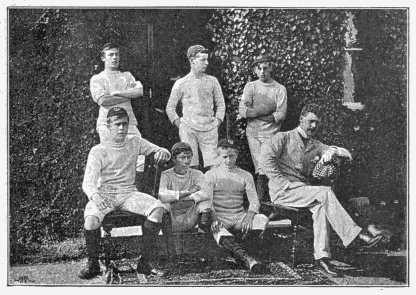
A travelling waxwork company was unpacking its caravan in the square outside my window on the morning when I pulled in my chair and light-heartedly wrote 'Dead Man's Rock (a Romance), by Q.,' at the top of the first sheet of foolscap. The initial was my old initial of the Oxford Magazine verses, and the title had been settled on for some time before. Staying with some friends on the Cornish coast, I had been taken to a picnic, or some similar function, on a beach, where they showed me a pillar-shaped rock, standing boldly up from the sands, and veined with curious red streaks resembling bloodstains. 'I want a story written about that rock,' a lady of the party had said; 'something really blood-thirsty. "Slaughter Rock" might do for the name.' But my title was really borrowed from the Dodman, locally called Deadman, a promontory east of Falmouth, between Veryan and St. Austell bays.
I had covered two pages of foolscap before the brass band of the waxwork show struck up and drove me out of doors and along the road that leads to the railway station—the only dull road around Petworth, and chosen now for that very reason. A good half of that morning's work was afterwards torn up; but I felt at the time that the enterprise was going well. I had written slowly, but easily; and, of course, believed that I had found my vocation, and would always be able to write easily—most vain delusion! For in six years and a half I have recaptured the fluency of that morning not half-a-dozen times. Still, I continued to take a lively interest in my story, and wrote at it very steadily, finishing Book I. before my return to Oxford. It surprised me, though, that, for all my interest in it, the story gave me little or no emotion. Once only did I get a genuine thrill, and that was at the point where young Jasper finds the sailor's cap (p. 25), and why at this point more than another is past explaining. In later efforts I have written several pages with a shaking pen and amid dismal signs of grief; and, on revision, have usually had to tear those pages up. On the whole, my short experience goes against