MY FIRST BOOK (continued 3)
Reading edition
These facts encouraged me, and I wrote a second novel—'The Witch's Head.' This book I endeavoured to publish serially by posting the MS. to the editors of various magazines for their consideration. But in those days there were no literary agents or Authors' Societies to help young writers with their experience and advice, and the bulky manuscript always came back to my hand like a boomerang, till at length I wearied of the attempt. Of course I sent to the wrong people; afterwards the editor of a leading monthly told me that he would have been delighted to run the book had it fallen into the hands of his firm. In the end, as in the case of 'Dawn,' I published 'The Witch's Head' in three volumes. Its reception astonished me, for I did not think so well of the book as I had done of its predecessor. In that view, by the way, the public has borne out my judgment, for to this day three copies of 'Dawn' are absorbed for every two of 'The Witch's Head,' a proportion that has never varied since the two works appeared in one-volume form.
'The Witch's Head' was very well reviewed; indeed, in one or two cases, the notices were almost enthusiastic, most of all when they dealt with the African part of the book, which I had inserted as padding, the fight between Jeremy and the Boer giant being singled out for especial praise. Whatever it may lack, one merit this novel has, however, that was overlooked by all the reviewers. Omitting the fictitious incidents introduced for the purposes of the story, it contains an accurate account of the great disaster inflicted upon our troops by the Zulus at Isandhlwana. I was in the country at the time of the massacre, and heard its story from the lips of survivors; also, in writing of it, I studied the official reports in the blue books and the minutes of the court martial.
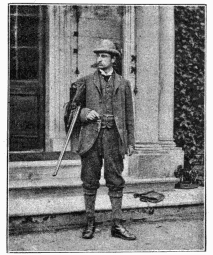
'The Witch's Head' attained the dignity of being pirated in America, and in England went out of print in a few weeks, but no argument that I could use would induce my publishers to re-issue it in a one volume edition. The risk was too great, they said. Then it was I came to the conclusion that I would abandon the making of books. The work was very hard, and when put to the test of experience the glamour that surrounds this occupation vanished. I did not care much for the publicity it involved, and, like most young authors, I failed to appreciate being sneered at by anonymous critics who happened not to admire what I wrote, and whom I had no opportunity of answering. It is true that then, as now, I liked the work for its own sake. Indeed, I have always thought that literature would be a charming profession if its conditions allowed of the depositing of manuscripts, when MR. RIDER HAGGARD completed, in a drawer, there to language in obscurity, or of their private publication only. But I could not afford myself these luxuries. I was too modest to hope for any renown worth having, and for the rest the game seemed scarcely worth the candle. I had published a history and two novels. On the history I had lost fifty pounds, on the first novel I had made ten pounds, and on the second fifty; net profit on the three, ten pounds, which in the case of a man with other occupations and duties did not appear to be an adequate return for the labour involved. But I was not destined to escape thus from the toils of romance. One day I chanced to read a clever article in favour of boys' books, and it occurred to me that I might be able to do as well as others in that line. I was working at the Bar at the time, but in my spare evenings, more from amusement than from any other reason, I entered on the literary adventure that ended in the appearance of 'King Solomon's Mines.' This romance has proved very successful, although three firms, including my own publishers, refused even to consider it. But as it can scarcely be called one of my first books, I shall not speak of it here.
In conclusion, I will tell a moving tale, that it may be a warning to young authors for ever. After my publishers declined to issue 'The Witch's Head' in a six-shilling edition, I tried many others without success, and at length in my folly signed an agreement with a firm since deceased. Under this document the firm in question agreed to bring out 'Dawn' and 'The Witch's Head' in a two-shilling edition, and generously to remunerate me with a third share in the profits realised, if any. In return for this concession, I on my part undertook to allow the said firm to republish any novel that I might write, for a period of five years from the date of the agreement, in a two-shilling form, and on the same third-profit terms. Of course, so soon as the success of 'King Solomon's Mines' was established, I received a polite letter from the publishers in question, asking when they might expect to republish that romance at two shillings. Then the matter came under the consideration of lawyers and other skilled persons, with the result that it appeared that, if the Courts took a strict view of the agreement, ruin stared me in the face, so far as my literary affairs were concerned. To begin with, either by accident or design, this artful document was so worded that, primâ facie, the contracting publisher had a right to place his cheap edition on the market whenever it might please him to do so, subject only to the payment of a third of the profit, to be assessed by himself, which practically might have meant nothing at all. How could I expect to dispose of work subject to such a legal 'servitude'? For five long years I was a slave to the framer of the 'hanging' clause of the agreement. Things looked black indeed, when, thanks to the diplomacy of my agent, and to a fortunate change in the personnel of the firm to which I was bound, I avoided disaster. The fatal agreement was cancelled, and in consideration of my release I undertook to write two books upon a moderate royalty. Thus, then, did I escape out of bondage. To be just, it was my own fault that I should ever have been sold into it, but authors are proverbially guileless when they are anxious to publish their books, and a piece of printed paper with a few additions written in a neat hand looks innocent enough. Now no such misfortunes need happen, for the Authors' Society is ready and anxious to protect them from themselves and others, but in those days it did not exist.
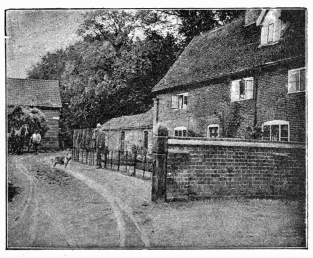
THE FARM
This is the history of how I drifted into the writing of books. If it saves one beginner so inexperienced and unfriended as I was in those days from putting his hand to a 'hanging' agreement under any circumstances whatsoever, it will not have been set out in vain.
The advice that I give to would-be authors, if I may presume to offer it, is to think for a long while before they enter at all upon a career so hard and hazardous, but having entered on it, not to be easily cast down. There are great virtues in perseverance, even though critics sneer and publishers prove unkind.
'HUDSON'S BAY'
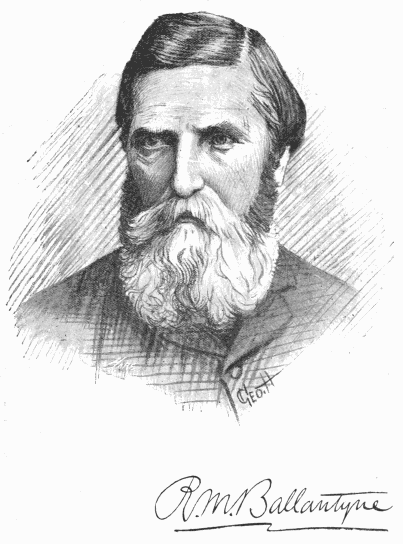
By R. M. BALLANTYNE
HAVING been asked to give some account of the commencement of my literary career, I begin by remarking that my first book was not a tale or 'story-book,' but a free-and-easy record of personal adventure and every-day life in those wild regions of North America which are known, variously, as Rupert's Land—The Hudson's Bay Territory—The Nor' West, and 'The Great Lone Land.'
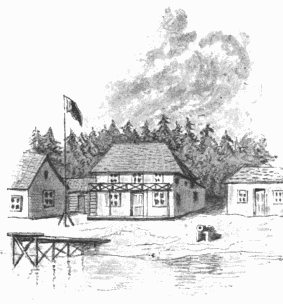
WHERE I WROTE MY FIRST BOOK (A Sketch by the Author)
The record was never meant to see the light in the form of a book. It was written solely for the eye of my mother, but, as it may be said that it was the means of leading me ultimately into the path of my life-work, and was penned under somewhat peculiar circumstances, it may not be out of place to refer to it particularly here.
The circumstances were as follows:—
After having spent about six years in the wild Nor' West, as a servant of the Hudson's Bay Fur Company, I found myself, one summer—at the advanced age of twenty-two—in charge of an outpost on the uninhabited northern shores of the Gulf of St. Lawrence named Seven Islands. It was a dreary, desolate spot; at that time far beyond the bounds of civilisation. The gulf, just opposite the establishment, was about fifty miles broad. The ships which passed up and down it were invisible, not only on account of distance, but because of seven islands at the mouth of the bay coming between them and the outpost. My next neighbour, in command of a similar post up the gulf, was about seventy miles distant. The nearest house down the gulf was about eighty miles off, and behind us lay the virgin forests, with swamps, lakes, prairies, and mountains, stretching away without break right across the continent to the Pacific Ocean.
The outpost—which, in virtue of a ship's carronade and a flagstaff, was occasionally styled a 'fort'—consisted of four wooden buildings. One of these—the largest, with a verandah—was the Residency. There was an offshoot in rear which served as a kitchen. The other houses were a store for goods wherewith to carry on trade with the Indians, a stable, and a workshop. The whole population of the establishment—indeed of the surrounding district—consisted of myself and one man—also a horse! The horse occupied the stable, I dwelt in the Residency, the rest of the population lived in the kitchen.
There were, indeed, five other men belonging to the establishment, but these did not affect its desolation, for they were away netting salmon at a river about twenty miles distant at the time I write of.
My 'Friday'—who was a French-Canadian—being cook, as well as man-of-all-works, found a little occupation in attending to the duties of his office, but the unfortunate Governor had nothing whatever to do except await the arrival of Indians, who were not due at that time. The horse was a bad one, without a saddle, and in possession of a pronounced backbone. My 'Friday' was not sociable. I had no books, no newspapers, no magazines or literature of any kind, no game to shoot, no boat wherewith to prosecute fishing in the bay, and no prospect of seeing anyone to speak to for weeks, if not months, to come. But I had pen and ink, and, by great good fortune, was in possession of a blank paper book fully an inch thick.
These, then, were the circumstances in which I began my first book.
When that book was finished, and, not long afterwards, submitted to the—I need hardly say favourable—criticism of my mother, I had not the most distant idea of taking to authorship as a profession. Even when a printer-cousin, seeing the MS., offered to print it, and the well-known Blackwood of Edinburgh, seeing the book, offered to publish it—and did publish it—my ambition was still so absolutely asleep that I did not again put pen to paper in that way for eight years thereafter, although I might have been encouraged thereto by the fact that this first book—named 'Hudson's Bay'—besides being a commercial success, received favourable notice from the Press.
It was not until the year 1854 that my literary path was opened up. At that time I was a partner in the late publishing firm of Constable & Co., of Edinburgh. Happening one day to meet with the late William Nelson, publisher, I was asked by him how I should like the idea of taking to literature as a profession. My answer I forget. It must have been vague, for I had never thought of the subject before.
'Well,' said he, 'what would you think of trying to write a story?'
Somewhat amused, I replied that I did not know what to think, but I would try if he wished me to do so.
'Do so,' said he, 'and go to work at once'—or words to that effect.
I went to work at once, and wrote my first story or work of fiction. It was published in 1855 under the name of 'Snowflakes and Sunbeams; or, The Young Fur-traders.' Afterwards the first part of the title was dropped, and the book is now known as 'The Young Fur-traders.' From that day to this I have lived by making story-books for young folk.
MR. BALLANTYNE'S HOUSE AT HARROW[C]
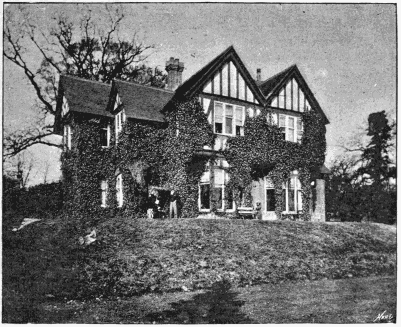
From what I have said it will be seen that I have never aimed at the achieving of this position, and I hope that it is not presumptuous in me to think—and to derive much comfort from the thought—that God led me into the particular path along which I have walked for so many years.
The scene of my first story was naturally laid in those backwoods with which I was familiar, and the story itself was founded on the adventures and experiences of myself and my companions. When a second book was required of me, I stuck to the same regions, but changed the locality. When casting about in my mind for a suitable subject, I happened to meet with an old retired 'Nor'wester' who had spent an adventurous life in Rupert's Land. Among other duties he had been sent to establish an outpost of the Hudson's Bay Company at Ungava Bay, one of the most dreary parts of a desolate region. On hearing what I wanted he sat down and wrote a long narrative of his proceedings there, which he placed at my disposal, and thus furnished me with the foundation of 'Ungava.'
But now I had reached the end of my tether, and when a third story was wanted I was compelled to seek new fields of adventure in the books of travellers. Regarding the Southern seas as a most romantic part of the world—after the backwoods!—I mentally and spiritually plunged into those warm waters, and the dive resulted in the 'Coral Island.'
It now began to be borne in upon me that there was something not quite satisfactory in describing, expatiating on, and energising in, regions which one has never seen. For one thing, it was needful to be always carefully on the watch to avoid falling into mistakes—geographical, topographical, natural-historical, and otherwise.
For instance, despite the utmost care of which I was capable while studying up for the 'Coral Island,' I fell into a blunder through ignorance in regard to a familiar fruit. I was under the impression that cocoanuts grew on their trees in the same form as that in which they are usually presented to us in grocers' windows—namely, about the size of a large fist, with three spots at one end. Learning from trustworthy books that at a certain stage of development the nut contains a delicious beverage like lemonade, I sent one of my heroes up a tree for a nut, through the shell of which he bored a hole with a penknife. It was not till long after the story was
TROPHIES FROM MR. BALLANTYNE'S TRAVELS
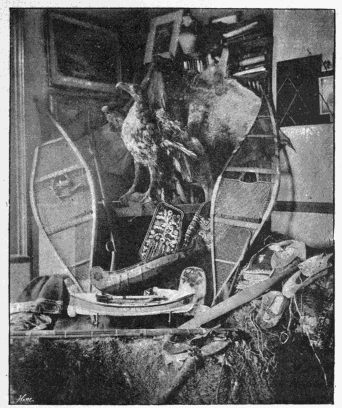
published that my own brother—who had voyaged in Southern seas—wrote to draw my attention to the fact that the cocoanut is nearly as large as a man's head, and its outer husk is over an inch thick, so that no ordinary penknife could bore to its interior! Of course I should have known this, and, perhaps, should be ashamed of my ignorance, but, somehow I'm not!
I admit that this was a slip, but such, and other slips, hardly justify the remark that some people have not hesitated to make—namely, that I have a tendency to draw the long bow. I feel almost sensitive on this point, for I have always laboured to be true to nature and to fact even in my wildest flights of fancy.
This reminds me of the remark made to myself once by a lady in reference to this same 'Coral Island.' 'There is one thing, Mr. Ballantyne,' she said, 'which I really find it hard to believe. You make one of your three boys dive into a clear pool, go to the bottom, and then, turning on his back, look up and wink and laugh at the other two.'
'No, no, not "laugh,"' said I, remonstratively.
'Well, then, you make him smile.'
'Ah! that is true, but there is a vast difference between laughing and smiling under water. But is it not singular that you should doubt the only incident in the story which I personally verify? I happened to be in lodgings at the seaside while writing that story, and, after penning the passage you refer to, I went down to the shore, pulled off my clothes, dived to the bottom, turned on my back, and, looking up, I smiled and winked.'
The lady laughed, but I have never been quite sure, from the tone of that laugh, whether it was a laugh of conviction or of unbelief. It is not improbable that my fair friend's mental constitution may have been somewhat similar to that of the old woman who declined to believe her sailor-grandson when he told her he had seen flying-fish, but at once recognised his veracity when he said he had seen the remains of Pharaoh's chariot wheels on the shores of the Red Sea.
Recognising, then, the difficulties of my position, I formed the resolution to visit—when possible—the scenes in which my stories were laid; converse with the people who, under modification, were to form the dramatis personæ of the tales, and, generally, to obtain information in each case, as far as lay in my power, from the fountain-head.
THE STUDY
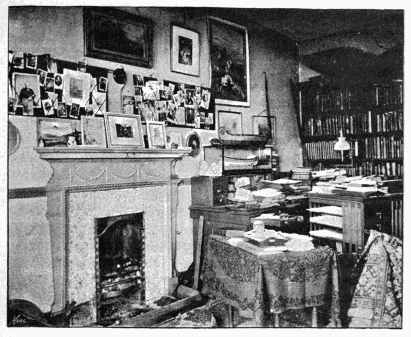
Thus, when about to begin 'The Lifeboat,' I went to Ramsgate, and, for some time, was hand and glove with Jarman, the heroic coxswain of the Ramsgate boat, a lion-like as well as a lion-hearted man, who rescued hundreds of lives from the fatal Goodwin Sands during his career. In like manner, when getting up information for 'The Lighthouse,' I obtained permission from the Commissioners of Northern Lights to visit the Bell Rock Lighthouse, where I hobnobbed with the three keepers of that celebrated pillar-in-the-sea for three weeks, and read Stevenson's graphic account of the building of the structure in the library, or visitors' room, just under the lantern. I was absolutely a prisoner there during those three weeks, for no boats ever came near us, and it need scarcely be said that ships kept well out of our way. By good fortune there came on a pretty stiff gale at the time, and Stevenson's thrilling narrative was read to the tune of whistling winds and roaring seas, many of which latter sent the spray right up to the lantern and caused the building, more than once, to quiver to its foundation.
In order to do justice to 'Fighting the Flames' I careered through the streets of London on fire-engines, clad in a pea-jacket and a black leather helmet of the Salvage Corps. This to enable me to pass the cordon of police without question—though not without recognition, as was made apparent to me on one occasion at a fire by a fireman whispering confidentially, 'I know what you are, sir, you're a hamitoor!'
'Right you are,' said I, and moved away in order to change the subject.
It was a glorious experience, by the way, this galloping on fire-engines through the crowded streets. It had in it much of the excitement of the chase—possibly that of war—with the noble end in view of saving instead of destroying life! Such tearing along at headlong speed; such wild roaring of the firemen to clear the way; such frantic dashing aside of cabs, carts, 'buses, and pedestrians; such reckless courage on the part of the men, and volcanic spoutings on the part of the fires! But I must not linger. The memory of it is too enticing. 'Deep Down' took me to Cornwall, where, over two hundred fathoms beneath the green turf, and more than half a mile out under the bed of the sea, I saw the sturdy miners at work winning copper and tin from the solid rock, and acquired some knowledge of their life, sufferings, and toils.
In the land of the Vikings I shot ptarmigan, caught salmon, and gathered material for 'Erling the Bold.' A winter in Algiers made me familiar with the 'Pirate City.' I enjoyed a fortnight with the hearty inhabitants of the Gull Lightship off the Goodwin Sands; and went to the Cape of Good Hope
MR. R. M. BALLANTYNE
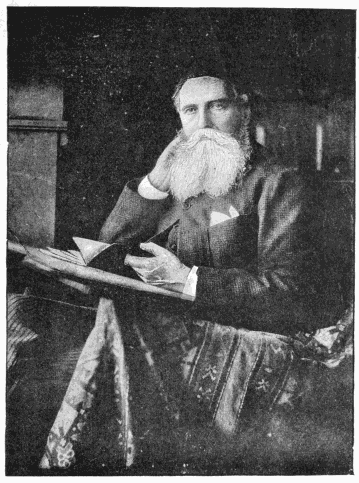
and up into the interior of the Colony, to spy out the land and hold intercourse with 'The Settler and the Savage'—although I am bound to confess that, with regard to the latter, I talked to him only with mine eyes. I also went afloat for a short time with the fishermen of the North Sea in order to be able to do justice to 'The Young Trawler.'
To arrive still closer at the truth, and to avoid errors, I have always endeavoured to submit my proof sheets, when possible, to experts and men who knew the subjects well. Thus, Captain Shaw, late chief of the London Fire Brigade, kindly read the proofs of 'Fighting the Flames,' and prevented my getting off the rails in matters of detail, and Sir Arthur Blackwood, financial secretary to the General Post Office, obligingly did me the same favour in regard to 'Post Haste.'
One other word in conclusion. Always, while writing—whatever might be the subject of my story—I have been influenced by an undercurrent of effort and desire to direct the minds and affections of my readers towards the higher life.
'THE PREMIER AND THE PAINTER'
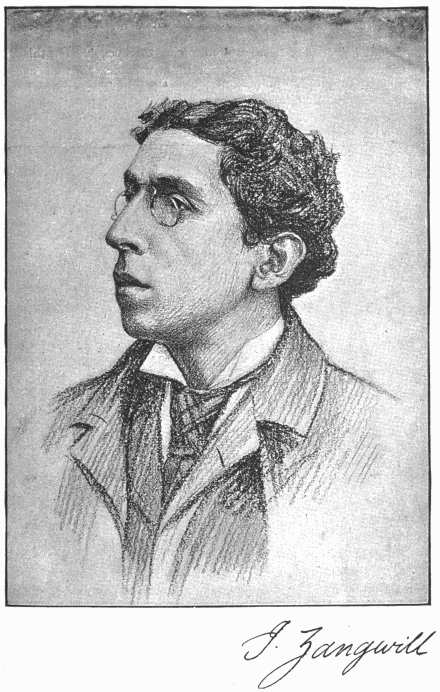
By I. ZANGWILL
AS it is scarcely two years since my name (which, I hear, is a nom de plume) appeared in print on the cover of a book, I may be suspected of professional humour when I say I do not really know which was my first book. Yet such is the fact. My literary career has been so queer that I find it not easy to write my autobibliography.
'What is a pound?' asked Sir Robert Peel in an interrogative mood futile as Pilate's. 'What is a book?' I ask, and the dictionary answers with its usual dogmatic air, 'A collection of sheets of paper, or similar material, blank, written, or printed, bound together.' At this rate my first book would be that romance of school life in two volumes, which, written in a couple of exercise books, circulated gratuitously in the schoolroom, and pleased our youthful imaginations with teacher-baiting tricks we had not the pluck to carry out in the actual. I shall always remember this story because, after making the tour of the class, it was returned to me with thanks and a new first page from which all my graces of style had evaporated. Indignant inquiry discovered the criminal—he admitted he had lost the page, and had rewritten it from memory. He pleaded that it was better written (which in one sense was true), and that none of the facts had been omitted.
This ill-treated tale was 'published' when I was ten, but an old schoolfellow recently wrote to me reminding me of an earlier novel written in an old account-book. Of this I have no recollection, but, as he says he wrote it day by day at my dictation, I suppose he ought to know. I am glad to find I had so early achieved the distinction of keeping an amanuensis.
The dignity of print I achieved not much later, contributing verses and virtuous essays to various juvenile organs. But it was not till I was eighteen that I achieved a printed first book. The story of this first book is peculiar; and, to tell it in approved story form, I must request the reader to come LOOKING FOR TOOLE back two years with me.
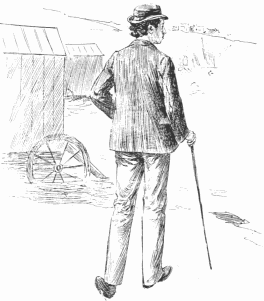
One fine day, when I was sixteen, I was wandering about the Ramsgate sands looking for Toole. I did not really expect to see him, and I had no reason to believe he was in Ramsgate, but I thought if Providence were kind to him it might throw him in my way. I wanted to do him a good turn. I had written a three-act farcical comedy at the request of an amateur dramatic club. I had written out all the parts, and I think there were rehearsals. But the play was never produced. In the light of after knowledge I suspect some of those actors must have been of quite professional calibre. You understand, therefore, why my thoughts turned to Toole. But I could not find Toole. Instead, I found on the sands a page of a paper called Society. It is still running merrily at a penny, but at that
time it had also a Saturday edition at threepence. On this page was a great prize-competition scheme, as well as details of a regular weekly competition. The competitions in those days were always literary and intellectual, but then popular education had not made such strides as to-day.
I sat down on the spot, and wrote something which took a prize in the weekly competition. This emboldened me to enter for the great stakes.
I SAT DOWN AND WROTE SOMETHING
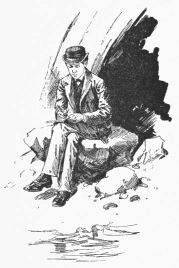
There were various events. I resolved to enter for two. One was a short novel, and the other a comedietta. The '5l. humorous story' competition I did not go in for; but when the last day of sending in MSS. for that had passed, I reproached myself with not having despatched one of my manuscripts. Modesty had prevented me sending in old work, as I felt assured it would stand no chance, but when it was too late I was annoyed with myself for having thrown away a possibility. After all I could have lost nothing. Then I discovered that I had mistaken the last date, and that there was still a day. In the joyful reaction I selected a story called 'Professor Grimmer,' and sent it in. Judge of my amazement when this got the prize (5l.), and was published in serial form running through three numbers of Society. Last year, at a Press dinner, I found myself next to Mr. Arthur Goddard, who told me he had acted as Competition Editor, and that quite a number of now well-known people had taken part in these admirable competitions. My painfully laboured novel only got honourable mention, and my comedietta was lost in the post.
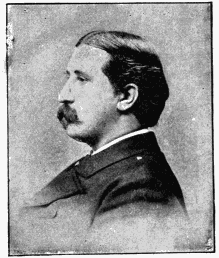
But I was now at the height of literary fame, and success stimulated me to fresh work. I still marvel when I think of the amount of rubbish I turned out in my seventeenth and eighteenth years, in the scanty leisure of a harassed pupil-teacher at an elementary school, working hard in the evenings for a degree at the London University to boot. There was a ARTHUR GODDARD fellow pupil-teacher (let us call him Y.) who believed in me, and who had a little money with which to back his belief. I was for starting a comic paper. The name was to be Grimaldi, and I was to write it all every week.
'But don't you think your invention would give way ultimately?' asked Y. It was the only time he ever doubted me.
'By that time I shall be able to afford a staff,' I replied triumphantly.
Y. was convinced. But before the comic paper was born, Y. had another happy thought. He suggested that if I wrote a Jewish story, we might make enough to finance the comic paper. I was quite willing. If he had suggested an epic, I should have written it.
So I wrote the story in four evenings (I always write in spurts), and within ten days from the inception of the idea the booklet was on sale in a coverless pamphlet form. The printing cost ten pounds. I paid five (the five I had won), Y. paid five, and we divided the profits. He has since not become a publisher.
IT WAS HAWKED ABOUT THE STREETS
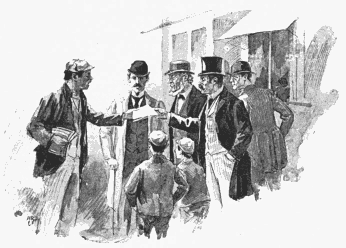
My first book (price one penny nett) went well. It was loudly denounced by those it described, and widely bought by them; it was hawked about the streets. One little shop in Whitechapel sold 400 copies. It was even on Smith's bookstalls. There was great curiosity among Jews to know the name of the writer. Owing to my anonymity, I was enabled to see those enjoying its perusal, who were afterwards to explain to me their horror and disgust at its illiteracy and vulgarity. By vulgarity vulgar Jews mean the reproduction of the Hebrew words with which the poor and the old-fashioned interlard their conversation. It is as if English-speaking Scotchmen and Irishmen should object to 'dialect' novels reproducing the idiom of their 'uncultured' countrymen. I do not possess a copy of my first book, but somehow or other I discovered the MS. when writing 'Children of the Ghetto.' The description of market-day in Jewry was transferred bodily from the MS. of my first book, and is now generally admired.
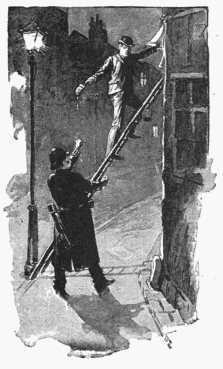
What the profits were I never knew, for they were invested in the second of our publications. Still jealously keeping the authorship secret, we published a long comic ballad which I had written on the model of 'Bab.' With this we determined to launch out in style, and so we had gorgeous advertisement A POLICEMAN TOLD HIM TO GET DOWN posters printed in three colours, which were to be stuck about London to beautify that great dreary city. Y. saw the black-hair of Fortune almost within our grasp.
One morning our headmaster walked into my room with a portentously solemn air. I felt instinctively that the murder was out. But he only said, 'Where is Y.?' though the mere coupling of our names was ominous, for our publishing partnership was unknown. I replied, 'How should I know? In his room, I suppose.'
He gave me a peculiar sceptical glance.
'When did you last see Y.?' he said.
'Yesterday afternoon,' I replied wonderingly.
'And you don't know where he is now?'
'Haven't an idea—isn't he in school?'
'No,' he replied in low, awful tones.
'Where then?' I murmured.
'In prison!'
'In prison!' I gasped.
'In prison; I have just been to help bail him out.'
It transpired that Y. had suddenly been taken with a further happy thought. Contemplation of those gorgeous tricoloured posters had turned his brain, and, armed with an amateur paste-pot and a ladder, he had sallied forth at midnight to stick them about the silent streets, so as to cut down the publishing expenses. A policeman, observing him at work, had told him to get down, and Y., being legal-minded, had argued it out with the policeman de haut en bas from the top of his ladder. The outraged majesty of the law thereupon haled Y. off to the cells.
Naturally the cat was now out of the bag, and the fat in the fire.
To explain away the poster was beyond the ingenuity of even a professed fiction-monger.
Straightway the committee of the school was summoned in hot haste, and held debate upon the scandal of a pupil-teacher being guilty of originality. And one dread afternoon, when all Nature seemed to hold its breath, I was called down to interview a member of the committee. In his hand were copies of the obnoxious publications.
I approached the great person with beating heart. He had been kind to me in the past, singling me out, on account of some scholastic successes, for an annual vacation at the seaside. It has only just struck me, after all these years, that, if he had not done so, I should not have found the page of Society, and so not have perpetrated the deplorable compositions.
In the course of a bad quarter of an hour, he told me that the ballad was tolerable, though not to be endured; he admitted the metre was perfect, and there wasn't a single false rhyme. But the prose novelette was disgusting. 'It is such stuff,' said he, 'as little boys scribble upon walls.'
I said I could not see anything objectionable in it.
'Come now, confess you are ashamed of it,' he urged. 'You only wrote it to make money.'
'If you mean that I deliberately wrote low stuff to make money,' I replied calmly, 'it is untrue. There is nothing I am ashamed of. What you object to is simply realism.' I pointed out that Bret Harte had been as realistic; but they did not understand literature on that committee.
SUCH STUFF AS LITTLE BOYS SCRIBBLE UPON WALLS
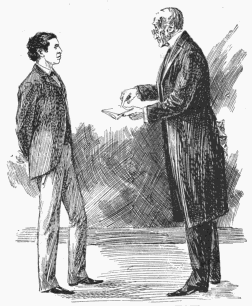
'Confess you are ashamed of yourself,' he reiterated, 'and we will look over it.'
'I am not,' I persisted, though I foresaw only too clearly that my summer's vacation was doomed if I told the truth. 'What is the use of saying I am?'
The headmaster uplifted his hands in horror. 'How, after all your kindness to him, he can contradict you—!' he cried.
'When I come to be your age,' I conceded to the member of the committee, 'it is possible I may look back on it with shame. At present I feel none.'
In the end I was given the alternative of expulsion or of publishing nothing which had not passed the censorship of the committee. After considerable hesitation I chose the latter.
This was a blessing in disguise; for, as I have never been able to endure the slightest arbitrary interference with my work, I simply abstained from publishing. Thus, although I still wrote—mainly sentimental verses—my nocturnal studies were less interrupted. Not till I had graduated, and was of age, did I return to my inky vomit. Then came my next first book—a real book at last.
In this also I had the collaboration of a fellow-teacher, Louis Cowen by name. This time my colleague was part-author. It was only gradually that I had been admitted to the privilege of communion with him, for he was my senior by five or six years, and a man of brilliant parts who had already won his spurs in journalism, and who enjoyed deservedly the reputation of an Admirable Crichton. What drew me to him was his mordant wit (to-day, alas! wasted on anonymous journalism! If he would only reconsider his indetermination, the reading public would be the richer!) Together we planned plays, novels, treatises on political economy, and contributions to philosophy. Those were the days of dreams.
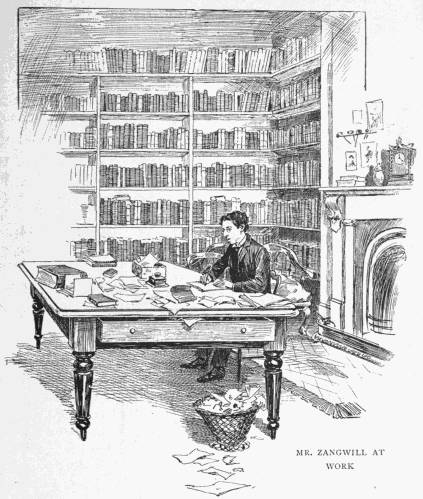
One afternoon he came to me with quivering sides, and told me that an idea for a little shilling book had occurred to him. It was that a Radical Prime Minister and a Conservative working man should change into each other by supernatural means, and the working man be confronted with the problem of governing, while the Prime Minister should be as comically out of place in the East End environment. He thought it would make a funny 'Arabian Nights' sort of burlesque. And so it would have done; but, unfortunately, I saw subtler possibilities of political satire in it, nothing less than a reductio ad absurdum of the whole system of Party Government. I insisted the story must be real, not supernatural, the Prime Minister must be a Tory, weary of office, and it must be an ultra-Radical atheistic artisan bearing a marvellous resemblance to him who directs (and with complete success) the Conservative Administration. To add to the mischief, owing to my collaborator's evenings being largely taken up by other work, seven-eighths of the book came to be written by me, though the leading ideas were, of
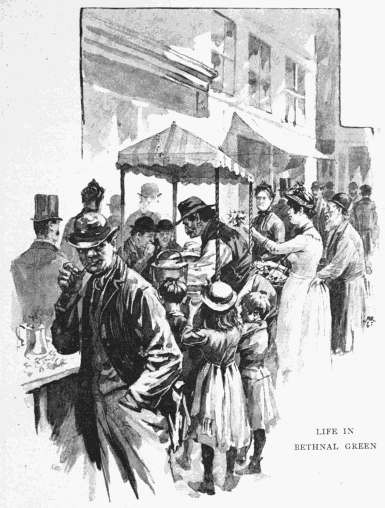
course, threshed out and the whole revised in common, and thus it became a vent-hole for all the ferment of a youth of twenty-one, whose literary faculty had furthermore been pent up for years by the potential censorship of a committee. The book, instead of being a shilling skit, grew to a ten-and-sixpenny (for that was the unfortunate price of publication) political treatise of over sixty long chapters and 500 closely printed pages. I drew all the characters as seriously and complexly as if the fundamental conception were a matter of history; the outgoing Premier became an elaborate study of a nineteenth-century Hamlet; the Bethnal Green life amid which he came to live was presented with photographic fulness and my old trick of realism; the governmental manœuvres were described with infinite detail; numerous real personages were introduced under nominal disguises; and subsequent history was curiously anticipated in some of the Female Franchise and Home Rule episodes. Worst of all, so super-subtle was the satire, that it was never actually stated straight out that the Premier had changed places with the Radical working man, so that the door might be left open for satirically suggested alternative explanations of the metamorphosis in their characters; and as, moreover, the two men re-assumed their original rôles for one night only with infinitely complex effects, many readers, otherwise unimpeachable, reached the end without any suspicion of the actual plot—and yet (on their own confession) enjoyed the book!
In contrast to all this elephantine waggery the half-dozen chapters near the commencement, in which my collaborator sketched the first adventures of the Radical working man in Downing Street, were light and sparkling, and I feel sure the shilling skit he originally meditated would have been a great success. We christened the book. 'The Premier and the Painter,' ourselves J. Freeman Bell, had it type-written, and sent it round to the publishers in two enormous quarto volumes. I had been working at it for more than a year every evening after the hellish torture of the day's teaching, and all day every holiday, but now I had a good rest while it was playing its boomerang prank of returning to me once a month. The only gleam of hope came from Bentleys, who wrote to say that they could not make up their minds to reject it; but they prevailed upon themselves to part with it at last, though not without asking to see Mr. Bell's next book. At last it was accepted by Spencer Blackett, and, though it had been refused by all the best houses, it failed. Failed in a material sense, that is; for there was plenty of praise in the papers, though at too 'WE SENT IT ROUND' long intervals to do us any good. The Athenæum has never spoken so well of anything I have done since. The late James Runciman (I learnt after his death that it was he) raved about it in various uninfluential organs. It even called forth a leader in the Family Herald(!), and there are odd people here and there, who know the secret of J. Freeman Bell, who declare that I. Zangwill will never do anything so good. There was a cheaper edition, but it did not sell much then, though now it is in its third edition, issued uniformly with my other books by Heinemann, and absolutely unrevised. But not only did 'The Premier and the Painter fail with the great public at first, it did not even help either of us one step up the ladder; never got us a letter of encouragement nor a stroke of work. I had to begin journalism at the very bottom and entirely unassisted, narrowly escaping canvassing for advertisements, for I had by this time thrown up my scholastic position, and had gone forth into the world penniless and without even a 'character,' branded as an Atheist (because I did not worship the Lord who presided over our committee) and a Revolutionary (because I refused to break the law of the land).
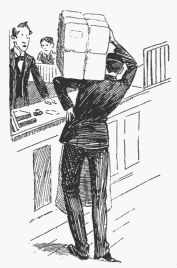
I should stop here if I were certain I had written the required article. But as 'The Premier and the Painter' was not entirely my first book, I may perhaps be expected to say something of my third first book, and the first to which I put my name—'The Bachelors' Club.' Years of literary apathy succeeded the failure of 'The Premier and the Painter.' All I did was to publish a few serious poems (which, I hope, will survive Time), a couple of pseudonymous stories signed 'The Baroness Von S.' (!), and a long philosophical essay upon religion, and to lend a hand in the writing of a few playlets. Becoming convinced of the irresponsible mendacity of the dramatic profession, I gave up the stage, too, vowing never to write except on commission (I kept my vow and yet was played ultimately), and sank entirely into the slough of journalism (glad enough to get there), inter alia editing a comic paper (not Grimaldi, but Ariel) with a heavy heart. At last the long apathy wore off, and I resolved to cultivate literature again in my scraps of time. It is a mere accident that I wrote a pair of 'funny' books, or put serious criticism of contemporary manners into a shape not understood in a country where only the dull are profound and only the ponderous are earnest. 'The Bachelors' Club' was the result of a whimsical remark made by my dear friend, Eder of Bartholomew's, with whom I was then sharing rooms in Bernard Street, and who helped me greatly with it, and its publication was equally accidental. One spring day, in the year of grace 1891, having lived unsuccessfully for a score of years and seven upon this absurd planet, I crossed Fleet Street and stepped into what is called 'success.' It was like this. Mr. J. T. Grein, now of the Independent Theatre, meditated a little monthly called The Playgoers' Review, and he asked me to do an article for the first number, on the strength of some speeches I had made at the Playgoers' Club.
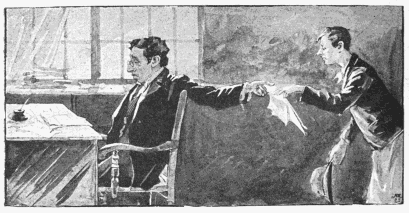
When I got the proof it was marked, 'Please return at once to 6 Bouverie Street.' My office boy being out, and Bouverie Street being only a few steps away, I took it over myself, and found myself, somewhat to my surprise, in the office of Henry & Co., publishers, and in the presence of Mr. J. Hannaford Bennett, an active partner in the firm. He greeted me by name, also to my surprise, and told me he had heard me speak at the Playgoers' Club. A little conversation ensued, and he mentioned that his firm was going to bring out a Library of Wit and Humour. I told him I had begun a book, avowedly humorous, and had written two chapters of it, and he straightway came over to my office, heard me read them, and immediately secured the book. (The then editor ultimately refused to have it in the 'Whitefriars' Library of Wit and Humour,' and so it was brought out separately.)
EDITING A COMIC PAPER
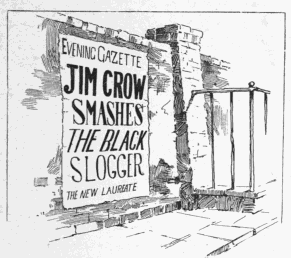
Within three months, working in odds and ends of time, I finished it, correcting the proofs of the first chapters while I was writing the last; indeed, ever since the day I read those two chapters to Mr. Hannaford Bennett I have never written a line anywhere that has not been purchased before it was written. For, to my undying astonishment, two average editions of my real 'first book' were disposed of on the day of publication, to say nothing of the sale in New York. Unless I had acquired a reputation of which I was totally unconscious, it must have been the title that 'fetched' the trade. Or, perhaps, it was the illustrations by my friend, Mr. George Hutchinson, whom I am proud to have discovered as a cartoonist for Ariel.
So here the story comes to a nice sensational climax. Re-reading it, I feel dimly that there ought to be a moral in it somewhere for the benefit of struggling fellow-scribblers. But the best I can find is this: That if you are blessed with some talent, a great deal of industry, and an amount of conceit mighty enough to enable you to disregard superiors, equals and critics, as well as the fancied demands of the public, it is possible, without friends, or introductions, or bothering celebrities to read your manuscripts, or cultivating the camp of the log-rollers, to attain, by dint of slaving day and night for years during the flower of your youth, to a fame infinitely less widespread than a prizefighter's, and a pecuniary position which you might with far less trouble have been born to.
A FAME LESS WIDESPREAD THAN A PRIZEFIGHTER'S
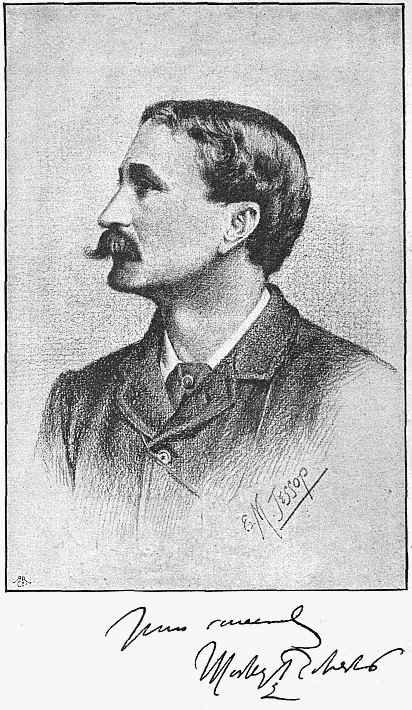
'THE WESTERN AVERNUS'
By MORLEY ROBERTS
CERTAINLY no one was more BEFORE THE MAST surprised than myself when I discovered that I could write decent prose, and even make money out of it, for during many years my youthful aspirations had been to rival Rossetti, or get on a level with Browning, rather than to make a living out of literature as a profession. But when I did start a book, I went through three years of American experience like fire through flax, and wrote 'The Western Avernus,' a volume containing ninety-three thousand words, in less than a lunar month.
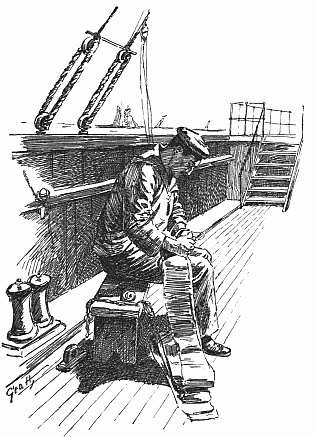
I had been in Australia years before, coming home before the mast as an A.B. in a Blackwall liner, but my occasional efforts to turn that experience into form always failed. Once or twice, I read some of my prose to friends, who told me that it was worse even than my poetry. Such criticism naturally confirmed me in the belief that I must be a poet or nothing, and I soon got into a fair way to become nothing, for my health broke down. At last, finding my choice lay between two kinds of tragedies, I chose the least, and went off to Texas. On February 27, 1884, I was working in a Government office as a writer; on March 27, I was sheep-herding in Scurry County, North-west Texas, in the south of the Panhandle. This experience was the opening of 'The Western Avernus.'
I MARRIED THEM ALL OFF AT THE END
But I should never have written the book if it had not been for two friends of mine. One was George Gissing, and the other W. H. Hudson, the Argentine naturalist. When I returned from the West, and yarned to them of starvation and toil and strife in that new world, they urged me to put it down instead of talking it. I suppose they looked on it as good material running to verbal conversational waste, being both writers of many years' standing. Now I understand their point of view, and carry a note-book, or an odd piece of paper, to jot down motives that crop up in occasional talk, but then I was ignorant, and astonished at the wild notion of writing anything saleable. However, in desperation, for I had no money, I began to write, and went ahead in the same way that I have so far kept to. I wrote it without notes, without care, without thought, save that each night the past was resurgent and alive before and within me, just as it was when I worked and starved between Texas and the great North-west. Each Sunday I read what I had done to George Gissing; at first with terror, but afterwards with more confidence when he nodded approval, and as the end approached I began to believe in it myself.
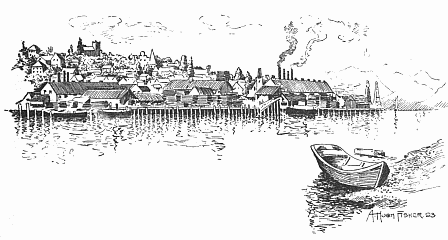
AN AMERICAN SAW-MILL WHERE MR. ROBERTS WORKED
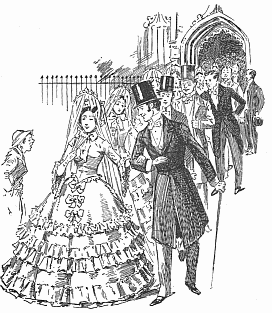
It is only six years since the book was finished and sent to Messrs. Smith, Elder, & Co., but it seems half a century ago, so much has happened since then; and when it was accepted and published and paid for, and actually reviewed favourably, I almost determined to take to literature as a profession. I remembered that when I was a boy of eleven I wrote a romance with twenty people, men and women, in it. I married them all off at the end, being then in the childish mind of the most usual novelist who believes, or pretends to believe, or at any rate by implication teaches, that the interesting part of life finishes then instead of beginning. I recalled the fact that I wrote doggerel verse at the age of thirteen when I was at Bedford Grammar School, and that an ardent, ignorant Conservatism drove me, when I was at Owens College, Manchester, to lampoon the Liberal candidates in rhymes, and paste them up in the big lavatory; and under the influence of these memories I began to think that perhaps scribbling was my natural trade. I had tried some forty different callings, including 'sailorising,' saw-mill work, bullock-driving, tramping, and the selling of books in San Francisco, with indifferent financial success, so perhaps my métier was the making of books instead. So I went on trying, and had a very bad time for two years.
Having written 'The Western Avernus' in a kind of intuitive, instructive way, it came easy enough to me, but very soon I began to think of the technique of writing, and wrote badly. I had to look back at the best part of that book to be assured I could write at all. For a long time it was a consolation and a distress to me, for I had to find out that knowledge must get into one's fingers before it can be used. Only those who know nothing, or who know a great deal very well, can write decently, and the intermediate state is exceedingly painful. Both the public and private laudation of my American book made me unhappy then. I thought I had only that one book in me.
Some of the letters I received from America, and, more particularly, British Columbia, were anything but cheerful reading. One man, of whom I had spoken rather freely, said I should be hanged on a cottonwood tree if I ever set foot in the Colony again. I do not believe there are any cottonwoods there, but he used a phrase common in American literature. Another whilom friend of mine, who had read some favourable criticisms, wrote me to say he was sure Messrs. Smith & Elder had paid for them. He had understood it was always done, and now he knew the truth of it, because the book was so bad. I almost feared to return to British Columbia: the critics there might use worse weapons than a sneering paragraph. In England the worst one need fear is an action for criminal libel, or a rough and tumble fight. There it might end in an inquest. I wrote back to my critics that if I ever came out again, I would come armed, and endeavour to reply effectually.
For that wild life, far away from the ancient set and hardened bonds of social law which crush a man and make him just like his fellows, or so nearly like that only intimacy can distinguish individual differences, had allowed me to grow in another way, and become more myself; more independent, more like a savage, better able to fight and endure. That is the use of going abroad, and going abroad to places that are not civilised. They allow a man to revert and be himself. It may make his return hard, his endurance of social bonds bitterer, but it may help him to refuse to endure. He may attain to some natural sight.
DEFYING THE UNIVERSE
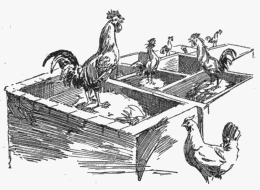
Not many weeks ago I was talking to a well-known American publisher, and our conversation ran on the trans-oceanic view of Europe. He was amused and delighted to come across an Englishman who was so Americanised in one way as to look on our standing camps and armed kingdoms as citizens of the States do, especially those who live in the West. To the American, Europe seems like a small collection of walled yards, each with a crowing fighting-cock defying the universe on the top of his own dunghill, with an occasional scream from the wall. The whole of our international politics gets to look small and petty, and a bitter waste of power. Perhaps the American view is right. At any rate, it seemed so when I sat far aloof upon the lofty mountains to the west of the great plains. The isolation from the politics of the moment allowed me to see nature and natural law.
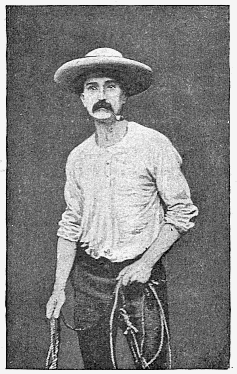
And as it was with nations, so it was with men. Out yonder, in the West, most of us were brutal at times, and ready to kill, or be killed, but my American-bred acquaintances looked like men, strikingly like men, independent, free, equal to the need of the ensuing day or the call of some sudden hour. COWBOY ROBERTS It is a liberal education to the law-abiding Englishman to see a good specimen of a Texan cowboy walk down a Western street; for he looks like a law unto himself, calm and greatly assured of the validity of his own enactments. We live in a crowd here, and it takes a rebel to be himself; and in the struggle for freedom he is likely to go under.
While I was gaining the experience that went solid and crystallised into 'The Western Avernus,' I was discovering much that had never been discovered before, not in a geographical sense—for I have been in few places where men have not been—but in myself. Each new task teaches us something new, and something more than the mere way to do it. To drive horses or milk a cow or make bread, or kill a sheep, sets us level with facts and face to face with some reality. We are called on to be real, and not the shadow of others. This is the worth that is in all real workers, whatever they do, under whatever conditions. Every truth so learnt strips away ancient falsehood from us; it is real education, not the taught instruction which makes us alike, and thus shams, merely arming us with weapons to fight our fellows in the crowded, unwholesome life of falsely civilised cities.
And in America there is the sharp contrast between the city life and the life of the mountain and the plain. It is seen more clearly than in England, which is all more or less city.
THE VERY PRAIRIE DOGS TAUGHT ME
There are no clear stellar interspaces in our life here. But out yonder, a long day's train ride across the high barren cactus plateaus of Arizona teaches us as much as a clear and open depth in the sky. For, of a sudden, we run into the very midst of a big town, and shams are made gods for our worship. It is difficult to be oneself when all others refuse to be themselves.
This was for me the lesson of the West and the life there. When I wrote this book I did not know it; I wrote almost unconsciously, without taking thought, without weighing words, without conscious knowledge. But I see now what I learnt in a hard and bitter school.
For I acknowledge that the experience was at times bitterly painful. It is not pleasant to toil sixteen hours a day; it is not good to starve overmuch; it is not well to feel bitter for long months. And yet it is well and good and pleasant in the end to learn realities and live without lies. It is better to be a truthful animal than a civilised man, as things go. I learnt much from horses and cattle and sheep; the very prairie dogs taught me; the ospreys and the salmon they preyed on expressed truths. They didn't attempt to live on words, or the dust and ashes of dead things. They were themselves and no one else, and were not diseased with theories or a morbid altruism that is based on dependence.
This, I think, is the lesson I learnt from my own book. I did not know it when I wrote it. I never thought of writing it; I never meant to write anything; I only went to America because England and the life of London made me ill. If I could have lived my own life here I would have stayed, but the crushing combination of social forces drove me out. For fear of cutting my own throat I left, and took my chance with natural forces. To fight with nature makes men, to fight with society makes devils, or criminals, or martyrs, and sometimes a man may be all three. I preferred to revert to mere natural conditions for a time.
To lead such a life for a long time is to give up creeds, and to go to the universal storehouse whence all creeds come. It is giving up dogmas and becoming religious. In true opposition to instructive nature, we find our own natural religion, which cannot be wholly like any other. So a life of this kind does not make men good, in the common sense of the word. But it makes a man good for something. It may make him an ethical outcast, as facts faced always will. He prefers induction to deduction, especially the sanctioned unverified deductions of social order. For nature affords the only verification for the logical process of deduction. 'We fear nature too much, to say the least.' For most of us hold to other men's theories instead of making our own.
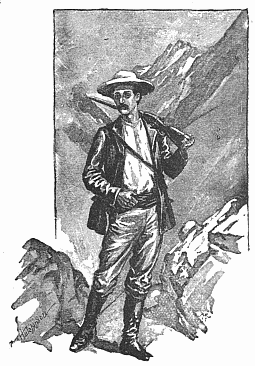
When Mill said, 'Solitude, in the sense of being frequently alone, is necessary to the formation of any depth of character,' he spoke almost absolute truth. But here we can THE CALIFORNIA COAST RANGE never be alone; the very air is full of the dead breath of others. I learnt more in a four days' walk over the California coast range, living on parched Indian corn, than I could have done in a lifetime of the solitude of a lonely house. The Selkirks and the Rocky Mountains are books of ancient learning: the long plains of grey grass, the burnt plateaus of the hot South, speak eternal truths to all who listen. They need not listen, for there men do not learn by the ear. They breathe the knowledge in.
In speaking as I have done about America I do not mean to praise it as a State or a society. In that respect it is perhaps worse than our own, more diseased, more under the heel of the money fiend, more recklessly and brutally acquisitive. But there are parts of it still more or less free; nature reigns still over vast tracts in the West. As a democracy it is so far a failure, as democracies must be organised on a plutocratic basis; but it at any rate allows a man to think himself a man. Walt Whitman is the big expression of that thought, but his fervent belief in America was really but deep trust in man himself, in man's power of revolt, in his ultimate recognition of the beauty of the truth. The power of America to teach lies in the fact that a great part of her fertile and barren soil has not yet been taught, not yet cultivated for the bread which of itself can feed no man wholly.
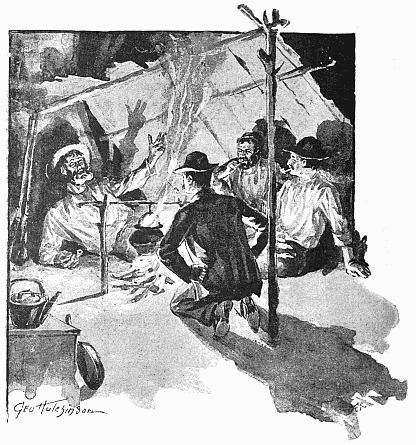
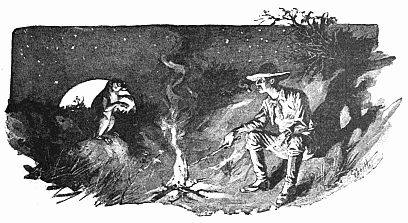
Perhaps among the few who have read 'The Western Avernus' (for it was not a financial success), fewer still have seen what I think I myself see in it now. But it has taken me six years to understand it, six years to know how I came to write it, and what it meant. That is the way in life: we do not learn at once what we are taught, we do not always understand all we say even when speaking earnestly. There is often one aspect of a book that the writer himself can learn from, and that is not always the technical part of it. All sayings may have an esoteric meaning. In those hard days by the camp fire, on the trail, on the prairie with sheep and cattle, I did not understand that they called up in me the ancient underlying experience of the race, and, like a deep plough, brought to the surface the lowest soil which should hereafter be a little fertile. When I starved, I thought not of our far ancestors who had suffered too; as I watched the sheep or the sharp-horned Texas steers, I could not reflect upon our pastoral forefathers; as I climbed with bleeding feet the steep slopes of the Western hills, my thoughts were set in a narrow circle of dark misery. I could not think of those who had striven, like me, in distant ages. But the songs of the camp fire, and the leap of the flame, and the crackling wood, and the lofty snow-clad hills, and the long dim plains, the wild beast, and the venomous serpents, and the need of food, brought me back to nature, the nature that had created those who were the fathers of us all, and, bringing me back, they taught me, as they strive to teach all, that the real and deeper life is everywhere, even in a city, if we will but look for it with unsealed eyes and minds set free from the tedious trivialities of this debauched modern life.
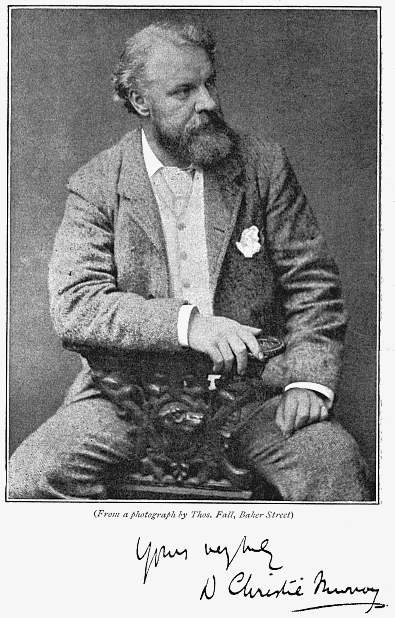
'A LIFE'S ATONEMENT'
By DAVID CHRISTIE MURRAY
I BEGAN my first book more years ago than I care to count, and, naturally enough, it took poetic form, if not poetic substance. In its original shape it was called 'Marsh Hall,' and ran into four cantos. On the eve of my twenty-first birthday I sent the MS. to Messrs. Macmillan, who, very wisely, as I have since come to believe, counselled me not to publish it. I say this in full sincerity, though I remember some of the youthful bombast not altogether without affection. Here and there I can recall a passage which still seems respectable. I wrote reams of verse in those days, but when I came into the rough and tumble of journalistic life I was too occupied to court the Muses any longer, and found myself condemned to a life of prose. I was acting as special correspondent for the Birmingham Morning News in the year '73—I think it was '73, though it might have been a year later—and at that time Mr. Edmund Yates was lecturing in America, and a novel of his, the last he ever wrote, was running through our columns. Whether the genial 'Atlas,' who at that time had not taken the burden of The World upon his shoulders, found his associations too numerous and heavy, I can only guess, but he closed the story with an unexpected suddenness, and the editor, who had supposed himself to have a month or two in hand in which to make arrangements for his next serial, was confronted with the finis of Mr. Yates's work, and was compelled to start a new novel at a week's notice. In this extremity he turned to me. 'I think, young 'un,' he said, 'that you ought to be able to write a novel.' I shared his faith, and had, indeed, already begun a story which I had christened 'Grace Forbeach.' I handed him two chapters, which he read at once, and, in high feather, sent to the printer. It never bade fair to be a mighty work, but at least it fulfilled the meaning of the original edition of Pope's famous line, for it was certainly 'all without
I HANDED HIM TWO CHAPTERS
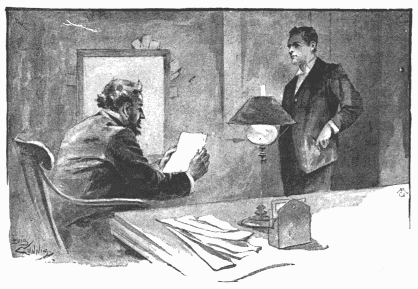
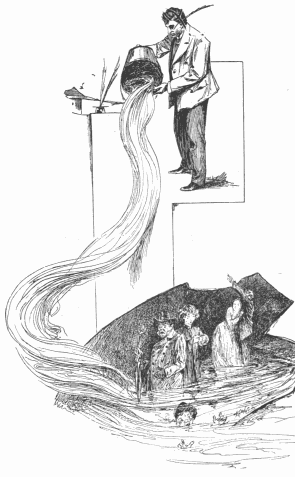
a plan.' I had appropriate scenery in my mind, no end of typical people to draw, and one or two moving actualities to work from. But I had forgotten the plot. To attempt a novel without a definite scheme of some sort is very like trying to make a Christmas pudding without a cloth. Ruth Pinch was uncertain as to whether her first venture at a pudding might not turn out a soup. My novelistic effort, I am sorry to confess, had no cohesion in it. Its parts got loose in the cooking, and I have reason to think that most people who tried it found the dish repellent. The cashier assured me that I had sent down the circulation of the SENT ALL MY PEOPLE INTO A COAL-MINE Saturday issue by sixteen thousand. I had excellent reasons for disbelieving this circumstantial statement in the fact that the Saturday issue had never reached that number, but I have no doubt I did a deal of damage. There had been an idea in 'Marsh Hall,' and what with interpolated ballads and poetic excursions and alarums of all sorts, I had found in it matter enough to fill out my four cantos. I set out with the intent to work that same idea through the pages of 'Grace Forbeach,' but it was too scanty for the uses of a three-volume novel, at least in the hands of a tiro. I know one or two accomplished gentlemen who could make it serve the purpose admirably, and, perhaps, I myself might do something with it at a pinch at this time of day. Anyhow, as it was, the cloth was too small to hold the pudding, and, in the process of cooking, I was driven to the most desperate expedients. To drop the simile and to come to the plain facts of the case, I sent all my wicked and superfluous people into a coal-mine, and there put an end to them by an inrush of water. I forget what became of the hero, but I know that some of the most promising characters dropped out of that story, and were no more heard of. The sub-editor used occasionally, for my encouragement, to show me letters he received, denouncing the work, and asking wrathfully when it would end.
Whilst I am about 'Grace Forbeach,' it may be worth while to tell the story of the champion printer's error of my experience. I wrote at the close of the story:
'Are there no troubles now?' the lover asks.
'Not one, dear Frank. Not one.'
And then, in brackets, thus [] I set the words:
[White line.]
This was a technical instruction to the printer, and meant that one line of space should be left clear. The genius who had the copy in hand put the lover's speech in type correctly, and then, setting it out as if it were a line of verse, he gave me—
'Not one, dear Frank, not one white line!'
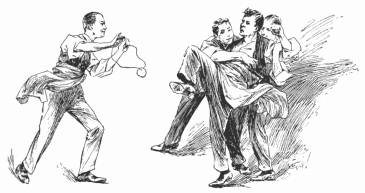
It was a custom in the printing office to suspend a leather medal by a leather bootlace round the neck of the man who had achieved the prize bêtise of the year. It was somewhere about midsummer at this time, but it was instantly and unanimously resolved that nothing better than this would or could be done by anybody. The compositors performed what they called a 'jerry' in the blunderer's honour, and invested him, after an animated fight, with the medal.
'Grace Forbeach' has been dead and buried for very nearly a score of years. It never saw book form, and I was never anxious that it should do so, but as it had grown out of 'Marsh Hall,' so my first book grew out of it, and, oddly enough, not only my first, but my second and my third. 'Joseph's Coat,' which made my fortune, and gave me such literary standing as I have, was built on one episode of that abortive story, and 'Val Strange' was constructed and written to lead up to the episode of the attempted suicide on Welbeck Head, which had formed the culminating point in the poem.
When I got to London I determined to try my hand anew, and, having learned by failure something more than success could ever have taught me, I built up my scheme before I started on my book. Having come to utter grief for want of a scheme to work on, I ran, in my eagerness to avoid that fault, into the opposite extreme, and built an iron-bound
THEY INVESTED HIM WITH THE MEDAL
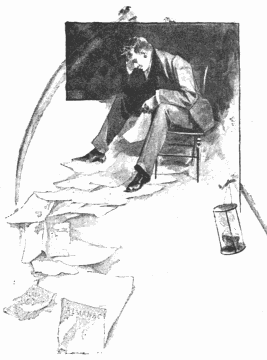
plot, which afterwards cost me very many weeks of unnecessary and unvalued labour. I am quite sure that no reader of 'A Life's Atonement' ever guessed that the author took one tithe, or even one-twentieth part, of the trouble it actually cost to weave the two strands of its narrative together. I divided my story into thirty-six chapters. Twelve of these were autobiographical, in the sense that they were supposed to be written by the hero in person. The remaining twenty-four were historical, purporting to be written, that is, by an impersonal author. The autobiographical portions necessarily began in the childhood of the narrator, and between them and the 'History' there was a considerable gulf of time. Little by little this gulf had to be bridged over until the action in both portions of the story became synchronous. I really do not suppose that the most pitiless critic ever felt it worth his while to question the accuracy of my dates, and I dare say that all the trouble I took was quite useless, but I fixed in my own mind the actual years over which the story extended, and spent scores of hours in the consultation of old almanacs. I have never verified the work since it was done, but I believe that in this one respect, at least, it is beyond cavil. The two central figures of the book were lifted straight from the story of 'Marsh Hall,' and 'Grace Forbeach' gave her quota to the narrative.
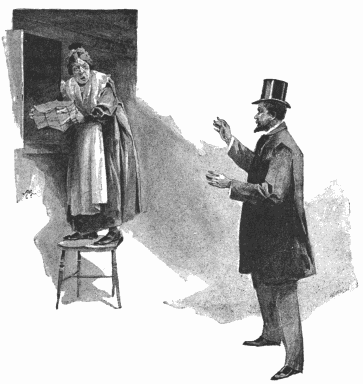
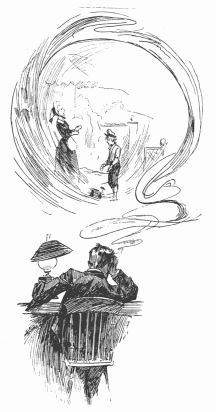
I had completed the first volume when I received a commission to go out as special correspondent to the Russo-Turkish war. I left the MS. behind me, and for many months the scheme was banished from my mind. I went through those cities of the dead, Kesanlik, Calofar, Carlova, and Sopot. I watched the long-drawn artillery duel at the Shipka Pass, made the dreary month-long march in the rainy season from Orkhanié to Plevna, with the army of reinforcement, under Chefket Pasha and Chakir Pasha, lived in the besieged town until Osman drove away all foreign visitors, and sent out his wounded to sow the whole melancholy road with corpses. I put up on the heights of Tashkesen, and saw the stubborn defence of Mehemet Ali, and there was pounced upon by the Turkish authorities for a too faithful dealing with the story of the horrors of the war, and was deported to Constantinople. I had originally gone out for an American journal at the instance of a gentleman who exceeded his instructions in despatching me, and I was left high and dry in the Turkish capital without a penny and without a friend. But work of the kind I could do was wanted, and I was on the spot. I slid into an engagement with the Scotsman, and then into another with the Times. The late Mr. Macdonald, who was killed by the Pigott forgeries, was then manager of the leading journal, and offered me fresh work. I waited for it, and a year of wild adventure in the face of war had given me such a taste for that sort of existence that I let 'A Life's Atonement' slide, and had no thought of taking it up again. A misunderstanding CONSULTING OLD ALMANACS with the Times authorities—happily cleared up years after—left me in the cold, and I was bound to do something for a living. The first volume of 'A Life's Atonement' had been written in the intervals of labour in the Gallery of the House of Commons, and such work as an active hack journalist can find among the magazines and the weekly society papers. I had been away a whole year, and everywhere my place was filled. It was obviously no use to a man in want of ready money to undertake the completion of a three-volume novel of which only one volume was written, and so I betook myself to the writing of short stories. The very first of these was blessed by a lucky accident. Mr. George Augustus Sala had begun to write for The Gentleman's Magazine a story called, if I remember rightly, 'Dr. Cupid.' Sala was suddenly summoned by the proprietors of the Daily Telegraph to undertake one of his innumerable journeys, and the copy of the second instalment of his story reached the editor too late for publication. Just when the publishers of the Gentleman's were at a loss for suitable copy, my MS. of 'An Old Meerschaum' reached them, and, to my delighted surprise, I received proofs almost by return of post. The story appeared, with an illustration by Arthur Hopkins, and, about a week later, there came to me, through Messrs. Chatto & Windus, a letter from Robert Chambers: 'Sir,—I have read, with unusual pleasure and interest, in this month's Gentleman's Magazine, a story from your pen entitled "An Old Meerschaum." If you have a novel on hand, or in preparation, I should be glad to see it. In the meantime, a short story, not much longer than "An Old Meerschaum," would be gladly considered by—Yours very truly, Robert Chambers. P.S.—We publish no authors' names, but we pay handsomely.' This letter brought back to mind at once the neglected 'Life's Atonement,' but I was uncertain as to the whereabouts of the MS. I searched everywhere amongst my own belongings in vain, but it suddenly occurred to me that I had left it in charge of a passing acquaintance of mine, who had taken up the unexpired lease of my chambers in Gray's Inn at the time of my departure for the seat of war. I jumped into a cab, and drove off in search of my property. The shabby old laundress who had made my bed and served my breakfast was pottering about the rooms. She remembered me perfectly well, of course, but could not remember that I had left anything behind me when I went away. I talked of manuscript, and she recalled doubtfully a quantity of waste paper, of the final destination of which she knew nothing. I began to think it extremely improbable that I should ever recover a line of the missing novel, when she opened a cupboard and drew from it a brown-paper parcel, and, opening it, displayed to me the MS. of which I was in search. I took it home and read it through with infinite misgiving. The enthusiasm with which I had begun the work had long since had time to pall, and the whole thing looked weary, flat, stale, and unprofitable. For one thing, I had adopted the abominable expedient of writing in the present tense so far as the autobiographical portion of the work was concerned, and, in the SHE DREW FROM IT A BROWN-PAPER PARCEL interval which had gone by, my taste had, I suppose, undergone an unconscious correction. It was a dull business, but, despondent as I was, I found the heart to rewrite those chapters. Charles Reade describes the task of writing out one's work a second time as 'nauseous,' and I confess that I am with him with all my heart. It is a misery which I have never since, in all my work, imposed upon myself. At that time I counted amongst my friends an eminent novelist, on whose critical faculty and honesty I knew I could place the most absolute reliance. I submitted my revised first volume to his judgment, and was surprised to learn that he thought highly of it. His judgment gave me new courage, and I sent the copy in to Chambers. After a delay of a week or two, I received a letter which gave me, I think, a keener delight IF THERE HAD BEEN NO 'DAVID COPPERFIELD' than has ever touched me at the receipt of any other communication. 'If,' wrote Robert Chambers,'the rest is as good as the first volume, I shall accept the book with pleasure. Our price for the serial use will be 250l., of which we will pay 100l. on receipt of completed MS.; the remaining 150l. will be paid on the publication of the first monthly number.' I had been out of harness for so long a time, and had been, by desultory work, able to earn so little, that this letter seemed to open a sort of Eldorado to my gaze. It was not that alone which made it so agreeable to receive. It opened the way to an honourable ambition which I had long nourished, and I slaved away at the remaining two volumes with an enthusiasm which I have never been able to revive. There are two or three people still extant who know in part the privations I endured whilst the book was being finished. I set everything else on one side for it, incautiously enough, and for two months I did not earn a penny by other means. The most trying accident of all the time was the tobacco famine which set in towards the close of the third volume, but, in spite of all obstacles, the book was finished. I worked all night at the final chapter, and wrote 'Finis' somewhere about five o'clock on a summer morning. I shall never forget the solemn THE STOCK WAS TRANSFERRED exultation with which I laid down my pen and looked from the window of the little room in which I had been working over the golden splendour of the gorse-covered common of Ditton Marsh. All my original enthusiasm had revived, and in the course of my lonely labours had grown to a white heat. I solemnly believed at that moment that I had written a great book. I suppose I may make that confession now without proclaiming myself a fool. I really and seriously believed that the work I had just finished was original in conception, style, and character. No reviewer ever taunted me with the fact, but the truth is that 'A Life's Atonement' is a very curious instance of unconscious plagiarism. It is quite evident to my mind now that if there had been no 'David Copperfield' there would have been no 'Life's Atonement.' My Gascoigne is Steerforth, my John Campbell is David, John's aunt is Miss Betsy Trotwood, Sally Troman is Peggotty. The very separation of the friends, though brought about by a different cause, is a reminiscence. I was utterly unconscious of these facts, and, remembering how devotedly and honestly I worked, how resolute I was to put my best of observation and invention into the story, I have ever since felt chary of entertaining a charge of plagiarism against anybody. There are, of course, flagrant and obvious cases, but I believe that in nine instances out of ten the supposed criminal has worked as I did, having so completely absorbed and digested in childhood the work of an admired master that he has come to feel that work as an actual portion of himself. 'A Life's Atonement' ran its course through Chambers's Journal in due time, and was received with favour. Messrs. Griffith & Farran undertook its publication in book form, but one or two accidental circumstances forbade it to prosper in their hands. To begin with, the firm at that time had only newly decided on publishing novels at all, and a work under such a title, and issued by such a house, was naturally supposed to have a theological tendency. Then again, in the very week in which my book saw the light, 'Lothair' appeared, and for the time being swamped everything. All the world read 'Lothair,' all the world talked about it, and all the newspapers and reviews dealt with it, to the exclusion of the products of the smaller fry. Later on, 'A Life's Atonement' was handsomely reviewed, and was indeed, as I am disposed to think, praised a good deal beyond its merits. But it lay a dead weight on the hands of its original publishers, until Messrs. Chatto & Windus expressed a wish to incorporate it in their Piccadilly Series. The negotiations between the two houses were easily completed, the stock was transferred from one establishment to the other, the volumes were stripped of their old binding and dressed anew, and with this novel impetus the story reached a second edition in three-volume form. It brought me almost immediately two commissions, and by the time that they were completed I had grown into a professional novel-writer.
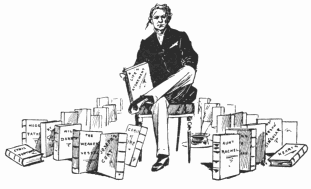
SOME NOVELS
'A ROMANCE OF TWO WORLDS'
By MARIE CORELLI
IT is an unromantic thing for an author to have had no literary vicissitudes. One cannot expect to be considered interesting, unless one has come up to London with the proverbial solitary 'shilling,' and gone about hungry and footsore, begging from one hard-hearted publisher's house to another with one's perpetually rejected manuscript under one's arm. One ought to have consumed the 'midnight oil;' to have 'coined one's heart's blood' (to borrow the tragic expression of a contemporary gentleman-novelist); to have sacrificed one's self-respect by metaphorically crawling on all-fours to the critical faculty; and to have become æsthetically cadaverous and blear-eyed through the action of inspired dyspepsia. Now, I am obliged to confess that I have done none of these things, which, to quote the Prayer-book, I ought to have done. I have had no difficulty in making my career or winning my public. And I attribute my good fortune to the simple fact that I have always tried to write straight from my own heart to the hearts of others, regardless of opinions and indifferent to results. My object in writing has never been, and never will be, to concoct a mere story which shall bring me in a certain amount of cash or notoriety, but solely because I wish to say something which, be it ill or well said, is the candid and independent expression of a thought which I will have uttered at all risks.
In this spirit I wrote my first book, 'A Romance of Two Worlds,' now in its seventh edition. It was the simply worded narration of a singular psychical experience, and included certain theories on religion which I, personally speaking, accept and believe. I had no sort of literary pride in my work whatsoever; there was nothing of self in the wish I had, that my ideas, such as they were, should reach the public, for I had no particular need of money, and certainly no hankering after fame. When the book was written I doubted whether it would ever find a publisher, though I determined to try and launch it if possible. My notion was to offer it to Arrowsmith as a shilling railway volume, under the title 'Lifted Up.' But in the interim, as a kind of test of its merit or demerit, I sent the MS. to Mr. George Bentley, head of the long-established and famous Bentley publishing firm. It ran the gauntlet of his 'readers' first, and they all advised its summary rejection. Among these 'readers' at that time was Mr. Hall Caine. His strictures on my work were peculiarly bitter, though, strange to relate, he afterwards forgot the nature of his own report. For, on being introduced to me at a ball given by Miss Eastlake, when my name was made and my success assured, he blandly remarked, before a select circle of interested auditors, that he 'had had the pleasure of recommending' my first book to Mr. Bentley! Comment on this were needless and unkind: he tells stories so admirably that I readily excuse him for his 'slip of memory,' and accept the whole incident as a delightful example of his inventive faculty.
His severe judgment pronounced upon me, combined with similar, but perhaps milder, severity on the part of the other 'readers,' had, however, an unexpected result. Mr. George Bentley, moved by curiosity, and possibly by compassion for the impending fate of a young woman so 'sat upon' by his selected censors, decided to read my MS. himself. Happily for me, the consequence of his unprejudiced and impartial perusal was acceptance; and I still keep the kind and encouraging letter he wrote to me at the time, informing me of his decision, and stating the terms of his offer. These terms were, a sum down for one year's rights, the copyright of the work to remain my own entire property. I did not then understand what an advantage this retaining of my copyright in my own possession was to prove to me, financially speaking; but I am willing to do Mr. Bentley the full justice of supposing that he foresaw the success of the book; and that, therefore, his action in leaving me the sole owner of my then very small literary estate redounds very much to his credit, and is an evident proof amongst many of his manifest honour and integrity. Of course, the copyright of an unsuccessful book is valueless; but my 'Romance' was destined to prove a sound investment, though I never dreamed that it would be so. Glad of my chance of reaching the public with what I had to say, I gratefully closed with Mr. Bentley's proposal. He considered the title 'Lifted Up' as lacking attractiveness; it was therefore discarded, and Mr. Eric Mackay, the poet, gave the book its present name, 'A Romance of Two Worlds.'
Once published, the career of the 'Romance' became singular, and totally apart from that of any other so-called 'novel.' It only received four reviews, all brief and distinctly unfavourable. The one which appeared in the dignified Morning Post is a fair sample of the rest. I keep it by me preciously, because it serves as a wholesome tonic to my mind, and proves to me that when a leading journal can so 'review' a book, one need fear nothing from the literary knowledge, acumen, or discernment of reviewers. I quote it verbatim: 'Miss Corelli would have been better advised had she embodied her ridiculous ideas in a sixpenny pamphlet. The names of Heliobas and Zara are alone sufficient indications of the dulness of this book.' This was all. No explanation was vouchsafed as to why my ideas were 'ridiculous,' though such explanation was justly due; nor did the reviewer state why he (or she) found the 'names' of characters 'sufficient indications' of dulness, a curious discovery which I believe is unique. However, the so-called 'critique' did one good thing; it moved me to sincere laughter, and showed me what I might expect from the critical brethren in these days—days which can no longer boast of a Lord Macaulay, a brilliant, if bitter, Jeffrey, or a generous Sir Walter Scott.
THE DRAWING-ROOM[D]
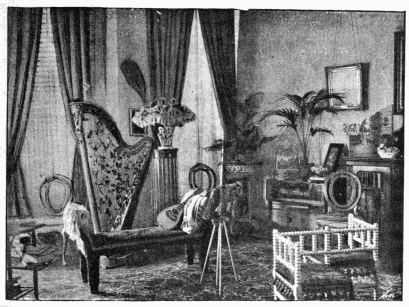
To resume: the four 'notices' having been grudgingly bestowed, the Press 'dropped' the 'Romance,' considering, no doubt, that it was 'quashed,' and would die the usual death of 'women's novels,' as they are contemptuously called, in the prescribed year. But it did nothing of the sort. Ignored by the Press, it attracted the public. Letters concerning it and its theories began to pour in from strangers in all parts of the United Kingdom; and at the end of its twelvemonth's run in the circulating libraries Mr. Bentley brought it out in one volume in his 'Favorite' series. Then it started off at full gallop—the 'great majority' got at it, and, what is more, kept at it. It was 'pirated' in America; chosen out and liberally paid for by Baron Tauchnitz for the 'Tauchnitz' series; translated into various languages on the Continent, and became a topic of social discussion. A perfect ocean of correspondence flowed in upon me from India, Africa, Australia, and America, and at this very time I count through correspondence a host of friends in all parts of the world whom I do not suppose I shall ever see; friends who even carry their enthusiasm so far as to place their houses at my disposal for a year or two years—and surely the force of hospitality can no further go! With all these attentions, I began to find out the advantage my practical publisher had given me in the retaining of my copyright; my 'royalties' commenced, increased, and accumulated with every quarter, and at the present moment continue still to accumulate, so much so, that the 'Romance of Two Worlds' alone, apart from all my other works, is the source of a very pleasant income. And I have great satisfaction in knowing that its prolonged success is not due to any influence save that which is contained within itself. It certainly has not been helped on by the Press, for since I began my career six years ago, I have never had a word of open encouragement or kindness from any leading English critic. The only real 'reviews' I ever received worthy of the name appeared in the Spectator and the Literary World. The first was on my book 'Ardath: The Story of a Dead Self,' and in this the over-abundant praise in the beginning was all smothered by the unmitigated abuse at the end. The second in the Literary World was eminently generous; it dealt with my last book, 'The Soul of Lilith.' So taken aback was I with surprise at receiving an all-through kindly, as well as scholarly, criticism from any quarter of the Press, that, though I knew nothing about the Literary World, I wrote a letter of thanks to my unknown reviewer, begging the editor to forward it in the right direction. He did so, and my generous critic turned out to be—a woman—a literary woman, too, fighting a hard fight herself, who would have had an excuse to 'slate' me as an unrequired rival in literature had she so chosen, but who, instead of this easy course, adopted the more difficult path of justice and unselfishness.
THE LIBRARY
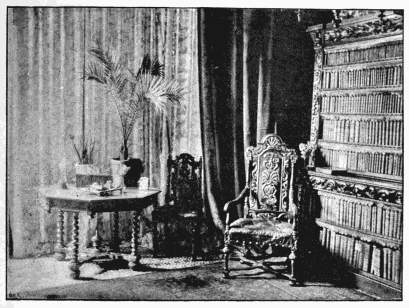
After the 'Romance of Two Worlds' I wrote 'Vendetta;' then followed 'Thelma,' and then 'Ardath: The Story of a Dead Self,' which, among other purely personal rewards, brought me a charming autograph letter from the late Lord Tennyson, full of valuable encouragement. Then followed 'Wormwood: A Drama of Paris'—now in its fifth edition; 'Ardath' and 'Thelma' being in their seventh editions. My publishers seldom advertise the number of my editions, which is, I suppose, the reason why the continuous 'run' of the books escapes the Press comment of the 'great success' supposed to attend various other novels which only attain to third or fourth editions. 'The Soul of Lilith,' published only last year, ran through four editions in three-volume form; it is issued now in one volume by Messrs. Bentley, to whom, however, I have not offered any new work. A change of publishers is sometimes advisable; but I have a sincere personal liking for Mr. George Bentley, who is himself an author of distinct originality and ability, though his literary gifts are only known to his own private circle. His book of essays, entitled 'After Business,' is a delightful volume, full of point and brilliancy, two specially admirable papers being those on Villon and Carlyle, while it would be difficult to discover a more 'taking' prose bit than the concluding chapter, 'Under an Old Poplar.'
A very foolish and erroneous rumour has of late been circulated concerning me, asserting that I owe a great measure of my literary success to the kindly recognition and interest of the Queen. I take the present opportunity to clear up this perverse misunderstanding. My books have been running successfully through several editions for six years, and the much-commented-upon presentation of a complete set of them to Her Majesty took place only last year. If it were possible to regret the honour of the Queen's acceptance of these volumes, I should certainly have cause to do so, as the extraordinary spite and malice that has since been poured on my unoffending head has shown me a very bad side of human nature, which I am sorry to have seen. There is very little cause to envy me in this matter. I have but received the courteously formal thanks of the Queen and the Empress Frederick, conveyed through the medium of their ladies-in-waiting, for the special copies of the books their Majesties were pleased to admire; yet for this simple and quite ordinary honour I have been subjected to such forms of gratuitous abuse as I did not think possible to a 'just and noble' English Press. I have often wondered why I was not equally assailed when the Queen of Italy, not content with merely 'accepting' a copy of the 'Romance of Two Worlds,' sent me an autograph
THE STUDY
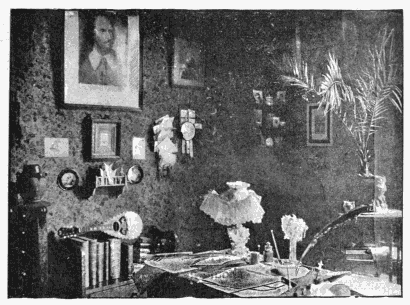
portrait of herself, accompanied by a charming letter, a souvenir which I value, not at all because the sender is a queen, but because she is a sweet and noble woman whose every action is marked by grace and unselfishness, and who has deservedly won the title given her by her people, 'the blessing of Italy.' I repeat, I owe nothing whatever of my popularity, such as it is, to any 'royal' notice or favour, though I am naturally glad to have been kindly recognised and encouraged by those 'thronëd powers' who command the nation's utmost love and loyalty. But my appeal for a hearing was first made to the great public, and the public responded; moreover, they do still respond with so much heartiness and goodwill, that I should be the most ungrateful scribbler that ever scribbled if I did not (despite Press 'drubbings' and the amusing total ignoring of my very existence by certain cliquey literary magazines) take up my courage in both hands, as the French say, and march steadily onward to such generous cheering and encouragement.
I am told by an eminent literary authority that critics are 'down upon me' because I write about the supernatural. I do not entirely believe the eminent literary authority, inasmuch as I have not always written about the supernatural. Neither 'Vendetta,' nor 'Thelma,' nor 'Wormwood' is supernatural. But, says the eminent literary authority, why write at all, at any time, about the supernatural? Why? Because I feel the existence of the supernatural, and feeling it, I must speak of it. I understand that the religion we profess to follow emanates from the supernatural. And I presume that churches exist for the solemn worship of the supernatural. Wherefore, if the supernatural be thus universally acknowledged as a guide for thought and morals, I fail to see why I, and as many others as choose to do so, should not write on the subject. An author has quite as much right to characterise angels and saints in his or her pages as a painter has to depict them on his canvas. And I do not keep my belief in the supernatural as a sort of special mood to be entered into on Sundays only; it accompanies me in my daily round, and helps me along in all my business. But I distinctly wish it to be understood that I am neither a 'Spiritualist' nor a 'Theosophist.' I am not a 'strong-minded' woman, with egotistical ideas of a 'mission.' I have no other supernatural belief than that which is taught by the Founder of our Faith, and this can never be shaken from me or 'sneered down.' If critics object to my dealing with this in my books, they are very welcome to do so; their objections will not turn me from what they are pleased to consider the error of my ways. I know that unrelieved naturalism and atheism are much more admired subjects with the critical faculty; but the public differ from this view. The public, being in the main healthy-minded and honest, do not care for positivism and pessimism. They like to believe in something better than themselves; they like to rest on the ennobling idea that there is a great loving Maker of this splendid Universe, and they have no lasting affection for any author whose tendency and teaching is to despise the hope of heaven, and 'reason away' the existence of God. It is very clever, no doubt, and very brilliant to deny the Creator; it is as if a monkey should, while being caged and fed by man, deny man's existence. Such a circumstance would make us laugh, of course; we should think it uncommonly 'smart' of the monkey. But we should not take his statement for a fact all the same.