Volume 2 — PART. III. (continued 3)
Nicolaus Staphorst translation
In their religion they follow for the greatest part the Greeks; they administer the Sacrament in leavened bread; and they say their masses like unto them in the vulgar Arabian tongue. They are a sort of poor naked, covetous, and helpless people; their gowns reach only to their knees, as those of the Maronites, some whereof are wrought of coarse goats hair, striped black and white, such as the Arabians make use of commonly, and almost alike unto their Mescha, which they use for sacks and tents, and they wear nothing underneath them, but shirts without neckbands, as is usual in all the eastern countries, they wear high shoes, which serve them for stockings and breeches also, being tied up with straps. They are subject unto the Turks, who make use of them as labourers both by water and land. They also mind their trade more than their religion; wherefore having lived so long among the Turks, they have already assumed their customs and manners in temporal and spiritual affairs, and are thereby become so confident and secure, that now-a-days the difference between these two religions are esteemed by them to be small and frivolous. If a Christian hath to deal with them, and desireth, to buy something of them, either Opium, Scammony, or any other the like drug, which they commonly falsify, he must look to himself as if he had to deal with Jews.
CHAP. XIII.
Of the Georgians.
Near unto the glorious city of Trapozinta, situated on the Euxine sea, beginneth the country of the Georgians, and buts toward the south upon Armenia. These are very civil and simple people, but yet strong and brave warriors; they esteem and honour among other saints, but chiefly for warlike businesses, as their patron, the Knight St George, from whom they take their denomination. Their Merchants come very often in great caravans to Aleppo, and are, according to all appearance, in their shape and posture like unto the Persians, only that these are more whitish, and the others more tawny and browner: they wear also like them, short flying coats, and long and wide drawers, &c. They have, as the rest, their Patriarchs and Bishops, who, altho’ they are differing and dissenting in some points; yet for the most part they follow the doctrine and errors of the Grecians, and so they have and use the same writings and offices. Their priests are, as well as those of the Armenians, allowed to be married; but yet if either of them should happen to die, they must not marry again. In Jerusalem they are also possessed of their peculiar places, wherein they sing and exercise the offices, and chiefly of one in the church of mount Calvaria, in the place near the sepulchre of our Lord Christ, where he did first appear unto Mary Magdalen in the similitude of a Gardener after his resurrection.
CHAP. XIV.
Of the Armenians and their religion.
The Armenians possess a large country, which is chiefly divided into two parts, viz. The lesser Armenia, which is now subject to the Turks, and the greater, now called Turco-Mannia by some, which is partly belonging to the Sophy King of Persia. In it arise two great rivers, the Euphrates and the Tygris, which run a great way toward the south, mix together below Bagadet, and at length fall into the Persian gulf, by the town Balsora or Batzera. They are pious and honest people, innocent, but very zealous in their religion, and receive strangers readily that come to them, and give them lodging, as I have often found it in my travels. They are also very much inclined to help and assist the poor slaves that are under Turkish confinement, and ready to help them out. Their Merchants, whereof there are many amongst them, are dispersed not only over all Turky, but also Persia, the Indies, and many other countries; wherefore they have in all chief towns of trading, as Antiochia, Aleppo, situated in Cœlosyria, Orpha, &c. their peculiar warehouses and churches; and also in Jerusalem (whither they go in great numbers) the beautiful church of St Jacob the Greater; and also below near to the place of Skulls, another chapel locked up, &c. and have commonly before their chancels large hangings, behind which the priests keep separated from the people.
These, although they agree in very many points and articles exactly with those of the reformed religion, yet notwithstanding they have some errors worth to be rejected, and some scandalous customs besides. So you may see them here and there cry over the graves of their deceased friends; for to give them visits, they go out in the morning early, the greater part of them old women, and there they make such mourning and howling, that the travellers that come by (for their graves or burying places, are generally out of town near the highways) may hear them a great way off. There you shall see them sit, some folding their hands over their heads, and looking mournfully; others fetching great sighs, beating on their breasts; others spreading themselves over the graves, as if they would embrace their friends and take them in their arms. In the mean while, their priests go about among them reading and praying, and sometimes they speak to some of them. When they have done mourning thus, and cast sorrows from their hearts sufficiently, they sit down together, eat, drink, and be merry.
They do not at all esteem the Popes of Rome, but have their own prelates, which they honour with great and peculiar reverence; neither do they believe any indulgences, nor purgatory.
Their priests go in plain habits; they have wives as well as their laymen; they let their hair and beards grow; they keep on Easter-day a great feast, and soon after beginneth their Lent, which they keep strictly, and therein, as also on Wednesday and Friday all the year round, they eat neither eggs nor flesh, nor any thing else that ever had life in it, only Saturday and Sundays they are allowed them, to refresh themselves; other feasts and holydays they do not keep any at all. In all these points, they rather agree with the Abyssins than the Romans; and also in these following, viz. That they eat not of unclean meats that are forbidden in the Old Testament; they admit to the communion young and old without distinction; they baptize their children in the name of the Holy Trinity; they believe the articles of our Christian faith; they preach, sing, pray, and perform all their devotion in the vulgar tongue, that every one may understand it; they use for the interpretation of the word of God, the writings of John Chrysostom, and Gregory Nazianzen; they dare not, no more than all the other nations that live amongst the Turks, except the Maronites, make use of any clocks, to call people to church, in place whereof they have strong wooden tables, or some house doors prepared, several in each street, whereon they strike several strokes with a great cudgel, and so call people to church.
CHAP. XV.
Of the Nestorians.
Towards the east, are other people which esteem themselves Christians, and among the rest, chiefly the Nestorians called after the Heretic Nestorius, who was a Bishop at Constantinople. Some of their priests live upon the mount Calvaria in the temple, and there are a great many adherents to this sect, most of them living in Mesopotamia, Chaldea and Assyria, but chiefly in the mountainous country of the Curtans, called Carduci by Ptolomy, which they almost quite possess, and have poisoned with their base and obnoxious error, as if it were by an infectious air; for in passing through, I have found many of them in their cities, as Hapril, Carcuck, Mosel, formerly called Nineveh. They are strong and warlike people, but full of vices, and from their infancy given to robbing. They inhabit towards north and east, as is before said, upon the Armenians and Medes; and they are a very ancient people, whereof chiefly Xenophon maketh mention under the name of Carducci, and are called to this day Curters. They speak their peculiar language, which neither the Arabians, Armenians, nor Turks do understand; they are of a brownish colour, like unto the Surians and Maronites, and wear the same cloth or habiliments that one cannot readily discern or distinguish one from the other, save only by their flesh coloured lists in their turbants. The Grand Signior is their head, whom they obey, and they are kept and respected very well by the Turks, partly that he may not give them occasion for an insurrection, because they are upon the borders, and partly because Mahomet hath charged them to be kind to them before others, and that the rather, because he had a frier of their sect called Sergius for his tutor, who did baptize him, and counselled and assisted him to make such laws, and to give them to his adherents; and so you may still see, that they agree more than any other sect with the Saracens. For whereas they believe, that in Christ, according to his two natures, are two distinct persons, one of the Godhead, the other of the Manhood. They will not allow, any more than Mahomet, the Virgin Mary to be the mother of God, but the mother of Christ, according to his human nature. They have a Prelate instead of the Pope, whom they call Jacelich. They bless and give the Sacrament as the Surians do, and use in their spiritual services the Chaldean language, else they speak the common of their provinces, viz. in their own country, as is abovesaid, their own language; in Chaldea and Mesopotamia, commonly the Arabian and Saracen language. So in Assyria beyond the river Tygris, where the two mighty Princes the Turk and the King of Persia do border upon one another, the language of the Turks, Persians and Medes, although they are quite differing. These and other languages the holy Apostles did understand, and in them they did speak on the day of Pentecost, when they received the Holy Ghost, as you may read in Acts ii. verse 5. where it is thus written: ‘And there were dwelling at Jerusalem, Jews, devout men out of every nation under heaven, each whereof heard the Apostles speak in his own language wherein he was born, as that of the Parthians, Medes, Elamites, or Persians, that of those also that live in Mesopotamia and Judea, &c.’ This sect was rejected and condemned in the council of Ephesus.

CHAP. XVI.
Of the Jacobites called Golti.
In the temple of mount Calvaria also live, in the chapel behind the Sepulchre of Christ, another sort, that boast to be Christians, call’d Jacobites, after Jacob the Heretic, who was a pupil of the Patriarch of Alexandria. They pretend to have been first converted to the Christian Religion by the holy Evangelist and Apostle Matthew; but they did not adhere to it, but fell afterwards into a great many errors, so that in our time they are divided into other sects and orders. For some have assumed the order of St Macharius, who with Eutichius did own or believe no more but one nature in Christ; others that of St Anthony, who was an Eremite in the year of our Lord Christ 324, in Egypt. Others have their male children circumcised; but others, and the greater part, have their children baptized with fire, and have crosses made on their foreheads or temples, according to the words of St John the Baptist in the third chapter of St Matthew v. 11. He that cometh after me, shall baptize you with the Holy Ghost and with fire. They live chiefly in Egypt, and in other adjacent places. They are generally subject unto the Turkish Sultan, and speak the vulgar Arabian language, and agree in most points, partly with the Abyssins, and partly with the Surians. We saw many of their wives go about in the temple, they wear hats near a span high, which at top have a broad brim like unto our bonnets, else they are habited like unto the Surians. This Heresy was rejected and condemn’d in the Chalcedonian council.
CHAP. XVII.
Of the Abyssins, Priest John called Lederwick, subject unto the King of the Moors.
These live at Jerusalem in the temple of mount Calvaria, just by the church door towards the left, and have through their lodging a peculiar way, so that without hindrance, according to their pleasure they may go in and out; and pretend that their King hath made a peculiar agreement to let his subjects have free egress and regress. According to all appearance they are a naked people, yet for all that they may be rich and able; they are of a dark brown colour. When we spoke to them by an interpreter, they shew’d themselves very kind and friendly, and always did give with a great deal of discretion such answers to our questions, that one might easily conclude that they were of good understanding, and well instructed and grounded in their religion. To their King is given, in the beginning of his reign, the sirname of David, which else are call’d Lederwick, and by the Persians, Amma, to shew and to make known by it, that they are derived from the kingly race and stem of David and Solomon; and to prove this, they alledge the history of the Queen of Sheba, call’d Merquerda, who, as we read in Scripture, came from rich Arabia, with many camels laden with gold, spices, and precious stones, to Jerusalem, to see the great wisdom and glory of Solomon, whereof she had heard much. When she had been there a good while, and in the mean time was got with child by Solomon, and brought him a son into the world call’d Meytich, she left him at Jerusalem, but she return’d into her own country again. Many years after, when the son was grown up, and came to his understanding, his father, seeing he had more sons, was persuaded to send him home to his mother, who had a greater kingdom than he. So he did dispatch him, and sent along with him the chiefest of his courtiers, and sent him away with a great train, as did become a King. When he was come into his kingdom, he entertained these lords and gentlemen very honourably, and promoted them before all others to the highest and best places, that they might the willinger stay with him. But all this would not prevail with them, but they grew daily more tired, and unwilling to stay longer in these strange and unaccostum’d countries; and this encreased daily more and more, and at length to that height, that they resolved that, if the King would not give them free leave, they would endeavour to make their escape clandestinly against the King’s will to Jerusalem in Judea. When this their design came before the King he was very angry, and order’d immediately, that a mark should be burnt on their foreheads, that every body might know them; and issued a proclamation. That all his subjects might watch them, and if any of them, that were a going away should be taken, they should detain them, and send them to him again. Now as at this time the marks did begin, and then those had them that were of a great race, so they are retained by their posterity to this very day, as we still see in these times, that their nobility have them on their foreheads towards the right; yet not all, for there are some that wear them rather upon their shields and arms, &c. These marks are not all alike, for in some you see a bear, a dragon’s head, &c. in others a lyon, a wolf, or three crossed arrows, &c. because every one hath that made that they give in their coats of arms; they colour it with an oil which they call Achalcinte, and is brought to them from Greece. Besides this custom, they still keep in many things to the ancient ones of the Jews, for they keep the Sabbath for their peculiar holiday; and also they do not eat all sorts of flesh, nor any of them that are forbid as unclean in the Old Testament; they pretend that the holy Apostle Philip hath, when he travell’d with the Chamberlain of Candaces Queen of the Moors to Gaza, and converted him there, allow’d them this and other things, being born Jews. Circumcision they believe unnecessary, and that it can neither profit nor hurt a Christian. And again, Baptism they believe to be necessary, wherefore through all his large dominions they bring their children to it on the third day, and baptize them yet with fire, in the name of God the Father, the Son, and the Holy Ghost, whom they believe to proceed only from the Father, and not from the Son, according to the words of St Matthew, chap. iii, vers. 11. He shall baptize you with the Holy Ghost and with fire. They take the oil of Achalcinte, dip a stick into it, and lay frankincense upon it, and set it on fire; and so they let some drops fall down, which do not hurt the children, being mix’d with the oil; and at last they make a cross with it upon the left side of their forehead near unto the temple.
They begin their Lent about Easter, as the Armenians, wherein the lay-men eat nothing else but fruit, herbs, and pulse; but their Priest generally nothing but bread and water, and so they do every Wednesday and Fryday throughout all the year. They marry also according to the words of St Paul, that a Priest shall be a husband of one wife; they give the Lord’s Supper to young and old alike in leaven’d bread in both kinds; and they confess their sins like unto the Jacobites, to no body but only God. The Portuguese that go to the Indies know them very well, and love them for being good soldiers, and are glad if they will live among them, and go out and in with them.
CHAP. XVIII.
Of the MARONITES.
Besides all these there is also a sort of Christians, who first after Maro the Heretic were call’d Maronites; who believed that there is but one Nature, Understanding, and Work in Christ, according to the opinion of Macharius the Heretic, whom he followeth diligently; but since they have by degrees left this, and are return’d to the Popish religion again. And although they are still of it, yet they give the Sacrament in both kinds to the lay-men, as almost all other nations do, according to the words of the institution of our Lord Christ. In all other points they follow the Roman religion more than any other nation. Their Priests wear over their cloaths black hair vestments. They live for the most part in Syria, but chiefly upon the promontory of mount Libanus, whereupon they have a monastery within a day’s journey of Tripoli, call’d Our Lady’s, which is situated underneath a large rock, wherein their Patriarch dwelleth, whom they respect very much, and kiss his hands with their knees bended, &c. whereof I have made mention here before. The Patriarchs are still to this day chosen by the commons, and afterwards confirmed by the Pope; and so this (when he after the decease of his predecessor, came into a dispute with one of his competitors concerning the election) did presently, unknown to his adversary, go to Rome, and so obtained in person the patriarchal sea from the Pope.
The common people are in their shape and habits so like unto the Surians, and their neighbours the Arabians, that except by their turbants none can know them from each other. They are a couragious and war-like people, very well provided with guns and other arms, as well as their confederates the Trusci; and because they are not subject, nor pay any contribution unto the Turkish Sultan, therefore they still keep their bells and other privileges.
They speak the Arabian language, and their books are also written (as many as I could see of them in their churches) with Arabian characters or letters, which they always kiss with great reverence when they take them up, or lay them down, according to the custom of all other eastern people or nations, as well Heathens as Christians.
They keep a very severe order, and never eat flesh, and on their fasts neither butter nor eggs, but live upon fruits, as beans, peas, French-beans, and such other common victuals. But yet if any Merchants, or Pilgrims, come from Tripoli, or any other places, they let them want neither for meat nor drink; nay, they shew themselves to every body so benevolent (as I have found it three several times) and civil, that one would wish to stay some time with them. These live not continually in the temple of mount Calvaria, but go often thither on pilgrimages.
CHAP. XIX.
Of the Latinists or Papists.
The Latinists or Papists, living at Jerusalem in the often before-named temple, are Friers of the order of the Lesser Franciscans; they chiefly possess the holy Sepulchre of our Lord Jesus Christ, which they keep in very good order, and read their Hora’s diligently, wherefore their father stileth himself Guardian of the holy Sepulchre and mount Sion. Besides this, they are possessed of more holy places, as at Bethlehem the stable wherein our dear Lord Christ did lie in the manger with the Ox and the Ass; in the mountains of Judea, the temple of St John the Baptist; in Bethania, the Sepulchre wherein Lazarus had lain four days when Christ raised him from the dead, and here and there many others. These, as all know, are dispersed in a great many places and kingdoms; nay, almost thro’ all the world. Their head is the Pope of Rome, who pretends to be the Vicegerent of Christ, and taketh upon himself so much power, as to prescribe to all men laws according to his own pleasure, which Christendom finds every day to it’s great grief. Wherefore in the mean while they are grown into so many divisions, idolatry, and ceremonies, that they quite out-do all the before-named nations. But being that they are in these our times so very well described, that, thanks to God, they are very well known to every body, therefore I forbear to write more of them, and will only before I conclude, make mention of these brethren that live at Jerusalem, only in a few points, and say that these that live in the monastery at Jerusalem are about twenty in number more or less, according as they go and come, and among them are Spaniards, Italians, French-men and Germans, &c. that commonly are sent thither by Kings and Princes; but being that they have more churches and places in and without Jerusalem to provide for, their Father Guardian distributeth them, sends some to Bethlehem to look after the manger of Christ, others upon the hills of Judea; to the mount of Olives, and towards Bethania, &c. but before all others, always two and two into the temple of mount Calvaria, to stay there for fourteen days together. But being that the temple is always lock’d up, that the Priests that are within it may not want for food, as well as others that are with them, therefore three holes, one bigger than the other, are made in the great door of the church, that thro’ them all necessaries of meat and drink may be convey’d to them. Those that are thus lock’d up in the temple, do but look diligently after the holy Sepulchre, and read their Hora’s, with singing and praying, and to look after the lamps; but chiefly those that hang in the Sepulchre of Christ to illuminate it. There are about twenty of these lamps, one better and clearer than the other; they belong for the most part to great persons, as Kings and Princes, whereof they have their yearly revenue, that is sent them by their brethren; but chiefly from Italy and the Italian Princes, and the most Catholic King of Spain. But from Germany, England, and also now Cyprus the isle since it hath been taken by the Turks, they complain they have nothing as they had in former ages; and the most Christian King of France, doth also already begin to forget them, which they have found some years since; and the number of the Pilgrims doth also decrease, which formerly used to flock thither in great numbers, and sometimes to reward them, besides meat and drink, very nobly, which they find very prejudicial to them, seeing they have no revenues of any other lands or the like.
They receive the Pilgrims, that come in to them, very kindly, and treat them very well with meat and drink, and shew them all the holy places, and keep them so long until they have seen every thing to their satisfaction, and are willing to depart.
They are but very meanly cloathed, like unto poor Mendicants; they live very privately, and keep their concerns very close, because of the Arabian horse-men or Beduins, that fall upon them daily, and ravage these countries continually, wherefore they are in great danger. When they come, you must at least give them meat and drink, if not other booty, as I saw my own self at Bethlehem when I first arrived there, that twelve horse-men, with guns, arrows, and darts, very well armed, came to the gates of the temple, and they were forced to satisfy them, before they would leave them, and to give them good words besides. So that they are not only sufficiently plagued by them, but also by the Sangiacks and Cadis, the Turkish magistrates at Jerusalem, who have continually their eyes over them that are well to pass; for covetousness is so great with them, that if they can but hear of one that hath money, they study night and day, how (if possible they can) they may right or wrong make him punishable. So they lately accused the Eastern Christians falsly, and punish’d them in some hundred ducats; whereat the Bashaw of Damascus, under whose command Jerusalem is, did wink, in hopes to have a great snack out of it.

CHAP. XX.
Of the Knights of the temple of Jerusalem, the Order of the Johannites.
Having made mention of these, I remember still another Order, that is, the Johannites, or Knights Templars of Jerusalem, which did first begin in the reign of Baldewin de Burgo, the second of that name, and the third King of Jerusalem. This Order is more secular than divine, and therefore quite differing from all the rest, for they need not to say Mass, nor perform any other devotion; but when they have heard Mass, and said so many Pater-Nosters and Ave-Marias, they have sufficiently discharged their office. This Order was first invented by his Holiness the Pope to that end, and endow’d with many privileges, that they might resist and oppose the Turks, and that all Infidels and Heretics might by them and their adherents, by force of arms, be driven and routed out of the Roman empire. And that he might promote this design of his more earnestly, he took in those chiefly that were well born, and had great revenues (as Princes, Counts, and other Noblemen). So it hath often happen’d formerly, chiefly when Popery was in a flourishing condition, that along with the Pilgrims, that had a mind to see the holy places, and to go to the Land of Promise, many persons of quality came, moved thereunto out of great zeal, together with them, to see them also, and to take upon them the order of that Knighthood, in the Sepulchre of our Lord Christ, as the proper place for that purpose. And besides that, other considerations there were which moved them to it, viz. The high title, and the authority of the place, and great privileges, whereby they hoped to be still preferr’d to greater dignities. Now as every one of them had laid before them to consider these points and articles, which every one must promise and take an oath to keep them strictly, some great and potent men found it so severe and hard, as you may see by that what followeth, that they were not only astonish’d at it, but refused openly to take it upon them. But what is laid before them that are made Knights, and also what ceremonies are used in it, I thought convenient to mention here briefly.
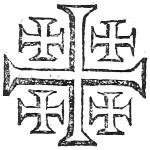
If there be one or more of them ready for it, that have at the instance of the Guardian, according to the ancient custom, been at confession, and also received the Sacrament, sub una Specie, under one species, on mount Calvaria, they are with great ceremonies conducted from thence into the holy Sepulchre, whither are also convey’d some other things that belong thereunto, viz. A fine book, a sword richly tipp’d with gold, with a red velvet girdle, a chain weighing about a hundred Hungarian ducats, whereon hangeth a golden cross of this form and shape, a pair of spurs with red velvet straps, which are laid down one by another upon the altar of the Sepulchre. As soon as the Gentleman cometh into it, they begin immediately to say Mass, and after that they sing without some Latin Psalms. In the mean while the Gentleman lieth down upon his knees in the Sepulchre before the Guardian, until the Friers have done singing. Then the Guardian bids all that stand about, to say Our Father and an Ave-Maria, in behalf of the Gentleman that is to be knighted. When this is done, he admonish’d the Gentleman, before he taketh the oath, to consider upon what condition he is admitted there; when this is done, he bids the standers-by pray for him once more, and then admonisheth the Gentleman again, and telleth him also, that hereafter he must be in all things subject and obedient to the Roman church; that he must fight and resist the Turks and Lutherans as Enemies and Heretics, so long as his blood and heart is warm. Then the Guardian asketh him farther, whether he doth receive all these points, (as they are written word by word in that book, and order’d by his Holiness the Pope, and subscribed by his own hand) and whether he will swear by the holy Sepulchre to keep them. Whereupon he consents to it presently, and promiseth with great eagerness and joy to keep it with all his heart, and thanketh God that he hath made him worthy of this blessing, and for having made him capable of it. After this the Monks begin again a long song; and then the Guardian taketh up the three pieces, the chain, sword and spurs, and puts them on him, and so adorneth him as beginning Knight. At last he taketh also the book, and puts it before him, and telleth him once more what he is about, and what he is going to swear. When he hath understood it, he kneeleth down again, and puts out his two fingers, which the Guardian puts upon the red cross in the book, and readeth to him the oath; the contents whereof are these:
First, That upon his conscience he do swear there to these following words, Not with a false heart, but that he doth confess out of zeal, with great eagerness, and with a clean heart, and also swear by God’s Omnipotence, the See of Rome, and his Holiness the Pope, that he is a good Catholic, educated in that religion from his infancy to that present hour; and that he never will go from it so long as he liveth, but will always defend and protect the Roman church against the Lutheran, and their adherents, with words and deeds, so long as his heart is warm; and that he will never be in a place where any evil is taught, or spoke of his Holiness the Pope. Secondly, That he doth swear by God’s Omnipotence, and the Pope at Rome, and the Cross of Jerusalem, that he is a nobleman in the fifth generation, both by Father and Mother. Thirdly, He sweareth also, that he hath so good income that he need not to follow merchandizing, or any other trade, nor to borrow money, or to ask others for help, but that he hath so much that he can live upon his revenues, and keep three horses besides from year to year, for the service of the church of Rome; nay, if necessity should urge, and others should rise against the Roman church to molest it, that he will then always be willing and ready, besides the three horses, to assist her with all his utmost power. He must also promise that he will so long as he shall live, diligently attend at Mass, and hear four or five every day, and also that he will keep the fasts zealously, and eat neither flesh, nor butter, nor cheese, nor eggs, on them; and also that he will confess and receive the Sacrament once a month, or every six weeks at farthest, and send his family at least once a year in Lent-time to do the same. And also that he will not forget, to the honour and encrease of the said church, to remember her in his last will; that he will protect and provide for the widows and fatherless; that he will maintain the Friers and Nuns, and their monasteries; and if by the Seculars any thing should be taken away from them, that he will not conceal it, but endeavour to the utmost of his power, as if it were his own, to recover it again. That he will assist those that would willingly turn Roman Catholics, and endeavour to bring them over; but that he will keep none in his service, nor any ways assist them that do not firmly adhere unto it. Then there is also inserted, That he will say forty nine Pater-Nosters and as many Ave-Marias every day, and visit his Holiness the Pope once a year, and come into the seven church processions and perform his office; and also assist at the Sacraments and other ceremonies with due reverence; and also respect and honour the holy water. At length, to conclude, he is forbid to talk idly, to be drunk, to live loosely, and to commit sodomy, that he, being knighted, may not lead a disorderly life, and give to others ill example.
When then the Guardian hath read the oaths that are written upon parchment out of the book, the Chevallier kneeleth down again, and when he bendeth his face down, and leaneth with both his arms on the book, which lieth on the altar-stone of the Sepulchre, the Guardian bids the Friers and Monks again to pray; then he draweth out the sword, and maketh with the flat side of it three crosses upon his head and shoulders, saying: At the command of God, and the See of Rome, and for the encrease of the church of Rome, I create you N. N. now a member of the Roman church, a Knight, in the name of the Father, Son, and Holy Ghost. And farther he adds: That in the room of his Holiness the Pope of Rome, he doth absolve him of all his sins; and that he doth also give him leave, and command him, by the oath he hath taken to his Holiness the Pope, to wear the usual red cross, as a sign whereby he may be known, publickly in his coat of arms, and on his cloaths. Also if he please, to put him in mind, as often as he shall look upon it, what he hath sworn, and to keep it the firmer. When all this is over, and they have pray’d again, the Guardian wisheth him joy of his Knighthood, and rejoyceth with the whole convent that he is come to this acknowledgement, and is become a true member of the Roman Catholic church: that he and all his brethren will always pray for his long life, and that God may keep him in health, to the comfort of the See of Rome. Immediately approach to him all the Monks, while he is still standing in his ornaments, and call him Brother; and when they have also wish’d him joy one after the other, the Guardian beginneth the Te Deum, &c. and then he taketh all the ornaments away again from him. Afterwards he leadeth him about with the Vicar in procession to the holy places, to invest him also in every one of them; when that is done they go to dinner.
Altho’ in former years every body was not presently admitted (as you may see by what hath been here before-said) except he were a Nobleman for several generations; yet in our time it is come to that pass, that they admit every body to it without any strict examination, that can pay the money, which amounts to eleven or twelve ducats. Nay, every Pilgrim that doth intend to take upon him that Knighthood, doth pray and persuade his companions by the way that they would do the same, that he may in case of necessity still have some friends to assist him, for his Holiness wants champions, because he taketh upon him the Civil Government as well as the Ecclesiastick, that when they can defend and prove their religion no longer by Scripture, they may defend and uphold it by power and strength of arms. Now as the Guardian, according to ancient custom, gives attestates to every Pilgrim concerning their pilgrimage, under his great Seal, that they may have it to shew, so he giveth also one to the Knight of the Order of St John of Jerusalem, and bids them to carry the letter themselves in person to Rome, to shew it to the Pope. This is sufficient of the temple of mount Calvaria, and it’s holy places, and the Christians that are dwelling there, of their chapels, and of their errors.
CHAP. XXI.
A short description of some Places, Hills, Valleys, &c. that lye near and about Jerusalem. Of the mount of Olives, and it’s holy places.
I having hitherto briefly described the situation of Jerusalem, and also related what buildings and holy places are still in being, and to be seen there, after it hath sustain’d so many wars, assaults and desolations, I cannot but speak of some adjacent places before I conclude. And so I begin with the mount of Olives, which lieth towards the east before the Temple-hill, over-against the Sheeps-gate, on the other side of the brook of Cedron, as the holy Prophet Zachariah xiv. 4. testifieth, when he saith, ‘And his feet shall stand in that day upon the mount of Olives, which is before Jerusalem on the east.’ This mount is about a quarter of a league, or as St Luke saith, A Sabbath day’s journey, distant from Jerusalem, pretty high, rough and stony, full of pleasant Olive-trees, from whence it hath it’s name, and also others; as Fig-trees, Lemon, and Orange, and Citron, and Siliqua-trees, by the inhabitants call’d Charnubi, Turpentine-trees, and Palm-trees; the like I have seen but few, &c. There are also some good herbs, viz. a strange Origanum, Tragoriganum, Roman Mother of Time, Spicanardi and a peculiar sort of Coniza, &c.
At the foot of the mount they shew us first a great church, between the rivulet Cedron and the valley of Josaphat, which was so cover’d with earth, that you could see nothing of it but the entry, and before it without a large place three steps deep. This church was build by Queen Helena, mother of Constantine the Emperor, and call’d, the Sepulchre of our Lady the Mother of God; to go into it, you must go down forty four steps. Within it towards the right, there is a small chapel, where they say our Lady was buried; and therefore, by the benevolence of the Pope, there is distributed and given to the Pilgrims, full forgiveness of all transgressions and punishments for ever. Some are of opinion, that this church did formerly stand even with the ground, and that after the devastation of Jerusalem, when part of the valley of Josaphat was fill’d up, it was cover’d thus over. This church stands (as Nicephorus saith in his eighth book and the thirtieth chapter) on that place where the village Gethsemane stood, whereby the garden was whither our dear Lord Christ did, just before his passion, go with his eleven disciples, after he had eaten the Paschal Lamb with them, and given thanks, according to his usual custom, over the rivulet Cedron, to regain us that which was formerly lost by our ancestors in the garden. There he left his eight disciples, while he went to pray, as the Scripture tells us; when he took with him Peter, James and John, the two sons of Zebedeus, and began to mourn, to quake, and to tremble, and said to them, ‘My soul is sorrowful unto death, stay here, watch with me, and pray that you enter not into temptation;’ and he withdrew from them about a stones cast, where he kneeled down, fell three times on his face, and pray’d to his heavenly Father, where he wrestled with death, and sweat a bloody sweat, so that an angel must come down from heaven at last to comfort him. This place is underneath a great rock that hangeth over a great cave, just at the entry of the valley of Josaphat.
This valley is still, where it cometh down from the mount of Olives, pretty deep, and is call’d by the holy Prophet Joel, chap. iii. 14, the valley of Judgment; which words of Joel give us to understand, that the Lord, as he was (when he first came upon the earth) in this valley taken prisoner, bound and carry’d away to the place of his bitter suffering, crucifixion and dying, so he shall in his second and glorious coming, appear in this valley of Judgment again to judge all people of the whole earth, &c. that then the impious shall see whom they have pierced. Zacharias speaks also of it in the above-mention’d place.
As you go from thence to the mount of Olives, you see below towards your left hand, near unto the bridge of the river Cedron, an old square building like unto a steeple. This altho’ it is believed to this day not only by Christians, but also by Turks and Moors, to be the grave of Absalom, as you shall see them sling stones into it as they go by, to revenge his undutifulness shewn to his father King David, yet notwithstanding he was not bury’d there, as we read in the second book of Samuel xviii. 17. ‘And they took Absalom and cast him into a great pit in the wood, and laid a very great heap of stones upon him.’ Yet for all this, when Absalom was alive (as you may farther read in the before-mention’d chapter) he erected a column in the king’s dale, for he said, ‘I have no son, therefore this shall be for a remembrance of my name,’ and call’d this pillar after his name; and it is still call’d to this day Absalom’s place. Of this pillar writes also Josephus in the seventh book of his Antiquities and the tenth chapter, saying, And Absalom did erect a kingly column of marble in the valley (Genes. xiv. it is call’d the King’s valley) that is two furlongs from Jerusalem. Just by this pillar beginneth a very steep foot-path, which parts a little above it into two, one whereof goeth southward, at the bottom of the mount of Olives towards Bethania and Jericho, &c. down thro’ the valley that is made by this and the other part of the hill, call’d Mashit in the fourth of Kings, chap. xxiii. but the other goeth over the height of the mount of Olives out by Bethania to the house of Mary and Martha. A little higher on this hill did our Saviour sit, over-against the temple, when he foretold his disciples that shewed him the glorious buildings thereof, ‘That not one stone should remain upon another that should not be thrown down;’ and did also tell them at length, the terrible and prodigious signs, that should come to pass before the desolation of Jerusalem, and the end of the world. To this day we still see into the Turkish mosque, with it’s large paved court-yard, over the walls thereof so perfectly, that you may distinguish almost the persons that walk there. From thence, when you go up to the hill, which is very steep and rough, there is a large plain, from whence our dear Lord Jesus Christ was taken up, and ascended into Heaven, as you may see by the words of the holy Evangelist St Luke, in his first chapter of the Acts, vers. 9. where he saith, ‘And he was taken up, and a cloud received him out of their sight,’ and verse 12. ‘Then return’d they unto Jerusalem from the mount call’d Olivet, which is from Jerusalem a Sabbath-day’s journey.’ On this place, as Nicephorus mentioneth, did Queen Helena also afterwards build a stately church, which now is so decay’d, that there is no more to be seen of it but a new built chapel in a large yard surrounded with a wall. Just by it on a hill of the mount towards the north and Galilea, there is an old and decay’d building, which was formerly (as my guide inform’d me) an inn for the Galileans, where commonly did take up those that went to Jerusalem from Galilea. Wherefore they are of opinion, that some of them were there in the time of Christ, that also were spectators of his glorious ascension, as it doth appear by the words of the two Angels, that spoke to them, and said, ‘You men of Galilea, why stand you here gazing up into heaven, &c.’ But if you duely consider these words, you will find, as you read it in the Acts ii. 7. that the Apostles themselves were these Galileans, where it is written: ‘Behold, are not all those which speak Galileans? and how hear we every man in our own tongue, &c.’ So did also the holy Angels speak to the Apostles after the same manner, and call’d them Galileans, rather to bring them, as Elders of the Christian church, off their worldly thoughts, which they had conceived in their hearts, of the restoring of the worldly regiment or kingdom again, which they should have left, and instead thereof look’d upon the heavenly kingdom, whereinto Christ was ascended, into the kingdom of God, whereinto they were received as members, which is a more spiritual kingdom, that doth not consist in outward things, eating and drinking, &c., but in a clean and faithful heart. After this they ought to strive, and to make it their only business, that it may be notify’d to all men, and be spread abroad all the world over.
From the top of the mountain, you have a prospect over all the holy land, towards the north over the valley Josaphat, which is just at the bottom of the hill, into the country of Galilea; towards the east, over some naked mountains, down into a large field which extends itself to the Dead Sea, that is, as Josephus mentioneth, twenty nine leagues long, and fifteen broad, whereof the Scripture maketh mention, chiefly the books of Macchabees, and in the second of Samuel, chap. xv. where it is written, That when King David did fly from his son Absolon, he tarry’d in the plain fields until he had intelligence of him. In these is still remaining the pillar of salt that Lot’s wife was turn’d into, when she, against the command of God, turn’d to look back to the city. The famous Historiographer Flavius Josephus did in his time see it in his own person; and the Pilgrims visit it to this day, and beat off of it some small pieces, as they do every where, chiefly in holy places, and yet it is found still whole, and without any defect; which did put some Pilgrims, that went to the Dead Sea, into great admiration. Now that they might be certain and be assured of the truth of the common assertion, That whatsoever was broken off of this pillar, was always found whole again; they did, chiefly one of them, (as I was informed by one that had been there before) knock off a whole hand, and took it away with them. Now after they had been at the end of their journey, and came back again, and went to look for it on purpose, they found it whole again, and exactly like unto the old one as it had been before. Farther beyond the plain fields, at the other side of Jordan that runs thro’ it, there appear the Arabian mountains, that were inhabited by Ruben, Gad, and half the Tribe of Manasse; they are very high, and afford very good pasture for the cattle; some among them were much noted and famous of old, as the mountain of Seir beyond the Dead Sea, mount Garizim and Ebal, whereof is made mention in Deuteronomy chap. xxvii. and also chap. xxxii. of mount Abarim, Nebo, and the point of Pisgah, situated in the land of the Moabites, over-against Jericho, which together with all the adjacent places are very well seen; as well as towards the west the rivulet Cedron, and the situation and largeness of the city of Jerusalem. After we had look’d about sufficiently, we went down to the place of the village Bethphage, which is at the other side on the ascent of mount Olivet, and belongeth to the Priests of Jerusalem; this is so ruin’d, that now-a-days there is nothing left of it save only a few foundation-walls. Into this did Christ send his disciples, to loosen the she-ass and the colt which was ty’d to the door in the road, and to bring them to him, whereon our Lord Christ also did ride to Jerusalem five days before he suffered, being the true Saviour.
Before it the mount is pretty plain, and is very rough and rocky, wherein Bethania lieth on the right hand upon one ascent, of the other part of mount Olivet, as is before said, but the village of Mary and Martha (whereof you read in the Gospel of St John, chap. xi.) is farther out by the beginning of the road towards Jericho, which is still very dangerous, because of the Arabian vagabonds. In these habitations did our dear Saviour oftentimes take up his lodgings with them; and in the same did Mary the sister of Lazarus, and Martha anoint the feet of our Lord Christ with a precious ointment of Nard, and dry them again with her hair; in our days they are quite desolated, and nothing left thereof but ruins. Near it as you come back again to Bethania, in the plain lieth a large stone, where also you may see the above-mention’d places very plain; where they say that Martha did meet the Lord, when he came up the steps, and rested on the mount, and talked with him of the resurrection of her brother, before her sister Mary did know any thing of the arrival of the Lord. Wherefore she went back again into their village, to call her sister Mary secretly, who, when she heard that our Lord Christ was near at hand, did hasten and went to him, for he was not yet come into the village, and fell down at his feet, and said weeping, ‘Lord, if thou hadst been here, my brother had not dy’d;’ then he groaned in his spirit, and enquired presently after the place where Lazarus his dear friend was laid, and went with them to it to Bethania that village, distant a league, (about an hours going,) or as the Scripture saith: about fifteen furlongs from Jerusalem on an ascent; wherein was a small chapel, and underneath it a deep cover’d cave, wherein Lazarus had lain four days, as you may also see in the before quoted chapter, where it is in the thirty eighth verse said: ‘It was a cave, and a stone lay upon it.’ When the Franciscan Friers would go to the grave of Lazarus, they were forced to go through this village, and a great concourse of the poor inhabitants used to flock about them, and did surround them, and detained them till they gave them something to be distributed amongst them; that they might evade this trouble, and not be necessitated to go thro’ this village, when they go to the grave, they have made behind at the other side on the height another avenue, but they do not escape the Mobile for all that, for they meet them notwithstanding, chiefly, if they know or have intelligence, that any Pilgrims came along with them to see the grave; so we did find it, for they came and kept us lock’d up in it so long, till we had given them so much as did satisfy them. As you come out again from Bethania towards Jerusalem, the Friers shew an old building, where Simon the Leper did dwell, in which when Christ was at the table, Mary the sister of Lazarus did come, and did break again, yet several days after, a glass of precious unguent of Nard over his head, which fill’d the whole house with a fragrant scent; which pleased Christ so well, that he took her part against his disciples, and commended her proceedings so highly, that it is recorded to her perpetual memory. From thence if you come nearer into the valley between thee mounts of Olives, there is still to be seen several fig-trees whereabouts Christ did curse one of that kind, because he found no fruit thereon when he was hungry. Just at the coming out of the valley near unto the steps of mount Olivet, you see the city again, but chiefly the mount of the temple and gate where you go up, walled up in the new wall. From this valley, when our Lord Christ came in sight, and came down the mount Olivet, the people, as he came riding along, cry’d, saying, ‘Hosanna, to the Son of David, &c.’ and a little after when he came nearer unto it, he lamented with tears also their future misery, and the terrible destruction of the town, and went in from thence towards the golden gate into the temple and drove out the buyers and sellers.
CHAP. XXII.
Of the Bethlehem, the mountains of Judea, and their famous places. Where also is made mention of my returning back from Jerusalem to Tripoli.
Bethlehem, formerly called Ephrata, is situated towards the south, twenty furlongs, or a German mile distant from Jerusalem. The nearest way to it, you go through the gate of Hebron, and come to the right by the upper mote, and the bloody field, up the steps over mount Gihon, where just before you see a cistern with good fresh water near the path, made of white stones, and well prepared; near which the star did appear again unto the three wise men of the eastern countries, and led them into Bethlehem. Near it there groweth a Turpentine-tree larger and higher than any that ever I saw elsewhere in my life. Farther, about half way, you pass over a hill, at the top whereof you may see both towns, Jerusalem and Bethlehem. Before you is a large valley, which, altho’ it be rocky, yet it is fruitful both of corn and wine. In it, towards the right hand near the road, is an acre called the Cicer field, which had it’s name (as I was informed) from the following transaction. It is said, that when Christ went by at a certain time, and saw a man that was sowing Cicers, he did speak to him kindly, and asked him what he was a sowing there, the man answered scornfully, and said, He sowed small stones. Then let it be, said our Lord, that thou reap the same seed thou sowest. So they say, that at harvest time, he found instead of the Cicer-pease, nothing but small pebbles in shape, and colour and bigness, like unto them exactly. Now whether there be any thing of truth in it or no I cannot affirm; but this I must say, that there are to this day, such stones found in this field. For, as we went by, some of us went into it, and did gather a great many of them that were in bigness, shape and colour, so like unto these Cicers (by the Arabians called Ommos, and in Latin, Cicer arietinum) that we could hardly distinguish them from natural ones.
Hard by it, you shall see still some old ruins of old stones, where first Abraham the Patriarch did build a tent as you read in Genesis xii. 8. And he removed from thence unto a mountain on the east of Bethel, and pitched his tent, having Bethel on the west, and Hai on the east. Senacherib, the King of Assyria, when he went before Jerusalem, did come into this valley with all his might and power; and had by the angel of the Lord in one nights time, one hundred and eighty-five thousand men slain; and still to this day, there are two great holes to be seen, wherein they flung the dead bodies; one whereof is hard by the road towards Bethlehem, the other towards the right hand over-against old Bethel; which town fell to the children of Benjamin, and is called still to this day Bethisella, and is situated half a league farther towards the west, at the foot of the hill, in a very fruitful country. There did Jacob the Patriarch when he fled from his brother Esau, see in his sleep the ladder which reached up into heaven, whereon the holy angels ascended and descended, wherefore he erected there a stone for a mark, and called the place Bethel, which was called Luz before, as you may read in Genesis xxviii. As you come nearer to Bethlehem, you see the grave of Rachel at your right hand near the road, which Jacob did erect there, when his wife died in labour with Benjamin, as you read in Genesis xxxv. 16. ‘And they journeyed from Bethel, and there was but a little way to come to Ephrath:’ and verse 18. ‘And it came to pass as her soul was in departing (for she died) that she called his name Benoni; but his father called him Benjamin; and Rachel died, and was buried in the way Ephrath, which is Bethlehem. And Jacob set a pillar upon her grave; that is the pillar of Rachel’s grave unto this day.’ Before you come quite thither, there is just by without it, on the left, a good rich cistern, which is deep and wide. Wherefore the people that go to dip water, are provided with small leathern buckets and a line, as is usual in these countries; and so the Merchants that go in carravans through great desarts into far countries, provide themselves also with these, because in these countries you find more cisterns or wells, than springs that lie high. This was formerly under the gates of Bethlehem, whereof King David longed to drink; wherefore his three champions did break into the camp of the Philistines, and did dip some water out of the well, and brought it to the King; but the King would not drink of it for certain reasons, as you may read in Samuel chap. xxiii, and in I. Chronicles chap. xii. From thence we went by the path of the mount into Bethlehem the town of David, where he was born and anointed King by the Prophet Samuel; it lieth upon an ascent, it’s buildings, town walls and towers are so decayed, that now it is quite open, and nothing at all to be seen, except the well and monastery, but ruined cottages.
Just without Bethlehem, at the other side of the path, towards the east, for formerly the town reached so far, they shew still the stable under a large rock, wherein Jesus Christ, the promised Messias, God and Man, was born of the immaculate Virgin Mary, and laid in a manger. Of his coming, and the place where he should be born, the holy prophet Micah long before prophesied in his fifth chapter, and second verse, saying: ‘But thou Bethlehem Ephrata, though thou be little among the thousands of Juda, yet out of thee shall he come forth unto me, that is to be ruler in Israel; whose goings forth have been from of old, from everlasting.’ On that place hath Helena, mother of Constantine the Great, also build a stately church; but since it is so ruined and demolished, that hardly half of it is left, as one may see by the old walls of the foundation, and other places and arches that are still left without; yet that part that still remaineth standing, is very large, covered with lead at top, and is so glorious a building, that one shall hardly find a better any where. For within it is paved with white marble all over, and upheld with a great many large and high marble pillars, each whereof is about nine spans in diameter; I told about fifty of them, they stand without before the chancel (and underneath them is the place of the holy and joyful birth of our Lord Jesus Christ) in four rows one behind the other, and so give a glorious ornament to the whole church. There are also to be seen on the arches and the walls about, some fine histories taken out of the Old Testament, made in Mosaick work, laid in with colours very artificially; and are still so plain to be seen and discerned, as if they were made but the other day. The cave wherein Christ was born, hath without, on each side of the chancel, underneath which is a peculiar way into it, one against the other, the doors thereof are commonly locked up, because behind the church, there is still another, through which they generally go down into it; therein is below at the right hand still another less one, going down two steps more, which is the true stable, wherein our Saviour Jesus Christ did lie in the manger between the ox and ass; so there is still in the same place made a marble one very well wrought. Without before it we put off our shoes, and went in with the father Guardian into the holy place. Where, when I considered the joyful birth of our Lord Jesus Christ; where he, as the true long before promised Messias and Saviour was born; I was affected, as if I saw the child wrapt up in swadling cloaths, and lying in the manger, disguised in our mortal flesh and blood, yet without sin, that we as children of wrath and eternal damnation, might be received again by God his Heavenly Father, as his children unto everlasting salvation; that did humble himself so low, as to be born in a dark stable in the miserablest poverty, that he might bring us out from the filth and mire of sin wherein we lay, into the parlour of his Heavenly Father. ‘Seeing then, my dear Lord Jesus Christ, that thou art come to us into the world, as the true light, to make of us, that were children of darkness and eternal damnation, children of light and eternal salvation and felicity; I return unto thee, O Lord, for these thy unspeakable benefits, eternal praises, and seeing that thou hast assumed our flesh and blood, and hast also caused these thy merits and benefits to be by thy holy angels proffered to me; therefore I pray thee let me come to thee with the poor shepherds, and see thy saving incarnation, give me and us all thy grace and holy spirit, that we may comfort our selves with this thy blessed birth, against our sinful and impure one, constantly and without cessation, that we may rejoice in it, in good and bad times, in tribulations and adversities, in prosperous success and ill fortune, in the time of this temporal life, heartily, until at length we shall, in the life to come, see thee with all the elected ones, face to face, to all eternity.’ Amen.
This cave is underneath about the walls, lined with long tables of grey marble, adorned with blue, artificially laid in; the rock that cometh out over the stable only excepted. Just by the furthermost entry of the fine chapel there are others, in one whereof St Jerom did live, and did translate the Bible out of the Hebrew and Chaldean languages into the Latin. In another near it, lieth buried the noble pious Roman lady Paula, with her daughter Eustachia. Who, after the decease of her husband, went thither to St Jerom, where she led all the rest of her days in Christian piety, until at length she died in the Lord. From thence we came up again into the church, wherein without close to the chancel each side, were to be seen two altars, covered with good large marble; on one thereof on the left, the father Guardian did shew me the effigies of the old Simeon, holding the child Jesus in his arms, and in the manger still another, with this admonition. ‘That from hence we may see, conclude and learn, that it is not culpable at all to have images, seeing that nature itself alloweth so much unto stones, that images may grow in them. Wherefore they are not only not to be forbidden, but rather to be honoured.’ What every Christian ought to think of this, being quite contrary to the holy Scripture, every child that hath but begun to learn the Catechism, can easily and sufficiently decide. The Franciscan monks have near the church, a large and pleasant habitation, and also by it great gardens (rich of fine plants and good fruits) defended round about with high walls, against the incursions of the Arabians, which they make daily. Bethlehem lieth high, surrounded by the hills of Judæa, as you may see by the words of Jeremiah, chap. xxxi. verse 15. where he doth prophecy the murdering of the children, which cruel tyranny Herod Ascalonit did a great while after in Christ’s time execute, the words are these: ‘Thus saith the Lord, a voice was heard in Ramah, lamentation and bitter weeping: Rachel weeping for her children, refused to be comforted for her children because they were not.’ In this monastery, because it lieth at the top of the path, you see with pleasure, as well as on mount Olivet, the confines of Jericho, and the Dead Sea, and the mountains of Arabia, but chiefly within the space of a league and a half towards the south, a great and high hill, which extends itself much farther than the rest; whereupon, in former years, the strong and mighty castle of Theckoa was built, whereof the holy Prophet Jeremias maketh mention in his sixth chapter, and also Amos (who did prophecy there) in his first chapter. The Christians had this in possession a great while, and did keep it against the Infidels and Heathens for above thirty years after Jerusalem and the Holy Land were taken; for they had corn, wine, water, and other necessaries, abundantly of their own growing, so that they might have kept it longer, if a great contagious distemper had not got among them, which did increase to that degree, that they were forced to leave it, and to retire to more healthy places. When the Heathens did understand that the Christians were marched off, they fell into the castle with a great multitude, tore it all to pieces, and did demolish it to the very ground, so that now one cannot discern that such a one did stand there before. But this lost troop of the Christians, did at length settle themselves on mount Libanus, and began to inhabit it, where they are still remaining in our times, and call themselves (as I have told you before) Trusci. About Bethlehem, there are some valleys very well tilled with corn and vines, and among the rest a very pleasant and fruitful one that beginneth immediately by the church and fountain, and runs down towards Jericho and Jordan. This is below pretty wide, full of Olive and Fig-trees, it also bringeth forth some comfortable herbs, viz. some strange Origanums, Tragoriganum, Roman Serpillum, which the Arabians call Sathar, Absinthium Santonicum, which groweth every where in the Holy Land, this hath small ash coloured leaves, very like unto them of ours, and many small stalks full of small yellowish seeds, it is of an unpleasant smell, very bitter, with a saltish sharpness, wherefore it is reputed to be the Scheba of the Arabians; from whence our Wormseed cometh.
In this valley were the shepherds, to whom the angels of the Lord did appear, and declared to them the saving birth of our Lord Jesus Christ, saying, ‘Behold I bring you good tidings of great joy, which shall be to all people; for unto you is born this day, in the city of David, a Saviour, which is Christ the Lord, &c. and suddenly there was with the angel a multitude of the heavenly host, praising God, and saying: Glory to God in the highest, and on earth peace, good will towards men.’ In that place, which is about half a league below Bethlehem, is still a church, which also Queen Helena did build, as Nicephorus testifieth in the thirtieth chapter of his eighth book, this is for the greatest part fallen in, so that nothing more but a small arch is to be seen of it. Hard by it did stand the tower Ader, as St Jerom writes, whereby Israel did erect a tent, (as you may read in Genesis:) and looked after the sheep with his twelve sons. This is in our time so demolished, that it lieth quite in ruins. Beyond it, in another valley, not far from Bethlehem, they shew still to this day a large orchard full of Citron, Lemon, Orange, Pomegranate, and Fig-trees, and many others; which King Solomon did plant in his days, with ponds, canals, and other water works, very pleasantly prepared; as he saith himself in Eccles. chap. ii. verse 5. ‘I made me gardens and orchards, and I planted trees in them of all kind of fruits; I made me pools of water, to water therewith the wood that bringeth forth trees.’ This is still in our time full of good and fruitful trees, wherefore it is worthy to be seen for their sakes, and also for the ditches sake that are still there. Wherefore I really believe it to be that same whereof Josephus maketh mention in his eighth book of the Jewish Antiquities, and the seventh chapter; saying, ‘And the King rode in a chariot, cloathed in white, and it was his custom to ride early in the morning to a place called Hetten, a hundred furlongs from Jerusalem, where he had a garden with water pools and works very pleasant, and rich. Thither went the King for his pleasure; and did always use great diligence and consideration in all things, and took delight to see every thing neat and handsome.’ &c. After we had seen the chiefest places within and without, near and afar off Bethlehem, we returned to Jerusalem again by another way, that was near as far again about, and went over the mountains of Judea, which have first as you come from thence very good and fruitful valleys, full of vines and corn, but the nearer you come to Jerusalem, the higher and rougher are the mountains. In this way, half a league from Nebeleschol, the friers shewed us a well very rich of water, just by the road that goeth down to Gaza, this runneth into a small rivulet, wherein the holy Apostle Phillip did baptize Candaces chamberlain to the Queen of Ethiopia; by it, is nothing else to be seen but a small church and a fish pond. From thence we came over high, rough and steep hills into the deserts, where St John the Baptist did lead his life in his young age, there is nothing to be seen but a very ancient chapel, and hard by it a delicate spring on the top of the hill, where we went up to refresh ourselves a little, with eating and drinking of what we had taken along with us. About the roads grow many trees, by the inhabitants called Charnubi, the fruit whereof is called St John’s Bread in our country, and is brought to us in great plenty. From thence we had still a very rough and hilly way to the church and habitation of Zachary, whither the Virgin Mary did come (climbing over the hills) to give Elizabeth a visit, &c. Before it, a league distance nearer to the town, at the end of the valley Raphaim (whereof the holy Scripture maketh often mention, viz. in Joshua xv. and xviii. and in I Chronicles chap. xii.) stands in a very pleasant and fruitful place, the church of St John the Baptist; and by it, before you come quite to it, falleth down the spring of Nephthaah, that is very rich of water. This church is very ancient, but yet pretty well built, and hath on the left hand as you go in, a deep and hidden cave, wherein Elizabeth did hide herself with John her child, that it might not be slain with the children of Bethlehem by the servants of Herod, whereof you may read more in the Proto-Evangelium of St Jacob, where it is thus written: ‘When Elizabeth did hear, that among the rest of the innocents which Herod had commanded to be killed, her son John was also searched for, she did climb up the hills, and looked about her where she might hide him; but when she saw no place there where she could preserve him, she sighed, and cried out with a loud voice, saying: O ye hills of Gad, take both the mother and the child; for she could not ascend them; the hill did open itself instantly, and took them into it, &c.’ But how afterwards Herod did search for John, and how he did threaten and exhort his father Zachary to tell him where his son was, and also how his servants did kill Zachary (not being satisfied with his answer) for it in the porch of the temple is at length related in the books of the martyrs of the learned and reverend Ludowich Rabus. As you come from the beforementioned church, nearer to the town of Jerusalem, there is still seen a large pillar, that is of great antiquity, and lieth very high between the mountains on a high hill, five furlongs off of Jerusalem, wherefore some take it to be ruins of the fortification of Betzura; but as far one can understand by the books of Maccabees, that is situated more towards the east behind mount Olivet. Just before it, within, stands in the valley (that is full of pleasant Olive-trees) a very old, yet well built church, called the Holy Cross, whereof some Greek friers are possessed; they pretend, that in that place the tree did stand, that was made use of for the cross of Christ: this we did soon leave, and went over a small height through the gate of Hebron again into Jerusalem, and made ourselves ready to return the next day again to Joppe towards our ship. And so we rewarded the father Guardian, their interpreter, and others that had conducted us, for their faithfulness and services done us according to our ability, to their full content and satisfaction, wherefore the father Guardian did freely give to each of us a certificate under his usual seal, that we had seen all the holy places which were named in it. This done, we went away, and came the next day to Rama towards Joppe. By the way, I found some Lentiscus’s, from whence the Mastich cometh, Arbutus, Ilex, and a strange sort of Willows, by the inhabitants called Sassaf, but by Theophrastus, Elæagnus, some Olive-trees, Palm-trees, white Mulberry-trees, Sumach-trees, and Styrax, from which cometh a sweet smelling Gum, called by the same name, that is brought from thence into our country; Spartium, Lycium, which is a strange shrub, and the juice thereof retaineth the same name, and is found sometimes in our Apothecaries shops; the King and Prophet David maketh mention thereof, under the Hebrew name Hadhadd, by which also the Arabians call it, their speech running much upon the Hebrew. Hereabout grow also very many fruits (called Siliquæ by the Latins, and κερατιὰ and κερατονία by the Greeks, but by the inhabitants Charnubi) whereof many are brought out to us, and are very well known by the name of St John’s Bread. These are so common in these countries, that they esteem them less than we do the worst fruit we have, wherefore they give them to the cattle to eat. Wherefore it is probable, that the prodigal son desired to fill his belly with these fruits, which, as it appeareth by the Greek text, the hogs did eat, and yet could not have enough of them to satisfy his hunger. Besides these, I found also by the way many Turpentine-trees, by the inhabitants called Botin and Albotin, which are very common in France, chiefly about Montpelier, they have small green kernels, that are of a reddish colour, and hollow within, and are oftentimes basely sold and used by the Apothecaries for the true Carpabalsamum; for these and others abovementioned, as we read in Nehemiah, chap. viii. the Israelites did take bows, and made themselves tents of them to live in, during their great feast of Tabernacles. I saw also chiefly between Rama and Joppa some white Barberry-trees, which I took first for Paliurus, the third kind of Rhamnus, unto which they are very like, except the fruits whereby I did discern them first, and besides, they are much higher, and their branches covered with a white bark. Now although they are not to be taken for the same, yet they are very like unto the second Paliurus, whereof Theophrastus maketh mention in the fourth chapter, and the fourth verse. Among the corn, I did find a strange Origanum, Serpillum; Smilax aspera, Triones of Theophrastus, whereof I have made mention above.
After we had made our selves quite ready to sail for Tripolis, whither we had about forty German miles, we went aboard the ship, and set sail with a fair wind. But this did not last long, for, as soon as we were out at sea, there arose one that was so contrary to us, that we hardly reached the confines of Tirus and Sidon the fourth day, where we arrived in our former voyage at night, as I have said before. I saw nothing of any buildings on the shoar, but some small houses in the place where formerly the town Sarepta did stand, which (as you may read in St Luke, chap. iv. and in III Kings, chap. xvii.) was situated near unto Sidon, or as Josephus writes in his eighth of the Jewish Antiquities, chap. xiii. between Tyrus and Sydon, in the country of Phœnicia, wherein the holy prophet Elias, during the great scarcity, did live a great while with a widow, and did restore her dead son to life again.
Departing thence, the night befel us before we gat overagainst Sidon, but we went so near the town, that we could see the houses, and some rocks butting upon them by moon-light. From thence, the nearer we came to Tripolis, the more the wind was for us, so that we arrived there on the first of October in the year 1575, in very good health and condition. Wherefore I give eternal thanks, glory and praise unto the Almighty God the Father, Son, and Holy Ghost. Amen.
CHAP. XXIII.
How I took ship at Tripolis in Syria, and sail’d back from thence to Venice, and travell’d home again to my own relations at Augspurg.
At my arrival at Tripolis, when I hoped that something might have been done for the good of Hans Ulrich Krafft, whom I left in prison behind, as is above mention’d, towards his deliverance; that we, seeing we came out together, might have remained together a while longer, and have ended our journey to our content, I found there was not only nothing done to the purpose, but his cause came to be worse and worse, so that it was even or odd whether I should not have been cast into prison also, and beaten severely to boot. When thus he was detain’d in prison, I receiv’d a letter and command, as well from his adversary, as from my own friends, desiring me to take the cause in hand earnestly, to bring them both to an accommodation; and that if I would do so, I should do him greater service, than if I should stay a whole year longer at Tripoli, expecting his deliverance. Now altho’ many means were used after my departure, for his liberty, yet they proved all fruitless, unsuccessful and vain, so that he was forced to spend three intire years miserably in this severe Turkish imprisonment, until at length he was miraculously deliver’d. Wherefore I got everything ready for my departure, and went aboard the ship called the St Matthew, on the day of St Leonhard, being the sixth day of November in the year 1575, having first taken my leave of the above-mention’d my dear friend Hans Ulrich Krafft, whom I loved as my own brother, and the next day we put out, having a very good wind. So our navigation proceeded in the beginning very successfully, and we discover’d on the third day early the great island of Cyprus. But when we approach’d unto it, a hurricane arose suddenly, and blew so fiercely upon us, that it wound our great sail round about our main mast, so that it was a wonder to me, that it did not bring it by the board, or (as it would if the seamen had not struck it down immediately) turn the ship over, and sink her. These winds arise from a wind that is call’d by the Greeks, Typhon; and Pliny calleth it Vertex and Vortex; but as dangerous as they are, as they arise suddenly, so quickly they are laid again also. The seamen pretend, that one shall sooner perceive them in the ship below, because they come up from the depth of the sea, than above deck. After this had continued about a quarter of an hour it was quite over, so that it was perfectly calm, and the sea very quiet. So our seamen hoisted up their sail again, and steered towards the Capo del Græco, with an intention to run in still before sun-set into the harbour of the metropolis call’d Famagusta; but before we were aware of it, another wind arose that did send us back again, so we stood out at sea, and went on with it so well, that we passed the island that is one hundred and sixty Italian miles long. Not long after the wind did change, and it came to be foul weather, and so contrary to us, that we went on but very slowly, and we were forced to drive upon the sea only for several days, until at length we came before the land of Pamphylia and Lycia, which came in sight now and then, nearer to the island of Rhodes; then arose a northerly wind that helped us into our true road again, and blew so fresh, that in a few hours we went by that mountainous island Scarpanthus, and afterwards by Solomon’s point of the isle of Candia out towards the south, which is forty leagues farther; and we had been almost quite thrown over into Africa, if we had not sheltered ourselves under the next mountains, so we got clear of the noise and turbulency of the wind and sea; but instead of that our ship came so near unto the shoar of Candia, that we feared every moment to have been shipwreck’d, which had certainly befallen us, if our Nacchier, that managed the sails, with his seamen (who wrought very hard, until they brought the ship out at sea again) had not for two days and nights done their utmost endeavour. When we kept thus out at sea, foul weather befel us again, and contrary and rough winds blew afresh, so that it was very dangerous sailing; wherefore our master as well as the men thought it best to get into an harbour; but finding that it was very dangerous to get in there, they went back again to the island Calderon, which lieth not above a German mile from Candia, to land there, and to stay for better weather. This island is small, and so rough and sandy within, that it cannot be inhabited; but yet being full of bushes, those of Candy, turn, chiefly in the summer, their cattel into it. Here I found a kind of Mandrake with blew flowers in great quantity, and also very many Oxycedri like unto our Juniper bushes, which are almost as high as our Pine-trees. When we, during this hard weather, were in this island Calderon for shelter, we saw sometimes clouds in the shape of a pillar, that came down from the skies to the next mountain, and so extended themselves sloping down into the next sea. Pliny makes mention also of them in his forty ninth chapter of the second book. When this did touch the sea, it begun to suck, as it were, thro’ a spout so fiercely, that the water began to move in that place, as if it were in a storm, so that we could not only hear the noise, but also see the great motion thereof. In the beginning it was pretty clear, but the longer it remained there the darker it grew, until at length it arose up again and ascended into the skies like unto a thick cloud. Wherefore it may very well be, that sometimes worms, frogs, fungusses, snails, muscles, &c. may fall down with the rain, chiefly in those places that are near to the sea; for I have myself seen it many times in my travels between Bononia and Florence on the high mountains, where I have found several of them. When the wind blew fair for us again, and we had sufficiently provided ourselves with wood and fresh water, we hoisted up our sails again and came away; and at length, not without great labour and changing of the wind, we got out before the island of Candy, which is about two hundred and fifty Italian leagues long, into the open sea, with an intention to go strait away for Venice. In the mean time one of our seamen did catch on a hook, that he had baited with some meat, a large fish, by the Latins call’d Lamia, but this fish being of some hundred weight in bulk, he brought him upon the hook by degrees to the ship, then they fastened a rope about his gills, and so drew him up very safely. When they did cut it open to salt it, I found that it’s bones were but very small, and not harder than a cartilage. They gave us now and then some of it to eat, but it was so much salted, that we could not eat it, so that at last they were forced to leave it. Soon after one of the Pilgrims, that was a Priest at Lille in Flanders, got a bloody flux so violently, that he was in danger of his life, so I took care of him, and gave him what physic I had by me in the ship. When we came to the island of Cerygo, else call’d Cithera, belonging to the Venetians, lying near to the Morea, (from whence Paris took away the Queen of King Menelaus, and carry’d her to Troy) upon a sudden a hurricane arose towards night with blowing, thundering and lightening, so that we at several times did despair of our lives. For when the waves swelled as big as large rocks, and pressed very hard upon our ship, so that they did fling it now on this, and then on the other side again, with great violence; so that not only our goods, arms, trunks, and boxes were tumbled up and down in the ship, but that also we were forced to take great care of ourselves during this tempest, that we might not tumble over board, of which we were in great danger. But how terribly soever this looked in the dark night, yet it still increased; for in a little while after the place that held the cannon shot that were near unto the steerage, where I had my cabin, broke open, so that the balls ran up and down over all the ship according as she rolled. Soon after the beating of the waves knock’d off the garland that was behind at the outside of the ship, and left some nails about a finger thick, that held it in the wood, with such a power, that one might hear it almost all over the ship. After all this the great sail was also torn off and fell down into the sea, so that we thought no less than that we were all lost; for then the ship was wholly left to the mercy of the roaring waves, that flung her, and tossed her about like a football from place to place, (which you may deduce from thence, that the Guardian that held himself fast by the main mast upon the deck, was sometimes above a man’s depth under water) so that every moment we expected to be overturned, and drown’d. Yet in all this calamity, we did not give over all, but did what we could for our safety, seeing that we could not do what we would, we stood together and pulled the sail out again, yet we did not all pull together, for it was so dark that we could not see one another but when it lightened, and in the place of the torn one we put up another new one; for generally in such ships they are provided with two sails, and also with two masts and rudders. After the seamen had put on the new sail, not without great labour, difficulty and danger, they fell down upon their knees, and began to pray to their intercessors and patrons, which every one chused for himself, by their names, some to Peter, others to St Paul, others to the holy Virgin Mary, but chiefly and before all the rest to St Nicholas, who in the like imminent dangers, necessities and calamities, hath oftenest before all the rest shew’d himself by sundry tokens, according to their opinion, ready to assist and to help, so that they might be sure of his help, and so comfort themselves with a certain deliverance.
After they had said their prayers, they let me understand that they had seen three burning candles on the top of the main mast, wherefore some of them for joy vowed solemnly to go a Pilgrimage to certain Holy Places, or else to give a certain Sum to one of their churches. This tempestuous weather held on all the night long and also for a great part of the next day, so that the seamen prayed three several times; I cannot justly tell whether I was more astonished at their prayers or at the tempestuousness of the sea, but chiefly when I understood, that they sought, without Christ our true Saviour and Helper, in this great danger to others, and such that did not only know nothing of us, as we may see by the words of Esaiah, when he saith, Abraham knoweth nothing of us, and Israel doth not know us; but that they also (if they had been still alive) would have directed us themselves to the true and only Mediator Jesus Christ. And so we read, That the virgin Mary her self did not know what was become of her Son, until she found him sitting amongst the teachers in the temple of Jerusalem: and also at the wedding of Cana in Galilea, she did direct the servants (that told her that they wanted wine) herself to her son our Lord Christ, (that they might not look upon her any more) when she saith to them, What he bids you so do. Seeing then that the saints will not receive such honour that only belongs unto the Lord, and on the contrary, the Lord bids us come to him, I turned from them all to Christ (when our ship was almost quite covered over with the waves) to awake the Lord as his Disciples did when he was asleep, saying, Lord help us or else we perish; and with the Apostle St Peter, O Lord save and deliver us, let us not sink down quite, but draw us out from the depth of the sea, and preserve us graciously in this great danger. This tempest made our seamen so distracted, that they did hardly know whether, and how far the weather had drove us out of our way, until we came quite about the Morea, and saw the Island Zant (formerly called Zacynthus). This we left on our right, and did go strait forwards to the next Island of Cephalonia. This is about 250 leagues distant from Candy, and doth belong as well as Zant, to the Venetians, and had over against us a fine large and strong port called Argostala, before which it was 14 days before we arrived: towards the left, a ship (being under full sail before a strong wind and missing the entry) was staved all in pieces. Into this we got (the Lord be thanked) safe, and remained there for some days to refresh ourselves. Just behind this island is the channel Viscardo, wherein the great Armada of the Christians did ride against the Turkish ones, until at length it came to a fight before it, where the Christians obtained a glorious victory. After we found our selves in a safer and quieter place than we were before, and did hope quickly to get good bread also, instead of our old black and worm-eaten biskets (which had been loaden in Spain a great while agone, wherewith we had made shift a good while) some of us went the next morning into the next village (which was pretty large) to buy some. But we did miss our aim very much; for being that the inhabitants continually and hourly feared that the Turks, whose Armada was not far off, would make a descent, upon them, therefore they conveyed all the goods they had into the castle, that we could see lye very high beyond the great harbour, and had kept no more but what was necessary for their daily use; so that no provision at all was to be had or found: And they had so little bread, that we went about in the village from house to house and could hardly get for money as much bread as would serve us for our dinner. But as for wine they let us have what we would, which was red, and very good, which the Merchants knew very well, wherefore they bought a considerable quantity thereof, to carry to Venice, and so did our ship’s master also. We also found many small grapes growing there, on the vines, as many as I saw of them, are rather less and lower than ours in our vineyards. During this our tarrying, our pilot being sick, so that he was not able to direct the ship any farther according to the compass, our master strove to get another, and that the rather, because the Adriatick sea, whereinto we expected to come daily, is very dangerous, because of it’s narrowness, plenty of islands, and hidden rocks, to navigate. So we got a Greek, and after the weather began to be fairer, we put out to sea again. But this did not continue long, for when we came a little out of the harbour, we had other winds upon the sea, that were rather contrary to us, and hindered us so very much in our navigation, that after many days we arrived only before the fort of Corfu, otherwise call’d Corsica, which we could hardly see in that misty and foggy weather, not without great pains and labour. This ill weather, with the contrary wind, lasted very long, and encreased more and more, the wind continuing high; so that we had almost been cast over into Apulia against our intention, chiefly between Cataxo and Ragusa, which Ptolemy called Epidaurus, had we not quickly made the island of Meleda. So we spent our time in this navigation, not only in hard and contrary winds, with great pains and labour, but were besides obliged to be above deck, because she was filled up with goods all within to the weight of above twelve thousand centners, where we endured great cold, and must remain there in all the rain and storms.