TURNING DEVICES AND TURNOUTS
Reading edition
When the truck and trailer reach the place where they are to be loaded, some method must be used to turn them around. Various means are used to accomplish this. One is the motor truck turn-table. The turn-table should be slightly longer than the length of the truck and trailer combined. It is constructed of heavy plank and timbers so that each track is about 16 inches wide and tapers in thickness from about 14 inches at the center to 4 inches at the ends. The two tracks are held together at the center and each end by heavy timbers. A heavy timber is sunk to the level of the road and at the center two circular saws are laid. A king bolt through the center brace of the turn-table and through the two saws into the sunken timber provides a pivot upon which the table turns. When properly balanced and with a little oil between the surfaces of the saws, the turn-table can be operated by hand with very little effort. It is usually placed at the end of the road. A turn-table can be loaded on the truck and trailer when it is desired to move it, so that as the road is extended into the timber, a means of turning the truck can be obtained close to the point where the logs are to be loaded. This device can be built at a cost of from $75 to $125 and is very serviceable. The main objection to its use is that the setting has to be just right to make it work satisfactorily and it is sometimes difficult to get a spot that is level enough. It is always a difficult problem and a different one for each set-up.
The use of the "back around" is more common with truck loggers at present because it is easier to build. The back-around is simply a pocket or short spur along the road above the landing ground which is planked solid. The truck and trailer are backed into this far enough so that the truck can pull ahead in the opposite direction. This method of turning the truck requires only a little extra clearing and grading and is less expensive and more easily constructed than a turn-table.
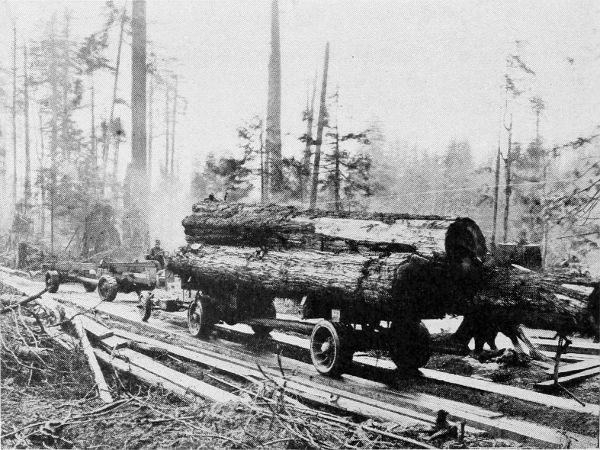
Turn out on fore-and-aft plank road.
When two or more truck units are to be used on a single track, a careful calculation must be made to determine the best passing places. The location of these points may determine the success of the operation. They should be placed so that the truck returning empty can reach the turnout before the loaded one comes along in order that the loaded one may not be held up. At the same time, the turnout should not be so far away from the loading ground that the loading crew will be idle for any length of time while waiting for an empty truck. It is better to have an extra turnout, even if seldom used, than conditions that would hinder efficient operation or might even result in a collision which would tie up the logging for several days.
A few loggers build a turnout of the same material as the main road for a short distance to the side. An illustration of this type of turnout is shown above. Most of them, however, simply clear off a right of way and put in a gravel bottom for the road as the waiting truck at this point is empty and will not ordinarily sink into the ground and get stalled. A few heavy planks laid fore and aft in the form of a track are sometimes used. The construction of passing places is very simple—the only important thing to be taken into consideration is the proper point at which the trucks should pass in order to keep the operation going at maximum efficiency.