LIFE AND DEPRECIATION
Reading edition
The life of a truck is directly proportional to the care that it receives, hence, a good driver is a most important consideration. If the right man can be secured his wages should be a secondary consideration.
The charge to be made for the depreciation of a truck is an uncertain question. Some loggers figure on the basis of four and a half years, others on as much as seven years. The depreciation charge on a truck used in the logging industry should depend largely upon the type of road over which it is operated. Loggers in general over-rate the life of their equipment because they do not fully realize the severity of the work. Over a fore and aft plank road or a cement road, where the jar and vibration are reduced to a minimum, the wear and tear on the equipment is very much less than where the truck is operated over a cross-plank road or an unpaved public road. The matter of depreciation, then, will depend largely upon the type of road over which the truck is to operate. In general a four-year depreciation charge less 25% sale value at the end of that time should be used as a basis for figuring costs unless the hauling conditions are very favorable. Only under very rare circumstances should more than four years be allowed. It should be remembered that the depreciation on a truck is very heavy during the first year, and the sale value at the end of a year is only half the original price. Many truck operators now hauling over good roads who are depreciating on the basis of five years say that a four-year depreciation would be more nearly correct. Another factor in favor of a four-year depreciation charge is that methods of logging are changing constantly and that trucks in that time may be improved upon to such an extent that the use of the old equipment would be unprofitable and inefficient.
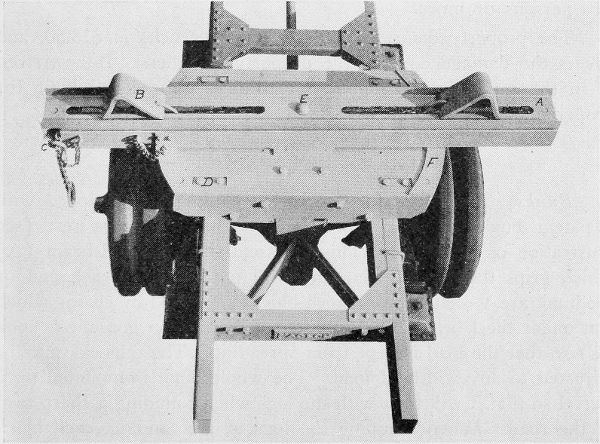
Swivel bunk on truck equipped for motor truck logging. The base on which the bunk rests is made of two heavy timbers about 18 inches by 24 inches in section and 4 feet long, bolted together and clamped to the frame of the truck by means of heavy N-bolts, (D). The bunk is fastened by a king-pin (E) to the base and is free to rotate upon a steel center plate and two side-bearing plates (F).