TRAILERS
Reading edition
The development of the trailer has made motor truck logging practical. Every truck has greater tractive power than it can utilize in the propulsion of the ordinary load. Its limitations are due to a short-bulk carrying capacity and not to any lack of pulling power. The ordinary truck has a draw-bar pull of 2600 pounds. The draw-bar pull per ton of load varies from the minimum of 50 pounds on a level pavement to 250 pounds on a level dirt road, depending upon the character of surface.[5] Twenty pounds of additional pull are required for each degree of gradient. For example, a fore and aft plank road offers a resistance of about 60 pounds pull to a ton of load. If this were located on a seven per cent grade, it would require a 60 pound pull to overcome the load resistance plus seven times twenty or 140 pounds additional pull for the grade, a total of 200 pounds to pull one ton. Dividing 2600, the draw-bar pull of the truck, by 200, the resistance offered by road and grade, gives 13 tons as the load that can be pulled by the truck over this surface and grade. As this must include the weight of the trailer, which when equipped for logging is about three tons, it leaves a total of 10 tons that the truck can pull. This is equivalent to about 3000 feet B. M. of Douglas fir logs, the average load that is hauled. While such an adverse grade as cited in this illustration is avoided if possible with a loaded truck, the illustration will serve to show the pulling capacity of the truck. The hauling of loads of this size would be impossible without the use of the trailer. The normal load, then, may be increased two, three, or even four times, by the use of the trailer, over the maximum load that can be carried by the truck alone.
Objection to the trailer that it tends to shorten the life of the truck is hardly worth consideration. According to a careful analysis it has been estimated that the use of the trailer does not shorten the life of the truck by more than one year, which is of little consequence when the saving due to the size of the load that can be carried is taken into consideration.
Description of the Trailer: The frame of the trailer is constructed of heavy steel channel bars which support the twin bunks used for logging, and for the substructure to carry the body when used for other service. The steel frame is supported by semi-elliptic springs held by shackles similar to those of the truck. The springs rest securely upon the axle, are clamped to it by U-bolts, and are relieved from side stresses by radius rods which connect the axle to the frame.
The trailer is coupled to the truck by a reach which is passed through guides secured to the hounds of the trailer. The latter may slide upon the reach and is held in the desired position with reference to the truck by means of clamps. The hounds are located fore and aft of the axle and are connected to it by steel plates. The square reach is more favored generally by loggers than the round type for the reason that it can be more easily adjusted, particularly the round reach that is cut in the woods, which is irregular and has to be clamped very tightly in order to make it stay in place. Holes bored through the square reach makes the adjustment easy. Combination steel and wood reaches, the sides being of channel iron and the center of wood, are favored by some operators.
The twin bunks of the trailer carry the load in balance upon the axle independent of the reach, thereby relieving the reach of all vertical stress. (See illustration below). The rear bunk is just an ordinary wooden affair designed only to help support the weight of the logs. The front bunk is of the same construction as the one on the truck (described above) and serves to hold the load in place.
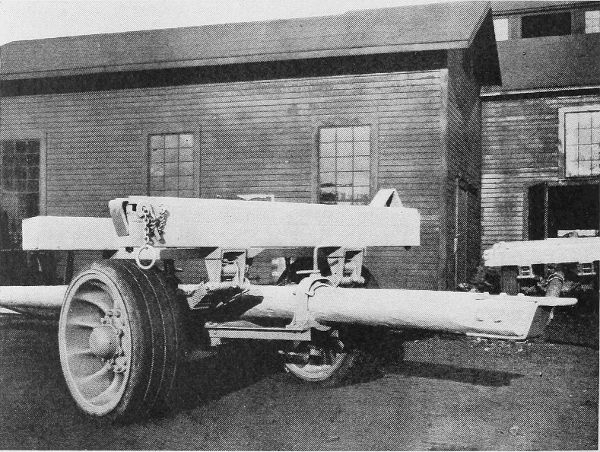
Type of trailer adapted for heavy Pacific coast logging.
The trailer is guided through the reach directly to the axles, thus relieving the springs and frame from side stresses. The springs and their suspension from the frame permit a limited movement of the frame and the load independent of the wheels and axles and vice versa. This enables the wheels to pass over an obstruction or drop into a hole without subjecting the trailer to shocks that would otherwise ensue.
Other types of trailers are used to a limited extent. The trailer described above was evolved by local engineers and is in almost universal use in motor truck logging operations.
Brakes. All trailers should be equipped with brakes when negotiating heavy grades. A device connecting the trailer brakes to the truck permits a ready control from the driver’s seat on the truck. The brake outfit is easily attached to the truck and consists of a ratchet and lever which winds a one-quarter inch cable on a small drum. The cable winds around a second drum which is attached to the frame of the truck about six feet back of the driver’s seat. A third drum in the center of the chassis attached to the shaft of the second drum winds a cable which goes to an equalizing bar just in front of the trailer brake. As the ratchet and drum are tightened, the motion is transmitted through the second and third drums to the equalizing bar. Two arms extend from this bar to roads which when pulled forward, move a bar attached to the road in such a way that the brake band in the inside of the brake shoe is extended against the shoe, applying the brakes evenly to each wheel no matter how uneven the road-bed or how sharp the curve. A spring attached to the reach clamp pulls back the equalizing bar when the brakes are released. A heavy spring on the drum in the center of the shaft on the truck allows for curves so that an even pressure is always maintained.
The use of a trailer equipped with brakes will do away with the numerous devices for snubbing a load of logs down a grade not steeper than twelve per cent. Grades up to this degree of steepness are safe to operate over in dry weather without added braking power if the trailer is properly equipped.
A simple and it is claimed an effective air brake for motor trucks and trailers is now being marketed by an air-brake concern of San Francisco but it has not yet been tried out in the logging industry. “Braking action is secured by means of a diaphragm and pressure plate. The diaphragm is directly connected to the brake-band lever. No air compressor is used in this system. A small air receiver or storage tank takes the spent gases from one of the cylinders by utilizing the outlet afforded by a priming cock. The brakes are applied by a control system mounted on the steering column. By means of a quickly adjusted hose connection, air can be applied to the wheels of the trailer using the control which governs the braking of the truck. The air pressure in the storage tank is automatically maintained by means of an accumulator valve which closes when the tank pressure reaches 150 to 175 pounds. If the tank should be empty at the top of a long grade, sufficient pressure is generated by the compression of the engine to operate the brakes. Opening the throttle to full emergency position will apply maximum braking effect without sliding the wheels.”[6]
This system has not been tried out under the conditions as found in the woods but if it can be made to work satisfactorily it will be a big improvement over the old system as the driver will then have instantaneous control over the load at all times.