Volume 1 / Part 2 — CHAPTER VII.
Reading edition
GENERAL APPLICATION OF THE FOREGOING PRINCIPLES.
We have seen, in the preceding chapters, some proof of what was before asserted, that the truths necessary for deceptive imitation § 1. The different selection of facts consequent on the several aims at imitation or at truth.are not only few, but of the very lowest order. We thus find painters ranging themselves into two great classes; one aiming at the development of the exquisite truths of specific form, refined color, and ethereal space, and content with the clear and impressive suggestion of any of these, by whatsoever means obtained; and the other casting all these aside, to attain those particular truths of tone and chiaroscuro, which may trick the spectator into a belief of reality. The first class, if they have to paint a tree, are intent upon giving the exquisite designs of intersecting undulation in its boughs, the grace of its leafage, the intricacy of its organization, and all those qualities which make it lovely or affecting of its kind. The second endeavor only to make you believe that you are looking at wood. They are totally regardless of truths or beauties of form; a stump is as good as a trunk for all their purposes, so that they can only deceive the eye into the supposition that it is a stump and not canvas.
§ 2. The old masters, as a body, aim only at imitation.
To which of these classes the great body of the old landscape painters belonged, may be partly gathered from the kind of praise which is bestowed upon them by those who admire them most, which either refers to technical matters, dexterity of touch, clever oppositions of color, etc., or is bestowed on the power of the painter to deceive. M. de Marmontel, going into a connoisseur's gallery, pretends to mistake a fine Berghem for a window. This, he says, was affirmed by its possessor to be the greatest praise the picture had ever received. Such is indeed the notion of art which is at the bottom of the veneration usually felt for the old landscape painters; it is of course the palpable, first idea of ignorance; it is the only notion which people unacquainted with art can by any possibility have of its ends; the only test by which people unacquainted with nature can pretend to form anything like judgment of art. It is strange that, with the great historical painters of Italy before them, who had broken so boldly and indignantly from the trammels of this notion, and shaken the very dust of it from their feet, the succeeding landscape painters should have wasted their lives in jugglery: but so it is, and so it will be felt, the more we look into their § 3. What truths they gave.works, that the deception of the senses was the great and first end of all their art. To attain this they paid deep and serious attention to effects of light and tone, and to the exact degree of relief which material objects take against light and atmosphere; and sacrificing every other truth to these, not necessarily, but because they required no others for deception, they succeeded in rendering these particular facts with a fidelity and force which, in the pictures that have come down to us uninjured, are as yet unequalled, and never can be surpassed. They painted their foregrounds with laborious industry, covering them with details so as to render them deceptive to the ordinary eye, regardless of beauty or truth in the details themselves; they painted their trees with careful attention to their pitch of shade against the sky, utterly regardless of all that is beautiful or essential in the anatomy of their foliage and boughs: they painted their distances with exquisite use of transparent color and aerial tone, totally neglectful of all facts and forms which nature uses such color and tone to relieve and adorn. They had neither love of nature, nor feeling of her beauty; they looked for her coldest and most commonplace effects, because they were easiest to imitate; and for her most vulgar forms, because they were most easily to be recognized by the untaught eyes of those whom alone they could hope to please; they did it, like the Pharisee of old, to be seen of men, and they had their reward. They do deceive and delight the unpractised eye; they will to all ages, as long as their colors endure, be the standards of excellence with all, who, ignorant of nature, claim to be thought learned in art. And they will to all ages be, to those who have thorough love and knowledge of the creation which they libel, instructive proofs of the limited number and low character of the truths which are necessary, and the accumulated multitude of pure, broad, bold falsehoods which are admissible in pictures meant only to deceive.
There is of course more or less accuracy of knowledge and execution combined with this aim at effect, according to the industry and precision of eye possessed by the master, and more or less of beauty in the forms selected, according to his natural taste; but both the beauty and truth are sacrificed unhesitatingly where they interfere with the great effort at deception. Claude had, if it had been cultivated, a fine feeling for beauty of form, and is seldom ungraceful in his foliage; but his picture, when examined with reference to essential truth, is one mass of error from beginning to end. Cuyp, on the other hand, could paint close truth of everything, except ground and water, with decision and success, but he has no sense of beauty. Gaspar Poussin, more ignorant of truth than Claude, and almost as dead to beauty as Cuyp, has yet a perception of the feeling and moral truth of nature which often redeems the picture; but yet in all of them, everything that they can do is done for deception, and nothing for the sake or love of what they are painting.
§ 4. The principles of selection adopted by modern artists.
Modern landscape painters have looked at nature with totally different eyes, seeking not for what is easiest to imitate, but for what is most important to tell. Rejecting at once all idea of bona fide imitation, they think only of conveying the impression of nature into the mind of the spectator. And there is, in consequence, a greater sum of valuable, essential, and impressive truth in the works of two or three of our leading modern landscape painters, than in those of all the old masters put together, and of truth too, nearly unmixed with definite or avoidable falsehood; while the unimportant and feeble truths of the old masters are choked with a mass of perpetual defiance of the most authoritative laws of nature.
I do not expect this assertion to be believed at present; it must rest for demonstration on the examination we are about to enter upon; yet, even without reference to any intricate or deep-laid truths, it appears strange to me, that any one familiar with nature, and fond of her, should not grow weary and sick § 5. General feeling of Claude, Salvator, and G. Poussin, contrasted with the freedom and vastness of nature.at heart among the melancholy and monotonous transcripts of her which alone can be received from the old school of art. A man accustomed to the broad, wild seashore, with its bright breakers, and free winds, and sounding rocks, and eternal sensation of tameless power, can scarcely but be angered when Claude bids him stand still on some paltry, chipped and chiselled quay with porters and wheelbarrows running against him, to watch a weak, rippling bound and barriered water, that has not strength enough in one of its waves to upset the flower-pots on the wall, or even to fling one jet of spray over the confining stone. A man accustomed to the strength and glory of God's mountains, with their soaring and radiant pinnacles, and surging sweeps of measureless distance, kingdoms in their valleys, and climates upon their crests, can scarcely but be angered when Salvator bids him stand still under some contemptible fragment of splintery crag, which an Alpine snow-wreath would smother in its first swell, with a stunted bush or two growing out of it, and a volume of manufactory smoke for a sky. A man accustomed to the grace and infinity of nature's foliage, with every vista a cathedral, and every bough a revelation, can scarcely but be angered when Poussin mocks him with a black round mass of impenetrable paint, diverging into feathers instead of leaves, and supported on a stick instead of a trunk. The fact is, there is one thing wanting in all the doing of these men, and that is the very virtue by which the work of human mind chiefly rises above that of the Daguerreotype or Calotype, or any other mechanical means that ever have been or may be invented, Love: There is no evidence of their ever having gone to nature with any thirst, or received from her such emotion as could make them, even for an instant, lose sight of themselves; there is in them neither earnestness nor humility; there is no simple or honest record of any single truth; none of the plain words nor straight efforts that men speak and make when they once feel.
Nor is it only by the professed landscape painters that the great verities of the material world are betrayed: Grand as are the motives of landscape in the works of the earlier and mightier men, there is yet in them nothing approaching to a general § 6. Inadequacy of the landscape of Titian and Tintoret.view nor complete rendering of natural phenomena; not that they are to be blamed for this; for they took out of nature that which was fit for their purpose, and their mission was to do no more; but we must be cautious to distinguish that imaginative abstraction of landscape which alone we find in them, from the entire statement of truth which has been attempted by the moderns. I have said in the chapter on symmetry in the second volume, that all landscape grandeur vanishes before that of Titian and Tintoret; and this is true of whatever these two giants touched;—but they touched little. A few level flakes of chestnut foliage; a blue abstraction of hill forms from Cadore or the Euganeans; a grand mass or two of glowing ground and mighty herbage, and a few burning fields of quiet cloud were all they needed; there is evidence of Tintoret's having felt more than this, but it occurs only in secondary fragments of rock, cloud, or pine, hardly noticed among the accumulated interest of his human subject. From the window of Titian's house at Venice, the chain of the Tyrolese Alps is seen lifted in spectral power above the tufted plain of Treviso; every dawn that reddens the towers of Murano lights also a line of pyramidal fires along that colossal ridge; but there is, so far as I know, no evidence in any of the master's works of his ever having beheld, much less felt, the majesty of their burning. The dark firmament and saddened twilight of Tintoret are sufficient for their end; but the sun never plunges behind San Giorgio in Aliga without such retinue of radiant cloud, such rest of zoned light on the green lagoon, as never received image from his hand. More than this, of that which they loved and rendered much is rendered conventionally; by noble conventionalities indeed, but such nevertheless as would be inexcusable if the landscape became the principal subject instead of an accompaniment. I will instance only the San Pietro Martire, which, if not the most perfect, is at least the most popular of Titian's landscapes; in which, to obtain light on the flesh of the near figures the sky is made as dark as deep sea, the mountains are laid in with violent and impossible blue, except one of them on the left, which, to connect the distant light with the foreground, is thrown into light relief, unexplained by its materials, unlikely in its position, and in its degree impossible under any circumstances.
§ 7. Causes of its want of influence on subsequent schools.
I do not instance these as faults in the picture: there are no works of very powerful color which are free from conventionality concentrated or diffused, daring or disguised; but as the conventionality of this whole picture is mainly thrown into the landscape, it is necessary, while we acknowledge the virtue of this distance as a part of the great composition, to be on our guard against the license it assumes and the attractiveness of its overcharged color. Fragments of far purer truth occur in the works of Tintoret; and in the drawing of foliage, whether rapid or elaborate, of masses or details, the Venetian painters, taken as a body, may be considered almost faultless models. But the whole field of what they have done is so narrow, and therein is so much of what is only relatively right, and in itself false or imperfect, that the young and inexperienced painter could run no greater risk than the too early taking them for teachers; and to the general spectator their landscape is valuable rather as a means of peculiar and solemn emotion than as ministering to, or inspiring the universal love of nature. Hence while men of serious mind, especially those whose pursuits have brought them into continued relations with the peopled rather than the lonely world, will always look to the Venetian painters as having touched those simple chords of landscape harmony which are most in unison with earnest and melancholy feeling; those whose philosophy is more cheerful and more extended, as having been trained and colored among simple and solitary nature, will seek for a wider and more systematic circle of teaching: they may grant that the barred horizontal gloom of the Titian sky, and the massy leaves of the Titian forest are among the most sublime of the conceivable forms of material things; but they know that the virtue of these very forms is to be learned only by right comparison of them with the cheerfulness, fulness and comparative inquietness of other hours and scenes; that they are not intended for the continual food, but the occasional soothing of the human heart; that there is a lesson of not less value in its place, though of less concluding and sealing authority, in every one of the more humble phases of material things: and that there are some lessons of equal or greater authority which these masters neither taught nor received. And until the school of modern landscape arose Art had never noted the links of this mighty chain; it mattered not that a fragment lay here and there, no heavenly lightning could descend by it; the landscape of the Venetians was without effect on any contemporary in subsequent schools; it still remains on the continent as useless as if it had never existed; and at this moment German and Italian landscapes, of which no words are scornful enough to befit the utter degradation, hang in the Venetian Academy in the next room to the Desert of Titian and the Paradise of Tintoret.[6]
§ 8. The value of inferior works of art how to be estimated.
That then which I would have the reader inquire respecting every work of art of undetermined merit submitted to his judgment, is not whether it be a work of especial grandeur, importance, or power; but whether it have any virtue or substance as a link in this chain of truth, whether it have recorded or interpreted anything before unknown, whether it have added one single stone to our heaven-pointing pyramid, cut away one dark bough, or levelled one rugged hillock in our path. This, if it be an honest work of art, it must have done, for no man ever yet worked honestly without giving some such help to his race. God appoints to every one of his creatures a separate mission, and if they discharge it honorably, if they quit themselves like men and faithfully follow that light which is in them, withdrawing from it all cold and quenching influence, there will assuredly come of it such burning as, in its appointed mode and measure, shall shine before men, and be of service constant and holy. Degrees infinite of lustre there must always be, but the weakest among us has a gift, however seemingly trivial, which is peculiar to him, and which worthily used will be a gift also to his race forever—
"Fool not," says George Herbert,
"For all may have, If they dare choose, a glorious life or grave."
If, on the contrary, there be nothing of this freshness achieved, if there be neither purpose nor fidelity in what is done, if it be an envious or powerless imitation of other men's labors, if it be a display of mere manual dexterity or curious manufacture, or if in any other mode it show itself as having its origin in vanity,—Cast it out. It matters not what powers of mind may have been concerned or corrupted in it, all have lost their savor, it is worse than worthless;—perilous—Cast it out.
Works of art are indeed always of mixed kind, their honesty being more or less corrupted by the various weaknesses of the painter, by his vanity, his idleness, or his cowardice; (the fear of doing right has far more influence on art than is commonly thought,) that only is altogether to be rejected which is altogether vain, idle, and cowardly. Of the rest the rank is to be estimated rather by the purity of their metal than the coined value of it.
§ 9. Religious landscape of Italy. The admirableness of its completion.
Keeping these principles in view, let us endeavor to obtain something like a general view of the assistance which has been rendered to our study of nature by the various occurrences of landscape in elder art, and by the more exclusively directed labors of modern schools.
To the ideal landscape of the early religious painters of Italy I have alluded in the concluding chapter of the second volume. It is absolutely right and beautiful in its peculiar application; but its grasp of nature is narrow and its treatment in most respects too severe and conventional to form a profitable example when the landscape is to be alone the subject of thought. The great virtue of it is its entire, exquisite, and humble realization of those objects it selects; in this respect differing from such German imitations of it as I have met with, that there is no effort of any fanciful or ornamental modifications, but loving fidelity to the thing studied. The foreground plants are usually neither exaggerated nor stiffened; they do not form arches or frames or borders; their grace is unconfined, their simplicity undestroyed. Cima da Conegliano, in his picture in the church of the Madonna dell' Orto at Venice, has given us the oak, the fig, the beautiful "Erba della Madonna" on the wall, precisely such a bunch of it as may be seen growing at this day on the marble steps of that very church; ivy and other creepers, and a strawberry plant in the foreground, with a blossom and a berry just set, and one half ripe and one ripe, all patiently and innocently painted from the real thing, and therefore most divine. Fra Angelico's use of the oxalis acetosella is as faithful in representation as touching in feeling.[7] The ferns that grow on the walls of Fiesole may be seen in their simple verity on the architecture of Ghirlandajo. The rose, the myrtle, and the lily, the olive and orange, pomegranate and vine, have received their fairest portraiture where they bear a sacred character; even the common plantains and mallows of the waysides are touched with deep reverence by Raffaelle; and indeed for the perfect treatment of details of this kind, treatment as delicate and affectionate as it is elevated and manly, it is to the works of these schools alone that we can refer. And on this their peculiar excellence I should the more earnestly insist, because it is of a kind altogether neglected by the English school, and with most unfortunate result, many of our best painters missing their deserved rank solely from the want of it, as Gainsborough; and all being more or less checked in their progress or vulgarized in their aim.
§ 10. Finish, and the want of it, how right and how wrong.
It is a misfortune for all honest critics, that hardly any quality of art is independently to be praised, and without reference to the motive from which it resulted, and the place in which it appears; so that no principle can be simply enforced but it shall seem to countenance a vice; while the work of qualification and explanation both weakens the force of what is said, and is not perhaps always likely to be with patience received: so also those who desire to misunderstand or to oppose have it always in their power to become obtuse listeners or specious opponents. Thus I hardly dare insist upon the virtue of completion, lest I should be supposed a defender of Wouvermans or Gerard Dow; neither can I adequately praise the power of Tintoret, without fearing to be thought adverse to Holbein or Perugino. The fact is, that both finish and impetuosity, specific minuteness, or large abstraction, may be the signs of passion, or of its reverse; may result from affection or indifference, intellect or dulness. Some men finish from intense love of the beautiful in the smallest parts of what they do; others in pure incapability of comprehending anything but parts; others to show their dexterity with the brush, and prove expenditure of time. Some are impetuous and bold in their handling, from having great thoughts to express which are independent of detail; others because they have bad taste or have been badly taught; others from vanity, and others from indolence. (Compare Vol. II. Chap. IX. § 8.) Now both the finish and incompletion are right where they are the signs of passion or of thought, and both are wrong, and I think the finish the more contemptible of the two, when they cease to be so. The modern Italians will paint every leaf of a laurel or rose-bush without the slightest feeling of their beauty or character; and without showing one spark of intellect or affection from beginning to end. Anything is better than this; and yet the very highest schools do the same thing, or nearly so, but with totally different motives and perceptions, and the result is divine. On the whole, I conceive that the extremes of good and evil lie with the finishers, and that whatever glorious power we may admit in men like Tintoret, whatever attractiveness of method to Rubens, Rembrandt, or, though in far less degree, our own Reynolds, still the thoroughly great men are those who have done everything thoroughly, and who, in a word, have never despised anything, however small, of God's making. And this is the chief fault of our English landscapists, that they have not the intense all-observing penetration of well-balanced mind; they have not, except in one or two instances, anything of that feeling which Wordsworth shows in the following lines:—
"So fair, so sweet, withal so sensitive;— Would that the little flowers were born to live Conscious of half the pleasure which they give. That to this mountain daisy's self were known The beauty of its star-shaped shadow, thrown On the smooth surface of this naked stone."
That is a little bit of good, downright, foreground painting—no mistake about it; daisy, and shadow, and stone texture and all. Our painters must come to this before they have done their duty; and yet, on the other hand, let them beware of finishing, for the sake of finish, all over their picture. The ground is not to be all over daisies, nor is every daisy to have its star-shaped shadow; there is as much finish in the right concealment of things as in the right exhibition of them; and while I demand this amount of specific character where nature shows it, I demand equal fidelity to her where she conceals it. To paint mist rightly, space rightly, and light rightly, it may be often necessary to paint nothing else rightly, but the rule is simple for all that; if the artist is painting something that he knows and loves, as he knows it because he loves it, whether it be the fair strawberry of Cima, or the clear sky of Francia, or the blazing incomprehensible mist of Turner, he is all right; but the moment he does anything as he thinks it ought to be, because he does not care about it, he is all wrong. He has only to ask himself whether he cares for anything except himself; so far as he does he will make a good picture; so far as he thinks of himself a vile one. This is the root of the viciousness of the whole French school. Industry they have, learning they have, power they have, feeling they have, yet not so much feeling as ever to force them to forget themselves even for a moment; the ruling motive is invariably vanity, and the picture therefore an abortion.
§ 11. The open skies of the religious schools, how valuable. Mountain drawing of Masaccio. Landscape of the Bellinis and Giorgione.
Returning to the pictures of the religious schools, we find that their open skies are also of the highest value. Their preciousness is such that no subsequent schools can by comparison be said to have painted sky at all, but only clouds, or mist, or blue canopies. The golden sky of Marco Basaiti in the Academy of Venice altogether overpowers and renders valueless that of Titian beside it. Those of Francia in the gallery of Bologna are even more wonderful, because cooler in tone and behind figures in full light. The touches of white light in the horizon of Angelico's Last Judgment are felt and wrought with equal truth. The dignified and simple forms of cloud in repose are often by these painters sublimely expressed, but of changeful cloud form they show no examples. The architecture, mountains, and water of these distances are commonly conventional; motives are to be found in them of the highest beauty, and especially remarkable for quantity and meaning of incident; but they can only be studied or accepted in the particular feeling that produced them. It may generally be observed that whatever has been the result of strong emotion is ill seen unless through the medium of such emotion, and will lead to conclusions utterly false and perilous, if it be made a subject of cold-hearted observance, or an object of systematic imitation. One piece of genuine mountain drawing, however, occurs in the landscape of Masaccio's Tribute Money. It is impossible to say what strange results might have taken place in this particular field of art, or how suddenly a great school of landscape might have arisen, had the life of this great painter been prolonged. Of this particular fresco I shall have much to say hereafter. The two brothers Bellini gave a marked and vigorous impulse to the landscape of Venice, of Gentile's architecture I shall speak presently. Giovanni's, though in style less interesting and in place less prominent, occurring chiefly as a kind of frame to his pictures, connecting them with the architecture of the churches for which they were intended, is in refinement of realization, I suppose, quite unrivalled, especially in passages requiring pure gradation, as the hollows of vaultings. That of Veronese would look ghostly beside it; that of Titian lightless. His landscape is occasionally quaint and strange like Giorgione's, and as fine in color, as that behind the Madonna in the Brera gallery at Milan; but a more truthful fragment occurs in the picture in San Francesco della Vigna at Venice; and in the picture of St. Jerome in the church of San Grisostomo, the landscape is as perfect and beautiful as any background may legitimately be, and finer, as far as it goes, than anything of Titian's. It is remarkable for the absolute truth of its sky, whose blue, clear as crystal, and though deep in tone bright as the open air, is gradated to the horizon with a cautiousness and finish almost inconceivable; and to obtain light at the horizon without contradicting the system of chiaroscuro adopted in the figures which are lighted from the right hand, it is barred across with some glowing white cirri which, in their turn, are opposed by a single dark horizontal line of lower cloud; and to throw the whole farther back, there is a wreath of rain cloud of warmer color floating above the mountains, lighted on its under edge, whose faithfulness to nature, both in hue and in its light and shattering form, is altogether exemplary; the wandering of the light among the hills is equally studied, and the whole is crowned by the grand realization of the leaves of the fig-tree alluded to (Vol. II. Part III. Chap. 5,) as well as of the herbage upon the rocks. Considering that with all this care and completeness in the background, there is nothing that is not of meaning and necessity in reference to the figures, and that in the figures themselves the dignity and heavenliness of the highest religious painters are combined with a force and purity of color, greater I think than Titian's, it is a work which may be set before the young artist as in every respect a nearly faultless guide. Giorgione's landscape is inventive and solemn, but owing to the rarity even of his nominal works I dare not speak of it in general terms. It is certainly conventional, and is rather, I imagine, to be studied for its color and its motives than its details.
§ 12. Landscape of Titian and Tintoret.
Of Titian and Tintoret I have spoken already. The latter is every way the greater master, never indulging in the exaggerated color of Titian, and attaining far more perfect light; his grasp of nature is more extensive, and his view of her more imaginative, (incidental notices of his landscape will be found in the chapter on Imagination penetrative, of the second volume,) but he is usually too impatient to carry his thoughts as far out, or to realize with as much substantiality as Titian. In the St. Jerome of the latter in the gallery of the Brera, there is a superb example of the modes in which the objects of landscape may be either suggested or elaborated according to their place and claim. The larger features of the ground, foliage, and drapery, as well as the lion in the lower angle, are executed with a slightness which admits not of close examination, and which, if not in shade, would be offensive to the generality of observers. But on the rock above the lion, where it turns towards the light, and where the eye is intended to dwell, there is a wreath of ivy of which every leaf is separately drawn with the greatest accuracy and care, and beside it a lizard, studied with equal earnestness, yet always with that right grandeur of manner to which I have alluded in the preface. Tintoret seldom reaches or attempts the elaboration in substance and color of these objects, but he is even more truth-telling and certain in his rendering of all the great characters of specific form, and as the painter of Space he stands altogether alone among dead masters; being the first who introduced the slightness and confusion of touch which are expressive of the effects of luminous objects seen through large spaces of air, and the principles of aerial color which have been since carried out in other fields by Turner. I conceive him to be the most powerful painter whom the world has seen, and that he was prevented from being also the most perfect, partly by untoward circumstances in his position and education, partly by the very fulness and impetuosity of his own mind, partly by the want of religious feeling and its accompanying perception of beauty; for his noble treatment of religious subject, of which I have given several examples in the third part, appears to be the result only of that grasp which a great and well-toned intellect necessarily takes of any subject submitted to it, and is wanting in the signs of the more withdrawn and sacred sympathies.
But whatever advances were made by Tintoret in modes of artistical treatment, he cannot be considered as having enlarged the sphere of landscape conception. He took no cognizance even of the materials and motives, so singularly rich in color, which were forever around him in his own Venice. All portions of Venetian scenery introduced by him are treated conventionally and carelessly; the architectural characters lost altogether, the sea distinguished from the sky only by a darker green, while of the sky itself only those forms were employed by him which had been repeated again and again for centuries, though in less tangibility and completion. Of mountain scenery he has left, I believe, no example so far carried as that of John Bellini above instanced.
§ 13. Schools of Florence, Milan, and Bologna.
The Florentine and Ambrian schools supply us with no examples of landscape, except that introduced by their earliest masters, gradually overwhelmed under renaissance architecture.
Leonardo's landscape has been of unfortunate effect on art, so far as it has had effect at all. In realization of detail he verges on the ornamental, in his rock outlines he has all the deficiencies and little of the feeling of the earlier men. Behind the "Sacrifice for the Friends" of Giotto at Pisa, there is a sweet piece of rock incident, a little fountain breaking out at the mountain foot, and trickling away, its course marked by branches of reeds, the latter formal enough certainly, and always in triplets, but still with a sense of nature pervading the whole which is utterly wanting to the rocks of Leonardo in the Holy Family in the Louvre. The latter are grotesque without being ideal, and extraordinary without being impressive. The sketch in the Uffizii of Florence has some fine foliage, and there is of course a certain virtue in all the work of a man like Leonardo which I would not depreciate, but our admiration of it in this particular field must be qualified, and our following cautious.
No advances were made in landscape, so far as I know, after the time of Tintoret; the power of art ebbed gradually away from the derivative schools; various degrees of cleverness or feeling being manifested in more or less brilliant conventionalism. I once supposed there was some life in the landscape of Domenichino, but in this I must have been wrong. The man who painted the Madonna del Rosario and Martyrdom of St. Agnes in the gallery of Bologna, is palpably incapable of doing anything good, great, or right in any field, way, or kind, whatsoever.[8]
§ 14. Claude, Salvator, and the Poussins.
Though, however, at this period the general grasp of the schools was perpetually contracting, a gift was given to the world by Claude, for which we are perhaps hardly enough grateful, owing to the very frequency of our after enjoyment of it. He set the sun in heaven, and was, I suppose, the first who attempted anything like the realization of actual sunshine in misty air. He gives the first example of the study of nature for her own sake, and allowing for the unfortunate circumstances of his education, and for his evident inferiority of intellect, more could hardly have been expected from him. His false taste, forced composition, and ignorant rendering of detail have perhaps been of more detriment to art than the gift he gave was of advantage. The character of his own mind is singular; I know of no other instance of a man's working from nature continually with the desire of being true, and never attaining the power of drawing so much as a bough of a tree rightly. Salvator, a man originally endowed with far higher power of mind than Claude, was altogether unfaithful to his mission, and has left us, I believe, no gift. Everything that he did is evidently for the sake of exhibiting his own dexterity; there is no love of any kind for anything; his choice of landscape features is dictated by no delight in the sublime, but by mere animal restlessness or ferocity, guided by an imaginative power of which he could not altogether deprive himself. He has done nothing which others have not done better, or which it would not have been better not to have done; in nature, he mistakes distortion for energy, and savageness for sublimity; in man, mendicity for sanctity, and conspiracy for heroism.
The landscape of Nicolo Poussin shows much power, and is usually composed and elaborated on right principles, (compare preface to second edition,) but I am aware of nothing that it has attained of new or peculiar excellence; it is a graceful mixture of qualities to be found in other masters in higher degrees. In finish it is inferior to Leonardo's, in invention to Giorgione's, in truth to Titian's, in grace to Raffaelle's. The landscapes of Gaspar have serious feeling and often valuable and solemn color; virtueless otherwise, they are full of the most degraded mannerism, and I believe the admiration of them to have been productive of extensive evil among recent schools.
§ 15. German and Flemish landscape.
The development of landscape north of the Alps, presents us with the same general phases under modifications dependent partly on less intensity of feeling, partly on diminished availableness of landscape material. That of the religious painters is treated with the same affectionate completion; but exuberance of fancy sometimes diminishes the influence of the imagination, and the absence of the Italian force of passion admits of more patient and somewhat less intellectual elaboration. A morbid habit of mind is evident in many, seeming to lose sight of the balance and relations of things, so as to become intense in trifles, gloomily minute, as in Albert Durer; and this mingled with a feverish operation of the fancy, which appears to result from certain habitual conditions of bodily health rather than of mental culture, (and of which the sickness without the power is eminently characteristic of the modern Germans;) but with all this there are virtues of the very highest order in those schools, and I regret that my knowledge is insufficient to admit of my giving any detailed account of them.
In the landscape of Rembrandt and Rubens, we have the northern parallel to the power of the Venetians. Among the etchings and drawings of Rembrandt, landscape thoughts may be found not unworthy of Titian, and studies from nature of sublime fidelity; but his system of chiaroscuro was inconsistent with the gladness, and his peculiar modes of feeling with the grace, of nature; nor from my present knowledge can I name any work on canvas in which he has carried out the dignity of his etched conceptions, or exhibited any perceptiveness of new truths.
Not so Rubens, who perhaps furnishes us with the first instances of complete unconventional unaffected landscape. His treatment is healthy, manly, and rational, not very affectionate, yet often condescending to minute and multitudinous detail; always as far as it goes pure, forcible, and refreshing, consummate in composition, and marvellous in color. In the Pitti palace, the best of its two Rubens landscapes has been placed near a characteristic and highly-finished Titian, the marriage of St. Catherine. But for the grandeur of line and solemn feeling in the flock of sheep, and the figures of the latter work, I doubt if all its glow and depth of tone could support its overcharged green and blue against the open breezy sunshine of the Fleming. I do not mean to rank the art of Rubens with that of Titian, but it is always to be remembered that Titian hardly ever paints sunshine, but a certain opalescent twilight which has as much of human emotion as of imitative truth in it,—
"The clouds that gather round the setting sun Do take a sober coloring from an eye That hath kept watch o'er man's mortality:"
and that art of this kind must always be liable to some appearance of failure when compared with a less pathetic statement of facts.
It is to be noted, however, that the licenses taken by Rubens in particular instances are as bold as his general statements are sincere. In the landscape just instanced the horizon is an oblique line; in the Sunset of our own gallery many of the shadows fall at right angles to the light; and in a picture in the Dulwich gallery a rainbow is seen by the spectator at the side of the sun.
These bold and frank licenses are not to be considered as detracting from the rank of the painter; they are usually characteristic of those minds whose grasp of nature is so certain and extensive as to enable them fearlessly to sacrifice a truth of actuality to a truth of feeling. Yet the young artist must keep in mind that the painter's greatness consists not in his taking, but in his atoning for them.
§ 16. The lower Dutch schools.
Among the professed landscapists of the Dutch school, we find much dexterous imitation of certain kinds of nature, remarkable usually for its persevering rejection of whatever is great, valuable, or affecting in the object studied. Where, however, they show real desire to paint what they saw as far as they saw it, there is of course much in them that is instructive, as in Cuyp and in the etchings of Waterloo, which have even very sweet and genuine feeling; and so in some of their architectural painters. But the object of the great body of them is merely to display manual dexterities of one kind or another, and their effect on the public mind is so totally for evil, that though I do not deny the advantage an artist of real judgment may derive from the study of some of them, I conceive the best patronage that any monarch could possibly bestow upon the arts, would be to collect the whole body of them into a grand gallery and burn it to the ground.
§ 17. English school, Wilson and Gainsborough.
Passing to the English school, we find a connecting link between them and the Italians formed by Richard Wilson. Had this artist studied under favorable circumstances, there is evidence of his having possessed power enough to produce an original picture; but, corrupted by study of the Poussins, and gathering his materials chiefly in their field, the district about Rome—a district especially unfavorable, as exhibiting no pure or healthy nature, but a diseased and overgrown Flora among half-developed volcanic rocks, loose calcareous concretions, and mouldering wrecks of buildings—and whose spirit, I conceive, to be especially opposed to the natural tone of the English mind, his originality was altogether overpowered, and, though he paints in a manly way and occasionally reaches exquisite tones of color, as in the small and very precious picture belonging to Mr. Rogers, and sometimes manifests some freshness of feeling, as in the Villa of Mæcenas of our National Gallery, yet his pictures are in general mere diluted adaptations from Poussin and Salvator, without the dignity of the one or the fire of the other.
Not so Gainsborough, a great name his whether of the English or any other school. The greatest colorist since Rubens, and the last, I think, of legitimate colorists; that is to say, of those who were fully acquainted with the power of their material; pure in his English feeling, profound in his seriousness, graceful in his gayety, there are nevertheless certain deductions to be made from his worthiness which yet I dread to make, because my knowledge of his landscape works is not extensive enough to justify me in speaking of them decisively; but this is to be noted of all that I know, that they are rather motives of feeling and color than earnest studies; that their execution is in some degree mannered, and always hasty; that they are altogether wanting in the affectionate detail of which I have already spoken; and that their color is in some measure dependent on a bituminous brown and conventional green which have more of science than of truth in them. These faults may be sufficiently noted in the magnificent picture presented by him to the Royal Academy, and tested by a comparison of it with the Turner (Llanberis,) in the same room. Nothing can be more attractively luminous or aerial than the distance of the Gainsborough, nothing more bold or inventive than the forms of its crags and the diffusion of the broad distant light upon them, where a vulgar artist would have thrown them into dark contrast. But it will be found that the light of the distance is brought out by a violent exaggeration of the gloom in the valley; that the forms of the green trees which bear the chief light are careless and ineffective; that the markings of the crags are equally hasty; and that no object in the foreground has realization enough to enable the eye to rest upon it. The Turner, a much feebler picture in its first impression, and altogether inferior in the quality and value of its individual hues, will yet be found to the end more forcible, because unexaggerated; its gloom is moderate and aerial, its light deep in tone, its color entirely unconventional, and the forms of its rocks studied with the most devoted care. With Gainsborough terminates the series of painters connected with the elder schools. By whom, among those yet living or lately lost, the impulse was first given to modern landscape, I attempt not to decide. Such questions are rather invidious than interesting; the particular tone or direction of any school seems to me always to have resulted rather from certain phases of national character, limited to particular periods, than from individual teaching; and, especially among moderns, what has been good in each master has been commonly original.
§ 18. Constable, Calcott.
I have already alluded to the simplicity and earnestness of the mind of Constable; to its vigorous rupture with school laws, and to its unfortunate error on the opposite side. Unteachableness seems to have been a main feature of his character, and there is corresponding want of veneration in the way he approaches nature herself. His early education and associations were also against him; they induced in him a morbid preference of subjects of a low order. I have never seen any work of his in which there were any signs of his being able to draw, and hence even the most necessary details are painted by him inefficiently. His works are also eminently wanting both in rest and refinement, and Fuseli's jesting compliment is too true; for the showery weather in which the artist delights, misses alike the majesty of storm and the loveliness of calm weather: it is great-coat weather, and nothing more. There is strange want of depth in the mind which has no pleasure in sunbeams but when piercing painfully through clouds, nor in foliage but when shaken by the wind, nor in light itself but when flickering, glistening, restless, and feeble. Yet, with all these deductions, his works are to be deeply respected as thoroughly original, thoroughly honest, free from affectation, manly in manner, frequently successful in cool color, and especially realizing certain motives of English scenery with perhaps as much affection as such scenery, unless when regarded through media of feeling derived from higher sources, is calculated to inspire.
On the works of Calcott, high as his reputation stands, I should look with far less respect; I see not any preference or affection in the artist; there is no tendency in him with which we can sympathize, nor does there appear any sign of aspiration, effort, or enjoyment in any one of his works. He appears to have completed them methodically, to have been content with them when completed, to have thought them good, legitimate, regular pictures; perhaps in some respects better than nature. He painted everything tolerably, and nothing excellently; he has given us no gift, struck for us no light, and though he has produced one or two valuable works, of which the finest I know is the Marine in the possession of Sir J. Swinburne, they will, I believe, in future have no place among those considered representative of the English school.
§ 19. Peculiar tendency of recent landscape.
Throughout the range of elder art it will be remembered we have found no instance of the faithful painting of mountain scenery, except in a faded background of Masaccio's: nothing more than rocky eminences, undulating hills, or fantastic crags, and even these treated altogether under typical forms. The more specific study of mountains seems to have coincided with the most dexterous practice of water-color; but it admits of doubt whether the choice of subject has been directed by the vehicle, or whether, as I rather think, the tendency of national feeling has been followed in the use of the most appropriate means. Something is to be attributed to the increased demand for slighter works of art, and much to the sense of the quality of objects now called picturesque, which appears to be exclusively of modern origin. From what feeling the character of middle-age architecture and costume arose, or with what kind of affection their forms were regarded by the inventors, I am utterly unable to guess; but of this I think we may be assured, that the natural instinct and child-like wisdom of those days were altogether different from the modern feeling, which appears to have taken its origin in the absence of such objects, and to be based rather on the strangeness of their occurrence than on any real affection for them; and which is certainly so shallow and ineffective as to be instantly and always sacrificed by the majority to fashion, comfort, or economy. Yet I trust that there is a healthy though feeble love of nature mingled with it, nature pure, separate, felicitous, which is also peculiar to the moderns; and as signs of this feeling, or ministers to it, I look with veneration upon many works which, in a technical point of view, are of minor importance.
§ 20. G. Robson, D. Cox. False use of the term "style."
I have been myself indebted for much teaching and more delight to those of the late G. Robson. Weaknesses there are in them manifold, much bad drawing, much forced color, much over finish, little of what artists call composition; but there is thorough affection for the thing drawn; they are serious and quiet in the highest degree, certain qualities of atmosphere and texture in them have never been excelled, and certain facts of mountain scenery never but by them expressed, as, for instance, the stillness and depth of the mountain tarns, with the reversed imagery of their darkness signed across by the soft lines of faintly touching winds; the solemn flush of the brown fern and glowing heath under evening light; the purple mass of mountains far removed, seen against clear still twilight. With equal gratitude I look to the drawings of David Cox, which, in spite of their loose and seemingly careless execution, are not less serious in their meaning, nor less important in their truth. I must, however, in reviewing those modern works in which certain modes of execution are particularly manifested, insist especially on this general principle, applicable to all times of art; that what is usually called the style or manner of an artist is, in all good art, nothing but the best means of getting at the particular truth which the artist wanted; it is not a mode peculiar to himself of getting at the same truths as other men, but the only mode of getting the particular facts he desires, and which mode, if others had desired to express those facts, they also must have adopted. All habits of execution persisted in under no such necessity, but because the artist has invented them, or desires to show his dexterity in them, are utterly base; for every good painter finds so much difficulty in reaching the end he sees and desires, that he has no time nor power left for playing tricks on the road to it; he catches at the easiest and best means he can get; it is possible that such means may be singular, and then it will be said that his style is strange; but it is not a style at all, it is the saying of a particular thing in the only way in which it possibly can be said. Thus the reed pen outline and peculiar touch of Prout, which are frequently considered as mere manner, are in fact the only means of expressing the crumbling character of stone which the artist loves and desires. That character never has been expressed except by him, nor will it ever be expressed except by his means. And it is of the greatest importance to distinguish this kind of necessary and virtuous manner from the conventional manners very frequent in derivative schools, and always utterly to be contemned, wherein an artist, desiring nothing and feeling nothing, executes everything in his own particular mode, and teaches emulous scholars how to do with difficulty what might have been done with ease. It is true that there are sometimes instances in which great masters have employed different means of getting at the same end, but in these cases their choice has been always of those which to them appeared the shortest and most complete; their practice has never been prescribed by affectation or continued from habit, except so far as must be expected from such weakness as is common to all men; from hands that necessarily do most readily what they are most accustomed to do, and minds always liable to prescribe to the hands that which they can do most readily.
The recollection of this will keep us from being offended with the loose and blotted handling of David Cox. There is no other means by which his object could be attained. The looseness, coolness, and moisture of his herbage; the rustling crumpled freshness of his broad-leaved weeds; the play of pleasant light across his deep heathered moor or plashing sand; the melting of fragments of white mist into the dropping blue above; all this has not been fully recorded except by him, and what there is of accidental in his mode of reaching it, answers gracefully to the accidental part of nature herself. Yet he is capable of more than this, and if he suffers himself uniformly to paint beneath his capability, that which began in feeling must necessarily end in manner. He paints too many small pictures, and perhaps has of late permitted his peculiar execution to be more manifest than is necessary. Of this, he is himself the best judge. For almost all faults of this kind the public are answerable, not the painter. I have alluded to one of his grander works—such as I should wish always to see him paint—in the preface; another, I think still finer, a red sunset on distant hills, almost unequalled for truth and power of color, was painted by him several years ago, and remains, I believe, in his own possession.
§ 21. Copley Fielding. Phenomena of distant color.
The deserved popularity of Copley Fielding has rendered it less necessary for me to allude frequently to his works in the following pages than it would otherwise have been, more especially as my own sympathies and enjoyments are so entirely directed in the channel which his art has taken, that I am afraid of trusting them too far. Yet I may, perhaps, be permitted to speak of myself so far as I suppose my own feelings to be representative of those of a class; and I suppose that there are many who, like myself, at some period of their life have derived more intense and healthy pleasure from the works of this painter than of any other whatsoever; healthy, because always based on his faithful and simple rendering of nature, and that of very lovely and impressive nature, altogether freed from coarseness, violence, or vulgarity. Various references to that which he has attained will be found subsequently: what I am now about to say respecting what he has not attained, is not in depreciation of what he has accomplished, but in regret at his suffering powers of a high order to remain in any measure dormant.
He indulges himself too much in the use of crude color. Pure cobalt, violent rose, and purple, are of frequent occurrence in his distances; pure siennas and other browns in his foregrounds, and that not as expressive of lighted but of local color. The reader will find in the following chapters that I am no advocate for subdued coloring; but crude color is not bright color, and there was never a noble or brilliant work of color yet produced, whose real form did not depend on the subduing of its tints rather than the elevation of them.
It is perhaps one of the most difficult lessons to learn in art, that the warm colors of distance, even the most glowing, are subdued by the air so as in no wise to resemble the same color seen on a foreground object; so that the rose of sunset on clouds or mountains has a gray in it which distinguishes it from the rose color of the leaf of a flower; and the mingling of this gray of distance, without in the slightest degree taking away the expression of the intense and perfect purity of the color in and by itself, is perhaps the last attainment of the great landscape colorist. In the same way the blue of distance, however intense, is not the blue of a bright blue flower, and it is not distinguished from it by different texture merely, but by a certain intermixture and under current of warm color, which is altogether wanting in many of the blues of Fielding's distances; and so of every bright distant color; while in foreground where colors may be, and ought to be, pure, yet that any of them are expressive of light is only to be felt where there is the accurate fitting of them to their relative shadows which we find in the works of Giorgione, Titian, Tintoret, Veronese, Turner, and all other great colorists in proportion as they are so. Of this fitting of light to shadow Fielding is altogether regardless, so that his foregrounds are constantly assuming the aspect of overcharged local color instead of sunshine, and his figures and cattle look transparent.
§ 22. Beauty of mountain foreground.
Again, the finishing of Fielding's foregrounds, as regards their drawing, is minute without accuracy, multitudinous without thought, and confused without mystery. Where execution is seen to be in measure accidental, as in Cox, it may be received as representative of what is accidental in nature; but there is no part of Fielding's foreground that is accidental; it is evidently worked and reworked, dotted, rubbed, and finished with great labor, and where the virtue, playfulness, and freedom of accident are thus removed, one of two virtues must be substituted for them. Either we must have the deeply studied and imaginative foreground, of which every part is necessary to every other, and whose every spark of light is essential to the well-being of the whole, of which the foregrounds of Turner in the Liber Studiorum are the most eminent examples I know, or else we must have in some measure the botanical faithfulness and realization of the early masters. Neither of these virtues is to be found in Fielding's. Its features, though grouped with feeling, are yet scattered and inessential. Any one of them might be altered in many ways without doing harm; there is no proportioned, necessary, unalterable relation among them; no evidence of invention or of careful thought, while on the other hand there is no botanical or geological accuracy, nor any point on which the eye may rest with thorough contentment in its realization.
It seems strange that to an artist of so quick feeling the details of a mountain foreground should not prove irresistibly attractive, and entice him to greater accuracy of study. There is not a fragment of its living rock, nor a tuft of its heathery herbage, that has not adorable manifestations of God's working thereupon. The harmonies of color among the native lichens are better than Titian's; the interwoven bells of campanula and heather are better than all the arabesques of the Vatican; they need no improvement, arrangement, nor alteration, nothing but love, and every combination of them is different from every other, so that a painter need never repeat himself if he will only be true; yet all these sources of power have been of late entirely neglected by Fielding; there is evidence through all his foregrounds of their being mere home inventions, and like all home inventions they exhibit perpetual resemblances and repetitions; the painter is evidently embarrassed without his rutted road in the middle, and his boggy pool at the side, which pool he has of late painted in hard lines of violent blue: there is not a stone, even of the nearest and most important, which has its real lichens upon it, or a studied form or anything more to occupy the mind than certain variations of dark and light browns. The same faults must be found with his present painting of foliage, neither the stems nor leafage being ever studied from nature; and this is the more to be regretted, because in the earlier works of the artist there was much admirable drawing, and even yet his power is occasionally developed in his larger works, as in a Bolton Abbey on canvas, which was,—I cannot say, exhibited,—but was in the rooms of the Royal Academy in 1843.[9] I should have made the preceding remarks with more hesitation and diffidence, but that, from a comparison of works of this kind with the slighter ornaments of the water-color rooms, it seems evident that the painter is not unaware of the deficiencies of these latter, and concedes something of what he would himself desire to what he has found to be the feeling of a majority of his admirers. This is a dangerous modesty, and especially so in these days when the judgment of the many is palpably as artificial as their feeling is cold.
§ 23. De Wint.
There is much that is instructive and deserving of high praise in the sketches of De Wint. Yet it is to be remembered that even the pursuit of truth, however determined, will have results limited and imperfect when its chief motive is the pride of being true; and I fear that these works, sublime as many of them have unquestionably been, testify more accuracy of eye and experience of color than exercise of thought. Their truth of effect is often purchased at too great an expense by the loss of all beauty of form, and of the higher refinements of color; deficiencies, however, on which I shall not insist, since the value of the sketches, as far as they go, is great; they have done good service and set good example, and whatever their failings may be, there is evidence in them that the painter has always done what he believed to be right.
§ 24. Influence of Engraving. J. D. Harding.
The influence of the masters of whom we have hitherto spoken is confined to those who have access to their actual works, since the particular qualities in which they excel, are in no wise to be rendered by the engraver. Those of whom we have next to speak are known to the public in a great measure by the help of the engraver; and while their influence is thus very far extended, their modes of working are perhaps, in some degree modified by the habitual reference to the future translation into light and shade; reference which is indeed beneficial in the care it induces respecting the arrangement of the chiaroscuro and the explanation of the forms, but which is harmful, so far as it involves a dependence rather on quantity of picturesque material than on substantial color or simple treatment, and as it admits of indolent diminution of size and slightness of execution.
We should not be just to the present works of J. D. Harding unless we took this influence into account. Some years back none of our artists realized more laboriously, nor obtained more substantial color and texture; a large drawing in the possession of B. G. Windus, Esq., of Tottenham, is of great value as an example of his manner at the period; a manner not only careful, but earnest, and free from any kind of affectation. Partly from the habit of making slight and small drawings for engravers, and partly also, I imagine, from an overstrained seeking after appearances of dexterity in execution, his drawings have of late years become both less solid and less complete; not, however, without attaining certain brilliant qualities in exchange which are very valuable in the treatment of some of the looser portions of subject. Of the extended knowledge and various powers of this painter, frequent instances are noted in the following pages. Neither, perhaps, are rightly estimated among artists, owing to a certain coldness of sentiment in his choice of subject, and a continual preference of the picturesque to the impressive; proved perhaps in nothing so distinctly as in the little interest usually attached to his skies, which, if aerial and expressive of space and movement, content him, though destitute of story, power, or character: an exception must be made in favor of the very grand sunrise on the Swiss Alps, exhibited in 1844, wherein the artist's real power was in some measure displayed, though I am convinced he is still capable of doing far greater things. So in his foliage he is apt to sacrifice the dignity of his trees to their wildness, and lose the forest in the copse, neither is he at all accurate enough in his expression of species or realization of near portions. These are deficiencies, be it observed, of sentiment, not of perception, as there are few who equal him in rapidity of seizure of material truth.
Very extensive influence in modern art must be attributed to the works of Samuel Prout; and as there are some circumstances belonging to his treatment of architectural subject § 25. Samuel Prout. Early painting of architecture, how deficient.which it does not come within the sphere of the following chapters to examine, I shall endeavor to note the more important of them here.
Let us glance back for a moment to the architectural drawing of earlier times. Before the time of the Bellinis at Venice, and of Ghirlandajo at Florence, I believe there are no examples of anything beyond conventional representation of architecture, often rich, quaint, and full of interest, as Memmi's abstract of the Duomo at Florence at S^ta. Maria Novella; but not to be classed with any genuine efforts at representation. It is much to be regretted that the power and custom of introducing well-drawn architecture should have taken place only when architectural taste had been itself corrupted, and that the architecture introduced by Bellini, Ghirlandajo, Francia, and the other patient and powerful workmen of the fifteenth century, is exclusively of the renaissance styles; while their drawing of it furnishes little that is of much interest to the architectural draughtsman as such, being always governed by a reference to its subordinate position, so that all forceful shadow and play of color are (most justly) surrendered for quiet and uniform hues of gray and chiaroscuro of extreme simplicity. Whatever they chose to do they did with consummate grandeur, (note especially the chiaroscuro of the square window of Ghirlandajo's which so much delighted Vasari in S^ta. Maria Novella; and the daring management of a piece of the perspective in the Salutation, opposite where he has painted a flight of stairs descending in front, though the picture is twelve feet above the eye); and yet this grandeur, in all these men, results rather from the general power obtained in their drawing of the figure than from any definite knowledge respecting the things introduced in these accessory parts; so that while in some points it is impossible for any painter to equal these accessories, unless he were in all respects as great as Ghirlandajo or Bellini, in others it is possible for him, with far inferior powers, to attain a representation both more accurate and more interesting.
In order to arrive at the knowledge of these, we must briefly take note of a few of the modes in which architecture itself is agreeable to the mind, especially of the influence upon the character of the building which is to be attributed to the signs of age.
§ 26. Effects of age upon buildings, how far desirable.
It is evident, first, that if the design of the building be originally bad, the only virtue it can ever possess will be in signs of antiquity. All that in this world enlarges the sphere of affection or imagination is to be reverenced, and all those circumstances enlarge it which strengthen our memory or quicken our conception of the dead; hence it is no light sin to destroy anything that is old, more especially because, even with the aid of all obtainable records of the past, we, the living, occupy a space of too large importance and interest in our own eyes; we look upon the world too much as our own, too much as if we had possessed it and should possess it forever, and forget that it is a mere hostelry, of which we occupy the apartments for a time, which others better than we have sojourned in before, who are now where we should desire to be with them. Fortunately for mankind, as some counterbalance to that wretched love of novelty which originates in selfishness, shallowness, and conceit, and which especially characterizes all vulgar minds, there is set in the deeper places of the heart such affection for the signs of age that the eye is delighted even by injuries which are the work of time; not but that there is also real and absolute beauty in the forms and colors so obtained, for which the original lines of the architecture, unless they have been very grand indeed, are well exchanged, so that there is hardly any building so ugly but that it may be made an agreeable object by such appearances. It would not be easy, for instance, to find a less pleasing piece of architecture than the portion of the front of Queen's College, Oxford, which has just been restored; yet I believe that few persons could have looked with total indifference on the mouldering and peeled surface of the oolite limestone previous to its restoration. If, however, the character of the building consist in minute detail or multitudinous lines, the evil or good effect of age upon it must depend in great measure on the kind of art, the material, and the climate. The Parthenon, for instance, would be injured by any markings which interfered with the contours of its sculptures; and any lines of extreme purity, or colors of original harmony and perfection are liable to injury, and are ill exchanged for mouldering edges or brown weatherstains.
But as all architecture is, or ought to be, meant to be durable, and to derive part of its glory from its antiquity, all art that is liable to mortal injury from effects of time is therein out of place, and this is another reason for the principle I have asserted in the second part, page 204. I do not at this instant recollect a single instance of any very fine building which is not improved up to a certain period by all its signs of age, after which period, like all other human works, it necessarily declines, its decline being in almost all ages and countries accelerated by neglect and abuse in its time of beauty, and alteration or restoration in its time of age.
Thus I conceive that all buildings dependent on color, whether of mosaic or painting, have their effect improved by the richness of the subsequent tones of age; for there are few arrangements of color so perfect but that they are capable of improvement by some softening and blending of this kind: with mosaic, the improvement may be considered as proceeding almost so long as the design can be distinctly seen; with painting, so long as the colors do not change or chip off.
Again, upon all forms of sculptural ornament, the effect of time is such, that if the design be poor, it will enrich it; if overcharged, simplify it; if harsh and violent, soften it; if smooth and obscure, exhibit it; whatever faults it may have are rapidly disguised, whatever virtue it has still shines and steals out in the mellow light; and this to such an extent, that the artist is always liable to be tempted to the drawing of details in old buildings as of extreme beauty, which look cold and hard in their architectural lines; and I have never yet seen any restoration or cleaned portion of a building whose effect was not inferior to the weathered parts, even to those of which the design had in some parts almost disappeared. On the front of the church of San Michele at Lucca, the mosaics have fallen out of half the columns, and lie in weedy ruin beneath; in many, the frost has torn large masses of the entire coating away, leaving a scarred unsightly surface. Two of the shafts of the upper star window are eaten entirely away by the sea wind, the rest have lost their proportions, the edges of the arches are hacked into deep hollows, and cast indented shadows on the weed-grown wall. The process has gone too far, and yet I doubt not but that this building is seen to greater advantage now than when first built, always with exception of one circumstance, that the French shattered the lower wheel window, and set up in front of it an escutcheon with "Libertas" upon it, which abomination of desolation, the Lucchese have not yet had human-heartedness enough to pull down.
Putting therefore the application of architecture as an accessory out of the question, and supposing our object to be the exhibition of the most impressive qualities of the building itself, it is evidently the duty of the draughtsman to represent it under those conditions, and with that amount of age-mark upon it which may best exalt and harmonize the sources of its beauty: this is no pursuit of mere picturesqueness, it is true following out of the ideal character of the building; nay, far greater dilapidation than this may in portions be exhibited, for there are beauties of other kinds, not otherwise attainable, brought out by advanced dilapidation; but when the artist suffers the mere love of ruinousness to interfere with his perception of the art of the building, and substitutes rude fractures and blotting stains for all its fine chiselling and determined color, he has lost the end of his own art.
§ 27. Effects of light, how necessary to the understanding of detail.
So far of aging; next of effects of light and color. It is, I believe, hardly enough observed among architects that the same decorations are of totally different effect according to their position and the time of day. A moulding which is of value on a building facing south, where it takes deep shadows from steep sun, may be utterly ineffective if placed west or east; and a moulding which is chaste and intelligible in shade on a north side, may be grotesque, vulgar, or confused when it takes black shadows on the south. Farther, there is a time of day in which every architectural decoration is seen to best advantage, and certain times in which its peculiar force and character are best explained; of these niceties the architect takes little cognizance, as he must in some sort calculate on the effect of ornament at all times; but to the artist they are of infinite importance, and especially for this reason, that there is always much detail on buildings which cannot be drawn as such, which is too far off, or too minute, and which must consequently be set down in short-hand of some kind or another; and, as it were, an abstract, more or less philosophical, made of its general heads. Of the style of this abstract, of the lightness, confusion, and mystery necessary in it, I have spoken elsewhere; at present I insist only on the arrangement and matter of it. All good ornament and all good architecture are capable of being put into short-hand; that is, each has a perfect system of parts, principal and subordinate, of which, even when the complemental details vanish in distance, the system and anatomy yet remain visible so long as anything is visible; so that the divisions of a beautiful spire shall be known as beautiful even till their last line vanishes in blue mist, and the effect of a well-designed moulding shall be visibly disciplined, harmonious, and inventive, as long as it is seen to be a moulding at all. Now the power of the artist of marking this character depends not on his complete knowledge of the design, but on his experimental knowledge of its salient and bearing parts, and of the effects of light and shadow, by which their saliency is best told. He must therefore be prepared, according to his subject, to use light, steep or level, intense or feeble, and out of the resulting chiaroscuro select those peculiar and hinging points on which the rest are based, and by which all else that is essential may be explained.
The thoughtful command of all these circumstances constitutes the real architectural draughtsman; the habits of executing everything either under one kind of effect or in one manner, or of using unintelligible and meaningless abstracts of beautiful designs, are those which must commonly take the place of it and are the most extensively esteemed.[10]
§ 28. Architectural painting of Gentile Bellini and Vittor Carpaccio;
Let us now proceed with our review of those artists who have devoted themselves more peculiarly to architectural subject.
Foremost among them stand Gentile Bellini and Vittor Carpaccio, to whom we are indebted for the only existing faithful statements of the architecture of Old Venice, and who are the only authorities to whom we can trust in conjecturing the former beauty of those few desecrated fragments, the last of which are now being rapidly swept away by the idiocy of modern Venetians.
Nothing can be more careful, nothing more delicately finished, or more dignified in feeling than the works of both these men; and as architectural evidence they are the best we could have had, all the gilded parts being gilt in the picture, so that there can be no mistake or confusion of them with yellow color or light, and all the frescoes or mosaics given with the most absolute precision and fidelity. At the same time they are by no means examples of perfect architectural drawing; there is little light and shade in them of any kind, and none whatever of the thoughtful observance of temporary effect of which we have just been speaking; so that, in rendering the character of the relieved parts, their solidity, depth, or gloom, the representation fails altogether, and it is moreover lifeless from its very completion, both the signs of age and the effects of use and habitation being utterly rejected; rightly so, indeed, in these instances, (all the architecture of these painters being in background to religious subject,) but wrongly so, if we look to the architecture alone. Neither is there anything like aerial perspective attempted; the employment of actual gold in the decoration of all the distances, and the entire realization of their details, as far as is possible on the scale compelled by perspective, being alone sufficient to prevent this, except in the hands of painters far more practised in effect than either Gentile or Carpaccio. But with all these discrepancies, Gentile Bellini's church of St. Mark's is the best church of St. Mark's that has ever been painted, so far as I know; and I believe the reconciliation of true aerial perspective and chiaroscuro with the splendor and dignity obtained by the real gilding and elaborate detail, is a problem yet to be accomplished. With the help of the Daguerreotype, and the lessons of color given by the later Venetians, we ought now to be able to accomplish it, more especially as the right use of gold has been shown us by the greatest master of effect whom Venice herself produced, Tintoret, who has employed it with infinite grace on the steps ascended by the young Madonna, in his large picture in the church of the Madonna dell' Orto. Perugino uses it also with singular grace, often employing it for golden light on distant trees, and continually on the high light of hair, and that without losing relative distances.
§ 29. And of the Venetians generally.
The great group of Venetian painters who brought landscape art, for that time, to its culminating point, have left, as we have already seen, little that is instructive in architectural painting. The causes of this I cannot comprehend, for neither Titian nor Tintoret appears to despise anything that affords them either variety of form or of color, the latter especially condescending to very trivial details,—as in the magnificent carpet painting of the Doge Mocenigo; so that it might have been expected that in the rich colors of St. Mark's, and the magnificent and fantastic masses of the Byzantine palaces, they would have found where-upon to dwell with delighted elaboration. This is, however, never the case, and although frequently compelled to introduce portions of Venetian locality in their backgrounds, such portions are always treated in a most hasty and faithless manner, missing frequently all character of the building, and never advanced to realization. In Titian's picture of Faith, the view of Venice below is laid in so rapidly and slightly, the houses all leaning this way and that, and of no color, the sea a dead gray green, and the ship-sails mere dashes of the brush, that the most obscure of Turner's Venices would look substantial beside it; while in the very picture of Tintoret in which he has dwelt so elaborately on the carpet, he has substituted a piece of ordinary renaissance composition for St. Mark's, and in the background has chosen the Sansovino side of the Piazzetta, treating even that so carelessly as to lose all the proportion and beauty of its design, and so flimsily that the line of the distant sea which has been first laid in, is seen through all the columns. Evidences of magnificent power of course exist in whatever he touches, but his full power is never turned in this direction. More space is allowed to his architecture by Paul Veronese, but it is still entirely suggestive, and would be utterly false except as a frame or background for figures. The same may be said with respect to Raffaelle and the Roman school.
If, however, these men laid architecture little under contribution to their own art, they made their own art a glorious § 30. Fresco painting of the Venetian exteriors. Canaletto.gift to architecture, and the walls of Venice, which before, I believe, had received color only in arabesque patterns, were lighted with human life by Giorgione, Titian, Tintoret, and Veronese. Of the works of Tintoret and Titian, nothing now, I believe, remains; two figures of Giorgione's are still traceable on the Fondaco de' Tedeschi, one of which, singularly uninjured, is seen from far above and below the Rialto, flaming like the reflection of a sunset. Two figures of Veronese were also traceable till lately, the head and arms of one still remain, and some glorious olive-branches which were beside the other; the figure having been entirely effaced by an inscription in large black letters on a whitewash tablet which we owe to the somewhat inopportunely expressed enthusiasm of the inhabitants of the district in favor of their new pastor.[11] Judging, however, from the rate at which destruction is at present advancing, and seeing that, in about seven or eight years more, Venice will have utterly lost every external claim to interest, except that which attaches to the group of buildings immediately around St. Mark's place, and to the larger churches, it may be conjectured that the greater part of her present degradation has taken place, at any rate, within the last forty years. Let the reader with such scraps of evidence as may still be gleaned from under the stucco and paint of the Italian committees of taste, and from among the drawing-room innovations of English and German residents restore Venice in his imagination to some resemblance of what she must have been before her fall. Let him, looking from Lido or Fusina, replace in the forest of towers those of the hundred and sixty-six churches which the French threw down; let him sheet her walls with purple and scarlet, overlay her minarets with gold,[12] cleanse from their pollution those choked canals which are now the drains of hovels, where they were once vestibules of palaces, and fill them with gilded barges and bannered ships; finally, let him withdraw from this scene, already so brilliant, such sadness and stain as had been set upon it by the declining energies of more than half a century, and he will see Venice as it was seen by Canaletto; whose miserable, virtueless, heartless mechanism, accepted as the representation of such various glory, is, both in its existence and acceptance, among the most striking signs of the lost sensation and deadened intellect of the nation at that time; a numbness and darkness more without hope than that of the grave itself, holding and wearing yet the sceptre and the crown like the corpses of the Etruscan kings, ready to sink into ashes at the first unbarring of the door of the sepulchre.
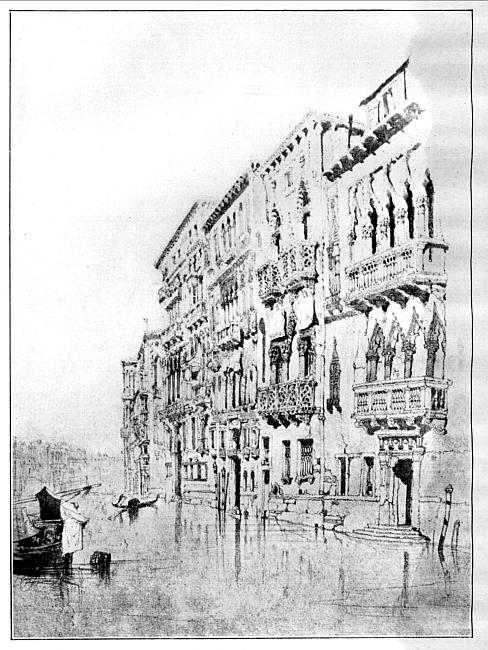
CASA CONTARINI FASAN, VENICE. From a drawing by Ruskin.
The mannerism of Canaletto is the most degraded that I know in the whole range of art. Professing the most servile and mindless imitation, it imitates nothing but the blackness of the shadows; it gives no one single architectural ornament, however near, so much form as might enable us even to guess at its actual one; and this I say not rashly, for I shall prove it by placing portions of detail accurately copied from Canaletto side by side with engravings from the Daguerreotype; it gives the buildings neither their architectural beauty nor their ancestral dignity, for there is no texture of stone nor character of age in Canaletto's touch; which is invariably a violent, black, sharp, ruled penmanlike line, as far removed from the grace of nature as from her faintness and transparency; and for his truth of color, let the single fact of his having omitted all record, whatsoever, of the frescoes whose wrecks are still to be found at least on one half of the unrestored palaces, and, with still less excusableness, all record of the magnificent colored marbles of many whose greens and purples are still undimmed upon the Casa Dario, Casa Bianca Capello, and multitudes besides, speak for him in this respect.
Let it be observed that I find no fault with Canaletto, for his want of poetry, of feeling, of artistical thoughtfulness in treatment, or of the various other virtues which he does not so much as profess. He professes nothing but colored Daguerreotypeism. Let us have it: most precious and to be revered it would be: let us have fresco where fresco was, and that copied faithfully; let us have carving where carving is, and that architecturally true. I have seen Daguerreotypes in which every figure and rosette, and crack and stain, and fissure are given on a scale of an inch to Canaletto's three feet. What excuse is there to be offered for his omitting, on that scale, as I shall hereafter show, all statement of such ornament whatever? Among the Flemish schools, exquisite imitations of architecture are found constantly, and that not with Canaletto's vulgar, black exaggeration of shadow, but in the most pure and silvery and luminous grays. I have little pleasure in such pictures; but I blame not those who have more; they are what they profess to be, and they are wonderful and instructive, and often graceful, and even affecting, but Canaletto possesses no virtue except that of dexterous imitation of commonplace light and shade, and perhaps, with the exception of Salvator, no artist has ever fettered his unfortunate admirers more securely from all healthy or vigorous perception of truth, or been of more general detriment to all subsequent schools.
§ 31. Expression of the effects of age on architecture by S. Prout.
Neither, however, by the Flemings, nor by any other of the elder schools, was the effect of age or of human life upon architecture ever adequately expressed. What ruins they drew looked as if broken down on purpose, what weeds they put on seemed put on for ornament. Their domestic buildings had never any domesticity, the people looked out of their windows evidently to be drawn, or came into the street only to stand there forever. A peculiar studiousness infected all accident; bricks fell out methodically, windows opened and shut by rule; stones were chipped at regular intervals; everything that happened seemed to have been expected before; and above all, the street had been washed and the houses dusted expressly to be painted in their best. We owe to Prout, I believe, the first perception, and certainly the only existing expression of precisely the characters which were wanting to old art, of that feeling which results from the influence among the noble lines of architecture, of the rent and the rust, the fissure, the lichen, and the weed, and from the writing upon the pages of ancient walls of the confused hieroglyphics of human history. I suppose, from the deserved popularity of the artist, that the strange pleasure which I find myself in the deciphering of these is common to many; the feeling has been rashly and thoughtlessly contemned as mere love of the picturesque; there is, as I have above shown, a deeper moral in it, and we owe much, I am not prepared to say how much, to the artist by whom pre-eminently it has been excited. For, numerous as have been his imitators, extended as his influence, and simple as his means and manner, there has yet appeared nothing at all to equal him; there is no stone drawing, no vitality of architecture like Prout's. I say not this rashly, I have Mackenzie in my eye and many other capital imitators; and I have carefully reviewed the Architectural work of the Academicians, often most accurate and elaborate. I repeat, there is nothing but the work of Prout which is true, living, or right in its general impression, and nothing, therefore, so inexhaustibly agreeable. Faults he has, manifold, easily detected, and much declaimed against by second-rate artists; but his excellence no one has ever touched, and his lithographic work, (Sketches in Flanders and Germany,) which was, I believe, the first of the kind, still remains the most valuable of all, numerous and elaborate as its various successors have been. The second series (in Italy and Switzerland) was of less value, the drawings seemed more laborious, and had less of the life of the original sketches, being also for the most part of subjects less adapted for the development of the artist's peculiar powers; but both are fine, and the Brussels, Louvain, Cologne, and Nuremberg, subjects of the one, together with the Tours, Amboise, Geneva, and Sion of the other, exhibit substantial qualities of stone and wood drawing, together with an ideal appreciation of the present active vital being of the cities, such as nothing else has ever approached. Their value is much increased by the circumstance of their being drawn by the artist's own hand upon the stone, and by the consequent manly recklessness of subordinate parts, (in works of this kind, be it remembered, much is subordinate,) which is of all characters of execution the most refreshing. Note the scrawled middle tint of the wall behind the Gothic well at Ratisbonne, and compare this manly piece of work with the wretched smoothness of recent lithography. Let it not be thought that there is any inconsistency between what I say here and what I have said respecting finish. This piece of dead wall is as much finished in relation to its function as a wall of Ghirlandajo's or Leonardo's in relation to theirs, and the refreshing quality is the same in both, and manifest in all great masters, without exception, that of the utter regardlessness of the means so that their end be reached. The same kind of scrawling occurs often in the shade of Raffaelle.
It is not only, however, by his peculiar stone touch nor perception of human character that he is distinguished. He § 32. His excellent composition and color.is the most dexterous of all our artists in a certain kind of composition. No one can place figures like him, except Turner. It is one thing to know where a piece of blue or white is wanted, and another to make the wearer of the blue apron or white cap come there, and not look as if it were against her will. Prout's streets are the only streets that are accidentally crowded, his markets are the only markets where one feels inclined to get out of the way. With others we feel the figures so right where they are, that we have no expectation of their going anywhere else, and approve of the position of the man with the wheelbarrow, without the slightest fear of his running against our legs. One other merit he has, far less generally acknowledged than it should be: he is among our most sunny and substantial colorists. Much conventional color occurs in his inferior pictures (for he is very unequal) and some in all; but portions are always to be found of quality so luminous and pure that I have found these works the only ones capable of bearing juxtaposition with Turner and Hunt, who invariably destroy everything else that comes within range of them. His most beautiful tones occur in those drawings in which there is prevalent and powerful warm gray, his most failing ones in those of sandy red. On his deficiencies I shall not insist, because I am not prepared to say how far it is possible for him to avoid them. We have never seen the reconciliation of the peculiar characters he has obtained with the accurate following out of architectural detail. With his present modes of execution, farther fidelity is impossible, nor has any other mode of execution yet obtained the same results; and though much is unaccomplished by him in certain subjects, and something of over-mannerism may be traced in his treatment of others, as especially in his mode of expressing the decorative parts of Greek or Roman architecture, yet in his own peculiar Gothic territory, where the spirit of the subject itself is somewhat rude and grotesque, his abstract of decoration has more of the spirit of the reality than far more laborious imitation. The spirit of the Flemish Hotel de Ville and decorated street architecture has never been even in the slightest degree felt or conveyed except by him, and by him, to my mind, faultlessly and absolutely; and though his interpretation of architecture that contains more refined art in its details is far less satisfactory, still it is impossible, while walking on his favorite angle of the Piazzetta at Venice, either to think of any other artist than Prout or not to think of him.