Volume 1 / Part 2 — CHAPTER VII. (continued 2)
Reading edition
Many other dexterous and agreeable architectural artists we § 33. Modern architectural painting generally. G. Cattermole.have of various degrees of merit, but of all of whom, it may be generally said, that they draw hats, faces, cloaks, and caps much better than Prout, but figures not so well; that they draw walls and windows but not cities, mouldings and buttresses but not cathedrals. Joseph Nash's work on the architecture of the middle ages is, however, valuable, and I suppose that Haghe's works may be depended on for fidelity. But it appears very strange that a workman capable of producing the clever drawings he has, from time to time, sent to the New Society of Painters in Water Colors, should publish lithographs so conventional, forced, and lifeless.
It is not without hesitation, that I mention a name respecting which the reader may already have been surprised at my silence, that of G. Cattermole. There are signs in his works of very peculiar gifts, and perhaps also of powerful genius; their deficiencies I should willingly attribute to the advice of ill-judging friends, and to the applause of a public satisfied with shallow efforts, if brilliant; yet I cannot but think it one necessary characteristic of all true genius to be misled by no such false fires. The Antiquarian feeling of Cattermole is pure, earnest, and natural; and I think his imagination originally vigorous, certainly his fancy, his grasp of momentary passion considerable, his sense of action in the human body vivid and ready. But no original talent, however brilliant, can sustain its energy when the demands upon it are constant, and all legitimate support and food withdrawn. I do not recollect in any, even of the most important of Cattermole's works, so much as a fold of drapery studied out from nature. Violent conventionalism of light and shade, sketchy forms continually less and less developed, the walls and the faces drawn with the same stucco color, alike opaque, and all the shades on flesh, dress, or stone, laid in with the same arbitrary brown, forever tell the same tale of a mind wasting its strength and substance in the production of emptiness, and seeking, by more and more blindly hazarded handling, to conceal the weakness which the attempt at finish would betray.
This tendency of late, has been painfully visible in his architecture. Some drawings made several years ago for an annual illustrative of Scott's works were for the most part pure and finely felt—(though irrelevant to our present subject, a fall of the Clyde should be noticed, admirable for breadth and grace of foliage, and for the bold sweeping of the water, and another subject of which I regret that I can only judge by the engraving; Glendearg at twilight—the monk Eustace chased by Christie of the Clint hill—which I think must have been one of the sweetest pieces of simple Border hill feeling ever painted)—and about that time his architecture, though always conventionally brown in the shadows, was generally well drawn, and always powerfully conceived.
Since then, he has been tending gradually through exaggeration to caricature, and vainly endeavoring to attain by inordinate bulk of decorated parts, that dignity which is only to be reached by purity of proportion and majesty of line.
It has pained me deeply, to see an artist of so great original power indulging in childish fantasticism and exaggeration, and substituting for the serious and subdued work of legitimate § 34. The evil in an archæological point of view of misapplied invention in architectural subject.imagination, monstre machicolations and colossal cusps and crockets. While there is so much beautiful architecture daily in process of destruction around us, I cannot but think it treason to imagine anything; at least, if we must have composition, let the design of the artist be such as the architect would applaud. But it is surely very grievous, that while our idle artists are helping their vain inventions by the fall of sponges on soiled paper, glorious buildings with the whole intellect and history of centuries concentrated in them, are suffered to fall into unrecorded ruin. A day does not now pass in Italy without the destruction of some mighty monument; the streets of all her cities echo to the hammer, half of her fair buildings lie in separate stones about the places of their foundation; would not time be better spent in telling us the truth about these perishing remnants of majestic thought, than in perpetuating the ill-digested fancies of idle hours? It is, I repeat, treason to the cause of art for any man to invent, unless he invents something better than has been invented before, or something differing in kind. There is room enough for invention in the pictorial treatment of what exists. There is no more honorable exhibition of imaginative power, than in the selection of such place, choice of such treatment, introduction of such incident, as may produce a noble picture without deviation from one line of the actual truth; and such I believe to be, indeed, in the end the most advantageous, as well as the most modest direction of the invention, for I recollect no single instance of architectural composition by any men except such as Leonardo or Veronese, who could design their architecture thoroughly before they painted it, which has not a look of inanity and absurdity. The best landscapes and the best architectural studies have been views; and I would have the artist take shame to himself in the exact degree in which he finds himself obliged in the production of his picture to lose any, even of the smallest parts or most trivial hues which bear a part in the great impression made by the reality. The difference between the drawing of the architect and artist[13] ought never to be, as it now commonly is, the difference between lifeless formality and witless license; it ought to be between giving the mere lines and measures of a building, and giving those lines and measures with the impression and soul of it besides. All artists should be ashamed of themselves when they find they have not the power of being true; the right wit of drawing is like the right wit of conversation, not hyperbole, not violence, not frivolity, only well expressed, laconic truth.
Among the members of the Academy, we have at present only one professedly architectural draughtsman of note, David Roberts, whose reputation is probably farther extended on the § 35. Works of David Roberts: their fidelity and grace.continent than that of any other of our artists, except Landseer. I am not certain, however, that I have any reason to congratulate either of my countrymen upon this their European estimation; for I think it exceedingly probable that in both instances it is exclusively based on their defects; and in the case of Mr. Roberts, in particular, there has of late appeared more ground for it than is altogether desirable in a smoothness and over-finish of texture which bears dangerous fellowship with the work of our Gallic neighbors.
The fidelity of intention and honesty of system of Roberts have, however, always been meritorious; his drawing of architecture is dependent on no unintelligible lines, or blots, or substituted types: the main lines of the real design are always there, and its hollowness and undercuttings given with exquisite feeling; his sense of solidity of form is very peculiar, leading him to dwell with great delight on the roundings of edges and angles; his execution is dexterous and delicate, singularly so in oil, and his sense of chiaroscuro refined. But he has never done himself justice, and suffers his pictures to fall below the rank they should assume, by the presence of several marring characters, which I shall name, because it is perfectly in his power to avoid them. In looking over the valuable series of drawing of the Holy Land, which we owe to Mr. Roberts, we cannot but be amazed to find how frequently it has happened that there was something very white immediately in the foreground, and something very black exactly behind it. The same thing happens perpetually with Mr. Roberts's pictures; a white column is always coming out of a blue mist, or a white stone out of a green pool, or a white monument out of a brown recess, and the artifice is not always concealed with dexterity. This is unworthy of so skilful a composer, and it has destroyed the impressiveness as well as the color of some of his finest works. It shows a poverty of conception, which appears to me to arise from a deficient habit of study. It will be remembered that of the sketches for this work, several times exhibited in London, every one was executed in the same manner, and with about the same degree of completion: being all of them accurate records of the main architectural lines, the shapes of the shadows, and the remnants of artificial color, obtained, by means of the same grays, throughout, and of the same yellow (a singularly false and cold though convenient color) touched upon the lights. As far as they went, nothing could be more valuable than these sketches, and the public, glancing rapidly at their general and graceful effects, could hardly form anything like an estimate of the endurance and determination which must have been necessary in such a climate to obtain records so patient, entire, and clear, of details so multitudinous as (especially) the hieroglyphics of the Egyptian temples; an endurance which perhaps only artists can estimate, and for which we owe a debt of gratitude to Mr. Roberts most difficult to discharge. But if these sketches were all that the artist brought home, whatever value is to be attached to them as statements of fact, they are altogether insufficient for the producing of pictures. I saw among them no single instance of a downright study; of a study in which the real hues and shades of sky and earth had been honestly realized or attempted; nor were there, on the other hand, any of those invaluable-blotted-five-minutes works which record the unity of some single and magnificent impressions. Hence the pictures which have been painted from these sketches have been as much alike in their want of impressiveness as the sketches themselves, and have never borne the living aspect of the Egyptian light; it has always been impossible to say whether the red in them (not a pleasant one) was meant for hot sunshine or for red sandstone—their power has been farther destroyed by the necessity the artist seems to feel himself under of eking out their effect by points of bright foreground color, and thus we have been encumbered with caftans, pipes, scymetars, and black hair, when all that we wanted was a lizard, or an ibis. It is perhaps owing to this want of earnestness in study rather than to deficiency of perception, that the coloring of this artist is commonly untrue. Some time ago when he was painting Spanish subjects, his habit was to bring out his whites in relief from transparent bituminous browns, which though not exactly right in color, were at any rate warm and agreeable; but of late his color has become cold, waxy, and opaque, and in his deep shades he sometimes permits himself the use of a violent black which is altogether unjustifiable. A picture of Roslin Chapel exhibited in 1844, showed this defect in the recess to which the stairs descend, in an extravagant degree; and another exhibited in the British Institution, instead of showing the exquisite crumbling and lichenous texture of the Roslin stone, was polished to as vapid smoothness as every French historical picture. The general feebleness of the effect is increased by the insertion of the figures as violent pieces of local color unaffected by the light and unblended with the hues around them, and bearing evidence of having been painted from models or draperies in the dead light of a room instead of sunshine. On these deficiencies I should not have remarked, but that by honest and determined painting from and of nature, it is perfectly in the power of the artist to supply them; and it is bitterly to be regretted that the accuracy and elegance of his work should not be aided by that genuineness of hue and effect which can only be given by the uncompromising effort to paint not a fine picture but an impressive and known verity.
The two artists whose works it remains for us to review, are men who have presented us with examples of the treatment of every kind of subject, and among the rest with portions of architecture which the best of our exclusively architectural draughtsmen could not excel.
The frequent references made to the works of Clarkson Stanfield throughout the subsequent pages render it less necessary for me to speak of him here at any length. He is the leader of the English Realists, and perhaps among the more remarkable of his § 36. Clarkson Stanfield.characteristics is the look of common-sense and rationality which his compositions will always bear when opposed to any kind of affectation. He appears to think of no other artist. What he has learned, has been from his own acquaintance with and affection for the steep hills and the deep sea; and his modes of treatment are alike removed from sketchiness or incompletion, and from exaggeration or effort. The somewhat over-prosaic tone of his subjects is rather a condescension to what he supposes to be public feeling, than a sign of want of feeling in himself; for in some of his sketches from nature or from fancy, I have seen powers and perceptions manifested of a far higher order than any that are traceable in his Academy works, powers which I think him much to be blamed for checking. The portion of his pictures usually most defective in this respect is the sky, which is apt to be cold and uninventive, always well drawn, but with a kind of hesitation in the clouds whether it is to be fair or foul weather; they having neither the joyfulness of rest, nor the majesty of storm. Their color is apt also to verge on a morbid purple, as was eminently the case in the large picture of the wreck on the coast of Holland exhibited in 1844, a work in which both his powers and faults were prominently manifested, the picture being full of good painting, but wanting in its entire appeal. There was no feeling of wreck about it; and, but for the damage about her bowsprit, it would have been impossible for a landsman to say whether the hull was meant for a wreck or a guardship. Nevertheless, it is always to be recollected, that in subjects of this kind it is probable that much escapes us in consequence of our want of knowledge, and that to the eye of the seaman much may be of interest and value which to us appears cold. At all events, this healthy and rational regard of things is incomparably preferable to the dramatic absurdities which weaker artists commit in matters marine; and from copper-colored sunsets on green waves sixty feet high, with cauliflower breakers, and ninepin rocks; from drowning on planks, and starving on rafts, and lying naked on beaches, it is really refreshing to turn to a surge of Stanfield's true salt, serviceable, unsentimental sea. It would be well, however, if he would sometimes take a higher flight. The castle of Ischia gave him a grand subject, and a little more invention in the sky, a little less muddiness in the rocks, and a little more savageness in the sea, would have made it an impressive picture; it just misses the sublime, yet is a fine work, and better engraved than usual by the Art Union.
One fault we cannot but venture to find, even in our own extreme ignorance, with Mr. Stanfield's boats; they never look weather-beaten. There is something peculiarly precious in the rusty, dusty, tar-trickled, fishy, phosphorescent brown of an old boat, and when this has just dipped under a wave and rises to the sunshine it is enough to drive Giorgione to despair. I have never seen any effort at this by Stanfield; his boats always look new painted and clean; witness especially the one before the ship in the wreck picture above noticed; and there is some such absence of a right sense of color in other portions of his subject; even his fishermen have always clean jackets and unsoiled caps, and his very rocks are lichenless. And, by the way, this ought to be noted respecting modern painters in general, that they have not a proper sense of the value of dirt; cottage children never appear but in fresh got-up caps and aprons, and white-handed beggars excite compassion in unexceptionable rags. In reality, almost all the colors of things associated with human life derive something of their expression and value from the tones of impurity, and so enhance the value of the entirely pure tints of nature herself. Of Stanfield's rock and mountain drawing enough will be said hereafter. His foliage is inferior; his architecture admirably drawn, but commonly wanting in color. His picture of the Doge's palace at Venice was quite clay-cold and untrue. Of late he has shown a marvellous predilection for the realization, even to actually relieved texture, of old worm-eaten wood; we trust he will not allow such fancies to carry him too far.
The name I have last to mention is that of J. M. W. Turner. I do not intend to speak of this artist at present in general terms, because my constant practice throughout this work is to say, when I speak of an artist at all, the very truth of what I believe and feel respecting him; and the truth of what I believe and feel respecting Turner would appear in this place, unsupported by any proof, mere rhapsody. I shall therefore here confine § 37. J. M. W. Turner. Force of national feeling in all great painters.myself to a rapid glance at the relations of his past and present works, and to some notice of what he has failed of accomplishing: the greater part of the subsequent chapters will be exclusively devoted to the examination of the new fields over which he has extended the range of landscape art.
It is a fact more universally acknowledged than enforced or acted upon, that all great painters, of whatever school, have been great only in their rendering of what they had seen and felt from early childhood; and that the greatest among them have been the most frank in acknowledging this their inability to treat anything successfully but that with which they had been familiar. The Madonna of Raffaelle was born on the Urbino mountains, Ghirlandajo's is a Florentine, Bellini's a Venetian; there is not the slightest effort on the part of any one of these great men to paint her as a Jewess. It is not the place here to insist farther on a point so simple and so universally demonstrable. Expression, character, types of countenance, costume, color, and accessories are with all great painters whatsoever those of their native land, and that frankly and entirely, without the slightest attempt at modification; and I assert fearlessly that it is impossible that it should ever be otherwise, and that no man ever painted or ever will paint well anything but what he has early and long seen, early and long felt, and early and long loved. How far it is possible for the mind of one nation or generation to be healthily modified and taught by the work of another, I presume not to determine; but it depends upon whether the energy of the mind which receives the instruction be sufficient, while it takes out of what it feeds upon that which is universal and common to all nature, to resist all warping from national or temporary peculiarities. Nino Pisano got nothing but good, the modern French nothing but evil, from the study of the antique; but Nino Pisano had a God and a character. All artists who have attempted to assume, or in their weakness have been affected by, the national peculiarities of other times and countries, have instantly, whatever their original power, fallen to third-rate rank, or fallen altogether, and have invariably lost their birthright and blessing, lost their power over the human heart, lost all capability of teaching or benefiting others. Compare the hybrid classification of Wilson with the rich English purity of Gainsborough; compare the recent exhibition of middle-age cartoons for the Houses of Parliament with the works of Hogarth; compare the sickly modern German imitations of the great Italians with Albert Durer and Holbein; compare the vile classicality of Canova and the modern Italians with Mino da Fiesole, Luca della Robbia, and Andrea del Verrocchio. The manner of Nicolo Poussin is said to be Greek—it may be so; this only I know, that it is heartless and profitless. The severity of the rule, however, extends not in full force to the nationality, but only to the visibility of things; for it is very possible for an artist of powerful mind to throw himself well into the feeling of foreign nations of his own time. Thus John Lewis has been eminently successful in his seizing of Spanish character. Yet it may be doubted if the seizure be such as Spaniards themselves would acknowledge; it is probably of the habits of the people more than their hearts; continued efforts of this kind, especially if their subjects be varied, assuredly end in failure; Lewis, who seemed so eminently penetrative in Spain, sent nothing from Italy but complexions and costumes, and I expect no good from his stay in Egypt. English artists are usually entirely ruined by residence in Italy, but for this there are collateral causes which it is not here the place to examine. Be this as it may, and whatever success may be attained in pictures of slight and unpretending aim, of genre, as they are called, in the rendering of foreign character, of this I am certain, that whatever is to be truly great and affecting must have on it the strong stamp of the native land; not a law this, but a necessity, from the intense hold on their country of the affections of all truly great men; all classicality, all middle-age patent reviving, is utterly vain and absurd; if we are now to do anything great, good, awful, religious, it must be got out of our own little island, and out of this year 1846, railroads and all: if a British painter, I say this in earnest seriousness, cannot make historical characters out of the British House of Peers, he cannot paint history; and if he cannot make a Madonna of a British girl of the nineteenth century, he cannot paint one at all.
The rule, of course, holds in landscape; yet so far less authoritatively, that the material nature of all countries and times is in many points actually, and in all, in principle, the § 38. Influence of this feeling on the choice of Landscape subject.same; so that feelings educated in Cumberland, may find their food in Switzerland, and impressions first received among the rocks of Cornwall, be recalled upon the precipices of Genoa. Add to this actual sameness, the power of every great mind to possess itself of the spirit of things once presented to it, and it is evident, that little limitation can be set to the landscape painter as to the choice of his field; and that the law of nationality will hold with him only so far as a certain joyfulness and completion will be by preference found in those parts of his subject which remind him of his own land. But if he attempt to impress on his landscapes any other spirit than that he has felt, and to make them landscapes of other times, it is all over with him, at least, in the degree in which such reflected moonshine takes place of the genuine light of the present day.
The reader will at once perceive how much trouble this simple principle will save both the painter and the critic; it at once sets aside the whole school of common composition, and exonerates us from the labor of minutely examining any landscape which has nymphs or philosophers in it.
It is hardly necessary for us to illustrate this principle by any reference to the works of early landscape painters, as I suppose it is universally acknowledged with respect to them; Titian being the most remarkable instance of the influence of the native air on a strong mind, and Claude, of that of the classical poison on a weak one; but it is very necessary to keep it in mind in reviewing the works of our great modern landscape painter.
I do not know in what district of England Turner first or longest studied, but the scenery whose influence I can trace most definitely throughout his works, varied as they are, is that § 39. Its peculiar manifestation in Turner.of Yorkshire. Of all his drawings, I think, those of the Yorkshire series have the most heart in them, the most affectionate, simple, unwearied, serious finishing of truth. There is in them little seeking after effect, but a strong love of place, little exhibition of the artist's own powers or peculiarities, but intense appreciation of the smallest local minutiæ. These drawings have unfortunately changed hands frequently, and have been abused and ill treated by picture dealers and cleaners; the greater number of them, are now mere wrecks. I name them not as instances, but as proofs of the artist's study in this district; for the affection to which they owe their excellence, must have been grounded long years before. It is to be traced, not only in these drawings of the places themselves, but in the peculiar love of the painter for rounded forms of hills; not but that he is right in this on general principles, for I doubt not, that, with his peculiar feeling for beauty of line, his hills would have been rounded still, even if he had studied first among the peaks of Cadore; but rounded to the same extent and with the same delight in their roundness, they would not have been. It is, I believe, to those broad wooded steeps and swells of the Yorkshire downs that we in part owe the singular massiveness that prevails in Turner's mountain drawing, and gives it one of its chief elements of grandeur. Let the reader open the Liber Studiorum, and compare the painter's enjoyment of the lines in the Ben Arthur, with his comparative uncomfortableness among those of the aiguilles about the Mer de Glace. Great as he is, those peaks would have been touched very differently by a Savoyard as great as he.
I am in the habit of looking to the Yorkshire drawings, as indicating one of the culminating points in Turner's career. In these he attained the highest degree of what he had up to that time attempted, namely, finish and quantity of form united with expression of atmosphere, and light without color. His early drawings are singularly instructive in this definiteness and simplicity of aim. No complicated or brilliant color is ever thought of in them; they are little more than exquisite studies in light and shade, very green blues being used for the shadows, and golden browns for the lights. The difficulty and treachery of color being thus avoided, the artist was able to bend his whole mind upon the drawing, and thus to attain such decision, delicacy, and completeness as have never in any wise been equalled, and as might serve him for a secure foundation in all after experiments. Of the quantity and precision of his details, the drawings made for Hakewill's Italy, are singular examples. The most perfect gem in execution is a little bit on the Rhine, with reeds in the foreground, in the possession of B. G. Windus, Esq., of Tottenham; but the Yorkshire drawings seem to be on the whole the most noble representatives of his art at this period.
About the time of their production, the artist seems to have felt that he had done either all that could be done, or all that was necessary, in that manner, and began to reach after something beyond it. The element of color begins to mingle with his work, and in the first efforts to reconcile his intense feeling for it with his careful form, several anomalies begin to be visible, and some unfortunate or uninteresting works necessarily belong to the period. The England drawings, which are very characteristic of it, are exceedingly unequal,—some, as the Oakhampton, Kilgarren, Alnwick, and Llanthony, being among his finest works; others, as the Windsor from Eton, the Eton College, and the Bedford, showing coarseness and conventionality.
I do not know at what time the painter first went abroad, but among the earliest of the series of the Liber Studiorum (dates 1808, 1809,) occur the magnificent Mont St. Gothard, and § 40. The domestic subjects of the Liber Studiorum.little Devil's Bridge. Now it is remarkable that after his acquaintance with this scenery, so congenial in almost all respects with the energy of his mind, and supplying him with materials of which in these two subjects, and in the Chartreuse, and several others afterwards, he showed both his entire appreciation and command, the proportion of English to foreign subjects should in the rest of the work be more than two to one; and that those English subjects should be—many of them—of a kind peculiarly simple, and of every-day occurrence, such as the Pembury Mill, the Farm Yard Composition with the White Horse, that with the Cocks and Pigs, Hedging and Ditching, Watercress Gatherers (scene at Twickenham,) and the beautiful and solemn rustic subject called a Watermill; and that the architectural subjects instead of being taken, as might have been expected of an artist so fond of treating effects of extended space, from some of the enormous continental masses are almost exclusively British; Rivaulx, Holy Island, Dumblain, Dunstanborough, Chepstow, St. Catherine's, Greenwich Hospital, an English Parish Church, a Saxon Ruin, and an exquisite Reminiscence of the English Lowland Castle in the pastoral, with the brook, wooden bridge, and wild duck, to all of which we have nothing foreign to oppose but three slight, ill-considered, and unsatisfactory subjects, from Basle, Lauffenbourg, and another Swiss village; and, further, not only is the preponderance of subject British, but of affection also; for it is strange with what fulness and completion the home subjects are treated in comparison with the greater part of the foreign ones. Compare the figures and sheep in the Hedging and Ditching, and the East Gate Winchelsea, together with the near leafage, with the puzzled foreground and inappropriate figures of the Lake of Thun; or the cattle and road of the St. Catherine's Hill, with the foreground of the Bonneville; or the exquisite figure with the sheaf of corn, in the Watermill, with the vintages of the Grenoble subject.
In his foliage the same predilections are remarkable. Reminiscences of English willows by the brooks, and English forest glades mingle even with the heroic foliage of the Æsacus and Hesperie, and the Cephalus; into the pine, whether of Switzerland or the glorious Stone, he cannot enter, or enters at his peril, like Ariel. Those of the Valley of Chamounix are fine masses, better pines than other people's, but not a bit like pines for all that; he feels his weakness, and tears them off the distant mountains with the mercilessness of an avalanche. The Stone pines of the two Italian compositions are fine in their arrangement, but they are very pitiful pines; the glory of the Alpine rose he never touches; he munches chestnuts with no relish; never has learned to like olives; and, by the vine, we find him in the foreground of the Grenoble Alps laid utterly and incontrovertibly on his back.
I adduce these evidences of Turner's nationality (and innumerable others might be given if need were) not as proofs of weakness but of power; not so much as testifying want of perception in foreign lands, as strong hold on his own will; for I am sure that no artist who has not this hold upon his own will ever get good out of any other. Keeping this principle in mind, it is instructive to observe the depth and solemnity which Turner's feeling received from the scenery of the continent, the keen appreciation up to a certain point of all that is locally characteristic, and the ready seizure for future use of all valuable material.
Of all foreign countries he has most entirely entered into the spirit of France; partly because here he found more fellowship of scene with his own England, partly because an amount of § 41. Turner's painting of French and Swiss landscape. The latter deficient.thought which will miss of Italy or Switzerland, will fathom France; partly because there is in the French foliage and forms of ground, much that is especially congenial with his own peculiar choice of form. To what cause it is owing I cannot tell, nor is it generally allowed or felt; but of the fact I am certain, that for grace of stem and perfection of form in their transparent foliage, the French trees are altogether unmatched; and their modes of grouping and massing are so perfectly and constantly beautiful that I think of all countries for educating an artist to the perception of grace, France bears the bell; and that not romantic nor mountainous France, not the Vosges, nor Auvergne, nor Provence, but lowland France, Picardy and Normandy, the valleys of the Loire and Seine, and even the district, so thoughtlessly and mindlessly abused by English travellers, as uninteresting, traversed between Calais and Dijon; of which there is not a single valley but is full of the most lovely pictures, nor a mile from which the artist may not receive instruction; the district immediately about Sens being perhaps the most valuable from the grandeur of its lines of poplars and the unimaginable finish and beauty of the tree forms in the two great avenues without the walls. Of this kind of beauty Turner was the first to take cognizance, and he still remains the only, but in himself the sufficient painter of French landscape. One of the most beautiful examples is the drawing of trees engraved for the Keepsake, now in the possession of B. G. Windus, Esq.; the drawings made to illustrate the scenery of the Rivers of France supply instances of the most varied character.
The artist appears, until very lately, rather to have taken from Switzerland thoughts and general conceptions of size and of grand form and effect to be used in his after compositions, than to have attempted the seizing of its actual character. This was beforehand to be expected from the utter physical impossibility of rendering certain effects of Swiss scenery, and the monotony and unmanageableness of others. The Valley of Chamounix in the collection of Walter Fawkes, Esq., I have never seen; it has a high reputation; the Hannibal passing the Alps in its present state exhibits nothing but a heavy shower and a crowd of people getting wet; another picture in the artist's gallery of a land-fall is most masterly and interesting, but more daring than agreeable. The Snowstorm, avalanche, and inundation, is one of his mightiest works, but the amount of mountain drawing in it is less than of cloud and effect; the subjects in the Liber Studiorum are on the whole the most intensely felt, and next to them the vignettes to Rogers's Poems and Italy. Of some recent drawings of Swiss subject I shall speak presently.
The effect of Italy upon his mind is very puzzling. On the one hand, it gave him the solemnity and power which are manifested in the historical compositions of the Liber Studiorum, § 42. His rendering of Italian character still less successful. His large compositions how failing.more especially the Rizpah, the Cephalus, the scene from the Fairy Queen, and the Æsacus and Hesperie: on the other, he seems never to have entered thoroughly into the spirit of Italy, and the materials he obtained there were afterwards but awkwardly introduced in his large compositions.
Of these there are very few at all worthy of him; none but the Liber Studiorum subjects are thoroughly great, and these are great because there is in them the seriousness without the materials of other countries and times. There is nothing particularly indicative of Palestine in the Barley Harvest of the Rizpah, nor in those round and awful trees; only the solemnity of the south in the lifting of the near burning moon. The rocks of the Jason may be seen in any quarry of Warwickshire sandstone. Jason himself has not a bit of Greek about him—he is a simple warrior of no period in particular, nay, I think there is something of the nineteenth century about his legs. When local character of this classical kind is attempted, the painter is visibly cramped: awkward resemblances to Claude testify the want of his usual forceful originality: in the tenth Plague of Egypt, he makes us think of Belzoni rather than of Moses; the fifth is a total failure, the pyramids look like brick-kilns, and the fire running along the ground bears brotherly resemblance to the burning of manure. The realization of the tenth plague now in his gallery is finer than the study, but still uninteresting; and of the large compositions which have much of Italy in them, the greater part are overwhelmed with quantity and deficient in emotion. The Crossing the Brook is one of the best of these hybrid pictures; incomparable in its tree drawing, it yet leaves us doubtful where we are to look and what we are to feel; it is northern in its color, southern in its foliage, Italy in its details, and England in its sensations, without the grandeur of the one, or the healthiness of the other.
The two Carthages are mere rationalizations of Claude, one of them excessively bad in color, the other a grand thought, and yet one of the kind which does no one any good, because everything in it is reciprocally sacrificed; the foliage is sacrificed to the architecture, the architecture to the water, the water is neither sea, nor river, nor lake, nor brook, nor canal, and savors of Regent's Park; the foreground is uncomfortable ground,—let on building leases. So the Caligula's Bridge, Temple of Jupiter, Departure of Regulus, Ancient Italy, Cicero's Villa, and such others, come they from whose hand they may, I class under the general head of "nonsense pictures." There never can be any wholesome feeling developed in these preposterous accumulations, and where the artist's feeling fails, his art follows; so that the worst possible examples of Turner's color are found in pictures of this class; in one or two instances he has broken through the conventional rules, and then is always fine, as in the Hero and Leander; but in general the picture rises in value as it approaches to a view, as the Fountain of Fallacy, a piece of rich northern Italy, with some fairy waterworks; this picture was unrivalled in color once, but is now a mere wreck. So the Rape of Proserpine, though it is singular that in his Academy pictures even his simplicity fails of reaching ideality; in this picture of Proserpine the nature is not the grand nature of all time, it is indubitably modern,[14] and we are perfectly electrified at anybody's being carried away in the corner except by people with spiky hats and carabines. This is traceable to several causes; partly to the want of any grand specific form, partly to the too evident middle-age character of the ruins crowning the hills, and to a multiplicity of minor causes which we cannot at present enter into.
Neither in his actual views of Italy has Turner ever caught her true spirit, except in the little vignettes to Rogers's Poems. The Villa of Galileo, the nameless composition with stone pines, § 43. His views of Italy destroyed by brilliancy and redundant quantity.the several villa moonlights, and the convent compositions in the Voyage of Columbus, are altogether exquisite; but this is owing chiefly to their simplicity and perhaps in some measure to their smallness of size. None of his large pictures at all equal them; the Bay of Baiæ is encumbered with material, it contains ten times as much as is necessary to a good picture, and yet is so crude in color as to look unfinished. The Palestrina is fall of raw white, and has a look of Hampton Court about its long avenue; the modern Italy is purely English in its near foliage; it is composed from Tivoli material enriched and arranged most dexterously, but it has the look of a rich arrangement, and not the virtue of the real thing. The early Tivoli, a large drawing taken from below the falls, was as little true, and still less fortunate, the trees there being altogether affected and artificial. The Florence engraved in the Keepsake is a glorious drawing, as far as regards the passage with the bridge and sunlight on the Arno, the Cascine foliage, and distant plain, and the towers of the fortress on the left; but the details of the duomo and the city are entirely missed, and with them the majesty of the whole scene. The vines and melons of the foreground are disorderly, and its cypresses conventional; in fact, I recollect no instance of Turner's drawing a cypress except in general terms.
The chief reason of these failures I imagine to be the effort of the artist to put joyousness and brilliancy of effect upon scenes eminently pensive, to substitute radiance for serenity of light, and to force the freedom and breadth of line which he learned to love on English downs and Highland moors, out of a country dotted by campaniles and square convents, bristled with cypresses, partitioned by walls, and gone up and down by steps.
In one of the cities of Italy he had no such difficulties to encounter. At Venice he found freedom of space, brilliancy of light, variety of color, massy simplicity of general form; and to Venice we owe many of the motives in which his highest powers of color have been displayed after that change in his system of which we must now take note.
Among the earlier paintings of Turner, the culminating period, marked by the Yorkshire series in his drawings, is distinguished by great solemnity and simplicity of subject, prevalent § 44. Changes introduced by him in the received system of art.gloom in light and shade, and brown in the hue, the drawing manly but careful, the minutiæ sometimes exquisitely delicate. All the finest works of this period are, I believe, without exception, views, or quiet single thoughts. The Calder Bridge, belonging to E. Bicknell, Esq., is a most pure and beautiful example. The Ivy Bridge I imagine to be later, but its rock foreground is altogether unrivalled and remarkable for its delicacy of detail; a butterfly is seen settled on one of the large brown stones in the midst of the torrent. Two paintings of Bonneville, in Savoy, one in the possession of Abel Allnutt, Esq., the other, and, I think, the finest, in a collection at Birmingham, show more variety of color than is usual with him at the period, and are in every respect magnificent examples. Pictures of this class are of peculiar value, for the larger compositions of the same period are all poor in color, and most of them much damaged, but the smaller works have been far finer originally, and their color seems secure. There is nothing in the range of landscape art equal to them in their way, but the full character and capacity of the painter is not in them. Grand as they are in their sobriety, they still leave much to be desired; there is great heaviness in their shadows, the material is never thoroughly vanquished, (though this partly for a very noble reason, that the painter is always thinking of and referring to nature, and indulges in no artistical conventionalities,) and sometimes the handling appears feeble. In warmth, lightness, and transparency they have no chance against Gainsborough; in clear skies and air tone they are alike unfortunate when they provoke comparison with Claude; and in force and solemnity they can in no wise stand with the landscape of the Venetians.
The painter evidently felt that he had farther powers, and pressed forward into the field where alone they could be brought into play. It was impossible for him, with all his keen and long-disciplined perceptions, not to feel that the real color of nature had never been attempted by any school; and that though conventional representations had been given by the Venetians of sunlight and twilight, by invariably rendering the whites golden and the blues green, yet of the actual, joyous, pure, roseate hues of the external world no record had ever been given. He saw also that the finish and specific grandeur of nature had been given, but her fulness, space, and mystery never; and he saw that the great landscape painters had always sunk the lower middle tints of nature in extreme shade, bringing the entire melody of color as many degrees down as their possible light was inferior to nature's; and that in so doing a gloomy principle had influenced them even in their choice of subject.
For the conventional color he substituted a pure straightforward rendering of fact, as far as was in his power; and that not of such fact as had been before even suggested, but of all that is most brilliant, beautiful, and inimitable; he went to the cataract for its iris, to the conflagration for its flames, asked of the sea its intensest azure, of the sky its clearest gold. For the limited space and defined forms of elder landscape, he substituted the quantity and the mystery of the vastest scenes of earth; and for the subdued chiaroscuro he substituted first a balanced diminution of oppositions throughout the scale, and afterwards, in one or two instances, attempted the reverse of the old principle, taking the lowest portion of the scale truly, and merging the upper part in high light.
Innovations so daring and so various could not be introduced without corresponding peril: the difficulties that lay in his way were more than any human intellect could altogether surmount. § 45. Difficulties of his later manner. Resultant deficiencies.In his time there has been no one system of color generally approved; every artist has his own method and his own vehicle; how to do what Gainsborough did, we know not; much less what Titian; to invent a new system of color can hardly be expected of those who cannot recover the old. To obtain perfectly satisfactory results in color under the new conditions introduced by Turner, would at least have required the exertion of all his energies in that sole direction. But color has always been only his second object. The effects of space and form, in which he delights, often require the employment of means and method totally at variance with those necessary for the obtaining of pure color. It is physically impossible, for instance, rightly to draw certain forms of the upper clouds with the brush; nothing will do it but the pallet knife with loaded white after the blue ground is prepared. Now it is impossible that a cloud so drawn, however glazed afterwards, should have the virtue of a thin warm tint of Titian's, showing the canvas throughout. So it happens continually. Add to these difficulties, those of the peculiar subjects attempted, and to these again, all that belong to the altered system of chiaroscuro, and it is evident that we must not be surprised at finding many deficiencies or faults in such works, especially in the earlier of them, nor even suffer ourselves to be withdrawn by the pursuit of what seems censurable from our devotion to what is mighty.
Notwithstanding, in some chosen examples of pictures of this kind, I will name three: Juliet and her Nurse; the Old Temeraire, and the Slave Ship: I do not admit that there are at the time of their first appearing on the walls of the Royal Academy, any demonstrably avoidable faults. I do not deny that there may be, nay, that it is likely there are; but there is no living artist in Europe whose judgment might safely be taken on the subject, or who could without arrogance affirm of any part of such a picture, that it was wrong; I am perfectly willing to allow, that the lemon yellow is not properly representative of the yellow of the sky, that the loading of the color is in many places disagreeable, that many of the details are drawn with a kind of imperfection different from what they would have in nature, and that many of the parts fail of imitation, especially to an uneducated eye. But no living authority is of weight enough to prove that the virtues of the picture could have been obtained at a less sacrifice, or that they are not worth the sacrifice; and though it is perfectly possible that such may be the case, and that what Turner has done may hereafter in some respects be done better, I believe myself that these works are at the time of their first appearing as perfect as those of Phidias or Leonardo; that is to say, incapable in their way, of any improvement conceivable by human mind.
Also, it is only by comparison with such that we are authorized to affirm definite faults in any of his others, for we should have been bound to speak, at least for the present, with the same modesty respecting even his worst pictures of this class, had not his more noble efforts given us canons of criticism.
But, as was beforehand to be expected from the difficulties he grappled with, Turner is exceedingly unequal; he appears always as a champion in the thick of fight, sometimes with his foot on his enemies' necks, sometimes staggered or struck to his knee; once or twice altogether down. He has failed most frequently, as before noticed, in elaborate compositions, from redundant quantity; sometimes, like most other men, from over-care, as very signally in a large and most labored drawing of Bamborough; sometimes, unaccountably, his eye for color seeming to fail him for a time, as in a large painting of Rome from the Forum, and in the Cicero's Villa, Building of Carthage, and the picture of this year in the British Institution; and sometimes I am sorry to say, criminally, from taking licenses which he must know to be illegitimate, or indulging in conventionalities which he does not require.
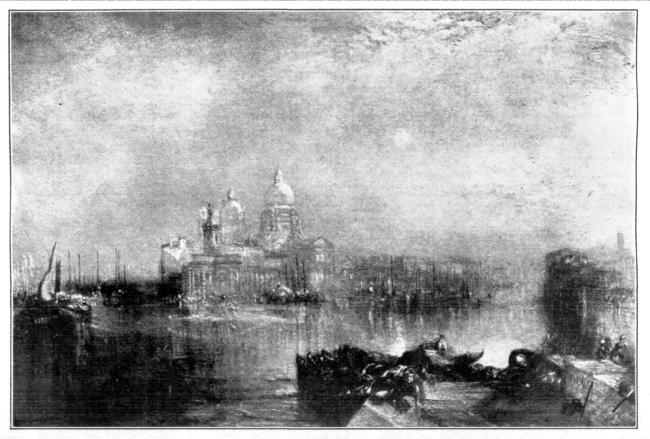
THE DOGANA, AND SANTA MARIA DELLA SALUTE, VENICE. From a painting by Turner.
On such instances I shall not insist, for the finding fault with Turner is not, I think, either decorous in myself or like to be beneficial to the reader.[15] The greater number of failures took § 46. Reflection of his very recent works.place in the transition period, when the artist was feeling for the new qualities, and endeavoring to reconcile them with more careful elaboration of form than was properly consistent with them. Gradually his hand became more free, his perception and grasp of the new truths more certain, and his choice of subject more adapted to the exhibition of them. But his powers did not attain their highest results till towards the year 1840, about which period they did so suddenly, and with a vigor and concentration which rendered his pictures at that time almost incomparable with those which had preceded them. The drawings of Nemi, and Oberwesel, in the possession of B. G. Windus, Esq., were among the first evidences of this sudden advance; only the foliage in both of these is inferior; and it is remarkable that in this phase of his art, Turner has drawn little foliage, and that little badly—the great characteristic of it being its power, beauty, and majesty of color, and its abandonment of all littleness and division of thought to a single impression. In the year 1842, he made some drawings from recent sketches in Switzerland; these, with some produced in the following years, all of Swiss subject, I consider to be, on the whole, the most characteristic and perfect works he has ever produced. The Academy pictures were far inferior to them; but among these examples of the same power were not wanting, more especially in the smaller pictures of Venice. The Sun of Venice, going to sea; the San Benedetto, looking towards Fusina; and a view of Murano, with the Cemetery, were all faultless: another of Venice, seen from near Fusina, with sunlight and moonlight mixed (1844) was, I think, when I first saw it, (and it still remains little injured,) the most perfectly beautiful piece of color of all that I have seen produced by human hands, by any means, or at any period. Of the exhibition of 1845, I have only seen a small Venice, (still I believe in the artist's possession,) and the two whaling subjects. The Venice is a second-rate work, and the two others altogether unworthy of him.
In conclusion of our present sketch of the course of landscape art, it may be generally stated that Turner is the only painter, so far as I know, who has ever drawn the sky, (not the clear sky, which we before saw belonged exclusively to the religious schools, but the various forms and phenomena of the cloudy heavens,) all previous artists having only represented it typically or partially; but he absolutely and universally: he is the only painter who has ever drawn a mountain, or a stone; no other man ever having learned their organization, or possessed himself of their spirit, except in part and obscurely, (the one or two stones noted of Tintoret's, (Vol. II., Part III. Ch. 3,) are perhaps hardly enough on which to found an exception in his favor.) He is the only painter who ever drew the stem of a tree, Titian having come the nearest before him, and excelling him in the muscular development of the larger trunks, (though sometimes losing the woody strength in a serpent-like flaccidity,) but missing the grace and character of the ramifications. He is the only painter who has ever represented the surface of calm, or the force of agitated water; who has represented the effects of space on distant objects, or who has rendered the abstract beauty of natural color. These assertions I make deliberately, after careful weighing and consideration, in no spirit of dispute, or momentary zeal; but from strong and convinced feeling, and with the consciousness of being able to prove them.
This proof is only partially and incidentally attempted in the present portion of this work, which was originally written, as before explained, for a temporary purpose, and which, therefore, I should have gladly cancelled, but that, relating as it does only to simple matters of fact and not to those of feeling, it may still, perhaps, be of service to some readers who would be unwilling to enter into the more speculative fields with which the § 47. Difficulty of demonstration in such subjects.succeeding sections are concerned. I leave, therefore, nearly as it was originally written, the following examination of the relative truthfulness of elder and of recent art; always requesting the reader to remember, as some excuse for the inadequate execution, even of what I have here attempted, how difficult it is to express or explain, by language only, those delicate qualities of the object of sense, on the seizing of which all refined truth of representation depends. Try, for instance, to explain in language the exact qualities of the lines on which depend the whole truth and beauty of expression about the half-opened lips of Raffaelle's St. Catherine. There is, indeed, nothing in landscape so ineffable as this; but there is no part nor portion of God's works in which the delicacy appreciable by a cultivated eye, and necessary to be rendered in art, is not beyond all expression and explanation; I cannot tell it you, if you do not see it. And thus I have been entirely unable, in the following pages, to demonstrate clearly anything of really deep and perfect truth; nothing but what is coarse and commonplace, in matters to be judged of by the senses, is within the reach of argument. How much or how little I have done must be judged of by the reader: how much it is impossible to do I have more fully shown in the concluding section.
I shall first take into consideration those general truths, common to all the objects of nature, which are productive of what is usually called "effect," that is to say, truths of tone, general color, space, and light. I shall then investigate the truths of specific form and color, in the four great component parts of landscape—sky, earth, water, and vegetation.
CAMPO. DI. S. MAURIZIO
DIO
CONSERVI A NOI. LUNGAMENTE LO ZELANTIS. E. REVERENDIS D. LUIGI. PICCINI. NOSTRO
NOVELLO PIEVANO.
GLI ESULTANT.
PARROCCHIANI