Front matter (continued 8)
Reading edition
The progress of the work of reinforcing Thomas was not quite as rapid as it seemed. Grant had sent General Rawlins, his chief of staff, from Petersburg to St. Louis to see that A. J. Smith's corps went promptly forward from Rosecrans's department. Besides the 9000 in Smith's immediate command, 5200 men were collected from posts on the Mississippi and Ohio, and were put in motion toward Nashville. [Footnote: Official Records, vol. xxxix. pt. iii. p. 684.] Rawlins's report on the 7th, that these were starting, was understood by Thomas to apply to the whole of Smith's force, and he therefore reckoned on their reaching him in a few days. [Footnote: Id., p. 685.] Rawlins in fact expected Smith's own divisions to leave St. Louis on the 10th, but even this was much sooner than they reached the river. The same news was sent to Sherman, and he expressed his joy that these veteran reinforcements were on the way, and his confidence that the enemy was now checkmated. [Footnote:Id., p. 686.] The result was a little over-confidence in all quarters, which probably had its influence in making Thomas less energetic in concentrating the troops available in Tennessee than he would have been had he known that Smith's 9000 would not reach Nashville till the last day of the month. [Footnote: See "Franklin and Nashville," pp. 132 et seq.; "Battle of Franklin," pp. 40, 41.]
On the 13th I marched to Columbia, and Schofield went in person to Pulaski, where he assumed command. [Footnote: Official Records, vol. xxxix. pt iii. pp. 764, 768.] Wooden pontoons were sent the same day to Columbia for the crossing of the Duck River there, and the bridge was completed at ten o'clock in the evening. [Footnote: Id., pt. i. p. 795.] As the river was too high to ford, we had encamped on the north side, in the tongue made by the horse-shoe bend to the southward. We occupied the fine open wood on rolling ground, and made ourselves as well acquainted with the village and surrounding country as time would allow. Columbia, on the south bank of the river, had been a centre of education and refinement, and several college buildings were there, surrounded by ample groves. The neighborhood was the home of the Polks and the Pillows and other people of national reputation, whose ample estates lay on the roads diverging from the town. Between the village and the railway bridge below the place was an isolated hill on which was an enclosed redoubt, commanding the crossing. It was a strong position when connected with sufficient forces near by, but too small and too detached to have much independent value.
Leaving Strickland's brigade as a garrison for the town, the rest of my command marched next morning toward Pulaski, reaching Lynnville, eighteen miles south of the river, where a road from Lawrenceburg comes into the turnpike. I was pretty strong in artillery, having five batteries, two of which properly belonged to the second division. Ten miles south of Columbia we left the open country and entered a hilly, forest-covered region, with cultivation only in the narrow valleys of small streams. This high water-shed between the Duck River and the Elk extends nearly all the way from the plateau of the Cumberland westward to the Tennessee River, where it has made its great bend to the north. It is known as the "barns" (barrens), and is desolate enough. In many places one may travel for miles without seeing a house. Wood-chopping and charcoal-burning for smelting furnaces seemed to be the principal industry.
On the 15th we continued our march in a heavy, cold rain to Pigeon Creek, two miles north of Pulaski, making sixteen miles. General Schofield met me there, and we examined the country westward some three miles, our reconnoissance determining him to keep the division at the turnpike crossing of the creek, where we accordingly encamped. [Footnote: Official Records, vol. xlv. pt. i. p. 357.] It had been confidently expected that Hood would march northward by the time we could reach Pulaski, but he delayed, and it was a week later before he really opened his new campaign. Various things combined to give plausible reasons for his delay. He could not get the supply of stores which he needed. The gap in his railroad from Cherokee to Tuscumbia was not rebuilt. The weather was continuously cold with heavy rains, and the roads going from bad to worse. The truth, no doubt, was that Sherman's march southward had a most perplexing effect, raising portentous problems as to its result upon the Confederacy, and reducing Hood's own campaign to a secondary place in the general progress of the war. Torn by doubts, he seemed willing to find excuses for postponing action, hoping to see clearer light on the future before committing himself to a decisive movement. An interesting item in the discussion between the Confederate generals was that Hood suggested Purdy as a better base than Tuscumbia, and proposed to abandon the work of rebuilding the railroad near that place. Purdy was some twenty-five miles north of Corinth on the Mobile and Ohio Railway, and not far from the old battlefield of Shiloh. Its landing-place on the Tennessee River was nearly opposite Savannah, and it was there that Grant had stopped his steamboat for a conference with General Lew Wallace on his way to Pittsburg Landing the morning of the great battle. It is probable that Hood thought it advantageous to take a line by which he might avoid the risk of expeditions from Decatur, and could more safely turn Schofield's position at Pulaski, by operating further from our line of railroad and making it necessary for us either to retire rapidly toward Nashville, or meet him so far from our supply line as to be dependent, like himself, on wagon transportation. Beauregard approved the change of base if made after the first stage of the campaign should be complete, and planned a scheme of floating booms armed with torpedoes to protect the pontoon bridge when it should be laid there. [Footnote: Official Records, vol. xxxix. pt. iii. pp. 900, 905; vol. xlv. pt. i. p. 1210.] The road from Savannah through Waynesborough to Columbia was a turnpike, and would be safer for wagon trains than that from Florence, because so much further from posts on our railway. It would also be a better line of retreat in case of disaster. The plan was not tried, because the withdrawal of our forces from Decatur and Pulaski removed the dangers which Hood apprehended, and made his communications secure. The rains raised the river so much that the bridge laid at Florence was no longer protected by its situation between Muscle Shoals above and Colbert Shoals below, and the Confederates had reason to fear that it would be destroyed by gunboats coming up the river. The navy had been unfortunate in the destruction of gunboats at Johnsonville, but Rear-Admiral S. P. Lee had been sent to take command of the river fleets co-operating with Thomas, and was planning active work with heavier vessels. [Footnote: Id., vol. xxxix. pt. iii. p. 734.]
On the 14th the river had risen eighteen feet at Florence, and Hood's bridge was with great difficulty kept in its place. [Footnote: Id., vol. xlv. pt. i. p. 887.] The same day General Wheeler informed him of Sherman's concentration at Atlanta, the destruction of the railroad above, and the strong rumors of the march on Augusta and Savannah. [Footnote: Id., p. 1206.] Forrest had not yet joined Hood, but did so in two days. Beauregard heard, through Taylor, of the movement of reinforcements to Thomas from Memphis and below, as well as of A. J. Smith's from St. Louis. [Footnote: Id., pp. 1208-1209.] On the 17th he got authentic news of Sherman's start from Atlanta, and ordered Hood to "take the offensive at the earliest practicable moment, and deal the enemy rapid and vigorous blows, striking him while thus dispersed, and by this means to distract Sherman's advance into Georgia." Hood replied that he had only one third of the quantity of rations accumulated which he needed for beginning the campaign. [Footnote: Official Records, vol. xlv. pt. i. p. 1215.] Beauregard himself left Tuscumbia for Montgomery and Macon, giving Hood the choice either to send part of his troops to Georgia or to take the offensive immediately. Under this spur Hood gave orders for an advance on the 19th, but there was still some cause of delay, and Beauregard reiterated, on the 20th, the peremptory order to "push an active offensive immediately." Next day all were in motion, and Hood issued a brief address to his troops, saying, "You march to-day to redeem by your valor and your arms one of the fairest portions of our Confederacy." [Footnote:Id., pp. 1220, 1225,1226,1236.]
During the week we were at Pulaski the rain had made our camp anything but a pleasant one, yet, as we were daily in expectation of Hood's advance, we could do nothing to improve our shelter or the means of warming our tents. The forests were near enough to furnish us the fuel for rousing camp-fires, and we made the most of them. At night I fastened back the flaps of my tent, and a blazing pile of logs threw in heat enough to temper the cold, and one slept sweetly in the fresh air as long as the wind was in the right direction. The day Hood advanced the rain changed to snow, driving in flurries and squalls all day. Marching orders for the 22d came in the evening, and we prepared for an early start to Lynnville, for the enemy was making for Columbia through Lawrenceburg, and we must anticipate him. The night was a freezing one, the mud was frozen stiff on the surface in the morning, making the worst possible marching for the infantry, while the artillery and horses broke through the crust at every step. Our only consolation was in the reflection that it was as bad for Hood as for us. By getting off at break of day my division reached Lynnville by noon, and took position on the north and west of the village. Wagner's division of the Fourth Corps followed and reported to me. [Footnote: Official Records, vol. xlv. pt. i. pp. 974, 985.] I gave them positions on the south and west. Schofield remained another day at Pulaski with two divisions of the Fourth Corps, but joined me at noon of the 23d, and under his orders I marched my division ten miles further north to the crossing of the road from Mount Pleasant to Shelbyville. Starting at three, we forced the pace a little, and went into position at six in the twilight. [Footnote:Id., pp. 357, 998.] The rest was a short one, for we were off again at four in the morning, hastening the march for Columbia in the cold and thick darkness. Schofield had learned in the night that the cavalry on the Lawrenceburg road had been driven back to Mount Pleasant, and that the advance of Hood's infantry was at the former place. [Footnote: Id., p. 989.] There was no time to lose if we were to reach Columbia in time to cover a concentration there. At the two-mile post south of the town a cross-road turns westward, leading into the Mount Pleasant turnpike where it crosses Bigby Creek, three miles out from Duck River. I turned the head of column upon this road, and reached the turnpike just in time to interpose between Capron's brigade of cavalry retreating into Columbia and the Confederates under Forrest who were sharply following. The rest of our horse were covering the flank of the Fourth Corps, which was on the march from Lynnville. It was close work, all round. My men deployed at double-quick along the bank of the creek, and after a brisk skirmish Forrest withdrew out of range. The head of the Fourth Corps column came up about eleven o'clock, having left Lynnville at three. [Footnote: Id., pp. 1017, 1018, 1020, 1021.] We naturally supposed Hood's infantry to be in close support of the cavalry, but they were still at Lawrenceburg, and learning that Forrest had been foiled in the effort to take Columbia, did not advance beyond Mount Pleasant till the 26th, though the cavalry made a vigorous reconnoissance on the 25th, giving us another lively skirmish in which my division had some fifteen casualties. My headquarters' tents were pitched in the grounds of Mrs. Martin, a member of the Polk family.
At Columbia we found General Ruger in command when we arrived. He had been transferred from the Twentieth Corps, and ordered to ours at the time we left Georgia, and Schofield had assigned him to the second division. [Footnote: Official Records, vol. xxxix. pt. iii. pp. 661, 682, 700, 748.] He joined the two brigades at Johnsonville, but at Schofield's request Thomas ordered him on the 20th to bring one brigade (Moore's) to Columbia, where Strickland's of the same division already was. The railroad from Johnsonville was broken by some raiders on the 21st, so that Ruger was delayed, and only reached Columbia himself in the afternoon of the 23d. Moore's brigade did not arrive till half-past two o'clock of the morning of the 24th. Under Thomas's orders he at once, upon his arrival, sent two regiments of Strickland's brigade down Duck River to Williamsport and Centreville to hold crossings there. It thus happened that Strickland was left with only his own regiment (Fiftieth Ohio), till, some new reinforcements coming forward, other regiments were temporarily assigned to him. [Footnote:Id., vol. xlv. pt. i. pp. 378, 955, 985, 999.] Until he reached Columbia, therefore, Schofield did not know that Strickland had been reinforced, and we all supposed that our safety depended on my getting there before the enemy.
Thomas also ordered General Cooper to march from Johnsonville on the 24th, with his own brigade, direct to Centerville and Beard's Ferry, some fifty miles. There he would be in communication with the two regiments sent down from Columbia to Williamsport, and he was put in command of the whole. He was thirty miles from our principal column, and posted his troops to observe the crossings through some fifteen miles of the river's course. He arrived at Beard's Ferry on the evening of the 28th, and was there only a day and a half, when our retreat to Franklin made it necessary for him also to fall back. He was beset by guerilla parties, so that he was almost without communication with his commanders, and being thrown on his own resources, made his way back to Nashville with a series of adventures. [Footnote: Official Records, vol. xlv. pt. i. p. 370.] Ruger's division was thus deprived of half its veteran troops at the battle of Franklin.
It must be noted also that it was not till the 24th that the troops at Decatur and Huntsville were ordered back, the withdrawal being made on the 25th. General R. S. Granger's old troops were then placed at Stevenson, and those recently recruited were sent to Murfreesborough.
Granger reported that the public property, except some forage, had been removed; but by what seems to have been a misunderstanding with the naval officers about convoying transports, the pontoon bridge was only detached at its southern end, and was neither taken up stream nor destroyed. It swung with the current against the northern shore, and proved of great use to Hood in his retreat a month later. [Footnote: Id., pp. 1003, 1027, 1046. See also "Franklin and Nashville," p. 125.] The continued hope that A. J. Smith's corps would arrive in time to reach Pulaski or Columbia before we should have to retreat counted for much, no doubt, in Thomas's postponement of decisive action; but it can hardly be disputed that the true military course would have been to strip his garrisons to the bone immediately after Sherman marched southward, concentrate at Pulaski a force superior to Hood's, and give him battle if he dared to advance north from Florence. [Footnote: For the forces on both sides in Tennessee, see Official Records, vol. xlv. pt. i. pp. 52-54, 678-679; "Franklin and Nashville," pp. 132-136; "The Battle of Franklin," pp. 9, 208. I discussed the same subject in "The Nation" for Nov. 9, 1893, p. 352.]
As it was too late for concentration at Duck River or south of it, Schofield was limited to a careful defensive, though he was willing to receive Hood's attack upon our lines. [Footnote: Official Records, vol. xlv. pt. i. p. 1017.] The latter, however, did no more than keep up a combat of skirmish lines, whilst he looked for ways to turn the position. Schofield, on his part, prepared a short interior line to be held by part of his troops when it was time to cross the river with the rest. In the night of the 25th this movement was made, and for a couple of days more our forces were divided, part holding the short line on the south side, and the greater portion encamped in the bend on the north bank, closely watching the development of the enemy's evident purpose to cross some miles above us. [Footnote:Id., pp. 1039, 1086-1091.]
The crossing of the river had been arranged for the early evening, the Fourth Corps moving first into the short line on the south of the river; and when this was done, I was to march two brigades of my division through the lines and across the river to the north bank by the pontoon bridge. There were delays in the change of position by the Fourth Corps, and it was past midnight when I was notified that they were in place and commenced my own movement. At that time a rain-storm had set in which made our whole operation uncomfortable in the wet and darkness, but especially the seeking a bivouac for the troops after we got over the river. We halted the men and parked the trains about a mile from the bridge at three o'clock. [Footnote:Id., p. 358.] I had a tent roughly pitched, and got a little sleep, but was roused at daybreak by musket firing, which sounded as if it were right among us. I sprang up with the feeling that I had been caught napping in a double sense; but a little examination showed that the enemy's pickets and our own were skirmishing on the other side of the river. The Confederates had pushed in a reconnoissance to find out what we had been at, and in the damp air the sound of the firing on the opposite bank where the flank of our new line rested was so loud and seemed so close that it had deceived me.
The remainder of our little army was brought over in the night of the 27th, and on the 28th Forrest's cavalry was over the upper fords of the river, pushing back our mounted troops and covering the laying of a pontoon bridge at Davis's ford, five or six miles above Columbia, where Hood's principal column of infantry crossed next day.
In the night of the 27th it occurred to General Thomas that Hood's advance left the bridge at Florence open to an attack, and on the next day he sent an officer to General Steedman, commanding at Chattanooga, with the suggestion that the latter should throw his force of 5000 men against Tuscumbia and destroy Hood's crossing of the Tennessee. Steedman was to use the railroad to Decatur, taking along the pontoons which Thomas supposed had been carried to Chattanooga from Decatur two days before, and relaying that crossing for the purposes of the expedition. [Footnote: Official Records, vol. xlv. pt. i. pp. 1100, 1125, 1126.] There seems to have been hesitation in letting Thomas know that the Decatur pontoons had not been brought away, and Steedman said he would take his infantry by rail, send his cavalry by steamboat transports, and use these boats to cross the troops instead of pontoons. On further reflection, however, Thomas found that Hood's movement on the 28th to turn Schofield's left made the plan too adventurous, and on the 29th he revoked the order, directing Steedman to take his men to Cowan. Strong posts were thus established at Murfreesborough, Stevenson, and Cowan on the railroad between Nashville and Chattanooga, under the impression which Thomas retained till after the battle of Franklin, that Hood would not advance on Nashville, but would march toward one of the three places named. [Footnote: Official Records, vol. xlv. pt. i. pp. 1159, 1160.]
A concentration in force at Decatur two weeks earlier, and an advance toward Tuscumbia, would have had much to recommend it, and it would perhaps have been the surest way to defend the line of the Tennessee; but it was now too late for that, as it was also too late to affect Hood's determination to seek an early battle with Schofield. Despite his hesitation to leave Florence and Tuscumbia, and his plea that his supplies were insufficient, Hood had found on reaching Mount Pleasant that he could live on the country, and telegraphed Beauregard that he found food enough and anticipated no further trouble on that score,--a confession that he might have advanced at the beginning of the month. [Footnote: Id., pp. 1245, 1254.] If Steedman had made the expedition, therefore, it would not have brought Hood back, and would only have wasted a strong division in a useless collateral operation. The scattering of 20,000 men along the Chattanooga route, "in small packages" (to use Napoleon's phrase), cannot be regarded as sound, though Steedman was more available at Cowan than at Chattanooga, and he got to Nashville "by the skin of his teeth" when the battle of Franklin proved that the enemy was aiming at that place, and made Thomas see the desirability of greater concentration. [Footnote: Thomas's order to Steedman to bring his troops from Cowan to Nashville was dated at 5.35 P. M. of the 30th, and his forces arrived, part on the 1st and part on the 2d of December, the last of the trains being attacked by the enemy five miles out of Nashville. Id., pp. 503, 1190.] He then ordered Steedman to bring his division to Nashville; but Rousseau, with Milroy's and Granger's commands, were still left at Murfreesborough and beyond. [Footnote: Id., p. 1153.]
I have already told the story of the march to Franklin, and the fierce battle at that place, in the Scribner Series, "March to the Sea; Franklin and Nashville," and in "The Battle of Franklin," and will not repeat it here. The effect of the belief that Hood would march eastward toward Murfreesborough had, however, so strong an influence upon General Wilson, the cavalry commander, that it is instructive to trace it in his dispatches. It seems to have been the cause of the loss of touch with our infantry during that important movement.
In the middle of the night of the 28th Wilson had reason to think that two divisions (Buford's and Jackson's) of Forrest's cavalry were north of Duck River upon the Lewisburg and Franklin turnpike, about Rally Hill, the rest of Hood's army on the Columbia and Shelbyville road in rear. They had driven our own horse away from the river, and the best Wilson had been able to do was to concentrate his troops about Hurt's Cross-roads, some miles further north on the same road. [Footnote: Official Records, vol. xlv. pt. i. p. 1143.] His communication with Schofield was through Spring Hill by a cross-road, and by that route he sent a report at three o'clock in the morning of the 29th. [Footnote: Ibid.] He then had information that the enemy were laying pontoon bridges for the infantry, though the place was not accurately fixed. He thought it very clear that they were aiming for Franklin by the turnpike he was on, and said he would stay on that road and hold them back as much as he could. He indicated Spring Hill or Thompson's Station as the points on the Columbia turnpike where cross-roads would bring Schofield's couriers to him, and said he would try to get no further back than the Ridge meeting-house, due east from Thompson's Station. There he would leave the turnpike and take a still more eastern course toward Nolensville. He closed the dispatch with, "Get back to Franklin without delay, leaving a small force to detain the enemy. The rebels will move by this road toward that point." [Footnote:Ibid.]
These positions will be understood if we note that the Lewisburg and Franklin turnpike is some twelve miles in a direct line east of that from Columbia to Franklin where they cross the river, and that these roads converge toward the last-named place twenty-three miles north. Nolensville is about twelve miles northeast of Franklin and considerably nearer Nashville. As one goes north on the Lewisburg turnpike, after passing Rally Hill and Hurt's Cross-roads, the next important crossing is at Mount Carmel, where the road from Spring Hill to Murfreesboro intersects the turnpike. Three miles still further on, a road from Thompson's Station is crossed at the so-called Ridge meeting-house. All these cross-roads gave the means of regaining touch with Schofield's main column; but the cavalry commander was so dominated by the belief that Forrest was making directly for Nashville by roads still further east, that he proposed neither to join the infantry by the cross-roads, nor to adhere to the converging one leading to Franklin, but would go to Nolensville. The imperative form of his suggestion to his commanding officer to "get back" shows not only the force of this mental preoccupation, but a forgetfulness that Schofield might have other information and be under a necessity of forming other plans for the day's operations to which the cavalry must be subordinate.
The whole of Hood's force had not crossed the river, but two thirds of Lee's corps and nearly all the artillery were still in Columbia, and made their presence known by a vigorous cannonade in the early morning of the 29th. The enemy's infantry was not marching to the Lewisburg turnpike, but was seen making for Spring Hill by roads five miles east of Columbia, and Forrest was in touch with their right flank. Schofield, under orders from Thomas, was obstructing the lower fords of the river, and trying to get orders through to General Cooper, directing him to concentrate his forces and retire from Centerville. The concentration of our cavalry had been so complete that when it took an independent line of retreat it ceased, for the time, to be any efficient part of Schofield's forces, and left him without cover for his flank or means of rapid reconnoissance. For conclusive reasons he held during the day of the 29th the line from Spring Hill to the Duck River; but after ten o'clock in the morning Wilson was wholly out of the game, looking off to the east for Forrest, who had gone west from Hurt's Cross-roads and Mount Carmel to attack our infantry at Spring Hill. [Footnote: Official Records, vol. xlv. pt. i. pp. 1144, 753, 769.]
At noon, north of the Ridge church and the road to Thompson's Station, Wilson was still of the opinion that the whole of the enemy's cavalry had gone to Nashville by eastern roads through Peytonsville, Triune, and Nolensville. [Footnote:Id., p. 1144.] At two in the afternoon he repeated the same opinion in a dispatch to Thomas, although he had heard heavy artillery firing in the direction of Spring Hill since eleven o'clock. He warned Thomas to look out for Forrest at Nashville by next day noon, but promised to be there himself before or very soon after he should make his appearance. [Footnote: Id., p. 1146.] At four o'clock he was four miles east of Franklin, still looking toward Nolensville for the enemy, who had "disappeared," and still of the opinion that Forrest had turned his left flank before he left Hurt's Cross-roads in the morning. The heavy firing he had heard all day had, however, awakened solicitude for Schofield. [Footnote: Id., p. 1145.] After nightfall he sent a scout back on the road he had travelled, nearly to the Ridge meeting-house, where was found a cavalry picket of the enemy, and a large camp was said to be discovered near by,--probably the light of the camp-fires at Thompson's Station, where they were still burning when Schofield placed Ruger's division there in the evening. [Footnote: Id., p. 342.] At ten o'clock Wilson had concluded that it was "probable that a part of the enemy's cavalry this afternoon aimed to strike your rear or flank at Thompson's Station," as he wrote to Schofield, and had marched a mile and a half toward Franklin, [Footnote: Official Records, vol. xlv. pt. i. p. 342.] where at the Matthews house his headquarters remained next day, when connection with the army had again been made. Nothing more than scouting parties and patrols from Forrest's column had gone north of Mount Carmel during the day. The adventures of the march had emphasized the danger that a preconceived opinion of probabilities may make an officer misinterpret such real facts as he may learn, or let very slight evidence take the place of thorough knowledge got by bold contact with the enemy. The experience also teaches how sure mischiefs are to follow the forgetfulness of the principle that, in such operations, it is the primary duty of the cavalry to keep in touch with the main body of the army, and where orders from the commanding general may be promptly received and acted on. Schofield, in fact, had no communication with his cavalry during the whole day, and none of Wilson's messages had reached him after the retreat from Hurt's Cross-roads began. [Footnote: Id., p. 343.]
CHAPTER XLIV
NASHVILLE--HOOD'S ARMY ROUTED
Defensive works of Nashville--Hood's lines--The ice blockade--Halleck on remounts for cavalry--Pressing horses and its abuse--The cavalry problem--Changes in organization--Assignment of General Couch--Confederate cavalry at Nashville--Counter-movements of our own--Detailed movements of our right--Difference of recollection between Schofield and Wilson--The field dispatches--Carrying Hood's works--Confederate rout.
At Nashville, when we reached there on the 1st of December, after the battle of Franklin, we were left for a couple of days in bivouac. The city had been covered by a line of interior earthworks, suitable for a moderate garrison, with strong forts on commanding hills. The Cumberland River, in its general course from east to west, partially encloses the town on north and west by one of its bends, and the Chattanooga Railroad runs out of the place not far from the river, passing under St. Cloud Hill, on which was Fort Negley, one of the strongest of the defensive works. Southwest of this, about eight hundred yards, was the Casino block-house on a still higher eminence, and some five hundred yards northwest of the Casino was Fort Morton, on a summit connected with the other. My division was assigned to the line including these forts, which formed the strong southern salient of the original city defences. Other troops of our corps continued the line on my left to the river, and Steedman's division was placed in advance of the left, along Brown's Creek, which was crossed by the Murfreesborough turnpike. From Fort Morton the original works continued northwestwardly, skirting the city to the Hyde's Ferry turnpike. [Footnote: Official Atlas, pl. lxxiii.] But the army now collected needed more room, and instead of turning back at the Casino the line was continued southwest till it reached a prominent hill near the Hillsborough turnpike. There it turned to the northwest, following a succession of hilltops to the river, enclosing the whole of the bend in which the city was. The Fourth Corps occupied the part of the line next to us on the right, and General A. J. Smith's detachment of the Army of the Tennessee was on the right of all. Until the eve of the battle of Nashville the cavalry were concentrated at Edgefield, on the north side of the Cumberland.
Hood had followed us up promptly from Franklin, and established his lines nearly parallel to ours on our centre and left, though they were shorter in extent, and a wide space near the river on our right was only occupied by his cavalry. In my own immediate front, looking down from the Casino block-house, were the Nolensville and Franklin turnpikes with the Alabama Railroad, along which we had retreated. Near my right was the Middle Franklin turnpike, which goes southward, a mile or two distant from the main road, into which it comes again below Brentwood. It is known locally as the Granny White pike. My headquarters were in rear of Fort Morton, at the dwelling of Mrs. Bilbo, a large house with a pillared portico the full height of the front. We had two rooms in the house for our clerical work, and pitched our tents in the dooryard. A short walk along the ridge led to the Casino, from which was a fine outlook southward and eastward.
During the time of the ice blockade from the 9th of December to the 13th, the slopes in front of the lines were a continuous glare of ice, so that movements away from the roads and broken paths could be made only with the greatest difficulty and at a snail's pace. Men and horses were seen falling whenever they attempted to move across country. A man slipping on the hillside had no choice but to sit down and slide to the bottom, and groups of men in the forts and lines found constant entertainment in watching these mishaps. There had been a mingling of snow and sleet with the rain which began on the 8th, and this compacted into a solid ice sheet. On a level country it would have caused much less trouble, but on the hills and rolling country about Nashville manoeuvres were out of the question for nearly a week.
The dissatisfaction of General Grant with the delay in taking the aggressive had begun with the withdrawal from Franklin on the 1st. Objections to waiting for new supplies of cavalry horses were not peculiar to this campaign. The waste of animals had been a constant source of complaint through the whole war. On the 5th Halleck made a report to Grant that 22,000 new cavalry horses had been issued at the posts where Thomas's forces were equipping, since September 20th. This was exclusive of those used in Kentucky or sent to Sherman. "If this number," he said, "without any campaign is already reduced to 10,000 mounted men, as reported by General Wilson, it may be safely assumed that the cavalry of that army will never be mounted, for the destruction of horses in the last two months has there alone been equal to the remounts obtained from the entire west." [Footnote: Official Records, vol. xlv. pt. ii. p. 55.] It was on this report that Stanton's famous dispatch was based, "If he waits for Wilson to get ready, Gabriel will be blowing his last horn." [Footnote:Id., p. 84.] Halleck repeated the same in substance to Thomas, adding, "Moreover, you will soon be in the same condition that Rosecrans was last year,--with so many animals that you cannot feed them. Reports already come in of a scarcity of forage." [Footnote: Id., p. 114.] Yet, to remove as far as possible the causes of delay, Grant directed mounted men from Missouri to be sent to Nashville, [Footnote: Official Records, vol. xlv. pt. ii. p. 130.] and even the "pressing" of horses in Kentucky was permitted, sure as it was to be abused in practice. This soon brought protests from the leading loyal men of Louisville. Mr. Speed (U. S. Attorney-General) and Mr. Ballard (afterward Judge of the U. S. Courts) telegraphed Mr. Stanton, "Loaded country wagons with produce for market are left in the road; milk-carts, drays, and butchers' wagons are left in the street--their horses seized." [Footnote: Id., p. 139.] Indeed, from the very beginning of the war, the cavalry problem had been an insoluble one. Raw recruits could not be made to take proper care of horses, to groom them, to ride them with judgment, or to save their strength. We campaigned in regions where forage was scarce and where it could not be brought up from the rear. A big cavalry force would starve when not moving, yet exaggerated reports of the enemy's mounted troops made a constant clamor for more. [Footnote: An interesting contribution to the practical discussion of the subject is found in Sherman's letter to General Meigs, Quartermaster-General from Savannah, December 25th, ending with, "If my cavalry cannot remount itself in the country, it may go afoot." (Official Records, vol. xliv. p. 807.) For the discussion of it in Rosecrans's campaign of '63, see ante, chap, xxiii. See also Official Records, vol. xxiii. pt. ii. pp. 300, 320.] The attempts to use them in large bodies were rarely successful, and the more modest duties of outpost and patrol in connection with the infantry columns were distasteful. All this knowledge, combined with the special causes of impatience now existing, gave to Grant's dispatches a more and more urgent tone, leading up to the "Delay no longer" of the 11th. [Footnote:Id., vol. xlv. pt. ii. pp. 70, 97, 143.] To judge fairly the attitude of both Grant and Thomas, this must not be overlooked, whilst we must also remember that the new element of the icy covering of the earth in the immediate vicinity of Nashville was so exceptional that it was not appreciated or fully understood at the East.
The halt at Nashville was the occasion for some temporary changes in the organization of my division. Colonel Henderson had not fully recovered from the ill-health which had interrupted the command of his brigade, and having obtained a leave of absence to go home for a few weeks, the command of this brigade remained with Colonel Stiles. General Reilly also found the need of recuperation and was granted a short leave. It happened that Colonel Doolittle, who had distinguished himself in command of the post at Decatur, had got back from a short absence, and reached Nashville after communications with Murfreesborough were interrupted. Not being able to join his proper command, I was glad to make arrangements to give him temporary service with me and to renew the pleasant acquaintance made on our journey from Georgia. He acted as chief of staff for a few days till Reilly left, and I then assigned him to command Reilly's brigade, where there was no officer of sufficient experience. [Footnote: Official Records, vol. xlv. pt. ii. pp. 86, 187.]
Another change which occurred was among the general officers, and strongly illustrated the chafing likely to arise under such circumstances. In pursuance of a policy before mentioned, the War Department was bringing pressure to bear upon officers to make them accept any active service suitable to their rank, or resign and leave room for promotions for others, since Congress refused to enlarge the number of general officers. Major-General Darius N. Couch had been, during the war, hitherto connected with the Army of the Potomac, but had drifted out of active service and was "waiting orders." Grant had suggested that he be sent to command the district of Kentucky, relieving Burbridge, whose administration was not satisfactory to the General-in-Chief. [Footnote: Id., pp. 16,28.] But political influences at Washington did not favor this change, and Couch was ordered to report to General Thomas for duty, and by him was sent to the Fourth Corps to report to General Stanley. [Footnote: Official Records, vol. xlv. pt. ii. p. 58.] The latter was just going on "sick leave" on account of his wound received at Franklin, and without being assigned to any division, Couch, by rank, assumed temporary command of the corps in the absence of the regularly assigned commandant. [Footnote: Id., p. 72.] The immediate result of this was to supersede Brigadier-General Wood, who had been second in rank in the corps through the year, and was one of the oldest officers in the Army of the Cumberland. In the rearrangement of divisions when the temporary command would cease, it would displace General Kimball, who was also one of the most experienced brigadiers, and would reduce him to a brigade. The dissatisfaction thus caused in Thomas's own department made him transfer the problem to Schofield and the Army of the Ohio. Thomas proposed to Couch to take a division, therefore, in the Twenty-third Corps. [Footnote: Ibid.] Schofield was induced to consent to this, as it was accompanied by an arrangement for the speedy organization of a division of new troops, to which General Ruger could be assigned whilst Couch should take that which Ruger now commanded. When the new scheme was laid before Couch, he replied with dignity that he would readily serve where he was ordered, but could not, of his own election, take a position that would throw him into a lesser command. The formal orders making the changes were then issued. [Footnote: Id., pp. 86, 103, 104.] We had two good brigadiers in our corps, who had recently proved their capacity to take the new division,--Reilly, who had been distinguished in the battle of Franklin, and Cooper, who had conducted his brigade by a most perilous and circuitous retreat from Centerville to Nashville; [Footnote: "Battle of Franklin," chap. vii. and p. 206.] but the commissions of these dated only from the taking of Atlanta, and being juniors on the list of general officers, their claims to the larger command were not considered very strong.
My own position was the one most affected by the advent of a senior in rank into the corps. I had been senior of the division commanders in East Tennessee as well as in the Atlanta campaign, and actually in command of the corps in the absence of its regular chief or his assumption of still wider duties. As second in rank, one is necessarily in confidential possession of much knowledge which he would not otherwise have, for the possibility that accidents of the campaign may throw the larger command upon him requires that he should have the means of judgment and action in such an event. He is therefore in much closer relations to his superiors than he would be as division commander merely. Again in marches and in any scattering of forces, as senior, his command will be extended over other portions of the corps in the absence of the commander, and I had not infrequently found myself in command of another division beside my own, either by definite orders or by operation of the articles of war. [Footnote: "Battle of Franklin," pp. 277, 278.] When to this is added such command as fell to me in the October campaign in Georgia, and in the battle of Franklin, which could not have been mine if I had not stood next to Schofield in the corps, it will be seen that for me it was the practical loss of a grade, as it would have been for General Wood in the Fourth Corps if General Couch had remained there. My only purpose in noting these things is to make intelligible the feeling in the army that such transfers are not good administration, except where they are in the nature of promotion for brilliant service. The feeling was also strong that the loss of one's footing in one large army, unless caused by exceptional reasons, fully understood, is a reason against a transfer to another, where, in generous rivalry, all have been striving to merit advanced instead of diminished grades. In justice to General Schofield, however, I must not omit to say that he fully appreciated my situation, and with an earnestness which outran anything I could claim, exerted himself to secure my promotion and to make me eligible to the permanent assignment to the corps' command when his own authority was afterward enlarged. General Couch's position was by no means a desirable one for him; for he could not be ignorant of the sentiment of the army, and he would probably have preferred a division in the Potomac Army to one in ours, for there in spite of a temporary eclipse, he had a fixed and honorable reputation which would justify a reasonable expectation of regaining prominence in it. [Footnote: In the spring of 1863 General Couch was the senior corps commander in the Army of the Potomac, and as such was nominally in command on the field in the battle of Chancellorsville during the temporary disability of General Hooker. Shortly after that battle he asked to be transferred to some other command, and was assigned to the Department of the Susquehanna in Pennsylvania, where the duty was merely administrative. In reducing these organizations in the fall of 1864, he became a supernumerary. See Walker's Second Army Corps, pp. 234, 235.]
Without going into a narration of the battle of Nashville, it may be worth while to remark that the publication of the official records increases the importance of the absence of Forrest's cavalry, which gave the opportunity for an almost unopposed advance of Thomas's right in the manoeuvres of the 15th December to turn Hood's flank. We had known that Chalmers, one of Forrest's division commanders, had been sent to cover the four miles of space intervening between the left of the Confederate line and the river. [Footnote: "March to the Sea, Nashville," etc., pp. 107, 114.] Chalmers' report now tells us that he had only Colonel Rucker's brigade with him, the rest of the division having been sent to the other flank. He asserts that, after leaving one regiment on the Granny White turnpike in immediate touch with the infantry line, he had only 900 men left. [Footnote: Official Records, vol. xlv. pt. i. p. 765.] With so small a force he, of course, could hardly do more than observe and report the advance of our three cavalry divisions. Coleman's brigade of infantry which had held the Hillsborough and Hardin turnpikes was recalled to the main line early in the day, [Footnote: Walthall's Report, Official Records, vol. xiv. pt. i p. 722] and as it moved away without his knowledge, Chalmers, on learning it, supposed it was driven back. It left uncovered the cavalry baggage train on the Hardin turnpike, which was captured by part of Colonel Coon's brigade of our horse. [Footnote: Chalmers' Report. Id., p. 765; Coon's Report, Id., p. 589.] Chalmers then took Rucker's brigade to the Hillsborough turnpike so as to cover more closely the infantry flank, and left only one regiment to delay the advance of our cavalry on the roads nearer the river.
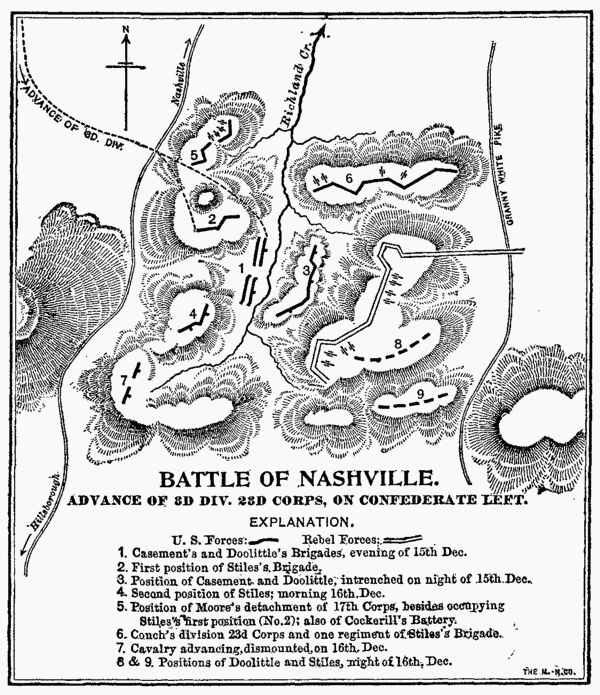
During the night of the 15th and the morning of the 16th the movement of Cheatham's corps to Hood's left had been observed by both our infantry and our cavalry. [Footnote: Official Records, vol. xlv. pt. ii. pp. 217, 224.] As part of these troops had been seen marching northward on the Granny White turnpike, Schofield very naturally took into consideration the probability of their being new reinforcements coming to Hood from the rear. [Footnote: Id., p. 214.] The extension of the enemy's fortified line to our right had made it necessary to extend my division in single line without reserves, and even then they were stretched almost to the breaking-point. [Footnote: Cox's Report, Id., pt. i. p. 407.] Thomas began his inspection of the line at Wood's position on the left in the forenoon, and came westward visiting the commands in turn. [Footnote: Wood's Report, Id., p. 131; A. J. Smith's Report, Id., p. 435; "Franklin and Nashville," p. 118; Schofield's "Forty-six Years in the Army," p. 246.]
At ten o'clock in the morning Wilson had most of his cavalry "refused, on the right of Schofield, the line extending across and perpendicular to the Hillsborough turnpike." [Footnote: Official Records, vol. xlv. pt. ii. p. 220. In the dispatch quoted, the name is given "Murfreesborough" by a manifest clerical error. Schofield's right was near the Hillsborough turnpike, the Murfreesborough turnpike being beyond the other flank of the whole army.] A regiment had been sent to try to reach the Granny White turnpike, but had been driven off and reported Cheatham's infantry moving to the left upon it. [Footnote: Id., p. 224.] Wilson reported this to Schofield, adding, "The country on the left of the Hillsborough pike, toward the enemy's left, is too difficult for cavalry operations. It seems to me if I was on the other flank of the army I might do more to annoy the enemy, unless it is intended that I shall push out as directed last night." [Footnote; Id., p. 216. See also Schofield's "Forty-six Years," p. 244.] Schofield acknowledged the receipt of this information at 11.15, and forwarded it to General Thomas. In view of the apparent concentration of the enemy's forces in his front, he advised Wilson, until he should receive other orders from Thomas (who was then on the left with General Wood), to hold his forces "in readiness to support the troops here, in case the enemy makes a heavy attack." [Footnote: Official Records, vol. xlv. pt. ii. p. 216. See also Schofield's "Forty-six Years," p. 244.] At half-past one his dispatch to Thomas, from his position on the field close to my own, fixes with clearness the situation at that hour. "Wilson is trying to push in toward the Granny White pike, about a mile south of my right. My skirmishers on the right are supporting him. The skirmishing is pretty heavy. I have not attempted to advance my main line to-day, and do not think I am strong enough to do so. Will you be on this part of the line soon?" [Footnote: Official Records, vol. xlv. pt. ii. p. 215; see also Stiles's Report, Id., pt. i. p. 431.]
In a letter written in 1882, to assist me when preparing to write my account of the battle of Nashville, [Footnote: "Franklin and Nashville," etc., chap. vi.] General Schofield gave me his recollection of the situation on our right during the morning of the 16th of December. [Footnote: Letter of June 1, 1882.] "I had gone back to Nashville in the night preceding," he said, "to persuade Thomas to order Wilson to remain on my right and take part in the battle the next morning, and A. J. Smith to close up on our left. Thomas had only partially adopted my views, and had not given Wilson any orders to attack. I had waited impatiently all the morning, and until some time after noon for Wilson to get orders from Thomas, or to comply with my request to put his troops in without waiting for orders. Finally, some time after noon, Wilson had consented to go in with his cavalry (I relieving him of all responsibility), and I had directed you, with your reserve brigade, which was not then in contact with the enemy, to support Wilson or join with him in attacking the enemy's flank." When Schofield received the proposal from McArthur through Couch, that an assault should be made on Shy's hill, in the angle of the enemy's line, by one of McArthur's brigades, supported by Couch, he "became impatient," he says, "for Wilson and Stiles [my flank brigade] to get possession of the commanding ground to the enemy's left-rear, so as to prepare the way for your [my] assault upon his intrenched line." [Footnote: See also General Schofield's discussion of the events of the 16th, in his "Forty-six Years," pp. 263-275.] The field dispatch of General Couch in regard to supporting McArthur was dated at 2.30 P.M. [Footnote: Official Records, vol. xlv. pt. ii. p. 217.]
General Schofield sought an opportunity to compare recollections with General Wilson, and wrote me again on the 29th of June, 1882, saying that he was greatly surprised to find that Wilson did not recollect the proposal and request stated above, but thought that General Thomas had come in person to his position on the Hillsborough turnpike, and about 10 or 10:30 o'clock A.M. had given him the orders under which he then undertook to advance against Hood's left-rear. Wilson also associated with it the capture of a dispatch from Hood to Chalmers, urging the latter to drive the Yankee cavalry from his left and rear, as otherwise he could not hold the position. This dispatch, Wilson said, he promptly sent to Thomas. As the conference between Schofield and Wilson was for the purpose of assisting me in getting undisputed facts for the history of the campaign, I was permitted to know the result and to have the contents of a letter from Wilson to Schofield of date of June 28, 1882, restating his recollection. In pursuance of my rule to avoid as far as possible the debate of subsidiary controverted points in my connected history, I omitted any reference to them in this instance. General Schofield's memory is, however, so strongly supported by the field dispatches, that it does not seem difficult now to reach a sound historical judgment.
It is plain that during the earlier part of the day General Wilson was reporting through General Schofield, who forwarded to General Thomas the information received. At some time before noon the latter had completed his examination of the position of the Fourth Corps on the left of the army, so that General Wood was at liberty to ride to General Steedman's headquarters on the Nolensville turnpike. [Footnote: Official Records, vol xlv. pt. i. p. 131.] Thomas passed westward to General Smith's headquarters at the centre, where he seems still to have been at three o'clock, [Footnote: Id., p. 435.] or at the time of the arrangement between McArthur and Couch, which the latter places at half-past two. [Footnote: Id., pt. ii. p. 217.] Thomas then visited General Schofield's position, where he was when the final assault was made and the enemy routed. General Wilson's reports make no mention of a visit from General Thomas on the 16th, and the contents of his dispatches show that there had been none up to eleven o'clock, when Thomas was with Wood on the other flank of the whole army. It can hardly be necessary to mention the extreme improbability of the commander's omission to visit Schofield's quarters near the Hillsborough turnpike, if he were going by that road to Wilson, who was also on it. We must conclude that General Wilson is mistaken in his recollection. That he saw General Thomas at Schofield's position late in the day, is conceded by all. [Footnote: The account in "Franklin and Nashville," etc., p. 119, must be modified in accord with the facts above stated.]
We find no mention in the records of any capture of an important dispatch from Hood to Chalmers, except that found on the person of Colonel Rucker, when he was wounded and captured at 6.30 P.M., trying to hold the pass of the Brentwood hills on the Granny White turnpike, in the darkness, two hours after the collapse of Hood's line. [Footnote: Official Records, vol. xlv. pt. ii. p. 218.] This dispatch seems to have strongly resembled the language used by Wilson in his letter to Schofield in 1882. It is said to have stated that Chalmers' cavalry must take care of this flank. In sending the information to General Johnson, Wilson added, "Go for him with all possible celerity, as Hood says the safety of their army depends upon Chalmers." [Footnote: Wilson to Johnson, Id., p. 222.] As we have already noted, Rucker's brigade, just routed, was all there was of Chalmers' division on that flank except a regiment covering trains making for Franklin.
The Confederate records support this view. Chalmers' report relates the skirmishing during the morning in which Rucker was holding the Hillsborough turnpike against Wilson, and the attempt on our side to move to the Granny White turnpike, from which Hammond's detachment was driven back. He says that with one regiment and his own escort he "held the enemy in check for more than three hours." [Footnote: Id., pt. i. p. 765.] This agrees very well with the situation as indicated in General Schofield's dispatch of 1.30 P.M., when a serious effort was making on our side to reach that road. Chalmers reported the fact that the regiment was hotly beset, and Hood's adjutant-general, in acknowledging it at 3.15 P.M., said, "Your dispatch, saying you were fighting the enemy with one regiment on the Granny White pike, received. General Hood says you must hold that pike; put in your escort and every available man you can find." [Footnote:Id., pt. ii. p. 697.] Chalmers reports that he received this about 4.30, when the regiment had been driven back; that he then moved up Rucker's brigade, which had reached the same turnpike nearer Brentwood, and after a sharp struggle it was routed. "By this time," he adds, "it was so dark that it was impossible to re-form the men, or, indeed, to distinguish friend from foe, so closely were they mingled together." [Footnote: Official Records, vol. xlv. pt. i. p. 766.] It was in this mêlée that Rucker was wounded and captured.
In preparation for the attack in concert with A. J. Smith's command, my flank brigade (Stiles's), which had been in echelon on our right, was ordered to swing forward in touch with our cavalry advance. [Footnote: My Report, Id., p. 407.] My own main attack was to be upon the bastion which made the flank of the enemy's works before us. I ordered Doolittle's brigade to charge straight at it. Casement's brigade, on Doolittle's left, was to march by the right flank at double-quick in rear of Doolittle, so as to become a second line to him and support the advance as might be necessary. The skirmishers of Stiles's brigade had accompanied the cavalry advance since half-past one, and in the final effort his troops in line were to take part as already stated. [Footnote: See Schofield to Thomas, 1.30 P. M., Id., pt. ii. p. 215; Stiles's Report, Id., pt. i. p. 431; my own Report, Id., p. 407, and sketch map accompanying the latter, Id., p. 408; also "Franklin and Nashville," etc., pp. 119-122.] After personal conference with my brigade commanders to insure complete mutual understanding, I rode to the hill in rear of my lines where Thomas and Schofield were together, [Footnote: Marked 2 in map, p. 359.] watching for the concerted attack upon Shy's hill in the salient angle of Hood's lines.
When Smith's men were seen to reach the summit of Shy's Hill, I received the signal from Schofield, and galloped down the hill toward Doolittle; but he also had caught sight of the movement, and his brigade was already charging on the run when I reached him. The excited firing of the enemy was too high, and Doolittle's men entered the works with very little loss. The collapse was general. As soon as we were over the works, I was ordered to stand fast with my command and give General Smith's command the right of way down the Granny White turnpike. Doolittle's brigade had carried the bastion in front of our right and the curtain adjoining it, and his line halted immediately in rear of these, partly facing the turnpike. He had captured a four-gun battery of light twelves in the bastion and another of the same number in the curtain, with the artillerists and part of the supports. [Footnote: See the official reports cited above, and special reports as to the guns, Official Records, vol. xlv. pt. ii. pp. 234, 235; also regimental reports, Twelfth Kentucky, Id., pt. i. p. 417, One Hundredth Ohio, Id., p. 420, and Eighth Tennessee, Id., p. 423.] Stiles, advancing with the cavalry, was halted a short distance in front of Doolittle, facing southward on the right of the turnpike. Casement was halted in the trenches from which Doolittle had started. [Footnote: Casement's Report, Id., pt. i. p. 425. All the reports on the National side except that of the cavalry refer to the concerted attack on Shy's hill as the signal for the general advance. The Confederate reports also speak of the carrying of that salient as the cause of the rout. In his second report, dated Feb. 1, 1865, and in his letter to General Schofield in 1882, cited above, General Wilson says that it was on his personal report of what his men were doing on the enemy's left rear that Thomas ordered the final assault.]
CHAPTER XLV
PURSUIT OF HOOD--END OF THE CAMPAIGN
Night after the battle--Unusual exposure--Hardships of company officers--Bad roads--Halt at Franklin--Visiting the battlefield--Continued pursuit--Decatur reoccupied--Hood at Tupelo, Miss.--Summary of captures--Thomas suggests winter-quarters--Grant orders continued activity--Schofield's proposal to move the corps to the East--Grant's correspondence with Sherman--Schofield's suggestion adopted--Illness--I ask for "sick-leave"--Do not use it--Promotion--Reinforcements--March from Columbia to Clifton--Columns on different roads--Western part of the barrens--Fording Buffalo River--An illumined camp--Dismay of the farmer--Clifton on the Tennessee--Admiral Lee--Methods of transport--Weary waiting--Private grumbling--Ordered East--Revulsion of spirits--On the transport fleet--Thomas's frame of mind at close of the campaign.
The night after the battle of Nashville was one we were not likely to forget. Twilight was falling when we halted, after the crushing of the Confederate lines, and as we were likely to join in the pursuit before morning, I had announced that I would be found with Doolittle's brigade. Owing to the darkness and a gathering storm, the troops having the advance did not get far, but the risks of missing dispatches that might be sent in haste made me adhere to my rule of staying where I had said I might be found. This kept the staff and headquarters in the space a little in rear of the captured line of works, a spot unclean and malodorous. We built a camp-fire, and tried to clean off spots on which we could sit on the ground; but a heavy rain soon came on, and as we were in the woods, the light soil soon made a mire, and we were forced to stand upright and take the weather as it came. The extreme weariness of standing about, with nothing to vary the monotony, physically tired and sleepy, in the reaction from the excitement of the afternoon, was something which cannot be understood unless one has had a similar experience. We had hoped our servants might find us during the evening and bring us something to eat; but the advance over hills and intrenchments had made it hard to follow our course even in daylight; but in the darkness and storm they entirely failed to find us. We felt a good deal like "belly-pinched wolves," but we had no den in which we could "keep the fur dry." Indeed, the suffering of a dog that was with us was a thing we often referred to as illustrating our utter discomfort. A fine pointer, astray in northern Georgia, had attached himself to me in October, and had been constantly with us, leaping and barking with joy whenever I mounted my horse. He was with us now, and when the rain came on he stood in the mud like the rest of us, finding no spot to lie down in. He grew tired and sleepy, and looked wistfully about for a place he could consent to lie in, but gave it up, and spreading all four legs well apart he tried to stand it out. Occasionally his eyes would close and his head droop, his body would slowly sway back and forth till he made a greater nod, his nose would go into the mud, and gathering himself up he would lift his head with a most piteous whine, protesting against such headquarters.
The longest night must have an end, and early in the morning one of our black boys found us, bringing with him on horseback a haversack full of hard-tack, and in his hand a kettle of coffee which we soon made piping hot at the camp-fire, and found the world looking much more cheerful. The storm continued, however, and made the pursuit slower and more difficult than it would have been in better weather. The cavalry had the advance, supported by A. J. Smith's troops on the Granny White turnpike, and by Wood's Fourth Corps on the Franklin turnpike. We were ordered to follow Smith. Our camp on the evening of the 17th was not far from Brentwood between the two roads which come together a little further on after crossing the Little Harpeth, some seven miles from Franklin and the larger stream of the same name.
Our headquarters the second night after the battle were an improvement on those of the night before. We found a knoll which was fairly drained, we borrowed a tarpaulin from a battery, and with fence-rails made of it a lean-to with back to the storm. A pile of evergreen boughs made a couch on which we lay, and a camp-fire blazing high in front made a heat which mitigated even the driving December storm. Our faithful black boys had coffee-pots and haversacks, so that we did not go supperless. I wrote home that my overcoat with large cape weighed about fifty pounds with the water in it, but it kept my body dry, and I found it better to wear it than to put on a rubber waterproof, for perspiration did not evaporate under the latter.
Our private soldiers wore the rubber poncho-blankets above their overcoats in wet weather, and two "pardners" would make a shelter tent of the pair of waterproofs which had metal eyelets to adapt them to this use. Veterans carefully selected the place for the tent, pitched it in good form, trenched it so that the water would flow off and not run into the tent; then with their bed of cedar boughs, their haversacks and coffee-kettles, they were not worse off than the officers,--better off indeed than their company officers who trudged afoot like themselves.
Transportation was so difficult to get that, in pressing forward, baggage was reduced to smallest possible allowance. In bad roads such wagons as we had were far behind the troops, and the company officers were exposed to severe hardships by the delay. I laid their condition before General Schofield, in a letter which better tells the tale than I could now give it from memory alone. [Footnote: Official Records, vol. xlv. pt. ii. p. 312.] "From the time we left Nashville," I wrote, "until last night [21st December], these gentlemen had no shelter, and only such food as they could obtain from the private soldiers, being far worse off than the men, since the latter had their shelter-tents and their rations in haversacks. The officers' rations and their cooking utensils are in the regimental wagons, which are necessarily left behind in movements such as we have lately made, and they must either furnish themselves with knapsacks and haversacks, and carry their cooking utensils upon their own persons or those of their servants, or be utterly destitute. Even if they do this, the wagons of the commissary of subsistence are also at the rear, except upon ordinary days of issue, and it would be necessary to issue to them precisely as is done to the soldiers in the ranks, and so break down the last vestige in distinction in mode of life between them and their commands. As it is, I state what I know from personal observation when I say that no individuals in any way connected with the army are enduring so much personal suffering and privation upon the present campaign as the officers of the line. As I know the commanding general will be most desirous to make any arrangement which is feasible to reduce the amount of discomfort, I take the liberty of suggesting that during the winter campaign the transportation for each regiment be one wagon for regimental headquarters and for company books and papers, desks, etc., as now, and in addition one pack-mule for each company. The pack-mules make little or no obstruction in the road, are easily moved to flank or rear in case of manoeuvre of troops, and will be up with the command when the regiment goes into camp. Unless some such arrangement is made, I fear many of our officers will break down in health, and many more, becoming disgusted with the hardships of the service, and especially with the difference between themselves and their more fortunate brethren of the staff and staff-corps, will seek to leave the army. In many commands some similar arrangements to the one I have suggested have been surreptitiously made; but as I have rigidly enforced the rule turning over to the quartermaster all unauthorized animals, I am the more desirous of obtaining for the gentlemen of the line whom I have the honor to command such authority to regulate their transportation as will save them from the apparently unnecessary hardships they have of late endured, without detracting from the mobility of the division." The plan suggested was one we had used in exigencies in the Atlanta campaign, and General Schofield immediately authorized it for winter use.
The cold rainstorm, in which the battle of Nashville had ended, lasted for a week, turning to sleet and snow on the 20th and clearing off with sharp cold on the 24th. [Footnote: Official Records, vol. xlv. pt. i. pp. 360, 361.] Worse weather for field operations it would be hard to imagine. The ordinary country roads were impassable, and even the turnpikes became nearly so. They had never been very solidly made, and had not been repaired for three years. In places the metalling broke through, making holes similar to holes in thick ice, with well-defined margin. These were filled to the brim with water, and churned into deep pits by the wheels of loaded wagons. It required watchfulness to see them, as the whole surface of the road was flowing with slush and mud. When a wheel went into one, the wagon dropped to the axle, and even where there was no upset it was a most difficult task to pry the wagon out and start it on the way again. The wagon-master was lucky if it did not stop his whole train, and it was no uncommon thing for a mule to be drowned by getting down in one of these pits. Hood's rear-guard under Forrest and Walthall destroyed bridges behind them, of course, and that our cavalry with the head of our infantry column were able to keep close on the enemy's rear till they passed Pulaski is good proof of the energy with which the pursuit was conducted. Yet it was necessarily slow, for it was confined to one road, the rest being impassable, and flanking operations could only be made on a small scale when in contact with the enemy.
When we reached Franklin on our southward march, we were halted for a day, so that we might not crowd too much upon the rest of the column, and I took advantage of the opportunity to study the condition of the battlefield there. My division camped between the Columbia and the Lewisburg turnpikes, on the ground over which the Confederates had advanced to attack it in the battle. Portions of the second line of works close to the Carter house and the retrenchment across the Columbia road had been levelled, but the principal defences were as we had left them. The osage orange-trees which we had used for abatis had been evenly cut away by the bullets, and the tough fibres hung in a fringe of white strings, the upper line quite even, and just a little lower than the top of the parapet. The effect was a curiously impressive one as we looked down the line we had held and thought what a level storm of lead was indicated by this long white fringe, and what desperate charges of Hood's divisions they were that came through it, close up to the line of this abatis. Every twig was weeping with the cold pouring rain of the dark midwinter storm, and this did not lessen the gloomy effect of the scene. At the Carter house we learned from the family many incidents of their own experience during the battle and of the scenes of the next day. [Footnote: See "Franklin," chap. xv.]
Our position in the rear of the marching columns put upon us the duty of building bridges, repairing roads, and improving the means of supplying the troops in front. We consequently made halts, one of two or three days at Spring Hill, and another in our old camps north of Duck River, where we had held the line of the river on the 28th and 29th of November. The day after Christmas we moved over the river and encamped in front of Columbia, on the Pulaski turnpike. We remained here for several days, whilst the Fourth Corps and the cavalry, making Pulaski their depot for supplies, followed Hood until he crossed the Tennessee on the 28th and 29th of December. The line of the Confederate retreat was stripped bare of supplies and forage, and every energy was devoted to rebuilding railroad bridges and getting the road opened to Pulaski so that wagon transportation might be limited to the region beyond the head of the rails. Thomas had ordered Steedman's and R. S. Granger's divisions to Decatur by rail, going by way of Stevenson. Once there, they were to operate in the direction of Tuscumbia and Florence, seeking to destroy Hood's pontoon bridges crossing the Tennessee. [Footnote: Official Records, vol. xlv. pt. ii. p. 260.] The light steamboats in the upper river were reckoned on to take supplies from Chattanooga, where an abundance was in depot. Steedman reached Decatur on the 27th of December, and Granger joined him from Huntsville, but Hood had reached Bainbridge, at the foot of Muscle Shoals on the 25th; [Footnote:Id., p. 731.] and next day had a bridge there, built in part of our pontoons which had been floated down from Decatur. [Footnote: Ante, p. 343.] He assembled the remnants of his army at Tupelo, Miss., fifty miles south of Corinth. The inspection report of January 20th showed 18,708, infantry and artillery, present for duty; Forrest's cavalry not reported. [Footnote: Official Records, vol. xlv. pt. i. p. 664.] Thomas's prizes in the two days' fighting at Nashville were reported by him as amounting to 4462 prisoners and fifty-three pieces of artillery. [Footnote: Id., p. 40.] The pursuit after the battle doubled the number of the prisoners, gathered large numbers of deserters, and considerably increased the number of guns captured. [Footnote:Id., pp. 46, 48, 51.]
On the 29th of December Thomas indicated to General Halleck his opinion that all had been done which was now practicable, and his purpose to put his forces into winter quarters,--A. J. Smith's corps with most of the cavalry at Eastport, where the Mississippi and Alabama line reaches the Tennessee River; the Fourth Corps at Huntsville, Ala., and the Twenty-third at Dalton, Ga. Steedman's and Granger's divisions were already at Decatur, and would hold that important position, with which direct railway communication from Nashville would be opened as quickly as the road could be repaired from Pulaski southward. Thomas also outlined for the spring a concerted advance of the columns into southern Alabama. [Footnote: Official Records, vol. xlv. pt. ii. p. 402.] The same day he issued his order to Schofield to prepare at once for the march of a hundred and fifty miles to northern Georgia. [Footnote: Id., p. 409.] A march of the same distance southward along the Mobile and Ohio Railway would have carried us to Hood's camps at Tupelo, with a prospect of immediate results, and we were not exhilarated by the order, which, however, was countermanded on the 30th in consequence of dispatches received by Thomas from Halleck.
General Grant had, on the 16th, authorized Sherman to make his own plan for a new campaign, and the latter had indicated the march from Savannah to Columbia and thence to Raleigh as that which he would make if left to himself. [Footnote: Id., vol. xliv. pp. 727-729.] The necessity of reducing the war expenses as soon as possible, as well as more purely military reasons, seemed to the General-in-Chief to make a continuous winter campaign imperative, and by his orders Halleck had directed Thomas not to go into winter quarters, but to assemble his army at Eastport and prepare for further active work. [Footnote:Id., vol. xlv. pt. ii. p. 441.] Grant rightly concluded that Hood's army would be sent to the Carolinas as soon as Sherman marched northward. He was therefore considering combinations of Thomas's with Canby's forces for the capture of Mobile and a movement on Selma, Ala., which was the only great armory and manufacturing centre now remaining to the Confederates in the Gulf States. [Footnote: Official Records, vol. xlv. pt. ii. pp. 419, 420.] Our army was a good deal worn with the hardships of the campaign, our wagon trains had not been brought up to the requirements for full field service, and we were receiving new troops which were not yet fully assimilated to the old; but the advantages of following up our successes by unflagging efforts in the West as well as in the East, and of making the "long pull and a pull all together" which would end the war, were so plain that all responded cheerily to the call.
But in the Twenty-third Corps a new element entered into the debate, which resulted, a fortnight later, in orders for us to move in a widely different direction. On the 27th, the day that we received at Columbia the news that Sherman had taken Savannah, Schofield wrote an unofficial letter to Grant, suggesting that the corps would no longer be needed for the spring campaign which Thomas was then planning, and that with its increase of strength it might be of more use in Grant's own operations in Virginia if it was not practicable for us to rejoin Sherman. [Footnote: Id., p. 377.] Circumstances were making Schofield's situation in Tennessee uncomfortable, for, as he said in the same letter, he was in an anomalous position, nominally commanding a department and an army, but practically doing neither. Such considerations reinforced the military reasons, but the latter were strong enough to establish the wisdom of his suggestion to Grant. He wrote at the same time to General Sherman, indicating that his strongest wish would be to join the army at Savannah if it should be feasible, for he recognized the great military importance of now concentrating against Lee. [Footnote: "Forty-six Years," p. 254.] It happened that on the same day that Schofield was writing these letters, Grant was writing to Sherman, expressing his pleasure in the latter's confidence of his ability to march through the Carolinas, and his own belief that it could be done. "The effect of such a campaign," he said, "will be to disorganize the South, and prevent the organization of new armies from their broken fragments." [Footnote: Official Records, vol. xliv. p. 820.] Giving a sketch of the situation in the West, he thought Sherman's advance would force the Confederacy to use Hood's broken army without allowing it time to collect its deserters and reorganize. As it would thus be "wiped out for present harm," he was considering the plan of ordering A. J. Smith away from his temporary connection with Thomas's main army, and bringing him with ten or fifteen thousand men to Virginia to make his own army strong enough to deal effectually with Lee, whether the Confederate general continued to defend Richmond or should abandon that city. [Footnote:Ibid.] Schofield's suggestion fitted so well the plan Grant was revolving in his mind, that he decided to bring the Twenty-third Corps East, instead of Smith's. On the 7th of January he directed Thomas to send Schofield and the corps to him with as little delay as possible, if he were sure that Hood had gone further south than Corinth. [Footnote: Id., vol. xlv. pt. ii. p. 529.] When Thomas received the order on the 11th, he was at Paducah on the Ohio River, and about to start up the Tennessee by steamboat. We were at Clifton on the Tennessee, after a hard march of some seventy miles southwest from Columbia, and were awaiting steamboats to take us up to Eastport, wholly ignorant of the surprise that was in store for us. [Footnote: Id., pt. i. p. 363.] Even Schofield had received no word from Grant as to his action.
In making this outline of the changing plans of our superiors, I have outrun the current of my personal experience in which some things may be worth noting. On the day after the battle of Nashville, I was conscious of malarial poisoning from the specially unwholesome conditions of our bivouac on the night of the 16th, but was so confident in the vigor of my constitution in throwing off such ailments that I paid no attention to my health, and kept about my duties with my ordinary activity. I found, however, that my strength was not equal to the demands upon it, and by the time we reached the Duck River on the 23d of December, I was glad to find quarters at the house of Mrs. Porter, in the bend of the river, where we had been during the two days before the battle of Franklin, and where we were again received with a kindness and hospitality which was wonderful when one considers how the passing and repassing of armies had ruined the country and overstrained the sympathies of the people.
Fortunately for me, our movements were suspended for a week and we made but one change of camp, crossing to the south side of the river, and taking the position in front of Columbia which I have already mentioned. [Footnote: Ante, p. 373.] My medical director, Surgeon Frink, gave me heroic treatment, and by the time we marched again on the 2d of January, I was able to do my ordinary duties, though I did not become quite well again till I reached the sea-coast and got a complete change of climate. At this time we were expecting to go into winter quarters, and when, on 29th December, I learned that orders were issued for the corps to winter at Dalton, I requested and received a leave of absence for thirty days, to go home and recover my health. [Footnote: Official Records, vol. xlv. pt. i. p. 361.] My order had been issued, turning over the command to Colonel Doolittle, the senior brigade commander present, [Footnote:Id., pt. ii. p. 476.] when I learned from General Schofield that the active campaign was to be resumed and that he had abandoned the purpose he had formed of going north himself as far as Louisville. I immediately rescinded my own order, and marched with the command. [Footnote: Id., pp. 426, 474, 475, 486.]
During the pursuit of Hood from Nashville, Thomas had followed in person the Fourth Corps, which was in advance of ours, and Schofield had no opportunity of personal conference with him, so that our only knowledge of his purposes was got from the formal correspondence with his headquarters. When Colonel Doolittle sent forward his communication reasserting the capture of the battery in the curtain of the Confederate works on the 16th of December, [Footnote:Ante, p. 366.] it was accompanied by my own and indorsed by General Schofield. It reached Thomas at Duck River, and he made it the occasion of indorsing upon it a recommendation for my promotion to the grade of Major-General. [Footnote: Official Records, vol. xlv. pt. ii. pp. 234, 235.] On the 19th, from Franklin, General Schofield made his own recommendation in terms which I may be pardoned for feeling more pride in than in the promotion itself. [Footnote: See Appendix C.] This was earnestly supported by General Thomas and forwarded on the 20th. The only vacancy in the grade was one made by the resignation of General McClernand, and to this I was assigned, as of the 7th of December, the date of General Schofield's report of the battle of Franklin, though the official notice of the promotion did not reach me till the 15th of January, at Clifton, as we were about to take steamboats for our movement to the East. [Footnote: Official Records, vol. xlv. pt. ii. pp. 273, 274; Id., pt. i. p. 364. Army Register for 1865, pp. 54, 95. Another vacancy occurred on the 13th December, by the resignation of General Crittenden, and to this General W. B. Hazen was appointed for his assault of Fort McAllister near Savannah. (Ibid.) On December 22d Mr. Stanton asked Thomas to make a list of promotions he desired to recommend, but informed him that there was then no vacancy in the grade of Major-General, and only two in that of Brigadier. (Official Records, vol. xlv. pt. ii. p. 307.) General Schofield thinks that Stanton, in the dispatch last mentioned, referred only to vacancies in the regular army. (Forty-six Years, p. 279.) The circumstances and the whole correspondence seem to me inconsistent with this view. Thomas made out his list on the 25th, and it was for promotions in the volunteer service only. (Official Records, vol. xlv. pt. ii. p. 343.) Thomas's own promotion as Major-General in the regular army was made on the 24th. (Id., pp. 318, 329.)]
Before leaving Columbia, General Schofield had, on the 28th of December, a consultation with his three division commanders in regard to the assignment of the new regiments, to the number of twelve or thirteen, which had been added to the corps. [Footnote: These included two or three which had been temporarily attached at Franklin, but were now made permanent parts of the organization.] It was agreed that it was best to preserve the older organizations of divisions and brigades, and to strengthen these by some new regiments, while the rest of the new regiments were organized into a division under General Ruger. [Footnote: Official Records, vol. xlv. pt. ii. p. 409.] Schofield had the promise of several other regiments whenever they should come forward; and by correspondence with Halleck and with the Governor of Illinois, as well as with Thomas, he was actively striving to bring the corps to the proper strength of three full divisions. At the end of the month we had 15,000 men, with at least two other regiments ordered to join us, one of them convalescing from the measles, which was very apt to run through a new organization taking the field. [Footnote:Id., pp. 426, 436, 445, 461, 473, 475.] The new troops were nearly all officered by men of experience, and contained many veterans who had re-enlisted. We thus welcomed back valuable men who had served in the corps, and came to us with increased rank and a renewed zeal which made our reinforcements at once nearly equal to seasoned troops.
Our orders to march from Columbia on the 1st of January were in pursuance of the orders Thomas had received to concentrate his army at Eastport and Tuscumbia for the continuance of the campaign. The Fourth Corps was en route to Huntsville, and Thomas did not change its destination, as he thought it could take part in new movements as well from that position as from Tuscumbia. A. J. Smith's corps had already been ordered to Eastport for winter quarters, and had marched from Pulaski by way of Lawrenceburg and Waynesborough, reaching Clifton on the 2d of January, where it awaited steamboat transportation. [Footnote: Official Records, vol. xlv. pt. ii. pp. 396, 410, 420, 427, 486. Clifton is called Carrollville in official Atlas, pl. cxlix. The former name is that used in the dispatches and which we found in use by everybody. The roads and topography in the map are very incorrect.] Thomas himself was at Pulaski, and went back by rail to his headquarters at Nashville, whence he took a steamer to convey his field headquarters and staff by way of the Cumberland and Tennessee rivers to Eastport. [Footnote: Official Records, vol. xlv. pt. ii. pp. 470, 530, 567.]
We marched from Columbia on the morning of the 2d of January, 1865, following the turnpike to Mt. Pleasant, ten miles, through some of the finest farms in the State. The afternoon was spent in organizing the corps to move in separate columns by division, each with its own supply train; for the information we got as to the condition of the roads made it wise to try any country roads which had not been used by the armies. It was arranged that Couch's division should march by the turnpike to Waynesborough, wind by a ridge road through the "barrens" north of the turnpike, and Ruger should follow me some distance, and then take an intermediate road through Laurel-Hill Factory, leaving an interval of a day's march between our columns. Couch's division was preceded by the engineer battalion of the corps, as pioneers to repair the turnpike. [Footnote: Id., pp. 475, 486.] Promptly at six o'clock on the 3d, my division marched from Mt. Pleasant, continuing for five miles on the Waynesborough turnpike, then turning to the right upon the Gordon road, we climbed by a steep and long hill to the barren ridge which is the watershed between the Duck River and Buffalo River. Five miles from the turnpike our way ran into the Beaverdam road, which we kept for five miles further to the fork of the Ashland road, turning to the left. Here we camped and waited for our trains, which had slow work in climbing the ridge, for it had rained all the morning, and the roads were slippery. [Footnote: Id., pt. i. p. 362; pt. ii. p. 498.]
It was noon of the 4th before the trains overtook us, and I then ordered an issue of rations to lighten them, and we started again, with a citizen for a guide. We followed the Perryville road seven miles to the headwaters of Grinder's Creek, a tributary of Buffalo River, and down the creek three miles, the road being a mere track in its bed. We now turned to the right over a ridge and came down into Rockhouse Creek, the course of which we followed to the river. I had learned that we must ford the Buffalo, and from the wet weather it would be whole leg deep. It was getting late in the day, and Rockhouse Creek had to be crossed many times; so I passed the order along the line not to try to bridge, but to march straight through the creek and make the more important crossing of the river before going into camp. This seemed hard, in the month of January, when, as it had cleared and was cold, ice was forming in the still places of the stream; but I heard that open farm lands bordered the river on the other side, and if our wading was done all at once, we could make the men dry their clothes and shoes with less danger to health than if we began another day with a soaking. [Footnote: Official Records, vol. xlv. pt. i. p. 362.]
It grew dark several hours before we reached Buffalo River, the column plodding along in the wooded ravine. I had turned out from the road to wait for the brigades to pass, and have a word with the commanders in turn, and was picking my way to the head of column again, when I overheard one of those little colloquies between soldiers which give real pleasure to an officer. A fresh recruit was grumbling at marching in the darkness and in the water, and wondering what generals could mean by putting such hardships upon the soldiers, when a veteran by his side answered cheerily, "When you've been in this division as long as I have, you'll know there's some good reason for pushing us this way; so take it easy, and don't growl. The General knows what he's about." I turned further out into the darkness, with a feeling that it would cheapen the brave man's words to let him learn who had heard him, but the evidence of the trust which is the foundation of soldierly devotion gave a deep satisfaction. When the column reached the river, which was about seventy-five yards wide, fires were lit on both sides as guides to the ford, and though it was near nine o'clock, the men were not permitted to rest till they had thoroughly dried themselves around the great fires of fence-rails. They did not need orders to boil their coffee and cook a hot supper in their bivouac. The broad fields between the hills and the river were illuminated far and wide, and the stillness of the dark valley was transformed into the noisy activity of the armed host. All in the camp were "merry as grigs," and did not need to be told why the march had been prolonged into the night. But the fun of the soldier was the grief and dismay of the farmer.
The place belonged to an elderly man named Churchill. We had to make use of his house for headquarters, and while our boys were cooking our supper, a busy group of officers was seated about the crackling fire in an open fireplace, writing dispatches and orders, receiving reports, and sending messages, while in the shadows of the background the farmer and his wife were moving uneasily about, looking out of door or window, and wringing their hands at the vision of destruction which had suddenly descended upon them. The old man protested at the burning of his fences, naturally enough, and all we could say was that, in the end, if he could prove his loyalty, he would be indemnified for his loss; but this was small consolation, and we pitied him whilst we applied the pitiless code of military necessity to save the troops from worse mischiefs.
The ridge road we had followed had been so completely a wilderness that we saw but one inhabited house for fifteen miles. The hillsides were covered with a young forest, the original woods having been cut off and made into charcoal for the iron furnaces of the region. In good weather it would have been easy marching through the region, for the top of the ridge was fairly level, winding along in a general westerly direction; but as the road had never been "worked," and was a mere wagon track, it soon became muddy, and our wagons cut it so deeply as to spoil it for the use of any who were to follow us, and to make about fifteen miles a day the most we could ourselves accomplish.
Starting again on the 5th, we marched through Ashland, [Footnote: In the Atlas, pl. cxlix., Ashland is erroneously placed north of Buffalo river.] up the valley of Forty-eight-mile Creek and thence along a ridge to Waynesborough, encamping just beyond the town. Our road ran into the turnpike two miles east of the village, and we met Couch's division at the junction of the roads. We took the advance, which we kept during the next day's march to the Tennessee, reaching Clifton toward evening of the 6th, after a very hard day's work, the weather beginning with rain in the morning and turning to sleet and snow after noon. We pitched our tents in the snowstorm, locating the camp more than a mile from the landing-place, as the eligible ground nearer was occupied by Smith's corps, which was waiting for transports to take them up the river.