Front matter (continued 10)
Reading edition
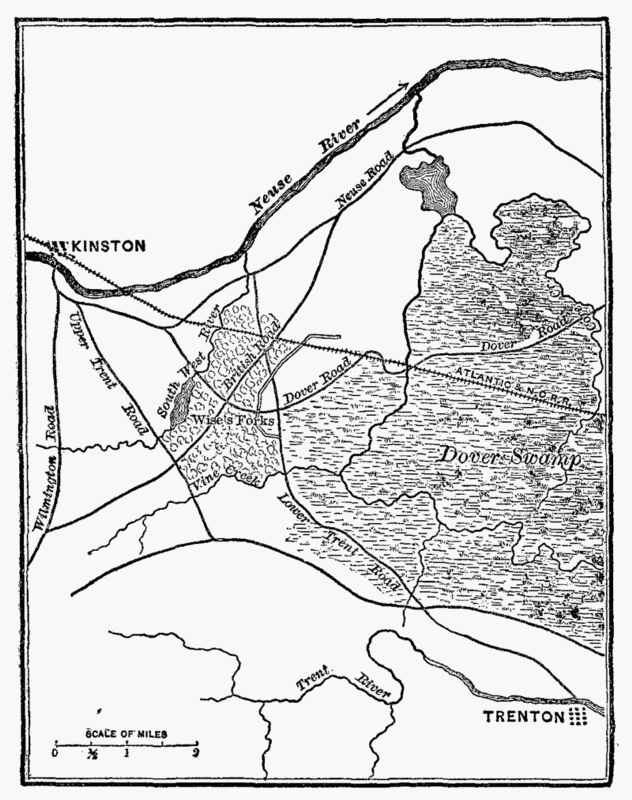
My habit was to keep my own headquarters well at the front, and I had purposed moving them from Gum Swamp to Wise's Forks on the 7th, but during the day I received word that General Schofield had arrived at Beaufort from Wilmington, coming by sea. We arranged that he should come up for a consultation with me next morning, and to facilitate this, I left my headquarters with Ruger's division, and after a personal visit to Palmer and Carter, I rode back to Gum Swamp in the evening. General Schofield was to come up to the end of the track on the railroad in the morning, and I sent led horses to meet him. [Footnote: Official Records, vol. xlvii. pt. ii. pp. 722-724.] The telegraph was made to keep pace with the progress of the railway, and from its upper station we had the aid of flag signals along the railroad bed to Palmer's headquarters. [Footnote: Id., pt i. p. 918.] The information we had received of Hoke's presence made it all the more important that we should get out of the swamps, where we could only operate by head of column, to the drier region along Southwest Creek, where the lower Trent road and the British road would give us communication between our flanks and some chance to manoeuvre. These reasons had made me push forward on the 7th, though the movement put us ten miles above the head of the rails and made it sure that we should be short of supplies. As soon as the troops were in position the few wagons with them were unloaded and hurried back, first for ammunition and then for rations. [Footnote: Id., pt. ii. p. 734.] We then had no knowledge of the arrival of any part of Hood's army in North Carolina, and although my provisional corps was far short of being solidly organized, and the troops were either new or unused to field service, I felt no concern lest Hoke should take the offensive alone.
General Schofield had joined me at Gum Swamp about nine o'clock on the morning of the 8th, and after our conference we had mounted to ride to General Palmer's headquarters to see what prospect there might be for securing a crossing near the railroad which would permit preparation for rebuilding the railroad bridge. A note now came from General Carter at Wise's Forks telling of information received from a negro that a large body of the enemy had crossed Southwest Creek at the Wilmington road early in the morning. As the cavalry had a picket at the upper Trent bridge and were supposed to be patrolling beyond the Wilmington road, the information did not seem threatening, but I sent back directions to have the cavalry ordered to do their work thoroughly by instantly testing the truth of the information. Carter was also ordered to support the cavalry with a regiment of infantry. [Footnote: Official Records, vol. xlvii. pt. ii. p. 734.] The message from the front was followed almost instantly by another, saying that a heavy force of the enemy had penetrated between Upham's brigade and the rest of the division, almost simultaneously with a report from the cavalry that their picket had been driven from the bridge at the Trent road. As that picket was two miles in front of Upham's left on the British road, it was too evident that the duty of the horsemen had not been well done. Ruger was ordered to march his division at speed to the front, and we galloped to Wise's Forks. [Footnote: Id., pt. i. pp. 977, 994.]
The account I have before given of the enemy's dispositions for the day's work [Footnote: Ante, pp. 429, 430.] makes it easy to understand the situation as we found it. Hoke, with his own and Clayton's divisions, had turned northward on the British road after getting over Southwest Creek, and as he approached the Dover road, had deployed and advanced upon Upham's flank. The latter, upon the first intimation of an enemy's approach, had hurried the Twenty-seventh Massachusetts to the British road and placed it in line about a quarter of a mile south of the Dover road, which was, of course, his connection with the rest of the division. He also ordered to the same point the section of artillery, and directed the left battalion of his other regiment (Fifteenth Connecticut) to change front also to the south. These orders were judicious, but the odds were too great to make them successful. Far outflanked on either hand, the Massachusetts regiment was put to rout, all the horses of one of the guns were killed, and though the men cut the traces and tried to save the gun by hand, they had to abandon it, while the other retreated on the run toward the main position. [Footnote: Official Records, vol. xlvii. pt. i. pp. 997-999.] General Hill had crossed the creek at the improvised bridge on hearing the sound of Hoke's engagement, but finding a swamp between him and Upham's right, had to make a circuit of it, driving back our pickets in the interval between Carter's and Palmer's divisions. Turning toward the noise of Hoke's firing, he intercepted the right battalion of Upham's Connecticut regiment, and took many of them prisoners. [Footnote:Id., p. 1087.] Most of the rest of the regiment finding Hoke's division partly surrounding them, and all other retreat cut off by Hill, surrendered to Hoke. Colonel Upham and most of the Massachusetts regiment succeeded in reaching our main lines, though in confusion. All this was not done, however, without fighting, which took time, and as the whole engagement was in forest or swamp, the enemy was a good deal delayed in his movements and in rectification of lines.
When we reached the field Carter had gone in person toward Upham's position, having first sent a regiment forward on the Dover road to try to reopen communication with him. Palmer was ordered to send his reserve brigade rapidly to extend his left and assist Carter. But as there was still an interval between them, the regiment of cavalry which had come in on the left was transferred to the centre and ordered to make a strong skirmishing fight till Ruger's division could arrive on the ground. Palmer at the same time was ordered to demonstrate strongly toward the creek. Riding forward on the Dover road, I found Carter with the regiment from his division, still energetically striving to reach Upham. As the sound of the battle showed that the enemy was also in front of our centre, it was evident that we must make a concentration of our forces till the divisions were in touch with each other. I therefore directed Carter to make his main line in front of Wise's Forks as solid as possible, concentrating his artillery near the Dover road, and to limit the activity of the advanced regiment to bold skirmishing, drawing it back to the main line as the enemy advanced in force.
Hoke had evidently supposed that Upham's detachment on the British road was the flank of our principal position, and was surprised at finding strong demonstrations from the direction of Wise's Forks, now partly in his own rear. This checked his progress and made him turn upon Carter. The advanced regiment retired as ordered, and when it was within the lines the enemy was saluted with such a fire of artillery and musketry as instantly checked him. Although he repeated his efforts to force the position at the Forks several times, they all were futile, and Carter had at no time the least difficulty in holding his main line firmly.
In Palmer's division, when Hill's advance across the creek drove back the pickets and threatened to pass the left flank of Boughton's brigade, this officer drew back his left to the British road and threw up a hasty barricade there. [Footnote: Official Records, vol. xlvii. pt. i. p. 992.] Claassen's brigade was sent to prolong Boughton's line to the left, and Ruger's division having come up, the connection between Palmer and Carter was secured, the latter advancing his brigades so as to make a better continuous line. The attacks of Hoke and Hill extended across Ruger's front, but nothing heavier than brisk skirmishing occurred on Boughton's line. Claassen's brigade was sent forward toward Jackson's Mill, accompanied by my aide, Captain Tracy, in order to locate the left of the enemy's line, and determine the extent of his forces in front of our left and centre. No strong opposition was met till the Dover road came in sight, where the enemy were seen moving toward Hoke's position in front of Carter. Claassen was followed back in his orderly retirement to his position on Ruger's right, and was attacked there, but easily repulsed his assailants. [Footnote: Official Records, vol. xlvii. pt. i. pp. 982, 990.]
Palmer had reported sharp skirmishing across his front all the way to the Neuse road on his right, and had drawn his lines back a little, so as to keep them in front of the British road, contracting his right and extending his left, as the sound of the fighting showed that the heaviest attacks were falling upon Carter. By the middle of the afternoon a continuous line of breastworks had been made along the whole of Palmer's division in front of the British road. Ruger had extended it diagonally till it joined Carter's right, the latter continuing it across the Dover road in front of Wise's Forks to a difficult swamp on the extreme left. For our left, the lower Trent road served for our communication along the front, and for our right the British road was used in like manner.
Late in the day there were indications of an attempt to turn Palmer's right on the Neuse road, and this, which added to the complexity of the situation, seems to have grown out of an excentric movement of the Confederate left under Hill. In crossing Southwest Creek to make his attack, he tells us the plan had been that when Hoke should strike our flank on the Dover road, he should cut off any retreat on the British and Neuse roads. This would be best accomplished by pushing straight from his bridges for the British road. But having made a circuit about a swamp to the rear of Upham's right, he received a note from Bragg's headquarters saying that Hoke wished he would enter the British road from the Neuse road, which implied a long circuit to their left. As Hoke had himself made the bridge by which Hill had crossed, and knew the field better than the rest by his skirmishes of the previous day, it is evident that there was an error in interpreting his wish. But as Hill was on ground unknown to him, and Bragg's dispatch directed Hoke's suggestion to be carried out, Hill obeyed, and turned his troops down the right bank of Southwest Creek, feeling the way to the Neuse road through swamps and woods. Reaching the outlet of the British road at half-past four without seeing signs of our retreat that way, and the distant firing showing that Hoke was not advancing, Hill thought it too late to venture further, and marched back by the way he had come five miles to his bridge. [Footnote: Official Records, vol. xlvii. pt. i. p. 1087.] His presence had been observed by our pickets and skirmishers, and was naturally interpreted by Palmer as the advance of a new column which had crossed the creek by the Neuse road. It, of course, gave an exaggerated impression of the enemy's strength, and as prisoners had been taken belonging to Lee's corps, who reported part of Hood's old army present with Bragg in command of the whole, we had to take into account the contingency of our having on our hands the formidable force thus indicated. Hill was met at his bridge by orders to cross to the left bank and join Hoke by recrossing at Jackson's Mills and following the Dover road. He effected the junction about midnight. [Footnote: Ibid.] Hoke had been keeping up a skirmishing fight in the latter part of the day, and at night intrenched himself across the Dover road just in front of the British road. Hill, after joining him, continued the line northward, parallel to ours, and therefore crossing the British road again, recurving toward the creek. Our breastworks were made stronger, and we kept our teams hard at work bringing up ammunition and supplies. General Schofield went back to New Berne to get into communication with the rest of his department, and try to hurry forward the two old divisions of the Twenty-third Corps, who were marching to join us. [Footnote: Official Records, vol. xlvii. pt. ii. pp. 743-751.] My own orders were to remain on the watchful defensive whilst the construction of the railroad toward us went on energetically. On Thursday, the 9th, we husbanded our resources, for our ammunition was running short and the roads through the swamp were nearly impassable. We extended our works on Carter's left, recurving them so as to cross the lower Trent road, and, though we had no troops at the moment except one regiment of Ruger's to put into these intrenchments, they were ready for prompt occupation by any we might send there if another effort were made to turn that flank. [Footnote: Id., pt. i. pp. 978, 995.] With this in view, General Ruger was directed to put one of his brigades in reserve, extending the rest of his troops to fill the vacancy so made, and covering the front with abatis and slashed timber. Pickets were advanced and every effort made to obtain information and keep close watch of the enemy's movements. About ten o'clock General Palmer reported a force moving toward the Neuse road which, after demonstrating there for some time, marched back again. [Footnote: Id., pt. ii. pp. 747, 749-750.] This seems to have been an effort to repeat the movement of Hill on the previous afternoon, but this time by Hoke's division. Finding Palmer's line in good earthworks, Hoke made no attack, and returned to his position, though Bragg's order declared that "success must be achieved." [Footnote:Id., p. 1359.] While this was going on, Hill advanced his line and drove in Carter's skirmishers; but these being reinforced, quickly retook their rifle-pits, and Hill retired to his own works. [Footnote: Official Records, vol. xlvii. pt. i. p. 1087.] Bragg's delay in testing conclusions with us was due, in part no doubt, to the fact that Stewart's corps of the Army of Tennessee was en route to him, and the railway was being worked energetically to bring up these reinforcements. They arrived during the day, and the final attack upon us was arranged for Friday, the 10th. Stewart's men were under the command of General Walthall, the senior division commander present. [Footnote:Id., p. 1088.]
In the night of Thursday and the early morning of Friday, the active skirmishing of the enemy was so continuous as to remind us of the days in the Georgia campaign when the intrenched lines of the opposing armies faced each other in the narrow valley near New Hope Church. [Footnote: Id., pt. ii. p. 769.] Bragg ordered Hoke's troops to be relieved by Walthall's, and to make a considerable circuit to their right, seeking to reach the lower Trent road in our rear, and, advancing upon it, attack Carter's division in reverse. The sharp skirmishing had covered these changes of position. Upon hearing the sounds of Hoke's attack, Walthall and Hill were to assist him by strong demonstrations, but, as the latter says, in deference to his report that the men were very unwilling to attack earthworks, "their experience in the late campaign [in the west] not being favorable to such an undertaking," no actual assault was ordered, but doubled skirmish lines were to advance as far as possible. [Footnote: Id., pt. i. p. 1088.]
On our side we were watchful and expectant, my orders to the divisions being that whenever one part of the line should be engaged, the rest should push forward strong skirmish lines to test the extent of the enemy's deployment, and gain the information on which I could act in reinforcing either wing from the other. General Greene, who was on his way to rejoin Sherman, volunteered for duty as a staff officer, [Footnote: Official Records, vol. xlvii. pt. i. p. 979.] as did General Stiles of my own division of the Twenty-third Corps, who was likewise returning to his proper command. [Footnote: General George S. Greene, division commander in the Twentieth Corps, had commanded a division in the Twelfth Corps, before its consolidation into the other. He was the same who was distinguished at Antietam (ante, vol. i. pp. 321-331). He graduated at West Point in 1823, and was a descendant of General Greene of the Revolutionary War, a military stock well continued in F. V. Greene of the Engineers, a general officer in the late Spanish War.] The absence of most of my own staff made their help most acceptable.
General Schofield was on his way up from New Berne, and horses were awaiting him at the end of the railway when, about half-past eleven, Hoke's attack came with much more energy and resolution than the Confederates had shown before. Ruger's reserve brigade (McQuiston's) was ordered over to the left at once, a brigade he had loaned to Palmer (Thomas's) was ordered back, and Palmer was ordered to send another brigade if the enemy was quiet in his front. Hoke's attack lapped so far over the lower Trent road as to threaten the Dover road also, and lest General Schofield should be in danger of capture, I directed Palmer to signal down the railroad track for him to await further news from us before leaving the train. [Footnote:Id., pt. ii. p. 772.]
The artillery of both Carter's and Ruger's divisions were concentrated upon Hoke, who was surprised to find our line so well prepared to meet him. For nearly an hour, however, the fighting was fierce; but it then began to flag a little, and I at once ordered McQuiston's brigade to charge, throwing the left forward upon Hoke's flank. This was decisive, and the enemy broke and fled. Walthall and Hill were now advancing against Carter's right and against Ruger, and as the line of the latter was very thin, I had to recall McQuiston in the full tide of pursuit and send him back to the centre double quick. He brought in nearly 300 prisoners, and our left was relieved of all danger. For a while my headquarters group was in a hot place. General Greene had his horse shot under him, one orderly had an arm taken off by a shell, two others were wounded, and several had horses killed.
The men of Stewart's and Lee's corps were to have co-operated with Hoke, but the difficulty of movement over such blind and wooded country caused delay which gave time for me to reinforce the centre. The artillery was hurried to the same position, and the Confederates were defeated easily, their unwillingness to assault breastworks being increased by the sight of Hoke's men in disordered flight. At half-past twelve I was able to send word to General Schofield that the road was no longer threatened by the enemy, and he joined us before the fighting at the centre was over. [Footnote: Official Records, vol. xlvii. pt. i. p. 978; pt. ii. p. 772.] Bragg withdrew to the intrenchments he had occupied on the 9th. The certainty that two corps of the Army of Tennessee were represented in the attack besides the troops of Bragg's own department, added to the lack of supplies and munitions, made us quite willing to remain on the defensive and await the arrival of Couch, who was within a day's march of us with the two veteran divisions of the Twenty-third Corps. The construction of the railroad and the hurrying forward of ammunition were ordered with strenuous urgency, and messages to Couch made him force the marching to join us. [Footnote: The officer who was sent by Schofield to hasten Couch's march found my old division at the head of the column slowly filing over a rickety foot-bridge in the darkness, grumbling at the continued plodding in the mud. He shouted to them the news of our fighting and my possible need of help. The cry went up from the men, "If General Cox wants us, he can have us," and they dashed into the stream in solid column, forcing the pace till they reached the field.] Bragg retreated in the night of the 10th and was speeding back to Goldsborough by rail, for Johnston was now hastening to join Hardee, who was retreating before Sherman out of South Carolina.
The numbers which Hill and Walthall brought to Bragg were smaller than we inferred from our knowledge of the organizations present. We took prisoners belonging to four divisions of Hood's old army. Hoke's division and the brigades of Whitford, Hagood, and Baker had all been stronger in numbers than similar organizations of our own. We were necessarily wholly ignorant of the causes which had reduced the divisions coming from the West, and indeed learned of their presence in North Carolina only through the prisoners we took in the engagement and the deserters who came into our lines. As we have seen, [Footnote: Ante, p. 424.] the number of Hood's men in the State at the beginning of the month was over 9000, with other detachments on the way. Bragg's other forces were an equal number. After all the casualties of the campaign, the Army of Tennessee reported 11,442 present on April 7th, of which 8953 were "effectives." When they were paroled at Greenesborough on April 26th, 17,934 appeared and signed the papers. [Footnote: Official Records, vol. xlvii. pt. i. pp. 1059, 1066. In the table of the paroled, Cheatham's two divisions (his own and Brown's) are listed in Hardee's corps, and with those of Stewart's and Lee's corps, less Anderson's (late Talliaferro's) division, make the total given.] It is impossible to tell exactly what part of these were at Kinston. Hill's claim that he had but little over 1300 effectives in five brigades of Lee's corps is not credible. [Footnote: Id., p. 1088. For my criticism of his amusingly erroneous statements in regard to Antietam, see "The Nation," No. 1538, p. 462, and No. 1543, p. 71.] It is certain that Bragg knew I had three divisions and that he believed his force was the stronger. Our losses had been 1337, of which 900 were the "missing" in Upton's brigade and the cavalry. Bragg made no formal report of the campaign or of his losses in this part of it.
CHAPTER XLVIII
JUNCTION WITH SHERMAN AT GOLDSBOROUGH--THE MARCH ON RALEIGH--CESSATION OF HOSTILITIES
Occupation of Kinston--Opening of Neuse River--Rebel ram destroyed--Listening to the distant battle at Bentonville--Entering Goldsborough--Meeting Sherman--Grant's congratulations--His own plans--Sketch of Sherman's march--Lee and Johnston's correspondence--Their gloomy outlook--Am made commandant of Twenty-third Corps--Terry assigned to Tenth--Schofield promoted in the Regular Army--Stanton's proviso--Ill effects of living on the country--Stopping it in North Carolina--Camp jubilee over the fall of Richmond--Changes in Sherman's plans--Our march on Smithfield--House-burning--News of Lee's surrender--Overtures from Governor Vance--Entering Raleigh--A mocking-bird's greeting--Further negotiations as to North Carolina--Johnston proposes an armistice--Broader scope of negotiations--The Southern people desire peace--Terrors of non-combatants assuaged--News of Lincoln's assassination--Precautions to preserve order--The dawn of peace.
Reconnoitring parties sent toward Kinston on the 11th showed that only a rear-guard occupied that town and that we could occupy it when we pleased. General Couch joined us on the 12th, and Hoke having sent in a flag of truce offering to exchange prisoners, of whom we had nearly 400, I sent Major Dow of my staff with General Schofield's answer declining to do so. The major found no enemy on our side of the Neuse. The railroad bridge was burned and the middle part of the wagon bridge destroyed. The roads were so nearly impassable that we could hardly feed the troops where we were, and whilst the railroad building went on, we hastened also the opening of a supply line by water. [Footnote: Official Records, vol. xlvii. pt. i. pp. 933, 934; pt. ii. pp. 801, 802, 814.] Commander Rhind of the navy efficiently co-operated in this, and we marched to Kinston bridge on the 14th, laid pontoon bridges on the next day, and occupied the town. The Confederate ram had been burnt and her wreck lay a little below the bridge. The transports and their convoying war vessel did not get up till the 18th, but as they then brought a hundred thousand rations, we were able to begin accumulating stores at Kinston as an advanced depot. [Footnote: Official Records, vol. xlvii. pt. ii. pp. 836-839, 880, 883.] Small additions to our wagon-trains also arrived, and orders were issued to march toward Goldsborough on the 20th. Meanwhile 2000 men had been set at work getting out railroad ties and timber for bridges. [Footnote: Id., pp. 836, 851.]
During the halt at Kinston we partly reorganized the troops in view of the approaching union with Sherman. The officers and men who belonged to the divisions in Sherman's army were separately organized into a division under General Greene, so that they could easily be transferred to their proper commands. The rest of Palmer's and Carter's divisions were united in one under Carter, and Palmer was assigned to the District of Beaufort, from which I was relieved. Ruger's division remained in my provisional corps with the other two. General Stiles was assigned to a brigade in Ruger's division. [Footnote:Id., pp. 839, 895.]
On Monday, the 20th, we were in march for Goldsborough, leaving a brigade to garrison the post at Kinston and protect the growing depot there. On Sunday we had heard all day the very distant artillery firing, which we knew indicated a battle between Sherman and Johnston. It was a scarcely distinguishable sound, like a dull thumping, becoming somewhat more distinct when one applied his ear to the ground. We judged that this final battle in the Carolinas was near Smithfield, and we were not far out of the way, for Bentonville was only a little south, and either place about fifty miles from us. Two days' march took us into Goldsborough with no opposition but skirmishing with the enemy's cavalry. We found the railroad uninjured, except that the bridges were burned; but they were small and would not delay Colonel Wright long when the large one at Kinston should be completed. Captain Twining, General Schofield's engineer and aide, had carried dispatches to Sherman on the 20th, and the latter was now in full possession of the story of our movements since the fall of Fort Fisher. [Footnote: Official Records, vol. xlvii. pt. ii. p. 942.] On the 22d Sherman was able to announce in field orders the retreat of Johnston toward Raleigh and our occupation of Goldsborough, whilst Terry had laid his pontoons across the Neuse completing the connection with Wilmington also. His declaration for the whole army that the "campaign has resulted in a glorious success" was more than justified. [Footnote: Id., pt. i. p. 44.]
On Thursday, the 23d, Sherman joined us in person, and we paraded the Twenty-third Corps to honor the march-past of Slocum's Army of Georgia, the Fourteenth and Twentieth Corps, as they came in from Bentonville. Sherman took his place with us by the roadside, and the formal reunion with the comrades who had fought with us in the Atlanta campaign was an event to stir deep emotions in our hearts. The general did not hesitate to speak out his readiness, now that his army was reunited, to meet the forces of Lee and Johnston combined, if they also should effect a junction and try to open a way southward. The men who had traversed the Carolinas were ragged and dirty, their faces were begrimed by the soot of their camp-fires of pine-knots in the forests, but their arms were in order, and they stepped out with the sturdy swing that marked all our Western troops. Our men were in new uniforms we had lately drawn from the quartermaster, and the tatterdemalions who had made the march to the sea were disposed to chaff us as if we were new recruits or pampered garrison troops. "Well, sonnies!" a regimental wag cried out, "do they issue butter to you regularly now?" "Oh, yes! to be sure!" was the instant retort; "but we trade it off for soap!" The ironical emphasis on the "we" was well understood and greeted with roars of laughter, and learning that our men were really those who had been with them in Georgia and had fought at Franklin and Nashville before making the tour of the North to come by sea and rejoin them in North Carolina, they made the welkin ring again with their greeting cheers.
Keeping close watch of Sherman's movements, as hinted at in the Southern newspapers, [Footnote: Till the capture of Columbia, the Southern newspapers gave Sherman's movements with satisfactory accuracy, and Grant's information on the subject was chiefly drawn from them. Afterward a more rigid censorship was enforced. Official Records, vol. xlvii. pt. ii. pp. 385, 405, 428, 441, 455, 472, 499, etc.] Grant concluded on the 22d that he must have reached Goldsborough, and wrote him congratulations on the same day that Sherman announced to his army the good result. "I congratulate you and the army," said Grant, "in what may be regarded as the successful termination of the third campaign since leaving the Tennessee River less than one year ago." [Footnote:Id., p. 948.] He briefly but clearly outlined his own plans. Sheridan was to start with his cavalry on the 25th, and, passing beyond the left of the lines before Petersburg, to strike the Southside railroad as near the town as might be, and destroy enough of it to interrupt its use by the enemy for three or four days. This done, he was to push for the Danville Railroad, do the like, and again cut the Southside road near Burkesville. After that Grant would leave Sheridan at liberty to join Sherman or to return to his own army. At the same time he would himself diminish the forces in his investing lines to the smallest that could hold them, and with all the rest crowd to the westward to prevent Lee from following Sheridan. He would attack if Lee should detach part of his army to follow Sheridan or to join Johnston, or would fight a decisive battle if the Confederates came out in force. [Footnote: Official Records, vol. xlvii. pt. ii. p. 948. See also p. 859.] The general principles which resulted in Five Forks and the abandonment of Richmond are here clearly evident, and Sherman could plan his own work accordingly.
The latter was also writing on that day to the Lieutenant-General, taking up the thread of his own story from the time he reached Fayetteville and learned that Johnston had been put in command of all the forces opposing him. He sketched the sharp combat between Slocum and Hardee at Averasborough on March 16th, where the latter had taken a strong position across the narrow swampy neck between Cape Fear River and North River at the forks of the Raleigh and Goldsborough roads. Hardee was working for time, as Johnston was collecting his forces at Smithfield after Bragg's unsuccessful blow at us near Kinston. A day's delay was gained at heavy cost for the Confederates. At Bentonville, on the 19th, Johnston had concentrated his army and struck fiercely at Slocum again, for the almost impassable mud had made it necessary for Howard's wing to seek roads some miles to the right. Slocum had to give some ground and draw back his advanced division to a better position, on which he formed the rest of his troops, Kilpatrick's cavalry covering his left. Here he repulsed all further efforts of Johnston and held his ground till Sherman could bring forward the right wing, when the enemy was forced to intrench and was put on the defensive. On the 21st Howard's extreme right broke through or turned the line, and nearly reached Johnston's headquarters. The blindly tangled swampy ground prevented full advantage being reaped from this success, and Johnston managed to hold on till night, when he abandoned his lines and retreated on Raleigh. Sherman's casualties of all sorts in the two engagements of Averasborough and Bentonville were 2209. He had buried on the abandoned fields 375 of the Confederate dead, and held 2000 prisoners. Johnston's wounded were 1694 at Bentonville, besides several hundred at Averasborough. [Footnote: Sherman to Grant, Official Records, vol. xlvii. pt. ii. p. 949; his report, Id., pt. i. pp. 27, 66, 76; Johnston's do., Id., pp. 1057, 1060.] The last battle in the Carolinas had been fought, Johnston had added to his reputation as a soldier by quick and strong blows skilfully delivered, first at Schofield, then at Sherman; but his numbers were not enough to make either blow successful, and the junction of our armies at Goldsborough made further fighting a mere waste of life, unless he and Lee could unite for a final effort. This Grant would not permit, and Johnston's message to Lee on the 23d was in substance the old one from Pavia, "All is lost but honor." "Sherman's course cannot be hindered by the small force I have. I can do no more than annoy him. I respectfully suggest that it is no longer a question whether you leave your present position; you have only to decide where to meet Sherman. I will be near him." [Footnote:Id., p. 1055.]
General Lee, from his own point of view, saw with equal clearness the net that was closing round him. He had telegraphed to Johnston on the 11th, "I fear I cannot hold my position if road to Raleigh is interrupted. Should you be forced back in this direction both armies would certainly starve." [Footnote:Id., pt. ii. p. 1372.] On the 15th he repeated, "If you are forced back from Raleigh and we deprived of the supplies from east North Carolina, I do not know how this army can be supported." [Footnote: Id., p. 1395.] But while he pointed out the vital importance of repulsing Sherman, he did not urge rashness in giving battle without prospect of success. Supplies in Virginia, he said, were exhausted. The western communication by Danville was now his only reliance. Since sending Hoke, Conner, and Hampton south, his forces were too weak to extend his lines, and he apprehended the very break in the Danville road which Grant was planning to make by Sheridan. "You will therefore perceive," he added, "that if I contract my lines as you propose, with the view of holding Richmond, our only resource for obtaining subsistence will be cut off and the city must be abandoned; whereas, if I take a position to maintain the road, Richmond will be lost." If Sherman could not be checked, "I cannot remain here, but must start out and seek a favorable opportunity for battle. I shall maintain my position as long as it appears advisable, both from the moral and material advantages of holding Richmond and Virginia." [Footnote: Official Records, vol. xlvii. pt. ii. p. 1395.] Danville, he saw, was his necessary aim if he broke away, and he pointed out the advantages they would have for manoeuvre if Sherman could be kept well to the east, giving them more room and a wider region to live upon after uniting. But Grant saw all this too, and the inexorable tenacity and vigor with which, a few days later, he pushed Lee north of the Danville line and cornered him at Appomattox, showed that his measure of the situation was as accurate as Lee's, and that he knew the quick ending of the war depended on his preventing at all hazards the junction of the Confederate armies. Nothing in military history is more interesting than the comparison of the letters and dispatches of the leaders on both sides in this crisis. Grant was not content with being upon Lee's heels when he abandoned Richmond, as he had promised Sherman he would be. He would do better. Well served by Sheridan's fiery energy, he would out-foot his adversary in the race for Danville, and even block his path on the road to Lynchburg when the junction with Johnston had to be given up.
For us at Goldsborough a day or two was delightfully spent in free conferences with Sherman and in getting from his own lips the story of his wonderful campaigns since we parted from him in Georgia. All the empty wagons of his enormous trains were now sent back to Kinston under escort to bring up clothing and supplies, and he thought a delay of a fortnight might be necessary to get ready for further active movements. He fixed April both as the date for opening a new campaign, and suggested to General Grant that when he had his troops properly placed and the supplies working well, he might "run up and see you for a day or two before diving again into the bowels of the country." [Footnote: Official Records, vol. xlvii. pt. ii. p. 969.] On the 25th the railroad was running to Goldsborough, and Colonel Wright was anxious to have the general go over the road with him and see for himself its condition and what had been acomplished as well as what was still needed to make its equipment ready for the heavy work of another campaign. Accordingly Sherman put Schofield temporarily in chief command, and after an inspection trip on a locomotive with Colonel Wright, he continued his journey to City Point in a steamer belonging to the quartermaster's department. [Footnote: Id., pt. iii. pp. 19, 20.] His memorable visit to Grant and Lincoln, there, will be considered in connection with the negotiations with Johnston a little later. Having spent the 27th and 28th of March there, he was sent back by Admiral Porter in a fast vessel of the navy, reached New Berne on the 30th, and rejoined us at Goldsborough the same evening.
His return was a matter of some personal interest to me, for it brought my permanent assignment to the command of the Twenty-third Corps by Presidential order. The other troops under Schofield were organized into a new corps with Terry for commandant, and as changes had vacated the original Tenth Corps organization, that number was given to Terry's. Schofield had asked for these appointments immediately after our occupation of Wilmington, but the letters had not reached General Grant, and action had not been taken. [Footnote: Official Records, vol. xlvii. pt. ii. p. 559.] At Goldsborough he had renewed the request which Sherman cordially indorsed, and the latter carried the papers with him to City Point, where the matter was acted upon at once by the President and General Grant. [Footnote: Id., pp. 960, 961; pt. iii. pp. 18, 34. See also Appendix C.]
Schofield's promotion to the rank of brigadier-general in the regular army had been recommended by Grant as a reward for the capture of Wilmington, with the remark that he ought to have had it from the battle of Franklin. [Footnote: Id., pt. ii. pp. 545, 558.] Mr. Stanton replied that the nomination would be made as requested, "subject, however, to his obedience to orders. I am not satisfied with his conduct in seizing the hospital boat 'Spaulding' to make it his own quarters," he said; adding, "I have directed him to give it up. If he obeys the order promptly, I will send in his nomination; otherwise I will not." [Footnote: Id., p. 562.] By an odd coincidence, the order to Schofield with the Secretary's reprimand was written on the same day Grant was making his recommendation for promotion, [Footnote:Id., p. 545.] and it well illustrates Stanton's characteristic impulsiveness and hasty temper which made him act on first reports, when a quiet investigation of facts would have changed his view and saved the feelings of his subordinates. An order forbidding the use of hospital boats for other military purposes, diverting them from hospital use, had been issued on February 8th, the day we reached Cape Fear Inlet after our sea voyage, [Footnote:Id., p. 342.] and by another coincidence Schofield had made the "Spaulding" his temporary headquarters on the same day. [Footnote: Id., pt. i. p. 927.] Not being a clairvoyant, Schofield knew nothing of the order which was then being written in the adjutant-general's office at Washington, and which did not reach him till his temporary use of the vessel had ended. Moreover, as he was as yet without his tents or horses, and as he intended his troops to operate on both sides of Cape Fear River, his prompt progress with the campaign depended on his ready communication with both banks, [Footnote: Ante, p. 405.] and the boat had been named as available for the purpose by the quartermaster responsible for the army transports and vessels. As it was a question of successful handling of his forces, the discretion would have belonged to the general commanding the department to make an exception to a rule, if the order had been in his hands instead of being wholly unknown to him. Still again, the use he made of the boat helped instead of hindering its availability as a hospital, for he kept it close to the advancing lines on the river banks so that the wounded were brought to it with greatest ease, and it had in fact no sick or disabled men on board till they were brought there under these circumstances. Lastly, the superior medical officer of the department was a member of Schofield's staff, wholly in accord with his views, and the complaint had been sent by the subordinate surgeon on the boat directly to the surgeon-general at Washington without the knowledge of the department medical director. To have referred it back to the general for his comments, calling his attention to the order, would have been regular and would have resulted in commendation of his action instead of disapproval. When Grant received the Secretary's dispatch, Colonel Comstock had returned from Wilmington, and from him the general got the information which enabled him to remove Stanton's misapprehension, so that the appointment was made before Schofield knew of the complaint. [Footnote: Official Records, vol. xlvii. pt. ii. pp. 562, 582.] Nearly a month later he made a full statement of the circumstances to put himself personally right with the Secretary. [Footnote: Id., p. 832.] The latter had borne no ill-will to Schofield, but even at the closing period of the war had not learned to temper his zeal with considerate patience.
The work which occupied us the ten days of April which we spent at Goldsborough was chiefly that of organizing our trains and collecting supplies in our depots, so that the foraging on the country which had been necessary in Georgia and South Carolina might cease, now that we had railway communication with a safe base on the Atlantic. Sherman had informed his principal subordinates that when he reached North Carolina he would resume the regular issue of supplies as far as possible, and put an end to the indiscriminate seizing of whatever the army needed. It had answered its purpose in the long marches from Atlanta to Savannah and from Savannah to Goldsborough, where the condition of success was cutting loose from the base; but the tendency to demoralization and loss of discipline in troops which practise it too long, made a return to regular methods very desirable.
As the army had approached the North Carolina line, General Blair, commanding the Seventeenth Corps, had written to Howard, his immediate superior: "Every house that we pass is pillaged, and as we are about to enter the State of North Carolina, I think the people should be treated more considerately. The only way to prevent this state of affairs is to put a stop to foraging. I have enough in my wagons to last to Goldsborough, and I suppose that the rest of the army has also. . . . The system is vicious and its results utterly deplorable. As there is no longer a necessity for it, I beg that an order may be issued to prohibit it. General Sherman said that when we reached North Carolina he would pay for everything brought to us and forbid foraging. I believe it would have an excellent effect upon the country to change our policy in this respect." [Footnote: Official Records, vol. xlvii. pt. ii. p. 717; pt. iii. pp. 46, 47.] Stringent orders were at once issued to modify the system and prevent the abuses of it, but it was not practicable to stop foraging entirely till the junction of the forces was made at Goldsborough. [Footnote: Official Records, vol. xlvii. pt. ii. pp. 718, 728, 760, 783.] The regular issue of rations furnished by the government was then resumed, except that long forage for horses and mules could not be obtained in this way and was collected from the country;[Footnote:Id., pt. iii. pp. 7-9.] but even then the correction of bad habits in the soldiery was only gradually accomplished.
The evacuation of Richmond and Petersburg on the morning of the 3d of April was not known to Sherman till the 6th, when Grant's letter reached him containing the joyful news. On Saturday, the 8th, it was confirmed, with particulars of Lee's disastrous retreat. [Footnote: Id., pp. 89, 99, 100, 109.] That night there was a noisy jubilee in our camps. Regular artillery salutes were fired, but the soldiers also extemporized all sorts of demonstrations of their joyfulness. The air resounded with cheers, with patriotic songs, with the beating of drums, with the music of the brass bands, with musket firing; whilst beautiful signal rockets rushed high into the air, dropping their brilliant stars of red, white, and blue from the very clouds. [Footnote:Id., pt. i. p. 936.]
So long as Lee held fast at Petersburg, Sherman's plan had been to feint on Raleigh, but make his real movement northward, crossing the Roanoke above Gaston and marching between Johnston and Lee. [Footnote: Id., pt. iii. p. 102.] Now, however, as he wrote Halleck, he would move in force upon Raleigh, repairing the railroad behind him and following the Confederate army close in whatever direction it should move. [Footnote: Id., p. 118.] Grant's letter of the 5th, giving his opinion that Lee was making for Danville with an army reduced to about 20,000 men, [Footnote: Id., P. 99.] reached Sherman on the 8th, and he immediately answered it, saying: "On Monday [10th] all my army will move straight on Joe Johnston, supposed to be between me and Raleigh, and I will follow him wherever he may go. If he retreats on Danville to make junction with Lee, I will do the same, though I may take a course round him, bending toward Greensborough for the purpose of turning him north.... I wish you could have waited a few days or that I could have been here a week sooner; but it is not too late yet, and you may rely with absolute certainty that I will be after Johnston with about 80,000 men, provided for twenty full days which will last me forty. I will have a small force here at Goldsborough and will repair the road to Raleigh." [Footnote: Official Records, vol. xlvii. pt. iii. p. 129.]
On Monday we marched,--Slocum with the Army of Georgia straight for Smithfield, Howard with the Army of the Tennessee going north to Pikeville and then turning toward Raleigh, keeping to the right of Slocum and abreast of him on parallel roads. Schofield with our Army of the Ohio moved a little to the left of Slocum in echelon, my corps taking the river road on the left (north) bank of the Neuse to Turner's Bridge, a little below Smithfield, and Terry's going through Bentonville somewhat further to left and rear. Kilpatrick with the cavalry covered the march of this flank. [Footnote:Id., p. 123.] It will be seen that this order of movement assumed that Johnston was at or near Smithfield, where our latest information put him. My corps had been somewhat scattered to cover our communications with Kinston and Newberne, and I was ordered to concentrate at Goldsborough on the 10th, advancing-from there on the 11th. [Footnote: Id., p. 134.] My old division, which had been commanded by General Reilly since he joined us at Wilmington, was for the rest of the campaign led by General Carter, Reilly's uncertain health making him anticipate the quickly approaching end of the war by resigning. Ruger and Couch continued in command of the first and second divisions respectively. [Footnote: Id., pt. i. p. 936.]
My own march was impeded by the slow progress of the pontoon-train which had been sent ahead of my column, where a part of Slocum's supply-train also moved. For this reason we found numbers of stragglers on our way and evidences of pillaging by which I was exasperated. We halted at noon of the 11th near a large house belonging to a Mr. Atkinson, a man of prominence in the region. The mansion had a Grecian portico with large columns the whole height of the building. Part of the furniture and the carpets had been removed, but evidences of refinement and intelligence were seen in the piano and the library with its books. With my staff I rested and ate my lunch in the spacious portico, and moving on when the halt was over, I had hardly ridden half a mile when a pillar of white smoke showed that the house was on fire. I sent back a staff officer in haste to order an instant investigation and the arrest of any authors of this vandalism. The most that could be learned was that some stragglers of another corps had been seen lurking in the house when we moved on, and soon after fire broke out in the second story, having been set, apparently, in a closet connected with one of the chambers. Efforts were made to extinguish it, but it had found its way into the garret and had such headway that the house was doomed. [Footnote: Official Records, vol. xlvii. pt. i. p. 936.] This was the first instance in my experience where a dwelling had been burned when my troops were passing, and I was greatly disturbed by their apparent responsibility for it. My anger was increased by repetitions of similar outrages during the afternoon. From our camp at Turner's Bridge I issued an order directing summary trial by drum-head court-martial and execution of marauders guilty of such outrages, whether belonging to my own corps or stragglers hanging on at its skirts. [Footnote: Id., pt. iii. p. 189.] The evidence seemed conclusive that the crimes were committed by "bummers" who had separated themselves from the army when marching up from Savannah, and were following it for purposes of pillage. [Footnote: Official Records, vol. xlvii. pt. iii. p. 281.] It was reported that Atkinson was a "conscription agent" of the Confederate government, and this perhaps was the incentive in his case for the outrage. As a precaution, I ordered sentinels to be left at dwellings on our march, to be relieved from the divisions in succession, the last to remain till our trains had passed and then join the rear-guard. [Footnote: Id., p. 189.]
In the march of the 12th Howard remained on the east side of the Neuse with a pretty widely extended front, aiming for the crossing of the river due east of Raleigh, at the Neuse Mills and Hinton's Bridge. Slocum crossed at Smithfield and took the roads up the right bank of the Neuse. Schofield crossed at Turner's Bridge, and sought roads further west, intending to reach the main road leading from Elevation to Raleigh. [Footnote: Id., pp. 163, 164, 187-189.] At Smithfield we learned that Johnston was at Raleigh, but we did not know that he had heard of Lee's surrender and had no longer a motive to hold tenaciously to the central part of the State. [Footnote: Id., p. 777.] It was on our march of Tuesday, the 12th, that the news of the surrender reached us, and was greeted with extravagant demonstrations of joy by both officers and men. [Footnote: For a vivid description of the scene, see "Ohio Loyal Legion Papers," vol. ii. p. 234, by A. J. Ricks, then a lieutenant on my staff, since Judge of U. S. District Court, N. Ohio.] Sherman had got the news in a dispatch sent by Grant on the 9th, as soon as the capitulation was complete, and which contained the terms he had offered Lee, with their acceptance. [Footnote: Official Records, vol. xlvii. pt. iii. p. 140.] Replying at once, Sherman said, "I hardly know how to express my feelings, but you can imagine them. The terms you have given Lee are magnanimous and liberal. Should Johnston follow Lee's example, I shall of course grant the same. He is retreating before me on Raleigh, but I shall be there to-morrow." [Footnote: Official Records, vol. xlvii. pt. iii. p. 177.] He indicated his hope that Johnston would surrender at Raleigh, but should he not do so, his own plan would be to push to the south and west to prevent the enemy's retreat into the Gulf States. "With a little more cavalry," he said, "I would be sure to capture the whole army." He issued also a Special Field Order, announcing to the army the momentous news. "Glory to God and to our country, and all honor to our comrades in arms toward whom we are marching. A little more labor, a little more toil on our part, the great race is won, and our government stands regenerated after four years of bloody war." [Footnote: Id., p. 180.] Such were the words which created a tumult of emotion in the heart of every soldier, when they were read that day, a beautiful spring day, at the head of each command. The order reached me near mid-day at a resting halt of the corps, and with bared heads my staff listened to the reading. We then greeted it with three cheers, I myself acting as fugleman, and the tidings sped down the column on the wings of the wind.
Late in the same day a delegation met Slocum's advance-guard coming from Raleigh in a car upon the railroad with a letter from Governor Vance making overtures to end the war, so far as North Carolina was concerned. The little party was headed by ex-Governor Graham and Mr. Swain, men who had led the opposition to secession till swept away by the popular whirlwind of war feeling, and who now came to acknowledge the victory of the National Government. Mr. Graham had been the candidate for Vice-President in 1852, nominated by the Whig party on the ticket with General Scott. Sherman received them kindly, and gave a safeguard for Governor Vance and any members of the State government who might await him in Raleigh, though, after a conference with Graham and his party in regard to their present relations to the Confederate government, he wrote to Vance, "I doubt if hostilities can be suspended as between the Army of the Confederate Government and the one I command, but I will aid you all in my power to contribute to the end you aim to reach, the termination of the existing war." [Footnote: Official Records, vol. xlvii. pt. iii. p. 178.]
The Twenty-third Corps marched eighteen miles on the 12th, and, as General Schofield reported, found that "Slocum's bummers had been all over the country," foraging it bare. [Footnote: Id., p. 187.] On the 13th we marched within two miles of Raleigh, making nineteen miles, the Army of Georgia entering the city just ahead of us. Sherman was with the head of Slocum's column, expecting to meet Governor Vance, but such delays had occurred to the train taking his messengers that Vance lost confidence, and had left the city ahead of Hampton's cavalry, the rear-guard of Johnston's army. Hampton was bitterly opposed to all negotiation by Vance, holding it to be treasonable, and had put such obstacles in the way of Graham's party as to make Vance think that they had been arrested and that the mission had failed. [Footnote: Id., pp. 178, 196.] Graham and Swain, however, were still there, and at once waited upon Sherman, who established his headquarters in the governor's mansion. The news, as it came to us in the marching column, was that Vance had met Sherman in person and surrendered the capital of the State; but the facts turned out to be as I have stated them. [Footnote: Id., pt. i. p. 937.]
A trifling incident gave us pleasure as we were approaching our camp near Raleigh, and, with the soldiers' disposition to interpret fortuitous things in earth and air, was greeted as a good omen. A great tree stood at the roadside, and, perched upon a dead limb high above the foliage and overhanging the way, a mocking-bird poured forth the most wonderful melodies ever heard even from that prince of songsters. Excited but not frightened away by the moving host beneath, the bird outdid its kind in its imitations of other birds, and in its calls and notes of endless variety, whistling and singing with a full resonant power that rose above all other sounds. The marching soldiers ceased their talk, listening intently and craning their necks to get a sight of the peerless musician. It was a celebration of the coming peace, unique in beauty and full of sweet suggestions.
On the 14th the greater part of the army moved westward a few miles in front of Raleigh, the Twenty-third Corps closing up to the eastern suburbs of the town. Sherman issued his marching orders for the 15th, beginning, "The next movement will be on Ashborough, to turn the position of the enemy at Company's shops in rear of Haw River Bridge and at Greensborough, and to cut off his only available line of retreat by Salisbury and Charlotte." [Footnote: Official Records, vol. xlvii. pt. iii. pp. 208, 217.] This march had hardly begun, however, when it was temporarily suspended and was never resumed. Our last hostile march against the Confederate armies had been made. Mr. Badger, the last senator from the State in the National Congress, and other leading men, including Mr. Holden, the leader of the Union element in the State, had joined Mr. Graham's party, and Sherman had been busy with them, negotiating informally to obtain the withdrawal of North Carolina from the Confederacy. The general was willing that the executive and legislature of the State should come to Raleigh for this purpose, but refused to suspend hostilities against Johnston's army except upon direct overtures for surrender on the part of the latter. [Footnote: Id., p. 221.] Whilst these conferences were in progress, others had been going on at Greensborough, and as a result General Johnston had sent a letter requesting an armistice. [Footnote:Id., p. 206.] Sherman immediately replied in terms which brought about the halt and temporary truce between the two armies and a personal conference three days later. Thus opened the famous negotiations, the story of which will be told in the next chapter.
Whilst the Southern people had shown wonderful fortitude and patience as long as a hope of success remained, they were most anxious to be spared the horrors of war when there was no compensating advantage to be looked for. The dread of our armies had been increased by the exaggerations which the Confederate authorities had used to excite the people to desperate resistance, and the terror now reacted in a general popular demand for surrender. The story of the burning of Columbia had been given to them as a wanton and deliberate barbarity on Sherman's part, and the delegation which met him could hardly believe their own senses when they heard his earnest expressions of desire to end the war at once and save the people from suffering and the country from devastation.
An experience of my own as we entered Raleigh gave me a startling view of the abject terror which had seized upon helpless families when they found themselves defenceless in our hands. In the night of Wednesday, the 12th, Hampton had made it known that the rear-guard which he commanded must retire before daylight, and the frightened people had at once begun to close their windows and sit in gloomy expectation of what the morning would bring. Early on Thursday Kilpatrick's cavalry clattered through the town, and on the further side some skirmishing occurred and an occasional cannon shot was thought to be the opening of battle. Slocum's infantry marched through after the cavalry advance-guard, and the heavy rattling of cannon and caissons with the shouting of the drivers of the trains seemed a pandemonium to unaccustomed ears. Sherman had issued stringent orders that no mischief should be done and no looting permitted in the city, and all the superior officers were earnest in enforcing the orders, so that I believe no town was ever more quietly occupied by an army in actual war. On Friday morning I was placing my own troops in the suburb and arranging to assume the guard of the city, left to us by the camping of the main body of the army beyond its western limits. An officer of the general staff came to me, saying he had been appealed to in a most piteous way for protection by a lady who with her household of women and children could endure the terror and suspense no longer. Knowing that I was to be in immediate charge of the place, he had given assurances that I would remove all cause for fear, but had still been begged to ask me to come in person and relieve their great distress. I went with him to one of the most comfortable homes of the town. The family had been collected in the parlors since midnight of Wednesday. They had not dared to retire to sleep, but clung about the mother and mistress. The windows were close shut, the rooms lit by candles, and pale, jaded with the long nervous strain, momentarily fearing the breaking in of those they had been taught to look upon as little better than fiends, their hollow eyes showed they were perilously near the limit of human endurance. I earnestly vouched for the good intentions of our generals, and promised the most ample protection. I assured them of sympathy and a purpose to give them the same safety as I should wish for my own wife and children if they were in a like situation. A guard was ordered for the house and the neighborhood. They were urged to open the windows to the cheerful light and to resume their ordinary way of life. The passing of the panic and the revival of confidence was a sort of return from the shadow of death and was most touching to behold. It added a new element of thankfulness that such terrors for the helpless were not to be renewed, since peace was really coming to heal the terrible wounds of war.
There was a moment when we once more feared we might not be able to save the city from vengeance. It was when, on the 17th of April, the news of Lincoln's assassination reached us. [Footnote: Official Records, vol. xlvii. pt. iii. p. 221.] Sherman had received the dispatch in cipher just as he was starting for his conference with Johnston at Durham Station, and had enjoined absolute secrecy upon the telegraph operator till his return in the evening. General Stiles, one of my most trusted subordinates, had been made commandant of the post of Raleigh with a garrison of three battalions of infantry, a brigade of reserve artillery, and the convalescents of the Army of the Ohio. [Footnote: Id., p. 217.] As soon as Sherman returned from his visit to Johnston, he sent for me and told me the terrible news of Lincoln's murder. He expressed the great fear he had lest, on its becoming known, it should be the occasion of outbreaks among the soldiers. He charged me to strengthen Stiles's garrison to any extent I might think necessary, to put strong guards at the edge of the city on the roads leading to the several camps, to send all soldiers off duty to their proper commands, and in short, till the first excitement should be over, to allow no one to visit the city or wander about it, and to keep all under strict military surveillance. Schofield and the other army commanders were with him, and all were seriously impressed with the danger of mischief resulting and with the need of thorough precautions. Sherman's general order announcing the assassination was then read, but its distribution and publication to the army was delayed till I should have time to prepare for safeguarding the city. [Footnote:Id., p. 238.] Fortunately the announcement of the first convention for the disbanding of all the remaining armies of the Confederacy accompanied the exciting news, and as it was regarded as the return of general peace, the effect on our army was that of deep mourning for the loss of a great leader in the hour of victory rather than an excitement to vengeance in a continuing strife. There was no noteworthy difficulty in preserving order, and, though the inhabitants of Raleigh had a day or two of great uneasiness, the beautiful town did not suffer in the least. Its broad streets, lined with forest trees, and the ample dooryards in the lush beauty of lawns and flowers were no more trespassed upon than the avenues and gardens of Washington, and nobody suffered from violence.
CHAPTER XLIX
THE SHERMAN-JOHNSTON CONVENTION
Sherman's earlier views of the slavery question--Opinions in 1864--War rights vs. statesmanship--Correspondence with Halleck--Conference with Stanton at Savannah--Letter to General Robert Anderson--Conference with Lincoln at City Point--First effect of the assassination of the President--Situation on the Confederate side--Davis at Danville--Cut off from Lee--Goes to Greensborough--Calls Johnston to conference--Lee's surrender--The Greensborough meeting--Approach of Stoneman's cavalry raid--Vance's deputation to Sherman--Davis orders their arrest--Vance asserts his loyalty--Attempts to concentrate Confederate forces on the Greensborough-Charlotte line--Cabinet meeting--Overthrow of the Confederacy acknowledged--Davis still hopeful--Yields to the cabinet--Dictates Johnston's letter to Sherman--Sherman's reply--Meeting arranged--Sherman sends preliminary correspondence to Washington--The Durham meeting--The negotiations--Two points of difficulty--Second day's session--Johnston's power to promise the disbanding of the civil government--The terms agreed upon--Transmittal letters--Assembling the Virginia legislature--Sherman's wish to make explicit declaration of the end of slavery--The assassination affecting public sentiment--Sherman's personal faith in Johnston--He sees the need of modifying the terms--Grant's arrival.
To understand Sherman's negotiations with Johnston, we must recall the general's attitude toward the rebellious States and his views on the subject of slavery. Originally a conservative Whig in politics, deprecating the anti-slavery agitation, as early as 1856 he had written to his brother, "Unless people both North and South learn more moderation, we'll 'see sights' in the way of civil war. Of course the North have the strength and must prevail, though the people of the South could and would be desperate enough." [Footnote: Sherman Letters, p. 63.] In 1859 he was still urging concessions instead of insisting on the absolute right, saying, "Each State has a perfect right to have its own local policy, and a majority in Congress has an absolute right to govern the whole country; but the North, being so strong in every sense of the term, can well afford to be generous, even to making reasonable concessions to the weakness and prejudices of the South." [Footnote: Sherman Letters, p. 77.] He returned to the same thought in 1860, saying, "So certain and inevitable is it that the physical and political power of this nation must pass into the hands of the free States, that I think you all can well afford to take things easy, bear the buffets of a sinking dynasty, and even smile at their impotent threats." [Footnote: Id., p. 83.]
The world is familiar with the ringing words with which he threw away his livelihood and turned from every attractive outlook in life, when, Secession having actually come, he said to the governor of Louisiana, "On no earthly account will I do any act or think any thought hostile to or in defiance of the United States." [Footnote: Id., p. 106.] But he was also one of the clearest-sighted in seeing that when slavery had appealed to the sword it would perish by the sword. In January, 1864, he expressed it tersely: "The South has made the interests of slavery the issue of the war. If they lose the war, they lose slavery." [Footnote: Id., p. 222.] At the end of the same month he said, "Three years ago, by a little reflection and patience, they could have had a hundred years of peace and prosperity; but they preferred war. Last year they could have saved their slaves, but now it is too late,--all the powers of earth cannot restore to them their slaves any more than their dead grandfathers." [Footnote: Official Records, vol, xxxii. pt. ii. p. 280.] And in the same letter, written to a subordinate with express authority to make it known to the Southern people within our lines, he said of certain administrative regulations: "These are well-established principles of war, and the people of the South, having appealed to war, are barred from appealing for protection to our Constitution, which they have practically and publicly defied. They have appealed to war, and must abide its rules and laws." [Footnote: Official Records, vol. xxxii. pt ii. p. 279.]
Two years later Thaddeus Stevens, as radical leader in Congress, enounced the same doctrine in no more trenchant terms. Sherman was explicit in regard to its scope, but he differed from Stevens in the extent to which he would go, as a matter of sound policy and statesmanship, in applying the possible penalties of war when submission was made. It is clear that he insisted there could be no resurrection for slavery, and that the freedmen must be protected in life, liberty, and property, with a true equality before the law in this protection; but he held that they were as yet unfit for political participation in the government, much less for the assumption of political rule in the Southern States.
In a friendly letter which General Halleck wrote to Sherman immediately after the capture of Savannah, he said with a freedom that long intimacy permitted: "Whilst almost every one is praising your great march through Georgia and the capture of Savannah, there is a certain class, having now great influence with the President and very probably anticipating still more on a change of cabinet, who are decidedly disposed to make a point against you--I mean in regard to 'Inevitable Sambo.' They say that you have manifested an almost criminal dislike to the negro, and that you are not willing to carry out the wishes of the government in regard to him, but repulse him with contempt." [Footnote: Id., vol. xliv. p. 836.] In short, it was said that his march through Georgia might have been made the means of a general exodus of the slaves, and ought to have been.
Sherman made a humorous reply, saying he allowed thousands of negroes to accompany his march, and set no limit but the necessities of his military operations. "If it be insisted," he said, "that I shall so conduct my operations that the negro alone is consulted, of course I will be defeated, and then where will be Sambo? Don't military success imply the safety of Sambo, and vice versa?... They gather round me in crowds, and I can't find out whether I am Moses or Aaron or which of the prophets. . . . The South deserves all she has got for her injustice to the negro, but that is no reason why we should go to the other extreme. I do and will do the best I can for negroes, and feel sure that the problem is solving itself slowly and naturally. It needs nothing more than our fostering care." [Footnote: Official Records, vol. xlvii. pt. ii. p. 36.]
The Secretary of War was broadly hinted at in Halleck's letter, but when Mr. Stanton visited Sherman at Savannah, the latter understood that his mind was disabused of any unfavorable impressions he may have had. Mr. Stanton had assembled a score of the leading colored preachers as the most intelligent representatives of their race, and examined them by written questions respecting their hopes and desires, their attitude in regard to military service, and in regard to living among the whites or separately. He learned that they generally preferred to try life in a separate community of their own, and that they were strongly opposed to the methods by which State agents were trying to enlist them as substitutes for men drafted in the Northern States. He even went so far as to ask these men whether they found Sherman friendly to the colored people's rights and interests or otherwise! The answer was that they had confidence in the general, and thought their concerns could not be in better hands. Some of them had called upon him on his arrival, and now said that they did not think he could have received Mr. Stanton with more courtesy than he showed to them. [Footnote: Id., p. 41.] Sherman's order relating to the allotment of sea-island lands to the freedmen for cultivation, and to the methods of procuring their enlistment as soldiers [Footnote: Official Records, vol. xlvii. pt. ii. p. 60.] was drafted while Mr. Stanton was with him, and he affirms that every paragraph had the Secretary's approval. [Footnote: Memoirs, vol. ii. p. 250.]
In his feelings toward the men chiefly responsible for secession and the war, Sherman had never measured his words when expressing his condemnation and wrath. In a letter to General Robert Anderson, written only a few days before meeting Johnston in negotiation, he had spoken with deepest feeling of his satisfaction that Anderson was to raise again the flag at Fort Sumter on April 14th (the fatal day on which also Lincoln died), saying he was "glad that it falls to the lot of one so pure and noble to represent our country in a drama so solemn, so majestic, and so just." To him it looked like "a retribution decreed by Heaven itself." Reminded by this thought of those who had caused this horrid war, he exclaimed: "But the end is not yet. The brain that first conceived the thought must burst in anguish, the heart that pulsated with hellish joy must cease to beat, the hand that pulled the first laniard must be palsied, before the wicked act begun in Charleston on the 13th of April, 1861, is avenged. But 'mine, not thine, is vengeance,' saith the Lord, and we poor sinners must let him work out the drama to its close." [Footnote: Official Records, vol. xlvii. pt. iii. p. 107.] Such was the man who went to meet General Johnston on the 17th of April; and in considering what he then did, we must take into the account the principles, the convictions, and the feelings which were part of his very nature.
Still further, we must remember that he had, less than three weeks before, a personal conference with the President at City Point, and had obtained from him personally the views he held with regard to the terms he was prepared to grant to the several rebel States as well as to the armies which might surrender, and the method by which he expected to obtain an acknowledgment of submission from some legally constituted authority, without dealing in any way with the Confederate civil government. General Sherman is conclusive authority as to what occurred at a conference which was in the nature of instructions to him from the Commander-in-Chief; and the more carefully we examine contemporaneous records, the stronger becomes the conviction that he has accurately reported what occurred at that meeting.
"Mr. Lincoln was full and frank in his conversation," says Sherman, "assuring me that in his mind he was all ready for the civil reorganization of affairs at the South as soon as the war was over; and he distinctly authorized me to assure Governor Vance and the people of North Carolina that as soon as the rebel armies laid down their arms and resumed their civil pursuits, they would at once be guaranteed all their rights as citizens of a common country; and that to avoid anarchy, the State governments then in existence, with their civil functionaries, would be recognized by him as the government de facto till Congress could provide others." [Footnote: Sherman's Memoirs, vol. ii. p. 327.]
When the general met Mr. Graham and others, he was aware that General Weitzel at Richmond had authorized the Virginia State government to assemble, Mr. Lincoln being on the ground. The views expressed in the famous interview at City Point had taken practical shape. In correspondence with Johnston while they were awaiting action on the first convention, Sherman referred to Weitzel's action as a reason for confidence that there would be "no trouble on the score of recognizing existing State governments." [Footnote: Official Records, vol. xlvii. pt. iii. p. 266.]
With the burden of the terrible news of Lincoln's assassination, Sherman went up to Durham Station to meet the Confederate general on the 17th of April. His grief was mingled with gloomy thoughts of the future, for it was natural that he as well as the authorities at Washington should at first think of the great crime as part of a system of desperate men to destroy both the civil and the military leaders of the country, and to disperse the armies into bands of merciless guerillas who would try the effect of anarchy now that civilized military operations had failed. We did injustice to the South in thinking so, but it was inevitable that such should be the first impression. As soon as we mingled a little with the leading soldiers and statesmen of the South we learned better, and the period of such apprehensions was a brief one, though terrible while it lasted.
But we must here consider what were the motives and purposes which, on his part, Johnston represented, when he came from Greensborough to meet his great opponent. To understand these we must trace rapidly the course of events within his military lines. When Petersburg was taken and Richmond evacuated, Mr. Davis with the members of his cabinet went to Danville, where he remained for a few days, protected by a small force under General H. H. Walker. [Footnote: Official Records, vol. xlvii. pt. iii. pp. 741, 750.] Beauregard was at Greensborough, collecting detachments to resist an expedition which General Stoneman was leading through the mountains from Tennessee. [Footnote: Id., p. 751.] Johnston was at Smithfield with the main body of his forces, watching our army at Goldsborough and preparing to retreat toward Lee as soon as the latter might escape from Grant and give a rendezvous at Danville or Greensborough. The retreat from Petersburg made a union east of Danville probably impracticable. [Footnote:Id., pp. 682, 737.]
Grant's persistent and vigorous pursuit soon turned Lee away from the Danville road at Burkesville, pushed him toward Lynchburg, and destroyed all hope of union with Johnston. Davis had no direct communication with Lee after reaching Danville, and his position there being unsafe, after Grant had occupied Burkesville, he went to Greensborough. [Footnote: Official Records, vol. xlvii. pt. iii. pp. 750, 787.] From Danville, on the 10th, he telegraphed Johnston that he had a report of the surrender of Lee, which there was little room to doubt. He also asked Johnston to meet him at Greensborough to confer as to future action. [Footnote: Id., p. 777.] The dispatch was, by some accident, prevented from reaching Johnston on the 10th, and Davis repeated it on the 11th, so that the news reached the Confederate headquarters only a day before we got it, on our march from Smithfield. On the same day (11th) Davis informed Governor Vance of the disaster, and suggested a meeting with him also. [Footnote: Id., p. 787.] He also forwarded to Johnston the suggestion of Beauregard (which he approved), that all the Confederate forces north of Augusta should concentrate at Salisbury.
The best evidence that Vance regarded the cause of the Confederacy as lost is found in his resolve to send a deputation to meet Sherman without waiting to confer with Davis. Johnston issued on the 11th his orders for the continued march of his army westward from Raleigh along the railroad, [Footnote: Id., p. 789.] and himself proceeded to Greensborough by train, to have the appointed conference. Whilst Davis and he were together on the 12th, Stoneman's cavalry, which had been in the vicinity the day before and had made a break in the Danville road, was heard of at Shallow Ford, on the Yadkin, about thirty miles west. Part of the troops at Greensborough were at once sent to Salisbury, which was about the same distance from the Yadkin ford. [Footnote:Id., p. 791.] At the same time came a cipher dispatch from Colonel Anderson of Johnston's staff, whom the latter had left at Raleigh, saying that Governor Vance was sending Messrs. Graham and Swain to meet Sherman, presumably by permission of Hardee, who was senior officer in Johnston's absence. Colonel Anderson had taken the responsibility of asking Hampton not to let them pass his cavalry outposts. [Footnote: Official Records, vol. xlvii. pt. iii. p. 791.] By Davis's direction, Johnston at once telegraphed Hardee to arrest the delegation and to permit no intercourse with us except under proper military flag of truce. [Footnote: Ibid.] Vance was of course informed by Hardee, and replied that he intended nothing subversive of Davis's prerogative or without consulting him. He also said that Johnston was aware of his purpose. [Footnote: Id., p. 792.] In saying further, however, that the initiative had been on Sherman's part, he was dissembling. [Footnote: See the letters, Id., p. 178.] The difficulty put in the way of his representatives in getting beyond the Confederate lines is thus accounted for, as well as his failure to remain in Raleigh on our arrival. Davis found it politic to accept the explanation, [Footnote: Id., p. 792.] but we may safely assume that the matter was discussed between him and Johnston, and that it led to its discussion with his cabinet also; for Johnston remained with him till the 14th, leaving to Hardee the direction of the army on the march, which was ordered to be pressed towards Greensborough. [Footnote: Id., pp. 796, 797.] The troops at Danville were called to the same rendezvous, and General Echols, with those in West Virginia, was ordered to make his way through the mountains to the northwestern part of South Carolina. [Footnote: Id., pp. 795, 796.]
In a formal conference with his advisers on the 13th (Thursday), all of the cabinet officers except Benjamin declared themselves of Johnston's and Beauregard's opinion, that a further prosecution of the war was hopeless; that the Southern Confederacy was in fact overthrown, and that the wise thing to do was to make at once the best terms possible. [Footnote: Johnston's Narrative, pp. 397-400.] Davis argued that the crisis might rouse the Southern people to new and desperate efforts, and that overtures for peace on the basis of submission were premature. The general opinion, however, was so strong against him that he reluctantly yielded, and, to make sure that he should not be committed further than he meant, he himself dictated, and Mr. Mallory, the Secretary of the Navy, wrote, the letter to Sherman, signed by Johnston, asking for an armistice between all the armies, if General Grant would consent, "the object being to permit the civil authorities to enter into the needful arrangements to terminate the existing war." [Footnote: Official Records, vol. xlvii. pt. iii. p. 206.] The form of each sentence of the letter is significant, in view of its authorship, but most so is the plain meaning of that just quoted, to make a complete surrender upon such terms as the National government should dictate. In like manner the opening sentence, "The results of the recent campaign in Virginia have changed the relative military condition of the belligerents," was a confession in diplomatic form of final defeat. Before sending the letter to Sherman, Johnston copied it with his own hand, in order, no doubt, to have a duplicate for his own protection, as well as to preserve secrecy. [Footnote: The only difference is that in his copy he put the date of the 13th at its head (the true date), whilst the original which he says he sent to Sherman (Narr., p. 400) was dated the 14th, when it would be sent from his outposts; a bit of forethought on Mr. Davis's part, which guarded against Sherman's suspicion that it had been prepared at a distance and had travelled more than a day's journey. Both of the duplicates are in the war archives, that written by Mr. Mallory having the indorsement in Sherman's own hand of its receipt on the 14th. (Official Records, vol. xlvii. pt. iii. p. 206, note.) In the Records Sherman's indorsement of the receipt of Johnston's dispatch is "12 night." This seems to be a clerical error, and should be "noon." (See Id., pp. 209, 215, 216, and Sherman's Memoirs, vol. ii. p. 346.) Mr. Davis's account is not inconsistent with Johnston's, which he had seen. (Rise and Fall, vol. ii. pp. 681, 684.)]
Sherman lost not a moment in answering, 1st, that he had power and was willing to arrange a suspension of hostilities between the armies under their respective commands, indicating a halt on both sides on the 15th; 2d, that he offered as a basis the terms given Lee at Appomattox: 3d, interpreting Johnston's reference to "other armies" which he desired the truce to include as referring to Stoneman (whom we had heard of in Raleigh as burning railway bridges on both sides of Greensborough [Footnote: Official Records, vol. xlvii. pt. iii. p. 197.]), he said that Stoneman was under his command, and that he would obtain from Grant a suspension of other movements from Virginia. [Footnote:Id., p. 207.] All this was strictly within the limits of Sherman's military authority and discretion.
The 15th of April (Saturday) was a day of pouring rain, making the roads almost impassable for wagons, as they were already cut up by the retreating army and by our advance. Sherman expected a reply from Johnston early, for he had directed Kilpatrick on Friday afternoon to send his answer at once to the Confederate lines. [Footnote: Id., p. 215.] He was annoyed at the delay, and sent up Major McCoy of his staff to Morrisville on the railway, where Kilpatrick's headquarters were, taking with him a telegraph operator to open an office there. But Kilpatrick had gone to his own outposts toward Hillsborough, and his staff seem to have been in no hurry to forward Sherman's letter, so that it was delivered to Hampton at sundown of the 15th instead of the 14th. [Footnote: Id., p. 222, 233, 234.] A locomotive engine was sent to McCoy on Sunday (16th), and with it he went on to Durham, taking his telegrapher along. Some torpedoes had been found on the road below, and McCoy diminished the risk from any others, by putting some empty cars ahead of the locomotive to explode them if there should be any. He got through safely, however, found Kilpatrick at Durham, opened telegraphic communication with headquarters at Raleigh, was authorized to read and transmit by the wire Johnston's reply, and so was able before night to give his impatiently waiting chief the Confederate general's proposal to meet in conference between the lines next morning, and to return Sherman's consent. [Footnote: Official Records, vol. xlvii. pt. iii. pp. 229-231.]
Meanwhile Kilpatrick had been sending dispatches saying he did not believe Johnston could be trusted, that his whole army was marching on, that the delay was a ruse to gain time, and that no confidence could be placed "in the word of a rebel, no matter what may be his position. He is but a traitor at best." [Footnote:Id., pp. 224, 233.] Sherman answered: "I have faith in General Johnston's personal sincerity, and do not believe he would use a subterfuge to cover his movements. He could not stop the movement of his troops till he got my letter, which I hear was delayed all day yesterday by your adjutants' not sending it forward." His faith in Johnston's honorable dealing was justified, but the delay had brought the Confederate infantry to the neighborhood of Greensborough. [Footnote: Id., p. 234. Also Johnston's Narrative, p. 401.]
On the 15th Sherman had sent both to Grant and to the Secretary of War copies of Johnston's overture and his own answer. He added that he should "be careful not to complicate any points of civil policy;" that he had invited Governor Vance to return to Raleigh with the civil officers of the State, and that ex-Governor Graham, Messrs. Badger, Moore, Holden, and others all agreed "that the war is over and that the States of the South must resume their allegiance, subject to the Constitution and laws of Congress, and that the military power of the South must submit to the National arms. This great fact once admitted," he said, "all the details are easy of arrangement." [Footnote: Official Records, vol. xlvii. pt. iii. p. 221.] He directed this to be sent by a swift steamer to Fort Monroe and from there by telegraph to Washington. As this dispatch was sent part of the way by telegraph, it should have reached Washington more than three days ahead of the convention signed on the 18th and carried to the capital by Major Hitchcock, who left Raleigh in the night of that day:[Footnote: Official Records, vol. xlvii. pt. iii. p. 246.] but no answer seems to have been made to it, unless it be in a dispatch of Grant on the 20th in which he directed the movement of Howard's and Slocum's armies to City Point in case Johnston surrendered. [Footnote: Id., p. 257.]
On Monday (April 17th), with the burden of the knowledge of Lincoln's assassination on his mind, Sherman went up to Durham by rail, accompanied by a few officers. There he met General Kilpatrick, who furnished a cavalry company as an escort, and led-horses to mount the party. [Footnote: Id., pp. 234, 235.] The bearer of the flag of truce and a trumpeter were in advance, followed by part of the escort, the general and his officers came next, the little cavalcade closing with the rest of the escort in due order. They rode about five miles on the Hillsborough road, when they met General Wade Hampton advancing with a flag from the other side. The house of a Mr. Bennett, near by, was made the place of conference. When Sherman and Johnston were alone, the dispatch announcing Mr. Lincoln's murder was shown the Confederate, and as he read it, Sherman tells us, beads of perspiration stood out on his forehead, his face showed the horror and distress he felt, and he denounced the act as a disgrace to the age. [Footnote: Memoirs, vol. ii. p. 349,] Both realized the danger that terrible results would follow if hostilities should be resumed, and both were impelled to yield whatever seemed possible to bring the war to an immediate end. In this praiseworthy spirit their discussion was carried on, Johnston saying that "the greatest possible calamity to the South had happened." [Footnote: Johnston's Narrative, p. 402.]
Johnston's first point was that his proposal of the 14th had been that the civil authorities should negotiate as to the terms of peace, while the armistice should continue. Sherman could not deal with the Confederate civil government or recognize it. It could only dissolve and vanish when the separate states should make their submission, and these were the only governments de facto with whom dealings could be had. Postponing this matter, they proceeded to the practical one,--the terms that could be assured to the armies of the South and to the States.
Here they found themselves not far apart. As to the troops, nothing more liberal could be asked than the terms already given to Lee. Sherman knew of Mr. Lincoln's willingness that the State governments should continue to act, if they began by declaring the Confederacy dissolved by defeat, and the authority of the United States recognized and acknowledged. He had no knowledge of any change in the policy of the government in this respect, and what he had said to Governor Vance's delegation was satisfactory to both negotiators.
But how as to amnesty? Here Sherman was also able to give Lincoln's own words, declaring his desire that the people in general should be assured of all their rights of life, liberty, and property, and the political rights of citizens of a common country on their complete submission. Lincoln wanted no more lives sacrificed, and would use his power to make amnesty complete. He could not control the legislative or the judicial department of the government, but he spoke for himself as executive. An agreement was easy here also.
What, then, as to slavery? Sherman regarded it utterly dead in the regions occupied by the Confederates at the time of the Emancipation Proclamation (Jan. 1, 1863), and Johnston frankly admitted that surrender in view of the whole situation acknowledged the end of the system which had been the great stake in the war. [Footnote: Official Records, vol. xlvii. pt. iii. p. 243.] The Thirteenth Amendment of the Constitution, abolishing slavery, had then been accepted by twenty States, Arkansas did so three days later, and the six Northern States which had been delayed in action upon it were as certain to ratify as that a little time should roll round. [Footnote: Rickey's Constitution, p. 43.] It was therefore no figure of speech to say that slavery was dead: Sherman, Johnston, and Breckinridge knew it to be true. But Johnston urged that to secure the prompt and peaceful acquiescence of the whole South, it was undesirable to force upon them irritating acknowledgments even of what they tacitly admitted to themselves was true; further, that the subject was not included in the scope of a military convention. If slavery was in fact abolished by Mr. Lincoln's proclamation, it was for Congress and the courts so to declare it, and two soldiers arranging the surrender had no call to assert all the legal consequences which would flow from the act. Sherman yielded to this argument, not from any doubt as to the fact of freedom, but from a certainty of it so complete that he would not prolong dispute to obtain a formal assent to it. He was the more ready to do so as he insisted that he acted simply as the representative of the Executive as Commander-in-Chief, and neither could nor would promise immunity from prosecutions under indictments or confiscation-laws. He said also that whilst he agreed with Mr. Lincoln in hoping no executions or long imprisonments would occur, he advised the leading men in the Confederate Government to get out of the country.